Categories
Nostalgia

Of Birthdays and Bondings

Ratnottama Sengupta traces her bonding with Joy Bimal Roy that commenced with their birth and has wended through the warp and weft of life…
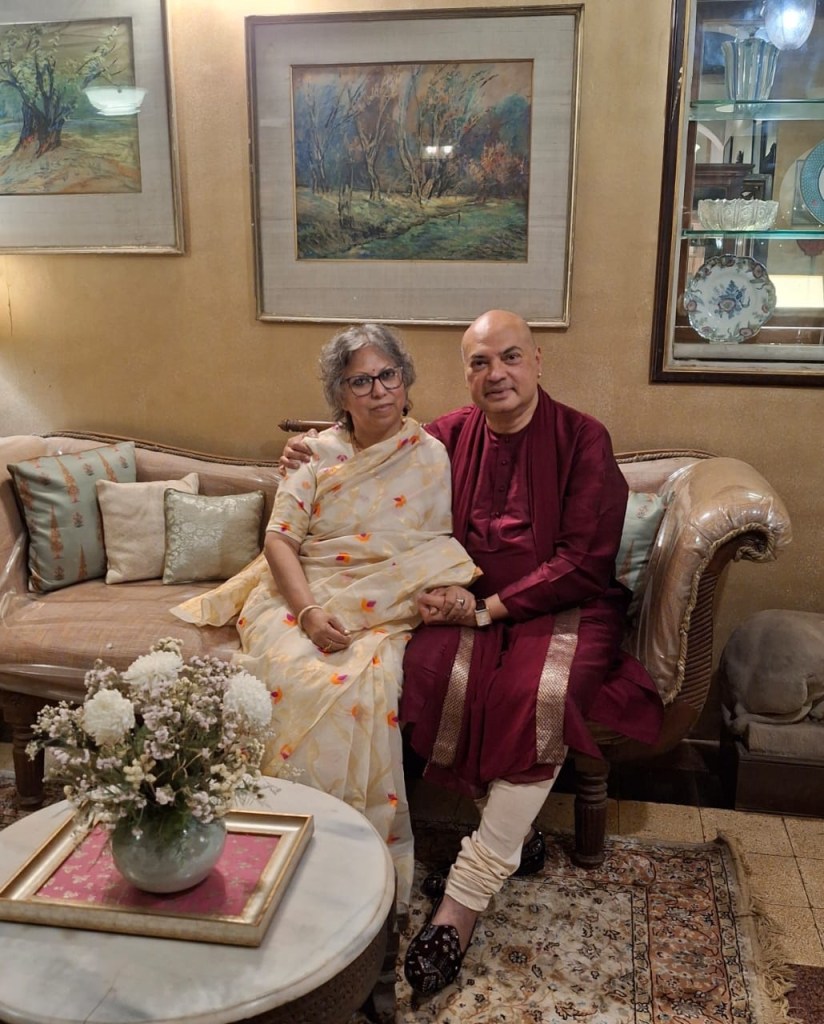
Ratnottama Sengupta and Joy Bimal Roy. Photo Courtesy: Debashish Sengupta

The year1955 is precious in the annals of Indian cinema. That year had seen the release of the Bengali classic, Pather Panchali in August and the Hindi evergreen, Devdas, in December. The opening month of that very year, a certain Mandakini Nursing Home in Bandra, the western suburb of Bombay had seen Manobina, wife of director Bimal Roy, give birth to a son, and Kanaklata, wife of writer Nabendu Ghosh, give birth to a daughter.

“Mita (Friend) Bina was expecting after three daughters and Kanak Boan (sister) was also in labour for the fourth time, after two sons (her first born had gone within months). And we were all praying that Mita should have a son, and Kanak should have a daughter – not the other way around!” This family lore comes from Mary Jethima, wife of music director Arun Mukherjee, first cousin of thespian Ashok Kumar.

So, every time the month of January came around, I would wonder, what if the Roys had a fourth daughter and the Ghosh family a third son? I have wondered but never needed an answer. Because? I have been ever grateful to the powers that be to have Joy as my virtual ‘twin’ born six days apart.

This bonding was forged years before our birth – when Nabendu Ghosh had watched Bimal Roy’s directorial debut, Udayer Pathey[1], in a theatre in Rajsahi, now in Bangladesh; and Bimal Roy had read Nabendu’s allegorical novel, Ajab Nagarer Kahini[2], wanting to film it before Pehla Aadmi [3]became a reality. “Never have I seen a film like this!” Nabendu had echoed what hundreds, thousands, were saying when Udayer Pathey released in 1944. And he had prayed, “If ever I get to work with this director, my dream will be fulfilled!”

Bimal Roy, on his part, had said to him, “Your writings have a graphic visual quality that is so important for cinema.” And when he took up Ashok Kumar’s offer to make Maa for Bombay Talkies, and moved to Bombay in 1951, he invited Nabendu to join him as his screen writer.

That momentous journey has moulded our lives.

*

My earliest memory of the Roys at Godiwala Bungalow on 5 Mount Mary Road is of a toy horse-drawn carriage that had come from some distant land, and a life-size doll – both properties of Joy. I would take turns to ‘drive’ the carriage through the giant hall. And the doll? It opened its eyes and shut them too and even said ‘Maw!’

Outside the bungalow was the garden, a beautiful landscape hemmed in by boulders that created nooks and corners where we children could play hide and seek. But wait, there was a swing and a seesaw too, and I had all the time in the world! There was a spoilsport well at the far end of the garden that I stayed as far away from as I could. “There are ghosts in the well!” – I remember Joy telling me in a hushed tone that was perhaps meant to fool me. But when Joy said something, could I ever doubt it?

The aforementioned giant hall indoors was dominated by an imposing photo of Jethu foregrounded by 11 identical statuettes. These dancing ladies, I later learned, were the coveted Filmfare awards he had won in his illustrious career studded with unforgettables like Do Bigha Zamin[4], Devdas, Madhumati, Sujata, Bandini. As long as he lived and for years after that, Bimal Roy was the sole ‘owner’ of that many ‘Black Ladies’. But, to a girl yet to grow up, more attractive were the Japanese beauties in colourful kimonos adorning another end of the hall. However, what struck even greater awe was a ‘mosaic’ image of Madonna that Joy had crafted while in school — at age 12? It still adorns a part of his world at 6 Mount Mary Road.

Joy had a natural gift for drawing cats: One large O, another horizontal O, a curve that was an inverted C, two bright eyes and perked up ears… How effortlessly he breathed life into the lines! Joy and Bubundi’s house is now overrun by cats but back then only two brown dogs ruled, Toto and Burikin.

*

Joy was the reason I trailed into a shooting floor for the first time in life. We were maybe seven when Benazir[5] was under production at the now-extinct Mohan Studios. As the producer, Bimal Roy need not have stood next to the camera when Meena Kumari, half lying on a mehfil-style chaise lounge, would sit up, sing a single line of a tarana, discant, and the director would say ‘Cut!’ Since the fans would all stop whirring as soon as a voice called ‘Action!’, every ‘Cut!’ was followed by the make-up person trotting up to the diva and retouching her beautiful face. How many ‘Cut!’ did we survive before Joy and I skittered off the floor? No idea. But to this day I remember the deep affection in the eyes of Jethu[6] who became an icon when Joy and I were yet to outgrow the tenth year of our lives.

We were not yet teenagers when Teesri Manzil [7] released in Bandra’s New Talkies which normally screened Hollywood films. Ma and I arrived when Joy, Bubundi and friends were heading for an evening show. I got included naturally. The super hit entertainer had smashing songs in a tautly constructed suspense tale – yet I was not floored. When I said this to Jethima[8], she said, “You are speaking like a critic Uttama!” Unknown to me, that comment had perhaps set me on the course of dissecting a film like an initiated viewer.

After our school finals, Joy took to studying Commerce at Sydenham College, while I marched on with the Arts. So, I joined the Elphinstone College where all the Roy sisters – Rinkidi, Tatudi and Bubundi – had studied English Literature. Bubundi – Aparajita is her bhalo[9] name — was in the final year of BA when I joined the institution. And after she graduated, I inherited all her books and notes. With her benign presence she has been the Didi I never had in the Ghosh house, I realised in the process of preparing the short Aparajita, for her 70th birthday.
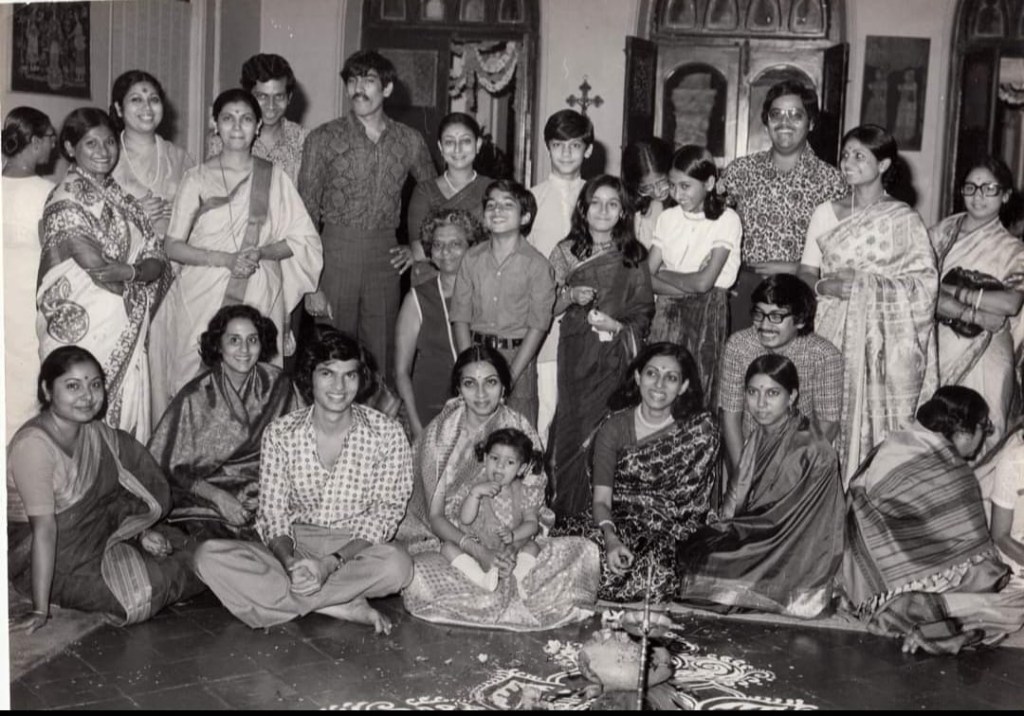
The Ghosh’s and the Roys at a family wedding. Photo provided by Ratnottama Sengupta

And when she got married, just like Joy I missed classes for days and weeks. More so because my elder brother, Dipankar, married Lesley Christine around the same time. Consequently, both Joy and I were least prepared for our MA exams. Together we shared our doubts with Mouni Baba, our spiritual guide who had come from Ujjain. “Do not entertain any doubt or fear,” Baba had drilled into us. “If you utter the word ‘No’ you say that to your inner self, and you will not succeed.” This priceless lesson has been my ‘Kindly Light’, leading me on at every turn of life.

*

* Jethima passed away when the 33rd International Film Festival of India was celebrating seven accounts of Devdas in Indian cinema, in 2002. In the chill of Delhi’s winter, Joy and I sat down in the Siri Fort lawns, clung to each other and howled away, oblivious of the curious stares darting in our direction.

* Joy was in Italy when Baba passed away in December 2007. The biggest bouquet at his funeral had come from Joy.

* Along with Aparajita and Yashodhara – that’s Tatudi’s formal name – Joy had completed Remembering Bimal Roy, a centenary tribute to their father. He had commenced its shooting with Nabendu Kaku, the most authentic and reliable resource person, having been with his father from Maa (1952), through Parineeta ( Wedded, 1953), Biraj Bahu (1954), Naukri (Job, 1953) and Yahudi ( The Jewess, 1957), till the very last Bandini (1964). There was another reason, as Joy himself wrote on Baba’s 90th birthday in March 2007. “He has expressed faith in my abilities even in my darkest moments of self-doubt and always encouraged me to come out of shell and move ahead in life.”

* Year 2008. Bimal Roy’s birth centenary was round the corner. Joy and I met my friend Neelam Kapur. As director, she lost no time in scheduling the tribute in the IFFI [10] at Goa. Serendipity! That very year, IFFI also paid a homage to Nabendu Ghosh who’d passed away the previous year.

The screenings, the press conferences, the purchases, the idling on the beach – more than all of these, I recall the time we spent on a boat that had ladies from Commonwealth of Independent States dancing away to glory. While most of the guests toasted with whiskey or wine, Joy and I sipped on our mineral water. Because? It happened to be a Sunday, the one day in a week we were enjoined by Mouni Baba to forego every food except one salt free vegetarian meal before sunset!

*After Remembering Bimal Roy had been feted internationally and enhanced Joy’s fan following at home, he said to me, “Here’s the entire conversation with Nabendu Kaku. I’ve used only a few minutes of it. I’ll be glad if you can use it.”

I can never thank him enough for this generosity. For, I culled 20 minutes out of the 2-hour conversation, added clippings, posters, stills, book covers, letters, reviews and critical comments to the hour-long documentary And They Made Classics… This centenary tribute traces the unique bonding Nabendu Ghosh shared with his Film Guru.

*

But let me circle back to the birth of a Bundle of Joy and the Best of Jewels in the Roy and Ghosh families respectively.

Days before 21 January 2015 Tatudi called me up. “Joy is turning 60, and how can the celebration be complete if you are not there?” Needless to add, I put on hold my preparation to retire from The Times of India just five days later, and boarded a flight bound for Mumbai. I alighted with just enough time to change into a joyous outfit, for I’ve always revered Tatudi’s good taste and Joy’s flair for dressing just right for any occasion. And was I glad I did so! For, when I reached the venue, I was speechless.
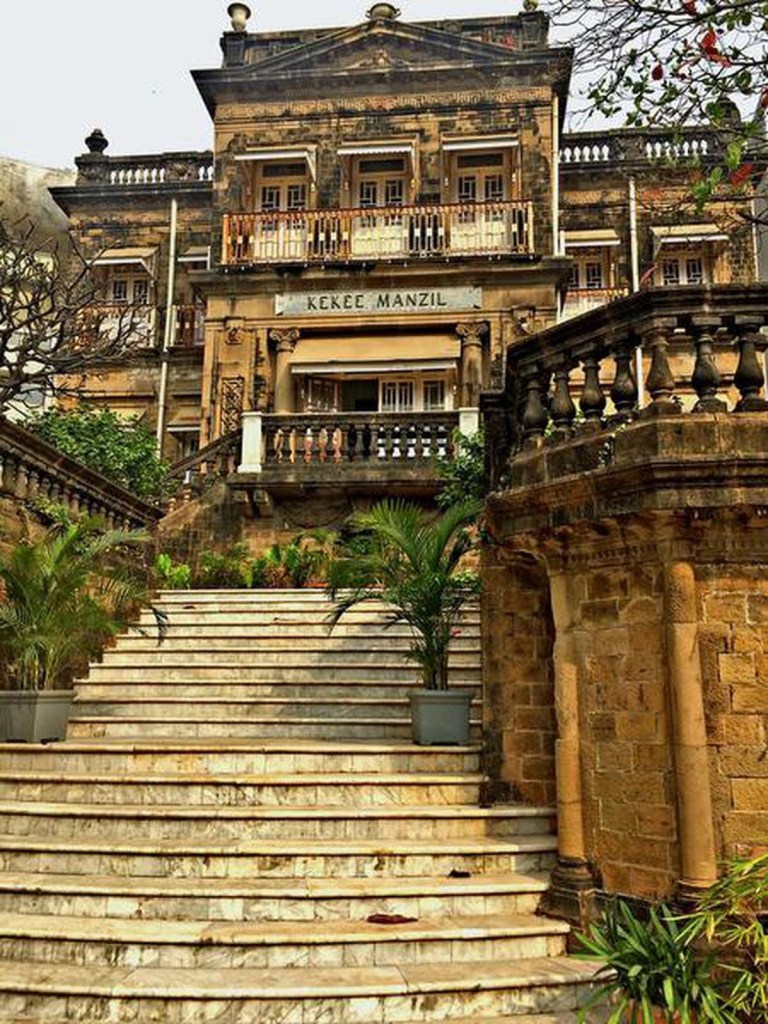

Filmmakers Behroze Gandhy and Dilesh Korya’s documentary,Kekee Manzil – The House of Art offers a glimpse into the interiors of a heritage home, shedding light on its iconic residents Kekoo and Khorshed Gandhy. Kekoo established the only picture-framing company in Asia in the 1940s and later opened the city’s first contemporary art gallery, Gallery Chemould, now known as Chemould Prescott Road, run by his daughter, Shireen Gandhy. The documentary captures how Kekoo and Khorshed displayed compassion during challenging times, stayed true to their secular ideals, and remained engaged civically, while building frameworks within which art could grow in post-colonial India.

What did I admire most? The heritage Kekee Manzil overlooking the Arabian Sea? The gathering of friends and family, including Gen-X of Bimal Roy’s team? The drinks, the amsatta paneer, the grand Birthday Cake? All of this, yes. But most of all, I will cherish for the rest of my life the taste of another cake that Tatudi and Bubundi and Joy had got. Inscribed on it were these words: “Happy Birthday Uttama!”

Some bondings start with our birth, but they live on beyond our life.

[1] On the Path of Light 

[2] Tales of a Curious Land

[3] The First Man(1950)

[4] Two Acres of Land

[5] Peerless, 1964 movie

[6] Uncle, father’s elder brother

[7] Third Floor, 1966

[8] Aunt, wife of Jethu

[9] Good, but when used with name, it conveys the formal name

[10] International Film Festival of India

.

Ratnottama Sengupta, formerly Arts Editor of  The Times of India, teaches mass communication and film appreciation, curates film festivals and art exhibitions, and translates and writes books. She has been a member of CBFC, served on the National Film Awards jury and has herself won a National Award. 

.

PLEASE NOTE: ARTICLES CAN ONLY BE REPRODUCED IN OTHER SITES WITH DUE ACKNOWLEDGEMENT TO BORDERLESS JOURNAL

Click here to access the Borderless anthology, Monalisa No Longer Smiles

Click here to access Monalisa No Longer Smiles on Amazon International
Categories
Nostalgia

A Doctor’s Diary: Life in the High Ranges

By Ravi Shankar

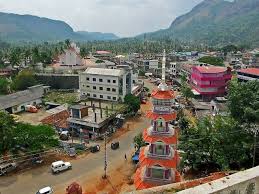
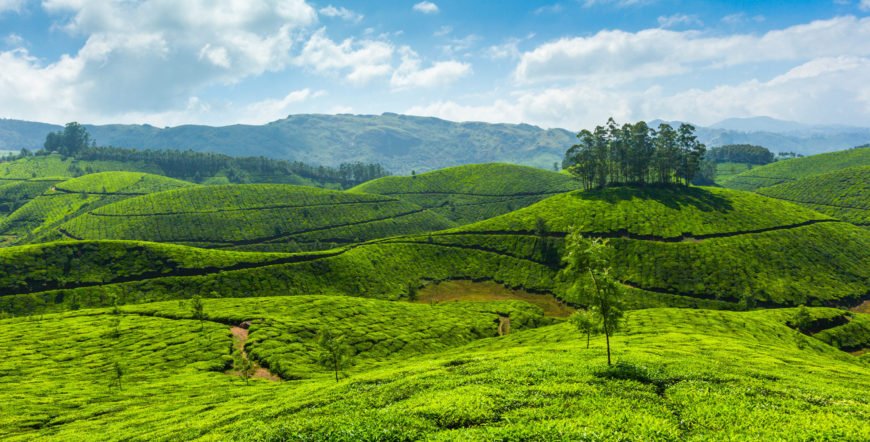
Munnar Hills. From Public Domain

The van suddenly went quiet. Night had fallen and our driver was negotiating the bends and turns in the road carefully. The yellow fog lights cut through the mists lighting up the dense forests on both sides. We were in Idukki district in the western ghats of the southern Indian state of Kerala. This region is called the high ranges. Areas above 600 m in height from the mean sea level in the central Travancore region of Kerala have rich biodiversity and a cooler climate. The weather was beginning to get colder.

We were ill prepared for the cold as we were students from Thrissur in the plains, where it was always hot and sticky. The road continued over the top of a dam. The security officer wanted to talk to us in person before letting us through. We boldly rushed out in our slippers and lungis[1] only to return at double the speed to the warmth of the van. It was freezing outside. The short but intense exposure to the cold may have frozen many vital organs. During winter, the temperatures here can dip to around 4 degrees Celsius once the sun goes down.

We were on a college trip to Idukki while studying for our undergraduate medical (MBBS) course. We had visited Thekkady and Peeramede and planned to spend the night in the hill station of Munnar. The trip was long and tiring as we drove through the mist along winding roads. The night in the hotel was freezing but we managed with the clothes we had, and the blankets provided by the hotel. The steaming tea with cardamom was the highlight of the morning. We hungrily gulped down several cups to chase away the cold.   

I eventually completed my MBBS and got an offer to work at a hospital in the high ranges. The place was Ellakkal at a height of about 1100 to 1200 m. The road diverted from the main highway to Munnar at a place called Pallivasal, the site of one of the earliest hydropower stations in Kerala. The village is also known as the gateway to Munnar. The area had a mix of Malyali and Tamil culture. Many poor families from Travancore had migrated to Idukki in search of land and better prospects. Tamil families had migrated too. The nearest village to Ellakkal was Kunchithanny (little water in Tamil). I had seen a similar system of naming places after water in Nepal. There was Kalopani (black water), Ratopani (red water), Ghorepani (where horses are watered) and Tadapani (far water) among others.

St Xavier’s hospital where I was working was situated up an incline from the main road. The location was spectacular. The hospital was established in the 1960s and was once the only source of medical care for a large region but now several clinics and hospitals had been established in towns and villages. The view across the valley was breathtaking. In the evening the mist slowly moved down the valley eventually reaching the river far below. The thickly forested green hills draped in thick white mist that slowly cleared as the Sun gained in strength was the highlight of my mornings! The hospital was run by the Medical Sisters of St Joseph and owned several acres of land on the hill. They grew coffee and cardamom and other spices. My quarters were a newly constructed annexe to an old house situated halfway up the hill. The view from the veranda was spectacular. I used to spend my afternoons and evenings drinking in the magnificent views and reading my books and magazines. The hospital still exists and provides affordable health care to the people.  

Dr Rodney Sebastian, the other doctor at the hospital had graduated from Kottayam Medical College. He was from the high ranges and a devout Christian. Many evenings there were prayer meetings at the hospital and people from the neighbourhood participated. The convent for the nuns was nearby. There was an old nun who was fond of gardening. Flowers grew well in the rich soil and the cool, moist climate. Multi-coloured roses were the highlight of the garden. There was a priest (Father) who lived on the other side of the hill next to the church. The deep phut-phut of his Enfield Bullet as he rode to the hospital was distinct. This heavy motorbike has a solid presence and is stable to drive on rough roads and undulating terrain. My cousin brother used to also ride one.

In the mid-1990s there was no internet and no mobile phones. The hospital had a landline. We lived more in the moment. Letters were still an important means of communication. My mother used to say that the arrival of a letter was as good as the arrival of a person. I have not posted a letter for a long time now choosing to go with email, voice chat, Skype and WhatsApp. During those days these were, however, all in the future. I never imagined the changes that would happen during the next two decades when I began working at Ellakkal.

We mostly had outpatients though we did admit people. Most of the admissions were for fever. Leptospirosis[2] was common. We also had X-ray facilities, and we sutured many wounds mostly caused by farm injuries. We did not handle surgeries and deliveries. We did not have any intensive care units and our lab investigations were basic.

We used to occasionally drop in to meet a doctor couple, Dr Verghese at Kunchithanny. His clinic was named John’s clinic, and he was called Dr Johnson by the locals. We knew some quacks, that is unqualified self-styled doctors, also practised in this area. The nearest big town was Adimali Adimali had a movie theatre, and a huge rock dominated the town. There were tribal settlements on top of the rock. The tribals were a deprived community. Long distance buses as local transport was something peculiar to the high ranges. The buses started from the town of Ernakulam over a hundred kilometres away and reached the high ranges through Kothamangalam. The buses had glass windows and were comfortable. Ellakkal was on the route to Rajakkad (literally the King’s Forest). There were many places named after rocks (para in Malayalam). Poopara (Flower rock), Santhanpara, Chaturangapara viewpoint were the most prominent.

Munnar was famous for heavy, dense white fogs that were almost opaque. The place was covered by a heavy mist most afternoons and evenings. The mist began a few kilometres from the town. Drinking cups of cardamom flavoured tea in the cold mist was a highlight of my visits to the place. The restaurant also served crisp dosas. We went on a trip to the Eravikulam National Park which took a lot of planning as both of us (Rodney and I) would be away from the hospital for over eight hours. Some of our local friends accompanied us. The route was through rolling Kanan Devan hills and expansive tea gardens.

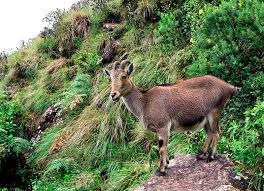
Nilgiri Tahr. From Public Domain

The hills are owned by Tata Tea, and they grow the famous Kanan Devan brand of tea. I used to remember their advertisements starring the megastar, Mohan Lal. The park is famous for the Nilgiri Tahr. I remember it also for the leeches. We were badly set upon by them and the bites bled for over twelve hours. Once I also took a bus ride with my cousin to Maraiyur near the Tamil Nadu border. The route was through spawling tea estates. Maraiyur was an end of the Road Town those days. The place was famous for sandalwood. The security checks were strict to ensure people did not decamp with a few thousands of rupees worth of sandalwood in their pockets.

I visited Ellakkal once more after I left toward the end of the last century. The ensuing three decades must have brought about a lot of change to this spice garden. Tourism has boomed and Idukki district is a prime tourist destination. Internet has made steady advances and cable TV is now common. Several resorts have opened, and the roads have improved. They have opened a hospital called Morningstar. The pace of life has quickened with all the city folks coming to escape from their hectic city lives. Someone once said about Munnar and I quote, “In Munnar, time slows down, allowing us to savour every moment, appreciate the present, and find joy in

[1] A sarong is called a lungi in South Asia

[2] A blood infection caused by contaminated water and soil

.

Dr. P Ravi Shankar is a faculty member at the IMU Centre for Education (ICE), International Medical University, Kuala Lumpur, Malaysia. He enjoys traveling and is a creative writer and photographer.

.

PLEASE NOTE: ARTICLES CAN ONLY BE REPRODUCED IN OTHER SITES WITH DUE ACKNOWLEDGEMENT TO BORDERLESS JOURNAL

Click here to access the Borderless anthology, Monalisa No Longer Smiles

Click here to access Monalisa No Longer Smiles on Kindle Amazon International

Categories
Nostalgia

Glimpses of an Indian Summer

By Madhuri Bhattacharya

Summer is a reality check that strengthens our resolve to survive each day, after a vacation. It is a sizzling 47 degrees Celsius outside. Even a simple task is a battle that needs to be won. My short morning walk almost finishes me, though I go in the very early hours. It becomes difficult to take it, making me sweat as in the gym. Even an urgent car drive can roast you. Going to the nearest market becomes an odyssey. The best thing about summer is that you can blame everything on it.

As I look back, from April through June, North India would descend into hell. As the mercury rose above 40C, the air turned progressively drier. Homes were cooled with curtains of the fragrant “khus”. This dried herb needed to be watered and the dry wind blows fragrance and moisture into the house. It was surprisingly effective. In school, students routinely suffered nosebleeds and fainted from the heat during morning assembly which  held in the school grounds. Now we have air conditioners in some places.

There were sandstorms accompanying the heat wave from deserts around Delhi. People would shut their doors and windows but the dust would still find its way in. In this lower ring of Hades, students would battle their final exams. Summer always brought the sense of an ending.

What also ended, was the supply of good vegetables. Bhindi (okra), eggplant, gourds, sundry root vegetables were all that could be found in the shops. Everything else died from the heat. But there were cucumbers — long, slender, foot long cucumbers with very fine skin. These were referred to, poetically, as “Laila ki ungliyan; Majnu ki pasliyan[1]”. And there was Rooh Afza: A lurid pink “sherbet” which came in a glass bottle and was made with Unani herbs to counter the heat. Jugs of this were served with ice and slices of lime. There were “cooling” foods with coriander, limes and raw white onions. Icy cold lassi with mint and roasted cumin were invariably present at every meal.

What would summer be without mangoes? We didn’t get the King of mangoes, Alphonso, always but there was the Dusshehri and Langda and so many varieties.   Mangoes in every way and in every variety– juice, pulp, fresh, fried, pickled, jams — sweet savoury.

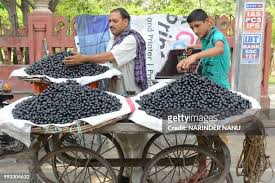
Men selling Jamun fruit. From Public Domain

Occasionally, on the way out of town as kids, we would buy sugary honeydews and watermelons on the dusty road of Rajasthan. A tall glass of nimbu pani[2], watermelon juice, buttermilk were very welcome.  Or relief of a cool shower at the conclusion of a punishing day. The soothing balm of an evening breeze. Sometimes, we bought deep purple Jamuns from handcarts. These stained our faces and dresses with its colour. The dresses would be thin cottons or muslin which turned into butter with repeated washes.

The summer was as cruel as it was generous. It sang a melodious tune — the cuckoo’s cry woke us up every morning.

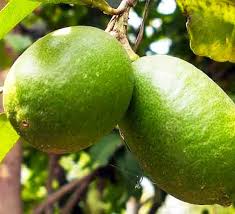
The Gondhoraj Lebu or lemon. From Public Domain

Many years ago, I had discovered in Bengal this marvellously rich, soothing, fresh scent which has become synonymous with the fragrance of summer for me. The scent  lingered and I knew the sapling was coming home with me. The great gondhoraj lebu, lime, lemon — call it as you will — but it is the king (raj)of taste and fragrance (gondho). It has a distinctive flavour and aroma akin to its South East Asian, lumpy bumpy cousin the kaffir lime. Lime to lemon in size and really used more for its zest rather than the pitiful amount of juice, although its still worth the trouble, trying to squeeze every last drop of it out into your meal or drink.

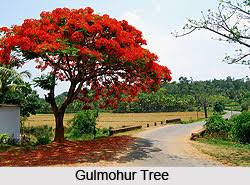
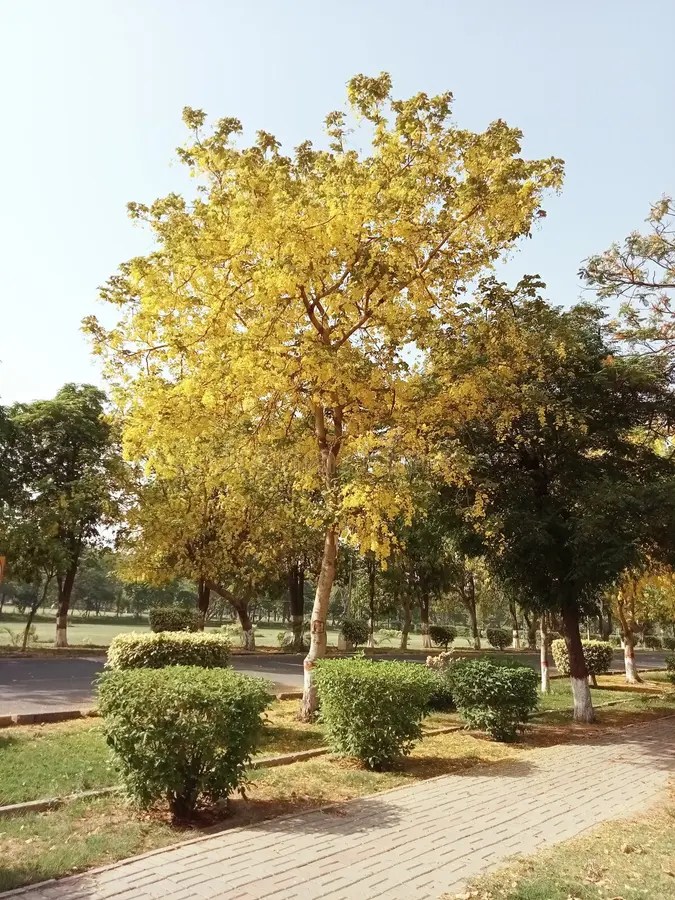
The streets stayed deserted all afternoon in the summer. There wouldn’t be a crow in sight. Though they stayed ablaze with the skies  with flames of gulmohar and the gold of amaltas. The curtains would be drawn, the cooler, would be on. We would listen to music or watch television.

And the saga of summer continues. At night, we are greeted with intoxicating perfumes of nature. Though the garden completely shrivels, jasmines and tuberoses bloom in the tender moonlight. Madhukamini wafts like a hundred blessings around my senses. It seems all pervasive, and the light breeze seems to control its intensity in the night…

Madhukamini Blooms. From Public Domain

[1] the fingers of Laila, the ribs of Majnu: From the legendary love story of Laila Majnu

[2] Lemon water

 Madhuri Bhattacharya is a closet writer and art enthusiast. She is interested in creative writing, translations and travel.

.

PLEASE NOTE: ARTICLES CAN ONLY BE REPRODUCED IN OTHER SITES WITH DUE ACKNOWLEDGEMENT TO BORDERLESS JOURNAL. 

Click here to access the Borderless anthology, Monalisa No Longer Smiles

Click here to access Monalisa No Longer Smiles on Kindle Amazon International
Categories
Nostalgia

A Musical Soiree

By Snigdha Agrawal

This was an annual event organised at home, on Tagore’s birthday.  Preparations started a week before ‘Pochishe Boishakh’)[1].

Musical instruments were dusted and tuned, particularly the most used harmonium and tablas. The living room was rearranged.  Chairs were pushed against the walls.  Centre and side tables were removed, creating space for floor seating.  Durries were laid over the carpet.  All the pash balish — bolsters — in the house with freshly laundered covers, placed haphazardly for those wanting to recline.  A space earmarked for the performers, usually against the room’s longest wall.  On this wall hung a fairly large black and white framed photo of Tagore, garlanded with freshly picked jasmine flowers. Not the fully bloomed one.  White buds with short green stems.  We girls were given the responsibility of making smaller wristbands from the jasmine buds, presented to the visitors.  Stalks of rajanigandha (tuberoses) stood erect in tall vases placed on either side of the photo. 

The overpowering smell of jasmine and tuberoses drowned other smells floating in from the kitchen.  A hands-full kitchen as no jalsa[2] is complete without serving the guests chai and piping hot assortment of pakoras — onions, potatoes, brinjal, pumpkin flowers, battered fried crispy brown. Poppy seed-sprinkled vegetable chops, cylindrically shaped, were polished off as fast as they were made and served.  The service continued till the guests left, mouths sweetened with the dessert — usually rossogollas, delivered by the sweet-meat dhoti-clad guy, arriving on foot, carrying gigantic-sized aluminium dekchis[3]balanced on two ends of a pole, hoisted on his shoulder.

It was an open house event for those interested and wanting to join.  There were the regulars and walk-ins as well. Performers and audience.  A manageable crowd most years. Rarely spilling out into the adjacent veranda.  Cane chairs were lined up to accommodate the latecomers.  Ma, a gifted and trained singer had the honour of opening the ceremony with the songHey Nutan, Dekha dik aar-baar janmero prothamo shubhokhan…”[4].  On popular demand, she went on to sing a couple of Tagore’s songs not omitting the song dedicated to Boishakh esho hey boishak, esho…esho. Taposniswasbaye mumushure dao uraye, botsorer aborjona dur hoye jak…”.  [5]A song that has been on our minds, with the current heat wave raging throughout the country.

As the evening progressed there were recitations from Tagore’s poetry collection.  A young couple, Soumenda and Rinadi, our neighbours, had the gathering spellbound with their singing and poetry recitation.  Close neighbourhood friends of ‘Puluda’, the affectionate nickname of the famed actor, the Late Soumitra Chatterjee, the talented couple were in demand at many such musical soirees held on Vijaya Doushami[6] in community clubs.  And through them, we met the greatest Bengali screen actor of all time, on many occasions, when he visited after the day’s outdoor shooting in the picturesque surrounding in Maithon and Panchayat, way back in the 1960s. 

With our leaving the gated community complex in 1968, ended the annual Rabindra Jayanti home celebrations. A not-forgotten era.  Rabindranath Tagore lives on. These days, I listen to Rabindrasangeet on YouTube, remembering the days of youth, Ma’s full-throated voice, and Somenda, and Rinadi regaling us with their practised/professional voices. Pakoras are replaced now with sushi.  God rest their souls. 

.

[1] The 25th day of the Bengali month of Boishakh, recorded as the official date of birth of the Rabindranath Tagore in 1861. As per the Gregorian calendar, the date falls between the 7th or 8th of May.

[2] Musical soiree

[3] broad-rimmed cooking utensil with a flat round bottom

[4] Oh ever new!/ Let my eyes behold once more/ the first blessed moment of birth.- Translation by Aruna Chakravarty, Borderless Journal

[5] Hail O boisakh! Welcome./ Blow away deadly diseases with your ascetic breath./May the debris from the old year disappear. – Translation from Borderless Journal

[6] Last day of Durga Puja

Snigdha Agrawal (nee Banerjee) has published four books and is a regular contributor to anthologies.  A septuagenarian, she writes in all genres of poetry, prose, short stories and travelogues.

PLEASE NOTE: ARTICLES CAN ONLY BE REPRODUCED IN OTHER SITES WITH DUE ACKNOWLEDGEMENT TO BORDERLESS JOURNAL

Click here to access the Borderless anthology, Monalisa No Longer Smiles

Click here to access Monalisa No Longer Smiles on Kindle Amazon International
Categories
Nostalgia

Remembering Jayanta Mahapatra

By K.V. Raghupathi

Jayanta Mahapatra (1928-2023), (Public Domain)

I’ll begin this brief essay by reflecting on my time in university. There was no paper on Indian writing in English when I was a student at Sri Venkateswara University in Tirupati studying for my master’s degree in English literature between 1977 and 1979. Many English departments were adamant about sticking with a colonial attitude and emphasizing teaching British literature. The teachers (professors), many of whom had returned from abroad, primarily from the UK with highly sought-after PhDs, propagated this notion and fervently supported British literature. They maintained the same colonial perspective and made English departments more English-centric (British) than what is apparent today with more democratisation in the curriculum. Many of these teachers with UK training had a prejudicial perspective on Indian writing in English.

Because it was still in its infancy, these professors with UK training did not support it. The literature that had blossomed in the UK was widely believed to represent what was meant by English literature at the time. They didn’t think much of other English literature works. Within this hostile setting, Professors MK Naik, CD Narasimaiah, and KR Srinivasa Iyengar worked arduously to develop Indian Writing in English (IWE) as a subject and make it an integral part of English departments at all universities. They fervently argued for the cause of Indian writing in English through their writing and publication of several articles and speeches. K.R. Srinivasa Iyengar’s seminal work Indian Writing in English (1984) and M.K. Naik’s Dimensions of Indian English Literature (1984), Indian English Literature: 1980-2000: A Critical Survey (1982), and Studies in Indian English Literature (1987) have strengthened the case for writings in English in India. They were all successful in having IWE included in the study of English literature. Many English departments in the universities didn’t start providing IWE as a course or even as a component of the curriculum until the 1980s. The new group of professors, which included the aforementioned three professors along with Professor P. Lal, who supported IWE, had replaced many earlier professors who had a limited perspective on it. It eventually evolved into an autonomous course over time.

In this light, I’d want to think back on a comparable experience I had in 2011, when I joined the Central University of Tamil Nadu in Thiruvarur as a regular faculty. At that time, a paper on IWE was not offered as part of the MA in English Literature. I had a terrible experience when I asked how the students could graduate from the university with a degree without having studied IWE. I claimed that such a degree lacked credence. In one of the Board of Studies meetings, I passionately argued in favour of it and won approval. The result was that it was transformed into an independent course, integrating with the core curriculum. I taught this subject, which included poems by Jayanta, until my departure from the institution in 2019.

Lal did a fantastic job advancing Indian writing in English. In Kolkata, he founded a publishing house called Writers Workshop, where he encouraged a number of new budding poets to write their works in English and submit them for publication. In his book History of Indian English Literature, M.K. Naik notes that only P. Lal published the first books of contemporary Indian poets who achieved success in Indian and international English poetry. It was true. All of the poets that Lal published under the Writers Workshop imprint became well-known figures around the globe. It was thought that any poet who was published by the Writers Workshop would become well-known in their field. Of them was Jayanta.

As a Post-graduate student, I read and studied only three Indian English poets—Nissim Ezekiel, A.K. Ramanujan, and Kamala Das as well as two novelists, R.K. Narayan, and Mulkraj Ananad. These were all part of the Commonwealth Literature (now New Literatures) paper, which covered the full range of post-colonial texts. This was my first introduction to Indian writers who wrote in English. For reasons best known to the group responsible for formulating the syllabus, Jayanta Mahapatra was excluded from the curriculum. I had no knowledge of Jayanta and had never read any of his poetry. I didn’t read two of his widely anthologized poems, “Indian Summer” and “Hunger,” which are recognized as classics in contemporary Indian English literature, until after I had finished my post-graduation. This served as my initial exposure to Jayanta’s poems.

I was fascinated by his writing after reading these two poems, especially because of the two components of imagery and elegant diction. I looked through other collections of his poems. By chance, I discovered a venerable anthology called Ten Twentieth Century Indian Poets, which was chosen and edited by R. Parthasarathy and published by OUP. At the time, this was the sole anthology on the market, and all universities required students to consult it when discussing Indian poets who wrote in English though other anthologies followed later such as, Indian Poetry in English (1993), edited by Makarand Paranjape, The Oxford Anthology of Modern Indian Poetry (1994) edited by Vinay Dharwadker and A.K. Ramanujan, and Twenty-five Indian Poets in English (1995), edited by K.S. Ramamurti. The poets who were included in the anthology were acknowledged as having achieved popularity and recognition on a global scale. It was a canon-like text for reference. It contained “A Missing Person”, “The Whorehouse in a Calcutta Street”, and “Indian Summer” from Mahapatra’s collection, A Rain of Rites, and “The Logic”, “Grass”, and “Lost” from other anthologies. I eventually had to look for his poetry collections after this reading. Luckily, my hands fell upon his two collections: Svayamvara and Other Poems (1971), Calcutta: Writers Workshop and Relationship (1980), New York: Greenfield Review Press. I read them avidly.

At that point in time, I read Jayanta purely for enjoyment. I wasn’t really taking his poetry very seriously. I never tried to review any of his poetry books or to write an article about his poetry. Despite this, I still thought highly of him, but I never had the chance to visit Cuttack and meet him in person since I was too busy attending to my academic obligations and immersed in my career. The most wonderful news was that I had been chosen for the 2014 Rock Pebbles National Award for Creativity, instituted by the Rock Pebbles Trust, which would be presented to me in Bhubaneswar by the legendary poet Jayanta Mahapatra. I realised that my dream was actually coming true.

He was already 85 in 2014. I arrived at the location considerably earlier in order to see this poet in his physical appearance. I had heard of him and read about him in books up to that point. Now I could actually communicate with him and see him in person. I was watching him approach from where I was standing by the venue’s entrance. He arrived at the location at precisely half past ten, joined by a couple of event organisers. Despite his aged appearance, he was nimble and exuded the assurance that, due to his asthma, he would live for a few more years despite whatever happened. I did not hear any gasps as he was moving. He was hospitalised, but he managed to survive the coronavirus. The ten years that passed between then and August 27, 2023 were a tremendous adventure in his life as a writer in general and as a poet in particular. He was engaged throughout the proceedings and talked for fifteen minutes, albeit a little erratically. Even so, I could understand what he was saying. A poet with a scientific background could sound like an English professor. He had a thorough understanding of Indian poetry, and he spoke with authenticity and assurance. He was distinct from the other poets since he was not a poet from the Bombay school. Over time, he was able to distinguish himself from his peers by developing a serene, peaceful poetic voice of his own.

He acted in this manner, and I was so moved by him that I asked for his blessings at the conclusion. He generously bestowed his blessings upon me, and I was so overjoyed that I continue to treasure them for the rest of my life. I always mentioned his name whenever the topic of Indian poetry in English came up in conversation and discussion. Even though he was a poet par excellence and the recipient of numerous national and international honours, he was such a modest being that he never showed any arrogance or pride. I observed this humility in him, and I had the impression that he could communicate it not just with words but also with his actions. He was so worn out at the end of the event from travelling from his home in Cuttack to Bhubaneswar. Despite my intention, I did not continue talking to him after realising the circumstances. I recognised him, and I felt so happy that I received the award and the honour from his hands. This was sufficient for me, I reasoned. I could learn the rest by reading his poetry! I must express my sincere gratitude to Dr. Udayanath Majhi, editor of the journal, for including me in the celebration and giving me the chance to meet the great poet by conferring me with the Rock Pebbles award and honour, a wish that had been gnawing at the back of my mind for a very long time and was finally realised.

IN MEMORIAM
(A Tribute to Jayanta Mahapatra)

With the muse
who had been
with you over sixty years,
you abruptly 
walked away surreptitiously
leaving the memory behind.
 
You have permanently
migrated to a distant land,
reconciling; 
moved to another world…
leaving behind 
your distinct footprints 
unerasable in your poetry, forever.

Though you were not of the Bombay School
you carved a niche 
distinguishing yourself from your peers 
by creating a serene, meditative lyrical voice
in the world of poetry
‘after a mountain of rejection slips’.

You might be
not present in the form
yet,
I feel 
your poetry
cracks and cackles with vibrant vivid imagery;
a torchbearer for the aspiring…

You have departed for 
Heavenly abode
but somehow as a poet
is always a poet forever
you proved, otherwise
glistening in the firmament 
as an early-morning and evening star
silencing grumbling dark clouds;
and, you still peep out
of a poem 
in the book
of my living room
to ensure
that everything is fine
with Indian poetry in English
in your absence, eternally.

K.V. Raghupathi, A former academic, poet, short story writer, novelist, critic, and book reviewer, has so far published thirteen collections of poetry, two short story collections, and two novels, and edited eight critical works and is widely published and anthologised both in online and print journals. He currently lives in Tirupati. He can be reached at drkvraghupathi9@gmail.com 

PLEASE NOTE: ARTICLES CAN ONLY BE REPRODUCED IN OTHER SITES WITH DUE ACKNOWLEDGEMENT TO BORDERLESS JOURNAL

Click here to access the Borderless anthology, Monalisa No Longer Smiles

Click here to access Monalisa No Longer Smiles on Kindle Amazon International

Categories
Nostalgia

My Hostel Days

By Ravi Shankar

The air was getting colder. There was an early morning chill. I wrapped my cotton blanket more tightly around me. January is one of the colder months of the year in Thrissur, Kerala, India. During winter and summer, I had taken to sleeping on the terrace of the men’s hostel. More peaceful and soothing. You can watch the twinkling stars and the clouds. A few other kindred souls did the same. Though it did rain on occasions and then we had to beat a hasty retreat with our bed rolls. The terrace also attracted students who studied using their table lamps till the small hours of the morning.

I stayed at the same hostel room throughout my undergraduate medical (MBBS) course and the first month of my internship. I still remember my entry into the men’s hostel. I had a big suitcase, a bedding roll, a table lamp, a plastic bucket, a mug, and a few daily necessities. We were allotted the first floor of the C Block called the C’ block. We were the sixth batch of the institution and the last one to enjoy the privilege of being allotted rooms together in a single block. Of the twelve rooms in C’ all except three were allotted to our batch.

Ragging was still going strong though strong anti-ragging efforts were also ongoing. We had security guards posted at the entrance to our block and our seniors screaming abuse at us. Gradually after the first few weeks, things quietened down. Reminiscing about those days, I am struck by the simplicity of our lives. Each room had two windows, a ceiling fan, three wooden tables with three wooden chairs, three wooden cots, three metallic cloth hangers, and concrete wall shelves. There was also a ventilator opening into the corridor. Each room was shared by three students. The older medical college hostels had high roofs and did not always have a ceiling fan.

The men’s hostel was located at the edge of the vast campus of the Medical College, Thrissur. There were three blocks (A, B and C) with each block spread over two floors. There was a big portico in front with a phone room and a phone boy. There were bigger rooms (with attached baths) for the tutors and a TV room on the first floor. We had an improvised gym on the ground floor. A room for indoor games was on the first floor next to the TV room and the hostel mess was on the ground floor. In those days there were no cell phones and subscriber trunk dialling (STD) was not yet available. Trunk calls had to be booked manually. The newspaper and magazines room were right at the hostel entrance.  

The mess was a simple affair with eight wooden tables and wooden stools and chairs. The chairs had to be strong enough to withstand frequent abuse from the students. There was a serving window, and the main kitchen was inside. Mornings were busy as the clinical students had to board the college buses to reach the hospitals in the town. We had a varied menu for breakfast. This could be masala dosa (a flat bread of rice and lentil flours stuffed with vegetables) puttu (steamed cylinders of ground rice, layered with coconut shavings and fillings), idli (a savoury rice cake), upma (a thick porridge made from rice flour or semolina), noolputtu (called string hoppers in Sri Lanka), bread with jam and butter and something that we called the fractional test meal (FTM). FTM consisted of a glass of warm milk, two boiled plantains and two hard boiled eggs. Quite nutritious and filling. Lunch was usually a hurried affair except on Sundays. Afternoon tea or coffee was one of my favourite repasts. Kerala has a rich and varied selection ranging from different types of vadas (savoury fried snacks), adas (fresh coconut and jaggery wrapped in a dough made of rice) steamed in banana leaf, cutlets, pazhampori (fried banana fritters) and something we called the grenade. The grenade was shaped like one, was mildly sweet and required some effort eating. Neither the mess tea nor coffee were remarkable.   

Hostel mess. Photo courtesy: Ravi Shankar

The quality of dinner varied greatly. On the menu could be chappati (unleavened flat bread), Kerala parotta (layered bread), biryani, plain rice among others. People from the central parts of the state were fond of kanji (a rice gruel). Each month we selected three mess secretaries to oversee the mess. Later we started having a dinner feast toward the end of the month with a grand menu. I still fondly remember the biryani and the lime juice. Lime juice is a specialty of the area with a beautiful blend of sourness and sweetness. We had the Indian Coffee House (ICH) run the college canteen off and on. They closed and reopened a number of times. The crowd we had was not enough for their operation? They served masala dosas with a stuffing of beetroot and potatoes, cutlets, and strong rich coffee. Economics restricted this outing to may be once a week. I survived on a monthly money order from my family.

We also had a local tea shop run by an old people a five-minute walk from the hostel. We used to drop in there during the evening for tea, coffee, and snacks. They also occasionally served lunch. The lunch was served on banana leaves and consisted of papadam, injipulli (dark brown sweet-sour and spicy curry made of ginger, tamarind, green chillies and jaggery), vegetables, sambar (a lentil-based vegetable stew), rasam (a spicy South Indian soup-like dish) and fish curry and fish fry as an extra. The fish was mackerel coated in a spicy rich coconut coating and deep fried in coconut oil. During the early days the mess had frequent financial difficulties resulting in closure and we had to hunt for food outside. Luckily there were a few local tea shops around the campus though this often required a long walk. This was challenging especially at night. Eventually the situation stabilized, and closures, luckily became rare. We also had water problems before we were connected to the main water supply. We were dependent on a small pond, which used to dry up during the summer. The mess had a huge water storage container placed near the wash basins in case the taps run dry.    

The medical college campus was the old TB sanatorium. The sanatorium was established several decades ago far away from human habitations. The campus was vast, and the soil rocky. There were a lot of cashew trees on the sprawling campus. Soon campus roads were constructed, and we could walk move about more easily amidst nature. The basketball and the badminton courts were closed to the hostel and were packed during the evenings. Summers were hot though the temperature was usually below 40 Celsius. Now summer temperatures are routinely over 40 degrees throughout much of Kerala. The state is facing the full brunt of global warming.

We organised a hostel day only once during the time I was at the college. That was a grand affair with music and dancing and several courses of food. The ground in front of the hostel was converted into a fairyland with twinkling lights and decorations. We had a system of ‘late mess’ where dinner was stored for us till 10 pm. We often used this service when we went to watch movies in Thrissur town. The bus fare then was below two rupees and now it is around twenty rupees.

We used to enjoy long walks in the sprawling campus and through the by lanes of surrounding villages. Life was very stressful with assignments, submissions, and frequent examinations. We had to find creative means to relax and recharge. I still remember my last week at the hostel. I was doing my posting in the hospital at Thrissur town and decided to shift to a lodge at the town outskirts. I had accumulated several medical textbooks during my study years, and these were heavy and had to be transported safely. Carrying these around required brute physical effort. You had to be physically strong to be a doctor. I developed close links with my room mates and my floor mates during my stay at the Men’s Hostel (MH). These are nurtured and maintained through our batch WhatsApp group. At my alma mater each batch is named after a famous personality in medicine. As I read more about Osler and his stellar contributions to medicine I felt justly proud that our batch carry his illustrious name. MH, Medical College, Trichur you have left an indelible mark on me and my fellow hostelers. MH tujhe salam[1]!    

[1] Salute to you.

Dr. P Ravi Shankar is a faculty member at the IMU Centre for Education (ICE), International Medical University, Kuala Lumpur, Malaysia. He enjoys traveling and is a creative writer and photographer.

.

PLEASE NOTE: ARTICLES CAN ONLY BE REPRODUCED IN OTHER SITES WITH DUE ACKNOWLEDGEMENT TO BORDERLESS JOURNAL

Click here to access the Borderless anthology, Monalisa No Longer Smiles

Click here to access Monalisa No Longer Smiles on Kindle Amazon International

Categories
Nostalgia

The Roy Senguptas

Ratnottama Sengupta continues her narrative about her family’s journey from the past to the present

Bengal Volunteers with young Netaji Subhash Chandra Bose, where young Kshiti Prasanna Sengupta volunteered. Photo sourced by Ratnottama Sengupta

Upendra Mohan Roy opened the telegram and stood still. He was on his way to London, to study at the Royal College of Art. But could he leave knowing that his mother was on her deathbed? No question. He turned around and returned from Bombay to Cachar in Assam, then East Bengal. Only to see that his mother, hale and hearty, had fixed his marriage! 

Angry and dejected, he stormed out of home and headed for the tea gardens where his father worked. Soon he set up a ‘business’ there. He would go from one tea estate to another with a hand operated projector and a generator in an ‘Army reject’ jeep and show silent films on  a makeshift screen in these remote pockets of India. That was the beginning of his life as an exhibitor which culminated in his setting up a cinema hall, Annapurna, in Silchar after the movies started speaking… This was one of the many businesses he eventually set up, in Tinsukia, Dibrugarh and Margarita. The prime of his ventures was in manufacturing — armatures and generators — and it led to setting up Surama Electrical Store in Silchar.

Labanya, the young lady his mother had chosen to be his wife, was a homemaker. As per the custom of the times, she channelised her spare hours in stitching clothes for the children, in knitting and embroidering. But far more importantly, she excelled at cooking. Not only the homely ‘Bangal’ cuisine of labda[1] and maricher jhol[2] but also pulau and chop, cutlets and kebabs – the latter pretty fancy, and even forbidden dishes in most Bengali kitchens of her times. That is probably how Minoo/ Aparna, the youngest born after the daughters Amiya Bala, Renu Bala, Smriti Kana and son Birendra Mohan, developed her culinary skills. But more of that later…

*

Upen Roy’s enterprise was probably not unique: the Baidyas of Bengal are known for their business acumen. But Satish Chandra Sengupta of Gaopara village in Dhaka Bikrampur district was the copy book Baidya: He was a country doctor who carried on the family trade of administering ayurvedic medicine to the ailing villagers. His son Kshiti Prasanna was just four and Rama, the baby daughter, was barely born when his first wife died. So the two siblings were sent to the care of his eldest brother Ambika Prasanna, a hugely successful lawyer practising in Midnapore.

This is where Kshiti grew up, going to school and tending to the needs of the large extended joint family that made up the household. The members included not only Ambika Prasanna’s sons Guru Prasanna, Satya Prasanna, Jyoti Prasanna and daughter Shanti — there were also those of his other brothers. Among them was Kusum Rani, who was married to Jyotish Chandra Gupta, whose brother Dinesh Gupta had to seek home with them when he had to flee Dhaka after he participated in an action against the British authorities. 

This is how Kshiti came to join Bengal Volunteers, the revolutionary group that took action — with the blessings of Netaji Subhas Chandra Bose — against three successive British District Magistrates: ICS James Peddy in 1931, ICS Robert Douglas 1932, and ICS Bernard Burge in 1933. Consequently, a few day after his Matriculation exams, Kshiti was arrested and forced to live in incarceration for 13 years 8 months — going from Hijlee to Buxar to Alipore Central Jail and more. But he put the years to gainful use and completed his IA, BA, MA and M.Com exams creditably. That is why, when he was set free as India prepared for its immanent independence from the British yoke, he could join Ashutosh College as a Professor of Economics.

*

Kshiti Prasanna with his wife, Aparna

By then Kshiti Prasanna was 31 years old, which was considered pretty old to marry in 1948. But he was adamant: he would not marry anyone younger to him by more than 10 years. So the matchmaker advised Upen Roy to present his darling daughter Aparna as 21 years of age,  when in reality she was only 18! Thankfully the subterfuge did not come in  the way of their happiness together. Nor did the fact that Kshiti took responsibility of getting his step sisters — Bharati, Putul, Madhabi and Golapi — married and support his successive brothers Shankar, Bhaskar, Runu, Haru, Naru — until they settled in jobs. For, the only thing Aparna made her husband promise was that he should get the best of education for their son Debasis and best of life for Bubun, their darling daughter Madhumanti…

This was after his heart too, for if there was anything Kshiti Prasanna regretted in life, it was that he himself could not go for a Ph D as guides were not allowed inside jails. So he ensured his son got the best of schooling at St Xavier’s School; the best of higher education at IIT Kharagpur, and then proceeded for his doctorate to Texas, at the A&M University, USA. “My nameplate reads ‘Adhyapak Kshiti Prasanna Sengupta,’ yours will read ‘Dr Debasis Sengupta,'” he dreamt. 

The father’s dream came true in 1977 when his Bappa completed his Doctor of Engineering in Biotechnology. Only,  KPS saw his convocation from the Heavens…

From that perch, he also saw his daughter – a consummate Odissi dancer – complete her graduation in Economics, take to the then new subject of Computer Science, finish a course in Law, peak in a corporate career, then retire to write the story of his stormy years with the Bengal Volunteers…

Aparna with Debasis

[1] A vegetables

[2] Fish curry

Ratnottama Sengupta, formerly Arts Editor of The Times of India, teaches mass communication and film appreciation, curates film festivals and art exhibitions, and translates and write books. She has been a member of CBFC, served on the National Film Awards jury and has herself won a National Award. 

.

PLEASE NOTE: ARTICLES CAN ONLY BE REPRODUCED IN OTHER SITES WITH DUE ACKNOWLEDGEMENT TO BORDERLESS JOURNAL

Click here to access the Borderless anthology, Monalisa No Longer Smiles

Categories
Nostalgia

Ghosh & Company


Ratnottama Sengupta travels down the path of nostalgia with her ancestors, her parents, eminent writer,  Nabendu Ghosh and his wife, Kanaklata

Nabendu with his children. From right to left: Ratnottama Sengupta, Nabendu Ghosh & Shubhankar Ghosh. Photo provided by Ratnottama Sengupta

Nabadwip Chandra Ghosh of Dhaka was an advocate who had mastered in both, Sanskrit and History. And he was a kirtan[1] singer par excellence. Both these traits have familial roots: His father was a court clerk, his cousin a doctor of those times. And all the males in the Vaishnav family — devotees of Prabhu Jagadbandhu Sundar of Faridpur — were good singers, a talent that was to continue with his sons and grandsons. 

It was for his kirtans in particular that P R Das, brother of freedom fighter Chittaranjan Das (1870-1925), asked Nabadwip Chandra to join him as his junior in Patna High Court. The year was 1920. Bihar which was a part of the Bengal Presidency, was steeped in casteism. The Ahirs — Yadavs who tended cattle and sold milk — were exploited by the Bhoomihars, who were Brahmins, and if they retaliated, they were arrested and put in jails. By 1920s, the freedom movement too had gained steam but the  political prisoners were also clubbed with the ‘hooligan’ Yadavs. Nabadwip Chandra fought courtroom battles to win this deprived section their political right, and came to be highly respected – a father figure for a large section of people in Bihar. 

In fighting those battles Nabadwip realised one thing: the acute need for education among the so called Backward Classes. “Unless a person has education, he or she is not respected and remains vulnerable to exploitation, economic or otherwise,” he maintained. And education is best spread through mothers. Consequently he sought marriage alliances for his sons with daughters of teachers, sisters of lawyers and doctors, and — later — with undergraduates and graduates. 

His elder son was married to Kalyani, the daughter of a school teacher. His third son’s wife, IA passed Sundara, was the daughter of a BA-BL – a lawyer in Bhagalpur. His fourth son’s wife, Namita was again the daughter of a teacher from Ranchi — and she was a graduate who was already teaching before she married, and did her MA after her wedding. So had Nabadwip Chandra’s daughter Rani who, after her tying the knot with Mahesh Chandra of Jorhat, completed her schooling and mastered in Economics. Further she taught in JB College, Jorhat and went on to become the vice principal whose students included Tarun Gogoi who rose to hold the high office of the Chief Minister of Assam.

In fact, Nabadwip Chandra’s own wife, Suniti Bala, was the daughter of a minister in the minor royalty of Jessore — a man who won a gold medal as one of the first matriculates of British India. His entire family was keen on education — and Suniti was not only literate, she received formal education at home before she was married at the age of 15 — which was pretty advanced for the first decade of 1900s. All her life, after child bearing, rearing kids, attending to household chores in the kitchen, she would spend her ration of leisure hours reading books and in her  later years, telling stories to her grandchildren.

*

Nabadwip and Suniti’s second son Nabendu inherited his parents’ love for letters. And he took it to a much higher level as a writer who carved a place for himself in the history of Bengali literature and of Hindi Cinema. He started writing early, when still in middle school, as he wrote for and co-edited a handwritten magazine. Even as a teenager he would attend Sahitya Sammelans and while in College he got published in sought-after literary magazines. 

But Nabendu did not stop with words alone. Along with singing kirtans, a talent he inherited from his father, he trained himself to dance in the mould of Uday Shankar. He would regularly dance and act on stage, in Patna and elsewhere in the state, and subsequently played memorable cameos in Bombay films too. Before he passed away at the full age of 91, he had penned 16 novels, 28 collections of stories, and nearly a hundred screenplays for Bollywood classics.

On January 31, 1944 he married Kanaklata. Sister of advocate Bhupendranath Ghosh from Malda. She turned out to be an architect of human lives. Kanak was born to Chandrakanta Ghosh, a landed gentry who was forward looking enough to will large tracts of agricultural land to his daughters at a time when all they were entitled to was Streedhan — jewellery given at the time of marriage. Still, his wife Dakshayani, who was ‘Karta’ — head of the Hindu joint family — after his death, decided to live a part of her sunset years in Vrindavan, the holy land of Vaishnavs.

Kanaklata had not completed her school years when she was married to Nabendu. But being a doughty soul, the 16-year-old not only read Nayak O Lekhak — Nabendu’s first published novel; she got it critiqued by an academic cousin (who later became a professor) before she consented to the marriage with a man older to her by ten years.

Kanaklata’s own education had to be shelved as she became a mother twice over; lost her first born; faced an uncertain future as Nabendu lost two successive government jobs because of his ‘seditious’ – anti-imperialist — writings; and then Partition uprooted the family that had to leave Bengal and seek livelihood in Bombay’s tinsel town. But, despite her young years, it was she who instilled in her husband the spirit to soldier on with his pen and not succumb to any compromise in his literary efforts. 

Kanaklata: Photo Courtesy: Monobina Roy

She herself did not surrender her appetite for formal education to circumstances. Years after her sons and daughter had graduated from universities and she had become a grandmother thrice over, she enrolled in Open Classrooms and got her Master’s certificate in Bengali language. 

In the intervening years? Her home provided a platform to umpteen writers, country cousins, sisters, nephews, nieces, even to nobodies. She was there at 2 Pushpa Colony when they wanted to pursue higher education in Bombay, or make a career in the country’s financial capital,  or shine in the tinsel town. She helped to negotiate marriage proposals, and she supported in every way she could, those who sought medical intervention by specialists. Simultaneously she secured the financial future of her nuclear family by judiciously building houses and investing in government bonds. 

Most of all, Kanaklata was the architect of the lives of her three offspring. Her eldest son Dipankar who, as a child, was legendary in family gatherings for his mischiefs and pranks, was groomed in Shivaji Military Preparatory School. Thereafter she ensured that he trained in Medicine at the Nil Ratan Sarkar Medical College in Kolkata. Once he became a doctor he served with Oxfam during the Bangladesh Liberation War. 

This education stood him in good stead when he went to UK and joined the Royal Army Medical Corp that swung into action during skirmishes in Belize, the Carribian country in Central American land, in 1986, and again in Desert Storm, the first Gulf War of 1991. When the Berlin Wall fell in 1990, he was serving in Belsen, where the Nazis had set up a concentration camp sometime in 1943. He went to the minefields of Bosnia, which Princess Diana visited in 1997. In mid-1990s he was stationed in Brunei, where the British Military protects the Sultan; at the turn of the millennium, he was in Cyprus, which the British forces use as base for both military and humanitarian operations in the region that often saw dissonance. What a rich life of experiences in helping the injured and ailing! 

At her insistence, Kanaklata’s second son Subhankar was trained in direction at the Film and Television Institute of India. He came out to be Associate Director of Damul (1984). He rose to  partner his father in the making of the classic, Trishagni (1989), to direct the National award winning Woh Chhokri (1993). With teleserials like YugantarNishkriti and Dances of India showing on Doordarshan he was a name to reckon with on the National network in its heyday. Then he went on to teach filmmaking in Mumbai’s Whistling Woods and to set up the wing of Filmmaking Studies in the National University of distant Fiji. 

*

And Kanaklata raised the youngest of her brood, their only daughter Ratnottama, to cultivate the inheritance from her father, in literature, cinema and the arts. Even before the word global environment gained currency, by demonstrating how not to chuck everything in the bin, she drove home to her daughter the concepts of ‘re-use and re-cycle’. Blessed with green fingers, she shared with neighbours and friends the fruits of her ‘farming’ in the patch of green surrounding their Goan-style bungalow in the Mumbai suburb of Malad – and inculcated in her children the importance of green environs. Cooking, she taught me, was as significant in our everyday life as banking or management of money. And she drilled into me when I was still in school, that “you must earn, even if it’s only a hundred rupees every month. Else, even your own children will not respect you.”

I am always delighted to give this one example of her practical thinking. Soon as her daughter joined college, the home-maker booked a Life Insurance policy for her and directed her to pay the annual premiums. And how could she do it without compromising on her studies? “Simple. Clean the house, sell the waste to the raddiwala; put the ‘income’ in the bank.” At the end of the year, she had the money for the insurance premium and also the experience of banking. This, at a time, when majority of account holders in the bank were men.

Through all this, long before the world started celebrating International Women’s Day, Kanaklata had taught her daughter to be “no less than a son.” For, she ingrained in her, “there is nothing you cannot do if it spells well-being for people in your care…”

Nabendu and his wife, Kanaklata. Photo provided by Ratnottama Sengupta

[1] Religious songs

Ratnottama Sengupta, formerly Arts Editor of The Times of India, teaches mass communication and film appreciation, curates film festivals and art exhibitions, and translates and write books. She has been a member of CBFC, served on the National Film Awards jury and has herself won a National Award. 

.

PLEASE NOTE: ARTICLES CAN ONLY BE REPRODUCED IN OTHER SITES WITH DUE ACKNOWLEDGEMENT TO BORDERLESS JOURNAL

Click here to access the Borderless anthology, Monalisa No Longer Smiles

Categories
Nostalgia

Dim Memories of the Festival of Lights

By Farouk Gulsara

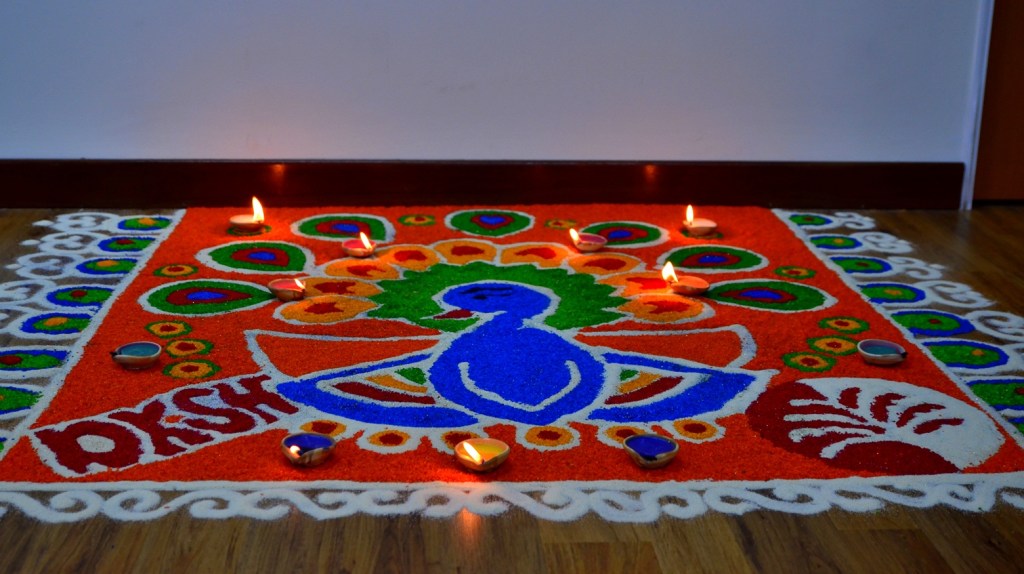
Deepavali Kolam in Penang, Malaysia. Courtesy: Creative Commons

In my naive childhood, I thought that Deepavali was one big celebration all over India and of those of the Indian diaspora the world over, at least of those of the Hindu faith. Bizarrely, I must have thought the whole of India would be up in jubilation anticipating the arrival of the festival of lights. Obviously not: the discussions surrounding the recent UNESCO recognition of Durga Puja as an Intangible Cultural Heritage are anything but unison. Now the Gujaratis want Navaratri[1] as a cultural loom. Interestingly, the people in power in Tamil Nadu want the harvest festival of Pongal as the main Tamil festival.

Indians who were brought in by the British to work in the Malayan rubber estates in the 1930s were mainly from Tamil Nadu. They celebrated Thaipusam[2] and Deepavali with much pomp and fanfare. Both days were soon declared holidays in many states of Malaysia.

I do not particularly remember my childhood memory of Deepavali being particularly joyous. Deepavali was another unnecessary expenditure in my home. We were a lower middle-class Malaysian Indian family of the 1970s. My thrifty Amma looked at this merrymaking as a hindrance. It was also the busiest time of the year for her. She was a kind of Indian Auntie Scrooge. She would drum up upon us at every moment that if one is healthy and wealthy, every day would be Deepavali. Deepavali comes once a year, right. But then, it comes every year.

Amma was a kind of local rock star amongst the flat dwellers when it came to stitching saree blouses. She was the go-to person for the aunties to enhance their assets and anatomy to look good in their sarees, even though most of them were overtly oversized and out of shape, to look trim and alluring, in their eyes, of course. Amma would use her talent to supplement Appa’s meagre take-home after the creditors’ scavenging.

She took in more orders than she could chew in her zeal to make hay while the sun was out. As the days grew nearer, she would become edgier and edgier. She would burn the midnight oil trying to finish the orders, as her customers would trickle in, demanding in desperation for their Deepavali blouses. She would smile apologetically to her clientele, but once they left, all of us, including Appa, would be the brunt of her frustrations. She would go on a monologue about the hopelessness of life, blaming all the people in her life, including God, for her miseries.

My sister, Sheela, grudging, had to help her, cutting loose ends, stitching buttons, edgings, and general tidying the blouses. Occasionally, Amma would cut or sew something wrongly, and that was when all hell would break loose. No one was spared of her screaming tirade. The smacking of children was legal then.

Deepavali was generally not what Malaysian Indian students, that is, those keen to score well in the Malaysian public examinations, looked forward to. Most, if not all, major public examinations were held at the end of the year. It made perfect sense as that was when the rest of the school would have finished their academic year, and there would be peace and quiet to conduct examinations. The trouble is that Deepavali mainly falls in late October or early November. Sometimes, the celebrations fell right smack between papers. The school would also be holding their end-of-year examinations if it was not for the public papers. Hence, we thought Deepavali was just another off-day to cramp up for the tests.

We, the children, could look forward to our annual sort of ‘pilgrimage’ thronging the bargain-hunting haven of Penang’s Campbell Street’s cheap sale’s stores two to three weeks before the auspicious day. We could look forward to the only two sets of new attire they would buy for the next twelve months. Seeing Amma bargain with the shopkeepers for the best price, I sometimes pitied the sellers. Sometimes, I feel like telling Amma to just pay what he asked. No, she would not do that. She would go to another shop, start another boxing match, loose, and return to the first shop smiling sheepishly.

As the days got closer, Amma would get even more and more high-strung. The children would be at the receiving end as the sewing orders piled up, and she could not find the correct thread colours for her blouses. In the midst of all that, some cloth piece or button would go missing, and then there would be a ruckus. Everyone would be roped in to search only to find the missing item right under her nose, where it would have been all the while.

Amma would become more desperate. The children, all preparing for the examinations, would be nagged for not helping enough, unlike other children – as if we were the only children in the world who needed to study! The sewing sessions would go on and on till the morning of Deepavali. On one occasion, probably due to fatigue, she actually cut out the wrong design for the wrong customer, and Amma had to replace the material later. Probably that customer must have ‘celebrated’ Deepavali that year with no saree blouse!  She might have passed it off as another new fad – as an empress in ‘new clothes’, perhaps!

About a week before Deepavali, cookies would have to be prepared in the middle of this entire melee. By tradition, the first to be cooked must be oil based; hence the opening ceremony was done by pressing murukku (a deep-fried snack made from rice flour and spices) and ghee balls (ney orundei). With a traditional and cumbersome murukku squeezing device, I would be assigned to give my muscle power to press down the murukku dough. A few other cookies would be baked in the then-spanking-new electric oven. To add to the local flavour, Amma would stir up sticky glutinous in brown sugar for a delicacy called ‘wajik‘.

One particular Deepavali eve, I remember an incident that triggered a stir in my neighbourhood. We were living on the 15th floor of a 17-storey low-cost flat. Residents were packed into tiny pigeonholes we called home. Privacy was the most diminutive of the priorities as we paved through life. Sheela was left to guard the fortress as my parents went off to the evening market to get groceries for the big day. I had gone off to school. I was in the afternoon session[3] that year.

I returned home to a big commotion outside my flat. Most of the neighbours were standing outside the unit, banging on the door, calling for Sheela and talking loudly amongst themselves. I peeked through the blind panel of the door. I could see Sheela slouched cosily on a sofa with her hands on her right cheek deep in slumberland. The television in front of her was blaring loudly, further drowning all the commotion outside. She was not too far from the door, but she continued snoozing. I guess all the late nights helping Amma must have gotten to her.

 Residents getting locked out was nothing new in our neighbourhood. I suppose it is one of the events that got the neighbours together to mingle and get to know each other. Among us were self-appointed ‘specialists’ who devised their own gadgets to deal with any locked-out situation. The most typical item used by most was a charcoal stirrer. I guess that is how laparoscopic surgeons got the idea of performing keyhole surgery. One with hyper-flexible joints was sometimes sorted after to insert his hand through the door blinds!

Yours truly saved the day when I managed to manoeuvre my hand through the door to flip the lock open. All through the melee, my sister was in total bliss. Finding her snoring, oblivious to all the pandemonium outside, Appa went on to reprimand her in the usual way – KABOOM! (i.e. smack).

With all that build-up, preparation and countdown, Deepavali was actually an anti-climax – except for the new clothes, the food and the angpows (money packets) we received after distributing cookies to our neighbours. Amma would be sleeping after finally finishing her sewing and cooking. Appa would catch his forty winks on his easy chair, and we, the children, would watch all the special programmes on TV. Nobody actually came to visit us, even on Deepavali day. The afternoon would come, and the family would again manifest in front of the idiot box to watch the Deepavali special Tamil movie on TV. When this was over, essentially Deepavali was over and reality bit in. It was time to prepare for school the following day. On Deepavali nights, we would fire up a couple of Chinese sparklers.

All the money collected in the angpows would go straight into our Post Office Savings accounts in the next few days. The grand finale of the Deepavali curtain would fall a few days later with the family outing to the movies, a Tamil movie, packed with cookies that Amma had prepared as viewing snacks. Then, it was the school holidays, and another school year would come.


[1] A Western Indian festival in honour of the Goddess Durga, celebrated around the same time as Durga Puja

[2]  The festival in January- February (called Thai in the Tamil calendar) commemorates the occasion when Durga gave her son, Murugan (or Kartikeya) a divine spear to defeat a demon. It is also commonly believed that Thaipusam marks Murugan’s birthday. It is a national holiday in many countries such as Malaysia, Sri Lanka and Mauritius. In India, in Tamil Nadu, it  is declared as a holiday but not celebrated in other parts of India.

[3] Schools in Malaysia and Singapore often ran two session – morning and afternoon.

Farouk Gulsara is an occasional writer who blogs at riflerangeboy.com. Whenever he gets nostalgic about the time that whisked by, he pens down whatever his grey cells are still able to retrieve.

.

PLEASE NOTE: ARTICLES CAN ONLY BE REPRODUCED IN OTHER SITES WITH DUE ACKNOWLEDGEMENT TO BORDERLESS JOURNAL

Categories
Nostalgia Slices from Life

Joy Bangla: Memories of 1971

Ratnottama Sengupta recaptures a time when as a teenager she witnessed a war that was fought to retain a culture

“Joy Bangla!”

I was startled by the greeting.  I was sixteen-going-on-seventeen and — en route to Darjeeling — I was visiting Malda, my ‘Mamabari’ where my mother lived until she was married at sixteen-just-turned-seventeen. I had just finished my school finals in ‘Bombai’ and was enjoying the long summer break with my school friend Swapna, my paternal didi, Tandra, and my maternal didi, Nanda. My Mama’s son, Shyamal, and his friend, Subhash, had graciously taken upon them the onus of taking us around Gaur, Pandua and Adina. All these are relics of the historical capitals that hark back to a glorious Bengal long past and — for most Indians – lost in oblivion. And here, in the 12-gate mosque of Baroduari, they were singing paeans to the Shahs and Sens and Pals of a medieval Bengal!

I was soon to face history-in-the-making. For, the rectangular brick and stone structure with three aisles, eleven arched openings, and so-many-times-that domes, built sometime in the 16th century and now in the care of Archeological Survey of India, was teeming with barely-clad men women and kids who were fleeing on a daily(or hourly?)-basis the gola-barood of the Razakars – the paramilitary force General Tikka Khan had unleashed in the eastern wing of Pakistan. This was May of 1971 and, even in the apolitical clime of the tinsel town in Bombay, we knew that the Pakistani President Yahya Khan was hounding supporters of the Awami League leader, Sheikh Mujibur Rahman.

I was therefore thrilled to hear the boom-boom-boom periodically rupturing the hazy horizon in the distant. Was it the spiteful army goons or was it the guerrillas fighting back? “How wonderful it would be to meet some of them!” the romantic in me spoke aloud to the red-eyed men and women who had greeted me with ‘Joy Bangla!’

“Don’t!” Shyamal Da and Subhash drew me aside. “Don’t get close to them – don’t you see they have all got ‘joy bangla’?”

“So what?!” I retaliated, “They are all infected with the love for their country – that’s why they are saying ‘Joy Bangla’! Isn’t that good!”

“No, they are all infected with conjunctivitis – it is highly infectious and spreading rapidly in the camps. So now, not only in Malda but all through West Bengal, ‘joy bangla’ is the name for conjunctivitis.”

.

Mangoes. Raw, green, going yellow-orange-red. Stretch out your hand, pluck them off the tree, hit hard on them with your fist and bite into the sour-sweet flesh… But we girls failed to emulate what Shyamal and Subhash could do with such ease on our way to Singhabad, the last stop for our trains this side of the border in that part of Bengal. Nevertheless, the fragrances of Amrapali, Moutuski, Kishanbog and Fazli remain fresh in my memory years after Shyamal, Nandadi, Swapna, Tandradi have all followed Bangobandhu to a borderless land beyond the clouds.

Singhabad is where my mother Kanaklata owned some 27 bighas of cultivable land inherited from her father: Chandrakanta Ghosh had, in 1940s, apportioned plots to his city dwelling daughters, Malati and Ranjita too, worried that they might face difficulties if their ‘job-dependent’ husbands lost their all to the Partition! He had reasons to worry. He had exchanged most of his land in Dinajpur but the daughters were married into families that had their base in Dhaka, Munshigunj and Kustia. Before you turn to your Google Guru let me tell you – all these were part of East Bengal and are now in Bangladesh.

Much later, in 2001, I would understand my grandfather’s angst when centurion Bhabesh Chandra Sanyal told me in Delhi: “This part of the subcontinent has seen three partitions – in 1905, 1947 and 1971.” The doyen of modernism in Indian painting, who had moved from Calcutta to Lahore in his youth and from Lahore to Delhi in 1947, had brought alive another chapter of history that most of us in India or Bangladesh don’t often recall. Yes, in 1905 the ‘territorial reorganisation’ of the Bengal Presidency by Lord Curzon was said to be for “better administration” since Bengal, for centuries, was spread right up to Burma in the East and well into Assam and Tripura in the North-East, into Bihar and Jharkhand in the West and in the South to Odissa. Noted: but why did it have to be along religious lines, separating the ‘Muslim-dominated’ areas from the ‘Hindu-majority’ ones? Because together the Hindus and Muslims had taken up arms against the goras in 1857, and starting from Barrackpore the mutiny had spread to Lucknow, Jhansi, Gwalior, Meerut, Delhi… After 1857, the last Mughal Badshah, 82-year-old Bahadur Shah Zafar, had to be exiled in Rangoon while in 1885 the last emperor of Burma, Thibaw Min, was forced to live in exile at Ratnagiri…

If it were not so tragic, it would have been ludicrous, this ‘exchange’ of emperors.

.

Nandadi’s brother, Nirjhar, now 79, vividly recalls crossing the newly defined boundary to come away for good from Meherpur, in Dinajpur of East Bengal, to Malda with his mother — my aunt — Pramila, his three-year-old sister, Nanda, and a just-born brother, Nirmal. “We were coming in three bullock carts: the first one driven by a certain Mongra carried our eldest Mama, his wife Charulata and youngest son Subrata; and the last had our younger Mama’s wife Gayatri, son Suvendu and daughter Maitreyi. Many people were coming just like us, there was no knowledge of the word ‘Passport’ and no concept of ‘Visa’. Since our Dadu – maternal grandfather Chandra Kanta – had to stay back to wind up things after us, he took us to a dear friend of his, a Muslim named Sukardi Chowdhury, in Anarpur and asked him to accompany us since he had a gun.

“He was to reach us to Jagannathpur where Dadu had built a house on the newly exchanged land just six kilometers away from Meherpur. Sukardi Chowdhury lived two kilometers from the border but we had to cross river Punarbhaba on a boat and then we followed the road along the railway line. All of a sudden, we were startled by a piercing cry in a female voice. ‘Who is this? Who goes there?’ demanded Sukardi Chowdhury. He climbed on to the railway track and witnessed some miscreants harassing a woman. He fired his gun in the air and the rascals fled. He walked up to the woman and found that the malefactors had bitten off the nipples of the woman who was bleeding and writhing in pain.

“Sukardi Chowdhury had a gamchha tied around his head like a bandana. He took it off and wound it around the chest of the victim. He advised her companions to go along the railway track straight to Singhabad station, take a train to Malda and seek medical aid there. ‘That will save your life,’ he assured her. I will never forget.” Incidentally Nirjhar’s father, Makhan Chandra Ghosh, did not cross the border until 1980. Along with his ageing mother he had stayed back to care for his widowed sister since their land further inside Dinajpur could not be exchanged.

.

This 27-acre land in Singhabad adjacent to the No-Man’s Land on the Bangladesh border was so dear to Kanaklata that she would not hear a word about selling it off although she lived far away with her husband, Nabendu, who was busy scripting films. “One should never forget one’s roots,” she told me in 1971 when she went around with a donation-book raising chanda for the Bangla refugees. She was delighted when – later – the government of India issued Refugee Relief stamps that had to be affixed to every letter, be it a postcard, an envelope, or an inland letter. Was it because deep within she identified with the uprooted people who were forced by history to cross borders?

Ma’s love for her land had, perhaps, infected us. When she passed on in 1999, we dispersed her ashes in the pond on this land. In 2007, before my son, Devottam, was to depart for higher studies abroad, he visited this innermost corner of his land. In 2017, when Ma would have turned ninety, my husband, Debasis, celebrated by planting mango trees around the pond and released fish, the sales of which now pays for a Durga Puja on the land. Yet, just last December, we severed our formal ties by selling off the ‘two-acre land.’ But no, Kanaklata is not forgotten by the men and women – many of whom studied in the school she helped set up long before government aid came their way. They are setting up a temple in her memory…

.

But hang on friends, that’s not the end of my story, “picture abhi baaki hai!”

On December 13, 1971, Tandra’s elder sister Chhanda got married. She came from Patna where Nabendu’s brother lived; the groom, Animesh, came from Delhi. But Kanaklata had organised everything in Bombay, in the same house in Malad where our family has lived since 1951. This Goan-style bungalow had a garden surrounding it and this tiny ‘lawn’ was to be the wedding venue. However, ten days before the event when the invitations had gone out and the baratis had already booked their tickets, aerial strikes on Indian air stations led to an all-out war with Pakistan.

This was ominous for many reasons. Six years before this, during another war with Pakistan, my grandfather had passed away in August 1965. This time around, the mighty Seventh Fleet of the USA had entered the Bay of Bengal to support Pakistan in the war. Sirens were being sounded at regular intervals and we joked that – since both the bride and the groom were trained musicians – these sirens were ‘replacing’ shehnai by Bismillah and party. Why? Because the police showed up to warn us that no conch shells or ululations that mark traditional revelry at Bengali weddings were to be sounded — and not even a single ray of light should evade the black-cloth-wrapped pandal that had to be erected to cover the house!

Ill omens? Never mind. You can’t stop a wedding because a war was on! All the Bengali families of Bollywood united that evening to celebrate with bated breath. And on December 16, when the bride was being formally inducted into the groom’s family in Delhi over the sumptuous meal of Boubhat, news came that General Niazi of Pakistan had surrendered to General Jagjit Singh Arora of India.

So Vijay Diwas is one day that unites India and Bangladesh in celebrating its actual secession from Pakistan. “Joy Bangla!” – we all said as Chhanda and Animesh led a chorus that sang,

 Aamar Sonar Bangla, aami tomay bhalobashi!*

Oh my glittering Bengal, I love you…

Glossary

Didi – elder sister

Mama – mother’s brother

golaa-barood — ammunition

Amrapali, Moutuski, Kishanbog and Fazli – Varities of mango

bighas – acres

goras – whites

Badshah — Emperor

chanda – donations

picture abhi baaki hai – The movie is still not over

Boubhat – wedding reception, traditionally

*Song by Tagore that became the national anthem of a free Bangladesh

Ratnottama Sengupta, formerly Arts Editor of The Times of India, teaches mass communication and film appreciation, curates film festivals and art exhibitions, and translates and write books. She has been a member of CBFC, served on the National Film Awards jury and has herself won a National Award. 

.

PLEASE NOTE: ARTICLES CAN ONLY BE REPRODUCED IN OTHER SITES WITH DUE ACKNOWLEDGEMENT TO BORDERLESS JOURNAL