Categories
Essay

Charlie and I: My Visit to Corsier-sur-Vevey

Nirupama Kotru, a film buff renews her acquaintance with Chaplin and, in the process, learns a life lesson.

“In that dark room in the basement of Oakley Street, Mother illuminated to me the kindliest light this world has ever known, which has endowed literature and the theatre with their greatest themes: love, pity and humanity.”

— Charles Chaplin, My Autobiography

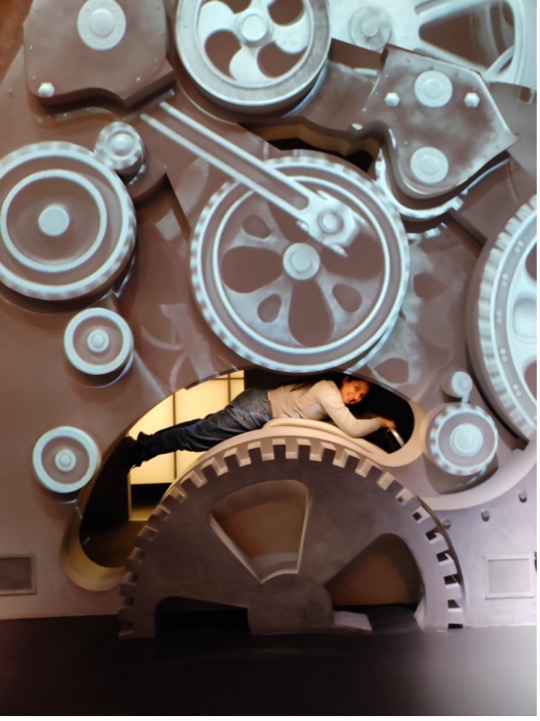
He has been called a genius by scientists, philosophers, writers, humanists, film-makers and actors. His films continue to fascinate generations. They are timeless in the true sense of the word. As children, we laughed at the slapstick and the physical humour in his films. As adults, we have learnt to appreciate the world-view that lies behind some of his funniest films. Charlie being sucked into the giant machine in Modern Times (1936) remains one of the indelible memories of childhood. Later in life, one came to appreciate the thought – the causes and consequences of the Great Depression (1929–39) – that went into the writing of the film.

Charlie Chaplin has been an important influence in Indian films. Take celebrated actor-director Raj Kapoor, for instance. Raj Kapoor absorbed the mannerisms associated with Chaplin’s Little Tramp, including the waddle. It is a tribute to Chaplin’s genius that this Indian actor came to be universally recognised as the tramp, with his film Awara (the title of the film means a vagabond or a tramp) becoming a huge hit at home and abroad. Many actors after Kapoor, among them Sridevi (Mr India,1987), Mehmood (Aulad,1968), Kamal Haasan (Punnaigai Mannan,1986), and Chiranjeevi (Chantabbai,1986), channelised their inner Charlie into their performances. But it was Noor Mohammed who first adopted the Chaplin persona, and even used the screen name “Charlie” in films like The Indian Charlie (1933), Toofan Mail (1934) and Musafir (1940).

In November 2022, when I was informed that I would have to travel to Geneva for work, my first reaction was far from enthusiastic. I thought Geneva would be bitterly cold; also I needed to start planning my forthcoming family vacation to the United States. The United Nations Conference on Trade and Development (UNCTAD), under whose aegis this program of the Intergovernmental Forum on Mining was taking place in Geneva, had asked India to send a women leader in mining.

Over the next four working days, I came to love Geneva Lake Geneve, the beautiful weather, the lovely architecture and the people. But the highlight of my trip was the last day, which I had taken off. The surprising part was that none of my colleagues, including those posted in the three Indian Missions/Consulates in Geneva, had visited the Chaplin Estate (The Manor de Bain). It was sheer luck that I remembered reading about Chaplin spending the last twenty-five years of his life in Switzerland, until his death in 1977. I discovered in the nick of time that Corsier-sur-Vevey was less than a two-hour drive from Geneva. I realised that this was a once-in-a-lifetime opportunity. A quick booking of tickets on the Chaplin World website and I was off to the Manor de Bain! I decided to combine my Vevey trip with one to Gruyere, the beautiful town which lends its name to a popular kind of cheese.

After a quick trip to Gruyere, I set off for Vevey. My heart started racing as I passed the town square in Vevey which had huge murals of Chaplin on some buildings. Finally, I entered the hallowed portals of the estate where Chaplin spent twenty-five years with his wife, Oona, and his children. Passing through his study in the main living quarters, as I entered the drawing room with its cosy sofas, I came across French windows which overlooked the massive grounds of the estate. I stopped to take a picture. Suddenly, my phone camera froze. I panicked. I tried to close the camera app and switch off my phone, but nothing worked. I thought, this was it, I won’t be able to take any more pictures to remind me of this special day. Dejected, I moved into the dining room. A lady guard came to me and asked me if I would like to write something in the visitor’s book, which I did, sitting down on a chair in the corner.

All this while I was feeling disappointed. Suddenly, I looked up to see a home video playing in a loop, of Chaplin enjoying a meal on a sunny day with family and friends. I thought to myself: Was this a sign? Was Chaplin saying, “Why are you obsessed with taking pictures? You have come so far to see my home; I want you to enjoy my estate, look at my work. Don’t let these modern gadgets rule your life. Slow down.Take it all in.”
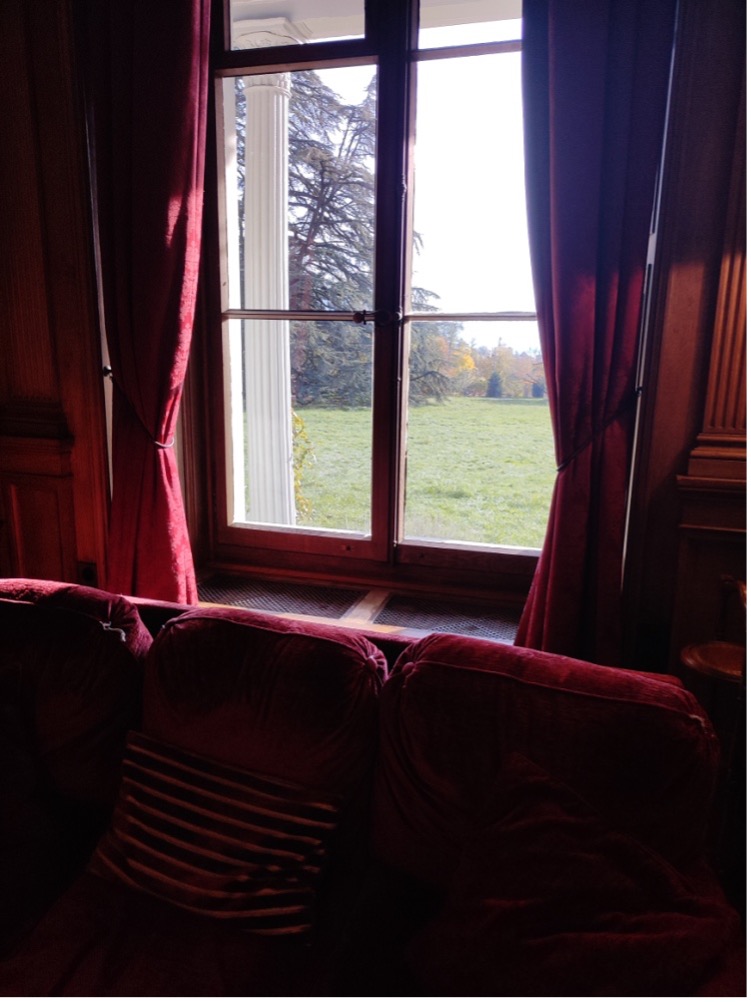
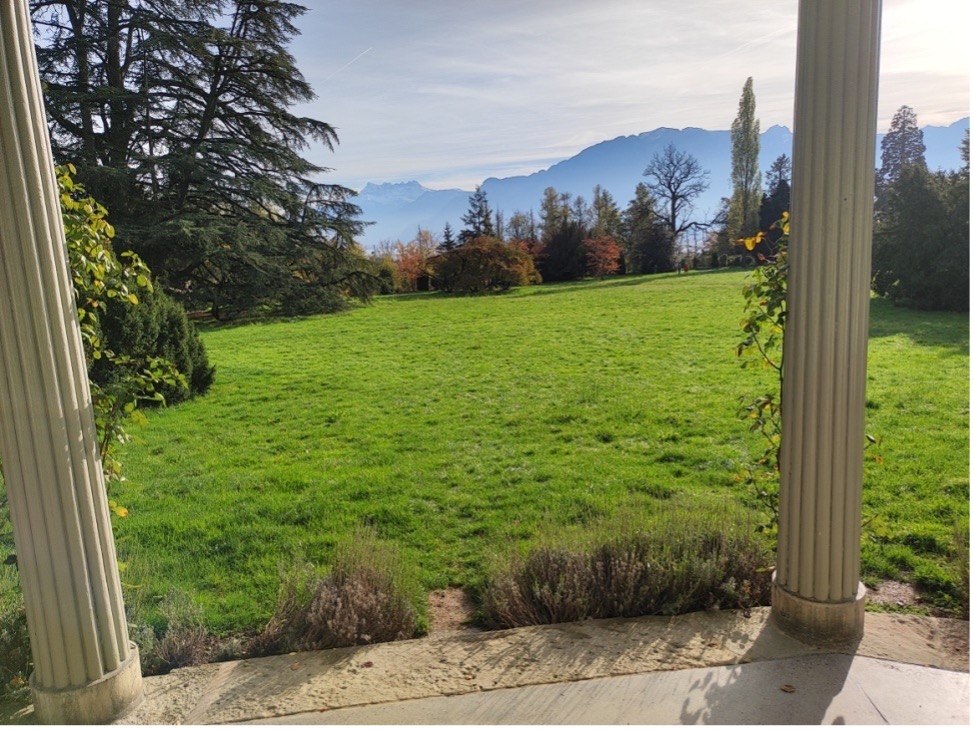
I calmed down and went back to those French windows in the drawing room to take in the magnificent view of the estate grounds. A man walked towards me. I asked him if he could help unfreeze my phone. He suggested I switch it off and then on again. I did that, and voila! It worked. Though I was relieved when my phone came back to life, I realised that in those intervening ten-fifteen minutes when my phone was frozen, I was forced to take a breather, to reflect upon the beauty I was surrounded by, and all the blessings which make life worth living. And I went back to the study and foyer of the house to spend some more time reading more about the struggles, trials and triumphs of this great artist.

As I emerged from the main building, I thought of rounding off the visit with a leisurely walk around the grounds. Suddenly I noticed a sign which said “The Studio”. I had deliberately avoided researching on what the visit had to offer, so I decided to just go with the flow and enjoy whatever was on offer. There was a screen outside “The Studio” which said that a film screening was to start in nine minutes. I waited, and finally watched the film, a moving take on Chaplin’s life and work, with ten other viewers.

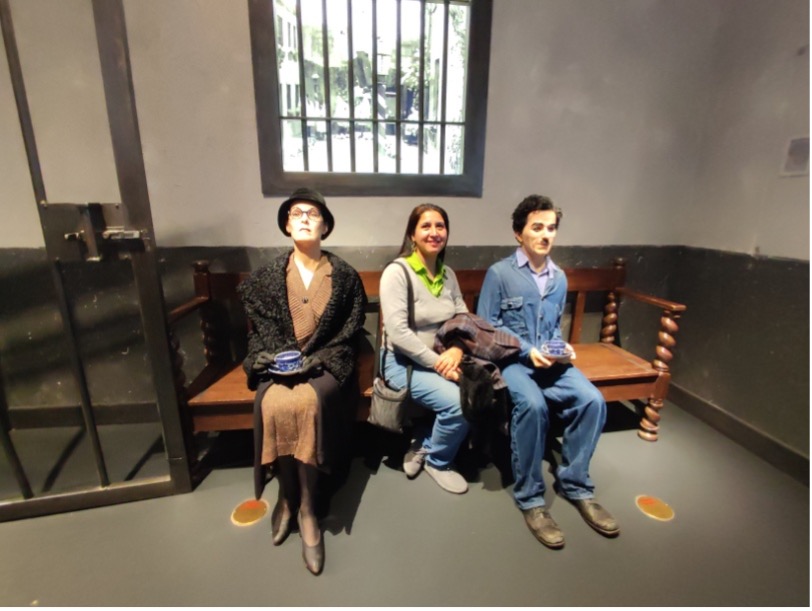
After the film ended, we were asked to move towards the screen. Suddenly, the screen disappeared and lo and behold, I found myself on a beautifully recreated set from The Kid. We were prompted to go behind the set, and to my bewilderment, what followed was one set after another – The Great Dictator, City Lights, Gold Rush, Limelight, A King in New York, whew! It was such a delight to go through those sets, to see the wax figurines, to sit on the chair from The Gold Rush with Charlie peeping from under a table, to pose next to Charlie in my own bowler’s hat, to sit on the jail bench next to him, to be swallowed by the giant machine from Modern Times. Mercifully, my camera behaved throughout the studio visit and I took many keepsake pictures. After a stroll through the beautiful grounds, I picked up some books, including Chaplin’s autobiography, and other memorabilia. I started reading the autobiography shortly after my visit and it reaffirmed my views about Charlie.

During my visit and afterwards, I got a lot of time to reflect upon how Chaplin’s films were deeply concerned with the human condition, with all the miseries and challenges brought upon it by events that the common man has no control over. Chaplin’s work includes The Gold Rush (1925), which drew from real-life events such as the Klondike Gold Rush and the Donner Party, and The Great Dictator(1940), a satire on Adolf Hitler. Limelight (1952), which depicted the frustration of a has-been comedian, can be classified as auto-fiction, as can The Kid (1921), while Modern Times has been hailed as an astute commentary on industrialisation. Levity was Chaplin’s forte, but all his films were deeply rooted in his political and social consciousness. More often than not, he had to pay a heavy price for sticking to his beliefs.

Recollecting the making of The Great Dictator, Charles says in his autobiography, “Halfway through, I began receiving alarming messages from United Artists … But I was determined to go ahead, for Hitler must be laughed at. Had I known of the actual horrors of the German concentration camps, I could not have made The Great Dictator; I could not have made fun of the homicidal insanity of the Nazis.”
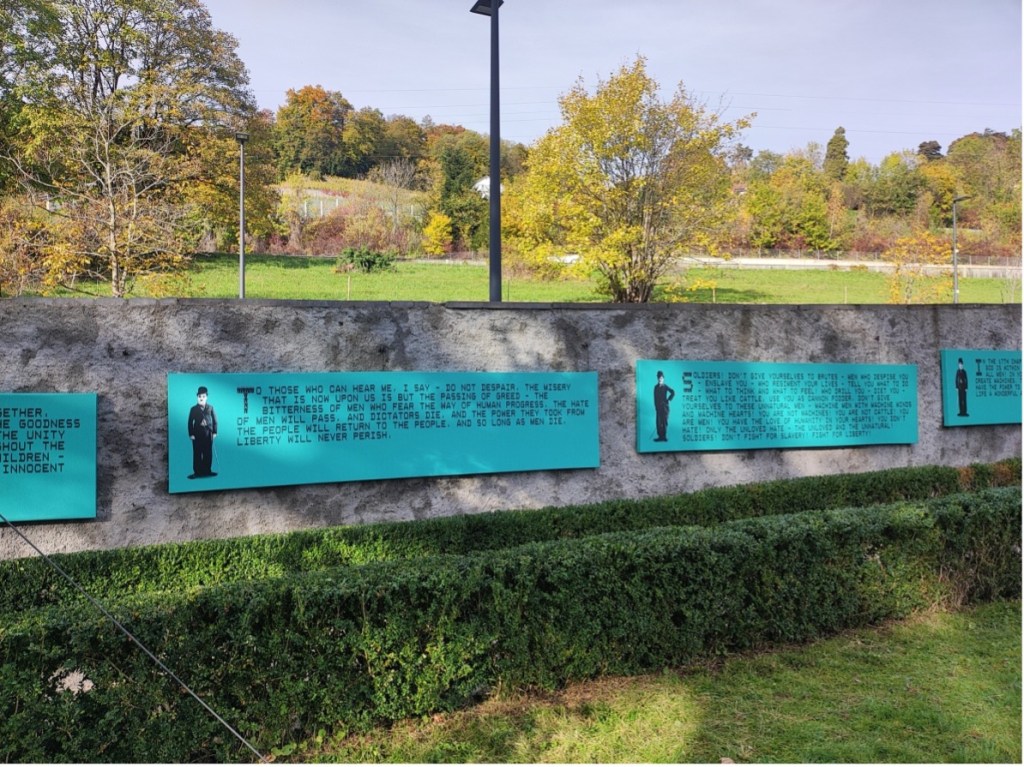
The boundary wall of the Manor de Bain. The sounds of cow bells from across the road drifted towards the estate, making for a mesmerising setting.

Chaplin was a genius who understood the power of the audio-visual medium. Since pantomime was his greatest strength, having performed bit roles in theatres during his childhood days of great hardship and penury, he used this technique to convey pathos through humour. Although he was earning quite well as a comedian-writer-director in Hollywood, by 1919, he was so frustrated with the studio system, which did not give him a free hand to write his own scripts, that he co-founded United Artists along with Douglas Fairbanks, Mary Pickford and D.W. Griffith.

His first major hit under his own banner was The Kid, which drew from his childhood experiences. So strong were his convictions about the silent film that he swam against the tide and released City Lights in 1931, well after talkies had completely taken over Hollywood. Slowly, he started warming up to the possibilities of sound in film. He used sound effects in Modern Times but no spoken dialogue. He composed and sang a charming ditty in gibberish, ‘Titine’,with some random words in French, Italian and English thrown in, for Modern Times which never fails to bring a smile to the face, even eighty-seven years after its release

Whether it was silent films or talkies, Chaplin continued to tell his stories of universal values, of hope amidst great suffering. As an artist, he never shied away from speaking truth to power. Like most great artists, he did not accept manmade boundaries. Although he was English by birth, he was criticised for not fighting in World War I. He had long arguments with Winston Churchill about Mahatma Gandhi and the struggle of the Indian people for freedom. In fact, he met Gandhi-ji shortly after meeting Churchill, during a trip to London, and questioned him at length about his abhorrence for machinery. He returned from the meeting with great admiration for Gandhi-ji’s strategies for achieving independence and his principles of non-violence and truth. His conversation with Gandhi-ji influenced his writing of Modern Times, especially the Gandhian theory about modernisation and rapid industrialisation being the cause of unemployment and rising inequality. The fearless artist once made an uncharitable remark about the English royalty, telling Churchill, “I thought socialists were opposed to a monarchy”, to which Winston Churchill replied, with a laugh, “If you were in England, we’d cut your head off for that remark.”

Being wary of the ways of Hollywood where an artist was judged by his or her success at the box office, he made few friends in the film industry. Chaplin was happy spending time visiting his childhood haunts on his trips to London, and also enjoyed wining and dining with film stars, princes and princesses, prime ministers and presidents, scientists, philosophers, poets and writers. He was friends with Mary and Douglas Fairbanks, Albert Einstein, George Bernard Shaw, H.G.Wells, Harold Laski, Aldous Huxley, Theodore Dreiser, et al. He went to Lucerne in Switzerland to meet India’s first prime minister, Jawaharlal Nehru, expressing his surprise at finding him “a small man like myself”. Chaplin invited Pt Nehru to his estate in Vevey for a meal. They had a long chat on the way, which left Chaplin impressed with the “…man of moods, austere and sensitive, with an exceedingly alert and appraising mind”.

Chaplin was a pacifist and a philosopher, and was derided for his views in America – not just mocked, but harassed by the FBI under its founding director, J. Edgar Hoover. In 1952, the country which has historically been considered the land of free speech hounded Charlie out of its borders under the mistaken impression that he was an avowed communist, and told him to never come back. Chaplin even narrowly escaped an assassination attempt in Japan.

Chaplin’s autobiography ends in 1964, on a poignant yet hopeful note, just like Charlie’s films, with Chaplin expressing his sadness at having to leave America, but also describing his happy days in Switzerland, where he befriended several artists who lived in the area. Eight years later, in 1972, Charles Spencer Chaplin was called back to America by the Academy of Motion Picture Arts & Sciences to receive an Honorary Oscar. After initial hesitation, Chaplin decided to attend the ceremony, which would end his twenty-year exile from America. He went on to receive an unprecedented standing ovation lasting twelve minutes. Cries of “Bravo!” filled the auditorium and Chaplin was clearly overwhelmed. It was an emotional homecoming for the man who had left Los Angeles in extremely unpleasant circumstances in 1952.

Chaplin was knighted by Queen Elizabeth II in 1975, but by then he was frail and had to accept the honour in a wheelchair. He passed away in 1977, but his legacy lives on. I hope cine buffs like me keep rediscovering him, for The Tramp is timeless.

(The photographs have been provided by the author, except for the book cover)

Nirupama Kotru is an officer of the Indian Revenue Service,1992 batch. Ms.Kotru has served in the Income Tax Department at Mumbai, Chennai, Delhi and Pune. On deputation, she served as Director (e Governance) in Ministry of Corporate Affairs and as Director (Films) in M/o Information & Broadcasting, where she looked after policy issues such as censorship, India’s participation in film festivals abroad, archiving, film schools and production of films.

As Joint Secretary in Ministry of Culture she has looked after prestigious national akademis such as Sahitya Akademi and National School of Drama, and national museums such as Indian Museum and Victoria Memorial Hall &Museum. She is presently posted as Joint Secretary& Financial Advisor, Ministries of Coal, Mines & Minority Affairs. She has released an album of bhajans called Upasana. She has also written around thirty articles on cinema and other topics such as parenting. She is currently co-authoring an anthology on Hindi cinema of the 1970s.

.

PLEASE NOTE: ARTICLES CAN ONLY BE REPRODUCED IN OTHER SITES WITH DUE ACKNOWLEDGEMENT TO BORDERLESS JOURNAL. 

Click here to access the Borderless anthology, Monalisa No Longer Smiles

Click here to access Monalisa No Longer Smiles on Kindle Amazon International

Categories
Essay

The Wonderland of Pokhara

By Ravi Shankar

Pokhara, Nepal. Courtesy: Creative Commons

The view of the Himalayan ranges through the airplane window to the right was breath-taking. The February day was bright and sunny, and the Himalayan giants were clearly seen. I was flying on an ATR 72 aircraft from Kathmandu to Pokhara. The flight was short (around 20 minutes) and soon I could see the Pokhara valley and the town far below. The town is cut into deep gorges by rivers flowing down from the Himalayas. I could see the vast building of the Manipal Teaching Hospital at the base of a huge hill.  

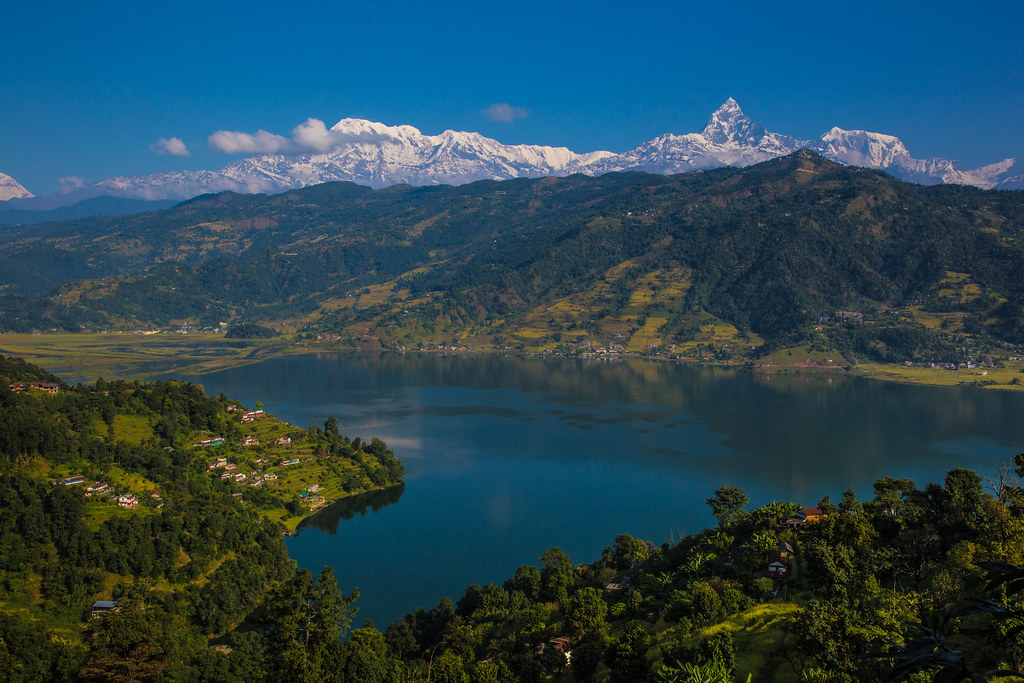
Pokhara is a magical city located in the western region of Nepal. Unfortunately, many confuse it with Pokhran, the site of India’s nuclear tests. I faced some difficulty explaining the location of these two places and their stark differences. The town is located about 250 km west of the capital, Kathmandu. The altitude is lower at around 900 m (Kathmandu is at 1300 m). Winters are less cold but there are violent hailstorms and thunderstorms during summer. The view of the Annapurna Himals (snow-covered mountains in Nepali) from Pokhara is spectacular. The Annapurnas have several peaks – Annapurna I, II, III, Hiunchuli, and Gangapurna. The fishtail mountain, Macchapucchare dominates the view from Pokhara. The fishtail aspect with twin peaks is only seen once you leave the Pokhara valley. The face of a tiger is said be discerned on the face of the peak. I spent a lot of time and effort trying to discern the tiger’s face. Then, one day, after a few years sustained effort suddenly my efforts paid off. I was able to see the tiger!    

Dashain (called Dussehra in India) is Nepal’s most important festival and celebrations go on for over two weeks. During autumn and winter, the air is clear, the dust has settled and the mountain views are spectacular. In the morning the faculty gather for tea/coffee near the mess at the Deep campus of Manipal College of Medical Sciences and enjoy a spectacular view. Watching birds glide against the clear blue sky and the clouds slowly gathering on the Himals is a unique experience. You could spend hours sitting quietly drinking in the view in the warm winter sunshine.

There are several day hikes around Pokhara. You can walk down to Lakeside. This takes a good ninety minutes from Phulbari where the Manipal Teaching Hospital is located. You can continue walking past the lake passing through rapidly urbanising villages, tourist lodges and restaurants. Phewa Lake is the jewel of Pokhara though it may be becoming congested. A road has been constructed around the lake and the lakeside is full of tourist hotels. The Tal Bharahi temple situated in the middle of the lake can be accessed by boat. Dervla Murphy stayed in Pokhara during the 1960s and writes about the pristine Phewa lake without the tourist accoutrements in her book ‘The waiting land’.  

Phewa Lake. Courtesy: Creative Commons

Pokhara Thakali Kitchen located at Lakeside serves authentic Thakali food. Thakalis are an ethnic group from the Thak Khola valley north of Pokhara famous as innkeepers and restaurateurs. I enjoyed piping hot rice, green dhal (lentil curry), saag (green leafy vegetables), potatoes roasted in ghiu (clarified butter), tomato achar (pickle), and the wonderful chicken or mutton jhol (curry in Nepali). I am also partial to dhido — a paste made from either corn or buckwheat. Another favourite place was a restaurant located toward the end of the lake. The tables were placed in small, thatched huts and you could enjoy the view while food was being prepared. There were also a few cots to enjoy a siesta. Their daal-bhaat-tarkari (lentil curry, rice, vegetables) and chicken curry were exceptional. In Nepal, restaurants usually prepare orders fresh, and you can expect to wait up to an hour for your order to be prepared.     

Sarangkot located at the height of around 1500 m offers spectacular views of the Dhaulagiri Himals to the west, the Annapurna range, and even the Manasulu peaks to the east. The area can get crowded during winter mornings and evenings as tourists and guides gather to watch the mountains turning golden, and different shades of red during spectacular sunrises and sunsets. The Annapurna Sherpa Resort is close by, and my friends and I had spent several New Years’ Eves there. From Sarangkot, you can descend to the lakeside. The trail is steep and passes through several villages. You can watch the hang gliders taking off, their colourful canopies staying suspended in the air and eventually landing at the far side of the lake.    

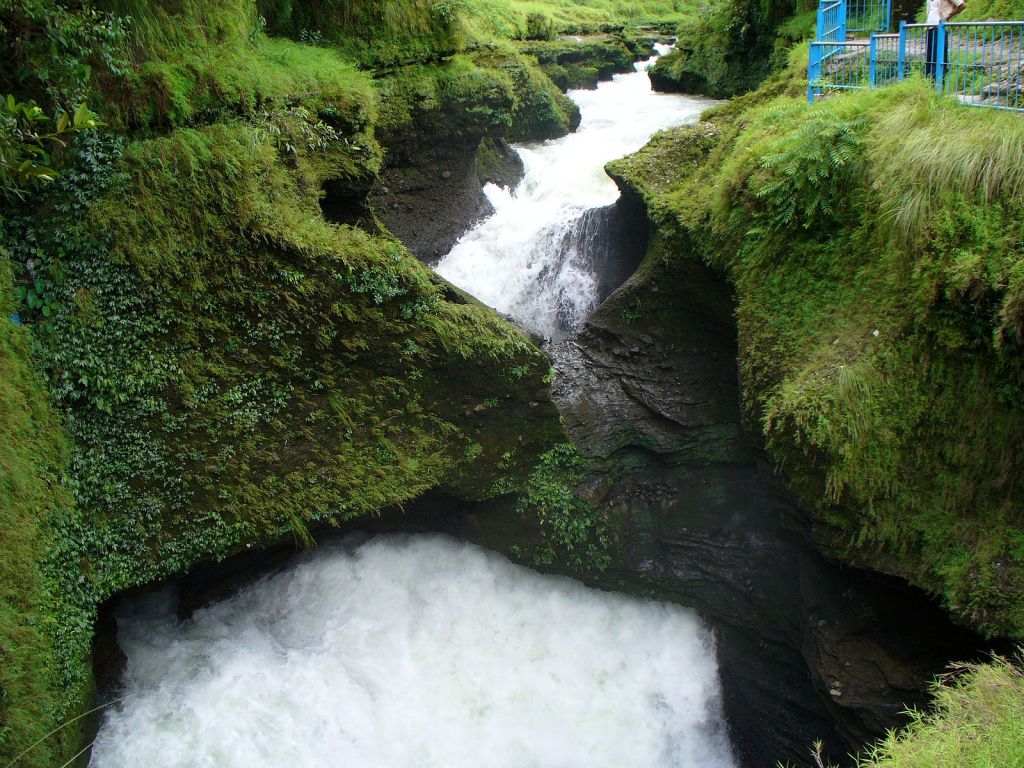
Kahundada is the mountain immediately behind the hospital. A road has now been cut to the top but two decades ago you had to climb up through stone staircases. There is a view tower at the top and you can enjoy the view of the Himals without the crowds. However, there are no hotels near the top so reaching the tower in time for sunrise is challenging. Devi’s fall is another attraction. In Pokhara, the ground in most areas is made of soft limestone and this can get dissolved in the acidic rainwater. In the Deep campus of Manipal, there were sudden cave-ins caused by limestone erosion. Devi’s fall is said to be named after a Swiss lady, Devine who went swimming in the fall but was swept away by a sudden gust of water. The Nepali name is Patale ko chango (underground waterfall).

Devi Fall. Courtesy: Creative Commons

The Gupteshwar Mahadev cave dedicated to Lord Shiva is nearby. This bat cave (chamere gufa in Nepali) is the habitat of the horseshoe bats. The exit requires some climbing and is narrower than the entrance. There is a belief that only those who have not sinned would be able to exit the cave. One of my favourite walks was to the village of Mauja. The trail climbs up through green forests and waterfalls. Mauja is a typical hill village and a good weekend hike. Another excellent hike is from Naudanda to the lakeside. You can take a bus to Naudanda and then walk down to the lake. You pass through several villages. Kaskikot was the old capital of the kings of Kaski. There is a fort on the hilltop with a good view over the valley. There is also a Kashyap hill where the rishi Kashyap is said to have meditated. A few high-end tourist hotels have now been established here. The view of the blue waters of Phewa lake get bigger as you slowly approach the lakeside.            

Begnas and Rupa lakes are two other lakes in the valley. Begnas lake is less crowded and is famous for its fish stalls. A small, forested hill, Panchabhaiya Dada, separates the two lakes. The waters of Begnas look darker and deeper. The International Mountain Museum was opened in Pokhara in 2004. The location offers spectacular views of the Annapurnas. The museum has three main exhibition halls: the Hall of Great Himalayas, the Hall of Fame, and the Hall of World Mountains. The cultures of the mountain people are also depicted. Bindhyabashini temple, the oldest temple in Pokhara was established in the 1760s. There is an interesting legend about the temple. The King of Kaski dreamt about establishing the temple. He had his men go to Bindhyachal Parbat and bring back an idol of the Goddess. While returning the men camped for the night in the current temple location. The next morning, they found they could not move the idol, and the king when informed ordered the temple to be set up at the current location.  

I enjoyed reading the fascinating book by Jagannath Adhikari and David Seddon, Pokhara: Biography of a Town. Pokhara is today one of the fastest-growing towns in Nepal. Ekai Kawaguchi, a Japanese monk was an early explorer of Tibet which he approached through Pokhara and the Thak khola. He was deeply impressed by the beauty of Pokhara. He mentioned in his writings that during all his travels he had never seen a place that rivalled the beauty of Pokhara. Magical Pokhara weaves its charm on visitors and residents alike!     

Dr. P Ravi Shankar is a faculty member at the IMU Centre for Education (ICE), International Medical University, Kuala Lumpur, Malaysia. He enjoys traveling and is a creative writer and photographer.

.

PLEASE NOTE: ARTICLES CAN ONLY BE REPRODUCED IN OTHER SITES WITH DUE ACKNOWLEDGEMENT TO BORDERLESS JOURNAL

Click here to access the Borderless anthology, Monalisa No Longer Smiles

Click here to access Monalisa No Longer Smiles on Kindle Amazon International
Categories
Essay

Which Way, Wanderer? Lyric or Screenplay…

Ratnottama Sengupta explores the poetry in lyrics of Bollywood songs and scans the title song of the Hindi film, Guide, to conclude that a film song can be more than a lyric, a screenplay…

“If you want to be famous, do not write screenplays,” Jean Claude Carriere once told film students in a workshop. The legendary screen writer could have just as well said, ‘Do not write for films!’ For, it is the same story for lyricists as well. The better a film and performance of the actors, the less people remember the writer. Similarly, the better the rendition of a song, listeners remember it by the voice that rendered it — the singer; the man who scored the music, the actors who embodied the persona; or the film for which it was written. Seldom do people remember or even know who had penned the ditty that has got woven into the warp and weft of not only the script but, over time, of our life! 

Festival of Letters 2023. Photo: Ratnottama Sengupta 

So where’s the question of according them the literary status of a poet? Yet, speaking in Sahityotsav 2023 – the Festival of Letters hosted March 11-16 by Sahitya Akademi, India’s national council for literature, Tamil lyricist Vairamuthu refuted that there is no literary value in writing for cinema. “Yes, in a commercial art like cinema, everything cannot be literature, but surely literature is not utterly absent!” The seven times National Film Award winner admits that all movie songs are not poetry but he is ready to tussle with those who demean songs by saying they do not have the charm or aesthetic of poetry.

The role of songs in cinema is different, and therefore the aesthetics is different from that of poetry, the celebrated song-writer elaborates. “Lyrics are written to fit into a script; a character; and a social clime. So a lyricist has to bow to politics, humanities and sociology. And still a film song becomes a feast for the tastes of common people, because it contains in its folds the seeds of nuanced literature.” When a poet becomes a lyricist, he does not have the same freedom: his imagination is bound by the barriers of melody. He has the added responsibility of creating poetry by overcoming the constraints of the situation and the tune scored to heighten the emotion of the moment. When the lyrics of a song transcends these constraints it attains the heights of aesthetics, not necessarily of poetry but of its own particular identity. “Why must banana be described as poor man’s apple?” Vairamuthu poses.

*

I can recall countless songs that fit the bill of poetry. But, as I prepared to speak to Film Appreciation students of the Film and Television Institute of India on Literature in Cinema, it struck me that some songs track a different course and go on to presage the yet-to-unfold narrative, or even the final resolution of the film. And, in doing so, they sometimes equate the screenplay. Here I can readily mention two songs, both penned by Shailendra for two films released in 1966. One is the Mahua Ghatwarin song from Teesri Kasam (The Third Vow). In it Hiraman, a bullock-cart driver, recounts the story of Mahua who is sold off for money by her own family to Hirabai, the Nautanki dancer, who eventually defies that fate. The second is the title song of Guide, directed by Vijay Anand with Dev Anand and Waheeda Rehman leading the cast, which I will scan today. 

R K Narayanan’s masterpiece was a rather unusual story for a Hindi film made so many years ago. The fact is that it started as a Hollywood venture. Pearl S Buck, the first woman to win the Pulitzer award with The Good Earth, was the screen writer for the English version. Unfortunately, that reached neither here nor there. The Hindi version, on the other hand, turned out to be a cult film – particularly for its unmatched songs and dances that were shorn off for the Hollywood version. Just goes to show how integral song and dance are to Indian life.

Genius, they say, always evokes admiration and provokes curiosity. My attention to this song was drawn when a handful of cine lovers got together to understand why its unconventional profiling of adultery succeed in tradition-bound India when it failed miserably in the ‘advanced’ society that is Hollywood?  Both the versions had the same plot, nearly the same cast and crew, and yet the difference was stunning. Their urge to analyse its extraordinariness led Blue Pencil to publish Guide The Film: Perspectives. And, while answering interviewer Antara Nanda Mandal, I realised how Wahan kaun hai tera is unique in the way it knits the past with the future of the character, grafting a seamless flow of flashbacks and offering a glimpse of the narrative as it will unravel on its way to the finale…

The story goes that Dev Anand and his brother Vijay Anand had approached Shailendra when the film was almost ready. Not being in a particularly obligatory mood, he demanded a fortune– Rs 1 lakh. Nearly 60 years ago, this was indeed a king’s ransom but without batting an eyelid, the producer-director duo of Navketan Films agreed – after all, they needed a mounting fit for the epic that was at once radical and traditional. And, set to music by Sachin Dev Burman, what a memorable number it turned out to be!

A brief synopsis of the film based on a 1958 novel: Freelance guide Raju meets Rosie, the daughter of a nautch girl married to Marko, a wealthy archaeologist who is a philanderer. But dancing in public was not only infra dig back then, it was an absolute no-no. Dancers were regarded as social outcasts, little better than prostitutes. One day, after a showdown with her womanising husband, Rosie seeks relief in a burst of Kalbelia, the dance of Rajasthan’s snake charmers, in the marketplace. As Raju watches her hypnotic passion, he is convinced that dance is Rosie’s calling, and he convinces her to leave Marko and move in with him. The repercussions? His mother leaves home, he is ostracised in the small town, he starts losing customers. But acting as her manager, Raju establishes Rosie as a star on the dance stage. However, without the bonding of marriage to hold them together they start to drift apart. Raju feels insecure because of her fame and fortune, and is jealous when Marko sends a cheque for her. To keep him away, he forges Rosie’s signature and is forced to go to jail.

Thus far is a ‘flashback’ – the film opens on the day of his release. Both Rosie and his mother arrive only to learn that he was released six months before his term. Narayanan’s multi-layered narrative now follows Raju who, disillusioned by Rosie’s reluctance to protect him, had set off by himself on an uncharted course towards a bleak future. Along the way he joins an itinerant group of sadhus and travels till he reaches a small village that spent many monsoons facing drought. There he finds shelter in a derelict temple, and the unshaven wanderer is mistaken for an ascetic. The simple villagers flock around him to unburden their woes as he offers them the wisdom rising out of his churnings. That becomes their solace, and soon they believe he’s a Sadhu sent for their deliverance. This takes the form of an announcement: the Saint will starve himself until the skies relent and relieve the villagers from the scourge of drought!

Will Raju, an outcast with a criminal past, now act like a mere mortal and devour the offerings for the gods? Or will he live up to their faith and find redemption by making possible the impossible?  Let’s study how the title song prepares the viewers for this mature narrative to unspool.

The song opens with one single string of sitar that goes on playing almost discordant notes. So you are not lured in by a melodious tune or tarana until the signature voice of Sachin Dev Burman breaks in, forcing you to follow the words. They don’t necessarily match the action on the screen which has a man coming out of a jail, pausing at a crossroad that points to the city, then walking in the opposite direction that gradually leads him into an unknown terrain of wilderness and desolation.

As the protagonist keeps walking and the titles appear, the song goes into its successive paras, and you realise that it is a song that could not have belonged to any other film. Nor was it an add-on number that you could take out if you so wished, without impacting the film negatively. For, the song is a planned part of the script and serves as an index to the narrative that will unfold in the next couple of hours.

It strings together glimpses of the past, the present and perhaps the future, in a way that resembles joining a musafir, a traveller, on the highway, to keep pace with him, strike up a conversation, and before long, you have plunged into his life. Your curiosity is aroused and you want to know why he was jailed and what will befall now when a criminal is mistaken to be a Swami, a sage, who must prove himself to be a saint, no less, so as not to destroy the faith of the trusting villagers. In doing so, the song becomes an index for the actions that will make the characters.

What is a more, it prepares the viewer for an unconventional structuring of the narrative which opens with the Epilogue, where the convicted becomes Conscience keeper; resorts to the flashback technique and reverts to the prologue, where a frustrated Rosie repeatedly attempts suicide; and then arrives at the main drama between the Guide and the Dancer. He, who helped her come out of her failed marriage and ride the crest of success in her dream career; She, who fails to plumb the depth of emotion in the man who loved her so much that he commits a crime rather than risk losing her to her legal husband.

Anyone waiting for you out there?!
Oh wanderer
Which way are you headed?
Come, rest a while here,
This bower's a shelter of greens
You will find nowhere...
 
Days untold have passed.
Those fleeting moments, those
Boundless nights of love,
They're but a dream
They've forgotten...
Why not you??
Those encounters, trysts of love!
Pitch dark, as far as your eyes go...
Where are you headed, wayfarer?
 
Not a soul's watching out for you.
No eye's on the winding road
Waiting for a sight of you.
No one squirmed when
You were in pain,
Not an eye shed tears...
So who is your dear,
Drifter? Where to...??
 
You guided them on their way.
Now you, Guide,
Have lost your way?!
You eased the knots in their lives,
Now you are twined in threads!
Why, oh why??
Why swings the charmer,
Not the serpent,
To the music of the Been?
 
Words of wisdom from the ancients:
This world's but a writing
On the face of a stream!
Watch 'em all, know it all but
No, don't belong to One...
Bonding is not for you, nor for me
Ambler... Where are you off to?

(Transliteration by Ratnottama Sengupta of the original lyrics by Shailendra that can be found below)
 
 
Wahan kaun hai tera, Musafir, jayega kahaan?
Dum le le, dum le le ghari bhar, Yeh chhaiyya payega kahan...
 
Beet gaye din pyar ke palchhin, Sapna bani woh ratein...
Bhool gaye woh, tu bhi bhoola de, Pyar ki woh mulaqatein!
Sab door andhera, Musafir, jayega kahaan?
 
Koi bhi teri raah na dekhe, Nain bichhaye na koi,
Dard se tere koi na tarpa, Aankh kisi ki na roi...
Kahe kisko tu mera, Musafir, jaayega kahaan?
 
Tuney toh sabko raah bataayi, Tu apni manzil kyoon bhoola?
Suljha ke raja, auron ki uljhan, Kyoon kachhe dhaagon mein bhoola?
Kyoon naache sapera, Musafir, jaayega kahaan!
 
Kehte hain gyaani, duniya hai paani, Paani pe likhi likhaai,
Hai sab ki dekhi, hai sab ki jaani, Haath kisi ke na aayi...
Kuchh tera na mera, Musafir jaayega kahaan?

Here, I must stress that Guide would not be the evergreen film it is sans the songs and dances. In particular, this opening number places the story in its context. Everytime it plays. 

Sapna bani woh raatein… the dizzy heights of love, fame, riches that did not last, alas! Night is what Rosie will celebrate when she sings, Raat ko jab chaand chamke, jal uthe tan mera… And Raju will lament, Din dhal jaaye haay, raat na jaaye

Koi bhi teri raah na dekhe, bhool gaye woh tu bhi bhoola de… endless roads, journeys on bus, on tonga, on foot, over hills, dales, and forests… matching his state of  mind.

Dard se tera koi na tarpa, aankh kisi ki na roi… One word of denial from Rosie and he would not have been convicted of forgery, but she simply watches him being taken into custody! Later, this would be echoed in the divergent perspectives of the twin numbers – Kya se kya ho gaya bewafa tere pyaar mein, Oh what have I not undergone by falling in love with a loveless woman, he sings while she dances to Mosey chhal kiye jaay, haay re haay! Saiyaan beimaan, Oh how he fakes love, my faithless lover!

Tuney toh sabko raah dikhaayi, tu apni manzil kyoon bhoola … Raju guide, how could you – who took others to their destination – forget your own and get waylaid?! For plain love?

And then the remarkable twist: Kyoon naache sapera! The snake swings to the tune of the snake-charmer; how come your tale is reversed? It could be the voice of destiny commenting on what has transpired in the life of the guide. This imagery in particular is so unique that celebrated lyricist Javed Akhtar is reported to have said, “The day I pen a line like this, I will  become a poet!”

Then, look at the layers within these three words. Both naach and sapera will be seen to be crucial motifs in the film. Rosie, born to a dancer, sought respectability through marriage but is stifled because it takes dance out of her life. The guide realises her passion when she dances the snake dance in the market; Raju establishes Rosie as a star performing artiste and not a mere homemaker, his ghar ki rani...

For me, the ultimate irony lies in the words, Kehte hain gyaani, duniya hai paani, paani mein likhi likhaayi.. The temporal world is ephemeral, much like words written on water. So, belong not, to anyone! And yet, it is the want of this very element — water — that will put his will to test, and ultimately claim his life. For, Swami must expiate for Raju Guide’s lapses, and when his followers are praying Allah megh de, paani de/ Send us the clouds, the rains, the droplets of water O Lord, he must fight the temptation to devour even a morsel, and be rewarded for it by a downpour in the parched land. 

How remarkably does philosophy dovetail into poetry!

.

Ratnottama Sengupta, formerly Arts Editor of The Times of India, teaches mass communication and film appreciation, curates film festivals and art exhibitions, and translates and write books. She has been a member of CBFC, served on the National Film Awards jury and has herself won a National Award. 

.

PLEASE NOTE: ARTICLES CAN ONLY BE REPRODUCED IN OTHER SITES WITH DUE ACKNOWLEDGEMENT TO BORDERLESS JOURNAL

Click here to access the Borderless anthology, Monalisa No Longer Smiles

Categories
Essay

Uehara by Kamaleswar Barua

A story based on the end of a world war II soldier by Kamaleswar Barua in Assamese, translated by Bikash K. Bhattacharya

Ei Ran Ei Jivan, a collection of wartime narratives penned and published in 1968 by the Assamese writer, Kamaleswar Barua who served as a military engineer in the British Indian Army during the Second World War. Photo: Bikash K. Bhattacharya

Introduction

This is a translation of the narrative “Uehara” from Kamaleswar Barua’s Ei Ran Ei Jivan [1], a collection of narratives published in Assamese in 1968 based on “true events and characters” the author had encountered while serving as a military engineer in the British Indian Army in the Second World War.

Kamaleswar Barua is a relatively lesser-known figure in Assamese literature. Having earned a bachelor’s degree in Civil Engineering from the University of Calcutta in 1932, Barua joined the British Indian Army as an engineer serving in the Naga hills, Manipur and Burma. Attached to engineering field companies, he saw combat in some of the fiercest battles fought in the region in the course of the Second World War. He rose to the rank of major. After the war, Barua earned a master’s degree in City Planning from the University of California, Berkley, in 1951.

Barua was an active member of Assamese literary clubs and reading groups like the Mukul Sangha, a club formed in January 1945 in Shillong, the then capital of Assam. It was in the weekly meetings of Mukul Sangha that Barua shared his personal accounts of the war before turning them into written narratives. Uehara’s story was also first told to a small audience of Assamese litterateurs who encouraged Barua to publish it [2]. However, the project took a backseat for a long time and Barua finally published an anthology of nine narratives, “based on characters he’d encountered during the war”, in 1968. Titled Ei Ran Ei Jivan—which translates as “This War, This Life” or as “Now War, Now Life”—the anthology’s fourth narrative is “Uehara”.

What makes the anthology interesting is the novelty of the genre. The author terms it “a collection of kahini (narratives) about a few wartime characters.” The standard word for short story in Assamese is galpa, while the word kahini doesn’t refer to a specific literary genre. A kahini could be fictional, but it could also be a true historical account. The generic instability notwithstanding, Barua declares in the preface to the anthology, “The names of the characters have been fictionalised unless they’re historically well-known people. I’ve strived to remain true to the characters as best as I could as I’d known and witnessed them.” The preface makes it amply clear that the kahinis Barua tells us are a specific type of wartime memoir narratives rather than autobiographical short stories.

While Barua’s “Uehara” remains a little-known, obscure work, the most prominent literary artefact in Assamese depicting the Japanese in the Second World War in northeast India is Birendra Kumar Bhattacharyya’s short story ‘Agyaat Japani Xainik’ (An Unknown Japanese Soldier) [3]. However, “Uehara” is probably the only work in Assamese that depicts an actual historical encounter between an Assamese native serving the Raj and an Imperial Japanese Army soldier. Barua’s narrative not only portrays an empathetic picture of the mortally wounded Japanese soldier, which is rare in the region’s Second World War literature, but also evokes Pan-Asianism [4].

The original text, by Barua, didn’t contain any notes in it. The endnotes, referenced to academic works for driving home the broader historical context, or for the purposes of clarification, have been added by the translator.

Translation

Uehara

July, 1944. It wouldn’t be an exaggeration to say that Imphal, the capital of the Kingdom of Manipur, was completely encircled by the Imperial Japanese Army. The only way out of Imphal was via air [5]. The city had been maintaining contact with the outside world through Koirengei airport. The plains of Imphal were surrounded on all sides by circular formations of Japanese troops. The city of Imphal and the Allied troops and war equipment it hosted, had been under siege for three months. During this period, there had been several fights between Allied soldiers and Japanese troops just outside the city centre of Imphal. The Japanese suffered huge losses. Many Japanese soldiers were captured and kept as prisoners of war (POW) by the Allied forces. Those who died were buried in temporary graves. The wounded Japanese soldiers were treated in Allied military hospitals and despatched to POW camps in Imphal. Starvation and sleeplessness had taken a toll on their war-weary, scarred bodies. The medical treatment they received was far from satisfactory. Shortage of doctors, nurses as well as medical supplies made it difficult to meet the requirements of the wounded Allied soldiers [6].In such a dire situation, it was only natural that the Allied forces fell short when it came to providing medical care to the wounded enemy soldiers, the Japanese POWs. As a result, the tally of dead soldiers increased by the day.

I had been undergoing treatment at a hospital in the besieged city of Imphal. I was gradually recovering from an intermediate risk surgery. Wounded soldiers from the frontline were arriving at the hospital all the time. By then, I’d been well acquainted with the horrors of war. The scenes were indescribable. It appeared as if lives and limbs of men had little value. I’d become accustomed to the sight of countless wounded soldiers, without limbs or a portion of the face, being brought to the hospital on stretchers. This war was necessary in order to establish peace and freedom, especially individual freedom, they said!

The ward next to the one I was staying at was reserved for the wounded enemy soldiers. Armed sentries guarded the ward all the time. This was where I met Uehara, an Imperial Japanese Army officer who’d sustained severe combat wounds in his chest. The angel of death appeared to be calling him. Uehara expressed his desire to share his last words with a fellow Asian.

Following the order of the commanding officer of the hospital, a British interpreter with knowledge of the Japanese language accompanied me to Uehara’s bed. I sat on a chair close to his bed and the interpreter sat beside me. As Uehara started to speak in Japanese, the interpreter translated his words into English for me.

Uehara was from a small village located on the outskirts of the city of Nagasaki. He was born to a family of farmers. He studied Japanese language, mathematics, geography and Japanese history in the village school. He started assisting his father in farm work since he was sixteen. They had a small plot of land. They cultivated paddy twice a year, and on a separate plot of land, they planted soy bean and vegetables. They had a cow, a few pigs and a flock of roosters and hens. And they had a small but neat wooden house where the four members of the family—Uehara, his parents and his sister—lived. They also had a small garden consisting of a few cherry trees and chrysanthemums. The blossoming of the cherry flowers in the month of May would bring a joy-filled atmosphere to the family. Although their garden was small, they had different colours of chrysanthemums that decorated the courtyard. Uehara’s sister would take care of the garden. The Ueharas would not earn much but they had a stable and happy life sustained by whatever income they would gain from their farm.

But destiny would not tolerate the peaceful life of the Ueharas. Things would take a sharp turn, and dark clouds of misfortune hung in the heavens.

December, 1941. Japan bombed Pearl Harbour, and the President of the United States of America declared war on the Empire of Japan. The young men of Japan either volunteered for, or drafted to, the Imperial Japanese forces. Uehara was one of them. Having undergone training in Tokyo, he was recruited to the Imperial Guards Division of the Japanese Army where he rose to the rank of officer. While serving in Tokyo, he met Yuzuki, a military nurse.

Yuzuki had a round face, a bright pair of eyes and beautiful black hair tied to the back of her head. Uehara was enamoured of her spritely and empathetic behaviour. They fell in love and got married. As the newlywed couple was nurturing dreams about their future, Uehara’s regiment was ordered to Burma [7]. With teary eyes, Uehara and Yuzuki took leave from each other at the Tokyo airport.

Uehara was hopeful. He had unwavering faith in the Mikado [8] and that Japan would emerge victorious in the war. And once the war was over, Uehara would settle down with Yuzuki somewhere in a quiet corner of Nagasaki or Tokyo in a small house with a courtyard and a garden of cherry trees that would offer a nice view of daybreak on the seashore. There they would raise a small family. This youthful determination kept Uehara and Yuzuki going even in separation.

In the jungles of Burma, Uehara’s regiment kept advancing—capturing town after town, Hakha, Falam, Tedim—on their way to Imphal in Manipur. Along with other Japanese troops, his regiment also took part in the siege of Imphal. One day, during the Battle of Imphal, artillery shells hit his chest, severely wounding him. Once he regained consciousness, Uehara found himself in the Allied military hospital. The days that followed were very painful for him. The doctors, despite their efforts, could not stop the bleeding from the wound. Although war essentially entails killing enemy troops, the rules of war also dictate that one is responsible for providing medical care to enemy soldiers wounded in combat. That said, many wounded soldiers are left in the battlefield to die.

When Uehara was narrating his story through the interpreter, I could not understand his language. But I could feel a sense of calm in his voice. I felt that he had a gentle heart that bore no hatred towards anyone. I tried to figure out what could have been the source of his power: Was it in his Japanese culture? Or, was it in his love for Yuzuki?

Uehara politely asked me to take custody of a few articles he’d with him: a blood-stained silk handkerchief in which both Uehara and Yuzuki’s names were inscribed in Japanese characters, a gift from Yuzuki, he said; an incomplete letter to Yuzuki; a flag of Japan with a blazing morning sun on it [9]; and a sword. He requested me as a fellow Asian to keep these items so that I could return them to his wife, Yuzuki if someday I got such an opportunity. He then handed me a note containing Yuzuki’s address in Japan. I took the items from Uehara and came back to my ward with a heavy heart tormented by sombre thoughts. Alas, this is human life! This is how all the dreams and desires come to an end. The next day, I was told, Uehara passed away.

After the end of the war, my peripatetic life once took me to Tokyo. Needless to mention that I took along with me the items Uehara had entrusted in my custody. With the help of the Indian embassy in Tokyo, I informed Yuzuki about my visit and one afternoon I knocked at her door. Yuzuki and her mother greeted me into their small wooden house. The house consisted of only one large room. There were two floor looms on one side of the room while the other side had a raised wooden sitting arrangement. On the wall was a scroll inscribed with Japanese characters. A framed photo of Uehara in military uniform was placed in the middle of the scroll.

The two women slept on the wooden floor. They cooked in the small kitchen in an extended corner of the room. Yuzuki and her mother received me very warmly. Following the Japanese custom, I’d taken off my shoes before entering the house. It was no exaggeration to say that at that time Japan was under the occupation of the United States of America. Items manufactured in Japan at that time were labelled with the phrase ‘made in Occupied Japan’. The Japanese people had learned to speak English. Yuzuki too could speak English. So I didn’t face any difficulty in communicating with her. The two women were happy to receive me. I gave Yuzuki the items Uehara had left with me. She held each of the items close to her bosom and then placed carefully on a cloth spread on a wooden table. Her face radiated with satisfaction. I saw on her face a sense of determination and self-conviction rather than signs of past trauma. The two women then brought tea and bowls of rice and boiled fish. We had dinner together. I felt like an emissary bringing greetings and news from Uehara. I spent several hours in their company. I took leave from them at about nine in the evening. On the way, I noticed the bright and tender moon in the sky. The cherry flowers were shining under the pale moonlight and I could see ripples on the waters of a nearby lake. The ripening apples on the apple trees that I passed by looked astonishingly fresh. The earth is so beautiful! The people are so good!

Translator’s Notes

[1] Kamaleswar Barua, Ei Ran Ei Jivan (Guwahati: Kamaleswar Barua, 1968), p. 23.

[2] Preface to Ei Ran Ei Jivan.

[3] The short story first appeared in the seventh volume of the Assamese literary magazine Jayanti in 1943-44.

[4] Pan-Asianism is an idea, movement, and ideology based on an assumed cultural and ethnic commonality of Asians. It assumes the existence of common political and economic interests and of a shared destiny which necessitate a union of Asian peoples or countries to realize common aims. For more on Pan-Asianism see Sven Saaler and Christopher W. A. Szpilman (Eds.), Pan-Asianism: A Documentary History, 1850-1920, Volume 1 (Maryland: Rowman & Littlefield Publishers, 2011).

[5] Although the author here states that Imphal remained cut off by the Imperial Japanese Army till July, 1944, the British Indian forces succeeded in opening the Imphal-Kohima road on 22 June, 1944, thus ending the three-month long siege of Imphal. See Raghu Karnad, The Farthest Field: An Indian Story of the Second World War (New Delhi: Fourth Estate, HarperCollins, 2015), p.209.

[6] General Sir George J. Giffard’s despatch submitted to the British Secretary of State for War on operations in Burma and Northeast India, 16 November 1943 to 22 June, 1944, mentioned the “decided shortage of medical officers, and a serious shortage of nurses and nursing personnel, though there has been no general shortage of hospital accommodation.” See John Grehan and Martin Mace, The Battle for Burma 1943-1954: From Kohima & Imphal through to Victory, (South Yorkshire: Pen & Sword, 2015), p.115.

[7] Imperial Guards Division of the Japanese Army didn’t take part in the siege of Imphal and they primarily fought in Malaya, Singapore and China. However, it was not impossible that certain officers from Imperial Guards Division were deployed to the Japanese Fifteenth Army that laid siege in Imphal. In fact, during the invasion of Burma, the Fifteenth Army was commanded by General Shojiro Iida, who had previously commanded the Imperial Guards Division in the China Theatre of the war. See Peter S. Crosthwaite A Bowl of Rice Too Far: The Burma Campaign of the Japanese Fifteenth Army (Fort Leavenworth, Kansas: School of Advanced Military Studies, United States Army Command and General Staff College monograph, 2016), p. 27.

[8] Mikado (御門) is a term commonly used in English and other foreign language writings to refer to the Emperor of Japan. However, the term originally meant not only the Sovereign, but also his palace, the court and even the State, and therefore is misleading when applied only for the Emperor. The native Japanese instead use the term Tennō (天皇) for their emperor. See Kanʼichi Asakawa, The Early Institutional Life of Japan: A Study in the Reform of 645 A.D. (Tokyo: Shueisha, 1903).

[9] Perhaps it was a yosegaki hinomaru, a “good luck” flag gifted to Japanese servicemen deployed into battle. For more on yosegaki hinomaru see Michael A. Bortner, Imperial Japanese Good Luck Flags and One-Thousand Stitch Belts (Schiffer Publishing Ltd., 2008).

.

Bikash K. Bhattacharya is a graduate student of anthropology at the University of Texas at Austin from fall 2023. He is a bilingual author writing in English and Assamese. His works have appeared in Journal of Global Indigeneity, The Indian Express and Border Criminologies among others.

PLEASE NOTE: ARTICLES CAN ONLY BE REPRODUCED IN OTHER SITES WITH DUE ACKNOWLEDGEMENT TO BORDERLESS JOURNAL

Click here to access the Borderless anthology, Monalisa No Longer Smiles

Categories
Essay

One Happy Island

Text and photographs by Ravi Shankar

Downtown Orenjestad

The plane was descending steadily. We were approaching an island. The sandy coastline and the hotels were now visible on the left. I was seated in the last row and luckily had the entire row to myself. The sand was white, and the waters of the Caribbean Sea were a deep turquoise blue. I was fascinated by the depth and translucence of the colours. A few boats and yachts were seen, cutting through the waters and we landed shortly.

Aruba, a small island located just off the coast of Venezuela is a part of the Netherlands. The island is a major destination for sun worshippers from North America. During the cold winter months, they do their surya namaskars (saluting the Sun exercise) in Aruba and other sunny places. The island is small at around 32 kilometres by 10 kilometres. The soil is sandy and there are no rivers. The island was considered useless by the Spaniards who termed it islas inutiles[1]. The origin of the name Aruba is debated. The most accepted version is that the name may have been derived from Caquetio Indian, Oruba meaning well situated. The island is mostly flat and there are four main settlements.  Oranjestad is the capital and the biggest city. San Nicholas is the entertainment hub, and Paradera and Santa Cruz are located more inland. Noord and Savaneta are the other settlements. The legal population is around 140, 000 though there may be several thousand undocumented immigrants.

Tourism has become a major source of revenue for the island like other islands and countries in the Caribbean. The island is well known in North America and the Netherlands and advertises itself as ‘One Happy Island’. During the pre-COVID days, the island used to receive nearly one million tourists yearly. Aruba is distant from South Asia; the most convenient connections are through Amsterdam and the United States (US). The island is well connected to the Eastern US and there is a US Immigration pre-clearance facility at the airport.

I was living in the capital, Oranjestad (orange city — named after the royal Dutch family, House of Orange),working at the Xavier University School of Medicine and my old friend from Nepal, Dr Dubey, was the Dean of Basic Sciences. I stayed near the school in a place called Paradijs.

Trade winds constantly blow across the island bringing down the temperature and keeping things tolerable. Walking in the housing colonies in Aruba can be a challenge. Most houses have aggressive dogs who seem to think their areas of influence extends right to the middle of the road. A house near mine had three dogs who always gave me a tough time.

Rains are not common in Aruba. Clouds gather but are blown away to the mainland of Latin America. Aruba is not built for rain. The streets flood and the college also used to get flooded after a downpour. I enjoyed walking along the seashore.

Once you leave the houses behind, the dogs are absent. A linear park runs from the airport to the cruise ship terminal. The path is paved with red stones and lined with divi-divi trees.

There is also exercise equipment installed at the surfside beach. The view of the sea is great and the sunsets on the island are spectacular. Divi-divi trees are common on the island and always point in a south-westerly direction due to the strong trade winds. Watching the planes land and take off at the airport is fascinating. KLM Royal Dutch Airlines flies the Airbus A330 which is the largest plane flying to the island.      

The carnival is a major celebration in Aruba and started as a series of street celebrations in 1954. The month of February is full of different carnival events. I attended a night parade one year and the event was spectacular. The sun can be hot and this needs to be factored in while watching the parades in the daytime.

San Nicolas has an oil refinery and is the fun side of the island. It also has a more Caribbean feel, and the cost of living is lower than Oranjestad. The oil refinery was once the largest in the Western hemisphere and was the target of German U-boats during WW II. There is a beautiful beach (Baby Beach) near the refinery.

Aruba has a Jekyll and Hyde personality. The Caribbean side facing Latin America has spectacular beaches and calm, turquoise waters. The Atlantic side is a different matter. The coast is rocky and splintered and the waters of the Atlantic Ocean crash with brute force.

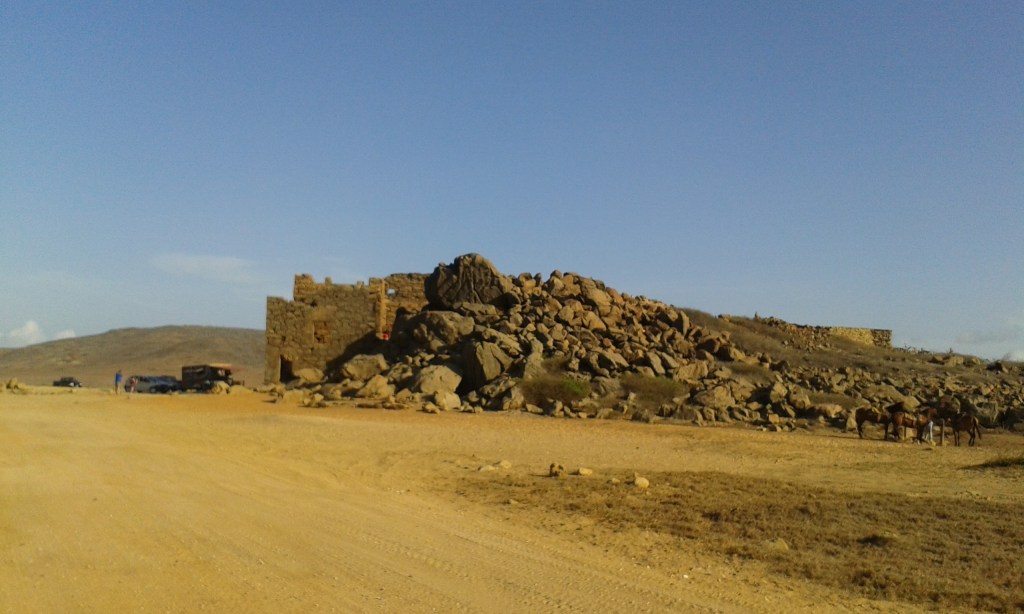
There is a gold mine and a natural bridge on the north and a large windmill farm. Semi-domestic goats graze in the arid landscape. I liked going to the wild side and watching the brute force of nature. The Arikok National Park occupies nearly a third of the island and has the highest peak, Yamanota (about 250 m), and spectacular cacti. It also has a cunucu, a traditional Aruban house. A Cunucu has thick walls that are whitewashed with small windows to stay cool in the heat.

Rainwater is collected for daily use. Today the water needs are met by desalinating sea water. The plant is located near Savaneta on the highway to San Nicolas. Water and electricity supply is stable, and disruptions are rare.

Most people have cars while the blue Arubuses provide public transportation. The bus frequency is low. Hooiberg is a mountain that rises steeply from the surrounding plains and climbing to the top provides excellent views of Oranjestad, the harbour, and the surrounding countryside.

The area around Noord is the tourist heartland and the lemon-yellow California lighthouse is located here. The lighthouse is named after the steamship, California, which sank near these waters in 1891. The downtown area of Oranjestad has Wilhelmina Park, Fort Zoutman, and the Willem III tower. The fort was built in 1798 by African slaves. There is also a historical museum nearby providing an excellent overview of the island’s history and geology. The Alto Vista chapel has a spectacular view of the surroundings and was originally built in 1750 by the Spanish missionary, Domingo Antonio Silvestre.

Aruba may be the most Latinised of the Caribbean islands. There is also a strong Dutch influence. Dutch and Papiamento are widely spoken. Papiamento is a Portuguese-based creole language. English and Spanish are also widely understood.

A lagoon

Aruba grows high-quality aloe vera and Aruba Aloe founded in 1890 is the world’s oldest aloe factory.  Aruba has plenty of beaches, Druif beach, Eagle beach, Palm beach, Malmok beach, and others. The island has invested in equipment to maintain the beaches. Turtles lay their eggs in the white sand and hatchlings clumsily move back to the ocean. The natural pool or conchi is located on the north side. Butterfly farm, Philips’s animal garden, and the Donkey sanctuary provide shelter to the fauna. You can volunteer at the donkey sanctuary. In Aruba, many families camp out on the beach during Easter. My landlord and his family used to camp on the surfside beach near the airport.

Aruba has high human development indicators. Healthcare is provided by the government through a corporation financed by taxes. Alcohol is widely consumed but I did not see drunken fights or disorderliness during my time on the island. Drivers need to be careful on Friday nights when parties get going. This arrow-shaped island with a variety of cultures and influences is geographically sheltered from the worst hurricanes with the balmy weather, caressing winds caressing, and inviting waters. The people are friendly. The moniker ‘One Happy Island’ may be well deserved!         

[1] Translates to Islands Useless

Dr. P Ravi Shankar is a faculty member at the IMU Centre for Education (ICE), International Medical University, Kuala Lumpur, Malaysia. He enjoys traveling and is a creative writer and photographer.

.

PLEASE NOTE: ARTICLES CAN ONLY BE REPRODUCED IN OTHER SITES WITH DUE ACKNOWLEDGEMENT TO BORDERLESS JOURNAL

Click here to access the Borderless anthology, Monalisa No Longer Smiles

Categories
Essay

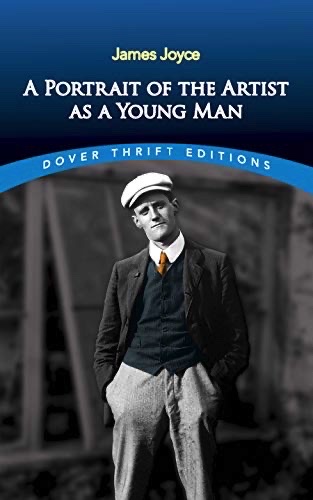
Cadences in A Portrait of the Artist as a Young Man

By Paul Mirabile

As the reader knows, syntactic and semantic rhythm in James Joyces’s writings was of capital importance. So important in fact that although he was staunchly anti-religious ( due no doubt to his severe religious schooling), the power and the movement of the sermons or homelies he heard when attending the Jesuit Seminary offered him ample linguistic material to contemplate and make full use of, as we shall see, in his A Portrait of an Artist as a Young Man[1]. To demonstrate this rhythmic force, I shall succinctly explore Joyce’s adjectival use in chapter three of his 1916 novella, adjectives that function either as noun modifiers, predicate attributes or verbal modifiers[2].

The writing cadence of chapter three can be configured to a descrendo-crescendo movement whose scores of adjectives express the falling and rising of Stephen Dedalus’ inner oscillating,  ambiguous emotions, his existential battle between Good and Evil. Joyce orchestrates, adjectivally, this movement with bombastic brio …

Every adjective, whatever its function be, underscores a movement, strikes up an image which represent the tortures and torments of Stephen Dedalus’ heart and mind, Joyce’s young hero. Each and every adjective rings a note of flat sadness or sharp happiness particular to Stephen’s waning or waxing states of mind. At the outset of chapter three, Joyce takes measure of Stephen’s inner and outer discordance with the following concaténation of adjectives : “December dusk, tumbling, dull day … dullsquare … gloomy, secret night … squalidquarter … devious course … darkcorner, clothlesstable … gawdy playbill … weary mind.” This melancholic opening movement sounds out Stephen’s visions as he roams through the“dulllight” and “colddarkness” of the streets of Dublin, or whilst listening to the sermons of the rector or preacher of his school. All the adjectives underscore Stephen’s terrible emotional ‘decrescendo’ which had been gradually spiralling downwards from the fabulous heights of joy that he had experienced at the end of chapter two.

And yet, the dark and grim adjectives go beyond the mere description of Stephen’s emotional state : they compose the vying forces of Good and Evil that rage within his heart ! In chapter three, Joyce communicates, with frightening precision, the impact of Good and Evil on his protagonist’s mind and body by the descriptions of Hell and sin as depicted by the rector or preacher. These descriptions galvanise the adolescent to such an extent that his only relief, his only vented recourse will be to take refuge in prayer to atone or repent for his sins by confessing them, and this, as I stated above, in spite of his anti-religious sentiments.

Chapter three takes place during a retreat. Stephen has become a prefect[3] at the sodality[4] of the Blessed Virgin Mary, and his contradictory way of life (sleeping with whores) has caused him to reflect upon his ambiguous existence. At first he displayed an apathetic indifference towards these feelings of remorse. Everything around him took on a sullen monotony which slowly seeped into his soul, so that  “a cold, lucid indifference reigned in his soul”. ‘Lucid’ here, albeit etymologically evokes ‘light’, in fact denotes the opposite : a heaviness of spirit, a numbing of the soul. Adjectives such as ‘cold’ and ‘dull’ connote Stephen’s pangs of self-guilt : “The chaos in which his ardour extinguished itself was a cold indifferent knowledge of himself.” The ardour that he experienced in chapter two has now been extinguished, and in its place a coldness of indifference seizes him, whose benumbed iciness he then projects outwards towards his classmates in sullen mockery : “… he glanced coldly at the worshippers” at “their dull piety”.

This projection grows stronger as he ignores his classmates, wrapping himself up within himself. He becomes terribly aware of his tribulations, his tremulous soul, which appear to have gained the upper hand on him. His former preening hauteur has fallen into a “barren pride”. “… the dusk, deepening in the schoolroom, covered over his thoughts.” He felt himself to be “… the swamp of spiritual and bodily sloth in which his whole being had sunk.” Hence, “Stephen’s heart began slowly to fold and fade with fear like a withering flower”. Overwhelmed by the throngs of fear, Stephen’s thoughts and heart sank into a quagmire of self-abomination, highlighted not only by the verbal modifier ‘withering’, but also by the alliterating ‘f’s of ‘fold’, ‘fade’ and ‘fear’ which ‘resonate’ his crying, discordant soul …

It is only when the preacher had begun his sermon that Stephen’s fall — that is, his incapacity to pull himself out of the ‘swamp’-, reaches its vibrant pitch of self-maceration as he listened to the thundering words of the preacher, recalling to the students by enjoinment and injunction the great theological questions of Catholicism. Questions that hammered at our hero’s head, and which brooked no contradiction nor went unchallenged scientifically, the fiery and fearless proof of which drove deep into the souls of those who listened. And although some might not have been sinners, many if not all would inexorably become one ! As to Stephen, he knew his sins to be countless ! “In the silence their dark fire kindled the dusk into a tawny glow. Stephen’s heart had withered up like a flower of the desert that feels the simoon coming from afar.” Joyce’s metaphor of a ‘tawny’ or brownish, darkening glow, and a heart withering as a flower would without water or sunshine, marks his hero as having fallen into the arid, sand-filled vastitude of Evil, unable to refresh his soul with the cleansing waters of Good …

A running parallel develops thus between the preacher’s trenchant words and Stephen’s culpable conscience, transforming the preacher’s words into knives and daggers that cut and slice at his defiled body and spirit. Here the long sermon, filled with brimstone, Judgement, Hell, Fire and Death, made the young boy ponder over his present state of mind both in the chapel and outside it, roaming the streets of Dublin in quest of loose pleasure. The sermon made him reflect upon those unholy nights and days, whoring within the folds of “thick fog …” trapped within “… the fog of his mind” … in the “darkening street”, in “the dull night, and that was life”. Everything about him was laden with a loathing dullness. The adjective ‘dull’, veritable leitmotif, is repeated more than ten times in this chapter, rivalled only by ‘dark’, for ‘dull’ evokes both Stephen’s mental state and his sordid surroundings. It discloses the gravity or weightiness of his mind in the same way that it describes the depraved streets of Dublin, which are indeed both ‘dull’ and ‘dark’. ‘Dark’, too, are his thoughts as he struggles against the forces of Evil which leave : “Stephen’s face pale and drawn[…] his voice broken.”  From those days of debauchery up till that ponderous sermon, his life had been inert, indolent, cloudy, due to the heavy fog that surrounded his heart and mind. Meanwhile, Stephen battled on in “listless despair[…] his dying limbs, his speech thickening and wandering and failing”. Joyce strings out four verbal modifiers which dramatically sound out the present state of his crestfallen hero. And if this terrible decrescendo were not enough, Stephen sees himself already in the grave, left “…to rot, to feed the mass its creeping worms and to be devoured by scuttling plump bellied rats”.

Stephen felt the weight of his sins as he imagined Doomsday to be near in sight : “The universe had become as sackcloth of hair …” “The moon was bloodred …” “The trumpet the brazen of death”.  Religious signs popped up in his mind convincing him of his disloyalty towards God. And as the sermon reached its ringing crescendo, as each adjective struck sensitive chords in Stephen’s tortured mind and body, scenes of unmitigated rack followed one after the other : death, judgement, sin and blare of the trumpet. Joyce records that : “The preacher’s knife had probed deeply into his disclosed conscious and he felt now that his soul was festering in sin.”

Slowly but surely Stephen was being swayed by the preacher’s words in the chapel “flooded by the dull, scarlet light”. “The sordid details of his orgies stank under his very nostrils.” Everything was afire, filled with blood, ‘scarlet’ red. Joyce’s adjectival cadence rhythms Stephen’s suffering: his hero smells the brimstone and fire, tastes the unmitigated heat of the preacher’s admonitions. The images of blood, red for death, are evoked when Stephen imagines the Biblical Flood scene : the drowning people … death ! He soon sees himself as Lucifer, the greatest of all sinners, his hero ; one with whom he could identify himself in view of his present agony. The admonitions drive ever downwards into the very fiery pit of damnation as the preacher raves on and on about Hell, darkness, worms gnawing at eyes, the Devil that saints such as Catherine of Sienna have seen with their own eyes ! His words swell with precise facts and figures to render Stephen’s ordeal both mentally and physically more unbearable : The walls of Hell are four-thousand miles thick, its fires do not burn the flesh but maintain it in eternal torment. “Saint Francis Xavier converted 10.000 souls in just one month !” sermons gravely the sermoniser. These bombastic figures and unchallenged facts are intermingled with eye-witness accounts of Hell written by well-known saints[5]. All these details transform Stephen into Hell itself as he hears a chorus of shrieks ring out in his fissured skull : “His brain was simmering and bubbling within the cracking tenement of the skull. Flames burst forth from his skull like a corolla, shrieking like voices : Hell ! Hell ! Hell ! Hell !”

One may say that every adjective that poured forth from the preacher’s mouth (or Joyce’s pen!) would brand Stephen for life, the imprint or mark of which making him afraid to enter his own room lest Death sweep him away … These terrible moments of guilt, up till his confession, represent Stephen’s imprisoned thoughts seeking sanctuary in a form of self-recognition ; that is, a self-understanding that persuades him that up till then only the Church, or better phrased, the Church’s ‘semantic authority’ had persuaded him to capitualate. For indeed, in the first two chapters the vaunting vainglorious Stephen had refused to apologise to his mother (his family) over a trifling ; had adamantly declined to yield about Lord Byon during a literary dispute before his mates. But now because of the preacher’s booming sermon, he will confess his waywardly ways, and by doing so, acknowledge his faults to God, and more importantly, to himself. He will avow to a father-confessor his contradictory existence. Indeed, the preacher’s reverberating handling of words brought the proud pedant to bay …

Stephen mocked himself during that period. He damned himself. Adjectives such as lusty, unbearable, intolerable, thick, dark and agonizing filled his mind until he vomited them into the wash-basin of his bedroom, so repeatedly had they been beating inside his head.

It is only after the confession of his sins (and they were plentiful!) that we read the beginnings of Stephen’s atonement and repentance, the sharp movement upwards rising from the bowels of Hell, scaling and scaling ever higher, breaking out into some celestial aria where the bombastic crescendo reaches its most airy and consonant strains, acutely measured by the peals of adjectives that now clanged from Joyce’s pen : “His sins trickled from his lips, one by one, trickled in shameful drops from his soul, festering and oozing like a sore, squalid stream of vice. The last sins oozed forth, sluggish, filthy.” The ‘last’ sins of a befallen soul, rhythmed by six of the most abject adjectives, in fact trigger Stephen’s revival, rejuvenation … resuscitation ; glorify his now “purified body”. Indeed, the father confessor’s voice “fell like sweet rain upon his quaking parching heart”.  Stephen’s confession soars him back to the heights of a joyous consonance he had enjoyed in chapter two. Now “the muddy streets were gay. He strode homeward, conscious of an invisible grace pervading and making light his limbs. His soul was made fair and holy once more, holy and happy.” (page 133). Yes, the ‘invisible’ grace is the grace of God whose shining benevolence upon Stephen has been prompted by the preacher’s excellent sermon and the father confessor’s astute forgiveness.

Stephen has indeed overcome Evil by the force of his elders’ well-chosen and -articulated words. We now read adjectives like ‘light’ which qualifies his limbs, those same limbs that at the outset of the chapter were ‘lifeless’. ‘fair’, ‘holy’ and ‘happy’ describe his now cleansed soul, vibrant substitutes for his former ‘dark’ and ‘dull’ soul. ‘Dark’ no longer modifies its nouns, but ‘clear’ and ‘white’ ring out on the pages : “white flowers’, ‘white pudding”. We read ‘morning light’ and no longer the ‘dark night’. ‘White’ flowers is repeated twice : “… white flowers were clear and silent as his own soul”, which, prior to the sermon and his confession, had been withering. He even felt that his classmates were ‘happy’ as they knelt in prayer at the chapel ! Our hero, thus, sums up his resonant revival : it is “beautiful to live”.

The battle between Good and Evil rose to a vibrant finale with Stephen’s triumphant victory. A victory in alliance with the preacher’s timely words which led him to the confession box, and to the father confessor’s humble but firm absolution. And although Stephen does admit that the father confessor’s words were ‘dull’ and ‘tepid’ as compared to the preacher’s horns and trumpets, there is no doubt that the power and vigour of language itself, be it flat or sharp, incited him to abdicate or surrender to his mixed and complicated juvenile emotions in order to receive absolution. For only the force of well-worded phrasings could have brought him to the confession box, could have breached his anti-religious rampart ; could have made him comprehend physically and psychologically the abyss which separates Good from Evil. In short, at the end of chapter three, Stephen’s crestfallen spirits reached the highest of pitches …

Now, whether or not Stephen Dedalus’ spirits will sustain that high pitch along the paths of his long life remains to be seen …      

.

[1]            A Portrait of an Artist as a Young Man, Penguin Modern Classics, London, England, 1931.

[2]          Verbal modifiers are participles that function as adjectives. Another term for predicate attributes is attribute complement.

[3]            A senior pupil in a religious school who maintains discipline.

[4]            A place of retreat where a group of people spend a period of seclusion in prayer and meditation.

[5]          For example Saint Theresa of Avila in her El Libro de la Vida (The Book of Life)..

Paul Mirabile is a retired professor of philology now living in France. He has published mostly academic works centred on philology, history, pedagogy and religion. He has also published stories of his travels throughout Asia, where he spent thirty years.

.

PLEASE NOTE: ARTICLES CAN ONLY BE REPRODUCED IN OTHER SITES WITH DUE ACKNOWLEDGEMENT TO BORDERLESS JOURNAL

Click here to access the Borderless anthology, Monalisa No Longer Smiles

Categories
Essay

When ‘they’ Danced…

Ratnottama Sengupta is riveted by the phantasmagoric Bhooter Naach, the Ghost Dance, in Satyajit Ray’s legendary film — Goopy Gyne Bagha Byne — that has no precedence nor any sequel in cinema worldwide.

Some years ago, I was preparing for my talk on dance in Hindi Films, given to the Film Appreciation students at the Film and Television Institute of India in Pune. I noticed that every major director in the earlier years, from Uday Shankar (Kalpana, 1948), V Shantaram (Jhanak Jhanak Payal Baje, 1955), and K Asif (Mughal-e-Azam, 1960), to Guru Dutt (Saheb Bibi Aur Ghulam, 1962), K A Abbas (Pardesi, 1957) and Sohrab Modi (Mirza Ghalib, 1954) had started with Indian classical dance in its purest form – Kathak — and the leading ladies Vyjayanthimala, Waheeda Rahman and Padmini came equipped with the dance of the devadasis, Bharatanatyam. Subsequently however, most filmmakers diluted the purity of these dances, perhaps to suit the situation in their films. And in recent years that dilution has gone further to take the form of fusion dance, westernised dancing, and group dancing to add volume to the glamorous visual of female torsos in movement.

Suddenly it struck me that Satyajit Ray (1921-92) too had used Kathak in its purest form in Jalsaghar (1958) and then ‘diluted’ the purity of classical movements to design the rhythmic footwork of disembodied spirits. And it dawned on me what level of genius could create a dance that becomes a visual statement on the history of the land itself! Of course, I am talking about the ‘Dance of the Ghosts’ in Goopy Gyne Bagha Byne (1969). The towering presence had ‘choreographed’ this dance which has simply no parallel in the world of cinema. Yes, the director — who also penned the lyrics besides screenwriting his grandfather’s adventure story first published in Sandesh in 1915 – had diluted the classicism of Kathakali and Manipuri. But he had fused in so many more art forms like masks, paper cutouts, shadow art, pantomime, celluloid negatives and special effects that it emerged as a class in itself, giving even today’s viewers an experience nonpareil.

In this fantasy that ends as a fable with a timeless moral, Ray experimented with a psychedelic burst of dancing. The narrative pivots on a tone-deaf singer and a bumbling drummer. Essentially though Ray’s telling of the ‘fairytale’ was a garbed plea against war. The message he sent out loud and with laughter: “When people have palatable food to fill their belly and music to fill their soul, the world will bid goodbye to wars.”

But Ray’s recounting of the story was far from didactic. Indeed, he himself is known to have said, “I don’t know if you can truly demarcate fantasy and fable.” So, instead of categorising it as one other the other, he recommended that we see Goopy Gyne Bagha Byne (GGBB) only as the story of a duo of untalented musicians. Their playing earns ridicule from fellow villagers and contempt from their king but appeals to the upside-down aesthetics of ghosts. The charmed King of Ghosts appears with an eerie twinkling of stars and a disembodied voice to bless them with three boons. With an enjoined clap of their hands, they could feed to their heart’s content, they could travel where they want to in their charmed shoes, and their music could entrance their listeners.

Building upon this children’s story, Ray himself wrote the dialogue, designed the music, the costumes of the entire cast, and the choreography of the Ghost Dance that is redolent of Uday Shankar’s Kalpana. The dead come alive when Goopy-Bagha play and perform a surreal dance that briefly echoes the past of India — because bhoot kaal in Bengali means ‘past tense’.

The celluloid representation depicts in minute details the division of society into caste, class and creed since time turned ‘civilised’. Ghosts in the first group are the royals – from the age of Puranas through Buddha’s times to the rule of Kanishka Gupta. The shadowy, amorphous shapes in the second lot belonged perhaps to the lowest strata of those they ruled – peasants, artisans, Santhals, Bauls, Mussalmans. The third set of ghosts recall the story of colonisation by people who are suited-booted, wear hats, walk with a stick, indigo planters who drink whisky from bottles and strike awe with their body language. The fourth group comprises potbellied ghosts whom Ray identified as ‘Nani Gopals’. They wear costumes that remind us of city-dwelling zamindars, money lenders, padres who try to teach Bible and orthodox priests who run away from them. Their bulky forms contrast the skeletal shadows that precede them on the screen – perhaps because they thrived by exploiting the plebians?

All these ghosts are described later by Goopy and Bagha: they are Baba bhoot Chhana bhoot, Kancha bhoot Paka bhoot Soja bhoot Banka bhoot, Roga bhoot Mota bhoot. Thin or fat, short or tall, crooked or straight, simple or strange… between them, they are the world we inhabit across time and space!

Each group appears separately, in harmony; then they reappear to fight a war and kill one another. The pantomime is danced only to the clash of percussion instruments – and makes us wonder, when did homo-sapiens get so divided?

The allegorical dance in four segments is a phantasmagoria of styles and moods that mesmerises at every repeat viewing – as much by the visuals as by its conceptualisation. But what were the technical feats that shaped the fantastic performance? In an interview given to Karuna Shankar Roy for Kolkata, a magazine edited by Jyotirmoy Dutta, for its special edition on Ray (published on May 2, 1970), the master himself had guided viewers through the Bhooter Naach. Let me retrace part of the journey.

*

Ray had, since Teen Kanya (Three Daughters, 1961), scored the music for his films as the ustads he earlier collaborated with were too engrossed in their ragas to understand the needs of a film script. In GGBB, in addition to the theme music that has always borne his signature, the songs had to speak, act, develop the characters…

Let me elaborate. The original story simply said Goopy is a singer. But when Ray sat down to write the songs he had to draw upon words, and since words have meaning, the songs “say” something. When Goopy sings to arrest the march of the advancing soldiers, what could the words say? Clearly they couldn’t say, “Dekho re nayan mele jagater bahar! Open your eyes to the wondrous beauty of this earth” – that is the ditty Goopy sings right after being blessed by the King of Ghosts. Set in the calming morning raga Bhairavi, it would not be appropriate here. So he sings, “O re Halla Rajar sena, tora juddha korey korbi ki ta bol! Tell us, oh soldiers of King Halla, what will you achieve through war? You will only sacrifice your life at the altar of weapons!” At once the song becomes a diatribe against wars worldwide and through history.

So, the words are fed by the situation in which the song is being sung – and the movements were stylisation that sometimes leaned towards the Western classical form of Opera and sometimes towards Bengal’s very own Jatra[1]. GGBB is in that sense a complete musical. Yet, I notice that the songs here don’t carry the story forward – instead, they arrest movement. In that sense they can be said to owe their lineage to Jatra where the songs act like the Greek chorus, commenting on the action and acting as the conscience keeper.

Ray did not settle for the obvious, much heard folk songs of Bengal, be it Baul or Bhatiali, Bhawaiya or Gambhira, Kirtan or Shyama Sangeet, Agamani or Patuar Gaan. Nor did he entirely shun the robust classicism of ragas. He crafted his own folksy scheme that was close to the soil of the rustic protagonists yet uncomplicated enough to appeal to the strangers inhabiting the land where they find themselves amid scholastic vocalists. Here, in the distant land where Goopy-Bagha had travelled in their magical shoes, their music had to transcend the barrier of language. In Ray’s own words, “it had to be deshottar, kaalottar[2]”. And in being so, every one of their songs has become timeless. Be it Mora sei bhashatei kori gaan/ We sing the melody of that or any language, or Aay re aay manda mithai/ Rain down on us, sweets for every taste – today they are a part of Bengal’s cultural ethos.

Ray may have caricatured the learned ustads seasoned in ragas but, repeatedly and in various ways, he uses Carnatic music. When Goopy and Bagha are fleeing from the lock-up, the stylised flight parodies Bharatanatyam movement – “Goopy re Bagha re Pala re pala re! Run run run…” Contrast this with the forlorn music of “Dukkho kise hoy? What causes sadness?” The score uses merely two string instruments – a dotara, a two-stringed instrument, and a violin which is widely used in Carnatic music “but here it is played much like the sarinda that is popular in East Bengal,” Ray had explained in the 1970 interview reprinted in Sandesh.

However, I am most fascinated by the use of Carnatic musical instruments in the Ghost Dance at the outset. As in the rest of the film, this sequence too has heavy orchestration — but the movements are choreographed not to a song, only to a quartet of percussion instruments.

At the risk of repeating myself I underscore that Bhooter Naach has no precedent nor any sequel in any movie made in any country at any point of time. So, to understand the process of its creation, we can only listen to Ray. “The story simply said, ‘the ghosts came and danced’. But how could I realise that in visual terms? Bengal of course has a conventional description of ghosts: their ears are like winnows, their teeth stick out like radish, they are pitch-dark, with arched back. But this would not be artistic. Nor could this meagre description sustain me through an entire sequence that had to create an impact deep enough for the film to rest on. Besides, there is no convention about their dancing. That is why I started to think:  What if those who actually lived and died, were to come back? How would their bhoot look and behave?”

Here, let me add that for Satyajit Ray as for Upendra Kishore too, the term bhoot was not synonymous with the English ghost or spirit. Indeed, ghosts have been part of our folklore since our forefathers peopled Bengal, so much so that villagers still won’t utter the word after sunset, preferring to refer to them as “They”. In fact, the bhoot always had a different connotation in Bengal’s literary convention that has an entire genre thriving on bhoot-pret-jinn-petni-sakchunni-dainee-Brahmadaitti… Not only is the phantom celebrated in Sanskrit literature’s Betal Panchavimsati, Tagore, talking of his childhood, writes how he expected one of them to stretch out a long arm from the trees after nightfall. Ray’s ‘Lilu Pishi’ – Leela Majumdar – had authored Sab Bhuturey[3], a collection of ghost stories, while Ray himself gave us Baro Bhuter Galpo [4]a fun collection of 12 stories meant to exorcise fear! The tradition continues to live on, through the pen of Sirshendu Mukherjee, author of Nabiganjer Daitya[5], Gosain Baganer Bhoot[6], and Rashmonir Goynar Baksho[7]that was made into a film by Aparna Sen.

Now, to circle back to the Ghost Dance: Once Ray had transformed the ‘positive’ – read, live humans — into their ‘negative’, the dead, he realised that they could be kings and colonists as in history books, and they could be farmers and sepoys, Buddhists and Bauls, preachers and rioters too. After all, there were miles of burial ground in Birbhum — the location where Ray was shooting — that were the resting ground for Europeans who had breathed their last in Bengal. Thus, organically, came the thought of the four categories of ghosts distinctly identified through the visuals: A) the royals; B) the exploited class; C) the firangees or foreign imperialists; D) the bloated exploiters – baniyas or shopkeepers, capitalists, preachers.

The ghosts of imperialists

In the Kheror Khata, notebooks where he drafted every frame for GGBB, Ray actually names his ghosts. So, Warren Hastings, Robert Clive and Cornwallis are resurrected with their guns and their swords. This reminded me of the Terracotta Soldiers I have seen in Xian: the funerary sculptures depicting the army of Qin Shi Huang, the first emperor of China, were modelled on actual lived soldiers, I had learnt. Similarly, the thought of Chatur Varnashram[8]may have led to the four classification of ghosts – and the depiction of rows of simplified human figures on many of our temple walls – including Konark — could have inspired the vertical arrangement of the four groups, one on top of the other.

In execution, these ‘disembodied’ figures were given body by actual dancers. “We spent long hours together choreographing the sequence,” Ray said of Shambhunath Bhattacharya who had trained students in his dance school to take turn in dancing the classical footsteps. Their costumes and make up were, of course, designed by Ray and devised by art director Bansi Chandragupta, in keeping with their station in life. The exception was the Europeans: Ray used shadow puppets dancing 16 frames a second to evoke their mechanised manner. The action was in ‘five movements’: They come, they dance, they clash and war, they build up a frenzy that is resolved in harmony. The ghosts, after all, cannot die again!

Realising the movements was a challenge that the genius overcame technically. “If the four rows had to be physically shot, with four rows of dancers standing one over another, it would have needed a three-storey space. So, we arranged two rows at first, photographed them by masking top half of the film. Then we reversed the film and operated the camera to capture two more rows. The camera was on a crane and at the precise moments marked by music, we had to zoom back from the close up…”

The music for Bhooter Naach has its origin in the Carnatic taal vadya kacheri – an orchestra of percussion instruments that Ray first heard on radio, then witnessed at the inauguration of an International Film Festival of India (IFFI) in Delhi. He decided to use a unique quartet comprising of mridangam, ghatam, kanjira and morsing. For the uninitiated: mridangam is a double-sided drum (somewhat like Bengal’s terracotta drum, khol) with a body made from hollowed jackfruit wood and the two mouthpieces covered by stretched goatskin. Ghatam, known as ghara in Punjab and matka in Rajasthan, is a clay pot with a narrow mouth whose pitch varies with its size. Kanjira, belonging to the tambourine family, has a single pair of jingles on it. And morsing, a plucked instrument held in the mouth to make the ‘twang twang’ sound, is also found in Rajasthan and Sindh. Ray used mridangam for the royals “because it is classical,” and their dance movement is also purely classical. Kanjira, with its semi-folk sound, he used for the farmers, and ghatam with its somewhat rigid sound was right for the rather wooden, mechanical movement of the Europeans. And the croaking sound of the morsing? Yes, it was just what the comical bloated figures needed!

Bhooter Raja or the ghost king

Finally, we come to the most haunting part of the stellar performance: the Ghost King who grants Goopy Baagha the three boons that change their lives, the lives of the kingdoms of Shundi and Halla, and the definition of fantasy in cinema. Chumki, the decorative spangles predominantly used in zardozi, combined with a soft light that diffused the reflected shine of the beads to work ethereal magic. The radish-like teeth crafted from shola pith – the milky white Indian cork that is hallowed by its association with Puja in Bengal — stuck out of the pitch-black body that had eyebrows whitened with paint. Finally, a thick white ‘sacred thread’ across its chest completed the appearance of the gigantic holy demon, Brahma Daitya.

The matching intonation? We all know by now: It was The Master’s Voice. Sound engineer Babu Sarkar had recorded Ray’s baritone, then played at double speed, and rerecorded it…

Only a genius of Ray’s stature could visualise this!

This essay is part of the online website dedicated to the Kheror Khata Satyajit Ray maintained, detailing the making of Goopy Gyne Bagha Byne. This was launched to celebrate the Birth Centenary of the legend. Republished with permission from TCG Crest.


[1] Folk theatre from Bengal

[2] Beyond the bounds of countries or time

[3] All ghosts

[4] Big Ghost Stories

[5] Nabiganj’s Demon

[6] Gosain Garden’s Ghost

[7] Rashmoni’s Jewel Box

[8] Four categorisations

Ratnottama Sengupta, formerly Arts Editor of The Times of India, teaches mass communication and film appreciation, curates film festivals and art exhibitions, and translates and write books. She has been a member of CBFC, served on the National Film Awards jury and has herself won a National Award. 

.

PLEASE NOTE: ARTICLES CAN ONLY BE REPRODUCED IN OTHER SITES WITH DUE ACKNOWLEDGEMENT TO BORDERLESS JOURNAL

Click here to access the Borderless anthology, Monalisa No Longer Smiles

Categories
Essay

Where Three Oceans Meet

By P Ravi Shankar

Vivekananda Rock Memorial. Courtesy: Creative Commons

I had always looked forward to visiting Kanyakumari. The idea of standing at the southernmost tip of India and gazing at the vastness of the Indian ocean was irresistible. There is no major land mass till you reach the southern continent of Antarctica. The union of the waters of the Arabian Sea, the Indian Ocean, and the Bay of Bengal make this area, referred to as Triveni[1]Sea, unique.

We wanted to visit the Southern most part – the Vivekananda rock, where Swami Vivekananda meditated before going to Chicago in 1893. However, the gate slammed shut as we rushed to the ferry terminal. It was past four in the afternoon, the hour when the last ferry departs for the rock that was at a point peaceful and calm. With it evaporated our hopes of visiting the Vivekananda rock memorial at Kanyakumari.

We were not deterred by having failed in our endeavour. We decide to continue our exploration on the mainland to see as much as we could. Huge crowds were everywhere. It was school holiday season, and everyone seemed to be travelling. Chaotic was the word that would best describe the situation. As my travel companion, Subhish, and I moved around, we noticed nearly every house in Kanyakumari seemed to have been converted into a restaurant and a homestay though waste management was poor and the toilets – especially in the tourist spots — were unsanitary and unusable.

We went to the Gandhi Mandapam by the Triveni Sea from where the Vivekananda Rock could be viewed. You can get an excellent view of the Vivekananda memorial and the statue from the top floor. In February 1948, Mahatma Gandhi’s ashes were immersed at this intersection. The memorial building houses several old photographs relating to Gandhi’s life but the museum needs maintenance and cleaning.

Kanyakumari houses ancient history. Our journey had started at the Sree Adi Kesava Perumal Temple, a temple dedicated to Vishnu, a major Hindu God, had been built in the Dravidian style and dates back at least to the seventh century. The stone and wood carvings speak of the deep devotion of the craftsmen.

Kanyakumari district had been part of the erstwhile kingdom of Travancore. King Marthanda Verma, who lived in the eighteenth century, is regarded as the founder of the Kingdom of Travancore. He had defeated the Dutch East India Company. A staunch devotee of Vishnu, he would pray before all his campaigns. Kanyakumari district had been the granary of the Travancore kingdom and was handed over to Tamil Nadu during the re-organisation of India along linguistic lines in 1956. Subish mentioned how his parents had told him about the fear and violence that existed for several years after the handover. Some of the monuments in the district are still maintained by the Kerala government under a 99-year lease. 


Just before lunch, we had visited the Padmanabhapuram palace, the capital of the Travancore kings which was rebuilt on an earlier structure from in the sixteenth century. King Marthanda Verma dedicated his kingdom to Lord Padmanabha, a manifestation of Lord Vishnu. The King and his successors saw themselves as Padmanabha dasa or subjects of the lord. The palace was vast and sprawling and situated in a four-kilometre-long fortress. Made entirely of wood, it had exquisite carvings. Though in some places, only the frames remain to suggest a story. There seemed to be massive halls where up to a thousand people could be fed at one time. They suggest a testament to the generosity of the kings. The palace unfortunately does not provide a glimpse into the life of its royal inhabitants. Having visited several museums and palaces elsewhere, I believe serious thought and action may be required on how to present this cultural gem better to visitors.

Pechiparai Reservoir

The Pechiparai Reservoir, where we stopped, has an interesting history. The dam was built across the Pechai River by a British engineer, Mr. Minchin working in the Travancore irrigation department. The site is peaceful, away from the hustle and bustle, and surrounded by green hills. In the 1880s when the dam was being built this would have been a remote location. Mr. Minchin’s grave has a home here – far from his own homeland in Britain.

Mathoor Aqueduct

We also visited structures closer to our times — the Mathoor Aqueduct, built in 1965. This is among the longest aqueducts in India. I was reminded of the Roman aqueducts. The view of the surrounding valley and hills from the aqueduct was spectacular. A rich agricultural area, you can walk along the aqueduct, come down and walk through the garden and playgrounds and then climb back to the starting point.

We drove to Sunset Point to watch the sun dip into the ocean after a hard day’s work. The sunset was spectacular. The few clouds had disappeared. The circular orb slowly sank into the silver sea.

Sunset Point

As dusk set in we started to drive back to Eraniel, Subhish’s hometown where we were staying. Subhish worked in Dubai and was on holiday like me. We stopped at Kilometre Zero on the national highway. The Indian politician, Rahul Gandhi had started his Bharat Jodho yatra[2] here a few months ago. ‘Kashmir to Kanyakumari’ is a popular slogan in India and this spot is a popular starting or ending point for political and other such marches.   

Kanyakumari has red bananas everywhere. They grow well in this soil. I am partial to this variety and enjoy them whenever and wherever I can. The district has several ancient Hindu temples. We were now returning from Kanyakumari. Dusk had settled in and there was a huge line of cars going back to Nagarkovil (Nagercoil in English). We were searching for the nongu fruit also known as ice apple, palmyra palm, and by several other names. We eventually located one at a roadside stall. Eating nongu was one of the best experiences of my life. An absolute delight.

Kanyakumari district has seen great progress over the last few decades. People from all over India have settled here. There are several water bodies scattered throughout the land and several wind farms. Tamil Nadu is among the wind energy giants in India. The climate here is less harsh compared to other parts of Tamil Nadu. Indians now have a good disposable income and are eager to explore their vast country. Will the tourism authorities pick up the gauntlet and cater to this population or will they continue along the old self-centred ways? Only time will tell!      


[1] Translates to where three sacred rivers – in this case oceans — meet

[2] Unite India March carried out in 2022 by the Congress Party

*Photos by P Ravi Shankar and Subhish, where unacknowledged

.

Dr. P Ravi Shankar is a faculty member at the IMU Centre for Education (ICE), International Medical University, Kuala Lumpur, Malaysia. He enjoys traveling and is a creative writer and photographer.

.

PLEASE NOTE: ARTICLES CAN ONLY BE REPRODUCED IN OTHER SITES WITH DUE ACKNOWLEDGEMENT TO BORDERLESS JOURNAL

Click here to access the Borderless anthology, Monalisa No Longer Smiles

Categories
A Special Tribute Essay

Gandhi in Cinema by Shantanu Ray Chaudhuri

An innovative rap contest between Gandhi and Martin Luther King, Gandhi as a stand-up comedian, his life as a musical, and at least seventeen actors portraying him across numerous films. No other political and spiritual leader has influenced our cultural discourse as much as M.K. Gandhi. This despite Gandhi’s deep-rooted aversion to cinema and theatre. Shantanu Ray Chaudhuri looks at the legacy of Gandhi in films, plays, songs and TV shows.

“Slim be a combination of an actual kamikaze and Gandhi.” This is Eminem, seventy years after the Mahatma was assassinated, in a song from his 2018 album Kamikaze, that also became the theme song of the Marvel film Venom. It is interesting to conjecture what the bhajan-loving apostle of peace and non-violence would have to say about being referenced by the hip-hop rapper in a song whose very next lines talk of killing and use the F-word.

Probably no other political leader anywhere in the world has been part of popular culture – films, songs, music videos, animation shows, graphic novels – as much as Mohandas Karamchand Gandhi. Newsreels on him run into hundreds of hours. A China-based journalist, A.K. Chattier, put together one of the first celluloid versions of the Mahatma’s life and times from archival material available, sourcing rare footage. Unfortunately, both the print and the negative have been lost.

Beginning with the American feature documentary Mahatma Gandhi: Twentieth-century Prophet in 1953, to The Gandhi Murder, a conspiracy theory film on the assassination, in 2019, he has been part of at least thirty films. Even the Marvel film Age of Ultron has his footage. As many as seventeen actors have played him onscreen: J.S. Casshyap, Ben Kingsley, Sam Dastor, Jay Levey, Yashwant Satvik, Annu Kapur, Rajit Kapur, Mohan Gokhale, Naseeruddin Shah, Surendra Rajan, Mohan Jhangiani (voiced by Zul Vilani), Dilip Prabhavalkar, Dr Shikaripura Krishnamurthy, Avijit Datta, S. Kanagaraj, Neeraj Kabi and Jesus Sans.

Of these, Sam Dastor featured as the Mahatma in Lord Mountbatten: The Last Viceroy (1986) and Jinnah (1998), while Surendra Rajan has donned Gandhi’s garb as many as six times, in Veer Savarkar (2001), The Legend of Bhagat Singh (2002), Netaji Subhash Chandra Bose: The Forgotten Hero (2005), the TV movie The Last Days of the Raj (2007), the short film Gandhi: The Silent Gun (2012) and Srijit Mukherji’s Gumnaami (2019).

Gandhi and Early Indian Cinema

It was common in the 1930s and 1940s for film hoardings to have life-size pictures of Gandhi over the photographs of the stars. The protagonist of Kanjibhai Rathod’s mythological Bhakta Vidura (1921), the first film to be banned in India, resembled Gandhi, cap and all. Ajanta Cinetone’s Mazdoor (1934), written by Munshi Premchand, too was banned, and promoted as ‘the banned film’, as it dealt with Gandhian principles. Produced by Imperial Film Company and directed by R.S. Chaudhary, Wrath (1931) had a character called Garibdas who fights untouchability. The censors cut out many of its scenes and renamed it Khuda Ki Shaan. Vinayak Damodar Karnataki’s Brandy Ki Botal (1939) took up Bapu’s campaign against liquor and referred to Gandhi as ‘azadi ka devta’.

The Feature Biopics

The most well-known of these is Richard Attenborough’s 1982 film. In the making for over twenty years, it remains, warts and all, the definitive film on Gandhi. And though Attenborough made the cardinal error of falling prey to what Nehru had warned him against at the outset when the director had met him with the proposal in 1963 – “Whatever you do, do not deify him … that is what we have done in India … and he was too great a man to be deified” – there is no doubt that this is an epic labour of love that delivers a series of spectacular set-pieces of great emotional heft.

As the filmmaker himself observed, “It took me 20 years to get the money to get that movie made. I remember my pitch to 20th Century Fox. The guy said: ‘Dickie, it’s sweet of you to come here. You’re obviously obsessed. But who the f***ing hell will be interested in a little brown man wrapped in a sheet carrying a beanpole?’” As it turned out, the whole world was, as was the Oscar committee. And Ben Kingsley set a benchmark for the onscreen Gandhi that has been impossible to top over forty years later. So complete was the identification that a few years later a popular Hindi film, Peechha Karro (d: Pankaj Parashar, 1986), had a character swear by Ben Kingsley instead of Gandhi.

Ben Kingsley

Surprisingly, despite the many incarnations of the Mahatma on cinema, Gandhi is only one of two full-length feature films to deal with his life. The other one being Shyam Benegal’s The Making of the Mahatma (with Rajit Kapoor essaying the role), which as its Hindi title, Gandhi Se Mahatma Tak, suggests, deals primarily with his experiences as a barrister and in South Africa. Several biopics on national leaders of the freedom movement feature Gandhi in important cameos. These include Sardar (d: Ketan Mehta, 1993, Annu Kapoor as Gandhi) and Jabbar Patel’s Dr B.R. Ambedkar (2000, with Mohan Gokhale as Gandhi), probably the first time the Mahatma was shown in a negative light. There was also the 2011 film Dear Friend Hitler, based on his correspondences with Adolf Hitler (played by Raghubir Yadav).

These biographical films include Gandhi, My Father, which deals with his tortured and tumultuous relationship with his son, Harilal Gandhi. Based on the latter’s biography Harilal Gandhi: A Life by Chandulal Bhagubhai Dalal, the film was directed by Feroz Abbas Khan, who had earlier helmed a stage version, Mahatma Vs Gandhi (based on Dinkar Joshi’s Gujarati novel Prakashno Padchhayo), starring Naseeruddin Shah and Kay Kay Menon as Gandhi and Hiralal respectively. The film version starred Darshan Jariwala and Akshaye Khanna as father and son respectively.

The Adversarial Gaze

Existing with the eulogies are a handful of films that portray the world of his adversaries – people like Nathuram Godse and Veer Savarkar, in particular. Unfortunately, none of these have the rigour of the works of Richard Attenborough and Shyam Benegal and have been rightly dismissed as sensationalist. Ashok Tyagi’s 2017 short film Why I Killed Gandhi, which released in early 2022, became controversial for allegedly showing Godse as a hero, forcing its lead actor to apologise for playing the role of Godse. In the same vein is Ved Rahi’s Veer Savarkar (2001). Kamal Haasan’s Hey Ram (2000), a fictional tale of the moral dilemmas facing a would-be assassin of Gandhi, is in comparison a more nuanced take, though Naseeruddin Shah is probably the healthiest Gandhi onscreen ever.

Naseeruddin Shah as Gandhi

But by far the more interesting fiction came close to sixty years ago. In 1963, around the time that Attenborough was talking to Pandit Nehru about his film on Gandhi, Nine Hours to Rama created quite a flutter for its purportedly ‘sympathetic’ take on Nathuram Godse. Narrating the last nine hours of the life of Gandhi’s assassin, this one is a strange beast. Dismissed by academic Ravinder Singh as “a heady concoction of a little history and too much fiction”, the film shows Godse involved in an affair with a married woman and even an encounter with a prostitute. Godse tries to lure the former into sharing a room with him, describing the sexual encounter likely to follow as ‘dessert’ after a meal. No wonder, the film, as well as the novel of the same name by Stanley Wolpert on which it was based, faced protests from both Congress and Godse’s supporters, and an eventual ban.

A laughable enterprise in all respects – the only thing it probably gets right are the three bullets, and even that scene is followed by a ridiculous one where Gandhi forgives Godse who is shown as repenting his act immediately afterwards – what is surprising about it are the credentials of the people involved with the project. The director Mark Robson is well known for Hollywood blockbusters like The Bridges of Toko Ri, The Harder They Hall, Peyton Place and Von Ryan’s Express. The screenwriter Nelson Gidding scripted critically acclaimed ones like The Haunting and Andromeda Strain. And among the cast, we have respected actors such as Jose Ferrer (who essayed the definitive Cyrano de Bergerac on stage and screen) and Robert Morley. 

What makes this somewhat of a curio are the smattering of Indian actors in cameos, including David as a policeman, Achala Sachdeva (as Godse’s mother) and P. Jairaj as G.D. Birla. By far the most interesting and innovative aspect of the film is its credit titles – comprising the ticking of an old-fashioned pocket watch – designed by Saul Bass, which is deserving of a full-length article.

The Shadow of Gandhi: Gandhigiri

Gandhi’s life and philosophy have cast long shadows, particularly in Hindi cinema. Almost all films that show a police station invariably have his photograph up there on the wall as part of the background décor. However, it is in the subtle messaging of Hindi cinema that his influence is most strongly felt, particularly the way our films have for the longest time made a virtue of being poor, equating money with all evil.

Possibly the one film that epitomises the enduring legacy of the Mahatma and was instrumental in reintroducing him in popular discourse is Raju Hirani’s Lage Raho Munna Bhai (2006). In a stroke of genius, the filmmakers have a goonda hallucinating about the Mahatma, who inspires him to ‘Gandhigiri’ (the term caught on in a big way, leading to a 2016 film starring Om Puri titled Gandhigiri) instead of gundagiri as a tool to get your way

Munnabhai and Gandhi

Though not as influential as the Munna Bhai film, Jahnu Barua’s Maine Gandhi Ko Nahin Mara (2005) is as important. The film, about a retired professor whose dementia-wasted mind begins to believe that he was accused of killing Gandhi, is a metaphoric exposition of what Gandhi and the values he espoused mean today, how he has been reduced to a statute, a road and a stamp. If Munna Bhai has the two goondas recalling Gandhi only from his photo on currency notes and on account of 2 October being a dry day, Barua’s film highlights how we remember the man only on two days – 2 October and 30 January

Gandhi’s influence on the national psyche has been part of many other films tangentially. The 2009 film Road to Sangam is the story of a Muslim mechanic entrusted the job of repairing an old V8 ford engine, little knowing that the car had once carried Gandhi’s ashes to the sangam for immersion. While Shah Rukh Khan’s character in Swades is named Mohan, and the film, according to Mahatma Gandhi’s grandson Tushar Gandhi, “epitomises Gandhi’s values”, A. Balakrishnan’s Welcome Back Gandhi (2012) imagines the leader returning to contemporary India and dealing with a country he barely recognises.

Girish Kasaravalli’s Koormavatara (2011) tells the story of a government employee who is selected to portray Gandhi in a TV series, owing to his strong resemblance to the leader. Having never acted before and not a believer in Gandhian principles, he resists before reluctantly taking up the assignment. Reading on Gandhi and his philosophies transforms his life as people start flocking to him and he must negotiate the tricky terrain of being regarded as a modern-day Gandhi.

Different Strokes

Imagine Gandhi and and civil rights champion Martin Luther King Jr engaged in a battle of rap! That is exactly what Keegan Michael Key and Jordan Peele did in the popular web series Key and Peele, which has Gandhi and King going the hip-hop way to decide who is the better pacifist.

While the inspiration behind the name of the Canadian punk rock band, Propagandhi, is not hard to ascertain, the animated TV series Clone High, made by Phil Lord, Christopher Miller and Bill Lawrence, imagined teenage versions of legends, among them Gandhi, who is shown as a ‘fun-loving, hyperactive teenage slacker’. An episode in the popular TV show Seinfeld has a character claiming to have met Gandhi and having an affair with him. In the TV series Family Guy, Gandhi shows up as a stand-up comedian while South Park has a character meeting Gandhi in hell. 

Following in the footsteps of Mahatma Vs Gandhi and Lillete Dubey’s Sammy, from Pratap Sharma’s play (the title derived from the word ‘swami’ which was used by South African whites as a demeaning term for Indian workers), Danesh Khambata went the Broadway-style musical way with his theatrical production, Gandhi: The Musical. The play covers the leader’s life through sixteen songs, a dozen dances, featuring a cast of over forty dancers, incredibly introducing song-and-dance routines into the Mahatma’s life.

The impact that playing Gandhi has on an actor and the process that it involves also need to be explored at greater length as it provides insights on how influential he continues to be. Joy Sengupta, who portrayed Gandhi in Sammy, says, “It changed my perspective in life. I was all revolutionary and fashionably loathing Gandhi. I had even directed a play on Bhagat Singh, taking pot-shots at Gandhi. Sohail Hashmi told me not to do that, as Gandhi was the only and the most powerful secular symbol surviving in India. That kind of opened a few clogs in my head regarding what secularism is, whether it could coexist with spiritualism, etc. Ten years later, Sammy happened. I gave up all mainstream work for four months to focus on the play. I went to every Gandhi institution I could, pored over every photograph to imbibe the body language. Every films division reel to get his body rhythm. Recording of his speeches gave me his intonation and pitch. I switched to a Gandhian diet and lost 12 kg. I travelled by local transport. I took in all the hardships and drew strength from the Gandhian perspective of using your negatives by turning them into your strengths. This is something I had read when I was a kid in a school textbook, and it had remained with me. Now it became my full-blown philosophy – hardships and punishment can go on to make you a better man. I did not go for any complicated process – Gandhi believed in simplicity and executed everything in its simple organic form (something the intellectual Nehru found difficult to understand). It was simple. Be transparent, rely on truth, accept faults and do penance, forgive others, do it yourself, and always look at the poorest and most vulnerable as a consequence of your actions. Most importantly, listen to your inner voice for guidance. If you really mix all that, you get a simple childlike man who was always busy doing simple things to improve his inner being. I aimed for his essence, focussing on catching his spirit on stage and not mimicking him.”

Songs eulogising Gandhi are dime a dozen in India, of course. These include the reverential non-film ‘Suno-suno ae duniya waalon Bapu ki ye amar kahani’(Mohammad Rafi) and ‘Gundham hamare Gandhiji’ (S.D Burman).

While the celebrated ‘De di hamme azadi bina khadag bina dhal, Sabarmati ke sant tune kar diya kamal’ (Jagriti, 1953) spoke of Gandhi as someone to look up to, to emulate, Lage Raho Munna Bhai’s sensational ‘Bande mein tha dum’ made Gandhi cool, a buddy you can count on when in trouble, giving us a Gandhi for Generation Z.

For someone who has been such an integral part of popular culture, and for someone almost deified for his pacifism, Gandhi’s views on cinema are stridently illiberal. In fact, some of his pronouncements almost echo those of the bigoted ‘right’ that keeps calling for bans and boycotts. Describing cinema as a ‘sinful technology’ and a ‘corrupting influence [as bad as] a drinking bout, he said, “If I was made prime minister, I would close all the cinemas and theatres…” and “if I had my way, I would see to it that all cinemas and theatres in this country were converted into spinning halls”.

He watched just two films in his life, and hated both. The first one was Mission to Moscow (1943), which Miraben insisted he watch. The film, based on the memoirs of Joseph Davies, the US ambassador to Russia, featured scantily clad women in a few dancing scene. Horrified, Gandhi admonished the people there ‘for showing such nude dances’ to him. Soon after, he happened to watch Vijay Bhatt’s production Ram Rajya, at the insistence of the film’s art director, Kanti Desai. Extremely reluctant, Gandhi agreed only because, as he said, “I will have to see an Indian film as I have made the mistake of watching an English one.” And contrary to popular opinion, as industrialist Shanti Kumar Morarje mentioned, he disliked it ‘especially because of the shouting and uproar in the film’.

Such was his abhorrence for cinema – “The cinema, the stage, the race-course, the drink-booth and the opium-den – all these [are] enemies of society …” – that industry stalwarts like Khwaja Ahmad Abbas and Baburao Patel wrote open letters and editorials to Gandhi, articulating “the positive contribution of cinema to entertainment and its utility as a tool to further the cause of Indian freedom movement.” Patel wrote: “Let this champion of Daridra Narayan come down and meet us and we shall try to convince him, or be convinced. Surely as workers in the film field, we are not worse than the poor untouchables for whom the old Mahatma’s heart so often bleeds. And if he thinks we are, the more reason why he should come to our rescue.”

But to no avail. Gandhi remained unmoved. As he said, “I refuse to be enthused about [cinema] and waste God-given time [on it] … in Ahmedabad children get headaches, lose power of thinking, get fever and die … The disease is caused by going to cinemas.”

The dislike defied all logic and was so deep-rooted that it probably needs a psychiatric assessment. Or better still, a film that addresses the great man’s aversion to cinema.

(Parts of this essay was first published in The Telegraph)

Shantanu Ray Chaudhuri is a film buff, editor, publisher, film critic and writer. Books commissioned and edited by him have won the National Award for Best Book on Cinema twice and the inaugural MAMI (Mumbai Academy of Moving Images) Award for Best Writing on Cinema. In 2017, he was named Editor of the Year by the apex publishing body, Publishing Next. He has contributed to a number of magazines and websites like The Daily Eye, Cinemaazi, Film Companion, The Wire, Outlook, The Taj, and others. He is the author of two books: Whims – A Book of Poems(published by Writers Workshop) and Icons from Bollywood (published by Penguin/Puffin).

PLEASE NOTE: ARTICLES CAN ONLY BE REPRODUCED IN OTHER SITES WITH DUE ACKNOWLEDGEMENT TO BORDERLESS JOURNAL

Click here to access the Borderless anthology, Monalisa No Longer Smiles

Categories
Essay

A Solitary Pursuit: The Art of Suhas Roy

Ratnottama Sengupta journeys with the signature art of Suhas Roy as it transformed in theme, style, and medium

Suhas Roy = Radha.

Correct.

Suhas Roy = Crows.

Right. 

Suhas Roy = Jesus.

So true.

Suhas Roy = Sensuality.

Yes. Witness the Mistress of the Moon.

For each of these Suhas Roy (1936-2016) was chased by galleries and collectors. His works have been widely exhibited and are well documented. Many of them on view at Mumbai’s prestigious Jehangir Art Galley (January 17 to 23, 2023) are not on sale. The intention is to train viewers on the diversity and skilfulness of the much loved artist from Bengal. In short, to hold up the totality of the artist who enriched Contemporary Indian Art with sketches in Western Academic style, graphics, landscapes; with his series on Crow, Jesus, Radha, The Seductress of Khajuraho; with aluminium paint on glass, acrylic on paper, egg tempera on canvas…

So where do we start? Where did he? There’s a story at every turn in the journey, so let’s start at the very beginning.

A little boy in Tejgaon, now in Bangladesh, had lost his father when he was not even two. One Kaji Saheb, who taught geography in the village school and doubled as the art teacher, took the child under his wings. If the boy learnt to outline India on the blackboard, he could also draw papayas and brinjals. And everything he drew scored 10 on 10. His teacher would say, “It seems you’ll grow up to be an artist!”

The boy loved to spend all his hours drawing and fishing. “How will these pleasures serve you in life?” the family elders would admonish him. The youth would smile in reply and go on, eventually to join the Indian Art College, study new methods of printmaking under Somenath Hore and S W Hayter, visit Paris and Florence to study Michelangelo’s David and Pieta…

Suhas Roy

However, Paris post WWII was an eye-opener for artists like Suhas Roy and, a decade before him, for Krishna Reddy, who had graduated from Santiniketan. Both India and Europe had come out of prolonged periods of turmoil. But, poised on the threshold of an independent existence as a sovereign nation, India was looking back to its roots for defining its identity, whereas England and France and Germany – which were eager to get over the bitterness left by their recent history – were looking for a complete break with the past. For Suhas Roy, returning home meant returning to his cultural roots. And Venus emerging from the Water became kin of the image of goddess Lakshmi emerging from the lotus-laden pond closer home.

*

This Indian-ness was reinforced when he joined Santiniketan as a painting teacher. The lush green environs, the ponds and rivulets, the chirping birds and rustic villagers took him back to the childhood haven snatched away by the politics of religion that had culminated in the Partition of the Subcontinent. Suhas Roy, raised in the British Academic mood, with undying admiration for the values of the Italian Renaissance and the visions of the French Classicists, riding the high tide of Modernism, debating whether to go Abstract or Semi-Abstract, started painting landscapes!

Yes, landscapes. Regardless of what the critics said – just as they did for the Bengal Masters – Suhas Roy was not being ‘regressive’. For, he did not paint any particular spot with fidelity to topography – as John Constable did. Instead, his landscapes were an expression of his yearning for a paradise lost: his place of birth. When he moved from Kolkata to Santiniketan, in a reflection of spatial reality the neighbourhood palm trees started putting their heads up in his paintings. His sensitive foliage, the birds and animals and ponds were all in answer to his quest for the luxuriant green he had left behind, across the Radcliffe Line.

“Santiniketan gave me back the opportunity to go fishing as I used to in East Bengal, and I rediscovered the beauty and calming effect of Nature,” he had said to me when I curated the Living Santiniketan exhibition in Delhi of late 1990s. “It came as a relief to me, burdened as I was with the constant thought of ‘What to paint?’ For, Nature constantly changes.” Additionally, he realised that appreciation of beauty is not confined to a class or profession. “Doctors and poets alike love flowers. So, I decided to go back to landscape, taking no note of whether it was in fashion or out of it.”

*

The crow, very much a part of the Bengal landscape, then became his signature in the 1970s. The scavenger was an attraction because of its black feathers. Japanese water-colourist Yokoyama Taikan (1868-1958) — notable for his role in creating the painting technique of Nihonga — had come to Bengal in early 20th century with scholar Okakura Kakuzo (1863-1913) and helped Abanindranath Tagore master the medium. He had done a series of Mount Fuji in black-n-white. Chancing upon that in the Santiniketan library, Suhas was so impressed as to reach for the austere palette. The crow readily lent itself to the scheme. Spraying the canvas with acrylic paint before construing the image in watercolour, Suhas would use a Japanese colour stick to create tones and dimensions. The Far Eastern concept of an object in a wide open space came to be highly appreciated and widely collected – including by philanthropist politician, Karan Singh.

In Indian philosophy and literature, Nature is the Eternal Feminine. That could be why, after ten years of doing landscape, Suhas Roy’s imagination sought out the allied image of tribal girls. It was a natural progression, for women – especially tribal women – have a symbolic if not symbiotic link with trees. Often, he would counterpoise a tree with a woman. Taru[1], he titled one done in an art workshop.

From a woman in a landscape to Radha was just one step away. For an exhibition on Krishna organised by Gallery 88 of Kolkata, Suhas Roy played with the concept of the Blue God being the Ultimate Being. Melding Purush and Prakriti – the Male and the Female forces of the Universe – his canvas sported a nude woman against a dark blue background. The painting, titled ‘Radha’, not only sold for an enviable sum, but it also set in motion an astonishing demand for the image that shows no sign of abating.

Truly he basked in the adulation of resolved collectors, one of whom said, “When I am tossed and tired of problems, I look at your paintings. They act like balms.” Yet, for painting these very ‘balms’ the artist had to hear the criticism that he was feeding the appetite for calendar art. His Radha was a concept no better than the ‘mass produced’ icons ubiquitous in Indian spaces.  But the master was far from apologetic. “It is the very definition of icons,” he had pointed out to me one afternoon. “Images of personalities deified by popular imagination, be they mythical, historical or social, are repeated again and again, generation after generation, in different styles and contexts.” If one age worshipped them as bronze figurines and gold paintings, another flaunted them in oleographs and calendars. It has been so with Radha-Krishna, Ram-Sita, Buddha-Jesus, and even with Gandhi-Tagore-Teresa, I realised.

*

Jesus, though, had entered Suhas Roy’s world long before Radha. Sometime in 1969 he had visited Florence to see David. He found the sculpture epitomising masculine beauty “too proportionate”, and wandered into the church next door preserving Dante’s Divine Comedy in parchment. There, in one corner, he saw the last work of Michelangelo – an unfinished Pieta. Such infinite pathos! The artist could not brush it off his memory even after he returned to Calcutta and one day its picture postcard inspired him to paint a Jesus. When he stopped, the canvas was sporting a contemporary pieta – Jesus without the head, his body descending from the heavens.

As a persona, Suhas Roy had deep regards for Jesus. He was, to the Bengali artist, a symbol of forbearance. Perhaps he also saw the serene visage of the Prophet sporting a Crown of Thorns as a reflection of his own self – or was it of his country, that had been crowned with an Independence bloodied by Partition? Somewhere Suhas, a father who in his own lifetime lost both his children to Eternal Sleep, saw Jesus as a redeemer who showed mankind how to bear every suffering and pain that was a mortal’s lot. That is why such palpable love, even when tinged with sorrow, pain or sadness, flows out of His veins. This must have prompted even Vatican to acquire his Jesus in 2006.

Suhas Roy arrived at ‘Khajuraho’ in the mature years of his well lived life. He was intrigued by the carvings on the walls of the temples in central India that have embarrassed some and outraged some. Considered the descendants of the celestial Moon, the Chandela rulers had celebrated love in every expressed formation. Love, the invincible bonding between man and woman, man and man, indeed between man and all living beings, is made explicit here. Surely Suhas Roy was not equating love with lust. Was there a spiritual pursuit layering the physicality of the actions immortalised in stone?

No doubt there was. For Moon has always been equated with romance, love, passion. The artist was exploring the mysticism that wraps the ascetic deity inside the temple. Much like the sculptors of yore, his ‘Seductress’ is a quest for the sublime. If the ancients believed that you must leave all your worldly longings outside the temple door if you seek moksha, deliverance, the contemporary artist continually sought nirvana, redemption from conflict, in the beauty of peace.

*

Rigidity was unknown to Suhas Roy. The changes in his art came spontaneously, and every good result goaded him to go on. He dwelt on a theme only until another creative urge besieged him, be it Khajuraho, the series he titled Mistress of the Moon, or Cappadocia in Turkey. Never shy of experimenting, his foremost concern – always – was meticulous quality. His temperas would have egg yolk with oil and Japanese porcelain, gelatin with resin and tamarind seed. If it held the promise of a finer texture for details, he would use a watercolour brush for oil paintings. For, he would repeat, “Good art will never lose its demand just as diamond will never lose its market.”

For Suhas Roy, the aesthetic and the spiritual were one and the same. And even the hurly-burly of political turmoil had to adhere to his norms of aesthetics. Did Suhas Roy, then, live in an ivory tower away from social realities? No, he insisted, he “never ran away…” Once, on a fishing trip outside Santiniketan, he witnessed dead bodies being fished out of water following a flash flood in Ilam Bazar. Haunted by that image he had painted the Disaster series, depicting landscapes with shrouded bodies. Indeed, when the Naxalite period gave rise to despondency, he was tossed by the political reality of his land. But he prophesized that “every turmoil, be it social or political – including the ongoing one at Singur – would be short-lived.” So, if contemporary art became mere documentation, then that too would be short-lived!

“Only when it transcends the here-and-now can art have lasting value,” maintained the artist even when disturbed by the dark side of humanity. So, though distressed by cruelty, he chose to decry war by showing not blood-spill but the meditative power of peace and sublimity of love. “I focused on what has lasting appeal. Flowers blossom in the same fields that are crushed by battling soldiers. I speak of the war through the Buddha who transcended war.”

This sublime pursuit of Suhas Roy explains the unending appeal of his Seductress, his Radha, his Jesus.

Bonophul

[1] Translates to tree

*All the photographs have been sourced by Ratnottama Sengupta

Ratnottama Sengupta, formerly Arts Editor of The Times of India, teaches mass communication and film appreciation, curates film festivals and art exhibitions, and translates and write books. She has been a member of CBFC, served on the National Film Awards jury and has herself won a National Award. Ratnottama Sengupta has the rights to translate her father, Nabendu Ghosh.

.

PLEASE NOTE: ARTICLES CAN ONLY BE REPRODUCED IN OTHER SITES WITH DUE ACKNOWLEDGEMENT TO BORDERLESS JOURNAL

Click here to access the Borderless anthology, Monalisa No Longer Smiles