Hafeez Rauf belongs to the generation of the poets who emerged on the literary landscape in the early 2000s. Homelessness, exile, uprootedness and related agony are the recurrent themes of his poetry.
How far will the last
sigh of the smoke stretch,
Rising from the tires
Burning in the distance?

The road lies closed --
No longer offers a passage.
Women and children,
Youths and elders --
All surrounded by an
ever-rising wall of helplessness.

How far can their hands,
their voices reach?

Meanwhile,
A crumbling wall,
In the wall, a decayed door,
And the door gazes at the occasional passerby,
Stretching its sight as far as it can see.

It watches the deserted roads
With the frantic eyes of a man
Who, after losing something,
searches his pockets in despair.

Where will this caravan of smoke lead?
The door just gazes.
From Public Domain
Fazal Baloch is a Balochi writer and translator. He has translated many Balochi poems and short stories into English. His translations have been featured in Pakistani Literature published by Pakistan Academy of Letters and in the form of books and anthologies. Fazal Baloch has the translation rights.
PLEASE NOTE: ARTICLES CAN ONLY BE REPRODUCED IN OTHER SITES WITH DUE ACKNOWLEDGEMENT TO BORDERLESS JOURNAL
Right now, we are on the cusp between pre-monsoon and full-blown monsoon. The commencement of cool windy breezes and the partially cloudy skies comes as a welcome relief after the asphalt-melting summer heat, experienced this year. Just what is needed to uplift melting spirits. The mind has started recalibrating, the body readjusting, to the sudden dip in temperatures in the ‘Garden City’ of Bangalore, known for its salubrious climate right around the year. Defined by a short, short summer with the temperature barometer rarely rising above 34°C. December, January, and February, temperatures usually hover around 16°C to 18°C, a trend that has barely changed over the last thirty-plus years of my stay in the city. However, over these thirty-odd years, there have been several departures concomitant to the growth and evolution of the city.
The nomenclature “Pensioner’s Paradise”, has lost its significance with the progressive encroachment into virgin lands and lung spaces in the city getting systematically squeezed. A ‘Paradise lost’ and no hopes of it ever being regained. Road rollers, cranes, and crawlers are seen in every neighbourhood, slowly but surely picking the city clean of all its flora, fauna and water bodies. Justifiably nothing different from the growth path in other metros across the world but its impact on the environment, has become more and more evident. I can unequivocally say, that some of these major shifts have had a huge impact on both climate and the environment. The causative effect of overpowering greed hinged on profitability. The then Bangalore, a far cry from the now Bangalore. I will come to that later.
When I first relocated to Bangalore from Kolkata, a coastal city with a hot and humid climate, the sobriquet ‘air-conditioned’ City was not its only USP. It had earned the epithet ‘Silicon Valley’ that came about with IT companies/industries shifting their operations, lock stock and barrel to this much sought-after location, ergo necessitating a shift of manpower. The city thus, witnessed a massive exodus of techies/white-collar workers, moving in from various parts of the country to take up residence in the city. Dominique Lapierre’s City of Joy[1] saw the greatest pullout. Discarding the old for the new as some would think, was not so out of choice but for compelling reasons, following the shutdown of establishments, an antiquated work culture, and the government’s short-sighted policies; some of the contributing factors attributed to this attrition.
In June 1991, we moved into the city which surprised us pleasantly. First, there was no need to run ceiling fans. Strikingly different from Kolkata, where fans and air-conditioners did little to relieve the heat and humidity. Bangalore’s room air-conditioner vents remained tightly closed permanently, and by extension, contributed to a reduction in noise pollution. The susurration of the breeze, floating in through the windows was like being permanently plugged into music channels on YouTube. Therefore, it was unsurprising to that the figure for the first month’s electricity bill was a record low since the previous decade.
Natural lighting was more than abundant without anything to block it, eliminating the need to switch on the lights till well after sunset. The view from the 6th-floor apartment balcony on Richmond Road opened into an orchard of tall palm trees, beyond which stood the Good Shepherd Convent. Nuns walking in the coconut orchards while fingering the moving rosary beads had this effect of transporting one to a seaside setting, sans the sand and sea. Sublime. Often, I wondered if we had moved to a city at all! The ambience was so contrary to what one would conjure about big cities.
By the time, we moved out of the apartment, after a stay of twelve years, the view was curtained off. Gone were the tall trees. Felled indiscriminately. Spidery earth movers had taken over, raising noise pollution, and piercing through the ear drums. The heavily laden polluted air inhaled gave rise to frequent allergies. From the perspective of the locals, who resented the invasion of their paradise, parthenium was not alone to blame. Rightly so.
Funnily with the commencement of the academic year, my girls then twelve and eight were taken aback by the need to wear sweaters to school. “Woollens are for winter months, right Mamma?” True that. A strange phenomenon for the newly arrived Kolkata migrants precipitated the need to unbox the woollens, with naphthalene balls inserted between folds. Duvets and blankets intended to be unpacked during November and December got a premature release from their taped cardboard cartons. That was Bangalore weather then.
In a couple of years, as the girls moved from school to college, they were no longer layering during these monsoon months of June/July. The only conclusion drawn is either they had acclimatised to the Deccan plateau weather conditions or had become self-conscious during the growing up process, or was it a clear pointer to climate change? The latter seems more plausible. Supported by the fact that initially during the first few years, the bathroom geysers stayed plugged in for the entire day, to the subsequently reduced hours (one/two hours before shower time) stay highlighted with a bright marker on memory panels.
With the wiping out of tree-lined avenues and vintage colonial bungalows dotting the landscape, giving way to multi-storeyed offices and high-rise apartment complexes, the city soon acquired a garish makeover plastering the natural tone of the city’s face. Twelve years on Richmond Road, saw all this and more. Decentralisation was on its way. Moving out from the central district to the outlying areas, becoming inevitable. In 2003, we moved to our new apartment in Domlur Layout, still relatively pristine, with virgin forest cover. But not for very long. The tentacles of greed reached out grabbing all this, in justification of better civic amenities. In a couple of years, the inner ring road snaked its way connecting Indiranagar to Koramangala thus reducing travel time. Hailed as the best thing for commuters, at what cost? Filling up ponds, deforestation, levelling whole villages, and gobbling up military land as well — approvers of the city’s expansion worked tirelessly.
Water shortage was evident here with most residential complexes having to rely on tankers for water supply. A cost added to the already steep monthly maintenance fee paid by apartment dwellers as well as stand-alone homes. Unbudgeted. Dipping into pockets, water shortage was rearing its ugly head in the City of Thousand Lakes, conceived and built by Kempe Gowda. The bane of urbanisation, reportedly, of the eighty-one existing ‘live’ lakes Kempambudhi and Ulsoor dating back to the 16th century, have since shrunk in acreage. Many others have just disappeared from the landscape.
In our pursuit of green spaces and low noise pollution, we once again moved further to Whitefield, named the Electronic City, a neighbourhood in Bangalore developed explicitly for housing the electronics industry in 2017. Greens visible. Aha! This would be our paradise in a city turned inside out with ugly stitches showing up in the inner seams. Alas! A short-lived dream. The beautiful Vathur Lake, a huge water body, soon was seen foaming and frothing, spilling over to the adjacent lands as a consequence of chemical effluents pouring into the lake. Resulting in the discolouration of water and an unbearable stench, it became imperative for lake-side dwellers to shift residence. The lavender hyacinth blooms floating on the lake surface were permanently coffined and nailed down by concrete slabs. Roads ran over these. Voices were raised in protest. But who’s listening? Construction activities continued, all in the name of development, providing job opportunities, and housing for the increased growth in population. A city bursting at the seams.
This year summer took the worst toll, with temperatures peaking at 38.1°C on 2nd May, the hottest day in forty years. From no air conditioners being run in 1991 to sitting whole day in air-conditioned surroundings is riling for all. Faced with acute shortages, the city authorities clamped down on water usage, making it mandatory for apartment dwellers to install aerators on taps, to reduce the water flow. Failure to comply would invite heavy penalties, uniformly across the city. And they were deadly serious, warning of inspectors making surprise visits to homes to ensure compliance.
Now, in a two-member household, that to retirees, that made no sense. I confess to non-compliance and got away with it. Resorting to ‘bucket baths’ in place of standing under the shower, was a contribution in the right direction. With the rains, this mandate has been lifted. And that brought on chuckles rewinding to childhood memories of those bitterly cold winter months and Ma’s famous line ‘no kager chaan[2]’ before our baths and, most often, being sent back to repeat baths. Ma put up with no excuses for short-cut baths. But the writing on the wall is loud and clear. Heading to the apocalypse?
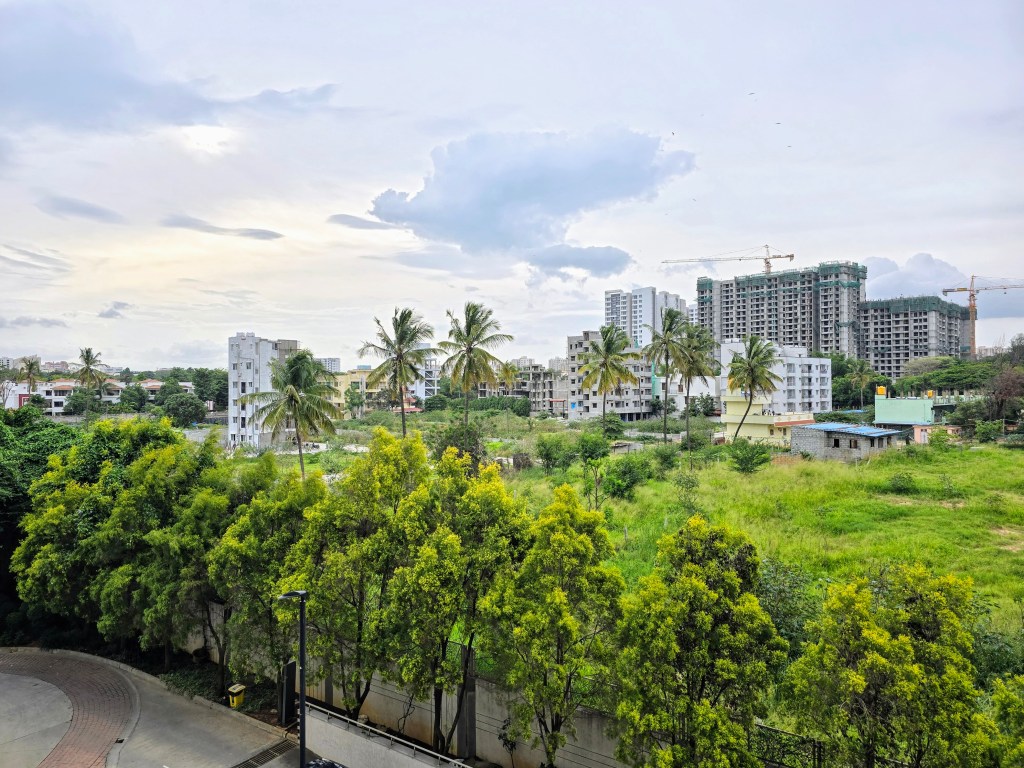
For the time being, I feel privileged that the green field outside my third-floor living room balcony, a disputed property, remains untouched. A treat for the old eyes. For how long is anybody’s guess?
The green field outside the window. Photograph by Snigdha Agrawal
[1] Kolkata. The City of Joy by Dominique La Pierre gave Kolkata that sobriquet
Snigdha Agrawal (nee Banerjee) is a published author of four books and a regular contributor to anthologies published in India and overseas. A septuagenarian, she writes in all genres of poetry, prose, short stories and travelogues.
PLEASE NOTE: ARTICLES CAN ONLY BE REPRODUCED IN OTHER SITES WITH DUE ACKNOWLEDGEMENT TO BORDERLESS JOURNAL
There were skies onyx at night ... moons by day ... lakes pale as her eyes ... breathless winds undressing tall elms ... she would say that we’d loved, but some book said we’d sinned.
Soon impatiens too fiery to stay sagged; the crocus bells drooped, golden-limned; things of brightness, rinsed out, ran to grey ... all the light of that world softly dimmed.
Where our feet were inclined, we would stray; there were paths where dead weeds stood untrimmed, distant mountains that loomed in our way, thunder booming down valleys dark-hymned.
What I found, I found lost in her face by yielding all my virtue to her grace.
(Originally published by Romantics Quarterly as “A Dying Fall”)
MIRAGE
You came to me as rain breaks on the desert when every flower springs to life at once. But joys are wan illusions to the expert: the Bedouin has learned how not to want.
Michael R. Burch’s poems have been published by hundreds of literary journals, taught in high schools and colleges, translated into fourteen languages, incorporated into three plays and two operas, and set to music by seventeen composers.
PLEASE NOTE: ARTICLES CAN ONLY BE REPRODUCED IN OTHER SITES WITH DUE ACKNOWLEDGEMENT TO BORDERLESS JOURNAL
Here I am, waiting in my car, clutching my steering wheel. It has been a good five minutes, and I am at a standstill. There are no vehicles in front of me. It is a T-junction with traffic lights. There is no traffic on either road, but I have no choice. I have to wait.
It does not matter whether I have a medical emergency or that there is a raving lunatic after my scalp. Laws are laws and have to be obeyed. Logical wisecracks and rationalisations do not work. Realistically, if the road is clear and there is no imminent danger of a collision, I should be good to go. Logically, that is. Reasoning does not work here. A set of closed-circuit systems records your every wrong move like a hawk. And diligently, the system would send a ticket directly to your mailing address, and viola, the rule of law prevails in the land. A potential offender is snipped in the bud. As the broken window theory of criminology dictates, getting away with minuscule wrongdoings would eventually snowball into something cataclysmic. Thank God for automation; another serial offender has been prevented. Everyone should be happy, right? So, everyone’s job is just to follow?
That is when my Dionysian mind grew antennas. My grey cells started buzzing, and their neuroelectric activities went on an overdrive.
The system is understandably flawed. At a time when everything is becoming more intelligent, something is not correct. What is naturally lacking is artificially enhanced. Artificial intelligence has superseded natural stupidity. If self-thinking automatons and machines can improve by self-learning and pass the Turing Test, why not our traffic lights?
Intelligent traffic signal lights are not alien to road traffic controllers worldwide. Automated light changes to keep up with altering traffic volume are nothing new. Many developed nations have been implementing this for ages. At an age when we are concerned about vehicle emissions worsened by repeated stops and starts, introducing the ‘green wave’ could help reduce congestion and the need to repeatedly slow down or stop at lights.
Returning to my situation at the traffic light, I am still stationary after what feels like ten minutes.
Coming to think of it, Adolf Eichmann and all his colleagues in the Schutzstaffel (SS) completed all their nefarious activities by being sticklers for rules and followers of protocols. By paying undivided attention to completing their paperwork and targets set for the day, they gave a new perspective on how banal evil can be. The rule of law did not prevent a maniacal figure like Hitler from being the Fuhrer. The citizens who followed the herd in not questioning the status quo lived to regret their apathy.
Spending less time at the traffic light is not going to prevent a Holocaust, but we should ask ourselves to change a system that does not work for us. We are already wasting enough time listening to guised automated messages, which actually eat on your phone bills, why do we need to waste time, petrol and sanity by just waiting and listening to screaming cicadas at a traffic junction without any traffic?
Honk, honk! Time for me to move on…
.
Farouk Gulsara is a daytime healer and a writer by night. After developing his left side of his brain almost half his lifetime, this johnny-come-lately decided to stimulate the non-dominant part of his remaining half. An author of two non-fiction books, Inside the twisted mind of Rifle Range Boy and Real Lessons from Reel Life, he writes regularly in his blogRifle Range Boy.
.
PLEASE NOTE: ARTICLES CAN ONLY BE REPRODUCED IN OTHER SITES WITH DUE ACKNOWLEDGEMENT TO BORDERLESS JOURNAL
At times the fabric shows itself, as though up close— A linen swatch, scraps from a shelf of silk, or those
Long scarves made of the lightest wool, that with a touch Can wrap around, yet never pull or press. For such
Affinity invokes, like wings against the air, What elevates but does not cling to what is there.
Photo from Public Domain
Jared Carter’s most recent collection, The Land Itself, is from Monongahela Books in West Virginia. His Darkened Rooms of Summer: New and Selected Poems, with an introduction by Ted Kooser, was published by the University of Nebraska Press in 2014. A recipient of several literary awards and fellowships, Carter is from the state of Indiana in the U.S.
.
PLEASE NOTE: ARTICLES CAN ONLY BE REPRODUCED IN OTHER SITES WITH DUE ACKNOWLEDGEMENT TO BORDERLESS JOURNAL
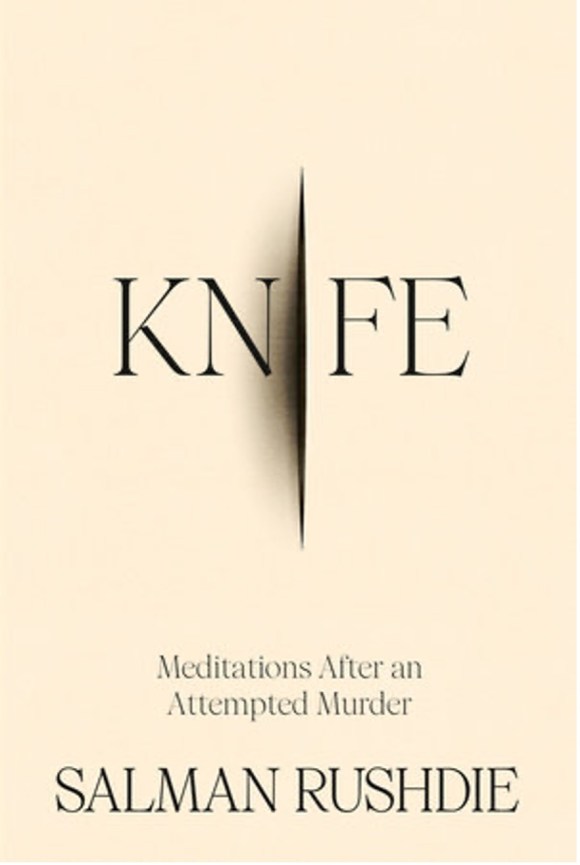
Title: Knife: Meditations After an Attempted Murder
Author: Salman Rushdie
Publisher: Penguin Random House
More than thirty years ago, a fatwa had been declared by Ayatollah Khomeini on the famous writer Salman Rushdie. The charge of blasphemy was labelled after the publication of The Satanic Verses, and since then the author has been living in asylum at different places because he was not safe in his own country. When it was assumed that the incident had died its natural death, the simmering vendetta and violence upsurged suddenly on 12th of August 2022, when Rushdie had gone to participate in a week of events at the Chautauqua Institution in upstate New York titled “More Than Shelter: Redefining the American Home”, and an unidentified man attempted to murder him on stage with a knife.
This horrific act of violence shook the entire world. No one hoped that they would ever be able to read a single line written by the author once again. He was a totally lost case. Now, one-and-a-half years after the incident, and in unforgettable detail, Rushdie writes this first-person memoir Knife where he relives the traumatic events of that day and its aftermath, as well as his journey towards physical recovery. His healing was made possible by the love and support of his present African American wife Eliza, his family, his army of doctors and physical therapists, and his readers worldwide.
Dedicating the book to the men and women who saved his life, the text is neatly divided into two parts, each containing four sections. The first half of the book titled “The Angel of Death” primarily revolves around ‘despair’, whereas the second part, “The Angel of Life,” narrates a vision of ‘hope’ and optimism and Rushdie’s attempt to return to normalcy once again with his indomitable spirit to fight on against all odds.
The opening chapter called ‘Knife’ begins with the description of a beautiful August morning in detail and how the apparent tranquility was shattered when suddenly violence appeared in the form of an unidentified man who rushed at him on the open stage and stabbed him indiscriminately. Totally flabbergasted, Rushdie obviously didn’t know what to do. So, he narrates the rest of the incidents in the form of a collage, with bits of memory pieced together with other eyewitness and news reports and tells us how that morning he “experienced both the worst and the best of human nature, almost simultaneously.” Though the incident of his attempted murder dragged “that” novel back into the narrative of scandal, Rushdie declares that till date he still felt proud of having written The Satanic Verses.
Apart from the day-by-day narration of how things shaped up after the stabbing incident, three things stand out very clearly in this memoir. First is of course the detailed description of his entire eighteen-day long stay initially at the extreme-trauma ward of the hospital and later at the rehab centre titled ‘Hamot’. Though in extreme pain we are told how doing a few simple everyday things for himself lifted his spirits greatly. So, apart from the rehab of the body, there was also the rehab of the mind and spirit. Spending more than six weeks in two hospitals, he could return to the world and so slowly he started feeling optimistic again.
The chapter called ‘Homecoming’ begins with his leaving the hospital at 3 A.M. as quietly as possible and going back home at that unearthly hour to evade any watching eyes.
Emotionally moved, even though he had lost one eye permanently, he felt “100 percent better and healthier immediately. I was home.”
The incident of homecoming is once again closely related to the second important issue during his convalescence –the love, care and bonding with his present wife Eliza. Dedicating a total chapter titled “Eliza”, Rushdie gives us details of how he met the African American poet Rachel Eliza Griffiths entirely unknown to him, through the eminent American writer, Norman Mailer, and how his friendship grew stronger day by day, leading to a secret marriage based on the realisation that it was a relationship not of competitiveness but of total mutual support. They showed that even in this attention-addicted time, it was still possible for two people to lead, pretty openly, a happily private life till the knife incident changed everything. He tells us how the poetical sensibilities of his wife lent extra support to him in such trying times.
The third most significant aspect of this memoir is the way Rushdie devotes an entire chapter addressed to his assassin –“The A”. And it is really at its imaginative best. In it he has recorded a detailed conversation that never actually occurred between himself and “a man I met for only twenty-seven seconds of my life”. After bringing in several intertextual references about other writers and situations, about other murders being committed in the lives of different personalities, in the fourth and final session of his imaginative conversation, Rushdie states, “You don’t know me. You’ll never know me.” After the imagined conversation is over, he no longer has the energy to imagine the assassin, just as he never had the ability to imagine him. He feels that the purgation is complete, and this chapter of his life is closed once and for all.
Interestingly after half a year of nothingness, Rushdie realises that his writing juices had indeed started to flow again. During his sleepless nights at the rehab, he often thought a lot about The Knife as an idea. Talking about different occasions and purposes when the knife is used, he realized that the knife is basically a tool and acquires meaning from the use we make of it. It is morally neutral, and it is the misuse of knives that is immoral. Then he states that language too was a knife for him, and he would use it to fight back. Here he made a resolution that instead of remaining as a mere victim, he would answer violence with art – “Hello, world, we were saying. We’re back, and after our encounter with hatred, we’re celebrating the survival of love. After the angel of death, the angel of life.” But it was hard for him to write about post-traumatic stress disorder at any time especially when his hand felt like it was “inside a glove” and “the eye… is an absence with an immensely powerful presence.” Returning to New York after a ten-day visit to London, he therefore decided to spend the second chance of his life on just love and work. Since several Muslim entities were still celebrating his pitiable condition, he thought to make it clear to his readers that his worldview about God had not changed a bit and so he declares — “My godlessness remains intact. That isn’t going to change in this second-chance life.”
In the final section ‘Closure?’ Rushdie writes that his own anger faded, and it felt trivial when set beside the anger of the planet. He understood that three things had happened that had helped him on his journey towards coming to terms with what had happened – namely — the passage of time, the therapy, and ultimately the writing of this book. Moving along with time, he felt he was no longer certain that he wanted, or needed, to confront and address his assassin in open court and that the “Samuel Beckett moment” no longer seemed significant at all. This is where art and love overcame all barriers. He has successfully moved on and there was no need to look backwards once again.
Written a few years ago, Rushdie’s Joseph Anton: A Memoir narrated the story of how he was living a disturbed life under the pseudonym of Joseph Anton. But that memoir did not create much impact upon the readers, whereas Knife has brought back the powerful and erudite Rushdie as he has risen phoenix-like from the ashes and revealed his erudition without being parochial. Ordinary readers often shy away from his work as it is full of intertextuality and cross-references. But even those who find his writing to be too high-brow will have no problem in understanding the ‘free-associative way’ in which the mind of this writer works even today. The book is a page-turner no doubt and has brought back the popularity of Salman Rushdie once again. The simplistic yet very appealing cover of the book is an added attraction too.
Somdatta Mandal, critic and translator, is a former Professor of English from Visva-Bharati University, Santiniketan, India.
.
PLEASE NOTE: ARTICLES CAN ONLY BE REPRODUCED IN OTHER SITES WITH DUE ACKNOWLEDGEMENT TO BORDERLESS JOURNAL
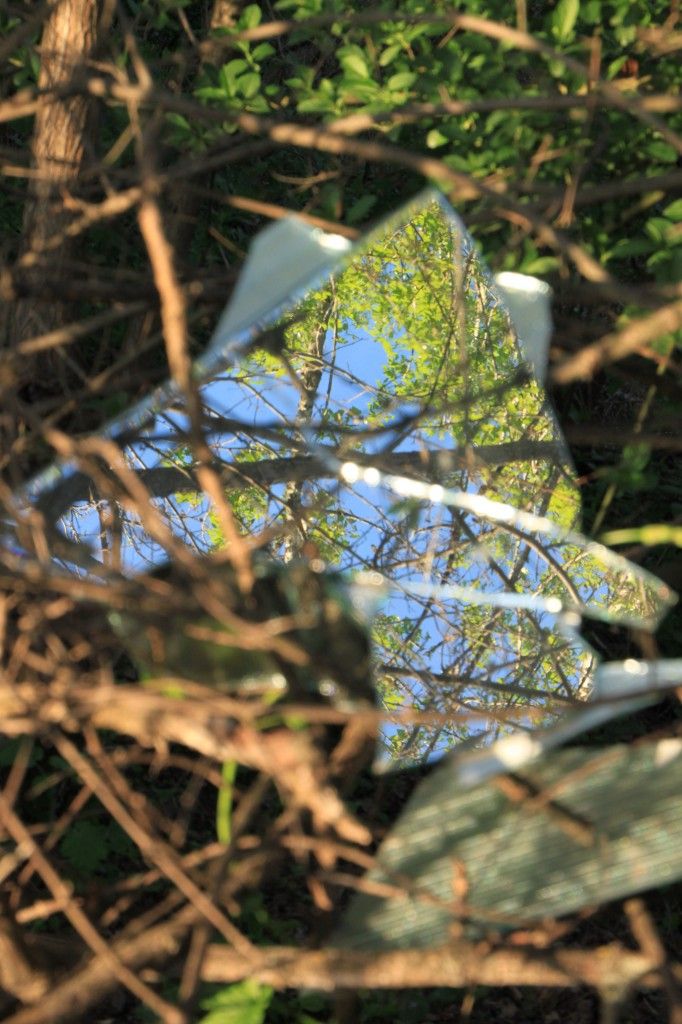
Shattered mirror on the ground sparkles sunlight. Tears glisten bright.
People shudder and protect their feet, Lest they cut and start to bleed; Broken glass… thousands of pieces, Prick and cut veins, Bleed but no one sees the pain.
I smile every day, a perfect smile, You say, ‘You are happy, you own a style.’
Have you seen the pain of my bleeding heart? Smiling every day is a beautiful art.
This world is a stage. Here in plots, we play our parts, I do my best to smile and dance, Perfect in my role, I am the star.
Shattered mirror of my heart, No one sees how I bleed and play my part.
Tasneem Hossain, an author of four poetry books, is also an op-ed and fiction writer, translator, educator and trainer from Bangladesh. Her poems are published frequently in literary journals worldwide and have been translated in seven other languages.
.
PLEASE NOTE: ARTICLES CAN ONLY BE REPRODUCED IN OTHER SITES WITH DUE ACKNOWLEDGEMENT TO BORDERLESS JOURNAL
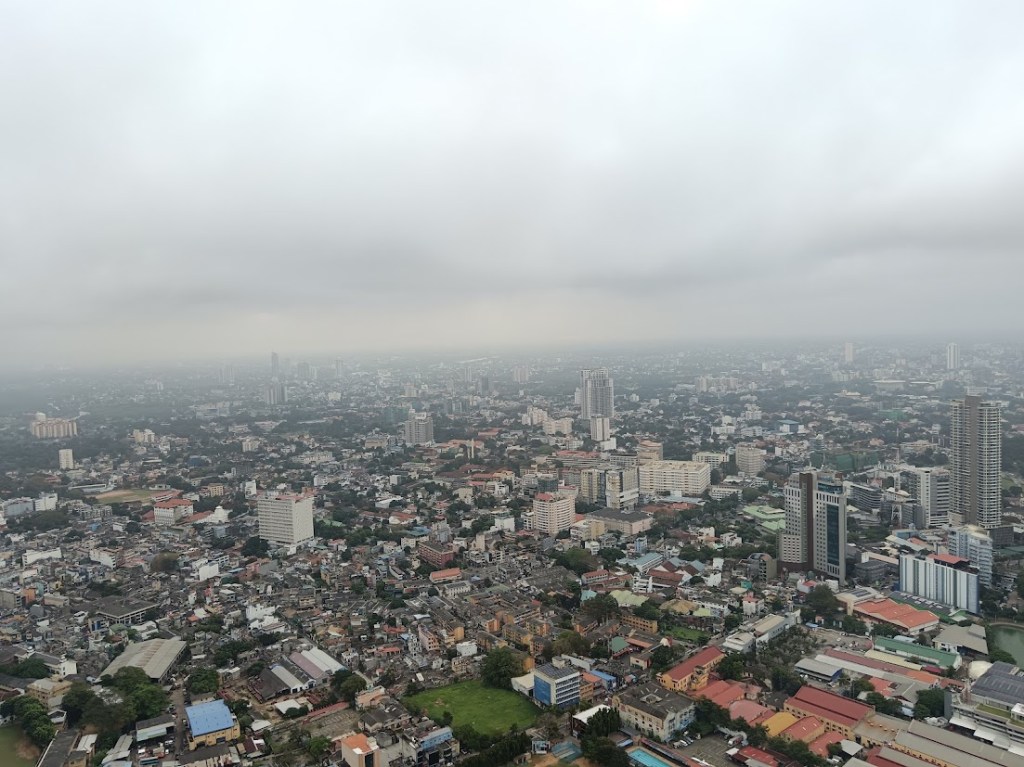
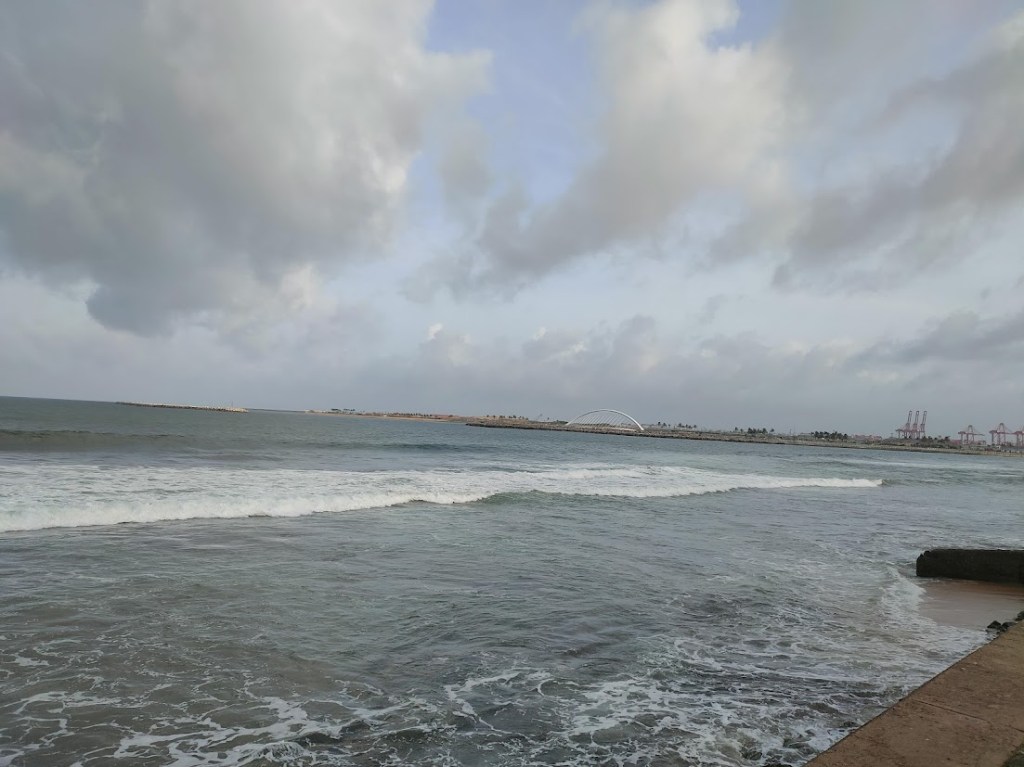
A panoramic view of Colombo. Photo courtesy: Ravi Shankar
My impressions of Colombo and Sri Lanka were positive. I was aware of the high human development indicators of the island nation, progress in access to essential medicines and the civil war. Sri Lanka shares many similarities with the state of Kerala in Indian in terms of topography, culture, food habits, high human development, outmigration, militant trade unions and a passion for egalitarian development. I also remembered the recent violent uprising against the former president and the image of the public frolicking in the pool at the presidential palace.
I was happy to receive an invitation to travel to Colombo in July 2023. I was invited to The Colombo Medical School, which was established by the British in 1870 and is one of the older schools in South Asia. It is the premier medical school of the country, and a new tower block has been constructed. The twenty-story tower is spacious and houses various departments. the humanities. The school was the first to start a Department of Medical Humanities (using art in the education of doctors) in South Asia. The physiology department has created a museum consisting of old instruments and apparatus that are no longer used. This is an excellent idea, and you remain in touch with the history of medicine.
The hotel where I stayed was located on Galle Face Road with the beach and the Galle Face green on the other side of the road. The beach was clean, and the park was originally laid out in 1859 by the British Governor General Sir Henry Ward. The Dutch had placed the cannons facing the ocean as a defence against the Portuguese. Sri Lanka had changed hands multiple times among the different colonial powers.
One of the striking features of Colombo is its cleanliness. The buses may be old and crowded but they are colourful. There are also rickshaws in a variety of colours, mainly green and red though yellow ones were less common. The kittul jaggery harvested from the fishtail palm or the jaggery palm is famous and I loved the gingelly rolls made with this jaggery. My second visit was in early January this year. The apartment where I stayed was attached to an old Sri Lankan house. The location was near to all conveniences but away from the noise and traffic.
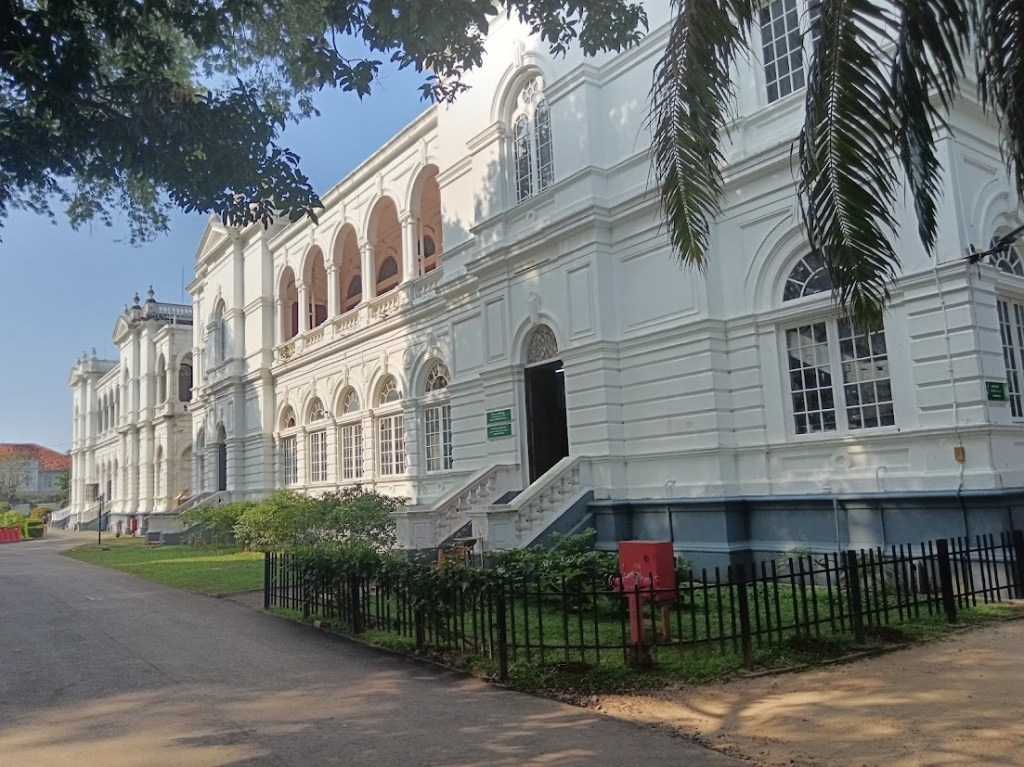
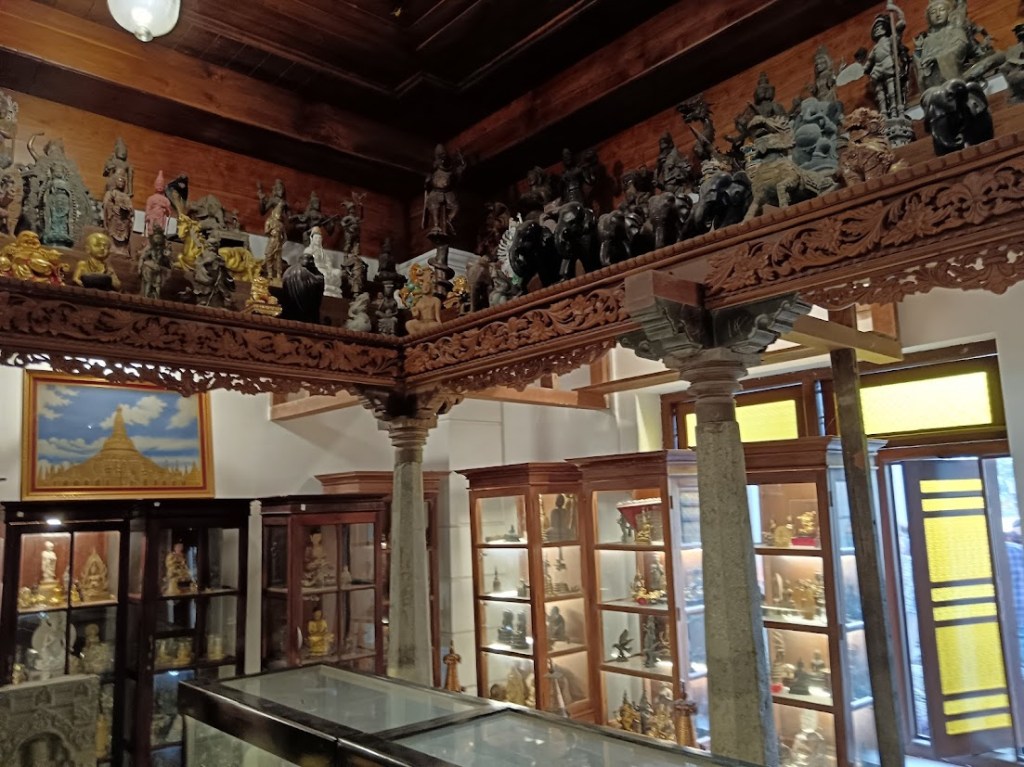
I visited the Sri Lankan national museum, the largest in the country. It was established by Sir Gregory, the British governor of Ceylon (as Sri Lanka was then called) in 1877. The museum is housed in a white, neo-Baroque building and offers a fascinating glimpse into Sri Lanka’s past. The museum is well maintained though it is not air conditioned. The humidity is a constant presence in Colombo. The collection of antiques at the museum is extraordinary.
The MuseumInside the templePhoto Courtesy: Ravi Shankar
On my last evening in Colombo, I did some sightseeing. We went to the Gangaramaya temple, the most important one in Colombo. The architecture is a mix of Sri Lankan, Indian, Thai, and Chinese styles. The temple was started by the famous scholar monk Hikkaduwe Sri Sumangala Nayaka Thera in the late 19th Century. The temple has a rich collection of Buddha statues and huge collections of ivory that must be worth millions if not billions. Our next stop was the Lotus tower at 351.5 metres, the largest self-supported structure in South Asia. The lotus is a symbol of purity. view of Colombo city from the observation tower at the top is excellent. I could see the Galle Face Road where I had stayed during my last visit. We could see the Sri Lankan railway depots and stations.
Colombo is a fascinating city. There is plenty to see and do. Recent economic events have hit the island hard. During my subsequent visit I plan to explore other parts of this magical country. Serendip/Serendib was the ancient Persian/Arab name for the country. The name is believed to be derived from the Sanskrit Simhaladwipa (dwelling place of Lion’s Island). The lion occupies a prominent place on the Sri Lankan flag.
The three princes of Serendip in an ancient story had the knack of making unexpected discoveries and is the root of the word serendipity in English. Visit Colombo and Sri Lanka, who knows what serendipitous discoveries await you?
Photo Courtesy: Ravi Shankar
Dr. P Ravi Shankar is a faculty member at the IMU Centre for Education (ICE), International Medical University, Kuala Lumpur, Malaysia. He enjoys traveling and is a creative writer and photographer.
.
PLEASE NOTE: ARTICLES CAN ONLY BE REPRODUCED IN OTHER SITES WITH DUE ACKNOWLEDGEMENT TO BORDERLESS JOURNAL
Upon the tracks of Assam's soggy soil, She peddles from one doorstep to another. Carrying a sling bag, she begins to toil. Her scraggy feet -- all varicosed together. Today, I saw her in a floundering state, Submerged in sweat, shod in half-tattered shoes, And haggling for the dairy in her crate -- Enslaved by mugginess -- to earn for two. She halted at a nearby marsh with trees, Reposed, and smeared some poultice on a heel, Then toiled some more until the day's release To have enough for one full, proper meal And rest at last when all her tasks were done While caring for her seven-year-old son.
Shamik Banerjee is a poet from Assam. He lives with his parents. Some of his latest poems have appeared in The Dirigible Balloon, New English Review, The Society of Classical Poets, and The Hypertexts.
.
PLEASE NOTE: ARTICLES CAN ONLY BE REPRODUCED IN OTHER SITES WITH DUE ACKNOWLEDGEMENT TO BORDERLESS JOURNAL
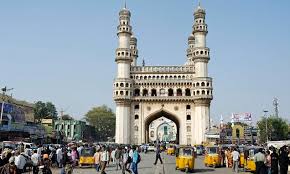
CharminarGolconda FortPhotographs from Public Domain
When the last Hyderabadi man walked into the last Hyderabadi Cafe in the last Hyderabadi part of the city, he winced in disapproval at what lay in front of his eyes.
The metro rail — almost always championed as a resort of the poor but as heavy on the pocket as a plate of haleem[1] from Pista House — seemed to have overtaken the remnants of what was once the Garden Cafe. The construction workers were often seen munching on luqmi[2]before starting work in the bright sunshine of the day.
***
Had Garden survived, the last Hyderabadi would have survived too. He would have dipped his roti into the banal bowl of keema that had largely seen the innards of whatever chopping machine they used in the kitchen and digressed considerably to criticise the commercial fervour that Paradise Cafe (the World’s Finest Biryani — as it advertised itself these days), less than a mile away to the southeast, had embraced.
Yet, the way that Paradise had fallen on its face would not have seemed agreeable to him — the pride of the city intact in this wounded yet uninjured man — and he would have argued with the horde of loafers roaming in anticipation of a few pennies near the bottom of the Clock Tower, or booed with derision at the well-dressed middle-class diners approaching Baseraa for a meal they had envisioned a month ago.
Deccan Chronicle, about a hundred metres to the east from Baseraa, would have stood in silent vigil for what it had noticed, and in muted rebuke for what it had let flow from its murky torrents. Long having divested himself of the habit of reading a newspaper, the last Hyderabadi would have turned north in search of something a bit more appetising than the statistics of bribes taken and favours disbursed.
Wasn’t it George Bernard Shaw who said that politics was the last resort of the scoundrel? The last Hyderabadi remembered having read something of the sort during his time at the Nizam College; surrounded by biryani by the bucketful at the Grand and mutton seekh by the skewer at Cafe Bahar, his wakeful remembrances were engulfed by a sordid affair at the Public Gardens which he would much rather not recall.
***
Much given to lewdness in his youth, which included moments of sheer discomfort riding pillion behind a pillion on a two-wheeler — effectively three on the Honda that grunted in distress. Time — often seen as slipping past him like the silky outflow of the Irani chai at Blue Sea — was the great deterrent that forced him to fight for the movement that once engulfed, and now corrupted those who had vowed to not get enamoured by the corridors of power.
The last Hyderabadi now watched the last cricket match on the last pitch at the Parade Ground and grunted in discontent while crossing the road to the Gymkhana and witnessing one of the finest cover drives ever seen on its now-remodelled track; for all his impartiality, in his eyes, the Gymkhana remained the home of cricket — the home of Indian cricket at the very least.
***
When peppered with bouts of time — of which he had plentiful — he often dreamt of the ideal that had consumed his passions and ignited the fires that have long been dormant now. Inexcusably, he had juggled three jobs at a time when his friends were struggling to make ends meet.
The opaque waters of the Hussain Sagar at the bend around Sanjeevaiah Park had seemed inviting enough on nights when he had not had time to read the freckled Dostoyevsky acquired that Sunday from Koti. It was the timely remembrance of an embrace from a friend who ran his father’s steel bearings business in Ranigunj that finally restored the last Hyderabadi to sanity and greater aspirations than what The Idiot had suggested. Strangely enough, he had dreamt of Alexander Pushkin that night; the duel upon the Black River seemed to be disapproving of what he had evaded in life.
The last Hyderabadi was often given to understand that those of his kind were an extinct race now, those who still studied the scores on Monday morning and despaired when their Bajaj ran out of fuel in the right lane in the thoroughfare he had called ‘Kingsway’ all his life.
Rather pitifully, the memories of his childhood visited upon him infrequently, withering that which he had left behind and flowering that which he did not want to remember. Oftentimes, these recollections included little apart from the moments tiptoed from the dispensation that ruled with an iron fist and earmarked itself to the cause — perhaps too vehemently for its liking — that he believed in.
The dilkhush[3]scarred him on more than a few occasions when he hung around the Armaan Bakery in Ferozguda. His friends had called upon him to administer the immaterial wealth he had gathered over the years and embark on the search that had bruised his ego and slighted his soul for long; it seemed to be of a lifetime ago now. The sun had set that evening beyond the railway tracks as it did today, and yet his memories conveniently lied when put on the spot.
***
Those friends to whom he had clung for stability through those years of intransigence, with whom he had set back innumerable cups of tea and luqmi at the Rio, with whom he had shared remembrances by the plentiful at the Bawarchi — they had all disappeared without a trace in a world where public memory lives long enough for the good to be remembered and the bad to be dismembered. Bawarchi had been overtaken by Shah Ghouse, and Abids by Gachibowli, the empty streets of Jubilee Hills notwithstanding.
The last Hyderabadi had known this long before they started constructing the statue of the prominent lawyer who had been responsible for drafting that which held the people of this nation liable for their values and the politicians who ruled over them accountable for the promises they made. These now loomed larger than that of the ascetic whose refuge he had sought towards the end of his life.
Neither the ascetic nor the lawyer mattered much in the minds of the newly-minted, power-hungry class who turned their noses away from him; the ideals the former propagated had been flung into the much-insulted Osman Sagar with grandeur, with the latter swallowing them without a hint of disgust.
The last Hyderabadi meditated upon this as he turned back from where Bade Miyan used to exist. The patthar ka gosht[4] lingered long on the tip of his tongue, but with his pockets empty and resources nullified, ice cream from one of the myriad Bihari push-cart vendors on Tank Bund would have to make do for dinner, washed down by a bottle of lemon soda made from water rarefied by the Hussain Sagar[5]‘s numerous cousins.
***
Had he taken the bus from Patny southwest to Mehdipatnam on a lazy Saturday afternoon, the last Hyderabadi would have noticed the hawker who still believed in the incorruptibility of man, who sold ball-point pens at the traffic signal without haranguing his clientele too much, or the stout hijra[6] in Rasoolpoora whose self-respect had given way to hunger, or the blind beggar in Masab Tank, who died with Hyderabad in his eyes.
Had he been flogged that day by the marching crowd demanding employment for the destitute who neither knew nor chose to care about the latest matinee flick at the Tivoli, the last Hyderabadi would have known the extent to which his boundaries lay.
The aggrieved mob screamed in righteous indignation and discontent as he sat beside the conductor, who counted the day’s earnings with just about enough interest to murmur,
“Haibat me ye logaan kahan-kahan toh bhi fir lete rehte, kya-kya toh bhi kar lete rehte – apan khaali ye puron ku dekh lena fir gumm bol leke palat lena. Shukraan apne ku koi dam nai karte!
(With great resentment these people move about in protest, but nothing comes of it. All we have to do is look the other way when they come here. Thankfully, nobody bothers us!)”
The last Hyderabadi had cried that night.
***
Spring seemed to be around the corner, but the last Hyderabadi had little by way of hope, further less by way of reflection. For what he remembered seemed to hark back to the days when he could still think of himself as a man in a city that bore him, that gleefully harboured him.
Those of his ilk had disappeared long ago, men among whose shadows he had multiplied himself and sat in the peace of knowing that there were at least some who were like him, who understood him and who, perhaps, even loved him.
.
[1] Stew originating in the Middle East and South Asia
[2] A Hyderabadi variation of the samosa with mince meat
[3] A sweet stuffed bread of coconut and tutti-fruiti
Mohul Bhowmick is a national-level cricketer, poet, sports journalist, essayist and travel writer from Hyderabad, India. He has published four collections of poems and one travelogue so far. More of his work can be discovered on his website: www.mohulbhowmick.com.
PLEASE NOTE: ARTICLES CAN ONLY BE REPRODUCED IN OTHER SITES WITH DUE ACKNOWLEDGEMENT TO BORDERLESS JOURNAL.






 Borderless