Every Room Has a View— A Novel by Sujit Saraf is a narrative of exceptional dignity and subtle audacity. A dark comedy, a rumination on loss, and an evocative picture of a diasporic life – this book manages to turn what could have been a simple account of bereavement and rites into something much richer – into a luminous examination of identity, remembrance, and ever shifting territory between tradition and revivification.
The author is an engineer by training. His novel, The Peacock Throne, has been was shortlisted for the Encore Prize in London. His third novel, The Confession of Sultana Daku, is being made into a motion picture. He also runs Naatak, an Indian theatre company in America for which he writes and directs plays and films.
In this novel, Naveen Gupta, an Indian engineer who made a life in Silicon Valley over three decades, is dead. His Bay Area home boasts of panoramic vistas of the Golden Gate Bridge, portraying the American dream he managed to make into a reality for himself and his family. Naveen’s final wish is, however, strikingly paradoxical. He wishes to be cremated on seashore in San Francisco with the same rites that his father was cremated in India with. This odd wish becomes the pivot around which the story revolves—divulging not only operational absurdities but innate questions about what it means to belong, or to crave for belonging, in a place that would hardly understand those traditions.
Narrated through the voice of Usha, Naveen’s widow, the novel gives a glimpse into the quiet perplexities of those living between cultures. We witness at once the chaos and comedy that ensues when a circle of well-meaning friends and relatives make attempts to honour Naveen’s wishes in a land where neither permits nor precedent exist for such rites. The absurd painted through images — a pandit in jeans and a backpack, a rented cow brought up through an apartment elevator, and confusions with local authorities who mistake a funeral pyre for a beach campfire — play like a comedy. These images are, however, never frivolous. They reveal how sometimes diaspora may cling to rituals in unsettling times.
The story’s procession brings in focus characters whose dilemmas and idiosyncrasies deepen the central themes. Maaji, Naveen’s mother, at first unsure about how to navigate life in a foreign land, eventually finds solace and community among other seniors in Sausalito. Her ache of displacement replaced by a sense of belongingness in a society. Ajay, the teenage son, is silent and observant. Standing on the edge of two cultures, he carries his father’s legacy in his reticent response to loss and his passionate retreat into music. Through these figures, the author explores different ways in which immigrants may carry and reconcile their heritage while forging new selves on unfamiliar ground.
The most compelling journey, though, is Usha’s own. What begins as confusion over her husband’s last wish slowly progresses into a thoughtful inner quest for meaning and autonomy. She moves through grief not as a passive mourner but as a pilgrim of her own consciousness.
Saraf’s narrative invites us to laugh at the ludicrousness of circumstance, to pause in instants of quiet contemplation, and to wonder at the fault lines between what is reminisced and what is lived. He shows that the immigrant experience is not uniform but a constellation of small, vivid moments — a recollection of a far-off village or city street, a misplaced ritual, a cautious chat in a new language or a yearning for ancestral soil that may never be touched again.
In Every Room Has a View, the titular phrase itself becomes a brilliant metaphor. The rooms in Naveen’s house may offer views of an iconic bridge and sweeping bay—a testament to success and achievement—but the novel invites us to look beyond the literal. Every room in Usha’s life, every memory and every ritual, holds its own view: of history, of loss, of transformation. It prompts the reader to ask: What do our “views” reveal? What do they conceal? And what remains when all the windows have been opened, and all the rituals performed – especially towards the end when Usha comes to know of the reason of Naveen’s reluctance to make a journey back home.
This novel is not a simple commentary on cultural collision nor a mere satire on complications of creed and law. It is a humane narrative of the perennial human quest for meaning. In seeking to honour his father’s rites, Naveen’s family—and through them, the reader—discovers that identity is not something anchored in a fixed geography or grammar of practice, but something that must be negotiated with love, imagination, and an openness to the unpredictable vistas of the heart.
Rakhi Dalal is an educator by profession. When not working, she can usually be found reading books or writing about reading them. She writes at https://rakhidalal.blogspot.com/ .
.
PLEASE NOTE: ARTICLES CAN ONLY BE REPRODUCED IN OTHER SITES WITH DUE ACKNOWLEDGEMENT TO BORDERLESS JOURNAL
A new lamb insists upon, really only one thing, and so her bleats increase into a screaming mantra. But spring shadows a rough beast
who drags his feet through the grass even in the day-long sun, even as the breeze massages the dry pasture slowly awake. Just when old Mother Ewe
can’t take one more snowfall, the sky darkens, the flakes begin to dress her fleece, and she lays down on her bags to low the same prayer with her lambs.
C. Mikal Oness is the author of Oracle Bones and Water Becomes Bone. His latest collection, Works and Days, is forthcoming from Cornerstone Press.
PLEASE NOTE: ARTICLES CAN ONLY BE REPRODUCED IN OTHER SITES WITH DUE ACKNOWLEDGEMENT TO BORDERLESS JOURNAL
By Hamiruddin Middya: Translated from Bengali by V. Ramaswamy
Babu, I am merely a poor Santhal. Please don’t take offence at anything I say. After all, we people who belong to the forest have always been losing. We are day labourers. We neither have nice houses nor do we possess any cultivable land.
Rangakul, Kusumkanali, Nabindanga and Mohulboni were all small Adivasi villages in the forest. Nearby were farmers, and people of the Ghosh, Mahato and Sinha communities. All the land belongs to them. We gaze at the sky in the hope of rain and cultivate a single crop. Some people have taken up the timber business and become rich and arrogant overnight. Why would they care about farming! It’s us who want to farm the land. A one-third share to the landlord, or else a monetary arrangement. We are poor folk, where will we get so much money! So, we cultivate the land on a crop sharing crop basis. But can one survive the whole year with that? The moment there’s no more rice for the cooking pot, we queue up beside the metalled road, wave out to any bus going eastward and get on board. After all, there’s no shortage of jobs there. With water from the canal available there, the fields yield golden paddy twice a year. By the grace of Marang Buru, all we want is to work our bodies so that we can feed our bellies.
When water is scarce at the edge of the forest where we live, famine looms. What’s new about that!
Singh babu is the big warehouse keeper here. He’s in the timber business. His house is at the fringe of the forest, across the railway line. It’s not a house but a fortress. He has done well in business with the help of his sons. Our men and women carry dry wood gathered from the forest to the babu’s warehouse across the railway bridge. He weighs our bundles and buys them. Even if the price is higher in the marketplace, who wants to go there if you have someone close by!
I cultivate a bigha-and-a-half of the babu’s land. It’s his warehouse that Lokha’s Ma carries wood to. There was a terrible drought this year. Fields, pastures and ponds were all parched, gasping for water. The paddy harvest was not good. The stalks were not tall. Just like a mother’s milk dries up if she is unable to eat, it’s the same with the ears of paddy. What will we eat the whole year? An unpared bamboo in the arse! How will I go to the babu and tell him?
I got the opportunity. Lokha set a trap somewhere and caught a waterhen. I told him, “Give me the bird, son. Let me give it to the babu.”
But Lokha did not want to part with it. “Why should I give it just like that?”
I said, “It’s not just like that, son. I have to make the babu happy, he’s very fond of bird meat. After all, we survive by cultivating his land.”
Who knows what Lokha thought but he did not argue any more.
I went with the bird at dusk. Singh babu was sitting with his son on a platform under the mango tree in front of the warehouse, he was doing some calculations. As soon as he saw me, he exclaimed, “Arey[1] it’s Hansda! What’s that in your hand?”
I went close to the babu. The babu studied the bird and exclaimed, “Wow! You’ve brought a waterhen!”
The babu never called me Sanatan Hansda, only Hansda. I could see that he was very happy to get the waterhen. His middle son, Haru, took the bird from me and left. Their house, surrounded by walls, was just behind the warehouse. I sat down below the platform.
The babu asked, “Has the paddy been threshed?”
“Babu, that’s what I came to tell you about. All the paddy has been destroyed in the drought! After threshing the remaining stalks, I could only get six sacks of paddy.”
The babu’s face turned grave. He blurted out angrily, “What the hell are you saying, bastard! Six sacks? I went to the field and saw for myself, it was full of swaying stalks.”
“Yes, babu, it was like that then. But there was no rain in Magh[2]. The plants began to droop after that!” I pleaded with the babu.
“Enough of your nonsense! Haru will go tomorrow and see how it’s only six sacks. Don’t try to be cunning!”
“Sure, send him then, babu. I am not telling you lies.”
Haru didn’t come. The next day, Singh babu himself arrived in haste. He came in the middle of our festivities. I was anxious wondering where I would ask him to sit, and what I would feed him. All of us, men and women, drink hanriya [3]and dance. Ours is a small village. We can’t afford to buy a dhamsa or a madol. We had everything earlier, but they broke long ago. When the boys and girls of the village grow up and it’s time for them to get married, we get those drums on rent. During our festivals, the boys in the youth club play music on the mic. We dance to that. Seeing our song and dance, Singh babu later whispered to me, “Give me a glass of hanriya too. Let me try it. But mind it, don’t tell Haru!”
“Oh no, babu. Don’t worry about that. Have as much as you want.” I thought it was funny. The father drinks out of his son’s sight. After all, we have none of all that. Father and son drink together to their heart’s content.
Why were Singh babu’s eyes so bloodshot today? I was scared. I said to him, “Come, come babu. Come inside and sit comfortably.”
The babu said angrily, “I haven’t come to sit, Hansda. Show me the paddy quickly.”
So, I showed the babu the paddy. He looked at me sternly and asked, “You haven’t hidden it somewhere, have you?”
“No, no babu. I would never do something like that in my life,” I said, holding my ears with my hands. “Why don’t you ask someone?”
“Chandmani and Gona Murmu got a good harvest. What kind of farming are you doing?”
“They got a pump-set from somewhere and irrigated their fields twice. There’s a shallow tubewell in the field there.”
The babu was about to leave with a sullen face. I said to him, “Let us keep the crop this time, babu. It’s a meagre harvest. My family can survive for a few days with that. I’ll repay you next time.”
The babu came to a halt with a start. He lowered his voice, and said, “Why should you go without food – am I not there! You have a young wife at home. Send her to the warehouse in the evening. After all, you can’t send her when people are around!” And saying so, the babu left. There was a strange smile on his face. Seeing that smile, my chest heaved. What on earth did the babu say before he left! How could I send Lokha’s Ma to the warehouse with wood now?
2
There was a fair in the nearby village of Mohulbani. As the Shalui festival is not celebrated with much fanfare in our village, it’s to the fair in Mohulbani that everyone dresses up and goes. There’s a cockfight every year during this time. This year, I too was a hauchi. Someone who participates in a cockfight is called a hauchi. I had never put a cock to fight. But the idea of doing that during this year’s festival caught my fancy.
Lokha’s Ma had brought the rooster as a tiny chick from her father’s house. I saved it so many times from the jaws of wretched mongooses and civets. It was big now, and sparkling red in colour. It crowed, konk konkkor konk, in the semi-darkness of dawn. Hearing its crow, the birds on the trees then began chirping. It hovered around every hen in the village, all by itself. It walked with its chest puffed out, as if it was the king of the forest. If such a rooster could not fight, then why on earth was it born?
Lokha tugged at my lungi and demanded, “I’ll go too, Baba. Take me along with you to see the fair.”
Lokha’s Ma said, “Take him along. He’s my little boy. On a festival day, he’ll go to see the fair, he’ll eat jilapi[4], but no – what kind of a father are you!”
“All right. Come along then.”
Mustard flowers were in bloom in the fields. It was yellow everywhere, both on the lowlands and the uplands. After all, it was a festival of flowers now. Men and women, old and young, were walking to the fair along the narrow boundary ridge. Some raced along on bicycles on the red laterite road, ringing their bells, kring kring. Close to the forest was the field known as Bhangatila Maath, which was where the fair took place. Shops with captivating wares, flutes for children, toy drums. Such a variety of food items, telebhaja[5], jilapi. Earthen pots and utensils were selling somewhere under a tree canopy. Rows of bicycles and pick-up vans were elsewhere. An old Santhal man was going around selling bamboo flutes. He himself was rapt in the melody he was playing. There was a cloud of red dust. Girls and young men were walking around holding hands, disregarding the dust. The crowd at the fair was made up of people from all the nearby villages.
Was it only Santhals? No, babu folk too had come to have fun. Everyone was dressed in new clothes, looking their best. Girls had applied mahua oil on their hair and parted their hair, with wildflowers adorning their coiffure.
Hidden away from the fair, in a clearing inside the forest, there was a crowd of people. That’s where the cockfights took place. It used to take place in the fair ground itself earlier. But a few times, police vans had arrived and pulled down everything. It has moved its venue into the forest ever since. I went there with Lokha. Sal-wood poles had been planted, and the spot had been encircled with a rope. Everyone was standing around the rope, Some of them were hauchis, with roosters in their hands. Others had come only to watch.
I asked Lokha to stand under a tendu tree, and told him, “Don’t go anywhere, son. Just stand here and watch the cockfights. I have to find us an opponent.”
I was going around with my rooster, looking for an opponent, when a suited and booted babu with a camera on his shoulder pushed his way through the crowd. Everyone gaped at the man.
A few kaatkaars, those who tied blades to the roosters’ feet, had gone into the enclosure through the boundary rope. Seeing the babu, they said, “Hey babu, what business do you have here? You want to publicise the cockfight? Stop taking pictures, we warn you!”
The babu put his camera into his bag following the threat.
As I went around searching, who should I encounterbut Singh babu — a pleasure-seeking man indeed! He frequently participated in cockfights to indulge his fancy. From time to time, he also wagered money on the days of the weekly market. There was a spirited rooster in the babu’s hands. Seeing me, he said, “What’s up, Hansda, have you brought one too?”
I nodded my head, and said, “Yes, babu. I did it for fun.”
“But you’re in bad times! So how come you’re indulging your fancy?”
Seeing the rooster in my hand, the babu’s rooster stretched its neck, fluffed the feathers on its neck, and glared agitatedly. When I had told the babu about the six sacks of paddy, the babu had glared at me in the same way. My rooster’s eyes too emitted fire. They were a fine pair, but how could I tell the babu that! He was a well-known man, why would he agree to a cockfight with me?
The kaatkar Hiralal, from Panchal was nearby, tying blades toa rooster’stoes. Seeing our two roosters, he burst out, “The two make a fine pair! Why don’t you get them to fight?”
Had Hiralal lost his head or what! What’s this he was saying! Would someone like Singh babu agree to a cockfight with my rooster! I was a poor Santhal. I survived by farming the babu’s land. But I was astonished to hear the babu’s response.
“Hey Hansda! Are you willing?”
I replied hesitantly, “Whatever you wish, babu.”
Hiralal began tying blades to the two roosters’ toes. We didn’t call them blades. The blades were known as heter. Kaatkars had arrived to tie the heter to the toes of all the fighting roosters. After all, there were so many roosters for the cockfight! If there had been only one kaatkaar, it would be night by the time the contests were over.
The rooster belonging to Budhon Ghosh, the ration-dealer from Harindanga village, was fighting now with the one belonging to Fatik Ghosh from Panchal. There was a circle made with lime powder within the roped-in enclosure. The two roosters were made to face each other within the circle. The roosters in the hands of other cockfighters in the crowd raised their necks and crowed. The cockfight was going to be a lively one.
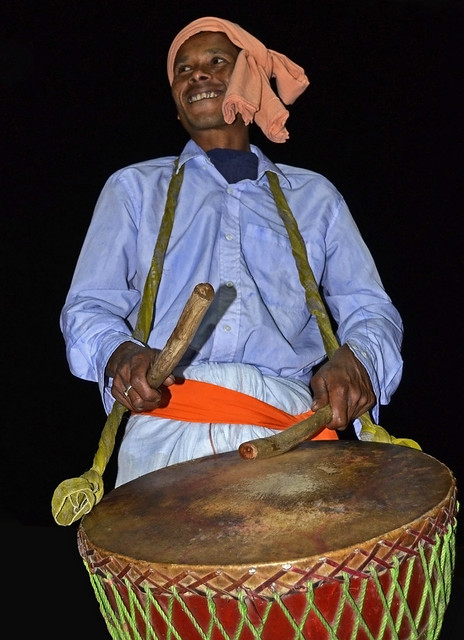
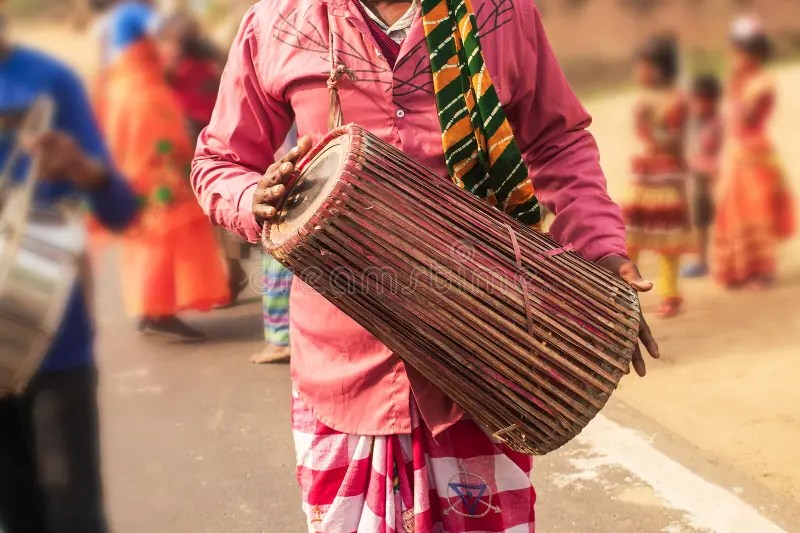
Man playing the DhamsaMan playing the MadolFrom Public Domain
Meanwhile, the beats of the dhamsa and madol came wafting from the fairground. Intoxicated with mahua[6]and hanriya, our young men and women were dancing in a circle, hand in hand. A tide of joy washed over the hills. The whole forest was in a state of intoxication with the drim drima drim beat.
Budhon Ghosh won the cockfight. The spectators clapped and whistled to congratulate him. Fatik’s defeated rooster was his now.
It was our turn next. Singh babu and I entered the roped enclosure. We held the tails of the two roosters and stood them face to face in the middle of the lime circle. Singh babu and I too were face to face. These weren’t roosters! They were like magnets drawn to iron. They could not be restrained, they kept pulling forward. As soon as the whistle blew, fweeeet, we released the roosters. The fight began. They flapped their wings, torn feathers flew into the air. Neither of them spared the other.
When the babu’s rooster was overcoming mine, the spectators applauded, and cried out, “Singh babu! Singh babu!” Again, when my rooster was beating the babu’s rooster, a few spectators behind me excitedly burst out, “Hansda! Hansda!”
I was witnessing another battle. After all, the two roosters weren’t roosters. They were Singh babu and me. We were down on our hands and knees, both of us had become roosters. We were in an unflinching face-off. Behind me were rows and rows of Santhal men and women, mothers, brothers and sisters, standing with bows and arrows, battle axes, and spears in their hands. And behind the babu were row upon row of diku, as outsiders were known.
I suddenly heard the Santhals cry out excitedly, ‘Sanatan! Sanatan!’ I realised I had lost my concentration. I saw that my brave rooster had pierced his blade into the breast of the babu’s rooster and felled it. I had won!
I rushed and picked up the babu’s rooster. It was mine according to the regulations. The kaatkaar too had to be paid for fixing the blades. There was no end to Lokha’s joy! The next fight had already begun.
Lokha’s Ma had forbidden me again and again. “Hey, what if this fully grown rooster loses? How about indulging yourself with food only at the festival instead?” But I paid her no heed. How happy Lokha’s Ma would be now!
But as soon as I glanced at Singh babu, I had a strange feeling. Why had his face turned so ashen? After all it was merely a battle between two roosters…
I felt no joy despite having won. What had I done, oh dear! I had beaten the babu. How could I take his rooster home and eat it?
I said to Lokha, “Go, my son. Go and give the rooster to the babu.”
Lokha asked me, “Are you very angry? We won! So why should I give it?”
What was Lokha saying! That we won? After all, we had never been able to win! We had been beaten time and again, my dear! Ever since some distant time. What had I done now, oh dear, by beating the babu! My eyes turned moist. I went with the rooster to the babu.
The babu did not say a single word to me.
I said, “Hey babu! Take this. Let your boys have a feast. I have one already!”
The babu said, “No, Hansda. I won’t take a beaten rooster home.”
Hearing that, I shook my head. The babu patted my shoulder and said, “Let’s see what happens next year.”
Hamiruddin Middya was born in 1997 in Ruppal, a remote village in Bankura district in West Bengal. Born in a marginal farmer’s family, he has been in agricultural fields and farming from his childhood. His passion for writing started from his school days. He has worked as a domestic helper, a migrant construction mason, and travelled to rural fairs to sell wares. Hamiruddin’s first story was published in the magazine Lagnausha in 2016. Since then, three collections of his short stories have been published, Azraeler Daak (2019), Mathrakha (2022), and Ponchisti Golpo (2025). The story collection, Mathrakha, received the Yuva Puraskar for 2023 from the Sahitya Akademi, India.
V. Ramaswamy took up translation following two decades of engagement in social activism for the rights of the labouring poor of Kolkata. Beginning with the iconic and experimental writer Subimal Misra, he then devoted himself to translating “voices from the margins”, both in fiction and nonfiction. Besides translating four volumes of Misra’s short fiction, Ramaswamy has translated Manoranjan Byapari, Adhir Biswas, Swati Guha, Mashiul Alam, Shahidul Zahir, Shahaduz Zaman and Ismail Darbesh, among others.
PLEASE NOTE: ARTICLES CAN ONLY BE REPRODUCED IN OTHER SITES WITH DUE ACKNOWLEDGEMENT TO BORDERLESS JOURNAL
sometimes they arrive like a fox with a mouthful of feathers
because somewhere, something has died or been eaten alive
or they startle you like the clapping of pigeon wings – a spasm of applause in a silent wood –
an idea stirring up there in the wet branches, one you’d half forgotten
others push their way out of dreams, in the way tiny quills would poke through a feather bed
or goose down pillow, to remind you of all you are resting on
but the best of them drift down like a blessing, rocking like an airborne cradle
to land between the gold of the nib and the cream of the paper
with a message from the bird who’s already flown
Chris Ringrose is a writer of poetry and fiction who lives in Melbourne, Australia. His latest poetry collection is Palmistry (ICoE Press, Melbourne, 2016). Creative Lives, a collection of interviews with South Asian writers, was published by Ibidem Press, Stuttgart, in 2021. His poetry website is http://www.cringrose.com
.
PLEASE NOTE: ARTICLES CAN ONLY BE REPRODUCED IN OTHER SITES WITH DUE ACKNOWLEDGEMENT TO BORDERLESS JOURNAL.
Pondicherry must have been a dream. To co-exist in the halls of history where the French had left their mark was well within one’s capacity, but to thrive in a society where sandwiches were the norm and butter paneer the exception verged on the extraordinary. Every day in Pondicherry merited a visit to Baker Street, whose otherworldly triad of sandwich, croissant and quiche deserved an equally competent pat on the back; to not grow fat, content and happy in this town would have been doing it an injustice.
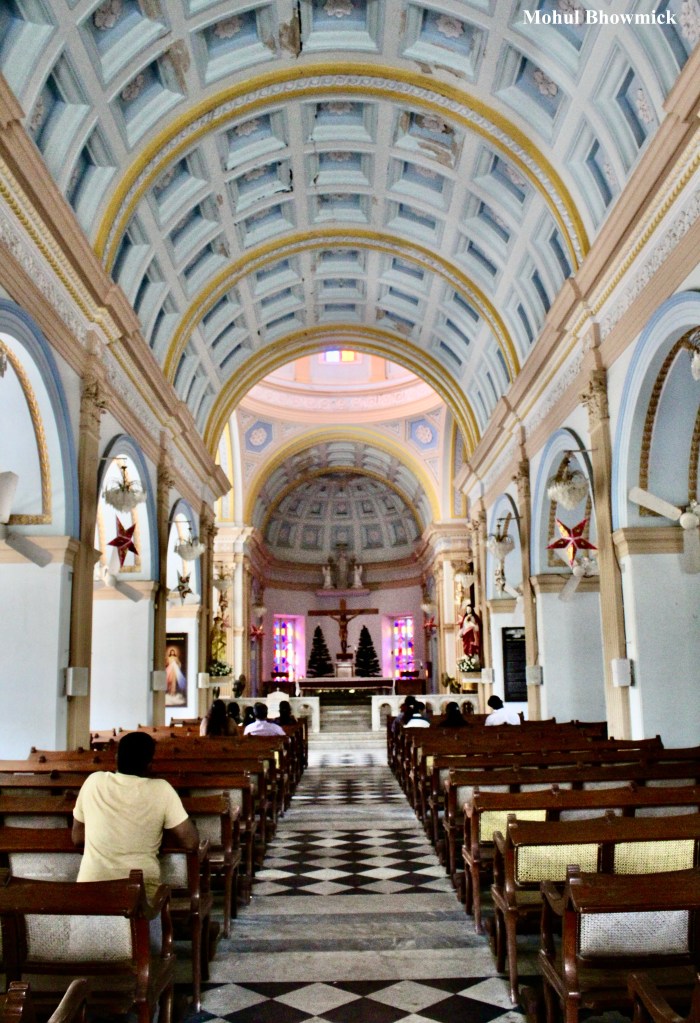
The Basilica of the Sacred Heart of Jesus, towering above the modest remains of Mahatma Gandhi Road, buffered the excesses that Our Lady of Angels (or Notre Dame des Anges – you tended to pick up lingua colonia in Pondicherry) gracefully bypassed. The ashram of the terrorist-turned-mystic Aurobindo Ghosh sat quietly on Rue Marine. To capture the whiff of spirituality by contact two lanes away on Rue de Dupleix was not to ask for much.
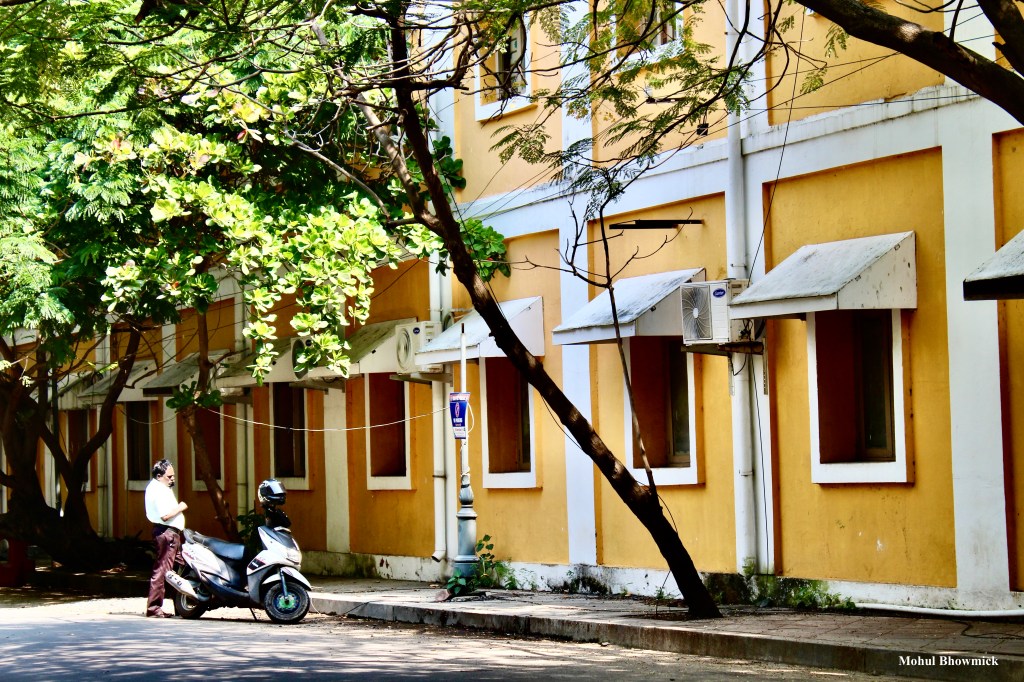
Yellow buildings in French Pondicherry Church of Notre Dame des Anges
The breath of fresh air that Ananda Adyar Bhavan up the same road promised but did not deliver remained just as it was when I had last come here three monsoons ago; in a stubborn reluctance to offer it anything but importune wisdom, I remembered being carried away by Alexander Dumas’ The Count of Monte Cristo (1846).Yet, it befitted the traveller to note that Rue Dumas honoured the colonialist Pierre Benoît Dumas[1], and not the man considerably greater than him. Of course, the French celebrated Dupleix[2] far more, as evidenced by a huge monument dedicated to him at the end of Goubert Avenue. To them, he was the greatest hero in a world where Napoleon was yet to be born, and where the English did not have Cromwell and the Americans had not seen Washington.
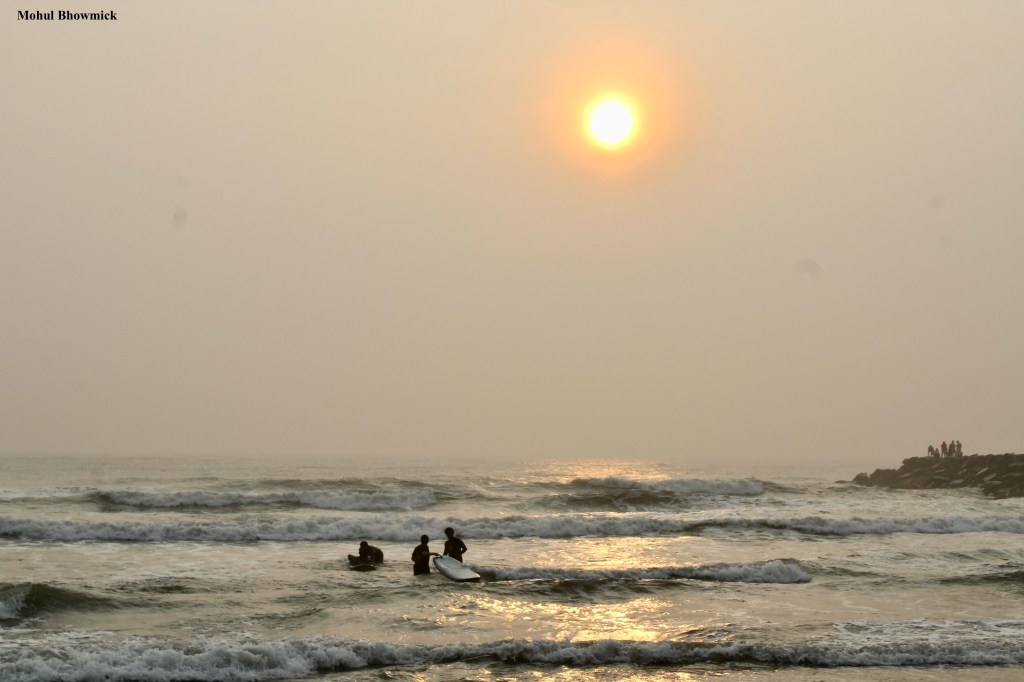
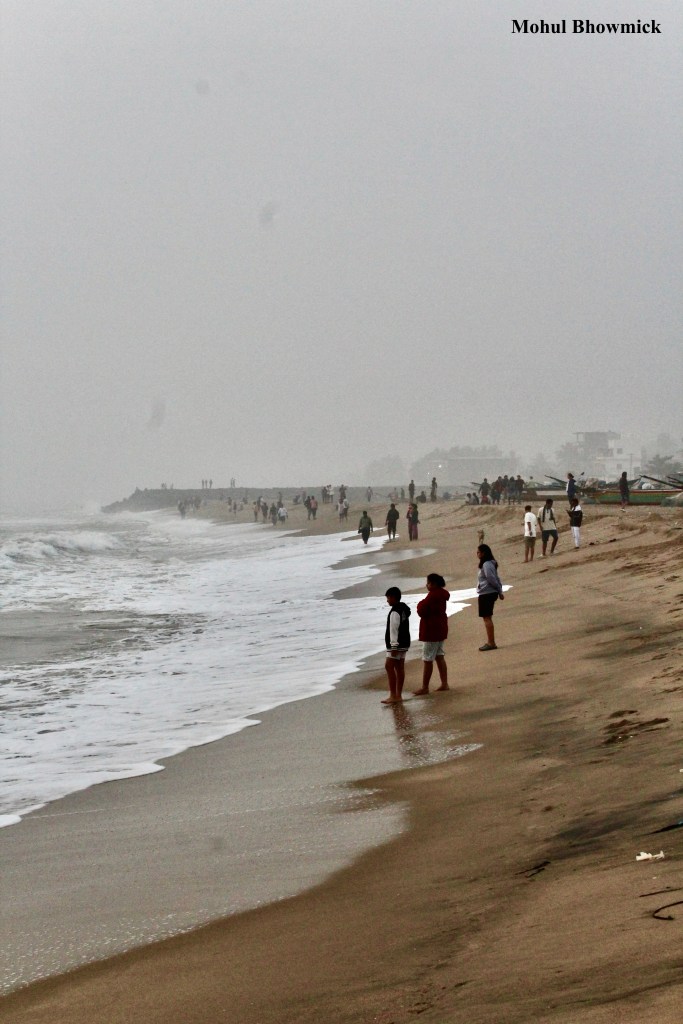
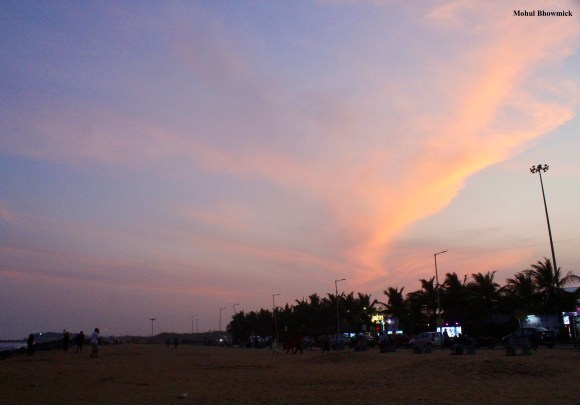
The sun bypassed the graceless winds that set up shop on the Promenade every evening; frequented far more by tourists than locals, it risked losing its sheen as something more than a weekend destination. But the coffee — of course, the coffee — whose aroma one could smell five streets away, was only a tad more appealing than the Pain au chocolat in all the bakeries of Pondicherry, upon whom entire paeans could be written.
To be carried away by such history was a must in Pondicherry; to stay sane, all one had to do was avoid mixing one’s emotions up in the Black Town, and be carried away by scarcity, poverty and destitution while crossing the canal between Netaji Salai and HM Kassim Salai. When I asked a fumbling Frenchman as to why the most significant roads of Pondicherry were named after men who vociferously advocated for self-rule, he told me that he did not know much about de Gaulle, and that his companion, a mild-complexioned young woman to whom being a liberal meant the same as being a libertine, had not read Voltaire.
“In the heart of every Frenchman, there is wine,” I said, quoting Ramanujan, who had been to Strasbourg and Marseille by road, but this only elicited the tiniest of smiles from a pockmarked student from Nantes who had read Hugo, and to whom the world was only just showing its vraies couleurs. It was all she could do not to stand in attention and belt out La Marseillaise under the mid-afternoon sun on Rue de Bussy.
[1] Pierre Benoît Dumas (1668–1745) was the French Governor General for Pondicherry
[2] Joseph Marquis Dupleix (1697-1763), Governor general of French India
Mohul Bhowmick is a national-level cricketer, sports journalist, poet, essayist and travel writer from Hyderabad, India. He has published five collections of poems and one travelogue so far. His latest book, The Past Is Another Country, came out in 2025. More of his work can be discovered on his website: www.mohulbhowmick.com.
.
PLEASE NOTE: ARTICLES CAN ONLY BE REPRODUCED IN OTHER SITES WITH DUE ACKNOWLEDGEMENT TO BORDERLESS JOURNAL
Beside a relentless freeway, which is anything but free and takes its toll on users and non-users as well, ‘boys’ meet for coffee at Mothers Instinct with no apostrophe or wives in sight. They’re old boys now, content to breathe and able to coast on Old Age Pension. They laboured long, fathered kids by un- leashing millions of apostrophes into wives, had operations via Medicare to fix things that could have meant never retiring. Considering current high price of houses in their suburb, they are now wealthy but that does not stop them breakfasting at home before venturing out for second coffees. Too late to become loose with money, they leave that to the next generation. Every boy knows what every other boy knows – they watch same TV shows – so, no serious debate. Chuckle, toss gossip, kid each other, talk sport while picking at pastries that wives wouldn’t approve. You’d think their lives had been one long joke here in big city. Sip that pricey espresso, chat, zone out then wander home for lunch. Their wives, the ‘girls’, are elsewhere for pre-coffee yoga. They also laboured long, had the babies, kept every body fed. Fact is women usually outlive men, perhaps due to mothers’ instinct.
Allan Lake is a migrant poet from Allover, Canada, who now lives in Allover, Australia. He has published poems in 24 countries. His latest chapbook of poems, entitled My Photos of Sicily, was published by Ginninderra Press.
PLEASE NOTE: ARTICLES CAN ONLY BE REPRODUCED IN OTHER SITES WITH DUE ACKNOWLEDGEMENT TO BORDERLESS JOURNAL
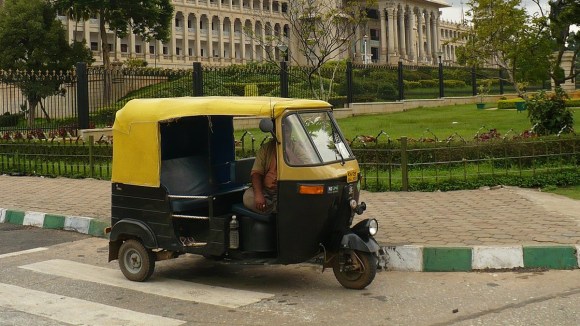
The December breeze had turned nippy in Bengaluru, carrying with it the aroma of roasted peanuts and freshly fried banana chips from roadside stalls. Fairy lights blinked across MG Road, and plastic Santas dangled from shopfronts. Ravi watched the sparkle through his rear-view mirror as he waited for his regular passenger, Ananya, to emerge from the Barton Centre, where she worked at a real estate firm.
“Sorry, Ravi bhaiya,” she said, sliding into the back seat. “The office party ran late. You know how these Christmas celebrations are: too much food, too little meaning.” She sighed, glancing at her half-open goody bag stuffed with unopened chips and chocolates.
Ravi smiled politely. He liked Ananya. Always punctual, always courteous, never haggling over the fare. But her words lingered. Too much food, too little meaning.
That night, after parking his autorickshaw near his rented room in Ejipura, Ravi noticed a group of slum children huddled under a flickering streetlight. They were watching a television through the open window of a well-to-do home. A Christmas carol drifted out, and the children sang along, slightly off-key.
“Santa will come!” one of the younger ones shouted.
“Arrey, fool,” another replied, “Santa only goes to rich houses.”
Their laughter carried a quiet truth. Ravi walked past them slowly, his chest tightening. What if Santa came here—just once?
The thought stayed with him.
The next morning, Ravi tied a cardboard sign inside his auto:
CHRISTMAS DONATION BOX – HELP BRING A SMILE TO CHILDREN LIVING IN SLUMS
An old plastic box sat beneath it. Some passengers glanced at it and looked away. Others smiled. A few dropped in coins or notes.
“What’s this for?” many asked.
“I want to buy small gifts for the children near my place,” Ravi explained. “Like Santa.”
An elderly woman patted his shoulder before slipping in a hundred-rupee note. “Good man. May God bless you.”
Within days, the box filled faster than Ravi had imagined. One evening, he counted the money: over three thousand rupees. More than a week’s earnings. His hands trembled slightly as he folded the notes.
At the market, he bought candy packets, crayons, and small notebooks. In a second-hand shop near Shivajinagar, he found a faded red Santa coat, a cotton beard, and a cap. It wasn’t perfect, but it would do.
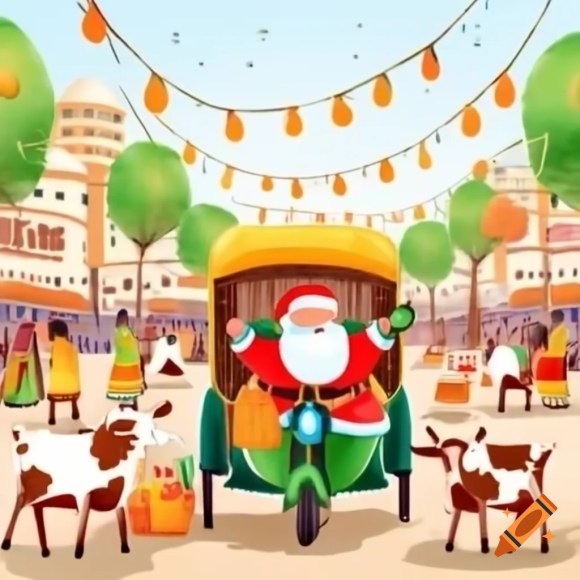
On Christmas Eve, Ravi transformed his green-and-yellow auto. Fairy lights ran along the roof. Paper stars swayed gently. A hand-painted ‘Merry Christmas’ sign was fixed to the back.
His neighbours laughed. “Ravi, have you gone mad? You’re a Hindu. Why Christmas?”
Ravi grinned. “Santa doesn’t ask who you are before giving gifts, right?”
By evening, the narrow lanes were alive with whispers and giggles. When Ravi stepped out dressed as Santa, a cheer erupted.
“Santa has come! Real Santa!”
He handed out candies, crayons, and notebooks. Laughter echoed between the tin roofs, mingling with jingling auto coins and distant church bells.
A barefoot little girl with bright eyes tugged at his sleeve. “Santa uncle, will you come next year also?”
Ravi bent down, his beard slipping sideways. “Only if you promise to study well and share your chocolates.”
She nodded gravely. “Done.”
Ravi laughed, blinking back, gripped by a sudden ache in his throat.
Later that night, he removed the Santa costume and counted the remaining money. Rs 1,800 still lay in the box. Someone had quietly slipped in two Rs 500 notes during the evening crowd. Ravi sat silently for a long moment, overwhelmed.
The next morning, he went to the Hanuman temple, where he prayed every Tuesday. He placed the leftover money before the priest as a thanksgiving.
The priest, an elderly man with cataract-clouded eyes, listened patiently as Ravi explained: the happiness he had brought to the slum children with the donation box, the costume, the Christmas star.
“I know it’s not our festival, Swamiji,” Ravi said apologetically. “But I wanted to do something good.”
The priest smiled. “Tell me, Ravi, did you ask those children their religion before giving them sweets?”
“No, Swamiji.”
“And did they ask yours?”
Ravi shook his head.
“Then where is the difference?” the priest said gently. “Whether one calls Him Krishna, Allah, or Christ, God smiles when His children care for one another. This is the true spirit of dharma[1].”
He placed his hand on Ravi’s head. “May your auto always carry light, not just passengers.”
That evening, Ravi drove through Bengaluru once more. Some fairy lights on his auto had dimmed, but a few still twinkled. The donation box remained inside. Though Christmas had passed, coins continued to clink into it.
For the first time, Ravi understood that Christmas wasn’t about religion, decorations, or abundance. It was about sharing warmth in a world that often forgets to care.
The road stretched ahead, glowing with city lights that shimmered like stars. And in the soft hum of his modest auto, Ravi felt as though he carried a small piece of swarg[2] through the streets of Bengaluru.
Snigdha Agrawal (née Banerjee) is the author of five books, a lifelong lover of words, and the writer of the memoir Fragments of Time, available on Amazon worldwide. She lives in Bangalore (India).
.
PLEASE NOTE: ARTICLES CAN ONLY BE REPRODUCED IN OTHER SITES WITH DUE ACKNOWLEDGEMENT TO BORDERLESS JOURNAL
Poetry by Atta Shad: Translated from Balochi by Fazal Baloch
Whether morning or eventide,
dawn or twilight—
what remains to be said
of the rainbow and raincloud,
of the scented breeze,
of the beloved earth?
The heart seems withdrawn from all.

The heart, a patient mendicant,
feels and endures each rebuff.
Desire wanders beneath the scorching sun,
a traveler without a destination.

Night falls, (so we’ve heard).
Day breaks, (so they claim).
But who can tell of day and the night?
Both are deemed dead now.
Joy wraps itself in mourning’s cloak.

Love’s springtide
carries the green pulse of bloom.
Yet to slay hope, to shatter a vow,
is a catastrophe enough for any age.
Love and wrath are bound in a single knot.

In the mirror of dreams
the world becomes a marketplace.
And in that marketplace
a shadow falls
over translucent melodies of spring,
over verdant meadows,
over pearl-laden, swaying fields.

Eyes go blind.
Ears turn deaf.
Only wealth gleams,
only riches glitter.

What remains to be said
of the rainbow and raincloud,
of the scented breeze,
of the beloved earth?

In this marketplace
you are for sale.
So am I.

The heart, a patient mendicant
feels and endures each rebuff.
Desire wanders in the scorching sun,
a traveler without a destination.
Atta Shad(1939-1997) is the most revered and cherished modern Balochi poet. He instilled a new spirit in the moribund body of modern Balochi poetry in the early 1950s when the latter was drastically paralysed by the influence of Persian and Urdu poetry. Atta Shad gave a new orientation to modern Balochi poetry by giving a formidable ground to the free verse, which also brought in its wake a chain of new themes and mode of expression hitherto untouched by Balochi poets. Apart from the popular motifs of love and romance, subjugation and suffering, freedom and liberty, life and its absurdities are a few recurrent themes which appear in Shad’s poetry. What sets Shad apart from the rest of Balochi poets is his subtle, metaphoric and symbolic approach while versifying socio-political themes. He seemed more concerned about the aesthetic sense of art than anything else.
Shad’s poetry anthologies include Roch Ger and Shap Sahaar Andem, which were later collected in a single anthology under the title Gulzameen, posthumously published by the Balochi Academy Quetta in 2015. The translated poem is from Gulzameen.
Fazal Baloch is a Balochi writer and translator. He has translated many Balochi poems and short stories into English. His translations have been featured in Pakistani Literature published by Pakistan Academy of Letters and in the form of books and anthologies. Fazal Baloch has the translation rights of Atta Shad from the publisher.
PLEASE NOTE: ARTICLES CAN ONLY BE REPRODUCED IN OTHER SITES WITH DUE ACKNOWLEDGEMENT TO BORDERLESS JOURNAL
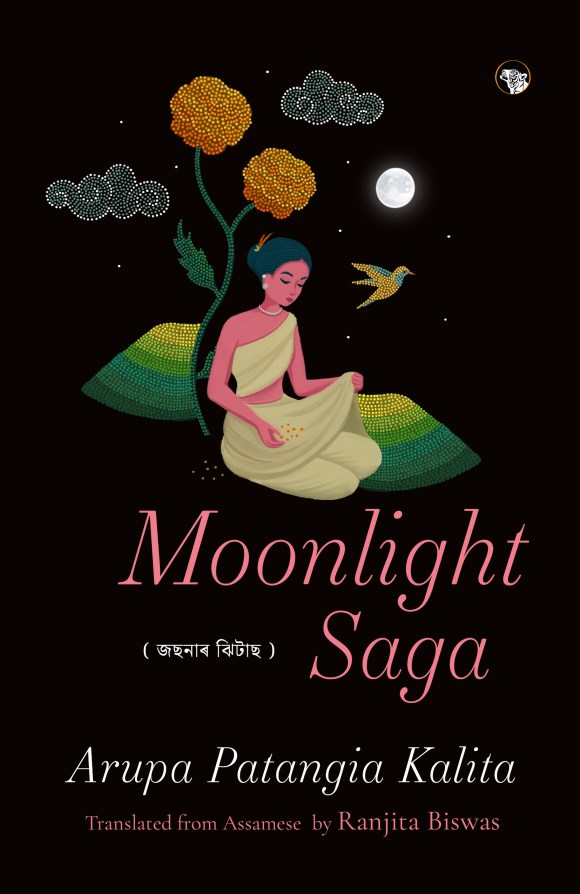
Many, many years ago, even before time could be stamped with a number, our earth was absolutely empty. The utter silence depressed Singh Buga, the Adi devata—the First God. He could not live in peace in his heavenly abode. So Singh Buga decided to use his magical power to fill up the void with living things. But there was no soil on which they could be nurtured. Water, water, that’s all he saw everywhere. Yes, there was soil under the water, but who could bring it up from such depths? If only he could get some earth, even a small amount, he would fill it with trees and flowers, animals and other living beings. He thought and thought and then he created a leech, a crab and a tortoise. The leech was sent first to get some soil, but he failed in his mission. How could he go down to such great depths under the water? So, Singh Buga sent the crab. But for him too, the soil was too down below. At last, he sent the tortoise. The tortoise followed his Lord’s command and plunged in. He swam far into the depths, reached the bottom and touched the earth’s core. He smelled the earth, took a deep breath, rubbed some of the earth on his body, dug up some more that lay almost inert for eons under the cold water and carried it back for his Lord. Singh Buga was delighted and soon created all the things he desired. The earth that had lain lifeless underwater for thousands of years was touched by sunlight. Wind blew over it. It became full of life. The fertile land became green and spread to the horizon. Plants flowered, trees bowed down with the weight of ripe fruits. The earth was now full of colour. The God decided to create living beings. The calls of birds, animals and insects broke the silence. A pair of milk-white swans laid two eggs. From them Singh Buga created a pair of humans—a man and a woman. He was elated that men would now inhabit the earth. He let them live in a cave and waited with bated breath for news of a new arrival. But where was the news? He waited and waited, finally feeling crestfallen. The pair were very happy roaming around in the beautiful land, but they were ignorant about the mystery of creating life themselves. So, he made them drink laopaani—rice wine—to make their bodies throb with desire.
See that couple sitting morosely in a corner on the ferry? They are no older than the young couple Singh Buga had created out of two swan eggs. But this young couple exudes no sense of happiness. They belong to this burdensome earth; not for them the serenity of the pristine world that God Singh Buga had created. True, they worship him, but in their lives there is only pain and sorrow. Hunger and the torment of a painful existence has chased them every moment. Lack of peace and resentment towards their lot were their constant companions. Adi devata could intoxicate the young couple he had brought to life with liquor and generate in them a desire to create. But for this couple, even if God Singh Buga offered them the best drink, he would only lull them physically from the pain; he would be unable to awaken in them the ancient hunger of the body. Their minds were as dry as the drought-affected earth. On that famished land, only hot tears trickled down drop by drop. The hungry earth sucked in those tears instantly.
The girl, at the cusp of youth, looked utterly dejected. The long arduous journey had drained her energy. Her eyes shut, she rested her head on the shoulder of the equally exhausted young man sitting next to her. If she opened her eyes, the bright sunlight playing on the river’s surface dazzled her and made her head spin. She was too weak to move much.
Her name was Durgi. Durgi Bhumij. An expert sculptor seemed to have lovingly carved her figure. Her statuesque body had thinned down somewhat, but strangely, though wreaked by hunger and thirst, her light brown face had not lost its charm. She was, after all, Durgi—Durga mai, Goddess Durga. She was born during the autumn festival of Durga puja, when the throbbing madal drum was beating frenziedly outside their house. Her grandmother cut the umbilical cord, gave the baby a bath and placed her on her mother’s breast and said, ‘Durga mai has come to our house.’ The old woman named her Durgi in the likeness of the Shakti Goddess.
But now, her granny’s beloved Durga mai was facing terrible times. A devastating famine had crippled their land of red earth. Its canopy of forests of mahua, sal and teak were now filled with only heart-rending cries from hungry mouths, and death.
Durgi was at an age when she could digest even chips of stone. But there was nothing to eat. The fields lay dry. The white sahibs had taken away everything. There was no water in the river for them, no forests to pick fruits from. There was no work: no field to till, no forest to forage for potatoes and yams. Entering the forest for their age-old practice of hunting was banned. As was fishing in the river next to their village. All these now belonged to ‘others’. The only word that echoed through the land was: NOTHING…NOTHING. Nothing was left for them. Rice became as costly as gold.
There had been floods in the past, even droughts. But like a mother whose annoyance with a child does not last long, Mother Nature’s anger also did not carry on forever. The earth became indulgent again, green shoots showed up joyfully once more. But the kind of famine Durgi and her people were now facing was like coming up against a formidable hill they could not surmount…
(Extracted from Moonlight Saga by Arupa Kalita Patangia, translated from Assamese by Ranjita Biswas. Published by Speaking Tiger Books 2026.)
ABOUT THE BOOK
In the lush yet brutal landscape of colonial Assam unfolds a haunting chapter of history—the rise of the tea plantations and the human cost that sustained them. Drawn by promises of Assam desh—a land of dignity, abundance, and fair wages—Adivasi families from central India are packed onto overcrowded steamers and sent upriver, where hunger, disease and death shadow every step of their journey. Among them is Durgi, a young woman whose resilience endures even in despair. With her, she carries a small bundle of marigold seeds, a fragile memory of the land of red earth she has left behind. At her side is her husband, Dosaru, the rebellious archer, bound to her by love and the shared hope of building a life of their own. However, what awaits them at Atharighat Tea Estate is no promised land. Labourers are stripped, disinfected, confined to barracks, and driven into relentless work, while sickness, fear, and muted defiance simmer beneath the ordered rows of tea bushes.
Durgi’s life takes a complicated turn over the years—an intimate affair with Fraser, the white manager of the tea garden, results in the birth of three mixed race children. Their unequal relationship exposes another unspoken truth about plantation life—the generations of similar children, many of whom, abandoned by their white ancestors, still live in Assam’s tea gardens today.
Rooted in lived experience, Moonlight Saga gives voice to the forgotten men and women who built the empire’s ‘green gold’, bearing witness to their suffering, endurance, and fragile hopes—as the British Raj begins to crumble in the shadows of India’s Independence struggle.
Originally written in Assamese, the novel is a celebrated and much-discussed work in Assam, recognised for its unflinching portrayal of plantation life and its place in the region’s collective memory. Its translation into English opens up an essential regional story to a wider readership, ensuring that the sacrifices and struggles embedded in the tea gardens are not forgotten.
ABOUT THE AUTHOR
Arupa Kalita Patangia is one of the best-known Assamese writers of today. She has five novels, twelve short story collections, several novellas, books for children, and translations into Assamese to her credit. In 2014, she received the prestigious Sahitya Akademi Award for her book of short stories, Mariam Austin Othoba Hira Barua.
ABOUT THE TRANSLATOR
Ranjita Biswas is an independent journalist, fiction and travel writer, and translator. Ranjita has won the KATHA translation awards several times. She has also to her credit eight published works in translation.
.
PLEASE NOTE: ARTICLES CAN ONLY BE REPRODUCED IN OTHER SITES WITH DUE ACKNOWLEDGEMENT TO BORDERLESS JOURNAL
We are living under fallen skies in dark basements of sorrow a world of broken elevators and stairs too steep for us to climb up from our depth of despair lying curled like a foetus for comfort waiting waiting and waiting for the skies to clear waiting waiting and waiting for the sun to fill the blanks waiting for the sun to shine again
Lynn White lives in north Wales. Her work is influenced by issues of social justice and events, places and people she has known or imagined. She is especially interested in exploring the boundaries of dream, fantasy and reality.
.
PLEASE NOTE: ARTICLES CAN ONLY BE REPRODUCED IN OTHER SITES WITH DUE ACKNOWLEDGEMENT TO BORDERLESS JOURNAL



 Borderless