How does one write about the experiences of war, escape and migration? For one who has not died and has lived on to tell the stories, what form of language can justifiably give voice to the atrocities endured or horrors encountered? Can the ugliness of wars be borne by poetry or the distress experienced, articulated reasonably by prose?
Ramy Al-Asheq, a Syrian-Palestinian poet who writes in Arabic, was born in Yarmouk camp for Palestinian refugees in Damascus. In 2011, during the Syrian revolution, he was imprisoned and persecuted by the Assad regime. After being released from jail, he was recaptured and imprisoned in Jordan again. He escaped the prison and spent two years under a fake name in Jordan during which he won the Heinrich Böll fellowship, which allowed him to move to Germany in 2014. He currently lives in Berlin. He has founded a German-Arabic cultural magazine, called FANN, and is a curator for Literaturhaus Berlin. Ever Since I Didn’t Die was written between 2014 and 2016 and was published in 2016. It has now been translated into English. His most recent poetry collection, My Heart Became a Bomb, was published in 2021.
Refusing to classify this collection as prose or poetry, in the preface of the book, the author says:
“I gather these texts like someone collecting body parts. Here are the pieces of my body, haphazardly brought together in a paper bag. This randomness of body parts is real in its destruction. Bloody at times, violent, honest, imaginary, personal. It looks like me with all my madness and sickness, how the revolution made me grow, what the war broke inside and what exile chipped away.”
The author’s voice aches with pain. In a world where nations are maddened by the desire to seek control and exercise unquestionable power, war ‘reaches across the horizon, loftier and older than peace’, leaving behind lives fractured by violence, displacement or exile, lives shattered and left crippled; their stories do not belong to an individual but map out the collective grief of all those forced to flee their homes.
Al-Asheq recounts the tragedies brought about by wars and oppression, by militarisation which seeks to replace the God of people by God of death, resulting in a place inhabited not by those living but by people dead-alive, turning a paradise into a wasteland. Those who escape the paradise are compelled to find shelter in distant camps. He also writes about the othering of refugees in a refugee camp, about how even after being born or living in a camp for decades, they are still seen as others, as people from distant lands who do not belong and cannot become citizens of the country they seek shelter in.
He writes of a mind in delirium which after having witnessed a massacre, becomes frenzied as if touched by jinn. His pen assumes the identity of a woman who cuts her braid and fights for revenge against the oppressor. With trembling words, he speaks of the bodies of women which are turned into sites of violence, where ‘from head to toe, the body turns into openings for death to penetrate’. He does not shy away from admitting his own cowardice which made him flee even when he wanted to scream with revenge, anger and hatred.
Al-Asheq tries to conjure up his lover as if to meet her in the sentences he weaves. His words reverberate with a yearning ‘like the sound of a lute when strummed’. Conversely however, they also deliberate on killing loved ones in his imagination, if only to get rid of their memories which do not leave him.
The seventeen texts which make this collection are marked by dualities which become part of everyday living of those wrecked by the violence. They cling to life in the face of death, their moments of relief tinged by the pain of loss, the longing for love accompanied by a despair as dark as a bleak night in prison.
In his narrative, the idea of homeland doesn’t assume the accepted notion of a place of belonging. He believes in the idea of a world where countries are without borders and humans can travel as freely as the migratory birds do.
For someone who did not die and lived on to tell his stories, Al-Asheq admits that fear has been the most honest feeling he has known. If not for that, he would have died and become a hero. And because ‘there can be no hero on a land sown with injustice, he thinks there is nothing deserving in heroism’.
“Ever since I did not die, I have lost my identity” he declares in the last chapter, an identity which was imposed upon him by a totalitarian regime and an affiliation to which only meant a life threatened by violence and shadowed by death. Loosing that identity and transformed by his experiences, the author returns to life to chronicle those sketches which may be identified with stories of millions of displaced people around the world. Perhaps texts like these can give voice to those voiceless and move the humankind to heal this world broken by injustice.
.
Rakhi Dalal is an educator by profession. When not working, she can usually be found reading books or writing about reading them. She writes at https://rakhidalal.blogspot.com/ .
.
PLEASE NOTE: ARTICLES CAN ONLY BE REPRODUCED IN OTHER SITES WITH DUE ACKNOWLEDGEMENT TO BORDERLESS JOURNAL.
I don’t remember when I started writing, or why I started writing. I don’t even remember my first poetry, or article, or any write up for that matter. It’s been an eternity. I just know I have been writing from the time when the children of my age were out in the garden playing games.
Writing runs in my blood. No, actually writing is my blood. It is my only escape from whatever exists outside into a magical world of inside. A world where I recline over ostrich cushions, cladded in a robe finely woven by the angels of beauty, wearing a bracelet made of stars, enjoying songs of cuckoo birds who gather to celebrate the baptism of newly born fairy.
Sorry.
I got lost. Now coming to the point.
I am a poet, or at least I think I am. And not a very good one, trust me. I mean no one has ever come to tell me that they enjoyed any specific piece of my poetry that I recited or shared on social media. No one reads my couplets to their lovers. No one texts me to tell me that they were touched by my recent ghazal or nazm.
None of those things happen you see.
But hey, hey, hey, no judging! I totally get it. I do understand. Even sometimes I too get this strong feeling that one of these days I am going to stop writing this stuff that I consider poetry. And I am not even lying.
But then there are two questions — could I really stop? And do I really have to?
And the answer to both of these questions is negative.
I mean whenever I pick up my pen to write, never ever I bother about what people want to read. I just write what my heart dictates ( like 90% of writers out there). It’s more like a revelation of my soul. And I can never stop listening to these revelations. Because I don’t know how to.
I mean, I wonder, if I stop writing then who will tell people about the old Neem tree which was there in my house, and which used to smell like heaven when the spring blooms came? Or those beautiful roses as red as the blood of Christ? Who will write about the lessons my grandmother taught me as a kid, or the lullabies that my mother sang to me? Who is going to narrate to them my perspective of the Romeo and Juliet? Who is going to write the last verse of that incomplete poem on my desk?
I need to understand the fact that when a poet writes a poem — no matter what — it is something that he has created, and he celebrates it. He should celebrate it! Irrespective of that fact the no one joins him in this celebration.
Because no matter what people say, every story is worth telling.
As I do not remember my first write up, I so don’t want to know my last. I want to die writing it. Leaving a door to my story open for others to enter.
.
Adnan Zaidi is pursuing his masters in law from Aligarh Muslim University, India. He has recited his poetry on various platforms and has also been published a couple of times by different magazines. He also writes his own blog, raising social and political issues.
.
PLEASE NOTE: ARTICLES CAN ONLY BE REPRODUCED IN OTHER SITES WITH DUE ACKNOWLEDGEMENT TO BORDERLESS JOURNAL
Language. Children learn it before they understand its importance. Adults can struggle to learn additional languages because the brain is less elastic as it ages. The formulation of language is a key component of what makes humans, human. Our language (though not our communication) is speculated to be among the most complicated and rule-bound of living creatures. Whether disproved in the future when we are able to translate other animals’ languages, we can all agree, the impact of language on us is invaluable.
Why then are our language skills diminishing? With every person who has benefited from being able to look up information online and thus, know a little bit about a lot of subjects, we have simultaneously reduced our language breadth. We are increasingly tempted to take short cuts linguistically both in writing (texts and emails) and how we speak to each other. It may be tempting to blame this on social media but it’s not that simple. This is not new: Throughout time, there has been enormous value put on ‘banter’, ‘ridicule’, ‘sarcasm’ and pithy retorts.
Perhaps people who can summon lightning fast rapporté are considered witty, nimble minded, fashionable. Contemplate those who have been considered ‘cool’ socially. Those who had the quick response, the short soundbite that cut to the chase or was easily repeatable, was often admired. Just recently Ukrainian President Volodymyr Zelenskyy in response to President Biden’s offer of a flight to get him and his family out of harm’s way, replied: “I don’t need a ride, I need bullets.”
People applauded his response because in many ways it describes the crux of what Volodymyr Zelenskyy and his country are going through and portrays him as a brave leader. Just as Clint Eastwood in the Dirty Harry series said the much-emulated words: “Make my day punk” and Arnold Schwarzenegger coined “hasta la vista” in the Terminator series alongside other iconic statements made by film stars, celebrities, politicians and authors. It’s the admiration of cutting to the chase, emulated by millions, as a means of extracting the essence of what we’re trying to say or merely being glib. We utilise quotes now more than ever, through the social media medium which makes it easy. The only question is; when we scroll through quotes and need ever increasing variety to our lives, are we really absorbing the meaning behind the soundbite or merely parroting it?
There is a history behind the proverb, quote and parable. It was a means of remembering wisdoms easily for those who might have been illiterate or before books were widely available. Along with songs, this was a method of retaining what was not written. Religion has employed this through easy to remember choruses and proverbs, it has long been human nature to reflect on life through such proverbs and sayings. In the 14th century the popular proverb “He who sups with the Devil should have a long spoon” and other sayings were a means of social control or wisdom, depending. In quotes from Aesop, (the famous fables) “We hang the petty thieves and appoint the great ones to public office.” We can admire the truism of this, just as we admire the bravado of a TV hero saying “make my day punk.” Perhaps Confucius said it best: “They must often change who would be constant in happiness or wisdom.” And quotes are a ready means of growth that don’t require the commitment of reading say, The Four Books and Five Classics of Confucianism.
But when do quotes stop being educational and more, inadequate shortcuts to knowledge? Where I live, people don’t read whole books very often anymore. They excuse this by saying they are ‘too busy’ to read. I work a 60-hour week and I read. I can understand emergency room doctor’s and new parents not having time to read, but regular folk? You can tell how much someone reads by asking them what their favourite books are. If they quote more than one high school book, chances are, they haven’t read much since high school. Reading is an evolutionary experience and we grow as we read. Many people have forsaken televisions (which isn’t a bad thing) but also the genre of fiction, believing it has no worth. Are we ‘better’ for reading less fiction, and for reading fewer complete books and more online news channels and texts and memes? Do we lose something? And if so, what do we lose when we absorb language in this different, shortened way?
When was the last time you sat down and had a really in-depth conversation that wasn’t about your parents’ dementia or a breast cancer diagnosis or something that serious? But simply analyzing a book you read, a play you went to see, a film, or a discussion on politics or history or psychology? Granted some of us may never have sought to do this and that’s okay, but of those who did used to analyze, it seems analysis is less mainstream and now very specific to your job field. Fewer people sit on Sunday afternoons and read the paper from front to back. More scroll quickly, gleaning the basic amuse-bouche but nothing of substance. If you are a marketing analysist you analyze market trends. If you work in the financial sector, you may analyse financial impact. If you are an economist, you may consider economic development. Because most of us work such long hours, do we really have time, energy (or desire) to analyse things we don’t have to analyse?
It could be a sign of the times, of modernity, cultural shifts, progress even, that we don’t need to delve as deeply. No longer subject to pouring through piles of textbooks to hand write a paper. And some of that progress facilitates other knowledge, such as an ability to navigate the www… and beyond — to understand HTML and design websites and publish books all by ourselves, things that formerly would have seemed impossible. The scope of things we can do with technology for example, has expanded our choices recreationally and professionally. Kids are creating entire music albums in their bedrooms with affordable equipment, people are making whole films on their iPhone, others earn a living filming themselves for social media platforms, models are made by Instagram photos, we have all become graphic designers and editors of our own stories.
On the flip side of that, jobs that once promised a living wage such as graphic design, photography, editing, translation, music production, are being replaced by cheaper options. Platforms like FIVERR can design your tattoo for you, create a corporate logo, a book cover, anything you should desire, for a fraction of the price a professional would charge, because they are borderless, not beholden to the rules of old, and could well be a 16-year-old practicing graphic design skills from their bedroom. On the face of it, there is nothing wrong with that. If someone in Indonesia wants to offer those services for a fraction of the price a US supplier would charge, and under-cuts them in the process, isn’t that just the consequence of a free marketplace? If that Indonesian supplier wishes to charge what for them is a relatively fair wage, but in the US market would be considered a pauper’s wage, is it exploitative to the Indonesian? Or must we accept an individual’s choice to make that decision for themselves?
Should we question what ‘choice’ means if there is effectively, less choice when someone offers services for less? What is equitable? Ethical? With technology half the times we don’t know what country, what nationality or the details of the people we work with and it becomes less important. The only reason it is important is if someone is working from Nepal for $3 an hour whilst someone is working from Australia for $25 an hour. Simultaneously if everyone is aware of that inequity but agrees-none-the-less, then who are we to complain? Cost of living varies and maybe charging commensurate to your cost of living is a more realistic model than across-the-board flat rates. How much has changed since the internet opened borders and countries to a greater freedom of the choice of commerce and services than ever before? Like with anything, there is exploitation and there is improvement, and there’s no one simple answer to ensuring everything is fair, or nobody is exploited.
How does this relate to language? Or a series of retorts? It comes down to shifting social mores and what our expectations are – with this comes a modification of language, much like that you read about in science fiction novels of the 1960’s where the homogenised aspect of the world watered down uniqueness in favour of uniformity and created a melting pot where language among other things, was diluted for simplicities sake. Interestingly science fiction also created entirely new languages, (conlang, which is an artificial language) and worlds, so one could say it added to as much as it abstracted the future. Using posteriori languages (borrowed words and grammar from existing languages) has become commonplace, from Spanglish to Yiddish in America.
In the article ‘SMS & Its Negative Effects on Language’ (www.itstillworks.com), the authors note the mass use of shortened ‘slang’ language employed by societal groups, not least teenagers. Such habits have been speculated to carry over into reduced grammatical and spelling abilities, although conversely it could be argued, if teens are writing more (even badly) it encourages those who formerly may not have written at all. If you think how much your social skills have deteriorated since the pandemic because of lock-down and less direct socialising, is it that hard to believe persistent use of abbreviations and icons would replace language fluency? In the article ‘Alienating the Audience: How Abbreviations Hamper Scientific Communication’ (http://www.Psychologicalscience.org) the authors point to loss of deeper meaning when employing constant acronyms.
In The Times of India article ‘Shortening language has negative implications’, the authors point to a misuse of technology (always being ‘on’ and responsive to technology) ironically reduces efficiency and that ‘infomania’ can cause an overload of information. Being ‘dumbed down’ by technology and linguistic abbreviation could reduce the sharpness of our knowledge. Conversely, The Atlantic says in its article ‘Teens Aren’t Ruining Language’ that while ‘fad’ words may have a different trajectory online, they don’t have the power to ‘debase’ linguistic standards. “How much a person’s vernacular changes over time may have as much to do with personality and social standing as it has to do with age. The extent to which teenagers are credited with (or blamed for) driving lasting change to language … is grossly overstated.”
Whatever language we speak, we may be aware of this shift in seeking depth. Not only reading less complete works but expecting a synopsis instead. How does this affect conversations? Social interactions? What do we value and consider ‘worth’ as well as what the shift from meaning to soundbite imply? It is good to be able to Google everything and think we understand things we may not have looked up if the internet did not exist. But simultaneously we’re aware what’s online isn’t always factual so much as a series of compiled opinion. If history is written by the victor, then doesn’t it stand to reason what we assume is ‘fact’ shifts dramatically? What people in China right now, are exposed to as ‘incontrovertible truth’ is not the same as what people in Russia are being exposed to, or America, or India. With so much variation in what represents pure truth, shouldn’t we worry about that? Or are we imagining a past where truth existed in a purer state than it ever did?
Journalists used to have to write objectively about subjects, unless they were writing opinion pieces or columns. Even with the latter, there was a responsibility to report news from both sides, and not let personal bias taint the reporting or the information being presented. When you read news articles now, if you step back and try to put your own personal political views aside – what do you think about the reporting of those subjects? Are they objective? Take any side you want, but what you’ll find is they are often blatant or subtle bias and invested in projecting their perspective as the ‘only truth.’ Even the most basic Wikipedia definition of journalistic objectivity states: “To maintain objectivity in journalism, journalists should present the facts whether or not they like or agree with those facts. Objective reporting is meant to portray issues and events in a neutral and unbiased manner, regardless of the writer’s opinion or personal beliefs.” Why then is this not demanded?
I admire journalists who could step outside of their own views and write on a subject without that natural bias. Non-journalists are biased and look to journalism as a fair reporter of facts, where we can make our own minds up. Reporting shouldn’t be an opportunity to tear one side down to promote another. In America, the backlash against Donald Trump was perhaps the greatest witnessed in this country because of the deep divide in voters and the horror felt towards Donald Trump by many. He was considered dangerous for the country and irrespective of whether it was a truth, the majority of news outlets were a 100 percent against him. When I brought this up, I was told I obviously was a racist who supported Donald Trump otherwise why would I even care? This missed the point. I cared not because I wanted to defend Trump, but because I felt objective, rational, non-biased news reporting had been completely eroded.
It’s more important to me that we retain that objectivity even in the face of things that we may personally revile. A journalist who is unable to be objective, forfeits the right to condemn another, because they are not utilising that objectivity in their analysis. Maybe we cannot expect regular every day people to be free of bias, but when the moral underpinning of your job requires it, then you owe it to your readership not to pander to their outrage and stir the pot, but present an objective overview. The same is true of social media ‘conversation’ where a subject is presented, and people sound off, often becoming offensive, outrageous and exceeding the remit expected if we were all sitting in a room together. That anonymity afforded by a screen and physical distance, seems to have opened a pandoras box of horrors.
People can be unrecognisably offensive in their attack of others, for no discernable reason. It should be possible to discuss any subject without people devolving into personal attack and ad hominin. Has our use of language also been altered via our anonymity online? The oft disputed Sapir–Whorf Hypothesis states that the language we speak, influences the way one thinks. This verges on potential fascism if it judges one language superior to another, but the point is taken. The complexity of language has been linked to higher IQ’s which may explain why Finnish and Japanese students tend to be in the top ten achieving academically, their languages being among the most complex. Likewise, people who are polyglots, and speak multiple languages, or those who are musical (often considered a language) or mathematical (likewise) tend to possess higher IQ’s. The problem with this is we will never know what other influencing factors play a part in this, including nurture and nature.
This paradox between cancel culture, that looks to demote those who say things deemed offensive, and the increasing offensive backlash and gaslighting of others, seems to point at the hypocrisy of ‘free speech.’ It’s only free if the right person is saying the right thing, otherwise you’re liable to be canceled, but watch out, because that’s subject to social fashions that vary wildly. Beyond that hypocrisy, what of the actual quality of communication? Have we devolved to the point of only being able to say what we really think anonymously? Why do people write reams online but say little in a real-life group? Are we hiding behind rules and etiquette that only creates sub-groups that have no tolerance for other groups? Does group think ever produce something other than subjective thinking?
If aliens came to Earth, they might notice humans seem to admire ridicule and socially sanctioned sarcasm and call it witty without needing to have a deeper conversation. Twitter represents this phenomenon most acutely because the actual length of your post is restricted and thus, you have to encapsulate what you want to convey, by honing it to that word-count. That’s great if you’re delivering a highly edited statement, but how naturalistic is it as a form of legitimate communication? Does it replace your grandmother sitting at the kitchen table with you for an hour? Maybe it doesn’t have to, but do we still sit at the kitchen table and have those conversations? And if we don’t, will that affect what human communication is evolving (or devolving) into?
Sometimes flim-flam is appealing, in its starry simplicity. We embrace Digi-Fiction written and read from computers, changing how we process fiction. We can be attracted to the code-switch of language that takes the guess work out of communication. For those neurodiverse populations and people increasingly using actual code as a form of language such as HTML, it may seem like a logical next step. An improvement on the guesswork of complex modes of communication that were challenging for so many. At the same time, when we lose the ability to read a book from beginning to end, we lose the patience and journey of that process, which if not replaced, may be a genuine loss we cannot even fathom. Then again, in the spirit of all possibilities it could be we leave behind that which is not necessary and embrace a Haiku perspective of saying more in less.
I confess, when I read a ‘classic’ novel I am aware of how much superfluous information exists and doesn’t strictly need to. It is interesting to consider how much language we used to say one thing, compared to now. The medium of social media means we’re busier than ever and take our ‘fix’ of what attracts us (quickly) before signing off. Therefore, long poems have less attraction than shorter memes. We fixate on the easily presented, the humorous and immediate. Nuance, subtlety, slow burns, those are almost luxuries we may leave for rare nights in the bath. Novels are changing to adjust to this phenomenon. Graphic novels are gaining further traction, even songs. Our entire social fabric has altered, and, in some ways, this was inevitable if you recall we always admired that witty fast retort, going back to Marie Antoinette, Gloria Swanson and beyond.
Does this mean all language must conform to this new rigor? Or will epochs of devotees to other forms of communication, endure? When I browse through bookstores, I notice there are many styles of writing, including the long-winded, and the easy read. My fear is not that we read ‘easier’ books but that we stop reading altogether, believing scrolling on our phone compensates for the discipline of reading a book. One may argue, do we need discipline? But learning is invariably discipline and part of honing rigorous learning habits is being challenged. We can do crosswords, play chess, sudoku, and go to the gym to maintain a healthy body and mind, but the ‘imaginarium’ of fiction and the need for creative expression is for many of us, equally necessary.
Fiction isn’t a waste of time simply because it’s not a literalism. Fiction as a speculative field, has inspired science, politics, social advancement and a sense of possibility. Fiction can thrill, entice, or simply entertain. Not all forms of entertainment are equal. Whilst I confess, I do watch television, I recognise the lasting value of a book compared to a serial, because it requires more of us mentally. For those highly disciplined souls, there may be no need to ‘indulge’ in fiction, or television. Maybe reading Scientific American or pouring over The Financial Times or Anglers Digest will be their choice. But language has a trickle-down effect, and you can guarantee, it will eventually permeate all sectors of our lives.
Do we want to completely dilute the value of further explanation, detail and depth in favour of the glamorous soundbite? Or is it possible to harness the value of succinct communication and retain the continued relevance of detail? When I read what passes for scientific news in popular media, it concerns me that we are picking and choosing for ‘click bait’ purposes and this leads to the proliferation of inaccuracy. Case in point, the startling headline: ‘The Epstein Barr Virus (EBV) causes MS’! Then in the meat of the article, we find 95 percent of humans have ‘EBV whilst only (35.9 [95% CI: 35.87, 35.95] per 100,000 people) have MS’ – we are leaving out the most important connections in favour of scaremongering journalism which only serves to increase (inaccurate) neuroticism when it should seek to educate and elucidate.
It’s not that too much information is bad for us, it’s that too much incomplete information can distract us from truth, and we may learn to gloss over what matters in favour of what shines brightest. Sometimes it is necessary to finish the chapter.
.
Candice Louisa Daquin is a Psychotherapist and Editor, having worked in Europe, Canada and the USA. Daquins own work is also published widely, she has written five books of poetry, the last published by Finishing Line Press called Pinch the Lock. Her website is www thefeatheredsleep.com
.
PLEASE NOTE: ARTICLES CAN ONLY BE REPRODUCED IN OTHER SITES WITH DUE ACKNOWLEDGEMENT TO BORDERLESS JOURNAL.
Rabindranath Tagore wrote several playlets for young people. These reveal the lighter side of the poet. Two of these have been translated from Bengali by Somdatta Mandal
Adwaita Charan Chattopadhyay and Chintamani Kundu.
Adwaita: Who are you?
Chintamani: I’m an Aryan, a Hindu.
Adwaita: What is your name?
Chintamani: Sri Chintamani Kundu.
Adwaita: What is your intention?
Chintamani: I want to contribute to your paper.
Adwaita: What would you like to contribute?
Chintamani: I’m an Aryan. I would like to write about the Aryan religion.
Adwaita: Sir, what is this thing that you call Aryan?
Chintamani: (surprised) Sir, you don’t know who an Aryan is? I’m an Aryan, my father Sri Nakur Kundu is an Aryan, his father, Late Nafar Kundu is an Aryan, his father —
Adwaita: I see! What is your religion?
Chintamani: That is a tough question! If I can put it in a nutshell, the religion of the non-Aryans is not that of the Aryans.
Adwaita: Now, who are the non-Aryans?
Chintamani: Those who are not Aryans are non-Aryans. I’m not a non-Aryan, my father Sri Nakur Kundu isn’t a non-Aryan, his father Late Nafar Kundu wasn’t a non-Aryan, his father—
Adwaita: Say no more! So, since Sri Nakur Kundu isn’t my father and since I have no relationship with Nafar Kundu, I’m a non-Aryan.
Chintamani: I can’t say that for sure.
Adwaita: (annoyed) What kind of talk is that? What do you mean that you can’t say for certain? Can’t you say for certain that Nakur isn’t my father? What caste are you? What could I have to do with the likes of you?
Chintamani: I’m not talking about caste, I’m talking about dynasty. You too have been born in the world-famous Aryan dynasty –
Adwaita: I born in the same dynasty in which your father Nakur Kundu was born? How dare you—the son of a peasant—even imagine such a thing?
Chintamani: Yes, sir. You might not be an Aryan, but I, and my respected father are Aryans. Alas! Where could my glorious ancestors be? Where are Kashyap, Bharadwaj, Bhrigu? What kind of talk is that?
Adwaita: What rot this man speaks? Kashyap happens to be my ancestor. We are all part of the Kashyap clan —how can Kashyap, Bharadwaj, Bhrigu be your ancestors?
Chintamani: You know nothing about these issues, so there is no point in discussing these things with you. I’m afraid this is all the tragic consequence of English education.
Adwaita: Hasn’t English education affected you?
Chintamani: Sir, you can’t blame me for such a thing. Because of the Aryan blood coursing through my veins, I ran away from school at quite an early age.
Enter Harihar Babu and several other writers.
Adwaita: Please come in. Have you got it all in writing?
Harihar: Yes. Here it is.
Chintamani: Sir, what have you been writing about?
Harihar: Lots of things.
Chintamani: Have you written anything about the Aryans?
Harihar: No.
Chintamani: About the science of the Aryans?
Harihar: The Europeans are Aryans and their science –
Chintamani: The Europeans are a very inferior race and compared to the knowledge that our Aryan forefathers had, they are really illiterate. I can prove this. Even now all descendants of Aryans invoke Aswathama before massaging oil over their bodies and then pour oil thrice on the earth. Do you know why they do so?
Harihar: No.
Chintamani: Do you?
Adwaita: No.
Chintamani: Do you?
First Writer: No.
Chintamani: If you don’t, then why talk about science? Do you know why Aryans click their fingers when they yawn?
All: (in unison) No, none of us do.
Chintamani: Really? Do you know the reason why our Aryan women beat the hand-fan on the floor if the fan touches the body of the person they are fanning?
All: No, not at all.
Chintamani: See, you know nothing. Without discussing these issues at all, without any sort of enquiry into such matters you persist in saying that European science is the best. And yet you don’t even know why Aryans sneeze, yawn or massage oil.
Harihar: All right, sir. You tell us. Why must oil be poured on the ground before it is poured over the body?
Chintamani: Magnetism! Nothing else. This is what is known in English as magnetism.
Harihar: (surprised) Have you read anything about magnetism in English science?
Chintamani: Nothing. No need for that. There is no need to study English to learn science or anything else. What do our Aryans say? There are three forces in nature – life force, causality and positivism. Just before bath the slippery force of oil being added to these forces creates physical negativity within our body. This is nothing but magnetism. Just think — the practice of wiping the body with a towel prevalent among Englishmen since the nineteenth century has been practiced by our Aryans for thousands of years for they have been using the gamcha for the same purpose since then.
The Writers: (with surprise) Wow! How commendable! What scientific skill the Aryans have! What great research our Aryan Kundu Sir has undertaken!
Harihar: We have fallen into the hands of a real idiot today! But there is no point in annoying him. He writes for several newspapers. I have heard that this Aryan Kundu is quite adept at cursing gentlemen a lot. That is why he is famous.
Chintamani: Look over there. That Aryan Brahmin is plucking flowers early in the morning. Why do you think is he doing such a thing?
Adwaita: To give them to the god during prayers.
Chintamani: Shame, shame. You don’t bother to get to the bottom of things. When the sages permitted the plucking of flowers at dawn it became obvious that they were aware of the presence of oxygen in the air. Since they knew of this, there is no doubt that they also knew of the presence of other gases too. In this manner we can clearly prove by moving from point to point that they were aware of all that was subsequently discovered by modern European chemistry. Why do we click our fingers when we yawn? That is also magnetism. When the rising gases combine with positivism, then the negative force conducted by the physical force exceeds the life force, causality and the positive force by its own power. Then the three qualities of sattwa, rajah and tama (excellence, essence of activity and lowest attributes) achieve exceptional attributes. During this phase, the heat caused in the air as a result of the friction between the middle finger and the thumb combines with the heat of the nervous system and solar heat to prevent the ultimate destruction of physical heat. If this can’t be called science, what can it be called? Isn’t it curious that none of our Aryan sages ever read any book by Darwin.?
The Writers: Amazing! Blessed be the achievements of the Aryans. All this time we couldn’t understand such theories.
Harihar: (to himself) But even today I don’t understand anything.
Chintamani: If you are wondering about the hitting of the hand fan on the floor, then that too is magnetism. Expansion, expulsion, repulsion and attraction – these physical acts add up to —
Adwaita: Spare us, spare us Sir. My head is reeling. You can write about the hitting of the hand fan in my newspaper. You have said enough already. Let me get you a paan.
Chintamani: No, sir. I haven’t come here to have a paan. You aren’t following Aryan customs and actions. The spiritual force flowing in our Aryan veins for generations, that force –
Adwaita: Enough, enough! I won’t give you a paan; you need not have one. If you permit me I will get you some tobacco instead.
Chintamani: Tobacco! What destruction! What a thought! It is even worse. Do you know why high caste people don’t smoke the hookah used by lower caste people? Why doesn’t one caste consume food touched by another caste? Why did the Aryan in earlier times not even tread over the shadow of a non-Aryan? Don’t you think there is a science behind it? Of course, there is. Let me explain it all to you. That too is magnetism. The three kinds of bodily radiance – excellent, mediocre and base –
Adwaita: Stop, stop. I won’t give you tobacco. You need not smoke the hookah. No need for paan or for tobacco – do what is convenient for you, something that will retain your bodily radiance.
The Writers: Shame on you, Adwaita babu. You did not allow us to listen to the learned words of Sri Kundu, the best of the Aryans.
First Writer: (to the second writer) Sri Kundu has such exceptional reasoning skills and knowledge. But, did you understand anything?
Second Writer: No, nothing. Let us ask him properly once again. Sir, you spoke of causality, reason and many other forces, what are they?
Chintamani: They are nothing than what is known in English as force and magnetism.
The Writers: (in unison) Oh, we’ve understood.
Harihar: Sir, I am none the wiser!
The Writers: (disgusted) You still can’t understand anything? Magnetism, force — these are easy concepts. You know what magnetism is. You know what force is. This is also the same thing. We know all of this because of the exceptional scientific enquiry pursued by the Aryans.
First Writer: If you have to understand these things clearly then you need to know all sorts of scriptures. Haven’t you read the scriptures?
Chintamani: No, I haven’t. My father and I, and Nafar Kundu are Aryans – that’s why I don’t consider it necessary to study the scriptures.
Second Writer: That’s true. But you’ve certainly read science very well.
Chintamani: Not at all. I’ve acquired the theories of sneezing, coughing, breaking the knuckles of the fingers and other specific scientific theories from my imagination. It wasn’t necessary for me to study science. You will probably not believe it, but swearing on the Aryan holy books I can say that I have studied neither Aryan scriptures nor scientific discourse. Everything that I know is the product of my imagination.
Harihar: Yes, but you certainly don’t need not swear by it. No one will ever accuse you of studying!
[Translated from “Arya O Anarya” (Chaitra 1292 B.S.) by Somdatta Mandal]
Testing the Student
The student is called Sri Madhusudan and Sri Kalachand Master is his tutor.
Enter the guardian.
Guardian: Kalachand babu, how is Madhusudan faring in his studies?
Kalachand: Sir, Madhusudan is very naughty but good in his studies. I never have to repeat anything twice to him. He never forgets what I have taught him once.
Guardian: Really! So let me put him to a test today.
Kalachand: Sure, go ahead.
Madhusudan: (to himself) Yesterday Mastermoshai beat me so badly that my back is still hurting. I will have my revenge today. I am going to have him thrown out.
Guardian: So now Modho, do you remember all that you’ve been taught till now?
Madhusudan: I remember whatever Mastermoshai has taught me.
Guardian: OK. Tell me then — what is a plant?
Madhusudan: Something that comes out of the earth.
Guardian: Give me an example.
Madhusudan: An earthworm!
Kalachand: (with eyes flashing) What did you just say?
Guardian: Shhh Sir…, don’t tell him anything now.
To Madhusudan
You have studied poetry; so, tell me, what blooms in the garden?
Madhusudan: Thorns.
Kalachand takes out a cane.
Why sir, why are you caning me? Am I lying?
Guardian: All right. Who destroyed Siraj-a-Daulah? What does history teach us?
Madhusudan: Insects.
He is caned again.
Sir, I am being caned for no reason at all! Not only Siraj-a-Daulah, but my entire history book has been eaten up by insects. Have a look.
He shows the book. Kalachand Master scratches his head.
Guardian: Do you remember any of the grammar you’ve been taught?
Madhusudan: Yes.
Guardian: What is a ‘subject’? Explain it with the help of examples.
Madhusudan: Okay. The subject is Joy Munshi who lives in the other village.
Guardian: Can you tell me why?
Madhusudan: He is a doer, busy with many virtuous rituals and activities.
Kalachand: (angrily) You must be off your head!
He canes him on his back.
Madhusudan: (startled) Sir, it’s not the head I am talking about, it’s my back.
Guardian: Tell me, what is the best way of compounding words?
Madhusudan: I don’t know.
Kalachand babu canes him again.
I know the answer to this one very well. It’s the grammar of the cane.
The guardian laughs. Kalachand babu is not amused at all.
Guardian: Have you learnt your maths lesson?
Madhusudan: Yes, I have.
Guardian: All right. Suppose you are given six and a half pieces of sweets and told to eat as many as you can in five minutes. Whatever remains will have to be given to your younger brother. If you need two minutes to eat one sweet, how many will you end up giving to your brother?
Madhusudan: Not a single piece.
Kalachand: How come?
Madhusudan: I’ll eat all of them. I wouldn’t want to give the sweets to anybody!
Guardian: All right. Suppose a banyan tree grows a quarter of an inch each day. If the tree was ten inches tall on the first of the month of Baisakh, how tall will it be on the first of Baisakh the next year?
Madhusudan: If the tree grows crooked then I won’t be able to say; but if it grows straight then we’ll be able to measure it and find out its exact height; but in the meantime if it dries up then there is nothing to be done.
Kalachand: Your brain won’t function at all till you get a good beating. Rascal, it’s only when I’ll beat you black and blue, that you’ll straighten up.
Madhusudan: Sir, even very straight things will bend if you keep beating them.
Guardian: Kalachand babu, you’re mistaken. Physical abuse won’t get you far. There is a saying that you cannot flog a donkey and turn it into a horse, but sometimes a flogged horse can turn into a donkey. Most students are capable of learning, but most teachers aren’t capable of teaching. But it’s the pupil who gets the beating. Please take yourself and your cane away and leave with your cane and let Madhusudan’s back rest for a few days, and then I myself will start teaching him.
Madhusudan: (to himself) Oh, I am so relieved!
Kalachand: Sir, I am so thankful. Only a labourer will enjoy teaching this boy—all it amounts to is manual labour. After working on him for thirty days all I get is only five rupees, while the same labour in tilling the earth would fetch me at least ten rupees per day!
[Translated from “Chhatrer Pariksha” in the Hasyakoutuk ]
Hasyakoutuk(1914) by Tagore
Somdatta Mandalis a former Professor of English and ex-Chairperson, Department of English, Visva-Bharati, Santiniketan, India. A recipient of several prestigious fellowships like the Fulbright Research and Teaching Fellowships, British Council Charles Wallace Trust Fellowship, Rockefeller Residency at Bellagio, Italy, Salzburg Seminar and Shastri Indo-Canadian Faculty Enrichment Fellowship, she has been published widely both nationally and internationally. She has also an award from Sahitya Akademi for the All India Indian Literature Golden Jubilee (1957-2007) Literary Translation Competition in the Fiction category for translating short stories series ‘Lalu’ by Sarat Chandra Chattopadhyaya.
.
PLEASE NOTE: ARTICLES CAN ONLY BE REPRODUCED IN OTHER SITES WITH DUE ACKNOWLEDGEMENT TO BORDERLESS JOURNAL
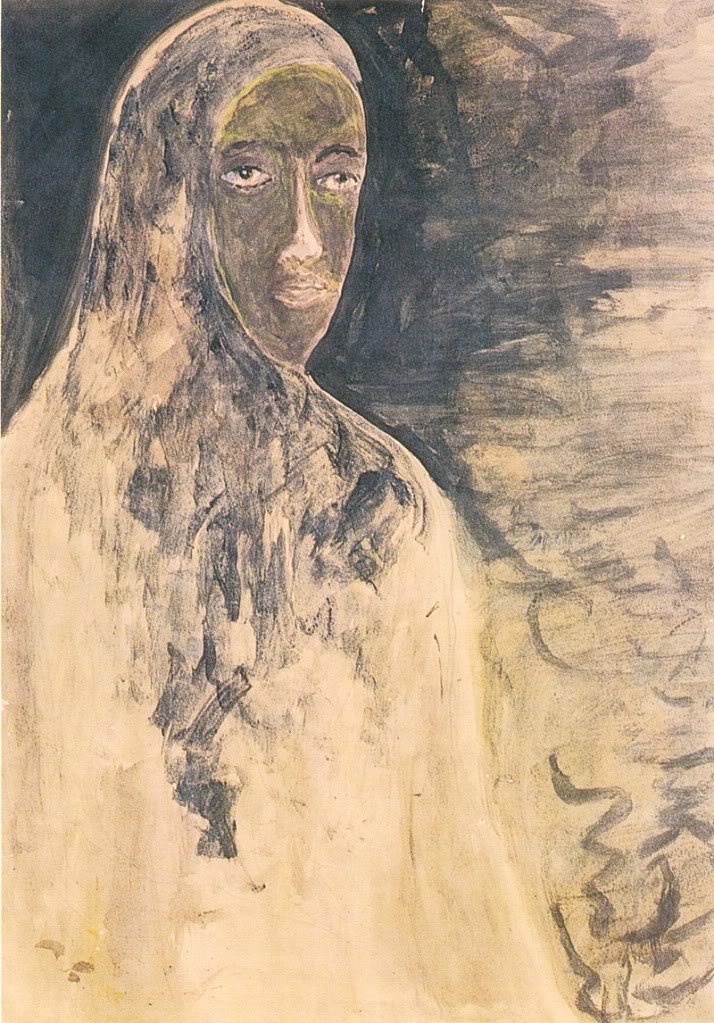
Veiled Woman: Painting by Rabindranath Tagore. Courtesy: Creative Commons
ENDLESS LOVE (Anonto Prem)

It is as if I’ve loved only you,
Hundreds of times, in hundreds of forms
In life after life, age after age, again and again!
Forever, and with an enchanted heart,
I wove necklaces of lyrics
Which you’d wear beautifully,
Accepting my gifts gracefully,
Life after life, age after age, again and again!
The more I hear stories from far away times
Of agonies lovers endured in ages long past,
Of tales of unions and separations
And whenever I look at events of days of yore,
Piercing the veil of darkness of times past
They appear in the form of an eternal star
In your visage.
The two of us float forward
In the current of a union
Emanating from eternity.
The two of us keep frolicking
Amidst millions of lovers,
Whose eyes moisten with tears of separation
Or light up with bashfulness as they meet—
In a love transcendental but in a guise all new
In love everlasting, but of this very day and age!
REMEMBERING NOT TO CALL(A villanelle permitting mourning, for my mother, Christine Ena Burch)
The hardest thing of all,
after telling her everything,
is remembering not to call.
Now the phone hanging on the wall
will never announce her ring:
the hardest thing of all
for children, however tall.
And the hardest thing this spring
will be remembering not to call
the one who was everything.
That the songbirds will nevermore sing
is the hardest thing of all
for those who once listened, in thrall,
and welcomed the message they bring,
since they won’t remember to call.
And the hardest thing this fall
will be a number with no one to ring.
No, the hardest thing of all
is remembering not to call.
LOVE UNFOLDED LIKE A FLOWER
Love unfolded
like a flower;
Pale petals pinked and blushed to see the sky.
I came to know you
and to trust you
in moments lost to springtime slipping by.
Then love burst outward,
leaping skyward,
and untamed blossoms danced against the wind.
All I wanted
was to hold you;
though passion tempted once, we never sinned.
Now love's gay petals
fade and wither,
and winter beckons, whispering a lie.
We were friends,
but friendships end . . .
yes, friendships end and even roses die.
MELTING
(for Beth)
Entirely, as spring consumes the snow,
the thought of you consumes me: I am found
in rivulets, dissolved to what I know
of former winters’ passions. Underground,
perhaps one slender icicle remains
of what I was before, in some dark cave—
a stalactite, long calcified, now drains
to sodden pools whose milky liquid laves
the colder rock, thus washing something clean
that never saw the light, that never knew
the crust could break above, that light could stream:
so luminous,
so bright,
so beautiful . . .
I lie revealed, and so I stand transformed,
and all because you smiled on me, and warmed.
Michael R. Burch’s poems have been published by hundreds of literary journals, taught in high schools and colleges, translated into fourteen languages, incorporated into three plays and two operas, and set to music by seventeen composers.
.
PLEASE NOTE: ARTICLES CAN ONLY BE REPRODUCED IN OTHER SITES WITH DUE ACKNOWLEDGEMENT TO BORDERLESS JOURNAL
“ … And do you think our present government is meeting the demands of its people ?” spouted the Spokesman Doctor, chairman of the Portuguese Communist Party Delegation in Nisa. Seated in a squalid, fly-laden café, he directed his poignant words towards a group of glassy-eyed villagers, seemingly rather perplexed at such a display of political pathos. He had been at it now for at least two hours.
A dusty gust of wind and shuffling of feet directed the villagers’ languid attention to the doorway. Long strips of coloured plastic peevishly scraped against one another. Someone stepped in : a young man, well-to-do, by his appearance, obviously not from Nisa. He side-stepped a dozing dwarf, making his way to the counter. All glassy eyes fell on the stranger.
“You never answer questions,” the Spokesman Doctor said, turning on the villagers coldly, although keeping a watchful eye on the stranger at the counter. “All of you, how long are you going to sit here swallowing insult and humiliation ? You can’t live on olives and bread alone. Look at our land … where are the tractors ? Where’s the money from America ?” There was no reply to those beseeching questions, only the slight chuckling of the stranger, who leaned gingerly at the bar sipping a coffee.
“You’d rather live then without running water and electricity ?” the Doctor spat out, staring hard at the stranger, who stared back at the Doctor even harder. “And still you don’t understand my questions.” One skinny, toothless fellow made some effort to amuse the Spokesman Doctor, but only succeeded in ordering another cup of coffee. The stranger broke into a wide grin. All eyes peered at him from yellow, sunken sockets. He broke the frosty silence by asking in the most delicious courtesy, but in the most atrocious Portuguese, for a glass of iced lemonade.
The unexpected appearance of this stranger brought whispered comments from the villagers. The Spokesman Doctor’s wiry face eyed the stranger with suspicion. He set aside his cup of coffee. A fly aimlessly found itself inside the sugar-coated rim of the cup where it remained until the Spokesman Doctor swished it disdainfully away.
“Are you Portuguese ?” he asked, rhetorically, with a slight accent of irony. The young man turned to him and answered in his choppy Portuguese that he was not, adding a few instants later that he was an American on visit to a friend whom he works with in France. This last phrase was declared in excellent French, something which surprised many of the villagers, most of whom had worked in France for years. The most astounded, however, was the Spokesman Doctor.
“So you have a friend in Nisa ?”
“Yes I do,” returned the American, catching a note of doubt in the Doctor’s authoritative tone.
“Who is this friend of yours ?”
“Domingo Flaco, but he’s still in France just now. I think he’s on his way, or at least he should be. I’m not certain ; he wrote me some time ago.”
“Do you still have the letter ?”
The American searched the Doctor’s tiny, black eyes, twitching nervously in their sockets.“No, am I supposed to have it ?” the other retorted dully.
The lanky American’s easy flow of speech and command of French relieved some of the villagers’ mistrustful thoughts, thoughts put there by the Doctor’s obsessional fear of alien spies in the mountain villages. Domingo’s name set the villagers at ease, but the Doctor remained on his guard, shifting irritably about the table, playing mindlessly with his empty cup of coffee. Another fly, finding itself helplessly stuck in the grounds of the coffee, the Doctor savagely crushed it with his thumb. He seemed to sense something foul ; something amiss, even insalubrious in this clean-cut American who spoke excellent French. Domingo indeed did live in Nisa, that was an undeniable fact. But what would an American be doing with Domingo … a poor mountain peasant who had immigrated to France, and there was presently working on a wine farm ? This relation had no logical link to it, or if it did, it completely escaped his wits. A well-to-do American visiting a peasant in the poverty of Portugal concealed a reason that his imagination could not fathom.
The Spokesman Doctor fell on his prey like a lion : “Does anyone know him ?” he asked the villagers in Portuguese. There followed a long pause. During that pause the American ordered another lemonade, quite unaware that he had become the topic of discussion. Nonchalantly he drained his glass, eyeing the assembly curiously. Again a jumble of words struck him oddly. The cold lemonade contrasted sharply with the heat that had been accumulating around him.
“Do you know this American ?” asked the Spokesman Doctor again, but this time addressing the veiny-face villager behind the counter.
“I think he does work with Domi,” he responded, wiping the counter for about the hundredth time which scattered the vexatious flies.
“No, I don’t think he does work with Domingo,” rallied the Doctor hurriedly. “I saw him handing out Jesus Christ leaflets yesterday. He was haranguing people for money. Then he went from bar to bar asking questions. Where’s your papers, American ?” The Doctor shot a fiery glance at the young man, who for one, was relieved that this man had finally spoken to him directly, and in French.
“What papers ?” he inquired. The Spokesman Doctor laughed haughtily. The others followed, but with more restraint. The Doctor now felt he had hit the nail on the head. His ‘people’ were with him, as always. “Come on, we want to see your papers. I saw you yesterday handing out Jesus Christ leaflets to people in the streets.”
The American wiped the sweat off his forehead, intrigued more by the use of ‘we’ than by the accusation. “What the hell are you talking about ?” replied the American, crimsoning under the glow of a dozen eyes.
“Are you a Communist ?” rifled the Doctor. The American nodded in the negative, taken aback by the bluntness of the question.
“Are you then a Capitalist ?” Again the same negative nod.
“Then you are nothing but an evangelizing parasite !” A pasty smile flitted across his lips. The American breathed deeply, moving a trembling finger across the counter. He couldn’t think of anything to say to defend himself ; all this seemed utter nonsense.
“Where are your papers ?” asked the Spokesman Doctor cloyingly.
“What in God’s name are you raving about, man ?” fired the American, stepping back, the enraged flies skirling about his red, sweaty face.
Again the Doctor smiled, slowly pushing his way towards the circle of villagers round the counter.
“Do you know about the CIA here in Portugal ?”
This question frightened the stranger. He brushed his flaky blond hair from his forehead, then threw the villagers a bewildering look. “Should l know about it ?” he retorted, involuntarily shifting his right foot towards the swaying, plastic strips of the doorway.
Suddenly a man shouted out coarsely : “No Doctor, he does work with Domi in France. I saw him there six months ago when I visited my cousin in Beaune.”
“No !” brayed the Spokesman Doctor vehemently. “I tell you I saw him yesterday handing out Jesus Christ leaflets. You know, there’s lots of those people in Portugal today, mostly Americans, too … you know, with the elections coming up … Look what happened before the last elections … the same thing, American agents running about the countryside posing as people of the Jesus Christ Movement.” This last statement was met by incredulous glances from the villagers. They all acknowledged the Doctor as a grand man, politically astute and well-read, but a doubt reigned over their blurry, uneducated minds. And yet, it was true: an American in Nisa posed a problem, and raised a mystery that none, at least in that hot and illiterate café, could unravel.
“You know a lot about many things, don’t you ?”enquired the Spokesman Doctor, ingratiatingly. This time the subject of conversation did not deign to reply. The Doctor scoffed at this show of pretense. “I don’t know American, but I saw you yesterday going from café to café with those dirty leaflets in your hands. There’s something about you I can’t understand. I know you speak excellent Portuguese, too.” With this ‘compliment’, if it may be considered as one, the American lifted an enigmatic eyebrow.
“There’s a lot of CIA activity in this area round election time,” continued the Doctor with his pasty smile. “Communism is very strong in our villages. Look around you … everything is falling apart in our villages. Americans are to blame for the poverty of our country.”
“Not Americans,” blared out the young man beside himself. “The …”
“No !” screamed the other louder than his rival. “I don’t want to listen to your sweet, poisoned words. Laughing, he turned away to speak quietly to his people.”
Many words darted in and round the savage, swirling flies, words which the American was at a loss to comprehend. He could have left, the way was clear to the door. But he remained adamant in his right to be in that café and drink coffee with the villagers. No proxy lout of a Communist courtier would eject him from that public place. Then a strange sensation crept up on him : everyone appeared to have come to some sort of resolution … verdict would be a better word … As if he had been accused of some crime. He saw the jury to his right … then the judge, to his left, a dark man, sporting a moustache with a horrible pasty smile.
“We have found the accused guilty,” came a hushed, indescribable voice. A wave of panic seized the accused.
“Guilty … guilty of what ?” The sad, sunken eyes of the jury hung suspended in the air. The flies, too, seemed to have adjourned their monotonous gyrating. The eyes of the judge were laughing at him, as a sickly moustache inched its black way into the left corner of his mouth.
— Has everyone gone crazy ? the American thought. –An innocent man has been falsely accused. Yes, something is very wrong here. How could this have happened ? I only came in for a cup of coffee ! Really I did … — These inner pleadings hammered at his temples, hot and pulsating. Was it real ? –To the doorway– were his next whispered words. –Must escape before they trap me in here.– The American rushed towards the doorway but scraping feet forced him to swing his shoulder to the left. –It’s not true … they’re on me. For what ? — A knotty fist shot out. He blocked it with his forearm. Then another which again he easily countered. –They’re all crazy … really crazy, — a tiny voice within him admonished.
He wanted to speak aloud but his voice found no chamber to echo his confused thoughts. Something cracked in his mouth; blood filled the spaces between his teeth. He stumbled back, catching hold of the counter. Turning, he faced his judge, and in an instant of crystal clarity he caught sight of a dull, metal object in his hairy hand. A flame tore through his belly. He grabbed at it … fingered it … found clots of blood smeared on it.
“What have you done ?” he managed to spit out in a flow of blood, his eyesight gradually fading into an empty space behind his head.
The American crumbled to his side, still conscious of his surroundings. A face slid across his sight, that of a moustached man, smiling a very pasty, wicked smile. A glibly voice nettled what remained of his pride. “That will be all for you,” said the pasty, wicked smile.
And it was true what that smile said. For the young man moaned aloud, then lay still. Everyone rose and left the café …
Paul Mirabile is a retired professor of philology now living in France. He has published mostly academic works centred on philology, history, pedagogy and religion. He has also published stories of his travels throughout Asia, where he spent thirty years.
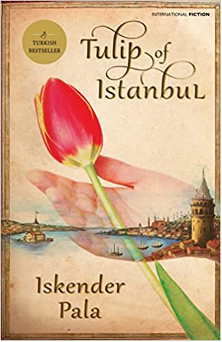
Tulip of Istanbul was originally written in Turkish in 2009, is a historical novel by Iskender Pala. The translation to English by Ruth Whitehouse and its publication by Niyogi Books in December 2021 has put it within the reach of the larger community of Anglophone readers.
Iskender Pala is a professor of Turkish (Ottoman) Divan Literature, an author, and a columnist. He is a recipient of the Turkish Writer’s Association Prize (1989), The Turkish Language Foundation (1990), The Turkish Writer’s Association Essay Prize (1996), and was honoured with The Presidential Culture and Arts Grand Award in literature in 2013. He has been conferred the title of “The People’s Poet” by popular vote in Usak, Turkey. Ruth Whitehouse is a scholar of Modern Turkish Literature and translator with multiple translations from Turkish.
Tulip of Istanbul , a fictionalised historical romance, is a murder mystery that is woven to highlight the period that followed the Treaty of Passarowitz in 1718. The story spans 1729 to 1730. Also known as the Tulip Age, this was a time when the glory of the peaceful period since the 1718 treaty was interrupted by an outbreak of a public revolt that showed resentment to over-indulgence and wastage, leading to social and economic downfall. The book has 66 brief chapters that seek to answer a question that is set as the title of each chapter. In the ‘Preface’, the author claims he wrote the book under the influence of a handwritten anthology of Turkish poetry by an anonymous compiler from an “Auction of Stamp Collections and Old Books” outside Istanbul’s Marmara Hotel. Impressed by the book, he wanted to showcase part of the Ottoman history as a storyteller. Thus was born the One Murder, Sixty-six Questions in Turkish translated as the Tulip of Istanbul.
The ‘Prologue’ reveals that “truth must not remain concealed” and so, the story is told two weeks after the October Revolution that deposed Sultan Ahmet III and slayed his son-in-law Grand Vizier Ibrahim Pasha of Nevsehir. The book opens with the question, “Is There No Limit to Self-Sacrifice?” The mysterious murder of Naksigul, the bride with heavenly beauty on the first night of the wedding, left the husband, Falco, distraught and deranged. The death of his wife had him thrown to prison as the prime suspect. Naksigul was holding a rare and beautiful purple twin bud tulip when she died. Two lovers were brought together by fate when Falco escaped the jailors. They jointly set out to solve the mystery.
In the story, Pala beautifully alludes to the rich culture and history of Istanbul. He manages to introduce the readers to the ninth-century music therapy called “Farabi”; historical figures who visited the empire of the time, the poet Nedim, the painter Van Mour and dignitary Lady Wortley Montagu; and to the Empire’s culture of maintaining insane asylums, prisons, lodges, and coffee houses. The narrative is interestingly infused with plots that are a story-within-a-story about the social life of the Ottoman Empire, the accounts behind the architectural beauties of the walled city of Istanbul, the picturesque sunsets of the Turkish straits be it by the Bosporus or sea of Marmara, the magnificent domed mosques, and palaces with fashionable gardens.
The action peaks to an important juncture at the house and garden of the most coveted tulip cultivator Hafiz Celebi. In the story, Pala includes mesmerising tales on the nomenclature, symbols, and meanings of the “Tulip” flower, which metaphorically and literally relate to the flourishing business, architectural beauty, and exchange of politics, art, and aesthetics of the Empire with the countries like Iran, Austria, Holland or Crimea. Through the story, Pala aptly accommodates how the Horticulturist community indirectly played a role in the policies and well-being of the state. Tulips are strewn through the story binding it into a poetic whole. Pala mentions the upgrade in information sharing with the coming of the first printing press in Turkey and succeeds in connecting it to the ongoing social unrest and the gruesome revolt that ensued in the Tulip Era. The mystery livens up till the end of the story where love guides and transforms, its own meaning and the seeker.
The language used by the translator in the story aids in understanding the appreciation for elegance and perfection in the art and aesthetics of the Ottoman Empire. Tulip of Istanbul is a potent read with a capacity to broaden the perspective about a culture one knows less about, a perfect springtime read. Changing seasons and social change serve as the backdrop to the dreamlike story filled with intrigues of royal secrets and suspense wreaths with those that pursued power alongside those that pursued love.
.
Gracy Samjetsabam teaches English Literature and Communication Skills at Manipal Institute of Technology, MAHE, Manipal. She is also a freelance writer and copy editor. Her interest is in Indian English Writings, Comparative Literature, Gender Studies, Culture Studies, and World Literature.
.
PLEASE NOTE: ARTICLES CAN ONLY BE REPRODUCED IN OTHER SITES WITH DUE ACKNOWLEDGEMENT TO BORDERLESS JOURNAL
I am not sure it is wise to choose a favourite poem out of the millions that exist. It would seem to exclude all the others from the imaginary summit of a fictional pillar. The circumference of that pillar means that there is only room for one poem up there and it might be better not to erect the pillar in the first place and leave the literary landscape unobstructed.
But it is too late for me. I have already chosen a favourite poem. In fact, I have chosen a favourite several times. The first poet I read in any depth, Edgar Allan Poe, provided me with my first favourite, not ‘The Raven’ but a slightly less famous work called ‘The Bells’. How I loved the tinkle, jangle and crash of the cadences in the stanzas of that piece!
I read it again recently and found that it retains great musical power and it is still a poem I regard with intense fondness, but it is no longer my favourite of all. That is hardly surprising considering I was reading Poe when I was 15 years old. Our youthful tastes change not only according to our experiences but also as a result of all the other literature we consume. There is surely a tendency to prefer narrative poems when we are small and a diminishing reliance on actual stories as we grow older. Yet it was the music of ‘The Bells’ that fascinated me rather than the febrile images it contains.
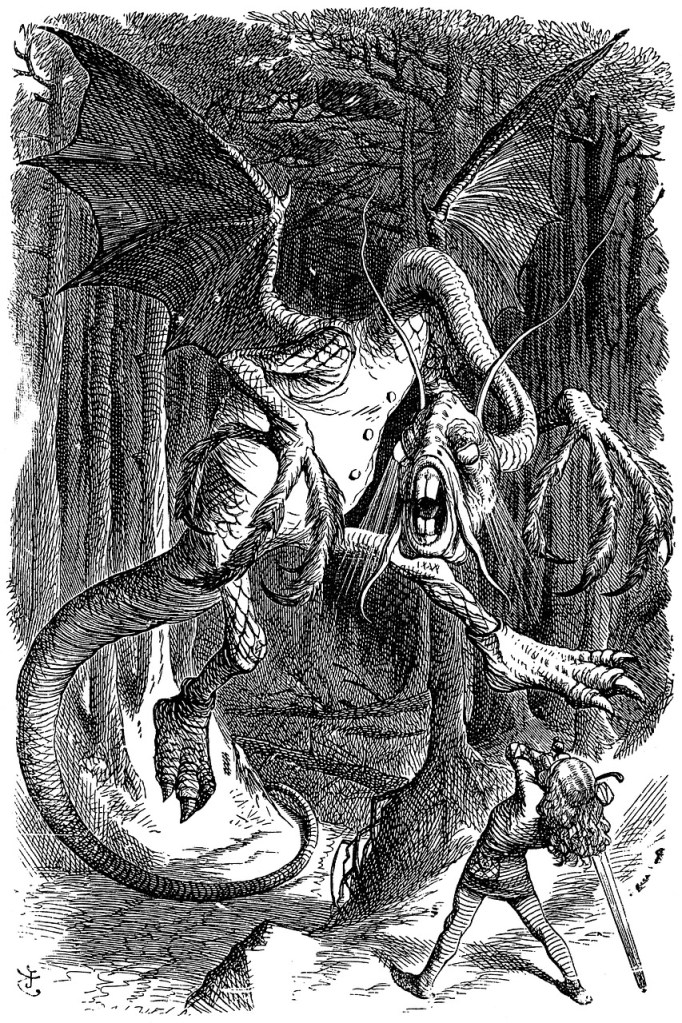
I think my love of euphony has always meant that I relish the way a poem sounds more than I appreciate any meanings it might convey. This is why it was easy for a nonsense poem to become my new favourite and to gently push aside the Poe piece. Lewis Carroll’s ‘Jabberwocky’ became for me the supreme poem and I learned it by heart. It is a poem that makes contextual sense despite all the meaningless neologisms with which it is sprinkled. Somehow, we understand the new words coined by Carroll and there is no need to have them explained. It is a poem that we absorb through osmosis rather than through the normal process of everyday communication. A masterpiece!
When I was 18 years old, I began reading Byron, Shelley, Coleridge and a few other English Romantics, and I discovered ‘Ozymandias’. Now this seemed to me to be a perfect poem. It had music, imagery and a moral, and furthermore it was ironic, an archaic episode with timeless relevance. Again, I learned it by heart, and I found myself in the not uncommon position of reciting it to myself whenever I happened to be confronted with an ancient ruin, whether the blocks of a tumbled castle or shattered torso of a fallen statue. It is a poem that turns a reader into an actor, an introvert into a declaimer. It became my new favourite but only for a short while. The poem that caused it to fall in my estimation was another in the same anthology I was reading.
‘Kubla Khan’ struck me as especially appealing because it has a wildness about it that balances out its sense of control. I am not sure why Coleridge affected me to a greater extent than Shelley (and Byron affected me hardly at all) but I was enthralled by the imprecise exoticism and the intimations of doom among paradise in this poem, which is as menacing as it is delightful, as frantic as it is magical. Coleridge himself regarded it as a work in progress, a frustrated potential, unfinished, a burst dream bubble. I wonder if a continuation might have diminished it? The fragmentary nature of the piece adds to its allure by increasing its strangeness. There is atonality here as well as smoothness, like troubling chords inserted in a serene nocturne.
A few years passed and I discovered a new favourite and had to topple poor old ‘Kubla Khan’ from the apex of that idealised pillar and replace it withThe Rubáiyát of Omar Khayyám in the first Edward Fitzgerald translation, but whether this series of seventy-five quatrains can be regarded as just one poem is open to debate. Personally, I regard the quatrains as linked inextricably by mood, metaphors as well as theme, and there is a mini-sequence within the whole that gains significant momentum by being treated as a single creation. My ambition once again was to learn the work by heart and recite it at moments that were appropriate but despite my efforts I failed in the endeavour. There was simply too much wordage for me to succeed.
I tried reading more modern poetry, serious and mature work that I failed to understand at first and had to consider very carefully before I could tease out any meaning. I read Akhmatova, Rilke, Pound, Eliot. I tried (but was generally defeated by) Ginsberg, Olsen, William Carlos Williams. This was all well and good but my candidate for new favourite turned out to be something light, an insignificant ditty dashed off by a poet who wrote it as a gift for a friend, and once again it was the music that won me over, the jangling, tinkling, tingling, clipping, clopping, jingly rhythms. ‘Tarantella’ by Hilaire Belloc imitates the sound of a guitar and clapping hands, it clatters along merrily, nostalgically, a tribute to an ephemeral occasion in a mountain tavern that can never be lived again, and the words and their phrasing evoke much of the atmosphere of that night with an appreciable impetus. A candidate for new favourite, yes, but it ultimately failed to displace the Rubáiyát.
That was in my early twenties and soon after I lost interest in poetry, I have no idea why, and rarely read any. Occasionally I would browse an anthology and discover something interesting, but only a few poems made any impression at all on me, and none became my favourite. The Rubáiyát of Omar Khayyám remained at the summit of my appreciation by default. My return to poetry was slow and uneven. The work of Federico García Lorca caught my attention and I chose ‘Canción de Jinete’ to learn by heart, which I did, probably poorly (my Spanish was never fluent). A little later I discovered the precocious genius of Arthur Rimbaud and taught myself ‘Le Coeur Supplicié’ because its torrent of fantastical words appealed to my inner ear.
Unfortunately, what I believed poetry had to offer was something I had no great use for. I misunderstood what it had to offer. That is no great crime, but I did miss out on its delights for a long time. Not until my mid-thirties did I start to return to the pleasures of poetry, and it was the humourist Don Marquis who ushered me back into the heaven I had forsaken, yet it is too much to claim that any of his poems became my favourite. I adore his cycle of poems about the cockroach Archy and the cat Mehitabel, but they must be taken as a whole in an evolving mythos. No individual poem of the cycle is worthy of special attention at the expense of the others. All are good, but together they are brilliant and thus they disqualify themselves from the game.
Now that I was reconciled with poetry, my tastes widened, and I read from a broader set of cultures and times than before. Sappho, Ovid, Catullus, Tagore, Basho, Tu Fu, Housman, Holub, Mandelstam, Eliot, Yeats, Edward Thomas, Dorothy Parker, Ai Ogawa, Ogden Nash, Derek Walcott. I was very enthusiastic about the novels and short stories of Richard Brautigan, so I read his poetry too and found a poem called ‘All Watched Over by Machines of Loving Grace’ that neatly summed up my own hopes for the future of the world. Did it become my new favourite? Not quite. I continued reading. Pessoa enthralled me, Cendrars and Queneau dazzled me. Complicated poetry dealing with the human condition and experimental verse based on mathematics made me nod my head sagely in a close approximation of a deep appreciation.
‘The City’ by C.P. Cavafy became my new favourite. I had heard his name often mentioned but felt no great desire to explore further. Then by chance I saw this particular poem. What a terrific piece! Hard, bleak even, wrenchingly bitter, but it does not depress the spirits of the reader despite its melancholy message. On the contrary it seems to inspire the reader to action. The poem is quietly and relentlessly insistent that you will never change your life for the better, that you can never escape the circumstances that have trapped you. It issues a challenge to the reader. Prove me wrong, the poem seems to say! I immersed myself in as much of Cavafy’s poetry as I could find. I went out of my way to visit his house in the city of Alexandria in Egypt, so wonderful did I now regard his work. Was this the final destination on my poetic voyage?
Not quite. There was another poem by another poet sunk deep beneath the surface of my awareness and it had been there for a long time. I can say that it had probably been my secret favourite from the beginning. I must have read it in an idle moment and forgotten about it, or thought I had forgotten about it, but it remained on the seabed of my subconscious, and ultimately it wrecked all the poetical vessels that followed, for I was never fully satisfied with any of those I called my favourites. I rediscovered it one unexpected day and it returned with unstoppable force into my affections. It was written by a poet who went to sea and saw the world, who travelled rather aimlessly for a number of years before the urge to write poetry took hold of him.
‘Cargoes’ by John Masefield is evocative and beautiful. It is heady and a little regretful at the same time. It contrasts the supposed splendours of the past with the drab present, and yet ironically in our own age we perceive romance even in the grime and smoke of Masefield’s ‘present’. Three ages are given to us for contemplation, a pre-classical time, the golden age of the Spanish Main, and the very start of the 20th Century, and three ships loaded with merchandise to represent those ages. The ships of Assyria and Spain are loaded with exotic and tropical treasures. They are floating envoys of a pair of widely spaced but equally fabulous cultures. The British ship is grimy and ugly and it wallows through a drab sea on a blustery day, carrying cargo that is practically an insult to the taste of the aesthete. The language employed is perfect for Masefield’s purpose. I know of no poem I like better.
Quinquireme of Nineveh from distant Ophir,
Rowing home to haven in sunny Palestine,
With a cargo of ivory,
And apes and peacocks,
Sandalwood, cedarwood, and sweet white wine…

Cargoes (1903), John Masefield (1878-1967)
Rhys Hughes has lived in many countries. He graduated as an engineer but currently works as a tutor of mathematics. Since his first book was published in 1995 he has had fifty other books published and his work has been translated into ten languages.
.
PLEASE NOTE: ARTICLES CAN ONLY BE REPRODUCED IN OTHER SITES WITH DUE ACKNOWLEDGEMENT TO BORDERLESS JOURNAL
POEM AFTER OU YANG HSIU

In my younger days,
I was arrogant, thinking
I was wise. I had friends,
who reassured me.
Now they’re dead,
and I’m sixty-five.
I took to wine.
It helped, but
life moves by so fast,
nothing lasts. Alone,
I watch the river
and its eternal flow.
I sip a cup of tea,
listening to clamouring geese.
They make me smile.
I think, perhaps,
they’re laughing at me.
George Freek’s poetry has recently appeared in The Ottawa Arts Review, Acumen, The Lake, The Whimsical Poet, Triggerfish and Torrid Literature.
.
PLEASE NOTE: ARTICLES CAN ONLY BE REPRODUCED IN OTHER SITES WITH DUE ACKNOWLEDGEMENT TO BORDERLESS JOURNAL







 Borderless