Categories
Poetry

My Mantra

By Ashok Suri

MY MANTRA

In the mesmerising twilight, 
I see untapped sources of delight.
There are no regrets,
But a new awareness, a new insight.

My prayers are now warm,
Not mere words uttered in haste.
My enthusiasm never fades
Even if I’m not ideally placed.

I cannot remain unmoved,
If I see the poverty-stricken in plight.
In the world torn by wrongdoings,
Clashes and mutual distrust,
My jivan mantra* is simple:
‘Trust in God and do the right.’


* Jivan Mantra: Guiding principle of life 

Ashok Suri is a retiree and is settled with his family in Mumbai. He tries to convey in simple words what he wants to say.

.

PLEASE NOTE: ARTICLES CAN ONLY BE REPRODUCED IN OTHER SITES WITH DUE ACKNOWLEDGEMENT TO BORDERLESS JOURNAL

Categories
Essay

A View of Mt Everest

By Ravi Shankar

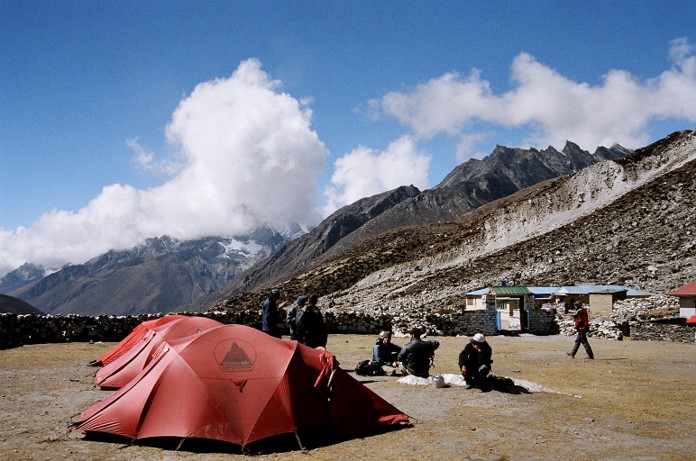
Everest up close. Photo courtesy: Ravi Shankar

The water was hot and the pressure optimum. For me the shower was a moment of pure bliss. I had heard poetic descriptions from fellow trekkers of the shower at the Eco Lodge. The hot water condensed in the cold air forming a welcome cocoon of warmth around me. Unfortunately, the shower duration was limited to five minutes. The water was heated using gas as was common throughout the Everest trekking region of Nepal. In the Annapurna region, north of the city of Pokhara, solar water heaters were common. Gas heaters always make me feel guilty about the environmental impact.  

The water washed away the accumulated grime and sweat. The shower was expensive, and I was on a tight budget. My funds only permitted a shower once every ten to fourteen days. We were researchers involved in a clinical trial on high-altitude illness. The participants were enrolled at Pheriche more than 700 meters below and the study end point was at Lobuche (4900 m).  Participants received two medical check-ups at high altitudes and two cups of tea/coffee for participating.

The Eco Lodge was an upmarket lodge in Lobuche in the year 2007 and we were staying there for over a month. Participants came to the lodge to complete the study and receive a second medical check-up. We listened to their chests, provided a physical examination, and measured their blood pressure and oxygen saturation. We had received a discount on the room rent but the food was expensive. Lobuche is situated at the foot of the Khumbu glacier. Everything had to be hauled from below.

For a long time, Lobuche had an unwelcome reputation due to the poor quality of the lodges. The restrooms were dirty, and the bedrooms flimsy. Maintaining hygiene in the cold dusty environment was a challenge. The Eco Lodge was the first upmarket lodge offering wood-panelled bedrooms with glass windows and clean toilets. The lodge had night toilets inside and day toilets outside. We were allotted an inside room in the main building. Dr Anup and I were the two doctors at Lobuche. The rooms were unheated and freezing though the main dining room had the ubiquitous cast iron heater burning yak dung. Yak dung is precious as fuel at these altitudes. It burns well with minimal smoke and residue and the flame is hot.    

We were also the only doctors camped at Lobuche though some of the larger groups did have a doctor and the Sherpa guides were well-versed in altitude sickness. We did receive occasional calls for assistance. The Mountain Medicine Society of Nepal (MMSN) and the Himalayan Rescue Association (HRA) conduct clinical trials in the Everest and Manang regions of Nepal every fall. These provide medical students an opportunity to work with foreign experts and develop an interest in the subject. You receive transportation to the site, the services of a porter and a subsistence allowance.

Participants in the study had been instructed to check in with us after they had settled in Lobuche. In the evening we used to go around the other lodges looking for participating trekkers who had not yet met us. The evenings were chilly, and a freezing wind blew from the high Himalayas across the glacier. On climbing the moraines of the glacier there were spectacular views of the snow peaks. Sunset on Mt Lobuche and Mt Nuptse is not to be missed. The peaks turn golden yellow, then red, different shades of pink and finally the light is slowly extinguished.

The dining room at the Eco Lodge was smaller than the one at Nuru’s place in Pheriche and there was no green house. Dining rooms are the beating hearts of trekking lodges. At Lobuche the Sun was often covered in clouds and a cold wind blew off and on. The lodge did have glass tiles in the roof to capture the Sun. At night the dining room was cosy, and we met some interesting persons there during our stay. In those days there was no telephone service and no internet. A satellite phone was available in case of emergencies.        

Nights in the room were freezing and I was reminded of Peter Matthiessen’s descriptions in the book The Snow Leopard of the long freezing nights in his tent at Shey Gompa in Dolpa. Our room was inside and out of the wind, and we also had a glass roof to catch the Sun. Anything kept outside in the room would be frozen solid by the morning. You had to keep stuff with you inside the quilt so that it could be gently warmed by your body heat. The long silent nights were conducive to meditating about life (and death).  

From Lobuche it is a four-hour hike to the Everest Base camp at 5400 m. The hike is through the Khumbu Glacier and through stones and boulders. Some of the boulders were larger than a house. Global warming has resulted in significant shrinking and drying of the glaciers and the Khumbu and Ngozumpa glacier in the Everest region have both retreated significantly. The hike passes through the settlement of Gorak Shep and the weather can change dramatically in a few minutes. I had started my trek on a clear, sunny day but halfway through clouds gathered and the mountains were shrouded in white. Soon it started snowing heavily. The boulders became slick and slippery in the snow and walking became difficult.

During a previous visit I had visited ‘The Pyramid’, a scientific research station run by an international consortium in association with the Nepal Academy of Science and Technology (NAST). The research facilities were great, and the station is located at a 20 minutes’ walk from the trail. The station is entirely powered by solar energy. The location is spectacular, and the station is located far from the trials and tribulations of our imperfect world.

Staying in a trekking lodge for over a month is a different experience. Trekkers come and go but we continued to remain in the lodge. The cold was our constant enemy. The tips of your fingers became numb after a few minutes in the cold wind. The ultraviolet rays were strong at the high altitude, and I was soon tanned a dark shade of brown. Lobuche was the highest altitude at which I had stayed for nearly 40 days. All things considered I still preferred staying with Nuru at Pheriche where the climate is more hospitable, and life was gentler.

My friend Anup left at the end of the month. I had changed my place of work and still had some time before I joined a new medical school being set up in the Kathmandu valley and could stay longer till the next group of doctors could reach Lobuche and manage the study. The settlement of Lobuche was set up to meet the requirements of trekkers to the Everest Base Camp and to Kala Pathar (black rock), a famous Everest viewpoint. I was alone in my room, and it felt strange. The second team soon reached us, and I briefed them about what had been done and handed over the study material. Soon it was time to trek down to Pheriche, Pangboche, Tengboche, Namche Bazar (the Sherpa capital) and eventually fly out from the Tenzing-Hillary airport at Lukla to Kathmandu.  

As mentioned, Lobuche for a long time had a terrible reputation. The quality of the lodges has steadily improved from bunk beds in dormitories to individual rooms. I was searching for lodges in Lobuche on the web recently. Many lodges now offer free wi-fi. The Pyramid also offers lodging at the 8000 Inn. With all these welcome developments, Lobuche can confidently and maybe, indignantly shrug off its reputation as the ‘arm pit’ of Nepal!  

The Himals. Photo courtesy: Ravi Shankar

Dr. P Ravi Shankar is a faculty member at the IMU Centre for Education (ICE), International Medical University, Kuala Lumpur, Malaysia. He enjoys traveling and is a creative writer and photographer.

.

PLEASE NOTE: ARTICLES CAN ONLY BE REPRODUCED IN OTHER SITES WITH DUE ACKNOWLEDGEMENT TO BORDERLESS JOURNAL

Categories
Poets, Poetry & Rhys Hughes

From a Kafkaesque Dream to the Penguin Cafe Orchestra

The Penguin Cafe Orchestras, and the plural is necessary because there were several of them, were responsible for a unique sonic experience, creating a blend of folk, jazz, classical and faux ethnic music that managed to pull off the difficult trick of sounding instantly familiar to the subconscious mind, as if it had already existed in the past but had been forgotten for ages and now was being retrieved from some pool of inspiration common to humanity.

They formed one of the background soundscapes to my student years. I recall the first time I heard a Penguin Cafe track. It was ‘Music for a Found Harmonium’ and it accompanied a short film featured on television called simply ‘Interlude’ that I have never been able to trace since. The melody and the visuals matched well, but it was years before I learned who was responsible for the music and I did so by pure chance. I went into a record store and bought the album Broadcasting from Home at random. That was a habit of mine back then.

Perhaps the cover image had intrigued me. Listening to the album at home I was delighted to recognise ‘Music for a Found Harmonium’ as the opening track. But I might be misremembering. There’s a suspicion in my mind that I actually bought the album Signs of Life on cassette first. It hardly matters. The title of that soul enhancing song, ‘Music for a Found Harmonium’, struck me as curiously enigmatic, so much so that I later entitled one of my books Stories from a Lost Anthology as a sort of tribute, an allusion noticed by no reviewers.

The real story behind the track is that Simon Jeffes (1949-1997), founder of the Orchestra, was on tour in Japan and wandering through the backstreets of Kyoto when he found an abandoned harmonium balanced on the apex of a pile of rubbish. He located the person who had discarded it and obtained permission to take the instrument away. The song was composed to celebrate this lucky find. I have never found a harmonium in a backstreet, or any other musical instrument for that matter, not even a harmonica. But Jeffes was special and attracted beauteous oddity by some form of magnetism he carried around within himself.

That magnetism is present in all the music he made. Born in 1949, Jeffes studied the classics in London before trying his hand at experimental music. He grew to be dissatisfied with the barren tonalities of contemporary avant-garde work. Similarly, his brief flirtation with rock came to nothing. African music alone seemed to contain elements he was seeking, powerful rhythms, freer harmonic approach, the mysterious qualities of its silences, an unmelodramatic emphasis on cadence, imaginative tuning systems and improvisational flair. Most of all, he was seeking pure musicality, pieces constructed of the vital essence of the art.

A Penguin Cafe composition rarely seems made up of separate parts, but is much more like an organic growth. Melody and harmony, rhythm and tone colour are fused together right from the very beginning, in an ambient seed. Then the piece grows into fruition with little fuss and perfect symmetry. In 1972, food poisoning confined Jeffes to bed where he dreamed of a Kafkaesque residential block full of people with empty lives. The following day a voice in his head said distinctly, “I am the proprietor of the Penguin Cafe. I will tell you things at random.” Jeffes tried to imagine what the house band of that cafe might sound like. When he recovered, he transformed his dream into truth and invented the PCO.

For the Orchestra, he recruited like-minded players Helen Leibmann, Steve Nye and Gavyn Wright. Calling themselves the “four musicians in green clothes”, they began recording and in 1976 released their first album, Music from the Penguin Cafe. Leibmann on cello, Nye on keyboards and Wright on violin remained with Jeffes for most of the subsequent recordings of this first phase of the Penguin Cafe adventure, but apart from Jeffes, Leibmann was the only member who has appeared on every one of the early albums. For this first release, they also recruited Neil Rennie on the ukulele and Emily Young to design the eye-catching album cover. Emily Young, who is now a high-regarded sculptor, was supposedly the same Emily that Syd Barrett and Pink Floyd sang about in ‘See Emily Play’.

Music from the Penguin Cafe is the most uncharacteristic and dissonant of the Orchestra’s productions. The multi-instrumentalism and big arrangements that were to become a trademark are largely absent. Though Jeffes plays bass, quatro, spinet, cheng, ring modulator and mouth percussion on some tracks, his primary duty is as an electric guitarist. The two earliest songs, ‘Penguin Cafe Single’ and ‘The Sound of Someone You Love Who’s Going Away and it Doesn’t Matter’, rely on just four basic instruments, with Nye’s electric piano and Leibmann’s cello largely displacing Jeffes, and they wrench the heart, sounding like reservoirs of poignancy, dammed to prevent sadness slipping over into the other tracks.

Despite lengthy improvisational passages, highly unusual for the early Orchestra, they are among the most successful songs on the album. Other oddities are dubious and not wholly forgivable, including a drenching vocal lament and a squeaky piece called ‘Pigtail’. Only on one track does the Orchestra provide a foretaste of what was to follow in the coming magical years, ‘Giles Farnaby’s Dream’, spinet and ukulele in foot-tapping mode, the strength of the piece deriving from its frenetic repetition. The album is the least Penguiny of the Orchestra’s productions and it was released on the Obscure label of ambient maestro Brian Eno.

Avant-gardists believe it to be their best album and easy listeners regard it as their worst. But it is neither. It is simply a prelude to the next four albums, which are the quintessential recordings. Yet there was a five year wait for the first of these. Jeffes never seemed in a hurry. The eponymous Penguin Cafe Orchestra (1981) defined the Penguin Cafe sound once and for all with the opening track, ‘Air à Danser’, which can almost be regarded as the PCO’s anthem. The jumpy guitar and wistful strings sound instantly recognisable even to someone who has never heard the piece before. It is the most perfect example of Jeffe’s ability to tap into the Universal Subconscious, an effect that is both pleasing and slightly eerie.

Several other tracks became mainstays of live performance, ‘Cutting Branches for a Temporary Shelter’, ‘Numbers 1-4’, the two ‘Yodel’ songs and ‘Paul’s Dance’. Best of all, however, is the funky and hypnotic ‘Ecstasy of Dancing Fleas’, a hugely gleeful song with warm bass and joyous refrain. The method of working employed by the Orchestra almost guaranteed good albums. Over a number of years, recordings would be made and only the finest tracks released. Again, Jeffes was never in a rush to push his music out there. He preferred a measured approach. This doesn’t mean that all his music sounds polished. Sometimes rough-edged work is exactly what is required to provide ideal incarnations for musical ideas.

After Penguin Cafe Orchestra, it was difficult to believe that a more archetypal sound could be achieved, but in Broadcasting from Home (1984), Jeffes refined the spirit of the music even further. The PCO had grown to encompass thirteen members of varying abilities and Jeffes had taken to playing more and more instruments. With another whimsical but haunting Emily Young cover, this is a vital release and tracks such as ‘Music For A Found Harmonium’, ‘Prelude & Yodel’, ‘In the Back of a Taxi’ and ‘Heartwind’ are impossible to dislike. Strangely enough, the album contains a couple of sequels to tracks on the first release. ‘More Milk’ and ‘Another One from the Colonies’ are wry comments on their predecessors. Musicians include Geoffrey Richardson on viola, shaker and bass; Dave Defries on trumpet and flugel; Annie Whitehead on trombone; Nye, Leibmann and Rennie on piano, cello and ukulele; and Jeffes on drums, harmonium, omnichord, soloban, dulcitone, penny whistle, violin, milk bottles, triangle, bass, and much more. It is easy to forget how peculiarly exotic some of those instruments seemed to the British public in those days. Musically we were far more insular then than we are now.

The fourth album was released in 1987. Signs of Life has a ‘frontier-ceilidh’ feel to it, taking elements of American country music, bluegrass and mountain folk. There is also a classical touch, particularly in the moody ‘Oscar Tango’. Sadness was a rare emotion in the Orchestra’s output, apart from in some of the very early material. It is on Signs of Life that the description of the PCO as ‘a string quartet letting its hair down at some mysteriously-located barn dance of the future’ most holds true. The opening track, ‘Bean Fields’, is quirky and imprecise and one of my three favourite Penguin Cafe tracks ever. ‘Dirt’ is rhythmic and compelling, as is ‘Sketch’ and ‘Swing The Cat’. ‘Southern Jukebox Music’, on the other hand, belies its title and is a deeply melodic lament. ‘Perpetuum Mobile’ is a punning title that references the metronymic pulse of the piece but also the town of Mobile, Alabama, and further connects the album to its basic Americana source, although the music seems to belong to another galaxy and to the distant past of our preliterate ancestors just as much as it does to any existing tradition. The ten minute long meditation ‘Wildlife’ is an acquired taste, seeming at first to be a directionless filler, but is perfect background music for simple relaxation or mind wandering. Personally it is my daydreaming and falling asleep music of choice. It evokes a strange forest soundscape where very little happens but everything eventually is found to have changed. Of the two pieces played wholly by Jeffes, one deserves special mention: ‘The Snake and the Lotus (The Pond)’, a piece just for bass, primeval and rather mystical.

The next two albums were live recordings. When in Rome… (1988) is a wonderful retrospective of the previous work and thus the best introduction to the PCO’s career. Pieces from all four albums are included and many have been improved, especially ‘Giles Farnaby’s Dream’ and ‘Air à Danser’, which have both been spiced up. Others sound almost identical to the studio recordings. The deliciously smooth atmosphere of the performance is captured well and the musicians are in complete empathy with each other. Missing on this album is Gavyn Wright and the PCO is down to nine members, but Bob Loveday on fiddle more than makes up for the loss. This is the only album where a member, Geoffrey Richardson in fact, actually plays more instruments than Jeffes. Less convincing is Still Life (1990), a ballet arrangement of material for a conventional orchestra. Although a nice album in itself, some of the pieces, such as ‘Numbers 1-4’, have been overdone, and this sixth release is probably the least essential album of them all. Nonetheless, listeners who prefer the grander feel of a larger orchestra and the traditional accents associated with classical music could do much worse than to seek it out.

Unusually for a project associated with Jeffes, the cover isn’t by Emily Young, and this detracts from the finished result. Luckily she was back on hand for the seventh, most sprawling, ambitious and varied of the PCO’s albums to date. Union Cafe (1993) was one of my most cherished albums of the decade in which it appeared. I appreciated its abundance and it felt more like a voyage than their other albums. This is not to say that all here is smooth and accomplished. Some tracks are doldrums in the sound ocean. As for the bolts of its realisation, more musicians than the PCO had ever employed before were used, though sadly Steve Nye isn’t one of them. The other originals, Leibmann, Wright and Rennie, seem content to share duties with a host of other puffers, pluckers, scrapers or bangers. Even Jeffes has decided to wisp himself out a little, be less dogmatic and often takes a lesser role in the performance of his own compositions. On two tracks, ‘Thorn Tree Wind’ and ‘Discover America’ he plays nothing at all. The former is given over entirely to the warblings of an electric Aeolian harp and credited to the winds of the cardinal points. This is fair enough as the winds compose the piece while in the act of playing it. The latter track employs a large number of strings, including twelve violins (led by Gavyn Wright), four violas, four cellos and two double basses. The result is an ear wash that doesn’t necessarily leave the ears feeling cleaner. But the variety is impressive. There is a track played by a computer called ‘Pythagoras on the Line’ that seems similar to a song on an earlier album called ‘Telephone and Rubber Band’.

There is also the excellent ‘Vega’, one of the Orchestra’s longest tracks to date; the salty ‘Organum’ and ‘Another one from Porlock’ and ‘Lifeboat (Lover’s Rock)’. Jeffes had recently announced his awakened re-interest in the Western Classical tradition and this new enthusiasm, together with the experience gathered from exploring other cultures, resulted in this album, which might be a melange, a mess or a masterpiece. The opening track is the superlative ‘Scherzo And Trio’ and because it is superlative I guess this means I ought to say nothing more about it, as superlative things are quite beyond praise, so my dictionary informs me.

Yet the one track that really stands out, conceptually if not sonically, is the tribute to composer John Cage, who had died not long before the album was made. Entitled ‘Cage Dead’, these words are all the notes of the melody, played strictly in that order, C-A-G-E-D-E-A-D. This is an example of a musical version of OuLiPo[1] (itself useably explained and defined as a playful workshop to create literature-that-is-both-constrained-and-made-ingenious by mathematics) officially known as OuMuPo, or Ouvroir de musique potentielle. Essentially it is trickery of the highest whimsical order and John Cage himself perhaps would be very pleased by it. Having said that, he could be inexplicably stringent and uncompromising about his music. He was a composer who wrote a piece requiring a musician to wear a tuba like a hat and not play it. When it was first performed he berated the musician for not wearing it in the correct manner and therefore spoiling the sound.

Now I have drifted off the point. Partly and paradoxically defined as avant-garde easy listening, the Penguin Cafe Orchestra are whimsical and catchy, yet there’s an improbable seriousness too, and a deep sadness embedded in some of the melodies. Good, I have returned to the point, deftly, quite deftly. After Union Cafe there were dramatic changes. Jeffes died. In effect he was the PCO and it became a ghost after his leaving. Yet as ghosts sometimes do, it floated on, splitting like ectoplasm that turns out to be flimsy fabric in an eerie half glow.

Some of the musicians who had worked with Jeffes wanted to continue with the PCO, as is only to be expected. We might also say they had the right to do so. The moral right, perhaps, but not the copyright. The words ‘Penguin Cafe Orchestra’ are not in the public domain, unlike the sound waves they threw out into the atmosphere during their performances and recordings. Jeffes’ son, also called Jeffes inevitably, wanted the name for himself, or a variation of the name. There was plenty of toing and froing and confusion and struggling. Eventually the situation thankfully seemed to settle down somewhat and we were left with…

(a) A set of original musicians in a combo initially called The Anteaters and then renamed the Orchestra that Fell to Earth, who mainly play PCO songs at festivals, and (b) Jeffes Junior in an outfit called Penguin Cafe, no relation to the Penguin Cafe Orchestra yet at the same time every relation to it. Penguin Cafe are a group of many musicians, none of whom were in the PCO, and they have released three albums so far (I write this in the year 2018). These albums are good albums, nobody can accuse the younger Jeffes of trampling or otherwise violating the memory and legacy of his father. Very good albums in fact. But they have a different tone to the albums of the old PCO. They are lusher, they sound sometimes as if Philip Glass was involved in some way, there is a rotational melancholy and not a bean field, temporary shelter or harmonium on a trash heap in view. I know I sound disparaging and I don’t mean to. I will shut my mouth soon, so don’t worry.

A Matter of Life (2011) is a rich surge of sound and one especially succinct critic described it as a ‘love letter’ to the original PCO music. Certainly there is nothing to suggest a travesty of what has gone before. The proprietor of the Penguin Cafe, if he is listening, will have no inclination to expel his house band and secure the services of another. I could drink cappuccino to this music all morning. Yet the lush element is suggestive of an autumn after the heady spring and sultry summer. I long for off-key twangs, for an occasional wrong note. But if this was the first album I ever sampled that had the words ‘Penguin Cafe’ on them and I was unable to make judgments based on the emotional resonances of prior knowledge sharpened by nostalgia, I would be happy enough. The music has the quality of being perfectly ignorable if you wish to ignore it and yet it also rewards careful listening. When you choose to focus in close to the unfolding soundscapes, it is gratifying.

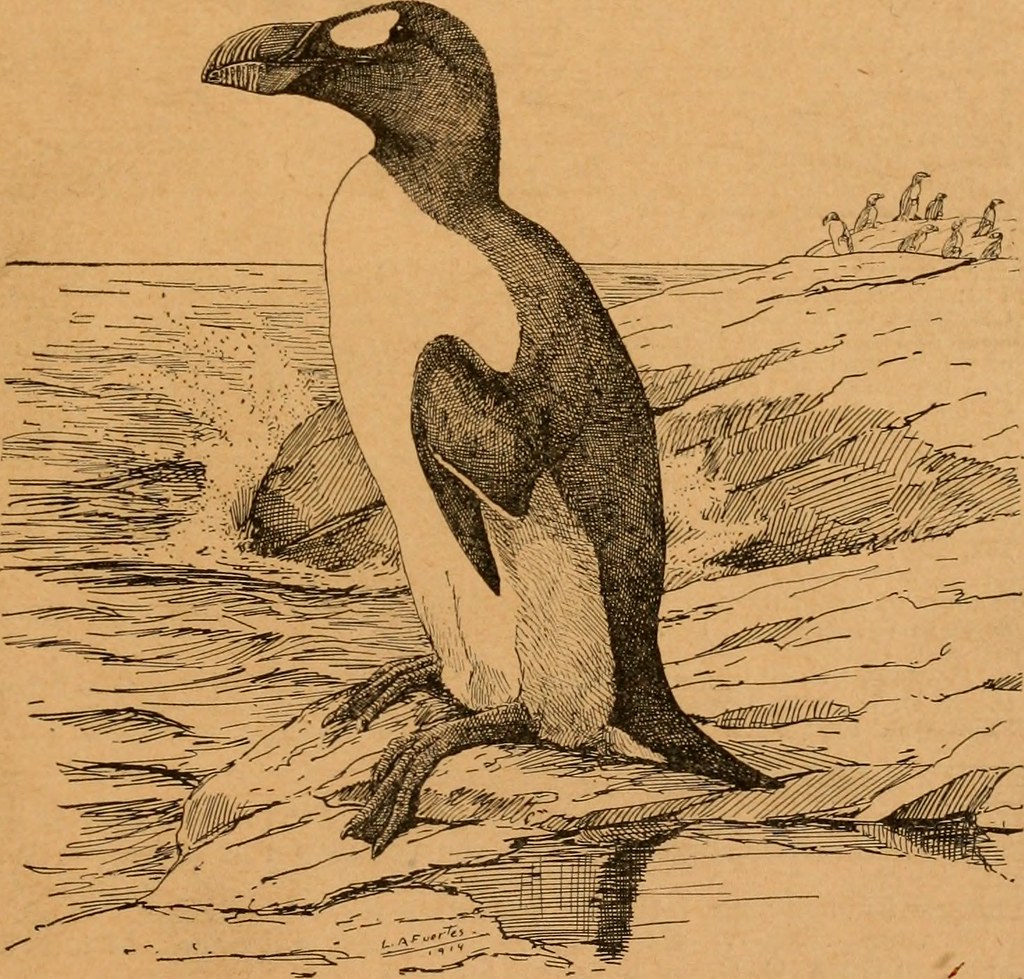
‘Landau’ is perhaps my favourite track, bouncy and melancholic at the same time. ‘Sundog’ is also very nice indeed. ‘The Fox and the Leopard’ contradicts everything I have said in the prior paragraph, being as softly jolly and funky as the earlier ‘Ecstasy of Dancing Fleas’. Perhaps I don’t know what I mean anymore. The Red Book (2014) and The Imperfect Sea (2017) present more of the same thing, hypnotic and wistful songs with a strong driving core that seems to want to become pure trance music. I haven’t yet seen them perform live but I absolutely will when I get the chance. This statement also applies to The Anteaters (who fell to earth). I had the privilege of being present when suggestions for a name change were open to their listeners. I had nothing to offer, but later the words ‘The Great Aukestra’ popped into my mind, an example of l’esprit de l’escalier (or ‘staircase wit’) in which one thinks of a rejoinder or a proposal when it is too late to be of any use. The great auk was the northern version of the more familiar southern penguin. It became extinct in the middle of the 19th Century and Anatole France wrote a satirical fantasy about a society of them called Penguin Island, in which he explains that the word ‘penguin’ first referred to auks. The great auks were the original penguins.

I am about to go now, but I have just recalled that I forgot to mention a six track EP that the PCO released in 1983. The Penguin Cafe Orchestra Mini Album features four songs that can be found on other albums and two originals, one of which, ‘Piano Music’ (recorded live in Japan) is a gentle and dreamy piece that is also a little odd harmonically, reminiscent perhaps of Sorabji but not quite. It is nothing special really but it has a haunting quality despite its brevity. Yet the reason why this EP is worth hunting down is a track called ‘The Toy’, pure magic and too little-known compared with so many of their other songs. Right, I’m off.


[1] Ouvroir de littérature potentielle; roughly translates to “workshop of potential literature”. It is a loose gathering of (mainly) French-speaking writers and mathematicians who seek to create works using constrained techniques. 

Rhys Hughes has lived in many countries. He graduated as an engineer but currently works as a tutor of mathematics. Since his first book was published in 1995 he has had fifty other books published and his work has been translated into ten languages.

.

PLEASE NOTE: ARTICLES CAN ONLY BE REPRODUCED IN OTHER SITES WITH DUE ACKNOWLEDGEMENT TO BORDERLESS JOURNAL

Categories
Poetry of Jibananda Das

Shorter Poems of Jibananda Das

Translated from Bengali by Professor Fakrul Alam

TO A PAINED ONE

Now late at night you have a bed,
A quiet and dark room,
Placidity and silence.
Think of nothing more.
Listen to no one speaking,
Just wipe your bloodied heart clean
And tucked like the tuberose,
Go to sleep. 
   
CITIES

My heart, you’ve seen many big cities
Cities whose bricks and stones
Accents, affairs, hopes, frustrations and terrifying deprivations
Have turned into ashes in the cauldron of my mind.
Nevertheless, I’ve seen the sun amidst thick clouds in a corner of a city
I’ve seen the sun on the other side of the river of a port city
Like a love-struck farmer, he bears his burden in the tangerine-cloud coloured fields of the sky;
Over the city’s gaslights and tall minarets, I’ve also seen—stars—
Like flocks of wild geese heading towards some southern city.

DAYS AND NIGHTS

The whole day went purposelessly.
The whole night will pass miserably.
Full of frustrations and failures,
Day in, day out, life is drudgery
To be wasted away.
And yet the phanimansha’s thorns we see 
Daubing the dew delightfully; not one bird in the sky
All knowingly guilty birds in their nests now lie.

(These translations are from Jibanananda Das: Selected Poems with an Introduction, Chronology and Glossary, translated by Fakrul Alam, published by The University Press Limited, Dhaka, 1999. Republished with permission from the original publisher.)

Jibananada Das (1899-1954) was a Bengali writer, who now is named as one of the greats. During his life he wrote beautiful poetry, novels, essays and more. He believed: “Poetry and life are two different outpouring of the same thing; life as we usually conceive it contains what we normally accept as reality, but the spectacle of this incoherent and disorderly life can satisfy neither the poet’s talent nor the reader’s imagination … poetry does not contain a complete reconstruction of what we call reality; we have entered a new world.”

Fakrul Alam is an academic, translator and writer from Bangladesh. He has translated works of Jibanananda Das and Rabindranath Tagore into English and is the recipient of Bangla Academy Literary Award (2012) for translation and SAARC Literary Award (2012).

.

PLEASE NOTE: ARTICLES CAN ONLY BE REPRODUCED IN OTHER SITES WITH DUE ACKNOWLEDGEMENT TO BORDERLESS JOURNAL
Categories
Review

Her Stories – Thinkers, Workers, Rebels, Queens

Book review by Bhaskar Parichha

Title: Her Stories –Indian Women Down the Ages — Thinkers, Workers, Rebels, Queens

Author: Deepti Priya Mehrotra

Publisher: Rupa Publications

This is a motivating book and a curious one too. Talking about several women of substance, it goes to jog your memory about their contributions to the respective arenas.

Her Stories–Indian Women Down the Ages- Thinkers, Workers, Rebels, Queens by Deepti Priya Mehrotra is a bold account of the women who have been overlooked and ignored. A political scientist with cross-disciplinary interests, Mehrotra counsels civil society organisations on gender and education issues. Having taught social science at Delhi University and TISS (Tata Institute of Social Sciences), she is the author of pioneering books that include Home Truths: Stories of Single Mothers, A Passion for Freedom: The Story of Kisanin Jaggi Devi, Gulab Bai: The Queen of Nautanki Theatre and more.

Says the book’s blurb: “Some were celebrated, others vilified. While some were casually neglected. Yet, the story of these women lived on Her-Stories is a discussion of women from Indian history whose contributions have been all but forgotten. These were poets, performers, warriors, saints, philosophers, activists and more, yet we hardly remember their courage and contributions. The time has come to bring their history to the fore.

“Their stories describe desperate situations, ingenious strategies and brilliant sparks of feminist consciousness. Rather than accounts of isolated ‘great women’, these stories place at the center the ordinary woman, in all her splendid diversity, multifaceted struggle and achievement. The women profiled were encouraged and supported by others—their achievements represent the aspirations of many in the past and provide inspiration for us in the present.”

Spanning different regions of India, the book presents in chronological order from the second millennium BCE to the mid-nineteenth century India stories of women who have been thinkers, doers, movers and shakers who have subverted hierarchies, brought peace out of chaos and survived despite routine devaluation. Philosopher Sulabha, philanthropist Vishakha, fearless Uppalavanna, wandering bard Auvaiyar, justice maker Leima Laisna, astronomer Khona, mountain queen Didda, radical poet Akkamahadevi, intrepid Sultan Razia, martial artiste Unniyarcha, poet-saint Janabai, Gond Rani Durgavati, historian Gulbadan, cultural ambassador Harkha, pepper queen Abbakka, fakira Jahanara, brave Onake Obavva, Dalit rebel Nangeli, dancer-diplomat Mahlaqa Bai Chanda, lion queen Jindan, Nawab Begum Qudsia, sharpshooter Uda, guerrillera Hazrat Begum and feminist writer Tarabai Shinde.

Writes Mehrotra in the introduction: “Where mainstream histories display yawning gaps, feminist scholarship, and Dalit, subaltern and gender studies have gradually unearthed rich data, and made analytical advances. Some gaps persist, for historical sources are inevitably limited. One needs to sift through document, legend, myth and hagiography, to arrive at the most plausible truth. While remaining true to evidence, through empathy and imagination facts grow wings and characters come alive.”

The book is incontestably a saga of valiant women achievers, dissenters, fighters and advocates who changed the wave of complacent human existence. Igniting the spark of feminist consciousness, it celebrates the stories of women with forgotten glory. 

In ‘Didda: Mountain Queen’, she contends: “Didda ruled in Kashmir for 50 years: nearly half of it is as an absolute sovereign. She earned the rare distinction of bringing stability into the fractious kingdom. Didda’s father-in-law, Parvagupta, was a clerk until in 949, he killed King Sangramdeva and grabbed the throne, only to die within a year. His son Kshemagupta took over, and proved as incapable as his young wife, Didda, was capable. Kshemagupta married Didda immediately after assuming power, slyly calculating that her royal lineage would provide legitimacy to his rule. Didda’s father was Simharaja, king of Lohara, and her maternal grandfather was Bhima Shah, powerful ruler of Kabul and Gandhara. Didda was in her mid-20s when she married, later than the usual age of marriage—quite likely because she suffered from a disability.” 

Mehrotra reasons about the book: “Critical feminist subaltern historiography asks new questions and makes fresh interpretations. The move away from androcentric elite history breaks down walls, releasing a surging ocean of human beings who have much to tell. Women characters emerge from nooks and crannies; each different, in varied circumstances, yet each laboring against the grain of patriarchy, in some or the other aspect of her life. For centuries, patriarchy has defined and limited, reserved the public sphere for men and assigned subsidiary roles in the private domain to women.” 

“Mainstream male-stream-history has colluded with these constructions, naturalizing women as stereotypical daughters, wives, mothers symbols  of domesticity, rather than active human being Dalit and working-class women have been, additionally, naturalized as workers whose labor belongs to the elite.” 

In about three hundred pages, Mehrotra writes about the injuries without making it an insipid narrative. She captures the drama concealed beneath the surface. If the women she dwells on in the book were not just victims, but makers of history and of literature, philosophy, law, medicine, science, art, architecture, music and religion, Her Stories goes that extra mile to bring out the tale of survival in a system rooted in domination and defeat.

.

Bhaskar Parichha is a journalist and author of UnbiasedNo Strings Attached: Writings on Odisha and Biju Patnaik – A Political Biography. He lives in Bhubaneswar and writes bilingually. Besides writing for newspapers, he also reviews books on various media platforms.

.

PLEASE NOTE: ARTICLES CAN ONLY BE REPRODUCED IN OTHER SITES WITH DUE ACKNOWLEDGEMENT TO BORDERLESS JOURNAL

Categories
Poetry

Mosquitoes & Daffodils

By John Grey

Courtesy: Creative Commons
MOSQUITOES

They've flown
in squadrons
since before
airplanes.

And they've 
been attracted
to human skin,
long in advance
of the first human romance.

Likewise,
they've sucked blood
for centuries, 
with enough 
dedication to the task
to put every vampire
in Romania to shame.

Does that mean
I respect them too much
to swat them?

No, just that
that the only good insect
is a dead antediluvian.

DAFFODILS

Massed daffodils in robust grass,
day after day – you know you’re safe.

For they bloom harmless, 
but deep with longing for the sun and rain.

Always rise up at morning’s call,
white-petaled, yellow-bud kisses.

Yesterday, the same.
Twenty years ago, no different.

Soft wind croons, low voltage beauty,
seeing them now like seeing them in retrospect.

John Grey is an Australian poet, US resident, recently published in Sheepshead Review, Stand, Poetry Salzburg Review and Hollins Critic. His latest books are “Leaves On Pages”, “Memory Outside The Head” and “Guest Of Myself”, available on Amazon. 

PLEASE NOTE: ARTICLES CAN ONLY BE REPRODUCED IN OTHER SITES WITH DUE ACKNOWLEDGEMENT TO BORDERLESS JOURNAL

Categories
Poetry

Framed Mesh

By Antara Mukherjee

FRAMED MESH 

The rasp of sand on sieve,
flipping urgency 
in rice grains on heat, 
an entourage to the jangle 
of her dozen green translucent dreams 
sold to her at the village fair 
wafting of love
through hordes 
in sherwanis and seheras alike 
matched with mannequin reds 
conceding to a horoscoped fate 

indistinguishable 

like the men in her new home, 
who take turns 
to unveil her at nights  
distributed even 
by the hypostyles 
of power and precedence, 
polyandrous as Pandavas 
fading in the daylight 
that ripens guavas, pickles, needlework 
in the barefoot corridors 
while the granular language of being 
falls through 
her framed mesh 
—the penury of silence.

 Antara Mukherjee’s poems and stories have appeared in Kitaab, Sahitya Akademi, Muse India, The Chakkar, Joao-Roque Literary Journal, Usawa Literary Review, The Chakkar, The Alipore Post and Verse of Silence among others. 

PLEASE NOTE: ARTICLES CAN ONLY BE REPRODUCED IN OTHER SITES WITH DUE ACKNOWLEDGEMENT TO BORDERLESS JOURNAL

Categories
Stories

Pagol Diaries

By Indrasish Banerjee

Courtesy: Creative Commons

I never knew Maa had developed such a filial attachment with Pagol* until I found her diary the other day. Probably to dispel her loneliness, Maa had started maintaining a diary. The diary had all the usual entries recording her day-to-day activities. Some about daily humdrum activities. “Today Anita came late again…the third day in a row….” Some on past recollections trigged by something with a tinge of melancholy. “Today morning the big glass jar slipped from my hand, raced to the floor and shattered. It was an antique dear to Gogol’s father.”

What took me by a pleasant surprise were Maa’s diary entries on Pagol. In Sweden those days lot of experiments were being carried out with robots. Robots were gradually replacing humans in various jobs. People were both excited and worried about them. Robots were being seen as a solution to many human problems as well as a threat to human existence. People felt the time when robots would completely take over humans was not very far.

Like many, I used to read a lot on the latest advancements happening in the world of robotics on my phone. One day I received an advertisement alert on my phone about a robot exhibition happening in the city. On a sunny Sunday afternoon, I visited the exhibition.

It was a noisy place. There were kiosks of companies from different parts of the world. Salesmen were demonstrating robots of different kinds to curious visitors and answering their questions. Most were basic robots which could perform singular tasks, and some were not for domestic use but meant for factories. They hardly looked like humans; in fact, some resembled snakes and even zombies of different shapes and sizes depending on the purpose they were made for. This disappointed many visitors, particularly children who had a very romantic notion about robots acquired from sci-fi comic books, TV serials and movies that were becoming very popular with youngsters.

It had been a few years since Baba had passed away when I finally left India, taking a job abroad. I had spent a few years in the West, in Germany, when Baba worked there. Since we returned to India, I always had a yearning to go back to the West. After working in India for some years, finally when I got a job abroad, Maa’s happiness was dampened by a trace of melancholy. I was the only son, after all. Initially I had plans to take Maa with me after I had settled down a bit, but it never came to pass.

When a Japanese kiosk drew my attention, a wave of euphoria gripped me. A boy was demonstrating a robot to some onlookers. The robot looked very close to an actual boy not much older than the demonstrator. The robot could have basic conversation with humans and perform basic tasks to assist elderly people. When one of the listeners referred to the contraption as robot, however, the boy immediately corrected him: “It’s a humanoid, sir.” I was familiar with the term, roughly meaning a combination of robot and human.

I tentatively approached the demonstrator, probably in his early twenties, and asked if I could take it to India. “We can completely dismantle it and put it in a suitcase for you, Sir.”  After some deliberation, I purchased the humanoid.

Later that month, I would travel to India and surprise Maa with it.

Gogol called from Sweden today. He will come to Calcutta next week. He said someone is going to come with him. He didn’t reveal anything about the person. I didn’t insist.

This morning Gogol arrived from Sweden. The first sight of him suggested he had lost some weight since he visited last time but when I complained he said he had actually put on weight and has to drop some. Apart from his usual paraphernalia, he had a metallic suitcase in hand. Once the initial euphoria was over, I asked him about the other person he had talked about on phone. He didn’t reply but I realised he was thinking about something and didn’t repeat the question. Gogol is a very absentminded boy especially when his mind is on something.  It could be the new company he has joined which is a little smaller than his last one, but he has more responsibilities, he said. Later in the day he had a telephonic meeting with his boss and immediately after the meeting his sat down to work – and remained with his laptop the rest of the day.

Today the whole day the suitcase lay in a corner of his room next to a book rack. My mild enquires about the content of the mysterious case, which looks a little unlike normal suitcases, failed to make me any wiser.

Last night, sleep arrived a little late and until it did the suitcase kept me worried. It felt like a trivial matter but somehow, I couldn’t get it out of my mind. It is an unusual looking suitcase. A modern-day version of our old-day trunk, a little smaller and stouter of course with big knob-like pins lining its sides, giving it a tough and impregnable appearance. Is it a memsahib Gogol is hiding inside? I didn’t bring up the topic at the breakfast table. We discussed humdrum things.

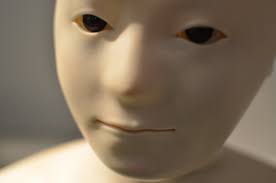
This afternoon, Anita came running to the kitchen when I was frying fish Gogol likes to eat with rice and daal. Panting, Anita mumbled something unintelligibly looking at our dining table. I held her arms and then leaned to check what it was. My heart missed a beat. A boy was standing in the passage. It had a very un-humanly chiseled looks – everything was too perfect as if it had walked out of some fairy tale book. But what would have scared Anita took me by surprise, too: its lifeless eyes, its gaze fixed in one direction. It looked like a human, but it wasn’t quite. When I stepped out of the kitchen, the boy robotically moved towards me: “Good afternoon, Maa.”

 I screamed. Gogol was standing next to the door of his room wickedly smiling as if sadistically observing what was going on and congratulating himself for his prescience.

 “Is it your surprise?” I asked now a little calmer realising that if Gogol was smiling the way he was it was part of his design.

“Yes, Maa. And now onwards it’s your companion. You have to give it a name, Maa.”

“Name? What name? What is it in the first place? Is it a live human?”

“It’s a humanoid which can do several things to assist you. It will make you feel less lonely when I am not around, Maa.”

Maa named the robot Pagol rhyming with my name, Gogol.  Until Maa became used to Pagol, there was a stiff carefulness. She had dealt with high technology in the past, particularly when we were in Germany, but not without close supervision of Baba until she became quite sure she could handle it herself. Anita learnt how to operate the robot very quickly and once she became comfortable Maa learnt things from her.

There wasn’t much to learn, though. Pagol was a fully automated robot with the intelligence of a two-year-old kid which helped it learn things by seeing them and then perform them with some basic assistance. It could perform four to five household chores, like reminding Maa of her daily medicines at the time she had to have them, bringing a tray to her with anything of moderate weight placed on it and having a basic conversation.

Slowly I’m forgetting Pagol is a robot. When Gogol visited me the next time, from Sweden, he did some tinkering to Pagol to make him more responsive to our needs and idiosyncrasies – and seeing me upset with him when he took Pagol apart to work on him, Gogol said: “Maa, you have become emotionally attached with Pagol. It’s only a contraption.” But it’s not the technological aspect of Pagol which has got me used to him but the fact that he has filled up a void in my life, one that had been left behind not so much by Gogol’s father’s sudden death in a road accident in Poland because there was Gogol to be brought up and other challenges that his passing way exposed me to, to be handled; as much by Gogol’s leaving India. Of course, Gogol does his bit to minimise the loneliness by phoning frequently and there is Anita, but the bouts of loneliness return nonetheless. I have fewer of those nowadays, thanks to Pagol.

You may find it strange that someone can develop emotions around a robot — a machine. Pagol is not many things that a normal human is. He can speak in, as Gogol calls them, preprogrammed scripts but you can’t have a conversation with Pagol. Nor can Pagol do things that come so naturally to us, like making meaningful eye contact or, say, a spontaneous chuckle or laugh or smile. But then doesn’t emotion, like beauty, lie in the eyes of the beholder?

But to Anita, Pagol was always a robot. Anita used to take care of all the mechanic needs of Pagol, setting the robot up on its charging station once every three days, calling me up in Sweden whenever Pagol needed technical attention.

But that wasn’t to be for too long.

                                                              *

When Maa called me in Sweden and very affectionately described how Pagol had ‘hit’ her gently, as if it had made the robot more endearing to her if anything, it reminded me of Edda. She had expressed her misgivings when I had told her that I was going to gift Maa an assistive robot. “There are lot of ethical concerns around these robots,” she had warned me. The concept of assistive robots for elderly people was widely known by then and so were the concerns about them. The popular concerns partly owed themselves to the sci-fi films and children’s books exaggerating these but also some incidents that had been reported widely in the media. Thanks to them, people saw robots as having a sinister side to them. What if a robot hit the elderly person it was assisting! Worse still, what if its functionality was sinisterly tweaked by someone to do so? Such were the concerns.

But Edda being a studious type was not the one to be swayed by popular beliefs. When she warned me, she had the real incidents reported in the media in mind. In one of them, an assistive robot helped an elderly person from his hospital bed to the balcony by holding his arms suddenly left the old man’s arms leaving the old man to himself and the old man, who couldn’t walk steadily without assistance, lost his balance, wobbled and fell down on a table injuring himself. 

On another occasion, an assistive robot had locked a bathroom door from outside locking an old woman in….And it took a long time for human help to arrive. The elderly woman was found in a state of panic and profusely sweating.

                                                         *

But we had to finally get rid of Pagol for entirely different reasons.

For a few days Pagol seems to have developed human qualities, a will of his own. He does things without being told to do them. This started since Gogol installed a new program in him to improve his cognitive abilities. I haven’t told it to Gogol because he would get worried and doing anything from so far is difficult anyway.

But since what Pagol did the other day, I have been a little concerned. Before Anita leaves for the day, which is generally late evening, she switches off Pagol and places him on his battery stand. It means Pagol is completely dysfunctional at night. That day I had dozed off while reading a Sunil Gangapadhay novel. After sometime, I woke up and realised I had slept off without switching off the lights and taking my medicines. I got up, finished my rituals, I retired for the day.

Sleep was hard to come by. I looked at the rafters thinking desultory thoughts until gradually the sleep god relented. Suddenly I felt the presence of another person in the room. When I looked up, I was startled. Two bright eyes were looking at me. For a moment I was paralyzed by fear, then I recognised the eyes — they were Pagol’s. I turned on the lights. I was right: Pagol was standing facing me. “Maa, you have not taken your medicines today,” he said.

But how did Pagol know this? During the day, when it is time for my medicines, he brings them to me on a tray. But at night, I take my medicines myself. And in any case Anita had put him to sleep for the night.

“What are doing here, Pagol? Didn’t Anita Di put you to sleep for night?” Pagol can respond to such simple questions nowadays, but he remained quiet, looking at me. Trying to move him to a corner of the room would be futile — Pagol was too heavy for that. The sudden surprise had dispelled my sleep. But, after sometime, I dozed off.

Next morning another surprise awaited me. When I got up, I didn’t see Pagol in the room. I rushed to the place where Anita keeps Pagol before leaving for the day — he was there exactly how Anita left him the previous day.

Today Pagol dropped a glass jar from his hand. He had taken the glass jar in his hand of his own volition; no one asked him to do it. When the glass slipped from his hand to the floor, Anita and I rushed to the kitchen. We were surprised. Not so much by the shattered jar as much by the expression of guilt on Pagol’s face. Anita shouted at Pagol: “Who asked you to play with that jar?” Later Anita saw Pagol standing in the balcony, looking at the lane below as if thinking something.

I knew very little about all this until I received a call from Anita one day. “Dada, lately Pagol has started acting strangely. It does things you don’t expect a robot to do.” She told me about the glass jar incident and what Maa had told her about finding Pagol standing in the middle of the room in the middle of night.

I was worried but I didn’t know what to do. I searched the net and found some short stories on robots developing human agencies. Finally, I mailed the Japanese company I had purchased Pagol from. After a few days, I received a response from a Japanese person by the name of Akinari, a robot engineer as per his mail signature.

Akinari said he had received similar complaints from customers before and had asked them to keep the robots under observation for some time to find out if there was any error of judgment on their part. He said he remembered almost everyone responding and confirming his doubt: that the complaints were the figment of imagination of the elderly persons receiving assistance from the robots.

I replied:

‘The robot assists my mother, and she is the person it spends most of its time with apart from Anita who takes care of my mother. It’s Anita who told me about the robot’s exploits. She wasn’t privy to some of them. She heard them from my mother, so I reluctantly ascribe some of the activities to my mother’s figment of imagination or error of judgement but Anita herself was witness to the other things the robot did.’

I want to mainly check with you if the robot can harm its benefactor.

Akinari wrote back:

‘I discussed it with other experts. Ordinarily we would have dismissed it as we have never heard anything like this before. But since you seem to be sure that your people back home have closely observed the robot for some time and are quite sure it is displaying behavior it is not programmed to, we would like to commission a special study of the robot in our lab.’

A week later a Japanese man visited our Calcutta house. Assisted by Anita, he dismantled the robot and took it with him.

The final entry on Pagol in Maa’s diary read:

It’s been six months since Pagol went missing one morning. He has not returned since. Anita assures me he will. The silly girl doesn’t seem to understand I know what they did to Pagol.

*

I never heard about Pagol again. I wrote to Akinari a few years after he sent a person to collect Pagol from our Calcutta home. But I didn’t get any reply from him. Did they completely dismantle him, and then dump his remains in a yard located somewhere in a third world country to add to the mounting pile of discarded gadgets abandoned because their utility to humankind had expired? I read on the net the other day that discarded robots are being recycled, also being used as fertilizer in some parts of the world. So, has Pagol ended up nourishing the food on the plate of someone?

I had expected Maa to react to Pagol’s sudden disappearance with the delirium of a mother who has suddenly lost her child. I had asked Anita to keep a tab on Maa in the days, weeks and months that followed Pagol’s sudden disappearance. But Maa never said anything about Pagol again. She continued with her life as if nothing had happened. Did she internalise the grief not expressing it lest it was trivialised by others? Or did she finally make peace with the fact that Pagol was a machine, after all.

After so many years I can only guess.

*Pagol in Bengali means mad or crazy.

Indrasish Banerjee has been writing and publishing his works for quite some time. He has published in Indian dailies like Hindustan Times and Pioneer, and Café Dissensus, a literary magazine. Indrasish is also a book reviewer with Readsy Discovery. Indrasish stays and works in Bangalore, India. 

.

PLEASE NOTE: ARTICLES CAN ONLY BE REPRODUCED IN OTHER SITES WITH DUE ACKNOWLEDGEMENT TO BORDERLESS JOURNAL
Categories
Poetry

A Love Poem by Candice Louisa Daquin

Courtesy: Creative Commons
TU ME FAIS MAL AVEC TA BEAUTÉ 

the shadows of us
were violet
with the crush of desire
racing in broken ways
toward the other
occasioning a need
to focus 
through glass
the elongation of
your beauty 

and this is for you
touche-moi avec ta douleur 
this is for you and all the moments
you weren't here 

You put your face up into my face
invading, disfiguring my space
like your hunger wasn't sate
near enough to avoid
being feral 
I lay my cheek
against your sharpness
and you bit into my fall 
joining burning fray
as if you belonged there
just as I

the shadows of us
were violet
with the crush of desire
racing in broken ways
toward the other
occasioning a need
to focus 
through glass
the elongation of
your beauty 

and this is for you
touche-moi avec ta douleur
this is for you and all the moments
you weren't here 

Glossary:

Tu me fais mal avec ta beauté: You hurt me with your beauty

touche-moi avec ta douleur: Touch me with your pain

.

Candice Louisa Daquin is a Psychotherapist and Editor, having worked in Europe, Canada and the USA. Daquins own work is also published widely, she has written five books of poetry, the last published by Finishing Line Press called Pinch the Lock. Her website is www thefeatheredsleep.com

.

PLEASE NOTE: ARTICLES CAN ONLY BE REPRODUCED IN OTHER SITES WITH DUE ACKNOWLEDGEMENT TO BORDERLESS JOURNAL.

Categories
Stories

Fakir Khizmil & the Missing Princess

A Balochi folktale translated by Fazal Baloch

Balochistan. Courtesy: Creative Commons

Once there ruled a king over a certain land. In the outskirts of the land there lived a rich man. A few days later the rich man died leaving a huge sum of wealth and property behind. His widow made it to the palace and told the king: “My husband passed away a few days back leaving enormous wealth behind. I have no one to look after me except for my son. I fear I’ll be robbed off my property. I urge you to give me a place near your palace where I could live in peace and without fear”.

The king asked his men to find out if the woman was telling the truth. They reported back  that whatever the woman had told him was true. Her husband left her with enormously wealthy. The king, then, summoned her and asked her to live with them in the palace. He also told the woman that he would marry his daughter with her son when they were old enough. The woman was quite happy hearing this.

Time passed by.

The boy grew young and so did the king’s daughter. One day the woman went to the king and told him that she wanted to the marriage to take place. The king said that he had no objection whatsoever, but he asked her for a few days to make preparations. A few days later they were finally married. Along with jewels and fineries, the king also gifted a golden bowl to his daughter.

The groom took the bride to his house. One day, when the womenfolk were going to fetch water at a river near their home, the king’s daughter also expressed her desire to accompany them. They tried to convince her that as she was a princess, she should let them have the opportunity to serve her. But she was adamant and accompanied them. They filled their pots, washed their faces and started on their way back home. Midway through, the princess remembered that she had unmindfully left her golden bowl at the river. She excused herself and hurried back to the river.

When she reached the riverbank, she met four thirsty horsemen who stopped by to ask for a drink of water. She filled the golden bowl and offered it to the horsemen. He was struck by her beauty. Since she was alone, they rode beside her.

Meanwhile, the womenfolk waited for long, but the princess did not return. When they went to the river, there was no trace of her there. They told her mother-in-law about what befell her daughter-in-law. Initially she waited for her to turn up, but she did not return. She went out to search of her but could not find any clue. Later in the evening when her son came back, she started wailing and told her about the incident. Her son immediately went out looking for his wife but he too could not find any trace of her. As he went along the road, he noticed some strands of a woman’s hair and drag marks on the road. He followed the marks till he reached a town.

A few children were playing there. He asked one of the children whose son he was. The boy replied, “Fakir Khizmil”. 

“Where do you live?” he asked them.

“There.” They pointed towards a nearby house.

“Ask your father, a horseman has said, he would be your guest tonight.”

After covering some more distance, he was overwhelmed by thirst. He saw a woman was filling her jar at a nearby stream. He approached her and asked her for a bowl of water. Initially, the woman berated him but then she offered her water. He sat there to rest for a while. Then he coaxed/lured the woman into a conversation. Amongst other things, the woman revealed to him that their king had brought a beautiful maiden with a golden bowl from a distant land. The man felt relieved to have finally found news of his wife. He took leave of the woman and rode back to fakir’s.

The fakir’s meal used to be sent from the king’s palace. At night the young horseman noticed that someone had sealed her ring in the middle of the plate. He looked closely at it. It was his wife’s ring. Next day, he noticed the seal again on the plate. He secretly sent a message to his wife with the maidservant who delivered the food asking her to be ready so that he could rescue her and take her back that evening.

Meanwhile the fakir asked him about the purpose of his journey. He told him how the king took his wife away and how he had uncovered her traces. The fakir asked him:

“Is she ready to come with you?”

“Of course, she is. But I am wondering how to manage the escape as the king has a huge contingent of army and the swiftest horses in the land.”

“Don’t worry. Just ask her to take a goatskin bag full of water, a stone from the right corner of the house and a matchbox. The rest I will explain to you later.”

The next day, the maidservant told the young man that his wife was ready, and she had asked him to wait for her in the garden. When stars arrayed themselves across the night sky, she would come to him. The young man conveyed to her what the fakir had told him to do.

The fakir further advised him thus: “When you notice the king’s army approaching you, throw the stone at them. When you see them again drawing nearer, spill the water. Again, when you notice them drawing close to you, just light a matchstick and throw it towards them.”

Later in the evening he saddled his horse and made preparations for his departure. When stars had covered almost the whole sky, he secretly rode to the garden and waited for his wife. A later, she arrived carrying the goatskin bag, the stone and a matchbox. They mounted the horse and rode off.

At dawn, the king noticed the maiden was not in her bed. He knew she had fled. He commanded his men to find her and bring her back to the palace. He said: “Whosoever will bring her alive or her head, I will give that person half of my wealth”.

Numerous soldiers went in different directions looking for the woman.

Meanwhile, the young man and his wife noticed a group of horsemen were approaching them. The young man threw the stone towards them. It turned into a huge mountain standing between them and the king’s men. After covering some distance, again he saw another group of horsemen drawing close to them. He untied the mouth of the waterskin and spilled the water on the ground. The spilt water turned into a huge sea. Some of the horsemen drowned in the sea and the others turned back.

When they had drawn close to their land, the young man noticed some dust spiralling into the air. A few horsemen emerged out of the dust. By then, their horse had almost collapsed and it was barely moving forward.

The woman said: “Hurry up! We are almost surrounded.”

“Don’t worry,” said the young man. In that very moment he lit a matchstick and flung it towards the horsemen. A huge fire erupted around. The horsemen turned back and took to their heels.

Finally, the couple reached home and lived happily ever after.

(This tale is taken from Geedi Kessa-2(Folktales: Vol 2) compiled and retold by Mahmood Mari in Balochi and published by the Balochi Academy Quetta in 1969. Fazal Baloch has the translation rights for this. )

Fazal Baloch is a Balochi writer and translator. He has translated many Balochi poems and short stories into English. His translations have been featured in Pakistani Literature published by Pakistan Academy of Letters and in the form of books and anthologies.

.

PLEASE NOTE: ARTICLES CAN ONLY BE REPRODUCED IN OTHER SITES WITH DUE ACKNOWLEDGEMENT TO BORDERLESS JOURNAL