Categories
A Special Tribute

In Memoriam: Star of the Stage Shines on Screen

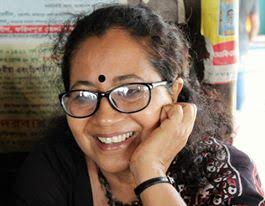
Ratnottama Sengupta trains the spotlight on actress Swatilekha Sengupta(22nd May 1950- 16th June 2021)

Swatilekha Sengupta in action in Shanu Roy Chowdhury. Photo sourced by Ratnottama Sengupta

“Swatilekha is more talented and far better actor than I. Still, everyone keeps asking for me!” Rudraprasad Sengupta was not boasting to me – the helmsman of  the celebrated Nandikar Theatre Group was citing just one instance to show that “women in theatre still suffer bias[1].”

He wasn’t far from the truth: Swatilekha Sengupta, who passed away exactly a year ago on June 16 at 71, had graduated in English, mastered Western classical music in England, received guidance in theatre from iconic names like Tapas Sen, B V Karanth and Khaled Chowdhury. She composed music for, directed and carried on her shoulder Nandikar productions like Madhabi, Shanu Roy Chowdhury, Pata Jhore Jaay (Dry Leaves Fall), Naachni(Dancers).

Madhabi was adapted from Bhishm Sahni’s Mahabharat based play; Shanu Roy Chowdhury was adapted from Willy Russel’s Shirley Valentine; Naachni encapsulated the exploitation of the nautch girls of tribal Purulia. She wrote some, she composed the music for some, she travelled to UK and USA, Germany and Norway and Scotland… with husband Rudrapasad, with daughter Sohini, even to stage a one-woman play.  Yet, she is most recalled for playing Bimala in Satyajit Ray’s Ghare Baire (Home and the World, 1985) – although, ironically, she faced fierce criticism for its critical failure!

Growing up in Allahabad Swatilekha – then Chatterjee – had repeatedly watched Charulata (1964) and Mahanagar (1963) with her school friends. She even wrote to Ray seeking an opportunity to work under him. Of course the letter went unanswered – or perhaps it went astray? For, Ray watched Swatilekha in Nandikar’s Galileo and zeroed in on her for the dream role of Bimala: the wife of a forward-thinking zamindar, Nikhiliesh, whose concern for the welfare of the peasantry under his care is critiqued and upended by an upstart revolutionary, Sandip.

Tagore had written the novel, told through the personal stories of the three protagonists, in 1916 when the Nationalist movement was peaking. The 1905 Partition of Bengal had outraged both, the Hindus and the Muslims, and the protests against the religion-based partition also saw Tagore set Bankim Chandra’s Vande Mataram to music and singing the song to protest the imposition of foreign rule. But after the ‘administrative division’ was rescinded, the call to boycott foreign goods in favour of Swadeshi, indigenous, appealed to the masses – and that led to tensions between the anti-British activists and the idealists. Swadeshi was critiqued as being unaffordable for the peasantry by Nikhilesh in the film and by Tagore, who contended that humanity came before nationalism. Effectively, then, the drama had pitted the conservative versus the radical, rational versus the emotional, East versus West. In short, the home versus the world.

So keen was Swatilekha’s appetite for the character that, on the first day, she’d defied a local bandh[2] and walked from her home in north Calcutta to the legend’s Bishop Lefroy address across the city. On learning that she’d not read the Tagore classic the iconic director had insisted that she should NOT read it. On noticing that she was staring at a harpsichord Ray had asked her if she could play it, and on hearing that she played the piano he’d asked her to play a Beethoven and he had himself whistled along!

Swatilekha Sengupta & Soumitra Chatterjee in Satyajit Ray’s 1985 film, Ghare Baire. Photo sourced by Ratnottama Sengupta

All this camaraderie must have passed on to his actor: when the film released to the world, a prestigious American newspaper praised the “immense grace” of the “pretty, surprisingly wilful Bimala”. But the demanding viewers at home tore her to pieces saying “she neither lived nor looked the role”. Suddenly her ‘home’ had turned into a horrid world… “I sunk into depression and wanted to end my life!” Swatilekha had confessed to my young screen-writer friend, Zinia Sen, while preparing to return to the screen 30 years later — with the same co-star, Soumitra Chatterjee, in Bela Sheshe (In the Autumn of My Life, 2015), which is now considered a cult film.

The story of Arati and Biswanath Majumdar takes a curious turn when, on the eve of their 50th anniversary, the husband seeks to divorce his wife. Because? Arati, a typical, traditional housewife, happily spends her life cooking and cleaning, washing and nursing. For, in her vocabulary, those are just other words to say ‘I love you’ to her husband; for looking after her in-laws; for expressing her concern for her daughters and son and grandchildren… This is a far cry from her husband’s definition of a dream partner. For Biswanath, the proprietor of a fabled bookstore, has unending curiosity about the world and wants to travel beyond the map… 

The five relationships depicted in the film attempt to define the life-long companionship we brand as marriage. Do marriage vows ensure the fairy tale ending of happiness ever after? Is married life built upon promises kept and love requited? Or do unfilled expectations and unarticulated expressions also cement the friendship? Is it possible to walk into the sunset hand in hand?

Soumitra Chatterjee and Swatilekha Sengupta in Belasheshe. Photo sourced by Ratnottama Sengupta

Bela Sheshe made on a budget of Rs 1.1 crore reaped Rs 2.3 crore. More importantly, while reviving faith in institutionalised partnership it also breathed new box office appeal in the screen partners, Soumitra Chatterjee and Swatilekha Sengupta. In Belashuru (A New Beginning, 2022) the latest outing of Nandita Roy and Shiboprasad Mukherjee, the director duo have again cast them as Arati and Biswanath. This time, though, it is a new beginning for the husband is eagerly striving for his Alzheimer afflicted wife to recognise that the ‘stranger’ who follows her everywhere, even her bed, is her now-aged groom. For, Arati now lives in the past she left in Faridpur, along with the pond she’d fish in with Atindrada and the textile shop of her comrade in crime, when she got married…

The film pivots on Arati, and Swatilekha outshines one and all in the cast. Not surprising: the actor’s total commitment to the character is borne out by Zinia. She recalls that, “when the rest of the unit sat listening to Soumitra Da’s [3]enthralling anecdotes and Kharaj Da’s [4] humour filled recitation, Swati Di[5] refused to join in. Instead, she retired within herself, just as Arati would.”

Swatilekha Sengupta as Ammi in Dharma Juddha, a film that will be released in August 2022. Photo sourced By Ratnottama Sengupta.

This is echoed by Raj Chakraborty, the director of Dharma Juddha (Religious War ) which was screened in the recent Kolkata International Film Festival. He recounts that the film was shot in Purulia that suffers extreme summer, but “since the sequence was set on a winter night, she kept her warm clothes on all through the shoot. Such was her dedication to the character and the script!”

Having followed her theatre over a long time Raj counts it amongst his blessings that he could work with her. “I’m certain there was more left to learn,” he sighs as he awaits the masses’ response to the film which once again, rests on the sturdy shoulder of Ma/ Ammi/Dadi[6]. Raj could envisage none but Swatilekha as the protagonist who shelters to two sets of men and women when Ismailpur is seized by an apocalyptic night of communal rage. The pacifier succeeds in instilling brotherhood in the four victims from rival camps – until the tragic truth about her son’s death is revealed. It drives home the realisation that the foremost religion is humanism.

Like Swatilekha, Soumitra Da too had a strong presence on the stage. And fortunately, the screen pair’s daughters – Sohini and Poulami, respectively – are also deeply into theatre.  “I had chosen theatre when I wanted to direct,” he’d said to me when Sangeet Natak Akademi had decorated him, “because, if I make films, people will always compare me with Manikda[7].”

That is why I am doubly delighted that the makers marked the release of Bela Shuru [8]– the duo’s last film – around Swatilekha’s birth anniversary[9], with a unique exhibition. it showcases Soumitra’s typewriter, the script he penned for a play, a collection of pipes acquired on travels abroad; his paintings, poems, letters to his daughter from his Jaisalmer shoot for Sonar Kella (1974)… And it showcases Swatilekha’s violin and mouth-organ; the costumes she wore in Nachni and Bela Shuru; and, a congratulatory letter to Swatilekha, from a star admirer — Amitabh Bachchan…[10]

Soumitra Chatterjee and Swatilekha Sengupta in Bela Shuru. Photo Sourced by Ratnottama Sengupta

Surely a far cry from the bias that you lamented when you celebrated the 150th birth anniversary of Notee Binodini [11] in 2013, Rudra Da[12]?

*

Yes, theatre people the world over agree, that the ‘Moon of Star Theatre’ was deprived of her rightful honour when the theatre that was founded by her not named after her. Why? Because “the aristocrats would not like to enter a place named after a noti.” Thespian Noti Binodini might have been, but she was a fallen woman, wasn’t she? So what if this contemporary of Tagore was the first South Asian actress to pen her own story – Aamar Katha — a lucid memoir that portrays the 19th century society in Bengal which was at ease with European ideas but confined women to homes. So what if the sage Ramakrishna had gone into a trance as he watched her essay Chaitanya Mahaprabhu (1884)? Such was her portrayal that thespian Amritlal Bose wrote, “Whenever I bow to any wooden or painted image of Sri Chaitanya, I see Binodini before my eyes.”

Binodini Dasi had gone onstage at age 12, under mentor Girish Ghosh (1844-1912), and her career had ended when she was just 23. Merely 11 years, but those were the years when the proscenium theatre modelled after European convention was spreading in Bengal. In those 11 years Binodini enacted 80 roles, playing Sita, Draupadi, Radha, Kaikeyi or Pramila, Mrinalini, Motibibi, Ayesha. Please note: She pioneered modern stage make-up by blending European and indigenous styles.

“Because of this, people who had seen her in one role could not recognise her in another,” Girish Ghosh himself wrote. Yet this same stalwart of theatre, to please whom Binodini had drained her own resources and founded Star Theatre in north Calcutta, refused to write a foreword for My Story as it contained uncomfortable truths about Binodini’s patrons!

Why did the chroniclers of Bengal Renaissance overlook the contribution of this marginalised star to the land’s cultural mileu? “Because of the class-caste divide,” Soumitra Chatterjee suggests in his foreword for the memoir. “How could the Brahmo-Brahmin dominated upper crust acknowledge the talents of a lowborn ‘prostitute’?”

More than a century later, Swatilekha took it upon herself to train the spotlight on the fact that the years had failed to change the plight of another set of dancing artistes – the Nachnis.


[1] Women in Theatre suffer bias.’ – quoted from Times of India, article by Ratnottama Sengupta.

[2] Strike where transport was halted

[3] Soumitra Chatterjee (1935-2020)

[4] Kharaj Mukherjee : Actor and comedian

[5] Swatilekha Sengupta (1950-2021)

[6] Grandmother

[7] Satyajit Ray

[8] Release date: 20.5.2022

[9] 22. 5. 1950

[10] Amitabh Bachhan, one of the most nationally and internationally awarded and influential actors

[11] Play based on the life Binodini Dasi

[12] Rudraprasad Sengupta, husband of Swatilekha and a theatre personality

Ratnottama Sengupta, formerly Arts Editor of The Times of India, teaches mass communication and film appreciation, curates film festivals and art exhibitions, and translates and write books. She has been a member of CBFC, served on the National Film Awards jury and has herself won a National Award. Ratnottama Sengupta has the rights to translate her father, Nabendu Ghosh.

.

PLEASE NOTE: ARTICLES CAN ONLY BE REPRODUCED IN OTHER SITES WITH DUE ACKNOWLEDGEMENT TO BORDERLESS JOURNAL

Categories
Tagore Translations

The Palmyra Tree or Taal Gaachh by Rabindranath

Taal Gaach or The Palmyra Tree was published as part of Shishu Bholanath (Child Bholanath) brought out in 1922. The poem has an inbuilt cadence and rhythm that flows like the sway of palmyra (commonly referred to as taal ) leaves in the breeze.

Taal Gaach, painting by Sohana Manzoor
THE PALMYRA TREE

The palmyra towers over all trees
Standing on one foot, it peeps
Into the sky.
It yearns to fly,
Piercing through dark clouds nigh 
But where will it find wings?
That is why, it thinks —
Leaves circling its crown
Are wings to float around.
To soar unhindered, free,
Leaving its home, it flees. 
The whole day, the foliage rustles,
Murmurs, susurrates and bustles. 
The tree imagines its flight, 
Drifting past stars in the sky, 
Towards a destination up high.
Then the breeze stalls.
The swish of leaves halts.
When it regards the loam
As its mother, its hearth.
It loves again its home, 
The nook on Earth. 

(This poem has been translated for Borderless Journal  by Mitali Chakravarty with editorial comments from Sohana Manzoor and Anasuya Bhar.)

.

PLEASE NOTE: ARTICLES CAN ONLY BE REPRODUCED IN OTHER SITES WITH DUE ACKNOWLEDGEMENT TO BORDERLESS JOURNAL
Categories
Tagore Translations

The Funeral: A skit by Rabindranath

Translated from Bengali by Somdatta Mandal, this satirical skit[1] was part of Hasyakoutuk (1914) or Humour by Tagore

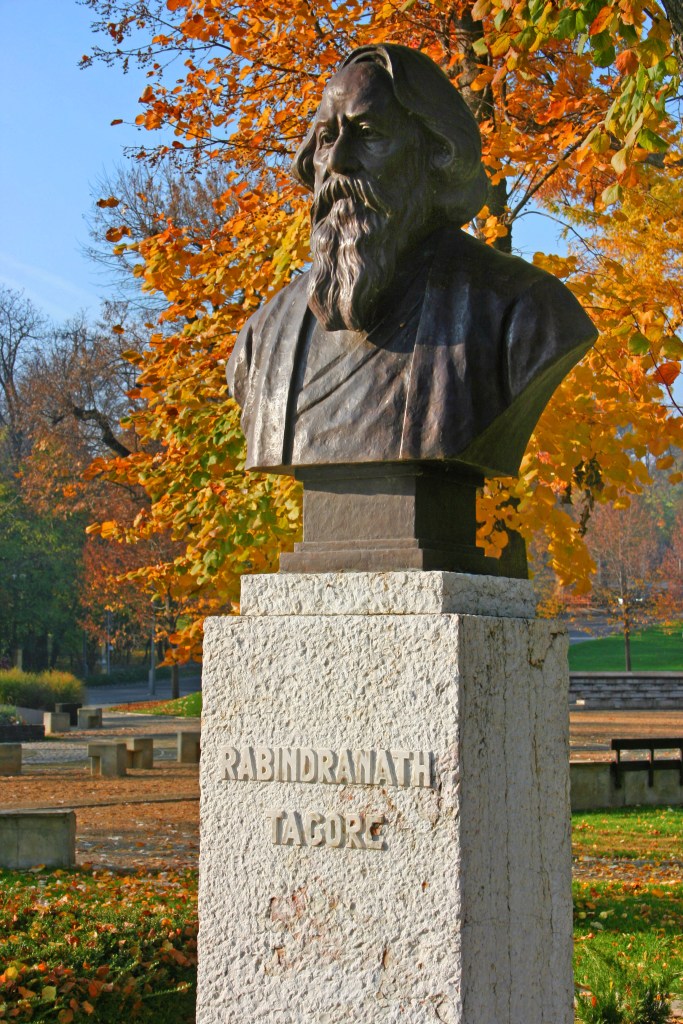
Rabindranth’s bust in  Hungary, Balatonfüred, Tagore promenade

Scene One

Ray Krishnakishore Bahadur is lying on his deathbed. His three sons Chandrakishore, Nandakishore and Indrakishore are busy consulting each other. A doctor is present. The women are close to tears.

Chandra: Who are the people we should write to?

Indra: Write to Sir Reynolds.

Krishna: (With great difficulty) What will you write, son?

Nanda: The news of your death.

Krishna: But I am not yet dead, son.

Indra: You might not die right now, but we have to fix a time for the event and write that down…

Chandra: We should collect the condolence letters from all the Englishmen here and get them published in newspapers. No point in publishing them when all the excitement is gone!

Krishna: Patience boys; let me die first.

Nanda: We can’t wait, father. Let’s make a list of the letters to be sent to the people in Shimla and Darjeeling. Come on, let’s get all the names down.

Chandra: The Governor, Sir Ilbert, Sir Wilson, Beresford, Macaulay, Peacock –

Krishna: Boys, what names are you chanting so close to my ears? Chant God’s name instead. When the time comes, He is the only one who can save us! Hari –

Indra: Yes, good thing that you reminded us, we forgot to include Sir Harrison.

Krishna: My sons, say Ram, Ram –

Nanda: Really, I had forgotten about Sir Ramsey.

Krishna: Narayan, Narayan!

Chandra: Nanda, write down the name of Sir Noran also.

Enter Skandakishore.

Skanda: So, you people seem so relaxed! You still haven’t done the real thing!

Chandra: And what is that?

Skanda: We have to inform in advance all the people who will be part of the procession going to the funeral ghat.

Krishna: Sons, which one do you consider the real thing? First, I’ll have to die, only then –-

Chandra: No worries on that account. Doctor!

Doctor: Yes sir!

Chandra: How much time is left for father to go? When do the public have to be here?

Doctor: Perhaps–

The women start wailing.

Skanda: (Disgusted) Ma, will you stop it? You’re creating quite a scene!  It’s better to sort out everything in advance. When doctor?

Doctor: Most likely this night at—

The women start wailing again.

Nanda: This is a huge problem! You shouldn’t disturb us during work. What do you think your crying will accomplish? We are planning to publish condolence letters sent by important Englishmen in newspapers.

The women are sent out.

Skanda: Doctor, what do you think?

Doctor: From what I can see I think he will expire around four a.m.

Chandra: Then there is no time – Nanda, go quickly, get the slips printed at once right in front of your eyes.

Doctor: But first mustn’t the medicine—

Skanda: Look here! Your medicine shop will not run away. On the other hand, we’ll be in trouble if the print ring shop shuts down.

Doctor: Sir, the patient might not —

Chandra: That is why you must hurry. For who knows what might happen if the slips are printed before the patient —

Nanda: Here I go.

Skanda: Write down that the procession will begin at eight tomorrow.

 Scene Two

Skanda: What, doctor? It’s already seven now instead of four.

Doctor: (Apologetically) Yes, yes, amazing the pulse is still strong.

Chandra: You are a fine one doctor to have got us into this mess!

Nanda: Everything went wrong when I was late in bringing the medicine. In fact, dad began to recover as soon as the doctor’s medicine was stopped.

Krishna: All this time you were so very cheerful, why is everyone looking so glum all of a sudden? I am feeling fine now.

Skanda: We aren’t feeling that great. We had already finalized all preparations to go to the funeral pyre.

Krishna: Is that so? I guess I should have died.

Doctor: (Feeling irritated) Do one thing and that will solve all problems.

Indra: What?

Skanda: What?

Chandra: What?

Nanda: What?

Doctor: Instead of him why don’t one of you die when the time is ripe.


Scene Three

A lot of people have assembled in the outer house.

Kanai: Hello, It’s already eight thirty. Why are you all late?

Chandra: Please sit down. Have some tobacco.

Kanai: I’ve been [chewing] tobacco from the morning!

Bolai: Where is everybody? I can’t see signs of any arrangements being made.

Chandra: Everything is ready – it’s not our fault – now only—

Ramtaran: Hey, Chandra, we shouldn’t waste any more time.

Chandra: Don’t I understand that – but—

Harihar: What is causing the delay? We’ll be late for office, what’s the matter?

Indrakishore enters.

Indra: Don’t be impatient. We are almost ready. In the meantime, why don’t you read the condolence letters?

He distributes them.

This is from Lambert, this from Harrison, this is Sir James’s—

Skandakishore enters.

Skanda: Here take them. In the meantime, read the obituary notices on father in the newspapers. Here is The Statesman, here The Englishman.

Madhusudan: (To Yadav) Isn’t this typical? Bengalis won’t ever learn what punctuality is all about.

Indra: You’re absolutely right. They will die and yet never learn to be punctual.

The guests shed tears reading the newspapers and the condolence messages.

Radhamohan:  (in tears) Oh God, the poor man’s friend!

Nayanchand:   Alas! To think that even such a good man has his share of troubles.

Nabadwipchandra: (in a deep breath) Lord! Everything is your will!

Rasik:‘The lotus that blooms in the heart’ – I’m forgetting what comes after that –

                        ‘The lotus that blooms in the heart

                        Has been plucked untimely

                        The lotus heart sinks in the sea of sorrow!’

This is exactly the case here. The lotus heart in the sea of sorrow. How sad! Add esquire. O tempora! O mores[2]!

Tarkabagish[3]: Challchittang challadbittang, challajiwan – The mind is inconsistent, wealth is transitory and one’s life is perishable. Oh how sad!

Nyayabagish[4]: Yadupathe kri gata mathurapuri, raghupate – Where is the city of Mathura that belonged to the Lord of the Yadavas (i.e. Krishna), to the Lord of the Raghus (i.e. Rama Chandra)? (chokes)

Dukhiram: Oh Krishnakishore Bahadur, where have you gone?

 A faint voice can be heard from within:  I am here. Please, don’t shout.  


[1] [Translated from “Antyashti-Satkar” in the Hasyakoutuk series Bhadra 1293 B.S. by Somdatta Mandal].

[2] “Oh the times! Oh the customs!” – Latin phrase, first recorded to have been spoken by Cicero

[3] Bengali title given to an expert debator

[4] Bengali title given to a legal expert

Somdatta Mandal is a former Professor of English and ex-Chairperson, Department of English, Visva-Bharati, Santiniketan, India. A recipient of several prestigious fellowships like the Fulbright Research and Teaching Fellowships, British Council Charles Wallace Trust Fellowship, Rockefeller Residency at Bellagio, Italy, Salzburg Seminar and Shastri Indo-Canadian Faculty Enrichment Fellowship, she has been published widely both nationally and internationally. She has also an award from Sahitya Akademi for the All India Indian Literature Golden Jubilee (1957-2007) Literary Translation Competition in the Fiction category for translating short stories series ‘Lalu’ by Sarat Chandra Chattopadhyaya.

.

PLEASE NOTE: ARTICLES CAN ONLY BE REPRODUCED IN OTHER SITES WITH DUE ACKNOWLEDGEMENT TO BORDERLESS JOURNAL
Categories
Excerpt

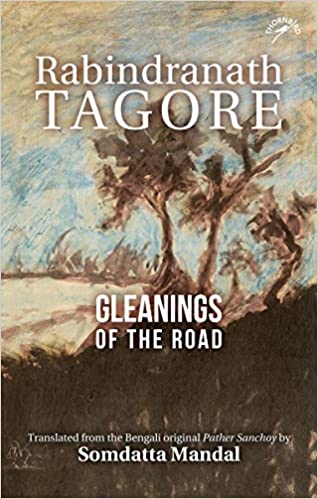
Tagore’s Gleanings of the Road

Author: Rabindranath Tagore 

Translator: Somdatta Mandal 

Publisher: Niyogi Books

Chapter 1 – Prelude to the Journey

Our ashrama school is situated in the midst of a meadow, a place where both the old and the young, students and teachers all reside in the same room. We also have other playmates; we do not have a concealed relationship with the blue sky, the light and the breeze. Here the early morning rays of the sun fall directly upon our eyelids, the evening stars in the sky directly stare at our faces. When the storm comes, its dusty stole warns us from a very long distance. The arrival of a new season is first heralded through the new leaves on our trees. It is as if Nature does not have to wait for a moment outside our doors. Our desire is to share this kind of a relationship with the people of the world as well. The desire of our heart is to see clearly all the seasons that come and go in the history of mankind, the rising and setting of the sun or the tumult that storm and rain create. This is possible for us because we stay far away from human habitation. Here all the information of the world is not received in a particular cookie-cutter mould; if we want we can receive them in an unadulterated form.

In order to make the relationship of our institution to the rest of the human world an open one, I feel it necessary to explore the world. We have received the invitation of that larger world. As it is not possible for all the 200 students of this school to accompany me in this grand tour, so I have decided that I shall alone attend the invitation on your behalf. Through me I shall complete all of yours travel. When I will again return to your ashrama I will be able to capture a lot of the external world in my life and bring it for you. Once I come back I will share my experiences at leisure, but now, before departing, I want to clearly explain some of my thoughts to you. Many people ask me why are you going for an Europe travel? I cannot find an answer to this question. If I give a simple answer that I am going because I simply want to travel, then people will think that I am dismissing the fact lightheartedly. Man is not at peace until a result is declared and an assessment made of the profit and loss involved. Why should man venture out of home without any need is a question that can be raised in our country only. We are oblivious of the fact that the wish to venture outside is a natural instinct in man. Home has bound us up in such a manner that we are tied by many superstitions and tears once we decide to set our feet across the threshold. Thus the outside is totally beyond us while its connection with home has been completely severed. Our friends and relatives enmesh us so closely that outsiders are outsiders in the true sense of the word.

ABOUT THE BOOK

Travels formed an integral part of the personae and creative artist that was Rabindranath Tagore. During his travels to England and the USA (1912-13 and 1920) Tagore wrote essays for publication in various Bengali journals. In 1939, Tagore selected fourteen of these essays and an appendix containing seven letters he had written to some of the teachers in the Shantiniketan ashram while he was on these trips, for publication as a volume. Tagore rewrote the original essays then using the colloquial instead of the formal language; he also revised the texts substantially. Later editions altered the number of essays, sometimes digressing from Tagore’s own selection, sometimes going back to Tagore’s original formal language. The travelogue provides an insight into Tagore’s perception of the different facets of western life and the diverse philosophical issues that cross his mind as he journeys from one continent to another. Translated from Bengali for the first time, Pather Sanchoy would be of interest to all those who enjoy exploring unknown territories geographically and psychologically.

ABOUT THE AUTHOR

Rabindranath Tagore, sobriquet Gurudev, was a Bengali polymath who reshaped Bengali literature and music, as well as Indian art with Contextual Modernism in the late 19th and early 20th centuries. Author of Gitanjali and its “profoundly sensitive, fresh and beautiful verse”, he became the first non-European to win the Nobel Prize in Literature in 1913.He is sometimes referred to as “The Bard of Bengal”.

ABOUT THE TRANSLATOR

Somdatta Mandal is a former Professor of English and ex-Chairperson, Department of English, Visva-Bharati, Santiniketan, India. A recipient of several prestigious fellowships like the Fulbright Research and Teaching Fellowships, British Council Charles Wallace Trust Fellowship, Rockefeller Residency at Bellagio, Italy, Salzburg Seminar and Shastri Indo-Canadian Faculty Enrichment Fellowship, she has been published widely both nationally and internationally. She has also an award from Sahitya Akademi for the All India Indian Literature Golden Jubilee (1957-2007) Literary Translation Competition in the Fiction category for translating short stories series ‘Lalu’ by Sarat Chandra Chattopadhyaya.

Click here to read the review

PLEASE NOTE: ARTICLES CAN ONLY BE REPRODUCED IN OTHER SITES WITH DUE ACKNOWLEDGEMENT TO BORDERLESS JOURNAL
Categories
Stories

The Magic Staff

A poignant short story about a Rohingya child by Shaheen Akhtar, translated from Bengali by Arifa Ghani Rahman

Shaheen Akhtar

Musa was born in the year when the girl child in his region was allowed to live and the sons were being killed. Dadi, his father’s mother, Bismillahjaan, had named him. There were no celebrations, no events to mark this ceremony, and not even an insignificant penny was spent on incense. However, as a tax for the arrival of a child into this world, a fat sum had to be donated to the nearby police station. That is how Dadi Bismillahjaan described the heavy term ‘birth registration’ used by people.

And Musa had landed on this side of the Naf River last night without that Dadi. He did not know at the time that his grandmother was not on the boat. She had paid for both their passages with six thousand kyat[1]. Then ensued the hullabaloo as people vied to get on the boat under cover of the darkest of nights.

A stream of salty tears ran down Musa’s cheeks as he stared down the endless river. Had his lungi been tied to his Dadi’s Thami,[2] he would never have let her float away. God forbid! Why would the old woman have floated away? She probably had not boarded the boat in the first place. She had ensured her grandson’s passage and quietly withdrawn from the back.

That was what Bismillahjaan had wanted from the very beginning. Musa was the sole heir to his family name, she used to say with every breath. If he survived in any corner of the earth, at least his bloodline would live on. And so, she had pulled her old, skeletal body across the hills and through the jungles. In all this time, she had held on to the enamel pot in which she cooked rice. Along the way, she had boiled whatever leaves she could gather and served them to Musa.

Musa had not paid attention to this at the time. His eye had been on the mountain along their path – perhaps he might see the light of God, the light which burned the mountain, but not Musa, the prophet. But none of these mountains were named Sinai. He had found a staff on the way though, and he had tied the bundle of clothes and the cooking pot to one end.

When Musa’s caravan arrived at the sandy banks of the Naf, he had relieved the stick of its burden. The sandy banks were like Karbala – with no water to drink nor food. The salty water where the river and the ocean met only made them vomit, cry, and struggle. In the meantime, when one woman gave birth, Musa, the learned student of the village religious school, was summoned to sound the azaan, the call for prayer, in the baby’s ear. Two days and two nights passed. There was no boat in sight. The Burmese army was hunting them down like the Pharaoh’s soldiers. Secretly, Musa had extended his arms once towards the river but to no avail. So, under cover of the night, he had thrown his staff into the water. This too was fruitless. The stick was swept away by the current. But at that moment, an engine boat puttered over from the other side and stopped at the bank. It was in that boat that Musa had piled in to arrive at this unknown destination last night. In the midst of this, he had lost Dadi, Bismillah.

How would Dadi traverse that long road again? Where would she go? What would she eat? Home burnt, fields burnt – their land had been destroyed by the ruling goons. If the family graveyard was still intact, she could probably find shelter in a foxhole. This must have been her plan all along. Musa’s sleep-deprived, numb, dizzy brain now recalled the rambling hints she had dropped about this. Five years ago, Bismillahjaan’s only son, Musa’s father, had been laid to rest in that graveyard. Musa had been a child of eight then. As he watched the gravedigger shovelling in the earth, he thought about the ancestors that were lying there. Baba had suffered much in life and his death had been worse. The military junta soldiers had shot him in the chest and then his throat had been slit by the monks. As he lay in his grave, Baba would tell of his travails to his dear ones who had led comparatively peaceful lives.

Musa wiped the tears from his eyes and sat on the rocks of the dam. He was closer to the water’s edge from here. Countless people stood squashed together on this side of the Naf, their eyes trained on the other bank. As darkness descended, a lantern or two lighted up on the river, and there was the occasional flicker of a flashlight. Musa drew in his breath sharply. Did the battery-operated lights belong to the military junta?

Perhaps there were still thousands of people waiting on the tarpaulin laid out on the sands he had left behind yesterday. Some would be giving birth; some would be dying – their bodies burned or maimed by bullets. There was no medicine, no proper food. For what sin were they suffering this hell on earth? Was Dadi still burning in the hell at the sandy banks?

As soon as a fleet of boats docked along the bank, Musa jumped into the water. He could not move forward as the crowd shoved through the neck-deep water from the opposite direction. He did not even have a light to shine on the faces of the swarm of people to find Dadi’s. Whatever light there was on this side came from the flash of cameras or the flashlights of the BGB[3] or the coastguards. They were using their flashlights to search through the refugees’ belongings that had been dumped on the banks – their plastic sacks, cooking utensils, urns, broken wall clocks, solar panels, and piles of quilts and pillows. At that moment, lightning in the sky heightened the tremors in Musa’s heart. What if Dadi drowned in the middle of the river in a storm? Raindrops fell on Musa’s head while he was still chest-deep in the water. In the meantime, boats docked relentlessly, as countless as the waves in the sea, compounded by the lapping of the water on the bank and the ear-splitting noise of their engines.

When it began to pour, Musa took shelter in the barn, or rather, a goat shed, of a nearby house. The shed shared a wall with the hut and was covered by the Nipa palm leaf with the other three sides open. In this tiny space stood two closely tethered goats. Musa crowded in with them. Who knew how late it was now. The homeowners must be sleeping soundly. He thought he would leave when the rain eased off but just then, the thunder clapped and he grabbed one of the goats around the neck and sat down. It was a familiar touch after so many days and the smell was exactly the same. When lightning struck a little later, he looked timidly, for the first time, at any creature from this unknown land. It did not look unfamiliar though. In fact, the eyes looked as tender as his pet goat’s. So what if Musa was a scholar in the maktab[4], at heart he was a shepherd – of a pair of golden buffalos and two goats with four or so kids. How much pain those goats must have suffered when they struggled in the fire that engulfed them!

Before the army set fire to their homes, the buffalos had been set free and Dadi had taken refuge in the forest with twelve-year-old Musa. Perhaps she had thought nothing would happen to a woman, child, and a few innocent goats. What Bismillahjaan did not know was that the tyranny of the army had heightened by the day. Even the girls were not spared. These tyrants used to rape before, but now they resorted to spilling blood. When Musa returned home two days later, all he found were ashes and destruction. They had taken shelter in Dadi’s sister’s home a little to the south that day and that is where they stayed for a full year prior to their migration.

When Musa thought of his mother, he recalled a woman sprawling on the front yard with a child in her lap. The child’s pigeon-like pink feet hung over one side of Ma’s lap. Where were his young siblings now? His mother? Musa was awoken by his own cries. He found himself lying curled up on the straw in the goat shed, the pair of goats standing next to him. Someone had wrapped his entire body with a torn quilt – just as his mother used to silently cover him up during the heavy monsoon or winter nights. Even so, Musa left the shed before the first light of dawn. He did not return to the dam. Instead, he began to wade through the muddy path in the opposite direction.

The marketplace ahead was already buzzing at this ungodly hour. City dwellers, alighting from the intercity buses, rushed to the stalls for breakfast, their bags hanging from their shoulders. Aromatic smells filled the dawn air. As hunger pangs rose in Musa’s empty stomach, he began to loiter around the stalls.

When someone came out of a stall and aimed a camera at him, Musa took shelter behind the stall. The camera was a lure – this person was actually a kidnapper, thought Musa. He hissed inwardly like a snake. When the same man, however, returned with a plate of food from inside the stall and called to him, Musa dragged his feet forward. Then he wolfed down the food. He cared nothing at all for the number of clicks the camera made or how many pictures were taken of his starved face. As he burped after polishing off the plate, Musa thought that he would be willing to allow photographs if it meant meals twice a day. He was actually waiting to find a staff that would transform magically into a snake. This was now his aim in life.

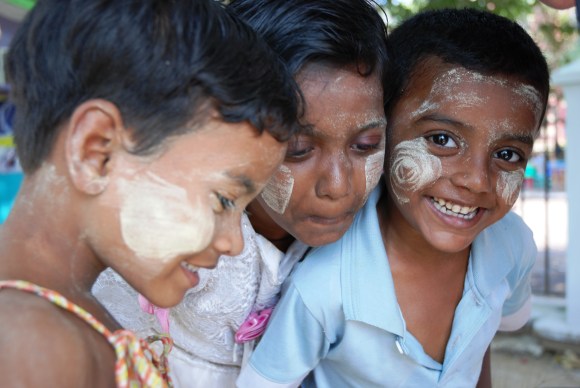
With his life’s goal determined, Musa could now afford to look around casually. The place may not have been a township but it was quite busy regardless. There were some paved stores. A schoolhouse stood nearby, some mud-splattered sleeping people crowding its veranda. In the middle stood a pile of their dirty household belongings. When someone emerged from behind a plastic sack of this rootless group, Musa was taken by surprise. Was this boy his twin or was he looking at himself in the mirror? The only difference was that the boy had a white clay mark of Thanaka[5] on his cheek. He was dressed in light blue denim shorts chopped off at the knees. With these and some other differences, the two of them stood in the shade of the stall, next to each other. Neither seemed to have the strength or the inclination to speak.

Children with Thanka on their face. Courtesy: Creative Commons

When the cameraman appeared with a local in tow, Musa quickly turned his back on them to face the wall. Why was this man so overenthusiastic? Wasn’t he satisfied with the bunch of photos he had already taken of his starving, beggarly face? But this time it was not the click of the camera, but the man’s words that drew attention. Musa realised he was taking interviews. In the beginning, the boy next to him also stood silently. Perhaps he was mute, deaf. But the next moment, he began to stammer. Musa felt goosebumps. Did everything become topsy-turvy when doomsday loomed? Was Musa glib of tongue and Harun a stammerer? Of course, he had no idea if this boy’s name was even Harun.

‘So many murders, rapes, arson – did you see these with your own eyes?’ The local translated the cameraman’s words into Rohingya.

What could be the answer to this question? And how could it be described? Did the kid next to him stammer so he did not have to answer such questions? Musa’s heart was in a turmoil. To save the boy who looked like his twin, Musa turned his face away from the wall.

Holding his Dadi’s hand, he had been escaping – Musa began to pour out his story in Rohingya. There was black smoke and fire behind, the sound of screams and bullets chasing them. Body after body lay dead along the road. Bullet-ridden. Throats slit. Then the thunder of the ocean. It seemed to be howling, wanting to divide itself into two. But the stick in his hand did not have that power.

The two men, like the Pharaoh, looked at Musa in disbelief. But the twin-like kid was happy, even though his name was not Harun, but Shah Alam.

As they walked towards the schoolhouse, Shah Alam said that they had crossed over on a raft the night before from the village of Fatongja in Maungdaw. Shah Alam’s father was missing and his older brother had been murdered. His three other siblings were with his mother.

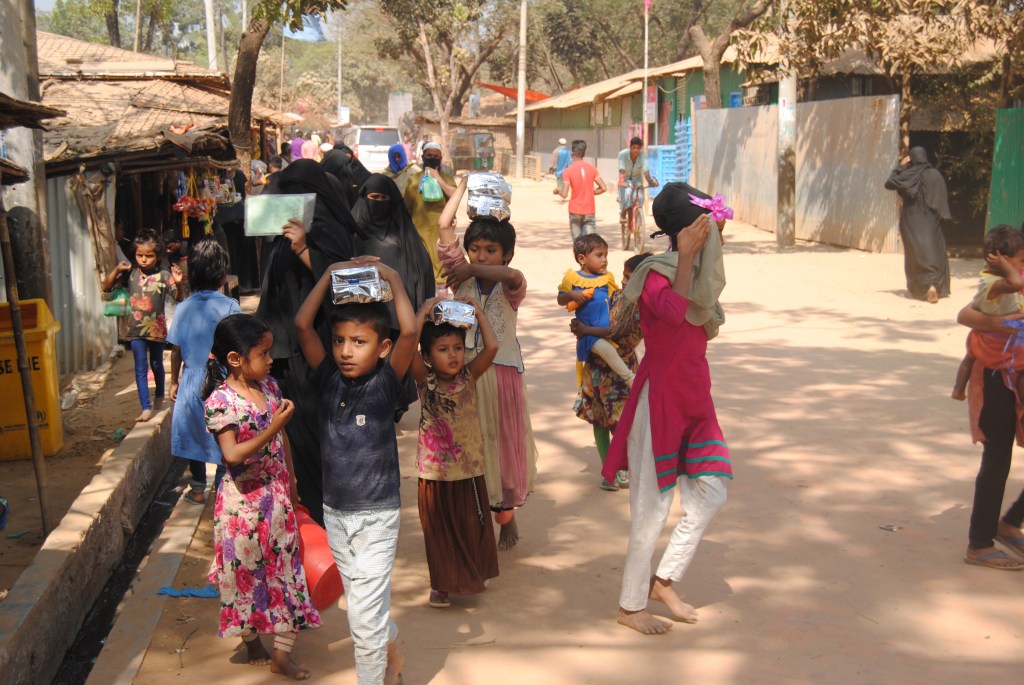
“With Musa, you are now four,” said his mother to Shah Alam as she sat on the veranda and rolled up a plastic mat. A truck was due to arrive shortly and they would be transferred to a nearby refugee camp. Musa felt suffocated. The air was moist and heavy like a full mashk[6]. Dazed people walked around, vacant looks in their sleepless, tired eyes. No face reflected any sign of joy at the prospect of a new life. Did Musa’s face show any sign of delight? He did not want to live the life of an insect in a camp.

When the convoy of trucks arrived in the marketplace, Musa ran the other way as fast as he could. Government forces of this land chased him back. Shah Alam was standing in the truck and sucking his thumb. His mother had let out a cry as if a child of her own womb was running away. Standing in the open truck like cattle, Musa growled in anger. He was more upset with Shah Alam’s mother than with the authorities here. Musa did not want an adoptive mother or brother – he wanted a staff, one that would magically turn into a snake.

“You must not take the words of the Book literally, Musa!” Bismillahjaan came into Musa’s dreams that night. “It is foolishness to do so. Forget about me. Your entire life awaits you. Go forward on your own.”

“Where will I go, Dadi?” Sad and angry, Musa asked in a teary voice. “I want to go back – to that graveyard where you are headed to take shelter in a foxhole.”

Musa shut up when he heard someone groan in their sleep. He began to sweat profusely as he lay under the tarpaulin. His stomach had encountered some rice after many days, refugee rice – and he had not been able to digest it properly. Yet, the day before, a lot had been accomplished. The authorities had done a family headcount and provided ration cards. They had collected and brought their rations of rice, lentils, sugar, and oil to their tarp-covered shelter. Shah Alam’s mother had instantly set up house and Musa had become a part of the family. He was now spending his nights under the same tarp.

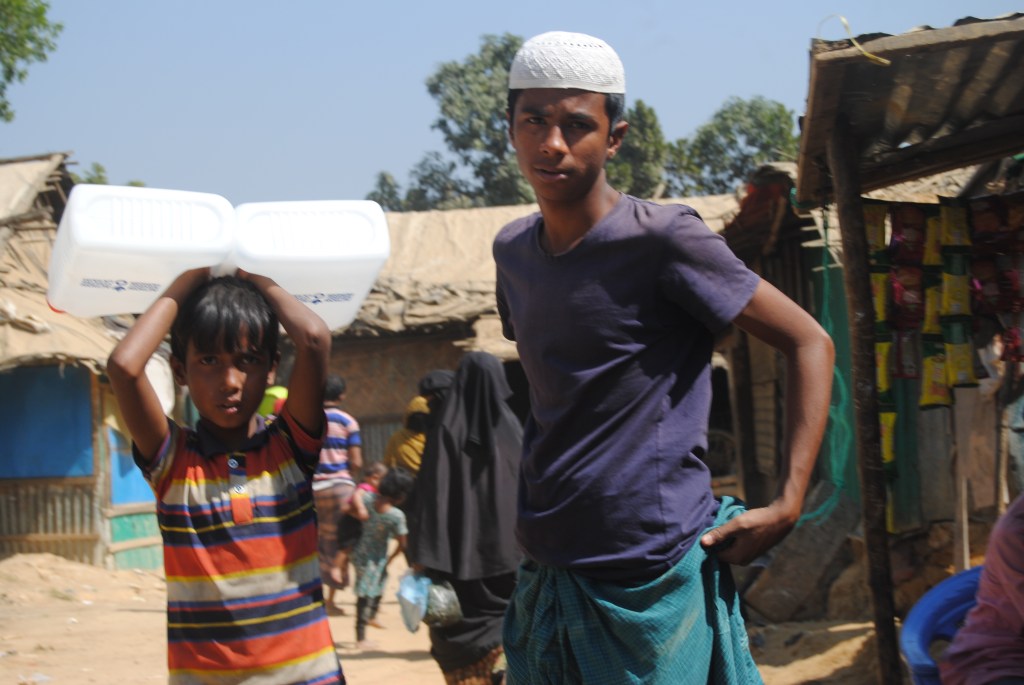
Chores were distributed in the morning. Shah Alam’s mother and siblings would stand in line at the ration shop while Musa and Shah Alam were responsible for collecting firewood from the forest and water from the pump. “Don’t fight like Habil and Qabil,[7] my dears,” Shah Alam’s mother poked her face through a hole in the tarp as they walked toward the jungle. “Be good brothers like Musa and Harun.[8]

Musa’s heart danced with joy when he heard the names Musa-Harun pronounced together. He immediately wanted to address Shah Alam’s mother as Ma, but he suppressed that desire by turning to look at Shah Alam. What a fool! He did not look like he could be good for anything other than gathering firewood. Anyhow, going into the forest did not just mean collecting firewood for the stove – it also meant that he might find the staff he had been searching for. By Allah’s infinite mercy, Shah Alam’s mother had not made him stand in line like a beggar with a bowl, waiting for handouts of food. Moreover, he did not have to remain confined to the camp.

Besides going into the forest, Musa also climbed the mounds around the camp with the others when he heard that the Burmese military had yet again set fire on the other side of the Naf. His people howled, the women wailed and beat their chests. Musa joined them: “Oh Dadi! My heart aches for you!” Sometimes, he cried in tune. “How will I live without Dadi!” When his tears dried up, there was fire in his eyes.

When he received news that a boat had sunk on the Naf, Musa rushed to see. He went close to the dam and sat on the stone slab to stare out into the river. In his hand was a branch of the gojari tree he had found in the forest. He muttered to himself as he struck the water with the branch.

What sort of justice was this? No one would remain – no father or mother, sister or brother, no home or land, no country, no earth. What was his fault? Why did he have to spend his life at a camp – like a cockroach under a tarp? And then there were other troubles. Young girls kept disappearing. As soon as their wounds healed, the young men plotted evil deeds while the police invaded at odd hours of the night. Children cried, old women lamented. Was there no way out of this hell?

“Of course, there is! There is only one route out of this place,” said a trafficker to Musa one day by the riverside. Musa could test his fortune by crossing the river like Sindabad the Sailor. There was a boat nearby and he would not even have to pay for passage.

Musa had no desire to test his fortune. He did not care either about the camp’s development like the light-skinned men who rolled in on expensive cars to find fault. He just wanted to return to his own land. For that he needed a magic staff that would turn into a snake and chase his enemies away. He wanted to see the land overrun with frogs, lice, and locusts that would put fear into the hearts of the Burmese soldiers and drive them out of Rakhine. Or blood would flow in the river instead of water, just like it did when his people were tortured by the commanding forces on his land.

The idea of blood flowing down the river appealed to the militant who waited by the mound everyday for Musa. He had no beard on his face or cap on his head and Musa had no idea where he came from or where he lived. Perhaps he hid beneath the grass like an insect or burrowed into the dark trunk of the enormous banyan tree. But no matter where he lived, the militant ignored the staff in Musa’s hand. As he stood on the mound and looked out onto the fire and smoke on the other side of the Naf, he said to Musa, “If you want blood to flow in the river, you must be trained in arms. It is not possible to do it with a mere gojari branch.”

“Who said this is merely a gojari branch?” Musa questioned. He had no use for an AK-47, grenades, or bombs. He wanted to tell him about the magic staff that would instantly turn into a snake and save his people.

The militant grew quite angry with Musa. He said, “Listen, O Musa, doomsday is near. Bullets and guns are the final answer.”

Musa felt helpless. Couldn’t he show the militant even a little bit of magic now? Like a tiny frog? Musa opened up his palm. Instead of a frog, his palm felt the brush of the breeze.

But neither of the paths suggested by the trafficker or the militant appealed to him. What would he do now? Musa wanted to howl. In anger and frustration, he flung away the branch in his hand. Instantly, it turned into a snake and disappeared into the wilderness around the mound.

(First published in Bengali in Prothom Alo on July 15, 2018)


[1] Kyat is the currency of Myanmar

[2] A sarong-like piece of clothing worn by the people of Myanmar

[3] The Border Guard Bangladesh

[4] Islamic elementary school

[5] Thanaka is made from barks of trees and used like Sandalwood paste to decorate and protect people from sunburns

[6] A traditional water carrying bag made from goat skin

[7] The Quranic equivalent of the Biblical Abel and Cain

[8] The Quranic equivalent of the Biblical Moses and Aaron

Shaheen Akhtar is a notable Bangladeshi short story writer and novelist. She received the Bangla Academy Literary Award (2015) for her contributions to literature and the Asian Literary Award (2020) for her novel The Search.

Arifa Ghani Rahman is Associate Professor and Head of English and Humanities at the University of Liberal Arts Bangladesh, Dhaka. In addition, she is a freelance editor and translator.

.

PLEASE NOTE: ARTICLES CAN ONLY BE REPRODUCED IN OTHER SITES WITH DUE ACKNOWLEDGEMENT TO BORDERLESS JOURNAL
Categories
Stories

   A Riverine Healing         

By P.G.Thomas.             


It all came back to Pappan in spurts; the rasp of his own laboured breathing, the sound of the runners’ bare feet slapping the wet mud pathway, and the choking sensation of fear welling up within him.  The flaming torches had streamed acrid smoke and sparks, and had lit their way through their flight that night.  They threw distorted shadows of the runners along the dense foliage rimming the pathway.  It had been in the late 1940s, and Pappan and his communist comrades had fled the sure retribution for their uprising in Kerala. 

Pappan wished he could suppress the memories of the shrieks of the landlord he had hamstrung that night.  It had all gone terribly wrong, and they had fled the scene as the wails of the women of the landlord’s household reverberated into the night. The wails had stubbornly clung to him throughout his life, and had lost none of their horror. 

 Pappan looked up from his reverie to the visitors who sat outside his home on a wooden bench.  They had come from the local communist party office to invite this old legend of a comrade to participate in the golden jubilee celebrations of the communist uprising.  Pappan’s reluctance had baffled his visitors.

The group leader persisted, “Comrade Pappan, we so need your presence at the golden jubilee celebrations.  You were the foundation on which this movement was built in this area.”

Pappan demurred, “All that was a very long time back.  I have not been involved for some time now.”

“Many will be disappointed by your absence.”

Pappan grunted an understanding of the matter; but said nothing more.  From the wooden stool he sat on, he glanced at his daughter who squatted on the riverside.  With a soot-blackened clay pot next to her, she was gutting and cleaning fish for the next meal.  The unwanted parts of the fish that she tossed into the flowing river were snapped up by schools of river fish.  Cawing crows circled overhead and attempted to pick up the floating offal with their beaks, only to be outdone by the fish eagles gliding in to precisely grapple it up with their talons from the river’s surface.  This frenzied feeding was a daily ritual, and the wheeling birds and their aerobatics never failed to hold Pappan’s attention.  He wished a man’s sins could as easily be discarded as his daughter did the fish offal.  His grandson played around his mother, a cat skulked nearby in the tall grass as his daughter cleaned the fish.  She looked over her shoulders at her father, with eyes that understood his dilemma. 

Over seventy years ago; in the very same hut, his mother had delivered him on a reed mat spread across the mud floor.  His inheritance had been grinding poverty and caste discrimination.  He was flung into a life of wildness and petty theft that finally drove him from home at the age of twelve.  Thereafter, he had begged, pilfered and done menial work with a bunch of similar youngsters on the streets of the nearby town.  The communist movement had found in these urchins the ideal storm troopers.  When he turned twenty, Pappan had returned to his native hamlet; his earlier rebelliousness and acrimony now nicely shaped and directed to achieving the goals of the communist party.  Pappan had come home to transform his own little world!

He had visited his parent’s hut on returning.  His father’s unease with his grown son was evident.  His mother smothered her mouth with her work gnarled hands, and her tears flowed freely down her wrinkled cheeks.  Pappan murmured, ‘Amma,’ and then squeezed into her hands some grubby notes and coins.  Nothing more was said, and Pappan after a long look at the Meenachil river flowing near the hut, had walked away.

And then subtly things began to change in the sleepy hamlet.  Polite but incessant demands for higher wages came to the ears of the landlords.  The customary deference to their betters suddenly seemed to be given with reluctance. And then it had all come boiling out at the time of the rice harvest, carefully crafted by the communist party to stun the landlords. 

A dry wind had been blowing and it had turned the rice fields a golden brown. The paddy had bent over, heavy with ripe rice ears, and there was expectancy in the air.  It was the morning of the harvest.  Mathai, the landlord, had walked the short distance to his fields along with his supervisors.  They were greeted by the sight of their workers lolling on the grassy banks of the field.  None rose in respect, nor showed any inclination to begin harvest work.  A supervisor whispered into the ear of the landlord, “There seems to be a problem!”

The demands for increased wages and a larger share of the harvested rice were made by the workers.  Mathai wasn’t sure what upset him more; the unreasonableness of the demands or the sheer effrontery of the stipulations being made at the nick of harvest time.  But he bit down on his irritation and merely said, “There are time-honoured ways of dealing with such matters.  This approach is unacceptable.”  He was met by a deadening silence from the workers.  He turned back towards his home, and the workers quietly disbursed.  No harvesting was done that day.

Two days later, Pappan was disturbed at his morning ablutions on the banks of the river with the hushed words; “Mathai has brought in outsiders and begun harvesting his rice.” Pappan and his comrades had walked into Mathai’s rice fields and its welcoming committee.  They were outnumbered and they retreated.  That night someone broke the dykes along Mathai’s fields; and the river poured in to submerge the yet to be harvested portion of the paddy.  The class war was out in the open.  Threats and posturing soon degenerated into brawls.  The communist cadres disrupted work where they could, and strike breakers began resisting and meting out punishment clandestinely.   The countryside waited with bated breath, disoriented by this strange movement that had upended long established customs.

An expedition to Mathai’s to scare and demoralise him had gone horribly wrong.  The converging of flaming torches in the night had roused the landlord’s household.  But to Pappan’s discomfiture, he met not a cowed downed Mathai, but one brimming with righteous indignation and contempt for Pappan.  Something snapped inside Pappan; and in moment he had swung his curved razor sharp sickle to hamstring the landlord.  Screams rend the air and blood squirted.  The other comrades froze, stunned by Pappan’s impulsive action.  Someone grabbed Pappan’s bloody hands, “Enough, enough! Let’s go.” And they left Mathai writhing on the ground and his household wailing into the night.

They ran, they hid and they scrambled from safe haven to safe haven until they reached the forest.  Weeks went by.  The local magistrate had issued a warrant for Pappan’s arrest.  Helped by informers, they were arrested quietly by the police as they slept in their forest dwelling.  Pappan disappeared into the labyrinth of the Central Prison; a place staffed with policemen drawn invariably from the upper castes and landowning classes.  They needed little instruction on how to deal with communist prisoners. 

Years went by, and the communists won the elections and came to power in Kerala; and with that a policy change in dealing with political prisoners would see them released from prison.  Following this, a bedraggled, sick and broken Pappan had walked into his hamlet.  He quietly made his way to his now dead parents’ dilapidated hut by the river.  He was soon joined by a woman and a girl child.  No one knew where the two had met.  They repaired the hut and Pappan began the long journey to mend his body and mind, both broken by methods of torture carefully nurtured and finessed over generations by the police fraternity. 

His wife took jobs where she could find them.  The seasons changed. The rains came and the flooded river spread its rich loam over their small patch of land.  The bananas and vegetables planted by his wife sprouted and began to grow, and Pappan began to mend too.

His wife’s people once visited and the idea to buy a boat was broached, and some money given for it.  It would give Pappan a living; for there was always work for a boat and boatman on the Meenachil River.  Somehow the idea trickled out to the other villagers, and their community spirit was tickled.  It began to be mentioned at the tea shops, at the bathing ghats on the riverbank and even under the Peepul tree in the temple compound.

“Did you hear that a canoe is to be built for Pappan?”

“Haha!  And turn a revolutionary into a boatman?”

Someone slapped his thigh and cackled, “Aiyo!! What a fate for an old communist!”

“Come on. Give a man a chance to live.” And so went the prattle in the village.  But the idea of the boat took off.  An old, discarded tin, with a cloth stretched over the top and a slit for coins in it began to do the rounds. The tin started to fill.  Someone in a fit of impertinence carried it to Mathai the landlord’s house; to buy a boat for the man who had hamstrung him years back.  They came back abashed by Mathai’s generosity.  It had been the largest donation yet received.

A slipshod committee that argued much, and agreed on little was formed, and the tin with its rattle and clinking was finally carried to Pappan’s house to his embarrassment and to the delight of his wife.  Opinions were gathered on how to proceed. 

“We need to find a mature Anjillee tree (Wild Jack) to make the canoe from,” quipped someone.  A haphazard and desultory search began.  Such a tree was soon found.  The owner was paid and the tree felled.  An elephant was hired to carry the tree trunk to Pappan’s house.  And this communal project soon became the most exciting happening in the village in years.

A slightly rowdy crowd, along with the elephant carrying the tree trunk wound its way across the countryside.  Someone brought a battered drum and the whole began to take on the look of a procession.  Women and children gathered along the way and giggled at the funny procession, and as it passed the village toddy shop, part of the procession melted away for a drink.  But they were soon replaced by some from within the toddy shop; tipsy and more suited to the occasion.

By late afternoon they reached Pappan’s house.  The mahout shouted and prodded the elephant into dropping the Anjillee tree trunk at an appropriate place to be worked on.  Pappan’s wife with folded hands thanked the jubilant crowd, and gave the elephant a parting gift of ripe bananas. 

The axe thudded, the wood chips flew and loafers congregated at the site to offer unsolicited advice to the canoe builders.  The yellow Anjillee log was hollowed out, and it began to take on the shape of a sleek canoe, and hope began to course through the veins of Pappan and his family.  The summer months dried out the canoe wood, and it was finished with layers of stinking fish oil to waterproof it.

And on an auspicious day, when the river flowed low, a crowd gathered to witness the launch of the canoe.  A collective holding of breaths accompanied the canoe, as it slid through the mud into the river.  Built with no modern measuring instruments, but only on the principles of Thatchu Sastra, the traditional craft of carpentry, the canoe wobbled into the water and then paused; to float perfectly, with no tilt whatsoever.  A cheer went up, and even Pappan’s normally stony lips quivered into a smile.  Someone slung a marigold garland on the bow of the canoe, and Pappan’s transformation from a revolutionary to a Meenachil river boatman was sanctified. 

Pappan often left with the rising sun glinting off the river surface.  He paddled swiftly to pick up his boat load.  It varied from pilgrims during temple festivals, to bags of rice, hay or mounds of freshly harvested coconut at other times.  He rarely argued about the fare; but his quiet demeanour somehow ensured a fair settlement of his dues.

He grew familiar with the changing seasons and moods of the river.  His boatman’s skills were often tested by a rapidly flowing flooded Meenachil river, where the swirling waters inundated its mud banks or its silt built up banks anew.  The colour of the foliage along the banks changed from lush green during the monsoons, to duller shades of green and yellow during the simmering summer months.  He watched the migrating birds visit and disappear; to come calling again as nature’s invisible wand directed them.  He too grew sinewy and grizzled, but a sense of purpose and belonging imbued his life.

Work done, he would paddle home in the late hours, through the buzz of night insects and the occasional splash of a fish breaking the river surface.  His riverine path was lit by moonlight or starlight, until he reached his bit of the river front. The last bit would be guided in by a lit lantern unfailingly left at the landing by his wife or at other times, by the soft singing of evening prayers by his wife and child in their hut.  

Pappan remembered, but his visitors stirred impatiently at Pappan’s inscrutable silence.  His grandchild sensing the tension in the air sidled up to Pappan and climbed into his lap.  The oldest of the visitors rose and walked deliberately to Pappan’s daughter by the river.  He earnestly appealed to her to persuade her father to come to the 50th celebration of the communist uprising.  She remained silent for a moment, and then turning to him said: “Has he not done enough for the movement?  Please let him be.  He’s old and carries a heavy burden.”

The visitor reasoned, “Yes, things were done during the uprising.  But it was for a cause, and comrade Pappan need not feel so burdened about those things.”

She sighed and said, “Would that not be for the man carrying the burden to decide?”

The crestfallen communist visitors slowly trooped out.  They paused at the gate and looked back at Pappan.  He had not stirred.  He sat there quietly with his grandchild in his lap, gazing into the dusk that slowly enveloped the river.

Courtesy: Creative Commons

P.G.Thomas, hailing from Kerala, India; has been intrigued by the changing phases of his land, its people and their way of life.  He draws on a lifetime of actual experience to write about it.   

PLEASE NOTE: ARTICLES CAN ONLY BE REPRODUCED IN OTHER SITES WITH DUE ACKNOWLEDGEMENT TO BORDERLESS JOURNAL
Categories
Poetry

‘I hear your heart, forget to breathe, and glow’

Poetry by Michael R Burch

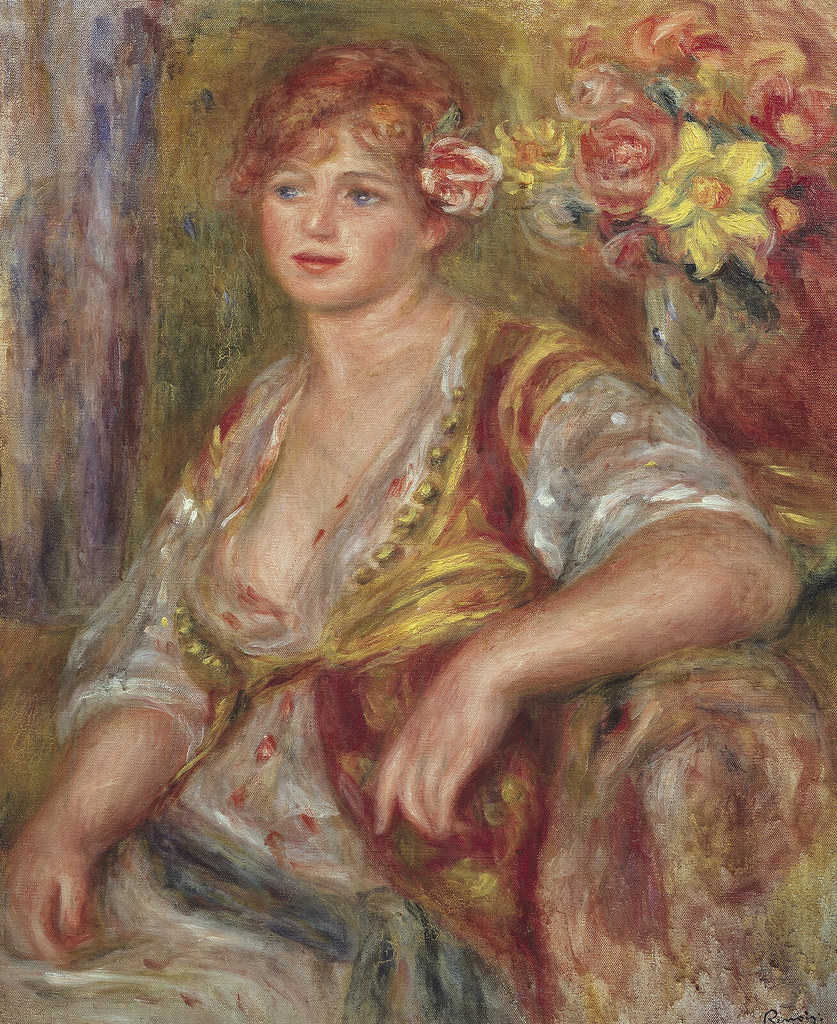
Painting by Pierre-Auguste Renoir( 1841-1919)
Courtesy: Creative Commons
THE HEDGEROW ROSE

I lead you here to pluck this florid rose
still tethered to its post, a dreary mass	
propped up to stiff attention, winsome-thorned
(what hand was ever daunted less to touch
such flame, in blatant disregard of all
but atavistic beauty)? Does this rose
not symbolise our love? But as I place
its emblem to your breast, how can this poem,
long centuries deflowered, not debase
all art, if merely genuine, but not
“original”? Love, how can reused words
though frailer than all petals, bent by air
to lovelier contortions, still persist,
defying even gravity? For here
beat Monarch’s wings: they rise on emptiness!


MINGLED AIR

for Beth

Ephemeral as breath, still words consume
the substance of our hearts; the very air
that fuels us is subsumed; sometimes the hair
that veils your eyes is lifted and the room

seems hackles-raised: a spring all tension wound
upon a word. At night I feel the care
evaporate—a vapour everywhere
more enervate than sighs: a mournful sound

grown blissful. In the silences between
I hear your heart, forget to breathe, and glow
somehow. And though the words subside, we know
the hearth light and the comfort embers gleam

upon our dreaming consciousness. We share
so much so common: sighs, breath, mingled air.


ROUNDS
 
Solitude surrounds me
though nearby laughter sounds;
around me mingle men who think
to drink their demons down,
in rounds.
 
Now agony still hounds me
though elsewhere mirth abounds;
hidebound I stand and try to think,
not sink still further down,
spellbound.
 
Their ecstasy astounds me,
though drunkenness compounds
resounding laughter into joy;
alloy such glee with beer and see
bliss found.

Michael R. Burch’s poems have been published by hundreds of literary journals, taught in high schools and colleges, translated into fourteen languages, incorporated into three plays and two operas, and set to music by seventeen composers.

.

PLEASE NOTE: ARTICLES CAN ONLY BE REPRODUCED IN OTHER SITES WITH DUE ACKNOWLEDGEMENT TO BORDERLESS JOURNAL
Categories
Stories

         Oliver’s Soul

Paul Mirabile weaves a yarn of murder and madness in Madrid of the 1970s         


Madrid: Courtesy: Creative Commons

I am jotting this down while it is still fresh in my mind, hoping that the police will not jump to hasty conclusions and accuse me falsely of the killing. The murderess, after relating the incident to me, left that very evening ; that is to say, the evening I found her at home standing over the corpse of my dear friend Oliver. Since her departure, the entire affair has shaken me up, given the terrible fact that I am the only person available, and I shall add, sound of mind, to offer an explanation. Here let me give you an account of what actually took place before anything injudicious happens to me.

She was a religious fanatic, the murderess, that I am certain, and although I had these impressions of her, I could never pin-point the source of material she utilised in her indefatigable tirades apropos the necessity of man to humiliate himself before God, who, as she insisted, created man in order that he may serve Him, and suffer the cross as He did. Apparently she was well read in mediaeval Christian dogma, and especially in the works of Fray Luis de Granada, Saint Thomas of Aquinas and Abelard. She had been a student of theology and philosophy, albeit a poor one, but did have an entertaining command of the subtle teachings and techniques of Meister Eckhart and Jacob Boehme.

Our conversations were weighty, yet erratic. The evening of the murder, for example, she picked up a book and tossed it out of the window. We had been talking about the physical attributes of the soul, and it seemed I had upset her over something. I asked her why she loved Oliver instead of me, and without a word she promptly threw out three more, one of which one was the Bible ! I heard them sailing through the still, night air and land on the small plaza below with a soft thump. Her eyes wandered off to stare at the empty space just below the low-ceiling of her flat. A crooked smile stretched on her bloodless lips. A fly had sailed in on the waves of the interminable Madrilenian heat from the open window, buzzing annoyingly about the wrought iron chandelier. She seemed to enjoy that buzzing.

When she had snapped out of her mesmerised state, she placed her hands upon my head and drew me towards her. She kissed me full on the lips. It was the first time we had kissed in many months. In the same distracted vein, she whispered that a sickness had befriended her, and a revelation had swollen her eyes with vivid scenes of lurid pleasure. At first she laughed, or rather giggled. A short time later, she said Oliver was coming to kill her, and that we must protect ourselves from him. I sat up staring at her in disbelief. She remained calm, disclosing her love for him, but added, that alas pure love could not be a defence against external, mundane effects. Love, she felt, could be overcome and defeated when the hour arrived for his meditated act. She continued saying that his soul could not forfeit this unleashed wave of energy, for he lacked in guided spiritual strength. I listened to her, not believing that Oliver was what she said he was. She continued to whisper in fey tones, her cold, blanched lips sometimes touching mine, whilst the wretched heat and that irritating buzzing were driving me insane.

The evening passed without any other incident, although her tone and breathing touched strange chords in my heart. She was obviously ill, but I refrained from asking her if she needed anything, or if I could be of any help. No, I take that back, I am lying to you : the thought never occurred to ask her ! Instead, my thoughts reached out in search of Oliver’s face. She made some more tea, we chatted a while then I left without a kiss.

The following morning, the air was less oppressive when I visited her; perhaps I had regrets about leaving so abruptly. She wasn’t in, but on the broken tiles, slipped halfway under the door was a note. It was Oliver’s handwriting, who apparently in great haste, had scrawled something about coming over that evening at around seven. Slipping the note back in its place, I elected that it would be better if I divulged to Oliver the scope of his lover’s uncanny behaviour and affected revelations. Rescinding the idea however, I walked the streets until nightfall.

The torrid dampness of late autumn in Madrid painted a dismal picture at that empty hour. The baroqueness of the city took on a ponderous, eerie, melancholic aura. I felt plunged in some Edgar Poe intrigue, sensed the triviality of my gestures and acts. My nerves were on edge: could hours be so onerous ? I continued my dreary pacing without pangs of hunger or weariness of stride. Suddenly, I found myself at the small plaza just below my sick friend’s flat, and where, from her window, she had a full view of the statue at the centre of the square, a commemorative homage to a fallen hero whose name I no longer recall. He held a huge white cross in his clenched fists, his eyes gaping feverishly ahead of him. Checking my watch, I read two. Looking up at her window, I saw the lights flash. Her head popped out, and I asked myself if she had, for some enigmatic reason, sensed my presence. What an absurd thought! I, nevertheless, slipped behind the statue, and kept perfectly still.

Thank heavens the hour was late and no one was in the street. Otherwise, some sober or insomniac portero[1] would have certainly run to the police. I must have cut a ridiculous figure, skulking behind that wild-eyed, cross-bearing zealot. I chanced another glance at her window. She had vanished. Recalling our conversation last evening, and Oliver’s note in the morning, I debated whether it were wise to go straight up or call the police. I decided to go up. In any case, the police would have thought me drunk, and perhaps would even have thrown me in jail.

I darted across the plaza into the shadows of the adjacent building. I can assure you that I felt like a thief sneaking through those bleak, heated hours of the night. A hussy with brazen bangles clinking in sad obscurity happened to discover me in the shadows of the doorway. Throwing up her arms, she let out a shriek and ran off across the plaza, her high-heels rapping, tapping and clacking a monotonous dirge upon the crooked stones. I speedily entered the building of Oliver’s lover. Happily the portero was either asleep or decidedly drunk. The stairway lay quiet.

My imagination was racing. Would she actually kill him ? How could she have ever conjured up such an extravagant idea ? Was she turning her destructive forces against Oliver because he had so oftentimes agreed to our platonic triad as the very proof of her incapacity to love just one man … or love any man ? Or was it her untamed inner drive set against society’s cruel hypocrisy of condemning a human being’s marginal existence as it played out in the complexity of an ever-shifting triangle ? It is true, however, that within the spheres of every man’s mind, dark moments instigate arrogance and envy to chase out reason and replace it with the urge to turn to crime and passion. I made haste, almost tripping on the last carpeted step.

I was startled to find her door ajar. I hesitated before I entered, apprehending what the consequences could be if my intrusion proved untimely … In one way or another. Oliver mustn’t know I suspected foul play. As for his lover, at this point I could not care a fig. It was merely a friendly visit. At two in the morning?

I strode boldly into the nondescript sitting room, stealing a glance at her. She stood there, gaping at me in bewilderment. Then a silly grin played across those thin, ghastly lips. She pointed to the mahogany table where the bloodstained corpse of Oliver lay, a kitchen knife thrust deep within his breast. I quickly shut the door then raced back to Oliver’s still warm body. She remained standing with that same plastic grin spread over a face of grotesque scorn.

Oliver was stone dead, his heavy body losing blood fast. A huge crimson pool formed under the mahogany table. Not a word passed between us. She scrutinised me, though, with a sort of curious air. Finally I stood, took hold of her shoulders, and signalled with a nod of my head to Oliver’s corpse. She pushed me away roughly, asked me to put aside my air of feigned mystery, then turned to make some coffee. I couldn’t believe the whole scene. Oliver lay murdered in the most despicable fashion and she sails off to the kitchen to make coffee! And that same damned fly kept buzzing about above me, flustering further my already knotted thoughts. I suddenly realised that I had walked into a terrible predicament. For all I knew she could have called the police, pinning the crime on me. Had I touched the knife ? No, thank God …

I glanced down at Oliver, my last thoughts finding their way into his, into our close, confidential past. We had so much in common, so much had been shared, and … and then she entered our manly nobleness, disrupting our toilsomely constructed dialectics. Had we not planned a long voyage to the East to spend a few years studying Eastern philosophy? The murderess returned with the utmost aplomb and placed the silver tray on the mahogany table round which the odour of thick, oozing blood wavered in wisps of despair.

I observed her carefully. She didn’t seem to be waiting for the police. Yet, she held her cup of coffee so delicately, as if that were the very cup with which she would scoop up Oliver’s blood and drink with it! I shuddered at this ridiculous image, again glancing at the Oliver’s frozen-white face. It was a mask of incomprehension … of unabashed innocence ! She asked me to sit, and soon began her morbid tale :

Oliver came as expected, carrying with him his usual pile of books. I interrupted to ask her which ones but she gritted her teeth and told me to keep my mouth shut. She didn’t like his books, they were foul, blasphemous and degrading to a pleading soul. But she loved him dearly, and that was enough for her to disregard these heinous felonies. This was the very reason for his death, she panted, her breath odious, nostrils wide. She loved him so much, but his books were soiling his pure, inborn thoughts. Those books were the external elements hacking away at his candid soul, squeezing him dry of his instinctive, natural energies derived from the inner depths, a gift from the Almighty. His poor, poor soul was incapable of overcoming these assailing evil elements from without. Oliver was a coward ! He dared not face extremities in fear of direct confrontation. She understood his dilemma, pitied him, sought to salvage him. He came to her explicitly for redemption. Oliver’s soul had to be soothed, then redeemed. She read it on his face, not in his vile books. His eyes had gone wild, the world blotting out his innate goodness. Weakening from these destructive powers, she tried to save him with her tenderness and love. This he took as mockery, throwing her savagely to the floor. She fully understood now that he had been ensnared by his own constructed cage of bookish death-traps.

She asked him if he wanted to die. The cage of death imprisoned him. He couldn’t break the iron bars, preferring to grapple with his gnomic books, boding his own plunge into the pits of slime and filth. He went berserk — tearing out her books from their shelves, stamping on them like some lunatic. And while he did so, she went ever so quietly into the kitchen to retrieve the salutary knife. He stopped, and eyed her funnily; what was the need of a knife? In that instant she went up to him, holding the life-saving helve firmly in hand. Oliver put out both hands but the blade was already deep inside his chest. She sighed as his big body slumped peacefully at her feet. He had been finally liberated from ignominy. Nothing again would ever harm him …

I listened in awe, and during those minutes (hours?) of madness a cold sensation slithered up my spine: she could kill me, too! The deadly killer was not strong, but her terrible tale left me hollow, defenceless. Her eyes searched mine, studying me, reading me. Are not the eyes the windows of the soul ? She walked towards the corpse, then burst into peels of harrowing laughter. I jumped up. She wrenched the knife out of Oliver’s chest and brandished it high overhead.

Dashing to the door, I heard footsteps and great gasps of breath right behind me. They resounded eerily as they followed mine down the stairway, my gait diminishing at each footfall downward. Into the street I charged, and hied to the statue. Only once had I gained the statue, I chanced a glance behind me. There was no one …

At home I resolved to run to the police, though, I couldn’t summon the nerve to make the move, much less the strength to descend back into the streets. I was frightened of the ill-lit, lonely lanes of cobblestone. And that insufferable heat and mugginess … Perhaps she was looking for me. She did have my address, I was sure of that. Unable to sleep, I sat at the window, scanning the narrow lanes below. The night was calm, not a soul passed, not a sound to disturb the hollow darkness. A light drizzle began to fall, the tiny drops flickering like silvery tinsel under the sallow, mournful street lamps.

The next morning, after a sleepless night, mooning confusedly in my flat, and before going to the police, I resolved to make a bee-line to her place to see if anything might have happened to her after my flight. With the new day, albeit a sunless one, all my feelings of insecurity had left me, and I felt strong enough to climb those wooden stairs and knock at her door. She didn’t answered … I turned the knob. Her door had been left unlocked.

Stealthily I inched my way into the sitting room, she apparently had gone out. But that infernal fly still hovered round the chandelier as if it had been sent by some Higher Spirit to hound me, to testify and vouch to the gruesome events of the evening before. And the loathing stench of blood ? And Oliver’s corpse ? Then I espied a note on the mahogany table, set beside the silver tray and empty coffee cups. In her customary scribble, the murderess had written that she would take the night train to an unspecified destination.

I looked around in a panic. Where had she hidden the body? I shuddered at the idea that my fingerprints were smudged on almost every item of that flat. She had completely gone mad, and I … yes I … what could I do ? Her friends (for I’m sure she must have had some lady friends) would definitely visit her, and when they found her gone, would believe something was amiss and go to the police station. Mine and Oliver’s names would be noted in all her address and notebooks, and there is no doubt that she had often spoken of us to those lady friends of hers. I could very well be suspected, even accused. Oliver and I were so close, so intimate. One need not be a Sherlock Holmes to put two and two together. And what did I care if she loved Oliver more than me ? Could the police possibly think that I would have murdered him for such a silly motive ? If so, then why hadn’t I murdered her ?

I dragged my feet out of the building and back to my dismal dwellings, where I am presently finishing this deposition for the police. I expect them very shortly now, I think it has been three days since the murder. At the same time, I feel as if I’m writing out a confession, or a death warrant for her, who, perhaps with very good reason, has put much distance between the scene of the crime and myself. As to Oliver, well, his soul now must lie somewhere far beyond the uncertainty of love, hatred and zealous misfortune … Did it not comprehend that our earthly existence was but a fleeting souvenir of timeless Eternity ?


[1] porter

Paul Mirabile is a retired professor of philology now living in France. He has published mostly academic works centred on philology, history, pedagogy and religion. He has also published stories of his travels throughout Asia, where he spent thirty years.

.

PLEASE NOTE: ARTICLES CAN ONLY BE REPRODUCED IN OTHER SITES WITH DUE ACKNOWLEDGEMENT TO BORDERLESS JOURNAL

Categories
Poetry

Poetry by David Francis

Courtesy: Creative Commons
THE CROP-DUSTER, ALABAMA


It’s evening; the windows are tinted:
I’ve seldom seen such landscape from a bus,
enchanting shades of green, without a gloss;
so leafy, “leafy” is what I’ve printed
in my letter—that was the adjective
with which I conveyed this peculiar state’s
fullness, a cornucopia of traits
flowing through this leafiness like a sieve.

Two radios play, one of them is heard;
not bothering with headphones in front
of me, a man as if to anoint
has his head down, like a sea-alighting bird.

In back, the reflections merged in the glass,
both of us watching the crop-duster pass.


EXPEDITION


Walking in fisherman’s boots
all the way to the fence,
deer hindquarters flash and thrash
through the thorns, and gluey spider webs
break against my innocent face;
crows maul the sky with their cries
and then, silent as pine needles snapping underfoot,
the give-way of a rotten trunk next to
those towers of those who live in the mud
and my own subsidence, rubbery, sodden;
scraping off on a root, nailed boards
reveal a blue canopied treehouse—
not the first in my sunny youth;
at the fence I rest in the sundown,
enervated in the cacophony of gloom
and transfixed by the motes floating
in the high-vaulted clearing.

David Francis has produced seven music albums, Always/Far: a chapbook of lyrics and drawings, and Poems from Argentina (Kelsay Books).  He has written and directed the films, Village Folksinger
(2013) and Memory Journey (2018).  He lives in New York City. 

.

PLEASE NOTE: ARTICLES CAN ONLY BE REPRODUCED IN OTHER SITES WITH DUE ACKNOWLEDGEMENT TO BORDERLESS JOURNAL

Categories
Review

An Aesthetic Rebellion set in Mumbai

Book Review by Gracy Samjetsabam

Title: Half-Blood

Author: Pronoti Datta

Publisher: Speaking Tiger Books

Half-blood by Pronoti Datta is a gripping noir-fiction that speaks about the harsh realities of urban settings, morally negotiated characters, dysfunctional families, and atypical individuals with dark secrets and surprises. Pronoti Datta was a journalist for about a decade and a half, covering culture and society in Bombay, the city from which she draws inspiration. She resides in Bombay and works as an editor of digital content. Half-blood is her debut novel.

The novel starts with a letter from Burjor to Moonie (Maya), the two main characters of the novel. In the letter, Burjor clandestinely explains his reason for disappearance by writing, “You see, Moonie, I did a terrible thing for which I had to leave Bombay. I don’t want to burden you, in this letter, with the details of my deed – or my life. It’s a long story and I’m not a man of words.” The prologue with this letter sets the tone for the story. The book has thirty-two   chapters with an ‘Epilogue’ that gives the new order of things and “a sense of having created meaning” to life, or rather to newer ways of looking at life.  

The story gives a glimpse into the lives of the dwindling Parsi population of Mumbai. The narrative spanning generations, time and space is a perfect read for those who love city stories, or love to know more about multicultural India. Most importantly, it is a fascinating story for those who love crime and suspense with a touch of history and culture. Datta brings to fore snippets specific to the lives of people and places in the then Bombay and now Mumbai. The author successfully addresses the failures, shortcomings, and the uglier side of life with wit and humour.

Maya, a journalist, who is young, talented, confident, ambitious, and disillusioned with life suffers from an existential crisis. She resurrects the past in search of her roots and meaning in life. Through the limited clues left in the “letter” from her biological father, she traces her bloodline. She embarks on a journey, stumbling upon unexpected facts and fiction on the life of Mumbaikars and Parsis some of who are poor and sometimes half-blooded or of mixed ethnicity. This is a story of rags-to-riches, underrated heroes and people in the sidelines. Burjor Elavia, a half-blood, a “fifty-fifty” is an “Adhkachru” — an illegitimate child of a Parsi man and a tribal woman. He accepts poverty and bondage to resist being pushed aside as a non-existent bastard.

Through the story of Burjor and Maya in Mumbai from the seventies, at the time of the prohibition till the 26/11 attack in 2008 in recent times, Datta weaves the  less explored facets of history of the city into her fiction. The characters in the novel range from different religions, language backgrounds, and communities residing and crisscrossing paths to give voice to the culturally diverse mega-city.

Maya, born to Mini and Burjor, is adopted by an unusually matched Bengali parent. Brought up in Mumbai, she grew up in a locality with a good mix of residents from different communities and religions. Moved by stories of those who “persisted in their beliefs, fielding scorns and disapprobation, and emerged victorious,” she goes on to study Philosophy in Delhi and mingles with friends from across the country. Datta presents a realistic picture of a young girl of mixed descent from Mumbai, pursuing her path of self-discovery by connecting the past with the present. In this quest, she unravels smaller plots that add to the larger picture. As she unravels her own past, Maya describes her situation as similar to that of the Prince of Denmark — Hamlet. She says, “I am Hamlet looking into my father’s ghost.” Datta grinds a story that carries a peek into the time and gives a space to those at the margins and the unconventional like the infamous “Aunty Bars,” savage liquor barons, Adivasi women, scandalous navjotes[1], and children growing up in multicultural society

The novel is an aesthetic rebellion as it delves into the Parsi way of life including that of poor Parsis, good-hearted rogues, crime and punishment in defiance of pigeon-holes and labels about a community or group. Half-blood as the title suggests, reveals wider horizons and deeper nuances of identity. A fiction about modern India, this book takes us on a tour of less revealed nooks of history and culture to unearth beauty in diversity. Elegantly presented with a cover design by Maithili Doshi Aphale, which speaks for itself, the Speaking Tiger book, Half-blood breaks through stereotypes and clichés to win your heart.


[1] A religious initiation to Zoroastrianism, the religion followed by Parsis

.

Gracy Samjetsabam teaches English Literature and Communication Skills at Manipal Institute of Technology, MAHE, Manipal. She is also a freelance writer and copy editor. Her interest is in Indian English Writings, Comparative Literature, Gender Studies, Culture Studies, and World Literature. 

.

PLEASE NOTE: ARTICLES CAN ONLY BE REPRODUCED IN OTHER SITES WITH DUE ACKNOWLEDGEMENT TO BORDERLESS JOURNAL