There is a metronome in the next room,
knocking against felled coconuts;
The body has parts like a salvage yard
has parts, like the miniseries hacked up
into televised segments that beg you to
watch the exhibitionist whirl his dervish;
hairy and monstrous, father just home
from the bars…
Let the Dangermouse know;
it is wise to be informed –
strafing metal birds and a cradle robber
recruiter to work the malls; expired
coupons never come to collect,
this sourest of science.
Dentistry calls the canines, Marathon
comes a running, the rolling ecstasies,
the raffish unfallowed.
Destiny, the unopened suitcase.
Diving metal birds, the body in parts –
weeping linen closet, little Dangermouse
knows it’s coming:
cover your eyes mouth toes:
a great biting frost returns to these
wailing unmeasured lands.
Ryan Quinn Flanagan is a Canadian-born author residing in Elliot Lake, Ontario, Canada with his wife and many bears that rifle through his garbage. His work can be found both in print and online in such places as: Evergreen Review, The New York Quarterly, Borderless Journal, GloMag, Red Fez, and Lothlorien Poetry Journal.
.
PLEASE NOTE: ARTICLES CAN ONLY BE REPRODUCED IN OTHER SITES WITH DUE ACKNOWLEDGEMENT TO BORDERLESS JOURNAL
                        even in Kyoto

                     I long for Kyoto—

                          cuckoo!

               --Matsuo Basho (1644-94)*
My story begins at Kyoto Station, where I alight after a three-hour bus ride. I am on my way to meet my friend Yoko for dinner in the Kitayama area, and a drink at the Kyoto Hotel Roku. She and I once worked together at the same university in Naruto, but now she is an associate professor at a small women’s college in Kyoto. I head underground, through the Porta shopping center, and get on a subway bound for Kokusaikan. In spite of the crowds up above, the train allows for elbow room, and I easily find a seat. Most of the passengers are glued to their phones, some are masked. My eyes flit to an advertisement for a display of kimono. After several stops, I get off at Kitayama and find Yoko waiting at the wicket. We have a spaghetti dinner at a nearby restaurant, and then hail a taxi via Didi, Japan’s answer to Uber.
The taxi takes us through an upscale residential area featuring traditional homes. Yoko tells me that we are near Bukkyo University, originally an institution of research for monks, but now a university grounded in Pure Land Buddhism offering degrees in a variety of subjects including English, nursing, and social welfare. We are also not too far from my favorite temple, Kinkakuji. One of the first novels that I read upon arriving in Japan was Yukio Mishima’s TheTemple of the Golden Pavilion, translated by Ivan Morris, about a deranged monk-in-training who set fire to the gilded temple and burned it down. Surprisingly, none of the visitors from abroad that I have taken to this temple had ever heard of this 1950 incident or the book.
The driver turns down a long driveway and drops us off at the hotel entrance. “Nice hotel!” he says.
I resist the urge to defend our extravagance, to say we are just here for a drink, and then the next day for lunch. I have been commissioned to write an article about the hotel, but I can’t afford to spend the night.
The Roku Kyoto, which opened in September of 2021 when Japan was off limits to foreign tourists, is one of eight of LXR luxury properties worldwide, and Hilton’s first in Kyoto. (Others include The Biltmore, Mayfair in the United Kingdom, and the Mango House in the Seychelles.) Along with a tranquil, storied setting (in the 16th century, it was a community for artists and artisans), the hotel offers bespoke experiences, such as a session of kintsugi with a local master of the craft, using cracked hotel pottery, and traditional papermaking using water from the Tenjin River, which runs through the hotel grounds. Guests can also opt for a New Year’s Eve package including a two-night stay, and a viewing of the sunrise over Mt. Fuji via private plane at a cost of \4,800,000. Nevertheless, the hotel strives to be a place where local residents can come for escape and enjoyment as well as high-flying tourists.
We are greeted warmly at the entrance and shown to the dimly lit bar. Walking along the basin at the center of the hotel complex, I take in the reflection of the full moon on the water. I feel like we should be writing haiku. The veranda would be the perfect setting for filming a period drama.
Resturant in TemujinEngawa: Non-tatami matted flooring Photos Provided by Suzanne Kamata
The day before, I had tried and failed to make a reservation, and assumed that the restaurant was fully booked. However, after verifying that we could drop in for a drink or a cup of coffee without notice, we decided to go ahead with our plans. As it turns out, we are the only ones in the bar at a little after eight.
A small lamp is placed on our table, and the bartender brings us a menu bound in leather. I had been planning on having the Hana-monogatari (flower story) cocktail made from seasonal herbs and flowers from the hotel garden, but the Pear Moscow Mule sounds irresistible. Yoko selects the Frozen Rum Chai, made with amazake (sweet sake). We also order a plate of chocolates.
Ambient music plays softly in the background as we catch up on gossip about former colleagues and update each other on current research projects. We speak softly in the hushed atmosphere which is broken only by the sound of a cocktail shaker behind the bar.
Our drinks arrive with paper straws. Mine has a slice of Asian pear hooked over the edge. The fruit changes by the season, I am told. I take a sip, taste a hint of lime with the kick of ginger: delicious.
“Mmmmm. This is so good,” Yoko says of her drink. We negotiate over the assorted chocolates, which are filled with raspberry and orange peels, among other things. Yoko lets me have the piece topped with gold.
Later, a couple more small groups enter the bar, but the area is spacious. Our privacy remains intact. We talk a bit more, finish our drinks, and agree about where to meet for lunch the next day.
Late the following morning, I take the same route from a bargain hotel near Kyoto Station, weaving between young women in yukata and a foreigner with brightly dyed, intricately braided hair, and get off at Kitayama. This time, as I emerge from underground, I take note of the electronic cuckoo sound chirping from a speaker, and I recall Basho’s famous poem about longing for Kyoto. Nearly 400 years after it was written, I imagine that the poem evokes the same emotion – a longing for the city in days of yore.
I have visited Kyoto many times since I first arrived in Japan. On the first, when I was just beginning to learn Japanese and still didn’t know quite what was going on, I spent the night at the residence where the previous Empress was trained in housekeeping, a rite of passage even for aristocratic girls. As I mentioned, I was partially motivated to come to Japan because of literature, namely the Heian court poetry that I learned about from a class in Asian history. I was enthralled with the idea of courtiers communicating via verse, and as a newly heartbroken nineteen-year-old, I identified with the intense longing in poems by Murasaki Shikibu and Ono no Komachi. Later, I read a novel set in Kyoto –Ransom, by Jay McInerney. What I remembered most about it was the funny Japlish phrases and scenes of karaoke, still a novelty in America in 1985. Flipping through it more recently, I came across this description of the Kamogawa (Duck River):
“From its source the river drained fields and paddies heavily fertilized with petrochemicals and manure. Closer in, the Kyoto silk dyers dumped their rinse tanks. The white herons that fished the shallows had purple plumage one day, green the next—weeks in advance of the women who brought the kimono silk in the shops downtown.”
Can this book really be what made me want to come to Japan? And yet, I also recall being attracted by the cuteness and kitsch, the Disney meets sci-fi vibe prevalent in Bubble Era Japan implied in, for example, Ridley Scott’s film Bladerunner. In any case, nostalgia sometimes leaves out the worst, and things seem to have changed for the better. As we cross the Kamogawa in another taxi, this time by daylight, I see no evidence of pollution.
“There are tons of ducks on the river,” Yoko says. “And ibises.”
“It’s famous.” I have come across many references to it in literature.
We arrive at the hotel a bit early for our noon lunch reservation, so we are shown to a large room with sofas and chairs, where we can drink tea or coffee while we wait. We choose to sit next to a window which looks out onto the basins. The blue sky, the changing leaves, and the still water create a calming tableau.
“I feel like my mind and brain are being purified,” Yoko says.
No other guests are around, and I wonder how many of the hotel’s 114 rooms are currently occupied. Perhaps everyone has already left the hotel for sightseeing.
A strip of moss runs parallel to the basin.
“It’s of better quality than the moss at Kokedera,” Yoko says, referring to another famous nearby temple renowned for its moss garden. “And you have to make a reservation a month in advance and pay \3,000 to visit!”
I write down her words, never having reflected upon the quality of moss before.
“You’d better write ‘as good as,’” she amends, suddenly aware of her sacrilege.
Finally, a gray-haired Japanese woman in a kimono emerges from the hotel and traverses the walkway between the two basins. A few minutes later, I see a Western woman with long brown hair pushing a baby in a stroller. And then a little later, a child wearing a fox mask, saunters across the walkway, slashing the air with a toy sword.
“He must have gone to Fushimi Inari Shrine,” Yoko says, referring to the popular tourist attraction known for its Instagram-worthy red torii gates.
Moss. Photo Provided by Suzanne Kamata
Just before twelve, we make our way to the restaurant, where we are shown to a table. The Japanese host/sommelier, suggests that we both sit on the same side, facing the window which provides a view of the fall foliage. He brings us the menu, and wine list.
I have already decided that I am having the wagyu burger. A glass of robust red wine would probably suit it best, but I am intrigued by the locally produced orange wine, which I’m told is comparable to a rose. Yoko asks the sommelier a lot of questions. Her partner works in wine in California, so she has visited many vineyards.
“It’s nice to talk to someone who knows so much about wine,” he says.
One of our two code-switching servers, both, as it turns out, from Nepal, pours a swallow of the orange wine into a glass for Yoko. She tastes it, but decides upon the sparkling plum wine, and the lunch course.
My image of plum wine comes from the syrupy homemade stuff we’d once received from my husband’s relative. “For when you have a cold,” she’d said. But this wine is something else – fruity, but light, and effervescent. Yoko asks where she can buy a bottle of it.
The sommelier explains that the hotel’s wines come from the nearby Tamba Winery, which is open to the public for tastings in the fall. It’s a short drive from where we are now. Their wines sell out quickly just in Kyoto and are mainly used by restaurants.
Yoko’s first course is pesto-dipped scallops submerged in vichyssoise made with white beans. She invites me to taste it. I dip my spoon into the shallow bowl. The bright green of the basil is a surprising delight. There is a bit of a crunch.
“What is that crunchy thing?” I ask our server. “And what kind of flower is that?”
“Just a moment,” he says, and ducks away to find out.
The answer: croutons, and linaria.
I am almost regretting that I didn’t choose the lunch course as well, but then my burger arrives, along with a generous serving of fries, and I am glad that I skipped breakfast. I probably won’t need dinner, either.
I’d imagined that all wagyu was from Kobe, but the host tells us that it’s Kyoto beef.
Yoko’s second course is marinated salmon with spinach, potatoes, onion, and amaranth flowers. The server spoons duck sauce around it.
“Is there a lot of duck cuisine in Kyoto?” I ask Yoko, my mind going to the Kamogawa.
“Yes,” she says, “But I don’t think the ducks are from the river.”
Lastly, we have dessert—a fig cradled in a chocolate shell, topped with a dollop of cassis ice cream. The plate is painted with sauces. It is exquisite to both eyes and tongue.
Before leaving the property, we stroll around the grounds taking in the lawn where morning yoga and meditation are held, the orange tree and lavender beside the thermal pool (the peels of the former are used in footbaths at the spa), the exercise room redolent with cedar and cypress with a vista of Takagamine Mountain.
As we prepare to leave, Yoko suggests that next time, we treat ourselves to a hot stone massage in the spa, followed by afternoon tea on the veranda overlooking the stream. We can come in the winter, when there is snow frosting the mountain, for a different view. Yoko says that she might come by bicycle, and I vow to wear sneakers, so that I can walk from the station. Instead of longing for the past, we look to the future.
*This translation is from Kyoto: A Literary Guide (Camphor Press, 2020), translated, collated, and edited by John Dougill, Paul Carty, Joe Cronin, Itsuyo Higashinaka, Michael Lambe, and David McCullough.
Suzanne Kamatawas born and raised in Grand Haven, Michigan. She now lives in Japan with her husband and two children. Her short stories, essays, articles and book reviews have appeared in over 100 publications. Her work has been nominated for the Pushcart Prize five times, and received a Special Mention in 2006. She is also a two-time winner of the All Nippon Airways/Wingspan Fiction Contest, winner of the Paris Book Festival, and winner of a SCBWI Magazine Merit Award.
PLEASE NOTE: ARTICLES CAN ONLY BE REPRODUCED IN OTHER SITES WITH DUE ACKNOWLEDGEMENT TO BORDERLESS JOURNAL
When you encounter something beautiful,

Even if you are not familiar with beauty,

Be willing to approach it,

Rather than hesitating and distancing yourself.


When something good is in front of you,

Even if it feels unfamiliar,

Show an interest,

Instead of being overly critical and parting ways.


When you encounter something true,

Even if you usually don't care much about it,

In the realm of human existence, truth is necessary.

Knowing that truth ultimately stays with us,

Accept it, instead of discarding it like an old rag.


Unacceptance, leads to inevitable collisions,

And regrets -- both big and small.

You end up being tossed around and remain indecisive at every turn.
Ihlwha Choi is a South Korean poet. He has published multiple poetry collections, such as Until the Time When Our Love will Flourish, The Color of Time, His Song and The Last Rehearsal.
.
PLEASE NOTE: ARTICLES CAN ONLY BE REPRODUCED IN OTHER SITES WITH DUE ACKNOWLEDGEMENT TO BORDERLESS JOURNAL.
Mrs Heather Richards’ aeroplane landed at the Bangkok airport after a gruelling eleven-and-a-half hour flight.
Her initial enthusiasm since leaving Stevenage and England seemed to flag a bit even before the landing. The uninspiring food lay heavy on her stomach, the people sitting by her – mostly Brits — made no attempt at casual conversation. The choice of pictures bored her to sleep. Mrs Richards squirmed in her seat as the faces of Francis and Jonathan floated queerly in her somnolence; the first in grievance, the second in indignation. Had Jonathan found her quickly scribbled note? Would he ever understand her sound resolution, however painful for him? Thick clouds suddenly hid the late afternoon sun. The aeroplane began to descend. How glad she was when they finally landed and could rid her mind of these disturbing, contorted faces.
Bangkok’s early evening heat and humidity made her gasp for breath as she stepped out of the airport into a taxi which wildly drove her to the Lamphu House. The sultry air seeped into her hair, silkily, penetrated the pores of her kneaded, wizened skin like the bites of tiny insects. She rolled down the window but the hot, oily air left her panting. She felt like candle wax melting under the ardour of the flame.
Shown to her pleasant, airy room at the Lamphu House, Mrs Richards dropped onto the bed and stared blankly at the slow turning sails of the ceiling fan, turning and turning lethargically. –No, there was no other choice — a fey voice reminded her. No other choice ! She pricked up her ears. Let Jonathan relish his despondency, you must bear the burden. You must now find what has gone so mysteriously missing.
After a cold shower she felt much relieved. Then at the downstairs café-bar she ordered a fine dish of Pad Krapow Moo[1] which she enjoyed immensely. At the reception desk she enquired about buses to the coastal town of Mawdaung in the province of Prachuap Khira Khan where her son had been teaching. According to her plan, she would begin her investigations there. She refused to believe that Francis had become a monk to hide from the law; refused to think of him as a criminal, although she was perfectly aware of the accounts of the drowned children at his school through newspapers and her hired detective’s report. But she wanted details of these facts. Where that evasive detective had failed she would prevail. Mrs Richards knew her mission would not be a sinecure, but it was her only hope; perhaps her last gesture of maternal love towards her only son, whom she believed to be still alive.
And this gesture of maternal love brooked no concessions … no repining after-thought.
Bright and early the next morning Heather Richards, dressed in a flowery robe of light cotton, agreeable to the skin, sandals and a huge straw hat, made for the bus terminal. The heat had already begun to rise. “Was it possible that Francis relinquished his British upbringing to embrace Buddhism?” she mused as her clear, blue eyes followed the swaggering gait of a bow-legged dwarf crossing the dusty street. His hunched back oscillated wavily through the particles of dust that his erratic movements caused. The sun rose ever higher. She stopped to wipe the perspiration off her wrinkled forehead.
Soon, through a concussion of vehicles, animals, men and women in sarongs, and locals in Western clothes, Mrs Richards caught sight of the bus terminal wavering dreamily amongst the colours of this moving spectacle. It all so amazed her. The scents, too, of juniper and camphor from the temples, jasmines, all amazed her. She experienced moments of unexplicable excitement, of enigmatic fervour; an almost religious experience.
The man at the ticket office spoke excellent English. She bought her ticket without even queuing up, an exploit she considered odd, given the fact that her guide book warned visitors to South-East Asia that queuing up at train or bus stations could last hours ! Be that as it may, armed with her ticket, she regained her hotel, had a quick lunch of tom yum goong[2] at the café-bar and packed her meagre belongings. She would leave on the morning bus.
Indeed, she had chosen to travel light and fast. Heather Richards had not come to Thailand as a tourist but on a mission … a very special mission. On the bus speeding to Mawdaung the morning sun, glowing orange, crept slowly over the crests of the bamboo forests. She brooded over Francis’ misfortunes, his mysterious disappearance. Intuition told her something had gone amiss. Something had not been touched upon during the investigations. All her thoughts converged on that ‘something’
The bus didn’t pull into the Mawdaung terminal until the following afternoon due to several unexpected delays and two flat tyres. Exhausted but determined, Mrs Richards followed the indications on the map and notes she had taken in England until she spotted Francis’ school perched on the brow of the hill overlooking the tragic bay, now, however, having regained its initial configuration, although the scars of that terrible event could still be detected here and there. The security guard escorted her to the office of the headmistress, a certain Anong Saetang, who on the phone two days back sounded not overly enthralled to meet Mrs Richards, judging by the frostiness of her voice.
Her ‘welcoming’ phrase stunned Heather as she strode deferentially towards the woman who throned behind her majestic mahogany bureau: “What did you expect by coming here, Mrs Richards, a letter of recommendation for your son’s exemplary teaching and moral qualities?” Mrs Richards stopped dead in her footfalls, stunted by the violence of such a ‘greeting’; Her face sunk. “The deep wounds of the parents who suffered loses of their loved ones remain open,” rasped the headmistress. “Do not expect any help from them nor from our school. Besides, your son has gone fugitive for over eight years, and I can assure you not one of the parents who lost their loved ones caused his equivocal disappearance.”
These words, spoken with pontifical stiffness, jolted Mrs Richards to the core of her pride. She had not come either as a defender or accuser of her son’s conduct, but only to learn more of Francis’ flight. To call his disappearance equivocal made her blood boil. She clenched her fists …
“He ran off like a coward,” pursued Miss Saetang, happily noting her ‘guest’s’ surging rage. “And perhaps like an arrant renegade he is still hiding behind his monkish mask.” She snarled. “And I will also inform you that because of your son’s irresponsible attitude, the headmaster was sacked!”
Mrs Richards’ glowered at her, eyes ablaze. She thrust out her square jaw in defiance: “Well, I’m sure you had no qualms about that since you’re now seated in his fine cushioned chair!” she riposted with overt disdain. Miss Saetang, shocked at the barely disguised insinuation was about to retort but her ‘guest’ put up an authoritative hand: “I’ve heard enough of your overbearing uncouthness towards my son. Whatever had been the fault which caused such a tragedy, I apologise for him. But do not try to overwhelm me with your supercilious self-importance and contemptuous righteousness.” Miss Saetang remained stoic in her sephia-upholstered chair. “And may I ask what has been done with his belongings?” Mrs Richards added tersely, staring at the headmistress with overt contempt.
The other threw back her haughty head: “They’ve been burnt and his bungalow fumigated with juniper leaves. At present, a pleasant gentleman from Scotland is teaching at our school, and I will add, is doing an excellent job of it.”
Mrs Richards jeered : “I’m sure he is!” She turned her back to the headmistress and walked out of the office without a goodbye, leaving the door wide open …
Infuriated but undaunted by the unsophisticated welcome of that brazen hussy, Mrs Richards took a last glance at the lieu of her son’s mournful destiny, and that too of those poor school children, a shared destiny that only an act of God could have brought about … and perhaps, too, a bit of heedlessness on the part of her son …
Although weary from a sleepless night and from that woman’s disdainful bantering, she directed her footsteps to the bus terminal, bought a ticket for Bangkok, and waited patiently for the night bus, a three hour wait, time during which she struggled with her thoughts. She needed to travel to Laos, but first had to meet the Laotian consul, Mr Inthavong, who had issued the visa to Francis. He would surely provide her information about her son … information and hope! As she ruminated these thoughts, she ploughed through a delightful dish of gaeng daeng or red curry. Indeed, the former barmaid was beginning to enjoy Thai food, spicy though it be. More tasty than that British Airways slop or that over-cooked fodder at the Lawrence’s Duck or Grouse …
Once in Bangkok, she bought a ticket for Wiang Kaen where the Laotian consulate was located. She had to change buses, but thanks to the smooth roads she was there the following afternoon and lost no time in locating the charming two-storey bungalow. She had spoken to Mr Inthavong on the phone from the Lamphu Guest House and he was expecting her, his voice as excited as hers to get to the bottom of Francis’ imbroglio, which he considered scandalous given all the rumours that his name had produced in Laos and abroad.
To tell the truth, bus travel in Thailand had become somewhat of a second nature to Mrs Richards. Those passengers who spoke a smattering of English greeted the ‘old lady’ from England warmly, plied her with coconut milk and gaeng daeng. She was beginning to feel quite at home here ! Some passengers even taught her several words in Thai, especially the names of the savoury dishes she now so relished. The ‘old lady’ from England began to sense her son’s fascination for this country, for Southeast Asia. There was something large and generous about the inhabitants, and the looming mountains mantled in thick forests, something so unbridled. A something that lacked in England, so regulated, so close-fisted. Francis had deciphered this nobleness of spirit, this betokening loftiness. Was this why she too had come ? And Jonathan ? She hadn’t written one letter to him as of yet. Well, he would just have to wait …
Before meeting Mr Inthavong, Mrs Richards indulged in her favourite dish at an outdoor eatery near to the consulate, a sai gok [3]! Delicious. How Mrs Richards loved those sausages …
At nine o’clock sharp she was at the consulate gate. The same puffy-eyed, indifferent security guard who had sized up her son some eight years back now sized up his wizened-face mother. She quickly explained (or rather gestured) her urgent need to see Mr Inthavong. The guardian nodded lethargically, then shuffled off to the front door of the consulate with her passport. Several minutes later Mr Inthavong came flying out to greet his friend’s mother. All agog, he ushered her into his spacious, air-conditioned office.
“How delighted I am! How delighted!” an enthusiastic Mr Inthavong tooted sonorously. Mrs Richards smiled unable to put in a word. For the loquacious consul had read the police reports, had even made enquiries with the secret police in Laos, coming to the conclusion that Mr Richards had not been abducted and was alive, living in Upper Laos in one of the Mekong River temples. Mrs Richards’ eyed glowed with renewed hope. She even stamped her feet in joy.
However, in order to ferret out the whereabouts of her dear son, Mr Inthavong would arrange for her to be accompanied by one of the monks at the Jin Jong Jaong Temple in Pak Beng where Francis had been studying. The proposition brought tears to Mrs Richards’ sleepless eyes. She did not know how to thank the kind consul, given the fact, too, that his non-stop volubility left no intervals to do so.
He picked up the phone and called his wife upstairs, notifying her that they would have a very important guest with them for a few days.
Mrs Richards objected: “But sir, truly … “
“Please … Please, it is our pleasure. We had your son stay with us for three or four days. Our conversations were most illuminating. He even played with our two children like a big brother.” Mrs Richards hardly believed that one could converse with the winsome Mr Inthavong. Nevertheless, the consul’s wife, a middle-aged woman of exceptional beauty, attired in a silken sarong of ochre, over which she had thrown a beautifully embroidered black shawl led her upstairs to the guest room of their lightly furnished flat.
Heather Richards spent a wonderful three day sojourn at the Inthavong’s, listening to Mr Inthavong enlightening her about her son’s prodigious teaching talents and odd, but heroic plunge into Buddhahood. Mrs Richards and Mrs Inthavong, tea-cups held high, sat politely, nodding their heads in approval, oftentimes quite perfunctorily. As to the children, they ran amok, upsetting furniture, fighting over toys or books, much to the stoic displeasure of their mother and to the manifest joy of their father.
To make her stay all the more enjoyable, Mrs Inthavong, a marvellous cook, served her guest with mok pal[4],tam mak hoong[5], and her very favourite dish, sai gok, those mouth-watering sausages served with khao niaw, sticky rice. And the more Mr Inthavong jabbered on, the more Mrs Richards’ images of Jonathan, Stevenage and England faded from her mind. It were as if she had returned home after having spent many years as an immigrant in the West. An odd sensation really that she herself could not quite fathom …
With many tears shed by both parties, Mrs Richards parted from her benefactors and boarded the same Nam Ou boat that had eddied her son to Laos. Whilst the sturdy vessel cleaved the waters of the Mother of all rivers, Heather let her thoughts drift back to Jonathan. How was he spending his time? In idle gloom, drowning himself in self-pity, wandering aimlessly from one room to another … from one pub to another, pissing it up with that fatuous Andy, plunging into the hissing cauldron of lust? She knew that leaving Jonathan alone for so long would be devastating to their marriage, but Francis … Yes Francis … He was alive somewhere in the wilds of Northern Laos, waiting for his mother’s maternal embrace. This she knew. And this Jonathan never understood. Would she ever write him a letter to explain this inexplicable presentiment ? She pursed her lips. As to Francis, he had been right from the very beginning: their home, neighbourhood, England as a whole had been too tiny for his august ambitions and dreams. “I’m sure he takes after me,” she gloated aloud as Ban Houei Sai rose to her extreme excitement.
The same collective taxi that sped the ‘Western monk’ to Pak Beng now sped Mrs Richards. The sun rose high. The heat too. She patted her neck and cheeks, fanning herself with her straw hat.
Stepping daintily out of the packed taxi at Pak Beng, she was warmly welcomed by two monks and quickly escorted to the Satu or Venerable Father. There in a spacious room for visitors, the ceiling fan stirring up the midday heat, he reminisced over her son’s seven-year sojourn at the temple. The wiry Father did not believe that Francis had been killed at the Pak Beng Grand Hotel, nor that he had been kidnapped by a group of Thais. Witnesses confirmed his presence in Upper Laos, albeit the reasons for his leaving the temple and travelling to Northern Laos remained obscure.
“And where would my son be?” implored Mrs Richards, wringing her knotty hands. The Venerable Father eyed her compassionately and in a mild voice intoned :
“Reports from wandering monks say that he may be living in the temples of Hatsa, Chao Dan Tra or U-Thai. I have received several letters from Mr Ithavong and assured him of my staunch collaboration in helping you locate your son. Please, stay with us several days and gather strength, the journey up north will be strenuous. You will be accompanied by Jai, one of your son’s former students at Luang Prabang.”
Mrs Richards clasped her hands in gratitude and stammered humbly that she would be honoured to spend a few days at the temple. “You will be given Francis’ cell, quite comfortable if you are not too accustomed to five-star hotels.” She smiled, waving her hand. The Satu stood, a sign that their audience had come to an end. She immediately rose out of her cane chair, bowed and was escorted to the ‘Western monk’s’ cell by Jai, who an hour later, knocked at her wooden door with a huge dish of tam mak hoong and khao niaw.
For those three days Mrs Richards did indeed relax, partaking of the temple’s excellent food, sauntering in the gardens, observing the monks’ morning and afternoon exercises. On the second day of her stay, she strolled to the Grand Pakbeng Hotel and thought of doing some enquiries there, but on second thought let it drop. No doubt, the staff would have changed by now, and the personnel would not even understand her questions.
On her last day at the temple before setting out with Jai, the Satu offered his honourable guest an ochre-coloured robe of pure cotton and a new pair of sandals. She placed a hand to her forehead and bowed, so beholden was she to this revered, saintly man.
Like snakes slithering with difficulty upstream, Mrs Richards and her guide Jai, slid their way upon the sullen waters of the Nam Ou River on an eight-padded chaired vessel. They were the only passengers. The stoic Jai. The uncanny silence of the surrounding jungle. The muteness of the navigator frightened her. Jai sat alongside her, face taunt, eyes alert, back straight as an arrow. His English was excellent. But his translated information to her was always measured in a very bland, monotonous tone, like a machine registering the input and output of data. She wondered whether or not the monk had chosen to accompany her or was chosen, against his will. He never sought to converse with her, nor did he ever smile, unless perfunctorily. Mrs Richards did not take this badly ; it was no doubt Jai’s personality, and she respected that. His presence alone comforted her in the mission to be completed. Nevertheless, Mrs Richards experienced this ghastly silence as an equivocal omen; a silence mantled by thick wavy wisps of mist through which oftentimes she caught fugitive glimpses of frail floating barks or dugouts, catamarans, rosy water buffaloes bathing, gigantic rhizomatous configurations of elephant ear leaves arching over the swirling waters.
The navigator had heard of this ‘Western monk’ praying in the temples of Nong Kiaw further upriver. But this was a few years back. Mrs Richards winced. Jai nodded his tonsured head.
The days wore on and on. They slept in village guesthouses, or in temples, eating sticky rice and fish served by monks clothed in saffron-coloured gowns whose velvety footfalls stealthily stole across the marble floors of the temples, their tonsured heads blending dreamily into dim corridor frescoes as the sun set behind the incandescent forests.
At Muang Khwa, Mrs Richards hired a dugout paddled by a huge muscular man. Here the river churned up a frightening white foam. The brittle hull shook at each cross-current, at each turbulent whirlpool of the dappled greys of the dangerous shoals of sunken rocks. The towering cliffs cast ominous shadows on their frail vessel. The sun was at its zenith. The courageous Heather beheld the most startling images: gutted jungles, lush foliage suddenly illumined by flaming orange foliage, bevies of buffaloes bathing in the mud of the banks, kingfishers perched on their coarse backs. Her eyes feasted on these primeval scenes, and with each lattice-work of aerial or gossamer vines, with every grunt of the black pig or sight of a stilt-home precariously sinking into the ever shifting clayey banks, she became more and more fascinated by the marvels of this living spectacle; by the savage vortex of energy into which she felt drawn. She no longer envisaged a Jonathan … a Stevenage … an England. She had penetrated the pristine world of Francis! Yes, she knew she was drawing nearer and nearer to him. She felt the horrors of his forced solitude, his lonely struggle for survival … the horror! The horror!
Meanwhile the dugout struggled upriver where former guesthouses lay in ruins, covered with thick vines. Where the eateries were scarce. Rare were the temples that offered them food.
One morning, the dugout hauled on to the bank, the navigator ran off to fetch water whilst Jai to gather mangoes and papayas. Mrs Richards sat upright in the dugout, weakened by a diet of one meal a day, exhausted by lack of sleep and the incessant mosquitoes. Haggard, her face red and sore from the heat, her lips swollen from insect bites, she had the nerve-racking impression that the jungle was closing in around them … slowly … ever so slowly. The navigator suddenly emerged from a thicket, threw a gourd of water into the dugout and pushed it out into the current.
“The Western monk is at U-Thai!” he shouted out hoarsely as he turned to her.
Words that Mrs Richards hardly understood but whose coarse inflexions she deciphered instinctively. He began paddling in strong strokes, the muscles of his naked back breaking into runnels of sweat. But where was Jai? She looked back towards the bank: No one! Nothing! She tapped the navigator on the shoulder. He smiled, nothing more. The dugout waded through a gaggle of reed and thistle. Above, the spiralling precipices arched over them, the sun had long since vanished, and a creeping blackness enshrouded them. Mrs Richards was now on her own … all alone, like Francis. She fixed her fatigued eyes on each bend of the great river, on each scene of their long-awaited reunion rehearsed again and again … and again …
As the steaming mist of evening tide rose off the white-crested waters, Mrs Richards’ vessel disappeared into their thick folds, the splashing of the navigator’s paddle fading … fading away, borne into the darkness and distance …
Paul Mirabile is a retired professor of philology now living in France. He has published mostly academic works centred on philology, history, pedagogy and religion. He has also published stories of his travels throughout Asia, where he spent thirty years.
.
PLEASE NOTE: ARTICLES CAN ONLY BE REPRODUCED IN OTHER SITES WITH DUE ACKNOWLEDGEMENT TO BORDERLESS JOURNAL
A leaf settles slowly to the ground.
It flutters and weaves in its fall.
It lands and rolls over and over,
It stops behind a small rock.
Its productive life seems to have ended.

In March, it began as a yellow-green bump.
A bump on a limb, high up on a tree.
Then, May, and June, July and August
Those were the productive months,
Oozing sugars and other nutrients.
Removing CO2 -- exhaling Oxygen.
Doing leaf things.

Then, the colour changes back to yellow, then brown.
Its grip on the limb weakens and it slowly falls.
Now, on the ground, a new existence begins.
Its productivity is not over.
It nestles with other leaves.
Narrow, broad, round.
Turning brown and crisp, fragile.
A walker shuffles through the leaves,
They mix and disintegrate.
Pine needles add to the pile.
A bicycle rolls through the leaves.
Leaves are broken and chipped.
The pile changes as pieces are smaller and smaller.
No longer leaves.

Then dust; mixed remains from a thousand leaves.
The dry, cool air breaks down the leaves.
Matter that once produced food for the tree.
Now seemingly useless and discarded.
Then the rains come, the dust slowly dissolves,
It seeps into the ground enriches the soil.
Roots pull the material in,
It moves up the tree.
It nourishes the spring growth,
Buds form on the branches.
Yellow-green bumps.
Bumps that will become leaves.
Leaves that will give life to the tree.
Leaves that will fall.
Leaves that will turn brown, turn to dust, be dissolved by the rains.
Taken up by the roots and nourish the tree,
Emerging bumps that will become leaves.
And it repeats, and repeats, and repeats forever.
Ron Pickett is a retired naval aviator with over 250 combat missions and 500 carrier landings. His 90-plus articles have appeared in numerous publications. He enjoys writing fiction and has published five books: Perfect Crimes – I Got Away with It, Discovering Roots, Getting Published, EMPATHS, and Sixty Odd Short Stories.
.
PLEASE NOTE: ARTICLES CAN ONLY BE REPRODUCED IN OTHER SITES WITH DUE ACKNOWLEDGEMENT TO BORDERLESS JOURNAL
It was the year 2020. When most of the world was lacking connection and normalcy, I had the privilege of being in Sri Lanka, an island that I had referred to as ‘home’ but hadn’t truly been my home since I left at the age of eighteen. Being here gave me connection with a sugary coat of ‘normalcy’. I had my affectionate family, who made lockdowns entertaining with the purchase of a ping pong table, the nightly binge of true crime documentaries and the occasional games night, including a terrible decision to play ‘Cards Against Humanity’. I had a relationship with my boyfriend in all the physical sense of the word after two years of long-distance phone calls. I had my friends who were all a 15-minute drive away. I had a flexible job where I could interact with smart and passionate coworkers, something I ignorantly thought I wouldn’t find in Sri Lanka. Add to that, countless long weekends and public holidays, mostly spent in the beach towns down south, a region brimming with excellent food options, tasty cocktail bars and magnificent sea swims – truly this was an island that brought comfort, safety and security.
But I wanted more.
This romanticised version of the pandemic years spent in Sri Lanka, while all true, evoked such strong feelings of being lost, purposeless, and devoid of self-worth. This most comfortable of comfort zones made me feel completely out of sorts and yearning for something different. Long, sleepless nights of overthinking, questioning and wondering, “What on earth am I doing here?” Did I spend four years in an exceedingly difficult academic environment and four years working in the most ambitious, individualistic, enlightening city to land up here? Did my parents really spend thousands of dollars on American college tuition for me to end up back home feeling like a failure?
The initial move back home in May 2020 was going to be temporary. I was placed on furlough from my job in London and I believed it was best to wait it out back home. I thought that once the pandemic was all well and done, which would obviously be in a few months, I’d return to London, like nothing had changed.
As I fell in deeper with the aesthetically pleasing confines of beautiful beaches in Trincomalee, the delicious home-cooked meals, the hugs from my parents, the kisses from my boyfriend, the cuddles with my little nieces and nephews, and the long weekend trips with friends, it would be an outright lie to say I wasn’t relieved when the furlough continued and ultimately, ended with the expiration of my work visa. That seemed to seal the decision. I had no way back to the United Kingdom. Sri Lanka was to be my home now.
Looking back at that time, it was like being given this Trojan horse of a cozy, tender, warm embrace, disguising claws that pierced slowly, leaking poison and disillusionment. The surrounding Indian Ocean was as confining as it was endless, as isolating as it was welcoming, as suffocating as it was refreshing.
*
Scrolling through social media, I compared myself to others. And no, it wasn’t the mindless glazing-of-the-eyes watching Tik Tok or Reels but the reading-every-post-with-anxiety on LinkedIn. I compared myself to my friends in New York City, progressively moving up the ladder with impressive promotions and new six figure salaries. I compared myself to my best friends, living their lives independently, powering through their work passionately. I compared myself to peers in my graduating class who seemed to be smashing it in whatever life path they were on. And I felt thoroughly sorry for myself.
While pleased to be working with smart individuals at my WFH startup job in Sri Lanka, the lack of growth and opportunity for professional development made me itch. There were too many moments in the middle of workdays, where I laid sprawled across my bed, staring up at the fan and berating myself down a black hole. I switched between two toxic mindsets, one telling myself that I was no longer worthy of doing exciting, cutting-edge, fulfilling work and the other questioning why I couldn’t be content with all the positives that I had around me? Why did I always want more? Why did I always have this “grass will be greener” frame of mind? Why couldn’t I just ‘be’? This second mindset would set in when I heard my mum’s call to come for her home-cooked lunch of rice and curry. Wasn’t I begging for all these luxuries when I was living abroad?
While work was a huge factor contributing to my discontent, lifestyle was a secondary, significant reason. Disclaimer, disclaimer, disclaimer that everyone has different priorities and are in different stages of life and I spent a lot of time (over)thinking about my priorities. I wanted new experiences. I wanted to be pushed outside my comfort zone to do things that terrified my introverted self. I wanted to work remotely from a Greek island. I wanted to pick up Spanish again and stay in Barcelona for the summer. I wanted to take a creative writing course in Paris. I wanted to hop on a flight and visit my best friend in Munich, where she was living on a farm. I wanted the luxury of having a multiple-year multiple-entry Schengen visa which would be stamped every few months. I wanted a different passport. I wanted to go for an innumerable amount of plays, whether they were in small, 30-seater spaces with no set design or in beautiful, historic theatres where the lead actor is naked almost the entire run time (for artistic purposes apparently). I wanted to watch Jodie Comer in Prima Facie. I wanted to laugh hysterically at a live interview with the legendary Phoebe Waller-Bridge. I wanted to listen to the beautiful minds of Konkona Sen Sharma, Nandita Das and Aparna Sen discussing the perils of censorship in their films in India; watch a match at Wimbledon; find a way to go to the Berlinnale Film Festival. Enjoy the Edinburgh Fringe Festival.
I wanted to do so many things.
Could I find these things while living in Sri Lanka? I convinced myself that I couldn’t.
*
Recently, at my one-year work anniversary in my current job, my manager thoughtfully said, “Thank you for always striving for excellence.” While very kind words, they made me understand something I perhaps always knew about myself, without ever being explicitly told. Always striving for excellence even as a type-A young person, pushing for excellent grades, in order to go to an excellent college in the United States, and ultimately, secure an excellent job. (I’m exhausted just typing out this sentence.) And after being extremely fortunate to work with intelligent and supportive people and have challenging, exciting projects, my own benchmark for excellence kept rising.
I wanted to really enjoy my work but also be challenged by it. I wanted to learn from diverse, brilliant colleagues. I wanted to learn new technical skills. I wanted to have workshops with Product teams on developing new AI functionalities and how best to position them in the marketplace. I wanted to brainstorm with the Content team on how to best partner with a certain Tamil British-Indian actress and not feel like the token voice of diversity. I wanted the promotion and the salary bump and the senior title and the recognition and the reputation. And if not now, then it was in the five-year plan. I can say that this is what New York City does to you, but that would be a lie. It’s me. Hi. I’m the problem, it’s me.
All this ambition drove me straight into a brick wall, dissolving my confidence in my own capabilities. I blamed Sri Lanka. I blamed a whole country for making me feel like this.
Soon, the island was facing its worst economic crisis since independence and to watch the destruction of possibility, willpower and any minute form of political stability in real time was heartbreaking. I won’t even attempt to put into words the plight of Sri Lankans who lost almost everything, unable to access the most basic essentials of fuel, electricity, cooking oil, milk powder and medicines. By early 2022, ‘home’, an island that had nurtured me, that gave me the most special roots, that offered me safety and security, was broken. In my siloed social bubble of international school kids, foreign-educated graduates and Colombo’s upper-middle class families, I desperately wanted to get out. And so did thousands of others who did not want to waste their potential in a nation that was falling apart at the seams.
After years of only regarding Sri Lanka with fondness, I found that bitterness, resentment, and animosity towards my island nation magnified to a point where I couldn’t even hold a conversation with friends who could leave but were choosing to stay. Give me a work permit, give me a Western passport, give me a student visa, give me anything that will allow me to leave this place.
A family meeting was called when my black mood permeated through the home, along with wine, cheese, and a whiteboard to discuss my future plans — the pleasures of coming from a business family — efficient but with alcohol. My family, the ever-loving, supportive, encouraging guiding lights in my life, told me point-black, “You need to leave.” In an atypical South Asian, fashion, they said, “Do what makes you happy. Get a job or do your Masters. Travel everywhere.” My sweet parents, knowing that they would once again be empty nesters with my brother and me elsewhere, knowing that they fully enjoyed having the house full again, also recognised that their kids would be their happiest selves outside of Sri Lanka.
To have diametrically opposing emotions about the right path forward is confusing to say the very least. If I chose to remain in Sri Lanka, it would have been because three people lived there. My parents were not getting any younger and more substantially, we treasured each other. My partner and I were finally living in the same city after years of distance and savouring every moment of togetherness. And to have all three people only having words of encouragement further deepened the guilt.
But I wanted to be selfish. I didn’t want to stay because I’m a patriotic citizen contributing to the brain drain. I didn’t want to stay because I’m a good daughter or girlfriend. I wanted to leverage my resources, my experiences and most importantly, my LinkedIn, to do the impossible. A broken island meant I had to put together the pieces. For myself.
To leave or not to leave? And to which part of the world? To return back to the country where I have the privilege of residency but do I want to live in the land of mass shootings and a work-till-you-die mentality? Or to pursue an entry into the U.K. through a student visa by doing an unwanted MBA? Or to strive for the most idealistic, unrealistic scenario — a job in London?
But in that snug, tightly wrapped, a-little-too-hot Anokhi[1] blanket of a comfort zone, the decision was always clear. Maybe one day, I’ll make my peace with my ‘home’. Maybe one day, my blood won’t boil with frustration when I’m on Sri Lankan soil for more than a fortnight. Maybe one day, I will feel the affection again. Maybe one day.
Fast forward two years to the present day, sitting in my cozy flat in London, having just spent a few electrifying weeks in Greece, riding on a high from a successful partnership with a certain tech juggernaut, and preparing for next week’s launch of a new AI product, I appreciate my new ‘home’. It might not be the island I once thought I would spend the rest of my life in, and it’s a little colder and gloomier than the tropics. But the possibilities are endless once again, my dreams are daring once again, and life is feeling full once again
Nitya Amalean is an emerging writer and storyteller. She was born and nurtured in Sri Lanka, college-educated in the United States and currently, lives in London where she works for an audio media company.
.
PLEASE NOTE: ARTICLES CAN ONLY BE REPRODUCED IN OTHER SITES WITH DUE ACKNOWLEDGEMENT TO BORDERLESS JOURNAL.
PAINT STRIPPER

This corrosion, for better bearing, ended,
stench of solvent above the flower box
flavours distended, unwatered, to demise.

I once feared being pounced on,.
people doing other than eating.
Minding their business, chatting to content.

Esoteric art hangs on the wall.
Selling for an orchestra, singing well,
enjoying the radio mumbling overhead.

Looking out on the cycle path, saying prayers
against the river's deluge, a fractured coursing
still only in one direction, catching fire.

The sun dances on various monuments,
sinking drinks al fresco, eating ad nauseum,
memoirs of the stony dead staying regardless.

Sweet wild flowers inhabit the tables,
scent bred out for better bearing
allergens eaten to hold for dear life.

A portmanteau life, an ersatz existence,
eat and somehow leave, bereft of information
imparted, sightseeing for dear life.
Patricia Walsh was born and raised in the parish of Mourneabbey, Co Cork, Ireland. To date, she has published one novel, titled The Quest for Lost Eire, in 2014, and has published one collection of poetry, titled Continuity Errors, with Lapwing Publications in 2010. She has since been published in a variety of print and online journals across Ireland, The UK, USA, and Canada. She has also published another novel, In The Days of Ford Cortina, in August 2021.
PLEASE NOTE: ARTICLES CAN ONLY BE REPRODUCED IN OTHER SITES WITH DUE ACKNOWLEDGEMENT TO BORDERLESS JOURNAL
On reading The Blue Dragonfly: healing through poetry, one has the impression that feeling itself has produced the work. Trepidation is sounded in the opening prayer, “saints and angels/protect me/from spilling/this cup of blood”, the prelude to the complex verse narrative that follows. The whole is organised into three main parts: ‘Secret Monsters,’ ‘The Bodhisattva,’ ‘Mother,’ each its own drama, with groups of poems forming subsidiary scenes under headings like ‘Childhood,’ ‘Altered States,’ ‘Memory.’
The framework neatly packages the author’s story into a beginning, middle, and end: trauma, intervention, and recovery. In real time, the poems arose in two great bursts of creativity, as if exploded from a star. They are the outcome of the poet’s journaling through the “tunnel of rooms” in her psyche. A small candle of poetry was held to each. It is this deep grounding in poetic language that gives the collection its true order. Arising in the liminal space between body and mind, the poet’s words arise as articulations of the wordless realm of feeling, instinct, and bodily sensations. Thus “uncomposed,” the poems re-enact the poet’s story rather than tell it. The reader is carried along in her “little boat,” drawn by the “undertow” of the poet’s past, as it “sails/the red rivers/of blood/in the/veins/and/arteries.”
The pre-embodied, pre-articulate vocality of language – her “cup of blood” – is at the heart of the collection. In an early poem, she compares her personality to “broken pieces of glass … rotating/like a wind chime/inside my body.” The body gives sound to sense. The mind listens as sound images record the mood-disordered turmoil of traumatic events:
when it rained
it hammered on the tin roof
horses’ hooves pounding on the track
the surf crashing
in and out
the recurring beat of a drum
This was “the soundtrack/for the birth of my first child,” she concludes; soon after, she carried her “swaddled newborn” down the “hardwood corridor” of the Home of the Guardian Angel, to be removed by the Sisters of Charity. Such cadences of language relax or arouse, harmonise or probe, the hidden world within. Repetitions like “my heart, my heart”; internal rhymes within and across poems; arpeggios of metaphor, as
layers of memory loss
like the crust
of the earth
the erosion
of a
riverbank
a rainforest
in distress
and multiple registers and tonalities covering the full gamut of emotion – all create a sustained sonorous weave of a body singing through pain.
Words derived in this way carry their own warrant of authenticity. The book reviewer for Trauma Psychology News, a publication of the American Psychological Association, says as much when she commends the work as a “remarkably convincing demonstration of the power of words”, observing that the long breakthrough poem, natural and man-made consequences, “cracks open new methods of figurative language to speak what cannot be said”. Other reviews point to this same intrinsic power of words to convey feeling, with descriptors like, ‘authentic,’ ‘searing,’ ‘vulnerable,’ ‘raw,’ ‘courageous.’ The word ‘beautiful’ also appears. The Blue Dragonfly is without doubt an absorbing example of scriptocatharsis, but it is also an achievement of art. As a fellow traveller and sometime poet, I understand the precious necessity of words for navigating a dark landscape. But it is poetic language, not authenticity alone, that gives words command over a reader. In this respect, words move from felt undergrounds toward a light source outside. Feelings become thought, things felt become seen. Through expressive language, private experience rises to a communal, sunlit space above, in an objectification of self and world.
The poetic enlightenment of the body (and its hidden pain) is achieved primarily through metaphor. “My life/is a room/that I have lived in/too long,” the poet writes. Starting as an interior space, as “silence/a space/dark and quiet,” each poem is itself a room. Metaphor reveals its contents. It is one of the pleasures of this book to see each room light up, as the protagonist plots her methodical path through the dispelling darkness. Trauma and unmeaning yield to new ways of seeing. Even a single image has the power to convey a story, as when a “little bird/with three-pronged feet,” seen outside her window, is described as a “microcosmic dinosaur.” Note the metaphorical flash, and how it resonates sympathy for her own survival. Two poems about her silver necklace show the personal distance she has travelled. In one, her necklace, of “sparkles, ice,” is “tight/to the point/of strangulation … reaching down/into the/depths of the earth … [where it] travels/down rivulets/into crystalline caves.” One hundred pages later, with winter ending, the necklace resurfaces as “an aura of protection/a token/of my truer self,” while “night stars/glitter … [and] snowflakes fall/uniquely … fairies skating/on a moonlit night.” Night has become day, aided by the language of light – candle, sun, or moon, or whatever glitters on the page. When the poet resolves at last “to climb out … of the deep/dark pit,” she carries with her a “a book/of poetry.”
Is poetry healing then? In his Poetics, Aristotle links poetry to pain as a purgative. The protagonist in Greek tragedy seeks relief from trauma. The chorus, a quasi-spectator, provides context and commentary for the audience, in chants and songs that dramatize contemplation. But it is poetic language, Aristotle emphasises, specifically metaphor, that moves the audience. Its ability to re-enact (or “imitate”) the protagonist’s painful circumstance draws others toward compassion (pity), relieving the sufferer of the isolation of her pain. In the resulting catharsis, fear and paralysis abate. In The Blue Dragonfly, the compassionate witness is the poet’s own psychiatrist, pseudonymised in the text as Pallavaraiyan. “Indian/from another continent,” he is the “stranger” whom she recognises as a “comrade spirit/a healer.” In their real-world encounter (as we learn from the foreword), he retained her for private therapy from professional curiosity. The creativity of her language had moved him to empathy. He was unable, however, to access her inner states through conventional therapy. Only when he discovered her poems did he gain insight into the turmoil of her mind. The poems then became the basis for a therapy that would last 17 years. Not surprisingly, in an unpublished commentary on her work, he describes her metaphors in terms similar to Aristotle, as “fresh, authentic, and beautiful.”
The literature on trauma and narrative recognises poetry as posing a challenge to trauma’s paralysing effect, like an in-woven mass on the brain, “tangled like vines … [in a] deep, dark pond.” In order to make it “speak,” the sufferer must unravel its “tight … interlocking barbwire.” The poet wrote 600 poems in this endeavour (of which 120 appear in the book). Readers should not look, however, for a concrete account of traumatic events. The poet’s focus is on the psychic impact of trauma. External events like incest, adumbrated partway through, cast an eerie shadow when one re-reads the section on childhood; but this only reinforces the psychological character of the work. The healing focus of her poetry is to re-imagine trauma in order to neutralise it. Psychic nuance also characterises the section on intervention, which restores personal agency to her life, and her subsequent post-traumatic growth. Her verse memoir is therefore a psychological record, with events occurring as states of mind. In its thoroughgoing attention to the stages of trauma and recovery, it is rare, and possibly unique, verse equivalent of the theory of trauma first presented by Judith Herman in her seminal work, Trauma and Recovery (1992).
It will not go amiss to conclude on the larger political and spiritual dimensions of the narrative, which, in related ways, express universal values. The author’s despair and outcry against her experience of rape is not confined to the incidents themselves. They carry as well an implicit yet unmistakable condemnation of the institutions of the police, judiciary, medical profession, and priesthood, which in her time she experienced as male. Her mother’s charismatic Catholicism internalised the institutional norms of permission which secretly or overtly blamed the victim. The poet’s cynicism and anger about this are apparent when she writes: “cross as symbol of suffering & affliction/cross as an excuse/cross over the bridge and see what’s on the other side/ (Little Flower) (Bear) (Monkey) (Pussy).” These words appear in the breakthrough poem already referenced, where she imagines herself “in a vaginal desert.” In the voice of an innocent yet knowing child, she issues a painful challenge to her mother’s view of the world. Before the poem fades out – losing consciousness, as it were – the poet has a vision that she will indeed find love, and that she and her mother will be reconciled.
This is the spiritual turning point in the narrative. Without quite realizing it, the poet/protagonist has crossed a psychological bridge to “the other side.” Three miracles await. The first is her experience of asylum. A prolonged stay in the psychiatric ward of a hospital provides refuge and support. Other patients, “monks praying for light,” form a community of suffering, all with stories not unlike her own. The second event is the encounter with the psychiatrist, someone “found … at the end of a long journey.” His compassionate, attentive gaze causes the paralysis of her trauma to relax its hold. As her feelings become unstuck, she senses the restoration of a “pulsation/in my robin’s breast.” She formulates this event as an effect of “the bodhisattva,” whom she conceives as a female spirit, who “wanders through the streets/a heart as big/as the whole outdoors.” The final miracle consists in her rising toward a newfound harmony with the world. She interprets this as synchronicity and flow in her own feelings. She has new access to the world, an immersive awareness of being both “outside in” and “inside out.” It is a stance of mindfulness that enables her to accept the risk of being and acting for herself. She is able to leave off “whispering a/little song” (inside therapy) and move toward the “greater surround/of movement and song” in the outer world.
In the last third of the book, catharsis lifts toward elation and wonder. Restored trust and a mastery of self has led to new sight. Appearances are revealed as but a window to a much greater reality, the visible world as but a veil for its secret beauty. “Free flowing/feelings” and thought fuse to sort out the “mise-en-scène”, to decode its patterns of connection and common humanity. This is “the miracle/of perception” which elicits her wonder. Protected by a new “harmony of body and soul,” her “guardian angel” – “he speaks without words/he comforts with touch” – she sets out on the final adventure. In the section on Memory, she re-imagines her past. Scenes from her childhood are re-visited, ghosts laid to rest, the metempsychotic history of the cotton mills acknowledged, mother forgiven. Healing, still fragile, is consolidated through moments of contemplative self-conversation, in rooms with “windows” to the natural world outside. The rhythms of time and space, of earth, sky, and animal life, are healing balms for her spirit. A red cardinal, “artistically contrasted to the/bleak surroundings” (of winter) is “a red lantern to light my way,” a promise of spring. The colours of a “changing sky” – pink, blue, fluorescent grey – tell their own story. While “across the street … [a] round/stained glass window/looking west” is a “bright yellow glow/a prayer.” It is the image of her confidant, the moon, whose “gold-yellow sanded beauty” reflects “the wholeness of round/the halfness of half” in a universe of “dark space” and “starlit nights.”
*Note on the Author: Veronica Eley was born 1950 in Manchester, England, the youngest of four children. Her family moved to Nova Scotia, Canada, in 1952. She worked as an adult literacy instructor in Toronto before retiring to Dartmouth, Nova Scotia, in 2016. The Blue Dragonfly: healing through poetry is her first book.
Christopher Marks is a retired teacher currently living with his cat Tigger in Mississauga, Ontario. He spent the last years of his professional life working with aboriginal students in the remote northern community of Moose Factory. He has published two collections of poetry, Something of Creation (White Mountain, 2008) and Further Up and Further In (Lyrical Myrical Press, 2012). His voice is that of the earnest spiritual seeker, following – wherever it might lead him – “the majestic trajectory of truth.”
PLEASE NOTE: ARTICLES CAN ONLY BE REPRODUCED IN OTHER SITES WITH DUE ACKNOWLEDGEMENT TO BORDERLESS JOURNAL
FLOWING RIVERS

My eyes are flowing rivers,
Abundant, turbulent rivers.
They flowed in all directions
To nourish withered roots.
They pour at all times
To endure shivering twigs.
Autumn passes, winter nears.
Oak trees whisper, secrets cross.
Still, the river flows from my eyes,
Yet, the tears fail to bloom flowers.
Time passes, frozen hearts,
Faded memory that yearn tears,
Tears strive to roots in their roots,
Roots draw the darkened shadows,
Shadows show arid rivers,
Arid rivers chant dreadful dreams,
Yet, the river is flowing!
Thoyyib Mohammad has been published several poems and short stories in English and Malayalam. His work mostly addressed human emotions, existence, and philosophical aspects. He is currently pursuing a Ph.D. at IIM Kashipur.
PLEASE NOTE: ARTICLES CAN ONLY BE REPRODUCED IN OTHER SITES WITH DUE ACKNOWLEDGEMENT TO BORDERLESS JOURNAL
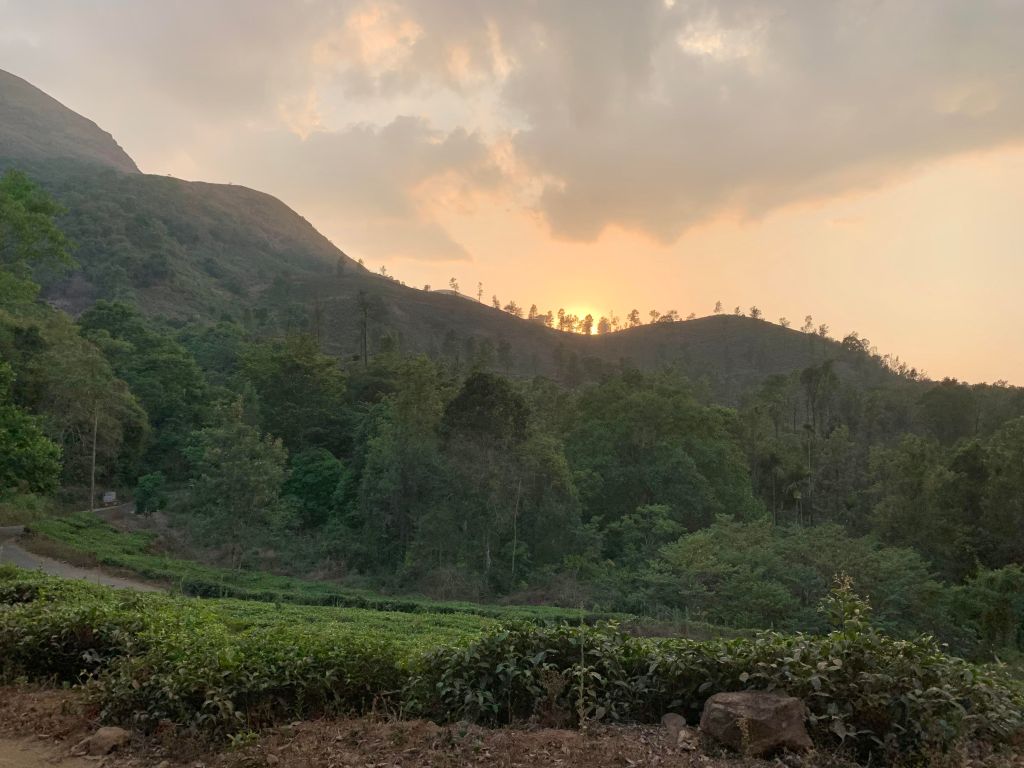
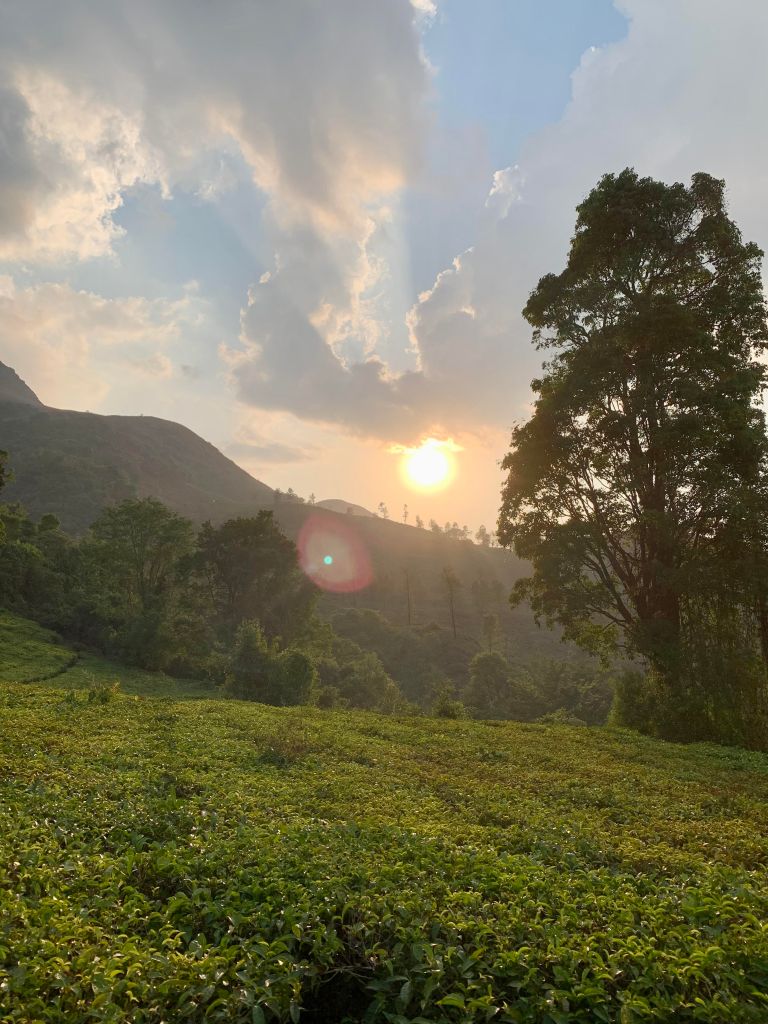
Chembra stands out imperceptibly in the background as the mist descends over its northern side. The driver of the rickety auto-rickshaw in which I make the topsy-turvy trip from Kalpetta settles to drop me at the backpacker’s hostel at Chembra’s foothills for 500 rupees. A vast tea estate stretches out for as far as the eye can see, and it is only when one edges closer to the property’s north-western precipice is any semblance of Wayanad encountered.
Originally a hospital set up by the British in the 1920s, the hostel is a renovated colonial-style structure with a vast corridor that runs parallel to its rooms. I learnt much later that the tea estate that houses the hostel is spread over 700 acres. The fall to the northwest is spectacular, with hills in the lower range of the Western Ghats basking in the late evening sun as it makes its way down to the low-country orbs of Mysore and Chamarajanagar.
It is no surprise that one has to cross Bandipur to reach Wayanad in the first place; any easier and one would have been tempted to think that one was within the anonymity of civilisation.
*
Earlier in the day, the elephants that I spotted from an unobtrusive window on the bus from Mysore seemed triumphant and exultant — for what I did not know. The egret that sat contentedly upon the shoulders of a rather guileless water buffalo winked at me as I struggled to bring my camera out of the mishmash that my backpack had become. I was reminded of an older boy with whom I never got along in school and who often bullied me for the pancakes my mother painstakingly packed.
*
I am forced to snap out of this reverie when my hostess reminds me that elephants were spotted at the southern expanses of the property a few days ago. She asks me to not step out after dark. In the common area boasting of a sit-out on a makeshift tree house, a motley crew from all hues of life rejoice at what appears to be a joint venture launched by a businessman from Bangalore and an engineer from Bombay. I join the pack and am welcomed by a loud cheer.
John, a chartered accountant who rode all the way from Coimbatore on his imported motorcycle, recounts having seen a leopard when turning in one of the several snaking curves when climbing from Kalpetta. He slurs as he articulates and his eyes appear bloodshot; I know only too well to separate the wheat from the chaff. Advait, a veterinarian from Anantapur, rebuffs everything that John says and vociferously advocates for an early dinner. He is, quite promptly, turned down.
*
The trek towards the peak of Chembra is made through the heartland of the eponymous forest range. Langurs peer out inadvertently while a flying squirrel makes an appearance from its cosmic abode. Catching sight of me and my companions’ incongruously sunscreened visages, it jumps shyly onto the double-storied Bo where it has made its home. Murali, the young forest officer who accompanies us jokes with Estelle, the German lady who quite fortuitously chooses to trek in her Birkenstock footwear, about sightings of bears in the vicinity but restrains himself when she turns ashen white.
The heart-shaped lake peeks with unabashed curiosity as we huff and puff our way up to the midway point of the trek. To our great consternation, this is where we have to end our trip as the summit of the peak is sealed off by the government. A few years ago, Murali tells us, a group of nincompoops who made it to the summit lit a couple of cigarettes to celebrate. They did not, however, stub them when they were done. What happened next is well documented — a forest fire of gargantuan scale that wiped out about 60 hectares of forest land and claimed the lives of hundreds of wild animals. The summit has been off-limits to travellers ever since.
The parched outcrops that surround the lake by no means diminish the panorama that lies to the west. A faint countenance of the vast fields of tea and paddy which fortify the district of Wayanad is visible through the mist. It is almost noon, but my companions and I find no reason to shed our coats. Specks of Mohit Chauhan’s Phir Se Ud Chala[1] fill the air; it feels as if Chembra herself has come to life.
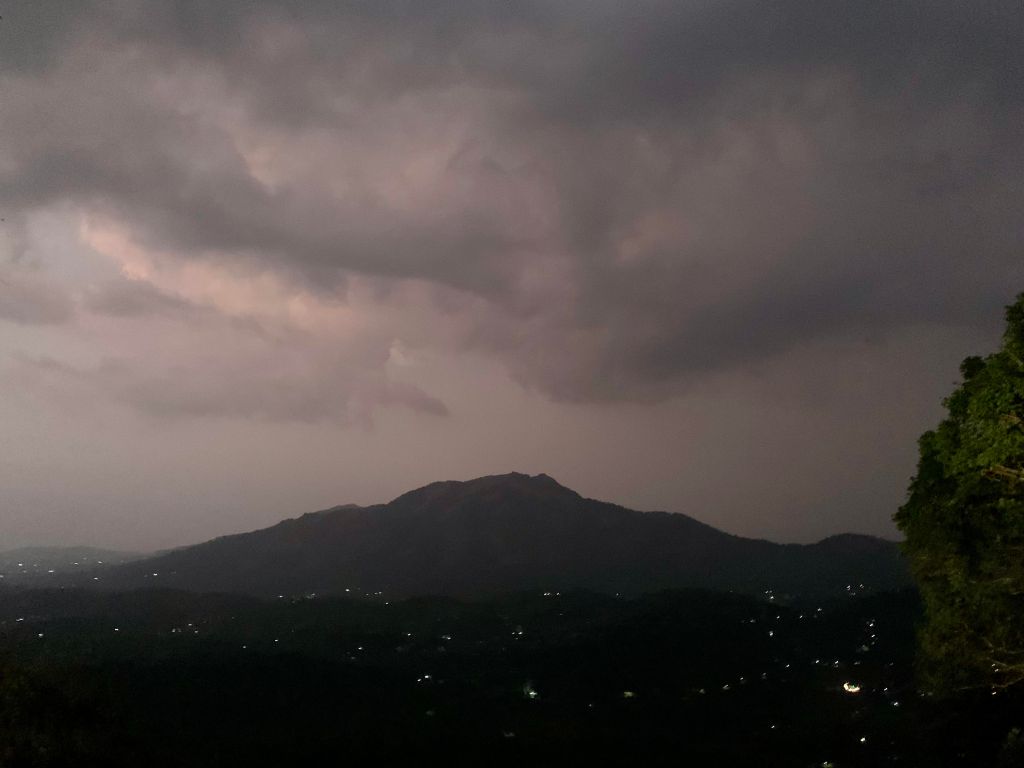
It is not exactly wise, but we surrender to the lure of lying down on the grass and bask, cocooned by the benevolent gaze of Chembra. Dark clouds brew overhead but Begum Akhtar reassures us in her palliative voice, and it is not before the first drops fall on my forehead that I alert the others over our predicament. Unsurprisingly, I find that most of my friends had nodded off, obliged by the exercise and the accompanying iridescent breeze.
*
The descent, as always, is trickier than the climb, and we take refuge from the rain under a giant rock midway. The shelter is insubstantial for a group of ten, and we end up getting soaked to the skin anyway. Murali, rather ingeniously, offers his service raincoat to Estelle. Much to his chagrin, she declines, and continues unabated in her soaking t-shirt, Nike track pants and Birkenstocks. Someone mentions a childhood spent in the Bavarian Alps…
Dry leaves fall from the trees — these untimely showers ensure that they are not held on to their material comforts for long — and the fauna we encountered on the way up seemed to have disappeared. The langurs call out occasionally, but the mynahs respond in dulcet tones of their own.
Drenched to the core yet alive beyond measure, the rain loses significance as we meander down the trail. Consciousness makes itself felt in every cell of my body as I lumber past the sludge and try to find a foothold on the wet tracks. Awake to the moment and mindful of not slipping — essentially holding my life in my hands — I experience a pacifying sense of tranquillity that I normally associate with timing a straight drive back past the bowler on a cloudy afternoon at the Gymkhana.
Damp pathways mark our way back to the hostel. On the way, an appetising breakfast of puttu and kadala curry[2] is sought to calm our nerves. A gulp of tea, brewed from the plants of the estate on which our hostel stands, soothes and brings some warmth back into our bodies. After that, we sleep all afternoon. The 1980s restaurant at this point serves as a reputable hotbed for the exchange of accounts as fellow travellers make their way upcountry for further investigation. Krishnagiri, Edakkal, Banasura and even Ooty, among other places, feature on their itinerary. Buses out of Meppadi take the circuitous route towards Sultan Bathery via Kalpetta. A few companions remain as I make the hike back to the hostel.
Last vestiges of the raindrops from earlier in the day cling on with pride on the tea leaves. Seen from a distance as we walk up the bend onto the track that leads to the hostel’s gates, it appears as if the leaves have shed tears of their own.
The sky turns a dull shade of orange, almost as if playing testament to friendships made and attachments uncovered. I am content enough to watch the sunset over the lower Western Ghats as another pre-monsoon drizzle wafts in. Someone mentions a fresh batch of pazham pori[3] being made in the kitchen. I scramble down the tree house to beat the rush.
[1] Song from Bollywood movie, Rockstar. Translates to: He flew again
[2] Local fare. Rice cake and spicy chick pea curry
Mohul Bhowmick is a national-level cricketer, poet, sports journalist, essayist and travel writer from Hyderabad, India. He has published four collections of poems and one travelogue so far. More of his work can be discovered on his website: www.mohulbhowmick.com.
PLEASE NOTE: ARTICLES CAN ONLY BE REPRODUCED IN OTHER SITES WITH DUE ACKNOWLEDGEMENT TO BORDERLESS JOURNAL.




 Borderless