Translators: Jerry Pinto, Pratik Kanjilal, Nirupama Dutt, Sukant Deepak
Publisher: Speaking Tiger Books
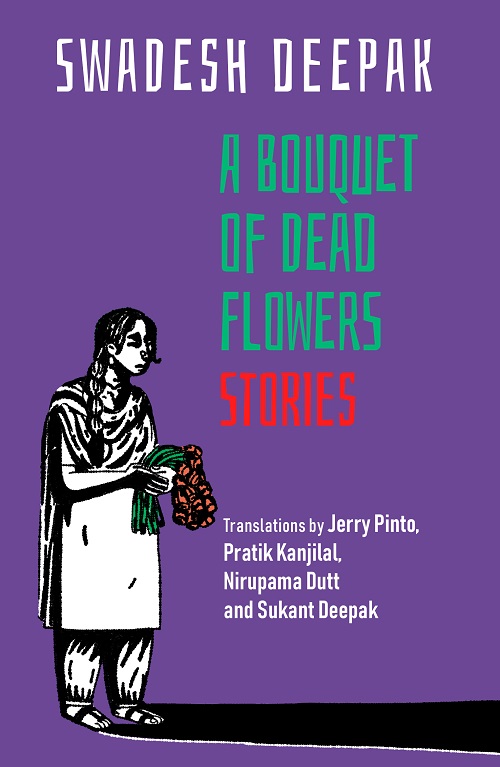
“Hindi literature, Swadesh Deepak maintained, had to be forced out of its comfort zone. The reader here is treated no less savagely,” writes Jerry Pinto in his introduction to this collection of ten stories by Swadesh Deepak, an author and playwright who was born in Rawalpindi on 6th August, 1942. After his masters in English Literature, he taught for a long time at the Gandhi Memorial National College, Ambala Cantonment. Following a period of illness from 1991 to 1997, when he had little contact with anyone other than his family and close friends, he made a momentous return to the world of letters with an autobiographical account of his illness, Maine Mandu Nahin Dekha[1], and the play Sabse Udaas Kavita[2]. He received the Sangeet Natak Akademi Award in 2004. He has a total of 15 published books to his name including short-story collections such as Tamasha, Baal Bhagwan[3]and Kisi Ek Pedh Ka Naam Lo[4]and hugely successful plays such as Court Martial and Kaal Kothri[5]. In 2006 he left home for a walk and never returned. He has been missing ever since.
These stories, deeply unsettling, challenge readers by taking them into a world where unknown forces work mysteriously, upending and affecting the lives of its characters, leaving them vulnerable at the mercy of chance happenings which rarely bring them relief. Much akin to what Thomas Hardy called as the Immanent Will — a blind and indifferent force determining the fates (and generally blighting the lives) of the privileged and the common people alike.
Whether it is the hunger for food, a ravenous longing of the starved and the deprived as portrayed in the stories ‘Hunger’ and ‘The Child God’, the mystery around the fate of a loved one in ‘For the Wind Cannot Read’, the struggle with depression in ‘Pears from Rawalpindi’ or ‘Horsemen’[, the unrequited yearning for a life of togetherness in ‘Dread and Dead End’, the author’s masterful play of the elements comes to the fore with an intensity that shakes and stuns the reader. Pinto refers to the author as the master of neo gothic,
The sunlight, the wind, the trees, the figure of a broken man, appears again and again. It seems as if it is just not the fate but also the forces of natural elements that keep rattling the course of the lives of the characters. The trees stand as guards, or sway in delight or offer a refuge, the sunlight “makes a hesitant arrival” sitting quietly or climbing the hills or sometimes streaking in the rooms, the wind is at times playful and at others vindictive. Then there are the flowers, the dead flowers of memories, whose bouquets one keeps holding, clinging to and clasping. And then there is the poetic play of words – “a pale yellow georgette afternoon in November” – bringing to life the patchy sunlight of autumn.
In the figure of broken man which appears again and again in stories, the author seems to be questioning the role that society has forced upon a man – that of a provider of the family, a role sometimes begrudgingly assumed in the stories because “no one respects a man without work, no matter how talented he is.”
In each story, the author weaves a tale that becomes a commentary — on society and its inherent evils, on relationships within a family stifled by arrogance, ignorance or circumstances and quietly working on the minds of those inhabiting it, on human greed engendered by depravity, hunger or lust, on the mysteriousness of fate whose force makes the mighty cower.
The translation, well executed, offers a closer reading experience and leaves a bilingual reader with the wish to approach the author’s works in original as well. I must make a special note on the introduction by the acclaimed writer and translator Jerry Pinto who offers a peek into the mind of Swadesh Deepak through a couple of excerpts of the author’s conversations with his psychiatrist and also with a convict brought to the hospital for evaluation. Perhaps these ideas had haunted him in the mental ward of the hospital and later seeped into his stories. Pinto in the introduction not only seeks to make sense of Deepak’s writing but also makes for a compelling reason to read his works – to read on without looking over one’s shoulders.
Rakhi Dalal is an educator by profession. When not working, she can usually be found reading books or writing about reading them. She writes at https://rakhidalal.blogspot.com/ .
.
PLEASE NOTE: ARTICLES CAN ONLY BE REPRODUCED IN OTHER SITES WITH DUE ACKNOWLEDGEMENT TO BORDERLESS JOURNAL
Shamik Banerjee resides in Assam with his parents. Some of his recent works will appear in York Literary Review, Willow Review, Thimble Lit and Modern Reformation — to name a few.
PLEASE NOTE: ARTICLES CAN ONLY BE REPRODUCED IN OTHER SITES WITH DUE ACKNOWLEDGEMENT TO BORDERLESS JOURNAL
It’s been 12 years since the day I stepped out of Navrang Opticians as a happy-but-slightly-embarrassed owner of an expensive pair of sunglasses. I remember feeling an inexplicable, capitalism-infused sense of confidence and eye-mancipation, like this pair of sunglasses was all I had needed to kickstart my post-college journey into adulthood.
But wow! 12 years! The world that I first witnessed from behind your tinted lenses has now changed beyond recognition. That’s how long you’ve been there for my eyes.
You have been my trusted companion through all my adventures in the past decade. You helped conceal the deep apprehensions in my eyes when I tried, as an unsettled young Masters’ student, to blend into the daily rhythms of life in a foreign country. You were there reassuringly embracing my face all through the 600-kilometre-long road journey when I decided to leave behind the only life I had known and move to Goa. You adapted with me, without any complaints, when you had to carry the additional weight of two face masks wrapped around you during those two horrific pandemic years. You were there alongside my amazed eyes and overwhelmed heart when I saw the mighty Pyrenees, the pristine blue sea and white-sand beaches in Andaman, and other parts of this country and the world that I never believed I’d actually see. And amid all this, you even managed to make my face look somewhat presentable at times, thanks to which I was able to get at least few decent photographs.
You have always been a safe space for me; like when you allowed foolish and outlandish hopes and dreams to float freely in the pool of my eyes as I watched a beautiful sunrise on top of a hill. And also, when my eyes needed to shed tears of disappointment and sadness as I watched a sunset on December 31st of another painfully unfulfilling year.
I am realising now that I may have taken you for granted. That you will always just be there in my backpack when I travel, on the mantel as I step out from home, or resting in my pocket or on a table in a cafe. I don’t even want to think about the day when you are damaged beyond repair or worse if I misplace you, because I don’t know what eye will do without you.
*’dhan‘ is wealth in Hindi and ‘bandhan‘ is the word for ties.
Uday Deshwal claims to have an ‘always wanted to be a writer but was diagnosed with impostor’ syndrome.
.
PLEASE NOTE: ARTICLES CAN ONLY BE REPRODUCED IN OTHER SITES WITH DUE ACKNOWLEDGEMENT TO BORDERLESS JOURNAL
First, sit comfortably on a white sofa --
no, a darker colour simply won’t do.
It must be at the home of a friend,
who is hopelessly in love with said sofa.

Second, choose an orange, very carefully --
not green and tender, or dry and shrivelled
but just the right shade of middling,
you want to know in advance it is going to be squirty.

Next, hold it in your palms, close to your heart,
shun the use of crockery or cutlery.
Real ladies peel oranges in their laps!
Make sure you wear your daintiest top
and bandhani pants that can only be dry-cleaned.

Then, look the orange in the eye.
Trust that it will never hurt you.
forget the laws of gravity, or that action
inevitably, has an equal and opposite reaction.

Now pry it open with both hands,
mustering every force.
Watch the rinds split, seeds
tear off at their core.
Watch citrus tears soar
into in the air, slo-mo
landing on --
the white sofa,
the dainty top,
the dry-clean pants
and yes, your friend's face.

Still, eat the orange anyway.
It is very likely very tasty.
The damage is already done,
and you still need your Vitamin C.

Later, forgive the orange for the mischief.
It should have been more careful, yes.
Apologise on its behalf, of course!
Turn orange-faced in embarrassment,
blame your child-like zest for life,
blame your brain for running out of juice.
Offer a piece as a peace offering
and hope that things don’t turn sour.
Supriya Javalgekar is an author, researcher and creative facilitator from Mumbai. Supriya draws upon story, theatre and art to cultivate nourishing spaces for self-exploration and dialogue. She currently lives in Amsterdam and is playing hard at improvised theatre. Discover more at www.supriyarakesh.com.
.
PLEASE NOTE: ARTICLES CAN ONLY BE REPRODUCED IN OTHER SITES WITH DUE ACKNOWLEDGEMENT TO BORDERLESS JOURNAL
In a tiny shop located within a narrow lane packed with people, sat Rakesh, in his late seventies, though he couldn’t say exactly. They didn’t keep proper records of birthdays back then. He sat staring outside as people pushed past one another, and over their heads, thick black electric cables coiled around one another and around long poles, forming a black canopy. He remained motionless, with glazed eyes.
Someone entered the shop, looked at him, and said something.
“What?” Rakesh muttered, coming out of his thoughts.
It was Nitesh, who had been running a food stall across the street for the past five months. It was called “Nitesh Snacks”.
“I came to have this watch repaired. It fell yesterday while I was going back home, and the glass broke.”
He put a watch on the counter. Rakesh picked it up and glanced thoughtfully at it. Then he nodded to himself and put it aside.
“I will give it to you tomorrow.”
Nitesh stood there hesitantly for a while, then said, “Arun ji was a very nice man. It’s a pity that he…died.”
Rakesh nodded again and said nothing. His shoulders seemed to weigh him down. His head was covered with thick grey hair, dyed bright orange with henna. He wore an oversized faded blue shirt that hung over his thin frame, and it was clear that he had forgotten to shave that morning. Nitesh looked worriedly at him. Things weren’t going well, and now that Arun ji was dead, they would likely worsen.
*
Rakesh walked into his single-floor house, which was a short distance from his watch repair shop. He remembered how he had started that shop. He had painted it himself, had the shutters fitted, and then began repairing watches. It had cost him plenty to buy that tiny room on the main street, but it paid well. People came frequently, and soon he could start selling clocks and watches. The shop was named after his late father, “Narayan Watch Repairing”. He remembered covering every shred of the wall with clocks- all colours and shapes.
He went right towards the back of the house, down a long narrow corridor, to a room that was visibly separated from all the other rooms. He sat down on the bed, thinking about when it had all started—when he became like this. It was probably when Arun died…no, that happened two days ago…it was when his wife died. Or around that time, or perhaps even before. He couldn’t think straight. He sat motionless, with a deep feverish glow in his eyes.
Someone looked into the room. It was his son with a big smile on his face. “How was work?”
Rakesh said nothing, and there was a pause. “You must miss your friend.”
Again, nothing.
“We all have to go sometime.”
This time, Rakesh just looked at him thoughtfully. His son nodded to himself and then said, “Sold any clocks today?”
When there was no reply, he added, “Well, that business is no longer as good. A few clocks, that’s all we can sell nowadays. Everyone has clocks on their smartphones. Who needs them now? That’s why we decided to shut it down. You do remember that we have only got a month left? I hope you have started wrapping everything up.”
His son had an easy smile on his face ever since he had entered the room. He looked at him for a moment before adding, “If you need any help at all while closing down, you can always call me.”
Rakesh nodded but said nothing. His son kept talking and then left after a while. Yes, he remembered now. He remembered how it had all started. It had started soon after his son got married. They began quarrelling frequently, especially Rakesh’s wife and their son. It felt like they were always in their son’s way, like they were always doing things to disrupt his life. He remembered his wife crying all night because of their son. He didn’t say anything much until she died. He did not like quarrelling. Many things displeased him, but he learned to remain quiet or use very few words. It had still not been as bad. At least, he still had some respect around the house.
Then one day, his son had seemed to turn over a new leaf. He was always there for him suddenly. He took an interest in the shop. He sat and chatted with him in the evenings over a cup of tea. Rakesh liked this change. Over several months, he came to trust his son, feeling a sense of satisfaction when he looked at him. There were disagreements, of course, but his son invariably seemed to come to his senses and apologised.
Rakesh couldn’t remember how long this harmony continued, but he did remember when it came to an end. It was a short time after he signed the documents that transferred all his property to his son. After that, things began to change. His son no longer took an interest in the shop. They barely spoke anymore. Rakesh’s health also started to deteriorate. Instead of taking more care of him, his son had a room built at the far end of the house. This room was bare except for an old wooden bed and an attached bathroom. It was in this room that Rakesh spent most of his time while he was in the house. His food was sent to the room. It always looked like leftover food from yesterday. Whenever they quarrelled, his son would always end the argument by giving the example of their old neighbour, who was sent to live in a temple by his children because he became ‘too much of a burden.’
He had lived like that for about a year now, missing his wife terribly. No one spoke to him in the house. His only solace was his shop. He eagerly spoke to the customers, absorbing himself in his work. His closest friend, Arun, was a barber whose small salon was right next to the watch repair shop. They had known each other for forty years. Every day, after closing up, they sat and chatted for about an hour. Arun was the one person he could always talk to, the one person who always shared his sorrow, and now Arun was dead. He had no one. At night, he would lie in bed, hearing laughter drift from the house. There was no outlet for his sorrow. It was bottled up inside him, and he felt that it was slowly poisoning him. His feet felt heavy, his breathing was often laborious, and he sometimes heard his wife calling out to him in the middle of the night. Was he going mad? Perhaps he was, and this month, his son’s news had been the final nail in his coffin.
His son had come bustling into the dingy room with a smile and told him that he urgently needed some money, then he had abruptly began talking about the watch shop—how it was not doing well, how people no longer cared about watches anyway, and how Rakesh was getting old and needed some rest. Then he explained that these things had prompted him to sell the shop, and they were required to clear out within two months.
There had been heated arguments between them. Rakesh had refused to speak to him for several days until one day, his son had assumed that his silence meant that the matter was settled. That there was no longer any need to discuss the issue anymore. Rakesh had become quieter than ever before. All he did was nod, as though if he was careful enough to maintain his stubborn silence, then perhaps someone out there would miss his words. Would miss them enough to make things right again. He would have a function in this world—a purpose. He would not be a burden on anyone. His son would miss speaking to him. They would once again sit in the evenings with a cup of tea and chat, not because he wanted his property, but for Rakesh’s sake. Because Rakesh would never be a burden. No one could make that happen to him.
*
Rakesh woke up and stared at the ceiling for several minutes before he realised that someone was in the room. Someone was speaking to him. He sat up and looked thoughtfully at his son. He was still too disoriented to hear him.
“You still haven’t done a thing…I can’t believe…we only have ten days left…do you realise how less time that is?” his son said.
Rakesh thought that he might be in a dream, but then he remembered that he hadn’t had a dream for years. He closed his eyes tightly and opened them again. It became clearer.
“You had two months to clear the shop. That’s more time than necessary in the first place, and today I went there in the morning to have a look, but not a thing has changed! I thought I could trust you with a simple task like this. How can I handle everything on my own? Haven’t I always taken proper care of you? But okay now, tomorrow I am coming down myself to start clearing things up. This has gone on for long enough. I know you have been handing over all the earnings from the shop to Arun’s old widow. I know that Arun was very poor, but we can’t really afford to be so generous if we are poor ourselves, can we? I tolerated all that, but you couldn’t even handle one small thing.”
Rakesh didn’t know how long his son had been speaking, but he understood what was being said. He did not reply at all and waited until his son stormed off.
He got his shirt off the hook and put it on. He stood in the middle of the room for a moment and then left the house. He walked for a long time to nowhere in particular. He had not eaten anything since the morning, but he didn’t feel hungry anyway.
He knew his son was lying. The shop had been doing just fine. His son just wanted to sell it off and get his hands on the money. Worst of all, Rakesh was powerless. Tomorrow, his son would come to start clearing up the shop, and after ten days, it would belong to someone else. He would probably spend the remainder of his days in the little cell his son had built as far away from their lives as possible, waiting for death. Waiting for time to pass.
He looked around and realised that he was near his shop. It was dusk now. In the deep orange sky, some birds were on their way home in a v-formation. How long had he walked? He felt drained, and his heart was fluttering slightly. He stared at the shop front for a while, waiting for his breathing to become normal again, but it didn’t. He then began to open the shutter, but it felt heavier than usual. By the time it was done, he was sweating profusely. Once inside, he collapsed into his chair behind the counter after locking the door from inside.
His mind was blank for a while. He was only aware of how tired his body was. Then he stared thoughtfully at each and every corner of the shop. He would leave this little space after ten days, and it would continue to exist without him. It might stand there for a hundred more years. He sometimes wished he could be a building. At least they were not a burden on anyone. They got to fulfil a certain function. He might leave, but this shop would continue to be a room. It might not be a watch repair shop, but it would still have a function. No one thought buildings were a burden. In fact, people fought with one another to get ownership. Wasn’t that what had happened to him? His son had lied and cheated to get his property, and it wasn’t even much at that.
He had thought that he would feel better after sitting down, but instead, his head had started spinning slightly. He looked at the walls. Each of them were covered with clocks from top to bottom. Normally, they would please him, the culmination of lifelong hard work. Now, looking at them, they all reminded him that time was passing. That the next day, he would have to pack each one of them. That ten days would pass soon, and after that all he would ever do would be to wait for time to pass. He could not bear the thought of packing the clocks up.
He realised that these were the last few moments of his old life, and they were passing really fast. Placing his palms on the counter, he hoisted himself out of the chair and stood for a moment, breathing hard. Then he walked over to the first clock on the wall—a bright yellow square-shaped one—and took it down from the hook. He stared at the minute hand for a while and then smashed it violently on the floor. Then he began moving faster, even though he still felt weak, but his eyes gleamed with determination. He went around smashing every clock. They all reminded him that time was flying by, leaving him behind, and for once, he wanted it to stop at the threshold of his shop. For once, he wanted to be free from the burden of the next day.
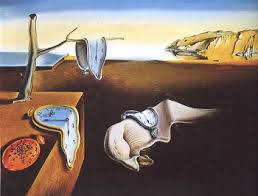
The Persistence of Memory by Salvador Dali (1904-1989). From Public Domain
Maliha Iqbal is a student and writer from Aligarh, India. Many of her short stories, write-ups, letters and poems have been published on platforms Live Wire (The Wire), Cerebration, Kitaab, Countercurrents, Freedom Review, ArmChair Journal, Counterview, Writers’ Cafeteria, Café Dissensus, Borderless Journal and Indian Periodical. She can be reached at malihaiqbal327@gmail.com.
.
PLEASE NOTE: ARTICLES CAN ONLY BE REPRODUCED IN OTHER SITES WITH DUE ACKNOWLEDGEMENT TO BORDERLESS JOURNAL
I would love to live a life
In rhyme with the wise
To help our planet renew
Its heydays of yore,
When a child could dream
Of the moon as a football
And would need to just stretch
His hands to touch the ball.

I live in accord with visions
Built with imagination.
Tied to my wishful dreams,
I like to give nuances
To my fleeting clouds of hopes
With a sketch pencil that scribbles
The rudiments of my compositions
Eager to soar.

Clouds soar when winds are nigh.
The Oceans, the Earth, and the sky sigh.
I leave footprints of my own
At a languorous pace
To embrace our progeny
On the palette of my dreams.
I leave these footprints of love
That leave no trace and sound.
Pramod Rastogi is an Emeritus Professor at the EPFL, Switzerland. He is a poet, academician, researcher, author of nine scientific books, and a former Editor-in-chief (1999-2019) of the international scientific journal “Optics and Lasers in Engineering”. He has published over hundred poems in international literary journals.
PLEASE NOTE: ARTICLES CAN ONLY BE REPRODUCED IN OTHER SITES WITH DUE ACKNOWLEDGEMENT TO BORDERLESS JOURNAL
There are good days, bad days, and then there are moderate days. What do we do on moderate days? These are days that don’t smell of cakes and candy, days that don’t bask in the glory of boisterous get-togethers, and that don’t have you running around in anxiety. They aren’t spent in hospital corridors and don’t promise hope and certainty.
Life, on most days, is a moderate one—rooted in mundanity and tied to the fabric of monotony. Routine allows us to remain distracted from issues that could consume us, provided we had the luxury of time. A great way to deal with the problems in our lives is to become so immersed in time that, when we finally come up for air, we are more concerned about breathing. Rough phases are accentuated by holidays. Your mind takes charge, playing Sisyphus, rolling up heavy boulders and then doing it all over again. There is no progress, no growth, no work happening, and yet you don’t feel relaxed because your mind is at work all the while—jumping from one thought to another, building bridges between past and future, thinking of what-ifs and what-cans, traversing distances within oneself.
We have been fed narratives on how to stay productive all our lives. Our social media platforms remind us of fancy vacations, celebrity-like dress-ups, mandatory postings on birthdays, festivals and events. So, we know the drill. We know that important days have to be documented, registered, laminated, and polished to make them even bigger. We learn how to hold ourselves together on rough days, and when we fail to do so on our own, we look around for company, securing ourselves in the den of familiarity. But what do we do about moderate days when life seems a humdrum affair, when the daily grind tastes dry and drab, when the clock ticks sound a tad bit slower, making us pine for ‘special days’?
On moderate days, we watch the world go by slowly. We sit with our cups of coffee or tea and let them brew a little longer. We indulge in small talk and greetings, building on past conversations. We catch trains, buses, and cabs as we gradually perfect the art of negotiating between the private and the public worlds. We wear our not-so-favourite clothes, which are dipped in comfort and familiarity, allowing us to blend into the larger crowd with nonchalance. We polish our to-do lists, letting them become maps to guide us in our future. We say our daily prayers and bless or curse people with equanimity. On moderate days, we let the world take us on a ride. On such days, we are mostly content with our lives. We are passive; we do not sit in the driver’s seat. Moderate days are forgettable, yet they are steeped in efforts, commitment, and drive. We do a lot, and yet nothing ‘significant’ happens.
Moderate days are for marinating—letting our lives soak in diverse hues, taking in flavour and texture, while we remain slightly detached from the end product. These are days when one would just sit laidback in chequered pajamas and unkempt hair mindlessly scrolling a social media page or sipping on the homely chai/coffee with some munchies. On days like these, we chat and gossip about anything under the sun and forget the conversations in the next instant. On moderate days, we blend, simmer, and evaporate, leaving behind traces of routine in the form of empty tea cups and several good morning greetings.
.
Priyanka Panwar is an Assistant Professor of English at Motilal Nehru College (Evening), Delhi University. When she isn’t reading or teaching, she likes to travel and observe. A movie buff and a voracious reader; on most days she dreams of coffee and mountains.
.
PLEASE NOTE: ARTICLES CAN ONLY BE REPRODUCED IN OTHER SITES WITH DUE ACKNOWLEDGEMENT TO BORDERLESS JOURNAL
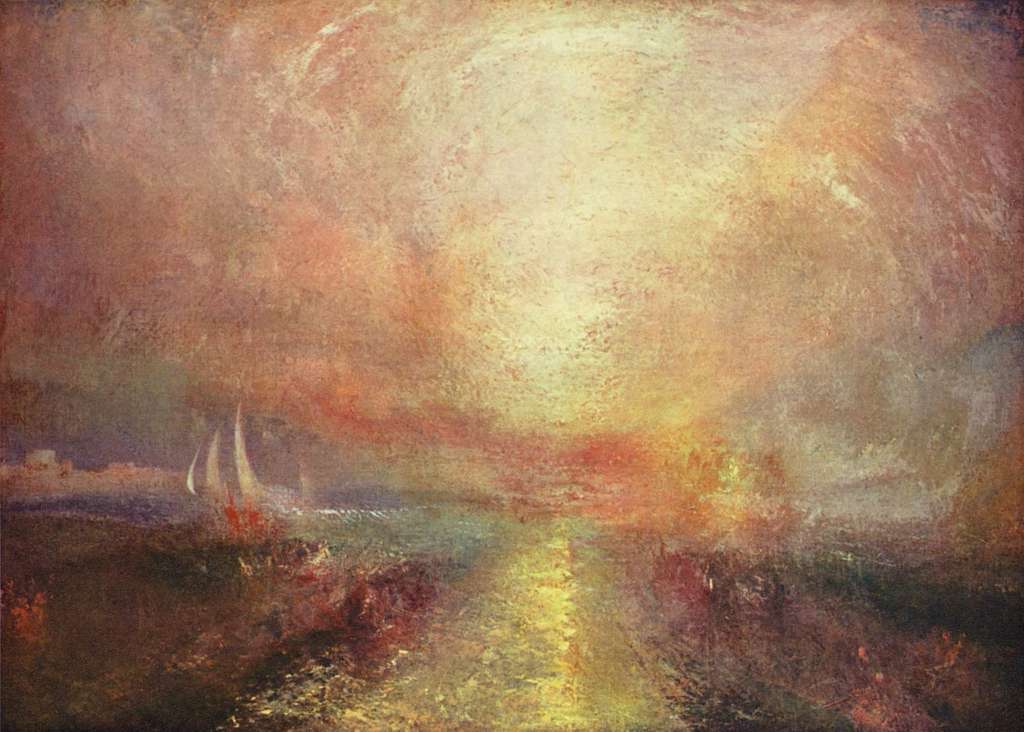
Painting by Joseph Mallord William Turner (1775-1851); From Public Domain
I’ve performed upon many stages of the World
Have donned many masks,
Am today like a ship whose sails furled
Floats listlessly upon the horizonless seas of uncertainty.
.
Passed are those days of fury and adventure,
Of desert crossings, mountain passes and oceanic swells ;
The hour has come to lie down and venture
Forth towards a novel existence of tolling kneels.
.
All has become pensive, still and Silent
Amidst the glorious illumination of nightly bidding ;
Where vivid Dreams and Tales invent
An irrevocable identity, so unexpected, yet so fitting.
.
.
Paul Mirabile is a retired professor of philology now living in France. He has published mostly academic works centred on philology, history, pedagogy and religion. He has also published stories of his travels throughout Asia, where he spent thirty years.
.
PLEASE NOTE: ARTICLES CAN ONLY BE REPRODUCED IN OTHER SITES WITH DUE ACKNOWLEDGEMENT TO BORDERLESS JOURNAL
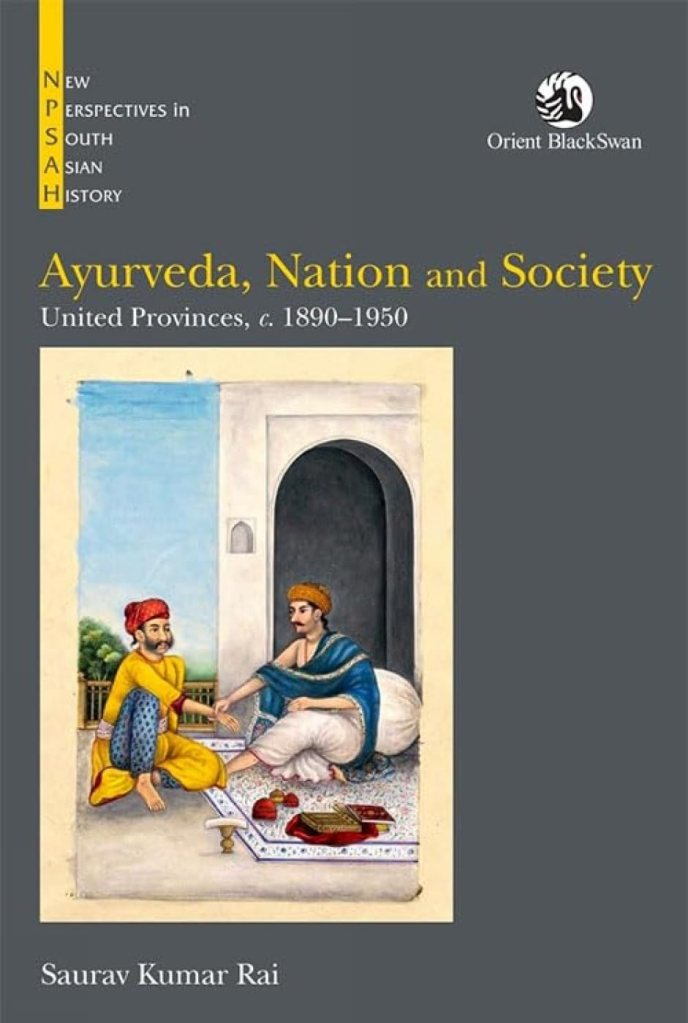
Title: Ayurveda, Nation and Society: United Provinces, c. 1890–1950
Author: Saurav Kumar Rai
Publisher: Orient Blackswan
The ayurvedic revivalist movement significantly influenced medical nationalism in the United Provinces[1] during the late 19th and early 20th centuries. This period saw a concerted effort to re-establish ayurveda as a legitimate and valuable medical system in the face of colonial dominance and the growing influence of Western medicine
The revival of ayurveda was intertwined with the broader nationalist movement in India. Proponents of this school sought to assert an indigenous identity, positioning ayurveda as a symbol of cultural pride and resistance against colonial rule. This was particularly important as the demand for swaraj (self-rule) intensified, necessitating a projection of India as a modern and scientifically progressive nation.
The formation of groups like the All India Ayurvedic Congress in 1907 created an opportunity for the practitioners to come together, exchange insights, and push for the acknowledgment of their stream in the broader national conversation. These meetings encouraged dialogue on blending ayurvedic and wHindu
estern medical approaches, positioning the indigenous school as a legitimate alternative to the colonial healthcare systems.
In a way, the proliferation of ayurvedic literature in various languages during this period helped democratise access to its content. This literature aimed to transform ayurveda from a specialised knowledge system into a shared cultural heritage, reinforcing its relevance in contemporary society. The revivalist discourse often emphasised the scientific basis of ayurveda, thereby aligning it with modernity and progress.
Fascinatingly, the ayurvedic revivalists critiqued colonial medical practices, often blaming external factors, particularly the ‘Other’, for health crises affecting the Hindu population. This narrative not only served to unify the community around ayurveda but also reinforced a sense of collective identity against colonial narratives that marginalised indigenous practices.
Also, the movement led to the commercialisation of ayurvedic medicine, with an increase in its products and practitioners. This economic aspect played a crucial role in embedding ayurveda within the social fabric of the United Provinces, making it a part of everyday life and health practices
It is in this backdrop that this book holds significance. Ayurveda, Nation and Society: United Provinces, c. 1890–195o by Saurav Kumar Rai explores the historical and socio-political dimensions of ayurveda during a transformative period in India. It is part of the New Perspectives in South Asian History series by Orient Blackswan. Saurav Kumar Rai is Research Officer, at Gandhi Smriti and Darshan Samiti, New Delhi.
Says the blurb: “Ayurveda enjoys a growing global appeal, and is often touted as ‘true’ and ‘time-tested’ by contemporary political actors, governments, social groups, practitioners and NGOs in India. With ‘indigenous’ healing systems enjoying increasing state support today, an examination of the socio-political aspects of medicine, in particular Ayurveda, and its role in nation-building is critically important. Ayurveda, Nation and Society, the latest in Orient Blackswan’s ‘New Perspectives in South Asian History’ series, captures the late nineteenth and early twentieth century growth of ‘medical nationalism’ through the Ayurvedic revivalist movement in the United Provinces, and observes the ensuing change and continuity in the attitude towards ‘indigenous’ medicine in independent India.”
This study investigates the emergence of medical nationalism as reflected in the ayurvedic revivalist movement within the United Provinces, focusing on its role in the nation-building process. It offers a critique of the social dynamics of the era, drawing attention to the caste, communal, class, and gender biases that permeated ayurvedic discussions. The author contends that advocates of ayurveda played a significant role in the reconstruction of both tradition and society, frequently attributing health crises affecting the Hindu male demographic to external ‘Others.’
The book contextualises ayurveda as an indigenous medical system, delving into its complexities during the late 19th and early 20th centuries. It examines the involvement of the Indian National Congress in the ayurvedic movement, illustrating how political groups harnessed this school of medicine to foster national identity. The author further explores the influence of print media and organisational initiatives in shaping ayurvedic discourse and rallying societal support. Additionally, the commercialisation of ayurveda is analysed through its print and pharmaceutical markets, investigating the impact of economic factors on health practices. The narrative also encompasses the period surrounding India’s independence, evaluating the evolution of ayurvedic practices during this pivotal transition.
This book stands out as an important resource for those looking to deepen their knowledge of health and medicine during colonial India, attracting both scholars and general readers who are curious about the development of ayurveda and its relevance today.
[1] Present day Uttar Pradesh and Uttarakhand in India was called United Province during this period
Bhaskar Parichha is a journalist and author of Unbiased, No Strings Attached: Writings on Odisha and Biju Patnaik – A Political Biography. He lives in Bhubaneswar and writes bilingually. Besides writing for newspapers, he also reviews books on various media platforms.
PLEASE NOTE: ARTICLES CAN ONLY BE REPRODUCED IN OTHER SITES WITH DUE ACKNOWLEDGEMENT TO BORDERLESS JOURNAL
Nazrul’s lyrics transcreated by Professor Fakrul Alam
Roomu Jhoomu Roomu Jhoomu

Roomo Jhoomo Roomo Jhoomo—anklet bells sound.
Addicted to dancing, bangles jingle jangle to that beat.
The dresses’ borders keep swaying in the restless wind.
Who could be moving with such wantonly dancing feet?
Stranger though she is and so close to the riverbank
I think I know this dancer on the move. Her movements
Fill this heart of mine. Her swan or peacock-like steps
Cast a spell, like a mirage in a desert will. With her smile
She even enchants the forest deer. Her big eyes dance,
Making the sea waves lilt. Forests in the high hills sway,
Sway away to the beat and music of her dancing feet.
Born in united Bengal, long before the Partition, Kazi Nazrul Islam(1899-1976) was known as the Bidrohi Kobi, or “rebel poet”. Nazrul is now regarded as the national poet of Bangladesh though he continues a revered name in the Indian subcontinent. In addition to his prose and poetry, Nazrul wrote about 4000 songs.




 Borderless