Categories
Essay

Corona Virus: What’s happening?

By Ugo Bardi from Florence, Italy

The most recent data indicate a decrease in the number of coronavirus infections in Italy. That means we could get out of the epidemic in the coming months. But why do we expect this trend? It is explained in the field of Science called “epidemiology” that studies how epidemics spread.

The first epidemiology studies date back to 1927, when two British researchers, Kermack and McKendrick, developed the “SIR” model (susceptible, infected, removed), still used today. However, the basis of these studies was the previous work of the American Alfred Lotka and the Italian Vito Volterra. A few years earlier, they had developed the model that we now call “Lotka-Volterra,” but also “predator-prey,” or “foxes and rabbits” (although neither Lotka nor Volterra ever spoke of foxes or rabbits).

Let’s explain. Imagine a green islet in the middle of the sea, populated by only two species: foxes and rabbits (there is no such island, but let’s take it as a hypothetical example). The population of foxes (predators) tends to grow when rabbits (prey) are abundant. It grows so fast that, at some point, the surviving rabbits can no longer reproduce quickly enough to replace those eaten by the foxes. The rabbit population reaches a maximum and then falls. At this point, the foxes starve. With few foxes around, the remaining rabbits can reproduce peacefully and the cycle begins again.

The model is based on the idea that predators tend to take more resources than nature can replace: it is what we now call “overexploitation” It always ends badly, but the model describes the trajectory of the populations that first grow and then collapse as a bell-shaped curve. An example of a real case is that of St. Matthew Island in the Pacific. There were no reindeer on the island before the US Navy brought some, in 1944. In a couple of decades they became thousands, they devoured all the grass, and then almost all died of starvation. Then, a couple of particularly harsh winters exterminated the last individuals, sick and hungry. Reindeer was the predators and grass the prey: a classic case of resource overexploitation.

Not that the model can explain the complex interactions in a whole ecosystem, but it is useful to provide us with a framework for what’s happening. And we can use it to understand the current epidemic. It is the same thing: the virus is the predator and the prey is us. The population of the virus is growing rapidly as it always happens when resources are abundant. But soon the virus will begin to run out of prey, fortunately not because infected people die (some, unfortunately, do). They are no longer prey because they become immune. Indeed, the epidemic is following the bell-shaped trajectory predicted by the Lotka-Volterra model.

So, nothing unexpected. Viruses are creatures looking for resources just like we do. They’re doing nothing different than what we did in the past by exterminating species like mammoths or the dodo. And, today, with the huge expansion of the human population over the last 1000-2000 years, we have become a great hunting ground for so many micro-organisms, also because of our tendency to live in crowded cities where it is easier to get infected. Thus, the past history is full of epidemics: plague, smallpox, cholera, influenza and many others.

In a way, we are at war: viruses attack us and we defend ourselves with vaccines, antibiotics, hygiene, and our immune system. But, if it’s a war, we won’t necessarily win it. Maybe we’ll find a vaccine for the Sars-VOC-2 virus, but don’t expect miracles.

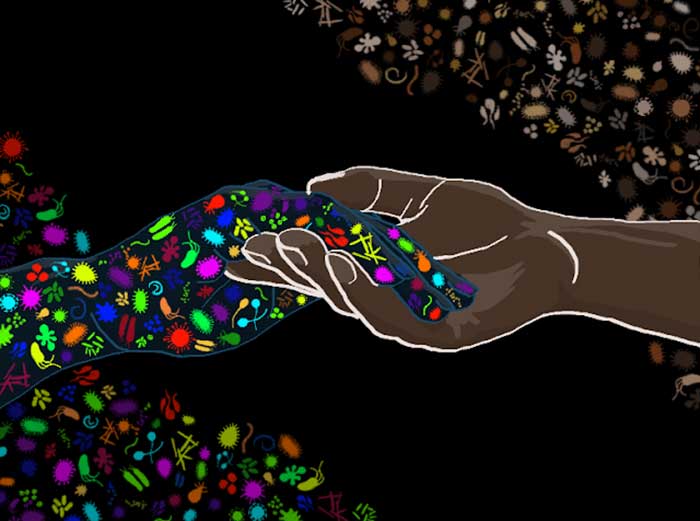
Actually, species do not make wars against each other: they adapt, that’s how the ecosystem works. Viruses and bacteria are seen almost only causes for diseases, but our body hosts a large number of them and of many different species. They are not parasites, many are “symbionts” – creatures that help us with so many things, think of our intestinal bacterial flora. So, in time, we’ll end up adapting. And the virus will adapt, too.

Ugo Bardi teaches physical chemistry at the University of Florence, in Italy and he is also a member of the Club of Rome. He is interested in resource depletion, system dynamics modeling, climate science and renewable energy. Contact: ugo.bardi(whirlything)unifi.it

This essay was first published in Countercurrents.org

Disclaimer: The opinions expressed are solely that of the author and not of Borderless Journal.

Categories
Poetry

In The Midst of The Plague

By Mutiu Olawuyi

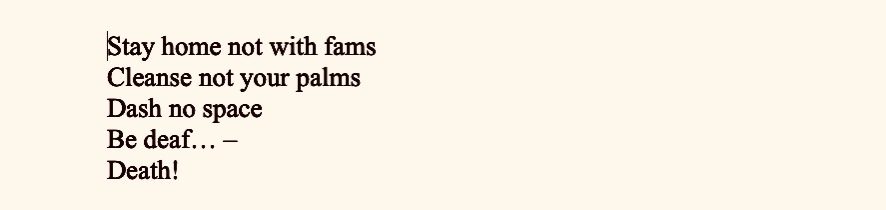
Stay home not with fams            
Cleanse not your palms                      
Dash no space                                             
Be deaf… –                                                  
Death!                                                                             
                                              
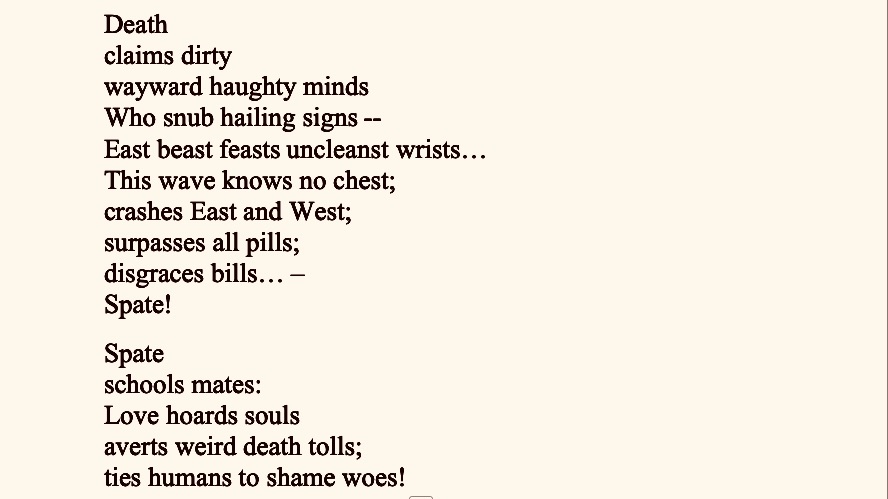
Death                                                                             
claims dirty                                                       
wayward haughty minds                                 
Who snub hailing signs --                 
East beast feasts uncleanst wrists… 
This wave knows no chest;  
crashes East and West;
surpasses all pills;
disgraces bills… –
Spate!
Spate
schools mates:
Love hoards souls
averts weird death tolls;
ties humans to shame woes!
Stay home not with fams            
Cleanse not your palms                      
Dash no space                                             
Be deaf… –                                                  
Death!                                                                             
                                              
Death                                                                             
claims dirty                                                       
wayward haughty minds                                 
Who snub hailing signs --                 
East beast feasts uncleanst wrists… 
This wave knows no chest;  
crashes East and West;
surpasses all pills;
disgraces bills… –
Spate!
Spate
schools mates:
Love hoards souls
averts weird death tolls;
ties humans to shame woes!

Mutiu Olawuyi (popularly called the Jungle Poet) is an international award-winning poet –  2013 World Poetry Empowered Poet Awardee, Canada, Honorary Professor of International Art Academy, Volos Greece; World Poetry Cultural Ambassador (2014) – Vancouver – Canada; and Master of Literary Innovation (2019) – World Poetry Conference, Bathinda Punjab, India . He is the producer and host of ArtFlakes on CBA TV, the Voice of East Africa and he is also the Editor-in-Chief of Parkchester Times and MCR newspapers (Print and Online) based in Bronx, New York, USA. He has authored numerous books of poetry (Among them are American Literary Legends and Other Poems [2010], Thoughts from the Jungle [2012], 9/11 Poetry [2012], and The Journey to the Archangels [2013]) and has edited numerous international anthologies, journals and magazines. Mutiu is a teacher, English language and literature curriculum developer, freelance writer/editor, literary critic and inventor of a new form of poetry called 9eleven (a poem of 9 lines written with 11 syllables) and the first writer of a story without verb – The Blotted Pawpaw (published 2013 by Bharat College in India). He is also an editor for The Criterion International Journal in English based in India. Mutiu has some of his poems, short stories and research papers published  in online and offline journals and magazines in India, Ireland, England, Canada, Greece, Nigeria and USA. Finally, some of his works have been translated to Arabic, French, Esperantos, Malayalam, Telugu and Hungarian.   

Categories
Interview

How Will the World look after COVID 19?

Fabrizio Verde of L’Antidiplomatico interviews Andre Vltchek

(During this exchange, both men were “locked up”. Verde in Naples, Vltchek in Santiago de Chile)

FV: How will the world be after the Covid-19?

AV: Totally different and I’d like to believe, much better.

But before it gets better, millions of people will lose their lives, and perhaps hundreds of millions will have their existence thoroughly ruined.

When I say ‘people will lose their lives’, I don’t say they will be killed by COVID-19. Instead, they will be killed by unemployment, by collapse of the social services, by psychological depression, and simply by misery.

The Western economy is crashing. The Western governments are behaving like a bunch of irrational trolls, and they are destroying, or “rearranging”, both industry and social system. Solidarity is gone; in North America, but especially in Europe. In such places like the United Kingdom, nobody is even pretending that the establishment cares about the people, anymore.

Therefore, most likely, things will get really terrible, horrific, before they get better.

The Western regime is devouring its own people, literally. Its own people, but especially people from all over the world, particularly in what could be defined as the ‘neo-colonies.’

What is new and positive is that human beings everywhere are shedding their illusions about the current arrangement of the world. They now clearly see that the gangrenous face of the Western system, of imperialism. COVID-19 is a symbol, not just a disease. After dust settles, after the epidemy is defeated, inhabitants of our Planet will never want to be governed by the European and North American “culture”.

Which means, there will be, once again, a chance for a logical development for the human race: towards socialism and democratic Communism; towards natural progress that was brutally interrupted, during the 20th century, by twisted fascist and imperialist forces with their bases in London, Paris, Berlin, Washington D.C. and New York.

FV: We are seeing two systems confronting COVID-19. Both China (we could even say Asia, in general) and the West, are fighting against the virus. Both are using all means available, but results are very different. In your opinion, is the Chinese system superior to the Western one?

AV: The Chinese system is clearly superior. For many reasons, but the most important is – because it is geared to serve and defend the Chinese people, and all human beings on this Planet. It is not a ‘perfect system’, but at this moment, it is the best system that we – our humankind – have.

It is repeatedly showing its superiority: in the social spheres, by pulling hundreds of millions of people out of poverty, and by creating a society without extreme misery. By its fight for the “ecological civilization”. And by aiming at the world without wars, free of armed conflicts. The Chinese system is bravely and effectively confronting the Western colonialism and imperialism, through many ways, one of which is the “Belt and Road Initiative” (BRI), a brainchild of President Xi.

Now, all that the West can use against China are not facts, it is the most vicious propaganda, dark sarcasm, smearing: in brief, nothing positive or progressive; no great ideas or ideals, only dirt, perverse lies, and brain manipulation of the masses through the mass media, NGOs and “education”. At a closer look, there is no logic in such propaganda. But the West uses negative indoctrination of its subjects for centuries, and it technically managed to achieve certain perfection in disseminating it all over the world. It already destroyed Soviet Union utilizing propaganda. It ruined many countries in Latin America and elsewhere. It doesn’t do it in order to improve life on our Planet. It only does it in order to keep its grip on power.

Look at the main U.S. anti-Chinese warriors: Peter Navarro and Steve Bannon: one uninformed, ignorant economist, ridiculed even by his own colleagues for knowing nothing about China; other being just an extreme right-wing wing ideologue and apparatchik.

The superiority of the Chinese system is now also clearly evident, when analyzing the struggle against COVID-19. China mobilized immediately after the first cases were detected. It behaved rationally, without excesses. Even at the most dangerous moments, it was only the hardest-hit areas, not the entire country, which were locked up. Simultaneously, the entire society went to work, enthusiastically, with great zeal, utilizing all intellectual and physical forces in the war against the novel coronavirus. It was an epic battle for the survival of the nation, and in a way, it was somehow beautiful to watch: the greatest country on Earth raising against the mortal enemy, a repulsive virus, which was, possibly, brought from abroad.

And after defeating the virus, China, together with Russia and Cuba, began helping other nations, including Italy, Serbia, but also many poor and defenseless nations, all over the world.

That is socialism, at its best. If they tell you that the great “isms” are dead, laugh at them!

Now look at the United States, United Kingdom, Italy, Spain and France! What are they doing to their people? How dare they? Inept, pathetic, ruthless approach. Why? Because these regimes cannot mobilize in the name of the people. They can only plunder, consume, and brutalize “the others.” They lost all their ability to work for the better future.

The Western civilization is dead. I have written a lot about it. And what we are experiencing now is clear proof of it. Such culture has no right to govern the world. Enough. Off the way! Let the much better systems influence the people of this Planet, instead.

FV: How do you judge the US sanctions imposed against the countries which are fighting the Covid-19?

AV: It is clear degeneracy.

The U.S. is imposing sanctions against China, Russia, Venezuela, Iran, Syria and many other places, as if it would have some moral upper hand.

You know, such countries like Venezuela ‘did not fall’. They were doing great! And the West broke their spine precisely because they were doing well. The West and their servants prevented them from changing, improving the world. First, sanctions were imposed, then huge destabilization campaigns were unleashed. Direct attempts at overthrowing legitimate governments were made. And then, when the Venezuelan economy was destroyed from abroad, massive propaganda went to work, repeating thousands of times: “You see, socialism cannot work!” And totally brainwashed and conditioned, the citizens of the West have been obediently accepting all these cheap propaganda gigs. It is shameful. Another sign that the West has no right to judge or lecture the world: its citizens are as conditioned as the ISIS fighters.

Also, just look at what is being done to Iran – a country which is, for decades, on the receiving end of the Western terror.

Recently, Venezuela and Iran asked for the assistance, so they could continue with the fight against Covid-19. And what did they get? Nothing! Sorry, they got something, obviously: the more threats, the more attacks, tightening of sanctions.

You know, in the U.S., even many doctors do not stop on the highway, when they see a car accident. So, what do you expect from their fascist government? You are down, and if you happen to be from the other end of the political spectrum, you will be kicked, robbed, violated, and perhaps, murdered. That is what they are doing to Venezuela and to Iran. It is actually not just shameful, it is twisted and inhuman.

FV: Your opinion, your thoughts, about incredible declarations of the U.S., against Maduro and Cabello of today?

AV: As mentioned above, the West is continuing to brutalize its victims, even during this tragedy. Or more precisely, especially now, when the countries like Venezuela are particularly vulnerable.

It is nothing less than a fascist, terrorist campaign against the independent-minded nations.

The United States has already managed to overthrow a socialist government in Bolivia. That was before COVID-19. Now COVID-19 is used by the “interim government” in La Paz as some justification, to ‘postpone’ the elections by several months.

Now, COVID-19 is immobilizing everybody. People cannot travel. If the U.S. decides to attack, to overthrow the socialist government in Venezuela, it can do it easily. There will be no foreign witnesses, as it is next to impossible to get to Caracas.

I am experiencing ridiculous lock-up in Santiago de Chile. I am desperately trying to get to Venezuela, but there seems to be no way. This is a political move. This fascist regime in Chile is playing the same game as its master – the West. In many ways, Santiago uses the same shameful strategy as Bolivia, where the US-backed coup broke the spine of the multi-racial socialism. The extreme right-wing government here postponed referendum on the new Constitution, by several months. It did it in the name of public health (in a country with only handful of fatalities). Ridiculous and perverse. And people, as in the West, are suddenly, obediently, accepting such lies from the president whose popularity is in only in single-digit neighborhood.

But back to Venezuela: it is possible that the West will take advantage of the situation, and try to overthrow President Nicolas Maduro, as well as the entire socialist system.

That would be detrimental to the entire Latin America and free world.

It is essential that the countries like China and Russia come to Venezuela’s rescue.

If Caracas falls, it will have huge, horrific impact on the region and the entire world. Venezuela is home to one of the most progressive internationalist philosophies on Earth. It is close to Russia, Cuba and China.

If the United States occupies it, the control of the largest oil reserves will fall into its hands, as well as the control of the access to the Panama Canal. That would have tremendously negative impact on both China and Russia.

Venezuela has to be defended, by all means.

And the entire world has to be defended against the lunatics in Washington and London, who are using COVID-19, in order to preserve their control over the Planet!

Andre Vltchek is a philosopher, novelist, filmmaker and investigative journalist. He has covered wars and conflicts in dozens of countries. Five of his latest books are “China Belt and Road Initiative”, China and Ecological Civilization” with John B. Cobb, Jr., “Revolutionary Optimism, Western Nihilism”, a revolutionary novel “Aurora” and a bestselling work of political non-fiction: “Exposing Lies Of The Empire”. View his other books here. Watch Rwanda Gambit, his groundbreaking documentary about Rwanda and DRCongo and his film/dialogue with Noam Chomsky “On Western Terrorism”. Vltchek presently resides in East Asia and Latin America, and continues to work around the world. He can be reached through his website, his Twitter and his Patreon.

First published in Countercurrents.org
Categories
Poetry

Elmhurst, O Elmhurst

By Melissa A. Chappell

(Elmhurst, the only public hospital in New York City was founded to serve the poor in 1832. It serves Western Queens County.)


Elmhurst, O Elmhurst,
I did not know you in your mothering shift
of glass and mortar.
 
I ticked off your name in my mind
as you caught my ear on the morning radio:
“Elmhurst.”
 
This, as I authored my own survival.
 
Perhaps I may be one of the remnant.
 
Perhaps this wasting bane
may steal away on some wing
of the breeze.
 
But, no, Corona prefers to steal the air
from the ravaged world;
 
so that one day I saw on my 52 in. screen,
Elmhurst,
with an almost snake like refrigerated truck,
parked outside its venerable walls,
the vile work of Corona
unmasked,
by the shining light of day;
 
so that, the wretched of God gathered at the hem
of her weeping garments.
 
The poor and the dead,
thronging around her.
 
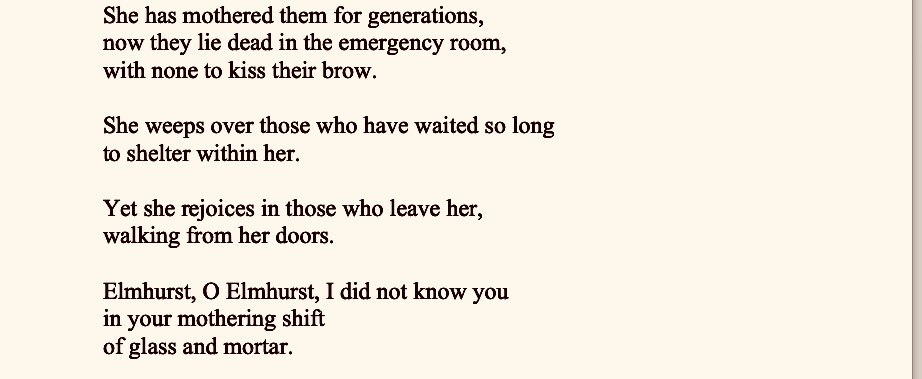
She has mothered them for generations,
now they lie dead in the emergency room,
with none to kiss their brow.
 
She weeps over those who have waited so long
to shelter within her.
 
Yet she rejoices in those who leave her,
walking from her doors.
 
Elmhurst, O Elmhurst, I did not know you
in your mothering shift
of glass and mortar.
 
Yet now, now, I catch the genesis
of the most improbable invitation
on a wind that comes
out of the surly darkness:
“Breathe, breathe.
I will keep your going out
and your coming in.”
 
This, for the poor who gather around
the shabby fringes of the earth.
 
This, for you, O Elmhurst,
form this time on,
and forevermore.

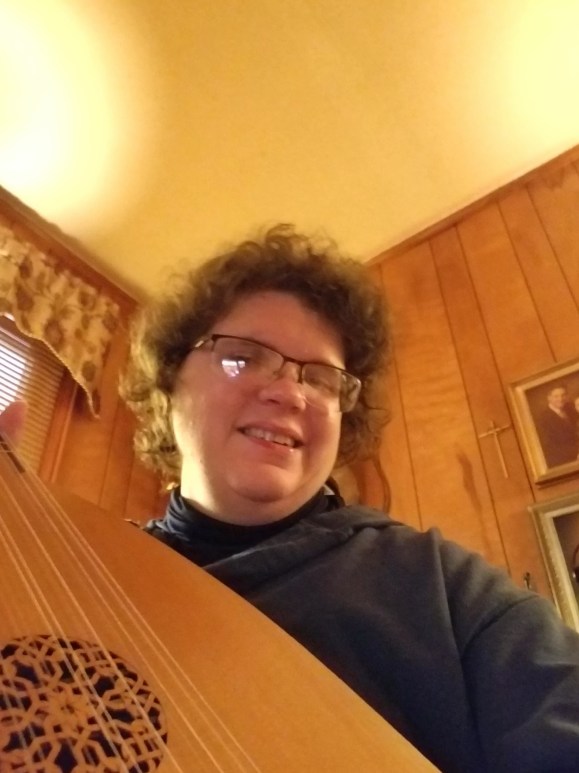
Melissa A. Chappell is a native of South Carolina, USA. She contentedly resides on land that has been in her family for over 130 years. She has a BA in the Theory of Music and a Master of Divinity degree. Besides writing, she plays several instruments, including the lute. Music and the land are her primary inspirations for her poetry. She has had two chapbooks published: Rivers and Relics (Desert Willow Press)

Categories
Musings

Notes from Myanmar: Humans versus Viruses

A reflection on Covid-19 virus outbreak by San Lin Tun

Deserted roads in Yangon

Birds are at ease, showing no worries, looking down at the helter-skelter of humans, struggling and striving to survive under this ruthless virus’ attack. Before that, birds caused flu and migratory birds could not be seen easily. That time, people hated birds; they stopped bird watching for the fear posed by the threat of bird flu. Birds migrated from one end of the world to another, crossing boundaries, as was their natural tendency. Now, the Covid-19 virus is traveling almost throughout the world.

We normally tend to look for experts to resolve emergencies or crisis. Why are the experts silent while human’s freedom has been attacked by the pandemic outbreak? Have humans transgressed the territories of the virus or their liberty? Or is it retaliation for human follies? People think that their lives are cosy and fine within the contexts of capitalism and democracy. They have, however, in their complacent existence, forgotten to think of emergencies like pandemics, the outbreak of anti-heroes and antithesis to blissful living.

Governments only set regulations to restrict human traffic and impose lockdowns on cities, poured funds to regain faltering economies after earlier crises. Now, people are at a loss and they do not know to whom they should turn to. They are realising they have to rely on themselves. They might wonder where their heroes are. They feel repentant for having done nothing, only things to destroy or to jeopardize world harmony, pouring budgets to manufacture hazardous equipment.

The outbreak of virus has restricted all-inclusive human activities, moving freely within the compass of the world and even posing a threat to human rights. We have been attacked by unknown and unseen enemies which are too small to see but powerful enough to cause a havoc in the whole human population. Scientists are now racing to search for the vaccines to combat its outbreak. What about other professions and creative industry? They should also join in fighting against this virus outbreak. Food, clothes and shelter are the three necessary things for humans daily needs. Maybe they can think of ways to provide these.

Professionals worldwide should form a think tank to come up with good and genuine ideas to combat this existing threat. There might be some ways to curb or contain the spread.

People-to-people contact carries virus which transmit person to person. In sci-fi movies or novels, we will find these alternatives and the creative minds will think up the following:

  1. Why not design virus repellent/protective outfits to wear when you go out?
  2. Why not create self- air purifying masks?
  3. Why not invent virus scanning goggles?
  4. Why not produce virus detecting devices?
  5. Why not manufacturing super-booster pills?
  6. Why not . . .?
  7. Why not . . .?
  8. . . .?

All these gadgets are only available in Sci-fi movies or fiction.  If we have those in real world, our lives would not have been disrupted to this level. All solutions tend to prevent virus containment in food, clothes and shelter. The blue planet belongs to the human race. Viruses have only one purpose that is to destroy. They cannot travel, only humans carry them.

Humans do not know the number of them. But they know they are lethal. So, people fear. Fear deters human intelligence to think or create properly, causing panic in people’s minds. Then, it will be hard to be in touch with witticisms under these trying circumstances where so many are petrified by the fear and horror of it.

They know that their liberty is disturbed, and they lose their freedom. Then, they are looking for the stable system to cope with their crises. They know that the only way to end this crisis is to get vaccines.

As for a miracle, men like to look for philosopher stones or magic wands to alter the circumstances and create a virus free world. You can say fantasies can ring a note of hope that will lighten anxious minds and bring a sense of cheer to the depressed. As we ponder realistically or miraculously, we will definitely find a solution to wage the counter-attack on viruses. And, the virus crisis will end.

San Lin Tun is a freelance writer of essays, poetry, short stories and novels from Myanmar and English. Sometimes, he draws cartoons for fun. His writings has appeared in Asia Literary Review, Kitaab, Mad in Asia Pacific, Mekong Review, NAW, PIX, Ponder Savant, South East of Now, Strukturriss and several others. He has authored ten books including ‘‘An English Writer’’. He lives in Yangon, Myanmar.

Disclaimer: The opinions expressed are solely that of the author and not of Borderless Journal.

Categories
Poetry

love quarantined

By Mallika Bhaumik

I pull up the blinds
and look at the glassy darkness waiting outside,
night is a pause,
droplets of the day's fatigue gathered in its palm,
its sighs and shadows coming back 
like cards from an anonymous lover, his
unclaimed love.
An insomniac tells the tale 
of the time that has flown through me, its slippery mossy trail, 
of a heart that remains folded in a Kashmiri wooden box, the smell of unread verses,
the fluid love of Darbari Kanada slow dance on my skin.

I close my eyes
Night becomes a long lonely stretch of asphalt
sound of footsteps fading, mingling with the dark 
an eerie silence envelopes a fear 
stretching itself to the fragile china cup that brings the day to my lips,
the quotidian of virus laden news and hand sanitisers follow me
a black kitten mews around the bin
I go through another day of quarantine.

Mallika Bhaumik has a Master’s degree in English from the university of Calcutta.Her works have been widely published in reputed e mags like Cafe Dissensus, Shot Glass journal, Harbinger Asylum, Mad Swirl, In Parentheses, Madras Courier to name a few. Her first book of poems, Echoes (2017) by Authorspress, has won the Reuel International Award for the best debut poetry collection, 2018. Her second book of poetry is, How not to remember (2019) by Hawakal Publishers. She is a nominee for the Pushcart Prize for poetry, 2019. Her poems have been included in the PG syllabus of BBKM university, Dhanbad (2020). She lives and writes from Kolkata

Categories
Musings

Not our crowning glory

By Farouk Gulsara

Is it funny that every time Man thinks that he has it all figured out, Nature (or fate if you like to call it) just jolts him back to reality? Like Will E Coyote and his spanking new latest invention from ACME Corporation, it just falls flat and blows right on his face again and again, and Roadrunner always goes scot-free, scooting off yet again, screeching “beep..beeep!”

The latest viral scare of COVID-19 (Coronavirus Disease 2019) just opens up our vulnerability. All the so-called foolproof systems that we had installed are just scribblings on the sand – they cannot withstand the test of time. And they are so porous. We thought we had all the arsenal that could not only not annihilate our enemies but ourselves in the process too. All these are useless in combating our electron-microscopic size enemy. We are literally crippled by an unseen offending foe. All the King’s horses and the King’s men cannot put our peace of mind together at least for now. 

In the 1990s, our leaders were hellbent on embracing globalisation. They argued that we were heading to a borderless world where physical borders were an illusion. Commerce transcended boundaries, and we should welcome it with open arms. No one could live in isolation. Now, see what is happening. Countries are scurrying to close the borders as not only diseases spread like wildfire, refugees who bungled up their own nation are clawing through the immigration gates displaying their victim card. Many have opted for self-isolation to keep their people safe.

Over-dependence on particular countries for supplies and over-concentration of the supply chain from a specific region has not a smart move after all. It looks like when China sneezes, the whole world may get pneumonia.

The democratisation of flying made travelling no more an activity of the bourgeois. Now, everyone could fly. With it came secondary industries and opening of new regions and tourists attractions. Unfortunately, the concept of open skies also opened the Pandora box of international subversive activities and seamless flow of problems. At the time of writing the tagline of one of the most popular low-cost airlines have changed from ‘Everyone can Fly’ to ‘No one wants to Fly’ or ‘Nowhere to Fly’.

We thought the world wide web of interconnectivity was going to transform the world into a utopia of a knowledge-based society,  well-informed consumers and broad-thinking creative communities. How naive we were. What we have are fake news of questionable authenticity and a band of fist thumping keyboard warriors who type away their hate speeches under the cloak of anonymity without a thought of the effects of their actions. 

Generations before us grew up without any exchange of physical touch or public display of affection. In some societies, physical touch between unmarriageable kins was frowned upon. With open-mindedness, bodily contacts by handshakes, hugging and pecking became the norm. Come SARS, MERS-CoV and now COVID-19, and we are back to our traditional ways of salutations – bowing and placing of own palms together; fear of transmission of pathogens.

Just a thought…

The mighty Chinese armada used to travel to the four corners of the globe. They are said to have ‘discovered’ the Americas even before Columbus’ alternate route to India. But then everything stopped. The Ming Dynasty decided to opt for a closed-door policy of the world. Even the Japanese kingdoms underwent a similar transformation. Was the spread of disease the reason for this move?

(Nerd Alert: Corona is Latin for Crown. Corona also refers to the gaseous accumulation around the Sun (which looks like a crown enveloping the Sun), mainly around its equator. Did you know that there is a field of study dedicated to studying the Sun called Solar Science (Helioseismology)? The suffix ‘seismology’ is used here because Solar Scientists principally study it via the oscillations of sound waves (?Om –  etc.) that are continuously driven and damped by convection near the Sun’s surface. One of the puzzling thing about the Sun is that the Corona is hotter than the Sun surface by a factor of 150 to 400. The Corona can reach temperatures of 1 to 3 million Kelvin.)

Farouk Gulsara is a daytime healer and a writer by night. After developing his left side of his brain almost half his lifetime, this johnny-come-lately decides to stimulate his non-dominant part on his remaining half. An author of two non-fiction books, ‘Inside the twisted mind of Rifle Range Boy’ and ‘Real Lessons from Reel Life’, he writes regularly in his blog ‘Rifle Range Boy’.

Categories
Poetry

In Solitude’s Splendour

By Christopher Manners


In Solitude’s Splendour 


In solitude’s splendour, I was blessed
by that graciously guiding breeze,
fervently free with towering thoughts,
as I philosophized amidst the trees,
energized as I examined existence,
contemplating through the destined day,
curiously seeking that cosmic clarity,
while the swift birds seemed to play.

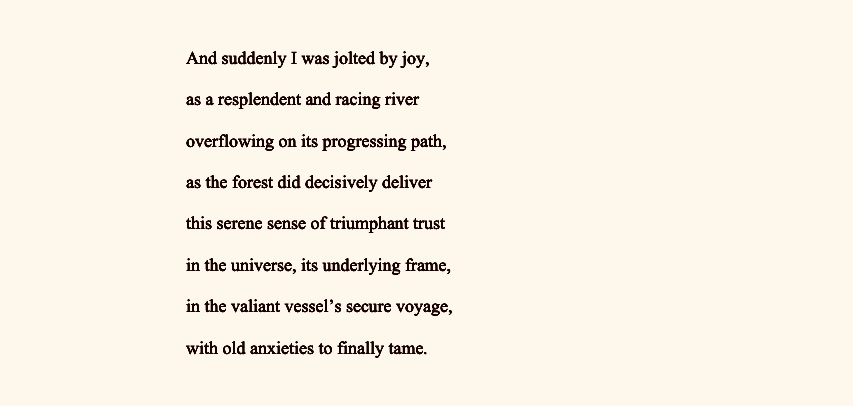
And suddenly I was jolted by joy,
as a resplendent and racing river
overflowing on its progressing path,
as the forest did decisively deliver
this serene sense of triumphant trust
in the universe, its underlying frame,
in the valiant vessel’s secure voyage,
with old anxieties to finally tame.

Immersed in that ecstatic elation,
though the experience was only brief,
it had this lasting influential impact,
vanquishing all my grueling grief,
as I was past my small worrying self,
in this euphoric expanse and tied
momentarily to the river’s source,
while the Sun’s chariot I did ride.

Christopher Manners has had 2 poetry books published by Poetica Press – Sophia Perennis.  He has also had poems published by Harbinger Asylum. Born and residing near Toronto, Canada, he has a Bachelor of Arts with Honours from York University.   Manners is the founder of poetryimmortal.com, a poetry blog and encyclopedia dedicated to the classics. 

Categories
Musings

A Planet of Missing Beauties – In Memoriam

By Tom Engelhardt

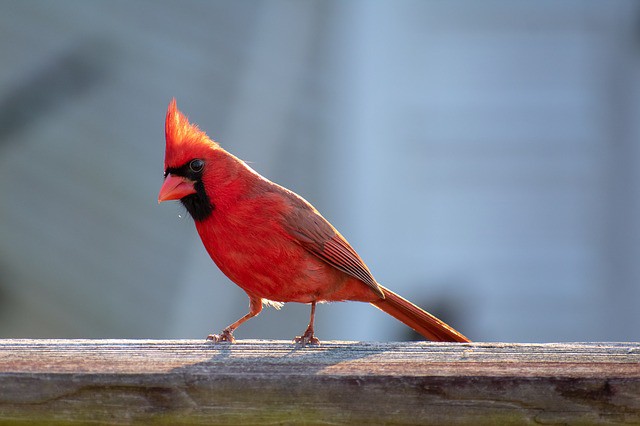
The other morning, walking at the edge of a local park, I caught sight of a beautiful red cardinal, the first bird I ever saw some 63 years ago.

Actually, to make that sentence accurate, I should probably have put either “first” or “ever saw” in quotation marks. After all, I was already 12 years old and, even as a city boy, I had seen plenty of birds. If nothing else, New York, where I grew up, is a city of pigeons (birds which, by the way, know nothing about “social distancing”).

Nonetheless, in a different sense, at age 12 I saw (was struck by, stunned by, awed by) that bright red bird. I was visiting a friend in Connecticut and, miraculously enough, though it was 1956, his parents had a bird identification book of some kind in their house. When I leafed through it, I came across the very bird I had seen, read about it, and on going home wrote a tiny essay about the experience for my sixth grade teacher, Mrs. Casey (one of those inspirational figures you never forget, just as I’ll never forget that bird). I still have what I wrote stuffed away amid ancient papers somewhere in the top of my bedroom closet.

Six decades later, in this grim coronavirus March of 2020, with my city essentially in lockdown and myself in something like self-isolation, I have to admit that I feel a little embarrassed writing about that bird. In fact, I feel as if I should apologize for doing so. After all, who can doubt that we’re now in a Covid-19 world from hell, in a country being run (into the ground) by the president from hell, on the planet that he and his cronies are remarkably intent on burning to hell.

It was no mistake, for instance, that, when Donald Trump finally turned his mind to the coming pandemic (rather than denying it) as the economy he had been bragging about for the previous three years began to crash, one of the first groups he genuinely worried about didn’t include you or me or even his base. It was America’s fossil-fuel industry. As global transportation ground down amid coronavirus panic and a wild oil price war between the Saudis and the Russians, those companies were being clobbered.  And so he quickly reached out to them with both empathy and money — promising to buy tons of extra crude oil for the nation’s strategic petroleum reserve (“We’re going to fill it right to the top”) — unavailable to so many other endangered Americans.  At that moment he made it perfectly clear that, in an unfolding crisis of the first order, all of us remain in a world run by arsonists led by the president of the United States.

So, a cardinal? Really? That’s what I want to focus on in a world which, as it grows hotter by the year, will only be ever more susceptible to pandemics, not to speak of staggering firesfloodingextreme storms, and god knows what else. Honestly, given a country of closed schools, self-isolating adults, and the sick and the dying, ona planet that seems to be cracking open, in a country which, until recently, couldn’t test as many people for Covid-19 in a couple of months as South Korea could in — yes, this is not a misprint — a day, where’s my sense of proportion?

A Secret Life

Still, if you can, bear with me for a moment, I think there’s a connection, even if anything but obvious, between our troubled world and that flaming bird I first saw so long ago. Let me start this way: believe it or not, birds were undoubtedly the greatest secret of my teenage years.

On spring weekends, my best friend and I would regularly head for Central Park, that magnificent patch of green at the center of Manhattan Island. That was the moment when the spectacular annual bird migration would be at its height and the park one of the few obvious places in a vast urban landscape for birds to alight. Sharing his uncle’s clunky old binoculars, my friend and I would wander alone there (having told no one, including our families, what we were doing).

We were on the lookout for exotic birds of every sort on their journeys north. Of course, for us then they were almost all exotic. There were brilliant scarlet tanagers with glossy black wings, chestnut-and-black orchard orioles (birds I wouldn’t see again for decades), as well as the more common, even more vivid Baltimore orioles.  And of course there were all the warblers, those tiny, flitting, singing creatures of just about every color and design: American redstarts, blackburnians, black-and-whites, black-throated blues, blue-wingeds, chestnut-sideds, common yellowthroats, magnolias, prairies, palms, yellows.

And here was the secret key to our secret pastime: the old birders. Mind you, when I say “old,” I mean perhaps my age now or even significantly younger. They would, for instance, be sitting on benches by Belvedere Castle overlooking Belvedere Lake (in reality, a pond), watching those very birds. They were remarkably patient, not to say amused (or perhaps amazed) by the two teenaged boys so eager to watch with them and learn from them. They were generous with their binoculars, quick to identify birds we otherwise would never have known or perhaps even noticed, and happy to offer lessons from their bird books (and their own years of experience).

And, for me at least, those birds were indeed a wonder. They were genuine beauties of this planet and in some odd way my friend and I grasped that deeply. In fact, ever since we’ve grown up — though this year may prove to be the self-isolating exception — we’ve always tried to meet again in that park as May began for one more look at, one more moment immersed in, the deep and moving winged beauty of this planet of ours.

Of course, in the 1950s, all of this was our deepest secret for the most obvious of reasons (at least then). If you were a boy and admitted that you actually wanted to look at birds — I’m not sure the phrase “bird watch” was even in use at the time — god knows what your peers would have said about you. They would — we had no doubt of this — have simply drummed us out of the corps of boys. (That any of them might then have had their own set of secret fascinations would never, of course, have crossed our minds.) All you have to do to conjure up the mood of that moment is to imagine our president back then and the kind of mockery to which he would certainly have subjected boys who looked at birds!

Now, so many decades later, in another America in which the coronavirus has already reached pandemic proportions (potentially threatening staggering losses, especially among old folks like me), in which the stock market is already tanking, in which a great recession-cum-depression could be on the horizon, and our future FDR — that is, the president who helped us out of the last Great Depression in the 1930s — could an over-the-hill 77-year-old former vice president, it seems odd indeed to write about beautiful birds from another earthly moment. But maybe that’s the point.

Fini?

Think about it this way: as last year ended, Science magazine reported that, in North America, there were three billion fewer birds than in 1970; in other words, almost one out of every three birds on this continent is now gone. As Carl Zimmer of the New York Times put it, “The skies are emptying out.” Among them, warblers have taken one of the heaviest hits — there are an estimated 617 million fewer of them — as well as birds more generally that migrate up the East Coast (and so have a shot at landing in Central Park). Many are the causes, including habitat loss, pesticides, and even feral cats, but climate change is undoubtedly a factor as well. The authors of the Audubon Society’s most recent national report, for instance, suggest that, “if Earth continues to warm according to current trends — rising 3 degrees Celsius (5.4 degrees Fahrenheit) by 2100 — more than two-thirds of North America’s bird species will be vulnerable to extinction due to range loss.”

Extinction. Take that word in. They’ll be gone. No more. Fini.

That, by the way, is a global, not just a North American, reality, and such apocalyptic possibilities are hardly restricted to birds. Insects, for instance, are experiencing their own Armageddon and while — monarch butterflies (down 90% in the U.S. in the last 20 years) aside — we humans don’t tend to think of them as beauties, they are, among other things, key pollinators and crucial to food chains everywhere.

Or think about it this way: on Monday, March 8th, in my hometown, New York City, it was 68 degrees and that was nothing. After all, on February 19th, in Central Park, the temperature had hit a record-breaking 78 degrees in the heart of winter, not just the highest for that day on record but for the month of February, historically speaking.  At the time, we were passing through a “winter” in which essentially no snow had fallen. And that should have surprised no one. After all, January had started the year with a bang globally as the hottest January on record, which again should have surprised no one, since the last five years have been the warmest ever recorded on this planet (ditto the last 10 years and 19 of the last 20 years). Oh, and 2020 already has a 50% chance of being the warmest year yet.

And by the way, soon after that 68-degree day, in our parks I began to notice the first crocuses and daffodils pushing through the soil and blooming. It was little short of remarkable and, in truth, would all have been beautiful, not to say glorious — the weather, the flowers, the sense of ease and comfort, the springiness of everything — if you didn’t know just what such “beauty” actually meant on a planet potentially heating to pandemic proportions.

How sad when even what’s still truly beautiful on this globe of ours increasingly tells a story that couldn’t be grimmer. So, think of this as my in-memoriam essay about the planet I thought I grew up on and the birds I thought I knew. Consider it a kind of epitaph-in-advance for a world that, if the rest of us can’t get ourselves together, if we can’t rid ourselves of arsonists like Donald Trump and his crew or those fossil-fueled CEOs that he loves so much, may all-too-soon seem unrecognizable.

In the meantime, consider me — semi-locked in my apartment — to be, in my own fashion, in mourning. Not for myself, mind you, though I’m almost 76 and my years on this planet are bound to be limited, but for those I’ll be leaving behind, my children and grandchildren in particular. This just wasn’t the world I ever wanted them to inherit.

In truth, in this coronaviral moment of ours, our world is being transformed before our eyes into one of missing beauties. Given my teenage years, I want to leave my grandchildren the pleasure of entering Central Park in some distant May, long after I’m gone, and still seeing the brilliant colors of a scarlet tanager. That’s my hope, despite everything.

Tom Engelhardt is a co-founder of the American Empire Project and the author of a history of the Cold War, The End of Victory Culture. He runs TomDispatch.com and is a fellow of the Type Media Center. His sixth and latest book is A Nation Unmade by War.

Follow TomDispatch on Twitter and join us on Facebook. Check out the newest Dispatch Books, John Feffer’s new dystopian novel (the second in the Splinterlands series) Frostlands, Beverly Gologorsky’s novel Every Body Has a Story, and Tom Engelhardt’s A Nation Unmade by War, as well as Alfred McCoy’s In the Shadows of the American Century: The Rise and Decline of U.S. Global Power and John Dower’s The Violent American Century: War and Terror Since World War II.

First Published in Countercurrents.org
Categories
Stories

Flash Fiction: Strangers

By Tina Morganella

The African man selling trinkets looks less out of place than me. In jeans and slippers he lopes over the sand, going between beachgoers calling out, “Signora, buon prezzo”, promising a “good price” in an accent that will never sound Italian. His smile is docile but nervous as he approaches three elderly Italians, plump and soft, golden and wrinkled, walking along the sand in their bikinis. He calls one of them by name. Regulars. They pluck at the jewels on offer – great hoops of gold-coloured earrings, chunks of necklaces with matching bracelets. They slip them on and turn their wrists this way and that. They gently prod each other and admire or admonish. The trinket seller senses a sale. He nods and offers other similar items. He’s gently insistent, but there are also unnerving silences that sound to me like desperate appeals for help. 

One of the ladies starts to haggle over the price of a bracelet. She halves the number and he looks betrayed and disappointed. He offers her another number in return and she shakes her head. She’s starting to move away now, waving her hands dismissively. He tilts his head to one side, holding out the bracelet, willing her to take it. She hesitates and takes it in her hands again. But then she makes a decision and brusquely hands it back to him. She says once more, sternly “No”, and walks away. One of her friends lingers for a moment, still listening to his appeal, trying to be kinder and smiling at him apologetically. But then she too turns and joins the others.

He looks angrily after them, “What do you want lady? You talk and talk and talk….” He rearranges his wares, shrugging them on his shoulder, over his forearm, around his neck, and lopes on. “Signora, buon prezzo, buon prezzo.” The call is woeful. The sun forces him to squint as he forges on.  

When he approaches me next my sympathy melts in the sun. I barely glance up from my book, my mouth a line, my eyes unsmiling, avoiding contact. When he, in English, offers me matching sets, I say no, no, several times, loudly, clearly. Annoyed. And as he walks on I’m immediately ashamed. Forgetting that in front of me was a man earning a living.  A man who felt the sting of “no” like anyone else would, and who perhaps heard it ring in his ears long into the night, disturbing his sleep. I watched him move slowly down the beach, hovering gently between groups, being waved away, sent on.

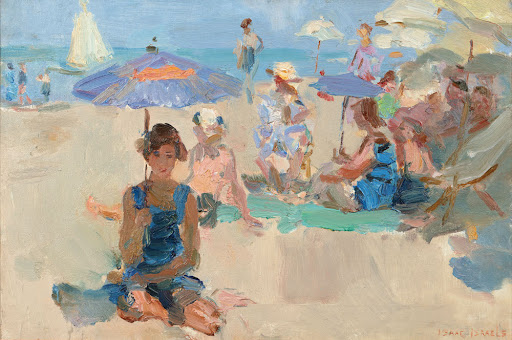
Under a hat and glasses, shaded by an umbrella and mostly clothed, the trinket seller had immediately recognised me as a fellow foreigner. I am overdressed, over cautious. On my own. Pale and cloudy, not sharp and strongly outlined like the Italians. They are minimally dressed, drowsy and lolling in the direct sun – professional couples on holidays feed morsels to small dogs; couples stroll hand in hand, slick with love and affection; and teenagers scoff and jab at each other, all bluster and swagger. The murmur of the ocean is a gentle and lulling hum, still discernible over the laughter and chatter. But behind me violent cliffs loom skyward, the blue sky presses down, heavy and suffocating. I’m half way between the wide expanse of blue, both sky and sea, and the menace of the earth.

Someone asked me earlier whether my beach at home looked out to the ocean or the sea. I had no idea what he was talking about. Confused I kept asking him to repeat himself. Voices were raised. When I finally understood what he meant, I faltered – I didn’t know the answer. What does it matter? He smiled patronisingly at me: “Never mind.” But what does it matter? I want to know. He wouldn’t say.

A shadow falls over my book. Before I can even look up an elderly woman is saying, in Italian, “Scusa signorina, can you look and tell me if my ear is completely covered by the bathing cap?” She assumes I will understand, and I do understand enough. But I still stare at her for a moment, processing. That she assumes I will recognise her words, her request, pleases and puzzles me. She has a sweet face and a patient smile. She is very plump, and is very pale for an Italian. Despite her obvious age, her eyes are lit with youth. She is standing quite still, waiting for me to get up and check her bathing cap.

“No, it’s not….,” I tell her, “wait”.

“Oh thank you. I’ve had an ear infection and my doctor said not to get water in it. But I have to go for my swim, of course.” She is serene.

The nape of her neck looks damp, threads of silver hair escape the cap. I try to tug the plastic over her ear. Her skin is soft and hot. I realise I have to tug reasonably hard and she braces herself and nods encouragingly. I touch her earlobe, brush her cheek. Then I gently nudge her to turn, so I can check the other ear. She obliges; it’s ok. She seems unmoved by the intimacy but I shiver at touching a stranger. Not in revulsion, but breathless and moved by her trust. 

I tell her, “You’re ok now,” in English. She pats her covered ears, satisfied.

“Come ti  chiama signorina?” she asks.

“Mi chiamo Serena.”

She nods once and smiles, “Grazie Serena.” Then turns towards the sea. I sit down again and watch as she shuffles slowly towards the water, wades in up to her thighs and then pushes herself under. I see her arms move rhythmically, her cap peaking above the gentle waves. I watch her until she becomes a pinpoint and I can no longer recognise the stranger.

Tina Morganella is a freelance writer and copy editor with an MPhil in creative writing from the University of Adelaide, Australia. Tina is most interested in short fiction, memoir and travel literature and has most recently been published in Rush (US), STORGY Magazine (UK), Tulpa Magazine (Australia), Sky Island Journal (US), Entropy (US) and Sudo (Australia). She also has nonfiction articles published in the Australian press (The Big Issue, The Australian, The Adelaide Advertiser).