Never talk to a bee as it is fecundating a sunflower,
Never talk to a butterfly as it is flying over a daisy,
Just keep seeing and thinking, and never glower
At them, just wonder on the way they go crazy!
Never abort their tuneful warbles while singing,
Never vex them or repress their deep thinking,
So, let them write the way their hearts like,
Let them think the way their minds like,
Let them sing the way their tongues love,
Let them have fun and fly with a cooing dove!
Never besiege or cage them in poetic death,
Never make them short of imaginative breath.
What garrulous lips that oppose calm and freedom!
Oh! Maybe they ignore that silence is wisdom!
Maybe, they think the two singers hate talking.
Yes, It’s true a bee and a butterfly hate talking,
And hate to be talked to while pollinating,
So, never imprison their words in one shut up house,
By talking to them about ladies’ soulless blouse,
As the butterfly and the bee like to resort to a journey
Across the world without a passport or a visa of entry,
As they don’t like to keep queuing at the embassy
To meet varied pollinated flowers from other continents,
Where they can go beyond any traditional confinements
Of thinking, feeling and creating a map of poetic seeds
That draws human love and peace that anyone needs,
So, let a ‘poet’ sing and fly like a bee and a butterfly,
Across his borderless world and transnational blue sky
Corona is a Plea for Love!
How stupid of world colorful peacocks
To boast of their wings and hearts of rocks!
How stupid of woodpeckers to eat bees!
How stupid of birds of prey to harm trees!
How stupid of wolves to eat rabbits!
What a gloomy forest of unfair habits!
*
How stupid of wealthy peasants
To sow hemlocks to kill thousands
Of pigeons put in dark dungeons,
Using Hitler’s nuclear weapons!
What a myopia to expose a pigeon to danger!
So, you fail to fight against a Honey badger!
Thus, corona is a cure for such a ‘corona!
It enfeebles tempted vultures’ vile stamina!
What a war that breaks out in the forest!
It stirs up peace and love to reach the crest,
As it’s unwise to keep seeing the waves of sea
And ignore inhaling its breeze that sows glee!
So, let’s quieten the roughness of East-West sea
Let’s stop political tides — it’s a sulky sky’s plea.
As the Nile and Euphrates complain of aridity,
Let’s unite world foes to celebrate humanity!
Enough of greedy guns, enough of grudge that is rife!
Coronavirus warns any lion as there is no eternal life!
Abdelmajid Erouhi is a Moroccan poet and writer. He is a teacher of English from Zagora, from an Amazigh origin. He is currently teaching in Tantan City in the south of Morocco. He has published some of his poems in different magazines and websites. He has an unpublished collection of poems, and he is now working on a new one. He is also interested in writing short stories.He is pursuing his PhD about Cultural Encounters between the East and the West in Postcolonial Narratives of Contemporary Arab Muslim writers in Diaspora at Sultan Moulay Slimane Faculty of Letters and Humanities in Beni Mellal. He is similarly interested in Travel literature, Diaspora, Cultural Studies and postcolonial theories. Besides, he is interested in Arabic literature.
“Stop cooking meat! I can smell it all the way up here,” my younger daughter Annika upbraided me from her upstairs bedroom.
I had made a rare purchase of mincemeat as part of a packet of ingredients to be assembled for the evening meal. Choices were so limited when you had a vegan in the family. I had almost given up buying meat and chicken, but persisted in buying eggs, fish and dairy. Eventually I found words to describe myself which I could use to feel virtuous, such as a ‘pescatarian’ – a fish eating vegetarian, and ‘flexitarian’ – a vegetarian when it was convenient. Annika didn’t mind if I made vegetarian dishes, but wouldn’t partake unless they were vegan.
“It’s okay for you to be vegan,” I retorted. “But you don’t have to impose your values on the rest of us. You don’t always conform to my values either.”
“Like what?” she asked.
“I’m not getting into that now. It’s okay for you not to eat meat but you can’t force the rest of us to give it up too,” I repeated.
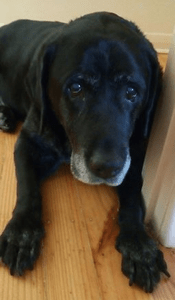
I descended the stairs to the kitchen and took in the unusual smell of cooking meat, which has been absent from our kitchen for a couple of years. Then I bravely assembled the meal, spreading out the wrap, adding the mince mixture and topping it off with some tzatziki (a Greek yogurt sauce. I folded the wrap and sat down to eat it with my trusted Labrador Tia in front of me. Tia fixed her eyes on me unwaveringly and pricked up her ears. It was my habit to share all my meals and snacks with her.
When we had bought her at the Royal Society for the Protection of Animals (RSPCA) I had asked the vet whether it was okay to give her human food. He asked whether I meant sharing my toast with her in the morning. When I nodded he affirmed, “Of course!” From that moment I considered myself to have official approval to share any healthy food with Tia. If I were eating an apple, I would bite off one bit for her and one for me. When I was making a salad, I would hygienically feed her lettuce leaves, tomato tops, or slices of cucumber. (I do confess to feeding her occasional crumbs from my chocolate cake when no-one was looking.) The day that Annika scolded me for cooking meat, Tia was even more excited than usual. She was anticipating that I would share the mincemeat with her. I started to ingest the meat, but the smell put me off, so I passed most of it off to Tia. Needless to say, she was delighted. However, she didn’t savour it, but rather gulped it down quickly without leaving time to enjoy it.
Annika had always shown a sensitivity to the feelings of animals, even rodents. When we first moved into our house we would sometimes see a sudden movement as a mouse darted between the sofa and the fireplace. It was embarrassing to have a well-to-do guest suddenly ask you, “Was that a mouse?”
I wasn’t sure how to get rid of mice without killing them, and tried sonic deterrents which you could plug into an electric socket. Once Annika spotted a mouse in the house. She thought it was a native mouse, a marsupial, because its forelegs were shorter than its hind legs. She could even see the mouse’s heart beating through its chest as it trembled. Then she felt sorry for it and left it alone. After that I asked my husband to deal with the mice, and didn’t ask any more questions. The mice disappeared.
Until Annika became a vegan I had disassociated meat from animals. The packets of neatly wrapped meat in the supermarkets had nothing to do with the animals that you passed on farms in drives through the country. One day Annika drew a connection between Tia and meat, asking if I would eat Tia. From then on I could associate meat with living animals. The meat shelves in the supermarket became distasteful and I had to look the other way as I passed.
A friend has a business selling kangaroo meat overseas. She made a post on social media explaining why kangaroo meat is better than meat from farms; kangaroos are game, and they are not killed in the abbatoirs. I hesitated over the ‘like’ button as I read this. I was convinced by her argument but reluctant to agree with the notion of killing Australia’s national symbol, featured in our Coat of Arms and decorating the tail of the national carrier.
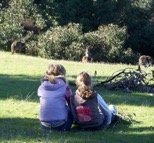
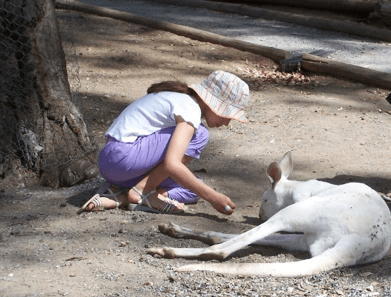
A kangaroo in the countryside
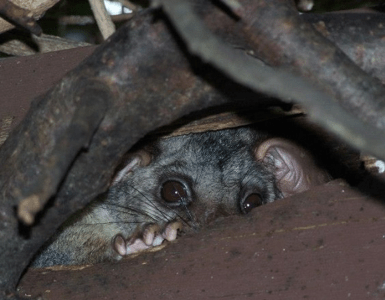
I work overseas and return to Australia every holiday. My pleasure in Australia’s fauna and flora is enhanced because of my long absences. When I return I am delighted to spot kangaroos in the countryside, possums in tree hollows, and koalas sleeping in trees in the neighbourhood.
Possum
A koala on a tree
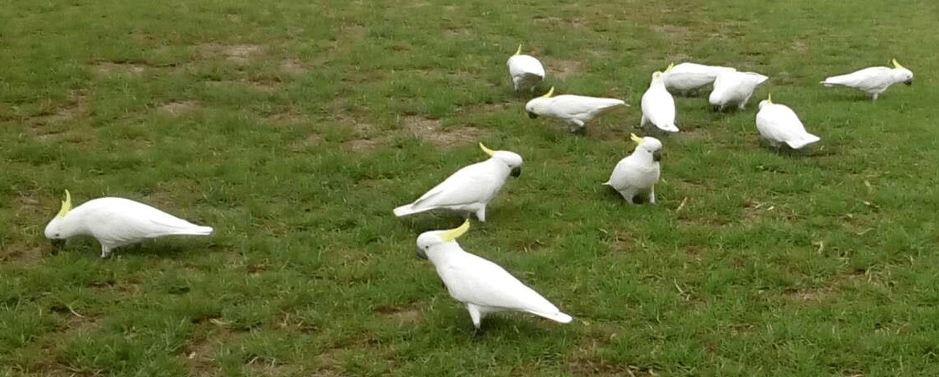
Every morning is a visual and auditory feast. I spot rainbow lorikeets on the balcony, and cockatoos feeding on neighbouring lawns.
Cockatoos on the neighbour’s lawn
I listen to families of kookaburras cackling, and magpies serenading me. I am enjoying the fauna more than ever, and I can understand Annika’s feelings for them.
Not only that, times of global turmoil when movement is restricted are ideal for slowing down and appreciating nature. As Alain de Botton says on his homepage, “You normally have to be bashed about a bit by life to see the point of daffodils, sunsets and uneventful nice days.” In these tumultuous and uncertain times there is an exquisite pleasure to be had in communing with animals and birds. Now I can find the time to still myself for long enough to enjoy watching the sulphur-crested cockatoos squawking as they land on the lawn to peck for their dinner.
Nevertheless, my dietary resolutions are more due to the impact of the younger generation than the enhanced appreciation of wildlife afforded by the time for reflection in the lockdown. I will probably remain a pescatarian, or even a flexitarian. I won’t become a vegan and I will respect the choices of my friends and family to eat whatever they want. However, I do understand the younger generation’s commitment to veganism, and am prepared to admit that older is not necessarily wiser.
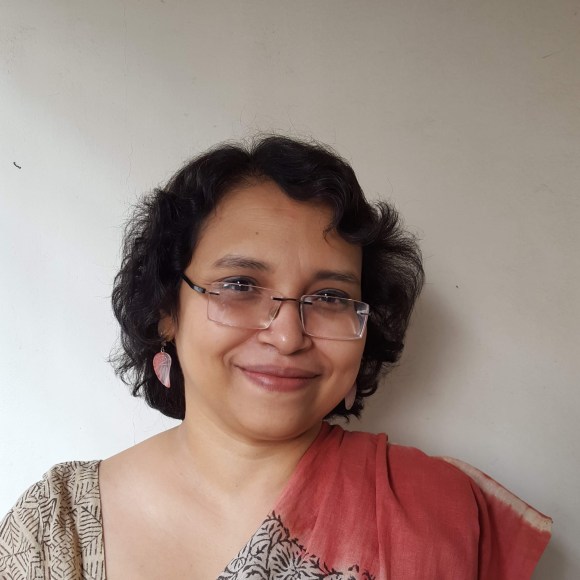
Meredith Stephens is an applied linguist in Japan. Her work has appeared in Transnational Literature, The Blue Nib, The Font – A Literary Journal for Language Teachers, The Journal of Literature in Language Teaching, The Writers’ and Readers’ Magazine, Reading in a Foreign Language, and in chapters in anthologies entitled What’s Cooking Mom? Narratives about Food and Family, The Migrant Maternal: “Birthing” New Lives Abroad, and Twenty-First Century Friendship, all published by Demeter Press, Canada.
At such a time as ours, I can identify with the first three lines, but not the last three. As I read the poem, I utter instead, “Ah, what dark tunnels are we crossing?”
I can’t believe that it has been six weeks since I have been to my office at the university. It has been more than a month since I was at my newspaper office. Things have been shifted online — without any of us having any preparation or training whatsoever. With the number of coronavirus affected patients rising rapidly in the country, sometimes I pinch myself to see if I am awake or if it’s only a nightmare. As I drift through one day exactly like another, I wonder if it is actually the beginning of a dystopic age. I recall all the science fiction books I have ever read and the movies that I have watched. This reality is more horrific than any of those because I am living in it. According to WHO, the worst is yet to come. And I wonder, I really wonder how my dear Dhaka city will look like after another month. How will Bangladesh feature in the world map after six months? Or next year this time how will the world function?
The governments across the world have declared lockdown and curfew of one kind or another. The situation in Bangladesh is really at a problematic stage. Being one of the most densely populated countries in the world, if not checked, the pandemic will cause a devastation that nobody has yet encountered anywhere. The close proximity and the number of people also are the reasons behind our tension—how to control this mass? The city of Dhaka is home to 160,000,000 people. Even though some have left for their hometowns, the larger portion still abides here. But we are so many in number and most live in such congested houses that it is difficult for them to continue indoors through days and nights. So, at the slightest chance, they slip out of their dilapidated shanties and cluster around half opened tea stalls and shops; they whisper to one another over a biscuit and half a cup of tea about the strange epidemic they can barely comprehend.
They look in apprehension and curiosity at a said narrow street that has been sealed because a family living there has been identified as COVID-19 victims. Then the police arrive with their batons and sticks and start beating people and they run to hide into their holes. Except for a few residential areas, this is the general scenario in Dhaka. People are prohibited from going to work, but who can take away their addas? The Bengalis can go without food but they cannot live without adda and gossip.
Hence, even though the government is dictating social distancing, ours is a culture that disapproves of such distances. The month of Ramadan has begun and for the first time in history, people are not going to the mosque for mass prayer. In all probability, the Eid Jamaat will not be held on the morning of Eid-ul-Fitr. But there is this group of religious leaders that continue to claim that if one dies after going to the mass prayer, they will go straight to heaven. No wonder that just over a week ago, around 100,000 people turned up at the funeral ritual of a senior member of Bangladesh political party, Khelafat Majlish. Some people will always benefit from any kind of disaster and such incidents only testify to that. One might ask, what can one benefit from such mass gathering that might result in extreme suffering and death? Well, the answer is — the ultimate objective of any system is to wield power over others. If it leads to death even, so be it; you have power over the dead and for some leaders at least, human life is expendable.
The biggest problem for us in Bangladesh right now is that in spite of the wide accessibility of the news channels, we are not fully aware of what we are dealing with. I was reading an article just this morning quoting the Director of Transparency International Bangladesh, who observes how the country has failed in protecting its citizens from Coronavirus. The system is so debased that even at this stage of the pandemic, some government officials are busy making money and compromising the situation by buying lower quality equipment for doctors and patients. The public announcement says that Personal Protective Equipment (PPE) has been bought for all doctors and medical staff, but in reality, those have been distributed selectively. The doctors outside of the capital city of Dhaka are mostly purchasing PPE out of their own pockets. Across the country, about 120 doctors have been affected by COVID-19, and among these only a handful are from those chosen hospitals.
There are all sorts of rumours, and because of those, people are ready to ransack hospitals as COVID patients have been admitted there. No wonder that a number of people are refusing to reveal that they are carrying the virus. When even the educated and conscious segment of the society does not know what lies ahead, one can only assume how the working class, who live from hand to mouth feels. Their daily living has been wrenched away from them by an unknown force.
Strangely enough, amidst this chaos a group of people are hopeful that this cannot last forever and something good will surely come up. Many will develop awareness of what they have done wrong. For me, that is only a distant possibility. More prominently looming in the near future are scarcity of jobs, lack of provision, budget cuts and trauma. How hopeful can we actually be when we know at heart that there is nothing bright and hopeful in the coming months?
Sitting at the heart of the city’s posh area, some are congratulating themselves as a few trucks of relief goods are distributed to some lucky ones. What about the rest of the country? How do we know that they are getting to eat? But then, some might counter that these people are half dead anyway and hence it would not matter much if they actually die now. It might sound atrocious and something we do not want to face, but it is the reality.
I used to be a workaholic. But I have not really been able to be productive since the lockdown began. This might be the beginning of a different set of thoughts for me. But I do not yet know what that might be exactly. I certainly am able to concentrate on work or creative writing. I am watching movies and keeping track of the COVID news. I fall asleep at odd hours and keep awake through the night.
On rare moments, I dream of a cloudless blue sky and endless green pastures, of the not so crowded roads and streets of the late 80s and early 90s, of the people I have lost over the years. I might lose some more in the near future. How do I stand proud, strong and unshakable when the ground under my feet is giving away and I feel that I am drowning?
Sohana Manzoor is an Associate Professor in the Department of English and Humanities at the University of Liberal Arts Bangladesh. She is also the Literary Editor of The Daily Star.
Disclaimer: The opinions expressed are solely that of the author and not of Borderless Journal.
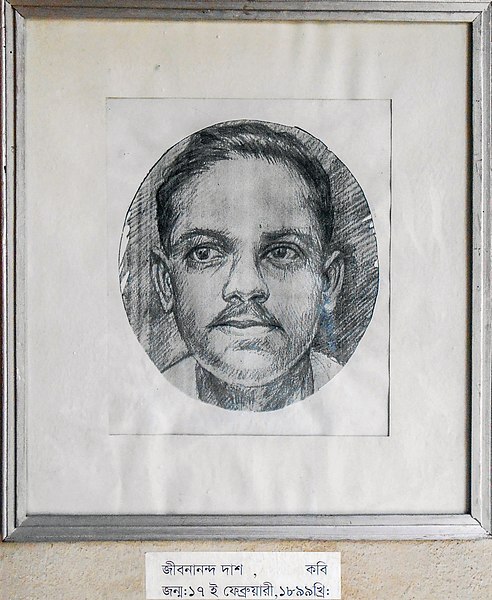
Often hailed as the most influential poet of the post-Tagore generation, Jibonananda Das remains one of Bengal’s most intimate and incisive observers. Born in 1899, at the cusp of change raging across India and indeed the world, Jibonananda started his poetic career as a Romantic celebrant of Bengal’s vast green fields, sun-dappled rivers, lush horizons, its minutest of elemental forces. As years rolled by, a variety of societal changes impacted this landscape and indeed his own life—colonialism, World Wars, the Bengal Famine, communalism and the dark days of Partition. His poetry and sensibility gradually took a turn to the urbane introspection of existential loneliness, tradition and its clash with modernity, death, sickness, and the newly evolving concept of the nation. However, the theme that towered over his thought-process was the concern of human civilization, its evolution and achievements and the paradox of death, disease and violence that this civilization always was confronted with. Both the pieces translated, ‘BANALATA SEN’ and ‘1946-47’ capture these romantic/humanist approach. ‘BANALATA SEN’ is perhaps his most-quoted poem, where the enigmatic, eponymous damsel offers respite and peace to the world-weary traveller-persona. What is striking in this piece, is the catalogue of places that the persona travels to—all strung together by a distinct Buddhist civilizational motif. Perhaps, he is quietly reflecting on India’s departure from its ethos of non-violence, peace and tolerance, across ages.
GLOSSARY:
Bimbisara: a 5th century BC king of the ancient kingdom of Magadha; remembered for his military exploits and his patronage of the Buddha
Asoka: Celebrated as one of the greatest imperialists in Indian history, he is remembered in history for his dramatic conversion from an aggressor to a Buddhist who spread the message of non-violence and peace.
Vidharba: The north-eastern territory of Maharashtra, on the banks of Godavari.
Natore: a district in northern Bangladesh. Legend has it that a Zaminder was once travelling by boat looking for a suitable place to build his principal residence. While travelling through Chalan beel (lake), he saw a frog being caught by a snake. His astrologers interpreted it as a sign of the end of his search for a place of residence. The Raja called out to his boatmen: ‘Nao Tharo, nao’ as in, ‘stop the boat’. From a corruption of this exclamation, the place eventually came to be called ‘Nator’.
Vidisha: Situated very to the Buddhist pilgrimage city of Sanchi, Vidisha was an important trade centre under Buddhist rulers in the 5th century BC.
Sravasti: Currently in modern day Uttar Pradesh, the city is one of the premiere centers of Buddhism.
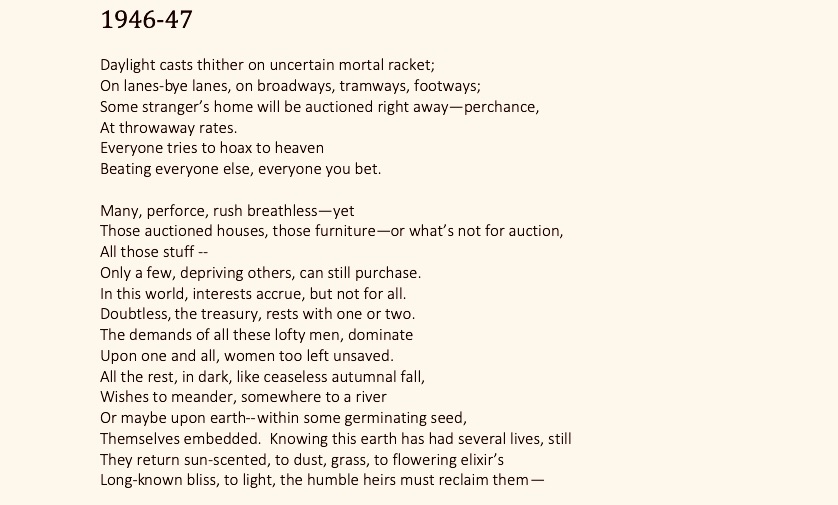
‘1946-47’ is a landmark poem on the history of violence and bloodshed that came in the wake of Partition. The poet is a chronicler of Bengal’s changing landscape, her ethos and values in the modern times. But above all, Jibonananda voices the subaltern, especially the Bengal peasantry, whose plight and suffering under colonialism is deeply etched on his mind.
GLOSSARY:
majhi-bagdi: Denoting the caste of fisherfolk and tribal warrior communities of rural Bengal
Permanent Settlement: A revenue agreement between the East India Company and Bengal’s landlords to fix taxes/revenues to be raised from land.
charok-gaach: a maypole erected out of the stump of a tall tree during the season-end festival of the last month of Bengali calendar, Chaitra. On top of this tall maypole are tied bundles of jute and flags with which a merry-go- round is built. Congregants whirl around the top of the maypole, supported by the ropes and hooks.
Although he spent his early days in earstwhile East Bengal, yet he moved to Kolkata where he graduated with an Honours in English in 1919 and thereafter earned an M.A., also in English, from the Calcutta University in 1921. Following his tragic death in a road accident in 1954, a vast body of novels and short stories, written by him, were discovered. Throughout his life, he shied away from public attention as posthumously he emerged to be a modern poetic giant in the annals of Bengali Literature.
Suparna Senguptalives in Bangalore, India and is a faculty, Department of English at the Jyoti Nivas College for more than a decade now. She has translated various poets from India and Bangladesh and has been published in literature magazines. Her translated poem has been published in “Silence Between the Notes”, an anthology on Partition Poetry (ed. Sarita Jemnani and Aftab Hussain). She also features in the Annual Handbook of “Words and Worlds”, a bi-lingual magazine (PEN Austria Chapter) as also in ‘City: A Journal of South-Asian Literature’, Vol 7, 2019 (City Press Bangalore).
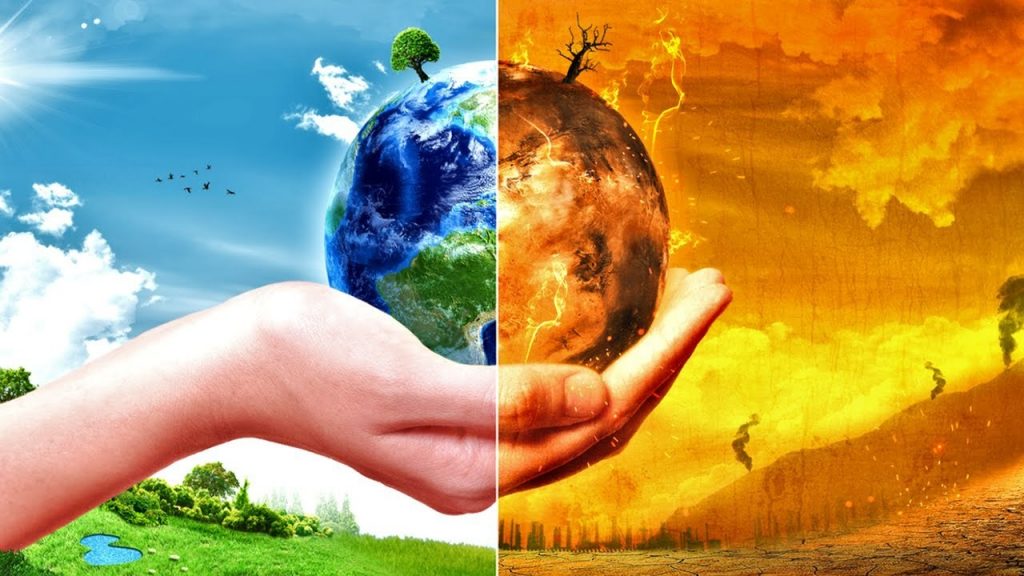
The COVID-19 has taught us that we are in an emergency. In 2019 a teenager named Greta Thumberg was crying hoarse that we are in an emergency and no one was listening. It’s time for us to take stock of the matter. Which is the greater emergency, this COVID-19 emergency or the climate emergency that Greta Thumberg was warning about?
Up to 1 million: species threatened with extinction, many within decades
>500,000 (+/-9%): share of the world’s estimated 5.9 million terrestrial species with insufficient habitat for long term survival without habitat restoration
>40%: amphibian species threatened with extinction
Almost 33%: reef forming corals, sharks and shark relatives, and >33% marine mammals threatened with extinction
25%: average proportion of species threatened with extinction across terrestrial, freshwater and marine vertebrate, invertebrate and plant groups that have been studied in sufficient detail
At least 680: vertebrate species driven to extinction by human actions since the 16th century
+/-10%: tentative estimate of proportion of insect species threatened with extinction
>20%: decline in average abundance of native species in most major terrestrial biomes, mostly since 1900
>6: species of ungulate (hoofed mammals) would likely be extinct or surviving only in captivity today without conservation measures Food and Agriculture
Yes this is an EMERGENCY that very few are talking about.
Why are all these species going extinct? Just because of the actions of this invasive dominant species called homosapiens!
The same UN report points out that:
1 degree Celsius: average global temperature difference in 2017 compared to pre-industrial levels, rising +/-0.2 (+/-0.1) degrees Celsius per decade
>3 mm: annual average global sea level rise over the past two decades
16-21 cm: rise in global average sea level since 1900
100% increase since 1980 in greenhouse gas emissions, raising average global temperature by at least 0.7 degree
40%: rise in carbon footprint of tourism (to 4.5Gt of carbon dioxide) from 2009 to 2013
8%: of total greenhouse gas emissions are from transport and food consumption related to tourism
5%: estimated fraction of species at risk of extinction from 2°C warming alone, rising to 16% at 4.3°C warming
Even for global warming of 1.5 to 2 degrees, the majority of terrestrial species ranges are projected to shrink profoundly.
When Countercurrents.org started in 2002, the CO2 level in atmosphere was 370 ppm. Now it stands at 412 ppm. Dr. Andrew Glikson, a climate scientist has pointed out in several articles in Countercurrents that total green house gases in the atmosphere in the atmosphere including CO2, Methane, Nitrous Oxide, Ozone etc has topped 500ppm.
The Paris Agreement’s goal is to keep the increase in global average temperature to well below 2 °C above pre-industrial levels; and to pursue efforts to limit the increase to 1.5 °C.
Coordinated by the World Meteorological Organisation which is also backed by the United Nations Environment Programme and the Intergovernmental Panel on Climate Change, the United in Science report released in September 2019 estimates global emissions are not likely to peak before 2030 on the current trajectory. It says policies to reduce emissions must triple to meet the 2°C target and increase fivefold to keep heating to within 1.5°C.
With the forced COVID-19 lockdown we are well on track to reach the Paris temperature goals. The COVID lockdown taught us what is essential for our sustenance. Most of the carbon emitting vehicles and airplanes are grounded. Our consumption has come down to our basic essentials. Continents jumping tourism has come to a standstill, so has the neoliberal globalisation. It is good time for globalisation to fail and save our planet. Pollution has come down. Cities have become serene. Rivers have become clean. We’ll have to wait for authentic studies to confirm how much carbon footprint did we reduce.
We were living a reckless life like there is no tomorrow, consuming as much as we can and travelling as far as we can. COVID lockdown has put a break to this reckless lifestyle. In fact it is so much better for the environment. The COVID lockdown has taught us how much wastage we were making. It also taught us we can live better life with much less than we usually consume.
The COVID lockdown has also taught us we have to do a lot more work to do make our economy resilient. We have to make our local economies resilient. We have to grow our food in our neighbourhood. It will create more local jobs and stop the long haul migration to the cities. The cities too have to become resilient by producing its own food. May be cities itself may not be a good idea and wither away.
The COVID lockdown has given us a sneak preview into the future if we are to meet the global temperature goals. We have no other choice if we are to believe our science experts. Scientists like James Hansen predicts that even the human species may go extinct if we can not control global warming.
Human civilization has seen many pandemics and have won over all of them. We’ll overcome this pandemic too. But I’m not so sure about the battle against global warming. The COVID-19 lockdown has taught us that we can win the battle against global warming too. With a little bit more planning we can do even better.
Green all around, shades of green actually, that seemed to smile at her as she looked out. The tall moringa tree that seemed to reach up high, its small leaves dazzling in the play of sun and rain. That tree that met her eyes each morning as she looked out of that large window always made her feel nice. The rusted iron grills, the wooden window shutters broken here and there, did not shut tight, the latch rusted too, some bit of concrete laid bare a little of the masonry – her eye moved along.
***
Bimala arrived in this house after her marriage. It was an arranged one. Baba and Ma looked for a suitable groom for their youngest born and the marriage was solemnised in the traditional way. Dida (grandmother) wanted it to be done just that way. Dada (elder brother) was working by then and just a few years before this they had moved into an apartment on the eastern fringes of the city.
It was a modest one and Bimala took great pains to do it up — from choosing the colours of the wall, the upholstery, the curtains, the fittings in the bathroom, almost everything. Bimala had a keen taste for the aesthetic and visitors to their home always made it a point to refer to it.
Baba had worked with the state government and retired a year after her marriage. They were a middle class family, and a very happy one at that. Bimala was never pampered, Ma and Baba were strict disciplinarians who made sure their children had the best in life.
Anupam, Bimala’s husband, lived with his mother in a neighbourhood in the southern part of the city. Anupam had his education from some of the best institutions in India, he obviously had been a very good student. He had been working with a multinational company for some years now and everyone knew he would soon rise to the top. Kumar Kaku (uncle) knew the family well and vouched for Anupam. He and Kakima (aunty) always said, Anupam was a wonderful person, soft spoken and reticent.
“A reserved lover, it is said, always makes a suspicious husband,” Kate Hardcastle’s line from the play she read in college had come to her mind. She spoke about it to Ma and Baba. Baba said, “You can surely talk to him. If you don’t approve, we will not go ahead.”
She remembered Ma’s reply, “Kumar is distantly related to the family. We have known him for years, he is our family friend, we can trust him completely. When he says the boy is good, we could go along. I see no reason why we need to have doubts.”
She did talk to him a few times before the wedding and Anupam came across as a decent guy. They met up too a few times. She did not want to rush into it, she wanted to take some more time, but Kumar Kaku was insistent. “I know the family well. They are decent people.”
“That is alright,” Baba said. “It is a question of Bimu’s life, let her take some more time before she decides.”
Kakima too waxed praises galore, “Anupam was such a nice person.” She spoke highly of him and his family and called up Ma regularly. For some days, this was what went on in the household. Dada also agreed with Baba.
“Bimala could be given time to decide,” she heard Baba tell Ma. That was all the kind of conversation that went on at home, these days, she thought. As days went by, Kumar Kaku’s visits to their house increased. Bimala said yes after some thought. Kakima and Kumar Kaku were jubilant.
“I know both families and this is what is best for our Bimala,” she could hear his words as he spoke to Ma.
Baba did not say much. “Are you sure, Bimu, you want to go ahead with it? If you have even a little bit of doubt, any questions, anything, let me know. I am sure I can talk with your Ma about it.”
Bimala just smiled, “Na, Baba, it is alright.”
So in about less than twelve months, the marriage was finalised. A flurry of activity – arrangements were done, invitations sent out, so much taken care of. Kaku and Kakima took an ever more eager interest in everything. Things moved real fast after she had agreed. A modest wedding and soon her new “life” in the new house began.
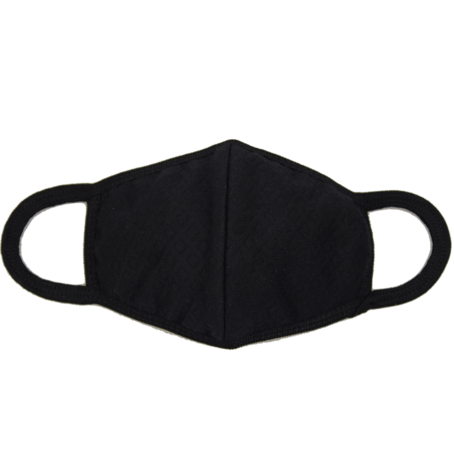
The ‘mask’ came off in less than six months. “Don’t touch that.” “Don’t do this.” “This is my house.” “Do not try to show off your learning.” “All your ideas are worthless” – they just kept coming at all times.
“Why do you need appliances? My mother did all these by herself. “
“But Khokha, things have changed now. Certain things are needed these days. Had they been available earlier on, my home would have been so very different.” Anupam’s mother had been the voice of good sense, not that she had much say in the house.
He would just stare at her. Bimala felt nice talking to her. A year after the marriage, a massive heart attack ended that life. They had been talking when the end came and Bimala was in a state of shock for weeks after that incident.
In summer months the house was unbearable. Bimala had not been used to this heat. Anupam had said that he would make provisions so that life could be nice. That was before the wedding. Kumar Kaku and Kakima too had said that he would do all that was needed to live life well. Nothing happened. Bimala tried to reason with him, he ignored her. That day, about a year and half after they had been married, the television was blaring and Anupam was watching the news. She tried speaking to him about getting an air conditioner, he turned away. She again tried speaking.
This time she switched off the television. He shouted at her. She tried keeping her cool, he refused to listen to anything. Suddenly he caught her with his two hands, he held her neck. He held her that way and pushed her from the living room to the bedroom, she tried to break free, but the grip was too strong. Bimala was so taken aback by the whole think that she could not utter a single word. He pushed her on the bed, holding her neck in his hands, shaking her. She struggled and struggled. After a while, he eased the grip, went into the living room, switched on the television.
She lay on the bed, crying in pain, in hurt, in humiliation, insulted. All for some cold air, to live life well. After some time, she got up, there were marks on her neck. Who should she turn to, she felt so lost. She called up Kakima and told her what had happened.
“Such things happen in marriages. Don’t pay much attention to them,” she said.
Bimala could not believe what she said, “Things will be alright now, you see.”
After the conversation was over, she took out her suitcase and started packing her things. The next morning she left.
Anupam did not say a word.
Baba told her, “You did just the right thing.” Ma was upset with the turn of events but they were both happy with the decision.
Bimala never went back.
***
It has been five years since then. Restricted by the lockdown, amid reports of an increase in domestic violence cases, she got talking about it that evening. I knew that was a traumatic period in her life. She had tried picking up her life little by little. I have known her for years and have seen her as she tried to begin things afresh.
“As I look at the masks that we are to wear these days as precautionary measures, I am so reminded of the masks that people always wore.” We were chatting online, and Bimala said, “Kumar Kaku and Kakima’s masks fell off after I walked out of that marriage. All those years of friendship with my parents ebbed so quickly. They never ever got in touch with us, never again.”
Dr. Nishi Pulugurtha is an Associate Professor in the department of English, Brahmananda Keshab Chandra College and has taught postgraduate courses at West Bengal State University, Rabindra Bharati University and the University of Calcutta. She is the Secretary of the Intercultural Poetry and Performance Library, Kolkata (IPPL). She writes on travel, film, short stories, poetry and on Alzheimer’s Disease. Her work has been published in The Statesman, Kolkata, in Prosopisia, in the anthology Tranquil Muse and online – Kitaab, Café Dissensus, Coldnoon, Queen Mob’s Tea House, The World Literature Blog and Setu. She guest edited the June 2018 Issue of Café Dissensus on Travel. She has a monograph on Derozio (2010) and a collection of essays on travel, Out in the Open (2019). She is now working on her first volume of poems and is editing a collection of essays on travel.
Dr. Santosh Bakaya is an academician, poet, essayist, novelist, biographer, Ted Speaker and creative writing mentor. She has been critically acclaimed for her poetic biography of Mahatma Gandhi [Ballad of Bapu]. Her Ted Talk on the myth of Writers’ Block is very popular in creative writing Circles . She has more than ten books to her credit , her latest books are a biography of Martin Luther King Jr. (Only in Darkness can you see the Stars) and Songs of Belligerence (poetry). She runs a very popular column Morning meanderings in Learning And Creativity.com.
Tsunamis of viral microscopic particles surge across continents to flood our cities, streets, and bodies. I stock up on masks, sanitizers, all that is anti-viral and anti-bacterial and watch my ‘home-store’ burgeon with a manic fascination ready to protest that I am not hoarding.
Day or night, I check the news and numbers before I sleep, when I wake up, and every hour in between with a strange obsession until the whirlpool of theories statistics pulls me down. I strike out. Fear. Anger. Grief. Shame. What should I feel and when? I clutch onto my planner and my to-do lists like a lifeboat only to see the ink fade and paper dissolve.
I click online to grasp a burst of pictures. I devour the jokes, memes, foods, and brain teasers for a few warm minutes until a cold post floats to the surface about someone who’s lost a friend, a friend of a friend, a good person, someone’s brother, sister, father, mother, aunt, or uncle. I mourn the loss. I knew them. The news doesn’t end. The news reports the youngest, the eldest, the first, the last, from my college community, or another group. Too many are leaving, and leaving too soon.
Being a seventy’s child, I look to the ‘old heroes’ in the West for leadership. Someone will step up and lead the way. Someone will find a free cure. Someone will save the world. Instead, I see the nations embroiled and torn in confusion, chaos and conflict as the numbers spike. My hope dissipates watching blame games, self-glorification, and trade wars. It’s a twenty-four hour non-stop live soap opera on the world stage. The headlines flash a new twist and slant until it’s hard to decode what’s true or not. I can’t help but grudge the movie directors for implanting a fallacy. There are no supermen or superwomen left there, or perhaps I am not looking in the right direction.
I meditate. I focus on the rhythm and the sound of my breath. I move with my breath as I inhale and exhale. A ping. My phone flashes, my heart lurches, and my attentions wavers. Lying on my yoga mat, I breathe long and deep while hundreds of thousands of young and old fight for each breath in crowded hospitals or might not even make it there and die at home or on the way. Should I look inward or outward, here, there or where? What should I pray for, who should I pray for, and in what order?
I step out for a walk and my husband turns back with a smile to hum one of his Steely Dan favourites. I snap, “Don’t do that.” He stares. I have no answers. I step out in fear, yet out of choice. Thousands don’t have a choice but to step out to earn a living. Thousands more are carried out in body bags to be buried into mass graves.
At home, I crib about missing my weekly trip to the grocery store. It is impossible to order online. I cannot see, feel or smell the fruits and vegetables. I moan when the plain yogurt runs ‘out of stock’, when the page stalls and crashes, when the message pops out that there are no more delivery slots, and when three of the thirty five items I have ordered are dumped out of my cart because they are not available. How do I forget that million will go hungry tonight?
I call family back home. The connection breaks. I call them again, and the connection breaks again. I sit down. A hot darkness swirls around me. I sink into a sense of loss. What’s happened? What’s wrong? No flights. No connection. No control. What will I do if I can’t reach them? The phone rings and I am able to breathe again.
I know then that if I lose control, I lose this battle.
Every day across the world, hundreds of thousands of government staff and healthcare and essential industry workers leave their loved ones to fight an amorphous and dangerous enemy. Can I do the same while staying home? They are at the front line. I must stand right behind them. It’s not their battle alone. It’s my fight too.
I cannot return to the past. I long to though, I admit. Yes, I can try to imagine a future, a better and different future, but I cannot control it. I straddle an uncertain present between the past and the future knowing I cannot go back and I have little jurisdiction over the future. But, in hedging between the past and the future, do I forget about the power of now, the power that I possess to change, to create change, to sustain change this very instant for myself, my family and for others around the world?
It’s not easy to open myself to the power of now. There are distractions, blockages energies that I have to move past or simply ignore. I push my own needs aside. It’s not about me. It’s about others. I stumble, fall, and then rise up again. When I focus on gratitude and goodness and all that is positive around the world, there is a shift, a change and opportunities glow around me. In wonder and silence, I appreciate and applaud the change-makers around the world. The virus is now part of my eco-system. It will recede but can rise again, mutate and swell again. Why do I wait and for what? If I live now, then I must live in this moment, to act in this moment and change in this moment.
I salute all the healthcare workers and the essential services providers for saving lives. I salute the charities and not profit organizations for helping the homeless, the needy, and the hungry. I salute the trainers, the teachers, the chefs, the artists, the writers, the poets, the drivers, entertainers, and comedians who keep young and old engaged and entertained at this time. I salute my husband who gives me hope. I salute the young Singaporean graduate of NUS school of Medicine who has built a website that makes translations easily accessible to all the medical care teams. And again, I salute the thousand of healthcare and essential industry workers who are in battle now.
I pick up the phone to call my loved ones. I click my phone to help charities and the communities of migrants that need food or medical supplies. I donate to the homeless, the hungry, the needy or just reach out or mail a note to someone who has made me smile. I share information that can help others. I reach out wanting to create change this very instant and now. If I open myself to the power of now and the power of this moment, then I open myself to immeasurable and sustainable change and part of the future I imagine.
Aysha Baqir grew up in Pakistan. Her time in college sparked a passion for economic development. In 1998 she founded a pioneering not for profit economic development organization, Kaarvan Crafts Foundation, with a mission to alleviate poverty by providing business and marketing training to girls and women in low-income communities. Her novel Beyond the Fields was published in January 2019 and she was invited to launch her book at the Lahore and Karachi Literary Festivals and was featured in the Singapore Writers Festival and Money FM Career 360 in Singapore. Her interviews have appeared in Ex-pat Living, Mount Holyoke Alumnae Quarterly, Kitaab, and The Tempest. She is an Ashoka Fellow.www.ayshabaqir.com
I know not how long this period of incarceration will continue! More than a couple of weeks have already sped by!
But believe me, days are not appearing long, neither the nights.
The self, I was groping for in the closet of my being, peeped out and hollered to me, “So finally we meet!”
I cheer up, eyeing a happy prospect of getting a friend, though supernatural, ‘otherworldly’ , or non-existent to the ordinary mortals like me! But I get a friend here, in this apartment, where stay I and the Self!
Last evening, just after I slurped the last drop of soup from my tureen, I saw her sitting in front of me, asking me, “So are you happy?”
She is my lookalike. I feel uneasy, sometimes, to talk to myself. But, when I see her crooning old, long-forgotten numbers to me, when I find her analyzing my past deeds with a serious face, I simply sit back, relaxed, thinking that I am in good hands.
Last evening, my next-door neighbour, rang me up to inquire about my whereabouts and said, “I find you in good mood these days. Yesterday, in the afternoon, while I was having my siesta, I heard you talking loudly to someone. But in these lockdown days, who has dropped in at your residence? Please ask him/her to leave at the earliest. You may fall ill. It may even turn fatal.”
I told her, “I was taking classes, online.”
“I see, then it’s fine.”
I am not just working from home, but I also love to indulge in exploration of the self and the world around me. I did not know that the afternoon sky has so many shades, apart from azure. I was not aware of the morning breeze that has a fragrance latent in its being. I had no idea that the cuckoo that coos beneath my balcony has a companion who answers its call from the coconut tree, standing tall in my neighbour’s courtyard. I was blissfully ignorant of so many things, how could it be so? Why was it so?
A few weeks of the lockdown are over by now. I keep wondering how a virus goes raging across the length and breadth of the world, claiming lives, taking pride in a large toll, escalating with each passing day. Just a microbial being and all experiments in all world-class laboratories are failing to discover a vaccine, let alone an antidote! All sorts of primitive measures are being followed: Wash hands again and again, as though an indelible mark of wrong-doing gets stuck in between palms of each inhabitant of this planet, which “ all the perfumes of Arabia” cannot sweeten, not to speak of washing it off!
Why are we being fooled by a virus, which if contracted, or smitten with, will land us straight before the gate of Paradise, nay Hades? Or if spared, may leave us crippled with a pair of weak lungs? I cannot think any further.
At one point of time, I kept toying with the idea of going out. Yes, I am running out of provisions. I have curtailed many a thing, putting embargo (self-imposed) on luxuries; for example, I am not casting a glance even at the chocolate bar, the last of its kind, lying at one corner of my fridge, trying to lure me with its tantalising taste whenever I fling open the refrigerator-door! I am now going to curb all of my cravings, it seems.
My mom used to say, “You can attain nirvana by saying ‘no’ to all sorts of temptations but winning the allurement of chocolates would be the Achilles heel, for which your nirvana might have to wait or be deferred to an unknown date in future. You may even cease to exist without tasting the nectar of nirvana!” Nirvana or no nirvana, I was happy with my irresistible love for chocolates! But these days, I am trying to say ‘no’ even to chocolates! If by any chance, I nibbled at the last bar, what would happen if I felt a craving at midnight with no chocolates around? So, I have to save it for some unforeseen desire for it!
When through my balcony I cast a glance overhead at the purplish-black sky, I can see a few stars, a few dim celestial bodies but I cannot tell one apart from the other. I try to trace the Milky Way, but a zigzag row of stars pop-up, which might or might not be the one. Standing there, for quite some time, I was trying to empathise with the people from all walks of life, who are terribly affected by this lockdown, a 21-day-period of total collapse of social life, gregarious existence of the populace, beyond home, even normal buying-and-selling in the shops.
The picture at a medicine shop may be different, chock-a-block with people, who are queuing up mostly to buy Vitamin B or C strips or even expectorants or common medicines for cough and cold or diarrhea. I went out only one day after a gap of about fifteen days to buy essentials, mainly eggs and biscuits. That too, at about seven in the morning. I was astounded to see the busy thoroughfare, which generally teems with life at cockcrow was desolate. Absolutely secluded. The old man who used to sit and beg outside the metro station was not there anymore. I was worried as I used to buy him medicines for his heart condition.
I found the dog, who is generally sprightly and feisty, sitting dejected, in front of the closed shutters of a shop. I was happy to see the birds chirping on the trees. They trilled, crooned, twittered, whistled as they pleased. They were probably so delighted to find a sky — clear, above their head, with not a speck of smog in it. The greenery outside got a shade extra, it seemed.
The air outside also seemed fresh. The roads were just devoid of the shouts and screams of the jostling crowd, there was no sign of any sick hurry of the regular commuters to distant places. It appeared as though, life needed a respite, the thoroughfares needed a break from daily schedule, a nagging routine. The small lane that leads up to the main road usually stay crammed with vehicles since 6.30 a.m., but the serene road seemed to enjoy a breather with no vehicles honking or waiting in a long queue. The traffic light changed colours as usual, but there was no hurry, no avid wait of people for the ‘red’ changing to ‘green’.
The sweet shop was about to open its doors. As I looked at it like a sleuth with my surgical mask on, the man drew a cloth mask from the counter and kept tying it round his nose and mouth. All of us, who came out risking our safety, were behind masks, as though to conceal our identities. A terrible something was about to transpire, it seemed. Only Nature and its feathered creatures seemed to have a field day. I could not sing within, I caught myself unawares, praying for the corona-affected patients who fought for life on the hospital bed, “Oh Lord, give them life! Let all the people come out unscathed and come around soon. Let others who are yet not affected by the viral attack enjoy health and secured existence. Amen.”
I was coming back that day with a vow to stay indoors from then on, and not to come out at all, howsoever necessity it would be. I haven’t reneged on my resolution as yet.
Ketaki Datta is an Associate Professor of English at Bidhannagar Government College, Kolkata, India. She did her Ph.D. on Tennessee Williams’s late plays and later it was published, titled, “ Black and Non-Black Shades of Tennessee Williams”. She has quite a few academic publications along with two novels, two books of poems and quite a few translations. She had been interviewed by Prof. Elisabetta Marino, University of Rome, archived by Flinders University, Australia. She won grants for working at American Studies Research Centre[1993,1995], Hyderabad, India. She presented academic papers at IFTR Conference[Lisbon], University of Oxford and University of California, Santa Barbara. Her debut collection of poems, Across the Blue Horizon, had been published from U.K. with the aid of Arts Council, England. Her latest poetry-book, Urban Reflections: A Dialogue Between Photography and Poetry has been published by KIPU, University of Bielefeld, Germany, with Professor/Photographer Wilfried Raussert [photographs of Street Art of Americas]. She has interviewed American novelist, Prof. Sybil Baker, recently for Compulsive Reader. She is a regular reviewer of poetry volumes with Compulsive Reader, USA. She interviewed poet Lucha Corpi of San Francisco, in 2018. She is the Regional Editor, India, of thetheatertimes.com, headed by Prof. Magda Romanska, Emerson College, Boston, U.S.A.
Dustin Pickering on Shakespeare’s The Taming of the Shrew
A literary work is often a code that reveals distinct things. Sometimes these things are simply too advanced or the logic of them too cruel. The Taming of the Shrew is one of Shakespeare’s most performed plays and its language is easily read and understood. However, the embedded symbolism may pass by even the most astute mind.
The play is obviously about gender battles, and it seems to some that Kate is tamed by her husband. However, a deeper look at the intricately woven tropes exhumes a critique of culture, a sense of equal justice, and the way institutions impress on our minds. The play extends beyond property relations and the inequality of women. It also poaches one of theatre’s daunting faults. In Shakespeare’s day, women could not play the female roles and instead teenage boys were selected. The theatre was considered dangerous and women too unfit to perform. There was lead in the makeup and the stage action too rough. Theatre was too bawdy.
The Taming of the Shrew contains puns on horses, games, “moveables”, music, and theatre itself. Props or “furniture” signify costumes; there are witty puns revealing the dissembling nature of appearances. In Act IV, Scene III, Petruchio says, “And as the sun breaks through the darkest clouds, / So honor peereth in the meanest habit.” The sun in this respect is the human mind because it is “the mind that makes the body rich”. After Petruchio is delivered a faulty wedding dress, he pontificates on the problem of physical beauty. It is true that he uses this reasoning to tame Katherina. It is part of the ploy to obfuscate her with a list of her own faults. He seeks to embody her worst aspects so she can learn from them how devilish they are. This discussion concerning the gown further moves toward critiquing the use of teenage boys to fill roles meant for females. Again, Petruchio: “is the adder better than the eel, / Because his painted skin contents the eye?” I remind the reader of the lead makeup.
Perhaps Shakespeare intends to remind us real world experience supplements bookish learning. When Vincenti is confused with a young virgin boy by Katherina (Act IV, Scene V), she realizes her error and admits to being “bedazzled with the sun”. Taking up from the aforementioned sun symbolism, Katherina’s error stands in as a trope for pure reason. With pure reason absent of categories, all things merge without identity or qualities. Her vision of green is one of seeing the world “light”. Much of the symbolism in The Taming of the Shrew references binaries such as bottom/top and heavy/light. There is a wild pun on the nature of matter. Actualities contain density while potentialities are ethereal. In an early passage, Tranio prescribes a middle way between the Stoics and Ovid. He advises Lucentio, “The mathematics, and the metaphysics, / Fall to them as you find your stomach serves you: / no profit grows where no pleasure is ta’en.”
Other engaging puns bring to mind property relationships of the Elizabethan era. A role reversal encouraged by Petruchio, of Katherina and Dian, and the playful engagement of dungeon metaphors parody imprisonment. I doubt it can be said with certainty what sort of political statement Shakespeare is making. Is he reflecting the faults of that era, or is he acclimatised to them? The bandying about concerning an imprisoned Kate, her shrewness, and the several occasions where property relations speak on their own behalf invite me to this conclusion: the play is comedic not just in form, but it is a satire of an unequal socio-political environment.
Continuous role reversals, contradictions, and allusions to myths concerning rape and chastity lead me to assume the play indicates that property relations sever our deepest humanity. Katherina can either be her husband’s chattel slave, or she can remain chaste. Both these options are not appealing and neither can be safely ruled out. Perhaps Petruchio marries for the dowry, or maybe he realises his error. After all, the play puns and moralises on looking beyond surface appearances.
Katherina is intent on remaining a shrew but Petruchio is set in taming her. Perhaps in the process both learn something new.
Dustin Pickering is the founder of Transcendent Zero Press and editor-in-chief of Harbinger Asylum. He has authored several poetry collections, a short story collection, and a novella. He is a Pushcart nominee and was a finalist in Adelaide Literary Journal’s short story contest in 2018. He is a former contributor to Huffington Post.









 Borderless