Categories
Musings

COVID-19: Days by the Arabian Sea

By Gracy Samjetsabam

COVID-19 lockdown continues. I am stationed in a small modern town, surrounded by rustic villages in coastal Karnataka. From some of the tallest buildings in the locality, you can see the mighty Arabian Sea in the horizon, far and wide like a steamy mirage. It’s dreamy!

As uncertain as the pandemic, the day kicks off with the thoughts of the “what ifs,” “What numbers?” and “What next?” Waking up to birds chirping, calm sunrise, though the sun’s the same — shining bright and ever brilliant — I wondered if today was going to be the same or any different. It was the same. It was a melodious morning with birds chirping and singing, except that I was missing the honking and bonking of the pre-office and office hours rush of children and people moving, waiting, walking, rushing, driving in or away, or embarking on their respective buses to work or school. My mind was not merry but having decided to ceremoniously spend some time in the garden before breakfast, I freshened up and invited my husband to join me. He isn’t always interested in garden stuff but agreed. In disbelief, he uttered, “COVID-19, it’s truly a Black Swan situation.”

I called home to find out their condition. Unsurprisingly, identical stories of the contagion loomed large enmeshed with gloom, grim and grimace. Feeling cynical, I asked my husband what would happen if things would get worse? Would we never go out again till some vaccine or a solution took the form of a saviour, or, if things got out of control, would we all fall sick and die — unable to get back to the old normal?

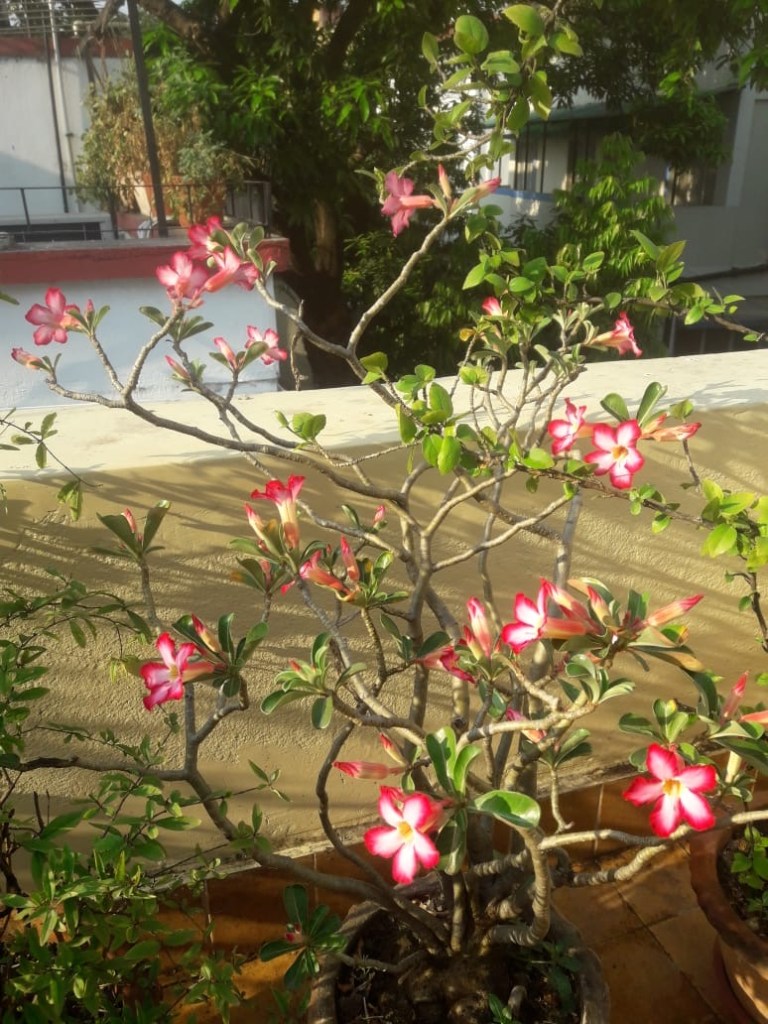
He just said, “Don’t be silly. It will be over soon. I mean, it has to …” Watering the plant leisurely, I was happy for those moments that I was able to spend tending plants, admiring the blooms and nurturing my garden. I wanted to think that this day was going to be a blessing in disguise.

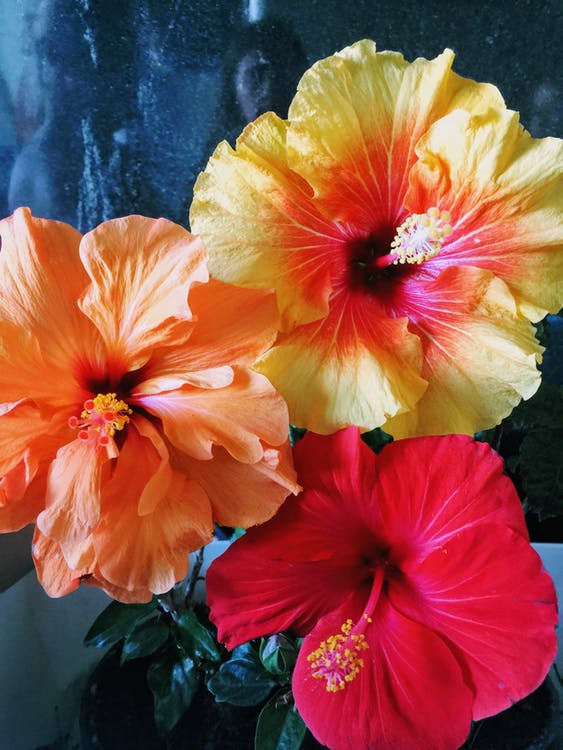
Multi-coloured Hibiscus

As I watered the plants, I was greeted by a couple of sunbirds sucking the nectar of the multi-coloured variety of hibiscus plants that grew along the fence in a row interrupted by jasmines followed by a parade of Ixora flowers mostly red, a couple of tall jackfruit trees bearing jackfruits big and small, a middle-aged cashew tree, a budding chikoo tree, curry leaf trees with its young ones sprouting around it like little children gathered around to listen to stories and, an alternate of tall coconut palm trees and lanky areca nut trees in each corner.

In one of the corners, was a family of plantains with one out of the two bigger ones that stood out gracefully, bearing tender bananas. They hung like braided hair with a flower at its tip. As I reached the corner, I could look up to the coconuts that hung so bountifully with spiky leaves that stretched out fiercely and proudly against the azure sky. For a moment I felt I was wrapped in a blue bubble.

I thought the sky is the same as the one I had seen from the rooftop of my house in Imphal on certain days when there were no clouds and the sky was exceptionally clear. But as I continued to look up almost breaking my neck, I twisted my head a little and wondered that it was the same sky yet it was different like a picture with filters. Spellbinding both though, in their own ways. 

Coucal

Spotting a greater coucal (crow pheasant) taking a quick-short flight from the cashew tree to the bushes reminded me of the Hume’s pheasant (Nong-in), the state bird of Manipur, which too loves to utilise the early hours of the day for food and fun. It reminded me of the familiar and at the same time made me curious.

Atypically, I missed rava idlis for breakfast, which I relished on certain mornings in the canteen, and so I had made plans to finally try cooking some at home. I always thought that the people of the place made it best, which surely is the case, but I thought of giving myself a chance. I looked up for the recipes and the procedures and made some with the emblematic coconut chutney. As I gave the final touches and made ginger tea, I thought of friends and family in this cosmic crisis. I could not help but feel heavy in my heart. I poured the hot aromatic tea into my favourite cups.

We were supposed to be home at this time of the year. By home, I mean my home in Manipur. A time we always look forward to, as the summer breaks are long and it has become a luxury to spend time at my home with dear and near ones. Along with the idea of longing and belonging, the idea of home too, keeps redefining with the passing time. And each time it gets defined, I get redefined too.

I remember, the first time I saw the Arabian Sea, it breathtakingly blew my mind. At the first glance, I felt like I was on the moon. The sea was calm and teeming blue. On the contrary, during the monsoons, the sea is wild, rough and voluminous. The sea, the waves, the sounds and sights of the beach slowly, becomes more familiar, the more I visit, the feeling is the less of a surprise but more of an endearing one.

Precarious as it may seem, the pandemic injected a moment of retrospection on the accustomed and the unaccustomed.

I continue to hope. I looked out into the garden from my window and smiled contentedly. I picked up my cup, sipped my tea and thought of home and of homes, at home. It captivatingly dawned on me that it was quite the same, yet not the same.

Gracy Samjetsabam teaches English Literature and Communication Skills at Manipal Institute of Technology, MAHE, Manipal. She is also a freelance writer and copyeditor. Her interest is in Indian English Writings, Comparative Literature, Gender Studies, Culture Studies, and World Literature. When not reading or writing, she loves to indulge in Nature.  

Categories
Poetry

To Do list & Morna

To-do List:

Today I will fall out of love with you.

I’ll sweep out the motes of dust
that clung to your feet. 
Each speck a single story, 
of your worldly being. 
 
I’ll climb ladders for the distant corners, 
to clear out limp cobwebs of words, 
whispered and strung in secret —
prose patterns of our desire. 

I’ll pick out tea leaves caught in the sieve,
filtering out sweet and twilit memories. 
A steel scrubber for the grimy pits of pots, 
dredging out the darkness of difficult days. 

I’ll dig out from under my nails, 
the memory of your skin. 
Make sure to clean behind my ears,
the salt of your lips.

I’ll iron out the creases of your smile, 
and allow my heart to ache for a while. 
Stretch out my fingers in vain,
and tremble for your touch. 

I’ll cap love off with a shot of whiskey.
A quick fix for the spirit.
A cinder for my belly.
A reminder to never quit it. 
MORNA
The Cape Verdeans call it their national music
A balm for the dis-ease of seafaring journeys.
Destined as they are, these archipelagic folk,
to grow roots in stormy waters.

The lips of waves carry these drawn out sighs,
a thousand and more exhalations.
The ocean laps up these lamentations.
Swayed as she is by their mournful preoccupations.

It is this suadade that breaks upon our calloused feet,
tempting us to wade and wallow deep.
And we dive in —
hungry as we are for borrowed emotion.

By Himani Sood

Himani Sood is a middle-school Humanities teacher currently residing in Mumbai, India. From a young age, Himani has found cathartic relief in writing in a myriad of forms, ranging to the more austere conventions of academic papers (which, she wishes to add, she happily disobeyed) to a number of comedic school productions. These poems mark a return to an art form she long-neglected — it is an attempt to connect with a long-stifled inner voice. 

Categories
Interview

“There is a voice within me/ That will not be Still”

Nalini Priyadarshni in conversation with Anu Mahadev

An abuse victim in the past, Anu Mahadev is a poet based in New Jersey. She is a 2016 MFA graduate of the Drew University’s MFA program in Madison, NJ. With two poetry collections to her credit, Myriad (2013) and Neem Leaves (2015) Anu is a curious reader and lifelong learner. She is passionate and outspoken about issues such as domestic violence, girls’ education and independence, and depression/bipolar disorder. She loves music, languages, animals and long walks. She writes and edits at The Woman Inc., and Jaggery Lit, a literary magazine for Indian diaspora. In this exclusive, she responds to questions from feminist poet Nalini Priyadarshni.

Nalini: Thank you so much, Anu, for taking time to talk to Borderless Journal. I have enjoyed reading your poetry for its vivid imagery and the subtle imprints it leaves on one’s mind. If you have not been asked umpteenth time already, let me ask, why do you write poetry? What is your goal?

Anu: Thank you Nalini for this interview, and for reading and appreciating my work! To me, poetry has always been my favourite form of expression. I write simply because I have to. I am an introvert by nature, and writing is not just my outlet, but my raison d’être. It is not a “hobby”, but what I do, and I do it because I don’t know any other way to be. I do not have a far-reaching goal in mind but I do think it is important to keep the arts alive. If I can change the way people look at the world, through a different lens, by the power of the written word, I would be happy.

Nalini: When is a poem done for you?

Anu: I don’t think I have a fixed rule for that. I try not to wrap my poems with a pretty little bow at the end. I do believe in revising and editing though. The first draft is seldom my final piece. That’s something I had to change about my writing – my impatience. The teachers at my MFA program insisted on it, and drilled it into my habits. Sometimes I even revisit a poem 6 months later with a fresh pair of eyes, and I may have an epiphany! When I feel like I have conveyed what I want to, with just the right words, with economy, I consider it done. Less is more when it comes to my writing.

Nalini: How does a poem begin for you — with an idea, an image or a form? Let’s just say, what triggers a poem?

Anu: My poems are usually an emotional response to something that is happening around me. Either something I’ve heard or seen or felt – sensory triggers basically. Or a memory from a long time ago, that has morphed into something different in the present. I don’t go seeking a poem. It comes to me when it has to. I do not force anything. I’ve been told to set aside time to write every day, which I probably should do, but I don’t believe my best work comes that way. I find that taking a break keeps my writing muscles fresh, and then I can be more open and receptive to what the world has to offer me, in terms of images and ideas. I am not a big fan of forms, and don’t write them unless I am forced!

Word of Mouth

Alive in the ice and fire, was a package

of minutes with no expiry date.

We unwrapped layer by layer,

unraveled the novelty, the raw scent

of unopened nerves, neatly tied up

in twine.

You said people don’t have a shelf life,

and I laughed.

Then we tasted the hate that comes only

from familiarity, it’s boring faults,

its ripened haste like a cashew flower’s

early bloom.

You said it’s a car with no brake pedal,

no insurance and no collateral damage.

I believed you then, when there was

nothing left in the airwaves but static,

doubt and guilty breathing.

Alive in the ice and fire, is a story,

its tiresome minutiae, and I still

gape at its impossibility with impatience.

Nalini:   Plath said, “Everything in life is writable about if you have the outgoing guts to do it and the imagination to improvise.” What is your opinion?

Anu: I believe the next line is “The worst enemy to creativity is self-doubt”. I agree fully with her quote. There is no reason to limit yourself to just a few aspects of life, because you are experiencing those at the moment. The world is your oyster, as they say. Everyone always has something interesting to say, whether they know it or not. Everybody has a story to tell. The fear of whether you will get published, or what if people don’t like it, should not come in the way of your writing. Easier said than done, I know, and it does seem daunting. But write the story, the whole story, and worry about revising later. Everything will come together at some point. Be brave enough to explore your soul.

Pencil

her pencil writes —

of styli, quills

scratched sound waves

impenetrable

between the lines

wood shavings

scattered word fragments

soft chipped graphite

shaded fingertips

empty notebooks wait

in silence, ruffled pages

reams of white

soon to be covered in print

this day

broken only by these faint

noises, muffled roar

traffic, teapot, dryer

her tapping toe rings

against the chair

the pencil writes —

of such things

when her thoughts

cannot sing her song

Nalini: Some of your poems come with a tinge of nostalgia such as– photograph in b/w, saudade while some of your poems like Laws of Poetry and Needlepoint Theory advocate breaking down old order. What can you tell us about this tension between belonging and charting new paths?

Anu: I don’t believe there is a tension or a tug between the two. Yes, I tend to write a lot about the past, the memories of growing up, family ties and so on, but also about what affects me in the present and what the future holds. Some poems are keen and curious observations about what a character might be feeling at a certain point of time. Some are extrapolations of my experiences, where my imagination takes over. I am equally part of all of these. Maybe I tend to write about loss more than anything else, and the pain associated with it, but these are personal experiences, and it is cathartic to write about them.

Photograph in b/w

sepia toned acacia tree, two

little girls standing—

one, bigger, smiling, two

dolls in her hand

one, smaller, wailing, one

doll, clay-baked mud

matching dresses, hairbands,

shoes, one happy

— she’s not an only child

anymore, she won’t

share though, the other

screams for mom

separated soon after birth,

reunited as sisters

strangers in the womb

awkward, holding

hands, trying to understand

how a family behaves

the definition of love, where

it comes from

Nalini: Do you recall a moment in your upbringing or childhood that, when you revisit, seems to presage for you a life in poetry and writing?

Anu: I think that being a shy and quiet child led me to books and writing, long before I realized that it was to be my passion. As an introvert, I grew up to be very observant about others and the world around me, and felt that I could see what others simply took for granted. As a sensitive child, I was generally ignored at school. Left to my own devices, I gave myself the freedom to explore. Without cellphones or Google, and with plenty of time to be bored, my imagination soared. I guess around the age of 10 till about 17 is when I wrote plenty. Life took me in other directions after that – engineering and computer science and so on. I got my second wind after my son was born and I was home for several years. It felt like poetry had never left me. I started writing again and enrolled in an MFA program for poetry at Drew University. After that, there was no looking back.

Nalini: How did you overcome the trauma of abuse to lead a normal life?

Anu: I suffered mental and physical abuse for four years in the mid 90s. Coming out of it was a Herculean task because first of all I did not know that I HAD to come out of it. As a victim I had learned to accept things as the status quo, believing that I had no other choice and that it was fate which brought me to that situation. Whatever little self-esteem I had had been eroded to such a bad degree that I could not think for myself any more. But the two things that were untouched were my faith, and my love of books/writing. Those too would have gone had I stayed longer, but I soon understood that this was a toxic relationship. And that it was better to be alone, no matter how terrifying that sounded.

Nalini: What role did writing, in general and poetry in particular, played during this difficult phase of your life? And how has it changed your perspective since then?

Anu: Overcoming the trauma was no small feat. What I did not know at the time was that I was also suffering from chronic depression. At first, building myself bit by bit felt like an ordeal, but soon, having removed the bad influences from my life, it was actually peaceful. Nobody to boss me around or show me the consequences if I did not do something right. Or waste my time after a long day at work. I returned to books and kept a small journal to chronicle my thoughts and my progress. Over the years, I have written more about living in abuse, and seeing my life on a sheet of paper has been surreal, but it helped a lot to write openly about that phase and get it out of my head. From believing that nobody would love me, or that I was not fit to have a normal life, I now believe that everyone is deserving and capable of love.

My desire is to help women in a similar situation understand that the power of the written word can work wonders. They light the fire that results in changing a thought. I know it seems crazy but Tagore’s “Where the mind is without fear” would help me. It was for a country, but at that time, I felt like it was written for me to wake up and take action.

“Star-crossed”

I remember a different time when Orion brought us

good luck. When the Big Dipper would point to Sirius,

and we thought the spirit of every dog lived there

When I would stare at your freckled back and look for a map of cities

where we would go, where we would separate

The hunt is important, you would say, so is the capture

who cares what happens after that?

They say it’s easy to get anything, maintaining is the hard part –

clothes, toys, luxury items,

relationships,

you with your blasé look — I, still hungry, look for a side of a cold bed

that’s no longer slept on

Your mind, partitioned into different countries,

a concubine in each harem, an echo in each chamber

I’m singing the same song, in a different intonation,

the way you did when your tongue first caressed my nape, my mouth,

my name

Crumbs of red velvet are still crumbs, in a vagabond’s palms.

Nalini:   We live in an age of Twitter and Instagram. There is a deluge of poets writing micro poems and riding on instant fame. It might seem that poetry has become more popular in recent years but is it really so? What do you think of instant/micro/4-line poetry written around popular notions?

Anu: I have nothing against micro-poetry, as long as it is well done. 4 lines can sometimes convey more than 40 lines. And as for the popularity, one can say they are easily relatable to the masses, therefore they become famous. However, the trend I observe is that there is nothing fresh about the poems themselves – they are trite and clumsy. I am not saying that someone has to come up with some out of the world topic – come to think of it, many poets write about the same things, but they do so in different, refreshing ways. That is what I find lacking these days. And in general, the opinion is that it is very easy to become a poet, as opposed to a fiction or a screenplay writer, and therefore everyone feels like taking it up. I have a problem with that J Poets go through rigorous technique training too, just like the others, and so, writing 4 lines one day doesn’t make you a poet. They are born, and then made just like in any other profession. I am not trying to sound like a snob. Certainly, everyone has the freedom to write, and everyone’s aims are different. If you want instant fame, sure social media will do it for you. But if you want to write everlasting poetry, something that will be quoted for generations to come, then that isn’t the way to go about it. I am getting to know several poets who write beautifully but don’t have a book out. So that definitely is no measure of success!

Nalini:   Talking of social media, Facebook poetry groups are ubiquitous. I keep removing myself but still I must be in a million groups. Though I must admit they are great places to read, share one’s poetry and interact with other creative minds. Poetry group, The Woman Inc.  that you run is one of my favorite for the powerful poetry it shares. How do you think internet and social media contribute towards well-being of the poetry?

Anu: I think it is great that these groups exist. I was a hesitant poet once, very unsure of my writing, and these groups gave me the confidence that I too could write. What I like is that the feedback is honest and sincere. I don’t like groups where everyone simply praises each other for a great poem, whether it is true or not. And if I am added to such a group, I remove myself. I myself started a small Facebook group for New Jersey based South Asian poets, where we post our poems and solicit blunt critique. That is the only way to grow. It is great for the future of poetry because budding poets come alive and develop their writing skills, and go on to write far better than when they started out with. Not to mention the community it creates. Such communities are important for the arts to thrive.

Nalini:  And now a question that all those who write poetry ask themselves at some point of time — what does it mean to be a poet?

Anu: According to me, being a poet means being connected to a deeper part of yourself, and feeling each moment, each ripple. The response that you create when you see something that moves you – a painful event, an injustice, a happy moment, the beauty of nature – these are just examples that make you want to bring about a change, even a small one, in the world. I think being a humble student for life is a poet’s personality. There are days when I struggle with the impostor syndrome, thinking I don’t belong here, or my writing is awful. But to persevere, and have faith in that part of yourself that is able to capture a different view of the world, is what makes you a poet. To be able to distinguish between seeing something and looking at something, to be part of that self-discovery that expresses who you are as a person, defines who you are as a poet.

Nalini: Any words for budding poets?

Anu: Read! Read your favorite poets, poets you’ve never heard of, the classic poets, the Pinterest poets, anything you can – this will expand your horizons and you will also learn to distinguish between different varieties of poetry, different styles of writing before gravitating towards some and developing your own style. And write regularly. Continue writing – I cannot advise that you do it every day because that is not what I do – but often enough, and find a mentor, a sounding board whom you can approach from time to time.

Also, start slow, and then find journals to submit to. You will get a lot of rejections before you get an acceptance, and that can be frustrating. But if getting a poem published is that important to you, then keep at it. You are creating something out of nothing, and that is a powerful skill. Be engrossed and be committed to your art. Feel each word. Get your ego out of your head and be open to receiving feedback. And in the midst of all this, don’t forget to have fun in the process.

Nalini: Thank you so much, Anu. It was a pleasure talking to you.

Anu: Likewise, Nalini! Thank you.

(This interview was conducted via email.)

Nalini Priyadarshni is a feminist poet, writer, translator, and educationist though not necessarily in that order who has authored Doppelganger in My House and co-authored Lines Across Oceans with late D. Russel Micnhimer. Her poetry, prose and photographs have appeared in numerous literary journals, podcasts and international anthologies including The Lie of the Land published by Sahitya Akademi, New Delhi. A nominee for the Best of The Net 2017 she lives in Punjab, India and moonlights as a linguistic consultant.

Categories
Musings

Creativity and Corona: Responses of Artistes

By Ratnottama Sengupta

Dil dhundta hai phir wohi fursat ke raat din

Baithey rahe tasavvur-e-jaana liye huye…

Garmiyon ki raat jo purvaiyaan chaley

Thandi safed chadaron pe jaagey der tak 

Taaron ko dekhtey rahe chhat par parey huey…

My words for Gulzar’s lyrics taking off from a Ghalib couplet?

Once more, my heart seeks 

Those days and nights of leisure, 

To simply lose them

In thoughts of the beloved!

Or, the balmy summer night 

When the Easterly breezes in,

To stay up till it’s dawn 

Only gazing at the stars…

Lying on cool white sheets 

Spread out on the roof…

Gulzar Sa’ab, how many more stanzas would you add to these lines, now that we have endless fursat ke raat din (days and nights of leisure)? 

A lot of people are seeking — no, not days and nights of leisure but ways to harness the close-door hours that are stretching on and on, yet leading to heated debates the world over whether to end or to extend the lockdown for some more days/weeks/months…

Meanwhile, the students and teachers of FTII — Film and Television Institute of India — have been making short films exhorting us to stay at home. Bollywood stars led by Amitabh Bachchan and including all others, have made a comedic short wherein they’re all searching for Big B’s misplaced chashma or glasses — from the confines of their individual homes.

Celebrated actor-director Aparna Sen has used the distancing hours to translate and audio recite evergreen poems of Tagore and Jibanananda. Members of the Contemporary Dance group Sapphire have been recording their creations conceived and executed in artistic isolation. Nandita Roy and Shiboprasad of Windows have come up with a series beginning with Hing or Asafoetida, a short about how being locked at home is providing new insights into the role of homemakers. Director Debesh Chatterjee has used Nabarun Bhattacharya’s concept of Fyataru – flying humans – to cinematically comment on the plight of people stockpiling food. 

With Tobu Maney Rekho (But Remember),  actor-anchor Aparajita Ghosh has initiated Galpo Toru, an audio series recording stories by contemporary authors from Bengal and Bangladesh. My dancer-actor niece Priyamvada Kant, living in Mumbai away from her Delhi-based parents, has made a short that asserts social distancing does not mean Dil Se Door (Far from the Heart). Documentarist Arindam Saha Sardar has crafted Ghaire Baire (Home and Outdoor), and Manush O Maanchitra (Contours of Human Subsistence), both involving his seven-year-daughter, Rupkatha. But what I’ve been most taken up with is You Can Fly by Kumaar Chowdhury wherein a little boy climbs up to the  roof or chhat and lets loose his imagination… 

Because? It comes closest to my experience of rediscovering the chhat — the key word of Gulzar’s lyric from the feature film, Mausam. Every flagstone of the open terrace on my house in Kolkata is shining like marble. Not one dry leaf in sight, and not just crows but doves and sparrows, bulbuls and mynahs are flocking to drink  from the earthen gamlas (basinets) I fill up for them. Ever since Biplab and Biru — the brothers who water my obsession with plants — bowed down to the lockdown, I have been going up to the terrace sharp at 6 pm, armed with a khurpi (hand trowel) and pruning shears. The hundred-and-more plants have never been so happy. The buds are blossoming into lilies and roses, adenium and petunia, genda and mogra, jaba and sthal padma, birds of paradise and orchids too!

This has prompted my husband to spend an hour in the morning and three every evening on the rooftop. The morning walk up the stairs mitigates his lack of exercise, and he paces the terrace too — a necessary part of the recovery process prescribed by doctors for his recent illness. And in the evenings he lies on a cot looking up at the stars and listening to music and jokes and stories on his handset. 

But bear with me: this piece is not about us. I have been amazed to see how many people have brought their so-far neglected rooftops back to life. Biswanath, CA by profession, finishes his brisk 30-minute walk on the house to our left. And on my right Bubai, my son’s childhood mate — in forced separation from his wife and baby girl stranded in Pune — is watering the plants for his mother. Across the street, Kailash has been putting to good use the cycle his ailing Mama is unable to exercise. As the boys are back from their campuses, the Bagadias next door have added clotheslines to sun-dry the joint family’s washing. One house away, I spot Aalo’s Dada assiduously keeping his mask in place when he alternates with his wife on the rooftop walks! From the adjacent terrace Ramola Di waves back a “Howdy?” in reply to my “Kemon achho (How are you) ?”

Diagonally across, on the rooftop of a multi-storied structure, I see three heads — one salt-n-pepper, one bald, one raven black — bobbing up and down.

“Are they playing badminton?” I wonder to myself. For, the terrace of the stand-alone next to theirs has been converted into a maidan by a lone child who’s scoring run after run with his football!

This brat, away from school, is not wanted downstairs where his mother is juggling with the mopping-chopping-cooking-serving-washing-cleaning as her kaajer mashi (home help) cannot relieve her from the drudgery of chores, while his father gravely sits before his laptop to comply with the ‘work from home’ ruling of his bosses. This child is not allowed to play with the neighbourhood kids, nor is he permitted to fiddle with his parents’ mobile phones. Lonely? He is. Forlorn? He is not. For he has his football, his terrace, and the liberty to let his imagination fly!

It is this liberty to fly, riding on imagination, that has fuelled the aforementioned Creativity in the countdown times of Corona. For, as Vilayat Khan once said to me, “If I don’t play my sitar for 2-3 days, saaz bhi kitne nakhre kartey hain ( even the chords will play up)! I have to put so much effort to appease them before I can tune them.”

A true artist can, then, never sit idle.

Remember Bengali litterateur Manik Bandopadhyay’s Madan Tanti? When the weaver of classy Balucharis grew tired of idling the days of bandh (strike), he sat on his loom all night, weaving the warp and weft — without a single strand of thread!

Ratnottama Sengupta turned director with And They Made Classics, on the unique bonding between screen writer Nabendu Ghosh and director Bimal Roy. A very senior journalist, she has been writing for newspapers and journals, participating in discussions on the electronic media; teaching mass communication students, writing books on cinema and art, programming film festivals and curating art exhibitions. She has written on Hindi films for the Encyclopaedia Britannica; been a member of CBFC, served on the National Film Awards jury and has herself won a National Award. The former Arts Editor of The Times of India is also a member of the NFDC’s script committee. Author of Krishna’s Cosmos and several other volumes, she has recently edited That Bird Called Happiness (2018/ Speaking Tiger), Me And I (2017/ Hachette India), Kadam Kadam (2016/ Bhashalipi), Chuninda Kahaniyaan: Nabendu Ghosh (2009/ Roshnai Prakashan).

Categories
Poetry

New York & more…

Poems by Pavol Janik, a virtusoso of Slovak Literature

(translated by James Sutherland Smith)

PAVOL JANIK | VIRTUOSO OF SLOVAK LITERATURE 


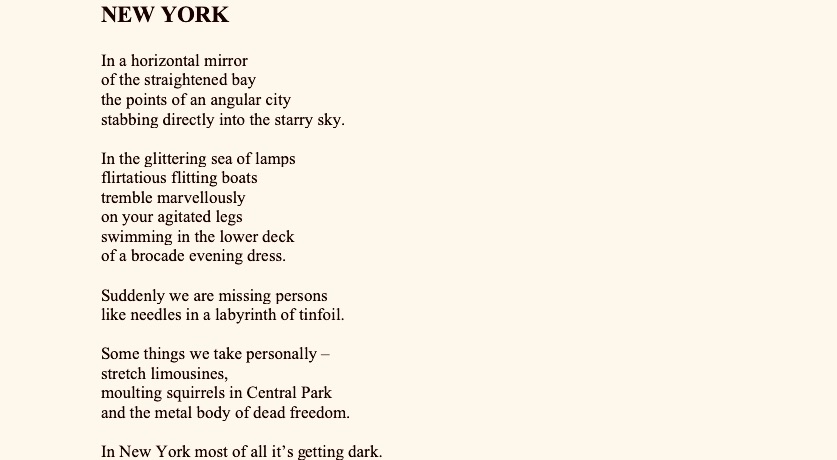
NEW YORK 


In a horizontal mirror
of the straightened bay
the points of an angular city
stabbing directly into the starry sky.

In the glittering sea of lamps
flirtatious flitting boats
tremble marvelously
on your agitated legs
swimming in the lower deck
of a brocade evening dress.

Suddenly we are missing persons
like needles in a labyrinth of tinfoil.

Some things we take personally –
stretch limousines,
moulting squirrels in Central Park
and the metal body of dead freedom.

In New York most of all it’s getting dark.

The glittering darkness lights up.

The thousand-armed luster of the mega city
writes Einstein’s message about the speed of light
every evening on the gleaming surface of the water.

And again before the dusk the silver screen
of the New York sky floods
with hectoliters of Hollywood blood.

Where does the empire of glass and marble reach?
Where do the slim rackets of the skyscrapers aim?

God buys a hot dog
at the bottom of a sixty-storey street.

God is a black
and loves the grey color of concrete.

His son was born from himself
in a paper box
from the newest sort of slave.


A DICTIONARY OF FOREIGN DREAMS


At the beginning it was like a dream.
She said:
“Have at least one dream with me.
You’ll see – it’ll be a dream
which you’ve never dreamt about before.”

Descend deeper with me,
dream from the back,
dream retrospectively
in a labyrinth of mirrors
which leads nowhere.

The moment you come to the beginning of nothing
you’ll dream an exciting dream.

Frame it
and hang it in your bedroom.

So it will always be before your eyes
because a dream which is removed from the eye
is removed from the mind
in the sense
of the ancient laws
of human forgetfulness.

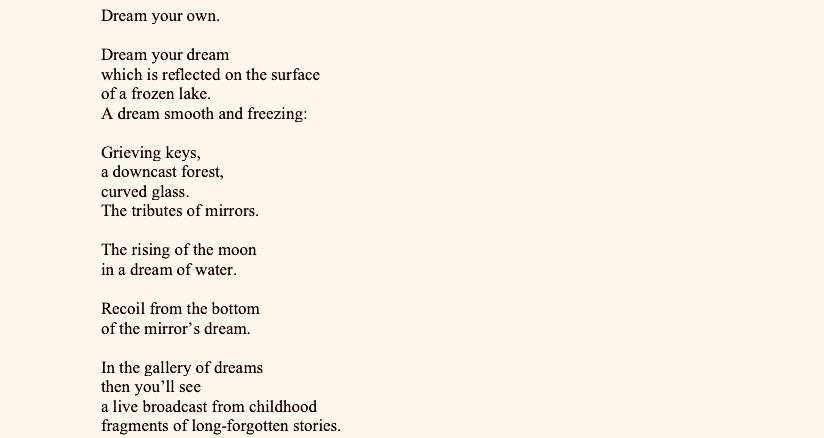
Dream your own.

Dream your dream
which is reflected on the surface 
of a frozen lake.
A dream smooth and freezing:

Grieving keys,
a downcast forest,
curved glass.
The tributes of mirrors.

The rising of the moon
in a dream of water.

Recoil from the bottom
of the mirror’s dream.

In the gallery of dreams
then you’ll see
a live broadcast from childhood
fragments of long-forgotten stories.

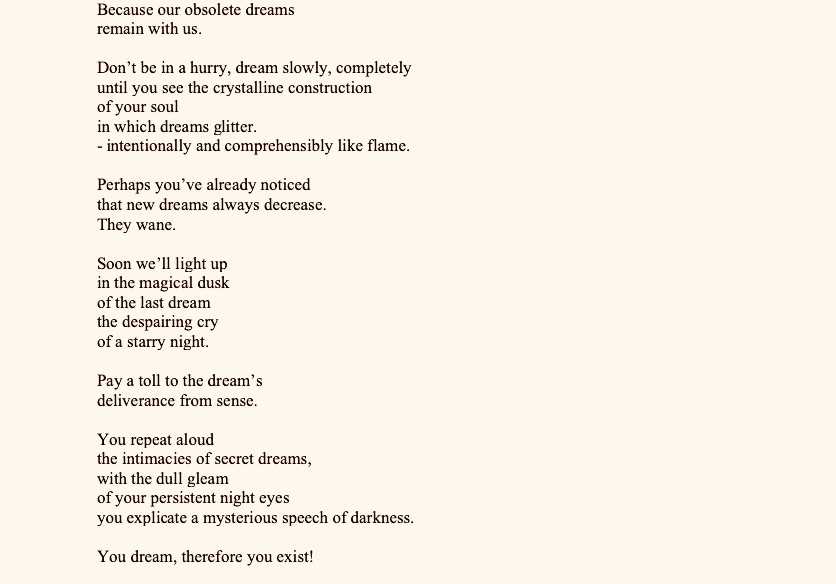
Because our obsolete dreams
remain with us.

Don’t be in a hurry, dream slowly, completely
until you see the crystalline construction
of your soul
in which dreams glitter.
- intentionally and comprehensibly like flame.

Perhaps you’ve already noticed
that new dreams always decrease.
They wane.

Soon we’ll light up
in the magical dusk
of the last dream
the despairing cry
of a starry night.

Pay a toll to the dream’s
deliverance from sense.

You repeat aloud
the intimacies of secret dreams,
with the dull gleam
of your persistent night eyes
you explicate a mysterious speech of darkness.

You dream, therefore you exist!


UNSENT TELEGRAM


Inside me a little bit of
a blue Christmas begins.
In the hotel room it’s snowing
a misty scent – of your
endlessly distant perfume.
We’re declining bodily
while in us the price
of night calls rises,
waves of private earth tremors
and the limits of an ocean of blood
on the curve of a lonely coast.

*New York has been translated to 21 languages

PAVOL JANIK | VIRTUOSO OF SLOVAK LITERATURE 


NEW YORK 


In a horizontal mirror
of the straightened bay
the points of an angular city
stabbing directly into the starry sky.

In the glittering sea of lamps
flirtatious flitting boats
tremble marvelously
on your agitated legs
swimming in the lower deck
of a brocade evening dress.

Suddenly we are missing persons
like needles in a labyrinth of tinfoil.

Some things we take personally –
stretch limousines,
moulting squirrels in Central Park
and the metal body of dead freedom.

In New York most of all it’s getting dark.

The glittering darkness lights up.

The thousand-armed luster of the mega city
writes Einstein’s message about the speed of light
every evening on the gleaming surface of the water.

And again before the dusk the silver screen
of the New York sky floods
with hectoliters of Hollywood blood.

Where does the empire of glass and marble reach?
Where do the slim rackets of the skyscrapers aim?

God buys a hot dog
at the bottom of a sixty-storey street.

God is a black
and loves the grey color of concrete.

His son was born from himself
in a paper box
from the newest sort of slave.


A DICTIONARY OF FOREIGN DREAMS


At the beginning it was like a dream.
She said:
“Have at least one dream with me.
You’ll see – it’ll be a dream
which you’ve never dreamt about before.”

Descend deeper with me,
dream from the back,
dream retrospectively
in a labyrinth of mirrors
which leads nowhere.

The moment you come to the beginning of nothing
you’ll dream an exciting dream.

Frame it
and hang it in your bedroom.

So it will always be before your eyes
because a dream which is removed from the eye
is removed from the mind
in the sense
of the ancient laws
of human forgetfulness.

Dream your own.

Dream your dream
which is reflected on the surface 
of a frozen lake.
A dream smooth and freezing:

Grieving keys,
a downcast forest,
curved glass.
The tributes of mirrors.

The rising of the moon
in a dream of water.

Recoil from the bottom
of the mirror’s dream.

In the gallery of dreams
then you’ll see
a live broadcast from childhood
fragments of long-forgotten stories.

Because our obsolete dreams
remain with us.

Don’t be in a hurry, dream slowly, completely
until you see the crystalline construction
of your soul
in which dreams glitter.
- intentionally and comprehensibly like flame.

Perhaps you’ve already noticed
that new dreams always decrease.
They wane.

Soon we’ll light up
in the magical dusk
of the last dream
the despairing cry
of a starry night.

Pay a toll to the dream’s
deliverance from sense.

You repeat aloud
the intimacies of secret dreams,
with the dull gleam
of your persistent night eyes
you explicate a mysterious speech of darkness.

You dream, therefore you exist!


UNSENT TELEGRAM


Inside me a little bit of
a blue Christmas begins.
In the hotel room it’s snowing
a misty scent – of your
endlessly distant perfume.
We’re declining bodily
while in us the price
of night calls rises,
waves of private earth tremors
and the limits of an ocean of blood
on the curve of a lonely coast.

All these poems are excerpted from his book, A Dictionary Of Foreign Dreams

Mgr. art. Pavol Janik, PhD., (magister artis et philosophiae doctor) was born in 1956 in Bratislava, where he also studied film and television dramaturgy and scriptwriting at the Drama Faculty of the Academy of Performing Arts (VSMU). He has worked at the Ministry of Culture (1983–1987), in the media and in advertising. President of the Slovak Writers’ Society (2003–2007), Secretary-General of the SWS (1998–2003, 2007–2013), Editor-in-Chief of the literary weekly of the SWS Literarny tyzdennik (2010–2013). Honorary Member of the Union of Czech Writers (from 2000), Member of the Editorial Board of the weekly of the UCW Obrys-Kmen (2004–2014), Member of the Editorial Board of the weekly of the UCW Literatura – Umeni – Kultura (from 2014). Member of the Writers Club International (from 2004). Member of the Poetas del Mundo (from 2015). Member of the World Poets Society (from 2016). Director of the Writers Capital International Foundation for Slovakia and the Czech Republic (2016–2017). Chief Representative of the World Nation Writers’ Union in Slovakia (from 2016). Ambassador of the Worldwide Peace Organization (Organizacion Para la Paz Mundial) in Slovakia (from 2018). Member of the Board of the International Writers Association (IWA BOGDANI) (from 2019). He has received a number of awards for his literary and advertising work both in his own country and abroad.

Pavol Janik’s literary works have been published not only in Slovakia, but also in Albania, Argentina, Bangladesh, Belarus, Belgium, Bosnia and Herzegovina, Bulgaria, Canada, Chile, Croatia, the Czech Republic, France, Germany, Hungary, India, Israel, Italy, Jordan, Kosovo, Macedonia, Mexico, Moldova, Nepal, Pakistan, Poland,  the People’s Republic of China, the Republic of China (Taiwan), Romania, the Russian Federation, Serbia, South Korea, Spain, Syria, Turkey, Ukraine, United Kingdom, the United States of America and Venezuela.

James Smith Sutherland is a writer, critic, poet and translator.

Categories
Musings

Observer at Home

By Devraj Singh Kalsi

During the lockdown phase, I started taking interest in what did not interest me earlier. As a writer fond of observing people and the world outside, my operating space was restricted now. Everything inside the house began to draw my attention. The small, minor issues and objects assumed greater importance than they actually deserved. My appetite for keen observation was evident every hour of the day.  

I had no memory that the ceramic mug I drank coffee from every morning was chipped. Quite like the small scratches you do not notice when they first appear. I held it close to my eyes to check whether it was fresh. Unable to reach a definite conclusion, I shared my observation with my partner to see how she reacted. My words did not elicit her glance in my direction so I placed the coffee mug on the table without making the slightest noise.  

After a long-drawn silence in which I had forgotten my query, she confirmed the coffee mug was chipped due to an accidental brush against the gushing steel tap in the sink almost month ago. Since it was emblazoned with her favourite motivational quote, she decided not to discard it. Maybe the coffee mug supplied her with the daily dose of positivity when I sat in front of her, holding it in my hand. A visual meditation with open eyes.  

It was amazing to discover the curtains of the windows in my study had two colours. Unwilling to blindly trust my vision, I walked to the window, held the fabric and double-checked it. What I had considered beige had a tinge of pink as well. I resisted for a while the urge to ask my partner to spell out the colours. I framed it a bit differently soon: Is the curtain in my study room baby pink?

Her reply was prompt this time: The curtain has been washed so many times that from fuschia pink it was now turned into pale baby pink. The presence of subtle elements in everything surrounding a writer is always elevating. Subtleties make art richer. And writers always look for possible signs of it. After this observation, I was filled with the joy of imagining a reader who finds a new shade of meaning in my stories years later. Maybe someone who reads my works with great passion is the one who locates fresh sensibilities in my writing.

On the top of my bookshelf, there had been a miniature terracotta elephant and a horse. I do not exactly remember when I last saw them there. But I remember seeing them whenever I looked that side. I found them missing for the first time in three years since they were purchased from the local arts fair and placed right on top. I needed an update regarding their present location. Had they been shifted elsewhere recently? I asked my partner about the elephant first. 

Thank God, you noticed that.  When they came, they were small. Now they have grown up. How can they fit in there?  

I was not getting what she was trying to imply through her sarcasm. Finding a blank expression on my sullen face, she said she had moved them to the terrace last year. For one year I had not noticed this change of location. It showed how unfamiliar I was with the house I was living in.

I know the rooms of my characters very well. Every nook and corner is vivid in my mind. When the world of fiction becomes so real, the real world the writer lives in tends to grow distant. Something of this kind had happened in my case.

While shaving during the afternoon, I noticed the mirror was not square anymore. The mystery of how it had become rectangle deepened. Various implausible plot angles took shape in my fecund mind. Laying them at rest because thrillers are not my genre, I rushed to seek clarity regarding my visual disturbance from my spouse who was ironing clothes.

Holding the hot iron in one hand like a shield, she looked vexed with arched eyebrows. She dismissed my repeated attempts at observing more inside the house and clarified that the square mirror fell off the wall last winter. Maybe the lizards engaged in combat had toppled it to gain more space. 

I realised this tendency would continue in this manner for weeks. Many striking differences would come to my attention and it was useless to irritate others with my queries. Instead of trying to update myself with the changes I was observing quite late now, I should ignore them all and give more rest to my frenzied brain during the lockdown phase.    

Devraj Singh Kalsi works as a senior copywriter in Kolkata. His short stories and essays have been published in Deccan Herald, Tehelka, Kitaab, Earthen Lamp Journal, Assam Tribune, and The Statesman. Pal Motors is his first novel.  


Categories
Musings

And then the tranquility got shattered

By Shevlin Sebastian 

At 11 p.m., on a Saturday a few weeks ago, I was cruising down National Highway No 47 in Kochi. Elton John’s ‘Circle of Life’ was playing on the music system. 

The mood inside the car was tranquil. My daughter, Sneha, had just landed from Bangalore. My wife, teenage son and I had gone to collect her from the airport. She has just started studying in a college in Bangalore. Dressed in jeans and a cream top, blue sneakers, without socks, she smiled happily as she entered the car. 

The conversation began. Sneha spoke about the quality of the food in her hostel, her roommates, lecturers, classmates, and the latest movie she had seen. My son, two years younger, sitting next to her on the back seat, listened silently. 

The highway was relatively deserted: a few trucks and some cars. Kochi sleeps early: the metro service, besides the pillars of which we were travelling, had closed. And so were the private bus services. An occasional long-distance Kerala State Road Transport Corporation bus trundled past, with its distinctive red and yellow colours. 

I was driving at 50 kms per hour as we were in no hurry and I was listening to what my daughter was saying rather than concentrating on the road. 

Children grow up so fast. It seemed only the other day that I held Sneha in my arms. And now she was all grown up. When she was in Class 12, I remembered the large birthday card, almost the size of an A 3 size chart, that some of her classmates had made in which they drew and wrote greetings, using red, green, blue and purple felt pens. However, one comment from a boy made me stop breathing for a few moments. “You have a nice ass,” he wrote. It took me some time to digest that. And accept. My daughter was a sexual being to her male contemporaries. 

In the car, Sneha suddenly asked, “Baba, do you mind if I put my music on?”  

“Sure,” I said. And she leaned forward and pressed a cable wire into the socket of the music system and her mobile. Soon, her songs started to play. The first one was Selena Gomez’s haunting ‘Lose you to love me’. 

Incredibly, I had heard it the day before. I read an article about the song and decided to hear it on YouTube. In her song, Selena was indirectly commenting on her failed romance with pop superstar Justin Bieber. Sneha was shocked and impressed when I told her all this. 

Baba, you are in touch,” she said, with a smile. 

“Just a fluke,” I said, modestly.   

She hummed the first few lines: 

‘You promised the world and I fell for it

I put you first and you adored it

Set fires to my forest

And you let it burn’

All of a sudden, a red Maruti Suzuki car swerved in from an outer lane and cut in front of me. I instinctively half-pressed the brake and dropped my speed to 40 kms an hour. The other car moved ahead. I was wondering why the driver had the need to cut in. There were three lanes on our side. He could have easily gone straight ahead. 

I thought: “Is the driver drunk, high on drugs or has he slept off for an instant?” 

 I could see a few heads in the car.  

Inexplicably, a few moments later, it swerved violently to the right and hit a pillar of the Kochi Metro at high speed. The thud sounded like a thunderbolt. All of us looked through the windscreen with bulging eyes and open mouths. I braked as a black piece, probably a part of the bumper, ricocheted away and came to a stop just in front. I quickly moved the vehicle to the left, without looking at the rear-view mirror. Thankfully, there was no vehicle behind us. I parked on one side.  

 Inside the stricken car, there was no movement for several moments.  

Sneha suggested that I call the police. I pulled out my mobile and did so. By the time I passed all the relevant information to the helpline, including the number of the metro pillar where the accident took place, a crowd had gathered. When I reached the damaged car I saw that the two white airbags in front had burst open. That probably explained why the driver, a thin man with curly black hair, had escaped with just a cut on his upper lip. A thin line of blood could be seen. He looked about 22, and stood to one side, with blank eyes, as if he could not see. 

Somebody said, “Did you sleep off suddenly?” He quickly shook his head and said, “No, I lost control.” Somebody asked whether it was a brake failure. He shook his head. Was he drinking? The reply was a tightening of his jaws.   

A woman, who was in the back seat, was pulled out gently by a few bystanders, with her husband cradling her head. She was laid down on the road — a middle-aged lady in a green salwar kameez. From the look on her face — the eyeballs almost vanishing as the lids closed — she was rapidly losing consciousness. There were two children, a boy and a girl, both below ten years of age. They stood nearby staring at their mother. 

Soon, a white car which was going past was stopped by several people, with raised arms and shouts. Again the woman was carried to the back seat, men holding her arms and legs, and somebody placed his palms under her back to balance her. The husband put his children on both his knees, as he sat in the front seat, next to the driver. They headed to the nearest hospital. 

Meanwhile, drivers, who were going past, slowed down, slid their window panes down, and stared with frozen eyes at the shattered engine. Where the bonnet had been smooth, now it was all crumpled metal. Ten minutes later, the police arrived. 

Some passers-by expressed the hope the woman would be okay.  

A couple of days later I called the Kalamassery police station under whose jurisdiction the accident had taken place. A policeman said that the woman had been declared brain-dead on her arrival at the hospital. The doctors put her on the ventilator. They informed the husband. He spoke to his family members. They agreed there was no point. Two days after the accident, the ventilator was switched off. And she passed away. She was only 37 years old and worked in the administration section of a government hospital in Kochi itself. It seemed she hit her forehead on the back of the front seat with great force, and this proved to be fatal.   

From the time the driver lost control to hitting the pillar was all of two seconds. That was the minuscule time taken for a tragedy to take place. 

So, why did this event take place? Why did God take the mother away from the children at such a crucial stage in their lives? What will be the psychological blow on them? Who can replace their irreplaceable mother? Nobody, I guess. How will the husband handle the situation of being both father and mother? As strangers, we will never know the answers.   

Meanwhile, when we set out again, there was a tomb-like silence in the car. Everybody stared straight ahead, lost in their thoughts. My wife told me later that Sneha had been deeply affected, especially when she came to know that the woman had died. 

So, how does one respond when a fortnight later Sneha was involved in a two-wheeler accident in Bangalore? She was travelling behind a classmate on a scooter on a Sunday morning. They took a right turn, a car came speeding up, hit them and sped away. My daughter was flung onto the pavement. She had scratches on her face, arms, elbows and knees. 

Sneha called us from the hospital. My wife shed tears but she quickly regained control. We decided to leave immediately. At that time, there were no flights. The runway at Kochi airport was being re-carpeted. So, the flights were only in the early mornings or at night. 

We took a train to Salem and then a bus. By the time we reached it was 11 p.m. Thankfully, a relative’s wife, a homoeopathic doctor, had handled matters. She went to the hospital, got my daughter discharged and took her to a better hospital. An X-ray revealed a crack in her pelvic bone. The healing had to be natural. A two-month rest was advised by the doctor. So, we brought her back to Kochi. Sadly, she missed many classes. 

I did wonder how much of seeing the first accident played a role in my daughter getting involved in an accident of her own? Who knows how the mind works? The subconscious is a mystery. 

In retrospect, I wished that we had not seen the accident. 

When asked what he feared the most as Prime Minister, the late Harold Macmillan said, “Events, dear boy, events.” 

Indeed, this seems to be right.   

The repercussions of an event can lead one to sunlight or darkness. 

Shevlin Sebastian is a journalist based in Kochi. He has published around 4500 articles over 30 years, most of them feature stories. He has worked in Sportsworld magazine, (ABP Group), The Week magazine (of the Malayala Manorama Group), the Hindustan Times in Mumbai and the New Indian Express in Kochi and in DC Books, Kottayam. 

Categories
Stories

Flash Fiction: The Guava Tree

By Sushant Thapa

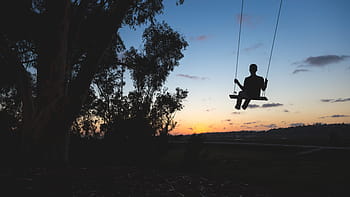
The guava tree always stood in seclusion. The lemon tree also grew beside it. The potential of the lemon tree was curbed by the sharpness of its thorns. Jubilant children did not care about thorns on the lemon tree and swung beside it on the guava tree where their swing was attached. The potential of children was one thing and that of a tree with respect to its thorn was another. Ah! The sharpening of the senses and the sharpening of thorns, two things related in Nature, but created differently by Nature for two different subjects. Still, children cherished the playful act of swinging from a tree.

The tree that stood in seclusion was not at all alone because children visited it regularly. Had the children not cared to visit the tree, it would have remained alone. The thorny tree was also not lonely because it stood beside the guava tree and children visited the guava tree as their swing was attached to it. Every day they visited the guava tree after school. It was their place of recreation. They embraced the joy present in the air around the tree. The tree welcomed them with its spaciousness. The lemon tree was the only thing that occupied space and interfered with the space for children to play. The children were not able to climb or swing on it because of its thorns.

The children visited the guava tree every day after four in the afternoon. Manu was among those youngsters. He was a shy lad. He didn’t talk much in school. He occupied small space in the library while he visited, and sat with his books. Ideas and words went above his head. He sat with his vacant mind in the vastness of the library. His mind dwelt around the guava tree and its spaciousness which was very lively for him in comparison to the sedate, quiet library. He liked the vastness and liveliness around the guava tree.

Manu dwelt happily on the secluded space of the orchard where those trees stood. Sometimes, he used to swing alone at the fall of dusk. He found himself even in the aloofness. The tree caught and captured his scattered self and he always felt himself to be slightly amassed when he was near it. Loneliness did not occupy any space near those trees, especially near the guava tree. Manu did not feel vacant at all; such was the ambience and the feeling, the feeling of personal space, in the vastness of nature. His heart and mind were occupied in that playful act of swinging on a tree. The freshness of the air and invigorating atmosphere made him feel lively. He did not feel alone. He was present in the wholeness of the space. He kept swinging on the guava tree beside the lemon tree, without caring about thorns of the lemon tree.

Eventually, he was able to make few friends. His shyness gave way while he played. After all, life in the orchard was not bad at all. Even beside the thorny lemon tree, goodness prevailed. Yes, the guava tree always stood there in its seclusion like in the beginning of the story.    

Sushant Thapa is a recent post-graduate in English Literature from Jawaharlal Nehru University, New Delhi, India. His short story “The Glass Slate” has been published in Kitaab.org from Singapore. His poems and essays have been published in Republica daily from Kathmandu. His short stories and poems have also been published by The Writers’ Club, New Jersey, United States. He revels in rock music, poetry, books and movies from his home in Biratnagar, Nepal. 

Categories
Review

Sita Under the Crescent Moon: A Travelogue in Syncretism

Book Review by Bhaskar Parichha

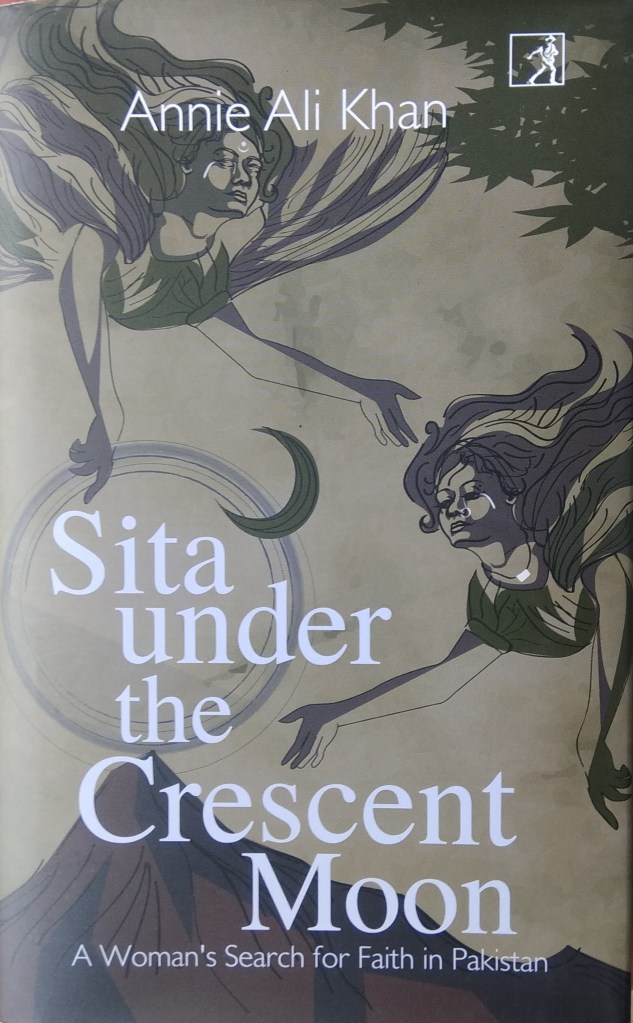
Title: Sita Under the Crescent Moon

Author: Annie Ali Khan

Publisher: Simon & Schuster India, 2019

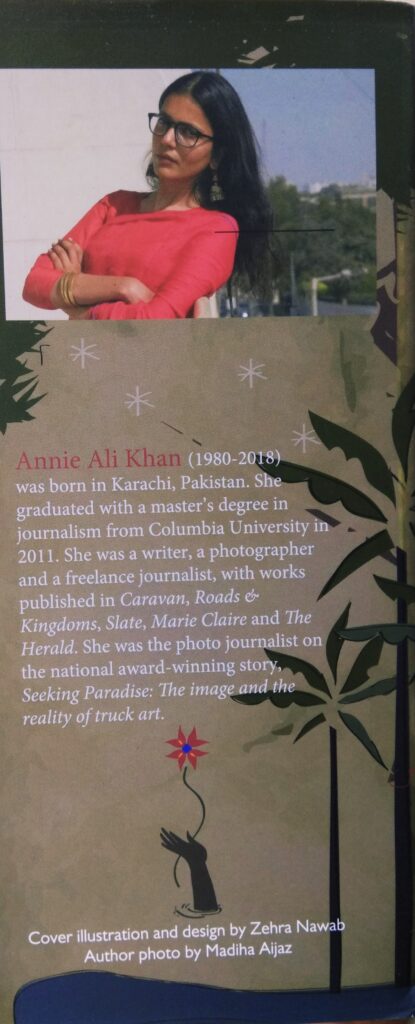
There is a poignant tale to this book. Before the manuscript could see the light of the day, its author Annie Ali Khan died in an accident in Karachi. Annie was merely thirty years at the time of death. A brilliant journalist with a master’s degree in journalism from Columbia University, she was a writer, a photographer with works published in Caravan, Marie Claire and The Herald. She had won Pakistan’s national photojournalist award for her story on truck art.

In the epilogue, Annie’s friend Manan Ahmed Asif writes equally touchingly about the events leading to the final publication of the book. Asif calls her a ‘fearless reporter of Pakistan’ and no journalist before had dared to do a newspaper story on a Hindu Pilgrimage in Pakistan. In reality, it is from this article that the book has originated.

Sita Under the Crescent Moon – A Woman’s Search for Faith in Pakistan is a dazzling account of a tradition purely for the reason that it combines spirituality with travel. The blurb says it all: “In present-day Pakistan, in the far corners of Lyari in Karachi, or Hingol in Balochistan, or Thatta in Sindh, tightly knit groups of women keep alive the folklore, songs, and legends of Sati—their name for Sita in the Ramayana.”

Annie traveled with women devotees on pilgrimages to retrace the way they worship the goddess. She followed “healers, heretics, seekers, wives, mothers, sisters, grandmothers and believers”. These journeys intensely throw light on a veiled and obscure world. With loads of empathy, love, and self-sacrifice, the author listens to the stories of these women. She writes them down — word for word in some cases — capturing their dilemmas, the violence and the outfits they belong to.

Her exploration doesn’t stop there. She eats, rests, sleeps, prays, and lives with them. She was adopted by some as their daughter. Some even relied on her knowledge of the world to help show them the way of the government and the benefits therein.

The book lays bare, meaningfully, how worship has changed mind-sets and altered many of the mores of the land. While the sacral sites, made up of clay and thread grant a woman power and autonomy to fight her wretched conditions, the narrative demonstrates the pliability of women and depicts how, under the shadow of militant majoritarianism, women are keeping alive the memories of Sita’s exile, and her ultimate sacrifice.

The travelogue also tells Annie Ali Khan’s own journey. From her memories of Durga in the house of her grandfather’s friend to her own experience before Durga Mata in Hinglaj, the book is a chronicle of a woman in search of healing power. Hinglaj is a Hindu Pilgrimage in Balochistan which is the quiescent place of Hingula Devi, locally called Nani Pir. This is one of the 51 Shakti Peethas*of Sati, wife of Shiva. Meeting Durga at Hinglaj ‘inspires her to explore the way of the Satiyan, the seven sacred sisters, and also to look for Sita.’

Take a look at the narrative: “At Hub Chowki, a historic-city-turned-transit-town is now the gateway between Sindh and Balochistan. Those traveling through are greeted by a road sign that reads ‘Mundra’ – a Sanskrit word meaning temple or place of worship or chasm – overshadowed by a larger sign with a new name, proclaiming, in bold Arabic script, ‘Seerat’, meaning inner beauty, heavenly light hidden from view, veiled. These are the many paths to the sacred and the beautiful that abound in the Islamic Republic of Pakistan. May the goddess protect us!

Next, she delves into the geography of the sub-continent: “Hinglaj, in the heart of the province, is as sacred as it is remote. The ancient temple is located along an endless terrain following a coastal route that reaches beyond the Malabar region in south India and extends further up north, past Rajasthan, then the coastal cities of Iran. I read somewhere that the road between the sea-facing shrine of Abdullah Shah Ghazi in the port city of Karachi and the shrine of Haji Ali, half-submerged in the sea in Bombay, was once a route well-traveled by pilgrims of the Sufi order – before the borders got in the way.

The book is replete with a wide range of socio-political events — the uprising in Balochistan, clashes between Shia and Sunni sects, activities of Jamiat-e-Ulema-e-Islam.

There are also cultural references and quaint factoids: about the Odh people specializing in building homes of mud and straw; descriptions of the traditional quilt, rally; Makli being the city of a hundred thousand graves; women smoking chillum and Capstan cigarettes at shrines; use of “bird water” for healing; hierarchical relationships between the Sindhi and Baloch communities; the Chaaran community; the Meghwars being denied cocaine on grounds of their low caste status; the “Hanging Mela”; the “Ram Bagh” metamorphosing into “Aaram Bagh”; the Benazir Fund and her husband, Asif Ali Zardari, being known as “Mr. Ten Percent” for demanding a cut in all governmental deals, and so on.

Annie’s exploration of faith is once more syncretic: “I was accompanying a family of yatris on a pilgrimage to the temple, entering the heavily patrolled and policed borders of the province with them. It was also the last night of Navratri, the festival celebrating the victory in the battle of the goddess Durga over a demon buffalo to restore dharma, the order of the cosmos. Sati’s suffering and sacrifice and the joy of her victory were remembered like Moharram, like Mohabbat; love in the heart, eternal and ever-flowing like the suffering that was life on earth.”

The three-hundred-page travelogue Sita under the Crescent Moon is a remarkable tribute to Pakistani women who have always been the custodians of small traditions. It is their songs, folktales, and legends that become powerful mediums of transmission of traditions and faith in the absence of higher psychical goals.

Dedicated to Quratulain Ali Hyder, Sita under the Crescent Moon is not only a breathtaking documentation of a spiritual journey, but it is also a gender- gaze. Conspicuously, so many entities come up for closer investigation in the book – nationality, community, ethnicity et al.

Bhaskar Parichha is a Bhubaneswar-based  journalist and author. He writes on a broad spectrum of  subjects , but more focused on art ,culture and biographies.His recent book ‘No Strings Attached’ has been published by Dhauli Books. 

*Shakti Peeth are shrines and pilgrimage destinations in Shaktism, a school of Hinduism which worships the mother goddess.

Categories
Review

‘Where the world has not been broken up into fragments by narrow domestic walls’

A review of Shankhachil – 2016 Bengali film by Gautam Ghose By Abhinandan Bhattacharya

In the surging ripples of the meandering river one is most likely to hear the symphony of the universe. Does the river understand the definition of state or country borders? Can any force stop the flow of the river or refuse to accept the waters of the river because it flowed in from the other side of the border? The map of the biggest delta in the world has undergone a complete change with the water bodies gradually wiping out many differences set by human beings. The tigers and crocodiles have eaten their way into the geography of the region only to remind their human counterparts that there is more to life than engaging in conflicts on grounds of caste, gender and religion.

Shankhachil, one of the most brilliant Bengali films that I have watched in the recent times, is midwifed into existence from the Indo-Bangladesh dispute after the Partition touching upon the very fabric of the sensitive Hindu-Muslim religious bigotry. Dangling on the philosophy of ‘borderless border’, acclaimed Director Gautam Ghose has wonderfully echoed the appeal of ‘Where the world has not been broken up into fragments by narrow domestic walls’. Extremely well-spun montages have emphasised yet once again that we need to rise above our religious differences and start considering one another as human beings.

A poignant narrative of how a helpless father is compelled to cross border illegally just to get proper treatment for his twelve-year old daughter who is born with a congenital heart disorder. As a respectable school teacher, Muntasir Chaudhury Badol (Prosenjit Chatterjee) lives in his humble dwelling with his wife, Laila (Kusum Sikder) and daughter, Roopsha (Shajbati) in a little hut along the majestic Ichamati River that connects Bangladesh to India. Shankhachil (or Brahminy Kite in English) is a bird symbolizing freedom, a thought which, sadly, resides in a poet’s imagination only. Badol is a true Mussalman preaching about peace and silently sobbing in the face of communal violence that tends to tear the society apart.

A fine specimen of a crossover film and winner of the National Film award in the category of the Best Feature Film in Bengali, Shankhachil, talks painfully of the plight of the immigrants not because of the Partition but because of the prejudiced mindset of the so-called civilised and literate society who derive some sadistic pleasure in inciting communal hatred instead of finding ways to plant a proper pacemaker (read ‘peacemaker’). Muntasir and Laila lose their innocent Roopsha while navigating through this heart of darkness. But he is a proud father as he lost his daughter who had won in a different battle.

All countries look the same. Human beings respond to various stimuli in the same manner in all countries. Must we respond to communal hatred and indifference too in the same manner? Isn’t life too short to engage in such petty things? Does it cost a single penny to speak forth words of love without thinking about your and my religion? Isn’t everyone on earth ‘fed with the same food, hurt with the same weapon, subject to the same diseases, healed by the same means, warmed and cooled by the same winter and summer’?

It’s time to introspect. It’s time to reflect. It’s time to be educated. Once again.

Abhinandan Bhattacharya is a Secondary school teacher of English Language and Literature training students at the CAIE and IBDP levels at JBCN International School, Oshiwara, Mumbai. He has been honoured with several professional merits in the form of Nation Builder Award by the Rotary Club of Mumbai and the Dedicated Teacher Award 2019 by Cambridge University Press in a campaign run by the University of Cambridge and CUP witnessing more than 40,000 nominations from across 150 countries worldwide. He is a published poet and writer winning the National level Poetry Writing Competition in 2019 organised by Story Mirror Schools Writing Competition. Today, he is a certified teacher trainer and mentor not only to his learners but to countless teachers as well.