Categories
Excerpt Tagore Translations

Letters From Tagore

Rabindranath’s introduction to his correspondence with Nirmalkumari Mahalanobis and a few letters dealing with death, his sense of loss on the death of a favourite and about his encounter with a German anthropologist, translated by Somdatta Mandal and included as a part of Kobi &Rani

Title: ‘Kobi’ and ‘Rani’: Memoirs and Correspondences of Nirmalkumari Mahalanobis and Rabindranath Tagore

Translator: Somdatta Mandal

Publisher: Birutjatio Sahitya Sammilani, Bolpur, W.B., 2021

On the Road and Beyond It

Introduction by Tagore

The earth expresses itself by moving in two ways. One is by rotating by itself, and the other through a larger movement by going around the sun. In the earth’s yearly cycle, we see the change of seasons, and different kinds of fruits and crops fill up the granary of man. Its diurnal course results in the play of light and shade on land and water, the change of nature’s moods in the sky, the play of colours every morning and evening on the horizon; different tones of voices between waking up and going to sleep.

These two different movements can be compared with two kinds of literature – first the ordinary one meant for the general public and the other, more intimate, one, that of letters. Usually ordinary literature draws a huge reading public, and moves far away from the limits of personal life to distant countries. By contrast, the literature of letters reveals the close periphery of a world known to the writer that includes shades of daily experience, its sights and sounds, and along with it, its instantaneous moods and feelings. At least, this is more or less true of the letters published in this series called ‘Patradhara.’

 Most of the letters published under the title Chinnapatra in this ‘Patradhara’ series have been selected from the letters I wrote to my niece Indira. At that time, I was wandering around the villages of Bengal; every second different village scenes were startling my wayfaring mind with their new appearances, and these were getting reflected in the letters. Those who have the habit of always speaking quickly open their mouths whenever they find anything funny and interesting. Once we try to package and express within the form of literature, the emotions that arise within and change their nature. We are constantly confronting different things from all parts of the world but it is not worth broadcasting them through loudspeakers. The easiest way to retain them is by confronting known people behind the crowd.

The second set of letters in ‘Patradhara’ was written to a young girl. Most of them were written from Santiniketan so the moving pictures of life there constantly flow through them. In these letters we do not have any grave news; the childishness of that girl, who is innocent about domestic affairs, is reflected through a jovial atmosphere; and along with this is the writer’s jocular benevolence. There is no way in which a mature writer can express permanently all that can be said in an ordinary light-hearted way.

 The third section of ‘Patradhara’ has been named Pathe O PatherPrante (On the Road and Beyond It). There is a story behind it. When I went to travel in Europe in 1926, I received invitations from various countries. During that period Rathindranath was sick and confined in a hospital in Berlin. So the responsibility for accompanying me fell on Prasanta Mahalanobis and his wife Rani who was also with him. Sometimes without speaking a single word and sometimes speaking too much, she took the entire responsibility upon her shoulders. She had to rectify all the problems that two inexperienced male travellers created while making proper arrangements for travel. Packing all our things, arranging them, keeping a count of the luggage and moving with them safely during our travels, coping with the sometimes careless and sometimes appropriate demands of the foreign authorities in those few months, Rani handled everything exceptionally well. I had been travelling in new railway coaches, ship’s cabins, living in hotel rooms, and at every step during these repeatedly changing situations, had been interacting with new people. By submitting all the unexpected problems to be resolved by her, I had shamelessly spent my days in peace while receiving a lot of care and nursing from her. At the end, when we completed our European tour and boarded a ship from a Greek port to go home, they kept on staying abroad. As I moved towards my homeland, I continued to keep our companionship alive through letters. Some of those letters, and also those written later, have now been collected here as the third series of ‘Patradhara.’ The constant debates going on all around regarding new experiences have also been expressed through these letters. But the value of narrating our European tour, which has not been published anywhere, is enormous.

 All the thoughts that go on within the mind and want to be expressed in our writings remain alive till death. But in our mental life the flow of ideas that are expressed in perpetual motion reach a saturation point at a certain period of time. When the mind is full, then apart from the essential words, a lot is left as excess. Those who love to socialize express those excess words in gatherings, those who are introverted express their feelings in their diaries, and people like me who like to write express their thoughts to someone for whom the road to writing is easily open through letters. In the end as one keeps on moving in time, the excess of emotions reaches its nadir and the mind reaches such a state that the urge to write dies. Today I have reached that point of time in my life when I am silent. I have crossed that stage when I wrote letters voluntarily, with some of them strewn about unnecessarily like multi-coloured shells and snails on a sea beach. I see them from a distance just like the inquisitive vision of external readers. The present mind which rarely speaks now is feeling envious of those times when emotions would rush out incessantly; of course some joyous moments also accompanied them. When grains ripen, it becomes time to gather them and put them inside the barn. Today I could like to gather the harvest from that season which was full of words.

                                                                                                  Rabindranath Tagore

                                                                                                  May/June 1938

Letter 4

I had thought that I would post your letter when the ship halted at Aden. Now I received the news that the ship will not halt anywhere between Suez and Colombo. So I am thinking of writing a little more.

The thought of death is not leaving my mind. In our world we are somehow connected to one another through our different selves, sometimes deeply and sometimes lightly. All of those are included in my life. I am not reluctant regarding anything in this world; this means I live quite intensively. But the more life is extended, the more happiness and sorrow also occur. The arrows of death find greater space to come and hurt you if your heart is extended. The true worship of life is immortality, which means living in a way that is beyond death. On many occasions the indifference that arises upon the death of someone you love means that the soul is hurt: it then wants to desert everything and live within something that does not erode or dissolve. I find this same message in the first chapter of my father’s life story. When death confronts life, it asks this question: “Is there anything left inside after what I have taken away? If nothing is left, then you are completely befooled.” Life wants life; it does not want to be cheated by death in any way. Once it clearly understands that it has been cheated, in an instant it eagerly states, “Something that cannot fetch me immortality is of no use to me.” Man says this so many times and forgets it so often.

                                                                                                            Yours,

                                                                                                            7 December 1926.

Letter 6

I cannot forget Santosh[1]. I think of my own life – I have been living for such a long time – how I have experienced sadness and happiness, hopes and desires, trials and pursuits, and how I have passed through so much difficult historical terrain. Compared to this, Santosh’s life was so limited. His life ended just after he had completed his youth. Even then, the picture of his life is clearly expressed. It is without any excitement but not meaningless. There are so many people all around us who are in service, who are running a household, but all of that is meaningless. Their days pass by in a heap – one upon the other. But taken together they don’t form a clear shape. Santosh’s life was not as formless as that. I remember how he came back some time ago after completing his education in America. He came and created his own space at Santiniketan. There are many other teachers working here. They work just as they would do elsewhere and some work maybe a little bit more than that. But with all the respect in his young heart, Santosh established himself with his entire life. Of course there was the necessity of earning his livelihood but his spiritual connection was stronger. The work we do every day for our personal necessities does not have any excess; it gets absorbed within itself and ends there. But Santosh associated his own life with a mission that was beyond his personal needs. I had very clearly seen the results of it because he led a simple, transparent and respectful life without excesses. But if I knew Santosh only from the work he did, then I would be mistaken. I knew him with my entire vision. It is not that the entire vision is sometimes deformed by love: it achieves a wholeness as well. My intelligence does not disregard the proofs, but my strength of vision also respects his direct sense of responsibility. Sometimes there is a conflict between these two and then the mystery becomes very difficult and sad. This dichotomy is present in the idea of death itself – our heart simply does not want to accept it as the extreme. But there is no end to the opposite proofs– the tug of war between the two makes this so extremely painful. My poem “Jete nahi dibo” (“I won’t let you go”) is one of such pain.

Today on behalf of all the middle class passengers of the ship, a white man had come to me with a request. They want to hear something from me this afternoon. I would not have suddenly agreed to this request if they had been first class passengers, but the egos of the second class passengers are much lighter. We can see human beings in them. Now it is almost time to go there.

Letter 7

Today is our fourth day on the ocean. We will reach Colombo on the morning of the 16th. But I will not have the peace of returning home. The long train journey is divided into many sections. Also, what Pupe[2] has now learnt to call “malpatro” (luggage), is great in number. They are large in volume and the containers are in a pitiable condition. There are some boxes which right from the beginning of the journey have permanently lost contact with their keys and there is no way out except to be tied up with strings. There are some boxes which have had their whole bodies damaged by being hit constantly; some other boxes look like patients who have eaten too much and are waiting to vomit and feel relieved. But Rathi is sympathetic towards them – he treats them like patients in a hospital on the battlefield. Whatever it may be, we are still travelling towards our country, and dark and deep greenery seems to be visible on the last leg our journey. Here the sky is full of beneficial sunshine just as it is in our own country. The moon is growing fuller day by day; I can visualize it swinging through the leaves of the sal trees murmuring in the wind. I imagine depositing the entire load of my stay abroad at the entrance of Uttarayan[3] and then quickly resuming the willing sojourns of my mind. But alas, I also know for sure that we do not reside in heaven and that wherever I go, after pushing my way forth after the desires of many other people, I have only a narrow path left for fulfilling my own desires. The only minor advantage is that, in spite of the path being narrow, I have trodden on it for a long time and have become used to it. In spite of the crowd, it is somewhat possible to walk there on your own.

Among our fellow passengers, there is a German anthropologist who is going to India along with his wife.[4] He has heard the name of our professor. He told me, “I have heard that he is a professor of physics. So I understand that he researches the mathematical side of anthropology; we are working on the human side.” What he means by the human side can be understood by his diligence. He is going to collect information about the wild and tribal communities in south and central India. Much of their lifestyle is still unknown and difficult to know; I have not even heard their names. They live discreetly in very difficult terrain. He wants to enter their territory in a latent or concealed manner in case they are afraid and suspect him. He does not want to live in a tent and instead has taken a sack to spend the nights in. There are snakes, wild animals, and the chance of falling sick due to an irregular routine and unhealthy food. In other words, he is taking a risk with his life. They have left their small child under the care of relatives. His wife has accompanied him on this trip in case he falls sick in the jungle. In the meantime, in order to expedite her husband’s work, she is preparing notes throughout the day with the help of maps and books. The people for whom they are willingly prepared to undergo hardship and to overlook all sorts of danger are not their relatives, nor are they civilized. Except for information about the human race there is no precious object to be recovered from them. These people have ventured to open the doors of information of the whole world, and we are rolling ourselves on torn mats by lying down on the mud floor of the earth. It is best to leave this space for them — God has sent many messengers to clear it up.

About the book:   Pathe O Pather Prante (On the Road and Beyond It) included in ‘Kobi’ and ‘Rani’: Memoirs and Correspondences of Nirmalkumari Mahalanobis and Rabindranath Tagore.

Rabindranath Tagore was a prolific letter writer and Rani Mahalanobis is the only person to whom he wrote more than five hundred letters, the maximum number written to any individual person. In 1938, in the third volume of the series entitled “Patradhara”[5], Rabindranath selected sixty letters written at different periods of time to her. This he titled Pathe O Pather Prante and it was published from Visva-Bharati Publications Department in Kolkata.

Incidentally, we find the first ten letters of this series as a supplement to the narrative where Rani’s memoir Kobir Shonge Europey ends in 1926. Since it was published much later, Rani has also included some of these letters in her memoir. The rest of the letters selected from those written up to 1938 describe various moods of the Poet for a period of twelve years. They include philosophical musings, his observations on the changing of seasons, news about the incidents and functions taking place in Santiniketan during Rani’s absence, and especially his views on his new-found interest in sketching and painting. In other words, unlike those written to Indira Devi and Ranu Adhikari, these letters are interesting because they cover multifarious topics and issues and reveal the Poet’s tone of intimacy with Rani. As per Prashantakumar Pal’s biography,

Rani Mahalanobis used to suffer from a sort of non-infectious tuberculosis, so for her fever was almost a regular affair. Naturally Rabindranath would get worried – he would suggest different medicines – and write innumerable long letters, which according to him would help Rani forget some of her physical ailments. (Rabijibani, vol.IX, p.297. Translation mine)

The sixty letters included in this volume also vary in length. Some are quite short, while others are lengthy. Again some of the letters are dated with the Bengali month and year, whereas others are dated according to the English calendar. A few of the letters do not have any dates at all. Also some of them seem quite sketchy, and do not have the usual beginning, middle or end. The reason for this becomes clear when we get to know that Tagore had drastically edited several sections of these letters, especially places which revealed his innermost self.

About the Author

Rabindranath Tagore (1861 to 1941) was a brilliant poet, writer, musician, artist, educator – a polymath. He was the first Nobel Laureate from Asia. His writing spanned across genres, across global issues and across the world. His works remains relevant to this day.

About the translator

Somdatta Mandal is Former Professor of English at Visva-Bharati University, Santiniketan, India. A recipient of several prestigious fellowships and awards, her areas of interest are American Literature, contemporary fiction, film and culture studies, Diaspora studies and translation. She has edited three volumes of travel writing —Indian Travel Narratives (2010), Journeys: Indian Travel Writing (2013), and Indian Travel Narratives: New Perspectives (2021) and has translated from Bengali to English different kinds of Indian travelogues, with special focus on men and women in colonial times. Among them are: The Westward Traveller by Durgabati Ghose (2010), Wanderlust: Travels of the Tagore Family (2014), which records vignettes of travel by nineteen members of the Tagore family spanning more than 150 years, A Bengali Lady in England by Krishnabhabini Das, which is the first woman’s travel narrative from Bengal published in 1885(2015), Crossing Many Seas(2018) by Chitrita Devi, Gleanings of the Road (2018) by Rabindranath Tagore, and The Journey of a Bengali Woman to Japan and Other Essays (2019) by Hariprabha Takeda. Two other translated volumes on Rabindranath Tagore have been published recently, ‘Kobi’ and ‘Rani’: Memoirs and Correspondences of Nirmalkumari Mahalanobis and Rabindranath Tagore (2020) and The Last Days of Rabindranath Tagore in Memoirs (2021).


[1] Santosh Chandra Majumdar was the eldest son of Rabindranath Tagore’s friend Shrish Chandra Majumdar. After passing his entrance examination along with Rathindranath, he went to America and upon returning in 1910 joined the Brahmacharyashram in Santiniketan on a monthly salary of two hundred Rupees. He actively took part in teaching, sports arrangements and hospitality of the guests. He served both Tagore and his institution wholeheartedly till his death in October 1926.  Rabindranath received the news of Santosh’s untimely death after reaching Aden.

[2]Pupe or Pupu was the pet name of Nandini, the adopted daughter of Rathindranath.

[3]One of the houses in which the poet lived at Santiniketan.

[4]The name of this anthropologist was Christoph Von Furer Heimendorf. He stayed in Hyderabad and South India for a long time to carry out research on remote backward tribes. Later he became famous for it.  See Prabhat Kumar Mukhopadhyay, Rabindrajiboni Vol.III, p. 293.

[5]The first volume consisted of selected letters written to his niece Indira Devi when he was wandering around the villages of Bengal and was titled “Chinnapatra”. The second set of letters was written from Santiniketan to a young girl named Ranu Adhikari.

.

PLEASE NOTE: ARTICLES CAN ONLY BE REPRODUCED IN OTHER SITES WITH DUE ACKNOWLEDGEMENT TO BORDERLESS JOURNAL
Categories
Poetry

Santhali Poetry in Translation: A Poem for The Ol Chiki

By Sokhen Tudu, translated from the Santhali by Hansda Sowvendra Shekhar, excerpted from Witness, The Red River Book of Poetry of Dissent

A Poem for the Ol-Chiki

The Bengali script in Bengal
The Odia script in Odisha
I do not know the Bengali script
You do not know the Odia script
Let us agree to one script for Santhali
The Ol-Chiki is our script.
They write in the Roman somewhere
They write in the Devanagari at some places
I do not know the Roman script
You do not know the Devanagari script
One script will unite us all
The Ol-Chiki is our script.
Dear writer, for how long will you
Write your language using
Someone else’s script?
You are dividing our readers
You are making our publishers lose money
Let us all understand this
The Ol-Chiki is our script.
One language, one Script.
This is what will strengthen us Santhals
The talents of so many of us
Scattered for the want of one script
All of us Santhals, let us solve this script issue.

(First published in 100 Poems are Not Enough, Walking Book Fairs)

Sokhen Tudu is a Mayurbhanj, Odisha-based Santhali poet, haiku writer and Santhali script activist. He was involved in spreading the Santhali script, the Ol chiki, among Santhals in Bangladesh.

 Hansda Sowvendra Shekhar writes in English and occasionally translates from Santhali and Hindi to English.

This poem has been excerpted from Witness, The Red River Book of Poetry of Dissent, edited by Nabina Das and brought out by Dibyajyoti Sarma of Red River Books.

Click here to buy.

.

PLEASE NOTE: ARTICLES CAN ONLY BE REPRODUCED IN OTHER SITES WITH DUE ACKNOWLEDGEMENT TO BORDERLESS JOURNAL

Categories
Poetry

Adivasi Poetry

A poem by Jitendra Vasava translated from the Dehawali Bhili via Gujarati by Gopika Jadeja, excerpted from Witness, The Red River book of Poetry of Dissent

Adivasi Poetry


When the sorrow of all the directions 
gathers as a whirlwind 
rising high as a pillar 
scattering 
as it reaches the roof of the earth 
making the heart shiver, 
there emerges Adivasi poetry. 

When there is anguish 
in jungle, mountain, grasslands
in the bowels of the earth, in the waters of the rivers,
when people leave their mud huts —
like mice escaping a flooded nest —
carrying their handlachaatva* 
in the crooks of their waists
in search of land
what rises with the tears in their eyes 
is Adivasi poetry.

After a few drops of rain 
trucks from the sugar factory 
arrive and stare at the empty huts. 
We toil, naked, on the earth for months
in the burning sun
without davaduri*.  
Do we crush the sugarcane 
or does the sugarcane crush us?  

It lies like animals 
at the edge of the river
on the outskirts of the village. 
Just like a dog, 
Adivasi poetry. 

As the day dawns, standing in queues, 
noses lowered, at the crossroads in cities 
like cattle in cattle markets
to sell our labour. 

All day and night, lying curled up 
invisible, with the hungry ones, 
Adivasi poetry. 

Like the one who carries the weight of the house  
rising with the first cock crowing 
going to the jungle with axe on her shoulder 
walking to the city through five villages 
with the wood on her head, 
pregnant, but carrying back 
one kilo of flour
rice
oil worth Rs 2
salt
chilli powder.

Just like she cooks rotlo for two meals  
a day, her blood turning to sweat 
Adivasi poetry 
is made. 

*handlachaatva: Earthen cooking pot and wooden spoon 
*davaduri: Medicine

Jitendra Vasava was born in Mahupada on the banks of the river Tapi in the Narmada district of Gujarat. He writes in Dehwali Bhili, one of the few poets in Gujarat writing in a tribal language. Vasava established the Adivasi Sahitya Academy in 2014. As the president of the Academy, he has also edited Lakhara, a poetry magazine dedicated to tribal voices published by Bhasha, Vadodara. Vasava has been awarded a PhD for his research on the cultural and mythological aspects of oral folk tales of the Bhils from the Narmada district.

Gopika Jadeja is a bilingual poet and translator, writing in English and Gujarati. Gopika publishes and edits the print journal and a series of pamphlets for a performance-publishing project called Five Issues. Her work has been published in Asymptote, Modern Poetry in Translation, Wasafiri, The Four Quarters Magazine, The Wolf, Cordite Poetry Review, Cha: An Asian Literary Journal, Indian Literature, Vahi, Etad, etc. She is currently working on a project of English translations of poetry from Gujarat.

This poem has been excerpted from Witness, The Red River Book of Poetry of Dissent, edited by Nabina Das and brought out by Dibyajyoti Sarma of Red River Books.

Click here to buy.

.

PLEASE NOTE: ARTICLES CAN ONLY BE REPRODUCED IN OTHER SITES WITH DUE ACKNOWLEDGEMENT TO BORDERLESS JOURNAL

Categories
Poets, Poetry & Rhys Hughes

Memory Gongs

By Rhys Hughes

“Very rarely do we remember our previous incarnations. But if you drink from this pool, you will live them again.”

“All of them?”

“Yes, in reverse order, right back to the original form of life. The pool is magic and a secret known only to the select few. I drank from it when I was your age. I am passing the secret to you.”

“What did it feel like?”

“I felt everything. Then there was a sound like a gong and I was taken back further. Each time the gong sounds you will remember a lifetime, an earlier incarnation, in sequence.”

“Right back to the beginning? To the first?”

“Yes, to the lowest.”

“Then I will drink from it now.”

He was free in the oceans and the whole of the blue expanse was open to him. How he sported in the waves! The feel of the spray on his back was a delight as he broke the surface again and again. He felt like leaping into the air and twirling a somersault or two.

The sun was low in the west and it seemed that the waves rose above it and made it into a new type of jellyfish. Orange and tranquil, it warmed itself on its journey towards the horizon.

He watched it through the lens of the ocean and it delighted his eye, a variation of beauty in this fluidly wonderful world. But then something to his left caught his attention, a disturbance on the surface that churned the water into ruddy foam. A life in danger!

One of his brothers was drowning, being pulled under by a force that was irresistible, a predator from the deeps. Without hesitation, he turned his nose in that direction and propelled himself at maximum speed. When the collision came, his inertia caused the grasping green tentacles to relax their cruel grip in the shock of the impact.

His brother was saved. Together they swam away from the nightmare and the knowledge that he was a very good dolphin filled him with serene delight. But he never suspected that rebirth upwards would be his reward. He regarded his action as a simple duty.

The dull booming of an unseen gong filled his head.

Now he was sitting in the forest.

All morning he had been eating bamboo and he was daydreaming of more bamboo and wondering how it might be possible to grow a bamboo thicket in his stomach in order to save on chewing, which was a tiresome chore, but one he never once neglected.

As he reached for another length of bamboo he noticed that an injured bird was flapping on the ground nearby. It would not survive the coming night in this condition. Some hungry creature was certain to chance upon it. Yet the injury did not have to be fatal.

He scooped up the bird and placed it on his stomach, where it nestled in his fur and closed its weary eyes. As far as he was concerned it could remain there, comfortable and protected, until it was healed. The chewing of bamboo would continue until then.

The gong sounded again, as if from another world.

He was a beautiful cow drinking from a river. There were crocodiles in the water, vultures overhead, but all was reasonably safe at the moment and his hooves and horns were healthy.

But what was this? Two lions had seized a calf.

He stopped drinking and snorted.

And yes, he was a ‘she’ in this incarnation but there was still a he who was remembering. He was simultaneously aware of both lives, the one in his present, which was also the future to this creature, and the one from a previous existence, which was a memory but also a reality that he felt he was experiencing for the very first time.

The other cows had fled, but without any faltering he dashed into the thick of the action. The lions were reluctant to give up their prey but such a fuss did he make in the struggle that finally they turned tail and ran, and that is how the calf won a reprieve.

The gong came once more, and already he had grown used to the note, the low shimmering reverberation of it.

He would hear the gong many times that morning.

And each time it sounded, it took him back to an even earlier stage of his fantastic existence, down the long ladder of life, through every species in creation, vegetable as well as animal, insectoid as well as mammalian, into species unfamiliar to science and back out of them again, lower and lower, towards the floor where the most base entity of all lurked, trapped in its sludge of ancient time, a monster.

But that floor was still far away, impossibly distant.

Capybara, a South American mammal

He was a gentle capybara, wading philosophically into a swamp and taking care not to step on the frogs. He was a giraffe, long eyelashes wet with the dew from low clouds, declining to strip more leaves from a tree that was wilting in a long drought.

And the gong sounded sweetly.

He was a mischievous monkey now. He stole bananas but offered one to a sick cousin prone on a tree branch.

Down he went, faster along the chute of time.

He was the lion that seized calves, the snake that swallowed birds, the squid that attempted to drown dolphins.

He was a vulture who refused to peck at a dying jackal until death had obliterated its suffering. He was the dying jackal who hastened his demise with a sheer act of will, in order that the good hungry vultures would not be kept waiting. He was his best self.

He was the kind spider, the thoughtful worm.

And the gong boomed again.

He was a mosquito and he buzzed like a miniature saw in the ear of a despondent elk and something told him that he was almost the lowest of the low, the second lowest creature in the world, that there was only one species worse than his own. But he felt no guilt or remorse. Why should he? Blood was his essential happiness.

Yet there was a spark of compassion deep in his soul.

A spark or perhaps an ember.

On the tundra, he thrived among this herd of elk and the large beasts were to him no more than casks of red wine to the connoisseur, vintages and years included as part of the bargain with oblivion. I came out of the void for just this purpose, he said.

But then the anguished cry of the elk moved him.

I am disgusted with myself.

The taste of blood is sour to me now.

I have had enough. I will perish if I decline to drink. So be it. I am a good mosquito and perhaps I will be reborn as something higher like an ant. And if I am a good ant, what then?

I might eventually climb the ladder of rebirth to the top rung.

And what will be at the top?

There is only one sure way to find out. I will begin that journey today by refusing to drink from this elk or any other. My bloodsucking days are over and so is my existence in this form.

And now the gong sounded again, for the very last time.

The lowest being had been reached.

The very bottom of the pit of existence, the nadir of life.

He scowled and put his foot down.

The accelerating car weaved erratically across the road as he shouted into his phone, buying stocks and shares, knocking a cyclist over in the wind of his passing, laughing as he did so, calling other numbers, telling his wife that she was an idiot, ordering one of his subservient managers to find any excuse to sack half the employees, threatening his secretary with a pay cut if she was unwilling to sleep with him, ordering his accountant to falsify the figures on his tax return.

The lowest species of all in this immense universe.

He was travelling too fast for the bend ahead. He cast aside the phone and gripped the steering wheel with both hands. Sweat poured down his face, dripped onto his expensive suit.

He came off the road and bumped down an uneven grass surface. He saw that he was heading for disaster. The gradient of the slope increased and his brakes did nothing to slow him.

A tree stood directly in his path at the base of the slope and next to it a boulder. The tree was slender and if he struck it, the blow would probably not kill him, only destroy the tree. He knew what he had to do and gritted his teeth. What a superb adventure to tell everyone at the next meeting of the board of directors! It would enhance his reputation still further, for he was truly a man of action, a winner.

Some strange sentiment rose up in his mind.

A tree was a life too. Why should it be sacrificed for his sake?

But that was nonsense. He was human.

Far more important than a tree!

Yet the sentiment persisted and in fact came to dominate.

He abandoned himself to the urge.

At the very last instant he swerved into the boulder, sparing the tree, and his last thought was that perhaps rocks are alive too, that his act of kindness was only a lesser of evils.

But he had done his best. That was his comfort.Then his universe vanished.

The gong did not sound. There were no notes left.

Not even a ghostly echo.

“Are you awake, my friend?”

“Yes, I am back in the present age. I feel scoured but also refreshed by my voyage into previous lives. That final life, the oldest memory, is one I shall probably never forget.”

“You are a billion species removed from such horror. Do not let the images and the evil depress you. We all must start from somewhere in order to climb to the highest point.”

“And higher than us? Only Nirvana remains.”

“Who knows? Maybe entities on other planets or in other dimensions will come before the ultimate state.”

“We must strive to find out, but not strive too hard.”

“Yes, to want Nirvana is a desire too, and aggressive desires cause all the troubles that exist. Let us remain calm and continue our lives as if we desire nothing that we do not have.”

It was time to leave the pool.

Slowly, as they turned to walk away, the two elephants trumpeted and flapped their enormous grey ears.

Rhys Hughes has lived in many countries. He graduated as an engineer but currently works as a tutor of mathematics. Since his first book was published in 1995 he has had fifty other books published and his work has been translated into ten languages.

.

PLEASE NOTE: ARTICLES CAN ONLY BE REPRODUCED IN OTHER SITES WITH DUE ACKNOWLEDGEMENT TO BORDERLESS JOURNAL
Categories
Poetry

More Poems from Arundhathi Subramaniam

When God is a Traveller
(wondering about Kartikeya, Muruga, Subramania, my namesake)

 
Trust the god
back from his travels,

his voice wholegrain 
       (and chamomile),
his wisdom neem,  
     his peacock, sweaty-plumed,
     drowsing in the shadows. 

Trust him 
who sits wordless on park benches
listening to the cries of children
fading into the dusk,
     his gaze emptied of vagrancy,
     his heart of ownership.

Trust him
who has seen enough --
revolutions, promises, the desperate light
of shopping malls, hospital rooms, 
manifestos, theologies, the iron taste 
of blood, the great craters in the middle 
                           of love.
                 
Trust him
who no longer begrudges 
his brother his prize,
his parents their partisanship.

Trust him
whose race is run,
whose journey remains,

who stands fluid-stemmed
knowing he is the tree
that bears fruit, festive 
     with sun.

Trust him
who recognizes you –
auspicious, abundant, battle-scarred, 
                     alive --
and knows from where you come.

Trust the god
ready to circle the world all over again
this time for no reason at all
     
other than to see it 
through your eyes. 


(Excerpted from When God is a Traveller, Bloodaxe Books, UK, 2014)

Eight Poems for Shakuntala


1


So here you are,
just another mixed-up kid,
daughter of a sage
and celestial sex worker,
clueless
like the rest of us
about your address  --
     hermitage or castle
     earth or sky
     here or hereafter.

What did you expect? 

What could you be 
but halfway,
forever interim?

What else 
but goddamn 
human?

 
2


The trick, Shakuntala,  
is not to see it
as betrayal 

when the sky collapses
and closes in
as four windowless walls

with a chipped Mickey Mouse magnet
on the refrigerator door

or as eviction

when the ceiling crumbles
and you walk 
into a night of stars.

 
3


Yes, there’s the grizzled sage Kanva
his clarity
      that creeps into your bones
      like warmth on a winter evening
as you watch
the milky jade
of the river Malini flow by,
serene, annotated 
by cloud

and there’s a home 
that will live evergreen
in the folklore of tourist brochures, 
      detonating 
with butterflies.

But what of those nights
when all you want 

is a lover’s breath, 

      regular, 
      regular,

starlight through a diaphanous curtain,
and a respite 
from too much wisdom?  

 
4


Besides, who hasn’t known Dushyanta’s charms?

The smell of perspiration, 
the sour sharp beginnings 
of decay

that never leave a man 
who’s breathed the air 
of courtrooms and battlefields.

A man with winedark eyes who knows
of the velvet liquors and hushed laughter
in curtained recesses.

A man whose smile is abstraction 
and crowsfeet, whose gaze 
is just a little shopsoiled,

whose hair, mussed 
by summer winds, still crackles 
with the verbal joust of distant worlds.

Who hasn’t known
a man cinnamon-tongued,
stubbled
with desire

and just the right smear
       of history?


5


The same hackneyed script.
The same old cast. 

Springtime
and the endless dress rehearsal --

a woman lustrous eyed,
a deer, two friends,
the lotus, the bee,
the inevitable man,
the heart’s sudden anapest.

Nothing original
but the hope 

of something new
between parted lips.

A kiss --
jasmine lapis moonshock.

And around the corner
with the old refrain, 
this chorus,
(Sanskrit, Greek, whatever):

It’s never close enough
It’s never long enough
It’s never enough
It’s never


6


As for his amnesia,
be fair.

He recognized the moment
when he saw it --

    sun    springtime    woman --  

and all around
thick, warm, motiveless 
green. 

Can we blame him 
for later erasing the snapshot
forgetting his lines
losing the plot?

We who still wander along alien shorelines
hoping one day to be stilled

    by the tidal gasp
    of recollection?

We whose fingers still trail the waters,
restless as seaweed,
hoping to snag
the ring in the belly of a deep river fish --

    round    starlit    uncompromised?

 
7


What you might say to the sage:    

It only makes sense
if you’re looking for me too

wild-eyed 
but never despairing,

certain
I’ll get through eventually

through palace and marketplace,
the smoky minarets of half-dreamed cities,

     and even if you know
     how it all ends

I need to know you’re wandering the forest 
     repeating the lines you cannot forget --

my conversations with the wind and the deer,
my songs to the creeper,

     our endless arguments
     about beginnings and endings.

Let’s hear it from you, big daddy
old man, keeper of the gates.

I need to know wise men
weep like little boys.

I need to hear your words,
     hoarse,
     parched,
     echoing

through the thickening air
and curdled fog 
of this endless city --
 
‘Come back, Shakuntala.’


8


And what you might say of the ending:  

Yes, it’s cosy --
family album in place, 
a kid with a name
to bequeath to a country,

perhaps even a chipped magnet 
on the refrigerator door.

I’m in favour of happy endings too
but not those born of bad bargains.

Next time
let there be a hermitage
in coconut green light,
     the sage and I in conversation,

two friends at the door, weaving
     garlands of fragrant dream
          through days long and riverine

and gazing at a waterfront
stunned by sun,
     my mother, on an indefinite sabbatical  
          from the skies.  

And let me never take for granted
this green into which I was born,

this green without ache,
this green without guile,

stippled with birdcall,
bruised with sun,

this clotted green,
this unpremeditated green.

And as wild jasmine blooms in courtrooms
and lotuses in battlefields

let warriors with winedark eyes
and hair rinsed in summer wind

gambol forever with knobble-kneed fawns
in the ancient forests of memory.


(Excerpted from When God is a Traveller, Bloodaxe Books, UK, 2014) 


The Fine Art of Ageing

1. 

It’s not that Avvaiyar* doesn’t admire
the green impertinence 
of sapling bodies

or the way a middle-aged woman
can smile 
at an ex-lover, an ex-rival,   
and effortlessly attain a kind 
of goddesshood.

She’s not against play-acting either. 
She enjoys the smell of fiction,
knows it’s fun to pretend
at immortality.

She knows centuries are separated
by historians, not poets,

that now and then
are divided by
the thinnest membranes
of belief,


that there’s not much difference
really

between lush shola grasslands 
stunned by a blue fusillade
of kurinji flowers

and urban jungles 
moistly evergreen 
with people on the make.

But she knows the journey
from goddess to gran,
sylph to hag, 
prom queen to queen mum,
is longer than most,
more tortuous.

She knows also
that folklore has its stories,
newspapers too,
of old kings 
dewrinkling 
into young men

(a man called Yayati, for instance,
conqueror of free radicals, victor of fine lines,
high on a son’s sacrifice, women, fine wines,

collagen, spirulina, vitamin E,
macadamia nuts, extracts of green tea, 

triclosan, selenium, proplylene glycol,
alpha hydroxy acids, bergamot, retinol).

Avvaiyar makes
another choice.

Spare me the desperation of the old, 
she says, 
and the puerility of the young.

Spare me the glamour 
of being youthful wife to five princes --
Draupadi, the fruit everyone wants to peel.

And spare me the sainthood
of mad women mystics 
who peel off their own rind
before others can get to them
          (vaporizing  
           into the white jasmine scent 
           of hagiography).

Avvaiyar makes
another choice --

fearless friend to gods,
ally of peasants,

counselor to kings,
traveler of the darkest streets,

she walks the world alone.

And on such a path, she says, 
it’s best to be 
a crone.


*Avvaiyar: legendary poet and wise woman of Tamil literature. The name (literally ‘respectable old woman’) was probably accorded to more than one poet in the canon.

Arundhathi Subramaniam is a poet who has recently won the Sahitya Akademi Award, 2020, for her book When God is a traveller (2014). She has authored a number of books and won multiple awards and fellowships. She has been part of numerous anthologies and journals.

.

PLEASE NOTE: ARTICLES CAN ONLY BE REPRODUCED IN OTHER SITES WITH DUE ACKNOWLEDGEMENT TO BORDERLESS JOURNAL
Categories
Musings

Leo Messi’s Magic Realism

By Saurabh Nagpal

Though it emerged as a political response to Eurocentric, objective forms of literature, magic realism is a postcolonial literary mode, which in its most elementary sense, fuses the fantastic, the magical, the mythical, the imaginary, the supernatural with the realistic, displaying the unbelievable in everyday, modern society in a very normal and acceptable manner. Unlike surrealism, this literary form does not make grandiose claims of transcending reality and unlike realism, it does not aim to represent one absolute Truth, rather it seeks to amplify the scope of and incorporate variant realities. One way in which magic realism functions is that it strives to defamiliarise the mundane, that is, to open alternatives, differing points of view on commonplace things and phenomena for its audience, thereby presenting newer realities. This literary form aspires to heighten the awareness of life’s connectedness or hidden meanings for its reader.

German intellectual, Franz Roh, coined the term ‘magic realism’ in 1925, however, the sense in which he used the term differs mightily from the literary genre that was responsible for the Latin American literary boom of the 1960s and 70s, and the revival of the novel form. The genre of magic realism finds its essence and context in the socio-political reality of Latin America. Alejo Carpentier, in his essay, On the Marvellous Real in America, delineates that in magic realism “improbable juxtapositions and marvellous mixtures exist by virtue of Latin America’s varied history, geography, demography, and politics – not by manifesto.” Gabriel García Márquez, a champion of this form, often elucidated that magic realist writings were unfathomable or were things to marvel at for a Western or a non-Latin-American reader, but for the natives, the so-called magical or imaginary was merely a part of their reality.

Lionel Andrés Messi, born on June 24, 1987, in Rosario, Argentina, hails from the land of literary giants and masters of the magic realism genre like Jorges Luis Borges and Julio Cortazar. Anyone who even has an inkling of football would have, most certainly, heard the name of Messi. Those more familiar with the beautiful game would be aware of the ridiculous records that he has set, the feats that he has achieved, the trophies that he has won, individual and collective, and so forth.

While his achievements are quantifiable, to a limited extent, in terms of goals, assists, trophies, and in the numerous new forms of statistical and analytical data catalogue tools that are emerging with the speed of light in the football industry, his greatest accomplishments still remain in the qualitative and emotional realm – he is a professor of joy and jubilance; a distributor of dreams; an inspiration to millions; a poet of bodily, sporting, and physiological aesthetics.

Messi’s astonishing or as the commentator Ray Hudson might put it, “magisterial” goals and moments of sheer excellence on the greens of a football turf are unforgettable and hence, very well documented, whether it be the dribbling wondergoal against Getafe in 2007 or against Real Madrid in the 2011 Champions League semifinal or against Athletic Bilbao in the 2015 Copa Del Rey final or that herculean header against Manchester United in the 2009 Champions League final or the outrageous chip against Real Betis in La Liga in 2019 or against Bayern Munich in the 2015 Champion’s League semifinal or the motley of searing free kicks that he has scored over the years. Honestly, the list is unending.

However, I want to emphasize that there is magic present in most, if not all, games that Messi plays in; that this magic is his every game reality; that he, in a way, defamiliarises football through his ability and body. This magic does not only exist in the dumbfounding, jaw-dropping goals that he scores or the killer assists that he makes (although it is most perceptible in such moments) but it also percolates through his whole manner of playing. It even resides in the seemingly less productive or significant things and movements that he performs on the field.

He stands at 5 feet 6 inches and visibly does not have the towering physique of an ultra-athlete that is fast becoming the norm of the game. He often slouches, bides his time by walking during a game, but his strolls are purposeful. While sauntering, he usually reads the game, mentally maps his surroundings, and acquires a nuanced kinesthetic awareness of his region. He does not have one of the fastest brains in the game for no reason.

Messi speaks the loudest when he has the ball at his feet. One of my friends said that his feet possess a strong spiritual connection with the ball. With the ball, he behaves like a child who just would not let go of his favourite toy. The thirty-four-old has championed the skill of dribbling and demonstrates it in its easiest, simplest form. He hardly performs flamboyant tricks, rather he makes efficient use of speed, time, and space by cunningly manipulating them. He can accelerate and stop dead and go again with rapid quickness. He shimmies, skims, skitters, skips, scampers with the ball at differing speeds and intensity in differing contexts, but is always oriented to solve some footballing problem. Repeatedly, with a drop of a shoulder or a twist of his body or a sudden change of direction, he opens newer perspectives and avenues to exploit on the field, making the viewer feel like a fool for not perceiving earlier that this move was also a possibility, that this route could have also been a reality. Similarly, the range of passes that he pulls off combined with his incisive vision that again and again opens the football field, like it is mozzarella on a pizza, show the diversified points of view that are visible to him, and with actions, he makes them visible to others as well. This is what is meant by defamiliarising events on a football field.

From his interviews and social media presence, Messi comes across as a shy, humble, quiet person in his private life but on the pitch, he is La Pulga Atomica, which translates as The Atomic Flea. A week after the start of 2021 Copa América, Jonathan Liew wrote in The Guardian, “Even at his (Messi’s) advanced age, is there a more purely expressive footballer in the world right now? A footballer with a richer or more varied vocabulary? Perhaps it’s no surprise that when you can perform something to the proficiency and complexity of language, a lot of people will confuse it with talking.” Like Liew, many others have also stated that Messi talks and expresses through playing football. I would like to take this notion further and assert that – like many postcolonial (among others) authors who understand language’s limitedness and its inability to express something fully, yet they seek to expand the scope of language by using innovative ways and choosing genres like magic realism (among others) – Messi too, through his style of play, his movements, his use of his body, in a way, tries to broaden the scope of footballing language.

Pep Guardiola once said, “Don’t write about him, don’t try to describe him, just watch him.” While Guardiola was implying that the genius of Messi was beyond description, he was also, through words and language, paradoxically describing the Argentinian. Articulating through paradoxes and by breaking binaries is another deconstructionist, postcolonial technique that writers regularly resort to when employing the conventions of the magic realist genre. And to comprehend what Messi does on the field, we are forced to make avail of paradoxes, contrasts, metaphors, and extra-terrestrial epithets because simple language fails us, even though he simplifies and unwraps football.

Eduardo Galeano, in his book, Soccer in Sun and Shadow appropriately pens, “The technocracy of professional sport has managed to impose a soccer of lightning speed and brute strength, a soccer that negates joy, kills fantasy, and outlaws daring.” However, Leo Messi, Barcelona and Argentina’s magical reality, drops his shoulder, shifts his body weight, and gracefully ballets pasts this assertion to stand for everything Galeano was longing for. Even in this contemporary football industry, Messi makes us feel the sport with such an intensity, such a passion that we are moved to express his play while, simultaneously, failing to do justice to it in our expression. 

Saurabh Nagpal is an aspiring sports journalist who loves cricket, football, and tennis, but a lot more than that also, beyond the field of sports. Follow him on Instagram @SportMelon_, Facebook @SportMelon, and Twitter @saurabhnagpal19

.

PLEASE NOTE: ARTICLES CAN ONLY BE REPRODUCED IN OTHER SITES WITH DUE ACKNOWLEDGEMENT TO BORDERLESS JOURNAL

Categories
Poetry

Myths & Michael

Poetry by Michael R Burch

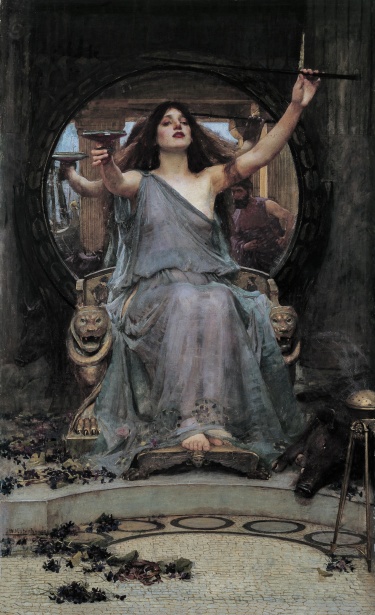
Circe


She spoke
and her words
were like a ringing echo dying

or like smoke
rising and drifting
while the earth below is spinning.

She awoke
with a cry
from a dream that had no ending,

without hope
or strength to rise,
into hopelessness descending.

And an ache
in her heart
toward that dream, retreating,

left a wake
of small waves
in circles never completing.


The Gardener’s Roses


Mary Magdalene, supposing him to be the gardener, saith unto him, “Sir, if thou have borne him hence, tell me where thou hast laid him, and I will take him away.” 


I too have come to the cave;
within: strange, half-glimpsed forms
and ghostly paradigms of things.
Here, nothing warms
		
this lightening moment of the dawn,
pale tendrils spreading east.
And I, of all who followed Him,
by far the least . . .

The women take no note of me;
I do not recognize
the men in white, the gardener,
these unfamiliar skies . . .

Faint scent of roses, then—a touch!
I turn, and I see: You.
My Lord, why do You tarry here:
Another waits, Whose love is true?

Although My Father waits, and bliss;
though angels call—ecstatic crew!—
I gathered roses for a Friend.
I waited here, for You.			


To Have Loved


Helen, bright accompaniment,
accouterment of war as sure as all
the polished swords of princes groomed to lie
in mausoleums all eternity ...

The price of love is not so high
as never to have loved once in the dark
beyond foreseeing. Now, as dawn gleams pale
upon small wind-fanned waves, amid white sails ...

Now all that war entails becomes as small,
as though receding. Paris in your arms
was never yours, nor were you his at all.
And should gods call

in numberless strange voices, should you hear,
still what would be the difference? Men must die
to be remembered. Fame, the shrillest cry,
leaves all the world dismembered.

Hold him, lie, 
tell many pleasant tales of lips and thighs;
enthrall him with your sweetness, till the pall 
and ash lie cold upon him.

Is this all? You saw fear in his eyes, and now they dim
with fear’s remembrance. Love, the fiercest cry,
becomes gasped sighs in his once-gallant hymn
of dreamed “salvation.” Still, you do not care

because you have this moment, and no man
can touch you as he can, and when he’s gone
there will be other men to look upon
your beauty, and have done.

Smile—woebegone, pale, haggard. Will the tales
paint this—your final portrait? Can the stars
find any strange alignments, Zodiacs,
to spell, or unspell, what held beauty lacks?

Michael R. Burch has over 6,000 publications, including poems that have gone viral. His poems have been translated into fourteen languages and set to music by eleven composers. He also edits The HyperTexts (online at www.thehypertexts.com).

.

PLEASE NOTE: ARTICLES CAN ONLY BE REPRODUCED IN OTHER SITES WITH DUE ACKNOWLEDGEMENT TO BORDERLESS JOURNAL.

Categories
Stories

The Cockatoo

By Revathi Ganeshsundaram

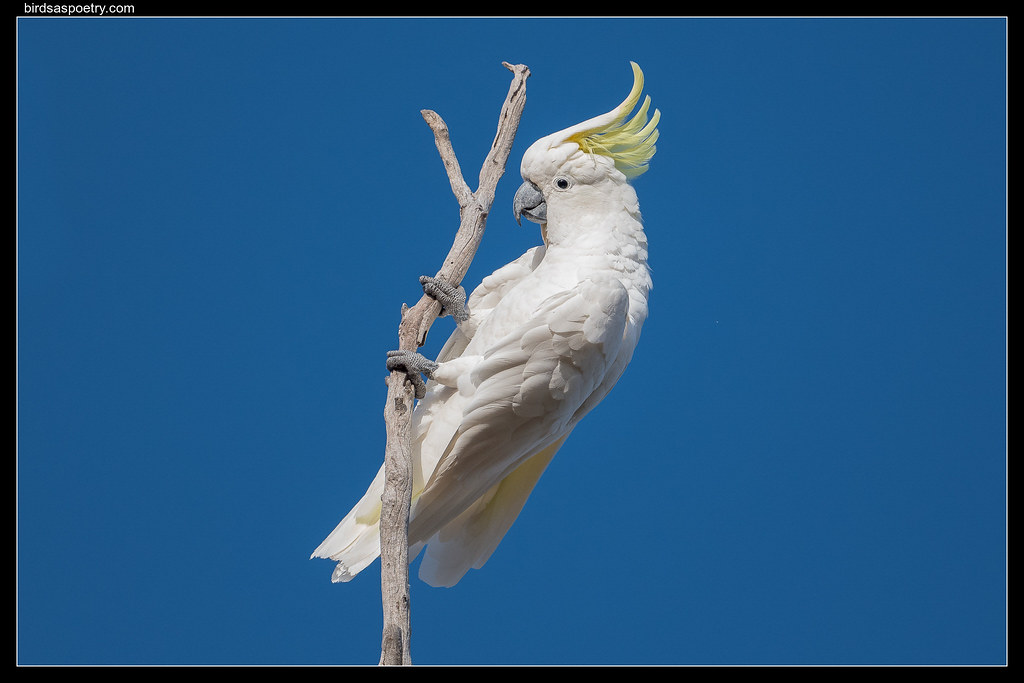
A Cockatoo. Courtesy: Creative Commons

She moved softly towards the edge of the balcony and stood there for a moment looking at the well-kept garden below. She could see an old man sitting on a bench, leaning heavily on one armrest, and she smiled in aesthetic pleasure at the picturesque contrast his grey shirt and trousers made with the dark brown wood on which he was seated and the sea of bright green grass that surrounded him. A row of colourful parakeets dotted the back of the garden seat and its other armrest in an uncannily equidistant arrangement, thereby completing the scenic view.

Although the old man was facing away from her, she was struck by his drooping shoulders and the overall impression he gave, of flagging hope. What ailed him?

Was he a convalescing patient, or an anxious relative? Was it a sick spouse he was waiting on, or an injured grandchild?With a pang, she thought: Is it a birth that awaits him, or…?

So many questions!

She sighed, a little disappointed that she would not be here when the answers came, in their own sweet time.

Something large and white swooped down just then, and she saw that it was a cockatoo, eagerly pecking at something in the as-yet dewy lawn, and as she watched, she saw two more alight nearby. She vaguely remembered reading something mystical about these birds but could not recall exactly.  

Some distance away, a rather ugly turkey waddled onto the scene, and she could not stop herself from thinking that it somehow spoilt the pretty picture-postcard effect. She smiled then, a little guiltily. Who was she to judge?

Someone had left a wheelchair out here, which was rather strange, given that they always seemed short of wheelchairs when you asked for one. Although she no longer needed it, she felt an urge to go over and seat herself in the rather abandoned-looking contraption. That was when she realised that there was something wrong with one of its wheels. No wonder it was not in use right now!

But it was still most disorganised of housekeeping to have left it out on the balcony, she thought as she settled herself in it, anyway.

It was so calm and peaceful out here in the early morning and she was glad of the solitude. Before long, there would be bedlam in the ward, but for now, she was on her own.

So quiet, so strange. Nothing had prepared her for this – it was really, so very peaceful.

And yet, why did she have this unfulfilled feeling, this one unchecked item in her bucket list?

Could it be that she had wanted it too much? Perhaps, she had wished too hard.

What was it they said – Let it go, then it will come to you? Perhaps she had never really let go…

She sighed again. Nothing to complain about, after all. A good husband, although he had died many years back, may he rest in peace. Good sons, who were taking turns looking after her. Why, even now, one of them was sleeping soundly back in the room, exhausted no doubt, by the several night-time interruptions that he uncomplainingly stayed awake to attend.

Her eldest. Her heart went out to him. She wished she could tell him that she had not meant to be a bother, that she had not wanted to trouble any of them. But they had never really been good at expressing feelings to each other.

Well, things would be all right. Eventually.

She was aware of the stranger’s arrival on the balcony even before she saw him. She let him stand there for a moment and get his bearings before she turned to acknowledge his presence with a smile. He smiled back.

It felt as if it was the most natural thing in the world.

He leaned over the railings to look down into the garden and she too turned to look again at the bench below. The old man was now rising from his seat, using the armrest to propel himself into a standing position while resting his weight on a stick. She noticed that his walking aid had a clawed foot with four prongs. It was strange that she could count them from this distance, but she supposed it was one of the perks of her situation.

On the man’s stirring from his hitherto statue-like posture, the parakeets on the bench took flight and rose into the air as one, like a multicoloured festoon on an invisible string. How pretty!  

Her companion on the balcony had turned around now and with his back against the railings, was looking at her. She gazed back at him serenely and they smiled at each other once more. It seemed that no words were needed.

But it would still be nice to talk.

Almost as if he read her thoughts, he said, “It’s so peaceful, isn’t it?”

She nodded, raising her eyebrows in agreement.

“What a contrast…!” he continued, gesturing with a circular motion of his hand towards the inside of the building and indicating a lower floor. “I mean, down there…”

She understood.

“Heart attack?” she queried gently.

It might have seemed a terribly rude question to anyone listening, especially since they were her very first words to a total stranger – her sons would certainly be horrified if they knew – but she was over eighty and old age brought with it certain privileges that the young could never understand.

He did not seem to mind, anyway, as she had known he would not. He raised his fist in a thumbs-up gesture and smiled at her again. Such a sweet smile he had, too.

“And you?” he asked.

“Well, just old age – all sorts of little complications… That is how it starts, you know.”

He looked doubtfully at her. “You don’t look that old to me – I mean, really – I’m not just flattering you…”

It was interesting that he could blush, even now.

She laughed. “I’m eighty,” she said and at his look of surprise, went on with a smile, “I believe you – that you are not flattering me – people always said I was very well-preserved…!”

He snorted. “What an expression! Sounds as though they’re referring to a bottle of pickles!”

She laughed again and looked at him with interest. “You can’t be above sixty-five yourself…”

He cast a sidelong glance at her, looking both pleased and self-conscious as he replied, “I’m seventy-two.”

They smiled again. It was such a comfortable feeling, this camaraderie with a perfect stranger. And yet, it did not feel like he was a stranger at all.

“What kept you?” she asked. Another strange question it would seem, to any eavesdropper, but to him it made perfect sense.

“The doctor would not let me go,” he said. “A very conscientious young chap… It was awful to see the look on his face – I felt I had let him down…”

She nodded. It was ironic that one tended to feel sorry for the people who left, when it was those left behind who needed sympathy. Her thoughts went to her sons, and then she wondered about her companion.

“Who do you have here with you?” she asked, a little curiously.

He coughed in embarrassment. “Nobody, really. A neighbour brought me here, and I guess my friends will be in sooner or later…”

“I’m sorry.” She really was. She thought again of her two lovely sons and was grateful.

She looked away through the railings and was once more impressed by the scene before her: It was as if someone had daubed bright streaks of paint onto a green canvas – a few large and white, and several smaller ones of varied hues – only, none of those spots of colour were still; some of them took wing even as she watched.

She was aware all the while that he was glancing at her on and off, so she was not surprised when he asked again, “And you?”

There was the faintest trace of anxiety in his voice, and she thought she caught a flash of jealousy in his dark eyes before he looked quickly away.

“My elder son is here with me now. He’s the more responsible one though he hates to show his affection openly…” She smiled with a mixture of fondness and regret as she thought of their most recent disagreement. She had not wanted to be hospitalised, but then she became so sick that she no longer had any say in the matter.

Looking back now — all those arguments seemed such a waste of time. And life. Or perhaps both were the same.

She looked up to see him listening intently and went on, “The younger one is more talkative and has been keeping me amused during the day – he should be here too, shortly…”

She waited a moment to hear the unspoken question she knew he was bursting to ask, but he was silent. Taking pity on him, she decided to answer it for him, “My husband is no more. He died many years ago.”

“Oh – I am sorry…” he said in genuine contrition.

She spread her hands philosophically. “It is okay, it was a long while ago. And I suppose we were just two good people blundering along together…”

He looked sharply at her then and she went on, “Somehow, we didn’t really connect – otherwise, he would be with me now, don’t you think?”

He looked down at his feet, his hands on the railing behind him. “My wife and I divorced a good many years back…” He coughed again. “I never really wanted to try again after that.”

She nodded. “You were waiting, but nothing ever happened.”

He glanced up at her in surprise. “You understand?”

She smiled, then. “I waited all my life.”

Perhaps it was something in her voice, or maybe it was the way she tilted her head when she looked at him. Nevertheless, that was when the shock of realisation hit him. He kept staring at her speechlessly until she asked gently, “What kept you?”

This time her meaning was different, yet he understood her perfectly. He came forward eagerly then, and reaching down, took her hands in his.

“I don’t know, I’m not sure… Was it Fate?!”

Their eyes met fully for the first time. Such dark eyes, a lifetime of longing. And his smile – the sweetest thing she had ever seen.

Behind them, the ward was coming to life. She thought she could discern sounds of panic, some sort of a flurry.

“Shall we?” he asked, still holding her hands. She rose from the wheelchair, but then could not resist turning to look towards the rooms.

“Don’t,” he said, gently. “If you do, he will feel your pain and be haunted by it for the rest of his life.”

“How do you…?” she began, but he answered in anticipation, “My mother. I felt it for years afterwards…”

She wavered in indecision, saying wistfully, “If only they could know how peaceful it is, it would not hurt them so much…”

He nodded then, but said again, firmly, “He will be all right – they both will. You’ll see.”

Just a while back, she had been amused by his boyish jealousy. And now, he seemed so much wiser than she. Perhaps, age and time and space meant nothing hereafter?

A large white bird flew up and landed expertly on the balcony railing. As it gazed boldly at them, she suddenly remembered what she had read and felt a strange compulsion to reach out and touch it.

“Don’t! You could lose a finger…!” he cried out, and then they both laughed at the absurdity of it.

She reached out, and the cockatoo – that symbol of light, and change, and of the end of the tunnel – fluttered up and seemed to rest lightly for a moment on her outstretched arm. Then it took off, and as they watched, it flew upwards towards the trees and out of their sight.

“Shall we?” he asked again, and this time, she was sure. They smiled at each other, the sweetest smiles, and it was the most natural thing in the universe.

.

Revathi Ganeshsundaram finds the written word therapeutic and loves reading and writing fiction, sometimes dabbling in poetry. Her work has been published in Borderless Journal, Kitaab, Literary Yard, and Readomania

.

PLEASE NOTE: ARTICLES CAN ONLY BE REPRODUCED IN OTHER SITES WITH DUE ACKNOWLEDGEMENT TO BORDERLESS JOURNAL

Categories
Poetry

Be And It All Came Into Being

Balochi poetry by Akbar Barakzai, translated by Fazal Baloch

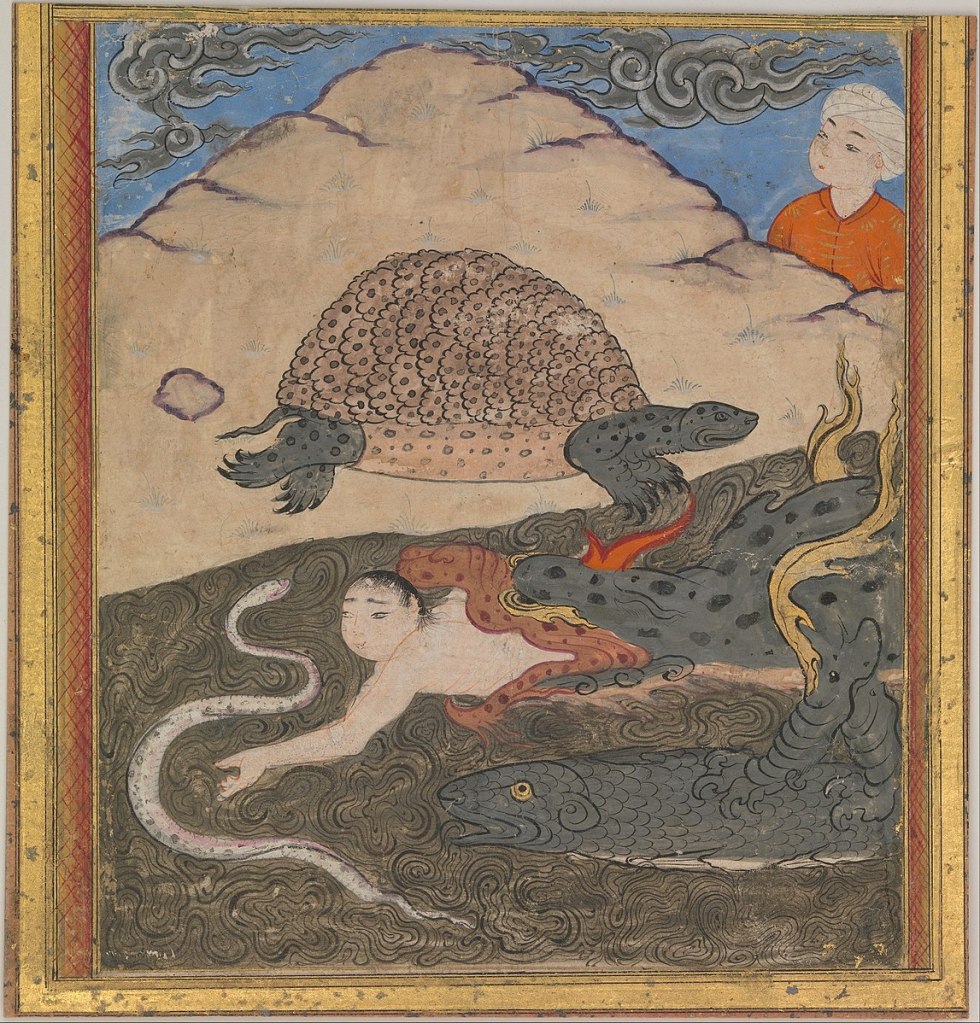
Folio from an `Aja’ib al-Makhluqat (Wonders of Creation) of Qazwini (late 16th century).Courtesy: Creative Commons
Be and it All came into Being
(A Poem for Atta Shad*)

The heavens and the earth 
The moon and the sun 
Stars, galaxies and clouds
Space and spacelessness
Indeed the entire creation
God created all in just seven days 
All praise be to God!
 
On the seventh day 
Tired of hard labour 
He thought of heavenly delights
Of fair damsels and houries
Thus hurried to the garden of paradise 
All praise be to God!

’Tis not all His fault 
If unaware He is of worldly woes and worries 
Of the agony of love and longing
Of the harsh nights of hunger and famine
'Tis not his fault if He is unaware
Of the monsters of tyranny and suppression     
Ours is a world too far from Him
Let us not disturb Him in His heavenly abode
He must have other more important things on His mind
May the curse of Allah befall these blasphemous thoughts!
Indeed how would Akbar, a mere minion of God
Know His never ending mysteries!
A mere poet and wordsmith 
He seeks His forgiveness
All praise be to God!

*Atta Shad (1939-1997) is one of the most cherished modern Balochi poets.

Akbar Barakzai was born in Shikarpur, Sindh in 1939. He is ranked amongst the proponents of modern Balochi literature. His poetry reflects the objective realities of life. Love for motherland, peace and prosperity and dignity of a man are the recurrent themes of his poetry. His love for human dignity transcends all geographical and cultural frontiers. Barakzai is not a prolific poet. In a literary career which spans over half a century, Barakzai has brought out just two anthologies of poetry, Who can Kill the Sunand The Lamps of Heads, but his poetry has depth and reaches out to human hearts with its profundity. Last year, Barakzai rejected the Pakistan Academy of Letters (PAL) award, quoting  the oppressive policies meted out to his region by the government as the reason.

Fazal Baloch is a Balochi writer and translator. He has translated many Balochi poems and short stories into English. His translations have been featured in Pakistani Literature published by Pakistan Academy of Letters and in the form of books and anthologies. Fazal Baloch has the translation rights to Barakzai’s works and is in the process of bringing them out as a book.

.

PLEASE NOTE: ARTICLES CAN ONLY BE REPRODUCED IN OTHER SITES WITH DUE ACKNOWLEDGEMENT TO BORDERLESS JOURNAL

Categories
Travel

Once Upon a Time in Burma: Of Babies and Buddhas

John Herlihy takes us through more of Myanmar with his companion, Peter, in the second part of his travelogue through this land of mystic Buddhas

My friend Peter had slept poorly, the reason being that he had spent much of the night visiting the inner sanctum of the toilet. Alas, the revenge of the spices from last night’s adventure was finally exacting its heavy toll. While I remained free of any stomach trouble, poor Peter had fallen victim to the age-old trials and tribulations of those with no experience with the culinary delights of Asia. We had gone to “the best restaurant in town” according to our Google advisory and indeed, it had turned out to meet our expectations when compared to the mosquito-infested nightmare that Peter had experienced the night before; the swarms of mosquitoes hadn’t condescended to touch, much less bite me. For the cost of about $6 or 9,000 kyat (a tidy sum if you live on the local economy), we were wined and dined with an array of fabulous foods.

The restaurant actually employed a system that I quite liked, namely, that the diner ordered a main course, and an array of side dishes was brought to table, including soups, breads and spicy sauces. I ordered lamb casserole in a creamy, curried dahl (lentils) stew baked in a pewter pot that was utterly delicious and Peter followed my lead in figuring out the best selection from local menus letting me order for both of us. The waiter brought on a dazzling array of sides dishes and a delectable soup that we both wolfed down in various gulps, being hungry after the long day’s trek and the far distance of the hotel breakfast. We tasted everything from curried chickpeas to braised eggplant seasoned with garlic, tomatoes and pine nuts. We need more, I thought to myself as Peter and I fought for the meager remains, but there was no need. The waiter quickly refurbished the little bowls with ample tidbits to last a lifetime, much less the evening meal. Peter, of course, had ordered an extra bowl of rice, two bowls in fact, in addition to the one he had. I had warned Peter about the little sauces served up in small dishes that were intended to be added drop by precious drop to the food to enhance the flavor with a hint of hot chilli. But Peter, in his traditional style, put heaping teaspoons into his food as if he would never taste these things again and needed to remember their flavour. I noted he begrudgingly scooped up the last remaining kernels, the fieriest part of the hot pepper, on his plate at the end of the meal. Indeed, now he was recalling their exotic flavours in unexpected ways.

The next day on our busy tour, we were scheduled to visit the Mahagandayon Monastery, but first we made a quick stop at the local market to find a remedy for the gentle giant’s diarrhea and dehydration problem. “Sticky rice,” Swun immediately said when I mentioned the problem to him. These local remedies can be quite effective; I knew from my own past experience on other trips. I had recommended doses of fresh lemon juice that had worked for me; but Peter wasn’t having it. When Swun suggested the sticky rice by saying, “I know just the place where we can get it,” I thought, yes, the perfect solution. Peter trudged along behind at a reduced pace through the hectic market until we found Swan’s contact standing before a large vat of sticky rice, nearly empty at that hour of the morning. The woman dolloped out several heaping spoonfuls of the steaming mass of rice in a plastic bag sealed with an elastic band. Not exactly pharmaceutical splendour, but it promised to do the job. Swun’s smile concurred as I laughed myself content. We returned to the car and insisted that Peter swallow the heaping brew which he gulped down quickly making grimacing faces that would scare the hand-carved gargoyles we saw earlier in some of the temples.

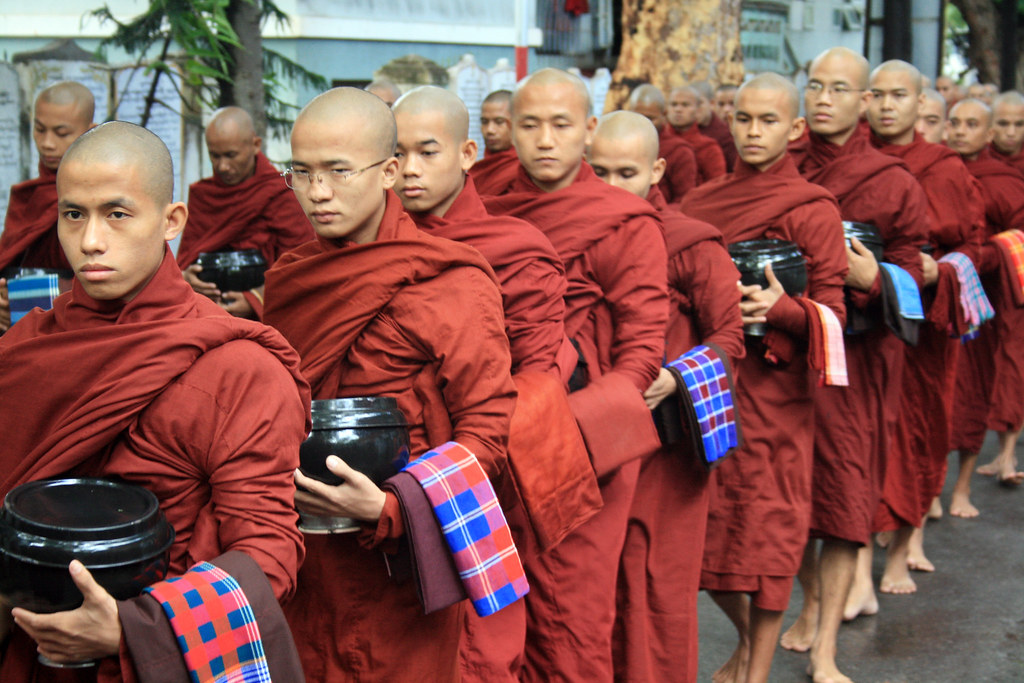
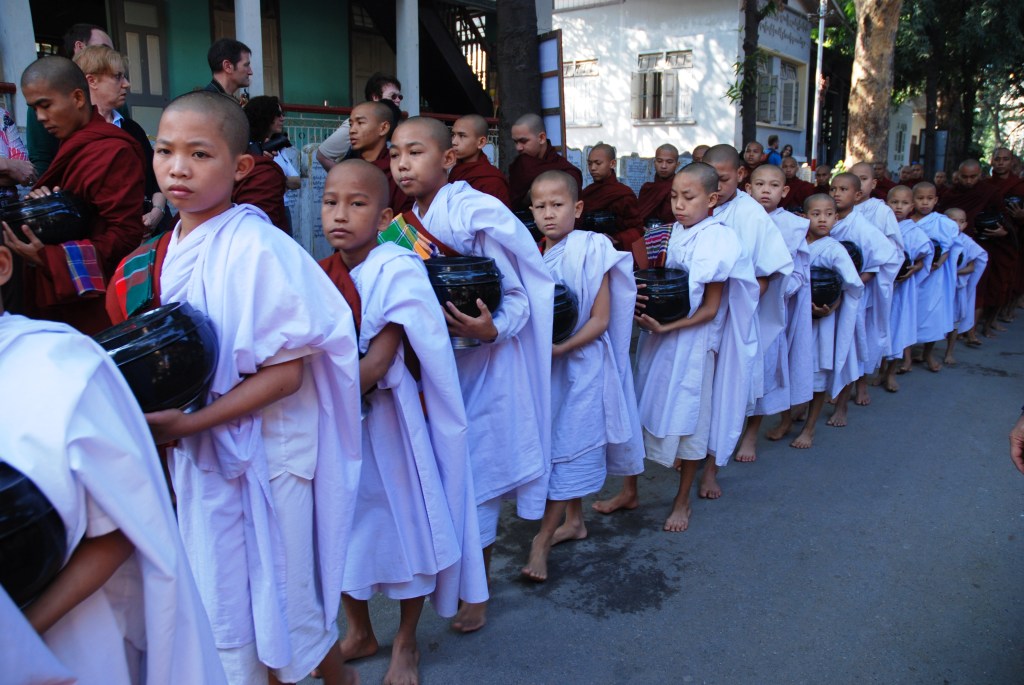
Our first stop was the Mahagandayon Monastery where more than a thousand monks live and study. A large group of tourists had gathered under the morning sun to see hundreds of monks return from their morning trek through the village with their begging bowls seeking food for the main meal of the day. Security police and a few senior monks, curiously chubby looking, created order of the disarray of Chinese tourists of every size, shape and colour behind police barriers, clear of the roadway where the returning monks would be walking. A hush and then a rumble of whispers announced that the monks were approaching down the street from the distance of the nearby village, walking briskly in a single file, holding their begging bowls, now filled or filling up fast with the charity offered to them. People from the sidelines approached with fruits, packages of biscuits, and the like, and even money, a thousand khat here and there which actually represents less than a dollar, but in local terms meant something; and given the size of the crowd could add up to a reasonable hoard. I took note of the soft, youthful faces of the young monks, their heads shaved clear and wearing the traditional orange wrap-around robes that we have become familiar with in Thailand. Some of the monks were very young indeed, children, eyeing the onlookers impishly and seemingly ready for flight. My friend Peter had a clear advantage as his giant stature afforded him the luxury of towering over everyone in sight to have an unimpeded view of the procession of the monks into the monastic enclosure. The monks soon disappeared into the surrounding buildings where they would have their one and only late morning meal of the day.

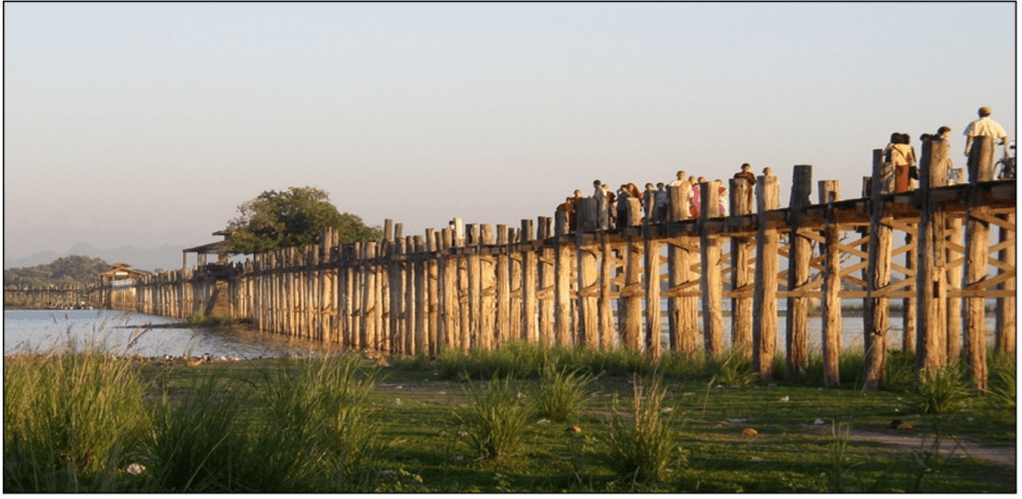
U Bein teak Bridge. Photo Courtesy: John Herlihy

A short, pleasant drive down lush tree-lined streets soon brought Swan, Peter and I to our next destination, the more than 100-year-old U Bein teak bridge, built in 1850, the oldest and longest teak-wood bridge in the world. The 1.2 km bridge spans the Taungthamam Lake near the ancient royal capital not far from Mandalay to an island nearby that could service the local villagers who wanted to get to the mainland across the broad lake to sell their crops. It features 1,086 pillars that stretch out of the water. Though the bridge largely remains intact, there are fears that an increasing number of pillars are becoming dangerously decayed. Damage to these supports have been caused by flooding as well as a fish breeding program introduced into the lake which has caused the water to become stagnant.

Of course, the old kilometer long bridge represented a challenge to Peter who was anxious to “make tracks” across the waters in his traditional swaggering style, leaving nothing behind in the wake of his hurried footsteps but a gentle wind. I also valiantly followed in his footsteps; but soon lost him as he made his way ahead into the thickening crowd. The local Burmese, many of them villagers and many of them in groups of families who were tourists, were making their way across the bridge as they have done for hundreds of years. I was prepared to put up a brave front and make my way across without complaint under the cool winter sun, but as I tripped my way forward across the creaking wooden planks, I became increasingly more uncomfortable. A kind of phobia took hold, as one might experience in confined spaces or riding shaky elevators. The truth was the bridge looked none too stable. The wooden planks were aged, chipped and broken throughout; gaping holes yawned where planks had broken through.

I took note of the fact that the bridge itself was fairly narrow, wide enough for three or four people, but there were no guard rails, just a gaping chasm on either side and a sizeable drop several hundred meters down to the murky waters below. I made my way forward nearly to the halfway point, where I saw Peter up ahead towering over the crowds of people, waiting for me under a make-shift wooden structure with the traditional pointed roof that marked the halfway point. Other elderly people had the same idea as I had; time to rest and take stock. “You go on ahead and make it to the other side,” I told Peter. “You can tell me about it when you come back. I’ll wait for you here.” And my valiant companion was off without further coaxing.

I tucked myself into a shady corner of the narrow bridge, which at that point was extended a little to accommodate the wooden structure marked there as a resting point in the river crossing. It was time to rest, to be alone for a few minutes, to gather myself into my own space and reconstruct the blessings of solitude as the crowds of people made their determined way back and forth across the age-old bridge. It was a cool mid-morning with a gentle breeze under the warming light of the winter sun. At my feet sat a local Burmese woman, with her jet-black hair collected into a wooden hair clip and adorned with a cluster of wildflowers. Her pudgy face held an eternal smile that matched the smile she held in her eyes. At her feet were the goods she was selling to the tourists and other local travelers crossing the bridge, as women have probably done for the last several centuries since the bridge was built. She had a good business for all that, seasoned sticky rice, spicy noodles, and a variety of fruits, all sold for pennies and packed into a little plastic sack and tied with an elastic band for safe keeping. I wished I could understand her chatter; but contended myself with the bird sounds that the Burmese language sounded to me as I listened.

A little boy, probably about one-and-a-half years old, sat at her sandaled feet. He sucked contentedly on a tangerine rind and half dozed with heavy eyelids as if he sat on the fringes of heaven and not on the fold of the wrap-around longyi (the Malays call it sarong famed for its batik cloth) of his young mother. I watched the child as he sat in dreamy splendour without a care in the world as if woken up by the breeze, or perhaps the chatter of the passers-by sounding like river stones. He now looked around as if interested in everything. It wasn’t long before his infant gaze fell upon me, an old man on a journey, lost in his own trance. Children are like cats; one doesn’t like to intrude on their space without alarming them; but leave them to their own devices and they will make their own way. I sat there contentedly; it was enough to rest my weary bones and take in the colour of the local life. I do love children, especially infants, and can sit and watch them for hours, their antics, their inventiveness, their curiosity, their sweet, angelic innocence remind me of another time and another place. I also wonder from where they have come and where they might be going.

When suddenly, the infant’s random glances fell upon me as I sat on the bridge resting. I pretended not to notice, not wishing to interrupt the rhythm or the intensity of his gaze. Indeed, children can come to us uninvited, as if they have known or are wanting to know. They do not bring with them all the excess baggage that we carry around as adults, who seldom look into the eyes of another, and if or when we do, we feel uncomfortable. The child looked at me with intense interest, as if he were remembering something and was still lost in thought. I smiled at him, and he immediately smiled back. I scowled backed him and he immediately scowled back. We seemed to be on the same wavelength. Some inner harmony had struck its chord. The years dissolved and the miles between disappeared as he threw the tangerine rind aside and began to crawl on all fours. His mother was distracted by a sale and was stuffing mango cubes and their sweet juice into a plastic container, selling the pulp for pennies to the taste.

The determined little fellow made his way over as I sat on a low stool. When he reached my legs, he extended his arms as if reaching for the open sky. No doubt, I looked to him like a grand patriarch with my thick mustache and bone-white beard. He soon found his way onto my lap, where he again sat content as if lost in reverie to the surrounding lake and countryside just as I was lost in sweet reverie, so unfamiliar to me, so familiar to him. “Found a friend, did you,” my companion Peter asked with a broad smile. “Children sometimes like me,” I mumbled embarrassed. The mood was broken, the happy child returned to his mother with a longing, backward glance and this is my backward glance to him in the only way a writer knows how, in the love and beauty of words written down on the page in sweet remembrance that will never die.     

We met our guide Swan after breakfast the next morning. Oh yes, a word (or two) should be written about our delightful buffet breakfasts that both Peter and I had come to look forward to. We had established a routine of a solid breakfast, followed by a full day of activity and touring the countryside, but no lunch or snacks of any kind, until evening time, when we took pains to find a nice place for dinner. By now, Peter was well over his stomach trouble, the sticky rice acting effectively as a sealant that put him to rights. We knew he was feeling much better at breakfast the next day. We would rise early, to get the jump on the waves of Chinese tourists that seemed to appear, especially in the breakfast room to lay waste the buffet table like hungry locusts.

I usually went to the egg station as soon as possible to get my order in. “Two eggs,” I whispered timidly, “Over easy,” I said, showing with an upside-down wave of the hand what I wanted, and then sliced down dramatically, “and cut the yoke.” The last thing I wanted were runny, undercooked eggs. The eggs were made in buttered splendor – they actually tasted like real eggs – and not the tasteless fare that we usually get in most modern metropolises. I skipped over with my plate of eggs to another table to pick up my freshly made toasted brown bread awash in melted cheese and butter.

“That should take care of me for the day,” I thought happily, when suddenly I heard a booming voice from the egg station. “Six eggs, please,” Peter cried, holding up a handful of fingers, plus one, to make sure the cook knew how many he meant. He returned to our table with a stack of untoasted bread to wash down the eggs in great gulps. Not to be outdone, I tiptoed back to the cooking station and asked for a crepe. I had seen the cook making a feather-light and thin pancake served up with Burmese honey and fresh cream that was cooked to perfection; but Peter had the final word with his stack of six pancakes dripping in honey and assorted jellies.

Photo Courtesy: John Herlihy

After breakfast, we met up with our beloved guide Swan again in the hotel lobby. “Not another pagoda,” I cried out in mock dismay, but Swan was now attuned to my humour and took up the slack by affirming that indeed we would be visiting another remarkable pagoda surrounded by 845 small stupas as though in deferent tribute to the richly decorated central pagoda. Work began on the pagoda in 1939 at the start of the Second World War and was finally completed in the March of 1952. There are many buddha statues row upon row in niches along the walls, all coloured gold, a truly sublime sight filled with religious nostalgia. The entrance is protected, not by the traditional mythical lions, but by the statues of the magnificent white elephants that are sacred and auspicious in Buddhist symbolism. Thereafter, we took a short walk through the nearby banyan tree grove Boddhitataung, where a thousand Buddha images lie at rest among the sprouting banyan trees. Ah, walking through the aged banyan trees is like walking through an ancient grove associated with the mythic gods of Greece. One half expects a centaur or unicorn to come trolling through the corridors of trees in this mystical setting. The banyan trees is considered sacred in places like India and Burma and is well known for the mercy of its abundant shade. In fact, in India, the leaf of the banyan is said to be the resting place of the Lord Krishna.

But even the shade of the banyan tree faded into darkness, and it was time for us to move on, even if we did feel most welcome in the the banyan tree’s embrace. We were scheduled to go down to the river and bid goodbye to our guide Swan, as we would be making our way by riverboat down to a town further south called Bagan. We were to meet the new guide on the boat who would escort us there. It was a little sad to bid goodbye to Swan. He was such a charming little fellow, a student who would complete his university studies soon. He worked on the side as a guide and had done this for the last few years. It doesn’t take long under these circumstances to get to know and like the guide, so it was with a heavy heart that both Peter and I bid him farewell.

However, Swan was to help me through one last challenge. After bidding me goodbye, he helped me down the side of the dusty hill to a steep embankment at the edge of which lay the river boat that would take us south to Bagan. When I saw the wooden plank that I had to walk across to get onto the boat, I stopped dead in my tracks. I can’t do this, I immediately said to myself. At my age, I now know what I can and cannot do, and crossing that narrow, wooden plank sagging perilously in the middle and crossing a no-man’s-land muddy cliffs and water about 50 meters seemed an impossible task.

Swan took me by the hand and coaxed me on, not wishing perhaps to have his charge stranded along the way without any option of moving forward. Peter, of course, was already up ahead on the plank himself with his usual bravado, but he also almost slipped and was standing on one leg before balancing himself once again, preventing himself from falling unceremoniously down in the muddy waters below. I took a deep breath and mounted the plank. Mercifully, two people stood nearby, a woman on the riverbank’s edge and her husband perhaps on the boat itself holding a lengthy bamboo pole that I was able to hold onto as a kind of makeshift handrail as I perilously crossed the narrow wooden plank like an infant learning how to walk in his new toddler shoes. Once on the boat and tucked into the lounge chair, I breathed a sigh of relief that I hadn’t made a fool of myself.

Traveling on Irrawaddy River from Mandalay. Courtesy: Creative Commons

Click here to read Part one of Once Upon a Time in Burma

Click here to read Part three of Once Upon a Time in Burma

Click here to read Part four of Once Upon a Time in Burma

.

John Herlihy, travel writer and poet, has published two collections of travel essays, Journeys with Soul and his more recent Distant Islands and Sealight, available at online booksellers and Amazon.

.

PLEASE NOTE: ARTICLES CAN ONLY BE REPRODUCED IN OTHER SITES WITH DUE ACKNOWLEDGEMENT TO BORDERLESS JOURNAL