Categories
Essay

The Call of the Himalayas

Narrative and photography by P Ravi Shankar
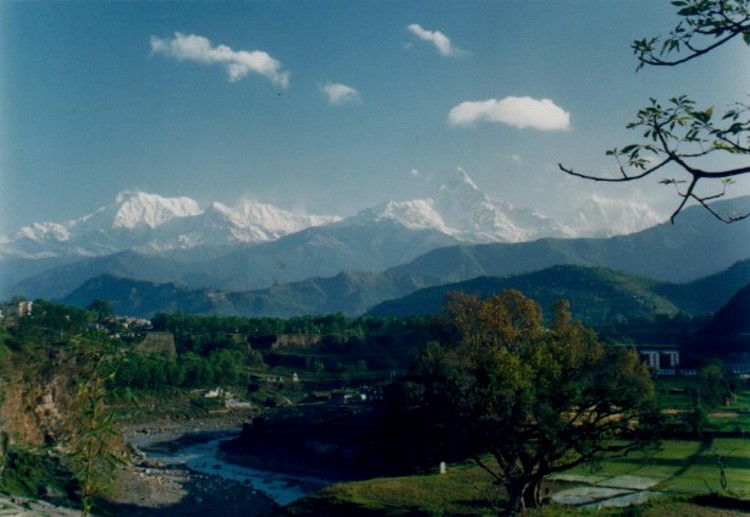

Pokhara with Annapurna towering in the backdrop

Pokhara, Nepal is one of the few places in the world where towering snow-clad mountains are easily seen from a subtropical setting. The town is at a height of around 900 meters and within a span of around 40 kilometres, the land rises to the summit of Annapurna at over 8000 meters. The view of colourful poinsettias and bougainvillea against the blue sky and the white peaks creates a picture postcard setting. The soft limestone rocks are easily eroded by powerful glacial-fed rivers creating deep gorges. The hills surrounding Pokhara have many charming villages and one can also follow the river valleys to the Annapurna Sanctuary (a pasture situated between the Annapurna peaks) and to the land of Mustang.

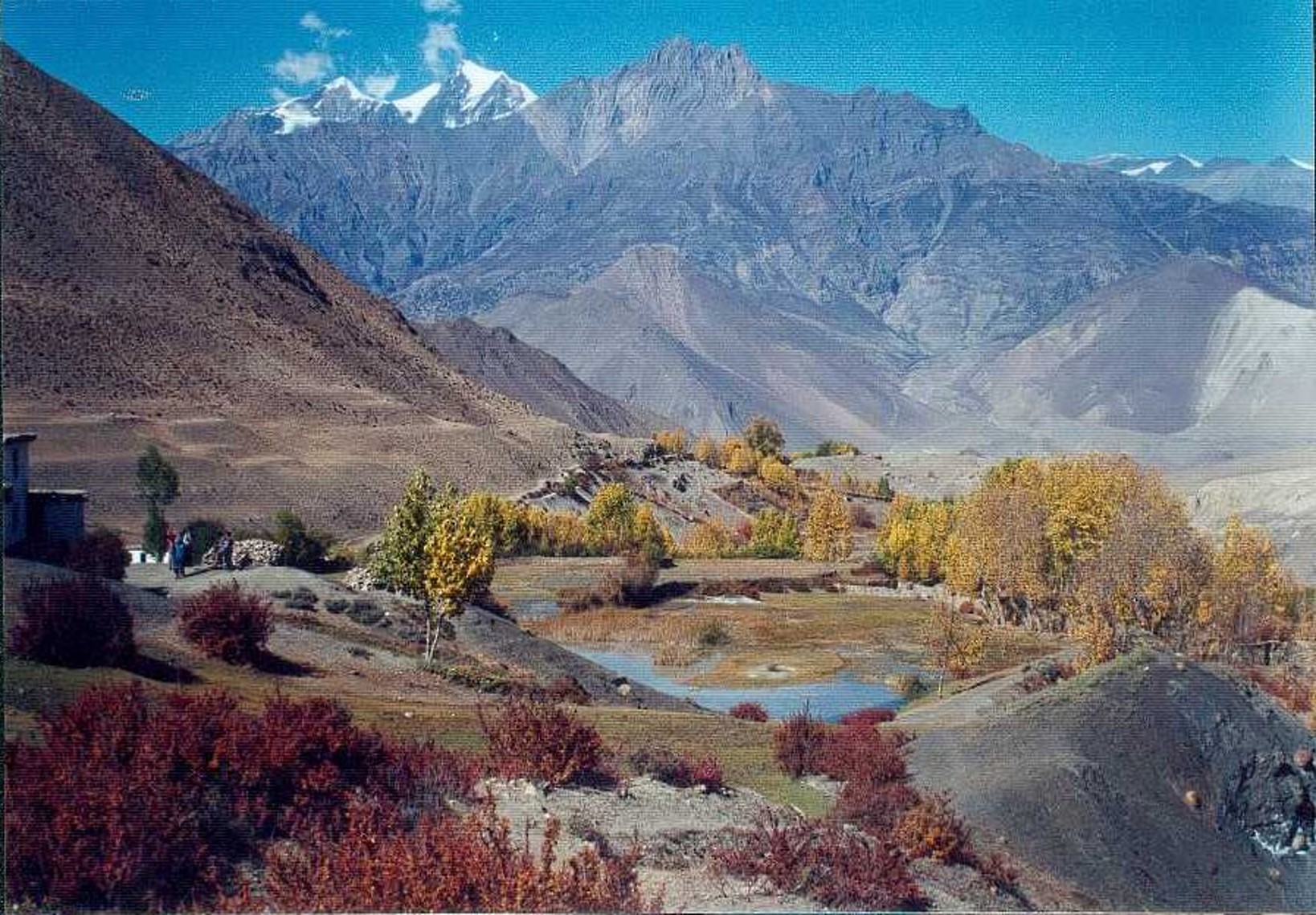
I was at Kalopani in Mustang. The morning was bright and sunny, but the air was still chilly. The dining room was heated, and many tourists were having their breakfast before continuing their treks. The Nilgiri Himals (snow-covered mountains in Nepali) were clear in the bright morning sunshine. We were waiting for our pooris to arrive.

My friend and I were hiking up toward the Thakali (the major ethnic group in this area) settlements of Tukuche and Marpha. The dining room was big, and the glass windows had spectacular views of the pine forests. We were at the Pine Forest Lodge in the twin settlements of Lete and Kalopani. The settlement continues for over thirty minutes on both sides of the trail. The lodge is big by trekking lodge standards and has sixteen rooms. Run by the Dhawlagiri Technical school, this facility is often used to train tourism students. The manager informed us that the number of tourists they can accept every day is limited due to an agreement with similar businesses in the area. Now, it also offers free wi-fi services. When we visited in the early 2000s, cellular and internet services were still in the future.

Our pooris finally arrived. They were fluffy and brownish red. A potato and peas gravy accompanied the pooris. The dish was thick and spicy. The small hill potatoes were tasty.

The lodge constructed of stone can be cold during the nights, but comforters are provided to guests. I always had pleasant stays at this lodge. I never had the opportunity to meet trainee students as usually they started their sessions only after nine in the morning. By that hour, we were already out on the trail.
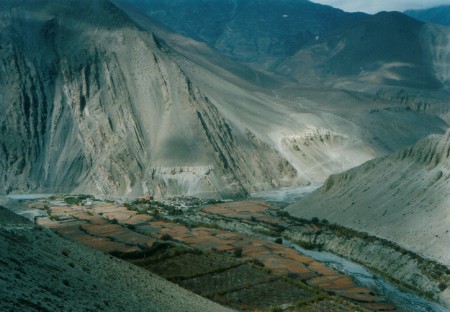
The Village of Kagbeni with the Kali Gandaki River
The Tibetan shrine with the five foot statue of Buddha in the background

The Red House Lodge in Kagbeni is a bewildering warren of rooms and passages. Kagbeni is on the way to the holy shrine of Muktinath and hikers without the expensive permit to Upper Mustang can watch the trail meandering through the Kali Gandaki River and the barren brown hills. The Red House Lodge is an iconic establishment and several stories and blogs have been written about it. The lodge is a traditional, red-coloured Tibetan house and was started by Pema Doma in 1997 when the region was opened to tourists. She developed a beautiful friendship with an Australian lady, Sydney Schuler. The small house that served as the lodge did not have a name and she then decided to install a signboard inscribed with ‘Red House Lodge’. There are Tibetan religious texts and a Tibetan shrine with a five feet statue of the Buddha at the centre. Firewood and provisions dry in the harsh sun on the flat roof and there is a large pole with prayer flags flapping in the wind.

From the roof, you can gaze at the dreamy landscapes of upper Mustang and watch the constantly changing play of light on the barren hills. By mid-morning strong winds roar from the Tibetan plateau. Tibetans use both the wind and water to carry their prayers far and wide. The lodge was used to store rations by the Khampa resistance fighters, who struggled against cultural hegemony in the mid-twentieth century. Kham in eastern Tibet was one of the three traditional provinces and the Khampas (the inhabitants) have a reputation as tough fighters. They eventually migrated to Nepal along with other refugees and waged armed resistance to free Tibet till they were eventually disarmed by the Nepalese army in the 1970s. Kesang in the Mustang region was one of the main centres of the Khampa resistance.   The food at the lodge in Kesang is excellent and it is a good place to rest either on your way up to or down from Muktinath. The sense of history is strong in this lodge as a comfortable familiarity with the past blends into the present.

Ghandruk is a large Gurung village near Pokhara and the headquarters of the Annapurna Conservation Area Project (ACAP). Gurungs are an ethnic group dominant in the hills around Pokhara. Along with other ethnicities they constitute the famous Gurkhas known for their courage and valour. Gurungs are believed to have originated in Tibet and practice a mixture of animistic, Hindu, and Buddhist religious practices. They live on the southern slopes of the Himalayas in central Nepal and call themselves Tamu. Many serve in the Nepalese, Indian, British and other armies and police forces and have seen action in several conflicts.

Due to the civil war, many Gurungs migrated from their villages to settle in Pokhara. Ghandruk (also called Ghandrung) is the second largest Gurung village in Nepal after Siklis. The village sprawls over a hillside with terraced fields. From the road head at Nayapul (new bridge), Ghandruk is a four-to-five-hour trek initially along the riverbank and then through well-maintained stone staircases. The Himalaya Lodge (a Kerr and Downey resort) is located right at the top of the village. This lodge lets out rooms to independent trekkers if not occupied by those who have reserved their rooms through Kerr and Downey.
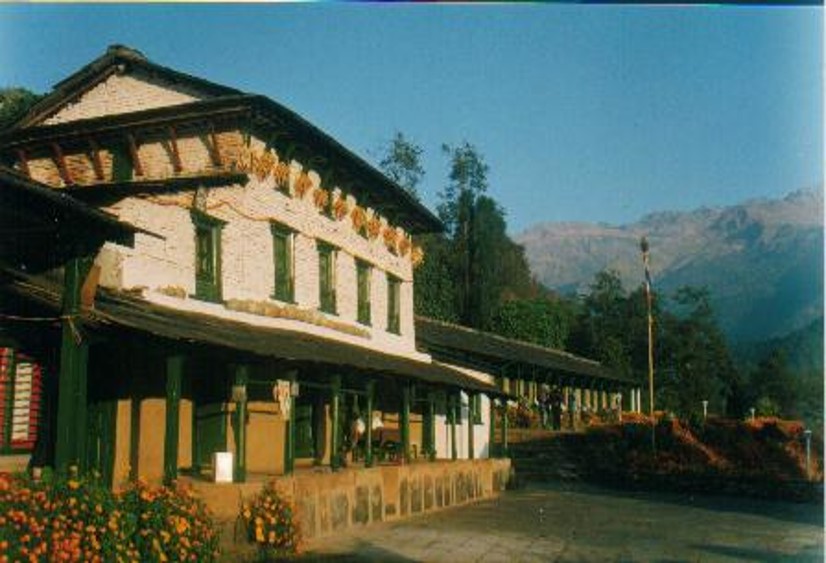
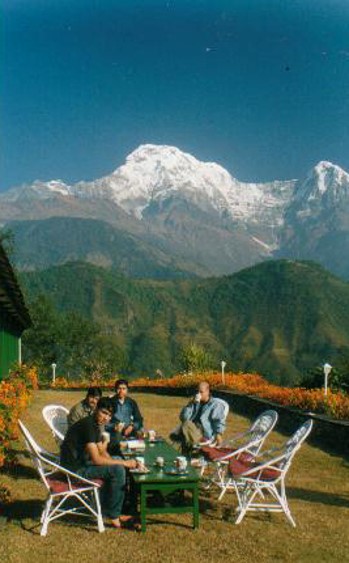
The lodge has spectacular views of the Annapurna Himals. The dining room is decorated in the Gurung style. The food at the lodge served in traditional copper utensils is excellent. The freshly plucked green leafy vegetables and the radish pickle are tasty. The rooms are well-appointed with attached bathrooms. You sleep between freshly laundered white sheets. The lodge provides guests with slippers and down jackets for their use during their stay. There are tables and comfortable chairs placed in the stone-paved courtyard for al fresco dining and you can watch the clouds gather and eventually cloak the Himals. Butterflies and birds flit among the flowers. The lodge also has different handicrafts for sale. I was first introduced to the singing bowl or the Himalayan bowl here.  The traditional bowls were originally made of a variety of metals including mercury, lead, silver, iron, gold, and copper. I found it fascinating that by moving a wooden stick around the bowl a rich harmonious note could be produced.

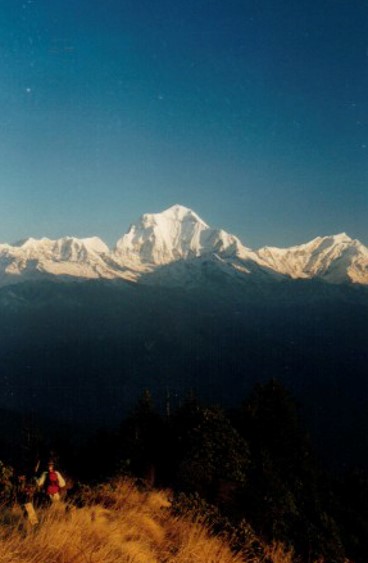
Ghorepani at around 2800 m is famous for the views of the Annapurna and Dhaulagiri Himals. The viewing of sunrise at Poon Hill is a highlight of the trek. I usually stay at the Snow View lodge located close to Poon Hill. The lodge is made of wood and has an excellent solar hot shower. They have a single room with a window providing excellent views. The cast-iron stove in the dining room is warm and the food is excellent. Ghorepani is a long day’s climb on steep stone staircases from Nayapul and Birethanti. Climbing to Poon hill from the lodges using flashlights in the predawn darkness is a unique experience. Ghorepani was a watering hole for horses till it was discovered by tourists. The settlement has several lodges both down in the main village and higher up at Deurali (the pass). The rhododendrons during spring bloom in various shades of red and pink. The cornbread baked at Snow View lodge is excellent and is my breakfast of choice.   
      

The last few years have been hard on the trekking lodges. First, there was the devastating earthquake of 2015 which damaged the infrastructure, and then the global shutdown due to the coronavirus pandemic. The lodge owners are resilient and resourceful. The lodges offer comfortable alternatives to staying in cold tents and also contribute to the local economy. Now, as the world is beginning to open its doors again to tourism and travel, I look forward to returning to the magic of the Himalayas and revisiting these wonderful lodges.

Sunset on Annapurna

Dr. P Ravi Shankar is a faculty member at the IMU Centre for Education (ICE), International Medical University, Kuala Lumpur, Malaysia. He enjoys traveling and is a creative writer and photographer.

.

PLEASE NOTE: ARTICLES CAN ONLY BE REPRODUCED IN OTHER SITES WITH DUE ACKNOWLEDGEMENT TO BORDERLESS JOURNAL

Categories
Poetry

A Grandchild

By Ashok Suri

O, the company of a grandchild!
A joy unparalleled --
There is nothing like this
In the entire world…

To see the little angel 
Sleep in the cradle with a doll,  
Crawl excitedly, 
Scribble cute lines on the wall,
Move with nimble steps around the table,
While you hold the soft little hand,
Fearing the little lamb may fall.

To have the sweet soul
Ride on your shoulders,
Play in your lap,
Hold you back with all her might
When you try to go out,
And rush on all fours towards you
When you come back.

Play hide and seek,
Guide and teach,
Take the little one 
To school, park and beach.
Weave each night new stories
Of kings and queens, angels and fairies,
Till your darling goes to sleep.

O, it’s a delight!
Pure bliss!
Even angels come down on earth
To relish this!
Courtesy: Creative Commons

Ashok Suri is a retiree and is settled with his family in Mumbai. He tries to convey in simple words what he wants to say.

.

PLEASE NOTE: ARTICLES CAN ONLY BE REPRODUCED IN OTHER SITES WITH DUE ACKNOWLEDGEMENT TO BORDERLESS JOURNAL

Categories
Stories

The Circle

By Sutputra Radheye

Courtesy: Creative Commons

It was Saraswati Puja that day when he went to my parents and asked, without any hesitation, if he could marry their daughter. Me. We had been dating for four years at that point of time. It was unusual for the India of our times in the 80s. We didn’t have gadgets like there are today. When he was studying in IIT(Indian Institute of Technology) Bombay, and I was in Kolkata, we used to write letters. Sometimes, they would arrive in a week or two, but sometimes, they took about a month. It was tough not seeing each other for years. But, finally it was happening. He didn’t leave me for someone better. He kept his promise.

We got married in October and were soon blessed with a daughter. She replaced me in his heart. She was now the person who used to live in most parts of his heart. I used to joke to him saying he has rented my house to our daughter. He was everything good that happened to me.

Decades later as I write this, my hands are trembling. I don’t know why but I am scared. Something is not right. Something terrible is on the way. I shouldn’t think that way but I am not able to stop myself from going into these routes. Today is Saraswati Puja and he is lying pale in the surgery. Our friend, Dr Ghosh, is inside with him. The operation is going on.

An hour and a half later, the doctor walked out of the surgery. His eyes were moist. I knew what I feared had happened. But, I won’t cry. He won’t like me teared up.

I am stronger than he thinks I am.

.

Sutputra Radheye is a young poet/writer  from India. He has published two poetry collections — Worshipping Bodies(Notion Press) and Inqalaab on the Walls (Delhi Poetry Slam). His works are reflective of the society he lives in and tries to capture the marginalised side of the story.

.

PLEASE NOTE: ARTICLES CAN ONLY BE REPRODUCED IN OTHER SITES WITH DUE ACKNOWLEDGEMENT TO BORDERLESS JOURNAL

Categories
Poetry

Black Clouds Drifted

By Sybil Elizabeth Pretious

Courtesy: Creative Commons
BLACK CLOUDS DRIFTED

I floated heavily across the moonlit field.
Above on the cliff, the light graced the wind-dancing grass
For a moment I was still.
Listening … nothing but the sighing.
Black clouds claimed the light
Drifting, secretly drifting.
Wind grasped my hair,
tugged it across my eyes.
Shutters came down.
The light captured behind lids and hair curtain.
Silence but for the wheezing of the wind 
and the roar of the sea. 
Sound surrounding thoughts:
Thoughts drifting like the black clouds.
Solutions? None.
A violent gust and I fall to my knees
A whistling through my heart,
A small prayer ventures out in the blackness.
And then
black clouds drift once more.
The moon captures my sadness
and lifts my soul to breathe again.

 Sybil Pretious writes mainly memoir pieces, paints and composes an occasional poem to reflect her varied life in many countries. Lessons in life are woven into her writing encouraging risk-taking and an appreciation of different cultures. 

.

PLEASE NOTE: ARTICLES CAN ONLY BE REPRODUCED IN OTHER SITES WITH DUE ACKNOWLEDGEMENT TO BORDERLESS JOURNAL

Categories
Slices from Life

Getting My Nemesis

By Erwin Coombs

You might be wondering how on earth Dusty, the cat, played such a huge role in my downfall. I suppose I should use the defence that the title of this piece is nothing more than literary license because for one thing, I have never had a downfall. Oh, I’ve had many falls and stumbles, but no major catastrophic tragedy that cast me into the pits of despair. I suppose rather than the pits of despair, I have just visited the suburbs of despair. And having lived in the suburbs, I don’t mind equating these two. That is one of the many wonderful things about life, that we can fall, but invariably we rise again, as it is said in a part of the Bible I can never remember, though I fall I shall rise. Confucius said it as well: that our greatest glory is not in never falling, but in rising every time we fall. The title of this book is misleading, to an extent. I never fell, absolutely, and Dusty had nothing to do with my stumbles. In fact, she was a factor in helping me to get up again and again. A cat? Yes, one might be amazed at the soothing companionship that pets offer generally. I don’t mean all pets. I can’t imagine a turtle, for example, offering solace at the end of a rotten day at work or after your partner has just told you that you are now a lone wolf and good luck with your future. But let me get back to when I finally decided to get a cat.

I was on my own and had rented a bachelor apartment. I was determined to have a pet, particularly a cat, as cats had been a big part of my life since I found the stray Dickens twenty years ago. It was the first of the month, moving day, and as I had not a lot to move for reasons to long to go into, I thought I wouldn’t go a day without company, so I asked my daughters to come with me to the Humane Society to pick one out. My eldest daughter was a little hesitant as she and her boyfriend had adopted a dog few months earlier and had to return it, for reasons once again too long to go into. As a result, she felt that she was blacklisted and that her picture was up on screens and walls and would somehow be subject to abuse at the hands of the workers there. I tried to explain that these people were very well intentioned and likely not wanting to seek revenge for the return of an animal. I mean, I asked her, what could they possibly do? Shame her in front of the other caged animals? Sick a wild pack of rabid pooches on her? But she was nervous enough that she left the choosing of my cat to me and Josie.

My other daughter and I went cruising through the rooms looking at the imprisoned beasts. Any visit to one of these places can be sad. They really do look like prisoners as they pace their small spaces and when you pass by a cage, they seem to do their best to be alluring, realizing on some level, that this stranger might just be their ticket out of Sing-Sing. They rub up against the bars and look at you with these pleading eyes that seem to say, “Please like me, take me home.” It’s every meathead’s dream of what a single’s bar should be like but isn’t for meatheads. My daughter finally found one that she connected with and told me to come over and have a look. It was an American Shorthair, grey and with lovely kind, green eyes. The assistant opened the cage for me and let me put my hand in to have a pet. It was a lovely meeting until the blood was drawn. Mine, I mean, not hers. She lashed out not too fiercely at my hand and I pulled back too late. Josie looked up at me and said,

“Dad, you moved too quickly!”

My argument was that the quick move was the result of having been assaulted and not the cause, but she was intent that this was the one for me and so, naturally, I agreed, as I held my hand up to prevent my life’s blood from escaping.

“There not used to being touched, poor things.” said the worker.

I looked at my gash and wondered if there would be any pity for me, or only another condemnation at having been doing jazz hands in a cat’s cage, but there was none. Nevertheless, I agreed to take this one home and started the paperwork. The woman across the desk took my particulars and my cheque and told me, quite casually.

“And we won’t charge you for the cream.”

“Cream?” I asked, “What cream?”

For a moment I thought that they were going to offer an antibacterial tube for my hand given that one of their inmates had attempted murder on me. But not even close.

“The cream for her backside” came the “as if you didn’t know” response.

“Why would I need cream for her backside?” I asked bracing myself for an answer I knew wouldn’t be pleasant. I mean, any conversation around creams and cat’s backsides is not going to work out well, and this one didn’t.

“As you probably noticed, the kitty is a little bit bigger than she should be.”

A little bit? This was one fat cat. Cats as a rule are about as sedentary a creature as you’ll find so being a little bit chunky is par for the course, but this one was two pars for the course. I didn’t mind as I thought I’ll get her slimmed down with a gym membership and controlled diet.

“And the cream on her anus will help her lose weight?” I asked hopefully.

“Oh no, it’s just that she is so big she can’t really reach her anus to clean it, so she has a wee bit of an infection. The cream will help clear it up. Twice a day, but I suggest you wear a glove as you do it.”

If there was one thing I didn’t need a suggestion about as to when to wear a glove it was that. I didn’t relish the idea with a glove anyway. We took her back to my sparsely furnished new apartment and put her down on the floor while I set up the all-important pooh box and, more important to her, the food and water bowl. She was still a nameless cat, so I asked the girls as I was busying myself rushing about, as much as one can in a bachelor apartment, setting up for my new roommate,

“Well girls, what should we name her?”

“Dusty.” Came the immediate response from Josie. And it made sense as she was a gray furred kitty with lovely white bits as well.

“Because she’s gray?” I called out from the bathroom as I scooped kitty litter into the target box.

“No.” said Josie. “Because she’s eating a fluff of dust.”

And that is my cat, Dusty. As if being so obese that you can’t clean your own backside wasn’t evidence enough, she has an eating compulsion that will not stop, even at dust. But we forged strong bonds and became good friends. As a matter of fact, there is a gay theatre in Toronto called Buddies in Bad Times Theatre Company, and they are quite good. So, from day one I would refer to Dusty and I as just that, buddies in bad times. Of course, the times weren’t bad exactly, but they were certainly getting better.

Erwin Coombs is a retired teacher of philosophy, history and literature who has rejected all forms of retirement. He is an avid writer, reader, and observer of life. When not observing and reading and living, he is writing. Erwin has lived in Egypt, Jamaica, England and travelled a great deal but, in his mind, not enough. His writing is a celebration of people and opportunity, both of which life gives in abundance. These stories are from his, as yet unpublished book, Dusty the Cat: Her Part in My Downfall.

.

PLEASE NOTE: ARTICLES CAN ONLY BE REPRODUCED IN OTHER SITES WITH DUE ACKNOWLEDGEMENT TO BORDERLESS JOURNAL

Categories
Poetry

Rhys on the War

Poetry By Rhys Hughes

Courtesy: Creative Commons
POEMS ARE USELESS


Poems are useless
at stopping wars that have started
but wars are more useless
at poetry than poets.
Missiles dipped in the ink of blood
write nothing worthwhile.


PROPAGANDA


The
invaders
are claiming
that we are shelling
     ourselves.

            That's nuts.


THE INVADERS

The invaders came across the land
but tripped on the steppes
and fell down
to death.


DICTATORS

Dictators strut
up and down like clowns
wearing big egos
   like oversized shoes.


GENERALLY

Generally
generals bend the knee
to politicians  
while privates have no
leg to stand on
after they leave the trenches.

At least that
is the way it used to be.
Now civilians
are legless too, a footnote
to official history.


Rhys Hughes has lived in many countries. He graduated as an engineer but currently works as a tutor of mathematics. Since his first book was published in 1995 he has had fifty other books published and his work has been translated into ten languages.

Disclaimer: The opinions expressed are solely that of the author and not of Borderless Journal.

PLEASE NOTE: ARTICLES CAN ONLY BE REPRODUCED IN OTHER SITES WITH DUE ACKNOWLEDGEMENT TO BORDERLESS JOURNAL

Categories
Mission Earth

No Adults Allowed!

By Kenny Peavy

When we were kids we weren’t allowed in the house. We were told that kids didn’t belong inside. The philosophy back then was that kids were meant to be outdoors playing. A kids place was outside. No kids inside.

It was a steadfast rule, because if we did manage to sneak into the house for some reason we’d be chased out again by our mamas yelling all sorts of stuff broom in hand.

Looking back, I am incredibly grateful that was the philosophy and the rule. Because it was strictly enforced, me, my sister and all my friends spent endless hours roaming free in the neighborhood in search of adventure, entertainment and distraction.

Boredom was an integral part of being a kid back then. We didn’t have fancy toys or video games. At most we might have a skate board, a bicycle, a football or related outdoor gear like a knife or fishing pole. This led to all sorts of games and time filling activities being invented. Often on the spot.

We’d find some scraps of tape or paper somewhere and roll it up into a ball. A stick became a bat. And a fierce game of stickball might erupt.

We’d yell out rules and make them up as we go.

“Three fouls count as one strike!” yelled just after one kid hit two fouls and we were weary of all the fouls being hit.

“If you hit more than two out of bounds it counts as a strike!” screamed after we got tired of somebody always hitting the ball out of bounds.

“If you can’t tag the person, you can throw the ball at ‘em to get ‘em out!” negotiated when the fastest player screamed around the bases. No one could catch them!

If we couldn’t catch them, maybe we might have a chance to get them out by flinging the ball at them as they scooted by. Or so it was reasoned.

“Wait, it only counts if you hit ‘em below the waistline.” a correction to the previous rule invented after someone got smacked in the skull. We couldn’t deliberately try to knock them out or aim at the head.

And so, it went. No adults in sight. No adults allowed.

All rules invented and implemented on the spot. Everything created on the fly.

We were learning negotiation skills. We were learning how to communicate. We were learning how to argue our case for the new rules we’d invented and wanted to implement. We were learning strategy and empathy (when someone got a bloody lip from being plonked with the paper tape ball!).

Of course, we didn’t call it that. We didn’t even realise it at the time. No one was implicitly teaching us.

We just called it playing outside.

All of it. Every single bit of it was student centered, student driven, discovery and peer teaching at its best. (To use modern educational jargon).

So much learning was taking place through play!

The best days would be when we would pretend to be Steve Austin from The Six Million Dollar Man and run through the woods in slow motion pretending to have bionic legs. Or even better, when we imagined we were Evel Knievel and set up ramps across the creek to simulate his jump across the Grand Canyon.

And some of the best times were when we built forts in the woods and pretended to be conquering knights or when we tried to build tree huts and figure out how to engineer slabs of 2” X 4” pieces of wood to stay in place and then figure out how to make a ladder using vines without accidentally weaving in poison ivy!

Boredom was the key. It gave time, space and freedom to make up our own games. Time to create. Time to invent.

If boredom is the mother of invention, then the lack of pre-made and readymade resources is the father. Back then we weren’t infected with Affluenza, the disease of affluence and excess, so we had to be inventive and creative with what little we had if we wanted to play and have fun.

I am afraid that is what is lacking today. A lack of lacking. We have too much. Too many things and too many distractions.

As a result, boredom has retreated into the forest waiting for explorers and adventurers to venture into the woods and come to discover their Muses for creativity and invention.

Things have changed since we were kids being chased out of the house.

Adults are always present. Rules are imposed. Games come pre-assembled. There are 1000+ tiny pieces or a screen. Batteries or a charger are always required.

Play dates are made. Play is scheduled and not spontaneous. The places where the play dates happen are sterile and manicured as ‘proper’ playgrounds tend to be these days.

Wildness and spontaneity have been chased out the window by fear, efficiency and convenience.

We even have terms for what we used to simply call playing outside. Now it’s referred to unsupervised, unstructured free time. Research is done on this topic. Papers are written. Data is analysed.

When all we simply need to do is get outside and play in Nature.

.

Kenny Peavy is an environmentalist who has a memoir called Young Homeless Professional. He has co-authored a pioneering environmental education handbook, As if the Earth Matters, and recently, an illustrated book, The Box People , was re-released digitally to enable children, young people and their parents and educators anywhere in the world to use the book. He also created Waffle House Prophets: Poems Inspired by Sacred People and Places

PLEASE NOTE: ARTICLES CAN ONLY BE REPRODUCED IN OTHER SITES WITH DUE ACKNOWLEDGEMENT TO BORDERLESS JOURNAL

Categories
Review

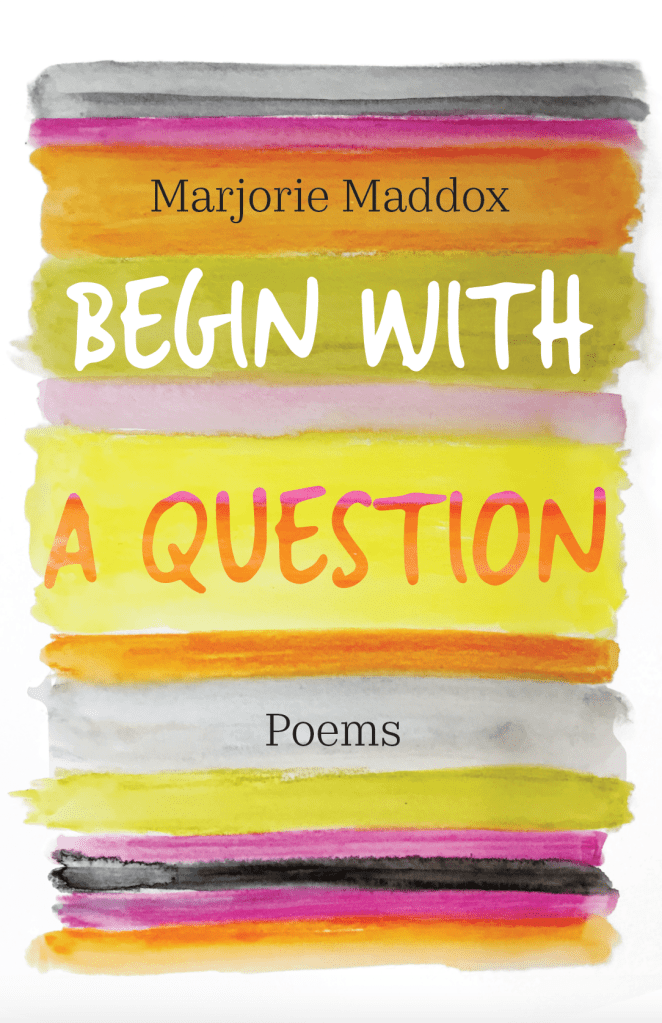
Begin with a Question

Book review by Candice Louisa Daquin

Title: Begin with a Question

Author: Marjorie Maddox

Publisher: Paraclete Press

There are people who write poetry, and there are great poets. By great, we speak of those few capable of transcending above the multitudes with their mastery of the word, imagination and homage to the interior and exterior worlds. An academic and writer, Marjorie Maddox, is such a poet. When you read her, you feel almost angry at her unbridled ability to speak to things you couldn’t begin to evoke yourself. She’s fleet of tongue in her assessment of the world, and does so without a shred of arrogance.

Begin with a Question is a clever collection of spiritual, religious and lived in moments. Whether you believe in a higher power or not, you may find yourself falling for Maddox’s quick wit, keen eye and erasable wordplay. Maddox explores existence from a multitude of directions. These are real moments, most of us have lived in some form. Who hasn’t sunk to their knees and asked;

“affirmation its own negation of belief— ‘no,
I do believe your unbelief’ —the tangles already
tugged and tied into a complicated Yes.” 
-- Begin with a Question

It’s such an honest reflection, painfully so — querying the very reasons we could wish to believe in a God juxtaposed against the real reasons we may not — ending in the all-abiding faith we want to, even if to do so is searingly hard at times. As much here is unsaid as said. There is a sensibility to the journey from first line to last that echoes a refrain, a favourite choral song, something holy and human being implored from a deep place.

This first poem sets the compass for the rest of the journey, this books intention is attuned to the whole with each poem. Structured collections don’t lose something by their intentionality, they often hone the message to greater clarity and this is the case with the poem ‘Begin with a Question’.

“by your own single note of joy: 
You stop moving. And that is when you begin.”  

This deliberation comes from experience, knowledge and the craft of writing. Maddox’s years spent teaching and writing are evidenced in the flow of her message. That said, she’s not sterile in her precision, there is an abundance of passion, intensity and emotion throughout, it’s just placed rather than flung. For some, the adherence to a spiritual theme, may be off-putting, though this would be a mistake, given one’s personal faith doesn’t have to alienate the worth of a story. We can all read about someone who has a different life and gain from it. Whether atheist, agnostic or spiritual, Maddox asks you to consider the story within the story, a story we all share. A search for the meaning of our existence and what matters along the way as found in the poem ‘Your Godmother, almost blind’:

“no promises, 
but it gets easier.
If you are left-
handed, reverse
everything.”

This poem has many layers. The same is true of the poem ‘During My Daily Phone Call to Her Assisted Living Facility, My Mother Explains That She Is Slowing Fading Away …’. The title itself is searing, liminal and the subsequent poem equal in measure. Maddox knows how to open a poem like nobody else with unforgettable lines like:

“And it is not the light but the dust in the light
that rises, plunges, plateaus on the short hhhhh
of my exhale, less final than a sigh that dies
from hopelessness but, still there…”

It’s devastating in its rendering, there are no unnecessary words. This poem is emotions in a capsule that reaches inside and rips out stifled feelings. The power it possesses is otherworldly, magnificent, terrifying:

“And it is not
the distance between words,
between parent/child, not the desert under the plane,
or the plane cursing above and past the jagged mountains,
the wholesome prairies, the vast expanse of flat nothing
I’ve come to expect from questions…”

This poem cuts in half any pretence. You just hang your jaw and drink it in. It’s only once in a lifetime someone can write a poem with this kind of truth.

Maddox knows her history of literature and many will feature in this collection, with the ease of a well-versed lover of stories. Few read like this anymore and even if you are not familiar with all the characters, you may appreciate this nod to them. She does this without a hint of pretension, naturally as if they represent in metaphor, our own lives. From her poem ‘Gardens and Farms’:

“Which we, weary Anno Domini gardeners,
expatriates of Eden” 

Whether you believe Eden on a metaphysical plane, you can appreciate the idea of having fallen to Earth and the subsequent toil, versus the dream of an ideal. Each observation is achieved with the fluidity of a natural observer. Maddox reminds of the pastoral poets of the 18th century who transcended their descriptions with the heraldry of their spiritual quest. When Maddox writes:

“Fear tangles every root of prayer;
all I can mutter is Why? How?”
 -- Without Ceasing

I heard the universal howl into the abyss, the raw cry of pain, unassuaged, lost and wandering. It felt both Biblical, as in Christ in the Wilderness, and also deeply human, the purpose of Christ being among humanity. Without obviating the religious undertones, Maddox piques the question we all have, when suffering, ‘Why? How?’ – echoing the universal refrain when faced with terror, pain, suffering. Paraclete Press who published this collection, is the publishing arm of the Cape Cod Benedictine community. Given that much published poetry today is based upon ‘trending’ themes, I am glad such publishers exist to ensure we are not blinkered in whom we publish:

“No longer partitioned off
by sin, by regret, by self-righteousness...” 
 -- Voices Raised

It could be argued, Maddox achieves the impossible, a meshing of past and present, in appreciating both. Paring a Leonard Cohen song with the story of Joseph and Mary. The poignant story of Mary finding ‘no room at the inn,’ is one that struck me as a small child (even as I was Jewish) because it spoke to me of human cruelty. It is that great story of overcoming, endurance, love, and something more than humanity. When Maddox writes:

“and still
convinced of the predestined
roll of dice chrismated with Miracle—
keeps walking with his-not-his woman
forever strangers in this hometown
that will not welcome them, will 
not lay them down to sleep.” 
-- Traveling Man

It’s truly clever to juxtapose Leonard Cohen’s prescient lyrics against a story we know relatively well. The bittersweet, the ideas of not being welcomed, nowhere to sleep. A powerful parallel between that and other acts of selfishness committed by humanity, how often we close doors and bar entry can be seen. There are universal themes here that haunt and force thought beyond comfort zone, which is exactly what poetry at its most powerful, can do. Saying so much in so little, is both reflective, achingly transposing and deft in its precision. Often, I am struck by how closely Maddox’s work feels like a prayer, incantation, yearning for … betterment. And I take solace in this because I share its intention.

“What does the world weight
slit this way; infused with sorrow?
The bones of betrayal are wood
nailed with pain.” 
-- The Five Sorrowful Mysteries 

Maddox ends with her poem And All Shall Be well. The title alone moved me. It soothes that entombment that haunts our peace, when we have been hurting and believe it will never end. We seek the solace of hope, and kindness. In many ways, whether we acknowledge it or not, this is a step Jesus would have taken, because all who live in the West are influenced by the teachings of Christianity even if we’re unawares. The infiltration of those simple morals and codes to live by, are often a solace without our knowing.

“Begin
where there is no beginning, where refrain neither breaks nor mends
what you once knew as discipline. The middle is where we start from—” 
-- And All Shall Be Well 

.

Candice Louisa Daquin is a Psychotherapist and Editor, having worked in Europe, Canada and the USA. Daquins own work is also published widely, she has written five books of poetry, the last published by Finishing Line Press called Pinch the Lock. Her website is www thefeatheredsleep.com

.

PLEASE NOTE: ARTICLES CAN ONLY BE REPRODUCED IN OTHER SITES WITH DUE ACKNOWLEDGEMENT TO BORDERLESS JOURNAL.

Categories
Poetry

Wars are for Powerful Men

By Sutputra Radheye

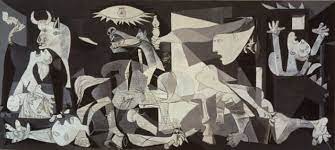
Guernica(1937) by Picasso (1881-1973). Courtesy: Creative Commons
COWARD LIKE ME

there was a sea of dead bodies
and a sky of jets passing by
when i scrolled the curtain
of my window this morning

yesterday night was loud
i could hear the firings
the screams and the cry 
for help but like a coward
i hid behind the walls
praying to see the sun again


i know i am not the ideal citizen
but why should i be?
wars are for powerful men
and not a poet like me

Sutputra Radheye is a young poet from India. He has published two poetry collections — Worshipping Bodies(Notion Press) and Inqalaab on the Walls (Delhi Poetry Slam)His works are reflective of the society he lives in and tries to capture the marginalised side of the story.

.

PLEASE NOTE: ARTICLES CAN ONLY BE REPRODUCED IN OTHER SITES WITH DUE ACKNOWLEDGEMENT TO BORDERLESS JOURNAL. 

Categories
Poetry

I Am Ukraine

Lesya Bakun, a Ukranian Refugee, writes of her country under attack giving courage and hope to the rest of the world.

REFUGEE IN MY OWN COUNTRY/ I AM UKRAINE 

I am Kharkiv.
I am Volnovakha.
I am Kyiv.
I am the blocked Mariupol on the verge of humanitarian catastrophe.

I am the completely destroyed
City of Shchastia --
That is literally translated as "happiness" --
Where people have to sit in the bomb shelters,
Because nothing else is preserved.
The Russian troops are not letting them out.

I am Ukraine.
I am a fighter. 

I am a refugee
In my own country.

What's in the minds of Russians?

Nine years ago, I was in Strasbourg, France.
Seven years ago, I was in Dublin, Ireland.
Two years ago, I was in Istanbul, Turkey.

Today, I am 
In an internally displaced people’s centre --
In a city that I cannot even publicly disclose
For the security of too many families
Who are fleeing to remain safe.

"The Ukrainian IT company N has left the markets of Russia and Belarus forever".
We should have done it eight years ago.
We should have done it thirty-one years ago.

A lot of my friends are switching from Russian to Ukrainian.
We should have done that thirty-one years ago
So that no one comes to "protect us".

I am the gasoline 
that NATO sent us
Instead of closing the sky -- 
Apparently so that we can burn
The Budapest Memorandum.

We have seen the real face of Russians.
Again,
They negotiated green corridors
And started shelling with heavy weaponry.

Evacuation is cancelled.

"I wish you survival, 
Health
And the closed sky above you."

07.03.2022
Ukraine

Lesya (Oleksandra) Bakun is a polyglot poet and non-formal educator who resides in Ukraine. She has been writing since the age of 14, in Ukrainian, Russian, and English; her poems were published in the local young poets’ anthology. Oleksandra has the ‘young’ and ‘adult’ periods of her writing life, and challenges of each are vividly seen in the words she’s sharing – both as texts and in poetry readings. Her poems revolve around complex themes like trauma, gender, societal issues, relationships, and mental health.

Disclaimer: The opinions expressed are solely that of the author and not of Borderless Journal.