Categories
Poetry

Kinematic by Jim Bellamy

KINEMATIC 

(after W.H Auden's 'Funeral Blues'/'Stop all the Clocks')


     Prune down the angels to the wick
Snuff out all candles, unbake all bread
Spoil all trenches with a slick
Ferry the living to the dead

   Where blows a lover, deal
A fatal flaw to all that call
Mar all saviours with a weal
Slash the cinema seats and stalls.

  They were the shivers of the silver screen
Where their blood flows, the curtain thralls
Retire all vision to the dumb
For now no good may come of all.

  Lash the usherette to the sedge
Unravel torches down the hill:
Crash the armies through pithead
Mess the crowd till life lies still

   Where crows a regime's alms,
Dash the lights and kill the spiels
Where glows a face of calm,
Gnash each drama round the keels.

  They were all we owned
Where they lie dead, there may be none
Embalm the filmic gods with bones
For now all love is done.
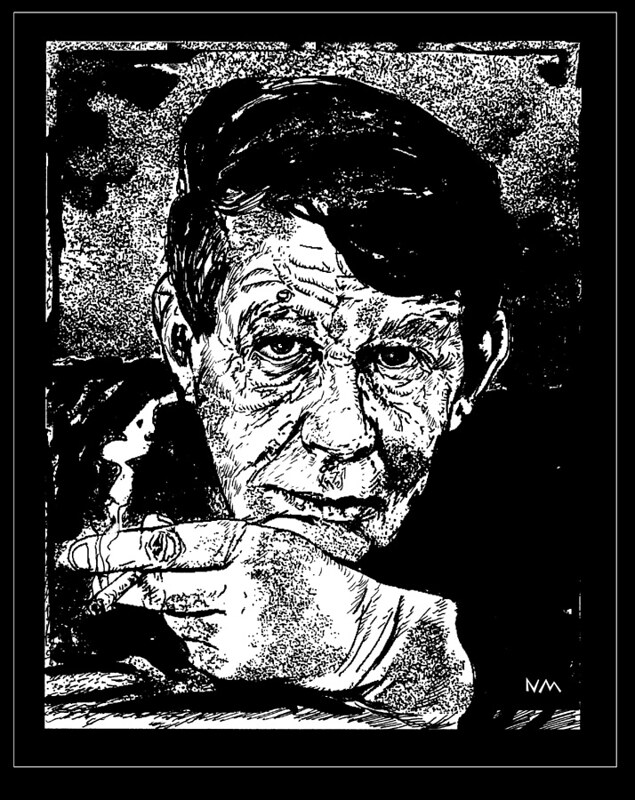
WH Auden(1907-1973). The poem, Funeral Blues, by WH Auden was also a part of the film, Four Weddings and a Funeral. Courtesy: Creative Commons

Jim Bellamy was born in a storm in 1972. He studied hard and sat entrance exams for Oxford University. Jim has a fine frenzy for poetry and has written in excess of 22,000 poems. Jim adores the art of poetry. He lives for prosody.

.

PLEASE NOTE: ARTICLES CAN ONLY BE REPRODUCED IN OTHER SITES WITH DUE ACKNOWLEDGEMENT TO BORDERLESS JOURNAL

Categories
Review

The Birth Lottery and Other Surprises

Book Review by Somdatta Mandal

Title: The Birth Lottery and Other Surprises

Author: Shehan Karunatilaka

Publisher: Hatchette India

When Hatchette India sent the reviewer’s copy of Sri Lankan author Shehan Karunatilaka’s collection of short stories, The Birth Lottery and Other Surprises, it had two eulogies on the cover, namely “From the Commonwealth Book Prize Winner” and “Booker-Shortlisted author,” assuming both would add to the USP[1] of the volume. Karunatilaka’s debut novel Chinaman: The Legend of Pradeep Mathew had received a lot of critical acclaim when it was first published in 2010 and received the Commonwealth Prize. In the meantime, on 17 October 2022, the author did manage to win this year’s Booker Prize for his third novel, The Seven Moons of Maali Almeida, set against the backdrop of the civil war in Sri Lanka. This award definitely garners more attention to read this new book of short stories. According to the publishers, The Birth Lottery and Other Surprises offers a pointed conversation “about religious fanaticism, social prejudices, and the devolving state of democratic order in the Indian subcontinent”. Replete with unexpected twists, it is a “vivid and engaging commentary on privilege, class, and societal ills” and offers a collection of fantastic short stories that serves up fantasies for both doomsday and everyday, marking the return of one of South Asia’s most compelling storytellers.

As a writer with an English literature background and having studied in Sri Lanka and Australia and lived and worked in London, Amsterdam, and Singapore, Karunatilaka’s style of writing is unique. He has not only written about the Tamil-Sinhala conflict plaguing the island nation both from an insider and an outsider’s point of view but has, at the same time, experimented with the postmodern literary form where many entries resemble the magic realistic mode of narration. Ranging from short entries of half a page to stories covering several pages, it seems that the author has put together all his assorted unpublished writing within the two covers of this volume. In an interesting entry at the beginning titled ‘How to Read This Collection’ the author with all his blessings to the readers prescribes seven different categories in which to read his work and clearly tells us not to read them in sequence – “I don’t with other people’s work. Why should anyone with mine?” He then tells us, “If you like stories with twists, try …. If you prefer tales where things happen, go for …. If you enjoy fiction, where nothing happens, start with …. If you’re okay with tales that force the author’s worldview down your throat, read …. If you prefer stories that hope there’s a God, try …. For ones that allow you to accept godlessness, read ….and if you like stories that everyone hates, start with ….”

With such a prescription, it becomes clear that the author himself is at a loss to classify the multifarious nature of the thirty stories of differing length under specific categories.  There is the story of unpleasant truths that await a Sri Lankan president in the back of a London cab. In ‘Small Miracles’, an advertising agency must come to terms with a blown-up collection of pictures of the employees’ penises. ‘If you’re Sad and You Know It’ talks about suicidal tendencies in poetry form. A man presumed missing, quietly journals by the sea – “while he sat alone, free of noise, on an island not far from here, writing his story in a yellowing journal…Staring at sunsets through large binoculars, surrounded by books and fruit and no one.”

Written in an interesting format in the nature of mobile text messages, ‘Easy Tiger’ has a husband and wife cheating each other while attending a movie show on Sylvester Stallone with someone else. With the background firing in the movie, the man pretends he is in the war front where the shooting has started and his phone would die soon; he knows adultery is a crime but doesn’t want a divorce, but his story of being in the warfront in the east is busted by his wife who came to watch the same movie with her paramour and a special camera and films her husband with another woman and asks, “Who’s the hag next to you?” Looks like everyone texts at the movies these days.” In ‘The Colonials’, an Englishman, a Dutchman and a Portuguese walk into a Ceylon bar and profess their grand narcotic designs and counter proposals–“Let us plant our poppies while we can.”

Karunalilaka experiments with the narrative mode once again in the title story ‘The Birth Lottery’ where he tries to depict the historical past and present condition of Sri Lanka through the point of view of forty-two different men and animals each written in the first person. For example, in entry number 27, we read:

“It is the first alliance between the Tamils, Cholas, Moors, Malays and Sinhalese, and I, the Great Arasaratnam, am charged with leading it. With an army of four thousand, we rout the Portuguese and hold the Sithawaka kingdom for three hundred moons. Then they return with bigger cannons, eviscerate us all, and erase our names from history.”

Entry number 29 states:

“I am the justice who signs as a witness the agreement between Wimaladharmasuriya and Joris Van Spillbergen. The one that hands the coast to the Dutch and the kingdom to Ceylon. A treaty that both parties break. I never marry, never amass wealth, never create. Never do anything aside from putting my name on a document that will outlast anything you have ever touched.”

The plight of indentured labourers becomes clear once again in entry number 32:

“I am brought to the hill country as a slave and made to pluck the sweet leaf. I am imprisoned with coolies from South India, even though my family has lived here for centuries. I bear children for five different masters, and each are taken from me. I take my life before my ovaries dry up. I am not unhappy to go.”

Wry humour is also revealed in entry number 37:

“I am an elephant in the Kandyan kingdom, and every few months, to celebrate being conquered by foreign invaders, they parade me in chains and walk me miles carrying burning objects that scald. I don’t mind, because I get to go home to Ravani, who lives with me all my life and bears me many calves.”

It is not possible to point out further details of other stories within the short span of this review. But one needs to mention two excellent long entries, ‘Time Machine. I have Built A (Part One)’ and ‘Time Machine. I Have Built A (Part Deux)’. In the first part the author speaks about stealing the time machine though he was not the one who built it. That credit belongs to Professor Cyril Ponnambalam, Dr Kumar Thiruchelvam and Chancellor Sivaram Duraiappah. Though some would say not. …All three resigned from their posts in 2004 to return to Sri Lanka, though not with their families. Two were executed by the Tiger leadership a week before the end of the war, five years later. One was reported missing in action.

“They weren’t the only scientists, engineers, financiers and logisticians from the diaspora to return to Sri Lanka following the 2002 ceasefire. Many came on humanitarian missions or for peace conferences, most to assist with reconstructing the north and the east, fractured from decades of war and about to be pounded by a tsunami. A majority were recruited by the LTTE, some by force, some by extortion, some by the memory of wrongs.”

The author’s political allegiances become clear in several places in the narrative. He says he “pondered whether this government would want to share examples of Tamil brilliance, when they were trying to convince the world of the enemy’s savagery.” Again, in another place he writes, “The Sinhala bullies had over the decades chased some of the brightest Tamil minds from the island and Prabhakaran had electoral rolls in 75 countries and conscripts to track down long names ending in consonants.”

Karunatilaka  ends the story by saying that he does not have any clue how time or history moves. If he assassinates a Milosevic, a Pinochet or a Cheney, how sure would he be that another butcher would not rise in their stead? Maybe certain destinies are made to play out as written and it is not their place to meddle. So he concludes, “Maybe the only thing I can affect and take responsibility for is my own could-have-been-better life.”

Karunatilaka begins the second part of the story with a more personal and direct statement:

“The history of Sri Lanka since 1945 is a catalogue of me missing out on sex. In 1958, when SWRD was sprouting the vitriol that would divide a nation, I was going to Aunty Sumana’s piano class. She used to put her hand on my shoulder as I played Chopin…. When the 1962 military coup was taken down with whimper and without bang, I was also whimpering and not getting banged in my first year of cadetting…. When the 1971 insurrection happened, I had a girlfriend in Polonnaruwa who only let me touch them under the umbrella. When the island changed from Ceylon to Sri Lanka in ’72, I fell into a whorehouse in Nikaweratiya along with nine other cadets and even though I ended up with the prettiest I was unable to spark the flame. By the time the ’83 riots came along, I was married with three, transformed into my wife’s peon and unable to raise a flag nor fire a gun.”

In an interview Karunatilaka had admitted that he took almost two decades to finish the entries in this book. The oldest story was written during the millennium bug and the newest during a global pandemic. These were stories that he wrote while procrastinating on things he never finished, or to win prizes that he never entered, or to try out ideas that wouldn’t leave him alone. All in all, Karunatilaka’s love and concern for his homeland comes out in different ways through these multifarious vignettes and he can certainly be labelled as a current spokesperson of this small, beleaguered nation of Sri Lanka, a strong and concerned South Asian voice indeed. Reading the book is surely recommended.

[1] Unique Selling Proposition

Somdatta Mandal, critic, reviewer, and translator, is a former Professor of English at Visva-Bharati, Santiniketan, India.

.

PLEASE NOTE: ARTICLES CAN ONLY BE REPRODUCED IN OTHER SITES WITH DUE ACKNOWLEDGEMENT TO BORDERLESS JOURNAL.
Categories
Poetry

She was

A nonsense poem by Rhys Hughes

Courtesy: Creative Commons

She was
a tremendous bowl of soup
with spaghetti
in a loop floating on top.
I don’t know why
this should be but it was.

She was
the elbow of an aardvark
loose in a park
in the dark after teatime.
I don’t know why
this should be but it was.

She was
many things and nothing
and rarely sang
when jumping on trampolines
but in dreams
she wouldn’t stop and the noise
was worse than
the hopping of amplified fleas
but she sustained
no damage at all to her knees.
I don’t know why
this should be but it was.

She was
the square root of minus one
and many buns
were fed to the elephants
of her equations.
I don’t know why
this should be but it was.

And if you like treacle
high up a steeple
but can’t stomach custard
because of the fuss made
in striving to contrive
a rhyme in good time
please make her acquaintance
without any pretence
and give my regards
when she turns into mustard
in the setting sun.

She was
a rapscallion and dandy
with a quaint
modus operandi
who rode on a stallion
named Disco Medallion.
I don’t know why
this should be but it was.

She was
a fruitcake lost in a lake
and I am a boat
with a sail for a coat
but I never intend to fish
her confectionary wish
out of the deeps
and send it for keeps
to the bakery zoo
where you know who
lives in a cage in a rage.
I don’t know why
this should be but it was.

She was
a clash of logical cymbals
festooning the
sides of roomy thimbles.
I don’t know why
this should be but it was.

And
maybe because
I can’t say how or why
anything should be
and neither can she
we are bewildered together
in inclement weather
and only a feather
floats between
scenes.

She was
the last verse of this poem
folded neatly
and kept in a jeroboam.
I think I know why
this should be but it wasn’t.

Rhys Hughes has lived in many countries. He graduated as an engineer but currently works as a tutor of mathematics. Since his first book was published in 1995 he has had fifty other books published and his work has been translated into ten languages.

.

PLEASE NOTE: ARTICLES CAN ONLY BE REPRODUCED IN OTHER SITES WITH DUE ACKNOWLEDGEMENT TO BORDERLESS JOURNAL

Categories
Musings of a Copywriter

Strumming Me Softly with His Guitar…

By Devraj Singh Kalsi

Strumming a guitar promises a note of success and a rush of adrenalin. Otherwise, there is no reason for young men with brawny biceps attired in sleeveless vests to sit beside the grilled window with creeping money plants on the balcony to invest their time and energy to impress the girl next door. Instead of handsome returns, the well-orchestrated operation often draws the unwarranted attention of the girl’s bifocal father who sniffs an ulterior motive while speed-reading the nasty headlines of the newspaper in hand and patrolling the antiskid balcony space in visible anxiety to crack a strategy to foil the covert takeover bid before his innocent girl slips for the nerd rock star.

Despite the long-drawn, dedicated mission of playing popular romantic numbers to woo the girl, my dear friend did not have any stroke of luck. But the girl’s father did suffer an unexpected stroke, leading to the untimely demise of the romantic misadventure. Assailed by the remorse of having stressed out the old fogey with his musical renditions and clandestine romantic intentions, he decided to punish himself by hanging the guitar on the wall. 

Years later, the girl’s mother visited my friend’s house one evening. That she was up to some mischief became evident when she disclosed to my friend’s bride how he played music for her teenage daughter every morning before she left for school. All hell broke loose when he returned home from the tailoring shop to face an angry spouse who picked up the guitar from the wall as if it were a royal sword and presented it to him with a solemn request to strum it and croon something for her. He tried to duck it by saying he had made a vow, a gentleman’s promise to abstain from playing music again. But she spilt the beans, charging him with how desperately and unsuccessfully he once tried to lure the neighbour’s daughter with his musical foray.   

Shocked by this disclosure, he found no escape route from the mess. He had to either recapitulate the long story long forgotten from his point of view or play the instrument and let his wife be instrumental in reviving his defunct musical career. Instead of denying what his wife accused him of doing many moons ago, he added a divine dimension as he decided that musical pursuit could be  another way of attaining God. The fact that he chose the wrong instrument for that purpose was not pointed out by his wife. She was eager to see him perform live and exclusively for her – in front of her smouldering kohl-lined eyes dying to blink in symphony with his heartbeat. She sat on the cushioned swing suspended from the balcony ceiling, with her long, lustrous hair thrown open, with a blooming pink rose plucked from the painted pot kept nearby and tucked neatly in her straightened tresses. He dithered and fine-tuned the guitar and then decided to select a few lilting numbers from his vast repertoire to play for her in the incandescent light of the paper lantern bulbs setting the romantic mood for the musical soiree.  

The story of this guitar began in Delhi when my friend accompanied me on what is called a business cum pleasure trip. Reaching the capital from Kolkata was a historic visit for my friend who was keen to pose in front of the Red Fort and go on a shopping spree in Connaught Place (CP). While walking on the CP pavement, similar to the Grand Hotel Arcade in design, my friend suddenly entered a music instruments store and quoted an incredible budget for an imported guitar. The bewildered shop owner remained quiet and scanned him for a while before asking him the difference between boiled rice and basmati rice. Taking it as an affront to his dignity and knowledge about the price of musical instruments, he shot back in accented Hindi with a quick reply to salvage his self-respect by claiming that his Ustad had taught many Indian classical legends and he knew several of them personally in Kolkata. 

Many other customers inside the store began to label us as pretentious ignoramuses from another planet. The smart-alecky shopkeeper asked us to identify the portraits on the upper portion of the wall right behind his counter. They were the leading lights who patronised his shop to buy instruments and agreed to get clicked with the owners of the music store that had been in existence for more than a century. My friend cast a quick look but failed to recognise any of them. So, the shopkeeper schooled us further by conducting a master class.

We had to either buy the guitar we had asked for or disappear from the store. I took small steps and reached the exit when I heard my friend holler in a stentorian voice: “Pack this guitar for me. Here — take the money.”

The price was well beyond his budget, but he saved our image and came out of the store with the guitar and a cash memo in hand. It was evident from the facial expression he had picked up a costly instrument he was not ready to buy. But the joy of silencing the shopkeeper and mellowing his tenor was a resounding victory, and he claimed he did not argue much regarding music since he respected elders. But an hour later, when he again felt pricked by this expenditure, he exploded in a language devoid of an iota of respect and issued threats of teaching that bald, grinning shopkeeper a proper lesson had this incident occurred in Bengal. The remarkable story of saving dignity became the dominant aspect of purchasing this guitar. I felt he had risen to the occasion though he had to cancel plans for his shopping spree as his money had gone into this guitar. 

He sat with the guitar and posed with fake smiles for my camera to capture. He did not appear comfortable holding it in his hands and passed it to me after a while. I found it a huge responsibility and took extra care of the guitar as we were proudly taking home something pricey. It was nothing less than a trophy won in a tough competition.

This imported guitar regaled many local listeners – including my friend’s wife at present. She had no idea that how her husband had acquired the prized beauty, saved our self-respect, and preserved the prestige of our state known for culture and music by shelling out an enormous amount to grab something rare that few people in our country can afford even today. Although his father never cut anything other than a piece of cloth, he had big dreams of cutting a music album someday, of inviting the Delhi-based shopkeeper to his launch event as the chief guest for the ribbon-cutting ceremony. This would prove that those from a non-privileged background also had the right to contribute to the enrichment of music was music to his ears.     

After returning home, my friend toyed with the idea of forming a music band, got his ears pierced to wear rings to connect with trendy youth, and offered to engage my services as a lyricist. Within the year, even before I could take a call on this offer, the band he had formed with much fanfare was disbanded due to the sudden exit of the lead vocalist poached by a more resourceful rival music band. He soon realized though he was getting offers to perform in local community functions with a limited budget, it was impossible to sustain this ambitious musical venture. Soon, he joined his father’s tailoring unit and restricted his role as a musician to woo the girl he loved. But some people, like my dear friend, are perhaps naturally attracted to failures and their dreams suffer from a chronic motivational deficiency syndrome that leads them to quit at the earliest pretext.

When his mother pressurised him to settle down as he pushed into his mid-thirties, her history of myocardial infarction made him agree to her proposal. And that is how the lady who was now making him sing live for her breezed into his life. In one of her disclosures after marriage, she revealed to my friend that she had agreed to marry him only because she had seen his photograph where he was strumming a guitar. The direct benefit she expected would be the opportunity to listen to his music after a tiring day in the kitchen. But she hesitated to make it explicit so long as her father-in-law was alive. The arrival of the mother of his lost love simplified the matter for her. 

After listening to his live performance for half an hour, she gave her verdict and a standing ovation with thunderous applause. She regretted such a talent could not deliver anything substantial. Even if half of her praise was a pure exaggeration for her doting husband, there were traces of truth in her observation. When she threatened to leave him forever if he did not resume his journey as a guitarist, he agreed to reconsider his earlier decision to give up music for the sake of his lost love. While this was her loving way to resurrect the failed artist and get him back on track, music had the power to make him a divorcee. The prospect of stitching together his life once again looked remote. So, he succumbed to her demands by resuming his practice sessions on the balcony. Unlike the earlier occasion when he sat on the windowsill and performed for the girl outside the house, this musical foray was for the kitchen queen regaling herself with Bollywood numbers and soothing her frayed nerves with the fragrance of tuberoses he brought home for the bedroom vase every evening.  

.

Devraj Singh Kalsi works as a senior copywriter in Kolkata. His short stories and essays have been published in Deccan Herald, Tehelka, Kitaab, Earthen Lamp Journal, Assam Tribune, and The Statesman. Pal Motors is his first novel.  


PLEASE NOTE: ARTICLES CAN ONLY BE REPRODUCED IN OTHER SITES WITH DUE ACKNOWLEDGEMENT TO BORDERLESS JOURNAL. 

Categories
Poetry

A Matter of Priorities

By George Freek

A MATTER OF PRIORITIES 
(After Mei Yao Chen, 1002-1060)
 
Things that once mattered
Now matter to me
less than a bowl of rice.
Stars like insects
spin across the sky,
but do they even exist?
Sparrows hop from branch 
to branch with a purpose.
They don’t care
if the stars are there.
They’re looking for
something to eat.
In a rain-soaked street, 
people rush by, 
terribly concerned 
with the mud on their feet.

George Freek’s poetry has recently appeared in The Ottawa Arts Review, Acumen, The Lake, The Whimsical Poet, Triggerfish and Torrid Literature.

.

PLEASE NOTE: ARTICLES CAN ONLY BE REPRODUCED IN OTHER SITES WITH DUE ACKNOWLEDGEMENT TO BORDERLESS JOURNAL

Categories
Slices from Life

The Death of a Doctor

By Ravi Shankar

Zhi-Khro mandala, a part of the Bardo Thodol’s collection, a text known in the West as The Tibetan Book of the Dead, which comprises part of a group of bardo teachings which originated with guru Padmasambhava in the 8th Century. Courtesy: Creative Commons

My friend, Dr Ramesh Kumaran first shared the shocking news with me on WhatsApp. Along with a recent photo, the caption mentioned ‘Mourning the sudden and untimely of our dear Joseph Francis (6th batch). May his soul rest in peace. 6th October 2022.’ I felt sick in the pit of my stomach. This was the first mortality among our MBBS batch mates. One of our friends died when he was studying for MBBS, but he had left the course and was suffering from a prolonged illness. Some of our batch mates had close encounters with death during the ongoing COVID-19 pandemic.   

I was reminded of my own mortality and the fact that we often forget that our time on earth is limited. None of us know when exactly or how we will die. This I believe is a good thing. Movies have explored the sad state of people who knew or supposed they knew when and how they would die. Humans stride through life assuming their immortality. We kill fellow humans indiscriminately. We learn to hate each other. We pursue wealth and power. When we leave our material existence on Earth, we can take none of the accumulated wealth and power with us. The ancient Egyptians believed otherwise and buried their Pharaohs with all they would need in the afterlife. Ordinary people had no such privileges. We do not know much about the afterlife. Here science ends and we enter the realm of religion.

I facilitated a module on Death and Dying for medical and other students and our ignorance about death is profound. Modern medicine has the motto of preserving life regardless of its quality. We have not been trained to let go and make a person’s remaining time on Earth worthwhile. This is slowly changing but change is slow. We do not live life assuming that any moment can be our last on Earth. The Tibetan Book of the Dead (Bardo Thodol) tells us to live each moment in a spiritually fulfilling manner and mentions that we all have the potential to break free from the cycle of reincarnation and become spiritually enlightened beings.

I first met Joseph when I joined the Men’s hostel and the undergraduate medical (MBBS) course at Thrissur, Kerala, India. Our seniors were prowling around our floor abusing us and one of my friends was crying as he had just been forced to take off his moustache. Ragging still exists in India and students who were abused by their seniors wait for the new intake to take revenge. You are not able to take revenge on the powerful, so you take out your anger on the powerless. We see this all around in the modern world.   

Joseph stayed in a room near mine, and we became friends though not extremely close. One of the things I still remember about him is that he used to write with a fountain pen and used black ink. Even in those days when writing was still common most of us used ballpoint pens. He had impeccable handwriting. Joseph was always a perfect gentleman and willing to help others. I believe we did a few of our internship postings together. We collaborated on skits and other presentations during the college day celebrations. I still remember our college trip to Trivandrum Medical College for the Intermedicos festival and we stayed and slept in the badminton court inside the Men’s hostel. Life was simpler in those days. We were beginning to see the end of the MBBS doctor and specialisation, and super specialisation was becoming common. I feel this is a sad development and an MBBS doctor is competent to treat most illnesses. In fact, evidence shows that most illnesses can be handled by a trained paramedic. In most European countries, care is mostly delivered by general physicians while in the United States care is mostly provided by specialists. The amount spent and the health status of these countries/regions tell their own story.  

During those days, failure in MBBS examinations was common. Anatomy at the end of the first MBBS and Medicine at the end of the Final MBBS had the maximum casualties. Grading was arbitrary and there were no clear rubrics to guide the scoring. I was lucky to have squeaked through the anatomy dissection and the medicine courses. Joseph was unlucky and mentioned this often as due to his failures, he could not appear for the entrance exam of PGIMER[1], Chandigarh, one of the top postgraduate institutes in the country. One could not appear for the entrance exams failing the MBBS. A lot of effort has gone globally into changing the assessment system in MBBS and making it fairer and more objective.

Joseph used to join us for an occasional game of basketball. I next met him at Ollur, near Thrissur, when I was doing my post-graduation. St Vincent de Paul hospital was a multi-specialty hospital. I had come down to Kerala for a few days and stayed with Job and Joseph, both medical officers with who I shared a large apartment.

Over the years I lost touch with Joseph, and I next interacted with him in 2018 when I joined a WhatsApp group of my classmates. Joseph was very active in the group and was working as an anaesthesiologist in the United Kingdom. Many of my batchmates were working in National Health Service (NHS) and they often would mention how the NHS is being steadily starved of funds. The COVID pandemic hit the medical community hard. Doctors in practice seem to be especially vulnerable. We discussed this and postulated that it could be because they are exposed to repeated doses of the virus in high concentrations from multiple patients. Many doctors had lost their lives; many others I know were in the Intensive Care Unit for prolonged periods of time. Two of my classmates in the UK had serious illnesses requiring hospitalisation and prolonged intensive care.       

I next interacted with Joseph when I was unable to make a bank transfer to the UK to pay for membership fees of a professional organisation. The transfer was not going through and eventually, I asked Joseph if he could do the transfer from his account in the UK, and I would deposit the money in his account in India. He readily agreed. Joseph was always very helpful. During the last two years, I have lost several friends. Two academic collaborators, one in Malaysia and the other in Yemen passed away. Colleagues I knew in Nepal died due to COVID complications.

Death can be a celebration of a person’s life. An Irish wake is one last party to honour the deceased. Unknown diseases plagued the Irish countryside causing a person to appear dead. Hence a person would be waked in the deceased’s home for at least one night. I had the exact fear while certifying death. What if the person then woke up and disputed my certification? I was very careful and meticulous while writing out a death certificate.     

These deaths have underscored my own mortality. As someone once said, death and taxes are inevitable. Accepting one’s own mortality and coming to terms with our eventual demise makes you aware of the folly of chasing power and glory and can contribute toward a gentler, more decent world. Climate change is a testament to human greed and folly. We are still uncertain how liveable Earth will be during the next hundred years. As Mahatma Gandhi said, we can satisfy human needs, but we cannot satisfy human greed!  

.

[1] Postgraduate Institute of Medical Education and Research

.

Dr. P Ravi Shankar is a faculty member at the IMU Centre for Education (ICE), International Medical University, Kuala Lumpur, Malaysia. He enjoys traveling and is a creative writer and photographer.

.

PLEASE NOTE: ARTICLES CAN ONLY BE REPRODUCED IN OTHER SITES WITH DUE ACKNOWLEDGEMENT TO BORDERLESS JOURNAL

Categories
Poetry

The Crack in the Pavement

By Ron Pickett

Courtesy: Creative Commons
Thump, whirr, snap.
Wow, that was quite a ride!
I guess I’ll stay here for a while.
It’s not like I have a choice.
I fell, don’t know from where exactly. 
Then I rolled along the ground until
I dropped into this crack in the pavement.
You don’t know me – people call me a weed seed. And no, I’m not that kind of weed.
I don’t much like it – weed seed sounds bland, boring, dull.
I’m NOT! I’m not boring. Just wait! Plant seed maybe?
I’ll stay here in this crack for a while, don’t have a choice.
I’m waiting for rain; that’s all it takes.
Then you’ll see. That’s all that it takes.
Rocks, Concrete, hard dirt, trees, grass, anything!
Just wait ‘til it rains, then I’m outta here!
Not really outta here, but zoom, I’m alive and growing like a, well, a weed. 
What kind of plant will I be? Couldn’t see what I dropped from.
Don’t know, could be a ground hugger – ground cover – that would be okay.
Could be milkweed; that white goo might be fun.
Could be a dandelion: Dandy? Lion that’s me!
Could be mustard; you get a lot of kids, seeds that is, to spread around.
I like those weeds, make that plants with sharp spikes, and purple flowers.
I could be a thistle, all those flying seeds, and spikes, perfect. 
Or a nettle, a stinging nettle, that would show them!
Here comes one of those pesky humans. 
Whoops he’s looking right at me! Whoo-Hoo, he’s gone; guess I’m too small to be seen.
Thing about being a weed seed is that if it doesn’t rain, no big deal.
I can wait for months, years even, then face it, I’m sure not alone. 
I know a guy, says he’s a Darwinian gardener; lets the fittest survive.
Beautiful yard. He’s a great friend to us weeds. 
Keep an eye out for me after it rains, after I sprout; you’ll be surprised!
Beautiful leaves, gorgeous flowers, unsurpassed tenacity, and a lust for life.
But you have to look carefully, and it’s okay to pull us – we’ve got millions of relatives!

Ron Pickett is a retired naval aviator with over 250 combat missions and 500 carrier landings. His 90-plus articles have appeared in numerous publications. He enjoys writing fiction and has published five books: Perfect Crimes – I Got Away with It, Discovering Roots, Getting Published, EMPATHS, and Sixty Odd Short Stories.

.

PLEASE NOTE: ARTICLES CAN ONLY BE REPRODUCED IN OTHER SITES WITH DUE ACKNOWLEDGEMENT TO BORDERLESS JOURNAL

Categories
Excerpt

On the Passing of Mahasweta Devi by Manoranjan Byapari

Title: How I Became a Writer: An Autobiography of a Dalit

Author: Manoranjan Byapari

Translator: Anurima Chanda

Publisher: SAGE Publications India and Samya under Samya SAGE Select imprint

Chapter 34: The End of an Era

The passing away of certain individuals left a huge impact on the human community. The void created by their absence was irreplaceable. This was especially true when it came to Mahasweta Devi. . . . Because of the power of Mahasweta Devi’s writing, there was a huge need for her leadership and protest. Equipped with the fire and anger akin to the sun, she was the one to have kept the fight against injustice alive. She had not given in to any temptation or fear, but spent an entire life battling in the interest of those starving penniless people tottering on empty stomachs. Her roar had raged right from the decade of the seventies to the dangerous days of Singur, Nandigram and Netai. Her fiery raging pen had dealt blow after blow like a cannon on the impenetrable fort of the cannibalistic and violent forces out to destroy human civilization . . .

              It was a painful time for Bengal, Bengalis, intellectuals and civil society. Somebody had said that a writer does not write with a pen, but with the spine . . . In those times, the one and only ‘soldier armed with a pen’, Mahasweta Devi, had protested against that which is unjust, improper and inhumane. Her fight was for the Adivasis, the foresters, the Dalits, the labouring classes and the minority groups…

    . . . With the death of Mahasweta Devi, I lost a mother who had…shown me a new direction. She was the one to explain the meaning of ‘jijibisha’ [the will to live]to me. There were multiple ways to live…But what is the point of that life which gets lost immediately after death? She showed me the direction of such an endless life.

. . . During the long thirty-six years, from 1981 to 2016, she was spread all over my life like a huge tree . . . This tree possessed the powers of the Sanjeevani plant whose mere touch could revive the dead.

              Although I started with Bartika and thereafter had my works find a place as part of course books for the West Bengal State University, within the journal of the Comparative Literature Journal of Jadavpur University, as questions under the Public Service Commission exams, I was still unsure how far I would have to swim to reach the end. According to me, I have been able to reach the ultimate stage. I have achieved as far as I could achieve, from being unlettered to discovering the world of letters which was then followed by receiving  the Bangla Akademi award and the Ananya Somman from 24 Ghonta. After obtaining the biggest two awards in Bangla literature, I could perhaps say with some amount of certainty that I have experienced it all.

. . . Having read so many books, I knew well enough that the world of my experiences were not readily available to many others.Hence, they were not able to write about it. They could not even think of writing about it, as their imaginations also failed. I, on the contrary, could easily write innumerable pages on them.  That’s what I did. I wrote four short stories and took it to Mahasweta Devi who explained, as I have mentioned earlier, that she does not publish fiction. I found the addresses of four magazines and sent them off to be published  . . . all the four stories had been published.  I found a lot of strength and self confidence at this incident. I realized that I could really do it. Even if there were no one backing me, I could fight my own fight.. ..

              I next came in contact with Mahasweta Devi in 2000, three years after my return [from Chhatisgarh]. Around this time, many of my works were published with Bartika. I revived my relations with her, which remained till her last breath . . . my association with her remained for the entire duration of 1981 to 2016. I would visit her place almost every other week. In the huge expanse of time, she wrote for so many newspapers starting with Jugantar to Bartaman, but she never wrote a line about the rickshaw-puller writer Manoranjan Byapari . . .. People might remember that just a few days before her death in 2016 she had written almost an entire-page article for Ei Shomoy about the rising young writers from West Bengal who had a lot of potential.

 . . . Mahasweta Devi loved me like her own child. She had already looked far into my future. She knew that it would cause me a lot of pain, but in her heart she wanted the world to cheer for me. However difficult it might be, she wanted me to make my own path, so that no tag of favouritism could get stuck to my life like a leech which would have compelled me to bow down my head with ‘gratitude’ all my life. She wanted me to become independent and did not desire my heart to grow weak . She had wanted me to become a writer on my own worth, an independent, self-dependent, courageous writer. 

ABOUT THE BOOK

‘Writing was my truth, my god, my everything. I could not leave it for anything.’

With these words, Manoranjan Byapari points to how writing is as important to him as breathing. How I Became a Writer: An Autobiography of a Dalit is the translation of the second volume of his remarkable life story Itibritte Chandal Jivan. In this volume, translated for the first time into English with great sensitivity, the author talks of his life in Kolkata after leaving the Chhattisgarh Mukti Morcha. He takes up the post of a cook at a school, which provides work, albeit gruelling. Part I, School Shenanigans, describes how he carried out his duties, while being treated contemptuously because he is a Dalit, and became more determined to forge a new identity as a writer. Part II, The Right to Write, reveals how his persistence gradually resulted in his works being published in little magazines and, later, by mainstream publishers and how his fame slowly spread with television interviews and prestigious awards.

He discusses Dalit writings, Dalit literary organizations and whether he is a ‘Dalit writer’. His forthright observations on society and governance provide many insights.

ABOUT THE AUTHOR

Manoranjan Byapari never went to school or university. He first wrote for little magazines where his success and popularity found him many publishers. His writing career took place as he worked as a cook for 21 years at the Helen Keller School for the Deaf and the Blind. He is a Trinamul Congress MLA for Balagarh since the 2021 West Bengal Vidhan Sabha elections. He has received many awards such as the Suprabha Majumdar Smarak Puraskar by the Paschim Banga Bangla Akademi in 2014, the television channel 24 Ghonta’s Ananya Samman in 2013 and in 2019 the Hindu Literary Fest’s nonfiction award. He is well known across India as he speaks in Hindi that he learnt in Chhatisgarh when he was with the Mukti Morcha of the late Shankar Guha Neogi.

ABOUT THE TRANSLATOR

Anurima Chanda is Assistant Professor, Department of English, Birsa Munda College, North Bengal University. She has taught English as Second Language (ESL) and students with learning disabilities at the Centre for Writing and Communication, Ashoka University. She received her PhD on Indian English Children’s Literatures from JNU. She was a pre-doctoral fellow at the University of Wüerzburg. She is also a literary translator (translating from Bengali/Hindi-English-Bengali. Among her books for children are Timelines from Indian History: From Ancient Civilizations to a Modern democracy; Tintin in Tibet by Herge: A Critical Companion; The Untouchable and Other Poem; and DK Indian Icons: Bhimrao Ambedkar: An Illustrated Story of a Life.

CREDIT LINE:

Excerpted from How I Became a Writer: An Autobiography of a Dalit by Manoranjan Byapari, translated by Anurima Chanda. Jointly published by SAGE Publications India and Samya. 2022, 376 pages, Paperback, Rs.650, ISBN: (978-93-81345-77-1), Samya SAGE Select.

PLEASE NOTE: ARTICLES CAN ONLY BE REPRODUCED IN OTHER SITES WITH DUE ACKNOWLEDGEMENT TO BORDERLESS JOURNAL

Click here to access the Borderless anthology, Monalisa No Longer Smiles

Categories
Stories

The Funeral Attendee

By Ravi Prakash


That day, the vast crowd on the road took me by surprise. I was riding back home from the school in the village where I teach. People had jammed the road near a cremation ground. I stopped my bike to ask a man: “What happened? Why are there so many people on the road? They must be thousands in number, don’t you think?”

“Don’t you know? Manglu died this morning. All these men have come to attend his funeral,” the man told me.

“Oh, was he a great leader or saint?”

“No, he was a great funeral attendee.”

“A funeral attendee! I had heard of poets, leaders, and saints whose funerals attracted a crowd like this but never of someone called a funeral attendee. What was so special about him?” I asked again.

“Manglu never left a funeral unattended if he came to know about any death nearby. It was his legacy.”

“Oh, achha[1]!” interjected I, and, having nothing to say more, started the bike.

 “What is so great about that?” I thought. But the crowd I was moving amidst defied the arguments my thoughts provided. This dead man must have been a man extraordinaire in his lifespan.

 But who cares?

I made my way somehow into the crowd and moved the bike ahead.

I came home. The day went as usual, but I realised that I could not stop thinking about that funeral attendee.

 The next day, in school, during recess, when I put a question about the dead man while chatting with my colleagues, it at once caught everyone’s attention. The head teacher, a greybeard, and a native of the village knew about him. He narrated Manglu’s story:

 “About thirty years ago, Manglu had to leave his native village Kherupura due to the disastrous flood. He could never return, for the flood had engulfed his village. The whole of it had vanished into the Rapti.

 “Manglu had nowhere to go. His father died in that flood. His mother had died earlier — a few years ago, and, as he had no sibling, he was left alone with his wife, who was pregnant at that time.

 “He had to move out. Destiny forced him to live a nomadic life. He came to live in Silva village near the main road, which connected two headquarters of the adjacent districts – Shravasti and Bahraich.

 “At first, the couple lived under a tree, but later on, seeing the condition of Manglu’s wife, the village head gave him a small piece of land. On it, he built a mud house. They lived happily for a few months, but Manglu could not save his wife till the following year. She died, I believe, during her childbearing. Manglu was all alone after that tragedy. He had no one whom he could consider as a family. His relatives were living in different places. He could go to any of them, but he decided to live on his own in the village.

 “To make ends meet, he worked as a woodcutter, a labourer, and a hawker, but he never left the village. After his day job, he actively participated in village life and attended every function and funeral, either invited or uninvited. Since he had no one he could call his own, he started regarding everyone as his own. No one took him seriously, but he maintained this routine.

“After many years, finding himself unable to do hard physical labor, he opened a kiosk-like shop by the roadside where he sold petty items like cigarettes, tobacco, and paan[2]. He made acquaintance with everyone who came to his gumti[3]. Motorcyclists, bus drivers, hawkers, rickshaw pullers, peddlers, and beggars – men from all walks of life were his friends. In a year or two, Manglu acquired such fame that people started talking about the directions and distances by referring to his kiosk as a distinctive landmark.

 “Manglu never indulged in hoarding money; he devoted himself to making friends. Anyone could purchase from him on credit. And such a good-natured man he was that even the vilest man paid him back.

 “He widened his social circle. People from adjacent districts knew his name and his thatched kiosk. I would say that he was more famous than a monument. In those days, too, he never left any funeral unattended, either in his village or in any other ones. If the dead belonged to another village, he would take a ride as soon as possible. Sometimes, people at the cremation ground wondered why he had not arrived yet, but he always arrived sooner or later.

“As he grew older, he found himself unable to run the shop. He took shelter in one of his friend’s houses to spend his last days. He could not walk straight then; he suffered from camptocormia–the bent spine syndrome, and he had to take the support of a bamboo staff. He roamed in the village all day with the bamboo staff in one hand and enquired about the well-being of whosoever came in his way. Even at that time, if someone died somewhere, he would try to go there to attend the funeral. 

 “The villagers thought he had a mania for attending funerals. And thus, in the last days of his life, people started calling him ‘the funeral attendee.’ He had become a piece of curiosity for the youngster in the village.

 “And then, he died yesterday. The news of his death spread like wildfire. Can you believe that more than two thousand people attended his funeral? I am not sure what exactly all this resembles, but I would say that Manglu must be smiling in heaven.”

.

Glossary

[1] Connotes– Is that so? Literal translation from Hindi — yes.

[2] Betel leaf

[3] A small stall or hutment

Ravi Prakash teaches small kids in a rural primary school. He lives in a small town near the Indo-Nepal border in the district of Shravasti, Uttar Pradesh. 

.

PLEASE NOTE: ARTICLES CAN ONLY BE REPRODUCED IN OTHER SITES WITH DUE ACKNOWLEDGEMENT TO BORDERLESS JOURNAL

Categories
Poetry

A Woman I Used to Call ‘Mother’

By Davis Varghese

A tiny wombling, me, caressed by lullabies,
silvern pink, much like
the hue of my venous playpen and
nine full moons later, her cry and my wail greeted us both.
 
Dollops of pearl stringed words laced
sometimes with blue plums of joy or
pimentos of makeshift anger dropped from
those rose petal lips. Nurtured me, flattered me,
 
for two hundred full moons, straight.
 
For the next seven hundred months, 
we made joy, we made play, we made life.
We were one, one were we.
 
Until, one after-night,
the dark embrace of a white angel in
an indigo mood and emerald tinged wings that
covered half the earth, sent her on a journey.
 
Floating in infinity.
Comatose. Serene. Flawless.
 
A tiny wombling, me, unfortunate, forlorn,
was left holding
a pretty picture and fragrant memories of
 
A woman I used to call 'Mother'.

Davis Varghese is an IT professional and a globally wandering one. Otherwise, he moonlights with novels and poetry whenever inspiration gives him a chance. A few detective fictions later, which have been translated and published by ‘Manorama Books’ as novels, his experiments with poetry have found a home in ‘The SquawkBack’ and ‘Indian Review’.

.

PLEASE NOTE: ARTICLES CAN ONLY BE REPRODUCED IN OTHER SITES WITH DUE ACKNOWLEDGEMENT TO BORDERLESS JOURNAL