Categories
Essay

When ‘they’ Danced…

Ratnottama Sengupta is riveted by the phantasmagoric Bhooter Naach, the Ghost Dance, in Satyajit Ray’s legendary film — Goopy Gyne Bagha Byne — that has no precedence nor any sequel in cinema worldwide.

Some years ago, I was preparing for my talk on dance in Hindi Films, given to the Film Appreciation students at the Film and Television Institute of India in Pune. I noticed that every major director in the earlier years, from Uday Shankar (Kalpana, 1948), V Shantaram (Jhanak Jhanak Payal Baje, 1955), and K Asif (Mughal-e-Azam, 1960), to Guru Dutt (Saheb Bibi Aur Ghulam, 1962), K A Abbas (Pardesi, 1957) and Sohrab Modi (Mirza Ghalib, 1954) had started with Indian classical dance in its purest form – Kathak — and the leading ladies Vyjayanthimala, Waheeda Rahman and Padmini came equipped with the dance of the devadasis, Bharatanatyam. Subsequently however, most filmmakers diluted the purity of these dances, perhaps to suit the situation in their films. And in recent years that dilution has gone further to take the form of fusion dance, westernised dancing, and group dancing to add volume to the glamorous visual of female torsos in movement.

Suddenly it struck me that Satyajit Ray (1921-92) too had used Kathak in its purest form in Jalsaghar (1958) and then ‘diluted’ the purity of classical movements to design the rhythmic footwork of disembodied spirits. And it dawned on me what level of genius could create a dance that becomes a visual statement on the history of the land itself! Of course, I am talking about the ‘Dance of the Ghosts’ in Goopy Gyne Bagha Byne (1969). The towering presence had ‘choreographed’ this dance which has simply no parallel in the world of cinema. Yes, the director — who also penned the lyrics besides screenwriting his grandfather’s adventure story first published in Sandesh in 1915 – had diluted the classicism of Kathakali and Manipuri. But he had fused in so many more art forms like masks, paper cutouts, shadow art, pantomime, celluloid negatives and special effects that it emerged as a class in itself, giving even today’s viewers an experience nonpareil.

In this fantasy that ends as a fable with a timeless moral, Ray experimented with a psychedelic burst of dancing. The narrative pivots on a tone-deaf singer and a bumbling drummer. Essentially though Ray’s telling of the ‘fairytale’ was a garbed plea against war. The message he sent out loud and with laughter: “When people have palatable food to fill their belly and music to fill their soul, the world will bid goodbye to wars.”

But Ray’s recounting of the story was far from didactic. Indeed, he himself is known to have said, “I don’t know if you can truly demarcate fantasy and fable.” So, instead of categorising it as one other the other, he recommended that we see Goopy Gyne Bagha Byne (GGBB) only as the story of a duo of untalented musicians. Their playing earns ridicule from fellow villagers and contempt from their king but appeals to the upside-down aesthetics of ghosts. The charmed King of Ghosts appears with an eerie twinkling of stars and a disembodied voice to bless them with three boons. With an enjoined clap of their hands, they could feed to their heart’s content, they could travel where they want to in their charmed shoes, and their music could entrance their listeners.

Building upon this children’s story, Ray himself wrote the dialogue, designed the music, the costumes of the entire cast, and the choreography of the Ghost Dance that is redolent of Uday Shankar’s Kalpana. The dead come alive when Goopy-Bagha play and perform a surreal dance that briefly echoes the past of India — because bhoot kaal in Bengali means ‘past tense’.

The celluloid representation depicts in minute details the division of society into caste, class and creed since time turned ‘civilised’. Ghosts in the first group are the royals – from the age of Puranas through Buddha’s times to the rule of Kanishka Gupta. The shadowy, amorphous shapes in the second lot belonged perhaps to the lowest strata of those they ruled – peasants, artisans, Santhals, Bauls, Mussalmans. The third set of ghosts recall the story of colonisation by people who are suited-booted, wear hats, walk with a stick, indigo planters who drink whisky from bottles and strike awe with their body language. The fourth group comprises potbellied ghosts whom Ray identified as ‘Nani Gopals’. They wear costumes that remind us of city-dwelling zamindars, money lenders, padres who try to teach Bible and orthodox priests who run away from them. Their bulky forms contrast the skeletal shadows that precede them on the screen – perhaps because they thrived by exploiting the plebians?

All these ghosts are described later by Goopy and Bagha: they are Baba bhoot Chhana bhoot, Kancha bhoot Paka bhoot Soja bhoot Banka bhoot, Roga bhoot Mota bhoot. Thin or fat, short or tall, crooked or straight, simple or strange… between them, they are the world we inhabit across time and space!

Each group appears separately, in harmony; then they reappear to fight a war and kill one another. The pantomime is danced only to the clash of percussion instruments – and makes us wonder, when did homo-sapiens get so divided?

The allegorical dance in four segments is a phantasmagoria of styles and moods that mesmerises at every repeat viewing – as much by the visuals as by its conceptualisation. But what were the technical feats that shaped the fantastic performance? In an interview given to Karuna Shankar Roy for Kolkata, a magazine edited by Jyotirmoy Dutta, for its special edition on Ray (published on May 2, 1970), the master himself had guided viewers through the Bhooter Naach. Let me retrace part of the journey.

*

Ray had, since Teen Kanya (Three Daughters, 1961), scored the music for his films as the ustads he earlier collaborated with were too engrossed in their ragas to understand the needs of a film script. In GGBB, in addition to the theme music that has always borne his signature, the songs had to speak, act, develop the characters…

Let me elaborate. The original story simply said Goopy is a singer. But when Ray sat down to write the songs he had to draw upon words, and since words have meaning, the songs “say” something. When Goopy sings to arrest the march of the advancing soldiers, what could the words say? Clearly they couldn’t say, “Dekho re nayan mele jagater bahar! Open your eyes to the wondrous beauty of this earth” – that is the ditty Goopy sings right after being blessed by the King of Ghosts. Set in the calming morning raga Bhairavi, it would not be appropriate here. So he sings, “O re Halla Rajar sena, tora juddha korey korbi ki ta bol! Tell us, oh soldiers of King Halla, what will you achieve through war? You will only sacrifice your life at the altar of weapons!” At once the song becomes a diatribe against wars worldwide and through history.

So, the words are fed by the situation in which the song is being sung – and the movements were stylisation that sometimes leaned towards the Western classical form of Opera and sometimes towards Bengal’s very own Jatra[1]. GGBB is in that sense a complete musical. Yet, I notice that the songs here don’t carry the story forward – instead, they arrest movement. In that sense they can be said to owe their lineage to Jatra where the songs act like the Greek chorus, commenting on the action and acting as the conscience keeper.

Ray did not settle for the obvious, much heard folk songs of Bengal, be it Baul or Bhatiali, Bhawaiya or Gambhira, Kirtan or Shyama Sangeet, Agamani or Patuar Gaan. Nor did he entirely shun the robust classicism of ragas. He crafted his own folksy scheme that was close to the soil of the rustic protagonists yet uncomplicated enough to appeal to the strangers inhabiting the land where they find themselves amid scholastic vocalists. Here, in the distant land where Goopy-Bagha had travelled in their magical shoes, their music had to transcend the barrier of language. In Ray’s own words, “it had to be deshottar, kaalottar[2]”. And in being so, every one of their songs has become timeless. Be it Mora sei bhashatei kori gaan/ We sing the melody of that or any language, or Aay re aay manda mithai/ Rain down on us, sweets for every taste – today they are a part of Bengal’s cultural ethos.

Ray may have caricatured the learned ustads seasoned in ragas but, repeatedly and in various ways, he uses Carnatic music. When Goopy and Bagha are fleeing from the lock-up, the stylised flight parodies Bharatanatyam movement – “Goopy re Bagha re Pala re pala re! Run run run…” Contrast this with the forlorn music of “Dukkho kise hoy? What causes sadness?” The score uses merely two string instruments – a dotara, a two-stringed instrument, and a violin which is widely used in Carnatic music “but here it is played much like the sarinda that is popular in East Bengal,” Ray had explained in the 1970 interview reprinted in Sandesh.

However, I am most fascinated by the use of Carnatic musical instruments in the Ghost Dance at the outset. As in the rest of the film, this sequence too has heavy orchestration — but the movements are choreographed not to a song, only to a quartet of percussion instruments.

At the risk of repeating myself I underscore that Bhooter Naach has no precedent nor any sequel in any movie made in any country at any point of time. So, to understand the process of its creation, we can only listen to Ray. “The story simply said, ‘the ghosts came and danced’. But how could I realise that in visual terms? Bengal of course has a conventional description of ghosts: their ears are like winnows, their teeth stick out like radish, they are pitch-dark, with arched back. But this would not be artistic. Nor could this meagre description sustain me through an entire sequence that had to create an impact deep enough for the film to rest on. Besides, there is no convention about their dancing. That is why I started to think:  What if those who actually lived and died, were to come back? How would their bhoot look and behave?”

Here, let me add that for Satyajit Ray as for Upendra Kishore too, the term bhoot was not synonymous with the English ghost or spirit. Indeed, ghosts have been part of our folklore since our forefathers peopled Bengal, so much so that villagers still won’t utter the word after sunset, preferring to refer to them as “They”. In fact, the bhoot always had a different connotation in Bengal’s literary convention that has an entire genre thriving on bhoot-pret-jinn-petni-sakchunni-dainee-Brahmadaitti… Not only is the phantom celebrated in Sanskrit literature’s Betal Panchavimsati, Tagore, talking of his childhood, writes how he expected one of them to stretch out a long arm from the trees after nightfall. Ray’s ‘Lilu Pishi’ – Leela Majumdar – had authored Sab Bhuturey[3], a collection of ghost stories, while Ray himself gave us Baro Bhuter Galpo [4]a fun collection of 12 stories meant to exorcise fear! The tradition continues to live on, through the pen of Sirshendu Mukherjee, author of Nabiganjer Daitya[5], Gosain Baganer Bhoot[6], and Rashmonir Goynar Baksho[7]that was made into a film by Aparna Sen.

Now, to circle back to the Ghost Dance: Once Ray had transformed the ‘positive’ – read, live humans — into their ‘negative’, the dead, he realised that they could be kings and colonists as in history books, and they could be farmers and sepoys, Buddhists and Bauls, preachers and rioters too. After all, there were miles of burial ground in Birbhum — the location where Ray was shooting — that were the resting ground for Europeans who had breathed their last in Bengal. Thus, organically, came the thought of the four categories of ghosts distinctly identified through the visuals: A) the royals; B) the exploited class; C) the firangees or foreign imperialists; D) the bloated exploiters – baniyas or shopkeepers, capitalists, preachers.

The ghosts of imperialists

In the Kheror Khata, notebooks where he drafted every frame for GGBB, Ray actually names his ghosts. So, Warren Hastings, Robert Clive and Cornwallis are resurrected with their guns and their swords. This reminded me of the Terracotta Soldiers I have seen in Xian: the funerary sculptures depicting the army of Qin Shi Huang, the first emperor of China, were modelled on actual lived soldiers, I had learnt. Similarly, the thought of Chatur Varnashram[8]may have led to the four classification of ghosts – and the depiction of rows of simplified human figures on many of our temple walls – including Konark — could have inspired the vertical arrangement of the four groups, one on top of the other.

In execution, these ‘disembodied’ figures were given body by actual dancers. “We spent long hours together choreographing the sequence,” Ray said of Shambhunath Bhattacharya who had trained students in his dance school to take turn in dancing the classical footsteps. Their costumes and make up were, of course, designed by Ray and devised by art director Bansi Chandragupta, in keeping with their station in life. The exception was the Europeans: Ray used shadow puppets dancing 16 frames a second to evoke their mechanised manner. The action was in ‘five movements’: They come, they dance, they clash and war, they build up a frenzy that is resolved in harmony. The ghosts, after all, cannot die again!

Realising the movements was a challenge that the genius overcame technically. “If the four rows had to be physically shot, with four rows of dancers standing one over another, it would have needed a three-storey space. So, we arranged two rows at first, photographed them by masking top half of the film. Then we reversed the film and operated the camera to capture two more rows. The camera was on a crane and at the precise moments marked by music, we had to zoom back from the close up…”

The music for Bhooter Naach has its origin in the Carnatic taal vadya kacheri – an orchestra of percussion instruments that Ray first heard on radio, then witnessed at the inauguration of an International Film Festival of India (IFFI) in Delhi. He decided to use a unique quartet comprising of mridangam, ghatam, kanjira and morsing. For the uninitiated: mridangam is a double-sided drum (somewhat like Bengal’s terracotta drum, khol) with a body made from hollowed jackfruit wood and the two mouthpieces covered by stretched goatskin. Ghatam, known as ghara in Punjab and matka in Rajasthan, is a clay pot with a narrow mouth whose pitch varies with its size. Kanjira, belonging to the tambourine family, has a single pair of jingles on it. And morsing, a plucked instrument held in the mouth to make the ‘twang twang’ sound, is also found in Rajasthan and Sindh. Ray used mridangam for the royals “because it is classical,” and their dance movement is also purely classical. Kanjira, with its semi-folk sound, he used for the farmers, and ghatam with its somewhat rigid sound was right for the rather wooden, mechanical movement of the Europeans. And the croaking sound of the morsing? Yes, it was just what the comical bloated figures needed!
Bhooter Raja or the ghost king

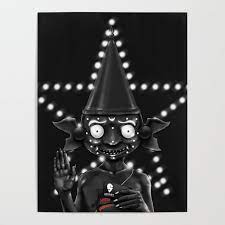
Finally, we come to the most haunting part of the stellar performance: the Ghost King who grants Goopy Baagha the three boons that change their lives, the lives of the kingdoms of Shundi and Halla, and the definition of fantasy in cinema. Chumki, the decorative spangles predominantly used in zardozi, combined with a soft light that diffused the reflected shine of the beads to work ethereal magic. The radish-like teeth crafted from shola pith – the milky white Indian cork that is hallowed by its association with Puja in Bengal — stuck out of the pitch-black body that had eyebrows whitened with paint. Finally, a thick white ‘sacred thread’ across its chest completed the appearance of the gigantic holy demon, Brahma Daitya.

The matching intonation? We all know by now: It was The Master’s Voice. Sound engineer Babu Sarkar had recorded Ray’s baritone, then played at double speed, and rerecorded it…

Only a genius of Ray’s stature could visualise this!

This essay is part of the online website dedicated to the Kheror Khata Satyajit Ray maintained, detailing the making of Goopy Gyne Bagha Byne. This was launched to celebrate the Birth Centenary of the legend. Republished with permission from TCG Crest.


[1] Folk theatre from Bengal

[2] Beyond the bounds of countries or time

[3] All ghosts

[4] Big Ghost Stories

[5] Nabiganj’s Demon

[6] Gosain Garden’s Ghost

[7] Rashmoni’s Jewel Box

[8] Four categorisations

Ratnottama Sengupta, formerly Arts Editor of The Times of India, teaches mass communication and film appreciation, curates film festivals and art exhibitions, and translates and write books. She has been a member of CBFC, served on the National Film Awards jury and has herself won a National Award. 

.

PLEASE NOTE: ARTICLES CAN ONLY BE REPRODUCED IN OTHER SITES WITH DUE ACKNOWLEDGEMENT TO BORDERLESS JOURNAL

Click here to access the Borderless anthology, Monalisa No Longer Smiles
Categories
Poetry

Today’s Child by Atta Shad

Translated from Balochi by Fazal Baloch

Courtesy: Creative Commons
Today’s child,
Tomorrow’s father,
A star of hope for the days ahead,
May you forever glow like moonlight!
 
From the ocean of the sky,
Countless stars sprinkle pearls of light.
Yet the dark night
Spreads out its tattered cloak.
Howsoever, it remains bright
Night is but night.
 
The moon is alone --
But it's a beacon of light,
The spirit of tomorrow’s hopes,
The soul of the night nibbled, glows
A harbinger of dawn,
A gift of the morn.
 
Countless are the stars
The moon is alone.
But absolute is its light.
 
Today’s child,
Tomorrow’s father,
Your little world --
Whether you drag it into a dark night,
Or illuminate it with moonlight.
 
Today’s child,
Tomorrow’s father,
A star of hope,
May you glow like the moonlight!
 

Atta Shad (1939-1997) is the most revered and cherished modern Balochi poet. He instilled a new spirit in the moribund body of modern Balochi poetry in the early 1950s when the latter was drastically paralysed by the influence of Persian and Urdu poetry. Atta Shad gave a new orientation to modern Balochi poetry by giving a formidable ground to the free verse, which also brought in its wake a chain of new themes and mode of expression hitherto untouched by Balochi poets. Apart from the popular motifs of love and romance, subjugation and suffering, freedom and liberty, life and its absurdities are a few recurrent themes which appear in Shad’s poetry. What sets Shad apart from the rest of Balochi poets is his subtle, metaphoric and symbolic approach while versifying socio-political themes. He seemed more concerned about the aesthetic sense of art than anything else.

Shad’s poetry anthologies include Roch Ger and Shap Sahaar Andem, which were later collected in a single anthology under the title Gulzameen, posthumously published by the Balochi Academy Quetta in 2015. The translated poem is from Gulzameen.

Fazal Baloch is a Balochi writer and translator. He has translated many Balochi poems and short stories into English. His translations have been featured in Pakistani Literature published by Pakistan Academy of Letters and in the form of books and anthologies. Fazal Baloch has the translation rights of Atta Shad from the publisher.

PLEASE NOTE: ARTICLES CAN ONLY BE REPRODUCED IN OTHER SITES WITH DUE ACKNOWLEDGEMENT TO BORDERLESS JOURNAL

Click here to access the Borderless anthology, Monalisa No Longer Smiles

Categories
Excerpt

August in Kabul

Title: August in Kabul: America’s Last Days in Afghanistan and the Return of the Taliban

Author: Andrew Quilty

Publisher: Speaking Tiger Books

I had been thinking about a book set in Afghanistan since late 2020. The Doha Agreement, signed that February, was already working to the Taliban’s advantage. Thousands of their prisoners had been released, and battlefield commanders were capitalising on the ‘active defence’ posture the Americans had pushed Kabul into adopting while being careful not to overextend and cause the Americans to stall their withdrawal. I saw the Doha Agreement as a death knell for the Afghan Government, but I never anticipated it would come so quickly.

The book I wanted to write would follow the theme I’d been following for several years. I would chart how the United States’ refusal to reconcile with the ousted Taliban regime, and the ensuing occupation, ignited the insurgency, just as it had in Iraq.

I would follow the lives of rural Afghans whose experience of the war, unlike those in Kabul who, while also encountering horrific violence, were given an array of new opportunities, was one of deprivation and disaffection—a story less often told.

Admittedly, the fascination with those living behind Taliban lines was amplified because their lives were virtually off-limits to journalists.

An unspoken race for access among writers, photographers and filmmakers began, intensifying in recent years as the prospect of a Taliban return to power became increasingly likely.

After the signing of the Doha Agreement, with US air support curtailed and the Taliban enjoying a wave of international recognition, some commanders began to open the doors to their districts. I had already been reporting on the ruthless exploits of the CIA’s Afghan proxies from the 01 National Strike Unit in Maidan Wardak—albeit from the relative safety of Kabul and the provincial capital, Maidan Shahr—when opportunities to visit the villages where they occurred began to arise from the middle of that year.

Those trips, which, for security reasons, lasted one night at most, were indeed as fascinating as I had expected. They also vindicated the hypothesis that the punitive neglect of the rural class— particularly those in predominantly Pashtun districts—and the violent ordeals they’d endured living among—and, often in cahoots with—the Taliban, were creating an increasingly unbridgeable gap between rural Afghanistan and the central government. The lack of accountability for their suffering was self-defeating for the aggressors, and, for journalists, I believed, the war’s essential theme.

It must be said that the Taliban’s military victory would never have come without the ineptitude and malfeasance of successive administrations in Kabul and their armed forces, and the hubris of the American-led international military coalition. The Taliban’s readiness to seize the advantage after the signing of the Doha Agreement did, however, expedite the eventual collapse that the agreement ensured. The realisation that the Americans were leaving, along with the military support and air power that had given Kabul a lifeline since 2015, was the final straw.

Aside from the almost daily guerrilla-style attacks by the Taliban and other anti-government groups in Kabul—‘The years long fears of the vehicle in front of you blowing up or the guy on the motorbike opening fire,’ as a friend who read an early version of this book reminded me—the war in Afghanistan had been fought largely in remote districts since the early 2000s. As I wrote in the prologue to this book, once the momentum swung decisively in the Taliban’s favour in the spring of 2020, and areas under government control started shrinking to virtual islands accessible only by air, many rural battlegrounds fell silent. The lives of those who had gained the most since the Taliban’s fall in 2001—lives that had overcome hardship and flourished, which I’d rarely been compelled to write about—were all of a sudden under threat. While their physical safety may not necessarily have been at risk, their personal liberty, the simple freedom to choose the trajectory of one’s own life, certainly was. For them, life without choice was no life at all.

If the threat of such loss had instigated a change in what I felt was pertinent to write about, 15 August completed the about-face.

With the Taliban’s victory came a level of scrutiny and critique that no insurgency warrants, no matter the wrongs of the government it was trying to overthrow nor the infringements on human rights it would institute once in power.

Amid the chaos of that day, I hugged farewell a tearful Aziz Tassal, a journalist with whom I’d worked for years and grown to love for his gentle company and care for his wife, three cheeky young daughters and everyone with whom he’d worked. I’d spent a week sharing a room with him in Uruzgan earlier in the year, reporting for an article published by The Monthly where we traded stories about our mutual friend Aliyas Dayee, a journalist from Helmand who had been assassinated three months earlier (the article won the 2021 Walkley Award for long-form feature writing). He’d calmly taken control when the car he was travelling in with Nanna Muus Steffensen, a journalist and my housemate, came under fire during a Taliban ambush in Maidan Wardak some months before. But on 15 August, he was inconsolable. ‘They betrayed us,’ he sobbed, before undertaking his own harrowing journey to the United States with his family.

The next day I photographed Noorullah Shirzada, a photographer with Agence France-Presse, carrying his baby into the French Embassy. The photo was published the day after by the French newspaper Le monde. Farshad Usyan, a friend who I also consider Afghanistan’s best photojournalist, was also there. His passport was inside the embassy awaiting a visa, but the Taliban weren’t allowing him in. Phone calls were made and eventually someone called his name. He disappeared behind the gate before we got a chance to say goodbye.

That day, 16 August, was also when BBC correspondent Kate Clark was flown out of Kabul.

Extracted from August in Kabul: America’s Last Days in Afghanistan and the Return of the Taliban by Andrew Quilty. Published by Speaking Tiger Books, 2022.

About the Book

As night fell on 15 August 2021, the Taliban swept into Kabul, capital of Afghanistan. After a twenty-year conflict with the United States, its Western allies and a proxy Afghan government, the Islamic militant group once aligned with al Qaeda was about to bury yet another foreign foe in the graveyard of empires. And for the US, the superpower, this was yet another foreign disaster. As cities and towns fell to the Taliban in rapid succession, Western troops and embassy staff scrambled to flee a country of which its government had lost control. To the world, Kabul in 2021 looked like Saigon in 1975.

August in Kabul is the story of how America’s longest mission came to an abrupt and chaotic end, told through the eyes of Afghans whose lives were turned upside down: a young woman who dreams of a university education but whose family now want to give her up to the Taliban in exchange for security; a presidential staffer who works desperately to hold things together as the government collapses around him; a prisoner in the notorious Bagram Prison who suddenly finds himself free when prison guards abandon their post. Andrew Quilty was one of a handful of foreign journalists who stayed in Kabul as the city fell. This remarkable book is his first-hand account of those dramatic final days.

About the Author

Andrew Quilty is the recipient of nine Walkley Awards, including the Gold Walkley, for his work on Afghanistan, where he has been based since 2013. He has also received the George Polk Award, the World Press Photo Award and the Overseas Press Club of America award for his investigation into massacres committed by a CIA-backed Afghan militia. August in Kabul is his first book.

Click here to read the interview and the review

PLEASE NOTE: ARTICLES CAN ONLY BE REPRODUCED IN OTHER SITES WITH DUE ACKNOWLEDGEMENT TO BORDERLESS JOURNAL. 

Categories
Poets, Poetry & Rhys Hughes

Climbing Sri Pada

I climbed Sri Pada on the 10th of January of the year 2023. I was still calling the mountain Adam’s Peak when I went up it, but on the way down I decided that it was more respectful to call it by the name the locals use. I had first glimpsed the mountain during my first visit to Sri Lanka, a year earlier. I saw it through a car window in the distance. “One day I will return and climb it,” I told myself, but I never imagined that I would do so just twelve months later. I often create lists of ‘things to do’ and items on those lists tend to remain on those lists for decades. I can be slow at compiling these lists and I found myself in the position of having to scratch out the words ‘Climb Sri Pada’ before I had even added them. Life is full of such ironies, luckily or unluckily.

Climbing mountains is one of the greatest delights of my existence, but the number of mountains I climb per year is low, on average just one, and I attribute my lack of drive to the typical mountaineer’s ‘peak lassitude’, which isn’t like the ‘peak performance’ of other kinds of athletes. You go up a mountain, stand on the summit and take a good look, then you climb down and look up, to see where you have been, and it is the theory of the climb, which has just been done in practice, that seems to be so exhausting. That’s my theory, anyway, or maybe it’s not quite deserving of the name ‘theory’. Perhaps it’s just a speculation or an excuse. But as I’ve always said, an excuse is as good a reason as any. I climbed Sri Pada and am still enjoying my fatigue.

Having arrived in Colombo by modern jet aeroplane, as one usually does, I caught a bus to the village of Maskeliya in the Central Province of the island, or rather a series of buses, as I couldn’t work out how to catch a direct bus there.

In fact, I first went to Kandy, a city on the way, or almost on the way, and stayed in a pleasant and cheap hotel for one night. I went to the Royal Bar for a meal and a drink, one of my favourite pubs in the world, and a place with strong nostalgic overtones for me. It’s a restored colonial building and I often feel like a restored colonial man, so it matches me perfectly. What I mean by this is that I’m getting old and cranky, but my foundations are solid, and my façade can be regarded as a noble one. There was a power cut while I was sitting at a chair on a balcony that overlooks an inner courtyard and the chef wasn’t able to prepare hummus in the dark, so I made do with chips and ketchup.

Sri Lanka was still reeling from the effects of economic mismanagement. I was expecting food and fuel shortages and disruption of public transport, as well as frequent power cuts, but I experienced little inconvenience, and I wouldn’t complain even if I had. Stiff upper lip and all that. A few days later, my British legs were stiffer than any lip has any right to be. But now I am jumping ahead. I couldn’t jump anywhere when my legs were stiff. I could hardly walk. But now I am drifting off the point, just as I drifted off the route when I was hiking to the base of the mountain. I am jumping ahead again. Let me go back a little and let me explain that all the inconvenience I didn’t experience because of economic mismanagement is still there, adversely affecting the people of the island, even if visitors don’t notice it. It’s important to be aware, even if the only thing we’re aware of is that we aren’t really aware.

From Kandy I caught a bus to Hatton. Every seat of this bus was occupied, and I had to stand. I wasn’t alone in standing, many other passengers were doing the same thing, and it was only the pressure from all these other standing bodies that prevented me from falling over on the winding road to the town of Hatton. I say ‘road’ but in fact it was just a series of bends that climb higher into the hills, an impressive drop on one side, no barriers, and a driver who liked to accelerate on those bends, presumably to teach them a lesson, or to teach us a lesson, about inertia and maybe some other laws of physics. It is cheaper than paying to use a rollercoaster and rather more sociable.

But the landscapes are beautiful. Tea plantations on undulating slopes with mountains in the background, and plenty of lakes. We reached Hatton and I tried to find another bus that would carry me the remaining distance to Maskeliya but I failed in this endeavour and caught a tuk-tuk with a talkative driver who acted as a tour guide on the way. “That’s a mountain over there, don’t know its name, and down there you can see a lake, not sure what it’s called, and reflected in the water is that very mountain. Imagine!”

At the time I had no idea that Hatton was the birthplace of one of my mightiest heroes, the explorer Eric Shipton, a man who climbed for real all the mountains I just gape at in picture books, and who probably found genuine evidence of the yeti, unless he was playing a prank and made the footprints himself. Who knows?

The tuk-tuk arrived in Maskeliya, which turned out to be a small place in which all the restaurants were closed, and it was impossible to secure a cup of tea or coffee. The fact we were surrounded by tea plantations and innumerable coffee bushes meant little, for all the tea and coffee was exported to Britain. I should have had a cup before I left my own country, I was informed. I replied that I had come from India where tea and coffee are daily occurrences, or even hourly occurrences, if necessary. There are numerous similarities between India and Sri Lanka, but also some differences. No snow-covered mountains on the island, for instance, therefore no yetis.

My tuk-tuk driver dropped me off on a dusty street full of holes over which his vehicle had been bouncing like a distorted rubber ball, and I found the place where I was staying. I was warmly greeted by my hosts and their two dogs. My room was above a garage and this building was the very last one in the village. I was given a pot of tea and a plate of biscuits to celebrate my arrival in such an obscure location. So, there was tea to be had in Maskeliya after all! I found it to have a pleasant but unorthodox flavour.

After I had drunk half a pot of the stuff, I was told it was coffee. So, there was coffee to be had in Maskeliya after all! Coffee that tastes like tea. Or rather, coffee that tastes like tea that doesn’t taste quite like tea. I learn something new every day, or nearly every day, even if it’s only that I don’t learn something new every day but only once a week. Does that make sense? I won’t say the altitude had affected my mind, because although we were quite high, we weren’t really very high. Maskeliya has an elevation of approximately 1205 metres. Nothing to write home about. But I only have an elevation of 1.74 metres, so who am I to pass judgement? I drank more of the tea.

For a few days, I prepared myself mentally and physically for the coming climb. I played with the dogs and read some books. One of the dogs had a habit of sunning himself on the roof of the house and I couldn’t work out how he got up there, onto the corrugated iron. Maybe he turned into a monkey by the light of the moon and turned back to a dog once he reached the roof. Magic is always a useful explanation for such mysteries.

At least it is useful until we know better. And often that ‘better’ turns out to be worse. Whatever the solution to the mystery, he was a nice dog and that’s what ultimately counts. An abacus also counts, but rarely ultimately, because it is limited by the number of beads on its wires. I went for a walk at a waterfall on the far side of the enormous lake that dominates the region horizontally, in the same way that Sri Pada dominates the region vertically. That was also part of my preparation. I drank more coffee.

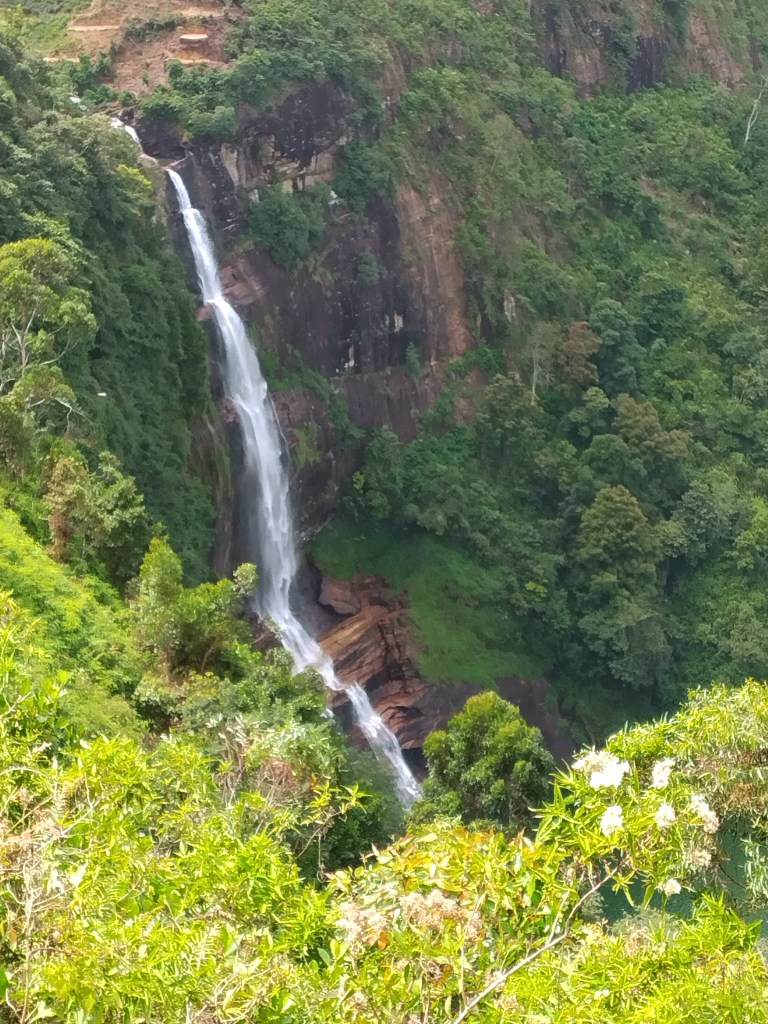
During my walk to the waterfall, it began raining and I ran for shelter. It’s a terrible thing to get wet on the way to a plummeting column of water that fills the air with spray and wets the onlookers. Almost as if the sky is trying to spoil the surprise. I found shelter too, in a lookout point with a roof. Two young men were sheltering there and they had a drum with them and they invited me to play it, which I did, while they did a peculiar dance. Perhaps it was the opposite of a rain dance? I didn’t think to ask, but I should have. The rain stopped. We left the shelter and went our separate ways. I ambled along a narrow path to the top of the waterfall and looked down.

Lots of gushing water making a roar. The world is God’s bathroom and he had left the tap on. That’s what it was like, a little anyway. I ambled back the way I had come and caught a bus to Maskeliya. An old man waiting at the stop thanked me for being British. It was the British, he told me, who brought tea to Sri Lanka. Before we came along, they only had mango juice and coconut water to drink. Appalling! I am uncomfortable when I am thanked for being British, and it does happen, more often than one might suppose. When the bus arrived, he was too emotional to board it and decided to wait for the next one. Personally, I like mango and coconut.

The day of the big climb arrived, or rather the night, for I had to depart my comfortable room at 2:30 in the morning and sit in a less comfortable tuk-tuk for an even less comfortable ride to a mountain that I could very uncomfortably climb to the top. I later wrote a poem about my climb which asked the question, why do I climb mountains at night in order to see the sunrise? The punchline of my poem was that I didn’t know the answer until I reached the top and then it dawned on me. Many or most poems don’t have punchlines, mine do. But this doesn’t mean mine are in the right. Sometimes I imagine they are punch drunk and that’s surely wrong. Punch can be made with mango and coconut as added ingredients, but probably not with tea.

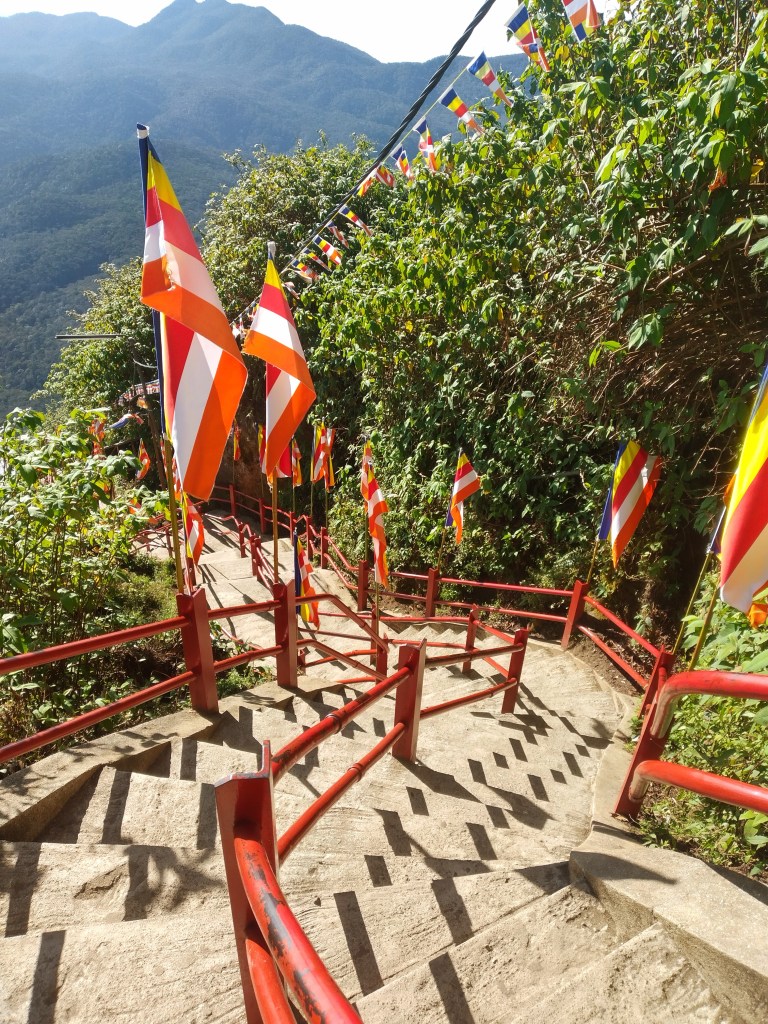
The tuk-tuk stopped and I dismounted and began my hike to the base of the mountain. There are several routes to the base of Sri Pada. Some are easier than others, and some of the easier ones are much longer than the harder ones, making them harder in some ways. That’s mountains for you. I walked up a stony path and into a forest. I began to suspect that this was the dry bed of a stream rather than a proper path and I thought of my own dry bed in my room in Maskeliya. Too late, I was committed to the climb. It was a forest where leopards and elephants roam, but I didn’t know that until later, for there was no sign of them as I trudged up the inclines.

After a few hours I wondered if I had taken a wrong turn. The mountain should have loomed above me, but it wasn’t to be seen. That was weird, but I am used to getting lost on hikes and climbs. I even get lost in cities when I have maps. I’m not saying that I am a terrible navigator, but I would be very unlikely to employ myself as a guide to anywhere. I decided to push on in order to see how lost I actually was. The only way of doing this efficiently is to become even more lost and then compare the degrees of lostness, if lostness is a real word, which probably it isn’t. Ah well! I noticed a light far ahead that was a beacon of hope, and I increased my speed.

The light belonged to the isolated hut of a tea picker. At least I assumed the hut was a worker’s shelter, but it might have been something else, of course. I had hiked out of the forest and into a tea plantation. Yes, I had taken a wrong turn somewhere, and now I needed to go back and find that somewhere. But if I looked for it, I probably wouldn’t find it. Best not to look for it and stumble on it by pure chance. That was my strategy.

And it worked. I wandered off the path again, the wrong path, and luckily managed to end up by accident on the right path. The Buddha told us to follow the middle path, but there were only two paths here. I would worry about this at the top of Sri Pada, where there is a shrine to him. Incidentally I am extremely interested in Buddhism, it’s a religion I find most compelling, the one with the most reasonable ideas, but what do I know?

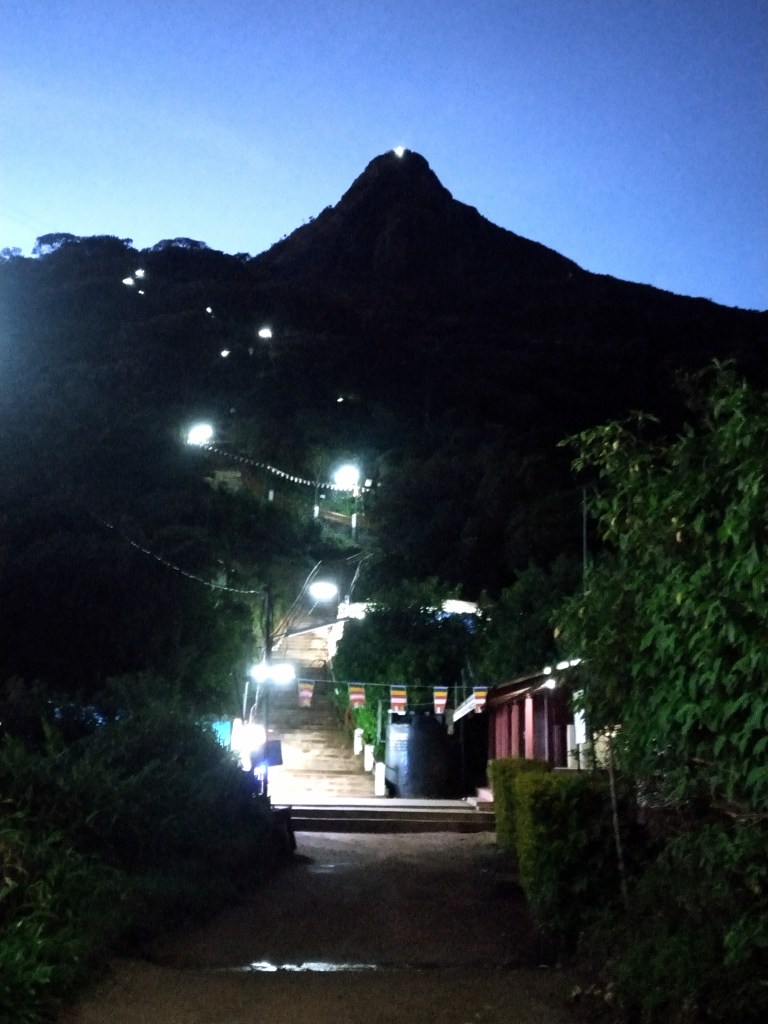
I can’t honestly say that my attempt to climb Sri Pada was a pilgrimage as well as a minor adventure. It would be nice to make that claim, but it would be dishonest. Maybe one day I will return in a more spiritual frame of mind and try again. I finally reached the 5500 steps that led up the side of the mountain and I climbed them and was rather astonished to find tea shops on the way, tea shops open all night. So, this is where the tea really went! Then I asked myself, how are these shops supplied? The tea must be carried up on foot, step by step, as there’s no other way of doing it, unless it is dropped by parachute, which is so improbable an option we can disregard it.

Five thousand five hundred steps up and five thousand five hundred steps down makes eleven thousand in total, and that’s a lot of steps. At first it seemed easy, because it was easy, then it began to seem more difficult, because it was more difficult. When things are exactly the way they seem, I find that it focuses my mind acutely. My legs were tired halfway to the top, but I told them to take heart and not let down the other parts of my body, which still wanted to get to the summit and were relying on them. I also told my heart to take heart. It didn’t really require that advice, as it happens.

Finally, I reached the top. The sun came up. It came up effortlessly, without the need for steps. The sun is five billion years old but acts like a youth, setting a good example to us all. Funny how it sets this example when it is rising. But I am wandering off the point, and the point is not a path. I took off my boots and approached the shrine, which stands on a small area at the very apex of Sri Pada and overlooks the other mountains and hills in every direction. Inside this shrine is the footprint, but it has been covered over with a golden seal in the shape of a foot and I can’t report on what it actually looks like. I also rang the bell that has been provided for the use of summiteers.

I don’t know if ‘summiteers’ is a real word. I could check but I worry that it might not exist in the lexicons and then I would feel obliged to change it, and I don’t want to do that. Musketeers is a real word, so I don’t see why lexicons should feel a need to pick on summiteers. If they picked on musketeers, they’d soon be sorry! The bell at the summit of Sri Pada should be rung the number of times the ringer has climbed the mountain. I rang it once. Then I began the long descent. I found this harder than the climb because my knees were sore, and my legs were shaky. They wibbled and wobbled like jellies in the shape of limbs, a very cunning pair of jellies no doubt, but a feeble set of legs. Nonetheless, down I managed to go, slowly, surely, puffingly.

On the descent, two boars crossed my path. They were very casual, a more nonchalant couple of wild pigs can hardly be imagined. They trotted out of the undergrowth on one side, stopped to admire the view, then carried on into dense undergrowth on the other side. I noticed that their legs didn’t wibble or wobble. It’s true that I might not be able to tell a wibble from a wobble when it comes to a pig because I’m not a trained vet. I’m not even a wild vet. I am no kind of vet. That goes without saying. I went without saying too, downwards again, until at long last I reached the bottom, exhausted.

All the photographs have been provided by Rhys Hughes

Rhys Hughes has lived in many countries. He graduated as an engineer but currently works as a tutor of mathematics. Since his first book was published in 1995 he has had fifty other books published and his work has been translated into ten languages.

.

PLEASE NOTE: ARTICLES CAN ONLY BE REPRODUCED IN OTHER SITES WITH DUE ACKNOWLEDGEMENT TO BORDERLESS JOURNAL. 

Click here to access the Borderless anthology, Monalisa No Longer Smiles

Categories
Poetry

Picture in Sepia

By Pragya Bajpai

SEPIA PICTURE

The monsoon is here 
but where do I tie the ropes of my swing 
The trees are missing

The hot summer is back 
but where do I search for shade 
the land is cracking and the trees are missing

The birds are migrating 
searching for a branch to build a nest
They are tired of flying but the trees are missing

I pull out a sepia picture from my pocket
taken thirty years ago
where I'm eating marshmallow 
standing by the lake under the tree shade
waiting for my turn to swing
I'm gazing at the nest 
where a bird is hatching eggs 

I look at the picture again and wonder 
if I've come at the wrong time or
I've come to a wrong place
I don't belong to this dry lake

Pragya Bajpai, Ph.D. is serving at the National Defence Academy, Pune. She has authored a collection of poems and has edited 4 anthologies celebrating the armed forces. pragyabajpai@gmail.com Instagram: pragyabajpai29

.

PLEASE NOTE: ARTICLES CAN ONLY BE REPRODUCED IN OTHER SITES WITH DUE ACKNOWLEDGEMENT TO BORDERLESS JOURNAL. 

Click here to access the Borderless anthology, Monalisa No Longer Smiles

Categories
Poetry

More Poetry by David Francis

Madame Manet at Bellevue (1880) painting by Édouard Manet. Courtesy: Creative Commons
TO TERRY

The happy times spent talking in cafés,
staying up all night and walking the blocks
of the old neighbourhood until the sunrays
ruined it all like workaholic clocks.

Exotic films marveled at until dawn
and late late show movies caught on TV,
by turns dead-serious in conversation,
then in tears laughing uproariously.

Surrealism, slapstick and nonsense
and gossip about an inhospitable wife:
all grist to us except current events—
we desired only the romantic life.

The irritation of get-rich-quick schemes;
procrastination of infinite dreams.


NEGLIGENCE

How long had it been—
well, they couldn’t find the grave—
eloquent enough

*******

Over time     
you can’t find the birthplace;
the hospital is bankrupt;
the first house unvisited; 
one play finishes its run:
another on the marquee;
no flowers on the grave
through many seasons


THE PUGILIST

Each fight is distinctive
and, once won,
the impetus is gone.

Who can remember—
so long ago torn—
the struggle to be born?

The next is with family
who blindly neglect
the individual respect.

Then follows the world:
to play that game,
to survive and keep your name.

Always with the self,
faith, purpose, doubt,
moving from inside-out.

The last is with sheer mystery:
the unknown destination
reached through resignation.

Forms of fights subsumed
utterly by their fires.
And so, the fighter retires.

David Francis has produced seven music albums, Always/Far: a chapbook of lyrics and drawings, and Poems from Argentina (Kelsay Books).  He has written and directed the films, Village Folksinger
(2013) and Memory Journey (2018).  He lives in New York City. 

.

PLEASE NOTE: ARTICLES CAN ONLY BE REPRODUCED IN OTHER SITES WITH DUE ACKNOWLEDGEMENT TO BORDERLESS JOURNAL

Click here to access the Borderless anthology, Monalisa No Longer Smiles

Categories
Poetry

Two Poems by Ron Pickett

Courtesy: Creative Commons
FORM VS FUNCTION

Stiletto heels in graveyard sod.
Shorts in a ski lift line.
Sneakers with a tuxedo
Style over substance
An apron over jeans.
Slippers – ever.
Form follows function,
Except when it doesn’t!
The rules we accept
Vs the rules we ignore,
My faded, frayed pale blue floppy hat.
The ultimate victory of Function over Form,
Of Substance over Style, 
Of Utility over Beauty
I love my floppy hat.

FREE LUNCH At CHIPOTLE!

How did we get here?
It’s noon, lunch time as I walk across the parking lot.
Four teenage girls, casually dressed, emerge from Chipotle.
Orders from the Web are on a table near the front door.
Orders paid for, filled and waiting for their owner.
One girl carries a large Chipotle bag.
They walk to a Lexus.
I hear a voice. “Stop I want to look at that bag,”
I see a server from the restaurant following the girls.
They hurriedly get into the car.
The voice repeats, “I want to look at that bag!”
She takes a picture of the license plate.
The girl in the back seat opens her door.
The server takes the bag, looks at the tag.
The car leaves -- quickly. 
It’s an old Lexus.
I hear one of the onlookers ask the server, “How did you know what they were doing?”
“It’s their behaviour!”
I shout to the server, “Great job, Thank you!”
I wonder, “How did we get here?”

Ron Pickett is a retired naval aviator with over 250 combat missions and 500 carrier landings. His 90-plus articles have appeared in numerous publications. He enjoys writing fiction and has published five books: Perfect Crimes – I Got Away with It, Discovering Roots, Getting Published, EMPATHS, and Sixty Odd Short Stories.

.

PLEASE NOTE: ARTICLES CAN ONLY BE REPRODUCED IN OTHER SITES WITH DUE ACKNOWLEDGEMENT TO BORDERLESS JOURNAL

Click here to access the Borderless anthology, Monalisa No Longer Smiles
Categories
Interview Review

Women, Taliban & More: In Conversation with Andrew Quilty

 August in Kabul: America’s Last Days in Afghanistan and the Return of the Taliban is a real-life account of a journalist who returned to Kabul from Dubai to be with his “friends”, to let them know that their well-wishers had not abandoned them, even while the American forces withdrew and the Taliban took over. Most, including President Ghani, were flying out of Kabul while acclaimed photojournalist who had spent eight years there, Andrew Quilty, flew back from Dubai on 14th August, 2021.

His account traces the history of the takeover, the inception of the Taliban, the reactions of the people to their earlier regime dating from 1996 to 2001: “The Taliban were initially welcomed there, and many young, uneducated male residents, enamoured by the group’s piety, joined their ranks. But to Soviet-era communist officials, senior Hezb-i Islami figures and those with tertiary educations or financial means, the Taliban’s devoutness foretold merciless intolerance, and they left the country, travelling to the West through costly smuggling networks or to neighbouring Pakistan or Iran, joining the millions who had moved there during the Soviet war, as refugees.”

He is vocal about the Doha Agreement made by the Trump regime and executed by Biden, where the handing over left gaps which caused suffering not only among foreigners but also the local population of Afghanistan. Citizens died trying to find safety for themselves and their loved ones. Chaos prevailed and both Taliban forces and American soldiers killed innocents. With more than hundred interviews, Quilty brings the plight of these people to light. What touches the heart in this narrative is the human suffering caused by political games and beliefs. This has been captured well in the account.

That the current acknowledged rulers of Afghanistan, the Talibans, have reverted in certain senses to their past stance, especially pertaining to a major issue, the freedom of women has been acknowledged. But is this an issue that is related essentially to Taliban only or does it run deeper within the culture? Through the narrative of a young girl, Nadia, the author relates the equation for Afghani women: “Preserving the safety of women is a common sleight of hand used by Afghan men to keep those within their family under control. Neglecting such a duty and allowing a young woman the freedom to walk when they wish in the streets, to socialise with unrelated men, and to develop their understanding of the world outside the home and their ideas about their place therein, is deduced by many outside the immediate family to imply the woman is what Nadia refers to euphemistically as a ‘bad girl’. Boiled down, a ‘bad girl’ is one who cavorts and sleeps with men out of wedlock—a prostitute in Afghan terms, a great stain on a family’s honour. To avert such a possibility, rather than confront those who deliberately misinterpret the young woman’s ways and use it to undermine her family, instead, her brothers, father and male members of the extended family more often elect to restrain her behaviour.”

Women are not the only victims of a society that balks at liberal or out of the box thinking. The book is an eye-opener and reveals how the events of that August unfolded in 2021. It was an amazing coincidence that the takeover was completed on a date that coincided with the Independence Day celebrations of its neighbours, India (15th August) and Pakistan (14th August).

This account varies from an earlier account of Afghanistan written almost a century ago in its tone – that was humorous essays, a memoir by Syed Mujtaba Ali translated by Nazes Afroz from Bengali, called In a Land Far from Home: A Bengali in Afghanistan. This is a journalistic account. But one thing that runs through both the narratives is the bonding both these writers experienced with the locals, perhaps a bond born of friendship with people who have lived in oppressed communities and the need to get the world to hear their voices. The social norms still sound the same with wild gun shots marking celebrations. But what was not mentioned in the earlier were the scars left by Soviets and American weapons – because Mujtaba Ali’s account ended at the start of the civil war (1928-29), long before the superpowers intervened in a major way, even though the then-ruler Amanullah Khan (1892-1960) had abdicated and escaped to British India.

Andrew Quilty in Kabul. Photo provided by Quilty

Andrew Quilty who gives a splendid coverage of the current scenario, had been in Afghanistan since 2013. He is the recipient of nine Walkley Awards, including the Gold Walkley, for his work on Afghanistan. He has also received the George Polk Award, the World Press Photo Award and the Overseas Press Club of America award for his investigation into massacres committed by a CIA-backed Afghan militia. In this conversation, Quilty tells us more about the writing of the book and his own responses to the change in regime and the takeover, and most of all what made him return to a conflict zone.

What made you return to Kabul, when others were fleeing from a Taliban takeover?

There were two things: as a journalist and photographer, the days ahead of when I decided to return to Afghanistan were going to be the country’s most pivotal since the US invasion in 2001. Having covered the country for eight years at that point, despite the risk, I really wanted to be present to cover the period that was to follow. But more than that, at the time I really just wanted to be with my friends, both foreign and Afghan, with whom I had experienced so much with in the country over the years leading up to August 2021. While many of my Afghan friends felt the international community was abandoning them, I didn’t want them to feel their friends had as well.

In your ‘Epilogue’, you tell us that the book turned out to be different from what you had thought it would be at the start. What was it that you had wanted to start with and how has it departed from the way you had visualised it earlier?

I had envisaged writing a book about the way international military special forces had, through their tactics of night raids and air strikes, turned much of the rural Afghan population against the central government and the US-led military coalition.

You are a well-known photo-journalist and yet your book is written only in words. Why did you opt to use words instead of photographs this time?

I am currently working on a photo book that will cover the entire time I spent in Afghanistan (2013 – 2022). But my photos of the events of 2021 alone wouldn’t have been sufficient to tell the story of what happened in the detail the way words can.

In the twentieth century, a book had been written by Syed Mujtaba Ali in Bengali and translated by a journalist who was in Afghanistan, Nazes Afroz, talks of the dislodging of Amanullah by Bacha-ye-Saqao (Habibullah Kalakani) during the civil war. Can Bachai-ye-Saquao be seen as some kind of a precursor to the making of Taliban? Please elaborate.

Not really. He was of Tajik descent and so didn’t have the support of the majority Pashtuns. Also, his rule didn’t even last a year. The Taliban that took control of Afghanistan in 1996 are a closer replica of the Taliban that took control of the country in 2021 than Kalakani.

Afghanistan seems to be a country torn by the politics induced by Cold War, which of course is said to have concluded now. How would you compare the Soviet intrusion from 1979 to 1989 with the recent American intrusion which concluded with the Taliban takeover? You have mentioned how bio warfare by Soviets ruined the countryside. Please elaborate.

There are a lot of comparisons that could be made. Both the Soviets and the US-led coalition had superior technology, equipment and training. The Mujahedin and the Taliban (whose fighters call themselves Mujahedin) had poor quality weapons, funding and training, but they had a motive to fight that invading nations could never match. The nature of the style of warfare they used also made them very hard to defeat — ie. an insurgency that lives among the population, whose fighters are very difficult to distinguish from the local non-combatants.

Reading some of the case stories that you have taken up in your non-fiction, the oppression of women seems to be an accepted social norm in Afghanistan and persisted before the current invasion of the Taliban. Can you please comment on this?

While there were improvements for women in Afghanistan after the Taliban were ousted in 2001 — education was once again permitted, they were allowed to work in all sectors of the workforce and allowed to own property etc. — across much of the country, especially in rural areas, many women’s lives were still highly restricted by conservative cultural norms. Despite the constitution giving women many more rights than they had previously, culture often overrode the law. That said, the Taliban have now enshrined the most conservative interpretation of cultural norms in law, and so for those families who had permitted women to live under the more permissive post-2001 laws, the choice is no longer theirs to make.

One of the major issues one gathers from various narratives as well as yours in Afghanistan is not only the lack of freedom to women but also extends to freethinkers. Is this a cultural issue, religious issue or Taliban induced?

I think this is more about stamping out dissent as well as ideas that don’t conform to the Taliban’s worldview, like communism or democracy for example. So, it’s both religious as well as a means for the Taliban to enforce those under their control to follow their very strict worldview.

The Taliban destroyed the Bamiyan Buddha. Have they changed since then to become more accepting of diverse thought?

I had hope that they might be. Most Afghans cautioned my optimism, and they seem to have been proven vindicated. While the Taliban haven’t yet destroyed any cultural heritage like the Buddhas, it took them five years in control to do that in 2001. The way they have rolled back rights in the 18 months they have been in control, it doesn’t bode well for what the next few years will bring. So far, however, they don’t seem to have been targeting ethnic minorities specifically or systematically.

The Taliban had taken control once earlier to be driven out by Americans in 2001. Can you tell us a bit about the origin of Talibans? Are they the same as Mujahedins?

The Taliban emerged from several groups that, combined, were known internationally as the Mujahedin. Once the Soviets left Afghanistan in 1989, the seven Mujahedin factions fought for control of the country. The Taliban, whose fighters were mostly drawn from religious madrasas, and known to be better-disciplined than the other lawless factions, promised to bring order to the country. Initially they were welcomed.

Photo provided by Andrew Quilty

You had moved to Afghanistan in 2013. Would you think of returning there now? Why?

I hadn’t planned to live in Afghanistan. Initially I went for two weeks to photograph the Afghan cricket team for an Australian magazine. I only planned to stay two weeks but quickly fell in love with the country and my work there and stayed nearly a decade. I have no plans to return as yet, but it will always be close to my heart, and I would love to return one day when it feels right.

Are you planning more books in the future? On Afghanistan?

Yes. As I mentioned, I will publish a photo book on Afghanistan later this year with Melbourne University Press. After that, let’s see.

Thank you for your time.

(This review and the online interview conducted through emails are by Mitali Chakravarty)

Click here to read the Book Excerpt

PLEASE NOTE: ARTICLES CAN ONLY BE REPRODUCED IN OTHER SITES WITH DUE ACKNOWLEDGEMENT TO BORDERLESS JOURNAL

Click here to access the Borderless anthology, Monalisa No Longer Smiles
Categories
Poetry

Amnesty of Form by Asad Latif

The Dance of Muses by Louis Candide Boulanger(1806-1867) Courtesy: Creative Commons
AMNESTY OF FORM

(For Siddhartha)

The departed fare well in art.
Karan's  broken heart 
fell with him in Kurukshetra
on the wrong side of history.
We still live in mourning,
seeking refuge in mysteries
of the Mahabharata
to redeem him in our longing.

Hasan's brother Hussein perished
in Karbala. I don't like the way
the city's so beautiful today
after Iraqis were reduced to dust.
But that's the point. The Marsiya of Anis
rises from these passing storms
to find two boys whom the Prophet
once held in his arms. They never rust.

Antigone's gone the way of her
brothers and Creon. All equally dead.
But look! There waits mad Sophocles.
He's breathing. He's writing. He's read.

And Stratford's always around.
Ophelia's in Hamlet drowned
and Desdemona died chaste.
Their unrequited lines 
won't let an honest English word
ever go to waste.
With Cordelia they sit adorned
to shape redemption into a tear.
Most art's a footnote to Lear.
 
But not all poems have been written.
"This one's for Lenin," she said
of her grenade to the Nazi tank ahead.
Who were you, my one-girl Soviet?
Herein I name you Land of the New
to honour Comrade Death.   

Oh Muses of uneasy morn,
people pass. Poets are reborn.
Grant to this play of transience
your final asylum of form.

Asad Latif is a Singapore-based journalist. He can be contacted at badiarghat@borderlesssg1

PLEASE NOTE: ARTICLES CAN ONLY BE REPRODUCED IN OTHER SITES WITH DUE ACKNOWLEDGEMENT TO BORDERLESS JOURNAL. 

Click here to access the Borderless anthology, Monalisa No Longer Smiles

Categories
Poetry

Poems by John Grey

Courtesy: Creative Commons

THE FOREST COMES BACK AFTER THE FIRE

I'm not the maple yet.
More of that tall pine from Norway.
or a fruit tree you wouldn't recognise
from your brief lessons in biology.
Already, in my branches,
fifty crows caw,
a thousand squirrels’ nest.
I face west where one dark lake
is my left hand;
and then east,
where a rocky escarpment
fills in for the fingers on my right.
My torso is, as yet,
a dark burnt patch
interrupted by a few green seedlings.
But soon enough
I'll boast a chest


A BOY THROWS ROCKS INTO THE LAKE

He'll never run out of rocks
and that lake is going nowhere.
And the splash is seductive, I expect.
It's not a loud noise but it's of his own making.
But, eventually, cold gray rock
won't be enough to satisfy his sense of touch.
And the lake will be such a lazy target.
Maybe he'll toss a leaf on the waters,
watch it float.
Or fish at its edge.
Or paddle a canoe into its center.
Or when he's old enough, he'll bring a girl here,
wrap his fingers around hers,
stare out at the glittering water together.
He'll hug her slim waist,
kiss her trembling lips.
The rocks won't move.
The surface won't ripple.
But the earth is a different story.


DARK OF THE DAY

When I learn to see,
the day will not be dark.
Maybe blue and green.

Like the blue and green of childhood.

When I had a voice.
And now I cannot speak any colour.
I can only write it down.

And when I learn to see,
the page will not be blank.
I will know what I have written. 

Like when I had a mind
and I could understand it as well.

I can only feel the words
and there is no blue or green in them.

They are colourless.

When I learn to see,
there’ll be payback
of a florid kind.

John Grey is an Australian poet, US resident, recently published in Sheepshead Review, Stand, Poetry Salzburg Review and Hollins Critic. His latest books are Leaves On Pages, Memory Outside The Head and Guest Of Myself, available on Amazon. 

PLEASE NOTE: ARTICLES CAN ONLY BE REPRODUCED IN OTHER SITES WITH DUE ACKNOWLEDGEMENT TO BORDERLESS JOURNAL

Click here to access the Borderless anthology, Monalisa No Longer Smiles