Categories
Stories

A Wooden Smile

By Shubhangi

Munni kept playing with the tap water until Malti came running into the bathroom, closed the tap, and smacked Munni on the back of her head. “As if we have a well full of water, you spoiled brat!Malti yelled and pinched her daughter’s ear. “Now gargle your mouth and hurry up.Munni made a little grunt and frowned at her mother. “Go and get ready,” Malti said as she wiped her thirteen-year daughter’s face with the end of her saree. Before Munni could ask why she had to be getting ready, Malti had already rushed out of their little, dilapidated, untended bathroom.

From where she stood, the little girl could see her mother straighten out one of her not-yet-tattered Kurtis and pajamas. Munni watched as Malti struggled to find a suitable dupatta to go with the outfit until she found one that had not gone colourless or wasn’t oil-stained.

“Are you going somewhere?Munni asked as she walked near to her mother. Malti sighed and continued to straighten the kurti which would not straighten at all. “Maa, are you going somewhere?” she persisted. Her mother ignored and measured the clothes on Munni, clicking her tongue upon seeing how loose the pajama was. “Maaaa,” Munni nagged and Malti cut her off. “Not me,” she replied sternly,”you –”

“Me?” Munni interrupted, excited. “Are we going to the park? Oh – you are taking me to that town fair, aren’t you? Okay, so I will get ice cream, um… a cotton candy, and yes, a doll, and…,” she paused. “Oh, but it will cost us a lot of money, won’t it, maa? Then maybe I will just get a doll. This one is jaded anyway.”Munni coiled the one-eyed doll’s hair around her thumb.

“A doll, eh?” Malti laughed a bit then. “You are thirteen years of age now. It’s time to act like a woman, hmm?” 

Munni could not understand her mother’s implication, so she just shrugged and braided one-half of her hair, while Malti did the other half. Then she took a bath, got dressed in oversized clothes without questioning why she was wearing her mother’s clothes all of a sudden instead of her frocks, and sat on her tiny, red, plastic chair.

Sitting on her red chair, Munni looked in the mirror and patted some talcum on her face, rubbed kohl under the eyes, and tied ribbons to her braids. She did not yet know where she was going or if she was really even going somewhere. Still, she had seen her mother do these things to herself every evening, when she wore her red sarees and lots of bangles to go and stand on the road outside with several other women who lived nearby, calling and talking to the men who passed by them. Along with the accessories, she also used to wear a big, wooden smile, which Munni had noticed, got bigger in front of these men. Looking at her from the window, Munni was always mesmerised by her mother’s beauty. Maybe that’s the reason a man or two was always by her side when she returned home every night.

Putting on some pink tint on her chapped lips, Munni rested her palms on her lap, looking at her mother cracking her knuckles in visible worry. Outside, the noise of a jeep was heard. She knew it was Gopal dada. But it was not the 1st of next month yet, why had he come then? “Maa, why has Gopal da…” before Munni could finish asking, Malti spoke, “Only come out when I ask you to, okay? And sit with your head down. Don’t play with your braids as you do. And hide that hideous doll you always play with. Be a woman now, will you?”And then she rushed out, wearing the same big, wooden smile.

Munni peeped through the curtain and saw her mother standing near the main gate, her hands folded in a habitual namaste, the kind she had come to know one used to beg and not to greet. Munni tried to get a glimpse of her face, but Malti’s head was covered with her saree.

“Is she ready?” Munni heard Gopal dada say. A strange feeling tugged at her wits. “Run,” a voice whispered inside her head.

Run! Run! Run!

“Munni?” Malti called for her just then. Startled for a bit, Munni went out anyway. Gopal dada was there. Also, another man. Munni did not know this other man. She looked at her mother and saw her eyes glistening. It took her a second to realise she was crying. “Maa,” Munni said faintly, tugging at Malti’s saree. Malti said nothing, just turned her head away.

Munni looked at Gopal dada. He was whispering something in the man’s ear. Then the man gave Munni a look up and down and walked inside the house as if it was his own. Malti put a hand on her grown-up daughter’s shoulder, without having the courage to meet her eyes, and pushed her gently toward their home.

Munni looked at her mother’s eyes shedding silent tears, the grip of her hand firm like a tree holding onto its dear leaves in the wild winds of autumn.“Eh, let her go already!”Gopal dada pushed Malti’s hand away, and a choked, silenced, burdened sob escaped from the mother’s lips.

Munni began to walk towards the cave of her childhood, unknowing that it would soon become the cage of her womanhood. But she did touch her braids, her face, her chest, her stomach — to lock a memory of her body as if she knew something was about to change about it. Reaching the doorstep, she consumed a huge breath, as if trying to store the old air around her in the helpless palate of her mouth. She looked back at her mother, who collapsed on the ground, wailing soundlessly. Munni felt an uncomfortable tremble in her legs, but she didn’t run. She knew she couldn’t. So, she just closed her eyes, exhaled the air she had previously stored inside her mouth, and mimicked her mother’s wooden smile. Then she walked inside.

.

Shubhangi is pursuing her Master’s degree in English literature from Jamia Millia Islamia, New Delhi. Passionate about reading and writing, her poems have been published in publications such as The Indian Review and The Indian Periodical

PLEASE NOTE: ARTICLES CAN ONLY BE REPRODUCED IN OTHER SITES WITH DUE ACKNOWLEDGEMENT TO BORDERLESS JOURNAL

Click here to access the Borderless anthology, Monalisa No Longer Smiles
Categories
Musings

Mother Teresa & MF Husain: Touching Lives

By Prithvijeet Sinha

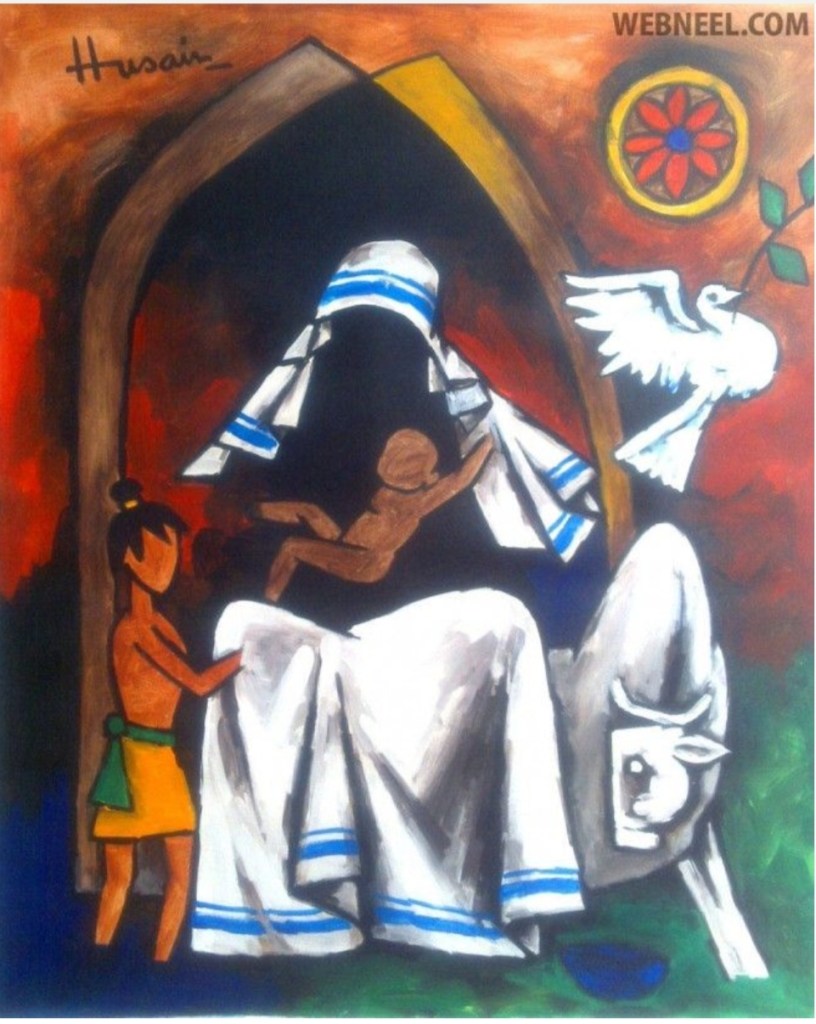
Mother Teresa–Goddess Of Peace by MF Husain. Photo provided by Prithvijeet Sinha

Art is often made out to be something unattainable, acquired strictly by virtue of good taste. To me that supposition has a very myopic idea of what actually constitutes art.

Art is spontaneous, sensual and immediately attractive to the naked eye simply because it is all around us in diverse forms, beginning with the canvas of nature.

From the first rays of sunlight to the final nocturnal lull of the moon, waxing and waning with our existence, a landscape is the first index of the omnipotent power of the hands that create. The stakes are just as natural when an influential figure who has provoked meaningful thoughts has her portrait occupy a space which we commit to our memory. Memory is to art, after all, what the intermingling of colours and shapes is to the structure of an artistic creation – even more than its form. Hence, beholding an artwork that inspires is a moment of personal reckoning with the feelings it evokes.

An artwork that has greatly impacted my artistic consciousness is ‘Mother Teresa–Goddess Of Peace’ by the indefatigable Maqbool Fida Husain. Mr. Husain is entrenched in the fabric of popular culture for his unmistakable, humbling style and use of colours eschewing any hint of beautification that sometimes becomes an accursed necessity in art.

His portrait of the benevolent social messiah is no different. Mother Teresa is someone who has graced his canvas in many iterations and the Goddess of Peace is one among the many he painted around the 1980s. As founder of Missionaries of Charity, Mother Teresa occupies a unique space in our cultural consciousness as we know it, caring for the neediest masses that society is quick to eliminate from the mainstream. That she was painted by another unassuming individual who was austerity personified made them equals. Mr. Hussain, on his part, dissociated his oeuvre from the elitist pretensions of galleries and terminologies of the ‘art world’, making art that touched hearts.

The artwork has Mother Teresa in the middle, in her trademark white sari with a blue border, faceless — an individual whose attire spelled a divorce from pretensions of the world. It is in perfect consonance with the painter who mostly walked bare feet and had not even a single iota of self-recognition about his position as an icon. He was an everyman. To him, it was a vocation but also a necessity to survive.

For others it is the 9 to 5 rule. For him, it was his art.

For Ms. Teresa too, it was personal duty that called for sacrifice of the ego. So, they were doing what they thought was essential in maintaining the order of who they were, in direct relation with an often imperfect world.

The central figure in the painting is surrounded by a young girl, a cow and a dove in flight holding olive tree leaves in its beak. The cow symbolises innate innocence and spiritual purity in concordance with the child while the bird signifies the efforts of people to uphold peace and effect constructive change, never shying away from the reality of poverty that millions endure.

The way her attire is spread out is as if she is holding the beleaguered world in her empathetic care (a baby in this case is on her lap) signals a last hope. She rises above the maternal role of primary caregiver alone. She is a universal figurehead, a genderless representative. That’s why her motives and actions translate so well through the brushstrokes of another. That’s the reason her faceless presence isn’t about fear but as a blank space meant to be filled with the image of any face that could set the same compassionate precedence as her.

Today, my evolution as a writer and poet owes its debts to that day when this artwork became wholly animated for me, creating a blueprint that continues to inspire and provoke thought. That’s the power of art– to create a space in memory and nudge us forward towards change, whether it’s a painter for the cause of artistic integrity and no monetary considerations, a messianic voice for the spiritual upliftment of the downtrodden or a writer preserving their collective legacies through his contemporary words.

The passion in these two people’s efforts to always strive in achieving integrity in service of the truth is soul-stirring. It is so easy to be swayed by conformity, even if it’s within the confines of an educated middle-class structure. The painting is a gateway to that natural state of mind which only creates and never jostles for accolades. I see that in myself.

Sincerity is a prized attribute which is often splayed wide open, to be attacked by a modern world where propagandas and muddled agendas defeat our simplicity of being. But people like Mother Teresa and Mr. Hussain show us the path where one walks the line, forging a map of individuality where materialism just cannot make a dent because the intent is to look at the truth of millions who cannot raise themselves from a cycle of grinding dispossession and exploitative tempers.

Art takes its imprints from the unvarnished truth. This artwork achieves that, illuminating all who dare to effect constructive actions and challenge conformity.

.

Prithvijeet Sinha has been prolifically publishing works of various hues in journals and magazines like   Cafe Dissensus, Confluence, The Medley, Borderless, Wilda Morris’ Poetry Blog, Screen Queens, Rhetorica Quarterly, Lothlorien, Chamber Magazine, Livewire  among others. He believes writing to be the true music of the soul.

.

PLEASE NOTE: ARTICLES CAN ONLY BE REPRODUCED IN OTHER SITES WITH DUE ACKNOWLEDGEMENT TO BORDERLESS JOURNAL. 

Click here to access the Borderless anthology, Monalisa No Longer Smiles

Categories
Poetry

Three Poems by Sanket Mhatre

Sanket Mhatre
THE FESTIVALS OF MIND 
We roister when a word bursts into a million atoms 
Each atom carrying the ink of thousand suns 
from one infinity to the next 
through blood streams 
We gyrate when we find the skin of our nuances 
melting into history’s conscious 
We revel secretly when the universe whispers a dark truth  
A firecracker erupting in our bones
For hours, we keep tying and untying tributaries of time
disentangling one soul from the next 
until we catch our dragonfly tailing past in alphabets 
tie them together with uneven hooks 
of kaanas and maatras, rhasvas and dirghas *
in a string of verses that light up against the evening sky 
Them blinking: a language of the unspoken
We gambol on discovering the lost sheets of an age
as we raise a toast to an empty labyrinth of chairs 
when a poem gets published, unexpectedly  
Like an accidental child or
a rocket dying a fragmented death 
by morphing into countless crackers that sends ripples
through the Prussian sky
We celebrate the festivals of our mind 
unknown to any calendar
uncharted by any astrologer
yet 

*different accents in Indian languages highlighting pronunciations


MATHEMATICS OF LUMINESCENCE
 
Light loses its equation on discovering the orifice
Yellow multiplies yellow, sprawls like an overnight rainforest
The amorphous supplicating the symmetry 
 
A beat erases from the history of her moment
Chest convulses under a string of lost screams
As if, an Atlantis was stolen overnight
-        She still doesn’t know the misery of her departure
 
Meanwhile, her face turns brighter
A wooden cottage caught in the web of sunlight
A chaparral waking up or -
a desert closing its eyes
while luminescence finds meaning
in its own circle
behind her

FEAR IS AN UNWANTED CHILD

Fear is... 
            ...a shooting star from the deep 
            ink of unwritten possibilities

            ...a nagging piece of bulb that 
            blinks in an unilluminated sky

Fear is...
           ...a faint smile of pink 
              on a weary face with broken 
              eyes that forgot to forgive

           ...a sneering bastard that 
          gesticulates at the flesh 
          of your heart even when it is dripping, tense 

Fear is...
          a gash on the skin of hope
          a glitch on the contours of time 

Fear is... 
            a poem written in the underbelly 
            of two thoughts in a bid to slay

before it rebirths 
an unwanted child 

Sanket Mhatre has been featured at Kala Ghoda Arts Festival, Jaipur Literature Festival and Glass House Poetry Festival. His first book of cross-translated poems, The Coordinates Of Us won the prestigious Raza Foundation Grant after been shortlisted at iWrite2020 at Jaipur Literature Festival. Sanket’s poems have appeared in multiple anthologies such as Shape Of A Poem, The Well Earned, Home Anthology by Brown Critique, Poetry Conclave Yearbook as well as literary magazines such as Punch, Borderless, Muse India, Madras Courier, The Usawa Literary Review, Men Matters Online, Anthology by Querencia Press and many others.   

PLEASE NOTE: ARTICLES CAN ONLY BE REPRODUCED IN OTHER SITES WITH DUE ACKNOWLEDGEMENT TO BORDERLESS JOURNAL

Click here to access the Borderless anthology, Monalisa No Longer Smiles
Categories
Poetry

Hands, Tentacles & Paws?

Poetry by Rhys Hughes

IF I SAW A MONKEY

If I saw a monkey
sailing on the sea
I might feel inclined to laugh –
but not with
     a tee hee hee.
It seems to me
that a ho ho ho
would better fit the rhythm
of the oars
     in his paws
     as he rows
     with his toes while the juice
     flows below
his banana canoe as he paddles
across the ocean
with a regular motion 
all the way to say
               hello to you.

Wait!
Do monkeys
actually have paws?


A FAN OF HANDS

I’m a fan of hands,
I am.
Tentacles
are all well and good
under the sea
and I don’t agree
that they never suit
the environmental mood
but when it’s time
for a cup of tea
on the beach, 
hands are handy
and although it’s sandy
we can reach
for the plate of biscuits
with more ease
and alacrity.
And when it’s too hot
there’s not
a lot we can do
to cool our brows
if we don’t have a fan
of hands.

Courtesy: Creative Commons

Rhys Hughes has lived in many countries. He graduated as an engineer but currently works as a tutor of mathematics. Since his first book was published in 1995 he has had fifty other books published and his work has been translated into ten languages.

.

PLEASE NOTE: ARTICLES CAN ONLY BE REPRODUCED IN OTHER SITES WITH DUE ACKNOWLEDGEMENT TO BORDERLESS JOURNAL

Categories
Excerpt

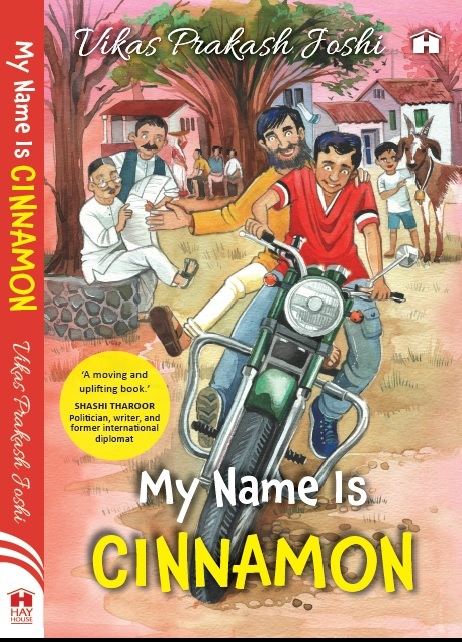
My Name is Cinnamon

Title: My Name is Cinnamon

Author: Vikas Prakash Joshi 

Publisher: Hay House

Krishna and Karna

It is Newton’s Fifth Law that when a teacher steps out of a primary school class for more than a decent period of time, somebody starts singing.

The 5th standard class at Diamond International School, Koregaon Park, was no exception to this eternal rule.

Cinnamon clutched the long stainless steel ruler like a mike in front of the class. The other twenty students noisily and tunelessly joined in as he belted out Lakdi ki kathi [1]at the top of his voice. It was a welcome break from the Environmental Science Class. Pallavi joined him as the female lead.

Just as the horse was bolting, EVS Ma’am, Mrs. Arora, came back into the classroom.

“Settle down, horses! Roshan and Palli, take your seats,” she said. The class went back to the lesson.

When the class ended, students started filing out noisily.

“Roshan.”

“Yes Ma’am?”

“Where do you stay?”

“Koregaon Park, Ma’am.”

“Wah. You like singing?”

“Ummm…love singing.”

“I am sure even Gulzar in Mumbai would have heard you singing his lyrics.”

“Really, Ma’am?”

Haanji[2].”

He blushed and looked down at the ground. It was the first time someone had paid him such a big compliment. He didn’t quite know how to react.

“Thank you, Ma’am.”

“How did you get the nickname, Cinnamon? Everyone calls you that.”

“My parents love to add cinnamon to everything. In tea, cakes, pastries and rolls…in everything. I couldn’t pronounce the word Cinnamon… so I called it Cimmanum or Cinnamum or even Cimmamom. So, they dubbed me ‘Cinnamon’.” He frowned. “I don’t like my nickname anymore. I want to change it.”

“Do they like music?”

“No ma’am. They don’t like music…uh…I mean they do like it. But not…er…this kind.” He tried to show with hand gestures what kind he meant.

She gave a knowing smile.  

 “It’s only me. I don’t know, Ma’am. Maybe my tummy-mummy liked this kind of music.”

“Your tummy mummy?”

“Yes. I am adopted.”

Mrs. Arora fiddled with her dangling silver earrings. After smiling a little too long, she said,

“Ok, wonderful, Roshan. Keep it up. You can go now.”

Baba and Maa had never hid from Cinnamon, or anyone else, that he was adopted. It was as much an accepted part of his life as his alert brown eyes and long, muscular legs.

When he was about two years old, Maa sat him down and told him a beautiful story. She read to him from a slim Bengali book. Cinnamon sat in front of her, curled up on the bed. Baba sat next to her. She told him about the ancient city of Mathura, near Delhi, where Vasudev and Devaki had eight children. 

Reading out the story with dramatic voice variations and hand movements, Maa said, “The eighth child was Krishna. When Krishna was born, there was heavy rain. Vasudev took the baby in a wicker basket to the house of Nanda. He placed him with Nanda, a cowherd, for his protection. Lord Krishna grew up with his adoptive parents.”

Baba then told a story in Marathi, in a silky smooth voice. In the story, a charioteer finds a baby in a basket floating in a river. The charioteer and his wife, Adirath and Radha, do not have children of their own. “Little did they know that the boy was the son of princess Kunti and Surya Dev. They named him Karna. He grew up to be a brave and fearless warrior.”

“So, you see, Cinnamon, some children come home in some ways and others in other ways, but every one of them is equally special,” Maa concluded.

Baba said, “When we went to the adoption agency, they said that the boy looks different from you. But that didn’t matter to us.”

When he was four, Baba and Maa took him to the hospital he was born in, in the congested and heaving Kusalkar Road area of Pune. They also took him to the adoption centre, near one of Pune’s biggest hospitals, when he was five, and again when he was six.

Baba told him the story of the day they adopted him. “Cinnamon, the day we went to bring you home, was the most memorable day of my life. It was not only your Maa and me who went to the adoption centre. Ajji, Ajoba, Dada Moshay and Didi Maa also came along. I finally understood what it was like to be the captain of the Indian cricket team. We had only the Maruti Zen at that time, so we arranged two auto rickshaws additionally to take everyone.”

He continued, eyes twinkling. “It rained the previous night and early that morning as well and we felt it to be a good omen. Later, we organised a get-together at a small mangal karyalaya[3] for all the people, on your homecoming day. So many people came home, that we had to finally shift it to a much bigger hall nearby.”

 Cinnamon asked to hear this several times, and each time Baba added extra details. It was like one of those stories that you never got tired of hearing.

As he grew older, he sometimes stared into the mirror in the bathroom, trying to imagine what his father and mother must have looked like. Did his swarthy skin, impressive height and sharp nose and cheekbones come from his father? Did he get his loud laughter and voice from his mother? Where did they live and what did they do?  When he travelled anywhere, he looked around at people, wondering whether any one of them was his father or mother.

Baba and Maa always supported him and let everyone know that he was adopted, so he had no sense of shame or embarrassment. He saw it as a very natural part of his identity.

On one occasion, when he was about six years old, he asked Baba, “Baba, if my birth mother were to come and ask to take me back, what would you do?”

“We don’t know where she is and she doesn’t know where we are either. So that can’t happen. Moreover, we love you and we won’t let you go ever.”

Later, when he was around seven, he had more questions.

He asked his parents, “What did my birth father and mother look like? Are they tall like me?”

“We don’t know, Cinnamon,” they said patiently.

 “How come?”

“We have never met them.”

“Why did they leave me? How could they do that?” He cried out.

Baba and Maa hugged him tightly and kissed him. “Was there something wrong with me?” he persisted.

“They didn’t give you up. There was, and is, nothing wrong with you. Your birth parents must have had some very good reasons, that is why they had to take the decision they did.”

But somewhere it remained in his mind. “Why did they let him go…,” Cinnamon wondered?

On the first floor of their building lived Nivedita Tai and Yatin Dada. They were regulars at the jogging track with Baba. They often came back home together, drenched in sweat, with Yatin and Nivedita always laughing, and Baba recounting some story or the other.

One day, at the breakfast table, Maa told Baba with a smile, “You know, Nivedita is expecting.”

Baba chuckled. “Well, that was quick,” he said.

Cinnamon didn’t know what Nivedita was expecting but he did see Nivedita Tai’s otherwise flat stomach grow and grow with no end in sight. It troubled him but nobody was bothered about it. On the contrary, they all seemed very happy. They even patted her on the stomach. 

He asked Maa, “Maa, what’s happening to Nivedita Tai? Why doesn’t she do something? She will burst open!”

“Khoka, she will do something soon.”

Then, one day, Nivedita Tai suddenly disappeared and so did Yatin Dada. Their flat was locked.

After a week, the doorbell rang. It was Yatin with a box of golden kesari pedhas[4] in his hands. He was beaming as if he had won on Kaun Banega Crorepati[5]or become the Prime Minister of India.

Maa came up to the door. “Oho! Congratulations!” exclaimed Maa, and hugged him. Baba reached out and hugged him too.

“What is her name?”

“Anvee.”

“Beautiful name. Welcome to the club, sir. Congratulations,” Baba said in Marathi.

Cinnamon didn’t completely understand why Baba was congratulating Yatinif Anvee had come out of Nivedita Tai’s tummy. “What did he have to do with it?” Cinnamon wondered.

On many Sunday evenings, his mother invariably gave a head massage to Cinnamon, with mustard oil. Baba had tried to get her to switch to coconut oil, but to no avail. Though Cinnamon hated the smell, he always loved the warm and fuzzy sensation it left when she finished her massage.  

He sat on a newspaper on the floor, while she vigorously pummelled and pounded his head.

“Head massage is good for blood flow and intelligence, you know,” she declared. “Your Dadu and Didima gave us regular head massages and castor oil, when we were growing up. That’s why we turned out so well, I say. It’s a must actually, for all children.”

Cinnamon knew where this conversation was going, so he decided to divert it.

“Maa, I have a question,” he asked.

“Yes.”

“Anvee came out of Nivedita Tai’s tummy?”

“Of course, baby.”

“So you and Baba also came out of Didima and Ajji’s tummies? And others too?”

“Yes, even we did,” she reassured.  

“But I didn’t come out of here?” He turned to touch Maa’s tummy. “I wasn’t in here?”

 “Not from my tummy. You were in my mind,” she said in Bengali, quoting Tagore.

“Whose stomach did I come from?”                   

“Your birth mother’s.”

He looked at his own tummy and imagined a baby inside. He imagined himself inside a tummy, arms and legs and all. What an ugly sight it must have been.

“Maa, it must be so painful,” Cinnamon cried out.

“Yes, it is painful at that time but then once the baby is born, the pain goes.”

“Don’t you think that shows how nice I am? I came without causing you any trouble.”  Maa cupped his chin and laughed.

Then she carried on with the head massage, humming to herself.

[1] A popular hindi film song

[2] Yes.

[3] Wedding

[4] Sweets

[5] A game show that translates to ‘Who will be a Millionaire’

About the book:

Both a captivating chronicle and an endeavour of remarkable depth and ambition, My Name Is Cinnamon provides a richly textured narrative of a boy trying to find his roots and place in the world. On each part of his journey, he encounters new people, new cuisines, and new adventures as he learns a lot about himself and the world around him.

While being a light-hearted and heart-warming read, the book also covers some difficult themes that are rarely explored in ­children’s and young adult literature. It is a deeply moving testament to the unceasing desire to know oneself, the unrelenting pull of familial bonds, and the power of hope, sacrifice, and love.

With his perceptive observations, vivid descriptions, and an authentic voice, the author, Vikas Prakash Joshi, weaves an immersive plot with fully realised environments and characters that are sure to stay with you for a long time. Above all, My Name Is Cinnamon is about finding your own people and accepting who you are.

About the Author:

Vikas Prakash Joshi is a writer by nature and nurture and not by compulsion, ambition, or conscious choice. His writing career started at the early age of eleven and since then, he has won numerous awards and achieved notable distinctions. He has written for leading Indian publications like The Caravan, Hindustan Times, The Wire, The Hindu, DNA, Sakal Times. His essays, articles, and short stories have been translated and published in 31 languages, both Indian and foreign, and in publications in 25 countries. His first book My Name is Cinnamon,was recently awarded the A3 Foundation literary prize 2023 by India-based A3 Foundation.

PLEASE NOTE: ARTICLES CAN ONLY BE REPRODUCED IN OTHER SITES WITH DUE ACKNOWLEDGEMENT TO BORDERLESS JOURNAL. 

Click here to access the Borderless anthology, Monalisa No Longer Smiles

Categories
Review

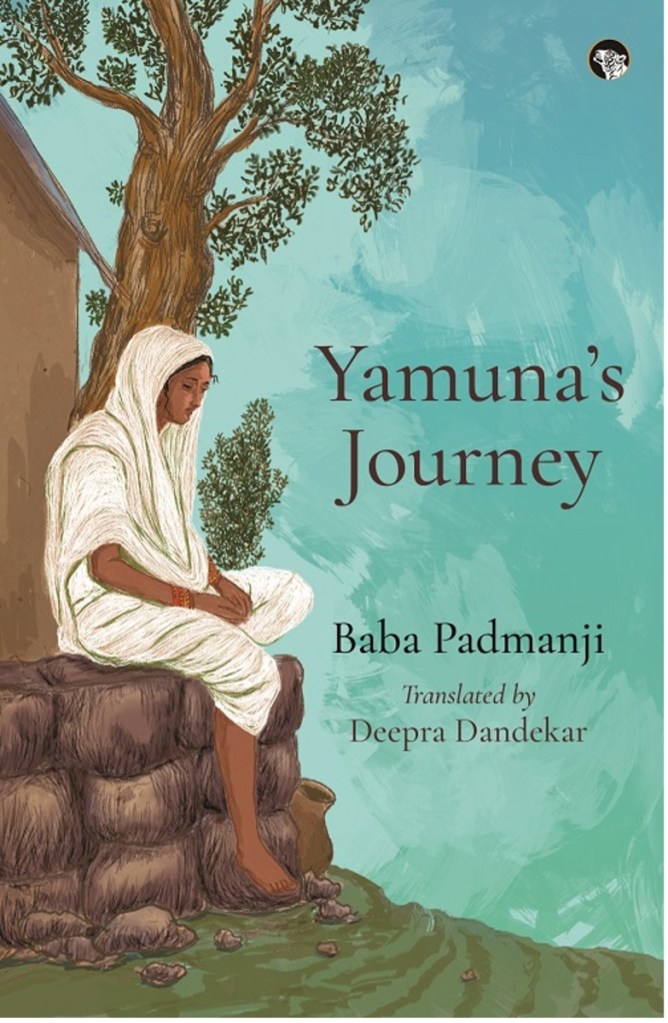
Yamuna’s Journey

Book Review by Somdatta Mandal

Title: Yamuna’s Journey

Author: Baba Padmanji, Translator: Deepra Dandekar

Publisher: Speaking Tiger Books

During the nineteenth century, among the various social concerns that plagued Indian society, three issues were greatly significant — the abolition of sati, or the burning of the widow on the pyre of her dead husband, the passing of the widow-remarriage bill by the British-Indian Parliament in 1856 augmented by the activism of reformers like Pandit Ishwar Chandra Vidyasagar, and of course the attempts at conversion to Christianity of people plagued, tortured and humiliated by the rigid strictures of class hierarchy and torture and humiliation imposed by Brahminical society during that period.

Baba Padmanji’s 1857 Marathi novel, Yamunaparyatan (translated as Yamuna’s Journey), is the first vernacular novel in India meant to provide a realistic account of the travails suffered by Hindu widows in Bombay Presidency region in particular and India in general and is based on empirical facts. It highlights the suffering of Hindu widows, forced into a life of loneliness and torture by their cruel Brahminical families. The heroine of the novel, Yamuna, starts off as a happily married woman, sharing a bond of mutual trust and respect with her husband. She travels with him across various regions of the Bombay Presidency and Western India and her interactions with widows on the way reveal the extent of their suffering within Hindu patriarchal and Brahminical society. Yamuna sympathises with them and calls for urgent reform, while advocating for widow remarriage.

Based on empirical research, and its main storyline composed of empirical anecdotes which were woven together in a single narrative, Yamunaparyatan was only written in the form of a novel. From the very beginning it was never meant to be a poetic, aesthetic book, and was always meant to be hard-hitting, and a realistic treatise. Deeply influenced by Rev. Surendra Nath Banerjea and his writings on women’s education and emancipation, Padmanji described the piteous situation of those young girls who were married off hastily as children to men decades older than themselves. Squeezed between marital duties, childbirth, and heavy domestic work, young girls became victims of their marital families. After their husbands died, they were subjected to further torture – tonsure, inadequate food and clothing, ill-treatment, a heavier than ever workload, and no creature comforts whatsoever. Padmanji argued that women within Brahminical families were constantly on the brink of abandonment and destitution, suffering deeply from the fear of becoming outcasts, even before they became widows.

When tragedy strikes and Yamuna is widowed, she too is tortured and stigmatised. But the feisty young woman manages to start a new chapter in life by converting to Christianity and remarrying a Christian man. In the last chapter of the novel, we are told how Yamuna-bai’s grief diminished gradually as she found solace in religion:

“After some time, God introduced her to an educated and religious young man, who became a loving and caring husband to her. With time, Yamuna dedicated herself to her new life companion and the couple thereafter spent the rest of their years in happiness, helping others and praising God.”

As mentioned earlier, Baba Padmanji was fiercely critical of the stigma accorded to widows within Brahmanical Hinduism and fought against it tooth and nail. In fact, one of the most enduring legacies of Yamunaparyatan is its portrayal of equal, romantic, conjugal partnerships, depicted between spouses of the same age, who shared religious, intellectual, emotional and moral proclivities and insights; spouses who were constantly in conversation and discussion with each other. Yamuna was not her husband’s junior, and their relationship constituted an ideal example of conjugal marital relationships for young, educated and reformed readers. This equality between spouses was something unimaginable in Hindu society of the time and one of Padmanji’s greatest anxieties was concerned with the hesitation of the educated and the reformed youth in taking the step to remarry widows. In fact, one of the book’s junior protagonists even outlines an evolved idea of running an organised, crowd funded, social movement in favour of widow remarriage. Padmanji even articulated the promise of happiness that reformed marriages held out for couples who could live together with social awareness, even if the women were widowed.

Apart from the proselytising mission by Baba Padmanji who himself converted to Christianity a few years earlier and thought it his duty to preach about its merits, especially the way women were respected in that religion, the novel is rather weak in structure. For instance, the last chapter begins in the following manner:

“The time has come for us to end the story and for our readers to finally know what the future held for Yamuna, Shivram, and his mother as the seeds of divine scripture sown in their hearts came to fruition.”

Labelled as the first of its kind in Indian literature, the novel’s weaknesses can of course be overlooked. It is true that the novel form in India was in its nascent stage at the time of composition of this text. The first vernacular novel in India was Fulmoni O Korunar Bibaran ( Fulmoni’s and Karuna’s Account) by Hanna Catherine Mullens published by the Calcutta Christian Tract and Book Society in 1852 and this Bengali book had its aim clearly mentioned in the subtitle –“Written for the purpose of educating women.” But since the author was not Indian by birth, the credit for being the first Indian author to pen a novel remains with Padmanji. It was about a decade later that writers like Bankim Chandra Chatterjee would gradually popularise the genre.  

What makes Yamuna’s Journey special even today is the bold feminist ideas expressed in the novel, and though it was published more than a hundred and fifty years earlier, one still feels the currency of the feminist issues that Padmanji had raised. When we read about the deplorable condition of Hindu widows in religious places like Varanasi and Vrindaban even today, we realise that the vice has not been eradicated from Hindu society even in this twenty-first century.  Not focusing particularly on the plight of lower-caste Hindus, Padmanji instead criticised middle-class Hindus (like the goldsmith caste, or Prabhus) for ritually aligning with Brahmins. The solution for him thus lay, not in focusing on lower-caste emancipation, but in strongly divesting Brahmins and Brahminism of demographic support, singling them out, and subjecting them to legal measures, social activism, and compulsory re-education. If Hindu society was bent on self-destruction by eliminating its women, then Padmanji felt that they had no right to be offended if these same women converted and lived respectful lives thereafter, as part of the Christian community that accorded them equality and dignity. Thus, reading the translation of this Marathi text, despite its proselytising tone and weak narrative structure, one still feels it to be rather significant.

Deepra Dandekar has done yeoman service by translating this vernacular Marathi text into English for a pan-Indian readership. In the note for the readers, she tells us how readability in the 21st century becomes the primary concern for her translation. Though she has kept Padmanji’s arguments intact, she has in other places paraphrased and desisted from providing verbatim translations, especially when Padmanji quotes Sanskrit passages or older Marathi religious texts. Since these verbatim translations do not add special meaning to the storyline, she has simplified the text in places, though she has also striven not to render it too simplistic. Dandekar also admits that in keeping with Padmanji’s aim of writing a fledgling romantic novel, she has desisted from making the text too academic. By avoiding footnotes, she has provided a glossary in the end that explains the meaning of vernacular words in context. So, Yamuna’s Journey is recommended for readers of all categories – those who want to study it as the first vernacular novel in India; those who want to know more about the larger debates concerning widow remarriage in the years 1856 and 1857; and those who want to read it as a feminist text propagating the drawbacks of Hindu contemporary society with its rigid class structures and embracing Christianity as a remedy to all social evils of the time.

.

Somdatta Mandal, critic and translator, is a Former Professor of English at Visva-Bharati, Santiniketan, India.

PLEASE NOTE: ARTICLES CAN ONLY BE REPRODUCED IN OTHER SITES WITH DUE ACKNOWLEDGEMENT TO BORDERLESS JOURNAL

Click here to access the Borderless anthology, Monalisa No Longer Smiles

Categories
Poetry

Kurigram

By Masud Khan: Translated from Bangla by Professor Fakrul Alam

Courtesy: Creative Commons
I’ve never been to Kurigram.

In the dead of night, sleeping Kurigram steadily detaches itself 
From the world that we know.
Ignores gravity completely 
Taking off with its tiny kingdom 
To some far-off galaxy.

We keep looking then at the deep blue of the sky 
While the tiny village becomes a speck up high.

For a long while Kurigram floats from one dome of heaven to another.
Till that star in the southern sky that pursued it so single-mindedly 
Settles by its side and claims it as its own.
Then from this new luminary
A mild red vaporous smell wafts across the sky.

In that realm, in Kurigram,
The Kingfisher and the Pankouri bird are stepbrothers. 
When all the rivers of Kurigram become calm
The two brothers make the river their home 
Squabbling with each other like families bickering!

When the river calms down again
The womenfolk, once bound by scriptural edicts, 
Throng to the riverbank.
Breaking all barriers,
They sparkle like large resplendent crystals.
 
Suddenly, a lonely babui bird, sans weaving skills, 
Perched on a battered old mast, starts swinging,
Finally settling down on the translucent steel-foiled river water. 
Kurigram, ah Kurigram!

Where Kurigram used to be
Is a dark and solitary space now.

Alas, I’ve never been to Kurigram
And I don’t think I ever will!

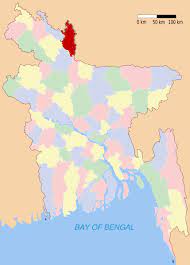
Kurigram—An innocuous town located in the northern region of Bangladesh
Paankouri—A species of bird, black in colour, found in marshes and rivers
Babui—A species of weaving bird
Kurigram is marked in red. Courtesy: Creative Commons

Masud Khan (b. 1959) is a Bengali poet and writer. He has, authored nine volumes of poetry and three volumes of prose and fiction. His poems and fictions (in translation) have appeared in journals including Asiatic, Contemporary Literary Horizon, Six Seasons Review, Kaurab, 3c World Fiction, Ragazine.cc, Nebo: A literary Journal, Last Bench, Urhalpul, Tower Journal, Muse Poetry, Word Machine, and anthologies including Language for a New Century: Contemporary Poetry from the Middle East, Asia, and Beyond (W.W. Norton & Co., NY/London); Contemporary Literary Horizon Anthology,Bucharest; Intercontinental Anthology of Poetry on Universal Peace (Global Fraternity of Poets); and Padma Meghna Jamuna: Modern Poetry from Bangladesh(Foundation of SAARC Writers and Literature, New Delhi). Two volumes of his poems have been published as translations, Poems of Masud Khan(English), Antivirus Publications, UK, and Carnival Time and Other Poems (English and Spanish), Bibliotheca Universalis, Romania.  Born and brought up in Bangladesh, Masud Khan lives in Canada and teaches at a college in Toronto.

Fakrul Alam is an academic, translator and writer from Bangladesh. He has translated works of Jibonananda Das and Rabindranath Tagore into English and is the recipient of Bangla Academy Literary Award (2012) for translation and SAARC Literary Award (2012).

PLEASE NOTE: ARTICLES CAN ONLY BE REPRODUCED IN OTHER SITES WITH DUE ACKNOWLEDGEMENT TO BORDERLESS JOURNAL

Click here to access the Borderless anthology, Monalisa No Longer Smiles
Categories
Poetry

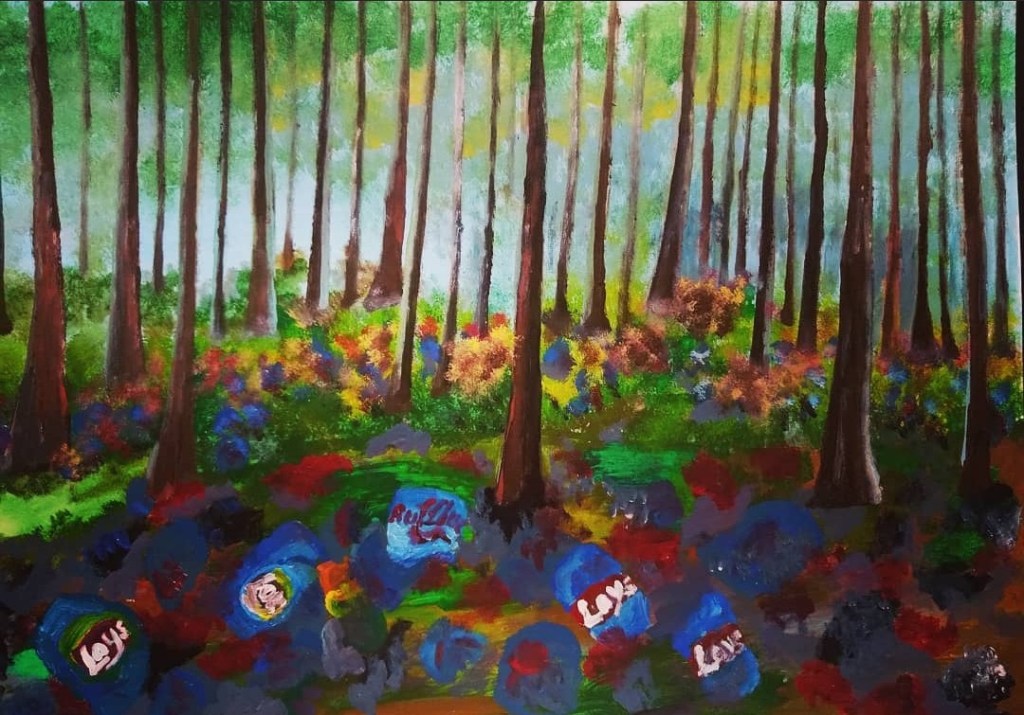
I sing the body plastic by Kirpal Singh 

Painting by Gita Viswanath
Yes, electric is gone, now it’s plastic—
From sex to food to procreation
Plastic rules the day and rues our time
Making it all easy and oh so convenient! 

All is plastic save, possibly, the brain;
This mass of nerves and neurons
Mirrors the bewilderment outside
Where people die and kill and cry

Where O where is the human 
We crave for meaninglessly?
In the dust bins of our hearts 
Mangled and confused, dying.

Save us O Lord, save us. Save. 

Kirpal Singh is a poet and a literary critic from Singapore. An internationally recognised scholar,  Singh has won research awards and grants from local and foreign universities. He was one of the founding members of the Centre for Research in New Literatures, Flinders University, Australia in 1977; the first Asian director for the Commonwealth Writers’ Prize in 1993 and 1994, and chairman of the Singapore Writers’ Festival in the 1990s. He retired the Director of the Wee Kim Wee Centre.

PLEASE NOTE: ARTICLES CAN ONLY BE REPRODUCED IN OTHER SITES WITH DUE ACKNOWLEDGEMENT TO BORDERLESS JOURNAL

Click here to access the Borderless anthology, Monalisa No Longer Smiles
Categories
Stories

Busun

By A Jessie Michael

Temiar people. Courtesy: Creative Commons

I am Busun, born in one world and living in two.

Excitement crawls like insects in my veins and explodes. My friends and I are distracted and hyperactive, packing meagre clothes into haversacks and scheming haphazardly about what we will do during the holidays.

The smells of the forest hit my senses as soon as our convoy of three 4WD SUVs leaves the highway and veers into a small tarred road which quickly morphs into a muddy track. These are odours we grew up with and missed so much – of earth, trees, vegetation, water, dankness, raw animal smells. My lungs expel the city smog and I breathe easier. The canopy rising from either side of the track and meeting over it cocoons us in its green coolness.

Once a year we change worlds and this other world draws us magnetically away from where we spend ten months a year — in a Christian hostel on the outskirts of the city, from where we are ferried to a government school to learn English, Malay, Geography, History, science and Maths. The towns near our Orang Asli community have no residential facilities, so when our elders heard the pastor offering to house and school the children for free, they thought it was a good opportunity for us to learn of the outside world. We get school every weekday, three meals daily, a structured life of learning and a regular input of Bible study. For two months a year we return to our Orang Asli community in the jungle. We call ourselves Temiar, foreigners call us aborigines, the government calls us Orang Asli and rude people call us sakai[1].

The ride becomes bumpy and suddenly it is bright and the green is gone. The heat hits us hard and the air is smoggy brown. Tree stumps stick out on a vast field of red on either side. Last year there was thick jungle here. Now the trees are gone. Our drivers try avoiding the deep wet ruts left by weighty lorries and trucks. Four times our vehicles sink in turn into the muddy tracks. We spend an hour each time maneuvering the vehicles out of the churning mud. There are streams to cross in the upper reaches where the tracks will virtually disappear. Then hopefully it will be jungle again.

Seven hours after setting out, we roll into an opening in deep jungle with a cluster of bamboo shacks. We ecstatically leap out whooping and racing like puppies let loose. Our parents and elders stand around grinning; they are not a demonstrative tribe. A look of gratitude and a laden table is plenty enough.

Our volunteer drivers and chaperons are ushered to the rickety bamboo table piled with food especially prepared for them and for us — yam and rice rolled in leaves and roasted in bamboo, a variety of boiled herbs and greens, roasted wild boar meat and venison — a rare feast for an auspicious day. Everyone digs in with fingers. We eat greedily, having missed this basic diet for months. The food reorients me. The empty vehicles leave soon after in order to exit the jungle before dark.

As we mingle with friends, I notice my father observing me closely. I am surprised to see that I have grown a head taller than him. He approaches me that evening before the night ceremonies begin.

“Busun,” he calls. “How is school?”

He spoke in our Temiar dialect and I quickly swing back into this mode of abrupt, brief speech.

“I don’t understand school….”

“Meaning….?

“The things we learn…. we can’t use.”

“What do you learn?”

“About past events in places we don’t know…. about cities and countries we never see…. they even tell us about the jungle….but they don’t know the jungle….I know the jungle. They can’t climb trees….no trees to climb, can’t kill animals or use a blowpipe….”

“The house?”

“Nice, clean. There is electricity but we can’t use much. It is expensive. A lot of food but not our food……I don’t like it much.”

“You don’t like the city? …. not happy?”

“No. They change us…”

“How?”

“We cannot speak Temiar in school…. must speak English and Malay. The other children laugh at us…. they call us ‘sakai” …. They don’t know us. In school they talk of Islam…. At hostel …. they teach about Jesus Christ….no meaning. How are the fruit orchards?”

“The rains have been unseasonal,” my father complains. “The fruit blossoms have been blown down in the storms. The fruit season will be poor this year.”

Juicy pulasan, langsat, medicinal petai and jering and wild long thorned durians are our specialty. Our people foray out in season to sell these to locals for a pittance, who in turn make a hefty profit in market towns further away.

My father speaks to me differently than before. Perhaps he sees I have grown up and that I see things as my elders do. How will the children survive in the jungle? The other children and I have lost muscle and gained more flab. Bigger, fatter is a disadvantage in the jungle which needs agile skills. We have to relearn our forest skills every time we return from school.  We forget much or rather our bodies forget.

At sundown the traditional cleansing ceremony begins. We shed our city clothes and don our minimal traditional woven bark garbs and headgear of bamboo leaves and feathers. Wooden and bamboo musical instruments are taken off the walls. The Halaa or medium arrives to lead the community in removing any malevolent spirit and influences that may have followed us children from the city to upset the balance of our lives with the jungle spirits. Accompanied by crude drum, zephyrs, flutes, rattles and poles keeping beat against each other. The community in chorus echoes the chants of the Halaa as he sings and dances himself into a trance as he performs to our polyphonically sung music — melodies that live under our skin, and that we subconsciously draw out. The cleansing over, the musicians, especially the young ones continue long into the night reproducing magical sounds of birdsong, crickets chirping and animal calls, water flowing, wind whistling.

I fall asleep under the stars feeling strange – sans walls, windows, doors and pillows. The symphony of the sounds of the night sing loud in my ears – insects whirring, frogs in a croaking chorus, animal howls and grunts — so different from the roar of vehicles on the city highway. I strain to identify separately these almost foreign sounds. Still, I awake refreshed, the unfamiliarity gone. I am one with the elements again, dew on my face, dappled light overhead casting shadows that dance on my skin.

I make my way to the river ten minutes away. My unpracticed bare feet stumbling over huge tree roots, vines, thicket and bamboo and slipping on slopes and ledges where once I romped like a deer. The younger children are already there, cutting through the water like little otters. They have not swum for ten months. However, my anticipated pleasure is short lived. The once pristine waters of the river now runs red — bleeding.

I return from the river a little while later to find all the village men gathered at the open area, with machetes and poles.

“We are going to Doso’s village,” my father announces to me.

I ask one of the other young men, “What’s happening?”

“Loggers. Trying to go through Doso’s village. They are cutting the jungle upriver. Already begun. And the loose earth is already clogging the river. The water is dirty. Doso’s village is short of food. The animals are moving out or dying. The loggers want the village to move. There is nowhere to go anymore. We help them and some people from outside are helping us to stop the loggers. From upriver the loggers will move down to our village. We too have nowhere to go…”

I listen in silence. Inside confusion stirs. As we walk to Doso’s village, I recall the vast red field with tree stumps on the way home yesterday. I had not even thought of the dangers it posed. Where will animals and birds go if there is no jungle? Where would I go? Whenever I am home I become one with the jungle. There are no timetables, deadlines, learning of unpragmatic knowledge, no competitions, exams or pride from dubious achievements. Here we all flow with the pulse of nature, living off its bosom and never yearning for more.

Emerging from the trees with the men and some women, we come upon a broad track denuded of trees. The blazing sun and the breeze raise a haze of red dust. Our people have constructed a crude barricade of logs to stop the trailers and tractors from driving further in.

We have hardly ever had confrontations. Violence is alien to us; passive resistance is our way. Even the assumed weapons we carry is to rebuild the stockade which has been bulldozed several times by the loggers. Yet here we are walking straight into a conflict. I hear a rare anger in my father’s voice. He speaks more than I have ever heard him speak before.

 “We have been here forever with the spirits of our ancestors….Now the government says we do not own the land because we have no ownership papers. How can we have ownership papers when we always move our village when someone dies or we need more space? If they take the jungle, we die. It is beyond our understanding… it is beyond their understanding. No one owns anything. We only live, one with the earth, sky, water, animals and plants. We get food, medicine and life here. It is enough.”

Suddenly I remember that yesterday after lunch I had climbed to the mountain top and seen large swathes of red, like blood, and small patches of green. I had not thought about it then but now realise that the skin of the earth was peeled off, showing flesh. The spirits of the trees and stones were homeless.

Today we all squat in the shade of the jungle fringe till we see a convoy of vehicle arriving — visitors from the authorities. That usually means officers from the department of Orang Asli and the Forest Department. Following the vehicles are young men on motorcycles. I recognise them as teenagers who have been lured out of the jungle into settlements prepared especially for them.

A few individuals standing away from the officials approach us and begin to speak in Malay. Those Orang Asli who can understand Malay translate for the others. I too join to translate what is said as I speak fluent Malay and Temiar.

“We support you; some of us are lawyers and we all fight for people’s rights. We will fight for you in court to stop the logging and allow you to stay here.”

Men with cameras move around taking photographs of the stockade and of the other Orang Asli who stand back passively.

The group of officials gather in front of the stockade and one man bellows out through a megaphone in Malay. His voice goes far and wide into the trees. After every few sentences one of the motorcycle riding boys in jeans and smart batik shirts translates the sentences into Temiar.

In essence I gather that we the Orang Asli are in the wrong place. The government has allocated certain areas in the forest reserves where we are allowed to live. The area where we live now is allocated for logging. The loggers have licenses. If we refuse to move, we can be arrested.

The friends of the Orang Asli shout through their own megaphone, “This is a forest reserve. NO logging allowed, NO chasing out Orang Asli.”

The other speaker ignores the protest and continues that these allocated areas are on the edge of the forest near the towns; we will have access to electricity, water, work and education for the children. There are hospitals nearby and mosques; even homes will be built for us. “Look at your friends,” he gestures to the bike boys. “They wear nice clothes and ride motorbikes.”

It is obvious that these people not only want the jungle but also want to change us to be like them — not to be as we really are. The changes have been subtle over time. In previous years, our nakedness had been a problem; our bare breasted women and loinclothed men have been yelled at, called sakai and hounded back into the jungle when they ventured out to sell rattan, seasonal fruits and wild honey or trade them for rice or tools. Now we wear donated clothes and frocks to appease the outsiders. It is the same as going to the far away school where for ten months I become someone else. What will I be after I completely change? A motorbike lay-about boy doing odd jobs for a meal? The motorbikes and their appearance for the day is part of the theater of change.

I hear the man’s voice rise. “Now let us know if you accept this offer.”

My people mutely shake their heads while our supporters shout, “NO! These people were not consulted. We go to court.”

“We are consulting them now. Move away from the barrier,” orders the official.

We do not move away. We close ranks and hope we look pretty menacing with our poles and machetes.

The official gives three more warnings and then there is chaos. Some plainclothes men rush forward. We hear the word police, and most of my people melt into the trees. However, a young man Anjam and I are handcuffed as we are speaking to our supporters. We do not resist and are dragged into a truck while our supporters argue loudly with the police. When this happens, the villagers reappear in alarm. Some outsiders are already breaking the stockade but the lawyers and our supporters pack as many of the Temiar villagers into their own vehicles and follow the truck right to the police station an hour away.

My head is in a whirl. What did we do wrong? A policeman herds Anjam and me into the police station while the others are barred entry. However, a lawyer among them insists on entering with us. We are questioned by a police officer and I answer him in Malay, giving him my name, age and school. I also answer on behalf of Anjam who only speaks Temiar. The officer seems taken aback and his aggressive tone diminishes. He orders that we be put in the only empty cell for the night until the District Police officer shows up the following day.

The next noon we hear an outburst of voices in the compound of the station. I gather from fragments of speech that the District Police Officer has arrived. The activists and the lawyer are protesting to him to release us at least on bail. He agrees and I soon see why. As we exit the station, we see half the village squatting all over the police compound together with our supporters, keeping vigil till our release. I am grateful they have stayed to give us strength. If he does not release us, my people will not budge. Even the ones rehomed into the new settlements behave similarly. When any of them is hospitalised, the whole village follows and sits around the wards or grounds, attempting to feed the patient jungle herbs. The police send all of us  prisoners and families back as far as the stockade in a jeep. The stockade has been rammed to the ground.

Two days later Anjam is very ill. Several Halaas perform all-day and all-night trance rituals searching for Anjam’s missing soul but on the third day Anjam is dead. The elders blame it on exposure to outside malevolence but I remember how when we are in the cell Anjam needs to pee. A policeman takes  him out but the boy comes back a while later bent double and speechless. In the morning he seems alright but fades into unconsciousness at home. When they bathe his body for burial, the blue bruises and swelling on his middle back are obvious.

The day of the funeral the sky weeps in torrents, drowning out the chants of the Halaa and the keening of the villagers. The grave is already dug on the other side of the river and as we mourners cross via the huge log that bridges the banks, the roiling river, tumbling and rolling wildly, threatens to drown us. We have no way of turning back when the omnipresent Thunder Spirit explodes in anger and releases the mountain to swallow us, making us one with the cosmos, with the earth and keeping us home.

What’s left is upended trees, boulders and mud — a movement of the mountain in apocalyptic proportions spreading at least a kilometer in radius. Giant roots reach for the sky and treetops lay buried — a new unmapped terrain of an unmappable people.


[1] Sakai: slang, offensive, ethnic slur, used for an Orang Asli or native people.

A. Jessie Michael is a retired Associate Professor of English from Malaysia. She has written short stories for online journals, local magazines and newspapers. She has published an anthology of short stories Snapshots, with two other writers and most recently her own anthology The Madman and Other Stories (2016).

PLEASE NOTE: ARTICLES CAN ONLY BE REPRODUCED IN OTHER SITES WITH DUE ACKNOWLEDGEMENT TO BORDERLESS JOURNAL

Click here to access the Borderless anthology, Monalisa No Longer Smiles

Categories
Notes from Japan

Multicultural Curry

Courtesy: Creative Commons

By Suzanne Kamata

When my son brought home a memo from school calling for families to host students from Australia, I hesitated to sign up. During college, I’d done a homestay in Avignon, because I was hoping to improve my foreign language skills and experience authentic French family life. Likewise, the visiting students were probably eager to immerse themselves in Japanese culture.

Our family, however, is hardly typical. First, there are the obvious differences. I’m an American, and my husband is Japanese, a relatively unusual combination in Japan. And although I’ve encountered more male nursery school teachers here than in my native country, household duties in Japan tend to be divided according to gender. I was reminded of this when, after my daughter told her teacher about the delicious risotto her father had prepared the night before, she was corrected: “You mean your mother made it.”

I worried about food, too. As an exchange student, I was eager to indulge in the pates, breads and cheeses that were famous in France. A visitor to our house, however, might be culturally confused at breakfast. The morning menu ranges from spaghetti pepperoncino to fried rice and Chinese pot-stickers. Occasionally we start the day with blueberry pie.

Language was another matter. In our family, we communicate in a combination of Japanese, English, and Japanese Sign Language. What would a teenager from Down Under make of our cultural mishmash?

In spite of my reservations, I volunteered to host a student. It would be fun for my own children, I thought, to meet and someone from another country.

A few weeks later, we welcomed Nikki. She told us that as part of a dance troupe, she’d traveled to other countries, and stayed with many different families. She settled easily into our home and quickly made friends with my daughter, who communicates primarily in Japanese Sign Language.

“How old are you?” My daughter wrote in Japanese.

Like many Australian students, Nikki had studied some basic Japanese at her junior high school back home. “Fourteen,” she wrote back.

“Do you like bananas?” my daughter asked via Japanese Sign Language.

I interpreted, and taught Nikki how to reply.

“Yes!” she signed.

As the visit wore on, I was reminded that Japanese culture is now a part of world culture. The video games Nikki played with our children were the ones she played at home. At dinner, we served Japanese-style curry and rice, which she told us she enjoys on the Gold Coast as well. And she related that her little brother was a fan of Japanese comics.

At the end of Nikki’s stay, we sent her off with an American-style hug, a copy of a popular manga, a few Japanese signs, and some warm memories of multicultural Japan.

Suzanne Kamata was born and raised in Grand Haven, Michigan. She now lives in Japan with her husband and two children. Her short stories, essays, articles and book reviews have appeared in over 100 publications. Her work has been nominated for the Pushcart Prize five times, and received a Special Mention in 2006. She is also a two-time winner of the All Nippon Airways/Wingspan Fiction Contest, winner of the Paris Book Festival, and winner of a SCBWI Magazine Merit Award.

PLEASE NOTE: ARTICLES CAN ONLY BE REPRODUCED IN OTHER SITES WITH DUE ACKNOWLEDGEMENT TO BORDERLESS JOURNAL

Click here to access the Borderless anthology, Monalisa No Longer Smiles