Categories
Slices from Life

The Night Shift to Nouméa

Sailing Adventures by Meredith Stephens

The moonlit sail

It was my turn to do the shift from midnight to two o’clock in the morning. I hastily arose and donned a thick coat.

“Put the personal location beacon (PLB) in your pocket,” Alex instructed me.

He retrieved the PLB and zipped it into my right coat pocket. I wondered what I would do if I were thrust into the sea as the boat lurched to the side. Would I recall the instructions and be able to hold onto it, unfasten it, push the alert button, and hold its antenna above the water until help came?

“Put your life jacket on too,” urged Alex.

I fiddled around with the life jacket and worked out where to put my arms through. I clinched the buckle across my chest and passed the strap though my legs, attaching it underneath the buckle.

“You need to tether too,” Alex added.
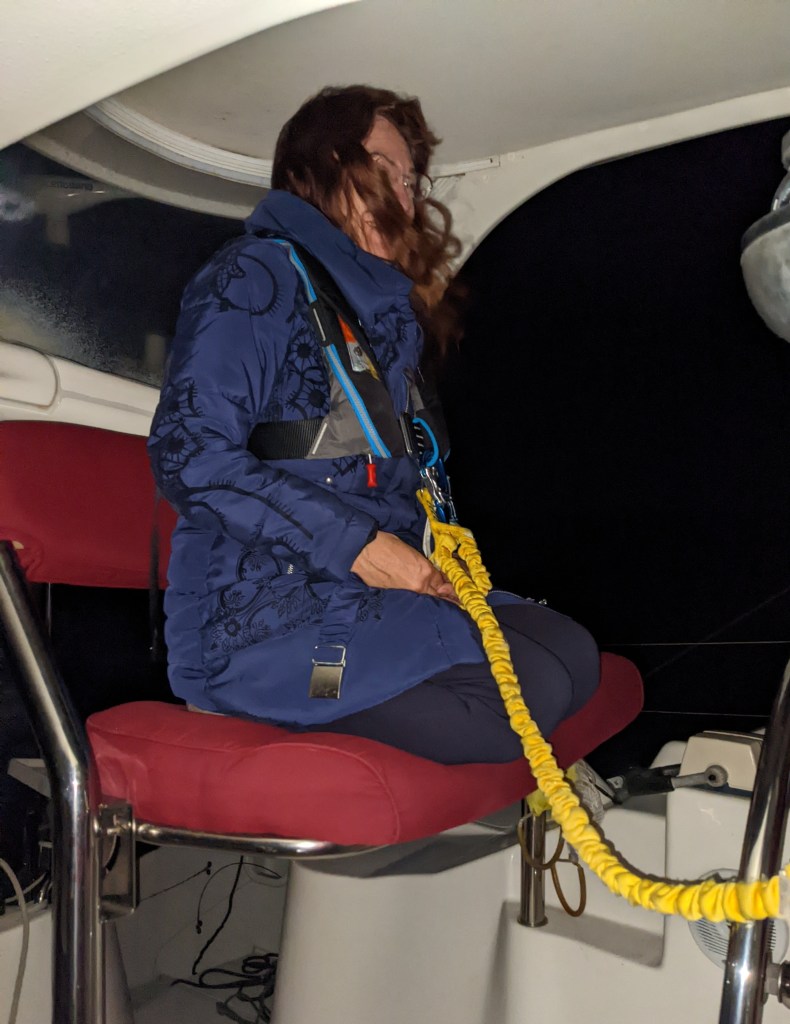
Tethered to the helm

I was so sleepy I was afraid the lurching of the boat might hurl me into the ocean. Alex attached one end of the bright yellow tether to my life jacket and the other to a clasp under the helm.

Alex sat next to me at the helm to check the instruments, and then retreated to bed. I had two hours to monitor the Automatic Identification System and radar for obstacles, and to scan the horizon for lights of other vessels. I couldn’t tell where the sea ended and where the sky started, but I tried to peer through the blackness around the gennaker[1] immediately in front of me while I periodically glanced down to the instruments.

I let my mind wander to reflect on my past in a dreamlike state. Gradually, I got used to holding my posture erect at the helm, as the vessel rocked across the waves. Because the motion reminded me of riding a horse, I sat deep in the saddle, as I had been taught in my youth. Eventually two hours passed, and I was glad it was not three, as it had been during our night sailing on a previous trip. Fellow crew member Luke appeared to relieve me, and I returned to bed, only to find slumber elusive as the boat crashed through the waves. Eventually the seas calmed, and the boat resumed to a slow canter, and I fell into a pleasurable sleep, like a child in a cradle.

The next morning, I was the last to rise, and languished reading a book in my bed as I heard the banter of my fellow sailors — Alex, Luke and Leo — in the saloon above. I eventually roused myself and greeted the others. The conversation turned to night sailing.

“It was so dark at four am this morning that I couldn’t see the horizon,” observed Leo.

“The boat was sluggish last night because the speed dropped to one knot at times,” Luke informed me.

Oh no! Had I sacrificed those two hours for nothing?  Alex assured me that we’d averaged 5.8 knots (11 km/h).

Then Luke looked up.

“There’s a hole in the gennaker!” he exclaimed.

Alex searched for sail tape and then the three of them moved to the deck to attend to the hole. The tape seemed to hold up and the sail was deftly repaired.

Luke attending to the gennaker

“We’re now ten degrees off our desired course,” observed Alex.

“I think that’s fine,” affirmed Luke. “We still have lots of ocean to cover.”

Over the next two days, our boat speed averaged 6.8 knots and we covered 326 nautical miles (604 km). Alex and Luke scrutinised the satellite weather forecasts several times a day, adjusting our course to take advantage of wind changes.

On our fourth day, Alex announced, “At this rate, we’ll arrive at Nouméa in the middle of the night. I think we should slow down.”

Slow down? Surely not! Five days is quite long enough, I mused.

The days and nights blurred, but we persevered sailing over the Coral Sea to reach Nouméa. I was assigned to speak in French to announce our arrival to the port. The last time I’d stayed in a Francophone country was as an au pair in Paris thirty-six years ago, so I was nervous to use my rusty French, particularly in front of the crew. I took hold of the VHF radio and announced the name of our vessel, Arriba, using the phrases from the French sailing handbook to no avail. Every few minutes I repeated the phrases but was met with silence. Was my French incomprehensible?

We arrived in the evening of day six, five days and ten hours after departing from Australia. Having failed to contact the port earlier in the day, we anchored at a suitable distance from the shore in Baie de L’Orphelinat. As a foreign vessel, we flew our bright yellow quarantine flag above the flag of our host country, France. Flying the host country’s flag, far from being a nicety, is a centuries-old maritime tradition that indicates that sailors come in peace.
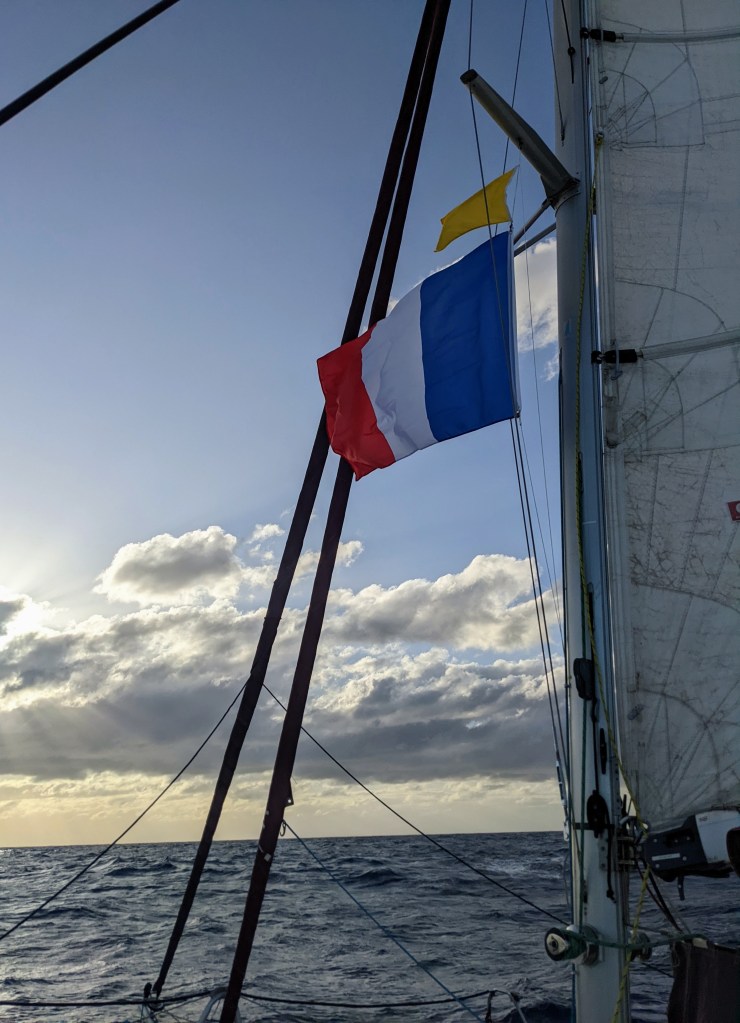
Quarantine flag above the host country’s flag

After so many days and nights at sea I was excited and relieved to see land. I looked to the shoreline and noticed fireworks erupting from the hills. Was this a special welcome for our Australian vessel? After safely anchoring, Alex retrieved the sparkling Tasmanian wine we had saved for the celebration of arriving at port. He stood at the bow, exultant, and made a speech, as he uncorked the bubbly wine. It made a large popping sound and then splashed into the ocean. Alex filled our glasses, and we toasted our arrival in Nouméa.
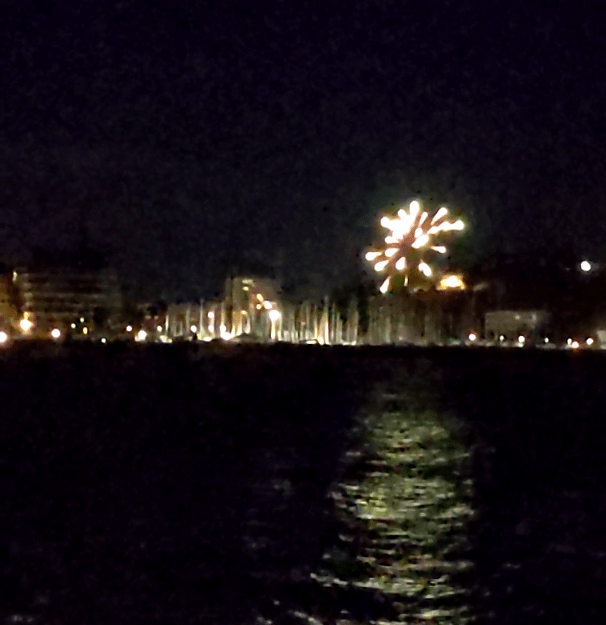
Fireworks over Nouméa.

The next day we made our way to the marina to complete the customs and immigration formalities. Stepping onto the pontoon, I was greeted by a fellow boatie walking back through the gates with a baguette under his arm. Instead of it being excessively wrapped in plastic or even a paper bag, it was wrapped in a slim piece of wrapping paper just where it was designed to be held. Of course, Francophones require their morning baguette, even if they are staying in a marina.

We made our way along the pontoon to the dock. The only trouble was that we could not open the pontoon gate from the inside. Some local children playing on the rocks lining the marina noticed our trouble and called out to us, directing us to the button to open the gates. We followed their instructions and stepped on to New Caledonian soil for the first time. After sailing for five days and nights we would not be deterred by a mere button to a gate. We soon found the marina office and were treated with utmost politeness and warmth by the officers we came into contact with. We were perturbed as to why our attempts to announce our arrival the previous day had been ignored, and then we realised. We had arrived on the 14th of July, Bastille Day, France’s national holiday, and the office must have been closed.

[1] The gennaker, or screecher, is a large flying headsail, i.e., a sail flown in front of the mast.

Alex & Meredith in Nouméa

(Photographs provided by Meredith Stephens)

Meredith Stephens is an applied linguist from South Australia. Her work has appeared in Transnational Literature, The Muse, The Font – A Literary Journal for Language Teachers, The Journal of Literature in Language Teaching, The Writers’ and Readers’ Magazine, Reading in a Foreign Language, and in chapters in anthologies published by Demeter Press, Canada.

PLEASE NOTE: ARTICLES CAN ONLY BE REPRODUCED IN OTHER SITES WITH DUE ACKNOWLEDGEMENT TO BORDERLESS JOURNAL

Click here to access the Borderless anthology, Monalisa No Longer Smiles
Categories
Poetry

Saint Sydney by Asad Latif

Courtesy: Creative Commons
SAINT SYDNEY
For David Fogarty

St Leonards station quite near Sydney Central
sends a Jew on an errand for the eternal.
A bag to deliver food tied firmly behind,   
she steadies her feet, balancing to find,
what her wandering eyes shortly meet,
the daily salvation of an Australian street.
Her cycle is rusting but her pedalling's divine.
Abraham, make a hasid's destination thine.

The rain drives me to destiny and a bus.
The skies like famished guests descend on us
between the ordered feast and the wind-swept dusk.
Ages recede to speed in the rising dust. 
Marist College boys smile. The eternal's outside
but seats blossom into girls inside.
There's nothing to see but the repentance of trees
bowing in hurried homage to me.

The cyclist's gone some other way
in the epiphany of a single day.
Sometimes a short journey's enough
to turn transience to a kind of love
lurking in a Jewish bicycle,
a Christian school bag and the final
words of a Muslim on a bus
passing the sufi jaywalker in all of us.

* a member of Jewish sect in Palestine in the 3rd and 2nd centuries BC

Asad Latif is a Singapore-based journalist. He can be contacted at badiarghat@borderlesssg1

PLEASE NOTE: ARTICLES CAN ONLY BE REPRODUCED IN OTHER SITES WITH DUE ACKNOWLEDGEMENT TO BORDERLESS JOURNAL. 

Click here to access the Borderless anthology, Monalisa No Longer Smiles

Categories
Poets, Poetry & Rhys Hughes

India Pale Ale

Courtesy: Creative Commons

I thought that I didn’t like India Pale Ale until I came to India. I wasn’t pale at the time but I was certainly ale (and arty)[1] because I had just spent three months in Sri Lanka and had acquired something of a tan. Maithreyi, my companion, took me to a place that sold ‘craft’ beers and I changed my mind about the merits of India Pale Ale and my mind has been changed ever since.

The notion of a ‘craft’ beer is one that intrigues and baffles me. I think of a craft as something involving working with wood, chiselling it, shaving it like an orthogonal chin with a plane, drilling it, fitting it together into a chair, table, ark for animals, or something beautiful but useless that looks like furniture but also might conceivably be a petrified tree stump.

Therefore, how can one ‘craft’ a beer? The foam on the surface of the brew once it has been poured into a glass can be removed with a flat tool, the blade of a knife or a metre long ruler or even a credit card. Yes, that is plausible and once or twice I have seen it done. But what other crafty actions remain to be taken in regard to the beer in order that it should be regarded as ‘crafted’? Drilling a beer is a futile exercise. We have all done that with our noses and understand the lack of permanent effect. Who among us has never surrendered to the temptation to dip our noses into the meniscus of our beers?

Let me adjust that hasty statement. Many or at least some of us have done that with our noses, at one time or another, probably long ago when we were the callowest of youths, students at some college or other and fairly new to the rite of drinking beer. The dipping of the nose might even have been accidental. Who can be a harsh judge in such circumstances?

So, it is settled that beer can’t be drilled, nor can it be sawn in half. We have all heard the wise saying that the optimist regards the glass as ‘half full’ and the pessimist regards it as ‘half empty’ and we instinctively know that the liquid in those philosophical glasses is beer. What kind of beer is less clear. If it is totally unclear then it must be a dark beer, but I suspect it is only unclear with a foggy opaqueness, which tends to lead me to conclude it is India Pale Ale. It becomes easier now to picture the scene in the drinking den, whether that den is posh and plush or crude and rude. We see the optimist and the pessimist, good friends but mismatched, holding up their depleted glasses.

Both are drinking India Pale Ale and have consumed exactly fifty percent of the contents of what once were brimming vessels. The optimist looks down at his glass with a large smile, “Ah, it is still half full. What excellent luck!” while the pessimist looks at his own glass with a deep frown, “It’s half empty already, what a blasted nuisance the world is!” But something strange has happened, and we have only just noticed it. We suppose that a ‘half empty’ glass contains beer in the bottom half and air in the top half.

Because this is a vision we are having, and visions aren’t subject to all the laws of physics, especially not gravity, we are amazed to peer closer and see the beer in the pessimist’s glass is confounding our (unreasonable) expectations. It contains the air at the bottom and the beer at the top. The optimist is impressed and cries, “What marvellous luck! You don’t need to tilt your glass at a steeper angle anymore in order to receive the India Pale Ale into your mouth. You can slurp it up from the summit of the glass.”

I am sure the pessimist will object to this positive interpretation of a beery situation and find some convoluted reason why this defiance of gravity is a bad outcome. But I am weary of these two fellows now. Let us leave them in peace to get drunk together, the optimist thinking that being drunk is good, his friend concluding that it’s not as good as he was led to believe it is, and head to a quite different location for a drink of our own.

The place Maithreyi took me to that sells ‘craft’ beers, including the India Pale Ale that is the subject of this small essay, was somewhere in Bangalore not far from Blossom Book House. We had bought books in that house, as we often do, a decent haul, and went to celebrate with beer and nibbles, and later, when we were just a little tipsy, we hurried back to Blossom Book House and bought more books. But this isn’t an article about books. It’s an article, or what passes in my mind for an article, about beer, specifically about the type of beer that is known as India Pale Ale. Where was I?

Oh yes, I was in that place that sold craft beers, and I have decided at this point to stop writing the word ‘craft’ in inverted commas. There were too many craft beers on offer for an easy selection to be made, so we ordered a sampler of many kinds, and they came on a big tray. They were in small glasses, dark beers and golden, reddish beers and greenish, fizzy beers and still beers, and perched on the end of the rectangular tray, two glasses of the mythic India Pale Ale. My reluctance to try these hangers-on is comprehensible when one considers how dreadful a non-craft India Pale Ale can be.

Back in Britain, decades ago, when first I allowed beer to pass the gates of my lips without turning it back, IPA was fairly popular among those unfortunate drinkers who lacked taste buds. Why they lacked taste buds was never explained to anyone’s satisfaction. Presumably they had lost them overboard while sailing from the Far East on packet steamers. It was a long time before I knew that IPA was an acronym for India Pale Ale. I assumed it was a word in its own right and that its own right was wrong. I would say that most beers sold in pubs in Britain in the 1970s were abominable, but this suggests that the Abominable Snowman would like them, and I doubt that he would.

I have done a little research (a very little, almost too little to be regarded as anything other than mildly faffing around) and I learn that India Pale Ales were once a noble style of beer, invented in the 18th Century for export by the sneaky imperialists of the East India Company. It was flavoured with hops, lots and lots of hops, more hops than a kangaroo would do, if it had a chance, and the adding of these extra hops had some effect that meant the ale would mature or whatever the word is during the difficult sea voyage.

I don’t really understand the chemistry of it, and I don’t really want to, I am merely repeating what I found out just now. IPA was an EIC product, proving to my own satisfaction that acronyms aren’t relatively modern inventions but have been around for a very long time. The decline in the quality of IPA, and all beers for that matter, during the 20th Century, is perhaps a mysterious one or maybe it has something to do with the big breweries rapaciously wanting to increase their profits by using less lovely ingredients and processes. I don’t especially like the taste of hops at the best of times. At the worst of times hops make me wince and frown like some kind of wincing frowner, a very lazy comparison, true, but my powers of simile and metaphor are temporarily on hold, for I haven’t recovered from a rather severe bout of acutely remembering the IPA and other beers of my early days on this gracious planet of ours.

A strongly hopped beer tastes, to me, like mouldy bread. The IPA of those long-gone days tasted like a sack of mouldy loaves swung around the head of a gorilla and used to bash one on the bonce. My powers of simile and metaphor, such as they are, seem to have returned. And yet when I took a cautious gulp of the IPA in the place that Maithreyi had guided me to, my preconceptions and established prejudices melted with the delightfulness of the taste that confronted me. What a magnificent India Pale Ale! I tried the other IPA on offer. Golly, this was even more wondrous! Let’s order more!

I say, my dear, we have bought books in our favourite bookshop. Isn’t it an astonishingly beneficial way to pass the time, obtaining books? And it’s not as if we buy them but never read them. We read them! Wouldn’t it be a jolly romp to return to the bookshop, once we have consumed more beers here, and engage in the act of purchasing more books? Indeed!

A final observation from an unobservant chap (myself). Any British fellow who guzzles IPA with gusto and ends up with a sodden moustache and beard as a consequence can be regarded as a ‘Pale Ale Face’ which is what ‘Indians’ in old Westerns almost called cowboys on occasion. Anyway, this essay appears to be over now, and the page on which this final paragraph has been written is an empty glass at last, the brew of its words fully consumed by your eyes, leaving only the dregs of a footnote at the bottom.

[1] Hale and hearty, a description used frequently in my youth, but which seems to have fallen out of favour. Falling out of favour is easily done if the speeding favour brakes to a sudden halt and the thing that was in favour isn’t strapped in properly. When it falls out of favour it often lands with a painful bump and favour drives off with a monstrous laugh. Even flavours can fall out of favour or back into it.

Rhys Hughes has lived in many countries. He graduated as an engineer but currently works as a tutor of mathematics. Since his first book was published in 1995 he has had fifty other books published and his work has been translated into ten languages.

.

PLEASE NOTE: ARTICLES CAN ONLY BE REPRODUCED IN OTHER SITES WITH DUE ACKNOWLEDGEMENT TO BORDERLESS JOURNAL. 

Click here to access the Borderless anthology, Monalisa No Longer Smiles

Categories
Poetry

Bonfire by Ihlwha Choi

Translated from Korean by Ihlwha Choi

Courtesy: Creative Commons
BONFIRE 

You are the wood,
I am the bonfire,
I embrace you and burn intensely.
You nestle in me
and ignite a brilliant flame.
In the pitch-black darkness,
in the biting cold that burns the flesh,
you disappear in the blaze,
and I, following you, am consumed.
You are the bonfire,
I am the wood,
in this fervent life we share.

Ihlwha Choi is a South Korean poet. He has published multiple poetry collections, such as Until the Time When Our Love will FlourishThe Colour of TimeHis Song and The Last Rehearsal.

.

PLEASE NOTE: ARTICLES CAN ONLY BE REPRODUCED IN OTHER SITES WITH DUE ACKNOWLEDGEMENT TO BORDERLESS JOURNAL

Click here to access the Borderless anthology, Monalisa No Longer Smiles

Categories
Review

A Thinker who Fought for an Inclusive India

Book Review by Bhaskar Parichha

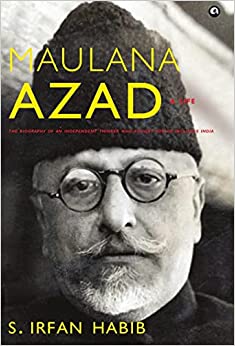
Title: Maulana Azad – A Life

Author: S.Irfan Habib

Publisher: Aleph Book Company

At a time when India is celebrating its 75th anniversary of independence, it is only fitting that Maulana Azad’s contributions to the country should be remembered. He was one of the most prominent Muslim leaders in India’s freedom movement, whose contribution to the establishment of the education foundation in India is recognised by observing his birthday across the country as “National Education Day”.

Azad became the youngest member of Congress to hold a presidential post. Using his position to work to re-unite the Swarajists and the Khilafat leaders under the common banner of the Congress. He opposed the Partition of India because he thought Muslims would be more powerful and dominant in a united India. After independence, he became the first Minister of Education in the Indian government. In 1992, he was posthumously awarded India’s highest civilian award, the Bharat Ratna.

Maulana Azad – A Life by S. Irfan Habib is “the biography of an independent thinker who fought for an inclusive India”. In this in-depth chronicle, historian Habib takes the reader through some of the most decisive moments in Azad’s life.

 A widely published historian of science and modern political history, Habib was the Maulana Azad Chair at the National University of Educational Planning and Administration, New Delhi. He has authored To Make the Deaf Hear: The Ideology and Programme of Bhagat Singh and His Comrades and is the editor of Indian Nationalism: The Essential Writings.

Says the blurb: “Born into an orthodox family of famed Islamic scholars, Azad was deeply influenced by the pan-Islamic philosophies of Sir Syed Ahmad Khan and Jamaluddin Afghani. Azad had no formal education, but he was an autodidact who taught himself about culture, philosophy, languages, and literature. As a teenager, he successfully published several magazines and newspapers and went on to publish the immensely popular Urdu weekly Al-Hilal through which he tried to persuade Indian Muslims to shake off the shackles of British rule. He became inspired by Gandhi’s non-violent civil disobedience movement and was extremely critical of the Muslim League’s communal politics.”

Azad’s unusual upbringing, his illustrious family, upheavals in the Islamic world, and the initial inklings of Azad’s freethinking outlook on life. ‘Maulana Azad and Critical Thinking in Islam’ examines the various schools of thought, ethical questions, and pan-Islamic debates that shaped Azad’s religious attitudes and his approach to the idea of nationalism. ‘Azad, Islam, and Nationalism’ looks at Azad’s political career and his unwavering belief in composite nationalism and staunch opposition to the Muslim League’s sectarian politics. ‘Ghubar-i-Khatir Beyond Faith and Politics’ lays bare Azad’s philosophical moorings and personal likes and dislikes through a collection of epistolary essays written during his imprisonment in the Ahmednagar Fort prison in the 1940s. And, finally, ‘Building a New India’ charts Azad’s efforts to strengthen the country’s weak education system through initiatives aimed at primary and adult education, his efforts towards the scientific and cultural advancement of the country, and his contribution to the arts and culture of a newly independent nation.”

As Habib writes, “justice is all the more relevant to education as a process of harmonious nurture. Indeed, social justice commands a pivotal place in Azad’s general perspective, which influenced his educational outlook quite profoundly. He was conscious of the fact that a class or caste-ridden education system needed to be replaced by a more inclusive and just educational order. In 1948, while addressing the educational conference, Azad again reiterated that education, at any rate, must be pushed forward as rapidly as possible. We must not, for a moment, forget that it is the birthright of every individual to receive at least the basic education, without which he cannot discharge his duties as a citizen.”

Writes Habib : “With a view to gearing education towards the cause of democracy, he, in his very first official statement, referred to Disraeli’s verdict: ‘A democracy has no future unless it educates its masters.’” In independent and democratic India, with universal franchise as the key principle, the voter was truly the master of democracy, and Azad wanted this voter to be educated and aware. He was conscious of the sad inheritance of colonial inequalities, where 85 per cent of the country’s population was illiterate on the eve of Independence. Several classes and caste discriminations were discussed for the first time, and it was necessary to eliminate them immediately.

Azad was convinced, according to the biography, that the state had to play a key role in combating such social afflictions and provide everyone with the means to “the acquisition of knowledge and self-betterment”; however, the most disconcerting factor was the lack of necessary funds to carry forward the state’s responsibilities. Azad conceded with a sense of guilt as minister of education that the central government had allotted only 1 per cent of the funds in the budget for education. He therefore urged the Constituent Assembly to raise expenditure to 10 per cent.

Maulana Azad pursued the issue with passion and was able to raise the allocation from Rs 20 million to around Rs 350 million during his tenure as minister of education. On September 30, 1953, Azad addressed the nation on All India Radio, reiterating that “every individual has a right to an education that will enable him to develop his faculties and live a full human life.”

In about three hundred pages of inexorable text, Habib reconstructs the life of the remarkable man while arguing that Azad is more relevant now than ever before. An essential read for understanding India’s pre-independence history and the significance of a dedicated life.   

Bhaskar Parichha is a journalist and author of UnbiasedNo Strings Attached: Writings on Odisha and Biju Patnaik – A Political Biography. He lives in Bhubaneswar and writes bilingually. Besides writing for newspapers, he also reviews books on various media platforms.

PLEASE NOTE: ARTICLES CAN ONLY BE REPRODUCED IN OTHER SITES WITH DUE ACKNOWLEDGEMENT TO BORDERLESS JOURNAL

Click here to access the Borderless anthology, Monalisa No Longer Smiles

Categories
Poetry

Wars and Rumours of Wars

By Ron Pickett

We thought it might be over;
Wars and rumours of wars.
Then Russia invaded.
It was a short incursion,
They said.
Ukraine was their territory 
Anyway, anyway!
They said,
It was too costly to try we thought,
Wars and rumours of wars.
Sanctions! we said.
They couldn’t take the sanctions.
The Russians couldn’t.
But they fought back
The Ukrainians fought back
They weren’t supposed to.
They were supposed to be easy pickins’;
A walk in the park,
A few weeks, an exercise
A year has passed.
60000 Russians are dead. Or 200000
15 thousand Ukrainians or 100000
Ukraine is blackened rubble.
The snow is red with blood.
All is dark
There is no winner.
We were wrong,
We were so wrong!
Wars and rumours of wars 
They are still there.
Peace is not a part of our nature!
China lusts for Taiwan.
Shalom.

Ron Pickett is a retired naval aviator with over 250 combat missions and 500 carrier landings. His 90-plus articles have appeared in numerous publications. He enjoys writing fiction and has published five books: Perfect Crimes – I Got Away with It, Discovering Roots, Getting Published, EMPATHS, and Sixty Odd Short Stories.

.

PLEASE NOTE: ARTICLES CAN ONLY BE REPRODUCED IN OTHER SITES WITH DUE ACKNOWLEDGEMENT TO BORDERLESS JOURNAL

Click here to access the Borderless anthology, Monalisa No Longer Smiles
Categories
Stories

        The Infallible Business


By Sangeetha G

 Courtesy: Creative Commons

“Did you apply for the job?” Somnath asked casually when they met in the evening that day. The playground adjacent to the village school had become their hangout place for the past two years. 

“I have lost hope in these applications, interviews, and jobs,” Rajesh sounded quite detached. That was a state mind he had acquired gradually over the past two years of joblessness and pandemic. It had changed his perspective about jobs, careers, city life, and life in general. Waking up early, catching the metro train during rush hours for office, slogging till late evenings, and catching the train again to get back home just for a few hours of sleep seemed a routine of a past life. In the village, they had nothing to do. The nothingness got into their heads. They found it difficult to return to their past life.

“We need to do something. But I don’t want to go back to the city,” said Somnath.

“I have a business idea. Capital-light, easily executable, infallible, and recession-proof and to top it all it has an unbelievable Return on Investment,” said Rajesh. 

“That sounds ideal, blurt it out,” Somnath looked excited.

“We can get into the business of religion and build a temple,” Rajesh said. 

Somnath was baffled. “Is that a business to do?”

“Religion is the best business and until humans continue to believe in unseen and unknown powers working upon them, the business will flourish. You can start with a very small capital and earn loyal customers, who would never question whether you deliver or not. They will keep on putting in money without applying logic. In a crisis, the business will not slacken. Instead, the loyal customers will keep on investing, hoping for a better tomorrow. What other business has these amazing deliverables?” he asked. 

“You have a point,” Somnath was on the same page. 

“What is the plan,” he asked. 

“It is simple. I have a ten-acre land that has been lying unused for years. We will set up the temple there,” Rajesh was confident.

“Just because we go ahead and build a temple, are people going to believe in the deity?”

“We will not build a temple just like that. First, a miracle should happen and then the temple will follow,” Rajesh detailed the plan. 

“As per my plan, you will fall sick…seriously sick and the doctors will not be able to diagnose your condition. As your condition starts worsening, you will announce that you had a dream. In the dream, a goddess appeared before you and asked you to dig out her idol from the nearest banyan tree. The nearest banyan tree falls in my land. As per your dream, your family and my family will dig out the idol from the soil near the banyan tree. The idol will be consecrated and you will be cured. This will be our base miracle,” Rajesh said. 

“First our families will start worshipping and slowly, by word of mouth, others will join us. As people will see that their wishes are getting fulfilled, worshippers will start flowing to our temple,” Rajesh added. 

“But, this is a farce. How will people’s real wishes come true by praying to the false idol?” Somnath was sceptical.

“Imagine, 100 people come and pray in the temple. They all will have their wishes, but at least 50 will be working towards their dreams. Simple statistics say that 30 percent are likely to achieve their dreams. Those who get their dreams fulfilled, will anyway become staunch believers. Of the remaining 70 percent, 20 percent might leave forever. But they would never complain or bad-mouth about the temple. After all, talking against God is sacrilegious,” Rajesh went on. 

“Now we have to focus on the 50 percent who are confused between belief and disbelief. We come up with propaganda that whoever did not get their wishes fulfilled in a month has some serious negative karma. They will have to do penance for nine consecutive weeks to mitigate the effect of their karma. At least 30 percent will fall for it. We will design some tough rituals as penance,” he said. 

“Why tough rituals?” Somnath was curious.

“Tougher the ritual, greater the belief,” Rajesh reasoned. 

“By then, more than 50 percent of the worshippers would have turned our believers. They will keep on pouring money into the temple and continue to do whatever we ask them to do. Further, new sets of worshippers will keep on coming to the temple. We will ask the worshippers to leave a note in a box if their wishes have been fulfilled. I am sure we will get ample notes for our marketing campaign through social media and elsewhere. Once we achieve a certain number of daily worshippers, we will touch the inflection point. Then we can relax and the system will take care of itself,” he sounded confident.

“What is the guarantee that all these worshippers will deposit money in our boxes?” Somnath asked.

“We will propagate that people who had put money saw their wealth growing multi-fold. We will get some notes substantiating this claim as well. Who does not love money? They will pour in money for the sake of more money,” Rajesh replied. 

“I liked the idea. But will people behave as we expect them to?” Somnath was critical. 

“Don’t worry. As long as humans have low levels of confidence in themselves and their efforts, they will continue to seek help from ‘above’,” Rajesh smiled. 

By then, the sun had started setting and the sky was at its crimson best. The nearest temple had started playing devotional songs and worshippers were on the way to attend the twilight veneration. They stood up and started walking back home. 

“I will get one idol from the antique dealer in the city. I will hide it in the soil near the banyan tree and you will have to come out with some convincing disease plan. We will meet tomorrow,” Rajesh said as he took the private road leading to his house.

.

Sangeetha G is a journalist in India. Her flash fiction and short stories have appeared in Down in the Dirt, Academy of the Heart and Mind, Kitaab International, Indian Review, Storizen, The Story Cabinet and Borderless Journal. Her story won Himalayan Writing Retreat Flash Fiction contest 2022. Her debut novel is in the works.

.

PLEASE NOTE: ARTICLES CAN ONLY BE REPRODUCED IN OTHER SITES WITH DUE ACKNOWLEDGEMENT TO BORDERLESS JOURNAL

Click here to access the Borderless anthology, Monalisa No Longer Smiles

Categories
Poetry

Spring Poems by Michael R Burch

Courtesy: Creative Commons
SPRINGTIME PRAYER
 
They’ll have to grow like crazy,
the springtime baby geese,
if they’re to fly to balmier climes
when autumn dismembers the leaves ...
 
And so I toss them loaves of bread,
then whisper an urgent prayer:
“Watch over these, my Angels,
if there’s anyone kind, up there.”
 
MOON POEM
 
I climb the mountain 
to inquire of the moon ...
the advantages of loftiness, absence, distance.
Is it true that it feels no pain,
or will she contradict me?
 
AH! SUNFLOWER
 
(After William Blake)
 
O little yellow flower
like a star ...
how beautiful,
how wonderful
we are!
 
A POSSIBLE EXPLANATION FOR THE MADNESS OF MARCH HARES

 
March hares,
beware!
Spring’s a tease, a flirt!
This is yet another late freeze alert.
Better comfort your babies;
the weather has rabies.

Michael R. Burch’s poems have been published by hundreds of literary journals, taught in high schools and colleges, translated into fourteen languages, incorporated into three plays and two operas, and set to music by seventeen composers.

PLEASE NOTE: ARTICLES CAN ONLY BE REPRODUCED IN OTHER SITES WITH DUE ACKNOWLEDGEMENT TO BORDERLESS JOURNAL

Click here to access the Borderless anthology, Monalisa No Longer Smiles
Categories
Essay

One Happy Island

Text and photographs by Ravi Shankar

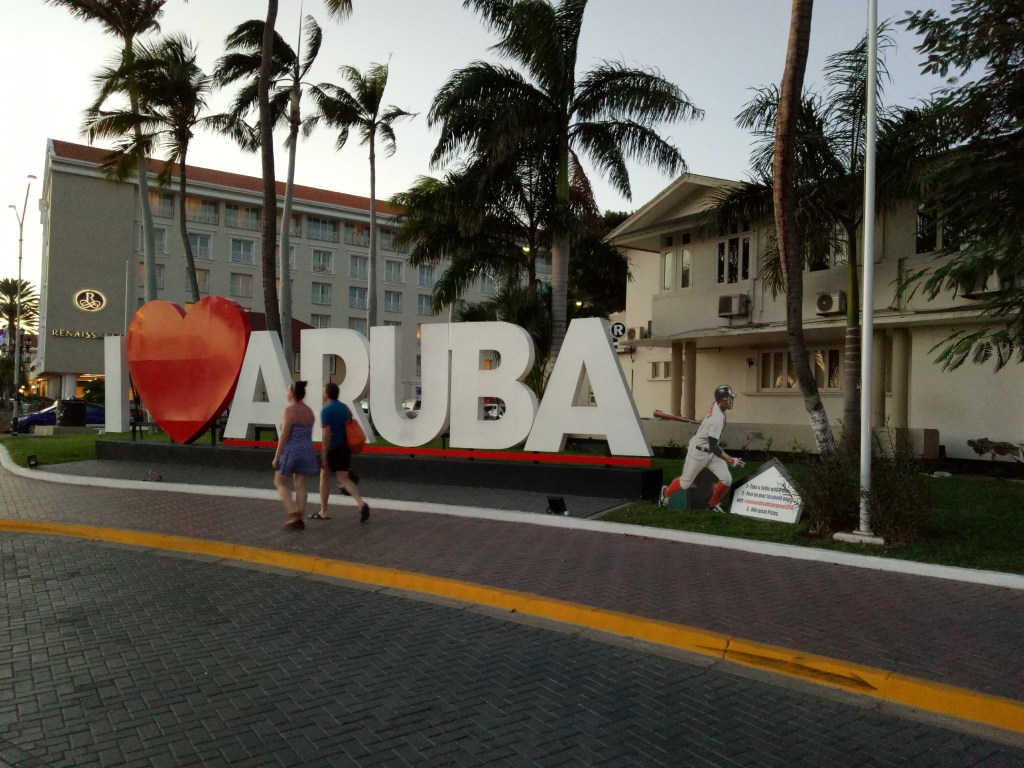
Downtown Orenjestad

The plane was descending steadily. We were approaching an island. The sandy coastline and the hotels were now visible on the left. I was seated in the last row and luckily had the entire row to myself. The sand was white, and the waters of the Caribbean Sea were a deep turquoise blue. I was fascinated by the depth and translucence of the colours. A few boats and yachts were seen, cutting through the waters and we landed shortly.

Aruba, a small island located just off the coast of Venezuela is a part of the Netherlands. The island is a major destination for sun worshippers from North America. During the cold winter months, they do their surya namaskars (saluting the Sun exercise) in Aruba and other sunny places. The island is small at around 32 kilometres by 10 kilometres. The soil is sandy and there are no rivers. The island was considered useless by the Spaniards who termed it islas inutiles[1]. The origin of the name Aruba is debated. The most accepted version is that the name may have been derived from Caquetio Indian, Oruba meaning well situated. The island is mostly flat and there are four main settlements.  Oranjestad is the capital and the biggest city. San Nicholas is the entertainment hub, and Paradera and Santa Cruz are located more inland. Noord and Savaneta are the other settlements. The legal population is around 140, 000 though there may be several thousand undocumented immigrants.

Tourism has become a major source of revenue for the island like other islands and countries in the Caribbean. The island is well known in North America and the Netherlands and advertises itself as ‘One Happy Island’. During the pre-COVID days, the island used to receive nearly one million tourists yearly. Aruba is distant from South Asia; the most convenient connections are through Amsterdam and the United States (US). The island is well connected to the Eastern US and there is a US Immigration pre-clearance facility at the airport.

I was living in the capital, Oranjestad (orange city — named after the royal Dutch family, House of Orange),working at the Xavier University School of Medicine and my old friend from Nepal, Dr Dubey, was the Dean of Basic Sciences. I stayed near the school in a place called Paradijs.

Trade winds constantly blow across the island bringing down the temperature and keeping things tolerable. Walking in the housing colonies in Aruba can be a challenge. Most houses have aggressive dogs who seem to think their areas of influence extends right to the middle of the road. A house near mine had three dogs who always gave me a tough time.

Rains are not common in Aruba. Clouds gather but are blown away to the mainland of Latin America. Aruba is not built for rain. The streets flood and the college also used to get flooded after a downpour. I enjoyed walking along the seashore.

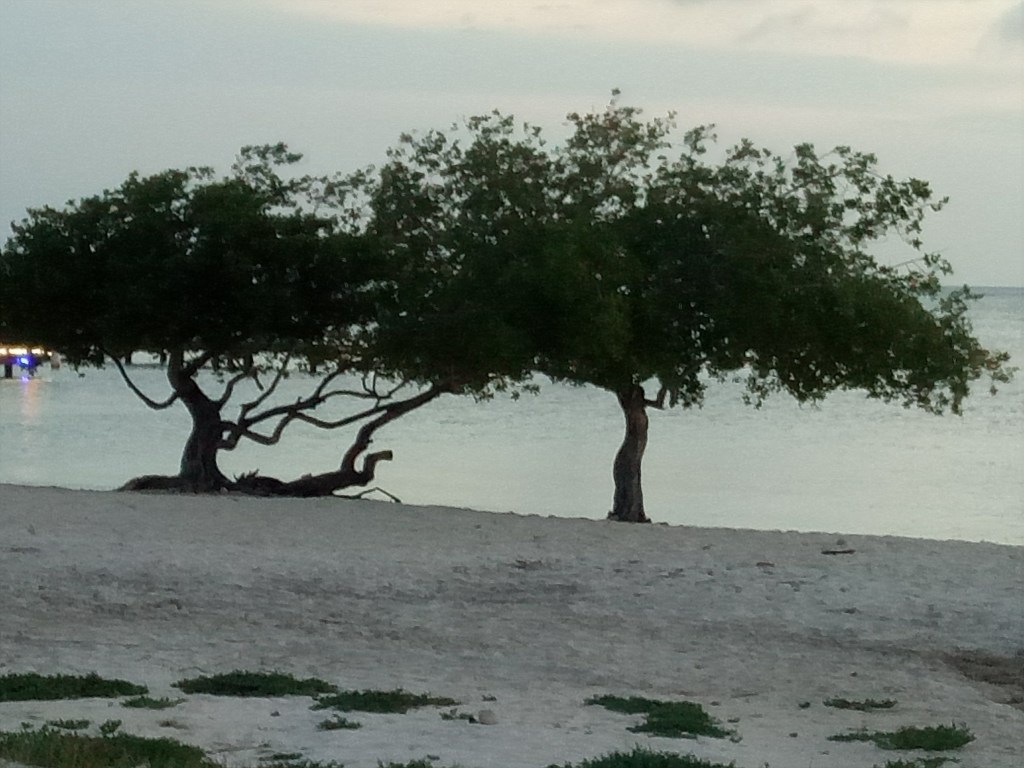
Once you leave the houses behind, the dogs are absent. A linear park runs from the airport to the cruise ship terminal. The path is paved with red stones and lined with divi-divi trees.

There is also exercise equipment installed at the surfside beach. The view of the sea is great and the sunsets on the island are spectacular. Divi-divi trees are common on the island and always point in a south-westerly direction due to the strong trade winds. Watching the planes land and take off at the airport is fascinating. KLM Royal Dutch Airlines flies the Airbus A330 which is the largest plane flying to the island.      

The carnival is a major celebration in Aruba and started as a series of street celebrations in 1954. The month of February is full of different carnival events. I attended a night parade one year and the event was spectacular. The sun can be hot and this needs to be factored in while watching the parades in the daytime.

San Nicolas has an oil refinery and is the fun side of the island. It also has a more Caribbean feel, and the cost of living is lower than Oranjestad. The oil refinery was once the largest in the Western hemisphere and was the target of German U-boats during WW II. There is a beautiful beach (Baby Beach) near the refinery.

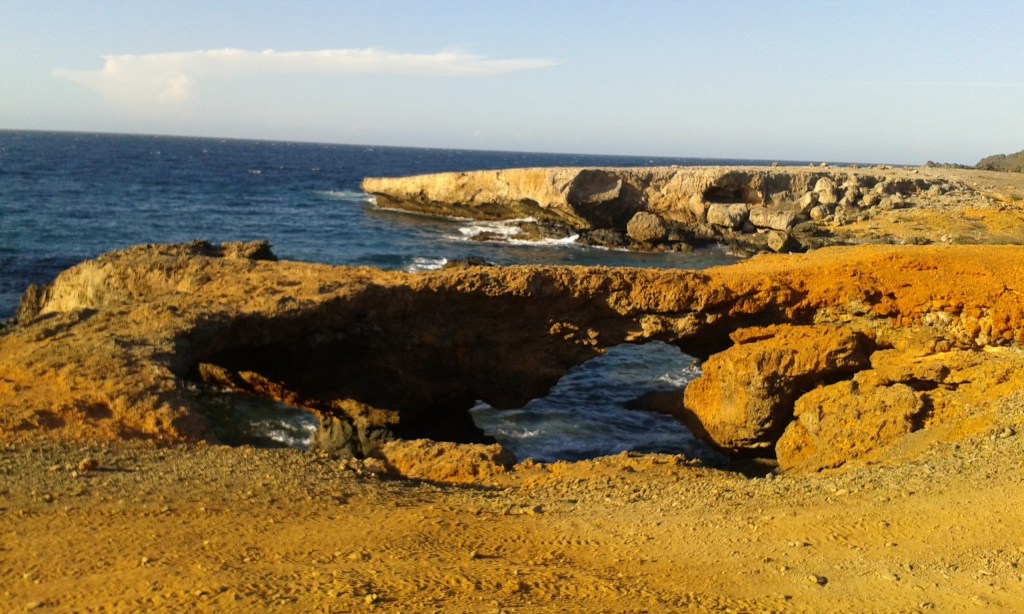
Aruba has a Jekyll and Hyde personality. The Caribbean side facing Latin America has spectacular beaches and calm, turquoise waters. The Atlantic side is a different matter. The coast is rocky and splintered and the waters of the Atlantic Ocean crash with brute force.

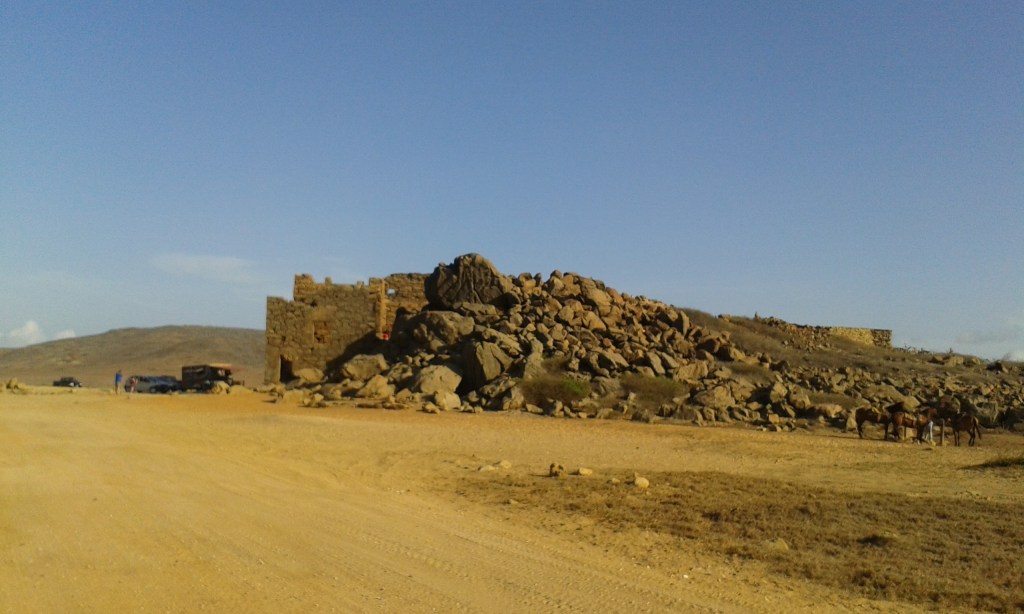
There is a gold mine and a natural bridge on the north and a large windmill farm. Semi-domestic goats graze in the arid landscape. I liked going to the wild side and watching the brute force of nature. The Arikok National Park occupies nearly a third of the island and has the highest peak, Yamanota (about 250 m), and spectacular cacti. It also has a cunucu, a traditional Aruban house. A Cunucu has thick walls that are whitewashed with small windows to stay cool in the heat.

Rainwater is collected for daily use. Today the water needs are met by desalinating sea water. The plant is located near Savaneta on the highway to San Nicolas. Water and electricity supply is stable, and disruptions are rare.

Most people have cars while the blue Arubuses provide public transportation. The bus frequency is low. Hooiberg is a mountain that rises steeply from the surrounding plains and climbing to the top provides excellent views of Oranjestad, the harbour, and the surrounding countryside.

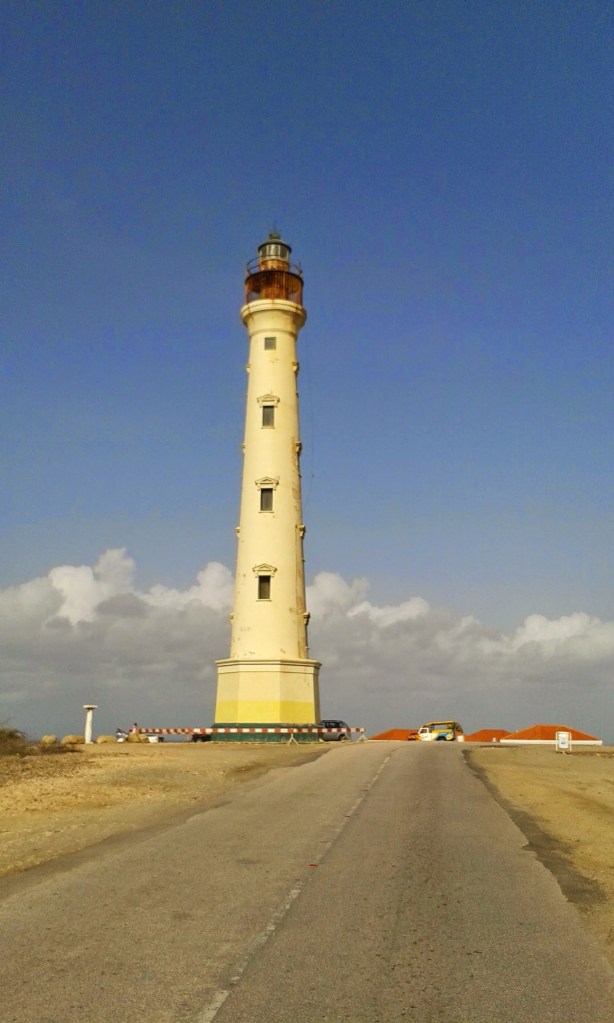
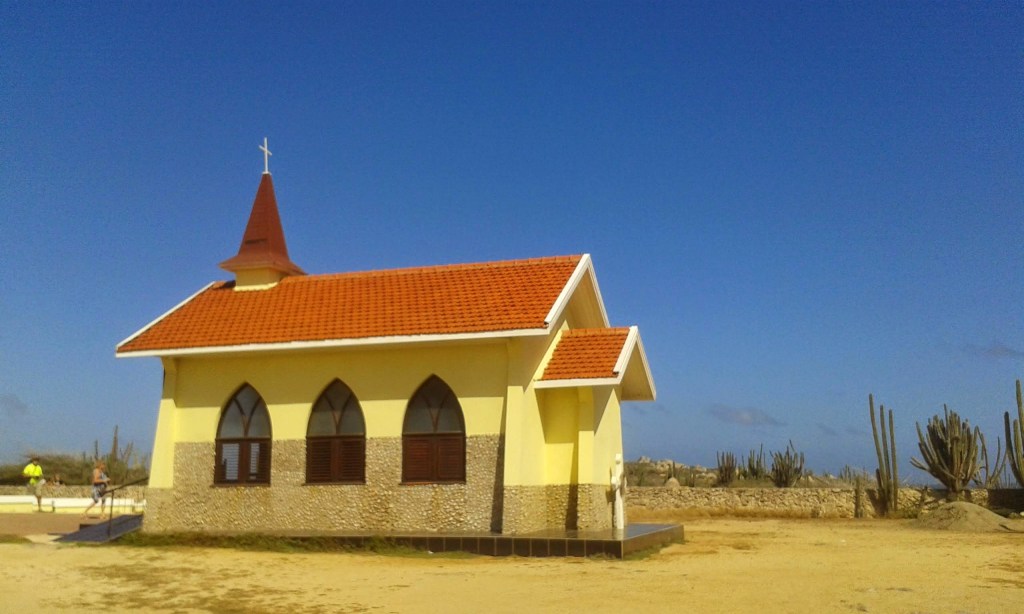
The area around Noord is the tourist heartland and the lemon-yellow California lighthouse is located here. The lighthouse is named after the steamship, California, which sank near these waters in 1891. The downtown area of Oranjestad has Wilhelmina Park, Fort Zoutman, and the Willem III tower. The fort was built in 1798 by African slaves. There is also a historical museum nearby providing an excellent overview of the island’s history and geology. The Alto Vista chapel has a spectacular view of the surroundings and was originally built in 1750 by the Spanish missionary, Domingo Antonio Silvestre.

Aruba may be the most Latinised of the Caribbean islands. There is also a strong Dutch influence. Dutch and Papiamento are widely spoken. Papiamento is a Portuguese-based creole language. English and Spanish are also widely understood.

A lagoon

Aruba grows high-quality aloe vera and Aruba Aloe founded in 1890 is the world’s oldest aloe factory.  Aruba has plenty of beaches, Druif beach, Eagle beach, Palm beach, Malmok beach, and others. The island has invested in equipment to maintain the beaches. Turtles lay their eggs in the white sand and hatchlings clumsily move back to the ocean. The natural pool or conchi is located on the north side. Butterfly farm, Philips’s animal garden, and the Donkey sanctuary provide shelter to the fauna. You can volunteer at the donkey sanctuary. In Aruba, many families camp out on the beach during Easter. My landlord and his family used to camp on the surfside beach near the airport.

Aruba has high human development indicators. Healthcare is provided by the government through a corporation financed by taxes. Alcohol is widely consumed but I did not see drunken fights or disorderliness during my time on the island. Drivers need to be careful on Friday nights when parties get going. This arrow-shaped island with a variety of cultures and influences is geographically sheltered from the worst hurricanes with the balmy weather, caressing winds caressing, and inviting waters. The people are friendly. The moniker ‘One Happy Island’ may be well deserved!         

[1] Translates to Islands Useless

Dr. P Ravi Shankar is a faculty member at the IMU Centre for Education (ICE), International Medical University, Kuala Lumpur, Malaysia. He enjoys traveling and is a creative writer and photographer.

.

PLEASE NOTE: ARTICLES CAN ONLY BE REPRODUCED IN OTHER SITES WITH DUE ACKNOWLEDGEMENT TO BORDERLESS JOURNAL

Click here to access the Borderless anthology, Monalisa No Longer Smiles
Categories
Poetry

Learning by Soul

By Anannya Dasgupta

AATMASAAR
( for Aparna & Seema) 


“Aatmsaar kar lijiye”* she said,
after a poem with a life lesson
had been recited -- “You know,
learn it by heart, memorise it.”
 
How beautiful a way to learn --
to have a saar, a gist, an insight
become a part of who you are, in
your aatma, your self, your soul.
This learning to be whole
in another language becomes a
learning-by-heart. Where words
felt and known are not apart. But
then we move somehow to
memorising – recalling for feat
from the surface of the mind,
heart and soul quite left behind.
 
Now we flog the dead horse of
rote learning, dangling carrots for
parrots, not for the soul’s yearning.

*Hindi phrase meaning 'learn by heart' 

Anannya Dasgupta writes both formal and free verse and enjoys writing in rhyme. She has a book of poems Between Sure Places. She has also been published in several print anthologies and online journals, most recently in Soul Spaces, Drifting Sands Haibun, Usawa Literary Review and Hakara Bilingual. She teaches at Krea University.

PLEASE NOTE: ARTICLES CAN ONLY BE REPRODUCED IN OTHER SITES WITH DUE ACKNOWLEDGEMENT TO BORDERLESS JOURNAL

Click here to access the Borderless anthology, Monalisa No Longer Smiles