OF CIVILISATION AND DISENCHANTMENT
Suddenly uncomfortable
to stay at my grandfather’s house—
actually his third new wife’s,
in her daughter’s bedroom
—one interminable summer
with nothing to do,
all the meals served cold,
even beans and peas—
Lacking the words to describe
ah!, those pearl-lustrous estuaries—
strange omens, incoherent nights.
Seeing the flares of the river barges
illuminating Memphis,
city of bluffs and dying splendours.
Drifting toward Alexandria,
Pharaos, Rhakotis, Djoser’s fertile delta,
lands at the beginning of a new time and “civilization.”
Leaving behind sixty miles of unbroken cemetery,
Alexander’s corpse floating seaward,
bobbing, milk white, in a jar of honey.
Memphis shall be waste and desolate,
without an inhabitant.
Or so the people dreamed, in chains.
(Published by The Centrifugal Eye and The Centrifugal Eye Fifth Anniversary Anthology)JUST DESSERTS
“The West Antarctic ice sheet
might not need a huge nudge
to budge.”
And if it does budge,
denialist fudge
may force us to trudge
neck-deep in the sludge!
(The first stanza is a quote by paleo-climatologist Jeremy Shakun in the Science magazine.)
Michael R. Burch’s poems have been published by hundreds of literary journals, taught in high schools and colleges, translated into fourteen languages, incorporated into three plays and two operas, and set to music by seventeen composers.
PLEASE NOTE: ARTICLES CAN ONLY BE REPRODUCED IN OTHER SITES WITH DUE ACKNOWLEDGEMENT TO BORDERLESS JOURNAL
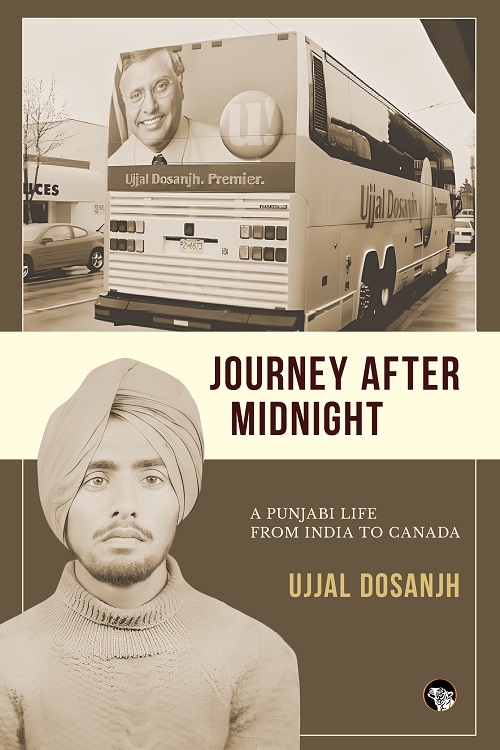
Title: Journey After Midnight – A Punjabi Life: From India to Canada
Author: Ujjal Dosanjh
Publisher: Speaking Tiger Books
The Punjabi Diaspora is a global phenomenon that has grown in size and complexity in recent years. It is estimated that there are around 20 million Punjabis living outside the Punjab region in India and Pakistan. This is stretching across multiple continents and countries. Punjabis have migrated to different parts of the world since the British Raj. However, this diaspora has become more visible in recent decades due to technology and global connectivity.
Highly diverse and dynamic, with different groups of Punjabis living in different places around the world. In North America, Punjabis are concentrated in the United States and Canada. In Europe they are mainly settled in the United Kingdom, Germany, Italy, and France. In the Middle East, they are found in the United Arab Emirates, Qatar, Kuwait, and Saudi Arabia. In South East Asia, they are mainly settled in Malaysia, Singapore, and Indonesia.
Punjabis have had a significant impact on the culture and economy of the countries where they have settled. Their positive contributions were felt in multiple industries, from agriculture to tech. They have been key to spurring economic growth in the areas where they have settled. They have also had a major influence on the culture and cuisine of these countries, with Punjabi food being a popular choice in many areas.
Journey After Midnight – A Punjabi Life : From India to Canada by Ujjal Dosanjh speaks about the Punjabi diaspora in all its splendor. Dosanjh was born in the Jalandhar district of Punjab in 1946. He emigrated to the UK in 1964 and from there to Canada in 1968. He was Premier of British Columbia from 2000 to 2001 and a Liberal Party of Canada Member of Parliament from 2004 to 2011, including a period as Minister of Health and Minister Responsible for Multiculturalism, Human Rights and Immigration. In 2003 he was awarded the Pravasi Bharatiya Samman, the highest honour conferred by the Government of India on overseas Indians.
The blurb contends: “Journey After Midnight is the compelling story of a life of rich and varied experience and rare conviction. With fascinating insight, Ujjal Dosanjh writes about life in rural Punjab in the 1950s and early ’60s; the Indian immigrant experience—from the late 19th century to the present day—in the UK and Canada; post-Independence politics in Punjab and the Punjabi diaspora— including the period of Sikh militancy—and the inner workings of the democratic process in Canada, one of the world’s more egalitarian nations.”
Dosanj states candidly: “Today’s world has few leaders brimming with great ideas. The paucity of great leaders afflicts India as well. There are no inspiring giants on the national stage tall enough to lead India out of the ethical and moral quagmire. Asked whether he was working to create a new India along with seeking its independence from Britain, Mahatma Gandhi had declared that he was trying to create a new Indian–an honest, fair and just Indian for a proud, progressive, prosperous and caring India. Since the Mahatma’s time the moral and ethical values of India have decayed. In Indian politics, civil service and public life, there is little evidence of the ideals he lived and died for.”
He continues: “A substantial portion of the Indian economy is underground; all due to the sadly enduring disease of corruption. The albatross of financial, ethical and moral corruption is strangulating and shortchanging the country. Those who say economic progress will by itself free India from corruption are just as wrong as those who in the 1950s maintained that education by itself would reduce corruption. It obviously hasn’t, and India finds itself counted among the most corrupt countries on earth. Corruption shatters human dreams and stunts ingenuity. It constrains personal and political liberties. It severely limits opportunities. The main hindrance in the path of social, political, economic and cultural progress is the disconnect between knowing what is right and doing the right thing; most know what is the right and the ethical thing to do, but they continue to do the wrong and the unethical thing; hence the ubiquitous corruption.”
Calling upon the Indians for a moral revolution Dosanj writes: “The sculpting of Gandhi’s Indians, and the building of the India of the dreams of its founding fathers and mothers, requires a moral and ethical revolution-a revolution of values that are of Indians, by Indians and for Indians. No matter how bleak the political and ethical scene today, I’m certain there are great minds fearless, humane and brave among the billion plus residents of India. We may not see them, but they exist. We may not know them, but they are among us. They must heed India’s call. They must come forward and lead. India’s destiny demands it.”
In the ‘Afterword’ he laments about the state of affairs of Punjab in recent times: “Punjab is staring at the prospect of turmoil, radicalization and violent fundamentalism, and yet many in the government and otherwise seem obsessed with presenting and treating the likes of the late singer Moosewala as modern Punjab’s heroes. That the young singer’s life was cut short by gangsters’ guns was horrible and must be condemned. Beyond that the AAP and others must be careful not to glorify violence. Unfortunately, almost the whole of Punjab seems taken with Moosewala; the young man was a talented singer but much of his poetry and music was about guns and aggressive machismo. Is that what Punjab needs and must idolize?”
Dosanjh writes candidly about his dual identity as a first-generation immigrant. And he describes how he has felt compelled to campaign against the discriminatory policies of his adopted country. He opposes regressive and extremist tendencies within the Punjabi community. His outspoken views against the Khalistan movement in the 1980s led to death threats and vicious physical assaults, and he narrowly escaped the bombing of Air India Flight 182 in 1985. Yet he has remained steadfast in his defence of democracy, human rights and effective governance in the two countries he calls home—Canada and India.
The writing style is fluid and languid. This is not a book that can be judged on the basis of its literary merit. It isn’t just a simple memoir, but rather a record of a turbulent period in India’s history. It is a book that represents a lifetime journey, crossing oceans and cultures. As a memoir, Ujjal Dosanjh’s book is at once personal and political, but most importantly, it is inspiring.
.
Bhaskar Parichha is a journalist and author of Unbiased, No Strings Attached: Writings on Odisha and Biju Patnaik – A Political Biography. He lives in Bhubaneswar and writes bilingually. Besides writing for newspapers, he also reviews books on various media platforms.
.
PLEASE NOTE: ARTICLES CAN ONLY BE REPRODUCED IN OTHER SITES WITH DUE ACKNOWLEDGEMENT TO BORDERLESS JOURNAL
Why didn’t you bring along the fire,
embers of pain or snow clouds?
Perched on the green meadow,
I wonder if it’s a bird or its silhouette,
looking all alone at the city
of its solitude
like a handful of breeze
someone held frozen in his hand.
If you move a few steps westward,
you’ll see life is a flock of birds
in a playful flight above
the surface of water.

Today, the eventide yielded
my exhausted soul as
an empty vessel of melodies
and a wound inflicted by stillness
wrapped in a melancholy haze.
Today there lingers nothing
between the heaven and earth,
neither a gaze, nor a scene,
nor even I --
no call, no gimmick
to thrive in solitude.

Ages after
the wind seemed to have come to life again,
so did the statue of solitude.
It raised its eyes
and saw the wind carry an epistle as
the cloud melted in its crystalline eyes.

O, pigeon!
If a tyrant monarch
forces upon me
his quietude, pain and solitude
I, in that very moment will
join the ranks of a fierce legion
and mark for myself a grave
in the battlefield.
Munir Momin is a contemporary Balochi poet widely cherished for his sublime art of poetry. Meticulously crafted images, linguistic finesse and profound aesthetic sense have earned him a distinguished place in Balochi literature. His poetry speaks through images, more than words. Momin’s poetry flows far beyond the reach of any ideology or socio-political movement. Nevertheless, he is not ignorant of the stark realities of life. The immenseness of his imagination and his mastery over the language rescues his poetry from becoming the part of any mundane narrative. So far Munir has published seven collections of his poetry and an anthology of short stories. His poetry has been translated into Urdu, English and Persian. He also edits a literary journal called Gidár.
Fazal Baloch is a Balochi writer and translator. He has translated many Balochi poems and short stories into English. His translations have been featured in Pakistani Literature published by Pakistan Academy of Letters and in the form of books and anthologies.
.
PLEASE NOTE: ARTICLES CAN ONLY BE REPRODUCED IN OTHER SITES WITH DUE ACKNOWLEDGEMENT TO BORDERLESS JOURNAL
The bird just died in his hand, a brown bird with a yellow beak. It didn’t bleed, but its senses were silent beneath the greenish-dark eyelids. The tiny heart within its chest didn’t beat anymore. “What have I done!” thought Manik.
He put the slingshot back into his torn pocket and tenderly held the dead shalik[1] in his sunburnt arms. Something inside his chest thumped heavily as if a mad giant was scampering within him. A gloomy whirlpool of clouded sorrow confused Manik. Where did his happiness go?
Two months ago, when his elder brother Ratan crafted this slingshot for him, Manik started to dream of hunting a bird with it. As Ratan cut the stick and attached the elastic to the leather pad, Manik crafted a colourful tapestry in his mind. Thousands of times, he imagined the bright, flamboyant vision of shooting birds with pebbles and capturing them once they had fallen to the ground. His mind would light up at the thought of it all.
But after the slingshot was built, and Manik threw his first shot with it, he realized it wouldn’t be as easy as he assumed. He nagged his brother to teach him how to shoot perfectly, but Ratan got irritated.
“Isn’t it enough that I made this slingshot for you? Don’t disturb me, or I will break it apart”. Ratan had yelled.
However, this didn’t deter Manik. He went on exploring his village, looking for a vulnerable bird. He would have a handful of tiny pebbles in the pocket of his dirty khakis. Their weight would weigh down his pants a little, and he would pull it up repeatedly.
In his own mind, Manik was a hunter. His one and only goal was to hunt down a bird. The moment the bird tumbled, Manik would cage it in his fists and put it inside the small mosquito net he used to sleep in when he was an infant. Everything was arranged. He even had his mother mend the hole in the net. Now there wouldn’t be any way for the bird to escape!
But where was the bird? That’s what Manik tried to hunt all day long.
He would wake up before the first ray of the sun blanketed their village because that’s when birds were abundant. Though his mother would scold him, he didn’t care much.
His hunt would begin near the bank of the canal. On either side of the stream, there were numerous nests of shalik, doves, and sparrows. Manik could never pinpoint the location of the nests, but he was aware of where the birds lived.
Right beside the canal, he would walk on the dewy grass and collect tiny stones for the day. While collecting the pebbles, he would sling some if he saw any bird, and obviously, he missed every time. His stone collection continued until the sun rose higher in the horizon. Then he would run around the village. Occasionally to spot a prey, he would tiptoe quietly and cautiously.
He would see hundreds of birds sitting here and there. But Maniks’ amateur hands would miss them by a yard, and the bird would fly away at the sound of the slingshot. After a week or two of this routine, almost all the birds were familiar with the little hunter who had a bad target and pulled up his pants every now and then. Thus, Manik had a hard time finding any prey.
He would sit silently in the bushes for hours and hours, waiting for at least a sparrow to show up. But nothing did. Every bird was aware of Manik now. The barber told Manik that his attempts had scared off all the feathered friends.
Just like every year, on the carpet of shadows beside the bamboo forest, the barber was shaving Maniks’ hair for the summer.
The barber said mockingly, “How is the hunting going?” while running the blade on his half shaven head.
Manik sat on a high stool with his feet dangling in the air, “There aren’t any bird around. I wonder why!” A tone of disappointment vibrated in his words.
“Well, probably they are scared because they all know your intention.” The barber said, not stopping the razor.
“So, what should I do?” Manik asked with genuine concern.
“You can try looking for birds in my village.”
“Will you take me?” Manik said, excitedly turning his face toward the barber who was still shaving the back part. This sudden jerk sliced a thin, long cut on Manik’s bald head. Blood began to slowly stream out of the fresh wound.
“Ehhe[2]! I asked you to sit still. Look what happened.” The barber washed Manik’s head and finished the rest of the job irritated. He was annoyed by the sudden movement.
But, even with a cut on his head, Manik was delighted by the thought of exploring a new territory. The next day he followed the barber. It was noon when Manik reached the new village.
The new village was just like his native one. The same trees, same odour of bamboo, wet mud, and the stench of cow dung were an imitation of his home. There were a lot of birds here too. The whisper of their fluttering wings expanded a new sky of hope in Manik. “I will catch one for sure,” he thought as he started on his hunting mission.
After missing a few, Manik found a shalik sitting on a bamboo fence. Manik was stealthy this time. He slowly approached a hedge near his target. From behind the bush, Manik stared at the bird for a while, memorising its position. Then he slowly grabbed his slingshot, drew out a good, round stone from his pocket, and set it on the leather pad properly. Holding the handle with a steady grip, he pulled the elastic with all his might to the back of his ear. The target was fixed on the bird.
Swoosh…
A tiny stone ran into a tiny bird. The prey fell on the ground and twitched its thin yellow feet for a few seconds. And then, the Shalik was still.
Maniks’ heart immediately filled up with victorious ecstasy. He couldn’t believe he had finally hit a bird. Holding on to the slingshot, he ran to his prize and picked it up.
But the smile faded away from his face in an instant. He realised that the bird had died. The profound innocence that slept inside him suddenly woke and stared at the dead life with melancholic eyes.
The brown Shalik lay like cold silence in his clutch. Its feathers dampened as Maniks’ tears fell on them. Though weeping like a beaten child, Manik didn’t know why he was crying. Something heavy was crumbling inside of him. His heart thumped loudly under his dust-covered chest.
Other birds gathered around and watched a small bald boy, wearing loose pants and torn shirt, digging a small hole in the ground with his bare hand. The sadness in his eyes echoed the vibration of his cracked heart. A small stream of thick, transparent mucus drooled down his nose, and he kept sucking it back as he patted the ground. When the hole was deep enough, the boy gently laid the Shalik to rest and then spread the loose soil all over the dead bird. A hefty cloud continued to blur his sight while a heart-wrenching torment swarmed inside him. He felt he was crumbling.
They could not stop arguing.
Lobbing the most vile of accusations at one another.

At this wine tasting in Southern Ontario.
In spite of the wonderful weather.

The host trying to ignore them as he poured.

These two vipers having escaped the pit.
Now standing in a vineyard, souring all the grapes.

So that you would taste it in the bottle
when it came time to pick the harvest.

That petty jealousy that kept them at each other’s throats.
Surrounded by all those grapes
that could not escape that overwhelming anger.

Their rancid lives infusing everything,
you could feel it!

A sudden heavy cloudiness of sky.
No one driving and everyone sauced.
Ryan Quinn Flanagan is a Canadian-born author residing in Elliot Lake, Ontario, Canada with his wife and many bears that rifle through his garbage. His work can be found both in print and online in such places as: Evergreen Review, The New York Quarterly, Borderless Journal, GloMag, Red Fez, and Lothlorien Poetry Journal.
.
PLEASE NOTE: ARTICLES CAN ONLY BE REPRODUCED IN OTHER SITES WITH DUE ACKNOWLEDGEMENT TO BORDERLESS JOURNAL.
LONELINESS

Like a breeze, I tread softly.
Sitting in the spring sun, gazing at the green mountain valley,
Life is truly a lonely thing.
Even with yesterday's memories and tomorrow's hopes,
Even with friends coming and going, amidst the daily bustles,
Living is truly a lonely thing.

All day today, I've been thinking of you.
Is my life lonely because I miss you?
Is this spring day lonely because you're there?
Like a breeze, I walk aimlessly.
Sitting in the grassy field, gazing at the lake's waves,
Even this blossoming season is lonely like this.
Ihlwha Choi is a South Korean poet. He has published multiple poetry collections, such as Until the Time When Our Love will Flourish, The Color of Time, His Song and The Last Rehearsal.
.
PLEASE NOTE: ARTICLES CAN ONLY BE REPRODUCED IN OTHER SITES WITH DUE ACKNOWLEDGEMENT TO BORDERLESS JOURNAL.
The laptop glows, as Ruby gazes at the email sent by an author. Her bespectacled, middle-aged eyes are like two ignited blocks of coal, burning with irritation from the constant stare at the computer and the revelation that the message has brought.
Dear Editor Ruby,
         Please reinsert the word “effigy” in the following sentence as the author himself wasn’t burnt down. Probably the word had been inadvertently missed out at the time of typesetting.

Typeset sentence: “Mr White was burnt down by a group of agitators who thought that his book dealt with controversial topics.”

Original sentence: “Mr White’s effigy was burnt down by a group of agitators who thought that his book dealt with controversial topics.”
Comparing the original manuscript with that of the copyedited version, Ruby calls Victor to her desk.
“Tell me the meaning of the word ‘effigy’?” She asks with an air of seriousness about her, adjusting her glasses which have almost reached the tip of her nose.
The frivolous young lad, in his early twenties, keeps quiet, toys with his mobile, while his eyes waver around the books, clutter of files, papers on her table. He notices the page tugged onto the clipboard in front of her table where he reads the well-known lines once again: “When I take a long time to finish, I’m slow, but when my boss takes a long time, he is thorough.”
Victor usually takes a long time to edit the manuscripts and the end result is mostly devastating, though he always makes a point to look everything up in the dictionary as well as do an online search on the internet. What he is unable to understand is that despite all his efforts, things don’t turn up the way they should have been and lead to fresh miseries. He stares at the clipboard and thinks of inserting another line there which he mumbles under his breath with a supercilious smile:“When you take a long time to discuss about something, then you are wasting your time, but when your boss takes a long time to discusses it, then it’s a serious matter that needs attention.”
He keeps his head obstinately lowered, determined that he will not look up.
Ruby squirms in her chair, observing his quivering lips. Is he muttering abuses? Or, calling her a devil (as they do behind her back)?
“Look at me, look into my eyes. Last time you’d queried an author about ellipsis points at several quoted instances in his article and asked him what he intended by that. Don’t you know what they are meant for?”
Victor winces as his face twists, struggling hard to appear unmoved. Impatiently, he wriggles his right toe on the floor as if he’ll create holes in it or trample her down.
“A copyeditor needs to be hawk-eyed. Use your damn eyes. The editing eyes reach the desired perfection based on their use and cultivation. Last time you misspelt the word ‘snacks’ in the sentence and it read: ‘Tea, coffee, and sacks served here.’ And you didn’t correct the word ‘molest’ to ‘mullet’—‘His eyes sparkled like the shiny skin of the molest.’ The words ‘soul’ and ‘peace’ were replaced by some ridiculous words in the sentence: ‘May his sole rest in piece. Can you bake a cake with flowers as was mentioned in the sentence—‘The main ingredient of the cake was flower.’”
In response to Ruby’s usual mocking harangue, he recalls a famous quote on shame and vulnerability:“Grace means that all of your mistakes now serve a purpose instead of serving shame.”
His sun sign is Cancer and he believes in the prophecies made by a Panditji every morning on a popular TV channel. Though he didn’t quite understand what Panditji’s astrological predictions for the day indicated when he watched the show early in the morning, but now it feels somewhat relevant in the present context:“Remember, the things that are occurring today are not happening ‘to’ you. You need to have a greater perspective in mind to understand that the so-called challenges you are facing at the moment aren’t what they appear to be. Turn your experience into wisdom and you’ll find the way ahead.”
That morning when he was stuck at the traffic signal, he recalled having seen a truck on which it was written “Sunil Treaders”. People often say that they write wrong spellings to attract attention, then why is it that editors are blamed for all the spelling errors that the authors make.
“When an editor makes a mistake, he is an idiot, but when an author makes a mistake, he is only human.” He utters in a low voice so that it doesn’t reach Ruby.
“Why don’t you look at me?” she yells.
Victor still keeps his eyes lowered or rather fixed on to the ground. Are those eyes loaded with tears?
Suddenly, he recalls that Panditji had mentioned something important and he totally forgot about it. He mumbles what Panditji repeated again and again today morning, “All Cancerians should be cautious about their position today. They should be standing on the left side of all their senior officials to avoid any sort of conflict.” But he is standing in front of his boss. How will he change his position now? That’s why things are not going in his favour. Absentmindedly, he moves towards the nearby wall.
Immediately, Ruby says testily, “Where are you going? Come closer.” After a brief pause, she resumes watching him through the edge of her eyes, “Look into my eyes. It’s where the truth lies.”
In an instant he is strangely reminded of the phrase that he has mostly seen painted on the rear side of trucks, lorries:“Dekho magar pyaar se.” (“Look but with love.”)
At last he raises his head, his cheeks flushed red, sweaty, tense-limbed, and says, wide-eyed, showing his tobacco-stained blackish teeth, “I’ve never looked into the eyes of my wife, how can I look into yours?”
Sreelekha Chatterjee lives in New Delhi, India. Her short stories have been published in various national, international magazines, journals, and have been included in numerous print and online anthologies.
PLEASE NOTE: ARTICLES CAN ONLY BE REPRODUCED IN OTHER SITES WITH DUE ACKNOWLEDGEMENT TO BORDERLESS JOURNAL
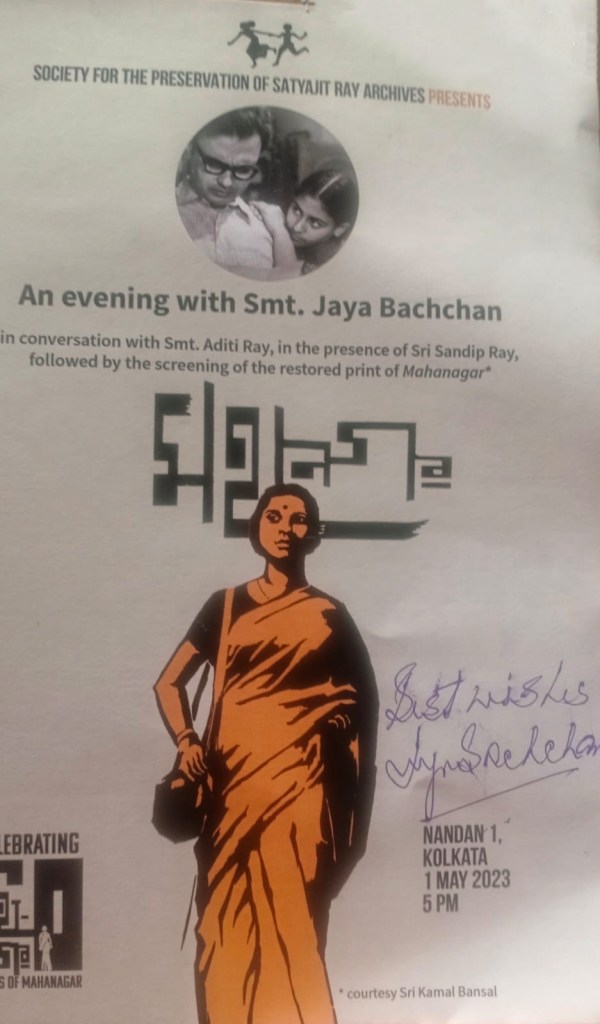
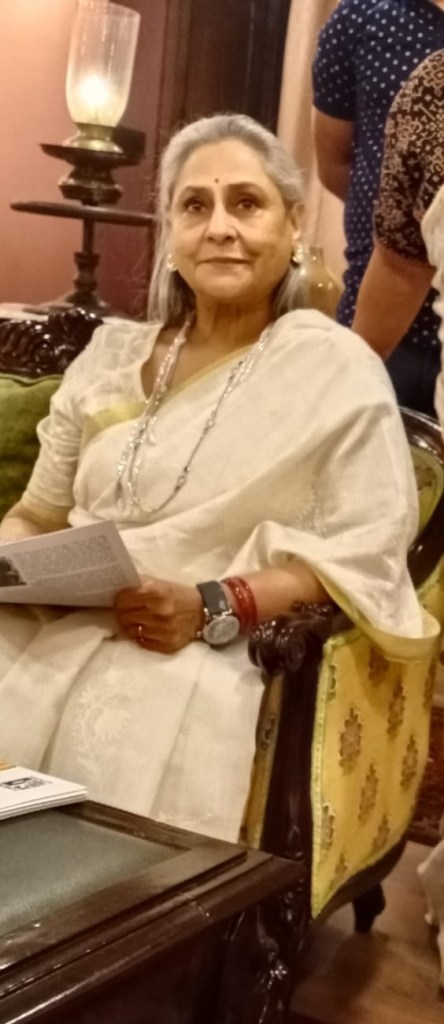
Ratnottama Sengupta time travels fifty years back as famed actress Jaya Bachchan recounts her first day on the sets of Satyajit Ray’s Mahanagar
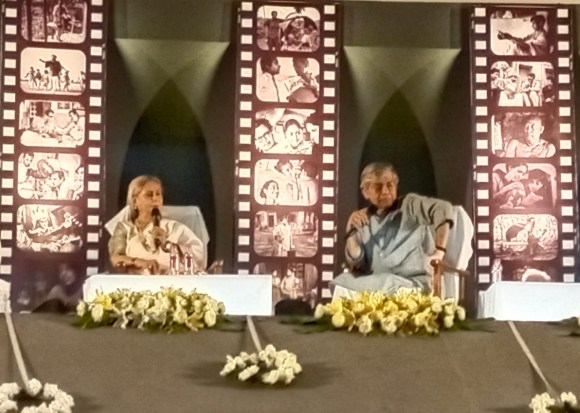
In this event, Jaya Bachchan recounts her days while acting in Satyajit Ray’s award-winning film Mahanagar or The Big City. Photo provided by Ratnottama Sengupta
When Shanti Di, my eldest aunt’s eldest daughter, had got married in 1964, she was already working. So she did not have to face the resistance Arati, the pivotal character of Mahanagar had to face from her in-laws and son. But prejudices and cryptic comments she did face — from her male colleagues. “Women in workplace? They only deprive deserving men of a livelihood,” they would say. “Because, men have to run entire households on their earnings while women work only for the ‘sauce’ — jewellery and saris!”
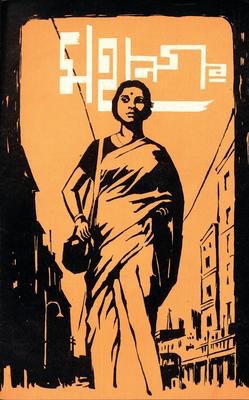
Mahanagar poster designed by Satyajit Ray. Photo provided by Ratnottama Sengupta
I remembered this at the screening of a restored print of Mahanagar (The Big City, 1963) at Nandan, the West Bengal Film Centre, to mark the 102nd birth anniversary of Satyajit Ray. Based on Narendra Mitra[1]‘s novel, Abataranika (Staircase), the film followed the trials and triumph of Arati, a housewife who steps out of the narrow domestic walls when she finds her husband Subrato bending under the weight of fending for a superannuated father, an aged mother, a school going sister, and their little boy along with themselves.
But once she starts working, she enjoys her new role of conversing with and convincing women with deep pockets to buy her products — and soon her confidence in her work grows along with her empathy with other women who are yet to be empowered like her sister-in-law, Bani, her mother-in-law, Sarojini, her Anglo Indian colleague, Edith Simmons… When her husband loses his job, Arati firmly negotiates a raise. And when Edith is fired for absence due to ill health she takes up cudgel for the ‘insult’.
The remarkable sensitivity and the eye for details with which Satyajit Ray etched the ordinary lives of a middle class family earned him the Golden Bear at the Berlin Film Festival 1964. The director’s son, Sandip Ray, remembers attending the ceremony with his parents. “Why were you not there?” a voice from the audience asked Jaya Bachchan, who was in conversation with the maestro’s son, now a renowned director in his own right. “Why would they invite me, who was just a ‘cameo artiste’ as someone mentioned this evening?”
Jaya Bachchan and Sandipt Ray conversing at the event on May 1, 2023.
Jaya Di[2] — as I am privileged to address her, much like Sandip ‘Babu’ Ray — was much more than a cameo artiste in Mahanagar. Her ‘Bani’ was a flesh and blood character as she brought to life a marriageable sister who, in my childhood and not just in Bengal, was a part and parcel of any Indian household. Bubbly, sincere, attached to her Boudi as much as to her little nephew whom she mothers when the housewife is earning the family its bread, she is pampered by her brother even as she is being trained by her mother to pick up the haata-khunti…spatula-spoon…in the kitchen!
“I distinctly remember the first day of shooting in Indrapuri Studios. It marked my debut in films. Madhabi Di and Anil Kaku were in that shot which is reproduced whenever something is written about Mahanagar. I am at the study table, trying to write something. Those days I used to wear specs when I was reading. Manik[3] Kaku must have made a mental note of that, he said, ‘Don’t take off your specs, keep them on for the shot.’ I didn’t have any dialogue for the scene. So, although I had not even been on stage before this, I didn’t feel that I was acting. The camera in front of me with Subrata Mitra behind it was not daunting. I was comfortable, just my usual self…”
Little did Jaya Bhaduri know, then, that this ‘girl-next-door’ identity would become her calling card in the years to come, storming even the glamorous boulevards of tinsel town Bollywood.
*
How did Jaya reach the sets of Mahanagar? She didn’t: Ray had sent for the girl in her teens. In all probability, she was recommended by Robi Ghosh and Sharmila Tagore. “They were shooting for Tapan Sinha’s Nirjan Saikatey (1963) when I had gone to Puri with my father, Tarun Bhaduri,” Jaya Di recounts. “We met them and on their return to Kolkata both Robi Kaku[4] and Rinku[5] Di told Manik Kaku that ‘the girl for that role (of sister) has been found at last!'”
The first time she met Ray he did not ask her anything special. Nor did he ask her to do anything particular on the set. Young Jaya was told to read her lessons aloud, which she did, just as any school going child in Bengal did half a century ago. “I remember that Baba told Jaya Di to continue reading after the camera had moved on because he wanted an audio track of her reading in the background,” Sandip recalled in the course of the conversation. “She continued to read, but suddenly there was a sound of coughing. What happened?? In reply to everyone’s anxious query she coolly replied, ‘Why? Can’t a fly wing its way into my mouth while I’m reading?'”
Jaya Di herself has no recollection of this prank, but she vividly remembers that she would pester people on the set, incessantly asking questions. She especially questioned Subrato Mitra for taking time to light up! “It was as if we were out on a picnic,” she smiles. “The entire unit indulged me like a little girl. I was very comfortable because I had no burden to carry. In the presence of major actors I was required to do very little!”
*
Jaya Bhaduri was not given any express direction — neither about how to speak her lines nor about action or emotion. She had full freedom to interpret the scene and react to the other characters. “Manik Kaku used to call all the artistes and read out all the dialogues to us. His intonation would give us an idea of what he wanted from us. We interpreted the scene according to our capacity and gave our best shot. He went about canning it, he never had any problem with my delivery.”
But lessons in acting she did learn on the sets of Mahanagar — by observing how the director groomed the lead actress. “I have seen Manik Kaku directing Madhabi Di to grow into the role of Arati. He literally groomed her in acting. ‘Look this way, through the corner of your eyes. Turn your head like this. Say it like this. Wear the sari in this manner…’ The fact is that Satyajit Ray had a strong visual sense. He envisaged how the character would look and behave at the outset, how she would change, how she would resolve her dilemmas.”
In other words, his actors were not puppets: he allowed the spontaneity of some, like Jaya; he moulded the emotive action of some, like Madhabi Mukherjee who would soon storm the silver screen as Charulata (1964).
*
“Mahanagar was a very modern film, and not just at the time it was made,” Jaya Bachchan observes. Her critique of Ray’s first urban development film gains greater weight from the fact that, in the intervening years, she has ‘grown up’. From a school girl to a trained actor. From the heartthrob of every Indian family in 1970s to the heartthrob of her ‘Lambuji[6]‘ — Amitabh Bachchan — whose charisma straddles two centuries, three generations, five continents. From a reclusive personal life to a vibrant political presence in the upper house of India’s Parliament.
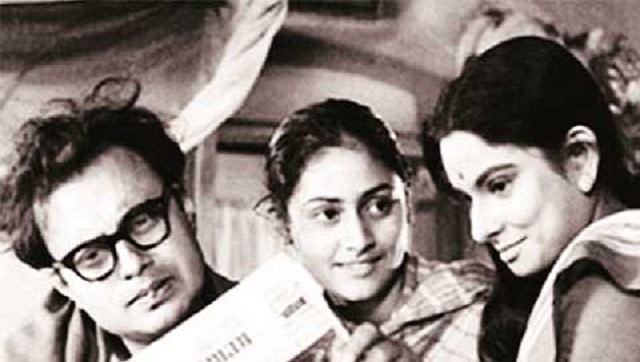
Young Jaya Bhaduri (now Jaya Bachchan) in between lead actress Madhabi Mukherjee and Anil Chatterjee. Photo provided by Ratnottama Sengupta
So let me elaborate on her observation, taking off from a scene between her and Subroto, her elder brother in Mahanagar, enacted by Anil Chatterjee.
Subrato has come home from work and his sister asks him for his pen as hers has run out of ink. He enquires when her exams are to commence, then he comments, “What use is this reading and writing? Sei toh henshel thelte hobey, you’ll end up dealing with only pots and pans!”
“Sekhaay toh,” Bani is quick to revert. “They teach us that too – it’s Domestic Science.”
That statement portrayed Ray’s attitude towards housewife. It was and still is a commentary on the identity — role — of a contemporary wife. It is in fact every woman’s attitude in contemporary India,
Jaya Di has observed: “Today every woman also has to and does work. Not only for economic reasons but for identity, purpose in life. Those who have had higher education, certainly do. Those who have not studied much, who help with housework also have such dignity. I see their confidence in the way they carry themselves. They know their mind and they don’t hesitate to say up front what work they will do and what they won’t; how much time they will apportion to a household and when they will leave. And like urban working women, they too save a little from their earnings, use some of it and keep some for emergencies.”
*
Ray’s masterstroke is seen in the way he sketched the nuances of the bank clerk husband, complete with his angst and jealousy. He is proud of his wife’s charming appearance, he is confident she can steer herself through the career of a salesgirl, he is happy when the second income flows in. Yet — and especially when he loses his job — he suffers from insecurity, jealousy, suspicion. To the extent that the man who wrote her application letters, goads her to write a resignation letter. He is redeemed by the stand he takes at the very end when she gives up her much-needed job to protest a wrong against a colleague.
Critics have found Ray to be more kind to the protagonist than Narendra Nath Mitra, the Bengali author who also penned Ras[7] (made into the Hindi film Saudagar (Trader, 1973) which again builds upon how economic realities can make or mar a marriage. About a decade later Jaya Bachchan co-starred with husband Amitabh Bachchan in Abhimaan[8](1973). In it Hrishikesh Mukherjee takes to an extreme the consequences of a husband’s ego trip when his wife fares better than him, professionally and financially.
*
Earlier Hrishikesh Mukherjee had, in Guddi (1971), given the young sister of Mahanagar a full canvas to come into her own as an actor. The same bubbly girl matures into a woman who can differentiate between love and infatuation. “After Mahanagar I was very selective. I chose to work only with directors who had a ‘Bengali’ sensibility,” Jaya Di says without a hint of hesitation.
And the rapport she struck with Ray? It lasted a lifetime. When she joined the Film and Television Institute of India (FTII) she asked her Manik Kaku for a letter of commendation to go with her biodata. He wrote back saying that she doesn’t need an institute but join it, “it is the place for you”.
She went thinking she would not last beyond a few months but with batchmates like Anil Dhawan, her co-star in Piya Ka Ghar (1972), and Danny Denzongpa, she stayed the full course. “And when Manik Kaku came with the print of Goopy Gyne Bagha Byne (1969), I felt so proud! I went to the airport to pick him up!”
That bonding would show every time they were in each other’s vicinity, Sandip Ray reiterates. “Once we were in Bombay and Baba stepped out of the Taj Mahal Hotel to leaf through books in the stall just outside. Suddenly a shrill voice screamed, ‘Manik Kakuuu!’ Jaya Di was passing by in her car and had spotted him!” “And I hugged him!” Jaya Di adds, “I took liberties others would hesitate to.”
So why was she was not seen in his films again? “There were talks of casting me in Pratidwandi (1970) opposite Dhritiman Chatterjee,” Jaya recalls, “but I was in FTII then. Later I accosted him for not giving me a thought (for the role) – ‘You could have at least called me!’ His reply? ‘It was not necessary.’ That’s all!
“As if to add insult to injury, Manik Kaku got Amitji to do the voice over for Shatranj Ke Khilari (The Chess Players, 1977) but a role for me? No! I was so angry I went and met him in Rajkamal Studio. His reply? ‘ Ha ha ha…’ Not a word more.”
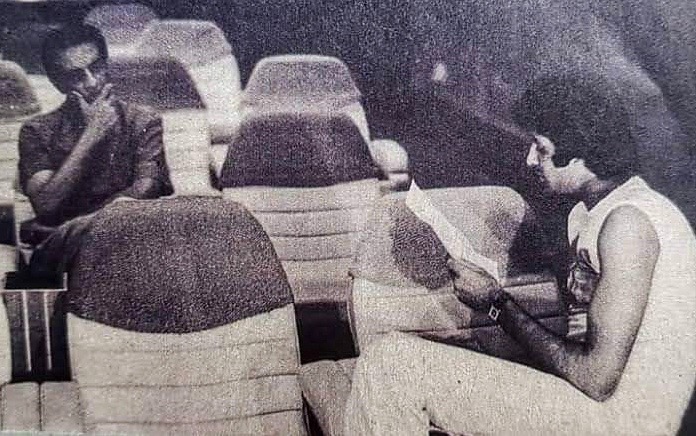
Amitabh Bachchan doing the voice over for Satyajit Ray in Shatranj Ke Khilari. Picture from Bachchan’s FB, provided by Ratnottama Sengupta.
That did not stop Jaya Bachchan from going to Bishop Lefroy Road every time she happened to be in Kolkata. She had, after all, seen the films the ‘Towering Inferno’ made even before Mahanagar. “Every time I watched a film by Ray I felt this is his best. Until the next one came along…” So, when Charulata came, Mahanagar paled. But wait, to this day Debi (The Goddess, 1960) continues to haunt Jaya Bachchan.
And to think that, when Ray had sent for her, the young girl growing up in Bhopal was beset with doubt and hesitation. “I was studying in a convent school, and I feared that the nuns would disapprove of my acting in a film. But my father said, ‘It’s the opportunity of a lifetime — don’t let go of it.'”
Cut to the convent when she went back after Mahanagar. The same austere nuns came and said, ” ‘You have acted in a Satyajit Ray film?! You are so lucky!!’ That is when I first realised, even before he was crowned in Berlin, what a major director my Manik Kaku was!”
Jaya Bachchan on 1/5/2023. Photo provided by Ratnottama Sengupta
Ratnottama Sengupta, formerly Arts Editor of The Times of India, teaches mass communication and film appreciation, curates film festivals and art exhibitions, and translates and write books. She has been a member of CBFC, served on the National Film Awards jury and has herself won a National Award.
.
PLEASE NOTE: ARTICLES CAN ONLY BE REPRODUCED IN OTHER SITES WITH DUE ACKNOWLEDGEMENT TO BORDERLESS JOURNAL
I watched the pregnant moon melt – a pearly blob
in the pulp of my onyx sleeplessness.
As I tossed and turned on the bed,
She played peek-a-boo through the lush filigree
of the wishing tree outside my window,
mocking my naivete, scorning at the maelstrom
ripping through my jilted heart.

I invited her to a late-night cognac.
She accepted, scattering her uppity sparkle
on the blistered walls and cracked floors
of my restless atelier -- with eavesdropping walls
and kitschy souvenirs, carrying the dust of sterile memories.

We clinked the crystals and raised a toast,
I, to my wasted sepia breath and moribund yen,
She, to her borrowed sheen and waning arc.
The clouds waved and the stars smiled but half.
We laid out our picnic basket on the leaden sky --
One, with the whiff of stale desire, and a taste of dementia,
A one-pot meal of life’s battle scars
Slow cooked on the embers of pain, love and loss.

Then the tired moon yawned and tucked herself to sleep
As I slid under the duvet of half-crocheted, gossamer dreams,
High on life…drunk on hope…a dandelion
amidst the rubble of my being.
Urmi Chakravorty is an educator whose articles, stories and poems have found space in The Hindu, The Times of India, multiple social and literary platforms and anthologies.
.
PLEASE NOTE: ARTICLES CAN ONLY BE REPRODUCED IN OTHER SITES WITH DUE ACKNOWLEDGEMENT TO BORDERLESS JOURNAL
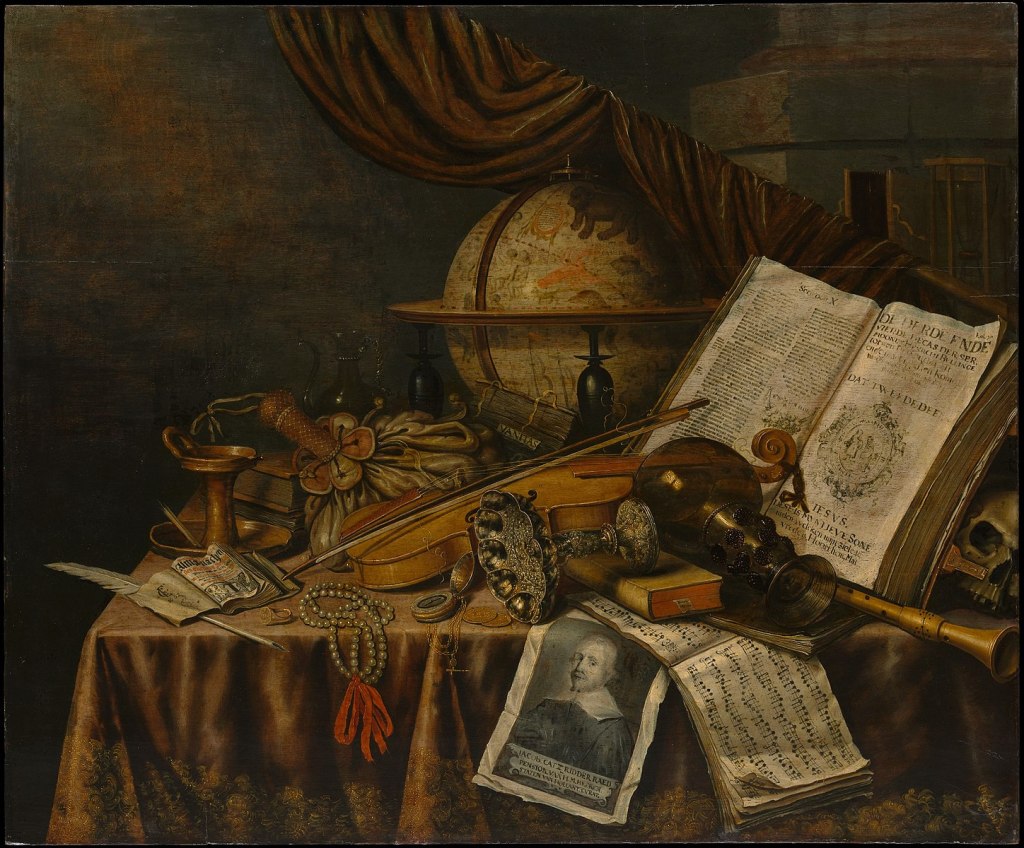
Vanitas Still Life, painting by Evert Collier(1640 –1708). Courtesy: Creative Commons
Back home in Madrid, having abandoned Adamov Plut to his posthumous fate, I was a bit surprised that neither the New York Times nor the Washington Post reported anything about the murder, not even a paragraph, or as the French so imagitively put it, an entre-filet ! I soon realised, due to this journalistic silence, that the time had come for me to give a full account of my relation to Mr Plut ; that the time had come for me to expose, publicly, by way of this revelation, his ‘mysterious murder’.
My information is of the surest sources for the simple reason that it was I who had Mr Plut murdered ! Yes, I ! And for reasons that shall be shortly disclosed. A mysterious man he might have been; however, his methods of acquiring priceless books and other inestimable valuables can hardly be called mysterious: Mr Plut was a vulgar thief, a scoundrel, an ingenious trickster whose singular flair caused much grief to many individuals, enraged those whose trust had been flouted.
It was in Istanbul, where I was invited to sojourn with an Armenian merchant, that I witnessed Mr Plut’s dupery. And if my naive friend fell for his crooked smile, I certainly didn’t swallow his high tale of returning to pay him for the two illuminated manuscripts my friend had graciously offered the blighter on condition that he be held accountable for them. His thick, coarse lips translated a smile that held contempt and disdain towards those who trusted him. So infuriated and insulted did I feel on behalf of my friend that that I reacted on a lightning urge and decided to follow him. I said nothing of this to my disbelieving companion, but left immediately in pursuit of my game — and game it was — for I, to tell the truth, had nothing more substantial to do at the moment and felt disposed for a good hunt.
I said that Mr Plut was a genius. Yes, in his own way. However, genius has its limitations. His arrogance and haughtiness knew no bounds, although he knew that his foul doings had attracted the attention of police and Interpol. Some may surmise that a certain paranoia drove him to invent individuals tracking him down like a wild boar or moose. No, no one was tracking him down except me, and that as subtlety as possible. In Uzbekistan, I actually chatted with him over a cup of coffee on two occasions disguised as a professor of Slavic philology, dressed in a quilted chapan robe and silk embroidered tubeteyka cap. There we sat in Samarkand, sipping our thick beverages in the vaulted bazaar at one of the storied cafés that dot the town. He was all smiles, obsequious and gold-toothed. I had the impression that I was dealing with a child or a mentally-dwarfed man whose sense of reality lacked all discernment or sagacity. I concluded that he had come into quite a bit of money, and never having had to work for a livelihood, traipsed about the world at his leisure, buying or stealing books, cheating people out of their invaluable collections. So self-indulgent and confident was he that he never saw through my masquerade as we conversed in broken Russian.
It was at that café where I learned about his fabulous treasure, as he called his book hoard. Only an idiot would have divulged this information to a perfect stranger, but as I said, Mr Plut’s contemptible demeanour caused him to fall into the most infantile traps. Traps that I began laying out for him, and that would lead to his downfall. For I had begun to design my own plan to relieve the rogue of his fabulous possessions, all the more so since he also let slip that his parents had passed away, and he had inherited the house. How I would make his treasure mine and ‘disinherit’ the owner still remained vague in my mind.
We departed as ‘friends’, as two strangers seeking an answer to the mystery of their existence. Or so I made him believe. Mr Plut appeared to me a dying species, a worldly aesthete, in spite of his extreme vulgarity and ponderous gait, whose debonair demeanour masked a loathing for his victims, a bent for the lowest duplicity, a gratification in spinning the most treacherous stratagems in order to allay his desire to prevail.
Mr Plut slipped out of Uzbekistan without my knowing it. He probably used his Russian passport, one of the four of five in his possession. I felt a twinge of misgiving. Had the fat fellow got on to me? After many enquiries, I finally discovered that he had crossed into China at the Xinjiang border, and was hastening towards the Yunnan. Why ? I hadn’t the faintest idea …
His brief sojourn in the town of Lijiang enabled me to catch up with him. My Chinese was fluent enough not only to query his whereabouts in that lovely town, but more important still, to learn of his new ‘purchases’, once I had questioned the director of the Dongba Museum of Culture. Mr Plut had planned to gone there to acquire several Naxi pictographic sacred books, which he did from a rather corrupt priest with whom he had been corresponding for some time, using a special code so as not to be unmasked by the Chinese authorities of the Centre. The director only learned of this a week after the unlawful negotiations had occurred, and three or four very valuable Dongba liturgical books had been stolen. It goes without saying that the rapacious priest was severely punished.
I immediately left Lijiang much to my displeasure for it was indeed a quiet, pleasant place, and set out in hot pursuit of the marauder. I followed his all too familiar scent through Nepal into North-western India to the Zanskar region where he put up for a while at the Phuktal Gompa[1], a strange spot to make a halt. But a perfect hideout to gain time in order for planning his next move, whilst at the same time inveigling in the most repulsive manner his generous hosts.
The monastery is nestled in the most remotest of valleys, ensconced within a cliff of tuft of fairy chimneys, crags and honey-combed spires which bulge black and red against the background of sandy, dazzling ash and cinerous tones of hemp. I had trekked there from Lamayuru in twenty days, and as I was to learn, Mr Plut had arrived there three days ahead of me, but by way of Padum. To gain the main entrance of the gompa, the pilgrim had to climb a steep path, keeping his or her right shoulder to the seventeen chortens[2] that mark the steep climb towards the vaulted entrance. I had shaved my head, grown a long beard and donned a woollen chuba tightened around my waist with a long colourful sash. It kept me warm, for in spite of it being Summer, the nights were very cold, and my cell had only a small wood-burning stove to keep me warm.
I spent three weeks at the monastery, sleeping on a ratten matting, eating skieu, tsampa and chappatti, drinking steaming salt-buttered tea off a chopsey — a low, small table — reading or gazing out of the little window that offered me a full view of the dusty, treeless courtyard below, where monks would mutter their mantras, and beyond into soundless nights whose stars were generally veiled.
Without Mr Plut’s slightest suspicions, I assisted at all the ceremonies, mornings and evenings, even vigils, while in the afternoon, I would venture out into the monastic complex, twisting and turning in the warren of lanes, under the low archways and high ladders, at times pursuing my promenades upon the rather precipitous mountain paths. As to Mr Plut, he hardly left his cell, and when we did cross paths, he most probably took me for a Buddhist pilgrim. Once or twice I sat near him in the prayer hall in the meditation grotto, but he never attempted to communicate with me, albeit he did not seem very deep in prayer or contemplation. He was probably scheming his next miserable move. His face had become terribly pale and flabby. His darting, black eyes seemed to have sunk deeper into their sockets. Unable to sit cross-legged on the low benches at the back of the prayer hall, he sat ‘western style’, staring off into the clusters of chanting monks, tilting his huge, bobbing head every so often to the banging drums, blowing ox-horns and tinkling triangles. Observing him from afar, I sought to sound his soul, to wring out his innermost thoughts, to extract from his evident lassitude and apathy his flight from both his victims and himself. But Mr Plut was a sphinx. Would he rise out of his own ashes when his hour came ?
I left the good monks three days after his departure, a hasty one indeed. And they were furious! The scoundrel had stolen several pustuks[3] and thangkas, and failed to pay for the prayer masks that he ‘purchased’. They implored me to find the culprit, inform the police and recover their stolen property. It was perhaps the beseeching words of the infuriated monks, after having received such incomparable hospitality from them, that my plans to have the thief killed began to germinate ! The theft was not only gratuitous, it exposed the very ugliness of the man’s heart, blackened by greed, cynicism and remorselessness. It would only be a matter of time before he tasted a soupçon of his own medicine.
Meanwhile the cat would play with the mouse, a rather fat mouse at that ! I boarded the cargo ship that took the fugitive from Karachi to Oakland via Japan. On the long, monotonous voyage across the Pacific, my ominous shadow crossed his at the most unsuspecting moments. Attired as a Pashtun merchant, bearded, long-haired and turbaned, Mr Plut sensed an onerous presence whenever he laboriously carried his huge body across the decks. How many times had my eyes penetrated his anguish, his torment, his pangs, not of compunction, but of incomprehension. He scented a sleepless menace pressing him. Fear inflamed his dark, beady, mirthless eyes like the burning incision of the trenchant knife.
Oakland … Sacramento … Reno … Tombstone … Boulder … Santa Fe … Saint Louis … Chicago … New Orleans … Birmingham … Miami … Atlanta and finally New York. Yes, New York, where the curtains would finally fall on this tragic fat figure. Where upon the stage of 8 million walk-ons, and against the backdrop of the grottiest of hotels, the last act of Mr Plut’s abominable performance would be played out.
His infatuation with Louis Wolfson amused me, as well as his grandiose project to write twelve stories in twelve different languages signed by twelve different authors. I found all this quite pompous and pathetic. A real exercise in self-indulgence to say the least. All this information I culled when I ‘accidentally’ met him in the ill-lit corridor of that hotel on Water street in downtown Manhattan. In New York, I played the role of a French researcher in mediaeval literature, a field that he completely ignored, in spite of possessing several manuscripts of Anglo-Norman stamp, apparently purchased (so he said ?) from a London book-seller. I pretended to be interested, taking the opportunity to study him closely. Besides, he was such an inveterate liar how could one believe anything he said ? He lied to curry favour and win confidence, only to swindle and steal from the naive and simple-hearted. Better to observe his eyes, his gestures, his bouncing from one tongue to another. These were all genuine signs of his distorted psychological make-up. To play my part well, I sported an immaculate white suit, orange tie, a pair of silver-rimmed glasses and spanking new alligator shoes. I had shaved my beard and moustache and had my hair cut very short, leaving a few gossamer wisps which touched the tips of my ears and fell bouncily on my forehead.
Every day I followed his Humpty Dumpty gait as he waddled to and from the public library, in and out of Central Park. And it was there, in Central Park, that I noted two blond-haired rough fellows slouching on a bench, eating the remains of fried chips or chicken sandwiches, cursing and making gross signs at the passers-by, drinking beer and spitting. They were seated at the same bench daily — the bench that Mr Plut walked by every day. They seemed to know him because they would hoot at him, call him names and ask for money. Fatso passed by without even a glance at them.
One Saturday, I decided to approach the two ruffians. They sized me up with obvious contempt, and made it perfectly clear that I was intruding on their ‘territory’. I sat down none the less, and exposed my scheme to be rid of Mr Plut once and for all, explaining how the culprit had cheated and robbed so many people. The two burly blokes, former marines in the Green Beret (or so they vaunted!) listened attentively as I unfolded my plan: Three thousand dollars for each if they would simply walk up to his room in the early morning hours, the night porter always being asleep, knock at his door and kill him, however, without any blood shed or theft of his belongings. It must be a murder without reason, without any sign of bestial violence. One of them suggested strangulation. Yes, excellent idea. It would thus be a ‘clean’ murder.
And so it was, very professional at that I must say. They were paid off, as agreed. And I left New York two days later, as planned, a very satisfied man indeed …
This all happened five years ago. Now … well, here is where my account ends and my confession begins. For you see, Mr Plut was never really murdered ! Those two ‘ruffians’ were in fact F.B.I. agents who had been trailing me since disembarking in California. To tell the truth, Interpol and local police had been following me since the Istanbul affair. How and why they began doing so I cannot say. During my trial neither the judge nor the prosecuting attorney afforded any information as how the F.B.I. learnt of my scheme, nor why they had decided, at one point in time, to cooperate with Plut. What was I convicted of ? What was my indictment ? As to my appointed lawyer, a young short-sighted clerk more than a seasoned lawyer, who could be easily cajoled by the ‘evidence’ against me, pliantly manipulated by the prosecutor, after he had taken the floor and had made an absolute fool of himself. He let out a sigh of relief when the judge pronounced a sentence of fifteen years instead of twenty-five! The wigged judge, a grotesque figure studded with huge warts, yawned throughout my lawyer’s deplorable speech for the defense, as well as during my feeble plea. There was no jury either to lament or to applaud his verdict. It was a trial held at ‘huis clos’[4], military style. I buried my face in my hands. As expected, my lawyer made no effort to appeal.
Had Plut sensed my innermost aversion towards him ? Or seen through my many disguises ? He was a clever man, and probably had hired detectives to learn why I was following him. The hotel room murder was staged. Plut lay recumbent on the floor, waiting for me to steal his papers so that I would be indicted for premeditated murder (although there was no murder!), of paying off hoodlums to commit this murder (although they were F.B.I. agents!) and the theft, which indeed it was (but fifteen years for that?) of his household papers, keys, and other official documents concerning his inheritance … and that vile short story of his.
So here I sit in my rancid smelling cell in Madrid, having been arrested at the aeroport on my arrival some five years ago, writing out this confession. I do not to repent mind you, I have no intention of atoning for my doings, nor avowing my sins. These words wrenched from my pen seek to vent the animosity and hatred I harbour towards that fat impostor who had the cheek to write me a letter from the Seychelles revealing how he had got on to me since Uzbekistan, and how our little cat and mouse game had amused him greatly : “You thought me a fool, deary, but I sawthrough your pusillanimous scheme in Samarkand ; that was some outfit, but you forgot the galoshes ! Not to mention your pilgrim weeds at Phuktal which truly charmed me, and your blazing orange tie in New York. Come, come, what French professor would ever sport an orange tie with a badly tailored, cheap white suit ?” The vicious irony underlining these sentences, along with a soupçon of cynicism caused me to gag. The blighter added in a post-script that he had sold all his books for a fabulous sum of money, and had retired from the world’s wearisome fair. In the envelope I found a photo of him sipping coconut juice, lying on the golden sands of a crescent-shaped beach under groves of swaying palm trees and an indigo blue sky. I laughed bitterly, and yet, in spite of my nettled nerves, pinned up the blasted photo in my lonely cell, a sort of souvenir of our enshrouded relationship …
One day at the prison library, browsing idly through a dull, detective story, I thought of Plut’s or Hilarius Eremita’s story The Enchanted Garden, which I had taken and read to amuse myself on the aeroplane to Buenos Aires. Had anyone ever published such ridiculous trash? To my horror, the answer came three days later whilst I rummaged through a new batch of literary magazines, some of which contained short stories in English, French and German. And there it was — The Enchanted Garden, by Hilarius Eremita, Plut’s pen name. I couldn’t believe my eyes — someone had published that rubbish ! Plut indeed had the last laugh, adding insult to injury, salt to my festering wounds.
I savagely tore out the pages of his story from the magazine, went to the toilet, ripped them into tiny pieces and flushed the filth down the bowl. So much for hiss ‘first of the twelve’ ! I shan’t be punished for it, no inmate in this prison reads any language besides Spanish, and that with a dictionary … I’m sure it was Plut who sent me that magazine to drive the knife deeper into my wounded pride. The miserable rat !
So here I sit at my iron table, staring at Plut’s photo as he sips his coconut drink under the blue skies and swaying palm trees whilst I sip my wretched thin noodle soup with strips of hard, nervy beef under a cracked, peeling, dirty grey prison ceiling …
[2] The Tibetan word for stûpa, a Buddist shrine which initially housed the relics of the Buddha.
[3] Books used for Buddhist ceremonies written in Tibetan.
[4] Behind closed door without any public participation or observers. It is a French legal term.
Paul Mirabile is a retired professor of philology now living in France. He has published mostly academic works centred on philology, history, pedagogy and religion. He has also published stories of his travels throughout Asia, where he spent thirty years.
.
PLEASE NOTE: ARTICLES CAN ONLY BE REPRODUCED IN OTHER SITES WITH DUE ACKNOWLEDGEMENT TO BORDERLESS JOURNAL





 Borderless