Categories
Essay

A Different Persuasion: On Jane Austen’s Novels & their Adaptations

By Deepa Onkar

Recently, a realisation dawned – it has been over a year since I have watched an adaptation of a Jane Austen novel as a film or television series. My earliest memories of watching them go back to 1995, when the BBC’s version of Pride and Prejudice was released – I would watch the DVDs, or episodes on YouTube, with some enthusiasm. Over the years, I didn’t lose a chance to watch others: Sense and Sensibility, (film), Emma (BBC television series) Pride and Prejudice (film) and so many others. Looking at the comments on YouTube, it was evident that the Jane Austen adaptation fandom was large, and on a global scale. The seamless way in which the adaptations were consumed in so many Indian homes, including mine, puzzled me. I was familiar with the novels, as I had been a student of English literature in postcolonial departments in India, but that could not be true of so many others.

I fretted about the fact that my literary moorings were not so much in my own mother-tongues, but in English. Middle-class India was forgetting its own languages. English has crept in slowly, unnoticed. We could of course, think like Chinua Achebe, the Nigerian novelist, for whom writing about our own cultural contexts, our histories, landscapes, and memories in English, changes the texture of that language, and diminishes its colonizing weight. It is also the attitude, conscious or unconscious, of so many Indian writers in English. Curiously not many Indian producers have picked up on the idea of serializing the novels of these writers – either in English or in an Indian translation – which should be easy to do. It was the BBC that first produced an Indian novel – Vikram Seth’s novel, A Suitable Boy as a television series (for a global audience).  

The Kenyan writer Ngugi wa Thiong’o has a much more radical perspective than Achebe – that it is not enough for people in previously colonised cultures to write in English, nor to claim it as their own. The very process by which English was acquired was violent and repressive. “(So) wherever you look at modern colonialism, the acquisition of the language of the coloniser was based on the death of the languages of the colonised. So it is a war zone.” Unless previously colonised cultures begin to train to think in their mother tongues again, he says, we will never really be able to shake off the mantle of colonisation.

This is a compelling, if daunting prospect – the work of decolonizing our minds perhaps begins within the education system which, in India, shows little inclination to change – it continues to lie in the shadows of the Anglo-American system, as it has for centuries. I draw comfort from Achebe’s attitude to English, which is the reality of many Indians. I don’t have to give up on Austen. But how do we rescue ourselves, and Austen? A critical and self-aware engagement with Austen – both the novels and the adaptations – seems to be a good place to begin. Reading Austen is arduous for those not born into English: I could hear my mother tongues tiptoe away as I read her. Reading is a solitary activity that connects us with the worlds of others, through the imagination. Watching an adaptation, on the other hand, can be solitary, or not. The visual text communicates through the senses rather than the imagination, although it does not mean it is not involved here.

It was not difficult to identify signs of England’s colonial links in either Austen’s novels, or the adaptations. Distant colonies such as the Caribbean and India were mentioned not infrequently in the novels: much of the income of the vast estates owned by the gentry was obtained from the colonies. Watching BBC’s Pride and Prejudice – and not for the first time – I spotted the tea, drunk in fine cups, the cigars that the men smoked, the cotton print dresses that women wore. I mentioned to a friend that some of the fabrics looked like the double-shaded handloom weaves from Andhra Pradesh, or Tamil Nadu. She agreed. Sometimes, the dresses also had paisley designs – these hugely popular prints were adaptations of Mughal mango motifs on textile. We, the global audience, need to train our gaze to the material roots of the English imagination, and be critical of it, rather than unreflectively consume its creations. Scenes of opulent country manors would appear repeatedly in many of the adaptations, and it was hard not to notice a kind of nostalgia for the glories of Empire. So much of the popularity of the adaptations seemed to be the result of clever packaging of Regency era settings and countryside.

Even as the lavish settings seemed to engulf Austen’s ingenious stories at times, a great deal of effort went into modernizing them. When Colin Firth came striding out of the lake in dripping wet shirt in 1995, the scene seemed to set the tone for other serials and films to become more inventive – as long as it created a stir. Almost every adaptation slipped in new scenes to suit their own narrative. They brought about a kind of visual cohesiveness to the series or films. Informal and relaxed body language, and facial expressions, and the manner in which emotions were expressed were adopted – rather than the stiff, stylized ways of the past. What we watched on screen was a hybrid text. I had no problem with this, unlike many die-hard Jane-ites the world over, who are perhaps purists at heart. Modern informality is, after all, a sign that the boundaries of class have become less rigid.  

When Austen’s world in the novel became too distant, and removed from my own, I would turn to the adaptations. They became relatable on screen. Besides, the adaptations were open to emotional expressiveness, where in the novels, emotions are sub-textual: I have lost count of the number of times I watched Elizabeth Bennett’s (Jennifer Ehle) fiery rejection of Darcy (Colin Firth) in Pride and Prejudice (1995, mini-series) or Elinor Dashwood (Emma Thomson) fall in love with Edward Ferras (Hugh Grant) in Sense and Sensibility (1995, film).

One of the main features of modernisation is the highlighting of the romantic plot. Love, is of course, central to Austen’s concerns, but on screen, it is difficult to see the larger moral order of which it was a part. Often, the biggest obstacle on the individual’s path to win over the object of their love is a moral flaw within themselves. Instead of Austen’s ironic, witty voice showing us the complexities of the individual, and of their interactions with society, we have to rely a lot on dialogue, and the point of view of the main character. Rather than the multiple layers of narrative in a novel, we have a linear effect in an adaptation. Everything is propelled towards a rather sentimental ‘happily ever after,’ which is not necessarily the point of a Jane Austen novel.

We do not – perhaps cannot – get to know the thoughts of Elizabeth Bennett or Elinor Dashwood on screen, independently of others. If emotions were more readily expressed on screen, we also had to contend with the loss of inner worlds, which a reader has access to. Action is all-important in an adaptation. The expression of physicality was thought to be enough to drive it, making up for our inability to know anything else. This seems to be the view of Andrew Davies, one of the most prolific adapters of Austen to the television screen. According to him, sexuality was already a major driver of the novels – his only task was to flesh it out. “Don’t be afraid (to represent) physicality… these are young people full of hormones and they are bursting with energy,” he says, when asked for pointers on adaptation.

In the novels, we also see how a character is separated from, or unable to communicate with the object of their love, until a morally satisfying solution is found. In Pride and Prejudice, Mr. Wickham’s true character had to be exposed, and Elizabeth could overcome her pride, and could accept that Mr. Darcy was right. In Emma, the eponymous heroine had much to learn in order to fully grow up: to be more self-aware and free from vanity, and realize she loved Mr. Knightley. Austen’s dislike of melodrama and writing that was overly invested in emotion is well-known. And so, it seems logical to think that she would not have liked mere ‘feel-good’ romanticism in the productions of her writings.

Morality as a force was more vivid on the page rather than the screen. It was arguably, an imaginatively constructed entity that was contemporaneous with the white man’s burden of colonization. Austen’s depictions of the world she lived in make her a ‘quintessentially English’ writer that is difficult for others to understand. But over the years, I learnt to understand her from my vantage point in post coloniality – the world is constituted of multiple identities and historical contexts, and being curious and open about others is a reasonable way of engaging with my own existential and sociological identities. 

Austen was an insider to her world – she deferred to the fact that women were very dependent on male approval and protection in order to survive. Most of the women in her novels were teenagers when they began their rounds of courtship, and often subjected to severe scrutiny by the world at large. But her women also used wit and rationality to make themselves seen and heard. Elizabeth Bennett (Pride and Prejudice) and Emma Woodhouse, (Emma) for example, challenged the existing model of the ‘superior,’ rational man.

Within the psychological worlds of men and women, Austen sought to describe the play of feeling, will and reason. Post-feminist critiques of Austen have been critical of her acceptance of these opposites and their implied gendered roles. Many adaptations exist, such as Lost in Austen, Pride and Prejudice Zombies, that satirize and parody Austen to a degree that ‘faithful’ adaptations do not aspire to. The comparisons and defenses could go on.

After years of reading Austen, my sympathies have recently begun to shift, imperceptibly – from the ‘wild and rational’ women of Austen’s novels, as Mary Wollestonecraft might have described them, to the quiet and introspective ones – more precisely, to Anne of Persuasion. Austen’s final novel seems to have achieved an introspective appeal that the other novels lacked. Anne’s deeply reflective and melancholic acceptance of her situation – a single woman stranded amidst a family that often exploited her situation – is the culmination of all of Austen’s literary prowess, and she herself seems to be on new ground as she explored Anne’s silences. A little into the novel, when she meets Captain Wentworth after eight years, there is some halting dialogue, as Anne comes to terms with her lost love, perhaps for the millionth time. Through these silences and halting dialogues, Austen seems to be testing the waters of what it means to be deeply self-aware. I’ve also read the dialogues to be a way in which words could be used to establish equality between them. It is through friendship that an egalitarianism of sorts is reached, that grows only gradually in strength.

The 2007 film adaptation of Persuasion portrayed the silences and the hesitant relationship between Anne and Wentworth admirably. It is difficult to portray interior worlds effectively on screen, and Sally Hawkins played the brooding, inconsolable Anne sensitively, particularly in the early scenes. Rupert Penry-Jones was striking as the embittered Captain Wentworth, seeking love elsewhere. The tension in their silences was palpably thick.

The letter Wentworth writes to Anne — “I am half-agony, half hope” — is a study in vulnerability: he is the flawed man who has to let go of his own stubborn refusal to acknowledge his feelings. The letter also indicates the difficulty of speech between them; writing is his only recourse. Men’s points of view are rarely presented in the novels. The adaptations turned this around – nearly all of the men have moments of vulnerability. This is a major breakthrough in modernization. Women all over the globe suddenly came upon visible evidence formen’s struggles with their feelings. This single factor alone, may be the reason for the huge popularity of the adaptations – men suddenly, were human and relatable.

When I learnt in 2022 of Netflix’s release of a new version of Persuasion, I began to watch it excitedly. But only a few moments in, I was sorely disappointed. The character of Anne (played by Dakota Johnson) was nothing like Austen’s – she was talkative and answered back. The key shortcoming of the film was the loss of Anne’s interior world.  When Anne and Wentworth (played by Cosmo Jarvis) meet, in the film, they engage in banter, from their very first meeting. Nothing much is left unsaid.  The absence of speech between Anne and Wentworth, which gives rise to one of the main tensions of the novel, and the earlier adaptation, is completely missing. They have finished saying a lot to each other in the very beginning. We cannot help wishing they hadn’t. Many of the characters were changed beyond recognition, and the sense of many scenes changed.

We know, early on, what the end is going to be. Austen plays words out in the final letter not coldly, but without a trace of extra emotion — that Wentworth’s maudlin show of tears were not for her. Perhaps, that was the final straw that drove me away from the film. I have not gone back to watching a film or adaptation after that. Something within me had died.

References

Language is a ‘war zone’: Conversation with Ngugi wa Thiong’o, The Nation, Rohit Inani, March 9, 2018

Adapting Emma for the 21st century:  An Emma no one will like; Laurie Kaplan, Jane Austen Society of North America (JASNA) V.30, no.1, (Winter 2009)

How to adapt Jane Austen to the screen, with Andrew Davies: Guardian Culture, YouTube, 2018

.

Deepa Onkar has degrees in English Literature from the Universities of Madras and Hyderabad, India. She was a teacher at Krishnamurti schools in Bangalore and Chennai, India, and a journalist at The Hindu. Her articles and poems have appeared in The Hindu, Punch magazine, The Bombay Literary Magazine, and The Lake, among others. 

.

PLEASE NOTE: ARTICLES CAN ONLY BE REPRODUCED IN OTHER SITES WITH DUE ACKNOWLEDGEMENT TO BORDERLESS JOURNAL

Click here to access the Borderless anthology, Monalisa No Longer Smiles

Click here to access Monalisa No Longer Smiles on Kindle Amazon International

Categories
Poetry

Dangerous Coexistence

Poetry and translation from Korean by Ihlwha Choi

In an Indian Santiniketan guesthouse,
I swatted a buzzing mosquito with my palm,
But it seems I hit the mosquito's back instead.
Startled, it hurriedly flew away.

On a summer night in Seoul,
A single mosquito is scouting my room with its buzzing wings.
I struck it with the fan I had,
Like a roof being blown away by a tornado,
The mosquito spiralled and shot up towards the ceiling.

Even after the fan's breeze subsided for quite some time,
It still seems not quite in its senses,
Continuing to buzz around every nook and cranny of the ceiling.

This mosquito is engaged in a dangerous coexistence,
I wonder if it has stockpiled emergency rations other than humans!

Ihlwha Choi is a South Korean poet. He has published multiple poetry collections, such as Until the Time When Our Love will Flourish, The Color of Time, His Song and The Last Rehearsal.

.

PLEASE NOTE: ARTICLES CAN ONLY BE REPRODUCED IN OTHER SITES WITH DUE ACKNOWLEDGEMENT TO BORDERLESS JOURNAL. 

Click here to access the Borderless anthology, Monalisa No Longer Smiles

Click here to access Monalisa No Longer Smiles on Kindle Amazon International

Categories
Stories

The Vagrant

By Reeti Jamil

The last thin strand of sunlight fades to reveal a murky gloom across the marshland. Nearby is the village enclosed by ponds, fens and the woods. Gardens of peonies and tulips are still prolific, though tinged with gray. The place I remember, but the people?

They are not there. The village I remember – an ancient vestige of my past: the crops I harvested, and the canines that accompanied me as I reaped the potatoes, tomatoes and the wheat that bore our appetite and supplied us with a little amount of wealth; there were the clouds that shielded me from the heat’s spite and poured down the sweet, saccharine rain (how I would lick my lips to feel the water wash over me) … and the people however, they seem lost to me. I had never been a wise man or an educated one either. But the Lord had blessed me with nature’s benevolence that nourished me through my life. I was a farmer, after all.

I was also a widowed father with a brood of five grown children whose mother passed away long ago from the onset of… no, not tuberculosis… not from a deadly flu… not pneumonia either… from the winter mornings when we had woken up together. She had died, in fact, in the hands of fate. I suppose it was my destiny to meet her and lose her. There she was buried uphill at the communal cemetery. I could see the tombstones elongating their heads and mocking at me amidst the dispersing plumes of fog. Albeit only a pauper’s wife, she showed aptitude for everything she cared for– cooking, farming, assisting her old husband and preparing clothes for her children. (She sewed them herself by working at midnights and would sleep little.) Moreover, she nursed our children to good health. When I called, she obeyed and came to me. There was, I think, love in her eyes. She was innocuously at my side. I could never reproach her. I reproached her for only leaving me. People asked, “Why did you reproach her when she was alive and servile to you?”

Later, I would lose my temper when someone uttered her name, “Alia… Alia was a darling to us all.” She was my darling! One day, my youngest child Anita inquired, “Can you describe what our mother looked like? I cannot recall her, and you have never owned a photograph of hers.” I responded to this innocent query with mere silence.

There was my failure. How could I describe Alia? I had delineated her characteristics in the mould of a farmer’s wife. We lived through three decades of marriage together. And yet, I failed to recall her appearance. How could I eulogise about my wife when her memory evades me! In my aching despair, I realised I could not remember how she died.

And what did she look like? I know she had no halo. Her mien, her physique, gait and grace must have had some impact on me. But they were all lost to me like a pristine scent thinning and dissipating! How can something as impalpable as a scent be captured for eternity? She was that scent for too brief a time to be fully appreciated.

I could proudly and yet painfully recollect she certainly cared for me and that was what I still needed in my old age. It was so cold. What could happen to poor old me? Did others think of me the same way? Was I of any worth in others’ eyes as I was in hers? What could have been more natural and soothing than her companionship?

But I had to come to my senses! I was ignorant. She was dead. I would be mad not to acknowledge it! I should find another outlet for my grief. Mother Nature had always consoled me. So, I could immerse myself in her with a light saunter to regain my composure.

My sight leant again on the wintry marshland where I stood. It was dull and dreary. Nonetheless, it drew me to it even more closely. Then, like a thick ponderous mist, the grievous black and green emanating from the marshland spread while the ponds, fens, the woods and the gardens turned monochromatic. Soon, every object of nature turned a deadly colour from sepia to grey and then finally to ebony black. Despondent and fearsome darkness shrouded me slowly, first in grainy spots. Then, a disorienting dread gripped me. I did not want to be alone.

As I tried to cry out “Alia”, the spots encompassed everything within my sight. Just before darkness wholly enclosed, I discerned another image vaguely: the open sky and showers of dirt falling on me.

That was my last recollection.

Now, I remember my purpose here – to meander every brittle winter – whilst life and death both co-exist. The sylvan entity may still nourish me whilst I believe I am underground. Worms may reach my body. Winter’s uncertain somber sun may strengthen me as it did all those years ago when I was a farmer. I am a spectral vagrant with a vessel that continues to dry and disappear until the world ceases to be. Only if I knew my destination!

.

Reeti Jamil explores life’s different complexities and mysteries by espousing love and empathy.

PLEASE NOTE: ARTICLES CAN ONLY BE REPRODUCED IN OTHER SITES WITH DUE ACKNOWLEDGEMENT TO BORDERLESS JOURNAL

Click here to access the Borderless anthology, Monalisa No Longer Smiles

Click here to access Monalisa No Longer Smiles on Kindle Amazon International

Categories
Poetry

Four Poems by David Francis

Erato. Courtesy: Creative Commons

PLEASANT NOSTALGIA 

Pleasant nostalgia comes around
until I am by its threads bound;
the only problem:  I do not choose;
it calls when it wants, like the Muse.


AFTER HER VOICE

“I’m too excited to write”
(Write whatever you want)
“But I’m too excited tonight”
(Don’t think…write anyway)

“And I will put it down in my book”
(Yes, put it in your diary)
“Someday I’ll have a look”
(Keep it for posterity)

“My heart is beating fast”
(Big deal…still alive…so?)
“I’ve just got off the line”
(She said no, she says yes…she’ll say no)

“I feel like Christmas Eve”
(Well, that’s a year away)
“I feel like a million bucks”
(Every dog has his day)


LETTER TO A FRIEND 

Dear ______,
   What you need is a pet—to brighten this (your) apartment up—
say a parrot or a myna—or a cat—preferably an alley cat—to slink
across this (your) immaculate dun carpet, to hop—no, to leap up
onto the sill you don’t have—no, to give your curtains that lived-in
look—the people across that morgue of a courtyard (glorified alleyway)
have a cat that parts their transparent curtains with its ears—if I
am not mistaken—I would not advise a gerbil unless you want that
ambiance of feed store—I would not advise a turtle, especially if you
are depressed—


FOOLISH AMBITION 

Those glittering jewels
that last for centuries
are not our deeds—
but the stars

David Francis has produced seven music albums, “Always/Far”: a chapbook of lyrics and drawings, and Poems from Argentina (Kelsay Books).  He has written and directed the films, Village Folksinger (2013) and Memory Journey (2018).  He lives in New York City.

PLEASE NOTE: ARTICLES CAN ONLY BE REPRODUCED IN OTHER SITES WITH DUE ACKNOWLEDGEMENT TO BORDERLESS JOURNAL

.

Click here to access the Borderless anthology, Monalisa No Longer Smiles

Click here to access Monalisa No Longer Smiles on Kindle Amazon International

Categories
Slices from Life

Sleepless in the High Desert, Slumber in the Sierra

Narrative and photographs by Meredith Stephens

Alex and I had completed our road trip from California to Colorado and now it was time to make the two-day drive back along the interminable desert roads.

Every time we stopped, I would try to get into the driver’s side of the vehicle, thinking it was the passenger side. My brain would not adapt to a car with the steering wheel on the left. Once back in the passenger seat, the sun blazed on my temple, so I manoeuvred my visor to cover the right window to block it from penetrating my eyes. It was hard sitting still, so I stretched my legs before me, then slid them beneath me to elevate my height.

“As soon as we hit the Nevada border you will see a casino town,” Alex informed me.

Sure enough, we crossed the border into Nevada from Utah and a town immediately arose from the desert. Alex made a detour into the town to get some fuel.

“Can we drive down the strip?” I asked.

“Sure,” he replied. “Are you hoping to find a hotel here?”

Yes, I thought, but kept my silence. I was too proud to confess that I wanted to stay anywhere near a casino, but I would have welcomed clean sheets and hot water.

I took hold of Alex’s phone and searched for campsites en route, but they all involved deviations that would rob us of precious time.

“We can always stop at a rest area,” suggested Alex.

He searched his phone and found a rest area nestled into a hill, with outdoor tables surrounded by trees. We arrived at sunset and parked the car at the far end, away from other vehicles. We gratefully hopped out, picked up the ice box, and headed for the picnic tables, which we had to ourselves. No sooner had we started anticipating our picnic than we heard the murmur of a refrigerated truck.

“He probably has to keep his engine on to keep the food cool,” observed Alex.

The din was inescapable, so we decided to park back near the entrance to the rest area. I noticed a car parked with sheets draping the windows. Clearly, we were not the only ones seeking sleep in the rest area. Alex parked the car at an angle contrary to the parking lines so that nobody would be tempted to park right next to us. We hauled the icebox to a nearby picnic table to consume our leftovers. Alex proceeded to pour us a glass of wine, and we snacked on sourdough, cheese, avocado, deli meats, and corn chips.

I ate a little too quickly because it was getting late, and I was hungry. It was high desert, so the air was cool, even though it was mid-June. We packed up our picnic and headed for the car, where Alex moved all of our goods to the front seat and made up our bed in the back.

It was nearly 9 pm and we went to bed in the twilight. I revelled in the sensation of the thick flannelette cotton sheets, but I could not slip into a deep sleep. The overhead lights snuck through cracks in the fabric I had put up to cover the window, and the traffic rumbled on the adjoining freeway. Then, a few hours into the night, I heard a clanging outside the car. I peered myopically outside.

“That’s just a dumpster diver,” explained Alex, who turned back to sleep, obviously not too alarmed.

I had never heard that expression before, but I realised that some poor soul was working their way through the bins in the rest area in the wee hours when nobody could see them. I reflected on what I had thrown out after dinner, which had included a nectarine seed, and hoped their fingers did not come into contact with its slime. Then I started worrying whether the dumpster diver would come after us in the night. The next morning Alex explained to me that they were probably collecting cans to sell to a recycling centre. That, at least, was preferable to scrounging around in the bins for food.

We left early the next morning because Alex wanted to show me Lake Tahoe en route to California.

“That reminds me of Lac Leman in Switzerland,” I told him.

“Yes, there’s California on one side, and Nevada on the other. They share the lake.”

We stopped for photos, then resumed our way, winding through snowy mountains, and passing cattle, horses and foals down below. It was a huge relief after the deserts of Utah and Nevada. Then we wound our way through a canyon, following a rushing river, passing through picturesque towns adjoining Yosemite National Park.

“I need a coffee,” lamented Alex, typing ‘coffee shop’ into Google Maps. We entered the town of Columbia, heeding Google’s directions. We were directed down a narrow road through wooded hills. We passed a large car park the size of an oval, much too large for this rolling wooded area. Then Google Maps told us we had arrived. We parked under some shady trees to arrive at a tea shop from another place and time.

We wandered inside. They had a wide range of teas but no coffee, so we took our leave. The voice on Google Maps kept insisting we take a detour, so we followed her urgings past what seemed to be a historical town.

We turned the corner to find the coffee shop Google Maps had been directing us to. We entered and ordered Americano coffee, which despite the 19th-century decor was served in 21st-century paper cups.

We then realised in our quest to find a roadside coffee shop we had stumbled on Columbia Historic Park. The buildings which had been used in the town in the gold rush had been restored and made available to tourists. I wanted to linger in this authentic setting. Unlike a theme park, this was not a re-creation. Alex was worried that we still had several hours driving to go, so we had to resume our journey.

We wound back home through gentle valleys, passing cattle and horses. The sun in my eyes gave me an aura; a circle of lights started appearing in my vision. After 25 hours of driving, we arrived at our cabin at Shaver Lake. I crashed on the sofa, while Alex made a fire. He made up a bed in cotton flannelette sheets in front of the fire, and I rolled onto it from the sofa. What a relief it was to sleep in comfort, in contrast to the person in the rest area scrounging for cans in the wee hours. For us, sleeping in a rest area was a novelty, but for others, it was a way of life.

Meredith Stephens is an applied linguist from South Australia. Her work has appeared in Transnational Literature, The Muse, The Font – A Literary Journal for Language Teachers, The Journal of Literature in Language Teaching, The Writers’ and Readers’ Magazine, Reading in a Foreign Language, and in chapters in anthologies published by Demeter Press, Canada.

PLEASE NOTE: ARTICLES CAN ONLY BE REPRODUCED IN OTHER SITES WITH DUE ACKNOWLEDGEMENT TO BORDERLESS JOURNAL

Click here to access the Borderless anthology, Monalisa No Longer Smiles

Click here to access Monalisa No Longer Smiles on Kindle Amazon International

Categories
Poetry

For My Lover

By Koushiki Dasgupta Chaudhuri

FOR MY LOVER

I was a woman
Stranded unto an island
Cold as the clams that rocked beneath my feet

Till you breathed
Fire into my veins
Your siren song upon my ears

Left sawdust on my skin
So easy to blow away
So difficult to keep

Now that you are gone
I sing your songs
To every shell I meet

Koushiki Dasgupta Chaudhuri is a software developer by profession. In her free time, she likes to read, write, travel and try to shatter the glass ceiling.

PLEASE NOTE: ARTICLES CAN ONLY BE REPRODUCED IN OTHER SITES WITH DUE ACKNOWLEDGEMENT TO BORDERLESS JOURNAL

Click here to access the Borderless anthology, Monalisa No Longer Smiles

Click here to access Monalisa No Longer Smiles on Kindle Amazon International

Categories
Review

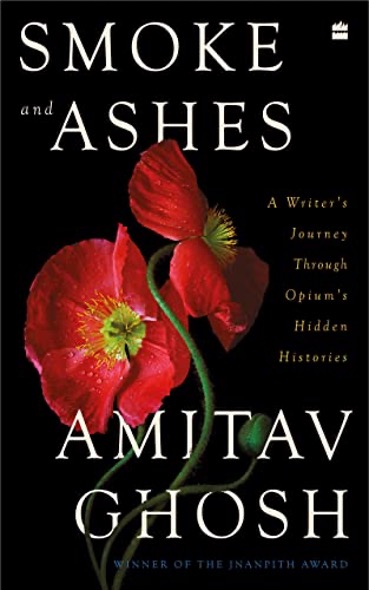
Smoke & Ashes

Book Review by Somdatta Mandal

Title: Smoke and Ashes: A Writer’s Journey Through Opium’s Hidden Histories

Author: Amitav Ghosh

Publisher: HarperCollins India

Amitav Ghosh has been traversing the boundaries between fiction, non-fiction, history, anthropology with ease for a long time. After the publication of his Ibis Trilogy [Sea of Poppies (2008), River of Smoke (2011) and Flood of Fire (2012)] more than a decade earlier, he has been primarily focusing on issues related to environment, global warming and ecology in his later novels like Gun Island (2019), The Nutmeg’s Curse: Parables for a Planet in Crisis (2021), a non-fiction like The Great Derangement (2016), and two slim volumes of fables, Jungle Nama (2021)  and The Living Mountain (2022). Now in his latest book Smoke and Ashes: A Writer’s Journey Through Opium’s Hidden Histories (2023), he blends travelogue, memoir, and historical tract into a multi-textured narrative that tells us about how ‘opium is a historical force in its own right’ and ‘must be approached with due attention to the ways in which it has interacted with humans over time.’ When he began his research for the Ibis Trilogy, he was startled to find how the lives of the nineteenth-century sailors and soldiers he wrote of were dictated not only by the currents of the Indian Ocean, but also by a precious commodity carried in enormous quantities on those currents: opium. Through both economic and cultural history, Ghosh traces the transformative effect the opium trade had on Britain, India and China; the trade and its revenues were essential to the Empire’s survival.

Of the eighteen chapters of the book, the first two enlighten the reader about little knowledge of China and the way tea (cha or chai) became an inevitable part of living both in the West and in India. It was after Ghosh’s first trip to Guangzhou (anglicized later to Canton) that the epiphany occurred about the very subtle influence of China and how the British actually stole the technology of tea plantation to make it flourish in the colonies. Thus ‘tea came to India as a corollary of a sustained contest – economic, social and military – between the West and China.’

From the third chapter onwards Ghosh gives us the history of the opium poppy and how social conventions that had developed through centuries of exposure to opium may have helped to protect some parts of Eurasia from highly addictive forms of opioid use and also how the drug was instrumental in the creation of a certain kind of colonial modernity. We get to know how it was the Dutch who led the way in enmeshing opium with colonialism, and in creating the first imperial narco-state, heavily dependent on drug revenues. But in India, the model of the colonial narco-state was perfected by the British. In the entire region of Purvanchal, the British created a system that was coercive to its core. The growth and cultivation of opium poppy was entirely controlled by them and the drug was mass produced in the two largest factories in Patna and Ghazipur. Though the dangers of opium were certainly no secret to the British government, yet they did not bat an eyelid in exporting the drug to China, knowing fully well it was a criminal enterprise utterly indefensible by the standards of its own time as well as ours.

Ghosh then gives details of the poppy cultivation in Malwa and the western provinces of India. By thwarting the British efforts to impose a monopoly on the trade, Malwa opium sustained Bombay and left a large share of the profits to remain in indigenous hands. Throughout the colonial era therefore, Calcutta and Bombay defined the two opposite poles of India’s political economy; the way in which business was conducted in the two cities were completely different and soon the Parsis turned out to be the maximum number of the non-western merchants who were present in Guangzhou in the years before the First Opium War. Thus, Bombay and its hinterlands benefited from Malwa’s opium in multiple ways. From Mumbai’s Parsis we go to the horticulturists and weavers, potters and painters of China, especially of the great city of Guangzhou. The intricacies of the Parsi Gara saris are traced back to weavers of Guangzhou, and so are the origins of an artistic ferment in Bombay when Jamsetji Tata, the founder of the Taj Mahal Hotel in Mumbai, brought back many paintings to India from China. The idea for an art school in Bombay came to Jamstjee Jejeebhoy after his Guangzhou visits, and the JJ School of Art came about.

Ghosh describes how opium money seeped so deeply into nineteenth century Britain that it essentially became invisible through ubiquity. After Britain, the country that benefited the most from the China trade and therefore, the global traffic in opium, was none other than the United States and the beneficiaries included many of the prominent families, institutions, and individuals in the land. By 1818 Americans were smuggling as much as a third of all the opium consumed in China thereby posing a major challenge to the East India Company’s domination of the market. Known as the Boston Concern, all the rich families from Boston, Massachusetts and the fortunate Americans were a series of names from the Northeastern upper crust — Astor, Cabot, Peabody, and so on. The young returnees from China ploughed their opium money into every sector of the rapidly expanding American economy. Even the opium money used in the railroad industry also came from China. “Opium was really a way that America was able to transfer China’s economic power to America’s industrial revolution”. In the United States the connection between opium and philanthropy has endured till the present day. It also left a distinct stamp on American architectural styles, modes of consumption, interior décor, philanthropy, and forms of recreation. Interestingly, Ghosh’s narrative keeps circling back to the present, when in the US as well in many countries around the world including India, the opioid crisis has reached epic proportions and the American government is bullish about its “War on Drugs”. Ghosh candidly states, “The ideology of Free Trade capitalism sanctioned entirely new levels of depravity in the pursuit of profit and the demons that were engendered as a result that have now so viscerally taken hold of the world that they can probably never be exorcised.”

Ghosh reiterates through the book that binary narratives about countries and culture — like, China is evil — that is entrenched in popular perception is misleading and takes away the historical context of trade relations among nations. “The staggering reality is that many of the cities that are now pillars of the modern globalised economy — Mumbai, Singapore, Hong Kong and Shanghai — were initially sustained by opium.”

There are many places in the book where Ghosh skilfully refers to his actual borrowing of historical details in his Ibis trilogy and these interjections add flavour to the non-fiction narration. Chapter Eight again is a memoir of Ghosh’s own lineage and how that has connections with the opium trade. Moving away from their ancestral home in East Bengal, it was the opium industry that took his ancestors to Chhapra in Bihar and kept them there. Like the millions of people that opium trading affected, uprooted, and dehumanised, his father told him stories of growing up in Chhapra and seeing opium ruin as well as make lives. These digressions add zing to the often-monotonous narration of facts and figures of the opium trade.

Ghosh goes on to devote pages to the nature of grassroots psychoactive substances and how opium was different in this class of psychoactive because it became a mainstay among pharmaceuticals too: “The reality is that all other efforts at curbing the spread of opioids have failed: the opium poppy has always found a way of circumventing them.” Towards the end of the book, after Ghosh finds that the wealthy and powerful people of the world to be suicidally indifferent to the prospect of a global catastrophe vis-s-vis the drug scenario, he asks a seminal question: “In such a world does it serve any purpose to recount this bleak and unedifying story?” Apparently, this question had haunted him since he first started working on the book, many years ago. It was the reason why, at a certain point, he felt he could not go on, even though he had already accumulated an enormous amount of material. It seemed to him then that Tagore had got it exactly right when he wrote: ‘in the Indo-China opium traffic, human nature itself sinks down to such a depth of despicable meanness, that is hateful even to follow the story to its conclusion.’ So persuaded was he of this that he decided to abandon the project: he cancelled the contracts he had signed and returned the advances he had been paid by his publishers.

Now we are happy that the story of the opium poppy had its cathartic effect upon Ghosh and in retrospect, after a period of more than a decade, he could give us the story from multiple perspectives today. Like his other books, this text is also accompanied by voluminous end notes which will deter the layman reader from enjoying the book. The amount of material and the different issues that Ghosh mentions is fit for at least four books but it is to his credit that he manages to present to us this world-roving tale in his signature method of weaving diverse narrative strands together into this book. How Ghosh establishes the interconnectedness of economic agency with geopolitics, a plant with human flourishing and wreckage and produces a narrative as luxuriant as it is painstaking in detail and density is his mastery as a prose writer and thinker.

.

Somdatta Mandal, author, academic and translator is former Professor of English at Visva-Bharati, Santiniketan, India.

PLEASE NOTE: ARTICLES CAN ONLY BE REPRODUCED IN OTHER SITES WITH DUE ACKNOWLEDGEMENT TO BORDERLESS JOURNAL

Click here to access the Borderless anthology, Monalisa No Longer Smiles

Click here to access Monalisa No Longer Smiles on Kindle Amazon International

Categories
Poetry

The Grave is Wide…

Poetry by Michael R. Burch

Courtesy: Creative Commons
Epitaph for a Refugee Child
		
I lived as best I could, and then I died.
Be careful where you step: the grave is wide.

Epitaph for a Refugee Mother

Find in her pallid, dread repose,
no hope, alas!, for a human Rose.

who, US?

jesus was born 
a palestinian child
where there’s no Room 
for the meek and the mild

... and in bethlehem still 
to this day, lambs are born
to cries of “no Room!” 
and Puritanical scorn ...

under Herod, Trump, Bibi
their fates are the same— 
the slouching Beast mauls them
and WE have no shame:

“who’s to blame?”

(First published in Setu)


Excerpts from “Travels with Einstein”


I went to Berlin to learn wisdom
from Adolph. The wild spittle flew
as he screamed at me, with great conviction:
“Please despise me! I look like a Jew!”

So I flew off to ’Nam to learn wisdom
from tall Yankees who cursed “yellow” foes.
“If we lose this small square,” they informed me,
earth’s nations will fall, dominoes!”

I then sat at Christ’s feet to learn wisdom,
but his Book, from its genesis to close,
said: “Men can enslave their own brothers!”
(I soon noticed he lacked any clothes.)

So I travelled to bright Tel Aviv
where great scholars with lofty IQs
informed me that (since I’m an Arab)
I’m unfit to lick dirt from their shoes.

At last, done with learning, I stumbled
to a well where the waters seemed sweet:
the mirage of American “justice.”
There I wept a real sea, in defeat.

(First published in Café Dissensus)

Michael R. Burch’s poems have been published by hundreds of literary journals, taught in high schools and colleges, translated into fourteen languages, incorporated into three plays and two operas, and set to music by seventeen composers.

PLEASE NOTE: ARTICLES CAN ONLY BE REPRODUCED IN OTHER SITES WITH DUE ACKNOWLEDGEMENT TO BORDERLESS JOURNAL

Click here to access the Borderless anthology, Monalisa No Longer Smiles

Click here to access Monalisa No Longer Smiles on Kindle Amazon International

Categories
Bhaskar's Corner

Chittaranjan Das: A Centenary Tribute

By Bhaskar Parichha

Chittaranjan Das (1923-2011)

In the contemporary world, with its multiple environmental crises, conflicts, and violence, persisting poverty, and social exclusion, the question about the role of arts in general, and of literature specifically, must inevitably arise. Do they have any positive role other than entertainment and distraction, or are they merely the icing on a rapidly decaying and disintegrating cake?

Without naming the problem in exactly this way, much of Chittaranjan Das’s work was devoted to implicitly answering this question, for he clearly recognised that a merely functionalist approach to trying to identify the role of the arts in society would be totally inadequate and theoretically shallow. Rather, to answer the question more fully, we should ask what constitutes a society’s self-understanding, its modes of self-representation, and its internal hermeneutics, and how, methodologically speaking, we can gain access to this deep cultural grammar of a society. Das’s original professional career was as a rural sociologist and teacher of the subject in Agra and elsewhere. As a sociologist he would have been aware that such questions arise not only in the sociology of the arts, but equally in relation to such intractable subjects as religion, suicide, and the emotions.[1]

The year 2023 is the centennial birth anniversary[2] of the thinker, educationist, critic, pioneer of Odia non-fiction writing and one of the finest translators, Professor Chittaranjan Das. Chittabhai — as he was known throughout Odisha — was the most prolific writer, with numerous diaries, essays, reviews, autobiographies, memoirs, columns, textbooks, and monographs.

Many eminent writers were born in Bagalpur village in Jagatsinghpur district. Chittaranjan Das was one of them. He was the third child of five brothers and three sisters. He attended Punang School after schooling in his native village. Afterwards, he attended Ranihat Minor School and Ravenshaw Collegiate School. In 1941, he passed the matriculation examination and enrolled at Ravenshaw College, Cuttack, for higher education. However, he became involved in the independence movement. His inspiration came from Manmohan Mishra[3]

During his Ravenshaw student days, he was an active member of the Communist Party of India. In 1942, he joined the Quit India Movement and was imprisoned. During his jail term, Das  acquired many skills, including learning languages, particularly French. In 1945, he was released from prison and attended Santiniketan. During his academic career, he was exposed to a wide variety of intellectuals, thinkers, and writers. He was deeply influenced by their works.

His studies in psychology, sociology, and cultural anthropology continued in Europe and abroad in the years that followed. He was trained in clinical psychology at the Vienna School established by Sigmund Freud. It was here that he met philosopher Martin Buber. He continued his studies at Santiniketan and later at Copenhagen University, Denmark.

He returned to Odisha in 1954 and joined the Jibana Bidyalaya, a school inspired by Gandhi’s ideals on education, established by Nabakrushna Choudhury and Malati Devi. Later on, he became the headmaster of this institution. He left after four years and took a teaching assignment near Agra.

Sri Aurobindo’s philosophy drew Das to the revered sage’s teachings. Upon returning to Odisha, he taught at the Institute of Integral Education in Bhubaneswar, based on Sri Aurobindo’s values. This was in 1973. While he did not stay for long, he remained associated with this movement until his death in 2011.

Das considered the whole world to be his home. He was proficient in a wide range of languages, including Hindi, Urdu, Bengali, Assamese, Sanskrit, Danish, Finnish, French, Spanish, and English. His vast studies covered many areas of social and human sciences like philosophy, psychology, religious studies, and linguistics as well as school studies. His knowledge is reflected in 250 books he wrote or translated into Odia.

He was a regular contributor to newspapers and his columns appeared in major Odia dailies like Dharitri, Pragativadi, Sambad, Samaja and more. These short pieces have been compiled into books that give insight into his views on contemporary issues. His first writing was an article in a school magazine. The article ‘Socrates’ appeared in 1937 in the Ravenshaw Collegiate magazine, Sikshabandhu.

Das travelled widely around the world. During his travels, he closely examined the social, cultural, and political life of the countries he visited. He wrote books describing his impressions. He has translated many books into Odia from countries he visited. His translation work is vast. His understanding of the topic and the translation of the books make for a pleasant reading experience.

He was an excellent diary writer. These captured his feelings about many incidents. The autobiographical diary entries have been published as Rohitara Daeri[4], a series of over 20 volumes. His love for the mother tongue was unparalleled. Despite excellent command of more than a dozen languages, including German, Danish and Finnish, as well as Sanskrit, Pali, Urdu and Bengali, he wrote mostly in his mother tongue, Odia.

His contribution to Odia literature was huge because he translated the works of many prominent writers — Bengali writer Ashapurna Devi, polymath Albert Schweitzer, French novelist François Mauriac, British-Indian anthropologist Verrier Elwin, Danish poet Karl Adolph Gjellerup, French writer Antoine de Saint-Exupéry, Lebanese-American poet and writer Kahlil Gibran, Russian poet Boris Pasternak, former President of India Sarvepalli Radhakrishnan and the iconic Mahatma Gandhi. Sri Aurobindo’s principal philosophic work, a theory of spiritual evolution culminating in the transformation of man from a mental into a supramental being and the advent of a divine life upon earth, Life Divine, is Chittranjan Das’s significant work.

Many awards have come his way. In 1960, for his essay ‘Jeevana Vidyalaya’[5], he was awarded by the Odisha Sahitya Akademi. He was given the Sarala Award in 1989 for his essay ‘Odisha O Odia’. He was conferred with the Sahitya Akademi Award in 1998 for his book Biswaku Gabakhya [6]. He bagged more accolades from Prajatantra Prachar Samiti, Gangadhar Rath Foundation, Utkal Sahitya Samaj and Gokarnika.

Chittaranjan Das’s works incorporate both creative experimentation and a transformative philosophy. He has worked in education, literature, cultural creativity and artistic criticism. During his lifetime, he was instrumental in the growth and development of numerous social action and development groups. Throughout his writings, he discussed self-development, social change, and mankind’s evolution. His Odia autobiography Mitrasya Chakhusa  [7]is an extraordinary work in the genre.

A scholar of eminence, literary commentator and author of numerous books in Odia and English, he was known as ‘Socrates of Odisha.’

.

[1] John Clammer (The Essays of Chittaranjan Das on Literature, Culture, and Society/Ed. Ananta Kumar Giri and Ivan Marquez)

[2] The Odia writer lived from 1923-2011.

[3] A revolutionary writer and poet who lived from 1917 to 2000.

[4] Rohit’s Diary

[5] School of life

[6] Window to the World

[7] Through the eyes of a Friend

Bhaskar Parichha is a journalist and author of UnbiasedNo Strings Attached: Writings on Odisha and Biju Patnaik – A Political Biography. He lives in Bhubaneswar and writes bilingually. Besides writing for newspapers, he also reviews books on various media platforms.

.

PLEASE NOTE: ARTICLES CAN ONLY BE REPRODUCED IN OTHER SITES WITH DUE ACKNOWLEDGEMENT TO BORDERLESS JOURNAL

Click here to access the Borderless anthology, Monalisa No Longer Smiles

Click here to access Monalisa No Longer Smiles on Kindle Amazon International

Categories
Poetry

Wyvern by Jared Carter

Wyvern. Courtesy: Creative Commons
                  WYVERN 

In European folklore, and also in British
heraldry, a winged, two-legged dragon.

You stood your ground and pawed the grass,
          and mewled, while I     
Aimed for your heart. My spear point passed
          on through. Your eyes

Lost all their sheen, your glossy wings
          fluttered and failed,
Till you became a tattered thing,
          still writhing, nailed.

And called unto your funeral dole
          in that dark fen,
The ant, the field-mouse, and the mole
          crept back again.

Jared Carter’s most recent collection, The Land Itself, is from Monongahela Books in West Virginia. His Darkened Rooms of Summer: New and Selected Poems, with an introduction by Ted Kooser, was published by the University of Nebraska Press in 2014. A recipient of several literary awards and fellowships, Carter is from the state of Indiana in the U.S.

.

PLEASE NOTE: ARTICLES CAN ONLY BE REPRODUCED IN OTHER SITES WITH DUE ACKNOWLEDGEMENT TO BORDERLESS JOURNAL

Click here to access the Borderless anthology, Monalisa No Longer Smiles

Click here to access Monalisa No Longer Smiles on Kindle Amazon International