Categories
Review

Mapping the Mind

Book Review by Navleen Multani

Title: Mapping the Mind, Minding the Map

Editors: Basudhara Roy and Jaydeep Sarangi

Publisher: Sahitya Akademi

Mapping the Mind, Minding the Map edited by Basudhara Roy and Jaydeep Sarangi anthologises twenty contemporary poets. This book unveils a large canvas of poems penned by poets hailing from diverse locations and cultures, evoking thoughts on existential dilemmas of the contemporary world. The 391 pages of the anthology comprise poems by multiple poets: Adil Jussawalla, Arundhati Subramaniam, Ashwani Kumar, Bashabi Fraser, Bibhu Padhi, Jayant Mahapatra, K. Satchidanandan, K.Srilata, Keki N.Daruwalla, Lakshmi Kannan, Mamang Dai, Nabina Das, Robin S. Ngangom, Sanjukta Dasgupta, Tabish Khair, Usha Akella, Yogesh Patel and more

Every poem entails evocative images, visual and syntactic cues that put forth poetics of everyday life. Traversing maps and minds, this engaging collection of two hundred poems unravels different places and persons. The anthology is a poetic narrative and holistic exploration of locating oneself through language. As the book brings together experiences and knowledge of space, it pushes readers to rethink how landscape shape identity.

Memories encompassing reflections on landscapes, ancient history, myth, family, home, towns, cities, countries, music, seasons, elements of nature, disasters, wants, love and wounds of Homo Sapiens, women, mother as well as immigrants abounds the creation of every poet. Memories of special days, seasons, cities and cultures culminate in the compositions of Mamang Dai. Nabina Das’ creations talk about death and else. Sanjukta Dasgupta juxtaposes past and present to celebrate free spirit of Kali, Alakshmi and Millenial Sita.

This compilation, published by Sahitya Akademi, is an itinerary for dreamers and travellers alike. Ten poems by each poet weave a tapestry of emotions, experiences, moments and memories that define persons, places, practices and cultures. Every word, image and syntactical turn in these poems moves readers to discover poet’s emotional state. Events and myriad experiences, memorable and unpleasant, form an intricate reflection on life. The poems are also revelations about the contemporary world. The mosaic of memories present a ceaseless stream of significant moments that mould the minds and the maps. The compositions heighten consciousness, enrich the understanding of readers and deepen their humanity. The poems make the readers encounter hardships, moments of despair, compassion, empathy and resilience to extract invaluable insights. Reflections on difficult and dark times infuse renewed strength to deal with adversity.

Every poet uses different linguistic register to delve into solitude, decay, death and a new force that nurtures mind as well as takes to greater understanding about existence. “When Landscape Becomes Woman” by Arundhati Subramaniam reveals “That a chink in a wall is all you need to tumble into a parallel universe”. Whether it is Bashabi Fraser’s “Mothers All” claiming, “They are the bravest soldiers-marching on”, or Adil Jussawalla’s “Refuge” telling “Mother tells her rosary from six to seven, her one hour refuge,” each poet, irrespective of gender, envisions an independent and autonomous identity. “What’s wrong with us Kali women?”, “Maryada[1] and modern Draupadi”, “Woman in a Landscape” by Adil Jussawalla, “History”, “Draupadi”, “Partition Ghazal”, “The Tribal Goddess” and “Patna to Nalanda-1979” by Keki N.Daruwalla transport readers from past to present and illuminate multi-facets of life. “Somewhere like a shadow in the night like a black mineral in the earth, /Somewhere in a mirror where you can see your dreams a poem awaits deftly angled light,” writes Keki Daruwalla. Ashwani Kumar’s poems dwell on Alzheimer’s, lies emerging from deception, town vanished in the reservoir of waters and the strange ways of the world.

The deftly crafted poems blend imagery, thoughts and experiences. Many of the poems are centred on home, landscape and seasons. Titles of a few poems like “Mitti[2]’, “Bhakti[3]”, “Haldi[4]”, “Mahaprajapati[5]”, “O Boisakh[6]” and “Lopamudra[7]” have not been provided with a translation. Supplementing these titles are poems like “Earthrise”, “Missives of Music”, “The Same Moon from Edinburgh to Calcutta: A Refracted Lens”, “Sunrise at Puri-on-Sea”, “The River” and “Earth Day”.

The poems ranging from prose to typographic and linguistic variations, Mapping the Mind, Minding the Map speaks to larger issues of urban Indian identity, acceptance, adaptation and cultural estrangement. These map the poetics of womanhood, the body, institution, family and love. By doing so, the anthology erases traditional boundaries to develop a new poetic form. The poems are ensembles of words that unite to present verbal, vocal and visual sphere of communication.

This three-dimensional language becomes carrier of aesthetic message of the poet. The reduction of language to a word or fragments in many of the poems is similar to the reduction of landscape to map elements selectively and generally. This gives a distinct charm to the anthology. The poems explode with bird-names, names of cities and countries making these compositions a dialectical map. Very aptly the poems, as Howard McCord contends, can be comprehended as “a map on which articulation of consciousness can be charted, and the serial flow we associate with prose can be gathered into clusters and islands of words which reveal the individual’s voice and vision, even his philosophical stance, more accurately than a line broken by a general rule imposed.” Poems in Mapping the Mind, Minding the Map are maps that offer ways to know simplified, generalised and selective views on the world and human existence.

[1] Dignity

[2] Mud

[3] Devotion

[4] Turmeric

[5] The woman who raised Buddha

[6] The second month in the Bengali calendar which coincides with April-May

[7] A philosopher who lived in the Rigvedic age

Dr Navleen Multani is Associate Professor, Head, School of Languages, and Director, Public Relations at Jagat Guru Nanak Dev Punjab State Open University, Patiala (India). She is Area Editor with Oxford Online Bibliographies: Literary and Critical Theory.

.

PLEASE NOTE: ARTICLES CAN ONLY BE REPRODUCED IN OTHER SITES WITH DUE ACKNOWLEDGEMENT TO BORDERLESS JOURNAL

Click here to access the Borderless anthology, Monalisa No Longer Smiles

Click here to access Monalisa No Longer Smiles on Kindle Amazon International

Categories
Poetry

The Chase

By Thompson Emate

THE CHASE

Chasing a moment in time,
Running against the changing clime,
Pursuit of a desire in life,
On the path of a worthy strife,

Listening to my mother,
Learning how she goes over and moves further,
Searching for a path through the night,
Seeking redemption’s light,

Walking out of each day’s shadow,
Hope tells me to look out of the gloomy window.
Buoyed by the benevolent elements of nature,
I bask in the Creator’s favour.

Every time I see a new way,
Monsters stealthily walk into that day.
I’m a conundrum of light and gloom,
It’s like an eternity in this room.

Thompson Emate spends his leisure time on creative writing. He has a deep love for nature and the arts. He lives in Lagos, Nigeria.

PLEASE NOTE: ARTICLES CAN ONLY BE REPRODUCED IN OTHER SITES WITH DUE ACKNOWLEDGEMENT TO BORDERLESS JOURNAL

Click here to access the Borderless anthology, Monalisa No Longer Smiles

Click here to access Monalisa No Longer Smiles on Amazon International

Categories
Stories

Speech Matters

Story by Naramsetti Umamaheswararao: Translated from Telugu by Johnny Takkedasila

Naramsetti Umamaheswararao

Naramsetti Umamaheswararao has written more than a thousand stories, poems, and novels in children’s literature over the past 42 years. He has 32 books to his credit. He was honoured by the Central Sahitya Akademi Award in Children’s Literature for his novel Anandalokam[1]. Naramshetty founded the Bal Sahitya[2] Organisation and is working for the promotion of children’s literature.

Photo from Public Domain

Parvathipuram’s Siddaiah roams the streets, selling vegetables and green leaves from a cart. He has two sons, Murali and Saradhi. Both are educated but idle, having picked up more bad habits from the street than good ones. Siddaiah also noticed an increase in their arrogance.

He called his sons and said, “We are poor people who need to be satisfied with what we have. I am afraid to see you behaving like this. You must be humble. We should learn to respect our elders.”

“Yours is an old way of thinking. Nowadays, we should be like this only. You should see us and change yourself,” replied the sons.

Siddaiah tried to convince his sons, but they did not listen. So Siddaiah asked Gangadharam, a teacher in their neighbourhood, for suggestions. Gangadharam gave him an idea to convince his sons.

The next morning, Siddaiah said to his sons, “I have brought vegetables, green leaves, and fruits for sale, but I am not feeling well and cannot go to sell them. If kept at home, they will lose their freshness by tomorrow. Can you both sell them?”

“We don’t know business. How can we sell these?” asked the sons.

“The saying goes that, ‘If you speak well, the village will thrive.’ Impress people with your speech and sell them at the prices I tell you,” Siddaiah retorted.

They took the cart and entered the streets, shouting, “Vegetables, green leaves, fruits.” Some women came out and asked their prices. Siddaiah’s sons told them the prices their father had set.

“How can you charge such a high price? If you reduce it by twenty per kg, we will buy one kg each,” said a woman.

“We do not lose if you buy or not, but we will not reduce the price,” Murali said.

“They are not harvested in the backyard. We also bought them. The prices can’t be reduced,” Saradhi said angrily.

She didn’t buy anything. Hearing their words, the other women also went away without buying. They said things like, “In business, there should be give and take,” but Murali and Saradhi went ahead without listening.

A woman stopped the cart on a side street and checked the freshness of the vegetables. “Your price is high… at least, will you weigh it properly?”

“How can we believe that you are giving real money?” Murali said angrily.

Even after asking the price, she did not buy it. She also told others not to buy from them. As the business did not work, they moved to another street.

The women started bargaining there too. This time Saradhi got angry and said, “People will post a WhatsApp status saying ‘Don’t haggle and buy from the small traders who come to the streets’. The true nature comes out only when you buy it.”

Everyone got angry. There was no business. They returned home without selling a single item.

Siddaiah, who saw his sons return in a hurry, said, “You are spoiling the business with your bad attitudes. I have been saying it from the beginning. You did not listen.”

“It’s okay, Dad. Even if you went, you couldn’t have sold it. None of them were ready to buy,” said both the brothers.

“Will you listen to me if I sell all the goods?” asked Siddaiah. Both sons agreed they would. Siddaiah told them to follow him to observe how he sold his goods.

First, Siddaiah went to a street and shouted that he had brought vegetables, green leaves, and fruits. Some women came to buy and asked the price. Siddaiah told them the prices. A woman among them said, “Some guys came earlier, their price is lower than yours. If you also give that price, we will buy it.”

“Buy it with your golden hands, mother. I just came into the street. If you buy first today, my business will be great,” said Siddaiah. She gave the money and bought the vegetables without saying a word.

To the second woman, he said, “Do you see the money, mother? Do you count ten or twenty for someone like me?” She also bought the vegetables without saying a single word.

“I will happily tell all others that Rangamma also buys vegetables from me only. So please don’t bargain and buy, mother,” he said. She bought vegetables with a happy smile.

“If you buy from me, other women in the street will also buy from me only. So please don’t ask me to lower the price. If I lower the price for you, I have to lower it for all,” Siddaiah pleaded. She also bought it.

After talking to each one of them, the sons saw Siddaiah had sold all the goods. “Didn’t you see what happened! Do you still think arrogance is necessary?” Siddaiah asked. Both nodded reluctantly.

“A friendly word we speak makes friends, and a hateful word makes enemies. Harsh words drive people away. Remember this,” said Siddaiah.

Later, Siddaiah noticed a change in his sons’ speech. Siddaiah didn’t forget to thank the teacher who gave him such a good idea.

.

[1] Abode of Happiness

[2] Children’s Literature

Johny Takkedasila is an Telugu poet, writer, novelist, critic, translator and editor from Andhra Pradesh, India. His literary journey, which began as a Telugu poet, has seen the publication of 27 books. He has received numerous awards for his contributions. The Central Sahitya Akademi Yuva Puraskar for 2023 (National Award) was awarded to Vivechani, a critical study book in the Telugu language.

PLEASE NOTE: ARTICLES CAN ONLY BE REPRODUCED IN OTHER SITES WITH DUE ACKNOWLEDGEMENT TO BORDERLESS JOURNAL

Click here to access the Borderless anthology, Monalisa No Longer Smiles

Click here to access Monalisa No Longer Smiles on Amazon International

Categories
Poetry

Every Day

Poetry by Hafeez Rauf, translated by Fazal Baloch

Hafeez Rauf

Hafeez Rauf belongs to the generation of the poets who emerged on the literary landscape in the early 2000s. Homelessness, exile, uprootedness and related agony are the recurrent themes of his poetry.

How far will the last 
sigh of the smoke stretch,
Rising from the tires
Burning in the distance?

The road lies closed --
No longer offers a passage.
Women and children,
Youths and elders --
All surrounded by an
ever-rising wall of helplessness.

How far can their hands,
their voices reach?

Meanwhile,
A crumbling wall,
In the wall, a decayed door,
And the door gazes at the occasional passerby,
Stretching its sight as far as it can see.

It watches the deserted roads
With the frantic eyes of a man
Who, after losing something,
searches his pockets in despair.

Where will this caravan of smoke lead?
The door just gazes.
From Public Domain

Fazal Baloch is a Balochi writer and translator. He has translated many Balochi poems and short stories into English. His translations have been featured in Pakistani Literature published by Pakistan Academy of Letters and in the form of books and anthologies. Fazal Baloch has the translation rights.

PLEASE NOTE: ARTICLES CAN ONLY BE REPRODUCED IN OTHER SITES WITH DUE ACKNOWLEDGEMENT TO BORDERLESS JOURNAL

Click here to access the Borderless anthology, Monalisa No Longer Smiles

Click here to access Monalisa No Longer Smiles on Amazon International

Categories
Essay

Picked Clean

By Snigdha Agrawal

Right now, we are on the cusp between pre-monsoon and full-blown monsoon.  The commencement of cool windy breezes and the partially cloudy skies comes as a welcome relief after the asphalt-melting summer heat, experienced this year.  Just what is needed to uplift melting spirits. The mind has started recalibrating, the body readjusting, to the sudden dip in temperatures in the ‘Garden City’ of Bangalore, known for its salubrious climate right around the year.  Defined by a short, short summer with the temperature barometer rarely rising above 34°C.  December, January, and February, temperatures usually hover around 16°C to 18°C, a trend that has barely changed over the last thirty-plus years of my stay in the city.  However, over these thirty-odd years, there have been several departures concomitant to the growth and evolution of the city. 

The nomenclature “Pensioner’s Paradise”, has lost its significance with the progressive encroachment into virgin lands and lung spaces in the city getting systematically squeezed. A ‘Paradise lost’ and no hopes of it ever being regained.  Road rollers, cranes, and crawlers are seen in every neighbourhood, slowly but surely picking the city clean of all its flora, fauna and water bodies. Justifiably nothing different from the growth path in other metros across the world but its impact on the environment, has become more and more evident.  I can unequivocally say, that some of these major shifts have had a huge impact on both climate and the environment. The causative effect of overpowering greed hinged on profitability.  The then Bangalore, a far cry from the now Bangalore. I will come to that later.  


When I first relocated to Bangalore from Kolkata, a coastal city with a hot and humid climate, the sobriquet ‘air-conditioned’ City was not its only USP.  It had earned the epithet ‘Silicon Valley’ that came about with IT companies/industries shifting their operations, lock stock and barrel to this much sought-after location, ergo necessitating a shift of manpower.  The city thus, witnessed a massive exodus of techies/white-collar workers, moving in from various parts of the country to take up residence in the city.  Dominique Lapierre’s City of Joy[1] saw the greatest pullout.  Discarding the old for the new as some would think, was not so out of choice but for compelling reasons, following the shutdown of establishments, an antiquated work culture, and the government’s short-sighted policies; some of the contributing factors attributed to this attrition.

In June 1991, we moved into the city which surprised us pleasantly.  First, there was no need to run ceiling fans.  Strikingly different from Kolkata, where fans and air-conditioners did little to relieve the heat and humidity. Bangalore’s room air-conditioner vents remained tightly closed permanently, and by extension, contributed to a reduction in noise pollution.  The susurration of the breeze, floating in through the windows was like being permanently plugged into music channels on YouTube.  Therefore, it was unsurprising to that the figure for the first month’s electricity bill was a record low since the previous decade. 

Natural lighting was more than abundant without anything to block it, eliminating the need to switch on the lights till well after sunset. The view from the 6th-floor apartment balcony on Richmond Road opened into an orchard of tall palm trees, beyond which stood the Good Shepherd Convent.  Nuns walking in the coconut orchards while fingering the moving rosary beads had this effect of transporting one to a seaside setting, sans the sand and sea.  Sublime.  Often, I wondered if we had moved to a city at all! The ambience was so contrary to what one would conjure about big cities. 

By the time, we moved out of the apartment, after a stay of twelve years, the view was curtained off.  Gone were the tall trees. Felled indiscriminately.  Spidery earth movers had taken over, raising noise pollution, and piercing through the ear drums.  The heavily laden polluted air inhaled gave rise to frequent allergies. From the perspective of the locals, who resented the invasion of their paradise, parthenium was not alone to blame.  Rightly so. 

Funnily with the commencement of the academic year, my girls then twelve and eight were taken aback by the need to wear sweaters to school. “Woollens are for winter months, right Mamma?”  True that. A strange phenomenon for the newly arrived Kolkata migrants precipitated the need to unbox the woollens, with naphthalene balls inserted between folds.  Duvets and blankets intended to be unpacked during November and December got a premature release from their taped cardboard cartons.  That was Bangalore weather then. 

In a couple of years, as the girls moved from school to college, they were no longer layering during these monsoon months of June/July.  The only conclusion drawn is either they had acclimatised to the Deccan plateau weather conditions or had become self-conscious during the growing up process, or was it a clear pointer to climate change? The latter seems more plausible.  Supported by the fact that initially during the first few years, the bathroom geysers stayed plugged in for the entire day, to the subsequently reduced hours (one/two hours before shower time) stay highlighted with a bright marker on memory panels. 

With the wiping out of tree-lined avenues and vintage colonial bungalows dotting the landscape, giving way to multi-storeyed offices and high-rise apartment complexes, the city soon acquired a garish makeover plastering the natural tone of the city’s face.  Twelve years on Richmond Road, saw all this and more.  Decentralisation was on its way.  Moving out from the central district to the outlying areas, becoming inevitable.  In 2003, we moved to our new apartment in Domlur Layout, still relatively pristine, with virgin forest cover.  But not for very long.  The tentacles of greed reached out grabbing all this, in justification of better civic amenities.  In a couple of years, the inner ring road snaked its way connecting Indiranagar to Koramangala thus reducing travel time.  Hailed as the best thing for commuters, at what cost?  Filling up ponds, deforestation, levelling whole villages, and gobbling up military land as well — approvers of the city’s expansion worked tirelessly.    

Water shortage was evident here with most residential complexes having to rely on tankers for water supply.  A cost added to the already steep monthly maintenance fee paid by apartment dwellers as well as stand-alone homes. Unbudgeted.  Dipping into pockets, water shortage was rearing its ugly head in the City of Thousand Lakes, conceived and built by Kempe Gowda.  The bane of urbanisation, reportedly, of the eighty-one existing ‘live’ lakes Kempambudhi and Ulsoor dating back to the 16th century, have since shrunk in acreage. Many others have just disappeared from the landscape.

In our pursuit of green spaces and low noise pollution, we once again moved further to Whitefield, named the Electronic City, a neighbourhood in Bangalore developed explicitly for housing the electronics industry in 2017.  Greens visible.  Aha! This would be our paradise in a city turned inside out with ugly stitches showing up in the inner seams.  Alas! A short-lived dream.  The beautiful Vathur Lake, a huge water body, soon was seen foaming and frothing, spilling over to the adjacent lands as a consequence of chemical effluents pouring into the lake.  Resulting in the discolouration of water and an unbearable stench, it became imperative for lake-side dwellers to shift residence. The lavender hyacinth blooms floating on the lake surface were permanently coffined and nailed down by concrete slabs.  Roads ran over these.  Voices were raised in protest.  But who’s listening?  Construction activities continued, all in the name of development, providing job opportunities, and housing for the increased growth in population.  A city bursting at the seams.

This year summer took the worst toll, with temperatures peaking at 38.1°C on 2nd May, the hottest day in forty years.  From no air conditioners being run in 1991 to sitting whole day in air-conditioned surroundings is riling for all.  Faced with acute shortages, the city authorities clamped down on water usage, making it mandatory for apartment dwellers to install aerators on taps, to reduce the water flow. Failure to comply would invite heavy penalties, uniformly across the city.  And they were deadly serious, warning of inspectors making surprise visits to homes to ensure compliance.

Now, in a two-member household, that to retirees, that made no sense.  I confess to non-compliance and got away with it.  Resorting to ‘bucket baths’ in place of standing under the shower, was a contribution in the right direction. With the rains, this mandate has been lifted. And that brought on chuckles rewinding to childhood memories of those bitterly cold winter months and Ma’s famous line ‘no kager chaan[2]’ before our baths and, most often, being sent back to repeat baths.  Ma put up with no excuses for short-cut baths.  But the writing on the wall is loud and clear.  Heading to the apocalypse?  

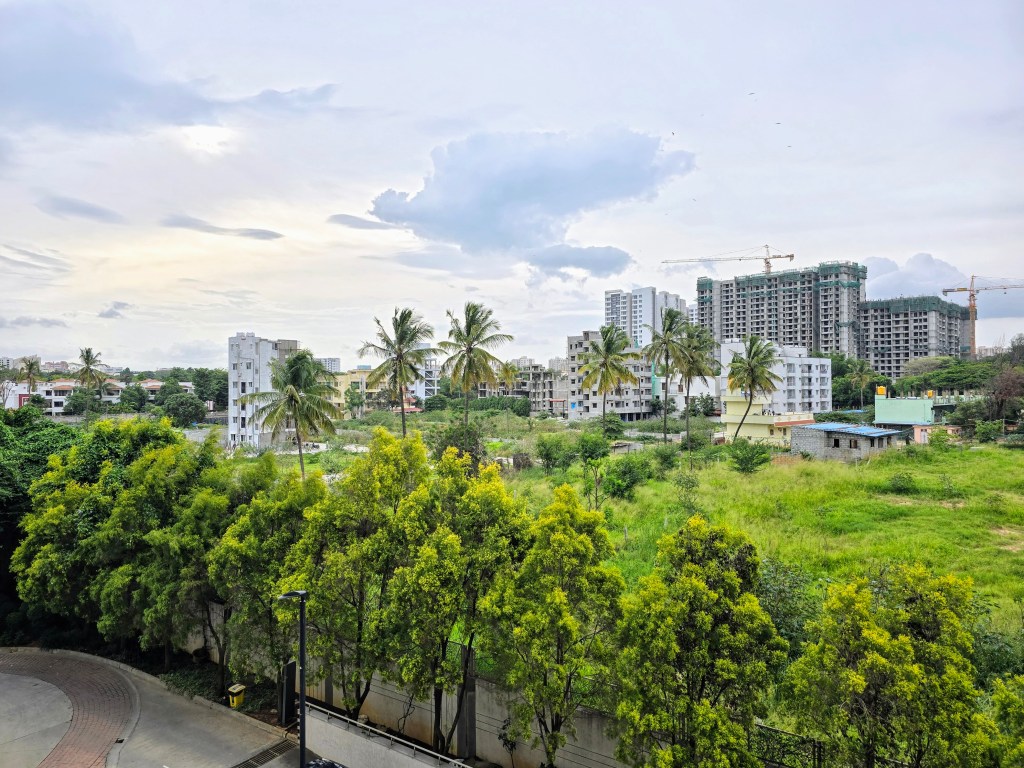
For the time being, I feel privileged that the green field outside my third-floor living room balcony, a disputed property, remains untouched.  A treat for the old eyes.  For how long is anybody’s guess?  

The green field outside the window. Photograph by Snigdha Agrawal

[1] Kolkata. The City of Joy by Dominique La Pierre gave Kolkata that sobriquet

[2] Crow’s bath

Snigdha Agrawal (nee Banerjee) is a published author of four books and a regular contributor to anthologies published in India and overseas.  A septuagenarian, she writes in all genres of poetry, prose, short stories and travelogues.

PLEASE NOTE: ARTICLES CAN ONLY BE REPRODUCED IN OTHER SITES WITH DUE ACKNOWLEDGEMENT TO BORDERLESS JOURNAL

Click here to access the Borderless anthology, Monalisa No Longer Smiles

Click here to access Monalisa No Longer Smiles on Amazon International

Categories
Poetry

How Not to Want…

Poetry by Michael Burch

CHLOE

There were skies onyx at night ... moons by day ...
lakes pale as her eyes ... breathless winds
undressing tall elms ... she would say
that we’d loved, but some book said we’d sinned.

Soon impatiens too fiery to stay
sagged; the crocus bells drooped, golden-limned;
things of brightness, rinsed out, ran to grey ...
all the light of that world softly dimmed.

Where our feet were inclined, we would stray;
there were paths where dead weeds stood untrimmed,
distant mountains that loomed in our way,
thunder booming down valleys dark-hymned.

What I found, I found lost in her face
by yielding all my virtue to her grace.

(Originally published by Romantics Quarterly as “A Dying Fall”)


MIRAGE


You came to me as rain breaks on the desert
when every flower springs to life at once.
But joys are wan illusions to the expert:
the Bedouin has learned how not to want.

Michael R. Burch’s poems have been published by hundreds of literary journals, taught in high schools and colleges, translated into fourteen languages, incorporated into three plays and two operas, and set to music by seventeen composers.

PLEASE NOTE: ARTICLES CAN ONLY BE REPRODUCED IN OTHER SITES WITH DUE ACKNOWLEDGEMENT TO BORDERLESS JOURNAL

Click here to access the Borderless anthology, Monalisa No Longer Smiles

Click here to access Monalisa No Longer Smiles on Kindle Amazon International
Categories
Musings

Stop, Look, Think!

By Farouk Gulsara

Here I am, waiting in my car, clutching my steering wheel. It has been a good five minutes, and I am at a standstill. There are no vehicles in front of me. It is a T-junction with traffic lights. There is no traffic on either road, but I have no choice. I have to wait.

It does not matter whether I have a medical emergency or that there is a raving lunatic after my scalp. Laws are laws and have to be obeyed. Logical wisecracks and rationalisations do not work. Realistically, if the road is clear and there is no imminent danger of a collision, I should be good to go. Logically, that is. Reasoning does not work here. A set of closed-circuit systems records your every wrong move like a hawk. And diligently, the system would send a ticket directly to your mailing address, and viola, the rule of law prevails in the land. A potential offender is snipped in the bud. As the broken window theory of criminology dictates, getting away with minuscule wrongdoings would eventually snowball into something cataclysmic. Thank God for automation; another serial offender has been prevented. Everyone should be happy, right? So, everyone’s job is just to follow?

That is when my Dionysian mind grew antennas. My grey cells started buzzing, and their neuroelectric activities went on an overdrive.

The system is understandably flawed. At a time when everything is becoming more intelligent, something is not correct. What is naturally lacking is artificially enhanced. Artificial intelligence has superseded natural stupidity. If self-thinking automatons and machines can improve by self-learning and pass the Turing Test, why not our traffic lights?

Intelligent traffic signal lights are not alien to road traffic controllers worldwide. Automated light changes to keep up with altering traffic volume are nothing new. Many developed nations have been implementing this for ages. At an age when we are concerned about vehicle emissions worsened by repeated stops and starts, introducing the ‘green wave’ could  help reduce congestion and the need to repeatedly slow down or stop at lights.

Returning to my situation at the traffic light, I am still stationary after what feels like ten minutes. 

Coming to think of it, Adolf Eichmann and all his colleagues in the Schutzstaffel (SS) completed all their nefarious activities by being sticklers for rules and followers of protocols. By paying undivided attention to completing their paperwork and targets set for the day, they gave a new perspective on how banal evil can be. The rule of law did not prevent a maniacal figure like Hitler from being the Fuhrer. The citizens who followed the herd in not questioning the status quo lived to regret their apathy. 

Spending less time at the traffic light is not going to prevent a Holocaust, but we should ask ourselves to change a system that does not work for us. We are already wasting enough time listening to guised automated messages, which actually eat on your phone bills, why do we need to waste time, petrol and sanity by just waiting and listening to screaming cicadas at a traffic junction without any traffic?

Honk, honk! Time for me to move on…

.

Farouk Gulsara is a daytime healer and a writer by night. After developing his left side of his brain almost half his lifetime, this johnny-come-lately decided to stimulate the non-dominant part of his remaining half. An author of two non-fiction books, Inside the twisted mind of Rifle Range Boy and Real Lessons from Reel Life, he writes regularly in his blogRifle Range Boy.

.

PLEASE NOTE: ARTICLES CAN ONLY BE REPRODUCED IN OTHER SITES WITH DUE ACKNOWLEDGEMENT TO BORDERLESS JOURNAL

Click here to access the Borderless anthology, Monalisa No Longer Smiles

Click here to access Monalisa No Longer Smiles on Kindle Amazon International

Categories
Poetry

Textures by Jared Carter

             TEXTURES

At times the fabric shows itself,
as though up close—
A linen swatch, scraps from a shelf
of silk, or those

Long scarves made of the lightest wool,
that with a touch
Can wrap around, yet never pull
or press. For such

Affinity invokes, like wings
against the air,
What elevates but does not cling
to what is there.

Photo from Public Domain

Jared Carter’s most recent collection, The Land Itself, is from Monongahela Books in West Virginia. His Darkened Rooms of Summer: New and Selected Poems, with an introduction by Ted Kooser, was published by the University of Nebraska Press in 2014. A recipient of several literary awards and fellowships, Carter is from the state of Indiana in the U.S.

.

PLEASE NOTE: ARTICLES CAN ONLY BE REPRODUCED IN OTHER SITES WITH DUE ACKNOWLEDGEMENT TO BORDERLESS JOURNAL

Click here to access the Borderless anthology, Monalisa No Longer Smiles

Click here to access Monalisa No Longer Smiles on Kindle Amazon International

Categories
Review

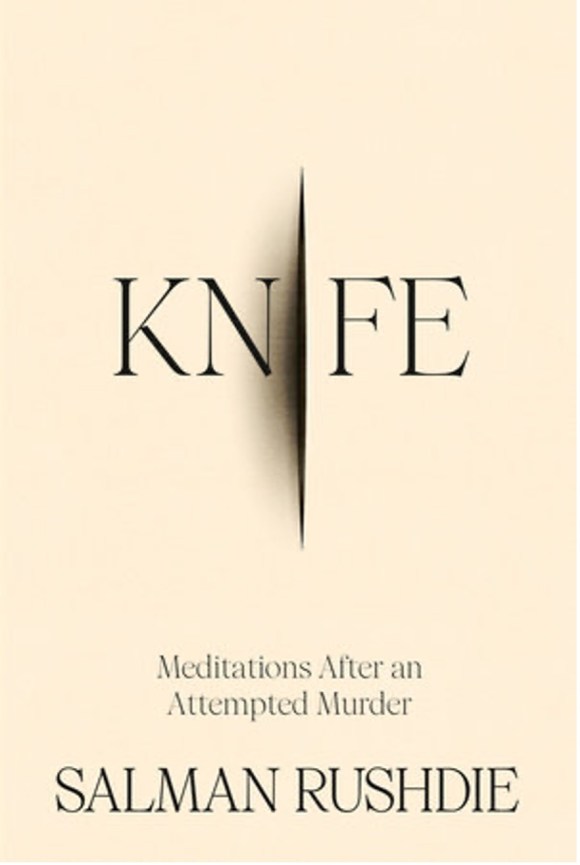
Knife by Salman Rushdie

Book Review by Somdatta Mandal

Title: Knife: Meditations After an Attempted Murder

Author: Salman Rushdie

Publisher: Penguin Random House

More than thirty years ago, a fatwa had been declared by Ayatollah Khomeini on the famous writer Salman Rushdie. The charge of blasphemy was labelled after the publication of The Satanic Verses, and since then the author has been living in asylum at different places because he was not safe in his own country. When it was assumed that the incident had died its natural death, the simmering vendetta and violence upsurged suddenly on 12th of August 2022, when Rushdie had gone to participate in a week of events at the Chautauqua Institution in upstate New York titled “More Than Shelter: Redefining the American Home”, and an unidentified man attempted to murder him on stage with a knife.

This horrific act of violence shook the entire world. No one hoped that they would ever be able to read a single line written by the author once again. He was a totally lost case. Now, one-and-a-half years after the incident, and in unforgettable detail, Rushdie writes this first-person memoir Knife where he relives the traumatic events of that day and its aftermath, as well as his journey towards physical recovery. His healing was made possible by the love and support of his present African American wife Eliza, his family, his army of doctors and physical therapists, and his readers worldwide.

Dedicating the book to the men and women who saved his life, the text is neatly divided into two parts, each containing four sections. The first half of the book titled “The Angel of Death” primarily revolves around ‘despair’, whereas the second part, “The Angel of Life,” narrates a vision of ‘hope’ and optimism and Rushdie’s attempt to return to normalcy once again with his indomitable spirit to fight on against all odds.

The opening chapter called ‘Knife’ begins with the description of a beautiful August morning in detail and how the apparent tranquility was shattered when suddenly violence appeared in the form of an unidentified man who rushed at him on the open stage and stabbed him indiscriminately. Totally flabbergasted, Rushdie obviously didn’t know what to do. So, he narrates the rest of the incidents in the form of a collage, with bits of memory pieced together with other eyewitness and news reports and tells us how that morning he “experienced both the worst and the best of human nature, almost simultaneously.” Though the incident of his attempted murder dragged “that” novel back into the narrative of scandal, Rushdie declares that till date he still felt proud of having written The Satanic Verses.

Apart from the day-by-day narration of how things shaped up after the stabbing incident, three things stand out very clearly in this memoir. First is of course the detailed description of his entire eighteen-day long stay initially at the extreme-trauma ward of the hospital and later at the rehab centre titled ‘Hamot’. Though in extreme pain we are told how doing a few simple everyday things for himself lifted his spirits greatly. So, apart from the rehab of the body, there was also the rehab of the mind and spirit. Spending more than six weeks in two hospitals, he could return to the world and so slowly he started feeling optimistic again.

The chapter called ‘Homecoming’ begins with his leaving the hospital at 3 A.M. as quietly as possible and going back home at that unearthly hour to evade any watching eyes.

Emotionally moved, even though he had lost one eye permanently, he felt “100 percent better and healthier immediately. I was home.”

The incident of homecoming is once again closely related to the second important issue during his convalescence –the love, care and bonding with his present wife Eliza. Dedicating a total chapter titled “Eliza”, Rushdie gives us details of how he met the African American poet Rachel Eliza Griffiths entirely unknown to him, through the eminent American writer, Norman Mailer, and how his friendship grew stronger day by day, leading to a secret marriage based on the realisation that it was a relationship not of competitiveness but of total mutual support. They showed that even in this attention-addicted time, it was still possible for two people to lead, pretty openly, a happily private life till the knife incident changed everything. He tells us how the poetical sensibilities of his wife lent extra support to him in such trying times.

The third most significant aspect of this memoir is the way Rushdie devotes an entire chapter addressed to his assassin –“The A”. And it is really at its imaginative best. In it he has recorded a detailed conversation that never actually occurred between himself and “a man I met for only twenty-seven seconds of my life”. After bringing in several intertextual references about other writers and situations, about other murders being committed in the lives of different personalities, in the fourth and final session of his imaginative conversation, Rushdie states, “You don’t know me. You’ll never know me.” After the imagined conversation is over, he no longer has the energy to imagine the assassin, just as he never had the ability to imagine him. He feels that the purgation is complete, and this chapter of his life is closed once and for all.

Interestingly after half a year of nothingness, Rushdie realises that his writing juices had indeed started to flow again. During his sleepless nights at the rehab, he often thought a lot about The Knife as an idea. Talking about different occasions and purposes when the knife is used, he realized that the knife is basically a tool and acquires meaning from the use we make of it. It is morally neutral, and it is the misuse of knives that is immoral. Then he states that language too was a knife for him, and he would use it to fight back. Here he made a resolution that instead of remaining as a mere victim, he would answer violence with art – “Hello, world, we were saying. We’re back, and after our encounter with hatred, we’re celebrating the survival of love. After the angel of death, the angel of life.” But it was hard for him to write about post-traumatic stress disorder at any time especially when his hand felt like it was “inside a glove” and “the eye… is an absence with an immensely powerful presence.” Returning to New York after a ten-day visit to London, he therefore decided to spend the second chance of his life on just love and work. Since several Muslim entities were still celebrating his pitiable condition, he thought to make it clear to his readers that his worldview about God had not changed a bit and so he declares — “My godlessness remains intact. That isn’t going to change in this second-chance life.”

In the final section ‘Closure?’ Rushdie writes that his own anger faded, and it felt trivial when set beside the anger of the planet. He understood that three things had happened that had helped him on his journey towards coming to terms with what had happened – namely — the passage of time, the therapy, and ultimately the writing of this book. Moving along with time, he felt he was no longer certain that he wanted, or needed, to confront and address his assassin in open court and that the “Samuel Beckett moment” no longer seemed significant at all. This is where art and love overcame all barriers. He has successfully moved on and there was no need to look backwards once again.

Written a few years ago, Rushdie’s Joseph Anton: A Memoir narrated the story of how he was living a disturbed life under the pseudonym of Joseph Anton. But that memoir did not create much impact upon the readers, whereas Knife has brought back the powerful and erudite Rushdie as he has risen phoenix-like from the ashes and revealed his erudition without being parochial. Ordinary readers often shy away from his work as it is full of intertextuality and cross-references. But even those who find his writing to be too high-brow will have no problem in understanding the ‘free-associative way’ in which the mind of this writer works even today. The book is a page-turner no doubt and has brought back the popularity of Salman Rushdie once again. The simplistic yet very appealing cover of the book is an added attraction too.

Somdatta Mandal, critic and translator, is a former Professor of English from Visva-Bharati University, Santiniketan, India.

.

PLEASE NOTE: ARTICLES CAN ONLY BE REPRODUCED IN OTHER SITES WITH DUE ACKNOWLEDGEMENT TO BORDERLESS JOURNAL

Click here to access the Borderless anthology, Monalisa No Longer Smiles

Click here to access Monalisa No Longer Smiles on Kindle Amazon International

Categories
Poetry

Shattered Mirror

By Tasneem Hossain

SHATTERED MIRROR 

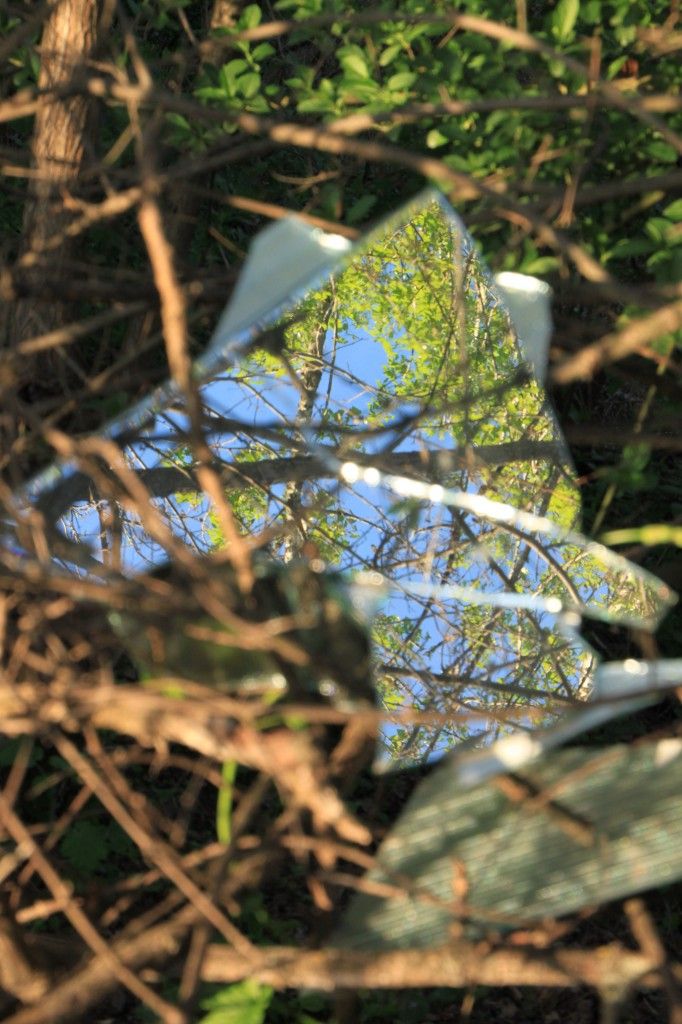
Shattered mirror on the ground sparkles sunlight.
Tears glisten bright.

People shudder and protect their feet,
Lest they cut and start to bleed;
Broken glass… thousands of pieces,
Prick and cut veins,
Bleed but no one sees the pain.

I smile every day, a perfect smile,
You say, ‘You are happy, you own a style.’

Have you seen the pain of my bleeding heart?
Smiling every day is a beautiful art.

This world is a stage.
Here in plots, we play our parts,
I do my best to smile and dance,
Perfect in my role, I am the star.

Shattered mirror of my heart,
No one sees how I bleed and play my part.

Tasneem Hossain, an author of four poetry books, is also an op-ed and fiction writer, translator, educator and trainer from Bangladesh. Her poems are published frequently in literary journals worldwide and have been translated in seven other languages.

.

PLEASE NOTE: ARTICLES CAN ONLY BE REPRODUCED IN OTHER SITES WITH DUE ACKNOWLEDGEMENT TO BORDERLESS JOURNAL

Click here to access the Borderless anthology, Monalisa No Longer Smiles

Click here to access Monalisa No Longer Smiles on Kindle Amazon International