He went for a walk
in the salty sea,
tripped over a ship,
a Spanish galleon.

He went for a stroll
in a summer meadow,
fell over a horse,
a thoroughbred stallion.

And every time
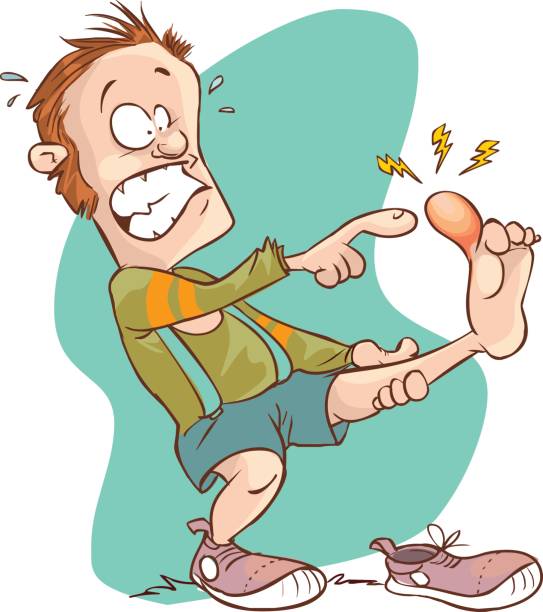
he stubbed his toes
he shouted, “Oh no!
I’m a clumsy giant.”

He went for a saunter
in haunted woodland,
tripped over a ghost
and injured his hand.

He went for a ramble
on a deserted beach,
slipped on a peach skin,
made a hole in the sand.

And every time
he stubbed his toes
he shouted, “Oh no!
I’m a clumsy giant.”

He liked to promenade
with a vat of lemonade
along the clifftop,
not afraid of the drop.

But accidents happen
and over he went
with a roll of thunder
accompanied by clapping.

And every time
he stubbed his toes
he shouted, “Oh no!
I’m a clumsy giant.”

Cyclops Billy was his friend,
Cyclops Billy advised him to mend
before he went walking again
and risked a tripping
over monsters
and men.

Cyclops Billy is tired of his groans,
Cyclops Billy adopted a tone
of gentle rebuke to the great fluke,
cushioned his bones
and proffered
him soup.

And every time
he stubbed his toes
he shouted, “Oh no!
I’m a clumsy giant.”

Thank you, Thank you,
I feel much better,
the giant admitted in a letter,
and then he went on his way
to take a tour
of pastures new,
to take a look and see the view,
hoping to do so
without any hassle.

He climbed a tree
higher and higher
and reached the top
with a skip and a hop
and took the look that he desired,
saw the sunset all on fire.

He climbed a mountain
even higher, reached the summit
before he retired,
scared the yeti who lived up there
until the poor creature
lost all its hair.

On an avalanche he descended,
soonest broken is soonest mended,
crashed into a castle
from a storybook,
rented by a vampire
but owned by a spook.

And every time
he stubbed his toes
he shouted, “Oh no!
I’m a clumsy giant.”
From Public Domain
Rhys Hughes has lived in many countries. He graduated as an engineer but currently works as a tutor of mathematics. Since his first book was published in 1995 he has had fifty other books published and his work has been translated into ten languages.
.
PLEASE NOTE: ARTICLES CAN ONLY BE REPRODUCED IN OTHER SITES WITH DUE ACKNOWLEDGEMENT TO BORDERLESS JOURNAL
Sometimes I wonder what makes us exclusive as a species on Earth? Do we really have some kind of superiority over the flora and fauna without which we may not survive? With multiple species of wildlife being threatened by human exploits, perhaps there is a need to remind ourselves of our dependence on our planet and the lives it supports while acknowledging our existence as just one of the many species. In this issue, we celebrate life on this planet… I do not know if a cockroach or a cow would be considered wildlife, but it seems only right to see all of them as our brethren… along with yetis who could be a figment of the human mind… Enjoy some of our selected fare from around the world on World Wildlife Day today.
Nonsense poems consist of nonsense without choice. You may choose to read or not read them, true enough, but once you have embarked on the journey you are helpless in the rushing of the raging word-torrent. Your reading mind becomes a canoe, sturdy enough but lacking a rudder or paddle. There are no alternatives to the direction in which you are rushing. You are committed, at least as much as the writer of the poem was, and the act of abandoning the work is equivalent to throwing yourself out of the canoe, immersing yourself in the foaming liquid, scraping your soul on the submerged rocks of the dangerous passage. Your inner being will experience this, even if it appears on the surface that you have simply ceased reading a few bewildering verses.
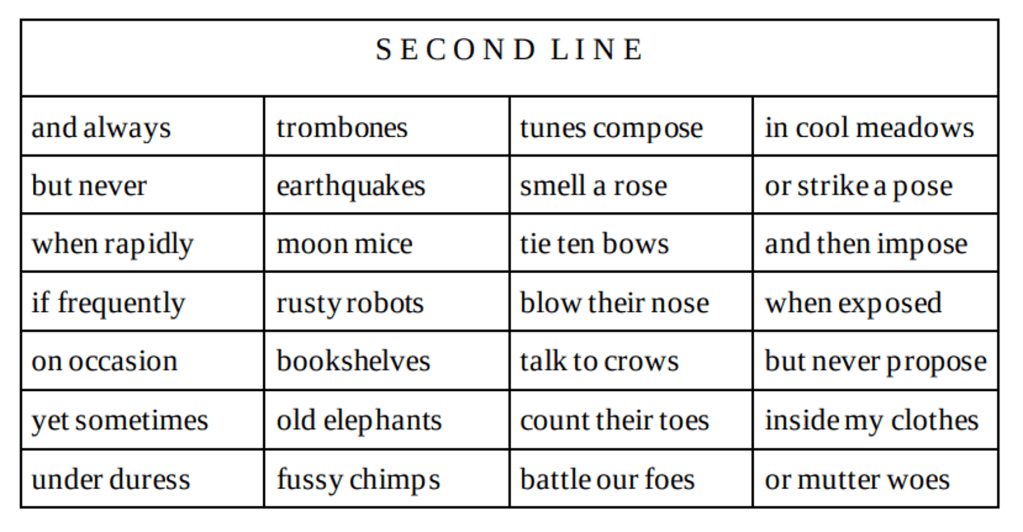
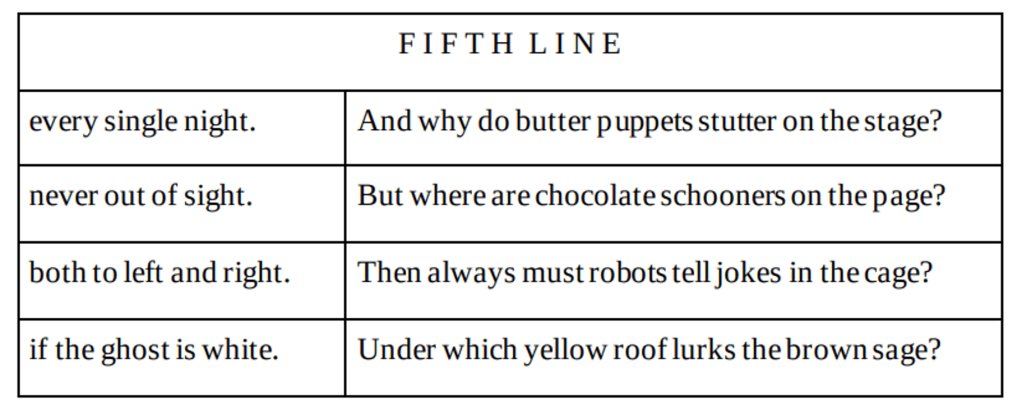
Therefore, I have decided, with some rhymes and a little reason, to create a nonsense poem that gives the reader rather more latitude in the way it develops. As an absurdist piece, the freedom of choice is limited to different meaningless outcomes, but my hope is that some of the permutations will be musical enough and sufficiently evocative to make the procedure worthwhile. The total number of combinations of lines is astronomical. This means that a reader who chooses a particular path through the poem will probably be the first to have done so. It is also likely he or she will be the last. The chances of someone else choosing the same route are vanishingly small. It can therefore be said that the poem was written entirely for you and nobody else. To navigate this ‘Do It Yourself Nonsense Poem’ simply choose a first line from the first grid, followed by a second line from the second grid, then a third line from the third grid, a fourth line from the fourth grid, and so on. There are twelve grids. The end result, if you persist, will be a twelve-line nonsense poem. It might be the case that a poem produced using this method makes some sort of sense. If this happens, I will be happy to offer you my condolences. But I think it is very unlikely a sensible poem will be found from this exercise, even if one really is hiding within the combined grids.
Among the multitude of poems that can be generated using these grids, one of them will be the best of all, and another one must be the worst, but it is simply unfeasible to work out which those are. The number of combinations is so high that the best will surely remain secret forever, and the same is true of the worst. This does not logically mean that the best is magnificent and the worst terrible. The difference between the best and worst might be very minor. But the grids are finished and I am the first reader of the work as well as its writer, so I felt entitled to find my own way through the grids. My random path led me to the following. After reading it through, my mind wanted to add the words ‘Well, wouldn’t you?’ to the end of the poem, but that is cheating. Attempts to twist nonsense into sense must be discouraged.
After cooking beans on the green platform the yeti mends a net
but never moon mice smell a rose inside my clothes
if singing a duet. The fanciest dress was bought new
thanks to rubber bones yet bedsteads gleam in smug dry streams
both to left and right. And why do butter puppets stutter on the stage?
The tangent was once unexplained, I guess, in situational anxiety
and so, aghast, four wise moons break a chair cogitating fruit.
The scholarly fruit trees rhyme badly, every day, or chatter with bees
greedily, noisily, sadly. And what of the butler? He loves all the clutter
under duress, he wonders while hissing, beautifully nonetheless.
And so the man blundered badly near a cockatoo but crystallised
and broke the cloud in the dusk to shun the vanilla fruit flies.
Rhys Hughes has lived in many countries. He graduated as an engineer but currently works as a tutor of mathematics. Since his first book was published in 1995 he has had fifty other books published and his work has been translated into ten languages.
.
PLEASE NOTE: ARTICLES CAN ONLY BE REPRODUCED IN OTHER SITES WITH DUE ACKNOWLEDGEMENT TO BORDERLESS JOURNAL
Ghee-laden, sugar-loaded, deep-fried, I have been warned that Indian sweets are naughty, even dangerous, and that I shouldn’t eat them at all, or if I do insist on eating them, then they must only be sampled in moderation, and even when I eat them in moderation I ought to visit a reliable doctor every week for a full health check, and even if I do that, I must bear in mind that men of my age die of heart attacks even when they don’t eat sweets of this nature. Indian sweets might look harmless on the plate but they are like cluster bombs, detonating inside the body and speeding a man into the next world.
But I climb mountains and mountaineering has been a huge part of my life, and when we climbed mountains back in Britain we took with us large amounts of a substance called Kendal Mint Cake. I need to talk about this food before I am able to make the point that I intend to make about Indian sweets. If you bear with me, I won’t be too long. Kendal Mint Cake is a sugar-based confection and is flavoured with peppermint oil. In fact, sugar, water and peppermint oil are the only ingredients, but they are prepared in a special way which remains a secret. I don’t think there’s much that’s very secretive about blending sugar, water and peppermint oil, but who am I to say that?
The ingredients are mixed together and boiled in copper pans while being continually stirred. If this stirring stops, the mixture becomes translucent and it will be ruined, because opacity is the desired feature of Kendal Mint Cake. How can a translucent sugar-rush product be taken seriously? We see the light after a lifetime of contemplation. We see a solid lump of minty sugar when we plan to ascend to the summit of some peak or other.
Kendal Mint Cake has a formidable and perhaps peerless reputation as the energy-providing snack of choice for the intrepid explorer. It played an essential role in the Trans-Antarctic Expedition of 1914–1917, led by Ernest Shackleton, one of the fittest and toughest men who ever lived. It aided Hillary and Tenzing in the first successful attempt on Everest in 1953 and other members of the team wrote, “It was easily the most popular item on our high altitude ration” and “our only criticism was that we did not have enough of it”. High praise indeed, with an emphasis on the high. Bonington also climbed Everest in 1975 using Kendal Mint Cake, as well as ropes and crampons.
I think we can safely declare that Kendal Mint Cake is heroic. Therefore, it seems to be that Indian sweets can also be regarded as mighty, valiant, doughty, gallant, fearless and daring. And when we consider that India has mountains far higher than those in Britain, shouldn’t we tend to the conclusion that the sweets of India are themselves a bracing landscape when seen on the counter of a shop that sells them? We hear a lot of talk about sugar highs and lows, but viewed as a backdrop, rather than as the progress of a graph line through time, highs and lows form mountain ranges. Indian sweets recreate on the inside the geography of the northern icy reaches of the country.
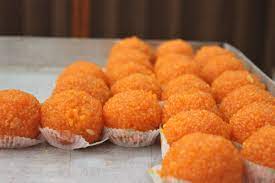
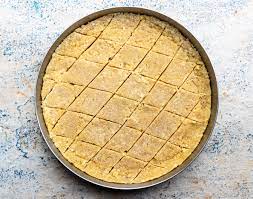
It is high time (more wordplay) that mountaineers and other explorers start carrying Indian sweets on their expeditions. Kendal Mint Cake has proved itself in the lonely heights, and now gulab jamuns and ladoos, and boxes of sandesh, modak, barfi and bowls of payasam should be given a fair chance, to say nothing of kulfi, halwa, gujiya, and my favourite, Mysore pak. Need I list them all? It is not just a question of providing energy to the adventurer, energy that can be expended a very short time after eating the sweets, as opposed to eating healthy foods which provide energy slowly and in trickles. No, there are many other good reasons for adding a broad selection of sweets to the supplies that are to be taken up slopes of staggering steepness into the very clouds.
First of all, sweets are light. They are lighter than so-called healthy foods. I pity the mountaineer who hefts sacks of cabbages and carrots to the top of harsh and fearsome Annapurna or Dhaulagiri. Sweets are considerably more compact than vegetables, especially the unpleasant-tasting vegetables. Sweets can remain fresh for longer and that’s another advantage. You don’t have to eat them all in the foothills but can save some for the ascent.
Sweets are rewards too. The fellow who promises himself a ladoo or two when he finally attains a certain tricky ledge is more likely to be motivated to strive for that ledge than the man who tempts himself with a turnip or beetroot. Who would want to munch on a root vegetable during a blizzard? Not me. The taking of sweets on expeditions also provides work for sweet-makers. It is both economically wise and aesthetically sensible to carry sweets together with ropes and pitons and carabiners and all the other accoutrements of a sober climb if one happens to be a serious climber. Hunger pangs are one thing at sea level, but at altitude they tend to be much worse.
There is another consideration that hasn’t yet been touched on. There is the perennial risk for the mountaineer who attempts the Himalayas that he will meet and be abducted by Yetis. I won’t overstate the risk. Most of the climbers of that range have returned without being abducted. But is it really responsible to poke one’s nose into the eternal snows without something to mollify the beast? There is the question of simply organic respect. The explorer who suddenly encounters a Yeti and emits a shriek has insulted his potential host. The explorer who opens a box of sweets and offers one, or several, or many, to the hairy brute will surely make a good impression. I can almost see them now, in my mind’s eye, man and monster sitting on a crag, sharing gulab jamuns.
Rhys Hughes has lived in many countries. He graduated as an engineer but currently works as a tutor of mathematics. Since his first book was published in 1995 he has had fifty other books published and his work has been translated into ten languages.
.
PLEASE NOTE: ARTICLES CAN ONLY BE REPRODUCED IN OTHER SITES WITH DUE ACKNOWLEDGEMENT TO BORDERLESS JOURNAL







 Borderless