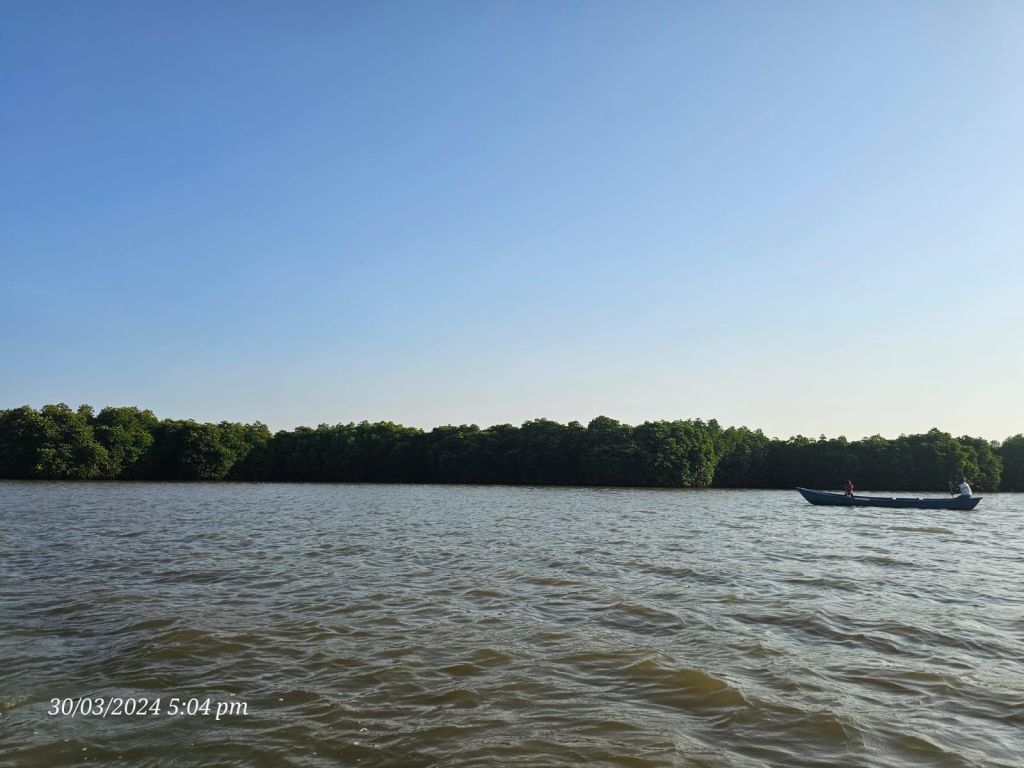
The air hummed with an enchanting melody, and the sun tipped below, casting long shadows that danced like playful spirits along the path. I boarded a small wooden boat, it’s hull adorned with intricate carvings that seemed to tell ancient tales of the forest that glides across the still waters.
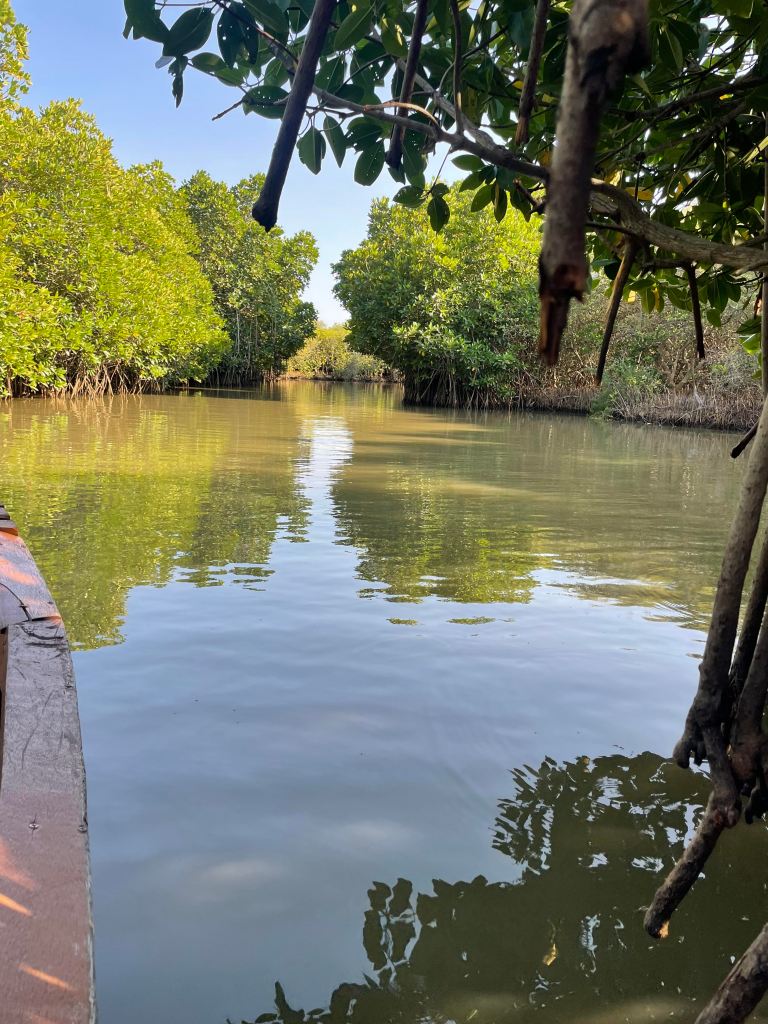
The mangroves that appeared tiny from afar now rose like towering sentinels, their twisted roots reaching down into the depths. Under the canopy rising up like a vast green cathedral, the sunlight dappled into a mosaic of varied hues. The boatman, a weathered old soul with eyes that gleamed with ancient wisdom, guided us through the labyrinthine channels with a steady hand. He spoke in a hushed tone, weaving tales of forgotten gods and spirits that dwelled within the heart of the forest,
Suddenly, the boatman pointed ahead to the other side, his voice barely more than a whisper through the mist. I saw it as a portal hidden among the tangled roots of an ancient tree. As they drew closer, the earth drummed with power, and I felt a sense of wonder wash over me.
With a gentle nudge from the boatman, we passed through the portal and into another realm entirely. The world around us shifted swirling colours, blending and merging into more hues. It seems strange but wonderful, the way nature’s law seemed to bend and twist, defying all logic and reason.
The trees danced with joy, their branches swinging in time to an unseen melody, while the leaves of the green mangrove stretched out in every line, shining in the sun as they unfurled like delicate works of art.
As we ventured deeper into the heart of the mystical realm, I could almost envision Lord Shiva himself taking on the form of Nataraja, the cosmic dancer. In the shifting shadows and shimmering light, I could see the divine figure gracefully moving amidst the swaying trees and swirling mist. His celestial dance seemed to echo through the very fabric of the universe, a mesmerizing display of cosmic energy and divine grace. With each step, he breathed life into the world around him, weaving together the threads of creation and destruction in a harmonious symphony of movement. It was as though the entire forest had become his sacred stage and I, a humble witness to the timeless dance of the cosmos.
All too soon, the journey came to an end. The boatman guided us back through the portal, and we emerged into the familiar world of the mangroves. I felt a pang of sorrow tug at my heart. I longed to stay in that magical realm forever, to lose myself in its wondrous embrace.
As we made our way back to the shore, the world around me seemed somehow different. The trees whispered secrets as we passed, their voices soft and melodic. The journey into the heart of the Pichavaram Forest[1] had changed me permanently, and I could feel the hum of unseen forces in the air.
And though I may never fully understand the mysteries that dwell within its depths, I will always carry with me the memory of this magical journey.
The journey made me conscious of the endless beauty the earth has to offer and revealed to me that real magic is found in the unending beauty of nature, not in spells and incantations.
The ring on the fourth finger Is supposed to tug at your heart strings. Initially, it served its purpose well. The day it slid into my life, The diamond dazzled in ecstasy, The metal danced in circles With every milestone we touched.
Over years, with dishwash and promises Running down the drain, The lack-lustre lonely thing, Trembling with the responsibility Of its most precious jewel, Disfigured the very throne it sat on. Growing stiff and refusing to budge. It dug into my soul for the flesh around it Began to swell and I writhed to fit my ring.
As I walk the shoreline now, My fingers thin and bare, The ring sitting uneasily In its box, Elliptically sulks at me. Not only has its noose tapered My ring-lady at the base, The flat oval of my stubby finger Has, for ever, Altered its rounded face.
Averi Saha is an academic, critic and translator. She teaches in a college in West Bengal and works on folk literature. She has published academic papers, translations and original poems.
.
PLEASE NOTE: ARTICLES CAN ONLY BE REPRODUCED IN OTHER SITES WITH DUE ACKNOWLEDGEMENT TO BORDERLESS JOURNAL
The Bengali poet, Kazi Nazrul Islam (1899-1976), is widely remembered as the fiery iconoclast who fought against the structures of oppression and orthodoxy. The iconic bidrohi or ‘rebel poet’ of Bengal, Nazrul continues to be loved for his songs and poetry that were aimed at arousing the rebellious spirit of both Hindus and Muslims alike. But what of his prose, his journalism, and his politics? Selected Essays reveals to us the extraordinary versatility of Nazrul as a writer, thinker, and activist. Addressing subjects as diverse as social reform, politics, communal harmony, environmental concerns, education, aesthetics, ethics, and philosophy, this rich collection showcases Nazrul’s dynamic vision and unique use of language as an instrument of change. The essays chart his evolving consciousness as a thinker, writer, and activist, offering vivid glimpses of the ethos of his times, his relationships with leading figures such as Tagore and Gandhi, and his active engagement with social, political, and cultural processes.
Of the forty-one essays selected here, (three undated), the first thirteen are all written in different places all in the year 1920. That was the year Nazrul returned to Bengal after serving in Karachi during World War I as a member of the Bengal regiment of the colonial British army. Reacting to the Jallianwallah Bagh massacre he writes, “May the Dyer monument never allow us to forget Dyer’s memory” because on that occasion Hindus and Muslims embraced each other and wept together as brothers. They shared the same agony as children of the same womb. In ‘Strike’, he praises the social awareness that has swept among the ranks of the labouring class and believes that the “protest is not just a rebellion, but the death-bite of the suffering, moribund class”. When some migrants were fired upon after a clash with the armed police at a place called Kanchagarhi, he asked in ‘Who is Responsible for the Killing of Migrants?’, whether anyone can ever tolerate such injustice towards humanity, conscience, self-respect and independence and states that they are no longer going to passively accept such assaults. ‘Awakening Our Neglected Power’ contends that democracy or people’s power cannot be established in our country because of the oppression inflicted by the Bhadra[1] community.
There are several essays in which Nazrul speaks about the state of National Education, he envisages ‘A National University’, and in a very powerful piece that he wrote from Presidency Jail in Kolkata on 7 January 1923, titled ‘Deposition of a Political Prisoner’ he reveals his self-confidence:
“If anything has struck me as unjust, I have described it as injustice, described oppression as oppression, named falsehoods as falsehood. …For that endless mockery, insults, humiliation and assaults have been rained on me, from within my home and beyond. But nothing whatsoever has intimidated me into dishonouring my own truth or my own Lord. No temptation has overpowered me enough to compromise my integrity or to diminish the immense self-satisfaction gleaned through my own endeavours…. I repeat, I have no fear, no sorrow. I am the child of the elixir of immortality.”
Nazrul grew up in a traditional religious environment, yet in his writings he drew upon both Hindu and Islamic sources, and expressed a faith that transcended the limits of any single religion. In several essays, he harps on the problems of Hindu-Muslim amity and enmity and warns us about “this hideous business of purity of touch and untouchability”. He wants only humans to live in India as brothers and wants everyone to be wary of the terrible deceptions created by both the religions.
In the essay ‘Temple and Mosque‘, he states that both parties have the same leader, and his real name is Shaitan, the Devil. Written in response to the communal riots that broke out in Kolkata on 2 April 1926, he feels that those very same places of worship that ought to have been bridges between heaven and earth are instead causing harm to humanity today, and so those temples and mosques should be broken down. In another essay titled ‘Hindu-Muslim’, penned the same year, Nazrul talks about the question of an internal tail in human beings. He says, “There’s no telling what animal excitement lured the human mind to discover a substitute for tails in the beard or tiki[2]!” He further elaborates:
“Both Hindu and Muslim ways of life can be tolerated, but their faith in tikitwa and daritwa, the orthodox ways of tiki and beard, is not to be borne, for both instigate violence and killing. Tikitwa is not Hindutwa, it is perhaps punditwa, the way of the pundit! Likewise, the beard, too, is not Islamic, it is mullatwa, the way of the mullah. These two types of hair tufts, marked with religious dogma, are precisely the reason for all the conflict and hair-splitting we witness today!”
Though it is not possible to discuss all the different editorials, book reviews, and political pieces that are included in this collection, one must mention at least two essays that speak about literary issues as well. In 1932, Nazrul wrote for Patrika (subsequently reprinted in Bulbul the following year), an interesting piece titled ‘World Literature Today’. In it he states that there are two kinds of writers present in the world today and their different tendencies have assumed immense proportions.
“Ranged on both sides are great war heroes, champion charioteers of the battlefield. On one side are the dreamers, such as Noguchi, Yeats and Rabindranath, and on the other, Gorky, Johan Bojer, Bernard Shaw, Benavente and their ilk.”
But Nazrul’s ire in being ostracized comes out clearly in ‘A Great Man’s Love Is a Sandbank’ (1927), where he criticises the high-handedness of Rabindranath Tagore. He begins by telling us how he was a prisoner of state at the Alipore Central Jail when he was informed by the assistant jailor that Tagore had recognised Nazrul’s talent and dedicated his play Basanta to him. The other political prisoners present there had laughed at him not in joy but in incredulity. For him, the blessing turned into a curse. His very close friends and state prisoners also turned away from him. He realised what massive internal damage this outward gain had caused him. Busy with his political agenda, he didn’t have the time to sit and meditate as advised several times by Tagore. So Nazrul writes, “I find that the brighter my countenance shines in this glory, the darker some other famous poets’ faces seem to appear.” He mentions that he had grown accustomed to police torture but when literary personages begin to torment one, their brutality knows no bounds. “Alas, O youthful new literature!” His crime was that young people celebrated his work. He laments further,
“That Kabiguru[3], revered by both parties like the grandsire Bhisma, should assent to this plot of killing Abhimanyu, is the greatest sorrow of our times. …As for me, I have discarded that topi–pyjama—sherwani–beard look[4], only out of fear of being mocked as a ‘Mia Saheb’. But still there is no respite for me…. Now we get the feeling that the Rabindranath of today is not the same Rabindranath we have always known.”
That the trajectories and beliefs of Tagore and Nazrul went in the opposite direction is well- known. In the essay, Nazrul then further continues his complaints against Tagore. He questions whether they have been considered as his enemies, simply because they didn’t go to him frequently. Also, since the goddess of wealth blessed him, Kabiguru did not know what dire poverty the new writers had to struggle against, languishing in conditions of starvation or semi-starvation. So, he humbly requests Kabiguru not to sprinkle salt on their wounds by mocking the impoverishment that is their singular affliction, for that is one form of heartlessness that they cannot tolerate.
Of the last three essays written in 1960, namely, ‘The Science of Life’(where men “are surrounded by all sorts of travails and sufferings, and many of them cannot be alleviated”), ‘A Point to Ponder’(where the nation faces an immense problem regarding the dispute about the instructions and procedure for the worship of the mother, the Bharatmata, our Mother India) and in ‘What We Need Today’, Nazrul speaks of the necessity of a “vast tumult in India”. Making his readers aware of the vast duplicity and trickery in the name of religion, he warns that unless one avoids the baseness of being subjugated by an external power, there is no prospect of heaven for us, only the grotesqueness of hell. He wants the kalboishakhi, the wild summer storm, to “approach in all its fury, rearing his head like a hooded serpent swimming in the unchecked torrents of an ocean of blood” and sweep everything away.
Before concluding one should also make a few comments on the translation. As a veteran translator, Radha Chakravarty, has successfully managed to transcreate some very difficult Bengali idioms, cultural nuances and analogies that Nazrul used in some of his essays. As she admitted in the Introduction, “[T]ranslating Nazrul’s prose proved to be a challenge, as demanding as it was exhilarating. …The endeavour demanded experiment and creativity rather than mechanical lexical ability and involved some difficult choices…Literal translation has been avoided, with greater focus on the sense, emotion, intellectual import, rhetorical features and stylistic particularities of the Bengali source texts.” She further adds that the present translations stemmed from a desire to bring Nazrul’s essays to a contemporary audience in South Asia and the rest of the world, to draw attention to his literary achievement as well as his significance as a writer, thinker, activist, and visionary. Though a lot of research and translation projects on Nazrul has been going on in Bangladesh for quite some time (where he holds the status of National Poet), in India, especially in West Bengal, the response is still rather lukewarm. Hence this volume is strongly recommended as a collector’s item.
[1] Literally decent but here indicates the bourgeoisie.
Once more, Ratnottama Sengupta explores the contemporariness of Tagore ….
In empathy with Kolkata’s heatwave in April 2024
The continuing heatwave in Kolkata that has defied the geographical reality of Kaal Baisakhi — the norwester that brings relief to sun-scorched beings — prompted me to continuously hum this Tagore song in Brindavani Sarang Raag, written in 1922.
Darun Agni Baaney Re... (Shafts of Fire)
Shafts of fire pour thirst on us -- Sleepless nights, long scorching days, No respite in sight! On withered branches, A listless dove wails Droopy doleful notes... No fear, no scare, My gaze is fixed on the sky, For you will come in the Form of a storm, And shower rain on scorched souls.
And as I kept singing the song first penned in Santiniketan, I marvelled at the creativity of the giant whose words are true to this very day, more than 100 years later!
Kaal Baisakhi, the nor’wester known in Assam as bordoisila, is a localised rainfall and thunderstorm event which occurs in the Indian states of West Bengal, Bihar, Jharkhand, Odisha, Tripura, and Assam as well as in Bangladesh during the summer month of Baisakh (April 15-May 14). This first month of the Bengali calendar also saw the birth of Rabindranath Tagore. These storms generally occur in the afternoon or just before sunset, when thick dark black clouds appear over the sky and then bring gale-speed wind with torrential rain, often with hail, but spanning only a short period of time.
Kalbaisakhi
Tagore’s love for Nature had compelled him to set up in Santiniketan open air classrooms, where students would learn sitting on the ground in the bower, under trees where birds would chirp and gentle breeze would caress their tired brows.
And, his involvement also expressed itself in the 293 songs he wrote in the segment titled Prakriti (nature) Parjaay. There are songs about nature in general. But he himself further classified the songs under subsections — Upa parjaay — that focus on the six seasons: grishma (summer), barsha (Monsoon), sharat( early autumn), hemanta (late autumn or early winter), sheet (winter), basanta (spring).
Tagore clearly was taken up by the wild beauty of monsoon with its dark clouds and thunderous showers. For, he wrote 150 songs on the drops of nectar from the heavens, while summer elicited a tenth of this number! If this is half the number celebrating sharat, the festive season of Durga Puja, it is thrice the number dedicated to hemanta, the confluence of autumn and winter.
I take heart in the fact that Grishma subsection includes Chokkhe aamar trishna, Ogo trishna aamar bakkho jurey… [1]
Thirst fills my eyes, Dear, Thirsty is my heart too... I'm a rain-starved day of Baisakh Burnt by the sun, heat stroked. There's a storm brewing In the ovenated air.. It sweeps my mind into the distance. It rips me of my veil. The blossom that lit up the garden Has withered and fallen. Who has reined in the stream Imprisoned in heartless stone At the peak of suffering?
And then, when it rained? The torrents poured balm on the angry burns. The fleet-footed lightning seared the heart of the cloud-covered darkness and extracted the nectar-like flow…
It assured us that no hardship lasts forever. It reiterated faith in the eternal words, “This too shall pass!” And, for me? It confirmed Tagore’s words that “You will come in the form of a storm and shower rain on scorched souls…”
Tagore lives on, 163 years after he came. In his words. In his imagery. In his empathy with every human situation…
[1] Thirst fills my eyes, Dear, /Thirsty is my heart too…
Ratnottama Sengupta, formerly Arts Editor of The Times of India, teaches mass communication and film appreciation, curates film festivals and art exhibitions, and translates and write books. She has been a member of CBFC, served on the National Film Awards jury and has herself won a National Award.
.
PLEASE NOTE: ARTICLES CAN ONLY BE REPRODUCED IN OTHER SITES WITH DUE ACKNOWLEDGEMENT TO BORDERLESS JOURNAL
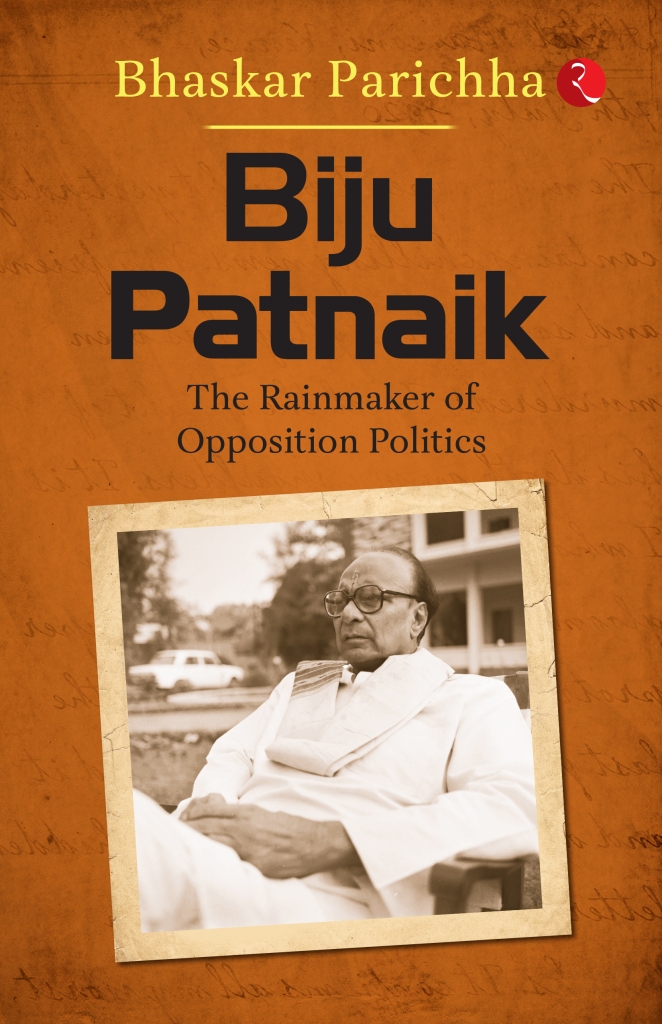
Title: Biju Patnaik: The Rainmaker of Opposition Politics
Author: Bhaskar Parichha
Publisher: Rupa Publications India
Architect of Modern Odisha
Biju had a strong sense of zeal for dreaming big. At that time, no one had even dreamt that there could be a private sector industry, much less one that was successful. He dreamt and succeeded. Throughout his life, Biju stood out as a person with courage, and that by itself chronicled a remarkable saga of industrial adventure in Odisha half a century ago.
In 1945, when he had attempted to establish an industrial empire in Odisha, he had several other responsibilities. He could have remained committed to politics and wielded political power, as he was exposed to it during the height of the freedom struggle. However, he had a unique vision of industrialization of Odisha. As mentioned earlier, Biju was greatly influenced by Manubhai Shah. In the same way that Mahtab taught him the basics of realpolitik, Manubhai taught him the first few lessons of setting up an industry.
In the years following Biju’s release from jail, he developed an unshakable faith in himself and a commitment to utilize his full potential. There were no great merchants or wealthy individuals in his circle, nor was he in possession of vast resources. The only thing he had was a lofty vision. Despite British strongholds throughout the country, he had flipped through quite a few pages on how to struggle and achieve success. However, the actual struggle had not yet begun.
Owing to his aviation background, several years before he became a big industrialist, he had set up his own airline Kalinga Airlines. At one time, it is believed that Biju had seven aircraft registered in his name, a rare possession. This demonstrated the importance of Biju as a pilot—industrialist. Apart from aviation, it was Choudwar’s textile mill that ushered in a new era of industrial expansion in Odisha. With the establishment of the Odisha Textile Mill in Choudwar, he launched the first chapter of his industrial empire. Slowly but surely, the Kalinga Empire was taking shape. Two years later, it swept through the area, adding a few more plants, both large and small. It would be a reiteration of the obvious to dwell on the ingenuity of this stalwart who painted a large industrial landscape on a blank canvas.
In setting his vision of an industrialized Odisha, Biju was clearly aiming to change the fate of Odias; to transform an agriculture-dominated, feudalist economy and society into something more industrial. This was the inevitable course of action that he took.
ODISHA TEXTILE MILL
From 1946 to 1950, Mahtab served as the Chief Minister of Odisha.
There was a great deal of activity during his tenure as
CM Mahtab, like Biju, was also concerned with the industrialization of Odisha. He was seeking a dynamic youth to this end, which he found in Biju. Mahtab was also instrumental in establishing Biju as a leading industrialist in the country. It took just a short period of time for Biju to become one.
In 1944, the interim Indian government decentralized the textile industry. As a result, Odisha received four textile units. As textiles appeared to have great potential, Biju was particularly interested in them. Odisha Textile Mills was established at that time. A company named B. Patnaik & Co. was established. A half stake in the company was owned by Biju. Lala Pratap Singh, a descendant of industrialists Lala Sriram and Bhubanananda Das, held the other half. In Odisha, it was the first private company to begin operations. Through this flagship company, Biju’s enterprise was growing rapidly. Several small- and medium-sized industries emerged, including cotton and ferromanganese. Biju Patnaik & Co. was an industry through and through. It was the birth of a brand. A common thread running through Biju’s corporate credo was the concept of industrialization and diversification.
It was in the late 1940s that Biju joined the Kalinga industrial empire. The primary objective of his career was to establish himself as an upcoming industrialist and develop a company that had the highest annual growth rate. Biju took a shot and Odisha’s industrialization was catapulted into a remarkable era. However, this glory did not last long. Out of his own free will, Btu was renouncing that industrial prowess. The two contrasting factors that contributed to his disdain for the position must have been his well-publicized commitment to do something for the slothful people of Odisha and his dislike of the responsibilities that came with being a manager.
After a brief blossoming, his entrepreneurial spirit soon faded. Biju was the only one apart from Prafulla Chandra Roy[1] in West Bengal, who was able to build industries from scratch. It has been decades since Sir Prafulla Chandra Roy pioneered the West Bengal industry before it withered away.
In 1963, Biju gave away his Ironworks plant in Barbil to the state when it was earning 10-15 per cent profit annually. Biju then gave other plants to his employees. The Kalinga Group saw a gradual decline once he made everything available to the state. All of this had the potential to make him the richest man in the state. This reluctance to engage in business, which Biju demonstrated later as well, was accompanied by a lack of expectation of compensation. All he wanted was a progressive Odisha, which could have never become a reality if he had no political power.
[1]Physicist, educator, historian, industrialist and philanthropist, Roy was an eminent figure in Indian science. Known as the father of chemical science in India, he established the first modern Indian research school in chemistry. While being the founder of Bengal Chemical & Pharmaceuticals, he also served as its chairman.
About the Book
Transitioning from pilot to freedom fighter, businessman to politician, Biju Patnaik(1916-1997) was a multifaceted leader and towering regional icon who has left behind an impactful legacy. Step into the riveting saga of Biju Patnaik, the icon of resurgent opposition politics, through this compelling biography, Biju Patnaik: The Rainmaker of Opposition Politics. His journey, from leaving office in 1963 to reclaiming it in 1990, epitomized resilience and rebirth in politics. Whether as chief minister or Opposition leader, Patnaik’s unwavering connection with the people of Odisha defied conventional politics. Navigating triumphs and trials, Patnaik wielded immense influence, shaping the state’s destiny. His adept manoeuvring from the state secretariat to the corridors of power in Delhi showcased unparalleled strategic prowess, strengthening Opposition alliances and advocating for a credible alternative to the dominant Congress. Biju had tremendous faith in Opposition unity, considering it vital for the survival of democracy in the country. A visionary and unifier, Biju Patnaik’s legacy as a stalwart of Opposition unity echoes through the captivating pages of this stirring account.
About the Author
Bhaskar Parichha is a renowned name in Odisha journalism. Throughout his four-decade long career in the media industry, he has been affiliated with various newspapers in the state. He is the writer of Unbiased: Writings on India, No Strings Attached: Writings on Odisha, and Madhubabu – The Global Indian. Recently, he has also edited a collection titled Naveen@25 – Perspectives. Residing in Bhubaneswar, he is known for his bilingual writing.
.
PLEASE NOTE: ARTICLES CAN ONLY BE REPRODUCED IN OTHER SITES WITH DUE ACKNOWLEDGEMENT TO BORDERLESS JOURNAL
Tagore would have been 163 years old this year. In fact, he is that old this year. That is because he did not die in 1941. When poets pass away, they merely pretend to die, leaving mortals to bear the weight of their non-passage. In my case, at the age of 66, the happy punishment for being a Bengali is to be tied to a childhood spent in the lap of Tagore’s poems. That lap gets younger as I grow older.
I remember listening to Phagun, haoai haoai[1], Tagore’s ode to the winds of spring, on the radio in the attic of my ancestral village home in West Bengal’s Hooghly district. My home bordered a vast, circular expanse of agricultural land contoured by villages that included mine. Sitting in the third-storey attic, next to a terrace that overlooked the fields, I was transformed by the song. It turned vision into movement. The song’s opening lines speak of the poet making the gift of his carefree and untamed soul to the flow of the eager spring winds. Those lines might have added that Tagore had cast my soul as well to his winds. I leapt out of myself: I gladly yielded to my capture by the elements. I looked out, imagining that the spring winds would carry me across the vast fields into the homes and lives of the people who were participating in the rituals of spring, one of which was Tagore’s song itself.
There were many other songs in the same vein that accompanied me into youth. Among them were Tomar khola hawa[2], where Tagore welcomes a fresh gush of wind to his waiting sails and promises the elements no regret even if his boat sinks; and Nil Digante[3], where the blue horizon catches fire from the rioting colours of flowers and even the sun asks for itself in the brightness of the earth. Such were the poetic conceits that lent the urgency of understanding to the passage of my youthful days. To lead the imaginative life was to consign oneself to the youthfulness of Tagore.
My spring is over: Those days have passed, taking a happy Tagore with them. Now, what appeal to me are his sombre songs that deal with mortality and the divine. Tai tomar ananda amar por[4] is an outstanding example of what I would call the Late Tagore in me. Essentially, Tagore says to God: “You are the Creator only because I am the created.” Can you imagine the degree of self-certainty that allows a human to address God so fearlessly? I do not share Tagore’s devout hubris but I listen to that song over and over again to reassure myself that my days have not been useless because they have been inhabited by God-created hours. And, of course, with Jokhon porbe na more payer chinho[5], Tagore turns death itself into a romance with the endless interplay of time and space that defines life. I stand redeemed by his lines.
But I am growing old. I am not conveyed out of myself by the spring poems any more: I prefer to age, as wildly as health and imagination allow me to, within myself. Tagore accompanies me still, but what confounds me is how young he remains even in his constancy to the maturity of my withering years.
Phagun, haoai haoai: Tagore is exulting in the colours of this spring, this very year, even as I accept my autumnal steps to the final winter.
An introduction to Ratna Magotra’sWhispers of the Heart: Not Just a Surgeon (Konark Publishers) and a conversation with the doctor who took cardiac care to the underprivileged.
“I slept and dreamt that life was joy. I awoke and saw that life was service. I acted and behold, service was joy?”— Tagore, Whispers of the Heart: Not Just a Surgeonby Ratna Magotra
“There are at least five estimates of the number of poor people in India, which put the number of poor in India between 34 million (equivalent to the population to Kerala) to 373 million (more than four times the population of West Bengal). This puts the number of the poor between 2.5% of the population to 29.5%, based on different estimates between 2014 and 2022.”
How are the healthcare needs of the poverty stricken met in a country with a vast number who are unable to foot their daily food, housing, and potable water needs? This has been a question that confronts every doctor in cities where labourers who build housing for the middle class are themselves homeless just like the street side immigrants who beg. Even dwellers of shanties that spring up around colonies of the well-to-do to provide informal labour to the affluent are hardly any better off. Few in the medical profession move towards finding solutions to bridge this gap.
Dr Ratna Magotra, who moved from Jammu to find a career in healthcare in Mumbai, is one such person. Recently, she wrote an autobiography which has consolidated the work being done by cardiologists to bridge this gap. In her book, Whispers of the Heart: Not Just a Surgeon, while identifying this divide, she writes: “Poverty, inequality, deficient primary healthcare, unequal access, and the escalating commercialisation of medical care were causing an angst that I found difficult to make peace with. As medical practitioners, our expertise lies in providing treatment, but we often overlook the broader social factors underlying ill health. It might escape the attention of a surgeon performing intricate heart surgery that a child who survived a complex heart surgery could succumb to diarrhoea due to the lack of access to clean drinking water. Issues like malnutrition, skin infections, superstitious beliefs, and poverty may be the harsh realities in the patient’s actual living conditions beyond the confines of sanitised medical environment. /Medical training, regrettably, seldom includes the connection between poverty and disease.”
The land reforms laws that followed post-Partition[1] led to her family losing their wealth. But Magotra bears no ill-will or scars that have crippled her ability to contribute to a world that needs to heal — of taking healthcare to those who can’t afford it. She starts her biography with vignettes from her childhood: “I recall that the agricultural land we owned in our village in Jammu was considered very fertile with the best Basmati rice grown there. Though I was very young, I have faint memories of the house amidst lush paddy fields and a small stream that we had to cross to enter the village. It was very close to the international border between India and Pakistan. The way my mother was respected reflected the high esteem that villagers had for my father. Though their tenant status had changed to that of being landowners, the villagers visited the house as they did before and received generous gifts from her. /They would indulge us children with home-made sweets made of peanuts, jaggery and spices. Rolling in heaps of post-harvest grains piled up in open fields was great fun.”
She lost all that and her father. But with supportive family and friends, drawn to healthcare, she became a doctor in times when women doctors were rare. If they at all specialised, it was mainly in gynaecology. She chose cardiac surgery trained in UK and US. She made friends where she went and with a singular dedication, found solutions to access the underprivileged. She elaborates: “The quantum leap in India’s healthcare sector occurred during the 1990s following the economic reforms and the liberalisation of the economy. The end of the licence raj system facilitated the imports of advanced technology and medical equipment. Specialists, who had long settled abroad, began contemplating a return to India.”
While she attended an International Course in Cardiac Surgery at Sicily to update her skills, she tells us: “During our interactions, some German surgeons raised questions about the rationale behind a developing country like India engaging in an expensive speciality like cardiac surgery. I realised how biased opinions can be formed and spread, though rooted in ignorance. /By this point, however, I had grown accustomed to explaining the paradox — why it was essential for India to advance in specialised care alongside its priorities in basic healthcare and poverty alleviation.”
She cites multiple instances of cases that she dealt with from the needy rural population, for who to pay prohibitive costs would mean an end to their family’s meals. Magotra writes, “I had seen numerous poor heart patients who suffered not only from the ailment itself but also from financial burden of the treatment. The medical expenses incurred for a single family member affected the well-being of entire household, depleting their limited resources and savings. Unfortunately, medical education does not include health economics as a subject. As a result, doctors, especially specialists, trained in a reductionist approach to diseases tend to move away from a holistic perspective. They readily embrace new technological advances, often neglecting proven and cost-effective treatment options. This, in turn, drives up healthcare costs and makes it unaffordable for the common man.”
Living through a series of historical upheavals, she brings to light some interesting observations. She came in contact with Jinnah’s personal physician while looking for a placement in Mumbai. There she mentions that many wondered if the Partition of India could have been averted if this doctor had shared the information that Jinnah had limited life expectancy as he had advanced tuberculosis. She has lived through floods in Mumbai and riots and wondered: “I was staring at the blood on my clothes, which had come from multiple patients. In that quiet moment, I couldn’t help but wonder if there was a ‘test’ to distinguish between a Hindu blood and a Muslim blood.” She joined the anti-corruption movement started by Anna Hazare and fasted! She has travelled and watched and collected her stories and she jotted these down during the pandemic to share her world and her concerns with all of us. In the process, recording changes in health care systems over the years… the historic passing of an era that documents the undocumented people’s needs.
Dr Ratna Magotra
An award-winning doctor for the efforts she has made to connect with people across all borders and use her experience, she talks to us in this interview about her journey and beliefs.
What made you write this book? Who were the readers you wanted to reach out to?
I had asked myself the same questions before I started and even while I was writing: Why and for whom?
Some younger friends and family members would find the anecdotes and stories, I would relate to them from time to time, interesting. They would often prod me to write about these. People, situations, my travels to places — not the usual popular tourist destinations, invoked further curiosity in them to know more about my life. As such I like to write my thoughts (usually for myself) and have been contributing small articles to newspapers, magazines, and Bhavan’s Journal for their special Issues. The pandemic provided me an opportunity to contemplate further when I seriously considered about writing an autobiographical narrative.
As I progressed with my account, I envisaged a wider readership outside the medical community as multiple facets emerged about places, people and events of varying interests.
What were the hurdles you faced while training as a doctor — in terms of gender and attitudes of others?
Fortunately, I can’t recall any specific hurdle or adverse experience because of my being a woman. Studying for MBBS degree at Lady Hardinge Medical College (LHMC), made it a normal affair as LHMC was an all-women medical college.
The struggle that I faced in getting PG admission in Bombay also had nothing to do with gender. The problem was being an outsider in Bombay when number of seats were limited. Students from local medical colleges and rest of Maharashtra had first preference for selection to PG courses. Anyone in my place would have had to go through a similar grind as I did.
Once PG admission was secured, it was smooth sailing through training and working alongside male colleagues! I asked for no concessions being a woman and worked as hard as they did or may be little more. We had a very close and harmonious working relationship with healthy mutual respect leading to lasting friendships.
What made you choose cardiac surgery over other areas of specialisation?
The decision to become a doctor and a surgeon was firmed very early in life. Interest in Cardiac surgery was acquired much later when I started working with Dr Dastur in Bombay. Seeing and touching a beating heart was fascinating and at the same time very challenging at that time. I was tempted to take it up for further specialisation. And yes, it was a very glamorous specialty at that time with names like Denton Cooley[2] and Christiaan Barnard [3]making waves in mainstream conversations!
Cardiac surgery was perceived by some as the forte of the rich, but you have shown how many villagers also had the need for the same specialised care. So, what was it that made you realise that? What could be seen as the incident that made you move towards closing social gaps in your horizon?
Heart disease affects the rich as also the poor. In fact, in earlier times when lifestyle diseases were not as common, it was the poor who suffered more from many afflictions including heart disease. Rheumatic heart disease was the bane of the underprivileged, living in overcrowded spaces with repeated streptococcal throat infections that eventually ravaged their heart valves. Congenital heart disease was common though not diagnosed as often. While the rich and affluent could afford to travel abroad to get treatment, in turn costing precious foreign exchange to the nation, others had to make do with whatever was available. Indian surgeons stretched their resources, skills and imagination to fill the gaps in the infrastructure.
Working in teaching hospitals, I saw the suffering and helplessness of the poor from very close. Inadequacies in healthcare stared at us every day. Moreover, those days cardiac surgery was being performed only in 4-5 teaching hospitals in the country.
I tried looking beyond the patient, connecting their illness with the social and economic environment they came from. Their personal courage, resilience and faith in overcoming difficult moments of life stirred something inside me. One such incidence involved a patient, Ahir Rao, from interiors of Maharashtra. His surgery at KEM and my subsequent visit to his home opens the chapter on ‘Reaching the Unreached’ in my book.
Ironically flip side of development and changing economic status, is that lifestyle diseases like hypertension, diabetes and heart disease are affecting less affluent even more. Lack of awareness about diet, and rapidly adopting urban fads have changed the rural-urban spectrum of heart disease.
The prejudices and biases of the developed countries influenced many in the country also to question a developing country like India from investing in super-specialty like cardiac surgery instead of focussing on providing basic amenities to the people.
It was amusing to see the BBC presenters asking the chronic questions as recently as the landing of Chandrayaan on moon in August 2023 — whether India should have space missions? Persistence of same mind set exposed their ignorance about the benefits the technology and the science bring to common man as also reluctance to accept the progress India has made!
How did your travels to other countries impact your own work and perspectives?
Traveling is a great education to broaden one’s horizon. My travels in India and to different countries contributed towards my personal growth by helping me connect to the geography, nature as also the people belonging to different cultures and sensibilities. Different foods, attires or attitudes but with one common underlying bond of humanity with similar aspirations.
Professionally, going to advanced centres exposed me to a work culture that was very different from ‘chalta hai’[4] attitude back home. Staying ahead with the best research, better working conditions, new technology were just the stimulants I needed in doing better for our patients.
There were many people you have mentioned who impacted you and your work. Who would you see as the persons/organisations who most inspired and led you to realise your goals?
I owe so much to so many people, whom I met at different stages of my life and who influenced my thinking, values and my work. It is difficult to pick one or two, however, if asked to narrow down to three or four most important individuals, these would be my mother and Prof Rameshwar in early years, and Dr K. N Dastur in my professional choice and career. However, biggest influence in my later life has been my Guru, Swami Ranganathananda — who imparted the wisdom of practical vedanta giving ultimate message of oneness and freedom of thought and action for universal good as propagated by Swami Vivekananda.
Why did you join Anna Hazare and his organisation? How did it impact you? What were your conclusions about such trysts?
I had heard of Anna Hazare as an anti-corruption crusader and had met him once at his village while accompanying Dr Antia. It was very admirable the way he had motivated the village people to participate voluntarily in the economic and social development making Ralegaon Siddhi a model village. This simple rustic person could stand up to the high and mighty and often made news in local newspapers; the politicians took his protests seriously at least in Maharashtra. When India Against Corruption (IAC) came into existence in 2011, I didn’t think twice before joining the unique coming together of civil society to fight corruption in the highest corridors of power. I was personally convinced that corruption had eroded and marred the dream of India keeping the common people poor and backward even as the corrupt flourished. As an individual, one could not do much beyond complaining and paying a price for a principled life. It required the civil society to stand up collectively to oppose the corrupt who were (are) actually very powerful!
There was nothing personal to gain by joining the protest but only lend my voice to the common objective of checking, if not eradicating, the menace of corruption.
The experience, highs and lows of the movement form a chapter in my book. The movement becoming political and losing the momentum of a countrywide movement was a big disappointment.
What would be the best way of closing the divides in healthcare?
There has been some forward movement in healthcare at grass root levels in last two decades or so. These gains need to be streamlined as at present we have islands of excellence with vast areas of dismal healthcare — the imbalance needs correction.
Increased spending by the State for healthcare, forward looking national health policy keeping in mind the diverse needs of such a vast country, rural urban realities are the way forward. Investment in medical and nursing education, primary health care, paramedics, rational use of appropriate technologies — all these need to be considered in totality and not in isolation.
Lot of the healthcare work is bridged by NGOS as per your book. Do you think a governmental intervention is necessary to bring healthcare to all its citizens?
My narrative belongs to the eighties and nineties when NGOs were vital in taking basic medical services to remote places where none existed. These organisations did a herculean task and several continue to be a significant provider even as the governments, both at the Centre and State level, have initiated many schemes that include healthcare besides general rural development. I personally think that the NGOs too need to retune their earlier approach of being stand-alone providers seeking funding from government and foreign donors to remain relevant. NGOs, though a vital link between the governments and the communities, have traditionally taken adversarial position to the governments. While keeping their independence of work, maybe they should strive to avoid duplication of services; provide authentic data, and create awareness. These along with constructive criticism and cooperation would benefit the communities and the stakeholders alike. Health education, women empowerment, strengthening the delivery of healthcare integrated with holistic rural development are best done by NGOs working at ground level.
What reform from the government would most help bridge these gaps and can these reforms be made a reality?
The question has been partially answered as above. Increase in budgetary allocation and intent are the prime requirement with focus on nutrition, clean drinking water, sanitation (end of open defecation, provision of toilets, is a major reform) and clean cooking fuel impact public health at grassroots substantially, especially that of women and children. These alone should reduce the load of common diseases and prevent 70 to 80 percent of maladies in a community. This is similar to what Dr Antia used to advocate — “People’s health in People’s hands”. No medical specialists are required, and community health workers would be fully capable of taking care of routine illness. The gains would need to be evaluated periodically to see the impact by way of reduced infant mortality, maternal health, reduction in school dropouts and increase in rural household incomes. Use of technology is an important tool to connect the masses with healthcare centres for more advanced care.
More thought is necessary for specialist oriented medical care. I am aware that we have some very wise and thinking people at the top deciding on national medical policy that should actually map the number of specialised centres and the doctors in each specialty and super specialities (SS) required over say next 10 years. The number of training programmes should be tailored accordingly. It is saddening to know that so many seats for post-doctoral training continue to remain vacant. It is specially so in surgical SS like cardiovascular, pediatric, and neurosurgery that are seeing less demand with interventional treatment making roads in treatment.
The change in the attitudes of administration as also the medical community is important. The benefits should be harvested with honest appraisals for course correction where needed for better planning in consultations with doctors, civil society, and the NGOs working in the rural areas.
Another idea close to my heart has been to motivate or even incentivise the senior medical practitioners to serve the rural areas for 2-3 years prior to their retirement from active service. They would carry experience and wisdom to manage medical needs even with limited resources as compared to enforced bonds for fresh graduates who are short of practical experience, anxious about their future and that of the families. Seniors on the other hand have fulfilled their responsibilities and may be really looking forward to satisfaction of giving back to the society. Having secured their future and relatively in good health, can be very useful human resource for the governments and the communities. This should be entirely out of volition and not under any pressure from the authorities.
Now that you have retired, what are your future plans?
Life is unpredictable at my age. I would, however, wish to remain in reasonable health to be able to be a useful citizen. I have no firm plans and will go where the life takes me like I have done so far.
I am aware that the age would no longer allow me to continue with specialised and highly technical profession I am trained for. Modern communication has narrowed the distances and made it possible to stay connected. I should be satisfied if I can provide any meaningful inputs, retain the attitude of service and remain contended in my personal being.
The tunes of Tagore’s Amar Sonar Bangla* flower in the streets of Bengal
Curzon calls the Partition to create a divide
However, ‘culture’ thrives
As Muslims and Hindus, unite
The year is 1947
Bloodshed and madness pick up as
Radcliffe creates new lines
People leave ‘homes’
To find new ones
Violence slices humanity
How could Bengal survive?
The year is 1965
Bengal has two sons, one -- West Bengal
The second, ‘East Pakistan’
As conflicts flare again, the memory of the lost home revives
Women adorning sarees sing the lyrics of that Rabindra Sangeet
The year is 1971
Liberation calls are made
As women get raped
A new nation is born but the legacy of the past still prospers
A woman in Bangladesh teaches her daughter tunes of Tagore’s song written in 1905 --
Amar Sonar Bangla may have been lost but is it fully forgotten?
It still hums ...somewhere
* The national anthem adopted by Bangladesh in 1971. It was written by Tagore to unite Bengalis together to oppose the 1905 Partition.
Isha Sharma is passionate about the process of translating emotions into verses. Her works, including articles and poems, have been published in Borderless Journal, Kitaab International, The Indian Literary Review, The Indian Periodical, The Indian Express, Indus Women Writing Newsletter, The Feminist Times, and The Tribune (Student Edition).
.
PLEASE NOTE: ARTICLES CAN ONLY BE REPRODUCED IN OTHER SITES WITH DUE ACKNOWLEDGEMENT TO BORDERLESS JOURNAL.
Our Tanda
Our tanda is a bird’s nest
our homes: broken refuges
and our lives are feathers
swirling in the air.
The moon and the sun
hatch time so long as they wish
and flee, leaving folds,
on the lips of time.
Mirrors raise our hopes
showing ourselves
break our knuckles quietly
shatter into fragments and prick hearts.
Goats, cows, buffaloes, sheep and hearts,
all dig out rivers of forests with desires
as kids draw winged horses on the black of night
with fingers
dreaming of sugary peppermints or custard blobs.
Mothers sing lullabies,
oil-lamps
embellishing the night
to sleep.
Fathers guard homes
one eye on the house
the other eye on the field
with their heads out of their windows
they turn into flaming torches.
The ippa flowers grieve
releasing inebriety
listening to the story of our tanda.
Chakmak
I
There were a few chakmak
at the window, ants and insects wandered
among them.
Whenever I visit the window,
I licked the chakmak,
no sweetness touched my heart,
nor did smell hit my nostril,
though they look like candy jellies.
I picked them
and threw them out of the window.
Daada picked them up,
took them again into the house
and placed them at the sill.
I thought of doing the same again.
He taunted our hen indirectly —
I could understand that the hen was me.
I thought the mysterious relationship
of our folk remains untold,
hid in the skulls
about chakmak.
II
One day when daadi was busy
in stitching her tukri
she kept the chakmak beside her
sharpening the needle on a chakmak.
I sat beside her staring at the chakmak —
darkness and light played about,
I was astonished by the sharp light
emitting from them.
The beads were placed in front of daadi
on a piece of cloth for stitching them on her tukri,
they stopped singing and rolling,
were trying to peep into daadi's honey eyes.
The needle writing the joy of tukri on the chakmak,
white stains swelled out from the black chakmak
when accidentally her sweat fell on it.
She saw me and asked me to sit beside her,
started narrating the tales of chakmak,
as I continued staring at them.
III
Birth after the water broke —
you crept out of your mother's womb
with stains of the eternal world
giving her womb to rest from the eternal sea.
This black stone gave you the world,
cut your umbilical cord
but it suffered by your birth,
fevered, it one day burnt our hut.
At the age of two
when the moon was peeping into the rice
squeezed in my hand with milk,
my hand filled with moonlit serpents crawling down
that trembled in my blood tunnels.
Your daada sang a song —
the red stones brought joy to earth,
consoling the hard skin of daada's hand,
illuminating his loneliness
Then you got an invitation to the wonderland,
and there you slept in the bed of the red stone's reflection.
At the age of five,
we were summoned by the monsoon and started migrating.
We were stuck in the forest
you weeping of darkness and hunger,
in the fierce night.
Flesh-coloured stones devoured the darkness,
sprinkled its hunger on your fear
and roasted a few onions for you.
At the age of eight,
you were anxious about seeing the lunar eclipse —
the milk stone dragged the sky in its reflection.
She kept on stitching her tukri.
I was plunged into gazing at the chakmak,
my heart sensed something strange strange is about to happen.
IV
I picked the chakmak into my palm.
The curves in the palms and lines on the chakmak
are trying to mate, and the curiosity in me reached my neck.
A cleft appeared in the chakmak.
I checked others for any more.
After a few minutes,
a butterfly soars from stone,
a man falls from its wing.
I take him in my hand,
he turns into a flute
made of animal bone.
I train my ear to hear him.
A voice from the bone flute starts talking
from the rusted past,
how we vanished from our identities,
how we were sheltered in the tortoise shells
and hung on horns of deers.
The world is trying to heap the chakmak together,
ransack our tribe for stones
and change the tanda into a haat
of banjara tribes.
The chakmak in the haat were ready to burst
with chronicles untold.
You gather the people.
The flute disappears.
I try fabricating the remaining tale.
Courtesy: Chakmak, art by Ramavath Sreenivas Nayak
Canvassing the Lives of Banjaras
By Surya Dhananjay
Banjara is an indigenous ethnic tribe of India. Banjara were historically nomads and later established settlements called tanda. Generally known as Gor-Banjara, they are also called Lambadis in Telangana, or Banjaras collectively across India. However, they are known by different names in various parts of the country, including Banjara, Gor, Gorya, Tanda, Laman, Lambadi, Sugali, Labhan, Labhana, Baladiya, Ladniya, Adavi, Banjari, Gypsy, Kora and Gormati, among others. The other names also indicate synonyms and signify the principal nature — wandering of Banjaras in various parts of the country.
Banjaras generally suffix Nayak with their names, along with other surnames such as Jadhav, Rathod and Pawar. Nayak was a title given by the local kings, Britishers and Mughals, as the Banjaras were warrior transporters, who transported essential commodities, such as salt, food grains (as well as weapons) on ladenis, bullock caravans for their armies. The titles were bestowed in appreciation of their honesty and hard work. Over time, the title has become the traditional name of many of the Banjaras.
The word Banjara is derived from the Sanskrit word Vana Chara — wanderer of the jungle. The word Lambani or Lamani, by which our community is also known, is derived from the Sanskrit word lavana (salt), which was the principal product the community transported across the country. Their moving assemblage on a pack of oxen was named tanda by the European traveller Peter Mundy in 1632 AD.
Historically, they were the original inhabitants of Rajputana, Rajasthan, and professional cattle breeders and transported these essentials to different parts of the region, using crucial transport routes. They are known to have invented Laman Margass1.
They then migrated to North India, East Asia and Europe in the ancient periods and to Central India and South India in the medieval periods along with the armies of Mughals from thirteenth to eighteenth century.
Banjaras lost their livelihood during British rule when the railways and roadways were constructed and they became the victims of predatory capitalism. Banjaras who were uprooted by the British government from their transportation profession were forced to indulge in petty crimes for their livelihood, which invited the wrath of the British and brought them under the ambit of the Criminal Tribes Act of 1871. Later, abandoning their traditional Ladeni profession, they settled wherever their Ladenis had halted in the colonial period and established their tandas, dwellings.
Traditionally, Banjaras depended on the pack of bullocks and bullock carts, called balder bandi in their Gorboli, for carrying out their ladenis and the cattle and oxen only were their properties for the ages, on which they built their livelihood through centuries. Many generations of Banjaras have taken birth on the balder bandi and have used it as shelter too.
Their language is called Gorboli, an Indo-Aryan language in addition to their own culture and traditions.
Gorboli has no script, it is either written in Devanagari script or the script of the local language, such as Hindi, Marathi, Telugu and Kannada, etc.
Most of their populations are concentrated in Maharashtra, Karnataka, Telangana, Andhra Pradesh, Bihar, Madhya Pradesh, Gujarat, Tamil Nadu, Himachal Pradesh, Orissa and West Bengal.
As such the local languages have much impact on their language, the words of which have found their way into Gorboli.
Owing to the fact that it is a dialect, the Banjaras do not have much written literature either. However, they keep their songs, lyrics, and literature alive orally. As there is no written literature available to the outer society about Banjaras, the chances of knowing their history, sentiments, culture and traditions are meagre.
Banjaras show a unique lifestyle, holding steadfast to their ancient dress code, perhaps the most colourful and elaborate of any tribal group in India.
The versatile and colourful Banjaras are found to be interspersed amidst tribal and non-tribal populations and yet tenaciously maintain their cultural and ethnic identity. Their dress and decoration and social practices have remained almost unchanged through the ages despite the habitation shift from northwest India to across India. Banjaras are a strong and virile race with tall stature and fair complexion.
The Banjara women’s dress and jewellery are auspicious and the whole outfit consists of elaborately embroidered and studded phetya or ghagro (skirt), kaacnhli or kaali (blouse), tukri and ghunghto (veil stitched in patches of cloth of various colours along with mirrors of different shapes, cowries and beads).
Women also wear baliya, bangles made of ivory to save their lives from wild animals. They wear many ornaments like topli, hanslo, rapiyar haar, wankdi, kasse, ghughara and phula pawla, which weigh nearly 20 kgs or more.
Banjara men (maati mankya) wear turban on their heads, a few wear babli (earrings) on the top of the right ear, kameez (white shirt) and dhoti, kolda (silver fat ring wrapped to wrist) in turban they hide chutta (cigar), tobacco, beedi leaves, cotton and chakmak (flint stone), etc.
Tattoos on their body parts define philosophies and memories of childhood. The main intention of tattoos is to sell them and buy food after death in heaven or hell. They make sacrifices to the earth and stones because they believe that God is in nature.
Banjaras have their own culture and traditions that reflect their life and beauty. Banjaras celebrate the festival of Goddess Seethla Matha (starting at the time of the rainy season to save us and our cattle from seasonal disease and for good yield) at the end of the rainy season.
They celebrate Teej Festival, a celebration of wheatgrass grown for nine days in bamboo baskets by maiden girls to get married to a good groom in the presence of Goddess Jagdamba,
Baar Nikler/ Baarand khayer is a feast in the forest, exposing the love towards nature that protects them.
Historically they had a big struggle to settle down since they led a nomadic life for centuries. During difficult times, they ate grass and clay. Their regular diet consists of grass poppies, leafy boiled dough-made baatis (chapattis), bran, maize, jowar, deer, pigeon, rabbit, fish, hen, turkey, peacock, tortoise, turtle, porcupine, goat, sheep, radish, raw onions, wild onions, green chilli, roasted potatoes, red clay, black clay, tamarind sprouts, rela pulu (golden shower flower as used to make curry) and monitor lizard.
Few folks sell their children, lands, traditional dress, ornaments and even wombs and many girls and women are known to have faced human trafficking. Many people have slaved as daily labours, women were sexually exploited, many of their tandas were wiped out and they have been killed.
Though The Constitution of India had provided many rights to the tribes, the provisions are unknown to these people who lead their lives as daily labourers, selling firewood and children for food, becoming street vendors, roadside chapati-makers and the like. People who do not know this stare at them. A small percentage of people use the reservation benefits, and most of them are subject to discrimination and exploitation.
As such, not much is spoken about in media channels and newspapers about the atrocities of land evictions and exploitations of Banjaras. This still happens throughout the country.
Only a few scholars have written books and presented papers on their lives. Few non-fiction collections have been published in Telugu, Kannada and Hindi languages. But no creative literature has been produced from the community.
This effort of bringing out the poetic illustration of the life of Banjaras is made by Ramesh Karthik Nayak, a young member of the Banjara community.
He hails from the small, remote village of VV Nagar Tanda of Jakranpally Mandal of Nizamabad District. He has published a poetry book, Balder Bandi (Ox Cart) and a short story collection, Dhaavlo (Mourning Song), canvassing the life of Banjaras in Telugu.
Both books have been received well by the literary world and have since opened the doors to Banjara literature. Within a short span, he has been able to bring before us this wonderful poetic format, which shows his interest in bringing out the historical, cultural, traditional and contemporary issues of Banjaras before the world.
I believe that he is like a popular flower called kesula (moduga puvvu in Telugu), which is seen brightly among all the trees in a jungle.
According to my knowledge, this is the first poetry collection written on the lives of Banjaras in the English language which brings out the rawness of Banjara’s lives and the poems are brilliantly written. It is a rare drop of honey from a kesula flower, in which the lives of Banjaras are carved transparently.
I believe that each poem of this collection is a chakmak, flint stone, which ignites many endless thoughts in the reader. I hope that this poetic creation of Ramesh Karthik Nayak will also definitely be received in a big way by all the literary minds. I hope this introduction about Banjara tribes will help you understand the tribal communities a little.
Finally, without going into the depth of his poems, I would like to quote a few lines from his poem ‘Tanda’:
Our tanda is a bird’s nest
our homes: broken refuges
and our lives are feathers
swirling in the air.
In this poem Ramesh has carved the picture of the status of the lives of Banjara tribes in the present-day context and earlier days. Banjara lives are indeed shattering day by day.
Courtesy: Chakmak, art by Ramavath Sreenivas Nayak
About the Book
Ramesh Karthik Nayak’s poems are marked by rich imagery, poignant stanzas, and moving stories about his people. I enjoyed reading his poems. — Hansda Sowvendra Shekhar
Ramesh Karthik Nayak distills all the pains and fears of his tribe to create a poetry of intense suffering and profound communion with nature. There is something primal, elemental, about his poetry that helps the reader distinguish it from the dominantly urban Indian English poetry. The poet brings a fresh voice, a new tone, and timbre seldom seen in traditional English poetry in the country, without making his poetry less sophisticated. — K Satchidanandan
Through his poems, Ramesh Karthik Nayak presents the celebratory life of the Banjara people; at the same time, he questions his existence. The questions he poses to us are both poignant and plausible. The poet expresses the truth with spontaneity and ferocity that if we are untouchables then, from nature to your vitality to your body, everything in this world has been touched by us. — Sukirtharani
Ramesh Karthik Nayak’s poems represent the dimensionalisation of Indian poetry in English. It’s appalling to think that a mature collection of poetry from a tribal/nomadic tribe poet had to wait for so long after Maucauley’s initiatives. Anchored in his cultural inheritance, Nayak documents with elan his dreams for the future. — Chandramohan S
About the Author
Ramesh Karthik Nayak is a Banjara (nomadic aboriginal community in South Asia) bilingual poet and short story writer from India. He Writes in Telugu and English. He is one of the first writers to depict the lifestyle of the Banjara tribe in literature. His writings have appeared in Poetry at Sangam, Indian Periodical, Live Wire, Outlook India, Nether Quarterly, and Borderless Journal and his story, “The Story of Birth was published in Exchanges: Journal of Literary Translation, University of IOWA. He was thrice shortlisted for the Sahitya Akademi Yuva Puraskar in Telugu.
Chakmak is his first collection of poems in English.
The poet can be reached at rameshkarthik225@gmail.com
Title:The Wizard of Festival Lighting – The Incredible Story of Srid
Author: Samragngi Roy
Publisher: Speaking Tiger Books
There are two things that make this book interesting. Firstly, it is the story of a man who decorated lights during festivals and got worldwide fame for what he did. Secondly, the author of the biography is a young writer. The Wizard of Festival Lighting: The Incredible Story of Srid is written by the protagonist’s granddaughter, Samragngi Roy, who published her debut novel, a young adult fiction in 2017.
Nevertheless, what makes this book stand out most is its unconventional theme. History is presented innovatively in this 352-page book, and folklore is at the center. Just like Durga puja can’t be mentioned without Kolkata, Jagatdhatri puja can’t be mentioned without lighting. This isn’t just West Bengal’s festival history, but India’s. Here’s how one man conquered the world through his vision. Documents like this are historical.
The blurb reads: “Eleven year old Sridhar was fascinated by light. Growing up among a dozen siblings in a mud cottage in Chandannagar in West Bengal, he longed to create something beautiful. A school dropout who never studied beyond Class Eight, he taught himself about lights and electricity by doing odd jobs at an electrician’s shop—an act that earned him a severe beating from his father. In spite of his family’s opposition, he grew up to become a celebrated light artist and inventor, setting new standards for festival lighting and pioneering new techniques.”
Recalls Sridhar “In 1968, when I was hired by the Bidyalankar Puja Committee for the purpose of providing street lighting, I had volunteered to additionally decorate the banks of our old pond too for three primary reasons. Number one, I had grown up next to it. Number two, it had been the source of some of our most sumptuous meals in childhood. And number three, it had been the setting for several of my childish shenanigans.
“However, when the lights glowed around the pond after sundown, the space enclosed by the banks of the pond looked extremely empty. But of course, I couldn’t have done anything about it because the enclosed space contained nothing but neck-deep water. That’s when I first contemplated the possibility of making lights glow under water and laughed at myself for being so impractical.”
The narrative continues: “So, I closed my eyes, muttered a quick prayer and used my stick to smash a glowing lamp. Then I waited for the impact. There was none that I could feel. My muscles, which had been tense and stiff all along, slowly relaxed. Parashuram and I looked at each other, and my gentle nod was met with a happy little jig that he performed on the steps of the ghat, bursting with excitement. But then the idea stuck with me for a while and what had seemed impossible in the evening had started to seem like an idea worth giving a shot by the night. I wasn’t even sure if the idea was feasible since it was unprecedented.”
Sridhar Das’s work received great acclaim throughout the world. His work has been exhibited in the Festival of India in Russia, Ireland, Los Angeles and Malaysia. The cover of the book is based on his exhibit in the Thames Festival in London — his famous illuminated peacock boat in three dimensions.
As a result of his fame and commitment to work, Sridhar, along with those closest to him, suffered from a variety of issues. His wife had to combat illness and loneliness to care for the family, leaving her husband free to forge his own path. His daughter grew up with her famous father largely absent. The telling encapsulates the true story of his meteoric rise, as well as his family with an unflinching exploration of what his meteoric rise cost him.
The story, poignantly related by his granddaughter, is both a subtle portrait of a complex individual and an affectionate tribute to a grandfather loved by his grandchildren. It takes readers back to vanished times, and introduces them to a man who pursued his dreams and created his own field through sheer determination.
.
Bhaskar Parichha is a journalist and author of Unbiased, No Strings Attached: Writings on Odisha and Biju Patnaik – A Political Biography. He lives in Bhubaneswar and writes bilingually. Besides writing for newspapers, he also reviews books on various media platforms.
.
PLEASE NOTE: ARTICLES CAN ONLY BE REPRODUCED IN OTHER SITES WITH DUE ACKNOWLEDGEMENT TO BORDERLESS JOURNAL