Categories
Review

The History Teacher of Lahore by Tahira Naqvi

Book Review by Somdatta Mandal

Title: The History Teacher of Lahore: A Novel

Author: Tahira Naqvi

Publisher: Speaking Tiger Books

Tahira Naqvi, the Pakistani American writer, has extensively translated the works of Saadat Hasan Manto, Khadija Mastur, Hajra Masroor, and the majority of works by Ismat Chughtai from Urdu into English. As a teacher/professor of Urdu language and literature at New York University, she has regaled us with several short stories that speak of cross-cultural encounters of immigrant Pakistanis in America, especially about how women experience acculturation in the New World. The History Teacher of Lahore is her first novel where she recollects the sights, sounds, and ambience of growing up in Lahore in intimate details. The setting of this novel is the nineteen eighties, which was particularly a time of unrest in Lahore. In this debut political novel, Naqvi eloquently portrays the struggle between a besieged democracy and the rise of Islamic fundamentalism on the one hand, and the thriving cultural traditions of Urdu poetry on the other.

The story begins with the young protagonist Arif Ali who moves from his hometown of Sialkot to Lahore with a dream of being a history teacher and a poet. A ‘tall, slight man in his late twenties,’ we find him relaxing on a bench in Jinnah Park — a place that has become haven for him to spend his time reading, far away from the ferocity of traffic and street crowds. In the days that followed, Arif realised that in the Government Model School for Boys where he taught, he was forced to teach the boys another kind of history for his sake as much as theirs. But that required deep thought, time, and enthusiasm. He befriended Salman Shah, another teacher in his school, and his rapport with him grew stronger by the day. But once again, Arif found the atmosphere in the school was becoming increasingly confining. He would often engage in animated chatter with the high school Islamiyat teacher Samiullah Sheikh, whom he found disagreeable. Not only dressed in Shariyah compliant clothes, but this man was also waiting for his opportunity to teach at a madrassah[1]. This was the period when bans were being imposed on popular music of the kind Nazia Hasan and her brother sang for the younger generation, and even though ‘Disco Deewane’ and ‘Dreamer Deewane’ were sung loud, fear had become an elixir for rebellion. Arif was forced to resign from the school and along with his friend Salman. he ultimately got another position as a history teacher in another private school, Lahore Grammar Institute, where there was more freedom to teach than in the earlier one. The free socializing among the sexes here was new and noteworthy for Arif.

As Arif’s impotent rage towards the increasing religious intolerance grew, he joined his friend’s uncle Kamal and his partner Nadira to secretly help them rescue underprivileged children in clandestine ways. In the meantime, his poetic creations found great impetus when he found a secret admirer in Roohi, Salman’s sister, and started sending her his poems regularly. Though they never met, Roohi would write letters to him every week, and gradually, the more letters Arif received from her, the more his feelings for her grew. The secrecy of their epistolary courtship continued for quite some time till things were disclosed and after a lot of twists and turns in the story, they were finally engaged to get married.

In the meantime, his friend Salman got engaged to a colleague Zehra Raza, and despite the Shia-Sunni clashes that prevailed in society all around, they were unaffected by such ideology. The three of them developed a close camaraderie among themselves, but soon after, the General’s death brought in a lot of political turmoil in the city. The mentality of the public also changed, people went en-masse to watch public flogging, and trouble loomed ahead when Sunni Shia, Ahmadi non-Ahmadi, Punjabi Urdu-speaking, Protestant-Catholic, divisions and sub-divisions, inter-faith, inter-class and inter-religion issues became more and more marked in all spheres of society. The warp and weft of faith produced such tangled intricacies as could only be imagined in nightmares.

As the nation was caught in the vortex of religious extremism, Arif’s position also underwent a great change in the school when he wanted to teach ‘true’ history to his students. He was caught in a dilemma when he found he was forced to teach false historical information in the doctored textbook that Aurangzeb with his hatred of other religions was adored whereas Akbar with more religious tolerance was totally sidelined. He tried to rectify the errors by providing supplementary notes to his students, but that landed him in more trouble. Apart from differences of opinion with the other teachers in school, Arif’s was gripped with a kind of fear and frustration when some unidentified goons threatened him to stay away from issues that did not concern him. Things got worse when a Christian student in his class was falsely accused of blasphemy and Arif decided to save him from being arrested. He embarked on a dangerous mission to resolve this Christian-Muslim conflict that landed him in the middle of sectarian clashes and without giving out all the details, one just mentions that the novel ends at a tragic moment.

In the acknowledgement section Naqvi states that she is grateful to her father for many things but especially for his Urdu poetry which she has used freely in translation. These poems, ghazals and nazms, help to explain the different moods of the protagonist and his mental situation very clearly. One interesting aspect of the novel is that each of the twenty-two chapters is prefaced by a small quote that in a way summarizes the mood and content of that chapter. Most of these quotes are from Jean-Paul Sartre, while others are from Spinoza, Ghalib, Shakespeare’s Sonnet 116, H.W. Longfellow, Jacques Derrida, Tertullian, Thomas Mann, and four entries particularly from The Lahore Observer dated 15 September 1990, December 1990, January 1997, and January 1998 respectively. These wide-ranging quotes not only increase the story-telling impact, but also endorse the erudition of the novelist herself.

To conclude we can say that Bapsi Sidhwa’s The Ice-Candy Man gave us the sights, sounds and details of Lahore during the Partition in 1947, and the same city becomes wonderfully alive again through the pen of another woman writer from Pakistan who had spent her growing years there, and who gives us details about it from the 1980’s onwards when  the political situation of the country was once again very murky. The novel wonderfully portrays the radical Islamisation of the country that included murder, mayhem, and public flogging and more that was visible in Lahore, as this process resulted in terrible uncertainty in the lives of the city’s residents from all walks of life. Strongly recommended for all readers, we eagerly wait for more novels by Tahira Naqvi in the future. The insider-outsider’s point of view offered by her is remarkable and this debut novel can be counted as a collector’s item.

[1] Muslim religious school

Somdatta Mandal, critic and translator, is a former Professor of English from Visva-Bharati University, Santiniketan, India.

.

PLEASE NOTE: ARTICLES CAN ONLY BE REPRODUCED IN OTHER SITES WITH DUE ACKNOWLEDGEMENT TO BORDERLESS JOURNAL

Click here to access the Borderless anthology, Monalisa No Longer Smiles

Click here to access Monalisa No Longer Smiles on Kindle Amazon International
Categories
Review

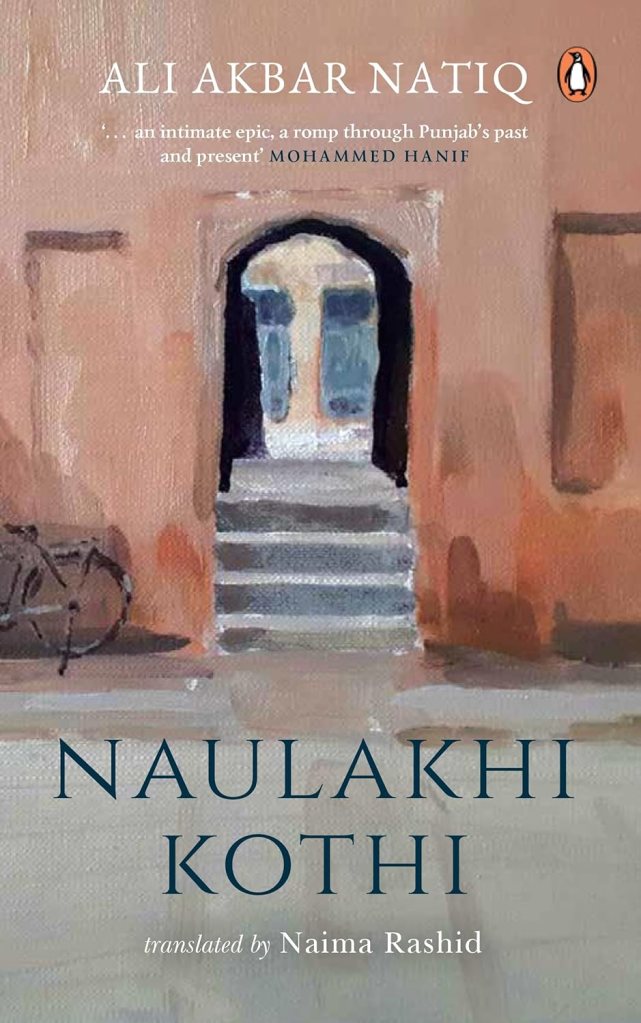
Naulakhi Kothi: A Saga by Ali Akbar Natiq

Book Review by Somdatta Mandal

Title: Naulakhi Kothi

Author: Ali Akbar Natiq (Written originally in Urdu)

Translator: Naima Rashid

Publisher: Penguin Random House India

The recent interest of big publishing houses in India venturing to bring out translated texts from various regional languages and bhasha[1] literatures into English is adding not only richness to the publishing arena but is also spreading the awareness of the existence of so many classic Indian texts which were inaccessible to the layman reader due to their inability to read the language used by the author. This has not only increased pan-Indian readership but spread the richness of Indian literature worldwide.

The novel, Naulakhi Kothi[2], containing 56 chapters and 464 pages, was written originally in Urdu by Ali Akbar Natiq, and has been translated into English by Naima Rashid. It contains a wide historical and meticulous geographical canvas in the micro-level as well as the sweeping narrative of rural Punjab that begins in British India and goes on in the years leading up to the Partition and ends around the nineteen-eighties. It brings us face to face with the lived culture of this place. The days of ordinary people of the entire rural Punjab region going about their business also come alive before us.

The wide canvas of Naulakhi Kothi offers more or less three simultaneous perspectives – that of the feud in the villages of Punjab between the Muslims and the Sikhs and the role of the British administrators who, in trying to maintain law and order in the region, also have their own axe to grind. In the sprawling canvas of characters, in the intricate, multi-layered world that Natiq conjures, with subtext, backstory and arcs, it seems as if we are literally living in the world and conversing daily with its contours.

The first chapter aptly titled “Homecoming” tells us the story of one of the protagonists of the novel, the Britisher, William, who after eight long years in England was returning to Hindustan, the land he had spent his childhood, to work as the newly appointed assistant commissioner of Jalalabad in eastern Punjab. He dreamt of returning ‘home’ to the idyllic Naulakhi Kothi, the titular bungalow built by his grandfather. The manner in which the Britishers had been spoilt silly in Hindustan made many families live like Nawabs and they lived a class apart – often more powerful than the kings who ruled the country. Throughout the novel William is warned by the hardened commissioner Hailey that his behaviour and softness towards the locals does not bode well for any British officer living in Hindustan. His nature was said to display “signs of a certain rebellion and a proclivity towards a poetic bent of mind”.  He was reminded that the British were there to rule these lands and not to romance them. He was asked to maintain a distance between the ruler and the ruled and in dispensing justice, distance himself from the wrongdoer and the wronged.

For the four years he was posted in Jalalabad, William took many radical steps. He toiled so diligently, putting his heart and soul in his work that he managed to change the entire face of the region. The standard of education alone had surpassed that in all other tehsils[3] of Punjab. He also had a new canal and several other small streams built. As a result of these, there was a plentiful supply of water across the tehsil, and an abundant produce of wheat, rice, and maize crops; a general well-being began to show on people’s faces. Because of his connections he could prevent his transfer from the place for some time but could not do so for ever. Through many twists and turns of events, after frequent transfers, and after the war broke out, he realised there was a grand conspiracy in which everyone had teamed up against him – the Hindus, the Muslims and the British. By the end of the novel, we find a decrepit old man who, shorn of his former British glory and power, living a lonely life in Naulakhi Kothi when his wife and children left him and went back to England. But soon he was even thrown out of that place to settle in one of the nehri kothis [4]nearby, and in the end, he died like a pauper with no one to even remember him. So much for his love for Hindustan!

The next sub-plot centres around Maulavi Karamat who for the past thirty years, had been the head imam of the small village mosque. The poor people of the village who could barely make ends meet, could not pay him a salary but instead supplied him with rotis daily which were religiously collected every day by his son Fazal Din. Whatever Maulavi Karamat had learnt from his father, Ahmed Din, and even that which he didn’t fully know, he used to transfer it all to Fazal Din, for the survival of their family rested with him. The fortunes of this man took a good turn when he was appointed by William to become the head munshi in Jalalabad and teach Urdu, Arabic and Persian to young children. This move was basically undertaken to do away with the disparity and poor percentage of Muslim students attending the government schools. From then on, we find Maulavi’s fortunes rising and gradually his son Fazal Din turns into a mature and sensible sarkari babu[5]. After two years of working at the Governor House, Fazal Din had enough to buy his own land and build a house. Post Partition, Fazal Din’s work increased considerably and with adequate means to prepare false property documents, he got enmeshed in corruption and amassed a great amount of wealth. His desire to learn more English and to go to Britain to rise above his class is an example often found among those who worked in the administrative service of the government.

The other most significant strand in the narrative is of course the constant enmity between the Muslims and the Sikhs. We are given the story of Sher Haidar who was the zamindar of a certain area being killed by Sardar Sauda Singh and his men — not in a clandestine way, but in an open, offensive manner. Ghulam Haidar, the son of Sher Haidar was entrusted by his subjects and relatives who pledged their loyalty to the new heir to take revenge of the killing and after a lot of incidents, looting, and fighting that ensues between the two rival religious groups, their fortunes kept fluctuating while the ordinary villagers continue suffering. The Sikh leader who was accused of murder remains free and he showed his prowess by moving around with arms in the open. Detailed descriptions of attack and counterattacks between the warring groups are narrated meticulously and one becomes aware of the looting, arson and treachery that prevailed in the villages of Punjab at that time.

It is difficult do justice to the vast canvas of storyline that Natiq so brilliantly interweaves throughout the novel in this review. The problems the British rulers faced during the world war, the changing equations in the country with the Quit India Movement, Jinnah’s policy for an independent Pakistan, the role of the Muslim League, the silent exodus of the British leaving Hindustan, the idea of Partition that had silently started ripping the population apart,  the resultant flow of refugees after the Partition was officially declared, the exodus – all these find detailed mention in the narrative as well.

Ali Akbar Natiq’s unique narrative style and the equally brilliant translation by Naima Rashid that stays close to the Urdu text preserving the flavour of Urdu sprinkled with regional dialect is to be really appreciated. There are no footnotes or glossaries but the context holds enough clues for flow of the narrative. In the translator’s note at the beginning, Rashid mentions that in the creative choices she has made. She favoured the mood and tone of the original – “If it’s bitingly sarcastic or insulting in the original, I’ve attempted to recreate the same tone and tailored the other choices accordingly.”  Throughout the novel the very detailed descriptions of characters and incidents create a great visual impact upon the reader, and we see the sequences like we do in films. Natiq has managed to cover such a wide canvas of the storyline with dexterity by juxtaposing chapters in such a way that they unfold like a cinematic reel in front of our eyes. Thus, despite its length, this novel with its social, political, religious, historical, and geographical issues covering a wide cross-section of the Punjab region remains a page-turner and is strongly recommended for all classes of reader alike.

.

[1]  Language, referring to different languages of India

[2] Translates to House of nine lakhs(ninety thousand)

[3] Subdistricts

[4] Houses by the river

[5] Government officer

Somdatta Mandal, critic, academic, and translator is a former professor of English at Visva-Bharati, Santiniketan, India.

PLEASE NOTE: ARTICLES CAN ONLY BE REPRODUCED IN OTHER SITES WITH DUE ACKNOWLEDGEMENT TO BORDERLESS JOURNAL

Click here to access the Borderless anthology, Monalisa No Longer Smiles

Click here to access Monalisa No Longer Smiles on Kindle Amazon International

Categories
Tagore Translations

The Welcome: A Skit by Rabindranath

Translated from Bengali by Somdatta Mandal, this satirical skit[1]was part of Hasyakoutuk (1914) or Humour by Tagore


Courtesy: Creative Commons

Scene One

A village road

Chaturbhuj Babu has come to his village after passing his M.A. exams. He had expected the entire village to be exuberant. He has a stout Kabul cat with him.

Enter Nilratan

Nilratan: So here is Chatubabu. When did you come?

Chaturbhuj: After appearing for my M.A. examination in college –

Nilratan: Oh! This cat is very exquisite.

Chaturbhuj: The examination this time was –

Nilratan: Sir, where did you get this cat?

Chaturbhuj: Bought it. The subject I had elected this year –

Nilratan: How much did you pay for it, sir?

Chaturbhuj: Can’t remember. Nilratanbabu, has anyone graduated from our village?

Nilratan: Plenty. But there is no such cat in the vicinity.

Chaturbhuj: (to himself) Oh God! He only speaks about cats. He does not talk about my success in the exams.

Enter the Zamindar

Zamindar: Oh, here is Chaturbhuj! What did you do all this while in Kolkata, son?

Chaturbhuj: Sir, just came after my M.A. exams.

Zamindar: What did you say? Meye[2]? Given a girl to somebody? To whom have you given?

Chaturbhuj: No, not that. After B.A.—

Zamindar: You have got your daughter married? Her biye[3]? But we did not get to know about it.

Chaturbhuj: Not marriage, but B.A. –

Zamindar: Oh, it’s the same thing. In the city you call it B.A., in our village we call it biye. Ok. Let that be. This cat is very beautiful.

Chaturbhuj: You are mistaken. My –

Zamindar: What mistake? Go and find a similar cat in this whole district.

Chaturbhuj: No, sir. I am not talking about cats –

Zamindar: Yes, we are talking about cats. I am saying that we can’t get such cats.

Chaturbhuj: (to himself) Goodness gracious!

Zamindar: Come with your cat to our locality in the afternoon. The children will be very happy to see it.

Chaturbhuj: Yes, they will surely be happy. They haven’t seen me for a long time.

Zamindar: Yes, that’s true. But I am saying that if you cannot come, then send it through Beni. I want to show it to the children.

[Exit]


Uncle Satu enters

Uncle Satu: Here you are. Seeing you after a long time.

Chaturbhuj: Won’t it take long? So many examinations –

Uncle Satu: This cat –

Chaturbhuj: (annoyed) I am going home.

[About to leave]

Uncle Satu: Here, listen to me. This cat –

Chaturbhuj: No sir, I have work at home.

Uncle Satu: Here, at least answer one question. This cat –

[Chaturbhuj does not reply but walks out hurriedly]

Uncle Satu: Oh God! These children have become very clever after being educated. They have many attributes but too much pride.

[Exit]

Scene Two

The inner domain of Chaturbhuj’s house

Maid: Mistress. Dada has come home very angry.

Mother: Why?

Maid: How do I know?

Enter Chaturbhuj

Small boy: Brother, I want this cat –

Chaturbhuj: (slapping him) Day in and day out only cat, cat, cat!

Mother: Poor son. Is he annoyed for nothing? He has come home after such a long time and the children are pestering him too much. Go! All of you go from here. [To Chaturbhuj] Give it to me, son. I have kept rice and milk for it. I’ll go feed your cat.

Chaturbhuj: (angrily) Take it, mother. All of you only feed the cat. I will not have food. I’m leaving.

Mother: (earnestly) What sort of statement is that? Son, your meal is ready. Just go and take your bath.

Chaturbhuj:    I am leaving. In your country only cats are admired. There is no place for geniuses. (He kicks the cat)

Aunt: Oh, don’t beat it. It has done no harm.

Chaturbhuj: All your affection is for the cat. You don’t have any pity for the human being. (Exit)

Small girl: (pointing offstage) Uncle Hari, come and see. Its tail is so thick and bushy.

Hari: Who’s tail?

Girl: There, his.

Hari: Is it Chaturbhuj’s?

Girl: No, the cat’s.

Scene Three

The road. Chaturbhuj with a bag in hand. No cat with him.

Sadhucharan: Sir, where is your cat?

Chaturbhuj: It’s dead.

Sadhucharan: Oh! How did it die?

Chaturbhuj: (Disgusted) I don’t know, sir.

Enter Paranbabu.

Paran: Sir, what happened to your cat?

Chaturbhuj: It is dead.

Paran: Really? How did it die?

Chaturbhuj: Just as you all will die. With a rope around your neck.

Paran: Oh my god, He is too angry.

A group of boys follow Chaturbhuj. Clapping themselves they tease him shouting

“Kabuli Cat,” “Kabuli Cat.”


[1] [Translated from “Abhyarthana” (Bhadra 1292 B.S.) by Somdatta Mandal]

[2] Daughter in Bengali

[3] Wedding in Bengali

Somdatta Mandal is a former Professor of English and ex-Chairperson, Department of English, Visva-Bharati, Santiniketan, India. A recipient of several prestigious fellowships like the Fulbright Research and Teaching Fellowships, British Council Charles Wallace Trust Fellowship, Rockefeller Residency at Bellagio, Italy, Salzburg Seminar and Shastri Indo-Canadian Faculty Enrichment Fellowship, she has been published widely both nationally and internationally. She has also an award from Sahitya Akademi for the All India Indian Literature Golden Jubilee (1957-2007) Literary Translation Competition in the Fiction category for translating short stories series ‘Lalu’ by Sarat Chandra Chattopadhyaya.

.

PLEASE NOTE: ARTICLES CAN ONLY BE REPRODUCED IN OTHER SITES WITH DUE ACKNOWLEDGEMENT TO BORDERLESS JOURNAL

Categories
Tagore Translations

The Funeral: A skit by Rabindranath

Translated from Bengali by Somdatta Mandal, this satirical skit[1] was part of Hasyakoutuk (1914) or Humour by Tagore

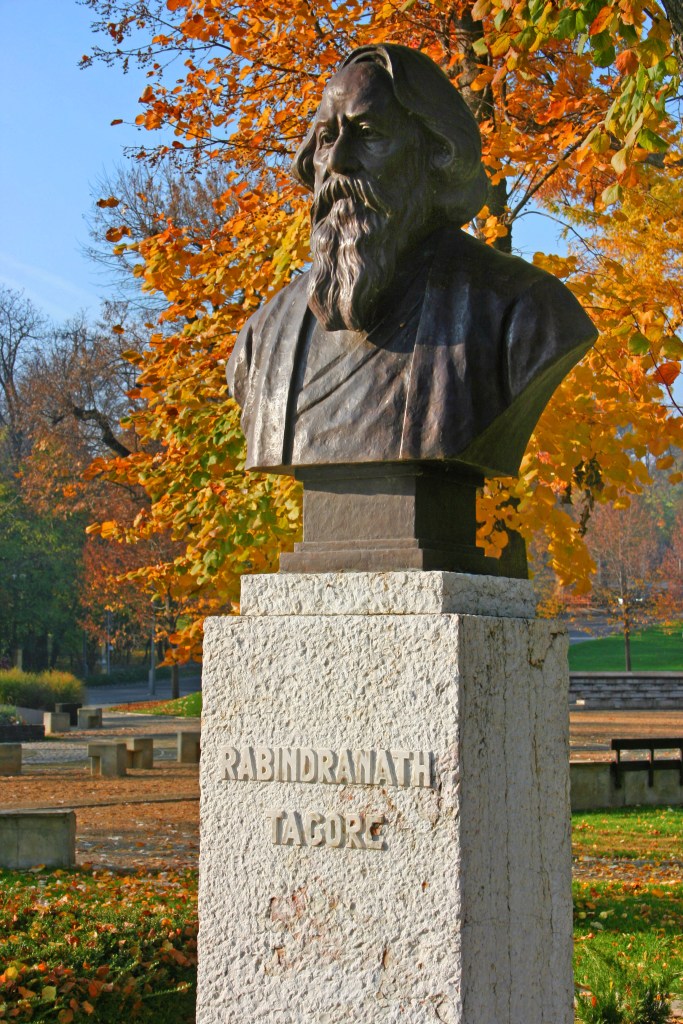
Rabindranth’s bust in  Hungary, Balatonfüred, Tagore promenade

Scene One

Ray Krishnakishore Bahadur is lying on his deathbed. His three sons Chandrakishore, Nandakishore and Indrakishore are busy consulting each other. A doctor is present. The women are close to tears.

Chandra: Who are the people we should write to?

Indra: Write to Sir Reynolds.

Krishna: (With great difficulty) What will you write, son?

Nanda: The news of your death.

Krishna: But I am not yet dead, son.

Indra: You might not die right now, but we have to fix a time for the event and write that down…

Chandra: We should collect the condolence letters from all the Englishmen here and get them published in newspapers. No point in publishing them when all the excitement is gone!

Krishna: Patience boys; let me die first.

Nanda: We can’t wait, father. Let’s make a list of the letters to be sent to the people in Shimla and Darjeeling. Come on, let’s get all the names down.

Chandra: The Governor, Sir Ilbert, Sir Wilson, Beresford, Macaulay, Peacock –

Krishna: Boys, what names are you chanting so close to my ears? Chant God’s name instead. When the time comes, He is the only one who can save us! Hari –

Indra: Yes, good thing that you reminded us, we forgot to include Sir Harrison.

Krishna: My sons, say Ram, Ram –

Nanda: Really, I had forgotten about Sir Ramsey.

Krishna: Narayan, Narayan!

Chandra: Nanda, write down the name of Sir Noran also.

Enter Skandakishore.

Skanda: So, you people seem so relaxed! You still haven’t done the real thing!

Chandra: And what is that?

Skanda: We have to inform in advance all the people who will be part of the procession going to the funeral ghat.

Krishna: Sons, which one do you consider the real thing? First, I’ll have to die, only then –-

Chandra: No worries on that account. Doctor!

Doctor: Yes sir!

Chandra: How much time is left for father to go? When do the public have to be here?

Doctor: Perhaps–

The women start wailing.

Skanda: (Disgusted) Ma, will you stop it? You’re creating quite a scene!  It’s better to sort out everything in advance. When doctor?

Doctor: Most likely this night at—

The women start wailing again.

Nanda: This is a huge problem! You shouldn’t disturb us during work. What do you think your crying will accomplish? We are planning to publish condolence letters sent by important Englishmen in newspapers.

The women are sent out.

Skanda: Doctor, what do you think?

Doctor: From what I can see I think he will expire around four a.m.

Chandra: Then there is no time – Nanda, go quickly, get the slips printed at once right in front of your eyes.

Doctor: But first mustn’t the medicine—

Skanda: Look here! Your medicine shop will not run away. On the other hand, we’ll be in trouble if the print ring shop shuts down.

Doctor: Sir, the patient might not —

Chandra: That is why you must hurry. For who knows what might happen if the slips are printed before the patient —

Nanda: Here I go.

Skanda: Write down that the procession will begin at eight tomorrow.

 Scene Two

Skanda: What, doctor? It’s already seven now instead of four.

Doctor: (Apologetically) Yes, yes, amazing the pulse is still strong.

Chandra: You are a fine one doctor to have got us into this mess!

Nanda: Everything went wrong when I was late in bringing the medicine. In fact, dad began to recover as soon as the doctor’s medicine was stopped.

Krishna: All this time you were so very cheerful, why is everyone looking so glum all of a sudden? I am feeling fine now.

Skanda: We aren’t feeling that great. We had already finalized all preparations to go to the funeral pyre.

Krishna: Is that so? I guess I should have died.

Doctor: (Feeling irritated) Do one thing and that will solve all problems.

Indra: What?

Skanda: What?

Chandra: What?

Nanda: What?

Doctor: Instead of him why don’t one of you die when the time is ripe.


Scene Three

A lot of people have assembled in the outer house.

Kanai: Hello, It’s already eight thirty. Why are you all late?

Chandra: Please sit down. Have some tobacco.

Kanai: I’ve been [chewing] tobacco from the morning!

Bolai: Where is everybody? I can’t see signs of any arrangements being made.

Chandra: Everything is ready – it’s not our fault – now only—

Ramtaran: Hey, Chandra, we shouldn’t waste any more time.

Chandra: Don’t I understand that – but—

Harihar: What is causing the delay? We’ll be late for office, what’s the matter?

Indrakishore enters.

Indra: Don’t be impatient. We are almost ready. In the meantime, why don’t you read the condolence letters?

He distributes them.

This is from Lambert, this from Harrison, this is Sir James’s—

Skandakishore enters.

Skanda: Here take them. In the meantime, read the obituary notices on father in the newspapers. Here is The Statesman, here The Englishman.

Madhusudan: (To Yadav) Isn’t this typical? Bengalis won’t ever learn what punctuality is all about.

Indra: You’re absolutely right. They will die and yet never learn to be punctual.

The guests shed tears reading the newspapers and the condolence messages.

Radhamohan:  (in tears) Oh God, the poor man’s friend!

Nayanchand:   Alas! To think that even such a good man has his share of troubles.

Nabadwipchandra: (in a deep breath) Lord! Everything is your will!

Rasik:‘The lotus that blooms in the heart’ – I’m forgetting what comes after that –

                        ‘The lotus that blooms in the heart

                        Has been plucked untimely

                        The lotus heart sinks in the sea of sorrow!’

This is exactly the case here. The lotus heart in the sea of sorrow. How sad! Add esquire. O tempora! O mores[2]!

Tarkabagish[3]: Challchittang challadbittang, challajiwan – The mind is inconsistent, wealth is transitory and one’s life is perishable. Oh how sad!

Nyayabagish[4]: Yadupathe kri gata mathurapuri, raghupate – Where is the city of Mathura that belonged to the Lord of the Yadavas (i.e. Krishna), to the Lord of the Raghus (i.e. Rama Chandra)? (chokes)

Dukhiram: Oh Krishnakishore Bahadur, where have you gone?

 A faint voice can be heard from within:  I am here. Please, don’t shout.  


[1] [Translated from “Antyashti-Satkar” in the Hasyakoutuk series Bhadra 1293 B.S. by Somdatta Mandal].

[2] “Oh the times! Oh the customs!” – Latin phrase, first recorded to have been spoken by Cicero

[3] Bengali title given to an expert debator

[4] Bengali title given to a legal expert

Somdatta Mandal is a former Professor of English and ex-Chairperson, Department of English, Visva-Bharati, Santiniketan, India. A recipient of several prestigious fellowships like the Fulbright Research and Teaching Fellowships, British Council Charles Wallace Trust Fellowship, Rockefeller Residency at Bellagio, Italy, Salzburg Seminar and Shastri Indo-Canadian Faculty Enrichment Fellowship, she has been published widely both nationally and internationally. She has also an award from Sahitya Akademi for the All India Indian Literature Golden Jubilee (1957-2007) Literary Translation Competition in the Fiction category for translating short stories series ‘Lalu’ by Sarat Chandra Chattopadhyaya.

.

PLEASE NOTE: ARTICLES CAN ONLY BE REPRODUCED IN OTHER SITES WITH DUE ACKNOWLEDGEMENT TO BORDERLESS JOURNAL

Categories
Excerpt

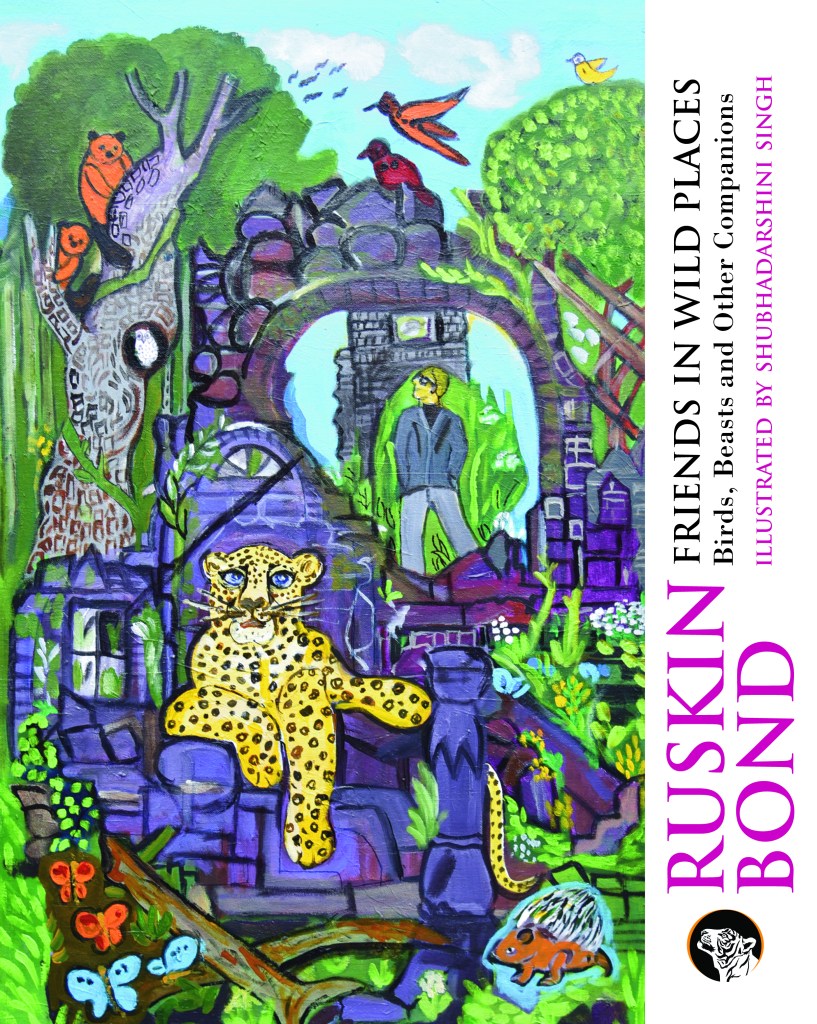
Ruskin Bond’s Friends in Wild Places

Title: Friends in Wild Places: Birds, Beasts and Other Companions

Author: Ruskin Bond

Illustrator: Shubhadarshini Singh

Publisher: Talking Cub, the children’s imprint of Speaking Tiger.

Timothy

TIMOTHY, THE TIGER cub, was discovered by Grandfather on a hunting expedition in the Terai jungle near Dehra.

Grandfather was no shikari, but as he knew the forests of the Siwalik hills better than most people, he was persuaded to accompany the party—it consisted of several Very Important Persons from Delhi—to advise on the terrain and the direction the beaters should take once a tiger had been spotted.

The camp itself was sumptuous—seven large tents (one for each shikari), a dining-tent, and a number of servants’ tents. The dinner was very good, as Grandfather admitted afterwards; it was not often that one saw hot-water plates, finger-glasses, and seven or eight courses, in a tent in the jungle! But that was how things were done in the days of the Viceroys… There were also some fifteen elephants, four of them with howdahs for the shikaris, and the others specially trained for taking part in the beat.

The sportsmen never saw a tiger, nor did they shoot anything else, though they saw a number of deer, peacocks, and wild boars. They were giving up all hope of finding a tiger, and were beginning to shoot at jackals, when Grandfather, strolling down the forest path at some distance from the rest of the party, discovered a little tiger about 18 inches long, hiding among the intricate roots of a banyan tree. Grandfather picked him up, and brought him home after the camp had broken up. He had the distinction of being the only member of the party to have bagged any game, dead or alive.

At first the tiger cub, who was named Timothy by Grandmother, was brought up entirely on milk given to him in a feeding bottle by our cook, Mahmoud. But the milk proved too rich for him, and he was put on a diet of raw mutton and cod liver oil, to be followed later by a more tempting diet of pigeons and rabbits.

Timothy was provided with two companions—Toto the monkey, who was bold enough to pull the young tiger by the tail, and then climb up the curtains if Timothy lost his temper; and a small mongrel puppy, found on the road by Grandfather.

At first Timothy appeared to be quite afraid of the puppy, and darted back with a spring if it came too near. He would make absurd dashes at it with his large forepaws, and then retreat to a ridiculously safe distance. Finally, he allowed the puppy to crawl on his back and rest there!

One of Timothy’s favourite amusements was to stalk anyone who would play with him, and so, when I came to live with Grandfather, I became one of the favourites of the tiger. With a crafty look in his glittering eyes, and his body crouching, he would creep closer and closer to me, suddenly making a dash for my feet, rolling over on his back and kicking me in delight, and pretending to bite my ankles.

He was by this time the size of a full-grown retriever, and when I took him out for walks, people on the road would give us a wide berth. When he pulled hard on his chain, I had difficulty in keeping up with him. His favourite place in the house was the drawing room, and he would make himself comfortable on the long sofa, reclining there with great dignity, and snarling at anybody who tried to get him off.

Timothy had clean habits, and would scrub his face with his paws exactly like a cat. He slept at night in the cook’s quarters, and was always delighted at being let out by him in the morning.

‘One of these days,’ declared Grandmother in her prophetic manner, ‘we are going to find Timothy sitting on Mahmoud’s bed, and no sign of the cook except his clothes and shoes!’

Of course, it never came to that, but when Timothy was about six months old a change came over him; he grew steadily less friendly. When out for a walk with me, he would try to steal away to stalk a cat or someone’s pet Pekinese. Sometimes at night we would hear frenzied cackling from the poultry house, and in the morning there would be feathers lying all over the veranda. Timothy had to be chained up more often. And finally, when he began to stalk Mahmoud about the house with what looked like villainous intent, Grandfather decided it was time to transfer him to a zoo.

The nearest zoo was at Lucknow, 200 miles away. Reserving a first-class compartment for himself and Timothy—no one would share a compartment with them— Grandfather took him to Lucknow where the zoo authorities were only too glad to receive as a gift a well-fed and fairly civilized tiger.

About six months later, when my grandparents were visiting their relatives in Lucknow, Grandfather took the opportunity of calling at the zoo to see how Timothy was getting on. I was not there to accompany him, but I heard all about it when he returned to Dehra.

Arriving at the zoo, Grandfather made straight for the particular cage in which Timothy had been interned. The tiger was there, crouched in a corner, full-grown and with a magnificent striped coat.

‘Hello Timothy!’ said Grandfather, and, climbing the railing with ease, he put his arm through the bars of the cage.

The tiger approached the bars, and allowed Grandfather to put both hands around his head. Grandfather stroked the tiger’s forehead and tickled his ear, and whenever he growled, smacked him across the mouth, which was his old way of keeping him quiet.

He licked Grandfather’s hands and only sprang away when a leopard in the next cage snarled at him. Grandfather ‘shooed’ the leopard away, and the tiger returned to lick his hands; but every now and then the leopard would rush at the bars, and the tiger would slink back to his corner.

Excerpted from Friends in Wild Places: Birds, Beasts and Other Companions by Ruskin Bond; illustrated by Shubhadarshini Singh. Published by Talking Cub, the children’s imprint of Speaking Tiger.

ABOUT THE BOOK

Since he was a young boy, Ruskin Bond has made friends easily. And some of the most rewarding and lasting friendships he has known have been with animals, birds and plants—big and small; outgoing and shy. This collection focuses on these companions and brings together his finest essays and stories, both classic and new. There are leopards and tigers, wise old forest oaks and geraniums on sunny balconies, a talking parrot and a tomcat called Suzie, bears in the mountains and kingfishers in Delhi, a family of langurs and a lonely bat—and many more ‘wild’ friends, some of an instant, others of several years.

Beautifully illustrated by Shubhadarshini Singh, this is a gift for nature- and book-lovers of all ages.

ABOUT THE AUTHOR

 Ruskin Bond is the author of numerous novellas, short-story collections and non-fiction books, many of them classics. Among them are The Room on the Roof, The Night Train at Deoli, Time Stops at Shamli, Rain in the Mountains, The Blue Umbrella, When I Was a Boy, Lone Fox Dancing (his autobiography) and A Book of Simple Living. He received the Sahitya Akademi Award in 1993, the Padma Shri in 1999 and the Padma Bhushan in 2014.

Ruskin lives in Landour, Mussoorie, with his extended family.

ABOUT THE ILLUSTRATOR

 Shubhadarshini Singh was brought up in Kolkata and studied in Visva-Bharati, Shantiniketan. She has been an ad woman, a journalist and a film-maker. She shares Ruskin Bond’s deep love for animals and wildlife and has made his best stories into a series for television: Ek Tha Rusty. Shubhadarshini runs an art gallery for Outsider Arts, and has had shows of her paintings in Delhi and Bhopal. She lives in Delhi with her husband, son and dogs.

PLEASE NOTE: ARTICLES CAN ONLY BE REPRODUCED IN OTHER SITES WITH DUE ACKNOWLEDGEMENT TO BORDERLESS JOURNAL

Categories
Review

Letters between Tagore & Nirmalkumari Mahalanobis 

Book Review by Himadri Lahiri

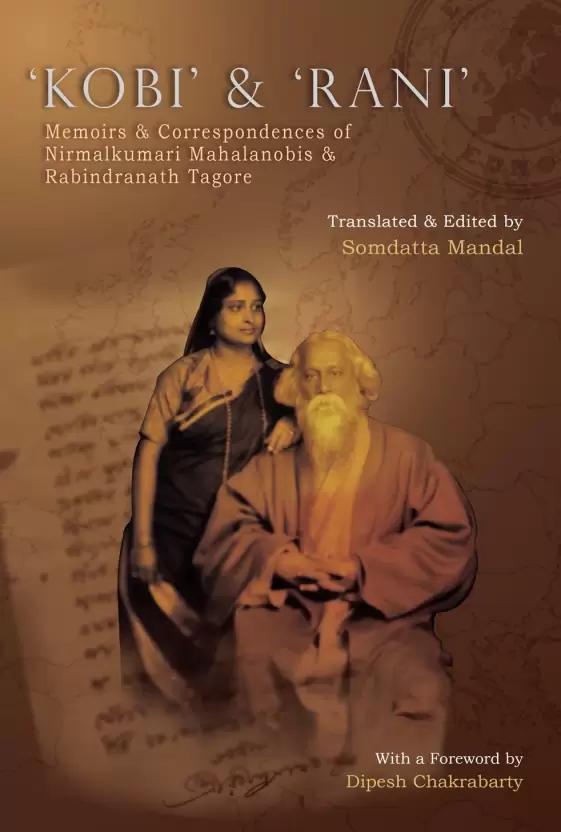
Title: ‘Kobi’ and ‘Rani’: Memoirs and Correspondences of Nirmalkumari Mahalanobis and Rabindranath Tagore

Translator/Editor: Somdatta Mandal; Foreword by Dipesh Chakrabarty.

Publisher: Bolpur: Birutjatiya Sammiloni.

Memoirs and correspondences constitute two alternative sources for reconstructing historical narratives. Generally kept outside the pale of mainstream history, memoirs, such as those included in the volume under review, can offer significant insights into the reading of important public figures and their activities. Despite the charges of ‘unreliability’ of memories with the help of which personal narratives are constructed, memoirs contribute to the understanding of a historical period with the help of small, apparently insignificant, details which can offer penetrating insights into reality. Personal correspondences with a public figure, preserved in family archives, too may contain interesting facts, figures and episodes which may help constructing their lives and recreating the social and intellectual environment of the time. Due to their very subjective nature, which mostly flouts the norms of objectivity, these genres may provide unique dimensions to the familiar historical narratives.

Somdatta Mandal’s book ‘Kobi’ and ‘Rani’: Memoirs and Correspondences of Nirmalkumari Mahalanobis and Rabindranath Tagore (2020), selected, translated and edited by her, is an important source, particularly for non-Bengali readers, for comprehending Rabindranath Tagore, the Nobel Prize winning poet from Bengal who continues in global limelight. It unearths hitherto unknown facts, some activities of ‘small’ actors who played a role in history and ‘trivial’ details which help us view Rabindranath Tagore and his contemporaries from fresh perspectives.  Written from an informed woman’s point of view, the narratives offer us opportunities for discovering ‘the lighter’ and homelier aspects of Tagore’s life – this is something “which is sorely missed in other serious narratives and biographies” (Mandal xvii).

The publication of this book is timely for yet another reason. Tagore’s tirade against fascism, unfettered authoritarianism, aggressive nationalism and his advocacy for personal freedom, national independence, universal humanism and global understanding have much relevance in our times. Reading Kobir Shonge Europey (With the Poet in Europe, 1969) in particular, one understands how a public figure with an impeccable record of liberal philosophical practices and humanist activities can be duped by the machination of fascist agents and utilised for fascist propaganda to the consternation of liberal intellectuals and common citizens across the world. For this very reason we need Tagore more than ever before. This is a point strongly emphasised by historian Dipesh Chakrabarty in his ‘Foreword’ to the book.

‘Kobi’ and ‘Rani’ anthologises English translation of two memoirs of Nirmalkumari Mahalanobis — Kobir Shongey Dakshinatte (With the Poet in the South) and Kobir Shongey Europey (With the Poet in Europe). The European tour took place in 1926 while Tagore travelled to South India and Ceylon in 1928. In her valuable Introduction to the book, Mandal raises the question of difficulty of determining the genre of the narratives. These are, according to her, not just memoirs, they are travelogues as well. Through them, one gets the feeling of following the trajectory of the author’s journey. But a reader also feels how Rani’s journey, along with her husband, revolves round an iconic personality whom they revered and valued. From this point of view, the memoirs often read like hagiographies as well.

In addition to these two memoirs, the anthology includes Pathe O Pather Prante (On the Road and Beyond It),a collection of sixty letters Tagore wrote to Nirmalkumari whom he affectionately called Rani. In the Appendices, we find three other articles on Tagore written by Nirmalkumari: “Om Pita Nohosi,” “Tamaso Ma Jyotirgamaya,” and an essay written for children and originally published in Anandamela, a children’s magazine published by the Anandabazar Patrika. All these make the book voluminous and largely comprehensive. It may be mentioned here that Mandal has recently translated and edited another volume on Tagore entitled The Last Days of Rabindranth Tagore in Memoirs (April 2021). It includes memoirs by Pratima Thakur, Rani Chanda, Maitrayei Devi, Nirmalkumari Mahalanobis, and Amita Thakur.

Interestingly, all these memoirs were written by women who either belonged to the Tagore family or were in close contact with the poet. Dipesh Chakrabarty, in the ‘Foreword’ to Kobi  and Rani, raises the issue of his “friendship with women that Tagore sought and sustained throughout his life” (iv), and mentioned in this context the names of Ranu Adhikari, Maitreyi Devi, Hemantabala Devi and Kadambari Devi. He observes that “a feeling of respectful affection and concern for the poet finds a deeply gendered and womanly expression in this book. It oozes out of each page” (iv). The above statement is true of The Last Days of Rabindranath Tagore in Memoirs too. Taken together, these two anthologies provide a very intimate and comprehensive account of one of the greatest poets of our time.

Tagore felt the need for recording the accounts of his travels in writing. That would be, in his opinion, a valuable source of literary and historical information in future. He was particularly sensitive about his European tour during which he met several well-known intellectuals. In the ‘Introduction’ to On the Road and Beyond It, he asserts, “the value of the narration of my European tour that has not been published anywhere is enormous” (391). Similarly, Tagore said in the Foreword to With the Poet in the South, “They [the details of his tour] should not be lost” (317). This sense of preservation of history is also present in Kobir Shonge Europey (With the poet in Europe). Here in the ‘Foreword’, Rani notes that Tagore, in a letter published in Prabasi, complained, “Those who had accompanied me during my foreign travel did not take the responsibility of protecting my travelogue, and that is why this chapter remains unknown to people, etc.” (3). As both her ‘Foreword’ and Prasantachandra Mahalanobis’s ‘Preface’ to the same memoir indicate, it was clearly the result of a misunderstanding for which Tagore apologised later.

The history of this misunderstanding goes deeper. The couple suspected the involvement of some insider in the loss of the file containing the manuscript of the despatches sent by Prasantachandra from Europe for publication in Visva-Bharati Bulletin. The file containing Nirmalkumari’s letters were also lost. Although retrieved afterwards, some valuable letters were never found.  Rani narrates in detail how the tour to Europe was mired in controversy and conspiracy right from the beginning. Rani’s narrative convincingly proves that Professor Guiseppe Tucci and Professor Carlo Formichi, two visiting professors at Visva-Bharati, functioned as Mussolini’s spies.

They were instrumental in Tagore being invited to Italy by Mussolini. Formichi who oversaw the arrangements of the tour conspired to exclude the Mahalanobis couple from the entourage. He also severely censored the list of Tagore’s visitors in Italy. How Benedetto Croce could meet Tagore with the help of Captain Rapicavoli reads like a detective story. Formichi wilfully misinterpreted Tagore’s messages to the press to create an impression that Tagore supported Mussolini’s fascist regime. The twisted versions were published in newspapers, and these spread across Europe, misrepresenting Tagore’s views.

When Tagore met Romain Rolland in Switzerland, Rolland was initially not well-disposed to Tagore because of the fake news stories in circulation. Nirmalkumari records all the details of Formichi’s machination in Kobir Shonge Europey (With the Poet in Europe). For this alone, if not for anything else, this book will provide invaluable materials to historians and common readers alike.

Although the narrative of the poet’s European tour will be of paramount interest particularly to non-Bengali readers who will try to visualize the poet from the East in the maelstrom of radical politics in Europe and to place him in the interface of East-West cultural encounter, his tour of Southern India will be of immense importance to readers intent on knowing the background history of two of his important novels Jogajog (Relationships) and Sesher Kobita (The Last Poem). This is provided in Kobir Shonge Dakshinatte (With the Poet in the South) which also brings to public knowledge intimate details such as how Tagore was affected by the Jalianwalla Bag killings, and how his interaction with Chittaranjan Das went on, C.F. Andrews’ meeting with Mahatma Gandhi as Tagore’s emissary, how intensely engaged Tagore himself had been in writing Lipika and so on. Tagore felt that all these should be preserved as “very important historical documents” (317). The poet’s meeting with Sri Aurobindo in Pondicherry is also an important part of the memoir.

Trivial but amusing incidents such as the idiosyncrasies of C.F. Andrews, Tagore’s own obsessions and childlike behaviour – all come out with a touch of humour. These correspond to Rani’s power of observation and sense of humour evident in the descriptions in Kobir Shonge Europey (With the Poet in Europe). She describes how a fancy dress ball was arranged aboard the ship Orama which took the Mahalanobis couple to Europe (36), how Rani was initially afraid of a large shark swimming on the water near Port Said (37), how Rani and her female companions, dressed in typical Indian attires and decked with heavy ornaments, became a public spectacle in Naples (39-40), how the unhygienic packaging of chocolates in Turin caused repulsion in Rani (70), and several other incidents.

Mandal has done well by including On the Road and Beyond It, Tagore’s collection of sixty letters, in the volume. Tagore wrote these letters to Rani after his return from Europe. He observes in the ‘Introduction’ to the collection, “I continued to keep our relationship alive through letters” (390-91). It, therefore, is intimately connected in spirit with the memoir With the Poet in Europe. The letters, the best medium for conveying emotional exuberance, testify to Tagore’s great affection for, and dependence on, Rani.

The book includes some black and white photographs of important persons and places. Two images of the first edition of Bangla Pathe O Pather Prante (On the Road and Beyond It) have found their place in the anthology. Mandal’s criteria for selection of texts are quite appropriate, her translation is smooth and editing praiseworthy. Her erudite Introduction will help the readers contextualising the texts included in the volume. The paratextual components of the book are aesthetically pleasing. On the whole, the production of the book is superb. This volume will be a valuable resource for Tagore Studies.

.

Himadri Lahiri is former Professor of English, University of Burdwan, West Bengal. Currently, he is Professor of English at the School of Humanities, Netaji Subhas Open University, Kolkata. Asia Travels: Pan-Asian Cultural Discourses and Diasporic Asian Literature/s in English (Bolpur: Birutjatiyo Sahitya Sammiloni, 2021) and Diaspora Theory and Transnationalism (Hyderabad: Orient Blackswan, 2019) are his latest books. He writes book reviews for academic journals and newspapers. He also writes poetry.

.

PLEASE NOTE: ARTICLES CAN ONLY BE REPRODUCED IN OTHER SITES WITH DUE ACKNOWLEDGEMENT TO BORDERLESS JOURNAL