Categories
Stories

Balak or the Child by Munshi Premchand

Translated from Hindi by Anurag Sharma

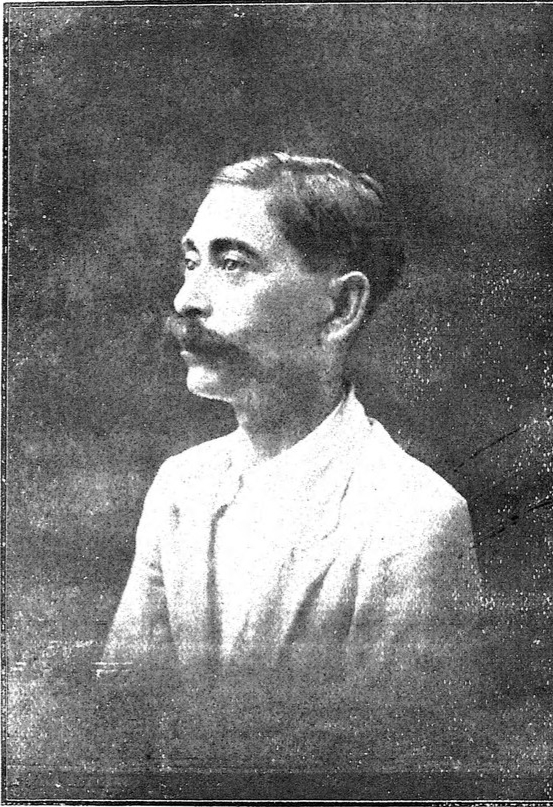
Munshi Premchand. Courtesy: Creative Commons

Premchand is the pen name adopted by the Indian writer, Dhanpat Rai Srivastava (31 July 1880- 8 October 1936).  He was a pioneer of modern Hindi-Urdu literature which focused upon contemporary social issues including caste, the treatment of women, day labour and other socio-political concerns. He remains one of the most heralded writers in South Asia. His oeuvre includes more than a dozen novels, about 300 short stories, numerous essays as well as translation of foreign literary works into Hindi.

Balak or the Child

1

All the servants greeted me from afar, as soon as they saw me. Gangu being the only exception, he never greeted me. He probably expected a palagan [1] salute from me. Everyone said he was a Brahmin. I bet he was because he never touched my dirty utensils [2]. Even in the hot and sweaty summer, I never dared to ask him to fan [3] me. When Gangu saw that I was sweaty and there were no other servants around, he picked up the fan on his own. But his posture made clear that he was doing me a favour and I snatched the fan away from his hand.

Gangu could not tolerate disrespect from anyone. He had few friends. He didn’t mix with my other servants. He couldn’t socialise easily either. He was full of contradictions. Unlike my other servants, he neither smoked, nor drank. On the other hand, despite being called a Brahmin, he seemed illiterate. I never saw him worship like most Brahmins do, nor take a vacation to visit pious rivers. He still expected the respect generally offered to a Brahmin, which seemed reasonable. When non-Brahmins have rights to material assets inherited from their ancestors as if they had earned those themselves, then why would Gangu renounce the prestige and honour that was earned by his forefathers through selfless dedication and sacrifices of many generations? That was his proud legacy.

Being an introvert, I spoke very less to my servants. I didn’t want them to approach me without being called. And I didn’t like calling them for simple tasks. It was much easier to pour water from a pitcher myself, light a lamp, put on my shoes, or take out a book from the shelf without waiting for a servant. My servants had also become accustomed to my personality, so they didn’t approach me without need.

They generally came to me for advance payment of wages, occasionally to complain about another servant. I despised both actions. I paid everyone’s salary on the first day of the month. I hated anyone asking for something extra in the middle; I couldn’t keep an account of two or four extra rupees. Besides, when a person had a full month’s wages, he had no right to spend it in fifteen days and beg for a loan or an advance? I was equally disgusted by their complaints. I considered these complaints to be a sign of weakness, or the petty gesture of toad-eating.

So, one morning when Gangu entered my room and stood in front of me, it made me unhappy.

Shrugging my shoulders, I asked, “What’s wrong? I didn’t call you.”

I was struck by the unexpected humility, and hesitation on Gangu’s normally sharp and arrogant face. It appeared as if he wanted to answer, but he couldn’t find the right words. I paused, and asked again, with a little humility this time, “What is the matter? Speak up. You know that I am getting late for my walk.”

Gangu sounded disappointed, “No problem, sir, please go and enjoy fresh air, I will come later.”

His response worried me. If he told his story then and there, I could ask him to finish quick as he knew that I was in a hurry. Postponing it to another occasion could cause a disturbance in my writing and reading later since the servants may not even have considered that as serious work. They may have just considered my thinking time, which is the most difficult practice for me, as my rest time. I didn’t want him to come and irritate me while I was working on a plot. Considering all these consequences of delaying the discussion, I relentlessly said, “If you come to ask for advance payment, the answer is no.”

“No sir, I never asked for an advance payment.”

“Well, do you want to complain about anyone? I hate complaints.”

“No sir, that’s not my nature.”

Gangu stood up straight. It was clear from his gestures that he was gathering all his strength to make a move. He paused and spoke in a faltering voice, “Let me leave you sir. I can no longer work here. I want to quit.”

His proposal surprised me. It hurt my ego. I considered myself a reflection of humanity, I never insulted my servants, I tried to be as humble as possible. I was shocked at this proposal. I asked in a curt voice, “Why? What’s your complaint?”

‘I have no complaints sir. You have got a good temperament. You are the best master a servant can get. But I can’t work here anymore because I don’t want you to feel upset because of me.”

I got confused. My curiosity flared up. I sat on a porch chair and asked with a sense of surrender, “What’s going on? Speak up clearly?”

Gangu said very humbly, “The thing is… that… Gomati Devi, the woman, who has just been expelled from the widows shelter home …”

He paused. I got impatient and said, “Yes, she was fired, then what? What does she have to do with your job here?”

Gangu paused for a moment as if he was trying to remove some heavy burden from his head, “I want to marry her sir!”

I stared at him with astonishment. This illiterate Brahmin of antiquated ideas, who never caught the breath of modern civilisation, was going to marry a woman of such questionable character that she would not even be allowed to enter any gentleman’s home.

Gomati had caused a bit of a stir in the peaceful atmosphere of her locality. After her husband’s death, she was moved to the shelter housing widows. She was made to marry by the staff of the shelter thrice, but each time she returned within 10-15 months. The last time she returned to the shelter, the minister of the home for widows threw her out. After being banished from the shelter, she lived in a closet in the neighbourhood. She soon became the centre of gossip for the loners of the entire locality.

I was angry after hearing about Gangu’s poor choice. This idiot couldn’t find another woman in the whole world to marry. I also felt sorry for his simplicity. I was sure that the woman who ran away from three comparatively rich husbands wasn’t going to stay for long with him. Had he been wealthy, the relationship would probably have lasted for six months. This naïve man didn’t even have a chance for a week.

“Do you know the life story of this woman?” I asked him with a sense of warning.

“All lies sir, people slandered her,” Gangu replied with the confidence of an eyewitness.

“What are you talking about, didn’t she run away from three husbands?”

“What if they kicked her out of their homes?”

“Are you foolish? Why would a man who comes to the shelter to marry abandon the woman after spending thousands of rupees?”

Gangu said passionately, “No woman can live in a place where there is no respect for her. A woman deserves some love and affection, not just bread and clothes. Those men would think that they had done a great favour by marrying a widow. They wanted to own her body and control her mind. They don’t understand that you can’t enslave other humans. To make others your own, you need to surrender first. Moreover, she has some health issues too. Sometimes she passes out suddenly. Those men considered her a burden because of her sickness.”

“Do you really want to marry such a woman?” I shook my head, “Understand that such a marriage would make your life bitter.”

Gangu said excitedly like a would-be martyr, “I understand everything sir, God willing!’

I insisted, “So you have made up your mind?”

‘Yes, sir!”

“In that case, I will accept your resignation.”

I was not afraid of futile conventions. But keeping a servant who married a wicked woman was a complicated problem. Every day could throw up new issues, new problems, and possibly police cases, and lawsuits. There could also be an accusation of domestic violence, or theft. It would be good to be away from this swamp. Gangu appeared to act like a monkey jumping at the sight of bread without realising that the bread was greasy, stale, dry, and completely inedible. I explained him the situation, but he didn’t care. It was difficult for him to work with thought and intelligence.

2

Five months had passed since Gangu married Gomati. They lived in the same locality in a tiny house. Whenever I saw him in the market, I checked to ask how he was. I had developed a curiosity about his new life. It was a test of psychological as well as social issues. I wanted to see the result of his bold action. I always found him happy. He appeared to be careless, somewhat prosperous, and confident. He had a daily sale of 20 to 25 rupees resulting in a saving of approximately 10 rupees. This was a meagre livelihood; But he certainly had a boon of some God. Because he had no sign of poverty, shame, or disgrace. There was a glimpse of self-development and joy on his face, a reflection, perhaps, of his peace of mind.

One day, I heard that Gomati ran away from Gangu’s house. I was strangely delighted. Not that I was jealous of Gangu’s contented and happy life. But I was waiting for something to happen to him – a bad thing, a catastrophe, a shameful event. I warned him earlier because I had my own doubts. Now my fears had been confirmed. Gangu had to bear the brunt of his short-sightedness. He, then lunged as if he was getting a rare substance. As if the gates of paradise had opened for him. Alas, now he would realise that those who tried to prevent this marriage were his true well-wishers. We warned him about that woman’s character. We reminded him that she had not been faithful in her earlier relationships, and he too would be cheated ultimately. But he didn’t pay any attention. I was eager to meet Gangu and remind him of his mistake in confusing this woman with a boon from the Goddess.

By chance, I ran into Gangu in the market that same day. He appeared depressed, anxious, and totally lost. On seeing me, he started crying. He didn’t cry out of embarrassment when he saw me; he cried out of grief. “Sir,” he said when he approached me, “… Gomati left me.”

“It’s your fault Gangu. You didn’t listen to my advice. I warned you, but you didn’t care. Now tell me, what can you do except bearing the pain patiently?” I showed him superficial sympathy, “Did she take all your money or left something?”

Gangu placed a hand on his chest as if my question pierced his heart.

‘No sir! Please don’t say that … she took nothing. She left everything behind, even her personal belongings. No idea what evil she perceived in me. I guess I was not worthy of her. She is educated, and I am as illiterate as a buffalo. I am fortunate that she stayed with me for so many days. Had she lived with me for some more time, she would have turned me into a fine man. I will be indebted to her forever. She was like a divine blessing of a deity to me. I must have done something seriously wrong because she always ignored my everyday mistakes with grace. After all, I am a man with no status. She managed the home so well with my petty earnings.”

I was deeply disappointed to hear these words. I thought he would tell the story of her infidelity and I would get a chance to express sympathy for his blind devotion. But the fool’s eyes had not opened yet. He was still reciting her mantra. Of course, he was still in shock.

“Are you certain she didn’t steal anything from your house?” I teased him.

“Not even a rag, sir,” he replied.

“But she left you…. And you think she really cared about you?”

“You’re right, sir; I’ll cherish her love until I die.”

“She abandoned you despite all the love?”

“That’s the mystery I can’t decipher, sir. “

“Have you ever heard the term ‘Triya-Charitra’ [4]?”

“Hey sir, don’t say that. I will sing her praise even if someone puts a knife on my neck.”

“Then go and find her.”

“Yes, sir. I am not going to give up until I find her. I’m confident that once I find her, I can convince her to come back to me. And sir, my gut tells me she will return to me without a doubt. She didn’t run away from me out of rage. I will go and look for her, even if it means wandering for several months. I will search for her everywhere –the woods, the mountains, and the deserts. I’ll come back to see you if I succeed in my mission.”

Before I could reply, he quickly walked away from me.

3

After a few days, I had to go to Nainital for a month-long assignment. I had just returned from Nainital when Gangu approached me holding a new-born infant in his lap. He exuded fatherly pride and joy in every aspect of his appearance, including his walk, posture, face, and eyes.

I asked, “Maharaj [5], you went to find Gomati, did you find her?”

“Yes Sir, with your blessings, I found her in a maternity hospital in Lucknow. Before leaving, Gomati instructed a girlfriend of hers to keep checking if I started getting too nervous about her absence. That friend told me where Gomati was. I ran to Lucknow and met her in the hospital, where she gave birth to this adorable child.” He raised the child with pride and came closer to me. As if a player is displaying the trophy after winning the match.

I asked sarcastically, “Well, she gave birth to this boy? Perhaps that’s why she ran away from here. Is this your child?”

“This is God’s gift for me.”

“So, he was born in Lucknow, right?”

“Yes Sir, he is just a month old.”

“How many days have you been married exactly?”

“… nearly seven months sir.”

“So, he is born within sixth month of your marriage?”

“Correct sir.”

“And you think of him as your son?”

“Yes, sir.”

“Have you lost your mind?”

He either ignored, or completely missed my intention. He exclaimed, “She had almost died sir. For three days and three nights, she kept on suffering. I can’t tell more but it’s like a new birth for her.”

I got a bit sarcastic now, “This is first time that I saw a child born in six months.”

He got my point this time, and smiled, “Okay, I understand! I did not even notice it earlier. Gomati ran away from home because of this fear only. But I told her not to care about what people say.”

He continued, “I told her she was free to leave me if she got tired of me. I would leave so as not to bother her ever again, but I would always be available should she require assistance. I told her that I had married her because I loved her and believed she wanted me, not because she was a Goddess. I am the parent of this child. He was born to us after our marriage.” saying this, he laughed loudly.

My eyes started to shine. I forgot how exhausted I was after the long trip. All my inherent hatred was suddenly washed away by a fresh shower of love. I kissed that little boy as I held him in my lap. Probably I didn’t show that much affection to my own children as I did to the helpless child in my lap.

“Sir, you are a wonderful gentleman.” Gangu continued, “I keep mentioning you to Gomati. I’ve asked her to come here with me so we can meet you once. But she is hesitant to meet new people.”

Me and gentleman? The innocent demeanour of Gangu had just opened my eyes. I was ashamed of my narrow-mindedness, my voice was filled with devotion towards him as I uttered, “No, I am not a gentleman, you are one. And this child is the fragrant flower that results from your kindness. Why would Gomati come here to meet a shallow man like me? Come on, I’m coming with you to see her.”

I walked towards Gangu’s house, holding the child close to my chest.

Translator’s notes:

[1] Palagan was a common respectful greeting offered to the brahmins in Hindi belt of North India

[2] Indian culture is very particular about purity of kitchen and observance of cleanliness of food and utensils. Any utensil that has been used once for serving or eating food or touched by someone is considered unfit for use until washed and cleaned properly.

[3] Except for a few princely states like Mysore, most Indian homes didn’t have access to power supply during British rule. Hand fans were commonly used during summer months in every household.

[4] Triya-Charitra – Complex character of a women, as discussed in Indian literature.

[5] Maharaj – Literally king of kings, a respectful address for the brahmins throughout India and Nepal

Anurag Sharma is  a writer and the co-founder of Radio Playback India. Anurag has been instrumental in podcasting over 300 short stories, radio dramas and Vinoba Bhave’s lectures on Gita. He is the editor-in-Chief of Setu, Pittsburgh.

PLEASE NOTE: ARTICLES CAN ONLY BE REPRODUCED IN OTHER SITES WITH DUE ACKNOWLEDGEMENT TO BORDERLESS JOURNAL. 

Click here to access the Borderless anthology, Monalisa No Longer Smiles

Categories
Tribute

Celebrating Freedom

Painting by Sohana Manzoor

The right to exist with freedom to choose is threatened when dictatorial regimes try to erase a culture or linguistic group as we can see in the current conflict that rages between Russia and Ukraine. In 1971, Bangladesh came into existence over a similar issue. The colonials had divided the Indian subcontinent on the basis of religion — not culture. Before this division, Bengal was a whole. In 1905, Tagore had marched against the British directive to divide Bengal and Lord Curzon, the Viceroy of India. In 1911, Bengal was reunited to be slashed again in 1947 and made a part of Pakistan with Urdu as its national language. Bangladesh fought a war to find the right to exist as an entity outside of Pakistan — adopting their favoured language Bangla. Throwing off the yoke of Urdu, Bangladesh came to its own. On 16th December, the battle against cultural hegemony was won with warplanes drawing to a halt.

Celebrating freedom from oppression, we have an article by Fakrul Alam giving the historical background of the struggle. A musing from across the border about the 1971 refugee exodus into India has been written by Ratnottama Sengupta. Asad Latif muses on the need to identify with a culture. We have translations of poetry by Nazrul to add a dash of seasoning.

Poetry

Translations of Nazrul Islam, the rebel poet of Bangladesh… Click here to read.

Prose

The Birth of Bangladesh & the University of Dhaka: Professor Fakrul Alam takes us through the Partitions of Bengal which ultimately led to the creation of Bangladesh, with focus on the role of Dhaka University. Click here to read.

Joy Bangla: Memories of 1971: Ratnottama Sengupta recaptures a time when as a teenager she witnessed a war that was fought to retain a culture. Click here to read.

Epaar Bangla, Opaar Bangla:  Bengals of the Mind: Asad Latif explores the need of a person to exist as belonging to a particular cultural group, in this case Bengal. Click here to read. 

Categories
Poetry

A Balochi Folk Song

Translated from Balochi by Fazal Baloch

Balochistan. Courtesy: Creative Commons
A CONVERSATION BETWEEN A LADY AND HER SUITOR

She: Hither come, help me get off the cliff, O white-shawled lad!
He: I’ll, O, red-dressed lass, but what will be the reward, I have?

She: Either my necklace or my bangles, you will have.
He: Of your necklace and bangles, none I ever need!
‘Tis your shapely nose and flowing tresses I seek.

She: Shapely nose and flowing tresses lie beyond your reach
-- I’ll become a wild citron on a lofty tree.
Boy: I’ll become grasshopper and nibble your tender leaves.

She: I’ll become a cumulus and on the valley burst forth.
He: A thirsty deer I’ll become, and drink all the fresh water you pour.

She: I’ll become a sorghum grain and rest on the field.
He: I’ll become a grey dove and hold you in my beak.

She: I’ll become a rabbit, in rosebushes I’ll sleep.
He: I’ll become a shepherd, you with my crook I’ll gently beat.

She: I’ll become a turban that rests on a bride’s head.
He: I’ll play my mouth-harp, and as a reward, you I’ll seek. 

She: I’ll become the helpless daughter of a poor man.
He: I’ll become the grim-reaper, and whisk you off to the heaven.

She: You’ve filled my heart with boundless joy and delight
Hurry to the wedding chamber, I’m your bride.

This folk song was originally featured in Dreen (The Rainbow: A Collection of Folksongs) collected and translated into Urdu by Atta Shad and A. Salam and published by the Balochi Academy Quetta. Fazal Baloch has the rights to the translation in English.

Fazal Baloch is a Balochi writer and translator. He has translated many Balochi poems and short stories into English. His translations have been featured in Pakistani Literature published by Pakistan Academy of Letters and in the form of books and anthologies.

.

PLEASE NOTE: ARTICLES CAN ONLY BE REPRODUCED IN OTHER SITES WITH DUE ACKNOWLEDGEMENT TO BORDERLESS JOURNAL. 

Categories
Review

John Lang: Wanderer of Hindoostan

Book Review by Bhaskar Parichha 

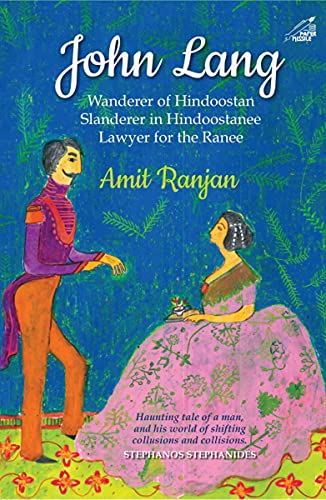
Title: John Lang; Wanderer of Hindoostan; Slanderer in Hindoostanee; Lawyer for the Ranee

Author: Amit Ranjan

Publisher: Niyogi Books

Retracing colonial history is always fascinating. And, if the characters are out of the ordinary, that re-examination is even more interesting. This book revisits the life of John Lang, an Australian writer-lawyer settled in India in the 19th century. 

John Lang: Wanderer of Hindoostan, Slanderer of Hindoostanee, Lawyer for the Ranee by Amit Ranjan is about Lang’s life, his accomplishments and his literary works. Lang (1816-1864) was a fiery journalist and novelist who constantly annoyed the establishment of the East India Company with his vituperative and pathogenic humor. He had lived in India since the age of 26. 

A visiting fellow at University of South Wales, Sydney, a Fulbright Scholar-in-Residence at Miami and who teaches English at NCERT , New Delhi Ranjan’s earlier books  include poetry collections Find Me Leonard Cohen, I’m Almost Thirty

A lawyer, John Lang picked up Persian and Urdu quickly to argue cases in lower courts. He mostly fought against the British and won a few well-known cases in the company’s own court. Also, Lang represented Rani Laxmibai in her legal battle against the annexation of her kingdom of Jhansi by the East India Company. 

In about five hundred pages, Ranjan looks at the personality of Lang rather vividly. Also Australia’s first native-born novelist, John Lang had a remarkable life. Coming from a family of ten children (including half- and step-siblings), he went to Cambridge to qualify as a barrister. When he represented the Rani of Jhansi against the East India Company, he documented his impression of the queen. 

Amusingly, this became the basis of some scenes in an Indian television serial depicting a fictitious intimate relationship between them. Lang flamboyantly fought yet another case of Lala Jotee Persaud for his due as a provisioner in the British army. Persaud won 2 lakh rupees, which was, in 1851, a princely amount. 

It is not because Lang was the first Australian writer or was among the first writers of English prose on India, or because of the historical place where Lang lived in the politically volatile 19th century that propelled Ranjan to write the book. The motive behind the book is clear:  Lang was a fine writer.

In his short life of 48 years, Lang produced 23 novels, one travelogue, some plays and five volumes of poetry. His novels were mostly in the romance genre and were set in India. His themes were typically bold and very much so somewhat rebellious. After his death in 1864, he remained a well-known writer and his books continued to sell for another 40 years. Lang’s novels were found to be too feminist for Victorian comfort, and his white male protagonists were often described by the narrator as ‘India he loved, England he despised’.

Lang also pursued a career as a journalist, producing The Mofussilite from Meerut — editions of which came out from Ambala, Calcutta. Apparently, as it carried anti-government reports, its file copies were destroyed. 

 “Lang can indeed be viewed as the father of Indian tabloid journalism. The tabloid, of course, had its equivalent of what is now known as ‘Page 3’, but it was very different–in that it was very literary, with an overdose of Lang’s Latin, Boccaccios and Byrons,” Ranjan writes in the book. 

As if all this wasn’t enough, the Indophile spoke at least five languages and produced works as a translator. There were numerous fictional works presumed to have been written or co-authored or significantly inspired by Lang. 

Lang’s versatile talents and established scholarship were surpassed by the colourful life that he led. His escapades and misadventures — landed him in a Calcutta jail for libel and in Vienna on suspicions of being a spy. He won the bets. His divorce and love affair even led to an illegitimate child. 

Lang had a rationalist’s curiosity about phrenology — a pseudoscience that correlated measurements of different parts of the skull with race and mental ability that was fashionable among Europeans in his times. All these are explored and commented upon. 

The book also captures some interesting episodes in Lang’s life like this one: There was a party in progress at John Lang’s house in Mussoorie as he died. Lang had frowned upon the idea of truncating it merely on account of his illness. Bronchitis was the immediate cause of this unforgettable personality’s demise. 

Writes Prof. Saugata Bhaduri in the foreword: “Far from being just another piece of sound academic literary-historical work and a well-researched biography of a lesser-known author who needs to be repatriated to the canon, this book is an exuberant exercise in passion – a passion that set one off on a late-night foray into the unknown just to look up some obscure tomb, or to pick up some obscure discursive thread. Amit’s is an exercise that demonstrates how variegated, yet connected, our little histories are.”

Part history and part literary pleasure, this book is captivating. It will be a delight for history and language buffs as also aficionados of wordplay. Ranjan’s book is well researched, with plenty of reference and end-notes. Witty and interweaving, the narrative makes for an interesting read.

.

Bhaskar Parichha is a journalist and author of UnbiasedNo Strings Attached: Writings on Odisha and Biju Patnaik – A Political Biography. He lives in Bhubaneswar and writes bilingually. Besides writing for newspapers, he also reviews books on various media platforms.

.

PLEASE NOTE: ARTICLES CAN ONLY BE REPRODUCED IN OTHER SITES WITH DUE ACKNOWLEDGEMENT TO BORDERLESS JOURNAL

Categories
Essay

The Birth of Bangladesh & the University of Dhaka

Professor Fakrul Alam takes us through the Partitions of Bengal which ultimately led to the creation of Bangladesh, with focus on the role of Dhaka University.

In Dhaka University: the Convocation Speeches, a volume compiled with an introduction by Serajul Islam Choudhury in 1988, we read that the university was established by the British as a “splendid imperial compensation” for the Muslims of East Bengal (Choudhury, 26). They had wanted the current rulers of India to make up through it for the loss, they felt, they had suffered because of the reunion of Bengal in 1911. Delivering his inaugural speech as the Chancellor of Dhaka University (DU) in 1923, Lord Lytton had not only made this point but had also expressed the hope that it would soon become “the chief center of Muhammadan learning” in India and would “devote special attention to higher Islamic studies” (26). However, Lytton had ended his speech by urging graduands to conceive of the institution “as an Alma Mater in whose service the Muhammadan and the Hindu can find a common bond of unity” (Choudhury, 29). The subsequent history of the university reveals that while some of its future students would viewed it as a site for cultivating Islamic values and consolidating the Islamic heritage of the part of Bengal in which it was located, others would claimed it as a space where a democratic and secular notion of being Bengalis could be disseminated.

DU started playing a decisive role in Bangladeshi national identity formation almost as soon as the Islamic state of Pakistan was born. It became the center of the movement that would lead to the creation of the country born out of the ashes of East Pakistan in 1971. The key issue here was language and the catalyst was the insistence by the central government of Pakistan that Urdu should be the lingua franca of the country, regardless of the fact that only three percent of Pakistanis actually used it in their everyday lives. For two successive days on 5 and 6 December 1947, teachers and students of the university demonstrated on campus and the streets of Dhaka against the government decision and in favour of Bengali.

The Pakistani government, however, paid no heed to the protests and went ahead with its decision to impose Urdu as the sole official language of the country. In response to this ruling DU students mobilised on 26 February, 1948 to form an “All Party Language Committee of Action.” Not daunted, Mohammad Ali Jinnah, the Governor General of Pakistan, and identified as the “Father of the Country” by the official media, reiterated publicly while on a visit to Dhaka on the 21st of March that “the state language of Pakistan is going to be Urdu and no other language” (Islam, 224). When he made the same point in addressing the DU Special Convocation on the 22nd of March, Bengali students present at the convocation protested. On March 11, 1950 the Dhaka University Language Action Committee was formed. In essence, the movement that was being spearheaded by university students and that soon spread across East Pakistan, ultimately led to the break-up of Pakistan, a state built entirely on Islamist nationalism.

A direct outcome of the language movement was that the government that had been held responsible for bruising the Bengali consciousness was voted out of power in East Pakistan in 1954. Instead, a short-lived but popular coalition government that was viewed to be pro-Bengali took over up the administration of the province. Students had played a major part in the election and the tradition of student activism in the cause of Bangladeshi nationalism became very noteworthy in national politics from this point onwards.        

In retrospect, we can see the Pakistani period was one which had witnessed a continuous tussle between successive Pakistani regimes wielding state power to curb Bengali rights and impose an Islamist state at the expense of Bengali language and culture and Bengali nationalism. DU teachers and students played a crucial part in the confrontation. It was mostly because of them that the Pakistani state apparatus failed to suppress Bengalis and prevent them from expressing themselves. The campus was at the heart of activity that promoted an awareness of secularism and brandished democracy as a goal to be achieved in national life.

It was to be expected, then, that when the Pakistani state made one last desperate attempt to suppress Bengalis clamouring for full autonomy and democracy on March 26, 1971 they would do so by targeting DU and attempting to mow down Dhaka university faculty members and students ruthlessly. When the Pakistani government decided to postpone the National Assembly meet, where the Awami League had got an absolute majority and where they were in a position to claim self-rule for East Pakistan and dominate Pakistani politics for the first time in that nation’s history, the campus broke out once again in loud protest. On the 7th of March, when the Awami League’s chief, Sheikh Mujibur Rahman, gave his historic speech claiming full autonomy and threatening to launch an armed movement that would drive away the Pakistanis from East Pakistan forever, DU student leaders were at his side as he spoke in Ramna Park, which borders the university.

What happened on 26 March was nothing less than a calculated bid to blast DU to smithereens, murder student leaders and selected faculty members, and drive out all students from the campus for playing leading roles in the movement against the Pakistani state. The Pakistani Army was nothing short of murderous in attempting to neutralize dissent. Inevitably, DU bore the brunt of their initial fury. Anybody found in the university that night was mowed down and dorms, faculty residences and the DU Teacher’s Club were shot at indiscriminately. The Shaheed Minar was razed to the ground and Bangla Academy was subject to artillery fire. Even university non-teaching staff and cafeteria officials were not spared. Madhu’s canteen – the favorite haunt of student politicians throughout the sixties – was attacked and Madhu – the benign owner of the cafeteria – was murdered. The huge bot tree (banyan) which provided shade under which student leaders delivered speeches and from which they had given the declaration of independence on one of the turbulent March days – was blasted out of existence.

It was clear that the Army had decided that DU was the ultimate symbol of the unacceptable form Bangladeshi national identity formation was assuming. As Professor Serajul Islam Chowdhury observes in “Ekattor O Dhaka Visva-Bidyalaya (1971 & DU),” the university ambience encouraged people to not merely dream about freedom and equality but to create an environment where the dream seemed to come close to reality. Also, the University had been consistently a site of resistance in its efforts to impose a theocratic or monolingual state on Bengalis, as on-campus happenings from the time of Jinnah’s 1948 declaration about making Urdu the only state language and the protest movements of the fifties and sixties that culminated in the month-long protests of March 1971 demonstrated. The six-point program proposed by the Awami League for financial and political autonomy had been drafted by DU professors.

In the nine-month liberation war that followed the Pakistani army crackdown on DU and the rest of Bangladesh, the university once again became a microcosm of the country in that almost all of its entire faculty and students fled it. Academic activities came to a standstill and it became a campus bereft of students who had deserted it along with most of their teachers since they were unwilling to kowtow to the Pakistani design to create a quiescent institution run by quislings and were not inclined to impart or acquire education in line with proto-Islamist and/or totalitarian concepts of nationalism. Many students died in the course of the next nine months fighting for liberation or suspected of doing so. When the birth of Bangladesh seemed imminent at the end of the year, the Pakistani Amy and its local collaborators carried out a systematic search of faculty members on, and outside, the campus to murder the ones still around, holding them largely responsible for the breakup of the country they had not been able to prevent from cracking up.

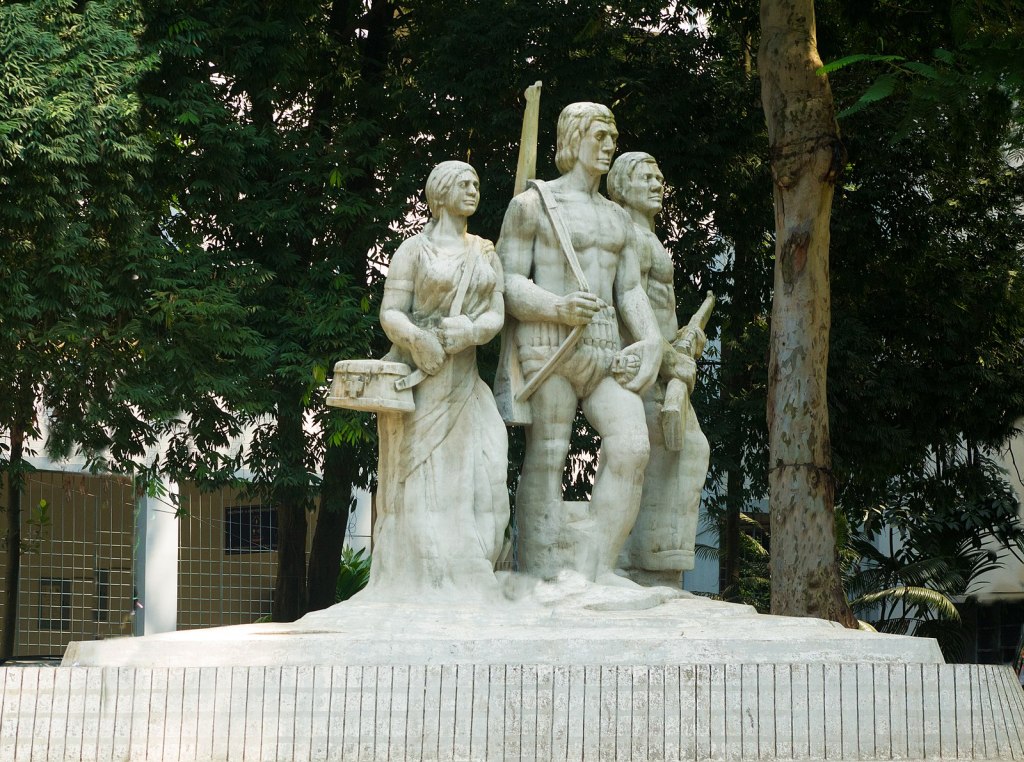
When independence finally came to Bangladesh on December 16, it was fitting that the Pakistani Army would surrender in the open space adjacent to the university known as Ramna Park. The many teachers and students who had been murdered since March 26 as well as the resistance put up by them were later commemorated with structures erected all over the campus, the most prominent of them being the “Aporajeyo Bangla” or “Invincible Bengal” sculpture in front of Kala Bhabhan or the Arts faculty building, the martyrs plaque put up opposite the central mall, and the sculpted figures of the freedom fighters erected in front of the Teachers-Students Centre. December 14 became from then on the day when the DU Liberation War martyrs were to be ceremonially remembered and December 16 the day when DU faculty and staff joined the rest of the country in celebrating Victory Day.

Aporajeyo Bangla” or “Invincible Bengal” sculpture. Courtesy: Creative Commons

(First published in Daily Star, Bangladesh)

Fakrul Alam is an academic, translator and writer from Bangladesh. He has translated works of Jibonananda Das and Rabindranath Tagore into English and is the recipient of Bangla Academy Literary Award (2012) for translation and SAARC Literary Award (2012).