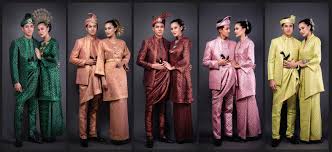
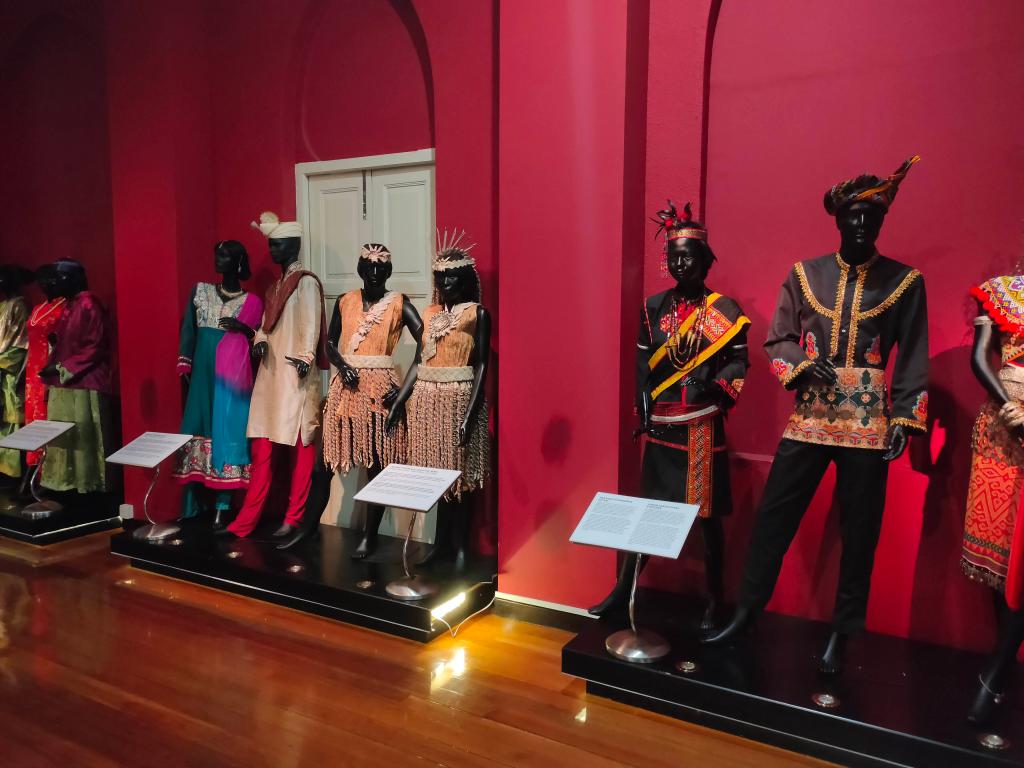
Women wearing baju kurongs and men wearing kain sampings. From Public Domain
OIL LAMPS

We did not taste chicken unless it was Hari Raya.
Mats laid on the corridor floor in front of ten doors—
the barrack houses at the end of Ramadan
decorated by oil lamps at each corner.
The gloomy village turned bright.
Each family brought out trays of varieties of dishes and cakes,
the feast welcoming Shawal.
The call of prayer from the radio,
followed by the hymns to glorify God.
Life in the village was indeed harmonious,
although sprinkled with misunderstandings,
slighted feelings throughout the year.
Exchanging delicious food,
extending congratulatory wishes,
laughter and tears flowed unimpeded.
The young proceeded to the field,
ignited the fuse of bamboo cannons
stuffed with carbide powder fodder.
The new moon was welcomed by blasts, claps, and cheers of happiness.
Flames of oil lamps swayed in the breeze,
resplendent till the morning,
before going to the mosque in groups,
wearing the baju kurung and kain samping.


THE BENCH

The melodious magpie on the bamboo twig,
the passing breeze welcomed the chirping.
Sitting on a dilapidated wooden bench,
the thick canopy of the mango tree,
village folks rested in the shade,
calming the tremors of troubled hearts.
The hardship evident in the sighs,
still hopeful of tomorrow’s dreams,
drying the sweat of weariness.
Honest earnings chased away worries.
A pinch on the thigh, a cry of pain,
laughter and jokes were shared merrily,
teasing the maiden sitting by the door,
smiling sheepishly, welcoming attention.
Recollecting a slice of an old tale,
fun and camaraderie were reminisced,
firm and amicable bonds were fostered.
It’s but a memory. It’s but a memory. It’s but a memory.
Now alone in a room,
gazing at the handphone screen,
chatting aimlessly in social media—
do we remember and long for the dilapidated bench,
crafting old tales, forging firm and amicable bonds?
Do we remember and pine
for the maiden sitting by the door?

CUSTOMS

Customs are not like banana fritters
coated with rice flour, dipped in hot oil,
served instantly, crispy and delicious, eaten warm,
accompanied by sips from a cup of black coffee.
Customs are like rain
that falls according to the weather.
It’s always there, although infrequent,
temperamental and purposeful,
sometimes an inconvenience— plans thwarted—
but always invigorating
and instils a sense of acceptance.
If received with gratitude,
directed with perseverance,
and tempered with wisdom,
life is beautiful with droplets of grace,
life is fertile with the pouring of bounties,
life is prosperous with love bestowed.
Customs make the earth supple.
Customs make the village noble.
Customs make a people well-mannered.
Once in a while,
relish a crispy banana fritter
and sip warm black coffee
while it rains cats and dogs.
Momentary disruption of plans,
the alleys and roads flooded—
a moment of reflection,
a moment of appreciation of the day,
inherent in droplets of grace,
inherent in the pouring of bounties,
inherent in love bestowed.
Shifting of time and signs
so the soil is tilled with purpose,
so the village gathers and collectively agrees,
the people ready to realise
aspirations of good character
and respected stature.

SIN

Sin is the earth,
Sin is the water,
Sin is the air,
Sin is the fire,
moved by a rebellious heart,
whispered by a vile intention.
Yes, Sin is the arrogance.
Yes, Sin is the pawn of power.
Yes, Sin is shamelessness.
Sin is a human,
who is given a will without limits,
without pity, who wants to be the reigning deity,
who wants to be the undeterred devil:
also, a human who chooses to want darkness,
wants to cheat, gorge, and be satiated:
the snake slithering in dark crevices,
the scorpion hiding in an undetected nest,
the leech waiting for prey in wetlands.
But Sin is the smelly compost that cultivates,
the cracked mirror that reflects form,
despondent valleys that look up to the summit,
tumultuous sea flowing from the openness of estuaries.
If the earth, water, air, and fire
are cleansed by seven skies, seven rivers, and seven blossoms,
moved by a modest heart,
whispered by a sincere intention,
Yes, the Sin will change to Repentance.
Yes, the Sin will change to Obedience.
The Sin will become Blissful and Fragrant.
Humanity.
Isa Kamari has written 12 novels, 3 collections of poetry, a collection of short stories, a book of essays on Singapore Malay poetry, a collection of theatre scripts and lyrics of 3 music albums, all in Malay. His novels have been translated into English, Turkish, Urdu, Arabic, Indonesian, Jawi, Russian, French, Spanish, Korean, Azerbaijan and Mandarin. Several of his essays and selected poems have been translated into English. Isa was conferred the S.E.A Write Award from Thailand (2006), the Singapore Cultural Medallion (2007), the Anugerah Tun Seri Lanang (2009) from the Singapore Malay Language Council, and the Mastera Literary Award (2018) from Brunei Darussalam.
He obtained a BArch (Hons) from the National University of Singapore in 1989, an MPhil (Malay Letters) from Universiti Kebangsaan Malaysia in 2008 and is currently pursuing a PhD programme at the Academy of Islamic Studies, Univeristi Malaya. His area of research is on the problem of alienation and the practice of firasat (spiritual intuition) in selected Singapore Malay novels.
The Lost Mantras is a collection that blends spirituality, Malay cultural heritage, and universal human experience. First published as part of Menyap Cinta (Love Greetings, 2022, Nuha Books KL), these poems are like a bridge between mysticism and everyday life, where traditional images (betel, jasmine, kris[1], oil lamps, setanjak[2]) are woven with Qur’anic echoes, prayers, and existential questioning. The collection carries a Sufi resonance—always circling back to longing, humility, surrender, and beauty as signs of God. The poems are not only lyrical but also function as cultural memory: they preserve Malay traditions, communal practices, and village life, while situating them in a cosmic framework of faith, sin, and redemption. The use of Malay customs, rituals, and objects is powerful: it asserts that spirituality is not abstract but embedded in heritage. This makes the collection uniquely Southeast Asian despite its universal in appeal.
Hey, the morning breaks! Hey, the faithful sun! Hey, the disappearing dew! Hey, the layered air! The breath desires, the soul asks: Who do you greet? Have you pondered, sons of Adam? Death awaits, life prolongs. Have you realised, progenies of Eve? The earth is impregnated and layered by purpose. The one that you welcome is the morning, The one that you coax is the sun, The one that you touch gently is the dew, The one that you breathe is the air. The gift of death, life fulfilled, accompanies the inevitable: morning, sun, dew, and air. A breath dissipates, a soul obliterates. Nothingness. Gone. Hey!
THE FIELD
The green grass is a mother’s heart, the velvet of love for her children. Although stepped upon by mischief and transgression, she distils dews of hope that her children would grow with the sun. The earth is the preparation of a father: soil and compost for his children where character would be rooted. Barren or fertile, he digs into his responsibility and self-worth, as long as the rain nourishes his age. Grass flowers are the children who only know the joy of the wind for as long as their dreams have not landed on earth and kissed the grass.
MOLTEN EARTH
This moment, we’re walking in the rain, accompanied by a bluish rainbow and red birds with purple blood. If they’re heading towards the dais, we have yet to embrace the longing. When the moon is in tears, it’s just ill-suited for us to sail on the orange henna sea. In truth, we verily love the eagle that flies in the desolate morning. If not for ravens like you, our forest would be infested with rabbits. Give us white wings; we want to fly with blue birds that return to reciprocate love. We want to taste milk. Is it for us only urine, the manifestation of love by dogs? Sound your prayer call in our shacks so that our tears are not just to bear the pain and bitterness of a plate of rice. If your pensiveness is just to reminisce the sufferings of night longing for day, our tears have flowed from the earth’s molten belly, which are stepped upon by saints like you and them who have cast curses upon us wretched souls.
POTPOURRI
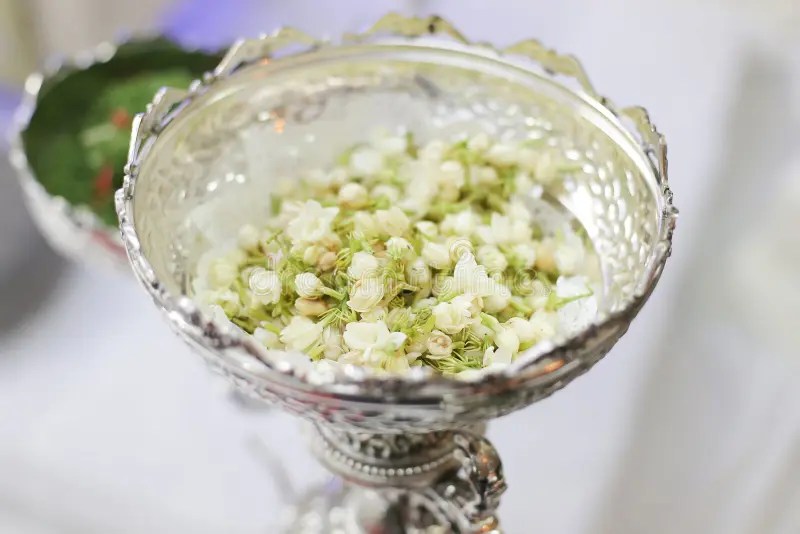
The screw pine thrives on damp soil, next to the swampy pond. It spreads its green in the wild; roots clench the earth we tread upon. The jasmine grows on the lawn, marks the boundaries of property. Sturdy branches, leaves flourish; petals open, greet the clouds. The sliced screw pine in a receptacle, the jasmine blossoms spread on the tray, perfume sprinkled to enhance the scent: the potpourri of bunga rampai welcomes guests. The ceremony officiated by the qadi, the couple duly married, customs and culture celebrated in fragrance, religious laws honoured on the dais. The shaving of the baby’s head, first steps on the soil, the coffin carried to the grave— the potpourri of bunga rampai adorns every domain, binding firmly entire life’s moments.
Bunga rampai — fresh flower potpourri used in Malay festivities and funerals. From Public Domain.
Isa Kamari has written 12 novels, 3 collections of poetry, a collection of short stories, a book of essays on Singapore Malay poetry, a collection of theatre scripts and lyrics of 3 music albums, all in Malay. His novels have been translated into English, Turkish, Urdu, Arabic, Indonesian, Jawi, Russian, French, Spanish, Korean, Azerbaijan and Mandarin. Several of his essays and selected poems have been translated into English. Isa was conferred the S.E.A Write Award from Thailand (2006), the Singapore Cultural Medallion (2007), the Anugerah Tun Seri Lanang (2009) from the Singapore Malay Language Council, and the Mastera Literary Award (2018) from Brunei Darussalam.
He obtained a BArch (Hons) from the National University of Singapore in 1989, an MPhil (Malay Letters) from Universiti Kebangsaan Malaysia in 2008 and is currently pursuing a PhD programme at the Academy of Islamic Studies, Univeristi Malaya. His area of research is on the problem of alienation and the practice of firasat (spiritual intuition) in selected Singapore Malay novels.
The Lost Mantras is a collection that blends spirituality, Malay cultural heritage, and universal human experience. First published as part of Menyap Cinta (Love Greetings, 2022, Nuha Books KL), these poems are like a bridge between mysticism and everyday life, where traditional images (betel, jasmine, kris[1], oil lamps, setanjak[2]) are woven with Qur’anic echoes, prayers, and existential questioning. The collection carries a Sufi resonance—always circling back to longing, humility, surrender, and beauty as signs of God. The poems are not only lyrical but also function as cultural memory: they preserve Malay traditions, communal practices, and village life, while situating them in a cosmic framework of faith, sin, and redemption. The use of Malay customs, rituals, and objects is powerful: it asserts that spirituality is not abstract but embedded in heritage. This makes the collection uniquely Southeast Asian despite its universal in appeal.
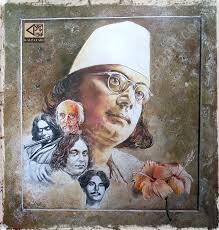
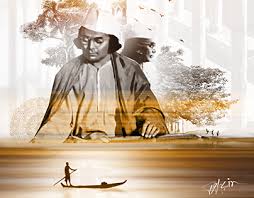
The many faces pf Kazi Nazrul Islam. From the Public Domain
The abiding image of Kazi Nazrul Islam (1899-1976) is that of the “Rebel Poet,” who defines himself as a fiery comet streaking across the firmament, emblazoning in the sky a message of revolutionary change. Unlike Rabindranath Tagore, Nazrul was not born into social and intellectual privilege. He has been described, in fact, as “the ‘other’ of the elite Kolkata bhadralok”.[1] Born in Churulia village in the Bardhaman district of Bengal, Nazrul was the son of the head of a mosque, studied in an Islamic school, and during his youth, joined a Leto group, a travelling band of local performers. When in high school, he was recruited into the British army, and served in Karachi. Even after he returned to Bengal as a young poet who had already acquired fame and repute, he remained something of an outsider to the intellectually sophisticated world of the literati. It was from this position of an outsider that he fashioned his own image as the bidrohior ‘Rebel poet’ who challenged the structures of the political, social, cultural and literary establishment with the sheer force of his iconoclastic writings.
Though best known as a poet, composer and revolutionary, Nazrul’s oeuvre also includes novels, essays, stories, editorials and journalistic pieces on a remarkable variety of topics. He was also a lyricist and composer, creator of the iconic genre called “Nazrulgeeti”. Nazrul’s brilliant literary career lasted from 1919 to 1942, when illness brought it to a sudden end. During this short span of time, he wrote on an amazing range of subjects, including politics, nationalism, social change, religion, communalism, education, philosophy, nature, love, aesthetics, literature and music. He saw it as his mission to arouse public awareness about pressing issues, and to jolt them out of their complacency and general apathy. Remembering Nazrul on the 48th anniversary of his death, it is daunting to think about his extraordinary legacy, but also a timely moment to reflect upon his significance for our own times.
In his political stance, Nazrul argued passionately in favour of armed struggle for total independence from colonial rule, rejecting the Gandhian path to advocate a freedom won via armed resistance. The trope of violence recurs in his writings. Yet his apparent espousal of the principle of destruction springs from a utopian dream of constructive change. “Reform can be brought about, not through evolution, but through an outright bloody revolution,” he says in the essay ‘World Literature Today’. “We shall transform the world completely, in form and substance, and remake it, from scratch. Through our endeavours, we shall produce new creation, as well as new creators”.[2]
Nazrul’s ideas on education counter the colonial pattern, advocating instead a curriculum that draws on indigenous contexts and models. He feels that the new education policy should emphasise empathy, inclusiveness and heterogeneity, with a special focus on psychological and emotional development. “It is our desire that our system of education should be such that it progressively makes our life-spirit awakened and alive,” he says in ‘A National Education’, adding: “… We would rather produce daredevils than spineless young men.” [3]
Inclusiveness and acceptance of heterogeneities are central to Nazrul’s vision. During his stint as a soldier in Karachi in his young days, he became interested in Marxist thought. The influence of this line of thinking can be felt in his emphasis on economic egalitarianism, and his passionate support of the cause of the downtrodden peasantry, particularly in his journal Langal. Following the 1926 riots in Kolkata, he expresses his anguish at the communal antagonism between Hindus and Muslims, critiquing different forms of orthodoxy in both religions. In the poem ‘Samyabadi (Egalitarian)’ [4], he declares:
I sing the song of equality—
Where all divisions vanish and barriers dissolve,
Where Hindu-Buddhist-Muslim-Christian
	merge and become one …
Nazrul was also a supporter of women’s rights. In his poetry, he speaks of equality between men and women. In ‘Nari (Woman)’ he argues: “If man keeps woman captive, then in ages to come, / He will languish in a prison of his own making”.[5]
Not surprisingly, Nazrul’s fearless, unconventional attitude aroused hostility in many quarters. His bold, outspoken magazine Dhumketu enraged the British. The journal was banned, and Nazrul condemned to rigorous imprisonment. At his trial in 1923, he delivered a resounding rejoinder in his speech ‘Rajbandir Jabanbandi (Deposition of a Political Prisoner)’. He remained a thorn in the flesh for the British administration because of his revolutionary views. Nazrul’s religious views also raised many hackles. He married Ashalata Sengupta, or Pramila, who belonged to the Brahmo Samaj. This antagonised conservative Hindus as well as orthodox Muslims.
Nazrul’s success as a writer, especially Rabindranath Tagore’s appreciation of his work, also caused jealousy among contemporary writers. For Tagore had dedicated his play Basanta to Nazrul, and also sent a telegram to him when he was in prison, exhorting him to give up his hunger strike. In 1922, Tagore had written a poem addressed to Nazrul, which appeared in successive issues of the journal Dhumketu[6]:
Come, O shining comet! Blaze
Across the darkness, with your fiery trail.
Upon the fortress-top of evil days,
Let your victory-pennant sail.
What if the forehead of the night
Bear misfortune’s sinister sign?
Awaken, with your flashing light,
All who lie comatose, supine.
Rabindranath Tagore’s recognition of Nazrul’s talent created a lot of envy in literary circles. In 1926-27, parodies of Nazrul’s poetry started appearing in Shanibarer Chithi, a journal published by the Tagore circle. It came to be rumoured that Tagore had not liked Nazrul’s use of the Persianate word khoon (blood) instead of the Sanskritised word rakta, in his composition ‘Kandari Hushiar’. This gave rise to a controversy that became known as khooner mamla (the bloody affair), which drew a strong reaction from a deeply perturbed Nazrul, in the shape of an essay ‘Boror Piriti Balir Baandh” (A Great Man’s Love is a Sandbank)’, in which he blamed Tagore’s followers for the entire misunderstanding. The situation was resolved through the mediation of friends, and relations between Tagore and Nazrul remained cordial. When Tagore died in 1941, Nazrul broadcast a moving elegy, “Robi-Hara”, on Calcutta Radio.
In some ways, Nazrul was ahead of his time. Not many people know that he was aware of environmental issues and the threat of climate change, pressing problems in our own times. In ‘The Day of Annihilation’, he writes in a prophetic vein, of global warming, dissolving ice-caps and a changing ecology, cautioning his readers that if humans exploit the planet, we will eventually be responsible for the destruction of life on earth.
In Nazrul’s life and writings, we encounter the constant pull of contraries.His consciousness was simultaneously rooted in local culture, and infused with a broad transnational spirit. He felt inspired by movements in other parts of the world, such as the Turkish Revolution, the Irish Revolution and the Russian Revolution. In the essay ‘Bartaman Viswasahitya (World Literature Today)’, we discover his awareness about literary developments across the globe.In his political writings he espouses the path of violence, but he also composes exquisitely tender love songs, devotional songs drawing on both Hindu and Muslim imagery, and songs about the beauty of nature.
Nazrul’s style is a volatile mix of colloquial, idiomatic expressions, formal Bengali, Sanskrit and Persianate vocabulary, a smattering of English, and multiple registers of language. His polyglot sensibility also surfaces in his practice as a translator. He translated Omar Khayyam and Hafez from Persian into Bengali. His translations from Arabic into Bengali include 38 verses of the Qu’ran, part of the Mirasun Nagmat (a treatise on Hindustani classical music) and some poems. He translated Whitman’s ‘O Pioneer’ from English into Bengali. He is also known for his innovative ghazals in Bengali.
In 1942, Nazrul suddenly lost his speech. His illness brought his literary life to an abrupt end. All the same, the impact of his writings continued to be felt. In the Bangladesh Liberation War of 1971, the freedom fighters adopted Nazrul’s music as a source of inspiration. He was later declared the National Poet of Bangladesh. Today, while Nazrul’s poems and songs continue to delight and inspire, the true extent of his achievement remains in shadow. It is time for a comprehensive reappraisal of this much underestimated literary genius, because his writings have so much to offer us in our present world.
[1]The Collected Short Stories of Kazi Nazrul Islam, ed. Syed Manzoorul Islam and Kaustav Chakraborty (Hyderabad: Orient Blackswan, 2024), p. xviii. Bhadralok translates to gentleman
[2]Kazi Nazrul Islam, Selected Essays, translated by Radha Chakravarty (New Delhi: Penguin Random House, 2024), p. 137.
[3] Kazi Nazrul Islam,Selected Essays, trans. Radha Chakravarty (2024), p. 60.
[6]The Essential Tagore, ed. Fakrul Alam and Radha Chakravarty. Cambridge, Massachusetts: Harvard University Press, 2011, pp. 115-116; Translation mine.
Radha Chakravarty is a writer, critic, and translator. She has published 23 books, including poetry, translations of major Bengali writers, anthologies of South Asian literature, and critical writings on Tagore, translation and contemporary women’s writing. She was nominated for the Crossword Translation Award 2004.
.
PLEASE NOTE: ARTICLES CAN ONLY BE REPRODUCED IN OTHER SITES WITH DUE ACKNOWLEDGEMENT TO BORDERLESS JOURNAL
I had a feeling of quiet satisfaction. I was finally able to locate the passage. I had spent a few weeks trying to do so without success. At ten in the morning, the iron gates of the passage/tunnel under the busy road were open as mentioned in the video on YouTube. I could see the lakes of the Perdana Gardens ahead. The Perdana Botanical Gardens is one of the major attractions of Kuala Lumpur.
There are also several attractions located around the garden. Among these are the KL Bird Park, the Butterfly Park, the National Planetarium, the Islamic art museum, the Royal Police Museum, and the Tun Razak Memorial. I visited these museums over several weekends. Walking to and from and within these museums keeps me active. Many are located around the Perdana Botanical Garden. Two are around the Dataran Merdeka, the Merdeka Square. The Royal Museum is separate but not very far from these two locations. KL has several other museums that we will examine in a later article.
The pandemic had created a sense of fear within me. In late 2000, COVID was still under control in Malaysia and the national museum was open with pandemic protocols. I was apprehensive but my entry to the museum was smooth. The National Museum of Malaysia (Muzium Negara in Malay) is an impressive structure inaugurated in 1963. The museum was designed in the style of a Malay palace and UNESCO had provided consultants from different countries. The museum is impressive and modern.
The ground floor details the history of Malaysia from ancient times to the Sultanate of Melaka. Kedah in the north was a major historical centre. Excavations have revealed old civilisations. Melaka was a major trading post. Various European colonial powers had fought over the state. The second-floor deals with the colonial and modern history of the country. I was fascinated by images of the Japanese occupation and the civil war. There are various exhibits located outside on the museum grounds. As the pandemic has slowly declined, the museum has come to life again attracting crowds, especially on weekends. There are local crafts and food items on display and sale.
There is a museum café on the premises that serves good Malay food. I often have lunched there while visiting the botanical garden and surrounding attractions. The textile museum or MuziumTekstil is in a beautiful old heritage building near Merdeka Square, the country’s historical heart. The building started as the headquarter of the Federated Malay states railways and served later as the main office for different government entities.
Inside the textile museum. Photo Courtesy: Ravi Shankar
The textile museum was opened in 2010. There are four galleries over two floors. The Pohon Budi Gallery deals with the tools, materials, and techniques of textile making over the ages. The Pelangi Gallery deals with batik. I visited the museum with a friend who hailed from Gujarat, and he was fascinated by how batik had been adopted here . The Teluk Berantai gallery concentrates on the teluk berantai (interlocking bays), a harmonious motif made up of individual flower designs stitched together into geometric patterns. The Ratna Sari gallery is also located upstairs. The British had brought in artists and artisans mainly from India to construct several colonial-era buildings in the Mughal style. The museum is within walking distance from the Masjid Jamek station on the Sri Petaling line.
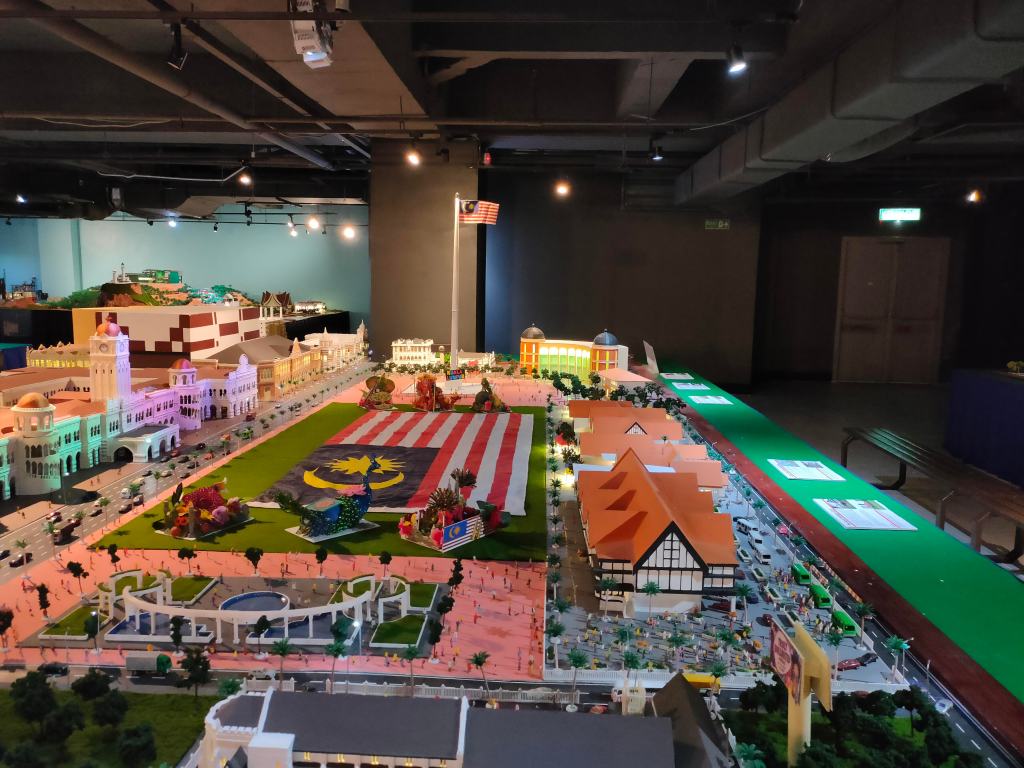
The KL City Gallery tells the story of the city from its founding as a tin mining town to eventually becoming the capital of British Malaya and modern Malaysia. Kuala Lumpur comes from two Malay words meaning the muddy confluence of two rivers. The town at the confluence of the Gombak and the Klang rivers grew rapidly into a modern metropolis. The gallery is operated by ARCH, a Malaysian brand making hand-assembled collectibles and gifts. The story of the city is told through old prints, miniatures, and photos. The centrepiece is the hand-assembled KL City model with over 5000 miniature buildings. The gallery has a café, and the city’s love of food is well showcased. At the entrance there is an I love KL sign popular with tourists and locals as a backdrop for photos.
The National art gallery (Balai Seni Negara) is within walking distance from the KL Hospital station on the newly opened Putrajaya line. The gallery is designed as spaces flanking the circular ramp to serve as exhibition areas for more intimate and contemplative viewing. The spiral ramp in the middle provides a dynamic visual experience to visitors showcasing the building from different angles at every level. There are galleries located on three levels. There is a mixture of different media like paintings, a few miniature paintings, sculptures, installations, and projected images among others. I love the space and feel of the building. There is a good collection of paintings and other works by Malaysian artists. British colonial artists and their impressions of life in colonial Malaysia are also featured. The gallery makes for an interesting and contemplative outing.
Dataran Merdeka ModelA model at Minniature GalleryPhoto Courtesy: Ravi Shanka
Minnature Gallery advertises itself not as a museum as the pieces on display were all created specifically and are not of historical value. There are thousands of miniature pieces, and the buildings were 3D printed. The location is within the Sungai Wang Plaza, near the Merdeka Square. The recreation of the Dataran Merdeka or the Independence Square and the light show at this historic location (in miniature) is impressive. are miniature models of several locations in the country. While the pandemic protocols lasted, these served as a good introduction for me to the attractions of other states in the country. They have a small store selling merchandise. Most museums in Malaysia have a gift shop and a dining area. The models of different foods from Malaysia in the Minnature gallery are impressive though I am not sure if there is a restaurant on the premises. The amount of detail is huge and the proportions of the structure correspond to the real world.
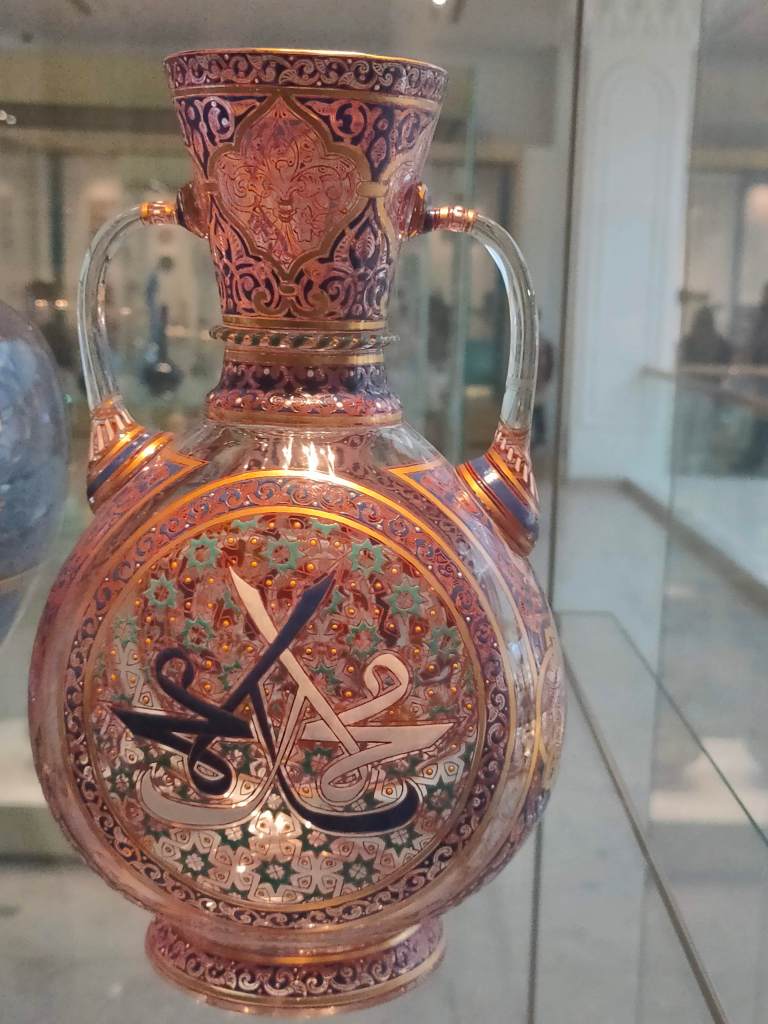
An artifact from the Islamic Museum. Photo Courtesy: Ravi Shankar
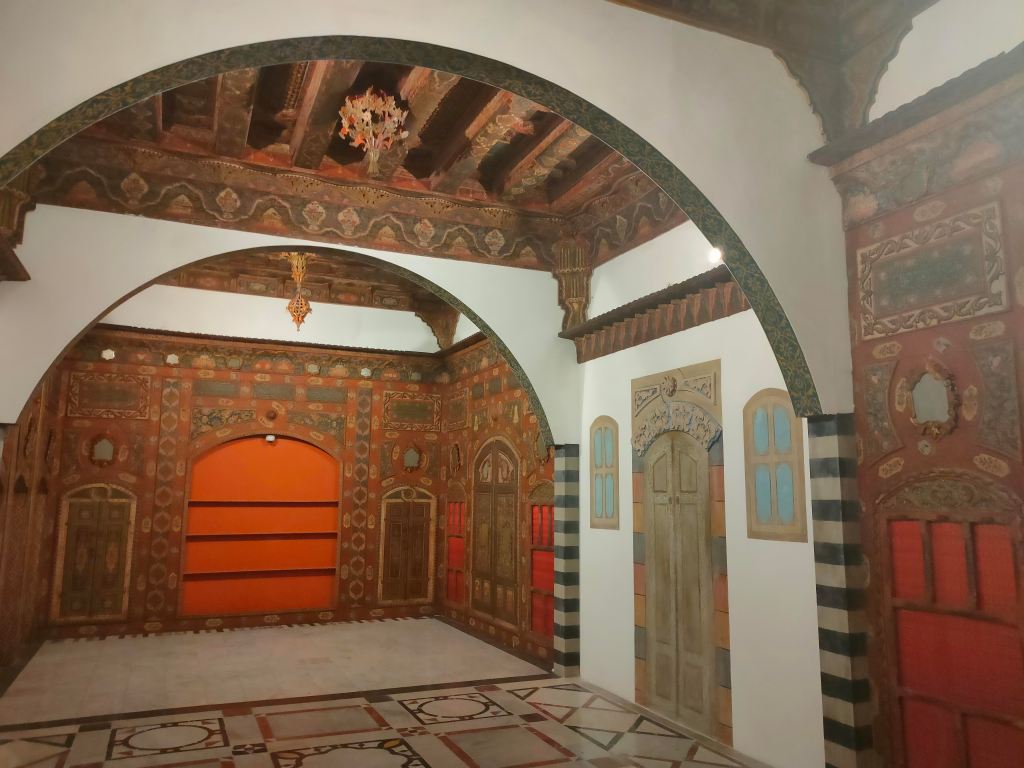
The Islamic Arts Museum (Muzium Kesenian Islam Malaysia) is located around the perimeter of the Perdana Garden. The museum claims to be the largest one on Islamic art in Southeast Asia. The Nusantara region including Malaysia and Indonesia claims to have the largest Muslim population in the world. There are more than 7000 artefacts. The building is spacious with large glass frames letting in plenty of light. The museum is spread over two levels. Level one contains galleries devoted to architecture, the Quran, and other manuscripts, and a gallery each for the art of India, China, and the Malay Peninsula. The second level is dedicated to Arms and Armours, Textiles, Jewelry, and Coins, and three galleries consisting of artworks categorised by their materials – Metal, Wood, and Ceramics. The craftsmanship of some of the pieces is sublime. The dedication of the craftsmen and the time they devoted to their tasks has to be admired. The highlight of the gallery to me was the delightful and elaborate roofs. Each is a masterpiece of design! There is also a fine dining restaurant on the premises.
The original Royal Malaysia police museum (Muzium Polis di Raja Malaysia) was built in 1958. The new building located on the outskirts of Perdana Garden was inaugurated in 1998. There are three galleries: one deals with policing during the early days of the Malay sultanate, the other, with the Colonial Era and the last with the period called Emergency, the Anti–British National Liberation War (1948-1980) which involved guerrilla warfare. There are a variety of materials used by the police force over the ages in the collection. There is a good collection of motorcycles and other vehicles. The police persons on duty at the museum are very friendly. There is a large collection of armoured vehicles and cars and a plane model on the grounds of the museum.
The Royal Museum (Muzium di Raja) was inaugurated in 2013 and was the residence of the King of Malaysia till the royal family moved to a new residence. The huge two-story property was built in 1928 by a Chinese mining tycoon for his huge family and was one of the biggest residences in Kuala Lumpur (KL). The museum provides a glimpse into the life of the royal family though most rooms can only be seen from the walkway. There is a good view of the KL skyline, including the iconic Petronas Tower.
All these museums are visitor friendly and provide a unique glimpse into the history of the city, the state of Selangor, and Malaysia. Tourists might need around three or four days to do justice to the richness on offer. Museums take you to other worlds and times. The American art critic, Jerry Saltz says, “Don’t go to a museum with a destination. Museums are wormholes to other worlds. They are ecstasy machines. Follow your eyes to wherever they lead you…and the world should begin to change for you.”
A restored museum room in the Islamic Arts Museum. Photo Courtesy: Ravi Shankar
Dr. P Ravi Shankar is a faculty member at the IMU Centre for Education (ICE), International Medical University, Kuala Lumpur, Malaysia. He enjoys traveling and is a creative writer and photographer.
.
PLEASE NOTE: ARTICLES CAN ONLY BE REPRODUCED IN OTHER SITES WITH DUE ACKNOWLEDGEMENT TO BORDERLESS JOURNAL
A poignant short story about a Rohingya child by Shaheen Akhtar, translated from Bengali by Arifa Ghani Rahman
Shaheen Akhtar
Musa was born in the year when the girl child in his region was allowed to live and the sons were being killed. Dadi, his father’s mother, Bismillahjaan, had named him. There were no celebrations, no events to mark this ceremony, and not even an insignificant penny was spent on incense. However, as a tax for the arrival of a child into this world, a fat sum had to be donated to the nearby police station. That is how Dadi Bismillahjaan described the heavy term ‘birth registration’ used by people.
And Musa had landed on this side of the Naf River last night without that Dadi. He did not know at the time that his grandmother was not on the boat. She had paid for both their passages with six thousand kyat[1]. Then ensued the hullabaloo as people vied to get on the boat under cover of the darkest of nights.
A stream of salty tears ran down Musa’s cheeks as he stared down the endless river. Had his lungi been tied to his Dadi’s Thami,[2] he would never have let her float away. God forbid! Why would the old woman have floated away? She probably had not boarded the boat in the first place. She had ensured her grandson’s passage and quietly withdrawn from the back.
That was what Bismillahjaan had wanted from the very beginning. Musa was the sole heir to his family name, she used to say with every breath. If he survived in any corner of the earth, at least his bloodline would live on. And so, she had pulled her old, skeletal body across the hills and through the jungles. In all this time, she had held on to the enamel pot in which she cooked rice. Along the way, she had boiled whatever leaves she could gather and served them to Musa.
Musa had not paid attention to this at the time. His eye had been on the mountain along their path – perhaps he might see the light of God, the light which burned the mountain, but not Musa, the prophet. But none of these mountains were named Sinai. He had found a staff on the way though, and he had tied the bundle of clothes and the cooking pot to one end.
When Musa’s caravan arrived at the sandy banks of the Naf, he had relieved the stick of its burden. The sandy banks were like Karbala – with no water to drink nor food. The salty water where the river and the ocean met only made them vomit, cry, and struggle. In the meantime, when one woman gave birth, Musa, the learned student of the village religious school, was summoned to sound the azaan, the call for prayer, in the baby’s ear. Two days and two nights passed. There was no boat in sight. The Burmese army was hunting them down like the Pharaoh’s soldiers. Secretly, Musa had extended his arms once towards the river but to no avail. So, under cover of the night, he had thrown his staff into the water. This too was fruitless. The stick was swept away by the current. But at that moment, an engine boat puttered over from the other side and stopped at the bank. It was in that boat that Musa had piled in to arrive at this unknown destination last night. In the midst of this, he had lost Dadi, Bismillah.
How would Dadi traverse that long road again? Where would she go? What would she eat? Home burnt, fields burnt – their land had been destroyed by the ruling goons. If the family graveyard was still intact, she could probably find shelter in a foxhole. This must have been her plan all along. Musa’s sleep-deprived, numb, dizzy brain now recalled the rambling hints she had dropped about this. Five years ago, Bismillahjaan’s only son, Musa’s father, had been laid to rest in that graveyard. Musa had been a child of eight then. As he watched the gravedigger shovelling in the earth, he thought about the ancestors that were lying there. Baba had suffered much in life and his death had been worse. The military junta soldiers had shot him in the chest and then his throat had been slit by the monks. As he lay in his grave, Baba would tell of his travails to his dear ones who had led comparatively peaceful lives.
Musa wiped the tears from his eyes and sat on the rocks of the dam. He was closer to the water’s edge from here. Countless people stood squashed together on this side of the Naf, their eyes trained on the other bank. As darkness descended, a lantern or two lighted up on the river, and there was the occasional flicker of a flashlight. Musa drew in his breath sharply. Did the battery-operated lights belong to the military junta?
Perhaps there were still thousands of people waiting on the tarpaulin laid out on the sands he had left behind yesterday. Some would be giving birth; some would be dying – their bodies burned or maimed by bullets. There was no medicine, no proper food. For what sin were they suffering this hell on earth? Was Dadi still burning in the hell at the sandy banks?
As soon as a fleet of boats docked along the bank, Musa jumped into the water. He could not move forward as the crowd shoved through the neck-deep water from the opposite direction. He did not even have a light to shine on the faces of the swarm of people to find Dadi’s. Whatever light there was on this side came from the flash of cameras or the flashlights of the BGB[3] or the coastguards. They were using their flashlights to search through the refugees’ belongings that had been dumped on the banks – their plastic sacks, cooking utensils, urns, broken wall clocks, solar panels, and piles of quilts and pillows. At that moment, lightning in the sky heightened the tremors in Musa’s heart. What if Dadi drowned in the middle of the river in a storm? Raindrops fell on Musa’s head while he was still chest-deep in the water. In the meantime, boats docked relentlessly, as countless as the waves in the sea, compounded by the lapping of the water on the bank and the ear-splitting noise of their engines.
When it began to pour, Musa took shelter in the barn, or rather, a goat shed, of a nearby house. The shed shared a wall with the hut and was covered by the Nipa palm leaf with the other three sides open. In this tiny space stood two closely tethered goats. Musa crowded in with them. Who knew how late it was now. The homeowners must be sleeping soundly. He thought he would leave when the rain eased off but just then, the thunder clapped and he grabbed one of the goats around the neck and sat down. It was a familiar touch after so many days and the smell was exactly the same. When lightning struck a little later, he looked timidly, for the first time, at any creature from this unknown land. It did not look unfamiliar though. In fact, the eyes looked as tender as his pet goat’s. So what if Musa was a scholar in the maktab[4], at heart he was a shepherd – of a pair of golden buffalos and two goats with four or so kids. How much pain those goats must have suffered when they struggled in the fire that engulfed them!
Before the army set fire to their homes, the buffalos had been set free and Dadi had taken refuge in the forest with twelve-year-old Musa. Perhaps she had thought nothing would happen to a woman, child, and a few innocent goats. What Bismillahjaan did not know was that the tyranny of the army had heightened by the day. Even the girls were not spared. These tyrants used to rape before, but now they resorted to spilling blood. When Musa returned home two days later, all he found were ashes and destruction. They had taken shelter in Dadi’s sister’s home a little to the south that day and that is where they stayed for a full year prior to their migration.
When Musa thought of his mother, he recalled a woman sprawling on the front yard with a child in her lap. The child’s pigeon-like pink feet hung over one side of Ma’s lap. Where were his young siblings now? His mother? Musa was awoken by his own cries. He found himself lying curled up on the straw in the goat shed, the pair of goats standing next to him. Someone had wrapped his entire body with a torn quilt – just as his mother used to silently cover him up during the heavy monsoon or winter nights. Even so, Musa left the shed before the first light of dawn. He did not return to the dam. Instead, he began to wade through the muddy path in the opposite direction.
The marketplace ahead was already buzzing at this ungodly hour. City dwellers, alighting from the intercity buses, rushed to the stalls for breakfast, their bags hanging from their shoulders. Aromatic smells filled the dawn air. As hunger pangs rose in Musa’s empty stomach, he began to loiter around the stalls.
When someone came out of a stall and aimed a camera at him, Musa took shelter behind the stall. The camera was a lure – this person was actually a kidnapper, thought Musa. He hissed inwardly like a snake. When the same man, however, returned with a plate of food from inside the stall and called to him, Musa dragged his feet forward. Then he wolfed down the food. He cared nothing at all for the number of clicks the camera made or how many pictures were taken of his starved face. As he burped after polishing off the plate, Musa thought that he would be willing to allow photographs if it meant meals twice a day. He was actually waiting to find a staff that would transform magically into a snake. This was now his aim in life.
With his life’s goal determined, Musa could now afford to look around casually. The place may not have been a township but it was quite busy regardless. There were some paved stores. A schoolhouse stood nearby, some mud-splattered sleeping people crowding its veranda. In the middle stood a pile of their dirty household belongings. When someone emerged from behind a plastic sack of this rootless group, Musa was taken by surprise. Was this boy his twin or was he looking at himself in the mirror? The only difference was that the boy had a white clay mark of Thanaka[5] on his cheek. He was dressed in light blue denim shorts chopped off at the knees. With these and some other differences, the two of them stood in the shade of the stall, next to each other. Neither seemed to have the strength or the inclination to speak.
When the cameraman appeared with a local in tow, Musa quickly turned his back on them to face the wall. Why was this man so overenthusiastic? Wasn’t he satisfied with the bunch of photos he had already taken of his starving, beggarly face? But this time it was not the click of the camera, but the man’s words that drew attention. Musa realised he was taking interviews. In the beginning, the boy next to him also stood silently. Perhaps he was mute, deaf. But the next moment, he began to stammer. Musa felt goosebumps. Did everything become topsy-turvy when doomsday loomed? Was Musa glib of tongue and Harun a stammerer? Of course, he had no idea if this boy’s name was even Harun.
‘So many murders, rapes, arson – did you see these with your own eyes?’ The local translated the cameraman’s words into Rohingya.
What could be the answer to this question? And how could it be described? Did the kid next to him stammer so he did not have to answer such questions? Musa’s heart was in a turmoil. To save the boy who looked like his twin, Musa turned his face away from the wall.
Holding his Dadi’s hand, he had been escaping – Musa began to pour out his story in Rohingya. There was black smoke and fire behind, the sound of screams and bullets chasing them. Body after body lay dead along the road. Bullet-ridden. Throats slit. Then the thunder of the ocean. It seemed to be howling, wanting to divide itself into two. But the stick in his hand did not have that power.
The two men, like the Pharaoh, looked at Musa in disbelief. But the twin-like kid was happy, even though his name was not Harun, but Shah Alam.
As they walked towards the schoolhouse, Shah Alam said that they had crossed over on a raft the night before from the village of Fatongja in Maungdaw. Shah Alam’s father was missing and his older brother had been murdered. His three other siblings were with his mother.
“With Musa, you are now four,” said his mother to Shah Alam as she sat on the veranda and rolled up a plastic mat. A truck was due to arrive shortly and they would be transferred to a nearby refugee camp. Musa felt suffocated. The air was moist and heavy like a full mashk[6]. Dazed people walked around, vacant looks in their sleepless, tired eyes. No face reflected any sign of joy at the prospect of a new life. Did Musa’s face show any sign of delight? He did not want to live the life of an insect in a camp.
When the convoy of trucks arrived in the marketplace, Musa ran the other way as fast as he could. Government forces of this land chased him back. Shah Alam was standing in the truck and sucking his thumb. His mother had let out a cry as if a child of her own womb was running away. Standing in the open truck like cattle, Musa growled in anger. He was more upset with Shah Alam’s mother than with the authorities here. Musa did not want an adoptive mother or brother – he wanted a staff, one that would magically turn into a snake.
“You must not take the words of the Book literally, Musa!” Bismillahjaan came into Musa’s dreams that night. “It is foolishness to do so. Forget about me. Your entire life awaits you. Go forward on your own.”
“Where will I go, Dadi?” Sad and angry, Musa asked in a teary voice. “I want to go back – to that graveyard where you are headed to take shelter in a foxhole.”
Musa shut up when he heard someone groan in their sleep. He began to sweat profusely as he lay under the tarpaulin. His stomach had encountered some rice after many days, refugee rice – and he had not been able to digest it properly. Yet, the day before, a lot had been accomplished. The authorities had done a family headcount and provided ration cards. They had collected and brought their rations of rice, lentils, sugar, and oil to their tarp-covered shelter. Shah Alam’s mother had instantly set up house and Musa had become a part of the family. He was now spending his nights under the same tarp.
Chores were distributed in the morning. Shah Alam’s mother and siblings would stand in line at the ration shop while Musa and Shah Alam were responsible for collecting firewood from the forest and water from the pump. “Don’t fight like Habil and Qabil,[7] my dears,” Shah Alam’s mother poked her face through a hole in the tarp as they walked toward the jungle. “Be good brothers like Musa and Harun.[8]”
Musa’s heart danced with joy when he heard the names Musa-Harun pronounced together. He immediately wanted to address Shah Alam’s mother as Ma, but he suppressed that desire by turning to look at Shah Alam. What a fool! He did not look like he could be good for anything other than gathering firewood. Anyhow, going into the forest did not just mean collecting firewood for the stove – it also meant that he might find the staff he had been searching for. By Allah’s infinite mercy, Shah Alam’s mother had not made him stand in line like a beggar with a bowl, waiting for handouts of food. Moreover, he did not have to remain confined to the camp.
Besides going into the forest, Musa also climbed the mounds around the camp with the others when he heard that the Burmese military had yet again set fire on the other side of the Naf. His people howled, the women wailed and beat their chests. Musa joined them: “Oh Dadi! My heart aches for you!” Sometimes, he cried in tune. “How will I live without Dadi!” When his tears dried up, there was fire in his eyes.
When he received news that a boat had sunk on the Naf, Musa rushed to see. He went close to the dam and sat on the stone slab to stare out into the river. In his hand was a branch of the gojari tree he had found in the forest. He muttered to himself as he struck the water with the branch.
What sort of justice was this? No one would remain – no father or mother, sister or brother, no home or land, no country, no earth. What was his fault? Why did he have to spend his life at a camp – like a cockroach under a tarp? And then there were other troubles. Young girls kept disappearing. As soon as their wounds healed, the young men plotted evil deeds while the police invaded at odd hours of the night. Children cried, old women lamented. Was there no way out of this hell?
“Of course, there is! There is only one route out of this place,” said a trafficker to Musa one day by the riverside. Musa could test his fortune by crossing the river like Sindabad the Sailor. There was a boat nearby and he would not even have to pay for passage.
Musa had no desire to test his fortune. He did not care either about the camp’s development like the light-skinned men who rolled in on expensive cars to find fault. He just wanted to return to his own land. For that he needed a magic staff that would turn into a snake and chase his enemies away. He wanted to see the land overrun with frogs, lice, and locusts that would put fear into the hearts of the Burmese soldiers and drive them out of Rakhine. Or blood would flow in the river instead of water, just like it did when his people were tortured by the commanding forces on his land.
The idea of blood flowing down the river appealed to the militant who waited by the mound everyday for Musa. He had no beard on his face or cap on his head and Musa had no idea where he came from or where he lived. Perhaps he hid beneath the grass like an insect or burrowed into the dark trunk of the enormous banyan tree. But no matter where he lived, the militant ignored the staff in Musa’s hand. As he stood on the mound and looked out onto the fire and smoke on the other side of the Naf, he said to Musa, “If you want blood to flow in the river, you must be trained in arms. It is not possible to do it with a mere gojari branch.”
“Who said this is merely a gojari branch?” Musa questioned. He had no use for an AK-47, grenades, or bombs. He wanted to tell him about the magic staff that would instantly turn into a snake and save his people.
The militant grew quite angry with Musa. He said, “Listen, O Musa, doomsday is near. Bullets and guns are the final answer.”
Musa felt helpless. Couldn’t he show the militant even a little bit of magic now? Like a tiny frog? Musa opened up his palm. Instead of a frog, his palm felt the brush of the breeze.
But neither of the paths suggested by the trafficker or the militant appealed to him. What would he do now? Musa wanted to howl. In anger and frustration, he flung away the branch in his hand. Instantly, it turned into a snake and disappeared into the wilderness around the mound.
(First published in Bengali in Prothom Alo on July 15, 2018)
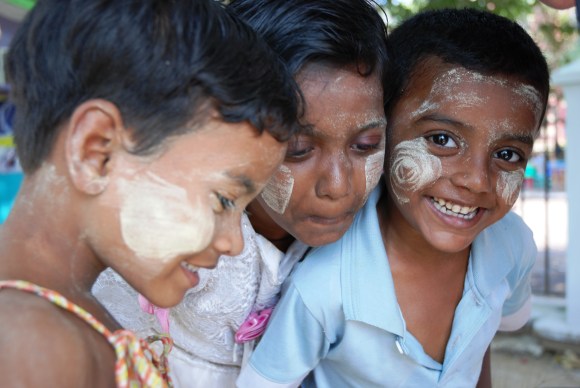
[5]Thanaka is made from barks of trees and used like Sandalwood paste to decorate and protect people from sunburns
[6] A traditional water carrying bag made from goat skin
[7] The Quranic equivalent of the Biblical Abel and Cain
[8] The Quranic equivalent of the Biblical Moses and Aaron
Shaheen Akhtar is a notable Bangladeshi short story writer and novelist. She received the Bangla Academy Literary Award (2015) for her contributions to literature and the Asian Literary Award (2020) for her novel The Search.
Arifa Ghani Rahman is Associate Professor and Head of English and Humanities at the University of Liberal Arts Bangladesh, Dhaka. In addition, she is a freelance editor and translator.
.
PLEASE NOTE: ARTICLES CAN ONLY BE REPRODUCED IN OTHER SITES WITH DUE ACKNOWLEDGEMENT TO BORDERLESS JOURNAL
Ratnottama Sengupta, who has edited an encyclopaedia on culture and is a renowned arts journalist, gives us the role ‘kanthas’ (hand-embroidered mats, made of old rags) played in India’s freedom struggle
Sarcasm dripped from every word when the Bengali proverb was missiled at a person who might have ignored his limited means when planning a revolution. But revolution indeed was wrought by the womenfolk of Bengal in the late 1890s and early 1900s when they discarded the brightly coloured drapes from factories across the seas and opted for the desi taant or handloom cotton saris that were less vibrant, even coarse. They were rising in response to Chaaran Kavi Mukunda Das, the itinerant singer who appealed to them through ballads such as “Chhere dao reshmi churi, aar poro na Banga nari (Leave behind silken threads, do not wear these on Bengali women)”. On the streets, in response to Gandhi’s call for Non-cooperation, men were burning clothes from the mills of Britain. The womenfolk, though confined to the inner courtyard, were not to be left behind in the struggle for the dignity that is freedom.
Subarnalata by Ashapurna Devi
Jnanpith winner Ashapurna Devi, in Subarnalata – the second part of her timeless trilogy on women’s struggle for empowerment which begins with Pratham Pratishruti (The First Undertaking) — records Haridasi, the housemaid who washed dishes round the clock in the wealthy joint family, bring back the expensive vilaiyati (foreign) sari she’d been given for the Durga Pujas. “Here, even if you can’t replace it, please take this back as this is an absolute no-no in our basti (colony) now,” she tells the karta, head of the tradition-bound family. Muktakeshi is stung by this insolence and threatens to sack Haridasi. But her daughter-in-law Subarnalata uses the incident as an excuse to make a bonfire on the terrace, with all the foreign made clothes the family elders and children had been gifted. If she’s chastised for this, so be it! When even little boys were submitting to police atrocities and men were sacrificing their all to sing Vande Mataram (Salute Motherland, authored by Bankim), how could the walls lock out the liberation cry?
Subarnalata, born and raised in the City of Palaces, is not alone in the silent war. Phuleswari, an elderly aunt-in-law she visits in the countryside, asks her if she has the borders of discarded saris. She needs two colours, black and red, to complete a kantha she has worked on. “But make sure these are not from vilaiyati saris,” she tells Subarna. “Those are far more attractive. The desi (Indian) ones are not half as shiny. But if I fall for the shine, my son Ambika will be offended. He told me, ‘It’s only because you have embroidered Yashoda-Krishna, else I would have fed this half-done kantha to fire!’” Subarna, who has not come armed with worn out saris, takes out her newly acquired hand-woven saris, tears off the desi borders and gives them to Phuleswari.
*
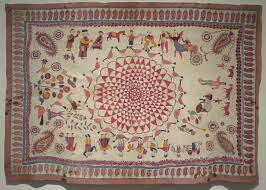
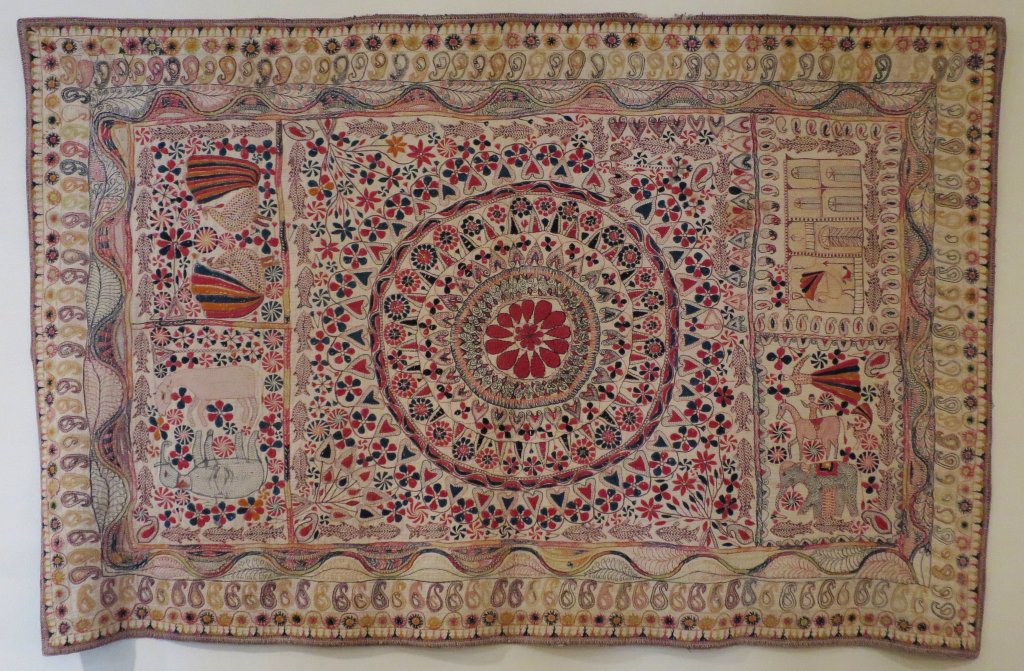
Yashoda chastising Krishna, gopinis (women friends or the milkmaids) pleading for their clothes, or dancing the Raas with Krishna, Duryodhan disrobing Draupadi, Durga slaying Mahishasura, Jagannath on the Rath with brother Balaram and sister Subhadra, Dasarath in a forest, Rama hunting the golden deer, Royal Bengal tiger, alligator, rows of elephants, horses, peacocks… Legends and icons were the major themes tackled by the ladies who inherited the evolved art of the needle from their mothers and aunts and grand aunts in the Hindu families. But these intricate lores were for the especially worked ‘lep’ kathas or sujnis – bedspreads primarily meant to be quilts or perhaps light wraps. Since these were given at marriages or at childbirth, soon ‘secular’ motifs such as boats and palanquins too entered the rectangular ‘playfield’, as did jewellery and ornaments like bajubandh which lent itself to the snake motif, and paati-haar or mat-patterned necklace.
But what kept the womenfolk busy round the year was the khoka (baby) kanthas used in the days when diapers were unknown, and every branch of the family tree became proud parents several times over. These small sized kanthas widely used the central motif of lotus and water lilies that were seen all around in the land of rivers, ponds, jheels or lakes. Surrounding the flora would be vines, the betel leaf, hand fans, fish, parrots, sparrows or some other small birds.
Then, there were the Aasan or carpet-like spreads meant for sitting on the floor. If they were to be used at mealtime, they would be patterned with kitchen utensils like ladle, kadhai, boti – the Bengali all-purpose knife, sickle or kaita, coconut dessicator, and fish that spells prosperity. The ones meant for daily pujas in the prayer room were adorned with floral motifs, leafs from nature, the paisley off a mango or recurrent curvilinear swastikas to ward off the evil eye. Such kanthas also served as covers for the mirror, on pillows, or even as rumal (kerchiefs).
In households that would spread out the jainamaza (prayer rug), dastarkhan (for mealtime spread) or gilaf to cover the Quran, the running stitch — mostly in red and black or green and blue thread drawn from worn out clothes — would conjure the tree of life, the pond laden with lotus, or simply abstract the rippling effect of water and of chatai, the mat in every Bengal home. In short, the craftsperson’s aesthetics built upon utilitarian objects of every shape from the landscape of everyday life. In this respect, kantha shared a kinship with Alpana, the art of drawing patterns on the earthen floor with rice powder.
*
The coming of the British changed the age-old tradition that is believed to have originated with the famished Buddha lying in the open, covered by patchwork rags or quilted cloth. Until, roughly, the 1800s the rag and the needle accounted for only the material half of the kantha: the hand that stitched and the imagination that determined the pattern to be embroidered spelt the other half. Both, the material and the motif were altered, subtly and gradually, by the historical and social metamorphosis that set in with the advent of the Europeans. For, with the imperialists came the tapestry inspired art and the needlework on matte cloth that relied upon the cross-stitch for its staple.
Now, this form of crafting spreads – be it for the bed, the table, or the floor – used designs that were published in books that came from England, France, Germany, and depicted European floral bouquets, pups and kittens, girls in bonnet or with umbrella, fairytale cottages, Greek warriors, even Zodiac signs. These mirrored the social reality of the landscape in which the rulers had grown up and left behind when they set out to conquer and rule. So, for the ‘natives’ this was as remote geographically as it was historically or in terms of tradition.
When the British rulers set up schools for girls and colleges for ladies, the students naturally took to crafting cross-stitch tablecloths and napkins, hand towels, tray cloth and tea cozy that were a part of the colonial lifestyle. The more enterprising ones even stitched the yardage together to make bedspreads and wraps but the amount of labour that went into it was immense. More importantly, the kantha was a unique, creative way of recycling that simultaneously conveyed the love of the elders who would make them in their minimal spare hours. Their kanthas may not have been autographed – though some were, but they certainly were ‘Stay Happy’ blessings even when the words ‘Sukhey Thako’ were not embroidered in by the unlettered grand aunts when the monsoon showers forced them to cut down on the outdoor rituals of preparing vadi, papad, achaar(pickle), kashundi(sauce) and sundry items for consumption round the year, or by widowed aunts with little wherewithal.
In later years, the creatively endowed craftswomen who could stitch layers of cloth without using a single knot, would also start stitching Radha Krishna, Shiv Parvati or Ram Sita on the matte. But by this time the Kantha had also come to grips with the social upheaval and had started depicting guns and cannons on the quilt! By this time, the Bengal Partition of 1905 had been reversed and the Nationalist movement had surged. Durga slaying the Bull Demon had acquired a renewed meaning as Sarbajanin Durgotsab – people’s celebration – took on a nationalist fervour. At the same time Khudiram, Netaji and Tagore gained wide popularity as icons to be mounted on the wall or even to be gifted as swaddle cloth for newborn to signify such blessings as “May you be like them!” or “May you live in a Free Country”. Gandhi’s charkha (spinning wheel) also gained popularity as a motif along the border of the kantha – this was another quiet way of joining the bandwagon of khadi that was spreading the unarmed war against the rulers into the interiors of the land.
As collections in some Museums of Folk Art such as Gurusaday Dutta’s show, the change in motif also saw the head to toe ‘Gora Sahib’ – a white-skinned European, as Bengal had also gone through periods of French domination – make his appearance in kanthas. This was not unique to the needlework art, though. The coveted Balucharis of Bishnupur and Murshidabad that were conventionally identified by their depiction of battle scenes from Kurukshetra or nawab-begums smoking hookahs or driving horse carriages were now sporting Europeans – suited booted and donning hat, and sometimes along with their automobiles!
This change carried itself into the terracotta tiles too: the terracotta temples of Bankura and Birbhum that stand to this day, singing paeans to the heroism of the Devatas who vanquished the Asuras, or of Radha Krishna, Shiv Parvati and Sri Chaitanya, now showed Bengali Babus wearing ‘chapkan’ like the ones we see on social reformer Raja Rammohan Roy or litterateur Bankim Chandra.
There is another, more subversive side to the use of motifs on kanthas. At the peak of the Nationalist movement, when almost every house in Bengal Province was proud to see their youngsters follow Shahid Khudiram’s way, when Master-Da Surya Sen and Binoy-Badal-Dinesh were inspiring the curbs to join organisations like the Bengal Volunteers, and when women like Bina Das, Kalpana Dutta and Pritilata Wadedar too were picking up guns and bhojalis (daggers), the preteen girls played messengers and couriers. Often, when they could not openly send out a message, the revolutionaries would code it through the motifs on the innocuous kanthas that would be draped on babies in arm.
*
This last bit of history comes from my personal family. My father-in-law Kshiti Prasanna Sengupta, first cousin of Shahid Dinesh Gupta and active member of Bengal Volunteers, was jailed in 1933 right after his Matriculation Examination to be released only at the crack of 1947. His incarceration followed the bombing of three consecutive District Magistrates in Midnapore – of James Peddie in 1931, Robert Douglas in 1932, and B E J Burge in 1933. His sister Rama, then in her pre-teens, was often one such unaware courier as she was asked to reach innocuous objects to one or the other household – among them, baby kanthas.
Kantha, as mentioned before, were crafted by women in their moments of leisure carved out of a daily household routine that enjoyed little assistance from mechanical tools and kitchen gadgets. Stitching together three, five or seven layers of saris or dhotis was an arduous pastime to say the least. Yet they took pride in this pastime as the result was their very own creation, not only putting to good use what would otherwise be considered waste but also adding to the wellness of family members, many of whom would not even have the comfort of sleeping on a charpoy. Away from any thought of carrying forward a heritage, our grandmas were not even doing it for economic benefit or ‘self-help.’
Then came the generation of my mother Kanaklata, mother-in-law Aparna and aunt Smritikana, who had gone to schools where they mastered the art of cross-stitch on matte and knitting woolens that would then be sent off to British soldiers on the Burma border of 1944. They were game for the simple art of running stitch; they were adept at crotchet and could weave silken laces by using the hook that interlocked yarns or thread. No longer were they confined to the inner courtyard although they did not have the compulsion to go out to earn their bread. Neither did they crave for an identity in the world out there save by preparing their offspring to usher a brave new world. For these mothers and aunts, the needlework creations were a matter of self-dignity alone: they took pride in preparing the trousseau of their daughters and daughters-in-law with the labour of their own nimble fingers.
The turbulences in the outer world are the stuff of history. The luminescence and crevices, the glories and betrayals of those events mould the rock bed of idealism for the generations that follow. But do we realise how the hand that rocked the cradle helped us rule our own nation? Until recent times we failed to take note of the demolitions and reinventions witnessed within the inner courtyard. The turmoils our mothers and aunts lived through changed the complexion of society, of their age, of the way people of their times thought. So much has changed since, too. But women like Ashapurna Devi started relating the story of Subarnalatas, we too were indifferent to the significance of such restructuring. It is time to celebrate those brave women who fought with bare needles and midwifed liberation in the dark quarters where maids would lose their jobs for refusing to wear foreign clothes.
Ratnottama Sengupta, formerly Arts Editor of The Times of India, teaches mass communication and film appreciation, curates film festivals and art exhibitions, and translates and write books. She has been a member of CBFC, served on the National Film Awards jury and has herself won a National Award.
(This essay will be published in Traditional & Contemporary Kantha, edited by Jasleen Dhamija, made possible by the effort of Siddharth Tagore. It has been shared by the author with permission of the editor and publisher.)
.
PLEASE NOTE: ARTICLES CAN ONLY BE REPRODUCED IN OTHER SITES WITH DUE ACKNOWLEDGEMENT TO BORDERLESS JOURNAL





 Borderless