Categories
Essay

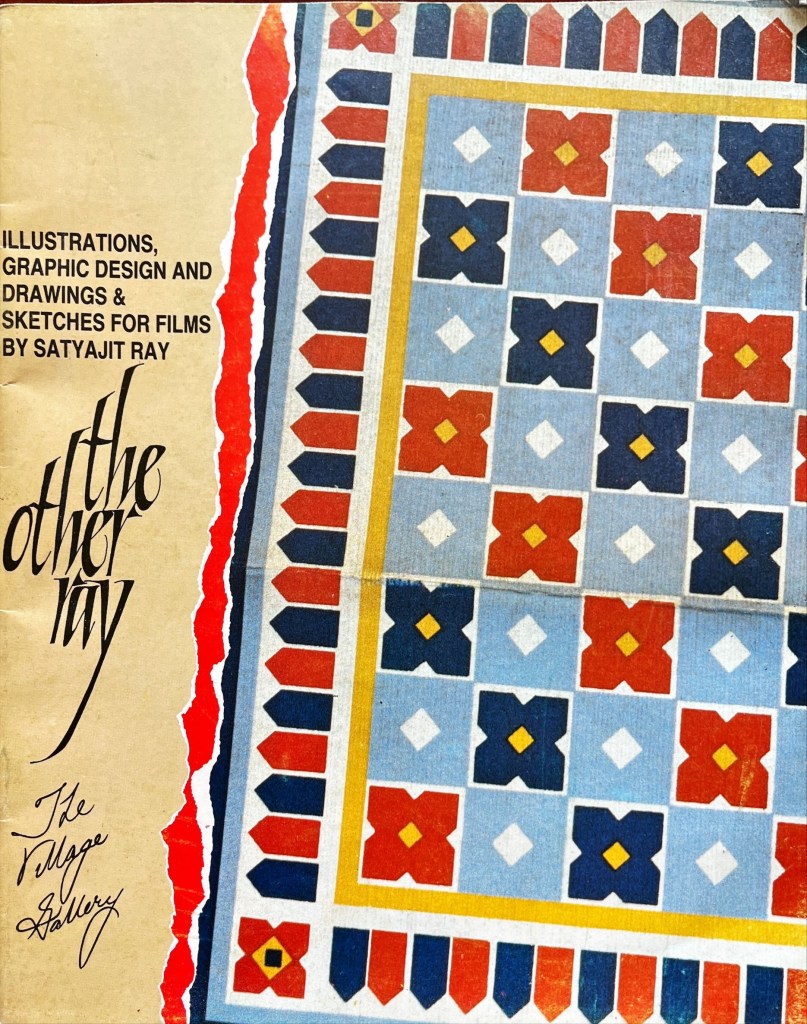
Reminiscences from a Gallery: The Other Ray

Dolly Narang muses on Satyajit Ray’s world beyond films and shares a note by the maestro and an essay on his art by the eminent artist, Paritosh Sen
My trunk call from Delhi to Calcutta booked one day before finally materialised.  This was way back in 1990 when trunk calls were the fastest mode of communication. In a coarse voice, the operator demanded a response from the deep, modulated voice on the other end. ‘Satyajit Ray hai[1]?’ she asked, her tone sharp with impatience.

I could hear the legendary filmmaker’s composed response to the operator’s gruff, abrupt tone.  I winced at her brusqueness feeling helpless to intervene and apologise.

When she connected me, I introduced myself to Satyajit Ray and ventured to share my idea of an  exhibition that would showcase a lesser-known yet equally fascinating facet of his oeuvre—his drawings, film sketches, graphic design and more. A visual archive that, though rarely seen by the public, was as significant as his cinematic legacy. He was initially apprehensive—modest about this body of work and uncertain about how it would be received

This initial conversation was followed by a series of follow-up exchanges over trunk calls,  over several months. Each call felt like a step closer to realising the exhibition. I would book trunk calls in the urgent category request for PP (person to person) as they took less time to materialise.  PP calls were specifically for the person whose name was specified.  Still, patience was essential.

Ray, to my surprise and admiration, always answered the phone himself. No secretary, no assistant screening the calls. The simplicity and humility was endearing.

I had first shared the idea of the exhibition with Paritosh Sen one of India’s master painters and a friend of Ray’s of an exhibition of a lesser known yet fascinating facet of Ray’s genius: children illustrations, detailed film sketches, designs for book and magazine covers, typeface designs, his diverse portfolio of graphic work.   Paritoshda, as I affectionately called him who mentored and guided  me as I began my journey into the art world, not only approved of the idea but took it upon himself to speak to Ray, whom he knew personally.  Following the introduction through Paritoshda, I pursued  the idea with the legend.

During the first phone call, I briefly spoke about my concept— an exhibition that would focus  on his rarely seen visual art. His immediate response was  hesitant and guarded, “These are very small works on paper just a few inches in length and width.” he said. “They would be of no interest.”  I ventured  that this was a unique and a first time view into his visual legacy and the size would not take away from the impact.  He further expressed his doubt  about his graphic work having any resonance beyond Bengal, in North India. I   further submitted that his artistic genius and versatility has an appeal beyond Bengal. This exhibition would give a rare insight into the work and thought process of not only the deeply respected and admired film maker that we all know but also of Satyajit Ray the illustrator, the graphic designer, along with revealing the meticulous and detailed planning into his films.

I hoped to bring this body of work — into public view for the first time. The idea was to get  people to see another Ray — not the filmmaker behind the camera, but the artist behind the pen and brush.

I remember Ray had explained that he had a  busy schedule and preoccupied with the editing of Ghare Baire. After several months  of trunk calls and waiting, I booked another urgent, person to person call. Finally the breakthrough I was waiting for, “ Come next week,” he said. His doubts of an exhibition having been cleared through the intervention of Paritoshda and somewhat through my persuasion.   

 As I boarded the Indian Airlines flight to Calcutta the following week, a surge of excitement gripped me. I was given a morning time to meet him at his residence: 1/1  Bishop Lefroy Road. I arrived with some trepidation. Standing outside this tall imposing door, I rang the bell. Soon, I found myself face to face with the master who opened the door himself—his tall, commanding presence matched only by his deep, well-modulated baritone voice greeting me warmly. He led me into his much photographed studio/workplace. He was looking comfortable and relaxed in a white kurta pajama. In contrast to his majestic yet simple presence,  I was nervous and hoping it was well masked.

Thereafter, began a series of visits to his flat. Each time the door was opened by the master himself. And I would be led into his study teeming with books lining the teak wood book shelves.   

He would sit  in a comfortable looking swivel chair with a brown rexine cover, the corners of which were slightly frayed.   Opposite him and within a comfortable arms reach was a small work table with jars tightly packed with paint brushes, pen, pencils.   Here is where he did his drawings to create his vast and varied visual legacy of set design, costume design, make up instructions, graphic design, children’s illustrations for the monthly children’s magazine, Sandesh, started by his grandfather,  He also designed the covers for Sandesh, more books and magazine covers.  

Making of the exhibition

 Working alongside him to sort through his drawings was an enriching and memorable experience—one that offered rare insight into his creative mind. Each meeting felt like a step closer to the exhibition becoming a reality.  I noticed  his interest was slowly growing and he was participating in the selection with increasing enthusiasm and a discerning eye.   He approved some while some he felt need not be exhibited. Our meetings would stretch till lunch time until he was gently summoned by his wife, Bijoyadi, to take his lunchbreak.  He would extend the search and wrapped up a little beyond lunch time. I too was cautious not to overstep limits.

As he began to look in his study, he unearthed these miniature treasures on paper tucked between  books or between their pages, resting on tall teakwood bookshelves. Some were found under sofa cushions. He remembered that many were with his cousin Lila Majumdar[2] and that he would have to ask her. As he delved deeper into his collection he remarked, “I had forgotten I have done all this work.”

During  few initial meetings, I would address him as Mr. Ray, which was beginning to feel formal and somewhat awkward. So I asked if there was another way I could address him.

“Manik,” he asserted. “Everyone calls me Manik.”

From that moment on, I called him Manikda. These recollections return to me vividly as I write this piece.

We turned our attention to his iconic crimson books, neatly stacked in his study. These well-known volumes are a treasure of Ray’s meticulous preparatory work—filled with detailed sketches for his films, costume and set designs, makeup instructions for his makeup artist, architectural notes, and an astonishing range that gave glimpses into his thought and work process.
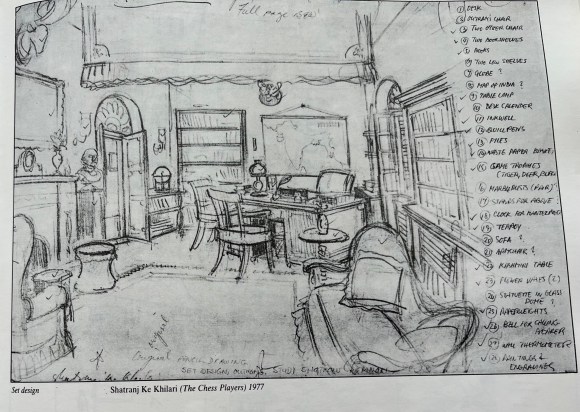
Sourced from the brochure provided by Dolly Narang

We did not want to remove any drawings from these precious notebooks. He selected the drawings that he liked and decided he would ask Nemai Ghosh (1934-2020), his close associate and long-time photographer, to photograph them for the exhibition.

Several drawings, having come loose from the notebooks, were used in their original. We did not want to remove any drawings which were firmly in  place in these volumes. Ray  identified  the drawings that appealed to him and Ghosh photographed them.

Part two of the exhibition was titled “Drawings and Sketches For Films’ and it comprised of both originals and the photographs by Nemai Ghosh  of the drawings chosen by Ray.

I nudged him further and asked if there was anything else he might suggest from his visual repertoire. 

He thought of his film posters. The ones readily available in his flat were  posters of Nayak and Ghare Baire, which were loaned for the exhibition. He was particularly eager to include the poster of Devi, but after searching, he discovered he only had one copy and was reluctant to part with it.
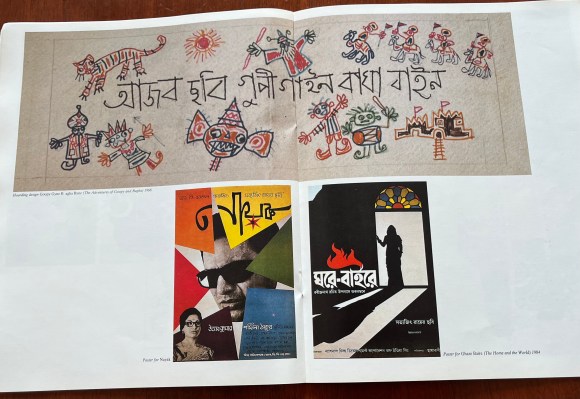
Top: Hoarding of Ray’s film Goopy Gyne Bagha Byne (1969). Below:: Film posters of Nayak(Actor, 1966) and Ghore Baire (Home and the World, 1984). Sourced from the brochure provided by Dolly Narang

 We tried to include artworks which would represent the different aspects of his visual repertoire.  It seemed there was no end — typefaces he had designed, advertising campaign when he worked for D.J.Keymer.   While searching he realised he did not have the originals of the typefaces he had designed but fortunately they had been preserved in the photographs taken  by Nemai Ghosh.  Later Paritoshda told me that he was given an award for  the typeface by an American foundry and named it after him, Ray Roman.  
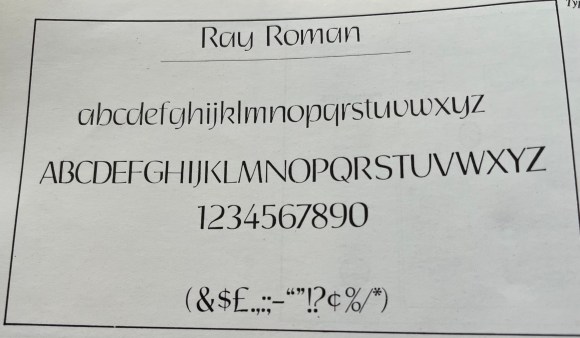
Provided by Dolly Narang

An album was discovered containing a silent film he had conceptualised on paper but never brought to life—a silent film on Ravi Shankar with his music in the background.  The album, composed of monochromatic black watercolours, was photographed by Nemaida. It drew great interest, offering a first-ever glimpse into a project that was never realised.

Paritoshda advised  that Ray had composed music for many of his films.  A tape with his compositions was playing continuously and softly in the background at the exhibition.

The exhibition was presented in two parts each had a duration of three weeks.  Part one was devoted to his Graphic design, drawing and part two was about his preparatory sketches for films.

I requested Paritoshda to write an article for the exhibition catalogue, to which he graciously agreed. He penned an insightful essay which was appreciated by Ray himself as well as by fellow artists, critics, and visitors who found his insights both illuminating and deeply  engaging.  When I asked him for his suggestion for a  title for the exhibition, he thoughtfully suggested  — “The Other Ray” — a title both fitting and meaningful.

With the socio-political upheavals around us in Delhi, it wasn’t easy—cataloguing, printing invitation cards, framing, arranging transport to distribute the invitations.  Invitation cards from our mailing list of  over one  thousand had to be hand delivered.

I asked Manikda for names of his friends and associates who he would like invitations to be sent to.  His list included names both in  India and abroad.

About a week before the event, I visited AIFACS[3] to put up a poster for the exhibition. To my surprise and delight, sitting in one of the exhibition halls was none other than M.F.Husain himself. It felt like a godsend—an unexpected opportunity to personally invite him.

He was visibly excited upon hearing about the exhibition and expressed  interest in seeing the artworks immediately wherever they were.   I explained that the pieces were still at home and would be better appreciated once they were displayed on the gallery walls.  But he was insistent—he wanted to see them right away.   We got into my car and drove to my house. Husain viewed the works in thoughtful silence moving from work to work, looking at each with great interest. After perusing them keenly he settled  at the dining  table and began reminiscing about his association with Ray – a moment as historic as it was moving, etched forever in my memory. 

I was not prepared with either a tape recorder or a camera to record this memorable encounter. Fortunately, The Illustrated Weekly, under editor Pritish Nandy, later published his reflections in an article spread over two pages with several illustrations of his graphic work.

Opening to the Public

When the exhibition finally opened at The Village Gallery in New Delhi’s quaint Hauz Khas Village it was received with great enthusiasm and acclaimed  by both critics and the public

 Visitors from all walks of life came to see the “ The Other Ray”.  For many, it was a revelation. The same legendary filmmaker who had given the world The Apu Trilogy had also crafted whimsical illustrations for children, designed  book jackets,  created typefaces. It was exciting for them to get a peek into his creative process as a filmmaker through his detailed film sketches.   

 I made another trunk call to inform him that the article in the brochure by Paritosh Sen had been chosen for The India Magazine’s cover story.   The next day, when I spoke to him again and offered to send him a copy of the magazine, he responded with excitement. He said he couldn’t wait and had already gone to the market to buy a copy for himself.

Once the exhibition—having stirred great excitement in the art world—came to an end, it was finally time to take it down. The last few days were deeply moving. Visitors lingered, often spending long hours in the gallery, reluctant to leave, as if trying to hold on to the experience a little longer. The space was filled with quiet reflection and enriched by heartfelt exchanges.

Looking back, organising this exhibition remains one of the most fulfilling experiences of my life. What I cherish is the memory of the many hours spent in his study carefully selecting the works for the exhibition.  It was a collaborative process, he was open to my suggestions yet he became more and more involved as he delved deeper into his graphic work.

An idea, carefully nurtured, took shape as an exhibition. What was especially fulfilling about the exhibition was how it brought to light a lesser-known facet of Ray’s creative genius—his remarkable visual imagination, his penchant for details, his industriousness. Until this exhibition, only a few of his sketches had appeared in articles and books, leaving much of this work largely unseen. The display offered audiences a rare and intimate glimpse into his visual world as well as his work and thought process, making it especially significant.

The final step was to return the works. I personally placed each delicate sheet into thin plastic sleeves, compiled them into a portfolio, and flew to Calcutta to return them to the master. True to his dignified demeanour, he received the compilation with quiet pleasure. He expressed both satisfaction and a hint of surprise at the enthusiastic response the exhibition had received. I took the liberty of asking him if I could keep as a memento two works from each part of the exhibition. He readily agreed and asked me to choose. I selected one black white illustration for Sandesh and credit title from his film Sonar Kella (The Golden Fort, 1974) .  One more request —  Could he sign these please? To which he graciously agreed.

As I took my leave, I shared a  thought—could we perhaps work on a sequel to The Other Ray? He received the idea warmly, but unfortunately, it never came to fruition. He soon became immersed in Agantuk (The Stranger, 1991), and not long after, his health began to decline.

As I write this, memories come rushing back, and I find myself tempted to echo Manikda’s words of my experience  that  “I had forgotten I had done all this work.”
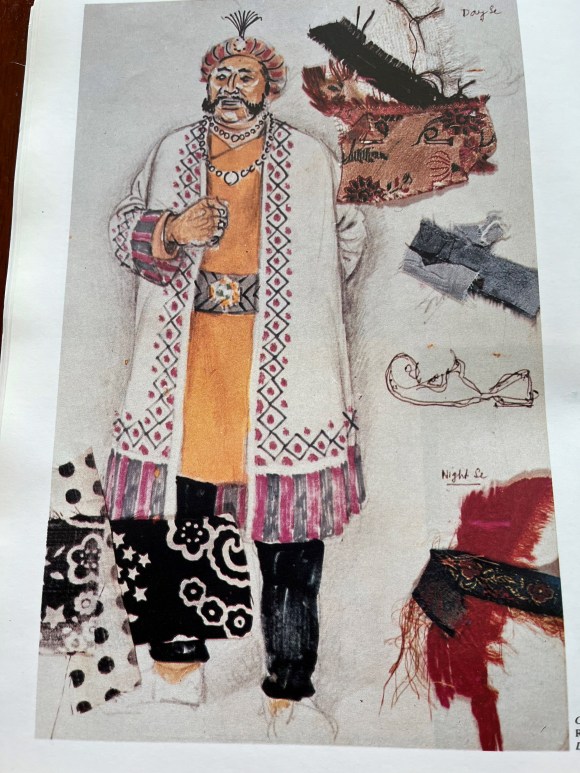
Costume designed and sketched by Ray for Hirak Rajar Deshe (In the Country of the Diamond King, 1980) Sourced from the brochure provided by Dolly Narang
Ray’s Note in the Brochure:

My grandfather was, among other things, a self-taught painter and illustrator of considerable skill and repute, and my father — also never trained as an artist — illustrated his inimitable nonsense rhymes in a way which can only be called inspired. It is, therefore, not surprising that I acquired the knack to draw at an early age.

Although I trained for three years as a student of Kalabhavan in Santiniketan under Nandalal Bose, I never became a painter. Instead, I decided to become a commercial artist and joined an advertising agency in 1943, the year of the great Bengal famine. Not content with only one pursuit, I also became involved in book designing and typography for an enterprising new publishing house.

In time I realised that since an advertising agency was subservient to the demands of its clients, an advertising artist seldom enjoyed complete freedom.

This led me to the profession of filmmaking where, in the 35 years that I’ve been practising it, I have given expression to my ideas in a completely untrammelled fashion.

As is my habit, along with filmmaking, I have indulged in other pursuits which afford me the freedom I hold so dear. Thus, I have been editing a children’s magazine for thirty years, writing stories for it and illustrating them, as well as illustrating stories by other writers.

While preparing a film, I’ve given vent to my graphic propensities by doing sketches for my shooting scripts, designing sets and costumes, and even designing posters for my own films.

Since I consider myself primarily to be a filmmaker and, secondarily, to be a writer of stories for young people, ·I have never taken my graphic work seriously, and I certainly never considered it worthy of being exposed to the public. It is entirely due to the tenacity and persuasiveness of Mrs. Narang that some samples of my graphic work are now being displayed. Needless to say, I’m thankful to Mrs. Narang; but, at the same time, I must insist that I do not make any large claims for them.

Ray’s signature: Sourced from the brochure provided by Dolly Narang

 SATYAJIT RAY

The Consummate Artist by Paritosh Sen (1918-2008)

(Republished from the brochure of “The Other Ray” exhibition)

It was the summer of 1945. I was holding my third one-man show and my first in Calcutta. On the third day of the exhibition, Prithwish Neogy (a brilliant scholar, now heading the Department of Asiatic Art at the Honolulu University) entered the exhibition hall accompanied by an extraordinarily tall and swarthy young man. I had known Prithwish earlier. The latter was introduced to me as Satyajit Ray. I was vaguely aware of him as the only son of the late Sukumar Ray, the creator of a unique body of nonsense rhymes and humorous prose remarkable for their originality of vision and an extremely sharp intellect and imaginative power. Satyajit was also known as the grandson of Upendra Kishore Ray, one of the inventors of half-tone block making, a pioneering creator of a sizeable body of children’s literature and the founder of the well-known children’s magazine, Sandesh, and a painter of no mean talent either.

Satyajit was then doing a course in painting in Santiniketan under the very able guidance of Benode Behari Mukherjee, a great artist and an equally great teacher. Besides, Ray had also the unique opportunity of coming in close contact with Nandalal Bose, the guru of both Benode Behari and Ram Kinkar, undoubtedly the foremost sculptor of contemporary India.

Earlier he had also received the blessings and affection of Rabindranath Tagore. Although he did not complete the art course in Santiniketan, the experience of being surrounded by these great artists and the unique rural setting of the Santhal Parganas, as portrayed by these artists and the poet, enabled Ray to appreciate nature in all its diverse and glorious manifestations and opened his eyes to the mysteries of creation. This single unprecedented and cherished experience helped him to formulate his ideas about the visual world and to unlock doors of visual perceptions. Added to this was his study and understanding of the classical and folk art, dance and music of our country. The magnificent collection of books in the Santiniketan library of world art and literature also helped him to widen his horizon. It was here that he read whatever books were available on the art of cinema. The seeds of a future design artist and a filmmaker were simultaneously sown here.

Having lost his father early in life, the need for earning a livelihood assumed enough importance to make him leave Santiniketan prematurely and look for a job in the field of advertising art or, as it is better known in modern parlance, graphic design. A latent talent is bound to make its presence felt sooner or later, whatever be the chosen field. As Tagore said in one of his early verses, “Flowers in bloom may remain hidden by leaves but can they hide their fragrance?” Satyajit Ray was appointed by the then D.J. Keymer (now known, as Clarion Advertising Services Ltd.) as a visualiser-cum-designer, often executing the finished design or an entire campaign himself.

Together with two of his contemporaries, O.C. Ganguli and Annada Munshi, Ray was trying to evolve certain concepts not only in illustrations but also in typography which would give their design an overall Indian look. One recalls those highly distinctive newspaper and magazine ads, the magnificent calendars, posters, cinema slides and what not of the late ’40s and ’50s not without a certain nostalgia. If my memory does not fail, I think some of the works of these three artists were even published in Penrose Annual and elsewhere. Here it may be worthwhile to bear in mind that the style evolved by these three artists made a welcome departure from the dull academicism and the stereotypes being practised by most of the advertising agencies of those times. The freshness and vigour displayed in their approach was readily appreciated both by their employers and their clients. Ray was particularly strong in the difficult area of figure drawing, an area in which many graphic designers were found singularly wanting.

Although he was soon to move away from commercial art to embrace his new-found love of filmmaking, he would continue to remain an illustrator of the first order as would be evident from his emergence as a story-teller in the two popular genres of detective and science fiction. (Not many outside Bengal know that Ray’s literary output is in no way less than that of his cinema and that most of his books have already run into thirty to thirty-five editions). He has not only been illustrating his own stories, but over the years he has been designing the covers of his grandfather’s once defunct children’s magazine Sandesh, revived by him nearly two decades ago, which also carried many illustrations by him. But in my opinion his most cherished field is calligraphy, whether that be of the pen or brush variety.
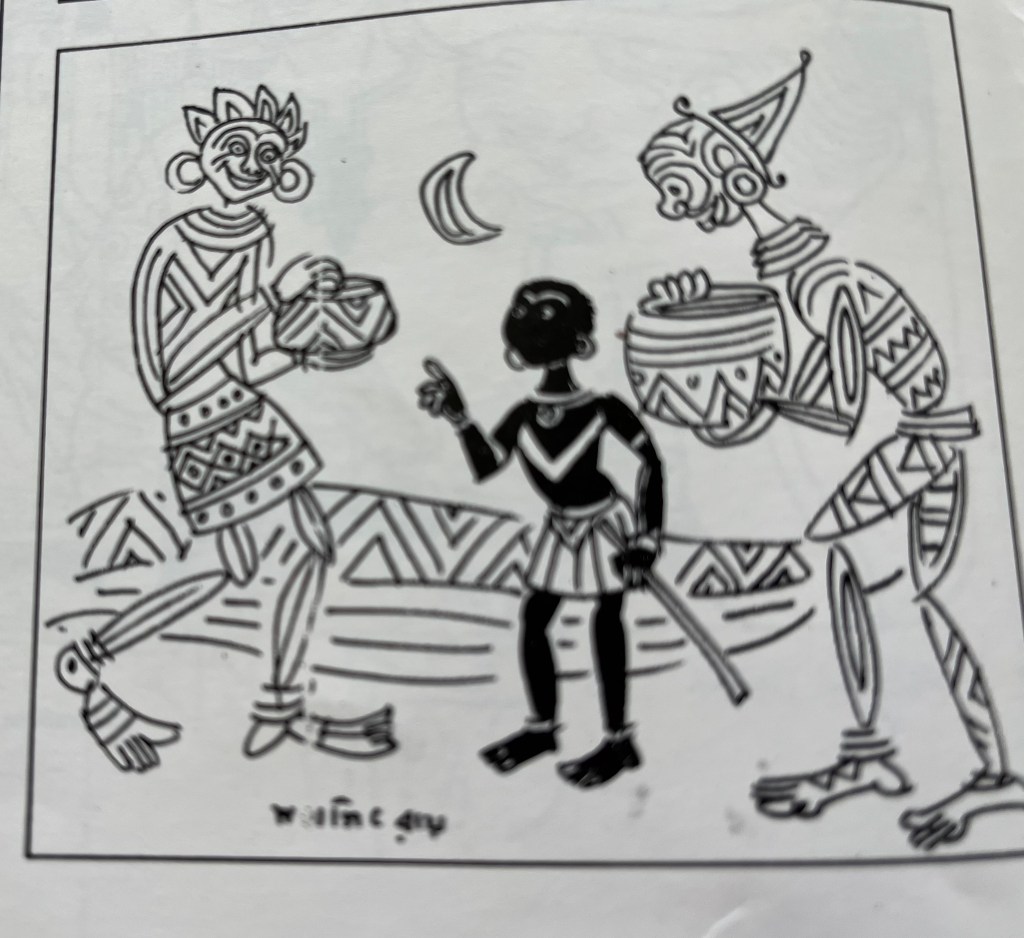
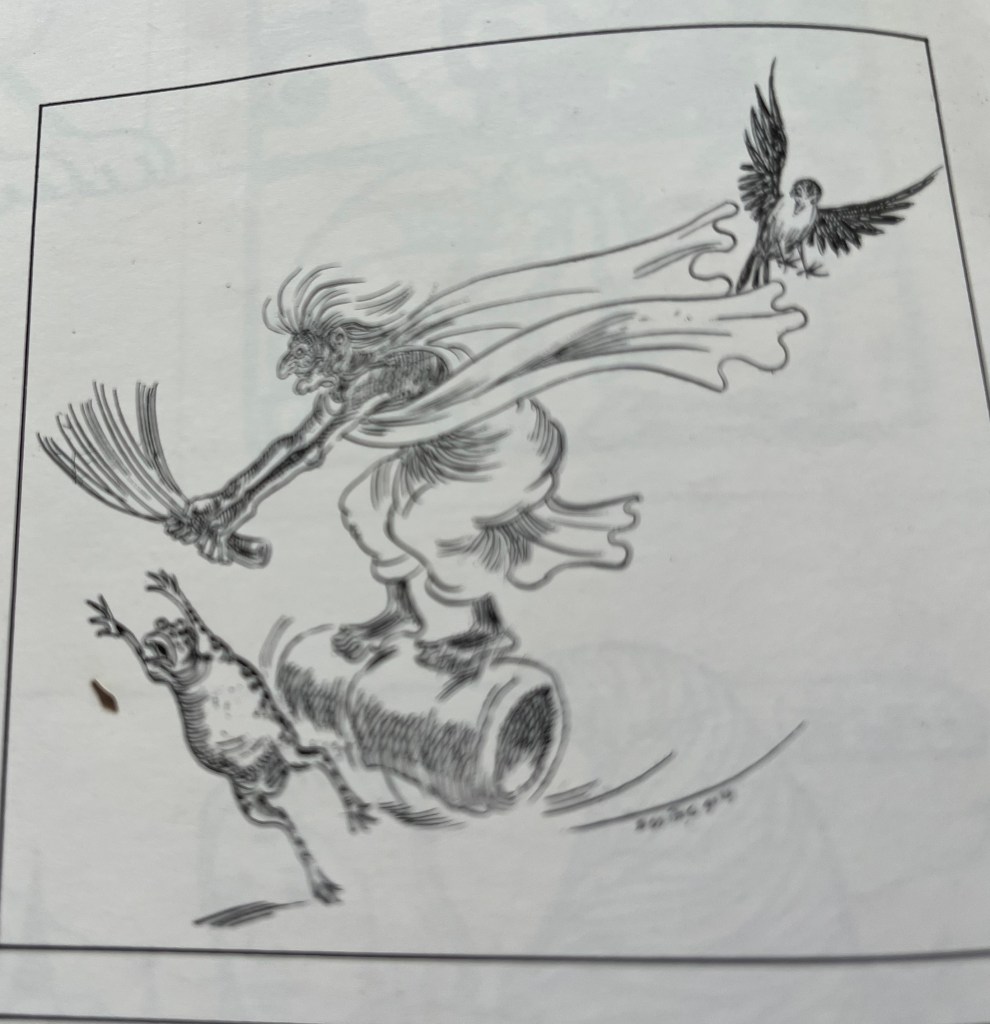
This art he imbibed from his guru Benode Behari Mukherjee. Over the years he had also been studying the art of typography with the scrutinising eye of a highly creative calligrapher. The result has been a series of innovations in both Bengali and English lettering evolved for posters, banners and book covers. These very original works gave a tremendous fillip to graphic design in general and book, magazine and record covers in particular, especially in Bengal. The books Ray designed for the now defunct Signet Press of Calcutta way back in the early ’50s set new trends and were considered as models for book production both in terms of page layout, typography and jacket design, the last being his chosen field where, as I said earlier, his innovations have known no bounds. The covers of the well-known literary magazine Ekshan, which he has been designing for many years, to give only one instance, bear ample testimony to his apparently playful but significant experiments with the forms of three Bengali letters which constitute the name of the magazine. The wide variety of his inventiveness is one of his great achievements in the field of cover design.
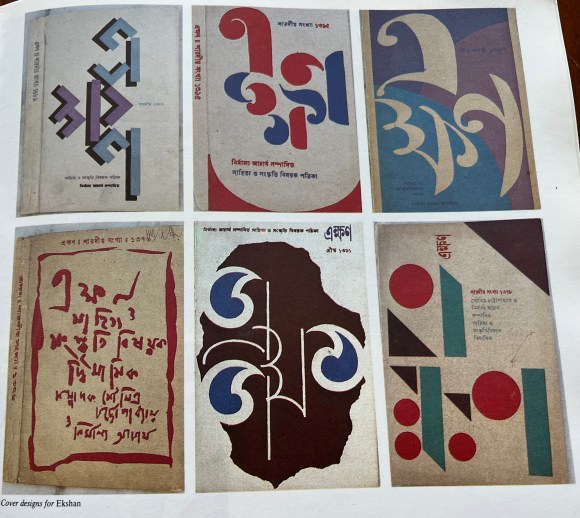
Cover designs for Ekshan. Sourced from the brochure provided by Dolly Narang

Then there are the posters, banners and slides he designed for his own films. These too were eye openers and instant trend setters. Who can ever forget the huge banners and billboards of the Apu trilogy put up at important street junctions of Calcutta! Their freshness of ideas, design concepts and calligraphy were not to be missed even by men and women in the street. Simultaneously with his creative outburst in the art of cinema, his creativity in graphic design reached new heights. What was remarkable was the fact that Ray imminently succeeded in investing all these works with a highly distinctive Indian flavour derived from his awareness of our folk traditions (especially 19th century Bengali book illustrations and woodcut prints of decorative lettering) both in their linear vigour and simplicity as well as in ornamentation.

One of the most outstanding examples of this approach was the publicity material he designed for Devi. The underlying theme of the title expresses itself forcefully both in the highly imaginative design of the lettering and the image. Their fusion is perfect. Not many graphic designers have been as type conscious as Ray. He personifies the printing designer’s gospel “type can talk”. That a letter or a printing type is not only a sign but an image by itself, and if appropriately employed can have immense communicative power and is capable of expressing a whole range of human emotions was known to Ray from the very beginning of his career.

In the enormous range of Roman printing types there are many in the humanist tradition in their simple aesthetic charm, warmth of feeling as well as in their highly elegant but delicate anatomical details. There are also those which are severe, powerful and cold but nonetheless are highly attractive in their own ways.

It is often overlooked by most readers that a letter’s structure and anatomy can be reminiscent of things in the visible world, both natural and man-made. Some can have the gentle rhythm of the rise and fall of a female form, others may have the majestic look of a well-designed edifice-just to give only two similes. Ray not only bore all these considerations in mind but used his calligraphic knowledge, skill and innovative power to their full advantage when he designed the three printing types called Ray Roman, Daphnis and Bizarre for an American type foundry nearly two decades ago.
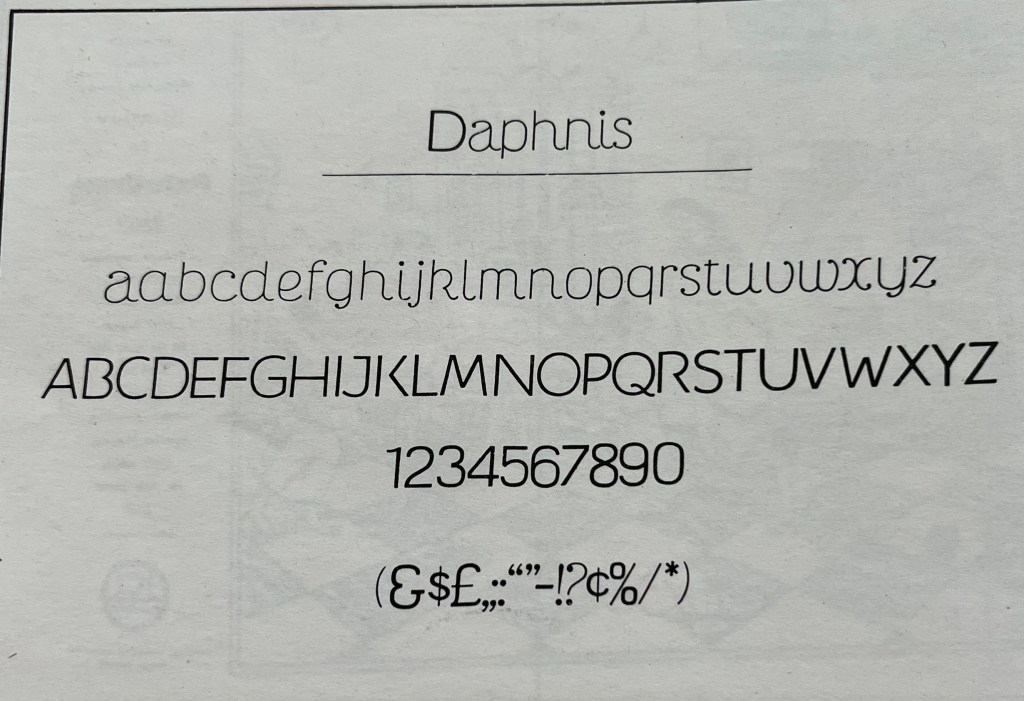
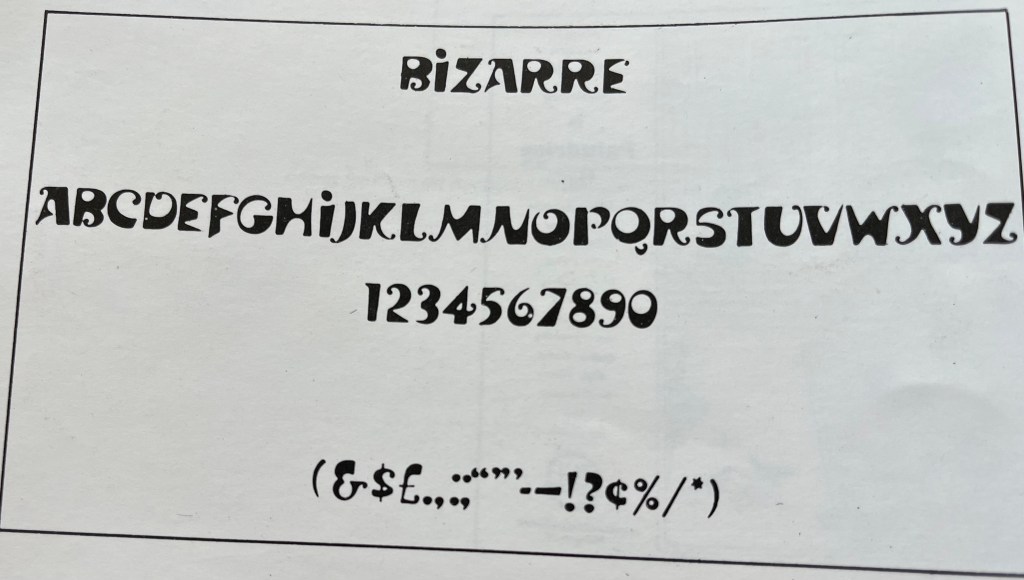
Not many of us know the infinite patience, rigours, discipline and the endless process of trial and error involved in designing a whole series of a printing type. That, in spite of his other demanding preoccupations, he found enough time to design three complete sets of types bears ample proof of his diligence and perseverance and his passionate love for the world of types. Those of us who have known him over the past decades are profoundly admiring of the fact that he is a workaholic in the best sense of the term. His diverse creative output is staggering and would put many a man half his age to shame.

In the ’40s, I met Satyajit periodically as I worked as an art master in Indore. One of the high points of my visits to Calcutta during the long summer or the short winter holidays was to frequent his ground-floor apartment in South Calcutta. It was at his place I first listened to TS Eliot’s recital in the poet’s own voice of The Waste Land which was just brought out by HMV (now known as EMI). It was on such visits I would also have an opportunity to listen to his latest collection of records of European classical music. And it was also on one of such occasions I first heard him toying with the idea of making a film based on Rabindranath Tagore’s novel, Home and the World, a project which was abandoned soon after and was finally realised nearly four decades later.

It was not before1 returned home in 1954 after a five years’ stint in Paris that I came to know of his intense involvement with the making of Pather Panchali[4]. I vividly remember to this day the excitement with which he described it to me and invited me to a screening of the rushes. He brought out all the sketches and doodles he made along with side notes in Bengali not only of the dress, props and characters in the script but also very quick but masterly sketches of frames of each of the sequences, camera movements, etc. I remember asking him why he thought it necessary to make such careful preparations before shooting. To which his quick but significant reply, “One of the foremost but very difficult things in filmmaking is to determine the placement of the camera.” He was equally quick to point out that this is only the first part of shooting a movie and not stills.

Those of us who watched him in action know only too well that although there is always a professional cameraman present in his unit, in reality he becomes the cameraman himself. The visual richness of a film is as important to him as a story well told — the one being inseparable from the other. This is the most distinctive feature of his artistic achievements in all his films.

Ray is a lyricist of the highest order. From his first film Pather Panchali to his latest Shakha Prashakha[5], this lyrical bend binds all his films together in the form of an oeuvre and finds full fruition in his most recent work.

Some of the imperceptibly slow camera movements in this film are sheer poetry. Although not yet released, I had the opportunity of seeing it twice, and apart from anything else, I as a painter was bowled over by its visual richness and its consummate technical finesse. I have reasons to say this. Whenever I see a movie, I try to see it through the lens of the camera and having witnessed many film shootings of some of Ray’s films, it has become a habit with me to follow the movements with great fascination. Thus, it helps me greatly to enjoy watching a film from the aesthetic and technical viewpoint.

I am sure that in order to achieve maximum artistic quality Ray finds the preliminary exercises made primarily in pen and ink very useful. These small and simple sketches, evidently done in quick succession, have all the spontaneity and vigour of something impeccably visualised and bear the unmistakable stamp of a born lyricist. Their linear treatment, unorthodox positioning on paper and an apparent insouciance, at any rate, in my eyes, are the products of a highly creative mind and are designed to meet the needs of a fastidious aesthete.

Among the sketches, one comes across portraits of many of the characters in his films in various moods and postures. These could easily be rated as some of his best works in this group. Only someone with consummate skill can bring out the full characterisation in a postage-stamp format with utmost economy and clarity. The lines which define the contours and other details of the figures are free flowing, sure and firm, the result of years of practice both with the pen and the brush.

One of the most interesting exhibits in the present collection is the album containing one of his earliest essays in visualisation of a film project — the documentary he once wanted to make on Ravi Shankar playing the sitar and on the tabla accompaniment. Ray showed it to me as early as 1954. It is possible that the inspiration came from his viewing Uday Shankar’s ballet film, Kalpana (Imagination) ­-– a film which he studied frame by frame by taking scores of stills in the dark theatre where the film was released. He showed me the entire series one by one and pointed out among other things the unusual camera angles, the dramatic lighting, the magic of black and white, especially in the close-ups of both the dancers and the tabla playing. Although the Ravi Shankar film was never released, I think Ray thoroughly enjoyed the exercise and learnt a lot from it.
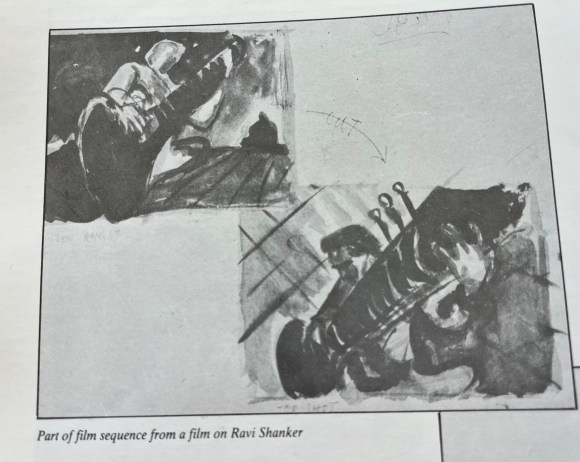
Sourced from the brochure provided by Dolly Narang

This, along with numerous sketches and doodles related to his films, will ever be regarded as something unique in the history of filmmaking in our country.’ Only a few’ and they can be counted on one’s fingers, in world cinema have been such gifted artists too like Eisenstein, Kurosawa, Fellini and a few others. The Village Gallery should be congratulated for presenting to us “The Other Ray – the Consummate Artist.”

[1] Is Satayjit Ray there?

[2] Lila Mazumdar ( 1908-2007, a well-known Bengali writer of children’s stories) 

[3] The All India Fine Arts and Crafts Society

[4] Song of the Road,1955

[5] Branches of a Tree, 1990

Dolly Narang, a gallerist, has conceptualised  innovative  pathbreaking exhibitions. A recent student of sculpture, she has the satisfaction of experiencing both personal and spiritual evolution as a Pranic healer and as a grandmother. 

.

PLEASE NOTE: ARTICLES CAN ONLY BE REPRODUCED IN OTHER SITES WITH DUE ACKNOWLEDGEMENT TO BORDERLESS JOURNAL

Click here to access the Borderless anthology, Monalisa No Longer Smiles

Click here to access Monalisa No Longer Smiles on Kindle Amazon International

Categories
Essay

Take One by Ratnottama Sengupta

A stock taking of women in Bengali cinema – as protagonists, actors and directors – by Ratnottama Sengupta

“Mother, allow me to go and get a slave for you,” this conventional line may have been uttered by the husband essayed by Anil Chatterjee in Mahanagar (The Big City, 1963), as he set out to marry Aarati alias Madhabi Mukherjee. Women of those years had no problem accepting such husbands as their Lord and Master. But the lead actress of Ray’s film evinced determination of a different order. That’s why even today, 52 years after its release, Mahanagar remains so contemporary.

Time was when women in Indian — rather than just Bengali — films were typecast as mother, sister or beloved of a male character. The mother would sacrifice her creature comforts, her career, her every happiness for her son — but if she cared for her brother, she would be rebuked (Mejdidi, Second Sister, 1950; 2003). If she offered shelter to her orphaned sister, she would have to ‘repay’ her in-laws for the favour by making her work overtime (Streer Patra, The Wife’s Letter, 1972). It was ‘her’ responsibility to stay ‘pure’. If she were ‘tainted’, she had no option but to embrace death. The long-suffering Indian woman has left way behind her ‘helpless’ (abala) definition: No Nirbhaya needs to die of shame if she’s the victim of rape. The silver screen is reflecting this transformation. She’s no goddess (devi) nor a slave (dasi) — she’s proud to be what she is: a woman (nari).

But a woman is always more vulnerable, more fragile compared to a man. Reason? Could be biological, economic, social structure, or her lack of confidence born of mental malnutrition. Perhaps that is why women have provided material for intense human drama. At times she is Lady Macbeth or Lady Chatterley, at other times she is Mrinal (of Streer Patra), or Ashapurna Devi’s Subarnalata (1981). Besides, Bengal worships Goddess Durga — in this state, women are simultaneously Saraswati, the goddess of learning; Lakshmi, the deity of prosperity; and Kali, the icon of destruction. That may be why, from the beginning of Bengali cinema, lead personalities have enjoyed multidimensional projection. Sometimes a mere ‘actress’ becomes a mouthpiece for a socially sensitive and relevant issue, sometimes she is the face of psychological conflict, sometimes she is a philosopher, preacher.

Un-Covered 

There are many different ways to approach the projection of women in Bengali films. Literature has always been the first to convey their self-sufficiency — be it on this soil or elsewhere. Gems mined from Bengali literature provided the raw material for pioneers like Naresh Mitra (1888-1968), Pramathesh Barua (1903-1951), Debaki Kumar Bose (1898-1971), Nitin Bose (1897-1986), Bimal Roy (1909-1966) — giving us landmarks such as Jogajog (Connections, 1943; 2015), Durgesh Nandini (Queen of the Fortress, 1956), Bishabriksha (The Poison Tree, 1922; 1983), Debi Chaudhurani (1974; upcoming 2025), Biraj Bou (Biraj, the Wife, 1972), Pather Dabi (The Right of Way, 1977), Udayer Pathey (Towards the Dawn, 1943). However, the minute we utter the two words — ‘women’ and ‘literature’ — in one breath, we think Pratham Pratishruti (The Early Promise, 1971) and Subarnalata (1981). Together  they are a flawless portrayal of social transformation and women’s emancipation.

Dinen Gupta had filmed Pratham Pratishruti even before Ashapurna Devi had won the Jnanpith Award. Its protagonist Satyawati kept at it but did not succeed in altering the social dynamics of Women’s Education. Her daughter Subarnalata is married off in her childhood, into an urban family with rustic mindset. Alone, unsupported she fights the male chauvinists (and this includes the women too!) who were unfamiliar with the word ‘self-identity’; whose only understanding of women’s honour, sanman, comprised of ghomta-sindoor, the veil and the vermilion. Despite her efforts, how often do we hear of a Bakul (Subarnalata’s daughter) who rides a bike to drop off her elder brother to his college?

Streer Patra devolves around ‘Mejo Bou’ Mrinal (Madhabi Mukherjee). She has the freedom to offer shelter to her sister-in-law’s sibling but not to love, educate, and honour her. When the sister, pushed into marriage with a mentally deranged person, commits suicide, Mrinal leaves home in protest. But her protest is not a sentimental reaction, so she does not end her life in the ocean. Nor does she sign off her letter as ‘Mejo Bou’ — the Second Bride of the joint family – which was till then her only identity. She is now ‘Charantalashray Chinna Mrinal’, one who has lost the protection of her husband’s feet.

*

Long before Purnendu Pattrea, Bimal Roy had set an example in ‘deconstructing’ the well-entrenched structure of male domination even in wealthy families. When it came in 1943, Udayer Pathey had broken several norms: Jyotirmoy Roy was an unknown writer, Binata Roy was not a conventional beauty. As the daughter of an industrialist — read, a 20th century princess — she takes up the fight for labourer’s rights and leaves the shelter of her father and brother to make a home with a ‘hired’ writer. She was emboldened by her predecessors like Kanan Devi who became a star in Mukti (Liberation,1937).

Rebellion need not necessarily be a battle — won or lost — as Sujata (1974) showed. Litterateur Subodh Ghosh, who created the character, imagined her as a sweet, caring persona, who is alert to every little need of her foster family. But, despite all her care and love, she doesn’t become ‘a daughter’ to the parents she dotes on. Her fault? She is born of ‘untouchable’ genes. An even bigger fault? She is loved by the man whom the foster parents want to see as the husband of their biological daughter. Film director and writer, Pinaki Mukherjee, fired away with this double-barrel gun although he knew it was impossible to overshadow Nutan’s performance in Bimal Roy’s Sujata (1959).

Director is Special            

Follow the director and you land at the door of Satyajit Ray. If his filmography opens with Pather Panchali (Song of the Road, 1955), his depiction of the mother, Sarbajaya, opens the pantheon to women who are found in any middle-class home. Women who are not dressed like the shiny stars of saas-bahu shows but cringe nevertheless when it comes to feeding their aged mother-in-law. Women who have no big dreams for their children but to protect them from any hint of slander by the neighbours.

Half a century later Mahanagar remains a head-turner. Its protagonist Aarati is a working woman whose pay-cheque keeps the kitchen fire going. But this does not place a halo around her head. Instead, society crinkles its brow at her. Still, she does not shy from protesting a wrong done to her colleague. Still, she does not think twice before turning in her resignation. She is not scared of the dark days ahead — because she has light within. She has confidence in her own entity. 

Prior to that Ray had etched with care the homemaker Charulata (1964). She too is a housewife but from another world, in terms of both time and social status. The educated wife of a wealthy intellectual — an editor who has no time to chat with his wife or hear her out — she sews, she writes, she is published in journals…  If the devotion of such a woman finds an anchor in her brother-in-law, what would the world say of the ‘homebreaker’? 

Charu’s husband Bhupati must shoulder the blame for wrecking the marriage, but Nikhilesh (Victor Banerjee) of Ghare Baire (The Home and the World, 1984)? The zamindar stood by his wife when Bimala (Swatilekha Sengupta) stepped out of the inner courtyard and wedded herself to the nationalist fervour of Sandip (Soumitra Chatterjee). Perhaps that is why, when she realises that Sandip loves himself far more than his motherland, the disillusioned wife returns to her original ‘guru’ — her husband. There is no shame nor despondency of defeat in this, for this is not regressive, it is merely a ‘course correction’.

*

Ritwik Ghatak, a contemporary of Ray, envisaged women as the Lakshmi-Saraswati-Kali of a partitioned Bengal. 

Nita (actress Supriya Devi) in Meghe Dhaaka Tara (The Cloud Capped Star, 1960) earns to feed her parents, marry off her sister, build her brother as a vocalist… But who cared for her love? Her dreams? Her sheer desire to live? At the other end of the spectrum is Sita (Madhabi Mukherjee in Subarnarekha, 1965). She had held her fatherly elder brother’s hand when the child had to seek refuge across the barbed wires. She sacrificed that secure shelter (of her brother) to her love. When that love proved ephemeral, she sought survival in the world’s oldest profession. When that profession placed her face to face with a fallen angel — her brother — she turned into Kali, the destroyer.

Mrinal Sen’s Baishe Shravan (The 22nd of Shravan, 1960) was an essay in marital discord in the disjointed times of war. But times change, and with that going out to work becomes routine for women in Bengal. No one looks askance — so long as she returns home by nightfall. For, that is one routine that hasn’t changed: even today, exceptions to it are meant only for men. Even today, if a Nirbhaya is gang-raped, many react by asking, “Why was she out so late?!” So, when the breadwinner daughter in Ekdin Pratidin (And Quiet Rolls the Dawn, 1979) does not return home, she is branded a siren even before she is given a hearing.

Tapan Sinha has repeatedly pointed to women’s vulnerability. His Nirjan Saikate (The Desolate Beach, 1963) depicts the barren lives of single women, be they widows or spinsters. Jatugriha (The Inflammable Home, 1964) paints the pangs of legal separation and divorce. Adalat O Ekti Meye (The Law and a Lady, 1981) highlights the legal ‘molestation’ of a rape victim. Aapanjon (Dear Ones, 1968) bestowed a new kind of dignity on the uncared for senior widows. Wheel Chair (1994) became the symbol of struggle when a chairbound woman fights the injustice of a rape that leaves her incapacitated for life. Antardhan (Missing,1992) opened our eyes to the base trade in human flesh. And the Daughters of This Century (Satabdir Kanya, 2001)? Better not talk of them, Sinha might say, for like Kadambini of Jibito O Mrito (Alive and Dead), they have to die in order to prove they were living!

Aparna Sen, as a popular actress, did characterise some women of substance. She charmed us in Ekhane Pinjar (Caged Here,1971)as she slaved to  provide her family a life of some worth. Much seen? Yes, it was a much seen reality in our midst. Shwet Patharer Thala (The Marble Plate, 1992), Prabhat Roy’s adaptation of Suchitra Bhattacharya, showed that despite the changed times, a widow’s is still a solitary struggle. A single shot in Paramitar Ekdin (House of Memories, 2000), under her own direction, makes her unforgettable. As the mother-in-law who loves fish, she’s chewing on a fishbone with deep satisfaction when she learns her husband is dead. “Over,” says the blank expression on her face, in her eyes, in her entire being, “no more fish.” That single look bespeaks sadness, disappointment, vacuum in the life of a Bengali widow. Why is it that a man does not stop having fish when his wife dies?

As a director Aparna uses the same fish, to establish a progressive mindset. When her daughter-in-law, Paromita (actress Rituparna), takes her to a restaurant and treats her to a fish fry, we viewers are delighted. She herself has suffered, so the daughter-in-law understands the mom-in-law’s suffering. Not for her the ‘revenge’ story of family dramas.

At the very outset Aparna Sen had given a fair indication of the road ahead. Elderly and lonely, Ms Stoneham in 36 Chowringhee Lane (1981) is poised against her ebullient, self-centred, even ruthless student Debasri Roy. The two worlds of seniors and youth clash again in Goynar Baksho.(The Aunt Who Wouldn’t Die, 2013). But this child widow, Pishima (the aunt), extracts every inch out of life. Even after death she demands her pound of flesh: she smokes, she bikes, she zealously guards her dowry, streedhan. She even encourages extramarital love! But, perhaps, Aparna Sen’s boldest statement is Paroma (The Ultimate Woman, 1985). Should a woman bury her sexuality simply because marriage has turned her into someone’s aunt or a sister-in-law? “No” —  comes the unflinching reply.

*

Women are deprived, exploited. They protest, they rebel. They stride ahead alone and draft a path for others to follow. Their confidence gets a boost, they enlighten hide-bound males, transform mindsets. This is how we see women in Rituparno Ghosh’s oeuvre. He drew our attention towards several issues, but the empathy in his tenor led us beyond the immediate pre-occupation and endowed his scripts with such universality that free-thinking men, too, had no issues with them.

In Unishe April (Nineteenth April, 1994), the national honour of a Padmashri for Sarojini angers her daughter. Because? She chose to be a danseuse rather than a homemaker, and sent her daughter to a hostel so that she could dance on. Dahan (Crossfire,1997)sees Ramita molested by strangers on the street, but the man in her bedroom? What about him? Surely you won’t construe a ‘husband’s conjugal right’ as ‘marital rape’?! On the other hand, Jhinuk has to pay a price as the witness. She is put in the dock by the law of the land, and dropped by her boyfriend. Banalata in the Bariwali (The Landlady, 2000) has aged but not married. Her dreams of a family are somewhat fulfilled when a film unit comes to shoot in her ancestral mansion. She drapes a red-bordered sari and dons sindoor in her hair too, for a single shot. But that’s mere acting! The director’s praise and love for her too was acting! Kiron Kher as Banalata realises this when she sits in the darkened theatre, and finds the scene has been clipped out of the film. How many times will you be shortchanged, lady, emotionally too?

In Antarmahal (The Inner Chamber, 2005), Zamindar Jackie Shroff authorises a sacrificial yagna to ensure the continuity of his line with the birth of a son. And what is that sacrifice? In the presence of his first wife (Rupa Ganguly), he will copulate with his child bride (Soha Ali Khan). Night after night. Isn’t this mental as well as physical torture? So what! Isn’t he a zamindar and the husband too!

Dosar (Companion, 2006) sees the husband (Prosenjit Chatterjee), a corporate bigwig, returning with his secretary from a weekend retreat in his love nest. A massive accident leaves the woman dead, the husband bedridden, and the wife in a fix. Should she leave the helpless man, or restore life in the faithless marriage?

Even when All his Characters are Fictitious (Sab Charitra Kalponik, 2009), Rituparno Ghosh speaks an Eternal (Abahoman, 2009) truth: Women’s efforts to create an identity for themselves have been wrecked by men. Women have had to confront layer after layer of inhibition, prejudice, agony. But it is much worse to be a woman trapped in a male body, Rituparno showed in his last film, Chitrangada (The Crowning Wish,2012).

*

Bengali cinema was meant to be thus: modern, lively, brilliant. Viewers have said this time and again. After the release of Anuranan (Resonance,2006) Antaheen (The Endless Wait, 2009), Aparajita Tumi (You Undefeated, 2012) this was said for Aniruddha Roy Chowdhury. He has continuously shown that women ‘culture, nurture, explore’ life. Viewers had applauded when Bappaditya Bandopadhyay (1970-2019) handed over the right to ‘give away the daughter’ in marriage to the mother in Sampradan (The Offering, 2000). The director of films like Kaal (An Era, 2005) on human trafficking and Kantataar (Barbed Wire, 2005) on illegal migration, Bappaditya was ecstatic that in the present century, women are being recognised as ‘Researcher in Child Development and Interpersonal Relationships’. Women are morally superior, declares Srijit Mukherjee in Autograph (2010), when the jean-clad Srinanda (Nandana Sen) leaves her live-in partner (Indraneil Sengupta), for encashing the accidentally recorded confession of the star Arun Chatterji (Prosenjit) in an inebriated moment of weakness. Somnath Gupta projects a mofussil girl in Aadu (2011) who does not hesitate to write to the President of America to find out the whereabouts of her immigrant husband who went missing in Iraq after the outbreak of Gulf War 1. With Shunyo E Buke (Empty Canvas 2005), Kaushik Ganguly raises a question that still seeks an answer: Is a big-hearted woman less attractive than a big-chested one?

We have watched films that break stereotypes in startling ways. The protagonist of Atanu Ghosh’s Rupkatha Noy (Not a Fairy Tale, 2013) is a bride who flees home; an IT professional who admits to taking a life, and a gritty though little educated delivery girl at a petrol pump. Judhajit Sircar’s Khasi Katha (Saga of a Goat, 2013), centres around Salma, the motherless daughter raised in a convention bound Muslim family who works in a leather factory to feed her unemployed father and brother but fights to become a professional boxer!

The Actor is the Star

Irony, thy name is cinema. For, here, the deception of ‘acting’ must turn imagination into ‘real’. The personas are imagined, but they are rooted in our soil. Naturally, some characterisations remain with us forever. Thus, some actresses become the voice of women’s fight for emancipation. Suchitra, Supriya, Madhabi, Arundhuti, Aparna, Rituparna, Paoli –any of these actors in the central role promises a powerful document in the fight for women’s rights.

* It started even before Suchitra Sen (1931-2014), when Kanan Devi (1916-1002), Bharati Devi (1922-2011), Chhaya Devi (1914-2001) and Sabitri Chatterjee (1937) were playing at New Theatres, Chhayabani, Radha Films. We will return to Kanan Devi but meanwhile, let’s revisit Suchitra Sen. A married woman, mother of one, Mrs Sen became — and still remains — an icon, not only in the two Bengals but pan India. No gossiping with unit members, the detailing of her character, its costume, its co-actors kept her busy as long as she was in the studio. Understandably, her fame ignited jealousy and she was tarnished as temperamental, aloof, selfish…

Yes, unwilling to compromise in matters pertaining to her role, Mrs Sen would not spare even haloed producers like R D Bansal or Haridas Bhattacharya. But her glamorous dignity ensured a so-far unknown respect for actresses in Bengali filmdom, especially when her name was printed above Uttam Kumar’s, in posters pasted all over the town. Nylon sari, sunshades, short hair, sleeveless blouse — every expression of ‘modernity’ became Mrs Sen. She came to personify the middle-class Bengali woman who — married or not — could be a professional: journalist, nurse, doctor, singer, lawyer… On the other hand, the single-minded determination that characterised courtesan Pannabai and her hostel-educated daughter Suparna (Uttar Falguni, In Her Autumn, 1963), Rina Brown (Saptapadi/ Seven Steps, 1961), Archana (Saat Paake Bandha, Knotted by the Vows, 1961), and Radha (Deep Jwele Jai, To Light a Lamp, 1959) only reflected Mrs Sen’s own firmness of intent. 

One Meghe Dhaka Tara alone was enough for Supriya Devi to shine through the annals of Bengali cinema. Add to that the appeal of Komal Gandhar (Soft Note on Sharp Scale, 1961). In many a film she is the beloved of matinee icon Uttam Kumar. What firmed her position was her boldness in accepting roles with negative shades. Be it Lal Pathar (The Red Stone,1964), Sanyasi Raja (The Monk Who Was a Monarch, 1975) or Mon Niye (All About Her Heart, 1969) — her presence gave a shine to both, the persona and the film. 

* Sharmila Tagore went away to Bombay and Bollywood gobbled her, but she remains evergreen as Aparna of Apur Sansar (The World of Apu, 1959), the newly wedded bride in Devi (Goddess, 1960), the journalist in Nayak (The Hero, 1966), the questioning eyes in Seemabaddha (Company Ltd, 1971) and the irrepressible, dark-complexioned tomboyish Ghetu of Chhaya Surja (Overshadowed, 1963). If Ray films cast her as the silent conscience speaking mainly through her eyes, Partha Pratim made her unforgettable in casting her in an opposite role.

* For a while, Tanuja ruled the Bengali heart from the theatre chain of Minar-Bijoli-Chhabighar. The frothy actress from Bombay became a hit with the superhit musical romance, Deya Neya (Give-n-Take, 1963). Uttam Kumar’s Antony Firingee (1967) immortalised her as Saudamini. And Nandini of Teen Bhubaner Pare (Beyond Three Worlds, 1969) broke new grounds in a society where it was customary for men to marry illiterate women, but unthinkable for an academic woman to marry an unlettered, alcoholic blue-collar worker. Husbands, after all, had to be superior, right? That’s why the highly educated princess of Ujjain during the Gupta period (3-4 CE) was ‘taught a lesson’ by being fooled into marriage with the worthless Kalidas, who eventually rose to be the peerless poet of Sanskrit classics like Abhijnana Shakuntalam and Meghdoot!

* In recent decades, Debasree Roy bagged the Golden Lotus through significant films like 36 Chowringhee Lane (1981), Unishe April (19the April, 1994),  Asukh (Ailing, 1999), Ek Je Achhe Kanya  (There’s This Girl, 2001), Dekha (Vision, 2001), and Nati Binodini (The Actress, 1994). Her contemporary, Rupa Ganguly scored nationally as Draupadi in the television serial Mahabharat (1988). The riveting beauty of the epic had ruled the five Pandava brothers who took on the male order of the Kauravas — the clan that de-robed her — even as their patriarchal head remained a silent spectator. Rupa endowed the persona with a rare dignity that came to the fore again in Antarmahal (The Inner Chamber, 2004) saving it from becoming voyeuristic. Instead, she evoked pathos and a certain sadness in us when her husband proceeded to copulate with a younger wife in front of her eyes. Again she won our applause and institutionalised laurels in Abosheshey, (Finally, 2011) as the mother whose separated son, raised in America, comes to know her heartbreaking love for her child after her death. And in Sekhar Das’s Nayanchampar Din Ratri (The Tale of Nayanchampa, 2019) she breathes life into the marginalised character who epitomises the multitudes that travel from the suburbs to serve as maids in urban homes. 

Rituparna Sengupta, the first of the divas from Bengal today, wears the mantle of Kanan Devi. Like the icon, she excelled in acting, bagged the Golden Lotus for her performances, and then started a production house, Bhavna Aaj O Kaal. This has enabled her to get a veteran like Tarun Majumdar to direct her in Aalo, (Light, 2003) and a young Ranjan Ghosh to explore her creativity in Aaha Re! (Wow! 2019).

Form and Content Too: Actor Turns Director

Roopey tomay bholabo naa – I will not entice you by looks alone, women directors have been saying for long. Thus, Manju Dey (1926-1989) not only starred in Jighansa (Blood Lust 1951), Neel Akasher Neechey (Under the Blue Sky, 1959), ’42 (19421951),her Abhishapta Chambal (The Blighted Ravine, 1967) based on Tarunkumar Bhaduri’s accounts. recounted the life of legendary dacoits of Chambal who paved the way for Phoolan Devi.

Arundhati Devi, (1924-1990) the unforgettable Bhagini Nivedita (1962) who lives on through Tapan Sinha’s Kshudhita Pashan (Hungry Stones,1960), Jatugriha (1964), Harmonium (1976), turned director with Megh O Roudra (Clouds and Sunshine, 1969) to highlight a young widow’s quest for education. Apart from making Chhuti (Vacation, 1967) and Padipishir Bormi Baksho (The Burmese Casket, 1972), she also composed music for Shiulibari (The House of Jasmines, 1962) and produced Bicharak (The Judge, 1959). In her personal life the independent minded actress-director had divorced writer-director Prabhat Mukherjee to marry Tapan Sinha — later highly decorated — in the-then convention-bound Tollygunge. Prior to her only Kanan Devi, the singing star of New Theatres classics who was celebrated across India, had taken upon herself the onus of producing films, by setting up Srimati Films.

Coming after them, Madhabi Mukherjee did not produce films. But the “beautiful, deep, wonderful … (lady who) surpasses all ordinary standards of judgment” justified the praises heaped on her Charulata by not merely acting in Baishey Shraban (22nd Srabon— July-August, 2011) Mahanagar, Subarnarekha, Kapurush (The Weakling, 1965), Dibaratrir Kabya (The Poetry of Everyday Lives, 1970), Streer Patra, Biraj Bou, Utsab (The Festival, 2000). She also took on the then chief minister Buddhadeb Bhattacharya in an election.

* Aparna Sen has been an inspiration to an entire generation of women directors. Satarupa Sanyal has garnered praise in the multiple roles of an actor, producer, director and editor. Her Anu (1998) exemplifies an idealist who is raped by the political opponents of her incarcerated fiancee. It is a crime they perpetrate, but a greater crime is perpetrated when her fiancée, Sugato, refuses to marry her because she has been raped!

* With financial help from NFDC, Urmi Chakravarty made Hemanter Pakhi (Autumn Bird, 2003). It offered another new experience. A housewife shoots into the limelight by authoring a book, but her middle-class husband and sons are not thrilled. They would rather she remained the demure housewife, cooking and caring only for them.

* Aditi Roy won Rupa Ganguly a Lotus through her Abosheshey.  Meanwhile Anumita Dasgupta won awards with Jumeli (2012) that tells the story of a tribal woman whose husband turns her pain of losing her child into a business commodity. How? The only balm for her pain lies in breastfeeding newborns. So? Get her pregnant, repeatedly, and get her to abort, again and again! The impact on her health? Her morale? Her childbearing ability? Who cares!

* Now we have Nandita Roy and Sudeshna Roy. Both are creating a buzz with their co-directors Shiboprasad Mukherjee and Abhijit Guha respectively. Nandita-Shiboprasad have come out with Icche (Desire, 2011), Muktodhara ( The River of Freedom, 2012), Accident (2012), Alik Sukh ( Unreal Happiness, 2013), Ramdhanu ( Rainbow, 2014) — all of which including their latest Amar Boss (My Boss, 2024) focus on various walks of our social life, be it education, accident, medical ethics, or jail reforms. 

* Sudeshna-Abhijit started with focusing on the sexually free relationship of gen-next, or the unrestricted use of abuses by urban youth, and graduated to Jodi Love Diley Na Prane (If There’s No Love, 2014), which shows that even undying love, once behind us, should be left behind. They used Chaplinesque spoof to tell the story of Hercules (2014), the power within us, which alone can give us the strength to fight bullies. Their latest Aapish (Office, 2024) recounts the plight of working women, whether they belong to the upper class or come from the suburbs.

Post Script

To conclude: Be it men or women, as director or actor, or even a writer like Suchitra Bhattacharya — they have all made it clear — that women in Bengali films are not mere sex objects. Yes, many films still use ‘item-numbers’ to titillate the male fantasy. But then, with Takhan Teish (When He Was 23, 2010), Atanu Ghosh records the attitudinal change in our men — through a woman protagonist who is a professional porn star. Rightly, then, we may say that Bengali films carry on the tradition of Kanan Bala who outclassed her humble origins to become the revered Kanan Devi.  

.

Ratnottama Sengupta, formerly Arts Editor of  The Times of India, teaches mass communication and film appreciation, curates film festivals and art exhibitions, and translates and writes books. She has been a member of CBFC, served on the National Film Awards jury and has herself won a National Award. 

.

PLEASE NOTE: ARTICLES CAN ONLY BE REPRODUCED IN OTHER SITES WITH DUE ACKNOWLEDGEMENT TO BORDERLESS JOURNAL

Click here to access the Borderless anthology, Monalisa No Longer Smiles

Click here to access Monalisa No Longer Smiles on Amazon International

Categories
Review

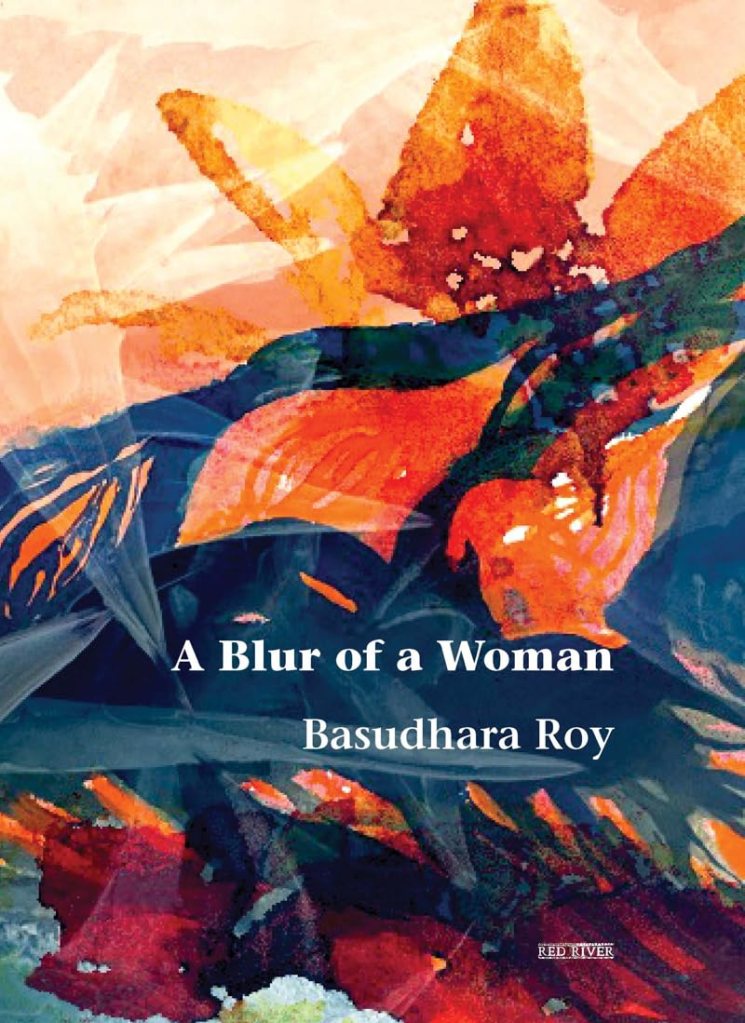
A Blur of a Woman

Book Review by Malashri Lal

Title: A Blur of a Woman

Author: Basudhara Roy

Publisher: Red River

The feminine mystique has defied every attempt to capture its attributes. If clusters of stories surround a goddess, dilemmas are embedded in them. If the pavement-dwelling mother with children clinging to her skirt images economic deprivation, there are stories hidden in her grey-flecked eyes. Basudhara Roy recognises this amorphous, protean aspect of the feminine and titles her collection A Blur of a Woman, poetically declaring; “she owns the place/and the little magic she has earned…she will use it someday to unbuild herself/disappear dissolve/ become a blur”.

This collection is a subtle attack on patriarchy as it encompasses the history and socio-cultural conditions that have moulded women into being mercurial yet tangible, pliant as well as resistive, buoyant but also vulnerable. As the poems flow in a drumroll of many contexts, vignettes of the journey are captured, symbolically strong and offering a plethora of layered meanings. The lines encourage a dialogic exchange whether with the poet, or with one’s own half-acknowledged self that is suddenly confronted by Medusa’s mirror.

The first two sections begin with poems titled ‘Duhkha’ and ‘Soka’[1], directing us towards the Buddhist principle of inevitable mutability and the need for acceptance.

I have seen hearts shut and bolt doors
from within, their windows walled while
on love the mold of ingratitude thrives

With such adaptations, the contemporary takes precedence over the philosophical teachings, and the identification with thwarted expectations, social discord, betrayal and helpless sorrow is almost immediate. If solace is to be found it is now individual—and, in this instance, by  turning to the gnarled trunks of trees where tears have watered the serrated bark. Speaking of the imagistic density of Roy’s phrases, this kind of interlinking through poetic shorthand is perceived in much of her narrativisation. The ‘betrayal’ that causes sorrow and also the maturity of recovery is a process resonant through the history of women’s writing. ‘Soka: A Triptych’ strings this further through contemplating the elegiac notes of death and mourning—yet birth and death are twins: “If life alone can be seen/all this emptiness must surely be death.”

A sizeable section of the book charts a trajectory of feminist fables, gleaning references from Rabindranath Tagore, Jayadev’s Geet Govinda, Philomela’s story, Virgo’s distress, and others. In Roy’s hands, irony becomes a viable and effective tool of social critique as in the poem

‘In Which Bimala Agrees to an Interview for a Special Issue of Post-Text Feminism’. Tagore’s popular novel Ghare Baire/ The Home and the World presents Bimala as the conventional woman who is persuaded to discover the turmoil of the world outside the threshold. Basudhara devises an imaginary conversation, some of which is quoted:

Where, then, would you locate yourself?
Here. Now.
Come on! I am hardly lost
and need no GPS of theory to find myself!

Such a startling reinvention of a canonical text subverts many assumptions with sharp, clear strokes: the jargon of literary theory, the leap into digital alignments, the confidence of the liberated woman, and the time travel that feminism has enabled.                     

My other favourite piece is about ‘Lalita’, a sakhi or friend  of the beauteous Radha who is always the heroine in the traditional tale. In Lalita’s version of the mysterious raas leela where Krishna is perceived by each woman as her partner, she is jubilant about her societal escape and physical abandon;

limbs supple like vines we danced,
thrilled to be
where love was recklessly returned.

This may be the right time to refer to the Author’s Note which is titled ‘I Write from the Body’ and seems to carry forward the feminist discourse of theorists such as Hélène Cixous who invented the term écriture feminine, or Julia Kristevawho perceived the  chora as a specially maternal zone.  According to Roy, “In the earth-bed of this woman’s life that I live, poetry runs as a river, its plenitude being both a lesson and an antidote to the prosaic borders of my world.” In which case, “Blur” is the right metaphor for attempting to break the boundaries through word-play and subversive themes expanded in poems  such ‘Aid to Forgetting’, ‘Praise for the Subaltern’, ‘Dis/enfranchised’—and several other poems  are expressions of resistance to the bastions of control. Philomela’s severed tongue has again learned to speak– but it’s a new language of assertion and intertextuality.

The semiotic breakthrough in Roy’s poems is accompanied by stylist experiments too, the Ghazal section being one such. The transcreated  use of the Urdu structure allows for couplets on a variety of subjects—for example, the seasons in the manner of the Baramasa (songs of the twelve months) with a twist that the woman is no longer the bereft, perpetually waiting figure uttering  her woes to the firmament. She says confidently now: 

You etch every constellation on your  palm
Yet secrets line the arcane of the body

In all, A Blur of a Woman, offers  poems for the intellect and the heart which are  indivisible aspects of a woman’s existence. That she  is mercurial  and evasive is once again a reminder of a fascinating mystery that has prevailed over time — and perhaps its more exciting to keep it that way.

[1] Both Dukha and Soka are forms of grief

Malashri Lal, writer and academic, with twenty one books, retired as Professor, English Department,  University of Delhi. Publications include Tagore and the Feminine, and the ‘goddess trilogy’ (co-edited with Namita Gokhale) In Search of SitaFinding Radha, and Treasures of LakshmiBetrayed by Hope: A Play on the Life of Michael Madhusudan Dutt  received the Kalinga Fiction Award.  Lal’s poems Mandalas of Time has recently been translated into Hindi as Mandal Dhwani. She is   currently Convener, English Advisory Board of the Sahitya Akademi.

.

PLEASE NOTE: ARTICLES CAN ONLY BE REPRODUCED IN OTHER SITES WITH DUE ACKNOWLEDGEMENT TO BORDERLESS JOURNAL

Click here to access the Borderless anthology, Monalisa No Longer Smiles

Click here to access Monalisa No Longer Smiles on Kindle Amazon International
Categories
A Special Tribute Review

Rabindranath’s Protest Against Violence

Book review of Tagore’s last novel by Meenakshi Malhotra on his death anniversary

Title: Four Chapters                                           

Author: Rabindranath Tagore

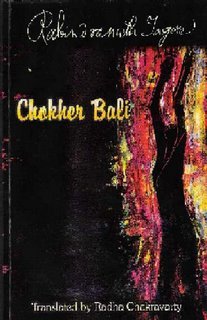
Translator: Radha Chakravarty

Publisher: Penguin

With Char Adhyay (1934, Four Chapters), Tagore’s last novel, he returns to his critique of violence, an almost ubiquitous preoccupation in this last phase of his writing which had earlier  witnessed the production of Ghare Baire (1916, The Home and the World) and his essays on nationalism. Both, The Home and the World and Four Chapters, share an underlying preoccupation about the limits of patriotism and the legitimacy of violence: does love for one’s own country justify violence and revolutionary terrorism? To put it in a philosophical vein: do the ends justify the means?

Like in The Home and the World , Tagore uses a triangulated relationship, if not a tripartite narrative structure. The plot could be summed up thus: Ela, a modern woman, looks for engagement, to give structure and meaning to her existence. At odds initially with her traditional but authoritarian mother, she grows up developing a strong sense of justice and a mistrust of blind superstitions and meaningless rituals, which hardly equip her to fit into a traditional marriage. After losing both her parents, she is under the care of her uncle and aunt, when she meets the charismatic Indranath, a disappointed scientist who has now turned to militancy and revolutionary terrorism. On  the other side is Atindranath or Atin (also called Antu), with whom Ela forms a romantic attachment. In the last segment of the novel, we realise that Ela’s politicisation had also pushed Atin into militancy since Ela’s dedication to the cause had co-opted him into it.

Stylistically this novel is striking. It consists of little narrative but is dialogic for the most part. As such, as the editor-translator mentions, the work acquires a dramatic quality. Also, Four Chapters comes across as a vehicle for ideas and at times, the novel seems to be weighed down by the predominance of ideas. Thus ideas of national regeneration, selfless action circulate in the text  without being directly co-related with the plot and story structure. The characters often are eloquent in their own praise. They seem to be mouthpieces produced as a result of clashing ideologies.

Four Chapters depicts the new, modern woman in all her complexity and confusion, poised on the brink of something new, yet unable to let go completely of the old. Torn between political zeal and romantic passion, Ela represents a model of womanhood which is recognisable and perhaps relatable. Displaying agency, she says she wants to “publicize the increase in women’s rights in the modern age.” Women , she feels, “don’t hesitate to speak the truth now”. In the “new literature, Bengali women’s characters are eloquent in their own praise. They have usurped the clay sculptor’s role of fashioning the images of goddesses.”

Both a scientist as well as a political leader, Indranath surveys human history as a continuing saga of oppression, death and destruction. His cold impersonality is contrasted with the romantic zeal and passion of Atin, who is devoted to Ela beyond doubt. Though Ela reciprocates his passion, she is committed to bow to the overarching cause of the nation and its freedom from subjugation. Yet Ela shows herself capable of great devotion as is evident  in her impassioned exchanges with Atin. She tells him, “You are great. I can see your brilliance, dazzling as a flash of lightning.” Fully aware of his devotion and of his romantic idealisation of her, she contrasts the small details which preoccupy women to the dazzling brilliance of Atin’s mind. In all these exchanges, we see her intelligence shine through. Moreover, she realises the entrapment of women’s biology. Nature, she feels, “has humiliated women from the time of our birth.” “We enter this world bearing destiny’s purpose in our biology, our bodies.”

In contrast to the passionate and emotional Atin is the  character of Indranath, who, seems cold, calculating and two-dimensional and driven by a single ideological narrative.  Indranath, the political zealot is charismatic but professes to be impersonal, commands and considers herself pledged to the nation’s cause. It is he who wins Ela over to the nationalist cause.

Nationalism here serves as a veneer for his revolutionary terrorism. As Radha Chakravarty writes in the ‘Introduction’ to the translated edition, “The novel charts the volatile scenario that arises from the conflict between Ela’s forbidden love and her dangerous involvement with political violence. Through the relationships between Ela, Atin and Indranath, the narrative explores the interface between love and revolutionary politics”. She also adds that the first draft of the novel focused on the romantic plot and did not have the character of Indranath. The character of Indranath is supposedly based upon a scholar-activist who was criticised by Tagore. In a letter written in August 1934, Tagore wrote to Prafulla Nath  Tagore, saying  that the latter must be aware of his eschewal of violence: “You are aware that I  am completely against the oppressive tactics of those who follow the path of terrorism…I have written a work of fiction that is cast as a protest against the terrorists.”

Tagore’s political views and novelistic stance elicited the wrath of many compatriots, political activists, extremists and nationalists who felt that this stance was expressive of his collusion with colonialism. Further, as Chakravarty phrases it, his “challenge to authoritarianism and insistence on freedom of thought” also aroused the suspicion of the British administration in India. Anticipating controversy, Tagore himself took steps to have it translated into English, though it took some time for the translation to see the light of day.

Radha Chakravarty’s recent translation captures the nuances of a complex text. It is one of the rare instances where the translation has rescued the occasional stiltedness of the original and thus fares better in some instances. The novel, which runs the occasional danger of collapsing under the weight of its own ideas in the original Bengali version, is modernised and through this particular translation, the narrative is made more empathetic to the needs of the contemporary reader. This is a translation of a difficult novel which serves to give a fresh lease of life to an important but not a very popular book, and restores it for the modern reader.     

.  


Dr Meenakshi Malhotra is Associate Professor of English Literature at Hansraj College, University of Delhi, and has been involved in teaching and curriculum development in several universities. She has edited two books on Women and Lifewriting, Representing the Self and Claiming the I, in addition  to numerous published articles on gender, literature and feminist theory.       

.

PLEASE NOTE: ARTICLES CAN ONLY BE REPRODUCED IN OTHER SITES WITH DUE ACKNOWLEDGEMENT TO BORDERLESS JOURNAL

Categories
A Special Tribute

In Memoriam: Star of the Stage Shines on Screen

Ratnottama Sengupta trains the spotlight on actress Swatilekha Sengupta(22nd May 1950- 16th June 2021)

Swatilekha Sengupta in action in Shanu Roy Chowdhury. Photo sourced by Ratnottama Sengupta

“Swatilekha is more talented and far better actor than I. Still, everyone keeps asking for me!” Rudraprasad Sengupta was not boasting to me – the helmsman of  the celebrated Nandikar Theatre Group was citing just one instance to show that “women in theatre still suffer bias[1].”

He wasn’t far from the truth: Swatilekha Sengupta, who passed away exactly a year ago on June 16 at 71, had graduated in English, mastered Western classical music in England, received guidance in theatre from iconic names like Tapas Sen, B V Karanth and Khaled Chowdhury. She composed music for, directed and carried on her shoulder Nandikar productions like Madhabi, Shanu Roy Chowdhury, Pata Jhore Jaay (Dry Leaves Fall), Naachni(Dancers).

Madhabi was adapted from Bhishm Sahni’s Mahabharat based play; Shanu Roy Chowdhury was adapted from Willy Russel’s Shirley Valentine; Naachni encapsulated the exploitation of the nautch girls of tribal Purulia. She wrote some, she composed the music for some, she travelled to UK and USA, Germany and Norway and Scotland… with husband Rudrapasad, with daughter Sohini, even to stage a one-woman play.  Yet, she is most recalled for playing Bimala in Satyajit Ray’s Ghare Baire (Home and the World, 1985) – although, ironically, she faced fierce criticism for its critical failure!

Growing up in Allahabad Swatilekha – then Chatterjee – had repeatedly watched Charulata (1964) and Mahanagar (1963) with her school friends. She even wrote to Ray seeking an opportunity to work under him. Of course the letter went unanswered – or perhaps it went astray? For, Ray watched Swatilekha in Nandikar’s Galileo and zeroed in on her for the dream role of Bimala: the wife of a forward-thinking zamindar, Nikhiliesh, whose concern for the welfare of the peasantry under his care is critiqued and upended by an upstart revolutionary, Sandip.

Tagore had written the novel, told through the personal stories of the three protagonists, in 1916 when the Nationalist movement was peaking. The 1905 Partition of Bengal had outraged both, the Hindus and the Muslims, and the protests against the religion-based partition also saw Tagore set Bankim Chandra’s Vande Mataram to music and singing the song to protest the imposition of foreign rule. But after the ‘administrative division’ was rescinded, the call to boycott foreign goods in favour of Swadeshi, indigenous, appealed to the masses – and that led to tensions between the anti-British activists and the idealists. Swadeshi was critiqued as being unaffordable for the peasantry by Nikhilesh in the film and by Tagore, who contended that humanity came before nationalism. Effectively, then, the drama had pitted the conservative versus the radical, rational versus the emotional, East versus West. In short, the home versus the world.

So keen was Swatilekha’s appetite for the character that, on the first day, she’d defied a local bandh[2] and walked from her home in north Calcutta to the legend’s Bishop Lefroy address across the city. On learning that she’d not read the Tagore classic the iconic director had insisted that she should NOT read it. On noticing that she was staring at a harpsichord Ray had asked her if she could play it, and on hearing that she played the piano he’d asked her to play a Beethoven and he had himself whistled along!

Swatilekha Sengupta & Soumitra Chatterjee in Satyajit Ray’s 1985 film, Ghare Baire. Photo sourced by Ratnottama Sengupta

All this camaraderie must have passed on to his actor: when the film released to the world, a prestigious American newspaper praised the “immense grace” of the “pretty, surprisingly wilful Bimala”. But the demanding viewers at home tore her to pieces saying “she neither lived nor looked the role”. Suddenly her ‘home’ had turned into a horrid world… “I sunk into depression and wanted to end my life!” Swatilekha had confessed to my young screen-writer friend, Zinia Sen, while preparing to return to the screen 30 years later — with the same co-star, Soumitra Chatterjee, in Bela Sheshe (In the Autumn of My Life, 2015), which is now considered a cult film.

The story of Arati and Biswanath Majumdar takes a curious turn when, on the eve of their 50th anniversary, the husband seeks to divorce his wife. Because? Arati, a typical, traditional housewife, happily spends her life cooking and cleaning, washing and nursing. For, in her vocabulary, those are just other words to say ‘I love you’ to her husband; for looking after her in-laws; for expressing her concern for her daughters and son and grandchildren… This is a far cry from her husband’s definition of a dream partner. For Biswanath, the proprietor of a fabled bookstore, has unending curiosity about the world and wants to travel beyond the map… 

The five relationships depicted in the film attempt to define the life-long companionship we brand as marriage. Do marriage vows ensure the fairy tale ending of happiness ever after? Is married life built upon promises kept and love requited? Or do unfilled expectations and unarticulated expressions also cement the friendship? Is it possible to walk into the sunset hand in hand?

Soumitra Chatterjee and Swatilekha Sengupta in Belasheshe. Photo sourced by Ratnottama Sengupta

Bela Sheshe made on a budget of Rs 1.1 crore reaped Rs 2.3 crore. More importantly, while reviving faith in institutionalised partnership it also breathed new box office appeal in the screen partners, Soumitra Chatterjee and Swatilekha Sengupta. In Belashuru (A New Beginning, 2022) the latest outing of Nandita Roy and Shiboprasad Mukherjee, the director duo have again cast them as Arati and Biswanath. This time, though, it is a new beginning for the husband is eagerly striving for his Alzheimer afflicted wife to recognise that the ‘stranger’ who follows her everywhere, even her bed, is her now-aged groom. For, Arati now lives in the past she left in Faridpur, along with the pond she’d fish in with Atindrada and the textile shop of her comrade in crime, when she got married…

The film pivots on Arati, and Swatilekha outshines one and all in the cast. Not surprising: the actor’s total commitment to the character is borne out by Zinia. She recalls that, “when the rest of the unit sat listening to Soumitra Da’s [3]enthralling anecdotes and Kharaj Da’s [4] humour filled recitation, Swati Di[5] refused to join in. Instead, she retired within herself, just as Arati would.”

Swatilekha Sengupta as Ammi in Dharma Juddha, a film that will be released in August 2022. Photo sourced By Ratnottama Sengupta.

This is echoed by Raj Chakraborty, the director of Dharma Juddha (Religious War ) which was screened in the recent Kolkata International Film Festival. He recounts that the film was shot in Purulia that suffers extreme summer, but “since the sequence was set on a winter night, she kept her warm clothes on all through the shoot. Such was her dedication to the character and the script!”
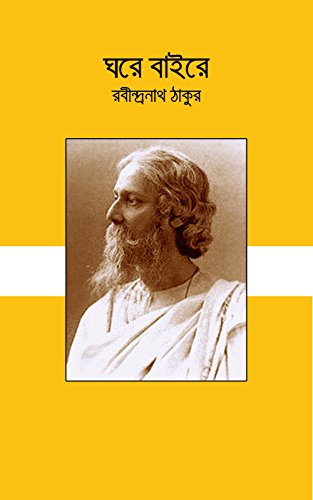
Having followed her theatre over a long time Raj counts it amongst his blessings that he could work with her. “I’m certain there was more left to learn,” he sighs as he awaits the masses’ response to the film which once again, rests on the sturdy shoulder of Ma/ Ammi/Dadi[6]. Raj could envisage none but Swatilekha as the protagonist who shelters to two sets of men and women when Ismailpur is seized by an apocalyptic night of communal rage. The pacifier succeeds in instilling brotherhood in the four victims from rival camps – until the tragic truth about her son’s death is revealed. It drives home the realisation that the foremost religion is humanism.

Like Swatilekha, Soumitra Da too had a strong presence on the stage. And fortunately, the screen pair’s daughters – Sohini and Poulami, respectively – are also deeply into theatre.  “I had chosen theatre when I wanted to direct,” he’d said to me when Sangeet Natak Akademi had decorated him, “because, if I make films, people will always compare me with Manikda[7].”

That is why I am doubly delighted that the makers marked the release of Bela Shuru [8]– the duo’s last film – around Swatilekha’s birth anniversary[9], with a unique exhibition. it showcases Soumitra’s typewriter, the script he penned for a play, a collection of pipes acquired on travels abroad; his paintings, poems, letters to his daughter from his Jaisalmer shoot for Sonar Kella (1974)… And it showcases Swatilekha’s violin and mouth-organ; the costumes she wore in Nachni and Bela Shuru; and, a congratulatory letter to Swatilekha, from a star admirer — Amitabh Bachchan…[10]

Soumitra Chatterjee and Swatilekha Sengupta in Bela Shuru. Photo Sourced by Ratnottama Sengupta

Surely a far cry from the bias that you lamented when you celebrated the 150th birth anniversary of Notee Binodini [11] in 2013, Rudra Da[12]?

*

Yes, theatre people the world over agree, that the ‘Moon of Star Theatre’ was deprived of her rightful honour when the theatre that was founded by her not named after her. Why? Because “the aristocrats would not like to enter a place named after a noti.” Thespian Noti Binodini might have been, but she was a fallen woman, wasn’t she? So what if this contemporary of Tagore was the first South Asian actress to pen her own story – Aamar Katha — a lucid memoir that portrays the 19th century society in Bengal which was at ease with European ideas but confined women to homes. So what if the sage Ramakrishna had gone into a trance as he watched her essay Chaitanya Mahaprabhu (1884)? Such was her portrayal that thespian Amritlal Bose wrote, “Whenever I bow to any wooden or painted image of Sri Chaitanya, I see Binodini before my eyes.”

Binodini Dasi had gone onstage at age 12, under mentor Girish Ghosh (1844-1912), and her career had ended when she was just 23. Merely 11 years, but those were the years when the proscenium theatre modelled after European convention was spreading in Bengal. In those 11 years Binodini enacted 80 roles, playing Sita, Draupadi, Radha, Kaikeyi or Pramila, Mrinalini, Motibibi, Ayesha. Please note: She pioneered modern stage make-up by blending European and indigenous styles.

“Because of this, people who had seen her in one role could not recognise her in another,” Girish Ghosh himself wrote. Yet this same stalwart of theatre, to please whom Binodini had drained her own resources and founded Star Theatre in north Calcutta, refused to write a foreword for My Story as it contained uncomfortable truths about Binodini’s patrons!

Why did the chroniclers of Bengal Renaissance overlook the contribution of this marginalised star to the land’s cultural mileu? “Because of the class-caste divide,” Soumitra Chatterjee suggests in his foreword for the memoir. “How could the Brahmo-Brahmin dominated upper crust acknowledge the talents of a lowborn ‘prostitute’?”

More than a century later, Swatilekha took it upon herself to train the spotlight on the fact that the years had failed to change the plight of another set of dancing artistes – the Nachnis.


[1] Women in Theatre suffer bias.’ – quoted from Times of India, article by Ratnottama Sengupta.

[2] Strike where transport was halted

[3] Soumitra Chatterjee (1935-2020)

[4] Kharaj Mukherjee : Actor and comedian

[5] Swatilekha Sengupta (1950-2021)

[6] Grandmother

[7] Satyajit Ray

[8] Release date: 20.5.2022

[9] 22. 5. 1950

[10] Amitabh Bachhan, one of the most nationally and internationally awarded and influential actors

[11] Play based on the life Binodini Dasi

[12] Rudraprasad Sengupta, husband of Swatilekha and a theatre personality

Ratnottama Sengupta, formerly Arts Editor of The Times of India, teaches mass communication and film appreciation, curates film festivals and art exhibitions, and translates and write books. She has been a member of CBFC, served on the National Film Awards jury and has herself won a National Award. Ratnottama Sengupta has the rights to translate her father, Nabendu Ghosh.

.

PLEASE NOTE: ARTICLES CAN ONLY BE REPRODUCED IN OTHER SITES WITH DUE ACKNOWLEDGEMENT TO BORDERLESS JOURNAL

Categories
Interview Review

Sriniketan: Tagore’s “Life Work”

In Conversation with Professor Uma Das Gupta, Tagore scholar, author of A History of Sriniketan: Rabindranath Tagore’s Pioneering work in Rural Reconstruction published by Niyogi Books, 2022

Tagore (1861-1941) has been celebrated as one of the greatest poets of the world, a great philosopher, a writer, an artist, a polyglot but what did the maestro himself perceive as his greatest ‘life work’?

He wrote: “My path, as you know, lies in the domain of quiet integral action and thought, my units must be few and small, and I can but face human problems in relation to some basic village or cultural area. So, in the midst of worldwide anguish, and with the problems of over three hundred millions staring us in the face, I stick to my work in Santiniketan and Sriniketan hoping that my efforts will touch the heart of our village neighbours and help them in reasserting themselves in a new social order. If we can give a start to a few villages, they would perhaps be an inspiration to some others—and my life work will have been done.” This was in a letter in 1939 to an agricultural scientist, Leonard Elmhirst (1893-1974), who helped him set up Sriniketan, a craft and agricultural development project for the villages which fell under the purview of the Tagore family zamindari.

To Tagore, his ‘life work’ lay in the welfare of humankind and poetry was just one of the things he did, like breathing. He told a group of writers, musicians, and artists, who were visiting Sriniketan in 1936: “The picture of the helpless village which I saw each day as I sailed past on the river has remained with me and so I have come to make the great initiation here. It is not the work for one, it must involve all. I have invited you today not to discuss my literature nor listen to my poetry. I want you to see for yourself where our society’s real work lies. That is the reason why I am pointing to it over and over again. My reward will be if you can feel for yourself the value of this work.”

Uma Das Gupta

These are all incidents woven into a book called A History of Sriniketan by historian and Tagore biographer, Uma Das Gupta, who did her post-doctoral research on the maestro and the history of the educational institutions he founded at Santiniketan and Sriniketan. She moved out of Oxford and pursued her studies in Calcutta. She has highlighted Tagore uniquely as an NGO (Non-governmental organisation) operator and also an educator. Mahasweta Devi (1926-2016) in her book Our Santiniketan, recently translated by Radha Chakravarty, focussed on his role mainly as an educator who sought to revive values, a love for nature along with rigorous academics to create thinkers and change makers like the author herself.

A History of Sriniketan is about his work among villagers to bridge gaps. Often, his poetry and writing expresses the empathy he felt for pain and suffering, his need to instil beauty and well-being into humankind so that they could evolve towards a better world — an ideal which he described to an extent in poems like ‘Where the Mind is Without Fear’ and India’s national anthem.

Dasgupta did this by not only delving into Tagore’s own writings but by devoting her life to unearth the depth of the maestro’s commitment and the hard work and money he invested in the project he described as his ‘Life’s work’. She even visited the villages and talked to the beneficiaries and workers. Her book is peppered with photographs of Tagore in Sriniketan. It is amazing to see pictures of the poet with people from Sriniketan sitting on the ground or celebrating festivities.

Tagore, Das Gupta tells us, poured all his Nobel prize money, into the Sriniketan Bank project which was led by his son, Rathindranath. The project hoped to free the peasant from debt. How well were these experiments received by Tagore’s contemporaries? Das Gupta writes in her book: “It would not be an exaggeration to say that Rabindranath had to encounter all of those things, that is, to ‘overcome opposition’ and to ‘conquer space and time’, in no uncertain measure. In short, he had to drive hard to do anything good for a better village life. As a first step, he insisted that Indians should unite to provide nation-building services to the village and not look to the State for doing what was our own duty towards our people. For him, this had to be the more important function of the Swaraj being sought from alien rule.

“In Rabindranath’s view, what had misled society in our transition to modernity was the introduction of the Western concepts of private property and material progress. What this led to was that mankind, though never free from greed, now crossed the limits, within which it was useful rather than harmful. What came about as a result was that property became individualistic and led to the abandoning of hospitality to our people and loss of communication with them. As a consequence, there was an increasing divide between city and village. He found all that to be the reality, when trying to bring about changes, both in his family’s agricultural estates and in the villages surrounding Santiniketan-Sriniketan.”


Tagore, Nandalal Bose & Leonard Elmhirst are together in this picture taken in 1924. Lord Elmhirst, then Tagore’s secretary/assistant stands at the back with Nandalal Bose between him and Gurudev. Courtesy: Creative Commons

To bridge this divide, Sriniketan was created with the involvement of more of the Tagore family, agriculturists, scientists from all over the world, like Leonard Elmhirst whom Tagore had invited in 1921 to lead the Sriniketan work, and artists, like Nandalal Bose. It was a path breaking experiment which found fruition in the long run. They adapted from multiple cultures without any nationalistic biases. Rathindranath brought batik from Indonesia into the leather craft of Sriniketan. We are told, “One of the early influences was from Santiniketan’s association with a group of creative thinkers from Asia, who were spearheading a Pan-Asian Movement that questioned Western hegemony in art and artistic expression. A pioneer of the Pan-Asian Movement was Kakuzo Okakura (1863–1913, Japanese scholar and author of The Book of Tea). He came to Calcutta in 1904, when he met Rabindranath, and they became friends. Okakura admired and supported Rabindranath’s Santiniketan school. Nandalal’s Kala-Bhavana syllabus included Okakura’s artistic principles of giving importance to nature, tradition, and creativity, which were the same as Rabindranath’s artistic principles.”

That Tagore’s effort was unique and overlooked by the mainstream is well brought out through the narrative which does not critique but only evidences. For instance, Das Gupta contends: “He (Tagore) wrote the same to Lord Irwin, the Viceroy, in a letter dated 28 February 1930, when appealing for a government grant towards agricultural research. ‘I hope I shall have the opportunity on my return for another talk with Your Excellency in regard to what has been my life’s work and in which I feel you take genuine personal interest.’ Lord Irwin had come for a visit to Sriniketan at the time and Rabindranath was told of his favourable impression of what he saw during his visit to Sriniketan. In his letter, Rabindranath wrote how he was doing the work ‘almost in isolation’, without any understanding from his people or from the government.” Does that often not continue to be the story of many NGOs?

Sriniketan by Dasgupta is a timely and very readable non-fiction which brings to light not just the humanitarian aspect of Tagore but the need for the world to wake up to the call of nature to unite as a species beyond borders created by humans and live in harmony with the Earth. It all adds up in the post-pandemic, climate-disaster threatened world. To survive, we could learn much from what is shared with us in this book. I would love to call it a survival manual towards a better future for mankind. Scholarship has found a way to connect with the needs of the real world. The book is reader friendly as Das Gupta writes fluently from the bottom of her heart of a felt need that is being voiced by modern thinkers and gurus like Harari — we need to bridge borders and unite to move forward.

Das Gupta retired as Professor, Social Sciences Division, Indian Statistical Institute. She was Head of the United States Educational Foundation in India for the Eastern Region. Recently, she has become a National Fellow of the Indian Institute of Advanced Study (IAAS), Shimla, and a Delegate of Oxford University Press. Her publications include Rabindranath Tagore: A Biography; The Oxford India Tagore: Selected Essays on Education and Nationalism; A Difficult Friendship: Letters of Rabindranath Tagore and Edward Thompson, 1913–1940; Friendships of ‘largeness and freedom’: Andrews, Tagore, and Gandhi, An Epistolary Account, 1912–1940. In this interview, she focusses mainly on her new book, A History of Sriniketan, while touching on how Tagore differed from others like Gandhi in his approach, his vision and enlightens us about a man who created a revolution in ideological and practical world, and yet remained unacknowledged for that as in posterity he continues to be perceived mainly as an intellectual, a poet and a writer.


Uma Das Gupta in the corridors of the Indian Institute of Advanced Studies (IIAS), Shimla, where she was visiting as a  National Fellow (2012 – 2014) to advise on a permanent exhibit on Tagore’s life and work. The project was sponsored by the Ministry of Culture in celebration of Tagore’s 150th anniversary. This Institute is housed in the erstwhile Viceregal Lodge of imperial times. Photo provided by Uma Das Gupta

You are a well-known biographer of Tagore and have done extensive research on him. What made you put together A History of Sriniketan?

Grateful for your kind appreciation.

Writing a history of Sriniketan has been a priority for me. As a Tagore biographer, my dominant theme is about a poet who was an indefatigable man of action. His work at Sriniketan is of prime importance in that perspective. The secondary theme is of him as a poet and writer of many a genre, lyric, poetry, narratives, short stories, novels and plays. I had to make a choice of emphasis between the two themes since I did not intend to write a full-scale biography covering all aspects of Tagore’s life, equally.  My choice was to explore his educational ideas and to examine how he implemented them at his Santiniketan and Sriniketan institutions. His work as an educator and rural reformer is even today hardly known because his genius as a poet and a song writer overshadowed his work as an educator, rural reformer, and institutional builder. That area of research was quite virgin when I started it as a post-doctoral project in the mid-1970s. For perceptions about his poetry and his large oeuvre I have drawn on the work of the scholars who know the subject better than I do.  

My focus is on the concerns that featured persistently in Tagore’s writings and his actions. These were about the alienation in our own society between the elite and the masses, about race conflict and the absence of unity in our society, India’s history, nationalism, national self-respect, internationalism, an alternative education, religion, and humanism as elaborated by him in his collection of essays titled The Religion of Man (1931).

A History of Sriniketan is a detailed presentation about his ideas and his work on rural reconstruction. The idea of doing something to redeem neglected villages came to him when he first went to live in his family’s agricultural estates in East Bengal. His father sent him as manager in 1889. The decade that he spent there was his first exposure to the impoverished countryside. He was then thirty, already a poet of fame, and had lived only in the city till then. The experience played a seminal part in turning him into a humanist and a man of action. The closer he felt to the masses of his society the further he moved from his own class who were indifferent to the masses. His independent thinking gave him the courage of conviction to work alone with his ideas of ‘constructive swadeshi’. 

As a pragmatist he knew there was not a lot he could do given his meagre resources as an individual in relation to the enormity of the needs. But he was determined at least to make a beginning with the work. His goals were a revitalized peasantry, village self-reliance through small scale enterprises, cottage industries and cooperative values. He wrote, “If we could free even one village from the shackles of helplessness and ignorance, an ideal for the whole of India would be established…Let a few villages be rebuilt in this way, and I shall say they are my India. That is the way to discover the true India.”

Disillusioned with nationalist politics he turned to his own responses to the many troubled questions of his times. Tagore was convinced there could be no real political progress until social injustices were removed. He pointed repeatedly to the sectarian elements of Indian nationalism which kept our people divided. He hoped that the Santiniketan-Sriniketan education would create a new Indian personality to show the way out of the conflict of communities. He thus brought a different dimension to nationalism by arguing for universal humanity. It led to doubts about his ‘Indianness’ among his contemporaries. He had the courage to defy the idea of rejecting the world as a condition for being ‘Indian’. In fact, he tried continuously to break out of the isolation imposed on his country by colonial rule. He had the foresight to sense that the awakening of India was bound to be a part of the awakening of the world.  

What is the kind of research that went in into the making of this book? What got you interested in Tagore in the first place?

I am a historian by training. Historians have to back up every statement they make in their analysis by written documents. That is why the historian’s main source is the archives. Likewise, my research for this book has been mainly archival. I searched for written documentation from 1922 when the Sriniketan scheme of rural reconstruction work was officially launched. The documentation included the minutes of meetings, memoranda exchanged among the workers of the Institute of Rural Reconstruction, official notes, and annual reports written and filed.

In addition, I used to visit the villages in which the scheme was implemented to get an understanding of the ground reality. The work was started with six villages in 1922, extended to twenty-two more villages in the first ten years, and to many more villages afterwards. When the work was being run on a small scale, the Institute tried to post a village worker to stay in the village itself and work along with the villagers to implement the Sriniketan scheme. Some of these villages actually kept notes and records of their work which I could use as part of my local level research. I also interviewed some of the workers who had retired but who were still living around Sriniketan in their old age though their number was small. I have used those oral interviews in my documentation. Some of the Village Workers had their own private correspondence to which they gave me access.

There is also extensive personal correspondence in the Rabindra-Bhavana Archives between the leaders of the Sriniketan work. Among them first and foremost are Rathindranath Tagore and the British agricultural scientist, Leonard Elmhirst, whom Tagore had invited in 1921 to lead the Sriniketan work. Elmhirst had been to India earlier as a Wartime Volunteer during World War 1. When Tagore came to know of him through another British agriculturist working in Allahabad, Sam Higginbottom by name, he contacted Elmhirst with a request to come to Santiniketan and to lead the Sriniketan work. One of Tagore’s prime targets was to implement Scientific Agriculture in the villages. In fact, many years earlier, in 1906, he had sent his son Rathindranath and another student of the Santiniketan school, Santoshchandra Majumdar, who was Rathindranath’s classmate, to the University of Illinois at Urbana-Champagne to study Agriculture with the view that they would bring back the expertise for the Sriniketan work at the completion of their studies.       

Leonard Elmhirst & his wife: Courtesy: Creative Commons

Elmhirst was in Sriniketan from 1922 to 1924 after which he returned to his work in England. He worked closely with the Sriniketan team even from far through the letters they exchanged. Rathindranath consulted Elmhirst regularly over Sriniketan’s work in progress and this correspondence is in the archives.

There is also a very charming body of personal letters between Tagore and Elmhirst. Tagore’s originals are among the Elmhirst Papers in the Dartinghall Hall Trust archives in Devonshire, UK, and Elmhirst’s original letters are in the Rabindra-Bhavana archives, Santiniketan. This correspondence has been published.  

Another very important source of documentation is available in the Diaries of Leonard Elmhirst which he wrote from the start of the Sriniketan work in 1922. Elmhirst’s Diaries were published by Visva-Bharati titled Poet and Plowman. There are some day-to-day accounts of how the work was being done on the ground by a group of senior students from Santiniketan who had chosen this field for training and of course by the Village Workers who had been appointed by the Institute. There were other leaders who helped with the work throughout like Kalimohan Ghose who later carried out the pioneering Surveys of the Villages. I have included some of these path breaking Surveys in the Appendices of A History of Sriniketan.   

Last but not the least important for my research were Tagore’s ideas of education and rural reconstruction about which he wrote several essays in two important collections, namely Palli-Prakriti (Countryside and Nature) and Sikshya (Education). Some of the essays were autobiographical as to how he started the rural work in his family’s agricultural estates in East Bengal where his father sent him in 1889. He stayed at Selidaha, the Estates’ headquarters, with his family till 1900 when he moved to Santiniketan in South Bengal’s Birbhum district where his father had founded an ashram and called it Santiniketan, the ‘Abode of Peace’. It was not a monastic ashram but one for householders to spend some days in prayer and meditation away from their household responsibilities. This is where Tagore and his young family moved in 1900-01 with his plans to start a school for children in the heart of nature. It was to be a school where the children could learn to creatively assimilate the knowledge imparted to them instead of in the classroom that characterised colonial education. This was how his Santiniketan school was founded in 1901.

Santiniketan was located within two miles of the Bolpur Railway Station on the East Indian Railway Line. It was situated on high ground, in the middle of a wide plain, open to the horizon on all sides. There, father and son had planted noble groves of mainly mango and sal trees. There, in the heart of nature not far from a big city, Tagore had the advantage of being able to draw upon both raw materials and cultural products in equal measure as it were. There was the influence of trees, open fields, and the seasons changing so starkly on the one hand; on the other hand, there was the inspiration of artists, science teachers, libraries, and hand-made, machine-made, equipment.        

You ask why I got interested in working on Tagore. There is a very personal story to share. When our son was born in Oxford where my husband and I were working with University Fellowships during 1972-73, we decided to move to Visva-Bharati on an invitation from the then Vice-Chancellor, the eminent historian Pratul Chandra Gupta. We were of course attracted to the possibility of being at Tagore’s institution and also to the prospect of raising our child in its pastoral environment. We did thus move to Visva-Bharati in 1973 leaving our Calcutta jobs at Presidency College, where my husband was Professor of History, and Jadavpur University, where I was teaching. Once we went Visva-Bharati, I began to explore the possibility of doing post-doctoral research on Tagore rather than on colonial history as was the area of my doctoral dissertation at the University of Oxford.

What would be the purpose of such a book? Do you think Tagore’s model would work if multiple NGOs adopted his ideas?

As I have already mentioned I am a biographer of Tagore’s educational ideas and the history of his institutions at Santiniketan and Sriniketan. To me writing this book on a history of Sriniketan was an integral part of my research. But at a personal level, I was concerned that the history of that practical and experimental work that Tagore did under the most difficult of circumstances might get completely forgotten if it were not documented. That was a genuine concern because of two reasons. Firstly, while Santiniketan has retained its charm as a popular tourist spot, and as Santiniketan’s oldest buildings of exceptional architecture had become heritage buildings, Sriniketan did not have anything to show or display for outsiders to connect with its one-time strident presence in bringing life and action to the villages. Secondly, Sriniketan never reinvented the wheel but just carried on from the 1950s as a unit of Visva-Bharati University to fill in for routine bureaucratic and funding purposes. Even its beautiful and thriving craft work that brought acclaim to Sriniketan from well beyond its precincts, would slowly but surely erode.  

Therefore, the primary purpose of this book is to document a pioneering humanistic enterprise for posterity, and also for the next generations who were expected to be engaged in the field of rural development even though the original model was not necessarily practically and theoretically viable in today’s socio-economic scenario. The book is also for the scholar and for the generally interested person. When I was starting my work in the mid 1970s, there was no doubt in my mind that Sriniketan was becoming less visible.   

As for whether multiple NGOs could use the Tagore model is for the NGOs to tell us, but I do know that in its neighbourhood, Sriniketan remains an important inspiration for mobilizing villages non-politically.  There have been one or two such movements in the vicinity of Santiniketan-Sriniketan which are continuing to work actively at grassroots. One is Pannalal Das Gupta’s ‘Tagore Society for Rural Development’. Founded in 1969-70 as a registered society, the Tagore Society specialises in motivating villagers to take on environmental self-help projects. There is also the ‘Amar Kutir Society for Rural Develoment’ located very close to Sriniketan which was once a shelter for runaway political prisoners. Founded in 1923 by Susen Mukhopadhyaya, a young revolutionary freedom fighter then, who was attracted to Tagore’s work in rural reconstruction. We learn from his writing that he kept observing the work while coming in and out of jail himself.  ‘Amar Kutir’ developed the work of organising local crafts persons, upgrading their skills, training them in design, and in marketing their products for economic rehabilitation. The Birbhum district had several families of traditional weavers. Some of them had been engaged in trade by the East India Company.     

Another such non-governmental private initiative for rural development has come up more recently in 1984 in the outskirts of Sriniketan called the ‘Elmhirst Institute of Community Studies’, (EICS), whose members are working mainly in the areas of women and child development including family counselling, family adoption, de-addiction and rehabilitation, HIV/AIDS education and intervention. They were started with substantial moral and financial support from Elmhirst who was interested in spreading Sriniketan’s pioneering enterprise and taking the ideas further to meet the needs of the later day.    

In other parts of India individual leaders were drawn to the work of building village self-reliance and a few had dedicated themselves to the cause in post-independence India. For his Ashrams at Sabarmati and Wardha, Gandhi himself kept closely in touch with Sriniketan which he visited several times even after Tagore’s passing and knew it well. Gandhi’s follower, Baba Amte, in Madhya Pradesh was a key worker in the field. More contemporarily one reads of the utopian commune ‘Timbaktu Collective’ in rural Andhra Pradesh where a husband-and-wife team, Bablu and Mary Ganguly, have organised the hapless farm labourers of Anantapur district to work for the regeneration of wasteland and start projects on organic farming, soil conservation, propagation of traditional food crops and have also taken steps for women’s and Dalit empowerment and rural health. Most of these ideas were at one time born and nurtured in the holistic laboratory for socio-economic development that Sriniketan was. Bablu Ganguly acknowledges Fukuoka as his mentor. Being Bengali by birth, it would not be surprising if he was aware of Tagore but perhaps only as a poet and songwriter.      

Tagore withdrew from the national movement to develop villages, which is where, he felt lived a large part of India. Gandhi had a similar outlook. So, where was the divide?

With his deepening sympathy for the suffering millions of his country, Tagore became increasingly critical of the changes that Britain had brought to India. But he also felt strongly for the West’s ideas of humanism and believed they were of benefit to Indian society. Revolutionary changes were inescapably entering into our thoughts and actions. This was evident in the proposition that those whom our society decreed to be ‘untouchables’ should be given the right to enter temples. The orthodox continued to justify their non-entry into temples on scriptural pretexts, but such advocacy was being challenged and resisted. The people’s ‘voice’ had put out the message that neither the scriptures nor tradition nor the force of personality could set a wrong right. Ethics alone could do so.   

There were important factors that led gradually to this new way of thinking. The impact of English literature was one such. Tagore pointed out that acquaintance with English Literature gave us not only a new wealth of emotion but also the will to break man’s tyranny over man. This was a novel point of view. The lowly in our society had taken it for granted that their birth and the fruits of their past actions could never be disowned; that their sufferings and the indignities of an inferior status had to be meekly accepted; that their lot could change only after a possible rebirth. Society’s patriarchs also held out no hope for the downtrodden. But contact with Europe became a wake-up call. It was no surprise that in his landmark essay Kalantar (Epoch’s End) Tagore recalled and endorsed the British poet Robert Burns’s unforgettable line, “A man’s a man for a’ that.

It was in that longing to bring hope to the deprived people that Tagore and Gandhi felt really close. They were both carrying out rural reconstruction work because they knew that the majority of Indians lived in villages and wanted to bring awakening and national consciousness to the villages as the prime goal to freedom. Both men focused their attention on the peasantry as the largest class within Indian society who were paralysed by anachronistic traditions and weighed down by poverty and the absence of education.

The major issues on which Tagore and Gandhi differed were debated nationally. Before discussing the specific issues in the controversy, it would be useful to examine their general positions on freedom and nationalism. In The Religion of Man (1931), Tagore developed the position that the history of the growth of freedom is the history of the “perfection of human relationship”. Gandhi applied the same principle to resolving India’s racial conflict. Tagore took the idea further and challenged the credo of nationalism. Tagore argued that the basis of the nation-state was a menace to the ideal of universal harmony or to the “perfection of human relationship”. But to the nationalist leadership all over the country, including Gandhi, political self-rule or swaraj came to be understood as a necessary phase of spiritual self-rule, or swarajya, and nationalism as the first step towards attaining free human fellowship.

Tagore alone spoke out against that trend. He argued that the crucial stumbling block in India’s future lay in the social problems of the country such as the absence of human rights for the masses and the alienation between the educated classes and the masses. He emphasised what the country needed most of all was constructive work coming from within herself and the building of an ethical society as the best way for rousing national consciousness. The rest would inevitably follow, even political freedom.

In his novel, Ghare Baire (The Home and the World, 1916), Tagore seemed critical of Gandhi’s call for Khadi and burning of mill cloth imported from England. Yet, Sriniketan was a handicraft forum for villagers to find a way to earn a living through agriculture and craft. So, why the dichotomy of perspectives as both were promoting local ware? Where was the clash between Gandhi’s interpretation of Khadi and Tagore’s interpretation of selling indigenous craft?

There was never any conflict in their perceptions or feelings for the poor, Gandhi’s and Tagore’s. Other issues were stirred in relation to the Khadi campaign and the burning of foreign cloth. For instance, the Congress in 1924 moved a resolution under Gandhi’s recommendation enlisting its members to spin a certain quantity of cloth on the charka (spinning wheel) as a monthly contribution. The idea was to give the movement country-wide publicity, and also, to make spinning a means of bonding between the masses and the politicians.

Tagore was wholly opposed to the idea of using the charka as a political strategy for swaraj and explained his position in his 1925 essay titled ‘The Cult of the Charka’. He argued that there was no short-cut to reason and hard work if anything was to succeed; that nothing worthwhile was possible by mass conversion to an idea; that our poverty was a complex phenomenon which could not be solved by one particular application such as spinning and weaving Khadi. Tagore raised the question if our poverty was due to the “lack of sufficient thread”, or due to “our lack of vitality, our lack of unity”?

On burning clothes Tagore’s position was that such a method hurt the poor by forcing them to sacrifice even what little they obtained from selling those clothes. He concluded that buying and selling foreign cloth should be delegated to the realm of economics. In his reply Gandhi wrote, that he did not draw “a sharp or any distinction between economics and ethics”. He added that the economics that hurt the moral well-being of an individual or a nation “are immoral and therefore sinful”.     

Is Sriniketan unique? Can it be seen as Tagore’s model for rural development?

To the best of my knowledge there is no parallel institution in India.

I am not aware if Tagore was ever talking of a ‘model’ that he expected others to follow. He was certainly hoping, as he wrote, that his work will help to establish an “ideal” [his word] for the rest of the country.

My own sense is that an “ideal” has been established given that empowerment of the villages through the Panchayats has become a nationwide project. Of course, the government’s approach is not fully in character with Tagore’s holistic vision for the individual’s humanistic development. Today the individual hardly counts, politics and economics are what matter. All the same it has to be said that the villages are getting some attention and are not left to rot as had been the case in the earlier century.       

You have said that Tagore faced criticism for the way he used Nobel Prize money. Can you enlighten us on this issue? Tell us a bit about the controversy and Tagore’s responses.

As anyone would surmise the Nobel Prize money was very precious also to the Santiniketan community because the teachers and workers there had to struggle over the resources for the institution. But contrary to the community’s expectation, Tagore decided that the Prize money would be given to the cause of rural credit. He had started the Patisar Krishi (farmers’) Bank in 1906 followed by the Kaligram Krishi Bank. According to Tagore’s biographer, Prasanta Pal, the total investment in the rural banks in 1914 amounted to Rs 75,000 of which Rs 48,000 was invested in the Patisar Krishi Bank at 7% interest per annum and Rs 27,000 at the same rate of interest in the Kaligram Krishi Bank. Tagore decided that only the interest from those investments could be used to pay for the maintenance of the Santiniketan school. The actual purpose of the fund was to give loans to the poor peasants so as to relieve them from exploitation by moneylenders and some unethical landlords too. In order to repay their loans, the peasants had to sell their produce at a rate lower than the market price immediately after drawing the harvest. This phenomenon was causing them perpetual indebtedness. The Krishi Banks were to loan money to the peasantry at a lower rate than the money lenders and relieve them from the age-old exploitation.     

Tagore was firm that the primary beneficiary of his Nobel Prize money would be the poor peasantry of his family’s estates, and the Santiniketan school would be only the secondary beneficiary. He tried thus to balance his two main concerns when settling the future of his Nobel Prize money.  

It cannot be said there was a ‘controversy’ over this as Gurudev (which was how the community addressed Tagore) was too revered for a controversy to be raised about a decision that he had taken. But there was disappointment.  It seemed strangely that even his inner circle had not realised his deep emotional attachment and ideological commitment to the cause of the impoverished peasantry. Perhaps, my response to your earlier question may explain why. 

Tagore had noticed the gaps between the different strata of Indian society. Sriniketan was an attempt to bridge the gap. How far did his ideals succeed?

There was tremendous societal gap between the different strata of Indian society.  With all of Tagore’s will and effort, it cannot be said that the Sriniketan ideals could bridge the gap. Even today, a perceptive visitor, who visits Santiniketan and Sriniketan, located only within two miles of each other, can tell the difference between the two. Santiniketan looks bright and thriving, but Sriniketan looks neglected.    

Community life in the Indian villages was seen to break for the first time with the emergence of professional classes among the English-educated Indians. The city began to attract them away from the villages. Those Indians were happy to let the government take over guardianship of the people and relinquish to it their own traditional duties to society. The result was a widening gap between town and country, city and village.  Tagore knew from his life’s direct experience that none of those who dominated the political scene in his time felt that the villagers ‘belonged’. The political leadership apprehended that recognising this vast multitude as their own people would force them to begin the real work of ‘constructive swadeshi’. They were not even interested to try. That was where the Sriniketan effort was invaluable to Tagore. He saw that the endeavour built at least a relationship with the village, if nothing else.

The Sriniketan scheme sought to bridge the gap by bringing to the village a combination of tradition and experiment. Tagore knew that a civilisation that comprises of only village life could not be sustained. “Rustic” was a synonym for the “mind’s narrowness”, he wrote. In modern times, the city had become the repository of knowledge. It was essential therefore for the village to cooperate with the city in accessing the new knowledge.  One such vital area of expertise was in agriculture. His study of “other agricultural countries” had shown that land in those countries was made to yield twice or thrice by the use of science. A motor tractor was bought for Sriniketan in 1927 because he believed that the machine must find its way to the Indian village. He wrote,If we can possess the science that gives power to this age, we may yet win, we may yet live.”

Your book tells us that Sugata Dasgupta’s publication, A Poet & A Plan (1962) showed that Sriniketan had benefitted the villages it adopted decades after Tagore’s death. Has there been further development of these communities or is it status quo?

No, it cannot be said that it is status quo from the 1960s. There have been changes for sure. There have been benefits to the villages from the Government’s projects. Indeed, the government had adopted some of their early projects from Sriniketan’s original work.

More interventions are needed of course but it has to be said something is being done. Of course, the changes I can mention that have benefitted the condition of the villages and therefore the villagers’ lives came well after Sugata Dasgupta’s publication. The three that I can mention are communications, roads, and electricity. Today there are more long-distance buses than ever before transporting people to and from the villages. Totos and cycle rickshaw-vans take passengers from the bus stands to the interior villages. Roads are another major development.  Besides the highways, the mud paths in the villages are now being converted to metalled roads. There is electricity in the villages.

I should mention one other significant change which is that secondary education is now fairly common to the present-day rural populace. College education has also come within their reach.

What is the current state of the present day Sriniketan? What do you see as the future of Sriniketan?

Presently, Sriniketan runs as a department or unit of Visva-Bharati University and works according to the University’s requirements. I am not acquainted with the requirements. I continue to be a regular user of the University’s Rabindra-Bhavana archives even now. But I have not been connected with the University in any official capacity after the 1980s which is a long time ago.

Thank you for your time.

(This is an online interview conducted by Mitali Chakravarty.)

PLEASE NOTE: ARTICLES CAN ONLY BE REPRODUCED IN OTHER SITES WITH DUE ACKNOWLEDGEMENT TO BORDERLESS JOURNAL

Categories
Essay

Satyajit Ray’s Cinematic Universe: Can Isolation Create a New World?

 By Rebanta Gupta

The Hungarian Marxist philosopher György Lukács coined the term “transcendental homelessness” in his essay The Theory of the Novel, to explore the feeling of homesickness prevalent in the arena of modern philosophy. The ecosystem of the epic was governed by the cosmic laws of fate, the transcendental signified was ever-present to protect mankind, and the human soul found a transcendental home in that cosmic destiny. The celebrated Postcolonial scholar Edward Said, in his essay, ‘Reflections on Exile’ observes, “Classical epics, Lukács wrote, emanate from settled cultures in which the values are clear, identities stable, life unchanging.” Novel, the brainchild of modernity, is the site where this “transcendental homelessness” functions. The European novel emerged out of a changing society, where the omnipotent figure of God had been effaced, with the invasion of skepticism and rationality. Novels germinate from a societal structure, Said writes, “in which an itinerant and disinterested middle-class hero or heroine seeks to construct a new world, that somewhat resembles an old world left behind forever.” A sense of retrogression, an insatiable urge to return to that erstwhile home haunts the modern world, which suffers from an ontological homelessness. The shadow of this sense of homelessness and estrangement also haunts cinema, which has a novelistic structure. Cinema, which is engraved on celluloid, is written by an auteur, the director, who is analogous to the author of a novel. The characters of the celebrated Indian filmmaker Satyajit Ray’s films suffer from a sense of perpetual homelessness; pangs of isolation and estrangement haunt their sinews and nerves, in the midst of a kaleidoscopic world. This essay would focus on two of Ray’s films: Kanchenjungha (1962) and Charulata (1964) and try to analyze how they create an atmosphere of isolation and estrangement.

Satyajit Ray. Courtesy: Creative Commons

Kanchenjungha (1962) narrates the saga of a wealthy aristocratic family, during the final lap of their vacation at Darjeeling. Inclement weather has shrouded the peak of Mount Kanchenjungha with mist, and a parallel mist of confusion, contradictions, unrequited desire, and unspoken words has enveloped the characters. The film describes the primacy of the father figure in the family ecosystem through the character of Indranath (played by Chhabi Biswas), who is a snooty, pompous, and authoritarian figure, who wants his daughter Manisha (played by Alokananda Roy), to marry a wealthy man whom he has hand-picked for her, but she seems to be reluctant to accept this unilateral decision of her father. William Wordsworth, in the poem Lines Composed a Few Miles Above Tintern Abbey (1798), had instructed his sister Dorothy to believe in the ways of nature, which fills the mind “with quietness and beauty” and “lofty thoughts, that neither evil tongues, rash judgments, nor the sneers of selfish men” can demotivate her. But Indranath, it seems, stands vertically opposite to the arena of Wordsworthian exhortations; he is completely alienated from nature, his materialistic drive has effaced his capacity to appreciate the beauteous aspects of Darjeeling and the Himalayan wildness. When the ornitho-enthusiast Jagadish, his brother-in-law (played by Pahari Sanyal) talks about his search for a bird, Indranath nonchalantly asks, “Roast hoy? (Could it be roasted?”). He is marooned in his sequestered island of materialism, and his desire to catch a glimpse of the snow-clad Kanchenjungha is basically a competitive desire to acquire a coveted product, real love of nature is not associated with that. He has high opinions about Banerjee (played by N. Viswanathan), the potential groom for Manisha, because he has a starting salary of twelve hundred rupees, which was indeed a handsome amount in the postcolonial context of the film. Indranath’s wife Labanya (played by Karuna Banerjee) is a subjugated woman, who has a feeble presence before the domineering existence of her husband, and her subjectivity finds no outlet. She, therefore, sits on a bench by the abyss, and at the hour of descending fog, sings the Tagore song E Parabase Rabe Ke Hay (“Alas, who will live in this forlorn and alien land”), set in the Hindustani Classical Raga Kafi, which uses the notes komal gandhar (E-Flat) and komal nishad (B-Flat). The raga creates a melancholic mood, as the song touches the somberness of gandhar and the solitary bohemianism of nishad (which is widely used in the mercurial and melancholic Bengali folk music), and it reflects the alienated state of a woman, who has not had her share of love from her husband. Fog dilutes the outlines of the horizon, as her hopes slowly get extinguished and desperation reigns supreme, and the last line, “Temon apon keho nahi e prantare hay re (There is no one dear and near in this alien world)” mingles with the fog to create an atmosphere of perennial loneliness. Jagadish’s comment, “You have sung after such a long time,” indicates that Labanya’s daily hectic life and Indranath’s iron fist have isolated her from her artistic persona. Rabindranath Tagore talks about the importance of aesthetics in his seminal work Japan Jatri (Travels through Japan, 1919) if humans become too much obsessed with the utilitarian domain, they become machine-like entities, whereas the domain of aesthetics is the area where they can actually realise the true nature of their existence, leading to the experience of the Lebenswelt (life-force)described by Edmund Husserl. The song not only translates Labanya’s melancholia into musical notes, but it also signifies her urge to rediscover her real self, as she expresses concern over the possibility of the smothering of Manisha’s artistic qualities and urges after the marriage. The golden Kanchenjunga, which appears in the last few frames of the film, signifies that cosmic home, the abode of hope, which has hitherto remained elusive to the characters. But in this journey to the cosmic abode, the rogue Indranath is left behind, as he frantically searches for his compatriots, and a terrifying wave of isolation hits him, along with a mocking, derisive tune of a hilly song.

Charulata (1964) is widely regarded as one of the premier achievements of Ray. The film, which is based on the 1901 novella Nashtaneer (The Broken Nest), written by Rabindranath Tagore, narrates the heart-wrenching saga of the eponymous heroine (played by Madhabi Mukherjee), who walks down the solitary passages of an aristocratic house like a spectre. Her husband, Bhupati (played by Shailen Mukherjee), the editor of a political newspaper, nurtures the dream of expanding his business, while Charu suffers from lovelessness; sexual and intellectual dissatisfaction simmers within her. The much-lauded opening scene sets the melancholic tone of the film. The scene where Charu is seen knitting the initials of Bhupati’s name on a handkerchief might remind the audience of Alfred Tennyson’s Lady of Shalott, who is imprisoned in an island castle. She weaves a colorful web in her solitary chamber under the shadow of an unknown curse, which will befall her, if she looks down at the city of Camelot. She can only catch glimpses of the “shadows of the world” in the mirror that hangs before her. Charu, like the Lady of Shalott, is imprisoned in an urban mansion, where household chores are managed by a fleet of servants. She watches the activities of the outside world through binoculars, in an effort to reconcile the differences between the home and the world. The images of the palanquin bearers, a man with monkeys, a fat man with an umbrella crossing the road- all these are reminiscent of the “shadows of the world” in Tennyson’s poem written in 1842, which have now appeared on the glasses of Charu’s binocular. But the Lady of Shalott had to pay the price for abandoning her loom and looking down at the blooming water lilies and the “helmet and the plume” of the gallant knight, as Tennyson writes,

Out flew the web and floated wide;
The mirror crack’d from side to side;
“The curse is come upon me,” cried
      The Lady of Shalott.

Similarly, the curse of infidelity and adultery hits Charu, with the arrival of Amal, her attractive brother-in-law (played by Soumitra Chatterjee). He enters her life in a tempestuous way, which echoes the knight’s entry into the lady’s life. Charu’s isolated state makes her desperate to efface the boundaries separating the home and the world, and the entry of Amal signifies the eruption of the outside world in Charu’s domestic discourse. Ray portrays the psychological gulf between Bhupati and Charu by making Charu stare at the fleeting image of Bhupati through the binocular. He is engrossed in his world of political journalism with no time to accompany his wife, while the latter tries to find solace in literature and other artistic works. But the binocular episode underscores the irreconcilable differences between them. The camera unprecedentedly backtracks, as she lowers the device and stares at her husband with a note of derision in her eyes. This derision anticipates the arrival of Amal, who will occupy the void left by Bhupati will emerge as his sexual and intellectual rival.

The last scene, which incorporates the freeze-frame technique, is reminiscent of the final scene of François Truffaut’s film The 400 Blows (1959) where the teenage protagonist Antoine Doinel stares at the audience by rupturing the fourth wall, and the camera zooms in on his face and refrigerates time, to show the signs of discontentment on his face. Charu and Bhupati face each-other, and the latter’s heart is exploding because of his wife’s supposed infidelity. Though a note of reconciliation is hinted at, when Charu invites Bhupati inside, the frame eventually freezes, the music halts, and Bhupati cannot hold Charu’s extended arm, underlining the impossibility of their conjugal bond. Antoine’s discontentment, along with a sense of guilt, now appears on the couple’s faces, as the word Nashtaneer or “Broken Nest” appears on the screen.

Tagore had celebrated the grandeur of a peaceful abode when he wrote the song “Ohe sundar mama griha aji paramatsaba rati, rekhechhi kanaka mandire kamalasana pati (Beauty, I have laid down the bed of lotus in the golden pagoda for you, on this auspicious night of festivity)”. But Charu and Bhupati fail to construct that resplendent home, since they are separated by circumstances. They could be inhabiting the same house, but with an abysmal gulf between them, they would be suffering from a sense of metaphorical homelessness. In this regard, Charu, Bhupati, and Amal anticipate the ménage à trois between Bimala, Nikhilesh, and Sandip in Ray’s Ghare Baire (1984). Bimala (played by Swatilekha Sengupta) too becomes a victim of the broken nest syndrome, as her nationalistic aspirations are at loggerheads with her conjugal fidelity.

These two films illustrate the urge to reach a cosmic abode of love, unity, and security, which is throttled by the constraints of worldly relationships and circumstances. Charu is searching for that elusive home, where she can find her true self, and fine-tune her soul with the ethereal harmony of the universe, but her failure to touch the perimeters of that utopian abode fills her hearts with pangs of isolation and estrangement. Labanya’s personal moments of discovery through the song by the abyss marks the intersection of solitude and loneliness; solitude has a personal dimension, when an individual can explore the hidden self away from the worldly bustles, but loneliness has an excruciating and universal dimension, that unravels her marooned condition, when materialist forces have encroached and decimated her subjectivity. Kanchenjungha and Charulata underscore the desire of these characters to travel from the world of loneliness and estrangement to the world of solitude, where they can re-explore and rediscover themselves to understand the divine mechanisms of the universe. It is an inward spiritual journey, which intersects with the journey of Christian, the protagonist of John Bunyan’s magnum opus The Pilgrim’s Progress (1678,1684) who had embarked on a quest for the Heavenly City.

.

Rebanta Gupta has completed his Postgraduate studies in English Literature from Presidency University, Kolkata. He is interested in Literary Theory, Hindustani Classical Music, Hermeneutics of Film, Narrative of Bengal, and Cultural Studies.

.

PLEASE NOTE: ARTICLES CAN ONLY BE REPRODUCED IN OTHER SITES WITH DUE ACKNOWLEDGEMENT TO BORDERLESS JOURNAL

Categories
Review

The Tale of a River

Book review by Bhaskar Parichha

Title: Mahanadi — The Tale of a River

Writer: Anita Agnihotri

Translator: Nivedita Sen

Publisher: Niyogi Books

 ‘I have seen the Mahanadi in so many ways: in the early morning light, in the reclining afternoon glow, in the blaze of the midday and in the shadow of the orange tinge of the sunset. I have seen this river in the form of its narrow current in winter, amidst profuse rain, in the forested region where it originates, and in the turbulent boundlessness of the estuary. And each time the river, serene, terrifying and quiet, has filled my mind with tremendous joy and nostalgia. Many people, both at the origin and basin of this river, are known to me. Their lives, inextricably linked with the river, have made me think, and have both fascinated and enriched me. The chronicle of this river, therefore, is also an extract of my life.’

One of the largest rivers of India, the Mahanadi has flown more than a thousand kilometers through Chhattisgarh and Orissa from the foothills of the Sihawa hills in Dhamtari district of Chhattisgarh and has fallen into the Bay of Bengal. Leaving behind the huge diamond reservoir at Sambalpur in Orissa, the archeological background of Subarnapur and Buddhist districts, the plains of Nayagarh, Cuttack and Jagatsinghpur flow through the middle of the deep forested gorge of Satakoshia, finally crossing the border near the port of Paradip.

But its journey is endless, as it flows day-after-day from the plateau to the forest to the ravine and finally to the plains. It unites with the sea every day. At every new turn, it leaves behind scores of villages, towns and cities. The din and bustle of a mofussil town, the solitary life in a standalone village, people’s struggle for survival, the episodes of their joys and sorrows, the sighs of the displaced people of Sambalpur during the building of the Hirakud dam mingles with the cries of the endangered people on the banks when the river overflows.

In the long journey of the river, it encounters mountainous plateaus, dense forests, villages and uninhabited emptiness. There are traces of the Paleolithic era at its source. There are ancient lyrical stories around it. Farmers, weavers and artisans have come and settled on the banks of the river to draw in the water. Mahanadi is to Odisha what Huang Ho is to China.

And so, Anita Agnihotri’s novel Mahanadi –The Tale of a River (translated from Bengali by Nivedita Sen) captures all these essential elements in a never written story of a stream which is a sorrow rather than a joy for crores of people in Odisha.

A civil servant, Anita Agnihotri, writes in Bengali in a wide variety of genres — poetry, novels, short stories and children’s literature. Recipient of prestigious awards like Bangiya Sahitya Parishad Award and the Bhuban Mohini Dasi Gold Medal conferred by Calcutta University, her writing explores the vast and complex Indian reality, many facets of human relations, and brings out the unheard voices of the marginalised and the underprivileged and has been translated into several Indian and foreign languages.

Translator Nivedita Sen taught English Literature at Hansraj College, University of Delhi. She worked on other popular genres, apart from Indian writing in English, post-colonial fiction and translation studies. She has translated Tagore’s Ghare Baire, and stories by Syed Mustafa Siraj, Leela Majumdar and others.

In the fiction, the narrative is through stories of the people living on the banks of the Mahanadi. Characters like Tularam Dhuru, Malati Gond, Neelakantha, Bhanu Shitulia, Parvati and others might never meet each other, but the story of their lives will remain strung together by the common thread of the ever– the streaming Mahanadi. The chronicle of Mahanadi is a journey through travails and misfortunes into life’s joys and mysterious beauty. 

Writes Sen in the ‘Translator’s Note’: “A socially conscious writer with a relentlessly dissident voice, Anita Agnihotri’s writing explores struggles in the lives of marginalised communities that are oppressed by underhand politics, social privilege and economic disparity. Though she was a member of the Indian Civil Service, she has maintained an anti-establishment stance throughout her writing career spanning four decades.

“In this novel, her non-noncompliance exposes the irony of Nehru’s urging those dispossessed by the building of the Hirakud dam to accept their suffering in the larger interest of the nation. She critiques the police turned into mercenaries by the state when they passively stand by during a violent attack on a social activist because they are paid to do just that. But she also elicits commensurate outrage at two policemen having to confront and succumb to senseless Maoist violence. The novel depicts how a cotton mill falls apart due to squandering of money and corruption in higher places and also how an upcoming steel factory with international collaboration threatens the livelihood of betel-leaf farmers. Her characters with enhanced sensibilities are haunted by the blatant social and economic inequality they witness all around. Yet Tanmay’s research on the abysmal living conditions in the slum clusters of Cuttack cannot resolve their problems.”
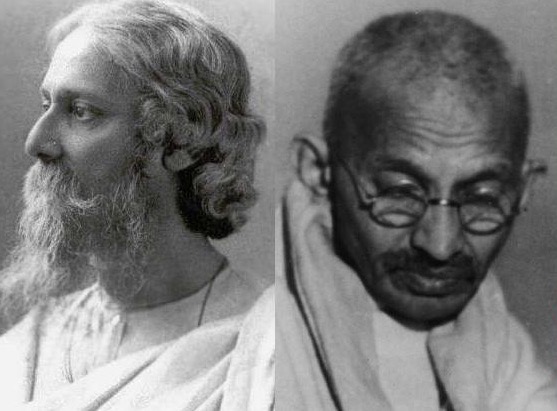
What is of significance is that there are a lot of facts in the novel that substantiates the geography, history and economics of the river and the state it mostly passes through. She sensitively kindles – rather in great detail — the realism, the deprivation and the travails of the people living on the riverbanks. The river forms the crux of the narrative, both as the central character and the primary subject.

As a novel, Mahanadi is poignant and is a fitting tribute to the place and people. Anita Agnihotri has been a percipient writer.

.

Bhaskar Parichha is a journalist and author of No Strings Attached: Writings on Odisha and Biju Patnaik – A Political Biography. He lives in Bhubaneswar and writes bilingually. Besides writing for newspapers, he also reviews books on various media platforms.

.

PLEASE NOTE: ARTICLES CAN ONLY BE REPRODUCED IN OTHER SITES WITH DUE ACKNOWLEDGEMENT TO BORDERLESS JOURNAL

Categories
Essay

Rabindranath and the Etchings of His Mind

Anasuya Bhar explores the various lives given to a publication through the different edited versions, translations and films, using Tagore as a case study and the work done to provide these online .

Rabindranath’s first efforts at writing poetry, what he refers to as padya or rhymes, were made when he was merely a boy of seven or eight years. This is what he has to say about his maiden experience, the magic and the awe with which it surprised him –

“I had, until then, only witnessed rhymes in printed books. Without any scratches, mistakes, nor any signs of thought even – there seemed to be no sign of any of the earthy weaknesses either. I dared not imagine that these rhymes could be produced by one’s own efforts. … But when the skilful mixing of a few words gave rise to the rhythm of the ‘payar’, the magic of making rhymes remained no longer an illusion. “(My translation from Jibansmriti ‘The Poetry Beginnings’, VB, 27)

The above excerpt from Jibansmriti is significant in many ways. The memoir was written when Rabindranath was in his fiftieth year, in 1911. A careful study reveals that there are three manuscript versions to the text of Jibansmriti and the one available on print (and published by Visva Bharati), is the third and the latest version. Jibansmriti (My Reminiscences) is a piece of Rabindranath’s own life writing, along with two other pieces in book form: Chelebela (My Boyhood Days, 1940) and Atmaparichay (The Self Revealed, 1943).  

Rabindranath was a reluctant biographer of himself. Perhaps his first conscious efforts at autobiography is to be found in an essay called Atmaparichay that was first published in 1904, wherein he had consistently defended his wishes to not fuss over his life. In fact, he had wanted to keep separate his jiban and brittanto, that is the biological nitty-gritty of his life and the descriptive and analytical of his creative life. He believed that a poet’s life inheres in his poetry; that there is no need to separately concern oneself about his life details. This was re-iterated in more than one places. Nevertheless, although Rabindranath was reluctant of a conscious autobiography, he has revealed much of himself in his letters, and other non-fiction and travel essays. He was a self-conscious writer with a great emphasis put towards self-expression as well as expression of the self.  To know about him one needs to scour through these writings.

My intention in this essay, however, lies not in the history of Rabindranath’s life writing. I would, instead, like to dwell on those scratchings, mistakes and etchings of the poet’s mind that made Rabindranath ponder about the final version of any of his manuscripts. He was a relentless revisionist of his own writings. My interest lies in that branch of study, quite recent in academic scholarship, which tries to examine the various changes that each text suffers before being available for the final print. The changes might take place in the manuscript or during the correction of proofs. The successive texts, the manuscripts, the proofs, and finally the printed text all seem to have their own dynamics and seem to possess an autonomy and character of their own. This seems true of all texts of all writers and those of Rabindranath are no exception. Between the ideas and their writing, between the manuscript and the print, between the printed text and its translation into other language(s), a particular text seems to have many distinct lives. Until a short time ago, these fell within the purview of textual criticism and editorial scholarship of a text. Now, they may be considered under the rubric of ‘alternative readings of a single text’. Walter Benjamin (1892 – 1940), the German Jewish philosopher, talks about the ‘afterlife’ of a text in his essay ‘The Task of the Translator’ when it is translated, that is to say, a text assumes a different and separate life, with its own dynamics and dimensions when it is translated, from the original. The lives of a text then, multiply when multiple translations take place.

If one studies the three manuscripts of Jibansmriti, one notices three separate beginnings: the first two distinctly pointing to his life proper and his unwillingness to share details of it, while the third and the printed version has a more abstract vision of a painter-like selection of memorable incidents from his life.  The text as it exists in Bangla now, begins in medias res, as it were, with the recollections of his early childhood, as becomes permissibly natural for the memory of a fifty-year-old person. What is interesting are the insights that time and aesthetic distance have provided. Editorial and textual scholarship of Jibansmriti as revealed in Rabindra Rachanabali (Volume 17, Visva Bharati), ‘Grantha parichay’ (introducing the text) cites the minute changes and differences in the three versions of the text. I enclose photographs of all the three versions of the text:

The first manuscript of Jibansmriti. Source: Bichitra

The second manuscript of Jibansmriti. Source: Bichitra

The third and final manuscript of Jibansmriti. Source: Bichitra

The different variations and all the manuscripts of not only ‘Jibansmriti’, but the entire Rabindranath Thakur corpus, including his plays, fiction, non-fiction, drama and poetry in English as well as in Bangla, are now available in the Online Tagore Variorum, Bichitra, which was inaugurated by the then President of India, (Late) Shri Pranab Mukhopadhyay, as a part of the Sesquicentenary (150 years) celebrations of Rabindranath Thakur’s birth, in the year 2011. The programme of the digital archives for Rabindranath was co-ordinated by Sukanta Chaudhuri, Professor Emeritus of English, Jadavpur University, and prepared by the School of Cultural Texts and Records, Jadavpur University. The digital archives bring together all the available versions of all his works and makes provision for their collation, thus allowing the researcher or anyone interested in the world-poet to look through the vast stretch and range of his works. Hence the aptness of its name ‘Bichitra’, meaning ‘various’. It is a unique venture of literary scholarship as well as of software engineering and has been put together by young members all below the age of 35, and academic degree holders mostly from Jadavpur University. It is a rare and pioneering achievement in the field of Digital Humanities in this part of the world.

Any given text may have three or four kinds of an ‘afterlife’. They may be interpretative or of the hermeneutic kind, for instance, those spelt by Rabindranath’s manuscript versions. Another may be achieved through translation, as mentioned earlier. The next may be when a text is being performed. The performance text, the play text, or even the screen play of any text, are effectively different texts in the new scheme of textual afterlives. Each of Rabindranath’s texts then, automatically have different autonomous afterlives as practically all of them have been translated and have several versions as well. Along with these familiar afterlives, the hypertext now, also adds a yet newer dimension. The study of afterlives of a text gains in an all-new dimension when a new text is created based on an older text, by retaining its title or its literary essence. For instance, Aparna Sen’s film Ghare Baire Aaj (2019), is not only an afterlife of Rabindranath’s text of the novel Ghare Baire (The Home and the World, 1916), but also one on Satyajit Ray’s 1984 film Ghare Baire. The study of the afterlives of a text is a never ending and rich treasure trove and affords endless intellectual curiosity and study. The English Gitanjali (1912), too, is a unique example of a text with many afterlives, even after a hundred years of its literary history. I have written about its complicated trajectory, elsewhere.*  

Sukanta Chaudhuri’s book The Metaphysics of Text (Cambridge University Press, 2010) provides significant and perhaps, pioneering insights on this newest aspect of textual scholarship.  Among other aspects of a text, Chaudhuri dedicates one whole chapter on Rabindranath’s ‘katakuti’ (pen scratches and crossings) which invariably were shaped into diagrammatical forms, which Chaudhuri identifies by the name of ‘doodles’. The printed texts do not showcase these pictorial designs or doodles.

A description of Rabindranath’s doodles in one of his manuscripts. Source: Bichitra

The visual aspect of these manuscript pages afford yet another dimension to the working of the poet’s mind while he was working on a poem or a song. They are creative outputs of a different kind, which remain hidden from the printed version of the text, thus disallowing the reader the privilege to dwell with the thoughts of the poet, his seemly and unseemly corrections, as it were. The digital archive Bichitra make all these easily available to us. Understanding, teaching and enjoying Rabindranath’s works become a more gratuitous experience for all of us. If translation is one way of making Rabindranath easily available to most corners of the world, this is yet another move to make his works and all his manuscripts available in every home of all corners of the world. A hundred and sixty years have passed and the magic of Rabindranath or his works remain undiminished and ever contemporary.

.

*Bhar, Anasuya. ‘The Many Lives of Gitanjali’ in Evolving Horizons, Volume 5, November 2016, pp. 20-27, ISSN 2319-6521

.

Dr. Anasuya Bhar is Associate Professor of English and Dean of Postgraduate Studies, at St. Paul’s Cathedral Mission College Kolkata, India. She has many publications, both academic and creative, to her credit.

.

PLEASE NOTE: ARTICLES CAN ONLY BE REPRODUCED IN OTHER SITES WITH DUE ACKNOWLEDGEMENT TO BORDERLESS JOURNAL. 

Categories
Essay

At Home in the World: Tagore, Gandhi and the Quest for Alternative Masculinities

By Meenakshi Malhotra


In exploring the question of Rabindranath Tagore (1861-1941) and alternative masculinities, it is important to keep in mind the multiple contexts and registers in which this question can be explored. One is obviously Tagore’s critique of and take on man-woman relationships in his books and stories throughout his life, which he had observed at close quarters in an extended/joint family context. Many of his short stories, like “The Exercise-Book”, and novels like, Chokhher Bali (A Grain of Sand), show a keen sympathy for women’s aspirations and the situation of that unaccommodated woman, the young widow. Tagore demonstrates his sympathy, even empathy, with the young widow, Binodini, while recognizing that she might pose a threat to social stability within the household of Mahendra and Asha, his girl-wife. The second register is the intertwining of creative writing and androgyny (the latter being a necessary attribute for an author, according to Virginia Woolf), and how Tagore in his capacity as a creative writer had qualities of empathy and sensitivity, which he drew upon to forge unusually close emotional bonds with women. This theme  has been discussed by writers and critics under the rubric of Tagore and the feminine or Tagore and women. However, this article seeks not just to explore Tagore’s views on women but his search for a calibrated and balanced way of being in the world without falling into the binaries of imperial and colonized masculinities, and to shape the contours of a self which makes the world its home and is at home in the world.

In his novel Ghare Baire (The Home and the World), we come across a criticism of extremist politics and jingoistic nationalism. A tripartite narrative about the growing political consciousness of Bimala, her failure to understand her liberal husband, Nikhilesh, a landlord and his friend Sandip, a fiery nationalist and a turbulent petrel, who storms the bastions of their household and marriage. Sandip’s brand of militant nationalism appeals to Bimala, who had once harboured feelings of inferiority because of her birth in an ordinary family, and who feels elevated and special under Sandip’s scrutiny. Sandip singles her out for special attention and calls her the “Queen Bee’’ and his muse and inspiration leading her to ignore Nikhilesh’s more mature and balanced views. Early in the novel, Nikhilesh who often functions as a mouthpiece for Tagore’s views in the novel, says that though he loves his country/nation, he cannot place nationalism over humanity. Reflecting Tagore’s views, which espouses internationalism and humanitarianism, Nikhilesh is not understood by his politically immature wife and ignored by his self-serving and unscrupulous friend.

Central to the formation of Tagore’s political views and suspicion about nationalism was his ideological debate with his own niece, his sister, the novelist Swarnalata Debi’s daughter, Sarala Debi Chaudhurani. A keen and fiery nationalist and patriot, Sarala was deeply impressed by the physical culture of imperial masculinities. She was particularly enthused/motivated by the concept of uplifting the nation through encouraging the growth of a physical culture. A statement that resonated with her was the idea of national character and she quotes lines from the ‘Educationist’:

“Physical weakness is a crime-against yourself and those who depend on you. Weaklings are despised and a weakling nation is doomed. The decline of ancient Greece and Rome which fell rapidly from the pinnacle of supreme civilization was due to physical neglect and abuse of the inflexible laws of nature. A physically weak nation is drained out mentally, its feet are on the downward path and it will end upon the scrap-heap if it does not act before it is too late.”

She also quotes a proverb which pronounces that the “battles of England are fought and won in the fields of Eton” (Chapter 18,129).  Her interest in and involvement with the politics of the freedom movement led her to initiate the celebration of Birashtami (festival of heroes to celebrate martial prowess, bravery and courage)) to mark courage and martial valour. Her belief in developing a physical culture and strengthening the national character made her revive certain traditions, re-invent rituals in order to paint a glorious version of India’s past. In doing so, she encouraged celebrations of Birashtami and invoked and revived the ‘braveheart’, Pratapditya, a landlord with questionable antecedents since he was also guilty of killing his father. In elevating such a figure to a status of a nationalist war-hero, she elicited mixed responses, particularly from her Brahmo family and her uncle, Rabindranath Tagore.

Rabindranath Tagore, among others, strongly objected to Sarala’s invocation of the figure of a parricide as a martial hero. Such a figure could act as a dangerous precedent since it would seem to encourage untrammeled and uncontrolled aggression and blur moral boundaries and ethical codes. This blunting of all moral and ethical codes and boundaries, the danger lurking in a militant and violent nationalism was, as indicated above, represented by Tagore in his novel, Ghare Baire but also in his essays on nationalism. In the novel, the conflict between a rational civic and humanitarian nationalism which eschews violence is embodied by the idealized figure of Nikhil and the primordial reactionary chauvinistic version of nationalism which endorses violence by his ‘friend’, Sandip. After casting a spell (metaphorically speaking) over the impressionable Bimala, whose affection he then misuses to drive a wedge between the couple and then to extract money from her to fund his terrorist activities.

The Scattred Leaves of my Life By Saraladebi Chaudhurani

Rabindranath’s indictment of Sandip could be viewed as his response, a sort of extended debate and dialogue with an ideological viewpoint diametrically different from his own, which was represented by his niece.  The increasing rift and estrangement between the two — Rabindranath and Sarala — might explain the wistfulness and occasionally melancholic and autumnal tone of Jibaner Jharapata (The Scattered Leaves of My Life) Saraladebi’s autobiography. A proud and self-respecting person, Sarala was probably conscious of the slur or aspersion of effeminacy that the British had cast on the Bengali character. She felt the humiliation and indignity too keenly to accept such descriptions and attributions quietly.

Gandhi and the Crafting of Political Masculinity

One common threadthat runs through the work and writings both these towering personalities of Tagore and Gandhi, is a critique of existing, culturally prescribed and sanctioned models of masculinity as they prevailed in the eastern (Tagore) and western (Gandhi) extremities of India. Both these great men, as public personages, were conscious that they were thought leaders and role models and that examples set by them would be emulated.

In the case of M.K. Gandhi(1869-1948), a great national leader who was instrumental in India’s throwing off the yoke of colonialism in 1947, there is a conscious experimentation with the “truth’’, presumably of one’s inner self, to oppose certain culturally sanctioned models of masculinity. Interestingly, his great-niece, Manu Gandhi referred to the ageing Gandhi as “Gandhiji, my mother” in her diaries, which were translated into English in 2019. When we focus on his corporeal politics, we see in Gandhi’s “experiments with truth” a series of experiments to do with the body which express both a consciously crafted gender ambivalence and throws a challenge to the concept of the manly body of the colonizer. Here my point is that Gandhi was consciously deploying his self, his body identity/ies and attendant subjectivities, in order to make a political point. He used his body and body-politics to establish his difference from the colonially attributed native body and also to mark his distance from colonial models of masculinity. While in one sense, this fluid body seems almost gender ambivalent, it is also an invitation to re-imagine and revision stereotypical notions of gender which circulate in cultures.

  Both of these thinkers were probably conscious of the import of the political masculinities espoused by them, particularly under the yoke of imperialism, at a specific historical conjuncture. This conjuncture is the first two decades of the twentieth century, when the models of masculinity available can be broadly conceptualized as imperial, colonial and ascetic masculinities.

The imperial masculinity model is based on the white imperial ‘master’, the civil servant, the ‘pukka saheb’, the kind extolled by Kipling and criticized by E. M.Forster. Coincidentally, this Kiplingesque masculinity, often caricatured, found its takers in people who extolled the muscular, strong masculinity of imperial cultures, like Sarala Debi, Tagore’s niece. The Forsterian view that the English public school culture shaped “well developed bodies, under-developed minds and undeveloped hearts’’ was not known to her, nor would it have found favour. This model also made its way into Indian discourses where it becomes linked with questions of national character and patriotism. In his book, The Intimate Enemy (1983) Ashis Nandy proffers the view that the Indian elite in the 19th century perceived the British as agents of progressive change and accepted the ethos of aggressive imperial masculinities.

According to historians and critics like Indira Chowdhury, Mrinalini Sinha and Chandrima Chakraborty, there was a developing discourse of de-masculinization and emasculation among the British, where they denigrated the Indian middle class and particularly the Bengali men as weak and effeminate and this also led some political leaders to move in the direction of defining and conscious crafting of alternative masculinities.    

Four Chapters by Tagore

The third or ascetic model is available in Ananda Math by Bankim Chandra Chatterjee and Char Adhay ( Four Chapters, 1933), the last and thirteenth novel by Tagore along with real life characters such as Swami Vivekanand (1863-1902) and Sri Aurobindo (1872-1950), albeit delineated with some ambivalence. Chandrima Chakraborty in her book on Masculinity, Asceticism, Hinduism: Past and Present Imaginings of India (2011), highlights the “conjunctural alignment of asceticism and masculinity in Indian political history,” in order for its transformation into a strident symbol of Indian nationalism.

Interestingly, there is a further dimension and  addition to this narrative. Jibaner Jharapata is not the only source of Sarala’s life story. She is described in Rajmohan Gandhi’s biography as Gandhi’s “spiritual wife”, because he felt strongly drawn to her, seeing in her a woman who possessed a unique combination of education and emotional strength. To Gandhi, she was a woman whose love for the nation was equally strong as his, although it followed and developed along different trajectories. In a peculiar role-reversal, we find Sarala Debi, who spent her formative years in Tagore family mansion at Jorashanko, inverts the models of “colonized masculinity” to promote and propagate militant nationalism. Tagore and Gandhi, whose spheres of influence she existed in, do not seem to have brought about much of a change in her. The great men eschewed and turned away from existing models of masculinity and moved towards the crafting of new masculinities, drawing on asceticism and spiritualism to do so.

References

Chakraborty, Chandrima(2011)Masculinity, Asceticism, Hinduism: Past and Present Imaginings of India. Delhi: Permanent Black

Chattopadhyay, Bankimchandra, Anandamath or The Sacred Brotherhood.Trana Julius Lipner, New DelhiOUP

Chaudhurani, Sarala Debi(2007)Jibaner Jharapata, Calcutta, Dey’s Publishing.(Bengali) All references in the text are to this edition,with translations by the author of this paper

Gandhi, Rajmohan (2006) Mohandas: A True Story of a Man, his People and an Empire. New Delhi:Penguin/Viking.

Kumar, Radha (1993) The History of Doing: An Illustrated History of Doing. New Delhi, Kali for Women

Malhotra, Meenakshi (2018) A Dark Goddess for a Fallen World: Mapping Apocalypse in Some of Bankim C.Chatterjee’s Novels in Unveiling Desire: Fallen Women in Literature, Culture and Films of the East eds Devaleena das and Colette Morrow. New Brunswick: Rutgers University Press

Ray, Sangeeta (2000) En-Gendering the Nation: Women and nation in Colonial and Postcolonial Narratives Duke UP

Dr Meenakshi Malhotra is Associate Professor in English at Hansraj College, University of Delhi and has been involved in teaching and curriculum development at several universities. She has edited two books on Women and Lifewriting, Representing the Self and Claiming the I, in addition  to numerous published articles on gender and/in literature and feminist theory.

.

PLEASE NOTE: ARTICLES CAN ONLY BE REPRODUCED IN OTHER SITES WITH DUE ACKNOWLEDGEMENT TO BORDERLESS JOURNAL