Categories
Essay

The Bauls of Bengal

Aruna Chakravarti writes of the Bauls (wandering minstrels) of Bengal and the impact their syncretic thought, music and life had on Tagore
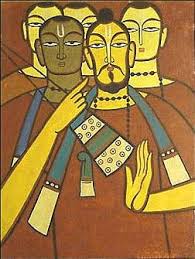
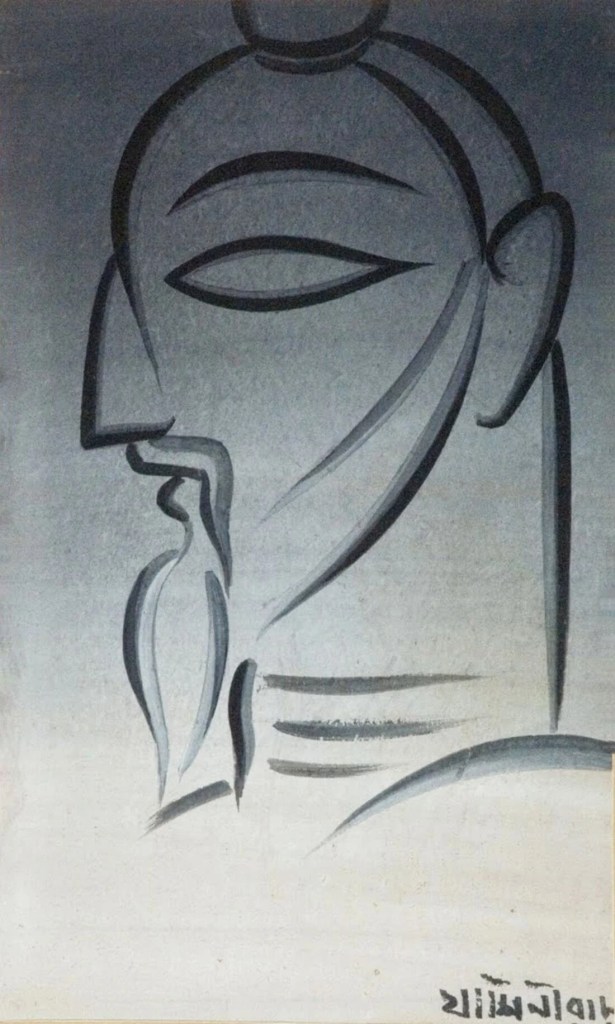
Religious movements such as Bhakti and Sufi have spanned time and territory and entered Bengal, in successive waves, creating a syncretic culture in which music and poetry are amalgamated. One of the forms in which these movements find creative expression is Baul Gaan —the singing of itinerant minstrels.

Universally recognised as foremost among the oralities of Bengal, the Baul Sampradai is a community for whom singing is synonymous with worship. The Baul expounds a philosophy of humanism which rejects religious orthodoxies and stresses human equality irrespective of caste, class, religion and gender. The Baul sets himself on a spiritual journey, lasting a lifetime, towards discovering his moner manush (man within the heart) thereby alienating the notion of seeking the Divine in external forms such as mosques, temples, images and sculptures. Since God is believed to reside within man, the human body is viewed as the site of the ultimate truth –that which encompasses the entire universe. This tenet of Baul philosophy is known as deha tatwabad—the belief that the soul being pure the body that houses it, together with all its functions, is pure and holy.

Concentrated mostly in Kushthia, Shilaidaha and Sajadpur in East Bengal (now Bangladesh) and Murshidabad and Birbhum in West Bengal, the Baul tradition, though drawing elements from Tantra, Shakta and Sahajiya[1], stems from two main sources — Muslim Sufi and Hindu Vaishnav. Hence the simultaneous presence of Hindu and Muslim bauls in the villages of Bengal and great composers from both streams—Lalon Fakir, Duddu Shah, Madan Baul, Gagan Harkara and Fakirchand. Rejecting religious codes such as Shariat and Shastras, caste differences, social conventions and taboos, which they see as barriers to a true union with God, they sing of harmony between man and man. “Temples and mosques obstruct my path,” the Baul sings, “and I can’t hear your voice when teachers and priests crowd around me.”

Refusing to conform to the conventions of religion and caste ridden Bengali society, Bauls (the word is sourced from the middle eastern bawal meaning mad or possessed) are wandering minstrels who sing and dance on their way to an inner vision. Essentially nomadic in nature walking, for them, is a way of life. “No baul should live under the same tree for more than three days” — the saying seems to stem from the Sufi doctrine of walking an endless path (manzil) in quest of the land where the Beloved (the Divine) might be glimpsed. Bauls live on alms which people give readily. In return the Baul sings strumming his ektara[2] with dancing movements. The songs are rich with symbolism, on the one hand, and full of ready wit and rustic humour on the other. The Baul rails against the hypocrisy of religion and caste and takes sharp digs at the clergy but totally without rancour.

Many of the composite forms found in an older culture of Bengal have become sadly obscured in the present scenario of identity politics. But the one that has not only survived but is gaining in recognition day by day, is the Baul tradition. This is, in no small measure, owing to the intervention and interest taken by Rabindranath Tagore. In his Religion of Man Rabindranath tells us that, being the son of the founder of the Adi Brahmo Samaj, he had followed a monotheistic ideal from childhood but, on gaining maturity, had sensed within himself a disconnect from the organised belief he had inherited. Gradually the feeling that he was using a mask to hide the fact that he had mentally severed his connection with the Brahmo Samaj began tormenting him. And while in this frame of mind, travelling through the family estates in rural Bengal, he heard a Baul sing. The singer was a postal runner by the name of Gagan Harkara and the song was “Ami kothai paabo tare/ amaar moner manush je re[3].”

“What struck me in this simple song,” Rabindranath goes on to say, “was a religious expression that was neither grossly concrete, full of crude details, nor metaphysical in its rarefied transcendentalism… Since then, I’ve often tried to meet these people and sought to understand them through their songs which are their only form of worship.” In his Preface to Haramoni[4], Rabindranath makes another reference to this song. Quoting some lines from the Upanishads—   Know him whom you need to know/ else suffer the pangs of death— he goes on to say, “What I heard from the mouth of a peasant in rustic language and a primary tune was the same. I heard, in his voice, the loss and bewilderment of a child separated from its mother. The Upanishads speak of the one who dwells deep within the heart antartama hridayatma[5]and the Baul sings of the moner manush. They seem to me to be one and the same and the thought fills me with wonder.”
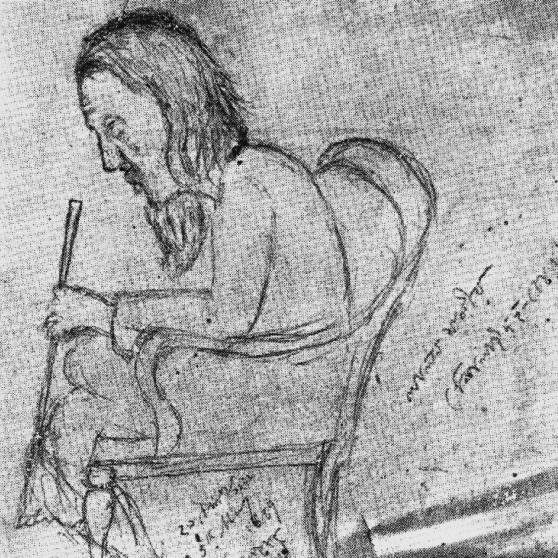
A Portrait of Lalon Fakir sketched by Jyotindranath Tagore(1849-1925)

Lalon Fakir’s commune was located in the village of Chheurhia which fell within Rabindranath’s father’s estates. Though there is no authentic record of a meeting between the two, it is a fact that the poet was the first to recognise Lalon’s merit which had the quality of a rough diamond. His inspiration was powerful and spontaneous but, lacking in clarity of expression, lay buried in obscurity till Rabindranath brought it out into the open. Publishing some of the songs in some of the major journals of the time, Rabindranath took them to the doors of the educated elite. Not only that. They gained in popularity from the fact that he, himself, often used Baul thought and melody in his own work. “In some songs,” he tells us in his Manush er Dharma[6], “the primary tunes got mixed up with other raags – raaginis which prove that the Baul idiom entered my sub conscious fairly early in life. The man of my heart, moner manush, is the true Devata[7]. To the extent that I’m honest and true to my knowledge, action and thought — to that extent will I find the man of my heart. When there is distortion within, I lose sight of him. Man’s tendency is to look two ways — within and without. When we seek him without — in wealth, fame and self- gratification — we lose him within.”

But it wasn’t only in his compositions that Rabindranath disseminated Baul ideology. It went deeper than that. The primitive simplicity and freedom of Baul thought and living charmed him so completely that he started imbibing them in his own lifestyle. He grew his hair long, kept a flowing beard and wore loose robes. He created Baul like characters in his plays and dance dramas and enacted the roles himself. And, as he grew older, a restlessness; an inability to stay in one place took hold of him. Leaving the ancestral mansion of Jorasanko he relocated to Santiniketan but even there he could not stay in the same house for more than two months. In the last two and half decades of his life, a tremendous wanderlust seized him. He travelled extensively both within the country and without, earning for himself the sobriquet of ‘roving ambassador for India’.

Perhaps, the most powerful testimony of the evolution of Rabindranath from a princely scion of the Tagores of Jorasanko to the man he finally became is found in Abanindranath’s portrait of his uncle. It depicts an old man with flowing white locks and beard, wearing a loose robe and holding an ektara high above his head. The limbs are fluid in an ecstatic dance movement. It is a significant fact that the painting is titled Robi Baul.
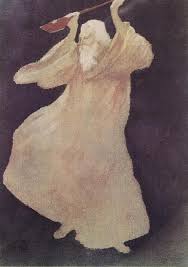
Robi Baul (1916): Painting by Abanindranath Tagore (1871-1951). From Public Domain

[1] Different schools of philosophy and religion. The Sahajiya is a philosophy that embrace nature and the natural way of life.

[2] String instrument

[3] Translates from Bengali to: “Where will I find Him — He who dwells within my heart”

[4] The Haramoni (Lost Jewels) is 13-volume collection of Baul songs compiled by Mansooruddin to which Tagore wrote the preface for the first volume published in 1931

[5] Translates to ‘innermost part of the heart and soul’

[6] Collection of Lectures by Tagore in Bengali, published in 1932

[7] Translates to “God’

Aruna Chakravarti has been the principal of a prestigious women’s college of Delhi University for ten years. She is also a well-known academic, creative writer and translator. Her novels, JorasankoDaughters of JorasankoThe Inheritors, Suralakshmi Villa and The Mendicant Prince have sold widely and received rave reviews. She has two collections of short stories and many translations, the latest being Rising from the Dust. She has also received awards such as the Vaitalik Award, Sahitya Akademi Award and Sarat Puraskar for her translations.

.

PLEASE NOTE: ARTICLES CAN ONLY BE REPRODUCED IN OTHER SITES WITH DUE ACKNOWLEDGEMENT TO BORDERLESS JOURNAL 

Click here to access the Borderless anthology, Monalisa No Longer Smiles

Click here to access Monalisa No Longer Smiles on Kindle Amazon International
Categories
Essay

Songs of the Adivasi Earth

For 50 years now Ratnottama Sengupta has seen Haren Thakur adroitly create art from the humdrum of tribal life. And his stylised abstract of the dark-toned humans still makes her sit up and take note.

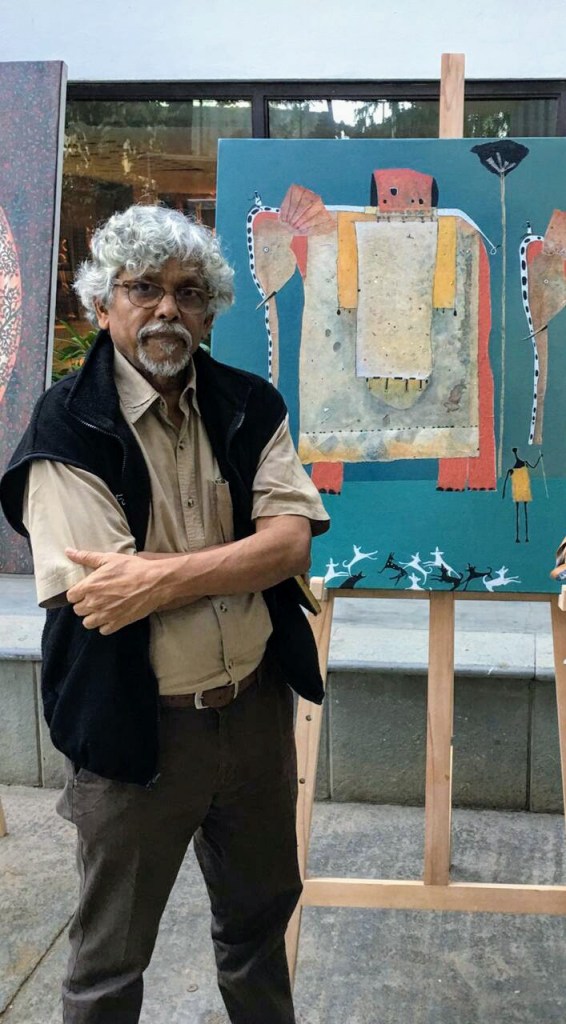
Haren Thakur with his painting. Photo provided by Ratnottama Sengupta

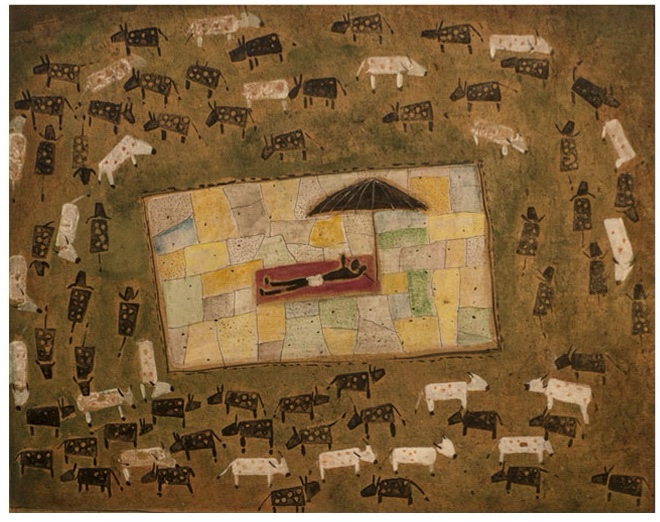
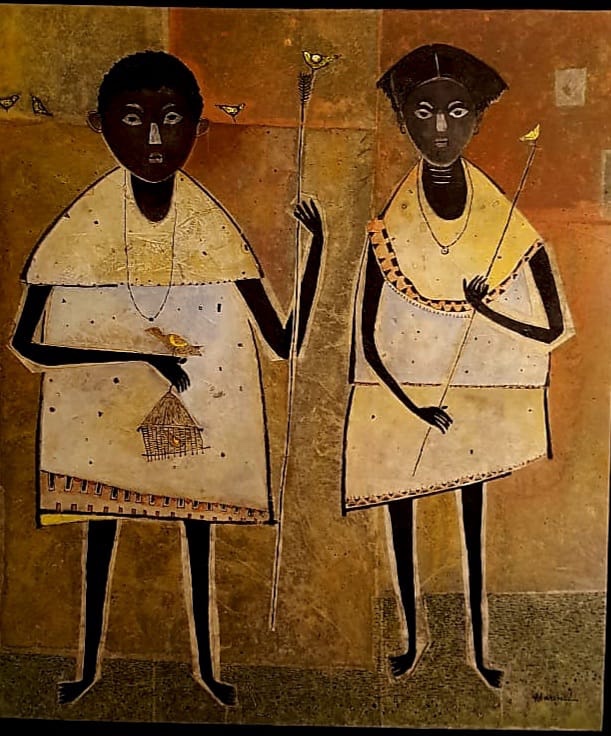
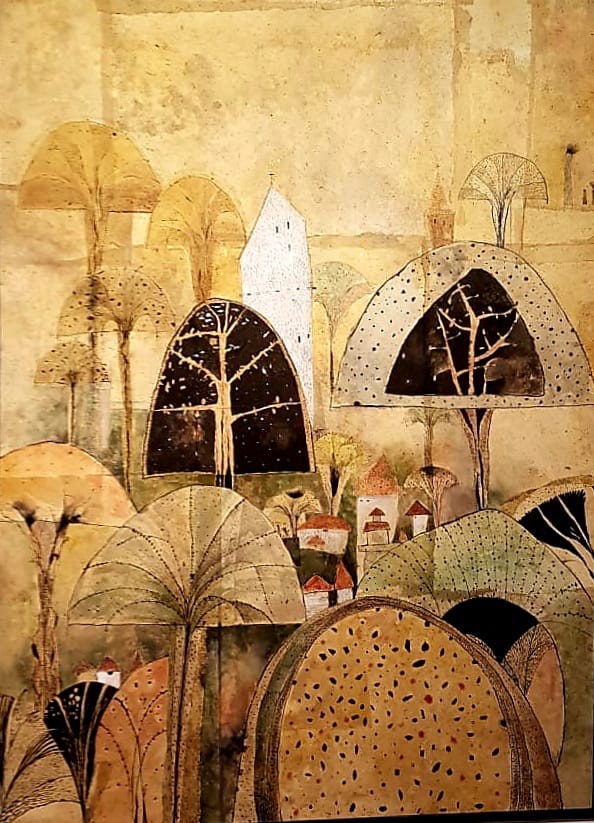
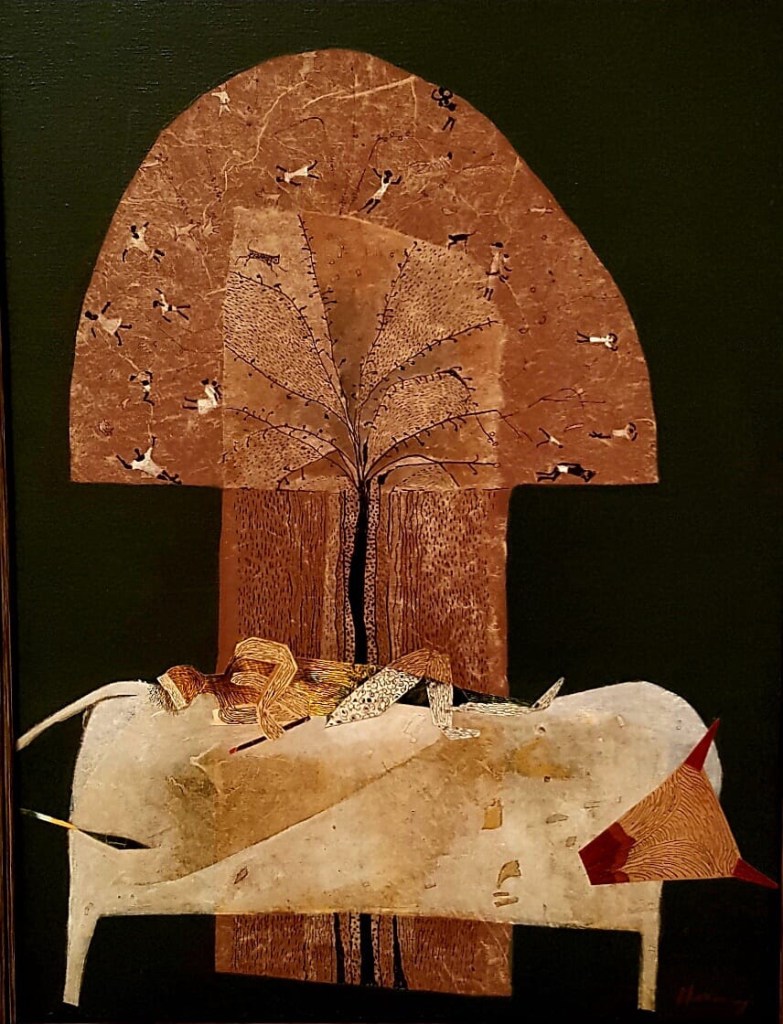
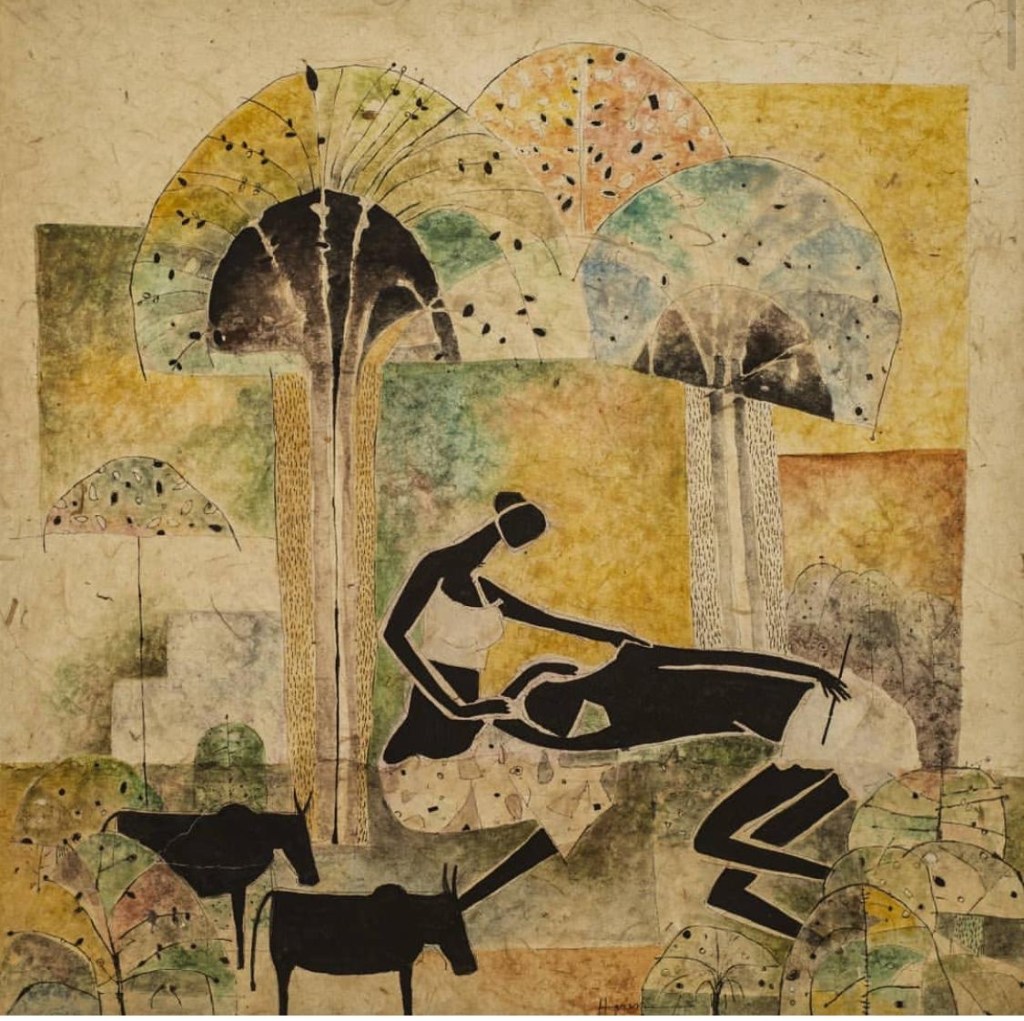
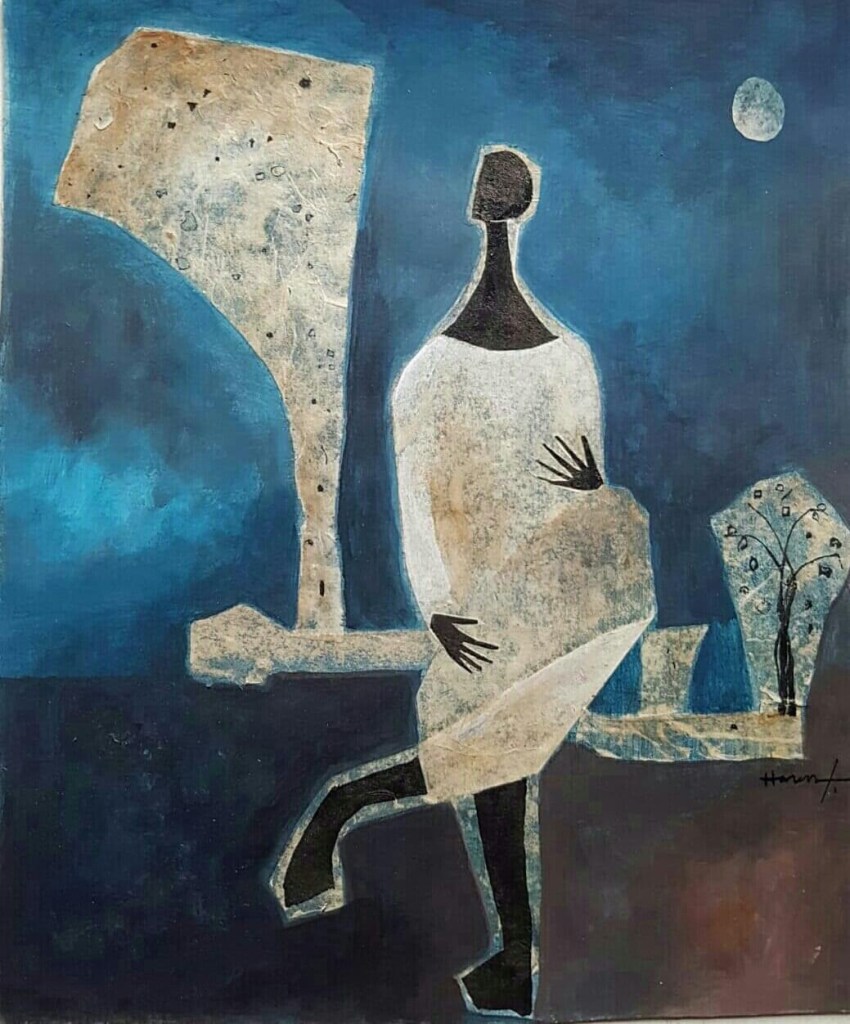
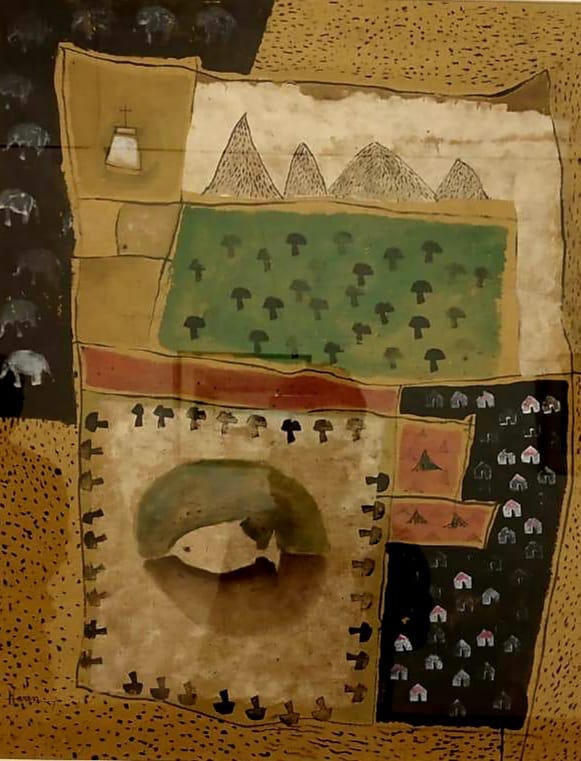
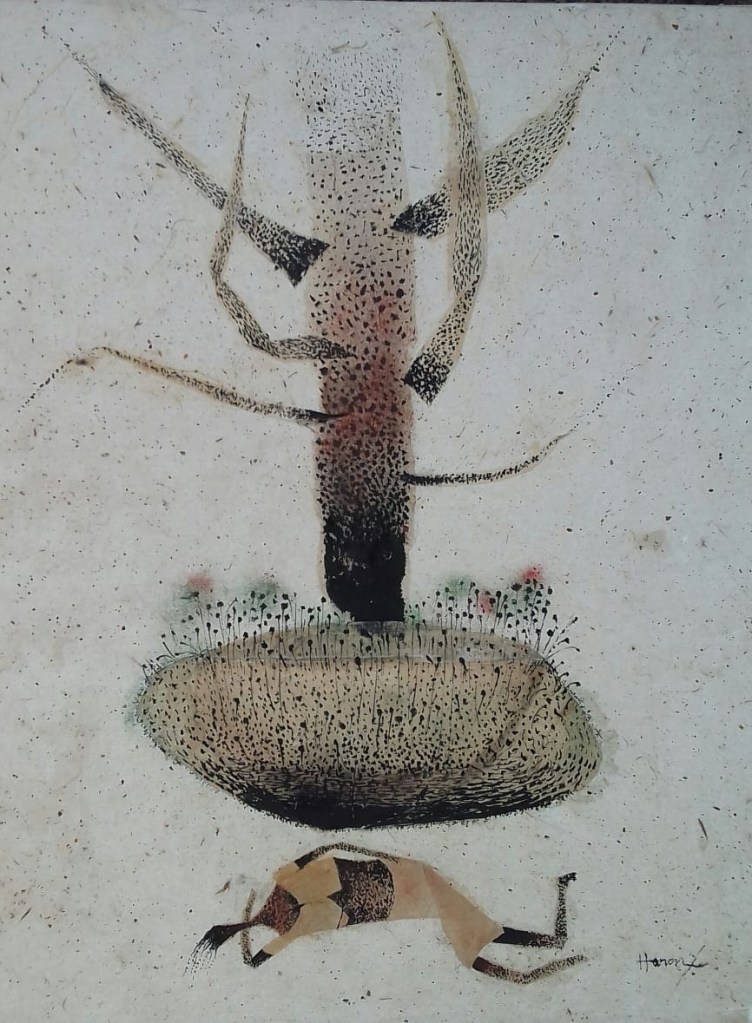
A dark, stick-like outline encompasses a human of the male species. A triangle, an oblong, a rectangle. A white patch in the midst of a sepia-green landscape. A drummer. A mother with a child holding aloft a balloon. Two women bathing in a primitive pond. A quizzical duck. A wriggling worm. Trees hills fish pigs cows fox… And, yes! A train zigzagging its way through a vast expanse of meadows. As we view the watercolours of Haren Thakur from Ranchi, you might think of the rice-white art of the Warli tribals characterised by geometric shapes that depict the rituals of everyday life. I might be inclined to revisit the painted layers on the 100,000-year laterite at the prehistoric rock shelters of Bhimbetka in the foothills of the Vindhyas in Madhya Pradesh. Another viewer might think of the ancient Sauras and the adornment of their walls in their adobe huts in Odisha. The artist himself might have recollections of the animated Santhal pats he saw being created during his student years in Tagore’s Santiniketan. However, none of Haren’s figures are simplistic. They are all stylised. And so adroitly that you are bound to sit up and take note of them no matter how many times you have come across the theme.

Form and content come seamlessly together in the paintings that Haren Thakur will exhibit in Delhi’s Habitat Centre from April 15. The artist who mastered Art at Santiniketan — home to Santhals, the native dwellers of Bengal and Odisha — then made his living in Jharkhand, which is home to 32 tribes… Indeed, from his very beginning, the beauty in the dark skin-tone of the men and women going about their chores was the most natural rhythm of life in the bazaars and streets of Bankura Bishnupur, where his family hailed from, or in Purulia, where his father made his home. 

Beyond doubt, Rabindranath’s deep affection for the Santhals and the Bauls reinforced this love. Much like Gurudev, Haren finds poetry in their tilling of the earth. In their mono-toned songs and the repetitive steps of their dance. In the fulfilment they find in the primeval life and archetypal love. And when, following in the footsteps of the Universal Poet, Haren finds beauty in a grain of sand, the everyday life ceases to be an essay in deprivation and rises to the level of art.

*

And his colour palette? That too came off the walls of his hostel in Santiniketan, from the frescoes and murals by Binode Behari Mukherjee. From the brick-toned ‘canvas’ that is the prehistoric rock painting of Bhimbetka. The pigment on Haren’s brush and tubes is never loud then, never grating. It is always muted, always mellow. And the impact is heightened by Haren’s utilisation of rice paper, and Chinese ink, on watercolour.

The Nepali rice paper became his signature in 1974. Prior to that he would work the rice paper in the tempera process that was ‘Master Moshai’ Nandalal Bose’s gharana, school – or Indian shaili, style. But in that process of painting layer by layer, the rice paper would lose its original character and serve merely as a background surface.

Then, in his fourth year, for a scholarship test of the Visva Bharati University, Haren experimented by soaking the rice paper in water. It became so pliant that he could spread it out like a piece of cloth. “And its texture!” It won him the scholarship — and immense appreciation from his teachers, Dinkar Kaushik and Somnath Hore. “They said, ‘Go ahead and explore this medium and this process further. It adds a dimension that has immense possibility.”

Fifty years have gone by since, but Haren has not given it up. Sometimes, when painting on canvas, he does apply acrylic directly on its surface. But at times, even here, he pastes rice paper on the canvas, primes it with watercolour, then inks in the forms. However he adds, “when I paint on rice paper mounted on board, I do not – cannot – use acrylic. It simply doesn’t have the capacity to be absorbed by the rice paper the way watercolour gets absorbed.” So, in such cases Haren uses transparent watercolour.

Clearly the chemistry between rice paper and watercolour is amazing. Unique.

*

Circling back to the content: Haren’s understated pitch was reinforced by the Zen worldview of a teacher like Somnath Hore. The master minimalist’s use of the white, barely scratched by the red of a wound, spoke volumes — and it made Haren introspect. Once, while exhibiting the Wound series, Somnath Da had said, “I discovered such depth of emotion in the reticence of tones!” This soliloquy got deeply etched in Haren’s unconscious. And eventually it came to express itself in the rusty red of the iron oxide rich Birbhum soil; the roasted brown of Purulia’s rocky earth; the weathered green of the Bauls; the soothing blue of the open sky high above the woolly white of floating clouds.

Flattened figures. Non-realistic features. Do you see a hint of Husain – or perhaps Paul Klee – in the abstraction of the human world? I notice a reflection of the figures encountered on Egyptian papyrus. Or the African world. Haren, on his part, reiterates his original inclination: the attraction towards the lack of artifice in Adivasi life. How else would the tribals go about their daily humdrum with a baby knotted to their back? Or float in an open pool under the sun-kissed sky? To the city-bred mind, this would be unthinkable — until Haren captions it ‘Nature’s Bathtub’!

But, notwithstanding my references, the art traditions of the indigenous people over the world have never influenced Haren. “Their art tradition is so rooted in their environment – be it of Jharkhand or of any other.” Even their pigments, brush, and surface are integral to their life. But he certainly derives inspiration from the lifestyle of the original inhabitants, he affirms.

“I have always admired their direct application, the spontaneity of their form,” Haren further explains. “But I am influenced rather by the uncomplicated lives they lead. Since I was in Santiniketan I have admired the way they connect with nature in everything they do. Their intimacy with animals is incredible – they seem to be in dialogue with the animals they domesticate! This became a part of my visual world, especially when I came to live in Ranchi. The same reality imbues the lives of the natives – Oraon, Munda, Ho, Sabar, Bedia, Lohar… They rest under the tree unconcerned about how the ‘civilised’ world looks at them. They speak with the hills, with clouds in the sky, with cattle and kids, trees and waters, rivers and streams!”

This they do with no inhibition. Because this routine is a reality they have inherited from their ancients. “That is why I believe there is nothing more ‘Contemporary’ than this,” Haren asserts. This innate natural life, and the Santiniketan grooming, combined to forge his vocabulary, his visual language.

So, in the exhibits, you encounter an abundance of water bodies. Pools and ponds. Rivers and waterfalls. Lotus and lily. Big fish. Many small fish in its tummy. Ducks and kingfishers. Hyacinth and hayfield. All this is a natural part of the countryside that has made Haren theirs.

Interestingly there is also this play with size. In one of the frames an elephant walks down the road – and at every footfall he is greeted by a number of… ants?! Look closely and you will decipher that they are dogs!

Haren is giving you a worm’s eye view. And, in addition to the proportion, he is  picturing the Hindi proverb Haathi chaley bazar, kutta bhaukey hazaar/ when an elephant walks to the market, a thousand dogs will bark! Political comment? You said it!

Stay tuned to the song of the Adivasi earth, Haren.

.

Ratnottama Sengupta, formerly Arts Editor of  The Times of India, teaches mass communication and film appreciation, curates film festivals and art exhibitions, and translates and writes books. She has been a member of CBFC, served on the National Film Awards jury and has herself won a National Award. 

.

PLEASE NOTE: ARTICLES CAN ONLY BE REPRODUCED IN OTHER SITES WITH DUE ACKNOWLEDGEMENT TO BORDERLESS JOURNAL

Click here to access the Borderless anthology, Monalisa No Longer Smiles

Click here to access Monalisa No Longer Smiles on Amazon International

Categories
Tribute

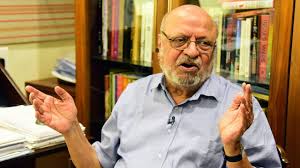
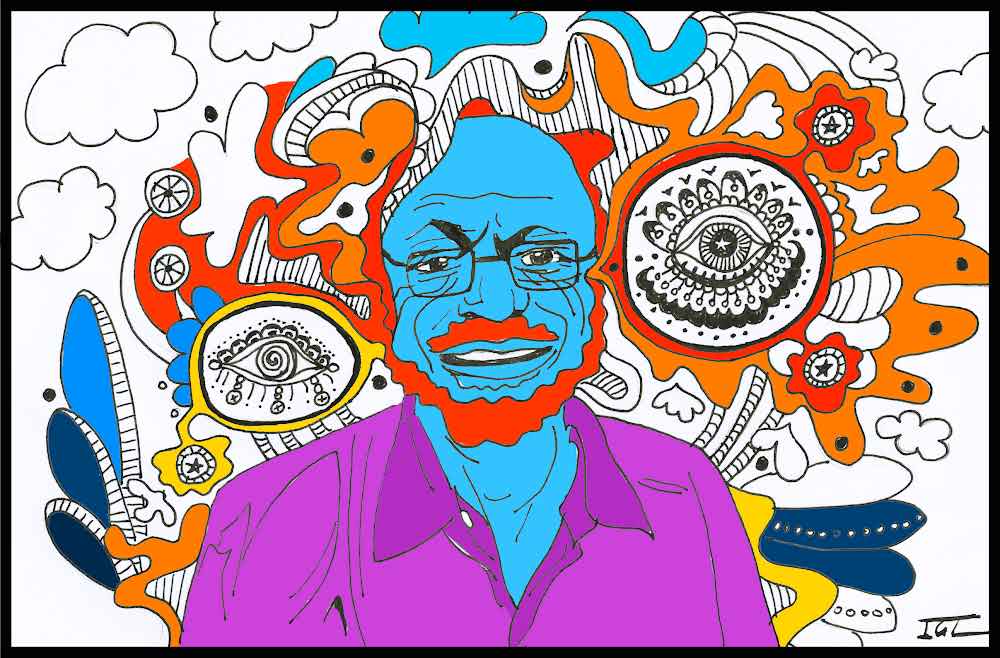
Well Done, Shyam! Never say ‘Goodbye’!

By Ratnottama Sengupta

“If I enjoy the film I have made, then I am quite certain viewers will too. And what business do I have to burden viewers with what I myself do not enjoy?”

–Shyam Benegal (in an interaction with Ratnottama Sengupta)

Art is not elitist. Nor is artistic experience one that only the elite can enjoy. The world’s greatest art has been accessible to all mankind. Taj Mahal was erected in memory of Mumtaz Mahal but it is for the world to access and admire. The cave paintings at Ajanta propagated a certain philosophy but thousands of years later too they mesmerise one and all.  And, anyone who goes to Tanjore temple experiences its magnificence. Cinema too is capable of providing such universal experience. What is more, it is possible to provide such an experience without distorting or oversimplifying an idea.

Shyam Benegal (1934-2024) had dinned this belief into me when I interviewed with him for the first time — in Bombay of 1980. Seven years before that he had proved it to the world with his debut film, Ankur (The Seedling, 1974). It had announced itself to cineastes through its nomination for the Golden Bear at the 24th Berlin Film Festival and had gone on to win three National Awards. In the wake of stylised trendsetters like Bhuvan Shome (directed by Mrinal Sen, 1969), Uski Roti (Others’ Bread, directed by Mani Kaul, 1969) and Maya Darpan (Illusory Mirror, directed by Kumar Shahani, 1972), everyone expected Ankur to be another “arty” film. In other words, “pretentious”, “pseudo intellectual”, even “boring”. Far from refusing to peter out of theatres due to lack of footfalls, the Rs 5-lakh budget film went on to garner millions because it engaged audiences of every shade and strata. And it was hailed as marking a new beginning in Indian cinema that had roots in the narrative tradition of earlier masters such as Bimal Roy and Benegal’s own cousin, Guru Dutt.

No, Ankur was not a fluke, Nishant (Night’s End, 1975) had proven. Once again, Benegal had set his film in Telengana, that part of Andhra Pradesh which had seen him grow up with his siblings in the household of his father whose livelihood came from a photo studio. “Alwal was a semi-rural semi-urban area, so I had seen both sides of a feudal society coming to grips with modernity setting in,” Benegal had explained to me.

Ankur had touched upon several ills of the feudal system: class difference, caste inequity, sexual exploitation of women, of the physically challenged, and even alcoholism among the poor. It had a sequence of thrashing, and it closed with the indication of violent protest. Almost all these themes would flower into independent saplings in Benegal’s subsequent films. Because the important thing for him, as he once said to BBC, was that “post-Independence India was changing its feudal character to the kind of society we wanted to create. Industrialisation at one level, creation of the middle class at another level, and disappearance of the regressive values of the feudal life.” 

At that time, when I was yet to step out of my teens, I was deeply impacted by the oppressive ‘liberty’ of the caste person who thought he had a right over the lowborn woman. The empowerment of women was a theme Benegal felt strongly about. “The idea had started during the national movement with Gandhi, who first talked about women having equal responsibility,” pointed out the director of The Making of a Mahatma (1996). “They have to become aware of their strength and empower themselves because 50 percent of your population comprises of women.”

*

From the birth of a new nation to the birth of a nation, Benegal constantly grappled with these themes. With “the whole business of tradition and modernity,” to borrow his words. “In an ancient society like India where so much of tradition is still valued and revered, when will we get rid of the dubious virtues?” he wondered.

Benegal functioned with a sensibility that was native to the length and breadth of the land that was his canvas. “As long as one functions with one’s sensibility, it will resonate with every person of that sensibility,” he maintained. 

To me the most endearing trait of a Benegal film is the simplicity of its narrative. His incidents came out of life, his characters were from his surroundings. And his unfolding, though devoid of gimmick, was not bereft of drama nor of violence. He learnt to steer clear of artifices while making ad films where, “because you have to make your point in one minute, you tend to fall back on gimmick.”

Clarity of purpose and simplicity of narration were the two rails that never let his script go off into a meander of ultra mystical or complex metaphors. Magic realism? Hyper realism? High pitched melodrama? Benegal had need for none of these ploys. “The most complex of ideas have a simple way of projecting themselves,” he’d say. That, and not its reverse, was the most valid mantra of his life.

Why did the Phalke or the Padma Bhushan awards like simple story telling? “Because I like to involve people, and that happens when there is a dramatic juxtaposition of characters.” The use of drama did not in any way dilute the significance of his subject — be it casteism (Samar, Conflict, 1999), women’s empowerment (Bhumika, Role, 1977), portrayal of the principles of national heroes (Making of the Mahatma), or the struggle to wrest power from an oppressor (Junoon, The Obsession, 1978). Be it in feudal Telengana (Nishant), in a Borgadar’s Bengal (Arohan, The Ascent, 1982), an industrial Bombay (Kalyug, The Age of Vice, 1981), in Bose’s Burma (The Forgotten Hero, 2005), or Mujib’s Bangla (Mujib: The Making of a Nation, 2023). 

In the process he dispelled the notion that showing our reality in cinema cannot engross or entertain. In fact, he questioned the very definition of the word ‘Entertainment’. “If a serious talk or a news holds you spellbound, isn’t that also entertainment?” he had asked me.

So, in order to engage the viewers, Benegal plunged into problems and miseries of the marginalised Indian: the milkman (Manthan, The Churning, 1976) and the weaver (Susman, The Essence, 1978), the untouchable (Samar) and the glamorous (Bhumika), the royals (Zubeidaa, 2001) and the entertainer (Sardari Begum, 1996), the middle class households where women are mere birthing machines (Hari Bhari, 2000), or the illiterate voters of Sajjanpur (Welcome to Sajjanpur, 2008).

Through all these voters, men and women, landlords and servants, on the banks of Katha Sagar (A Sea of Stories, 1986, TV series) or in the arid Birbhum or in the Mandi (Market Place, 1983) of flesh, Benegal made spectators of us. “Even a road accident turns us into spectators, some mute, some aggressive, some caring,” he’d pointed out. “What is it we want to experience when we rush to the window when we hear a car screeching to a half?” he’d asked. “Why is an unanticipated death — or murder — part of the entertainment formula? Because the adrenaline rush, the excitement in these exorcises our fears,” he had explained. 

But Benegal’s wasn’t a conventional definition of entertainment. Nor did he decry the use of violence in mainstream cinema. “Indeed, it helps society because viewers find vicarious release from the stress that builds up in the tension filled life in urban societies.” As for his own films rooted in the remote pockets away from the metros? “Sometimes we need to use force because some social problems have got so deeply entrenched,” he was unabashed about violence in his films. “Change in certain situations can come only from the use of violence. But be careful never to lose your moral compass,” he immediately warned me. “Violence cannot be indiscriminately justified nor universalised. And in no circumstance should it be  glamourised.”

So human impulses, and social well-being were his prime concern.  The constant interaction between an individual and his or her milieu; suffering inequities, and standing up against exploitation — we gained insight into these when we sat in darkened auditoriums to watch Arohan, Sardari Begum, Mammo (1994), Well Done Abba…(2010)

Socio-economic. Socio-political. Socio-legal. No label of genre could own Shyam Benegal. Because? “That will restrict my own thinking. How can I keep pace with the galloping changes that come with the ticking of centuries? And when the march of science unleashes computers and cellular phones, Internet and digital filmmaking?”

But what prompted his choice of subject every time he sat down to work on a script — with Shama Zaidi or Girish Karnad, Satyadev Dubey or Khalid Mohamed[1]? “There’s an electic streak in me that will not let me go where I’ve been before or do what I’ve done before,” Benegal was clear. So historical patterns to saw him go from The Making of a Mahatma on Gandhi, the advocate of non-violence, to Bose, The Forgotten Hero who escaped home incarceration and travelled through Himalayan hurdles and joined the Japanese to fight the British colonisers of India. From the Junoon of the Sepoy Rebellion of 1857, to Bharat Ek Khoj (India, a Search, 1988 TV serial) exploring the roots of India. From my Samvidhan (2010, TV mini-series),  the formulation of the Constitution that is the firm foundation of the nation he mapped through his films, to Mujib on the birth of Bangladesh.

This refusal to be contained in a box had seen Benegal go from making promotional ads to documentaries on Steel Authority of India and Artificial Insemination in Animal Husbandry, on Nehru and Satyajit Ray. Benegal’s refusal to be boxed and labelled saw him make

Manthan and Hari Bhari — two prime examples of turning a documentary subject into a feature film. Why, his varied interest saw him making a documentary that mapped the course of a raga which originated with Mallikarjun Mansur hearing a leaking tap in the kitchenette of a friend in Bombay – and went on to capture the spirit of the financial capital!

What explains the prolificity of the man who celebrated his 90th birthday on December 16 and bade goodbye a week later? His indomitable and indefatigable spirit. 

Unusual Concerts: The documentary on Mallikarjun Mansur (1910-1992) and Bombay

[1] Actors on the Hindi screen

.

Ratnottama Sengupta, formerly Arts Editor of  The Times of India, teaches mass communication and film appreciation, curates film festivals and art exhibitions, and translates and write books. She has been a member of CBFC, served on the National Film Awards jury and has herself won a National Award. 

.

PLEASE NOTE: ARTICLES CAN ONLY BE REPRODUCED IN OTHER SITES WITH DUE ACKNOWLEDGEMENT TO BORDERLESS JOURNAL

Click here to access the Borderless anthology, Monalisa No Longer Smiles

Click here to access Monalisa No Longer Smiles on Amazon International

Categories
Review

Short Stories by Nazrul

Book Review by Somdatta Mandal

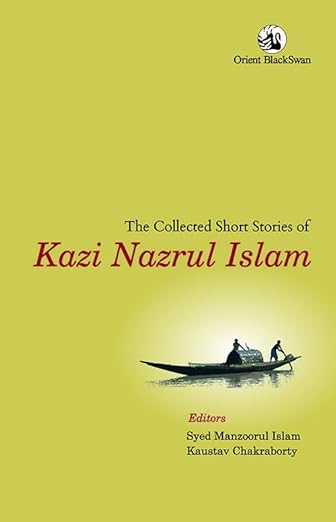
Title: The Collected Short Stories of Kazi Nazrul Islam

Editors: Syed Manzoorul Islam and Kaustav Chakraborty

Publisher: Orient Blackswan

He dons many mantles. Kazi Nazrul Islam (1899 – 1976), the national poet of Bangladesh, was a prolific Bengali poet, revolutionary, essayist, journalist, editor, activist and composer of songs. The very mention of his name conjures up the figure of a fiery iconoclast who fought against the structures of oppression and orthodoxy in society to bring about progress and change. In fact, his self-styled image as the volatile bidrohi or ‘rebel poet’ overshadows his other literary achievements and that is how ordinary people still remember him.

This unique volume presents all twenty of Kazi Nazrul Islam’s short stories for the first time in English translation. Done by different hands, they feature rich imagery, evocative landscapes, references to music, classical poetry, folktales and more. The prominent characteristics of these stories are simplicity, vivacity and emotionality. They have been sourced from different anthologies. The first six stories are from the collection Harvest of Sorrow1.  The opening story of the collection titled “Harvest of Sorrow”, is a collage of tales narrated by the three characters: Dara, Bedoura and Saiful Mulk. Dara, located in Iran’s Golestan, narrates his tale of love, separation and devotion to his motherland through a series of reminiscences. After that, we hear the same set of events narrated from Bedoura’s perspective. Then follows the account narrated by Saiful Mulk, portrayed as a sinner who tempted Bedoura into losing her virginity. Overcome by guilt, he joins the freedom struggle where he encounters Dara. What follows is a tale of redemption loss and transcendence of physical love to a more spiritual kind of love. “Hena”, the second story of the collection, is narrated by Sohrab, and its theme is also love and war – both internal and external battle. “In the Relentless Rain” is basically a story of love between strangers. The author doesn’t provide us the names of the lovers – rather both are addressed as dark-skinned. The next story, “Half Asleep”, is divided into two parts: Azhar’s story and Pari’s story. Azhar’s story is mainly about his sacrifices and why he favours detachment from the sensuousness. His renunciation of carnal pleasures towards attaining greater contentment ends his relationship with Pari, whose marriage he arranges with one of his friends. He ensures that Pari remains confined within the household structure. By making Pari assert that she will not betray her role as a loving wife without pretending to erase the love that she has for her former lover, Nazrul offers a critique of the conventional notion of ‘loyalty’ of wives to serve their husbands. The first-person narrator of “Insatiate Desire” soliloquizes on a saga of disunited love where the narrator falls in love with his childhood friend, feigns disinterest in her when her marriage is arranged to another man, and characterises his own actions as stemming from the most noble impulses. The final piece of the volume, “Letter from a Political Prisoner”, is an epistolary story of a political prisoner who has also been diagnosed with fatal tuberculosis. The story is addressed to the lady of his dreams, Manashi, who does not seem to have reciprocated his love.

 The title story of the next section is from an anthology of the same name, The Agony of the Destitute2. The story centres around the glorification of war but in the process, it also raises questions related to war and gender. In sharp contrast to the narrator-protagonist of this narrative who detaches himself from domesticity to join the war, the protagonist of the very next story, “Autobiography of a Vagabond” suffers a tragic end to his domestic life and thereafter joins the army and eventually dies while fighting in Baghdad. “Meher Negar”, the third story of this section, is another tale of war and conflicts in love. Yusuf Khan, the protagonist, is a Pathan from the mountains of Waziristan who meets Meher Negar (whose actual name is Gulshan) after reaching a distant land to learn music. Later he joins the War of Independence for Afghanistan. Unable to forget her, he visits Meher Negar one last time only to discover that she is no more. As an allegorical piece of writing, “Evening Star” is about a man’s love for a distant beloved that is ultimately futile because of the probable demise of the beloved.

“Rakshasi” is written in the language spoken by the Bagdi community of the Birbhum district in West Bengal in which the speaker Bindi is a woman who complains to her friend about how society has stigmatized her as a demoness because she has killed her husband to save him from abandoning her and getting remarried to a notorious girl.“Salek” is a short moral story where, through a series of events, a dervish (later revealed to be Hafiz) shows an arrogant Kazi the path to salvation; the former becomes the latter’s salek or the one who shows the way. In “The Widow”, Begum, the narrator, speaks of her sorrowful youth, her happy married life and the miseries of her widowhood to her friend Salima. The story challenge multiple stereotypes that are often associated with the women of South Asia. The concluding tale of this volume is titled “The Restless Traveller” which is an impressionistic story centered round the urge towards finding freedom by restless youth.

The four stories that comprise the third volume of Nazrul’s stories and the next section, called The Shiuli Mala3, speak about Nazrul’s ecological sensitivity. The opening story “The Lotus-Cobras” is about Zohra and her human and non-human intimacies. As the editors rightly point out, “In the portrayal of Zohra’s attachment with her serpent sons, Nazrul seems to be very close to the essence of posthumanism where radical posthuman subjectivity is understood on the basis of an intersectional ethics of plurality”. “The King of the Djinns” is a tragicomic story about how Alla-Rakha, the protagonist, resorts to a series of tricks to get married to Chan Bhanu, the woman he desires. “The Volcano” deals with the disaster that is caused by the sudden eruption of repressed anger and egotistic pride in Sabur, the humble, helpful and uncomplaining protagonist of the story. It is a study of the anxiety of manliness. “The Shiuli Mala”, the concluding story of this section, is a testimony to Nazrul’s love for the trope of separated lovers or unrequited love. Set in Shillong, it primarily deals with a platonic and disunited love between Azhar, a well-known chess player, and Shiuli, the daughter of another brilliant chess player, Professor Chowdhury. Structured as a flashback, Azhar narrates the story to his friends who are part of a regular chess adda.

Two unanthologised stories end the collection. “Letter from a Lost Boy” is an epistolary account of a boy who writes to his mother about some incidents in his life that have occurred since he had left her until the time of his return. The story is a critique of child marriage and the consequent early widowhood that brings never-ending misery in the life of a woman. “The Hawk-Cuckoo from the Woods” tells the story of a marital discord between Dushasan Mitra and his wife Romola. Their friction widens after Romola becomes too attached to an injured hawk-cuckoo and her husband feels agitated by her gradual disconnect from their conjugal life.  The story ends with Romola flaying her husband for throwing the bird away, finding and hugging the dying bird to her heart and plunging into the waters of the Padma.

All these twenty stories invite the reader to re-evaluate the ‘rebel poet’ as an empathetic humanitarian who also excelled in human relationships. Nazrul is essentially multilingual – he uses Hindi, Urdu, Arabic and Persian words along with Bangla. This book is the outcome of a project sponsored by the Nazrul Centre for Social and Cultural Studies, Kazi Nazrul University, Asansol, West Bengal. The volume is a transnational, collaborative labour of love bringing together the editors and translators from Bangladesh and India. Most of them are academics and have taken up the challenge to translate the stories, which in their infinite variety, is indeed a difficult task. The stories are accompanied by a timeline of Nazrul’s life and a detailed critical introduction that not only provides foundational context for the stories, but also highlights Nazrul’s attempt to counter majoritarianism and various hegemonies by dismantling hierarchies and celebrating intimate pluralities. In fact, at the end of their introduction, the editors Syed Manzoorul Islam and Kaustav Chakraborty ask two very pertinent questions. “In which category can we place Nazrul? Is there a need to formulate a different category altogether in order to position him?” The answers of course lie with the readers of the translated stories to decide. All said and done, this volume of short stories is strongly recommended for all classes of readers who are keen to discover the multi-faceted genius of Kazi Nazrul Islam and who could not earlier savour their uniqueness because they were only written in Bangla.

  1. Byathar Daan (Harvest of Sorrows) published in March 1922 ↩︎
  2. Rikter Bedon (Agony of the Destitute) published in January 1925 ↩︎
  3. Shiuli Mala (Garland of Jasmines) published in October 1931 ↩︎

Somdatta Mandal, critic, academic and translator, is a former Professor of English at Visva-Bharati University, Santiniketan, India.

PLEASE NOTE: ARTICLES CAN ONLY BE REPRODUCED IN OTHER SITES WITH DUE ACKNOWLEDGEMENT TO BORDERLESS JOURNAL

Click here to access the Borderless anthology, Monalisa No Longer Smiles

Click here to access Monalisa No Longer Smiles on Amazon International