Categories
Interview Review

Can Climate Change Lead to More Cyclones?

A discussion with Bhaksar Parichha, author of Cyclones in Odisha, Landfall, Wreckage and Resilience, published by Pen in Books.

While wars respect manmade borders, cyclones do not. They rip across countries, borders, seas and land — destroying not just trees, forests and fields but also human constructs, countries, economies and homes. They ravage and rage bringing floods, landslides and contamination in their wake. Discussing these, Bhaskar Parichha, a senior journalist, has written a book called Cyclones in Odisha, Landfall, Wreckage and Resilience. He has concluded interestingly that climate change will increase the frequency of such weather events, and the recovery has to be dealt by with regional support from NGOs.
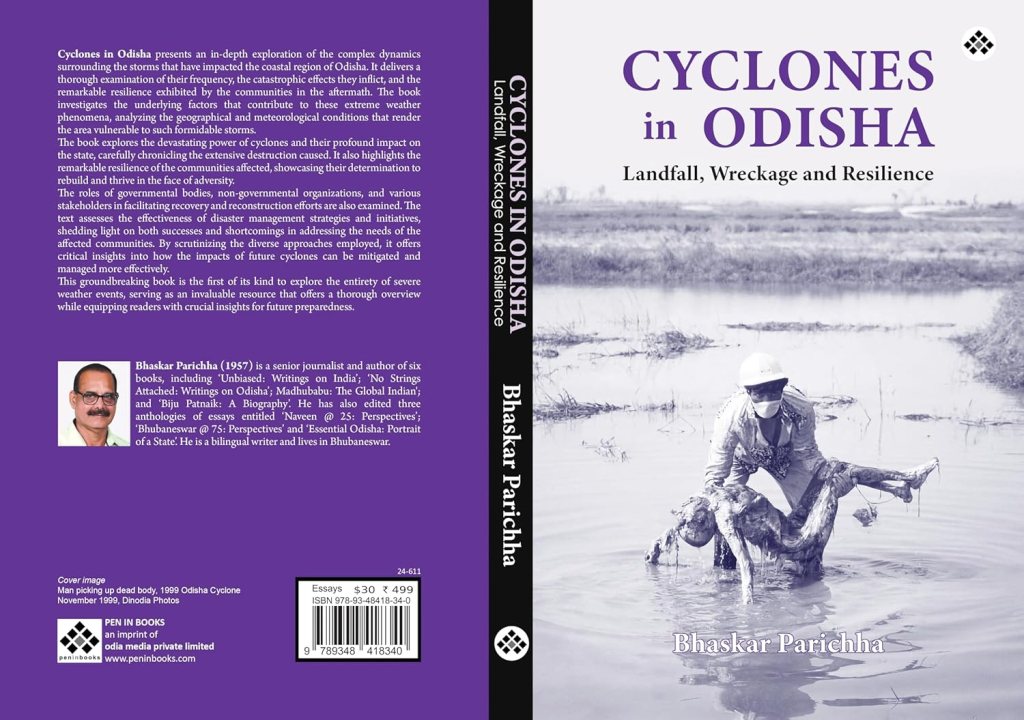
Perhaps, this conclusion has been borne of the experience in Odisha, one of the most vulnerable, disaster prone states of India, where he stays and a place which he feels passionately about. Centring his narrative initially around the Super Cyclone of 1999, he has shown how as a region, Odisha arranged its own recovery process. During the Super Cyclone, the central government allocated only Rs 8 crore where Rs 500 crore had been requested and set up a task force to help. They distributed vaccines and necessary relief but solving the problem at a national level seemed a far cry. Parichha writes: “As a result, the relief efforts were temporarily limited. To accommodate the displaced individuals, schools that remained intact after the cyclone were repurposed as temporary shelters.

 “The aftermath of the cyclone also led to a significant number of animal carcasses, prompting the Government of India to offer a compensation of 250 rupees for each carcass burned, which was higher than the minimum wage. However, this decision faced criticism, leading the government to fly in 200 castaways from New Delhi and 500 from Odisha to carry out the removal of the carcasses.”

He goes on to tell us: “The international community came together to provide much-needed support to the recovery efforts in India following the devastating cyclone. The Canadian International Development Agency, European Commission, British Department for International Development, Swiss Humanitarian Aid Unit, and Australian Government all made significant contributions to various relief organisations on the ground. These donations helped to provide essential aid such as food, shelter, and medical assistance to those affected by the disaster. The generosity and solidarity shown by these countries underscored the importance of global cooperation in times of crisis.” They had to take aid from organisations like Oxfam, Indian Red Cross and more organisations based out of US and other countries. Concerted international effort was necessary to heal back.

He gives us the details of the subsequent cyclones, the statistics and the action taken. He tells us while the Bay of Bengal has always been prone to cyclones, from 1773 to 1999, over more than two centuries, ten cyclones were listed. Whereas from 1999 to 2021, a little over two decades, there have been nine cyclones. Have the frequency of cyclones gone up due to climate change? A question that has been repeatedly discussed with ongoing research mentioned in this book. Given the scenario that the whole world is impacted by climate disasters — including forest fires that continue to rage through the LA region in USA — Parichha’s suggestion we build resilience comes at a very timely juncture. He has spoken of resilience eloquently:

“Resilience refers to the ability to recover and bounce back from challenging situations. It encompasses the capacity of individuals, communities, or systems to withstand, adapt, and overcome adversity, trauma, or significant obstacles. Resilience involves not only psychological and emotional strength but also physical resilience to navigate through hardships, setbacks, or crises.

“Resilience is the remarkable capacity of individuals to recover, adapt and thrive in the face of adversity, challenges, or significant life changes. It is the ability to bounce back from setbacks, disappointments, or failures, and to maintain a positive outlook and sense of well-being despite difficult circumstances.

“Resilience is not about avoiding or denying the existence of hardships, but rather about facing them head-on and finding ways to overcome them. It involves developing a set of skills, attitudes, and strategies that enable individuals to navigate through difficult times and emerge stronger and more capable.”

He has hit the nail on the head with his accurate description of where we need to be if we want our progeny to have a good life hundred years from now. We need this effort and the ability to find ways to solve and survive major events like climate change. Parichha argues Odisha has built its resilience at a regional level, then why can’t we? This conversation focusses on Parichha’s book in context of the current climate scenario.

Bhaskar Parichha

What prompted you to write this book?

Odisha possesses an unfavorable history of cyclones with some of the most catastrophic storms. People suffered. My motivation stemmed from documenting this history, emphasising previous occurrences and their effects on communities, infrastructure, and the environment.

What kind of research went into this book? How long did it take you to have the book ready?

The idea for the book originated more than a year ago. It was intended for release to commemorate the twenty-fifth anniversary of the 1999 Super Cyclone and the cyclones that followed. Having witnessed the disaster first-hand and having been involved in the audio-visual documentation of the relief and rehabilitation initiatives in and around Paradip Port after the Super Cyclone, I gained a comprehensive understanding of the topic. The research was largely based on a thorough examination of the available literature, which included numerous documents and reports.

Promptly after you launched your book, we had Cyclone Dana in October 2024. Can you tell us how it was tackled in Odisha? Did you need help from the central government or other countries?

Cyclone Dana made landfall on the eastern coast on the morning of October 25, unleashing heavy rainfall and strong winds that uprooted trees and power poles, resulting in considerable damage to infrastructure and agriculture across 14 districts in Odisha. Approximately 4.5 million individuals were affected. West Bengal also experienced the effects of Cyclone Dana. After effectively addressing the cyclone’s impact with a goal of zero casualties, the Odisha government shifted its focus to restoration efforts, addressing the extensive damage to crops, thatched homes, and public infrastructure. The government managed the aftermath of the cyclone utilizing its financial resources.

Tell us how climate change impacts such weather events.

Climate change significantly influences weather events in a variety of ways, leading to more frequent and intense occurrences of extreme weather phenomena. As global temperatures rise due to increased greenhouse gas emissions, the atmosphere can hold more moisture, which can result in heavier rainfall and more severe storms. This can lead to flooding in some regions while causing droughts in others, as altered precipitation patterns disrupt the natural balance of ecosystems.

What made people in Odisha think of starting their own NGOs and state-level groups to work with cyclones?

The impetus for establishing non-governmental organisations and state-level entities in Odisha is fundamentally linked to the region’s historical encounters with cyclones, which have highlighted the necessity for improved community readiness. Through the promotion of cooperation between governmental agencies and civil society organisations, Odisha has developed a robust framework that is adept at responding to natural disasters while simultaneously empowering local communities.

What are the steps you take to build this resilience to withstand the destruction caused by cyclones? Where should other regions start? And would they get support from Odisha to help build their resilience?

Building resilience to withstand the destruction caused by cyclones involves a multi-faceted approach that encompasses infrastructure development, community engagement, and effective disaster management systems. Odisha has established a robust model that other regions can learn from. Odisha’s experience positions it as a potential leader in sharing knowledge and best practices with other regions. The state has demonstrated its commitment to enhancing disaster resilience through partnerships with international organisations and by sharing its model of disaster preparedness with other states facing similar challenges. Odisha can offer training programs and workshops based on its successful strategies, guide in implementing early warning systems, building resilient infrastructure and also collaborating with NGOs and international agencies to secure funding for resilience-building initiatives in vulnerable regions.

You have shown that these cyclones rage across states, countries and borders in the region, impacting even Bangladesh and Myanmar. They do not really respect borders drawn by politics, religion or even nature. If your state is prepared, do the other regions impacted by the storm continue to suffer…? Or does your support extend to the whole region?

Odisha is diligently assisting its impacted regions through comprehensive evacuation and relief initiatives, while adjacent areas such as West Bengal are also feeling the effects of the cyclone. The collaborative response seeks to reduce damage and safeguard the well-being of residents in both states. Odisha’s approach to cyclone response has garnered international acclaim.

Can we have complete immunity from such weather events by building our resilience? I remember in Star Wars — of course this is a stretch — in Kamino they had a fortress against bad weather which seemed to rage endlessly and in Asimov’s novels, humanity moved underground, abandoning the surface. Would you think humanity would ever have to resort to such extreme measures?

The idea of humanity seeking refuge underground, as illustrated in the writings of Isaac Asimov, alongside the perpetual storms on Kamino from the Star Wars franchise, provokes thought-provoking inquiries regarding the future of human settlement in light of environmental adversities. Although these scenarios may appear to be exaggerated, they underscore an increasing awareness of the necessity for adaptability when confronted with ecological challenges. The stories from both Kamino and Asimov’s literature act as cautionary narratives, encouraging reflection on potential strategies for human resilience in the future.

With the world torn by political battles, and human-made divisions of various kinds, how do you think we can get their attention to focus on issues like climate change, which could threaten our very survival?

A comprehensive strategy is crucial for effectively highlighting climate change in the context of persistent political conflicts and societal rifts. Various methods can be utilised to enhance public awareness, galvanise grassroots initiatives, promote political advocacy, emphasise economic prospects, frame climate change as a security concern, and encourage international collaboration.

Can the victims of weather events go back to their annihilated homes?  If not, how would you suggest we deal with climate refugees? Has Odisha found ways to relocate the people affected by the storms?

Individuals affected by severe weather events frequently encounter considerable difficulties in returning to their residences, particularly when those residences have been destroyed or made uninhabitable. In numerous instances, entire communities may require relocation due to the devastation inflicted by natural disasters, especially in areas susceptible to extreme weather conditions. Odisha’s proactive stance on disaster management and community involvement has greatly improved its ability to address challenges related to cyclones. The state’s initiatives not only prioritise immediate evacuation but also emphasize long-term resettlement plans to safeguard its inhabitants against future cyclonic events. For instance, residents from regions such as Satabhaya in Kendrapara district are being moved to safer locations like Bagapatia, where they are provided with land and support to construct new homes. This programme seeks to reduce future risks linked to coastal erosion and flooding.

Thanks for your book and your time.

(This review and online interview is by Mitali Chakravarty.)

Click here to read an excerpt from the book.

PLEASE NOTE: ARTICLES CAN ONLY BE REPRODUCED IN OTHER SITES WITH DUE ACKNOWLEDGEMENT TO BORDERLESS JOURNAL. 

Click here to access the Borderless anthology, Monalisa No Longer Smiles

Click here to access Monalisa No Longer Smiles on Kindle Amazon International

Categories
Review

“…in order to hear the Earth, we must first learn to love it…”: Amitav Ghosh

Book Review by Somdatta Mandal

Title: Wild Fictions: Essays

Author: Amitav Ghosh

Publisher: HarperCollins (Fourth Estate)

How can a 470-page long book turn into a page-turner when it is neither a historical novel nor a whodunit thriller that compels the reader to go on reading as quickly as he/she can? That too when it is a motley collection of twenty-six essays written on different occasions and on different topics for the last twenty-five years. The answer is of course Amitav Ghosh who can literally mesmerise his readers with his multi-faceted interests and subjects ranging from literature and language, climate change and the environment, human lives, travels, and discoveries. Divided into six broad sections, Ghosh clearly mentions in the Introduction that the pieces in this collection are about a wide variety of subjects, yet there is one thread that runs through most of them: of bearing witness to a rupture in time, of chronicling the passing of an era that began 300 years ago, in the eighteenth century. It was a time when the West tightened its grip over most of the world, culminating ultimately in the emergence of the US as the planet’s sole superpower and the profound shocks that began in 2001.

A subject very close to his heart and that is reflected in all the books that he has been writing over the last decade or more, the six essays of the first section are on “Climate Change and Environment.” Ghosh writes about different aspects of migration (both in the sub-continent and in Europe), about the storm in the Bay of Bengal, cyclones, the tsunami affecting the Andaman and Nicobar Islands, and about Ternate, the spice island in Indonesia. According to him, by knowing about anthropogenic greenhouse emissions and their role in intensifying climate disasters, it is no longer possible to cling to the fiction of there being a strict division between the natural and the political. Climate change and migration are, in fact, two cognate aspects of the same thing, in that both are effects of the ever-increasing growth and acceleration of processes of production, consumption and circulation.

According to Ghosh, each of the six essays in the second section entitled “Witnesses” grew out of the research he undertook for his four historical novels, The Glass Palace, and the Ibis Trilogy. All the essays in it “are attempts to account, in one way or another, for the recurrent absences and silences that are so marked a feature of India’s colonial history”. While looking for accounts written by Indian military personnel during the First World War, Ghosh came across two truly amazing books, both written in Bengali, on which three pieces in this section are based. The first of these books is Mokshada Devi’s Kalyan-Pradeep (‘Kalyan’s Lamp’; 1928), an extended commentary on the letters of her grandson, Captain Kalyan Mukherji, who was a doctor in the Indian Medical Service. The second, Abhi Le Baghdad (‘On to Baghdad’), is by Sisir Sarbadhikari, who was a member of the Bengal Ambulance Corps, and is based on his wartime journal. Both Mukherji and Sarbadhikari served in the Mesopotamian campaign of 1915-16; they were both taken captive when the British forces surrendered to the Turkish Army in 1916 after enduring a five-month siege in the town of Kut-al-Amara – the greatest battlefield defeat suffered by the British empire in more than a century. He also writes about how these two prisoners of war witnessed the Armenian genocide.

Regarding the exodus from Burma, Ghosh narrates the plight of one Bengali doctor, Dr. Shanti Brata Ghosh from whose diary (written in English) we are given incidents of events that are a striking contrast to British accounts of the Long March. What the doctor remembered most clearly were his conflicts with his white colleagues and his diary represents a personal assertion of the freedom that his nation’s hard-won independence had bestowed upon him.

Section Four entitled “Narratives” consists of three essays. Speaking about the etymology of the word ‘banyan’, and a short personal anecdote about 11 September 2001, we come to the essay from which the title of this collection – Wild Fictions – is taken. It shows us how the policies and administrative actions have divided landscapes between the ‘natural’ and the ‘social.’ Discussing several environmental issues related to the manner in which over many decades there has been a kind of ethnic cleansing of India’s forests and how the costs of protecting nature have been thrust upon some of the poorest people in the country, while the rewards have been reaped by certain segments of the urban middle class, Ghosh warns us why the exclusivist approach to conservation must be rethought. Before environmental catastrophe happens, we have to find some middle way, one in which the people of the forest are regarded not as enemies but as partners. The idea of an ‘untouched’ forest is none other than a wild fiction.

As mentioned in the beginning, Ghosh’s intellectual curiosity ranges from exploring themes of history, culture, colonialism, climate change and the interconnectedness of human and natural worlds and the readers will get a sample of these different topics in this rich collection. Over the years, we had read some of the essays in journals like Outlook, The New Yorker, The New York Times, The Hindu, The Economic and Political Weekly, The Massachusetts Review, Conde Nast Traveller and so on, and some of the articles have been the product of his detailed research before he commenced writing a novel. The five essays in the penultimate section titled “Conversations” begins with a long correspondence that Ghosh had with Dipesh Chakraborty via email after Provincilaizing Europe was published in 2000. The two never met personally as Chakraborty was in Australia at that time, but the exchanges between these two scholars on such wide-ranging issues is surely a reader’s delight. The pieces on Shashi Tharoor’s An Era of Darkness and Priya Satia’s Time’s Monster which were written as reviews also form parts of ongoing dialogue. As Ghosh states, Sattia’s work “has given me new ways of understanding the role that ideas like ‘progress’ have played in the gestation of this time of monsters”. In ‘Storytelling and the Spectrum of the Past’, we are told about the historians versus the novelists view of seeing and documenting themes.

The final and sixth section comprises of three pieces that were originally conceived as blogposts or presentations, accompanied by a succession of images – “the texts that accompany my presentations are scripts for performances rather than essays as such”. In the first one, Ghosh gives us new insights from his diary notes (the Geniza documents) about how he chose to study social anthropology and how In an Antique Land was made—about the Muslim predominance in the Arab village where he stayed and how he evaded the attempt at conversion. In a lecture he delivered at Indian Institute of Technology, Kharagpur, Ghosh asks us to think back for a moment to the intellectual and historical context that led to the foundation of such institutions as the IITs, the IIMs and the outstanding medical institutions of contemporary India. He tells us how we cannot depend on machines alone to provide the solution to our social problems and talks about mercenaries, prisons, the hegemony of the Anglo-American power and how the empires kept close control over rights to knowledge. One of the great regrets of Ghosh’s life was that he never met A.K.Ramanujan and in the concluding essay of this section, he tells us how he considered Ramanujan to be “one of the foremost writers and intellectuals of the twentieth century and how one of the most important aspects of his work is the context from which it emerged.

In the introduction to this collection Ghosh wrote that we were now in a time between the ending of one epoch and the birth of another – ‘a time of monsters’, in the words of Antonio Gramsci. In the Afterword he mentions how the strange thing about this interstitial era is that it could also be described as a ‘time of benedictions’ in that it has suddenly become possible to contemplate, and even embrace, potentialities that were denied or rejected during the age of high modernity. He reiterates that it is the elevation of humans above all other species, indeed above the Earth itself, that is largely responsible for our current planetary crisis. “The discrediting of modernity’s anthropocentricism is itself a part of the ongoing collapse that we are now witnessing.” The only domains of human culture where doubt is held in suspension are poetry and fiction. Though it is not possible to discuss all other aspects that Ghosh deals with in this anthology as the purview of the review is rather limited, I would like to conclude it by quoting the last couple of sentences written by Ghosh himself when he categorically states: “High modernity taught us that the Earth was inert and existed to be exploited by human beings for their own purposes. In this time of angels, we are slowly beginning to understand that in order to hear the Earth, we must first learn to love it.”

.

Somdatta Mandal is a critic and translator and a former Professor of English at Visva-Bharati, Santiniketan, India.

.

PLEASE NOTE: ARTICLES CAN ONLY BE REPRODUCED IN OTHER SITES WITH DUE ACKNOWLEDGEMENT TO BORDERLESS JOURNAL. 

Click here to access the Borderless anthology, Monalisa No Longer Smiles

Click here to access Monalisa No Longer Smiles on Kindle Amazon International

Categories
Review

Thus Flow the Verses…

Book Review by Malashri Lal

Title: Nadistuti: Poems

Author: Lakshmi Kannan

Publisher: Author Press

The title plunges us into the sacrality of resonant words, the Nadistuti sukta being a hymn in the Rigveda in praise of rivers. Poet, novelist and translator Lakshmi-Kaaveri equates the flow of the waters with ‘the flow of poetry’, the quiet mingling of streams of remembrance and phrases that shape into lines of verse. Her book is dedicated to Jayanta Mahapatra ‘who lives on’ and an exordium titled ‘Naman’ offers gentle tribute to H.K. Kaul, who was among the founders of the Poetry Society of India and passed away during the recent pandemic. Nadistuti is a brilliant and thought-provoking collection of poems that charts the timeless continuums while being aware of the fragility of human existence.

The book begins with a prayer to the River Narmada (meaning ‘the giver of pleasure’), which divides the north from the south of India. Yet the rippling waters have no boundary—a philosophical observation that I find marks much of this remarkable volume. Remembering Ganga, Yamuna, Godavari, Saraswati, Narmada, Sindhu, Kaaveri, devotees recite the shloka[1] at their morning bath seeking the blessings of the rivers. Though such rituals are mostly forgotten in modern times, the climate crisis should remind us of the consequences of such amnesia. The invisible Saraswati is possibly a metaphor for such “forgetting” simply because of her partial invisibility. Lakshmi Kannan’s vibrant lines recall the disappearance of the river as also of Saraswati’s appearance in another form as a revered Goddess invoked by “students, writers, musicians, dancers, painters”. From the Nadistuti I learned the word— ‘potomologist’—the study of rivers, but the book is far greater than an academic enquiry—it’s a recognition of the civilisational bloodline that is linked to the ancient rivers which  were the earliest cradles of humankind.

Some extraordinary and innovative aspects Lakshmi’s book deserve special mention. First, the remarkable prose- poem called ‘Ponni Looks Back’ which stretches the boundaries of imagination in a charming manner.   Ponni is the name of the river Kaaveri in classical Tamil Literature.  It flows through Tamil Nadu and Karnataka and is always perceived as a woman. Lakshmi tracks Ponni’s autobiography as though writing a Bildungsroman, the education and growing up of an innocent girl and her experiences along the way. Therefore, Ponni is born as a small unobtrusive stream on the Mysore-Coorg border. Then she becomes prominent and significant, and a vital witness to history—the Hoysala kingdom, the classical arts of Belur, Halibid, Somnathpur, then carrying on further to wrap around the islands of Srirangapatnam and Srirangam and so on. I enjoyed the autobiographical voice of Ponni reveling in her centuries of testimony to all the changes she has observed and imbibed—till we come to the new politics that is destroying rivers and society today. Ponni says, “One day I heard different voices floating over my waters…they sit around tables, shout at each other and refer to me dryly as the Kaaveri dispute, wrenching my waters apart”. Like yet another goddess, Sita, she chooses to end her journey. Ponni merges with her mother, the Bay of Bengal —her love and amity having completed what tasks she could undertake towards humanitarian goals. The world of manmade disasters is a chapter River Kaaveri would rather not participate in.

My question here is: “Do poetry and politics merge?…  Can poets continue to be as Shelley called them ‘the unacknowledged legislators of the world’?”  This brings me to another significant aspect of Nadistuti: Lakshmi’s brand of subtle feminism. Predictably, I am drawn to the poems that argue against son-preference, challenge gender stereotypes, and poke gentle barbs at unenlightened men.

Second, I cite a longish poem called “Snake Woman” from the section titled Chamundi, because it combines rituals, dream imagery, gender prejudice and the paradox of son preference. The ritual is called Nagapuja and has strict rules of abstinence from certain foods like snake gourd, and it entails hours of prayer—the chant being:

Please grant me a male child
Oh, King of Cobras
I will name him Nagaraja
In your honour.

Something strange started happening that the pregnant woman could never dare reveal to the world. She dreamt every night of a female baby cobra wearing jhumkies (long earrings) and a jeweled girdle and sporting a red dot on her forehead. Well, the baby born was female—and the happy mother, though a little fearful, called her Nagalakshmi. The mother-in-law showed acute displeasure: “She can have any name.  Who cares!”

Another pregnancy, again the rituals of Nagapuja—more stringent than before. No dreams this time. And an eagerly welcomed boy-child is born, enthusiastically named Nagaraja. And guess what? As he grows up, he ‘hissed at is mother’, ‘bared his fangs at his father’ and ‘spewed venom on his sister’.  These are poet Lakshmi Kannan’s vivid vocabulary for the revered son! And the snake woman sister, what happened to her? She sloughed off her skin seasonally, grew strong, capable and emerged as a “lustrous one”.

I selected this poem for more than just Lakshmi’s clever reversal of gender prejudice. Snakes have a central place in the folktales and folklore of India. The word used, “theriomorphic”,  denotes  situations, where animals and human beings interchange  bodies and identities. Snakes are not evil—they are often the progenitors of good deeds and the shapeshifting happens for many commendable reasons.  The figuration of the snake as exclusively evil does not derive from Indian mythology. Lakshmi’s poem, this one and several others, tread this beautiful territory of humans and non-humans sharing a common abode, the Earth, and there is an implied lament that we have ignored this vital connectivity.  

And finally, I am delving into the emotive, personal poems that end the collection. Called  ‘Fireside’, it invites   memories of WB Yeats’ classic lines:

When you are old and grey and full of sleep,
And nodding by the fire, take down this book…

Lakshmi addresses many members of her family; they are named, thanked and remembered for their acts of love and compassion. Because Lakshmi believes in history and continuities, as we have seen in ‘Ponni Looks Back’, and the Nagalakshmi reference, these too are poems about lineage, heritage, respect and love—the attributes that make life worthwhile. Lakshmi’s mother (addressed in the poems as Amma) was Sharada Devi, an acclaimed painter in Mysore and Bangalore whom the daughter remembers with her easel-mounted canvas gently acquiring colours, the landscapes emerging from the contours of her imagination. Today, Lakshmi Kannan, the poet of Nadistuti, looks at a blank sheet of paper and compares that to her Amma’s canvas—the words will surely incarnate. Another poem has a redolent title ‘In Search of Father’s Gardens’, upturning African American writer Alice Walker’s book In Search Of Our Mothers’ Gardens, but for me it’s a tale reminiscent of Lakshmi’s early novel Going Home that I had reviewed decades ago. It was a book about ancestral homes and families breaking up. In the reconfigurations over time, Nadistuti’s final section presents poems to members of Lakshmi’s immediate family, named, but not too personalised, making this an exemplary template for those who hesitate to present the private in public poetry.  With beauty, grace, gratitude, humour, irony—each person emerges as a tributary in the flow of the poet and writer we know and love as Lakshmi- Kaaveri. The last poem ‘If You Want to Visit’ is deeply poignant.  It’s not a farewell poem—instead it’s an invitation to an eternal companionship:

Come
Visit me now
I’ll not have a word of complaint
I’ll gather all of these and leave with you.

Here is the confluence of all that Nadistuti says: the day’s prayer in the morning, the Ponni River encapsulating history, the rituals that pass through many generations, and the legacy of a poet’s words embedded in the annals of time. An exquisite and meaningful collection of poems, Lakshmi has introduced concepts of poetic writing that are evocative of the ancient Rigveda and equally provide the guiding lamps for modern choices.

[1] Holy chants

Malashri Lal, Former Professor in the English Department, University of Delhi, has published   twenty one  books of which Mandalas of Time: Poems, and Treasures of Lakshmi: The Goddess Who Gives   are the most recent. Lal has received several research and writing fellowships.  She is currently Convener, English Advisory Board of the Sahitya Akademi.

.

PLEASE NOTE: ARTICLES CAN ONLY BE REPRODUCED IN OTHER SITES WITH DUE ACKNOWLEDGEMENT TO BORDERLESS JOURNAL

Click here to access the Borderless anthology, Monalisa No Longer Smiles

Click here to access Monalisa No Longer Smiles on Amazon International

Categories
Essay

A Foray into Andaman

Narrative and photographs by Mohul Bhowmick

The swaying palms at Corbyn’s Cove, Port Blair

The palms sway as if they are reminded of a time long ago when they did not know that tectonic shifts would eventually edge them closer to the peninsular sequestration of mainland India. I bristle with the unimpeded curiosity of a man who knows that there is little to be seen apart from the reality of the here and the now. Corbyn’s Cove remains deliciously impaired by the downhill stretch of road that sees at least a hundred motor mishaps a year; I cannot help but grimace as the palms continue their little dance in immaculate rhythm with the late evening breeze.

Corbyn’s Cove seems to be a delightful aperitif before the hinging actuality imposed upon us by that of the most symbolic images of the island: the Cellular Jail. The garden near the gate of Cellular Jail boasts of petunias imported from England; I give them as much of a passing glance as the after-effects of the audio-visual show permit me.

Savarkar, hailed as a hero by the modern dispensation of our country, was perhaps the most well-known inmate of this gaol. As a reward for the valour he displayed while submitting at least three mercy petitions to the British for clemency after being sentenced here, the airport in Port Blair was named after him. On being granted that, Savarkar virtually stopped all criticism of the British Raj, as a result of which he enjoys a considerable legacy in present-day India as a freedom fighter. The museum here offers no facts about the said freedom or fighting. A young schoolboy asks questions to which his parents have no answer.

*

The convoy through which our car moves in giddying fashion on the Andaman Trunk Road leads us, after a fleeting glimpse of the indigenous people of the island — the Jarawas, to Baratang, where limestone caves await. An old, almost run-down ferry transports us to the mangrove creeks over the Middle Strait and heaves with painful aggravation before vomiting us out of its hull. The mud volcanoes watch with distaste and emit a sigh of antipathy. While the limestone caves remain apathetic to our incursions, I pay no heed to their unvoiced contempt.

Wading through the mangrove forests of Baratang Island

But unlike many of my forays in the past, I have felt less at home in Andaman than I have anywhere else. On leaving Port Blair, it seems as if I am circumnavigating an alternate planet, where the corruption that greed unfailingly encourages is let down by the unbridled probity of the officialdom, many of whom hail from the mainland. There is little of culture to speak of, save that which is showcased by settlers from the mainland. As is usually the case when emigres outnumber natives by their sheer magnitude, the indigenous peoples of Andaman have been forced to the margins of a history that they could not claim to have created.

Repeated written requests to visit the island of Nicobar get turned down. Resigned to an expedition that matches the itinerary of other visitors from the mainland, it is not hard to find solace in Aberdeen Bazaar in downtown Port Blair when the sun goes down. The limestone caves of Baratang had been exceptionally kind during the day, decrypting my confusion between stalagmites and stalactites with ease. Listening to my questions with the uninhibited sagacity of a sixty-year-old, the caves showcased how indifference does not necessarily have to portray weakness. 

*

Havelock is perhaps the best-known illustration of a one-horse or one-road-town. The ferry from Haddo twists and tumbles in the unfamiliar Bay of Bengal, infamous for its stomach-churning capabilities; it is not before the reassuring Naseeruddin Shah makes an appearance on the in-house television that I finally close my eyes. I wake to the turquoise-clear waters of the same tormentor (the Bay, not Shah) before descending into the waiting taxi, grateful for another chance at life. 

The sun sets without leaving a trace of itself at Radhanagar, and the Bengali migrants who serve up a delightful Mughlai parantha[1] talk endlessly of the overflow of tourists. Their Tamil neighbours, who sell seashells and illegal necklaces made from corals, seem happy enough to welcome the said disturbance, without whom their livelihoods would have been at stake.

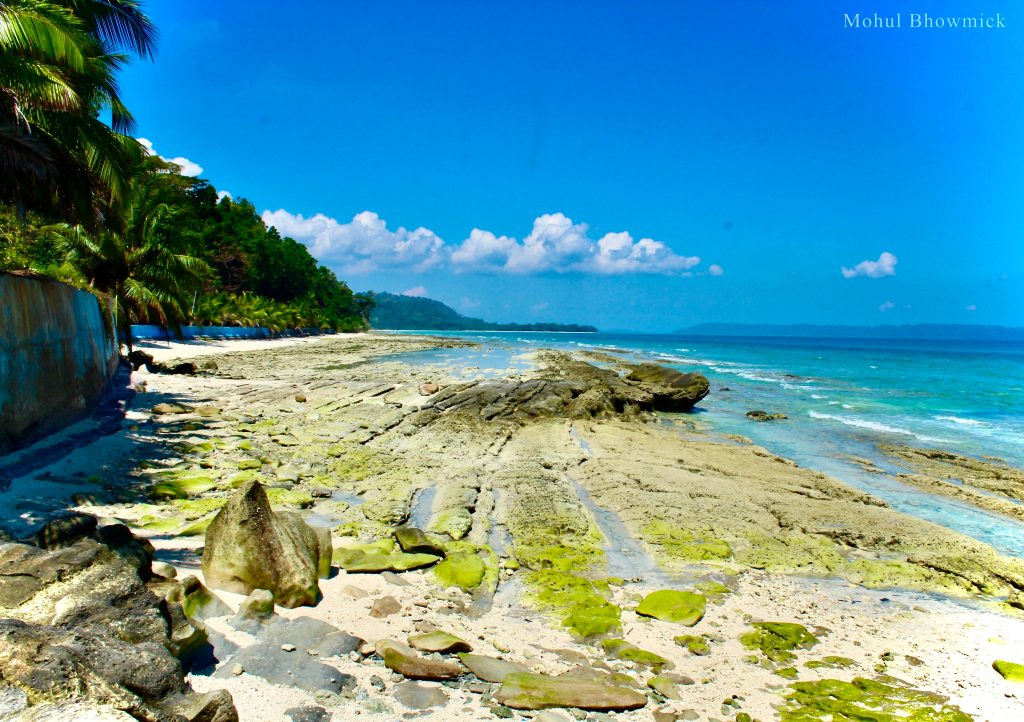
The next day, the Kala Patthar beach seems astral at high noon as the sun beats gently down on the golden sand. I sit sipping on tender coconut juice and remind myself that it is too easy to seek the idea of Shangri-la in such locales, and not in the grim reality that the here and the now present. The harsh sun that burns my bare forearms to embers brings with it the missive that utopia, after all, is a state of mind. 

The bright sun parches you on the Kala Patthar beach, Havelock Island.

“All the way to heaven is heaven,” Saint Catherine had decreed in the fourteenth century. I found little to argue with the apostle when heading into Neil Island, recently renamed Shaheed Dweep by the central government. Bharatpur merits no mention at all, or about as much as a slap the genteel administrator at the tourist information centre would deserve for including it in one’s itinerary. Laxmanpur 1 and 2, strangely enough, overwhelm me enough to want as little to do with them as possible; it is often the untested and untried that draw a weary traveller’s mind.

Going against the tide? Almost sunset at the Laxmanpur -2 beach on Neil Island.

*

Return to Port Blair. The droll afternoon spent at Ross takes one back a century or two, but the cacophony that the resultant evening provides is worthy enough of a Tarantino chef-d’oeuvre. At dinner, two raucous Punjabi gentlemen argue over the viscosity of the dal makhni on offer; I take second helpings of the rabri[2] keeping an ear out for the chatter. They involve the floor staff as well, who are helpless, and have no option but to get a new batch of dal tadka served. The gentlemen say that they remember having asked for dal fry… I wonder what Rasheed, our driver during the sojourn, feels when he drops his guests at the airport for their flights back home to the mainland. He has never stepped out of Port Blair and continues to seem distant from the release (or is it escape?) that the terminal offers. I imagine him looking towards me misty-eyed, hopeful for a future in which his reality mirrors that which Andaman often proffers to travellers. But he turns the car around and rushes past the incoming traffic even before we have entered the concours

[1] Mughlai Parantha is flatbread stuffed with minced meat and coated with eggs

[2] Dessert

Mohul Bhowmick is a national-level cricketer, poet, sports journalist, essayist and travel writer from Hyderabad, India. He has published four collections of poems and one travelogue so far. More of his work can be discovered on his website: www.mohulbhowmick.com.

PLEASE NOTE: ARTICLES CAN ONLY BE REPRODUCED IN OTHER SITES WITH DUE ACKNOWLEDGEMENT TO BORDERLESS JOURNAL. 

Click here to access the Borderless anthology, Monalisa No Longer Smiles

Click here to access Monalisa No Longer Smiles on Kindle Amazon International

Categories
Essay

Where Three Oceans Meet

By P Ravi Shankar

Vivekananda Rock Memorial. Courtesy: Creative Commons

I had always looked forward to visiting Kanyakumari. The idea of standing at the southernmost tip of India and gazing at the vastness of the Indian ocean was irresistible. There is no major land mass till you reach the southern continent of Antarctica. The union of the waters of the Arabian Sea, the Indian Ocean, and the Bay of Bengal make this area, referred to as Triveni[1]Sea, unique.

We wanted to visit the Southern most part – the Vivekananda rock, where Swami Vivekananda meditated before going to Chicago in 1893. However, the gate slammed shut as we rushed to the ferry terminal. It was past four in the afternoon, the hour when the last ferry departs for the rock that was at a point peaceful and calm. With it evaporated our hopes of visiting the Vivekananda rock memorial at Kanyakumari.

We were not deterred by having failed in our endeavour. We decide to continue our exploration on the mainland to see as much as we could. Huge crowds were everywhere. It was school holiday season, and everyone seemed to be travelling. Chaotic was the word that would best describe the situation. As my travel companion, Subhish, and I moved around, we noticed nearly every house in Kanyakumari seemed to have been converted into a restaurant and a homestay though waste management was poor and the toilets – especially in the tourist spots — were unsanitary and unusable.

We went to the Gandhi Mandapam by the Triveni Sea from where the Vivekananda Rock could be viewed. You can get an excellent view of the Vivekananda memorial and the statue from the top floor. In February 1948, Mahatma Gandhi’s ashes were immersed at this intersection. The memorial building houses several old photographs relating to Gandhi’s life but the museum needs maintenance and cleaning.

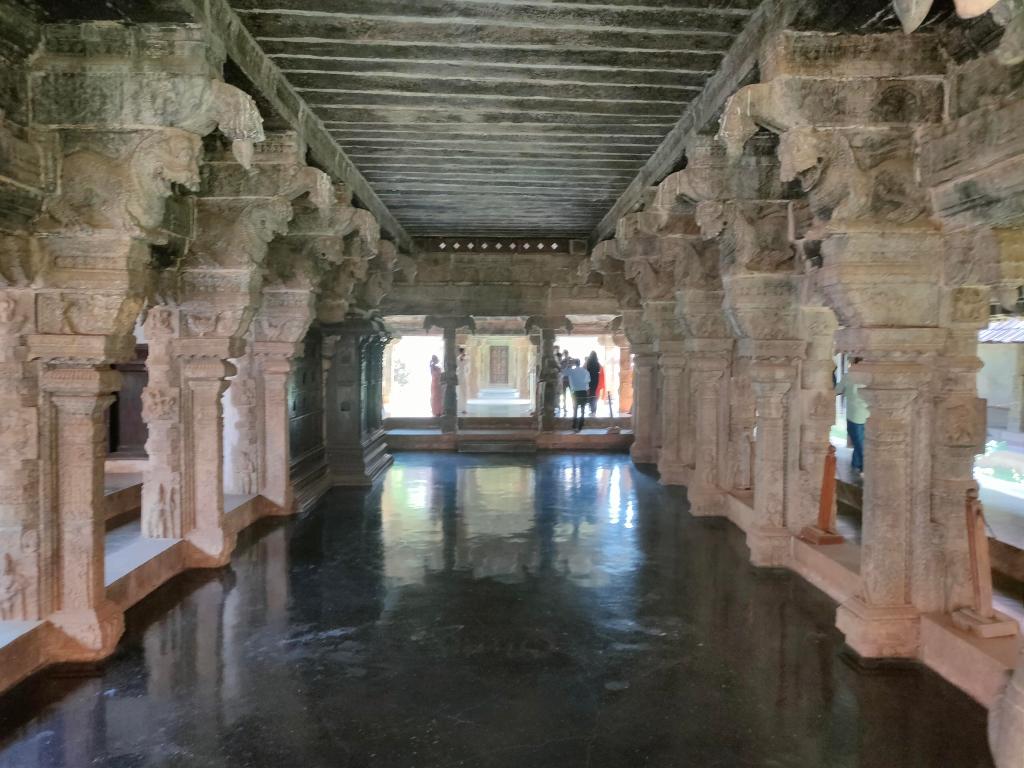
Kanyakumari houses ancient history. Our journey had started at the Sree Adi Kesava Perumal Temple, a temple dedicated to Vishnu, a major Hindu God, had been built in the Dravidian style and dates back at least to the seventh century. The stone and wood carvings speak of the deep devotion of the craftsmen.

Kanyakumari district had been part of the erstwhile kingdom of Travancore. King Marthanda Verma, who lived in the eighteenth century, is regarded as the founder of the Kingdom of Travancore. He had defeated the Dutch East India Company. A staunch devotee of Vishnu, he would pray before all his campaigns. Kanyakumari district had been the granary of the Travancore kingdom and was handed over to Tamil Nadu during the re-organisation of India along linguistic lines in 1956. Subish mentioned how his parents had told him about the fear and violence that existed for several years after the handover. Some of the monuments in the district are still maintained by the Kerala government under a 99-year lease. 


Just before lunch, we had visited the Padmanabhapuram palace, the capital of the Travancore kings which was rebuilt on an earlier structure from in the sixteenth century. King Marthanda Verma dedicated his kingdom to Lord Padmanabha, a manifestation of Lord Vishnu. The King and his successors saw themselves as Padmanabha dasa or subjects of the lord. The palace was vast and sprawling and situated in a four-kilometre-long fortress. Made entirely of wood, it had exquisite carvings. Though in some places, only the frames remain to suggest a story. There seemed to be massive halls where up to a thousand people could be fed at one time. They suggest a testament to the generosity of the kings. The palace unfortunately does not provide a glimpse into the life of its royal inhabitants. Having visited several museums and palaces elsewhere, I believe serious thought and action may be required on how to present this cultural gem better to visitors.

Pechiparai Reservoir

The Pechiparai Reservoir, where we stopped, has an interesting history. The dam was built across the Pechai River by a British engineer, Mr. Minchin working in the Travancore irrigation department. The site is peaceful, away from the hustle and bustle, and surrounded by green hills. In the 1880s when the dam was being built this would have been a remote location. Mr. Minchin’s grave has a home here – far from his own homeland in Britain.

Mathoor Aqueduct

We also visited structures closer to our times — the Mathoor Aqueduct, built in 1965. This is among the longest aqueducts in India. I was reminded of the Roman aqueducts. The view of the surrounding valley and hills from the aqueduct was spectacular. A rich agricultural area, you can walk along the aqueduct, come down and walk through the garden and playgrounds and then climb back to the starting point.

We drove to Sunset Point to watch the sun dip into the ocean after a hard day’s work. The sunset was spectacular. The few clouds had disappeared. The circular orb slowly sank into the silver sea.

Sunset Point

As dusk set in we started to drive back to Eraniel, Subhish’s hometown where we were staying. Subhish worked in Dubai and was on holiday like me. We stopped at Kilometre Zero on the national highway. The Indian politician, Rahul Gandhi had started his Bharat Jodho yatra[2] here a few months ago. ‘Kashmir to Kanyakumari’ is a popular slogan in India and this spot is a popular starting or ending point for political and other such marches.   

Kanyakumari has red bananas everywhere. They grow well in this soil. I am partial to this variety and enjoy them whenever and wherever I can. The district has several ancient Hindu temples. We were now returning from Kanyakumari. Dusk had settled in and there was a huge line of cars going back to Nagarkovil (Nagercoil in English). We were searching for the nongu fruit also known as ice apple, palmyra palm, and by several other names. We eventually located one at a roadside stall. Eating nongu was one of the best experiences of my life. An absolute delight.

Kanyakumari district has seen great progress over the last few decades. People from all over India have settled here. There are several water bodies scattered throughout the land and several wind farms. Tamil Nadu is among the wind energy giants in India. The climate here is less harsh compared to other parts of Tamil Nadu. Indians now have a good disposable income and are eager to explore their vast country. Will the tourism authorities pick up the gauntlet and cater to this population or will they continue along the old self-centred ways? Only time will tell!      


[1] Translates to where three sacred rivers – in this case oceans — meet

[2] Unite India March carried out in 2022 by the Congress Party

*Photos by P Ravi Shankar and Subhish, where unacknowledged

.

Dr. P Ravi Shankar is a faculty member at the IMU Centre for Education (ICE), International Medical University, Kuala Lumpur, Malaysia. He enjoys traveling and is a creative writer and photographer.

.

PLEASE NOTE: ARTICLES CAN ONLY BE REPRODUCED IN OTHER SITES WITH DUE ACKNOWLEDGEMENT TO BORDERLESS JOURNAL

Click here to access the Borderless anthology, Monalisa No Longer Smiles

Categories
Essay

Potable Water Crisis & the Sunderbans

By Camellia Biswas

Many projected climate change impacts, including sea-level rise, temperature increase, heavy rainfall, drought and cyclone intensity, is increasing yearly flooding, riverbank erosion, salinity intrusion, etc. These pose severe impediments to the socio-economic development of India, especially the coastal areas. The coastal area of India, especially the Bay of Bengal, is located at the tip of the northern Indian Ocean. It is frequently hit by severe cyclonic storms, generating long tidal waves aggravated by the shallow bay.

At least one major tropical cyclone strikes the Eastern/south-eastern coast each year with powerful tidal surges. The Chakraborty et al (2016, 13-19) report states almost 2.3 million people were affected by Cyclone Aila more than a decade ago in May 2009. Many people were stranded in flooded villages. The tidal surge was about 10-13metres in height. It washed away enormous number of households, lives, livestock, crops and all other resources of the affected region. Aila was not a powerful storm, but its heavy incessant rains and storm surges were enough to swamp the mouths of the Ganges in both Bangladesh and India (Biswas 2017).

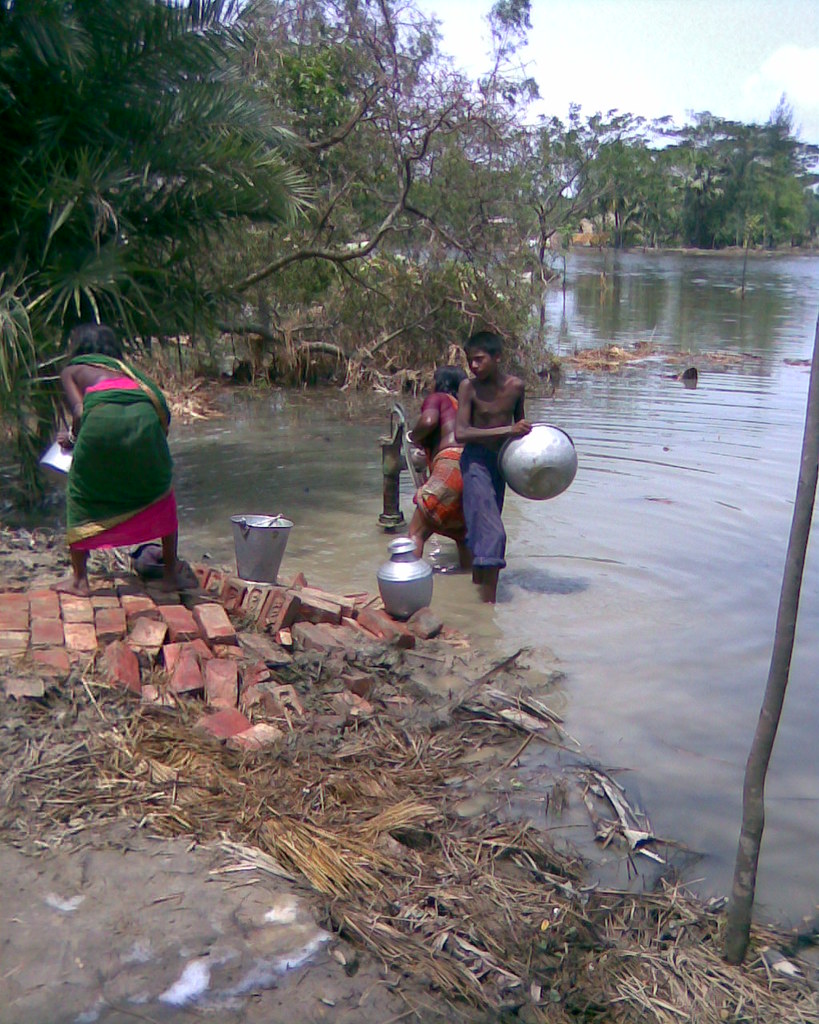
Some islands in the Bay of Bengal and the mangrove forests of the Sundarbans region were wholly submerged underwater. This catastrophe happened within a brief period, which resulted in people becoming homeless, leaving their assets in the households. A tiny percentage of the affected people could take shelter in the nearby cyclone shelter or schools during the cyclonic event. However, in several discussions, the affected people criticised that most cyclone shelters were built post-Aila and schools had only ground floors, which was anyways inundated. Most people thus took refuge on elevated roads. The extreme flooding also resulted in thousands of people losing access to safe drinking water and exposure to floodwaters containing untreated wastewater, dead animals and fish.

Impacts on water systems and water quality are often not visualised as chronic damage to property or the landscape. And thus, most treatments to these problems are temporary and short-lived. Potable water scarcity is a cumulative problem in the coastal region of India, especially Sundarbans, as it is revolving saline water slowly. Climate-induced disasters like rainfall, cyclone and storm surge, flood etc., are making the situation worse. Coastal people gradually depend on groundwater due to surface water salinity. As a result, groundwater extraction is increasing day by day. For that reason, the shallow aquifer has also been contaminated by salinity intrusion.

I have witnessed the horrific situation of women and children wailing for drinking water and waiting for relief distribution while spending my summer holidays at my native house in Sundarbans. The 14-year-old me then was horrified by the helpless situation of my own people, my kin and kept wondering whether disaster management conditions would be better or worse in due course of time especially when it concerns marginal communities of Dalits and Adivasis.

The memories of Aila keep flashing back to these Sundarban islanders every time they are hit by a cyclone or post-cyclone flood. Some of the stories they shared with me during my doctoral fieldwork made me revisit my Aila memories. As a native researcher, it gave a new stance towards the importance of water beyond its economic value and enhancing communities’ socio-cultural ties. Water, which has often served as an agency to conflict and dispute, during Aila it stimulated the sense of brotherhood and togetherness among the Samsernagar village residents.

Flood Friendship Between India-Bangladesh

Samsernagar is the last village in West Bengal’s Sundarban, bordering Bangladesh by river Kalindi. During Aila, the embankments of Samsernagar broke, resulting in the inundation of the village with the high tide influx from Kalindi. It led to total ruination of the settlement in just a couple of minutes. Samsernagar was submerged in the water, and so were the tube-wells and ponds, which were the only source of drinking water. It is where the villagers from Bangladesh came as harbingers of help.

In the political map, Bangladesh and India are demarcated as two separate nations. However, for people in Samsernagar, their neighboring village will still be the Village Koikhali of Bangladesh. To better understand, I phoned one of my respondent’s relatives who lived on the other side and asked about their experience during Aila regarding the help they provided to the Samsernagar residents. Koikhali residents came to Samsernagar rowing on their boat with barrels of potable water and other essential aids like food, clothes and mats. From several discussion and information interaction, it can be inferred that Samsernagar still recognises their international neighbour’s gesture which didn’t let them die of drinking polluted water. This act showed how, on the one hand, the water acted as a demon to the villagers through flooding and on the other, the barrels of drinking water brought by the neighbouring villages of Bangladesh became a sign of camaraderie and community interest. It went beyond just a mere necessity to live. It showed us how two villages come together, ignoring the human-made international boundary.

The Dilemma of Drinking water Crisis

That this acute drinking water problem can turn into a chronic issue in events like Aila and similar flooding situations is given credence by the fact that underground water also becomes saline due to leaching and seepage. Even after the floodwater recedes, the tube well water remains undrinkable. Sittler (2017), in her study on ‘Floodwater and stormwater can contaminate your water well’ argues that regardless of where storm-water runoff occurs, like floods, it can carry harmful contaminants such as soil, animal waste, salt, pesticides, and oil, potentially impacting drinking water wells and water quality. When discussed these challenges with groundwater experts at Sundarbans, they pointed out that in the Hingalganj Block, where Samsernagar village is situated, many deep tube well weren’t rightly maintained. Excessive contaminant-laden run-off infiltrated these drinking water wells through and assessed that the well casings or caps may not have been completely watertight. Moreover, any potential contaminants into the well can pose at least a short-term risk to water quality and human health.

In 2009, many families in Sundarbans, out of desperation, consumed pond water undergoing some basic filtration, knowing that the pond water stank from carcasses of dead animals. As farmlands remain filled with saline water, paddy yield became meagre the same and following year. Affected people when interviewed spoke of the mismanagement of the state’s relief supply and its lack of providing safe water, on how the local administrations would run some basic filtration like boiling the contaminated water and distributing it. As a result, hundreds of villagers suffered from diarrhea two weeks after drinking contaminated water. According to UNICEF, 28 diarrheal deaths were registered, and over 85,000 cases were reported from the Aila-hit districts of West Bengal.

Water can be considered a symbolic element, a resource, a commercial product, or a service. The interconnections established and the value attributed to water usage serves to build norms and references that influence the decision-making process from individuals to higher levels of social organisation. When considering it a resource for life, its interests and values vary and change across cultures, communities, states, space and time. One may raise an inquiry that spaces like Sundarbans is surrounded by rivers and seas, and that’s presumably the reason why Sundarban locals might not feel impacted by the presence of noble metals in the water.

However, as Sundarban landscape has a mangrove ecosystem, the water quality in and around the area has been found to be of inferior quality (CGWB report, 2014-15). If also, post-Aila most deep wells that were reconstructed at the height of 8-10ft above flood level so that the runoff was less likely to introduce contaminants into these wells, slight amount of saline water still managed to seep into the groundwater. However, it is the persistent presences of high iron and arsenic in the wells within that should raise alarm. So, even though the region is surrounded by water, most of it is toxic. Thus, for the Sundarban islanders, continuous access to safe and potable water is an aspiration that continues a dream for the whole community.

REFERENCES:

.

Camellia Biswas is a doctoral candidate at the discipline of Humanities & Social science, IIT Gandhinagar. She is an Inlaks-RS conservation grantee for the year 2021-22. Her research specialises in Environmental anthropology, focusing on human- Nature Interaction in Indian Sundarban under the larger discourse of Climate disaster.

.

PLEASE NOTE: ARTICLES CAN ONLY BE REPRODUCED IN OTHER SITES WITH DUE ACKNOWLEDGEMENT TO BORDERLESS JOURNAL

Categories
Stories

Dawn in Calicut

By Krishna Sruthi Srivalsan

The call for fajr from the local mosque
Pierces the stillness of early morning,
The sruthi box in the puja room stirs awake.

It is dawn in Calicut. The house is quiet, except for the muffled sound of water from the washroom, where my aunt does her ablutions before prayer. She shuffles her way into the puja room and hurriedly shuts the door, careful not to let even a slice of light escape the room and disturb the rest of us. For the next hour, she will be in deep meditation.

Across my bed, I see Amaama. Wisps of white hair framing her toothless mouth, she seems peaceful. Sleep didn’t come to me easy the previous night. A long journey back home and the sudden shock of seeing my grandma succumb to inevitable illness, leaving both her mind and body fragile, have rattled me. I watch her, drifting away in the land of nod.

As the sun peeks out reluctantly from the rain clouds, she wakes up. She looks at me, a question mark on her face. “Do you remember me, Amaama?” I ask. She nods, but when I ask her to tell me my name, she mumbles. I realise that I have become unrecognisable to her. Even after watching her struggle with her memory for the past two years, this upsets me.

My aunt makes idlies for breakfast. I offer to feed Amaama idlies and sugar. It is the food of infants, but it seems like she is a helpless child all over again. After an hour, she quips in a plaintive tone, “I haven’t eaten anything.” We make her a cup of Horlicks and she smacks her lips appreciatively while sipping on the sweetness of the malt.

I spend the day sitting near her bed, reading, in an effort to forget the maze of memories that cloud my mind. I also feel vaguely guilty, though I can’t really tell why. Should I have called her more often when I was away? Should I have been more affectionate to her when she could remember? Could I have been a better grandchild? The regrets pile on, one after the other, and then I understand that the root cause of my guilt is the startling realisation that I never got to know Amaama as a person. All my life, she has been Amaama. What was she like as a child? What was she like as a young woman? What made her happy? Did she have any regrets? I will be in Calicut for the next two weeks and I determine to make use of that time to understand more. I speak to my aunts, pore through old photographs, try talking to Amaama herself.

                                               *

A little girl in pigtails and pinafore
Finds the greatest joy
In knitting needles and yarn.

My grandmother, Saraswathi Menon, was born in 1932. Her ancestral house is in a village called Kalapatti, in the district of Palakkad, in the foothills of the Western Ghats of southern India. Sarasu, as she is known to her family, was the fifth of seven children. Her father was an inspector in the public works department of the Indian Railways. The family moved between Tuticorin and Sucheendram, two towns on the tip of the Bay of Bengal, and Sarasu grew up in relative affluence. The first brush with hardship must have come at the age of eight, when she lost her mother, who at that time was hardly thirty-three.

Sarasu’s paternal aunt helped raise her, and she moved back to her hometown in Kerala with her younger siblings. As a teenager, she developed a lifelong interest in embroidery and knitting, spending all her time with her knitting needles and balls of yarn. She did not pursue studies after her high school matriculation exams; she did not pass the English examination and did not want to place a burden on the family’s dwindling finances by making another effort.

A memory of Amaama urging me to study flashes across my mind. At that point, she had self-deprecatingly joked that she had no buddhi and that’s why she didn’t study further. I think back and often marvel at how Amaama still aced the many challenges that life presented her, despite this lack of formal higher education. To think of the person she could have become with the right opportunities…

Barely out of her teens, Sarasu returned to Tamil Nadu, as a newly married bride. This time, she found herself in Trichy. I look at Amaama sitting in her bed, propped up by pillows, listening to a version of the Ramayana rendered by Kavalam Sreekumar. I try to jog her memory, and surprisingly, she offers a story of her Trichy days. Her eyes well up as she mentions hopping onto rickety buses that took her to the Rockfort temple and the Sriranganathan temple on an island in river Cauvery. She smiles as she remembers an old lady who taught her how to make murukku and other delectable goodies that she treated her daughters to after a long day at school. She remembers getting married to my Thatha, and accompanying him to the various towns that his job as a sales engineer demanded.

I try to ask more questions, but Sarasu’s spark has disappeared now, and Amaama cannot remember anything else. She can remember events that occurred more than thirty years ago, but she cannot remember what she ate this morning — how treacherous is this mind!

As Kavalam Sreekumar sings in the background, my aunt quietly tells me of Sarasu’s first born child — it was not my aunt, as I had always thought. Sarasu’s first born was a boy; they named him Ravi but they lost him to smallpox at the age of two. This news startles me again — how had Amaama coped with the loss of her only son all those years ago? He would have been the brother my mother never had. How little do we really know of those close to us!

Life blessed Amaama and Thatha with four other children, all of them girls. My aunt talks about the ridicule and pity heaped on her parents, Amaama in particular – “Four girls! No sons! How will you raise four girls?” They raised them with love, making numerous sacrifices, instilling in them courage, confidence, compassion, and a sense of fierce dignity, a determinedness to be independent. It is a testament to Amaama’s sacrifices that all her daughters, and by extension, us — my cousins and I — have reached so far.

                                                        *

Coffee stains on the table
A jumbled-up algebra problem
Anger turns into a ghost of regret.

The day has come to an end. I have learnt new things about Amaama’s life, and I can now see a glimpse of Sarasu, behind the shadow of Amaama. My mother lights the lamp and takes it to the entrance of the house, chanting “Deepam, Deepam!” It is auspicious to keep a lit lamp at the door front at twilight. The air is alive with the buzz of mosquitoes. Amaama is awake. I venture to sing an old bhajan which she used to love. She smiles, she seems to recognise the song, but she still cannot recognise me. Memories spring up from the cobwebs of my mind.

It is supposed to be a holiday for Amaama. Two months in Dubai with her youngest daughter, my mother. I am in grade 10, at the peak of schoolgirl rebellion. A few weeks before the all-important board examinations begin, we have study leave. With my parents away at work, I find myself alone with Amaama.

One morning, I am working on algebra, timing myself to see how quickly I could finish a sum. I hear a cup of coffee being knocked over in the kitchen, but I pretend not to hear. Amaama calls out for me, but I ignore her. When she calls me a third time, I can no longer ignore her, so I stomp into the kitchen, sulking. Not saying a word, I mop up the coffee stains, and slam the microwave to warm another cup of coffee from the flask.

Amaama has not spoken a word about my unreasonable behaviour. I know I have reacted badly, behaving like a spoilt child, but a false sense of pride keeps me from apologising. I hand her a second cup of coffee and try to study for the rest of the day. It is a completely useless day; my anger has now turned to regret and guilt.

When my parents return from work, I observe Amaama speak with them. Will she snitch on me, complain about the brat they raised? She remains quiet, does not say a word about me; instead, she asks them about their day and tells them about gifts she wants to take back from Dubai. I feel uncomfortable. I would have felt better if she had reprimanded me instead.

That night, I toss and turn in bed. Amaama and I share a room, and I hear her sob quietly into her pillow. Guilt engulfs me. I reach out to hug her and I begin to cry too. Amaama turns over and asks what is upsetting me. Exams, I mumble, not wanting to apologise. She hugs me tight and says “What is there to worry? You’re such a midukki kutty. God is always with you!” I sob into the softness of her sari and she says, “I was wondering why my midukki kutty doesn’t like me anymore!” I reply in my garbled Malayalam that I would always love her, but I still did not apologise.

Forgiveness has always been Amaama’s best friend.

                                                        *

Barefoot pilgrims walk to Pandharpur
Saffron flags fluttering in the wind
“Vitthal! Vitthal!” The palkhi bearers chant.

It is pilgrimage season in Maharashtra. Visiting my aunts in Mumbai after ages, we arrange for a trip to Shirdi. A road trip will take us at least six hours. Amaama cannot sit in a car for that long. We decide that the Shirdi trip can wait, but Amaama insists that we do not cancel on account of her. “I’ll stay alone. Will keep myself busy with TV and my books. And anyway, Padma will come for a few hours in the afternoon, so I won’t be lonely”, she says. I wonder what sort of conversation our Marathi speaking helper will have with Amaama whose vocabulary in Hindi (leave alone Marathi) does not extend beyond Kaise Ho! I tell my parents and aunts to go ahead, and I offer to stay with Amaama. “Nothing doing, you have to go see the Baba at Shirdi!” Amaama insists. I slowly understand where my mother gets her stubbornness from.

We set out at dawn the next day and reach Shirdi a little ahead of noon. We spend the next few hours in the temple town, offering our prayers, and soaking in the meditative stillness of the masjid where Baba lived — it is a salve to a weary heart. Before dusk sets, we leave Shirdi. We whizz past fields of sugarcane and cotton, growing in abundance, on the rich black soil of these lands, stopping for a quick cup of tea at Igatpuri. There is a thick shroud of mist, and my mind keeps wandering back to Amaama. What could she be doing, all alone in that flat?

We reach home an hour before midnight. The Matunga neighbourhood is quiet. Amaama is in her chair by the puja room, reading Narayaneeyam. “Did you get scared, Amaama?”, I ask. She shrugs away the question and asks me back, “What is there to get scared of when I have God by my side?” Faith has always been Amaama’s best friend.

*

The Nilambur river quietly chugs along
Through hills and fields and forests
And merges into nothingness at Beypore.
                                                    

It has now been three years since Amaama finally succumbed. Watching her struggle through ill health, losing control of her mind and memory, has been an excruciating journey for all of us. Ironically, death seemed to free her, release her from the terrible pain she endured for a few years. When I miss her a little too much, I turn to my phone which had faithfully captured a Boomerang video of her making a dosa when she was in better health. It reminds me of better days in the past when she would make bite sized unniappams, as dainty as the dimples on a toddler’s fist. Sometimes the grief of losing her is too much to bear. I think of a story I read as a child — something about a magic pot which kept cooking porridge for a hungry family. The family gobbled up the porridge, but the pot simply would not stop. It kept cooking porridge, till the porridge overflowed and flooded the entire city! Sometimes, my grief is like that. But then, I look at the photo of Amaama by my bookshelf. A sparkle in her eyes, and a half smile on her lips, she looks the picture of equanimity.

Many dawns have now passed by in that house in Calicut. Sometimes, during the monsoon season, I gaze at the grove of coconut trees outside. The wind rustles the coconut palms and the foliage sways, like dervishes drunk on divine nectar. Sometimes, a bubble of calm quietens an intense battle in my head. Sometimes, instead of holding onto an angry thought, I just let go, like the Nilambur river. In those times, I feel as if Amaama is watching me, from somewhere, where she is reunited with her beloved Krishna, where she can forever listen to the lilting melody from his flute, where she can watch him play by the Yamuna river. In those times, I feel as if her prayers and love have formed a protective shield, an invisible amulet protecting me from all perils. Love has always been Amaama’s best friend.

Glossary

Fajr – The first of five Islamic prayers, also known as the dawn prayer

Sruthi box – An instrument used in Indian classical singing to help tune the voice

Puja room – A shrine room for worship, religious rituals, prayers, and meditation in a Hindu household

Amaama – Malayalam word for grandmother

Idlies – Steamed rice dumplings, traditionally eaten as a breakfast dish in south India

Buddhi – Malayalam word for intelligence

Murukku – Savoury crunchy snack made from rice flour and lentils

Thatha – Tamil word for grandfather

Deeepam, deepam – The word “deepam” means lamp in Malayalam. In Kerala, at dusk, women carry lit lamps to the entrance of the house, chanting “deepam, deepam” in order to invite light and auspiciousness into their homes.

Midukki kutty – Malayalam term for smart girl

Vitthal – Form of the Hindu god Vishnu or Krishna, as he is known in the state of Maharashtra

Palkhi – Marathi word for palanquin. In this context, the verse refers to a yearly pilgrimage where devotees carry the sandals or padukas of the saint Dnyaneshwar from his shrine at Aalandi to the famous Vitthal temple at Pandharpur. The barefoot pilgrims carry the padukas in a wooden palkhi and the journey takes around 21 days by foot.

Shirdi – A town in Maharashtra, which is the home of Shirdi Sai Baba, a revered fakir or saint

Kaise ho! – Hindi phrase for “How are you?”

Narayaneeyam – An epic poem, comprising of 1,035 verses, narrating the life of Lord Krishna. The poem was composed in the 16th century by Melpathur Narayana Bhattathiri, a renowned Sanskrit poet hailing from Kerala.

Unniappam – Sweet dumplings made with rice, banana, jaggery and coconut


Krishna Sruthi Srivalsan is a chartered accountant by profession and is passionate about  books, writing, travel, and celebrating diversities, not in any particular order. She firmly believes that human beings should not strive to “fit in” when they are designed to “stand out”. She reads on a variety of subjects and genres and hopes to publish a novel someday.

.

PLEASE NOTE: ARTICLES CAN ONLY BE REPRODUCED IN OTHER SITES WITH DUE ACKNOWLEDGEMENT TO BORDERLESS JOURNAL