Categories
Excerpt

The House of Flowers by Aruna Chakravarti

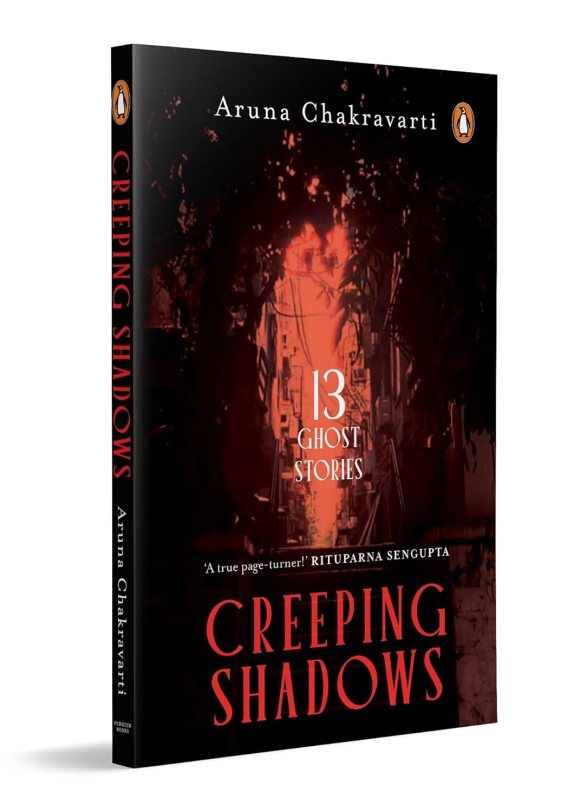
Title: Creeping Shadows: 13 Ghost Stories

Author: Aruna Chakravarti

Publisher: Penguin India

The House of Flowers

Zihan stirred in his sleep. A chill breath passing over his limbs had awakened him. He strained his eyes, still heavy with wine fumes, and looked around. Where was he? This was not his room and this wasn’t his bed. He was lying in what seemed to be a small, confined space under an ornate gilded ceiling in a bed so soft, his limbs were sinking into its depths. The sky was paling with first light and long beams from a dying moon streamed in through the open window. The fragrance of an unknown flower, wild and sweet, filled the room. 

He turned his head towards the window. Something, like an opalescent haze, was obscuring his vision. At first, he thought it was a sheet of mist. Then, before his amazed eyes, it started to take a shape and form. It became a woman. He could see her slender limbs, smooth as white satin, shimmering through the garment that swayed and billowed around her form. Diaphanous as a film of gossamer. So light, it seemed woven out of moonbeams. Her face was swathed in mist.

The figure moved from the window and came gliding towards him. He could see her face clearly now. A perfect oval with apricot shaped eyes, brows like strung bows and hair that fell down her back like a sheet of black silk. He stared at the vision of loveliness so long and hard …his eyes began to hurt. He had never seen such beauty in a woman before.

She stood by his bed for a while gazing into his eyes, then lay down, her body light as a feather against his. Taking his face in her hands, she caressed it with a tenderness that reminded him of his mother’s touch. She drew the silky strands of her floating hair all over his naked body. Across his chest and abdomen, over his genitals, thighs and legs, down to the insteps of his feet. The wildflower scent from her limbs filled his nostrils. Her kisses fluttered on his lips, soft and cold as drifting snow…

The wine, still running in his blood, quivered in his veins. His limbs, untouched by a woman before, heaved luxuriously and his eyes closed in ecstasy. He drifted away…

How long he lay in this state of bliss, he couldn’t tell. It could be minutes. It could be hours. Gradually, an uneasy feeling came over him. Something heavy was pressing against his body. It was squashing his chest and squeezing the breath out of his lungs. He moved aside but the pressure grew in intensity, driving him further and further towards the edge of the bed. And now his heart beat rapidly with an unknown dread. What was happening? Was he still asleep and this a fearful dream? Suddenly his eyes sprang open and what he saw sent currents of ice water rippling down his spine. He felt the hot blood pulsing and pounding in his ears.  A muscle twitched and shuddered in his cheek…

The reed-slim body of the woman beside him had bloated to a colossal size. Her eyes, thin slits in the vast globe of her face, glittered with hate. Her mouth was a deep red gash through which yellow teeth, long and sharp as a panther’s fangs, hung to her chin.

The mountain of flesh was growing larger and larger every moment. It was filling the bed. He would fall over the edge any moment now. A scream gathered in his lungs but froze before it could reach his throat…

Suddenly she sprang on him; her nails sharp as claws ripping the skin off his chest and thighs. Digging her teeth into the soft flesh just below the right shoulder, she bit off a large hunk. Zihan’s eyes were glazed with pain and fear. He stared mesmerized as the monstrous creature rose from the bed and swayed and shuffled towards the opposite wall. She wore a garment of sheer white muslin that swelled and surged like waves about her form. Blood dripped from her slavering mouth and fell on the floor as her great body waddled, like a gorilla’s, from side to side. And now, for the first time, Zihan saw the coffin. It was open… 

Zihan screamed. Shriek after shriek burst from the throat that had been frozen all this while, hit the walls, and sent fearful echoes all through the house. Then, exhausted and half dead from shock and loss of blood, he lay motionless, whimpering like a child.

Kueilan was a light sleeper and the first to hear the cries. They seemed to be coming from the dead girl’s room. Her heart thudded with fear as she rushed to it and flung the door open. She stood where she was for a while, her eyes glued to the coffin. It stood in the same place but the seal was broken and its open lid rested against the wall. A lily-white hand with long tapering fingers was dangling from the edge. And now the lid began to move downwards. Slowly, soundlessly, it was falling in place. In a few moments it would reach the hand and crush it. A tremor ran through Kueilan’s frame. Her mouth opened in a scream but before she could utter a sound, the hand glided over the edge and slipped into the hollow where the rest of the dead girl lay. Then, before Kueilan’s amazed eyes, the coffin closed, the seal came together and all was as it had been.

‘Published with permission from Penguin Random House India from Creeping Shadows (2026)’.

About the Book:

The stories in Creeping Shadows are spread over a vast canvas, both in terms of time span and locale. A teahouse in ancient China. A brothel in nineteenth-century Calcutta. A forest lodge in Bankura. An old mansion in Bangladesh. A university campus in today’s Delhi. Beginning as human-interest narratives, they end with sudden, unexpected twists that raise hair ends and send trickles of ice water down the spine. Here are tales of shadows, tingles and chills…

About the Author:

Aruna Chakravarti has been principal of a prestigious women’s college of Delhi University for ten years. She is also a well-known academic, creative writer and translator with eighteen published books on record. They comprise five novels, two books of short stories, two academic works and nine volumes of translation.
Her first novel, The Inheritors (published by Penguin Random House), was shortlisted for the Commonwealth Writers’ Prize and her second, Jorasanko, received critical acclaim and became a bestseller. Daughters of Jorasanko, a sequel to Jorasanko, has sold widely and received rave reviews. Her novel Suralakshmi Villa was adjudged ‘Novel of the year (India 2020)’ by Indian Bibliography published in The Journal of Commonwealth Literature U.K. Her other well-known works include The Mendicant Prince which has been shortlisted for the Rabindranath Tagore Literary Prize, and Through a Looking Glass: Stories. Her translated works include an anthology of songs from Rabindranath Tagore’s Gitabitaan, Saratchandra Chattopadhyay’s Srikanta and Sunil Gangopadhyay’s Those Days, First Light and Primal Woman: Stories. Her most recent work is titled Rising from the Dust.
Among the various awards she has received are Vaitalik Award, Sahitya Akademi Award and Sarat Puraskar. She is also a scriptwriter and producer of seven multi-media presentations based on her novels. Comprising dramatized readings, interspersed with songs and accompanied by a visual presentation by professional artists and singers, these programmes have been widely acclaimed and performed in many parts of India and abroad.

Click here to read her interview/review

.

PLEASE NOTE: ARTICLES CAN ONLY BE REPRODUCED IN OTHER SITES WITH DUE ACKNOWLEDGEMENT TO BORDERLESS JOURNAL

Categories
Stories

The Beaten Rooster

By Hamiruddin Middya: Translated from Bengali by V. Ramaswamy

Babu, I am merely a poor Santhal. Please don’t take offence at anything I say. After all, we people who belong to the forest have always been losing. We are day labourers. We neither have nice houses nor do we possess any cultivable land.

Rangakul, Kusumkanali, Nabindanga and Mohulboni were all small Adivasi villages in the forest. Nearby were farmers, and people of the Ghosh, Mahato and Sinha communities. All the land belongs to them. We gaze at the sky in the hope of rain and cultivate a single crop. Some people have taken up the timber business and become rich and arrogant overnight. Why would they care about farming! It’s us who want to farm the land. A one-third share to the landlord, or else a monetary arrangement. We are poor folk, where will we get so much money! So, we cultivate the land on a crop sharing crop basis. But can one survive the whole year with that? The moment there’s no more rice for the cooking pot, we queue up beside the metalled road, wave out to any bus going eastward and get on board. After all, there’s no shortage of jobs there. With water from the canal available there, the fields yield golden paddy twice a year. By the grace of Marang Buru, all we want is to work our bodies so that we can feed our bellies.

When water is scarce at the edge of the forest where we live, famine looms. What’s new about that!

Singh babu is the big warehouse keeper here. He’s in the timber business. His house is at the fringe of the forest, across the railway line. It’s not a house but a fortress. He has done well in business with the help of his sons. Our men and women carry dry wood gathered from the forest to the babu’s warehouse across the railway bridge. He weighs our bundles and buys them. Even if the price is higher in the marketplace, who wants to go there if you have someone close by!

I cultivate a bigha-and-a-half of the babu’s land. It’s his warehouse that Lokha’s Ma carries wood to. There was a terrible drought this year. Fields, pastures and ponds were all parched, gasping for water. The paddy harvest was not good. The stalks were not tall. Just like a mother’s milk dries up if she is unable to eat, it’s the same with the ears of paddy. What will we eat the whole year? An unpared bamboo in the arse! How will I go to the babu and tell him?

I got the opportunity. Lokha set a trap somewhere and caught a waterhen. I told him, “Give me the bird, son. Let me give it to the babu.”

But Lokha did not want to part with it. “Why should I give it just like that?”

I said, “It’s not just like that, son. I have to make the babu happy, he’s very fond of bird meat. After all, we survive by cultivating his land.”

Who knows what Lokha thought but he did not argue any more.

I went with the bird at dusk. Singh babu was sitting with his son on a platform under the mango tree in front of the warehouse, he was doing some calculations. As soon as he saw me, he exclaimed, “Arey[1] it’s Hansda! What’s that in your hand?”

I went close to the babu. The babu studied the bird and exclaimed, “Wow! You’ve brought a waterhen!”

The babu never called me Sanatan Hansda, only Hansda. I could see that he was very happy to get the waterhen. His middle son, Haru, took the bird from me and left. Their house, surrounded by walls, was just behind the warehouse. I sat down below the platform.

The babu asked, “Has the paddy been threshed?”

“Babu, that’s what I came to tell you about. All the paddy has been destroyed in the drought! After threshing the remaining stalks, I could only get six sacks of paddy.”

The babu’s face turned grave. He blurted out angrily, “What the hell are you saying, bastard! Six sacks? I went to the field and saw for myself, it was full of swaying stalks.”

“Yes, babu, it was like that then. But there was no rain in Magh[2]. The plants began to droop after that!” I pleaded with the babu.

“Enough of your nonsense! Haru will go tomorrow and see how it’s only six sacks. Don’t try to be cunning!”

“Sure, send him then, babu. I am not telling you lies.”

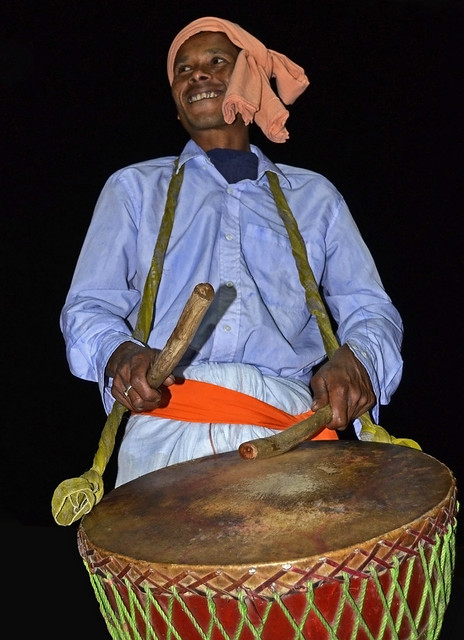
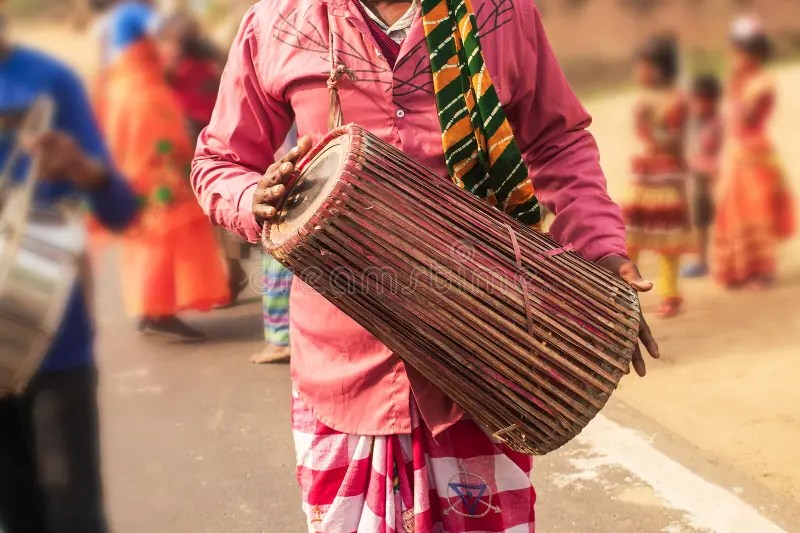
Haru didn’t come. The next day, Singh babu himself arrived in haste. He came in the middle of our festivities. I was anxious wondering where I would ask him to sit, and what I would feed him. All of us, men and women, drink hanriya [3]and dance. Ours is a small village. We can’t afford to buy a dhamsa or a madol. We had everything earlier, but they broke long ago. When the boys and girls of the village grow up and it’s time for them to get married, we get those drums on rent. During our festivals, the boys in the youth club play music on the mic. We dance to that. Seeing our song and dance, Singh babu later whispered to me, “Give me a glass of hanriya too. Let me try it. But mind it, don’t tell Haru!”

“Oh no, babu. Don’t worry about that. Have as much as you want.” I thought it was funny. The father drinks out of his son’s sight. After all, we have none of all that. Father and son drink together to their heart’s content.

Why were Singh babu’s eyes so bloodshot today? I was scared. I said to him, “Come, come babu. Come inside and sit comfortably.”

The babu said angrily, “I haven’t come to sit, Hansda. Show me the paddy quickly.”

So, I showed the babu the paddy. He looked at me sternly and asked, “You haven’t hidden it somewhere, have you?”

“No, no babu. I would never do something like that in my life,” I said, holding my ears with my hands. “Why don’t you ask someone?”

“Chandmani and Gona Murmu got a good harvest. What kind of farming are you doing?”

“They got a pump-set from somewhere and irrigated their fields twice. There’s a shallow tubewell in the field there.”

The babu was about to leave with a sullen face. I said to him, “Let us keep the crop this time, babu. It’s a meagre harvest. My family can survive for a few days with that. I’ll repay you next time.”

The babu came to a halt with a start. He lowered his voice, and said, “Why should you go without food – am I not there! You have a young wife at home. Send her to the warehouse in the evening. After all, you can’t send her when people are around!” And saying so, the babu left. There was a strange smile on his face. Seeing that smile, my chest heaved. What on earth did the babu say before he left! How could I send Lokha’s Ma to the warehouse with wood now?

2

There was a fair in the nearby village of Mohulbani. As the Shalui festival is not celebrated with much fanfare in our village, it’s to the fair in Mohulbani that everyone dresses up and goes. There’s a cockfight every year during this time. This year, I too was a hauchi. Someone who participates in a cockfight is called a hauchi. I had never put a cock to fight. But the idea of doing that during this year’s festival caught my fancy.

Lokha’s Ma had brought the rooster as a tiny chick from her father’s house. I saved it so many times from the jaws of wretched mongooses and civets. It was big now, and sparkling red in colour. It crowed, konk konkkor konk, in the semi-darkness of dawn. Hearing its crow, the birds on the trees then began chirping. It hovered around every hen in the village, all by itself. It walked with its chest puffed out, as if it was the king of the forest. If such a rooster could not fight, then why on earth was it born?

Lokha tugged at my lungi and demanded, “I’ll go too, Baba. Take me along with you to see the fair.”

Lokha’s Ma said, “Take him along. He’s my little boy. On a festival day, he’ll go to see the fair, he’ll eat jilapi[4], but no – what kind of a father are you!”

“All right. Come along then.”

Mustard flowers were in bloom in the fields. It was yellow everywhere, both on the lowlands and the uplands. After all, it was a festival of flowers now. Men and women, old and young, were walking to the fair along the narrow boundary ridge. Some raced along on bicycles on the red laterite road, ringing their bells, kring kring. Close to the forest was the field known as Bhangatila Maath, which was where the fair took place. Shops with captivating wares, flutes for children, toy drums. Such a variety of food items, telebhaja[5], jilapi. Earthen pots and utensils were selling somewhere under a tree canopy. Rows of bicycles and pick-up vans were elsewhere. An old Santhal man was going around selling bamboo flutes. He himself was rapt in the melody he was playing. There was a cloud of red dust. Girls and young men were walking around holding hands, disregarding the dust. The crowd at the fair was made up of people from all the nearby villages.

Was it only Santhals? No, babu folk too had come to have fun. Everyone was dressed in new clothes, looking their best. Girls had applied mahua oil on their hair and parted their hair, with wildflowers adorning their coiffure.

Hidden away from the fair, in a clearing inside the forest, there was a crowd of people. That’s where the cockfights took place. It used to take place in the fair ground itself earlier. But a few times, police vans had arrived and pulled down everything. It has moved its venue into the forest ever since. I went there with Lokha. Sal-wood poles had been planted, and the spot had been encircled with a rope. Everyone was standing around the rope, Some of them were hauchis, with roosters in their hands. Others had come only to watch.

I asked Lokha to stand under a tendu tree, and told him, “Don’t go anywhere, son. Just stand here and watch the cockfights. I have to find us an opponent.”

I was going around with my rooster, looking for an opponent, when a suited and booted babu with a camera on his shoulder pushed his way through the crowd. Everyone gaped at the man.

A few kaatkaars, those who tied blades to the roosters’ feet, had gone into the enclosure through the boundary rope. Seeing the babu, they said, “Hey babu, what business do you have here? You want to publicise the cockfight? Stop taking pictures, we warn you!”

The babu put his camera into his bag following the threat.

As I went around searching, who should I encounterbut Singh babu — a pleasure-seeking man indeed! He frequently participated in cockfights to indulge his fancy. From time to time, he also wagered money on the days of the weekly market. There was a spirited rooster in the babu’s hands. Seeing me, he said, “What’s up, Hansda, have you brought one too?”

I nodded my head, and said, “Yes, babu. I did it for fun.”

“But you’re in bad times! So how come you’re indulging your fancy?”

Seeing the rooster in my hand, the babu’s rooster stretched its neck, fluffed the feathers on its neck, and glared agitatedly. When I had told the babu about the six sacks of paddy, the babu had glared at me in the same way. My rooster’s eyes too emitted fire. They were a fine pair, but how could I tell the babu that! He was a well-known man, why would he agree to a cockfight with me?

The kaatkar Hiralal, from Panchal was nearby, tying blades toa rooster’stoes. Seeing our two roosters, he burst out, “The two make a fine pair! Why don’t you get them to fight?”

Had Hiralal lost his head or what! What’s this he was saying! Would someone like Singh babu agree to a cockfight with my rooster! I was a poor Santhal. I survived by farming the babu’s land. But I was astonished to hear the babu’s response.

“Hey Hansda! Are you willing?”

I replied hesitantly, “Whatever you wish, babu.”

Hiralal began tying blades to the two roosters’ toes. We didn’t call them blades. The blades were known as heter. Kaatkars had arrived to tie the heter to the toes of all the fighting roosters. After all, there were so many roosters for the cockfight! If there had been only one kaatkaar, it would be night by the time the contests were over.

The rooster belonging to Budhon Ghosh, the ration-dealer from Harindanga village, was fighting now with the one belonging to Fatik Ghosh from Panchal. There was a circle made with lime powder within the roped-in enclosure. The two roosters were made to face each other within the circle. The roosters in the hands of other cockfighters in the crowd raised their necks and crowed. The cockfight was going to be a lively one.

Meanwhile, the beats of the dhamsa and madol came wafting from the fairground. Intoxicated with mahua [6]and hanriya, our young men and women were dancing in a circle, hand in hand. A tide of joy washed over the hills. The whole forest was in a state of intoxication with the drim drima drim beat.

Budhon Ghosh won the cockfight. The spectators clapped and whistled to congratulate him. Fatik’s defeated rooster was his now.

It was our turn next. Singh babu and I entered the roped enclosure. We held the tails of the two roosters and stood them face to face in the middle of the lime circle. Singh babu and I too were face to face. These weren’t roosters! They were like magnets drawn to iron. They could not be restrained, they kept pulling forward. As soon as the whistle blew, fweeeet, we released the roosters. The fight began. They flapped their wings, torn feathers flew into the air. Neither of them spared the other.

When the babu’s rooster was overcoming mine, the spectators applauded, and cried out, “Singh babu! Singh babu!” Again, when my rooster was beating the babu’s rooster, a few spectators behind me excitedly burst out, “Hansda! Hansda!”

I was witnessing another battle. After all, the two roosters weren’t roosters. They were Singh babu and me. We were down on our hands and knees, both of us had become roosters. We were in an unflinching face-off. Behind me were rows and rows of Santhal men and women, mothers, brothers and sisters, standing with bows and arrows, battle axes, and spears in their hands. And behind the babu were row upon row of diku, as outsiders were known.

I suddenly heard the Santhals cry out excitedly, ‘Sanatan! Sanatan!’ I realised I had lost my concentration. I saw that my brave rooster had pierced his blade into the breast of the babu’s rooster and felled it. I had won!

I rushed and picked up the babu’s rooster. It was mine according to the regulations. The kaatkaar too had to be paid for fixing the blades. There was no end to Lokha’s joy! The next fight had already begun.

Lokha’s Ma had forbidden me again and again. “Hey, what if this fully grown rooster loses? How about indulging yourself with food only at the festival instead?” But I paid her no heed. How happy Lokha’s Ma would be now!

But as soon as I glanced at Singh babu, I had a strange feeling. Why had his face turned so ashen? After all it was merely a battle between two roosters…

I felt no joy despite having won. What had I done, oh dear! I had beaten the babu. How could I take his rooster home and eat it?

I said to Lokha, “Go, my son. Go and give the rooster to the babu.”

Lokha asked me, “Are you very angry? We won! So why should I give it?”

What was Lokha saying! That we won? After all, we had never been able to win! We had been beaten time and again, my dear! Ever since some distant time. What had I done now, oh dear, by beating the babu! My eyes turned moist. I went with the rooster to the babu.

The babu did not say a single word to me.

I said, “Hey babu! Take this. Let your boys have a feast. I have one already!”

The babu said, “No, Hansda. I won’t take a beaten rooster home.”

Hearing that, I shook my head. The babu patted my shoulder and said, “Let’s see what happens next year.”

[1] Oh!

[2]  Bengali month starting mid-January and ending mid-February

[3] Local liquor

[4] A fried sweet

[5] Deep fried snacks

[6] Local liquor

Hamiruddin Middya was born in 1997 in Ruppal, a remote village in Bankura district in West Bengal. Born in a marginal farmer’s family, he has been in agricultural fields and farming from his childhood. His passion for writing started from his school days. He has worked as a domestic helper, a migrant construction mason, and travelled to rural fairs to sell wares. Hamiruddin’s first story was published in the magazine Lagnausha in 2016. Since then, three collections of his short stories have been published, Azraeler Daak (2019), Mathrakha (2022), and Ponchisti Golpo (2025). The story collection, Mathrakha, received the Yuva Puraskar for 2023 from the Sahitya Akademi, India.

V. Ramaswamy took up translation following two decades of engagement in social activism for the rights of the labouring poor of Kolkata. Beginning with the iconic and experimental writer Subimal Misra, he then devoted himself to translating “voices from the margins”, both in fiction and nonfiction. Besides translating four volumes of Misra’s short fiction, Ramaswamy has translated Manoranjan Byapari, Adhir Biswas, Swati Guha, Mashiul Alam, Shahidul Zahir, Shahaduz Zaman and Ismail Darbesh, among others.

PLEASE NOTE: ARTICLES CAN ONLY BE REPRODUCED IN OTHER SITES WITH DUE ACKNOWLEDGEMENT TO BORDERLESS JOURNAL

Click here to access the Borderless anthology, Monalisa No Longer Smiles

Click here to access Monalisa No Longer Smiles on Amazon International

Categories
Stories

Evergreen

By Sayan Sarkar

For 30 years, Mr. Roy had been a professor of mathematics at a university in Kolkata.

At 65, he had grown tired of the fast-paced and boisterous city life. He never married and had no close relatives in the city. Therefore, he never had any attachments to the city.

A few months before his retirement, he had heard of an old British-era bungalow in a village in the district of Bankura.

Mr. Roy visited the location and immediately fell in love with the place. The two-storeyed bungalow stood near the outskirts of the village, very close to the forest. The other houses in the village were a little further away, and it took around 10 minutes to reach the nearest house on foot. A peepul and a banyan tree flanked the back portion of the bungalow, behind which lay a large pond. The forest began from the other end of the pond. Numerous rows of teak, sal, mahua, and arjun trees stood almost shoulder to shoulder, creating a pleasant view for the human eye.

After inspecting the bungalow and speaking with the owner, Mr. Roy finalised the deal and completed the associated formalities promptly. He decided to employ the existing caretaker as his daily help. The caretaker lived just 15 minutes from the bungalow with his family.

Mr. Roy had already sent some of his belongings to the bungalow before his retirement, and on the 15th of April, he moved permanently to this place with the rest of his items. The date was significant – 15th April was the Bengali New Year, or Poila Baisakh. Mr. Roy had specifically chosen the beginning of the new year to start this new phase in his life.

Upon his arrival on the 15th, he found a small crowd in front of his bungalow. Many of the locals had come to welcome him to their village. He invited all of them into the bungalow and spent a considerable amount of time interacting with them. The crowd thinned around noon until only the caretaker was left. His name was Samir, a man in his mid-40s.

“Samir, please give me something to eat. I am famished,” Mr. Roy said, getting ready for his bath.

“Yes, Dada! I will prepare your lunch within half an hour,” Samir replied, heading towards the kitchen.

After a long and refreshing bath, Mr. Roy got dressed and approached his bedroom window to look outside. He found that the banyan and peepul trees were quite close to his window and obstructed most of the view. Some of the branches almost touched the window as if trying to claw their way into the house. He saw a lot of birds on the trees, chirping and hopping from branch to branch. As he looked down, he suddenly noticed a young boy of around 10. The little boy was sitting on a branch of the banyan tree and munching on an apple.

“Hey! What are you doing there? You’ll get hurt if you fall!” Mr. Roy shouted with a look of apprehension.

The boy looked up and saw Mr. Roy’s worried face. He smiled from ear to ear in response and jumped down from the branch like a trapeze artist.

“Don’t worry, Kaku[1]! I have a habit of climbing this tree,” he said with a mischievous smile and disappeared around the corner.

Hearing Mr. Roy’s shouts, Samir came up from the kitchen, just in time to see the little boy run away.

“That’s my son, Sukumar! He’s a very mischievous boy, Dada[2]! He runs around the village all day after returning from school. He climbs trees like a monkey. This spot is his favourite. He must climb the banyan tree at least once every day,” Samir confessed.

“I see,” replied Mr. Roy. “But don’t you think these trees are a little too close to the window? This is the only room in the house facing the forest, but I can’t see anything because of these two trees. And here I was thinking of sitting in front of this window and enjoying a view of the forest.”

“Yes, Dada! These trees are quite close to the house. You can even consider them to be a part of the house. It’s said that they are more than a hundred years old!” Samir informed Mr. Roy.

“Hmm. I see!” he remarked.

The next morning, Mr. Roy went out to explore the village after breakfast. He returned around noon, huffing and puffing in the summer heat. After his bath, he called Samir to his bedroom.

“Samir, there’s something I wanted to talk to you about,” he said, his eyes fixed on the trees outside.
“You see, I’d been thinking about those trees since yesterday. You must admit that the view of the forest beyond the pond is breathtaking. But those damned trees are in the way! I can’t see anything at all! So, I’ve decided to get rid of them.

“Usually, I’m against the felling of trees, but I must make an exception this time. I talked to a woodcutter in the village bazaar today. He agreed to do the job for me. However, he already had some assignments for the next three days, so he’ll be coming on Sunday.”

Samir stood aghast. He couldn’t believe his ears.

Dada…you wish to cut down the trees? But they’re a part of this house! They’ve been here long before I came to this house. You can simply cut some of the branches to give you a better view. You don’t need to cut down the entire trees!” he said, visibly emotional.

Mr. Roy stared at Samir for a few seconds before giving his reply.

“I’d thought about pruning the trees as well. But that wouldn’t solve the problem. The branches would grow back over time, and I’d have to continue pruning them every now and then. It’s better to just be done with them entirely. Besides, this village has an abundance of trees all around. It won’t cause anyone harm if I cut just two. No, no. I’ve made up my mind.”

“Okay, Dada… As you wish!” Samir turned away dejectedly.

“Samir,” Mr. Roy called him back, his tone much softer than before.

“I know you love the trees, and your son loves them too. I’ll build him a playground where he can enjoy himself.”

Samir nodded slowly and headed down towards the kitchen.

Mr. Roy felt a pang of guilt in his heart, but his desire to enjoy the view from his bedroom far outweighed his feeling of guilt. As he walked towards the window, he found Sukumar playing among the branches of the trees like the day before.

They’ll feel bad now. But time will heal everything eventually, he thought to himself.

*

Samir was a little late arriving the next day.

“What happened? Is everything all right?” enquired Mr. Roy, a little upset as well as worried.

“Sukumar is not well, Dada. He went swimming in the pond yesterday and caught a terrible cold. He’s had a fever since last night and couldn’t sleep a wink. I was finally able to put him to sleep in the morning. I’m sorry for being late,” Samir explained. His face looked worn out.

“Poor boy! If you need medicines, you can come to me, you know. I’ve been practicing homeopathy for quite some time,” Mr. Roy responded.

Samir nodded his head.

“You can go home early today after preparing dinner,” Mr. Roy added after a little pause. “Your son’s health comes first!”

“Thank you, Dada!” Samir said gratefully.

He took his leave around 5 PM, two hours before his usual time.

Mr. Roy read a book until nine o’clock, had his dinner, and then went to sleep.
He kept his bedroom window open for better air circulation. The weather outside was oppressively hot and humid. There was an unnatural stillness in the air, with no hint of a breeze whatsoever.

*

Mr. Roy was woken up by the chirping of the birds outside his window at the crack of dawn. As he gathered his senses and sat up in bed, he received quite a shock – the entire bedroom floor was strewn with dead leaves of peepul and banyan. They had reached as far as the door, which was quite some distance from the open window.

But how’s this possible? There wasn’t the slightest breeze last night! Even if there was a breeze late at night, how have the leaves fallen only on the floor and not on my bed? Mr. Roy thought to himself.

He couldn’t make head or tail of the situation.

The thing that worried him the most was the fact that all the leaves were withered and dead. Not a single fresh leaf was in sight! He collected the leaves and threw them out the window before Samir arrived, not wanting him to know about this incident.

When Samir came to work, he tried to act normally. He learnt that Sukumar was better, but still very weak. His mother was taking care of him that day.

The day passed quite uneventfully. Mr. Roy went out for a stroll through the village and returned before lunch. He took a nap in the afternoon and spent the evening reading. By the time Samir left at eight o’clock, he had finished his dinner and was sitting in front of his bedroom window smoking a cigar. As he gazed outside, the silhouette of the trees was the only thing visible to him.

The night was quite hot, and there was still no sign of a breeze. His mind wandered to the incident of the morning, and he tried in vain to find a logical explanation to satisfy himself. He decided to close the window that night to be on the safe side.

At 10 PM, Mr. Roy locked the window, double-checked it, and went to bed. As he dozed off, he silently hoped everything would be all right the next morning.

*

But alas! He woke up to a similar scene the next morning. Dead leaves were strewn across the floor. That day, he even found some leaves on his bed and his body. He jumped up to the window and found it locked—just as he’d left it the night before. His face turned pale, and he felt a chill run down his spine. As he opened the window, his eyes fell on the two trees staring back at him ominously.

Are the trees sending me a message and warning me against cutting them? But how’s that possible? Am I really supposed to believe that some tree spirits are trying to threaten me? That’s simply absurd!

Mr. Roy tried to strengthen his mind. It was Friday, and the woodcutter would be arriving on Sunday to do his job. He just had to endure two more nights. He decided that he would ask Samir to stay with him for the remaining two nights.

Happy with the resolution, he then proceeded to pick up the leaves and dump them out the window.

When Samir arrived, Mr. Roy learned that his son was much better. Relieved, he asked Samir to stay with him for the next two nights, citing that he wasn’t feeling well and might need assistance at night. Samir agreed and took his leave after lunch to inform his family of his overnight stay.

Mr. Roy took a little nap in the afternoon and read the paper till evening. There was a forecast of a thunderstorm at night—what the locals called Kalbaisakhi, or what is referred to as a Nor’wester.

Samir returned around 6 PM and prepared some tea for both of them. He sat on the floor of his master’s bedroom and sipped tea, chatting with him about various topics.

Mr. Roy felt his confidence returning in the presence of another human being.

After dinner, Samir made his bed on the floor and waited for his master to go to bed. Mr. Roy instructed him to close the window just in case it started raining after they fell asleep.
They conversed a little before eventually drifting off.

Mr. Roy’s sleep was disturbed by a series of shrill noises. As he woke up with a start, he found the room engulfed in pitch-black darkness. He heard the rain pattering against the closed window. A storm was brewing outside. The fan had stopped moving.

There was a power cut.

But all this was quite normal. The only abnormal thing in this atmosphere was the continuous chirping of birds outside his window! It felt as if dozens of birds were pressed against the window, chirping incessantly.

Mr. Roy had never had such an experience before. The avian cacophony created a haunting ambience.

“Samir! Samir! Wake up!” he shouted at the top of his voice.

Samir jolted up in his bed.

Dada? What’s wrong?” he asked, unable to grasp the situation.

“Birds! Why are so many birds chirping outside my window?” Mr. Roy panicked.

Samir rubbed his eyes in confusion. “Birds? Where? I can’t hear anything!” he said after processing everything around him.

“What do you mean you can’t hear anything? There are dozens of birds chirping outside! Have you gone deaf?!” Mr. Roy responded, his voice shaking with fear.

Dada, are you alright? I can’t hear any birds at all. The only things I hear are the sound of the rain and the whistling of the wind. Maybe you are mistaking the wind for birds,” Samir tried to explain, visibly confused at the delirium of his master.

“Impossible! That’s not the wind! That’s the sound of birds! I can’t stand it anymore!” Mr. Roy desperately put both hands against his ears.

“It’s those damned trees! They won’t leave me alone!” he shouted like a madman.

Dada! Calm down, I’m here with you. Nothing will happen.” Samir got up from his bed and approached his master.

But by this time, Mr. Roy had fallen silent. He had fainted.

*

When he finally opened his eyes, it was morning.

“Thank God you’re awake! How do you feel now?” enquired Samir with a worried expression.

“What happened? Did I pass out?” Mr. Roy blurted out, still quite confused.

“Yes, Dada! Last night, you were shouting about hearing birds. You passed out shortly after that episode. I was quite worried. I couldn’t go out to fetch anyone in the storm, so I waited till morning. Should I call a doctor?” Samir asked, still quite concerned.

“No, I’m fine. No need to call a doctor. I must’ve been dreaming. Why don’t you make some tea for both of us?” Mr. Roy replied slowly.

As Samir went to the kitchen, he sat up in his bed. Although he had told Samir that he might have been dreaming of the bird sounds, he knew that he had been wide awake. He had definitely heard the chirping of birds.

It must be the trees! What are they trying to tell me? That dozens of birds will be forced to abandon their nests if I cut them down? What should I do then?

He got out of bed and moved towards the window, deep in thought. As he looked outside, he found Sukumar playing near the peepul tree. How happy he looked!

A smile appeared across Mr. Roy’s face as he watched the child enjoying himself.

“Here’s your tea, Dada,” he heard Samir’s voice behind him.

“Samir, your son is here. He’s playing with the trees again,” Mr. Roy said, taking up his cup and sipping the hot tea.

“Yes, Dada. He missed his friends for the last few days. So, he came here early today to catch up.” Samir laughed.

Mr. Roy’s smile broadened.

“Samir, I’ve decided not to cut the trees,” he said after a moment’s silence. “As you said, they are a part of the house. Your son loves them too. Maybe I’ll get used to this view after all!”

Samir stared at his master, overwhelmed with joy.

“That’s great news, Dada! Sukumar will be very happy to hear that!” he said, wiping away a tear from his eye.

“Very well then, go home and get some rest. Come back in the afternoon. I have some reading to do.” Mr. Roy got up and shook Samir’s hand.

“Okay, Dada!” Samir replied, getting ready to go.

As he went out of the main gate, Sukumar ran to greet him.

“What did he say?” the 10-year-old boy asked anxiously.

“He has decided against cutting the trees,” assured Samir.

The boy’s face lit up. He started dancing around in joy.

Samir put his hand inside his pocket and took out an audio cassette player.

“Here, take it.” He handed it over to his son.

“I never thought your cassette recording of chirping birds from the zoo would be of any use. But it was of great service last night. You should’ve seen Mr. Roy’s face when the recording started playing outside the window. It looked like he’d seen a ghost. It was difficult for me to keep a straight face!” Samir broke off into laughter.

Sukumar quickly joined him.

“What about the dead leaves? You should give me some credit for that! That was my idea!” he declared, looking for his father’s approval.

“Of course! That was a fantastic idea,” Samir replied.

“That’s what sowed the seed of doubt in his mind. Little did he know that I’ve always had spare keys to the rooms in the house. With the keys, it was child’s play to get into his room and spread the leaves at night.”

“We sure fooled him, didn’t we, Dad?” Sukumar beamed.

“Yes, we did, son. Although it’s never good to fool another person, we did it for the greater good. Those trees are a part of the history of this village, and I will never let them be harmed!” Samir spoke, his voice quivering with emotion.

Sukumar squeezed his father’s hand tightly.

“I will protect the trees with you, Dad! I promise!” he replied with tears in his eyes.

.

[1] Uncle

[2] Elder brother – a polite form of address

Sayan Sarkar was born and raised in Kolkata. He is a passionate reader and lifelong learner who spends his leisure time immersed in books and new ideas.

.

PLEASE NOTE: ARTICLES CAN ONLY BE REPRODUCED IN OTHER SITES WITH DUE ACKNOWLEDGEMENT TO BORDERLESS JOURNAL

Click here to access the Borderless anthology, Monalisa No Longer Smiles

Click here to access Monalisa No Longer Smiles on Kindle Amazon International
Categories
Essay

Songs of the Adivasi Earth

For 50 years now Ratnottama Sengupta has seen Haren Thakur adroitly create art from the humdrum of tribal life. And his stylised abstract of the dark-toned humans still makes her sit up and take note.

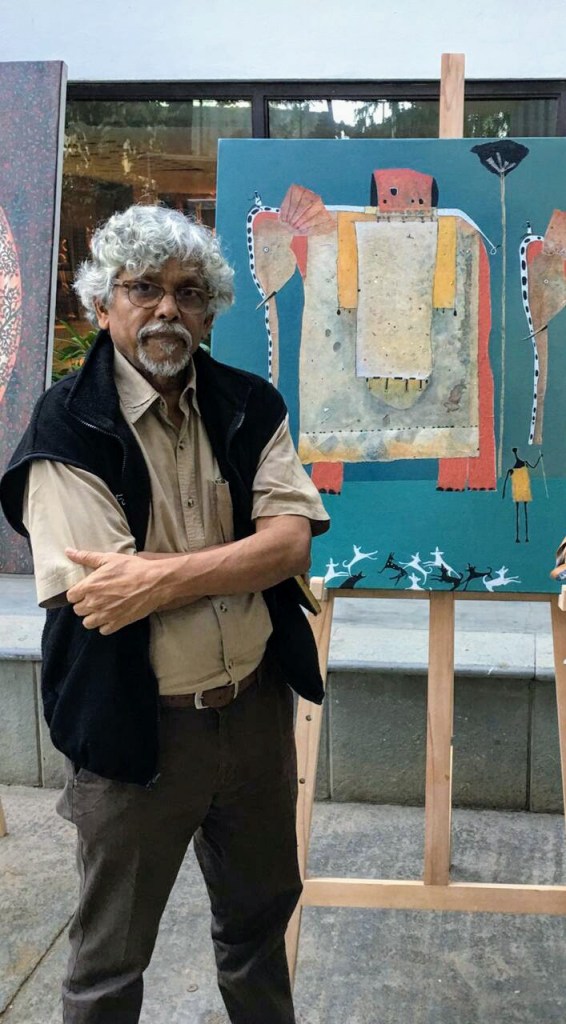
Haren Thakur with his painting. Photo provided by Ratnottama Sengupta

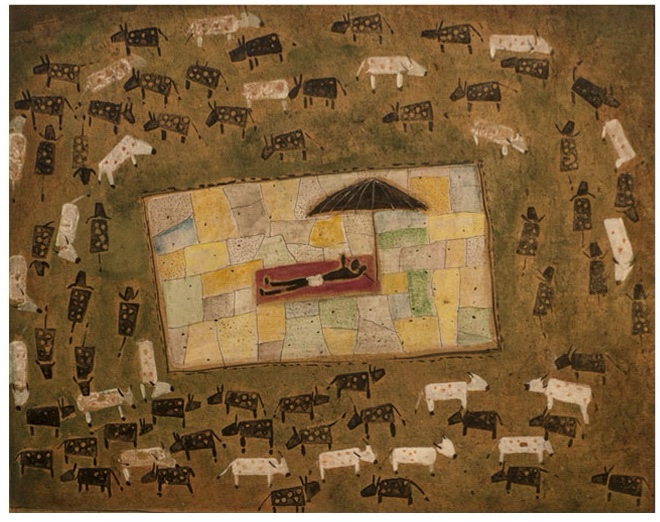
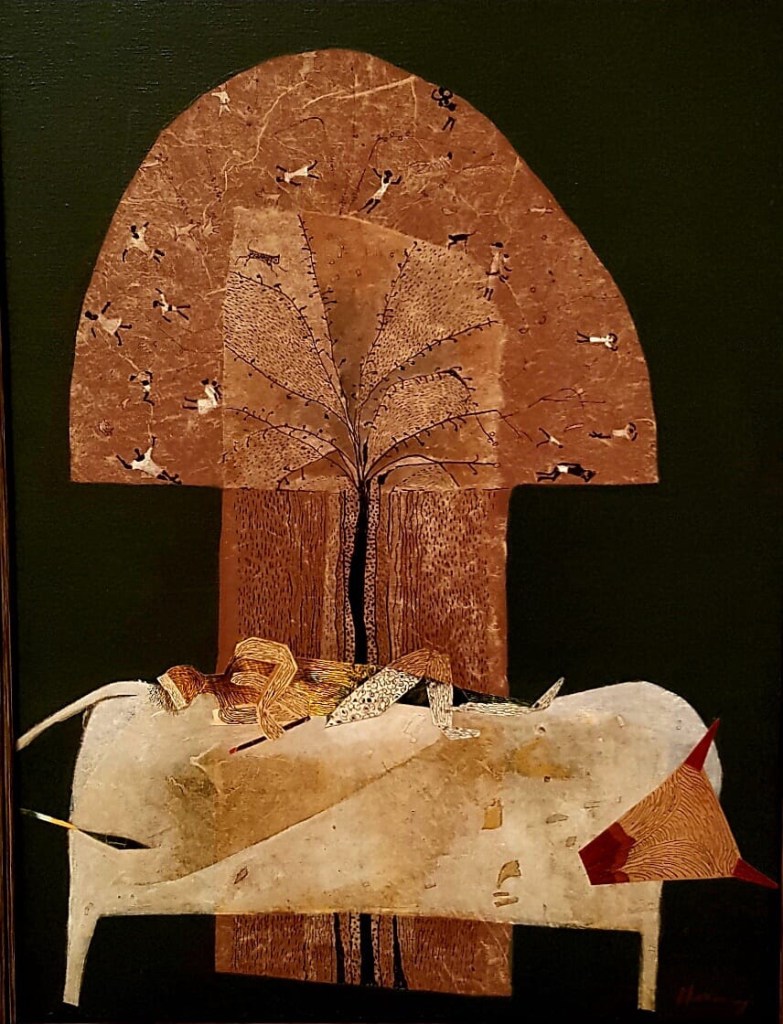
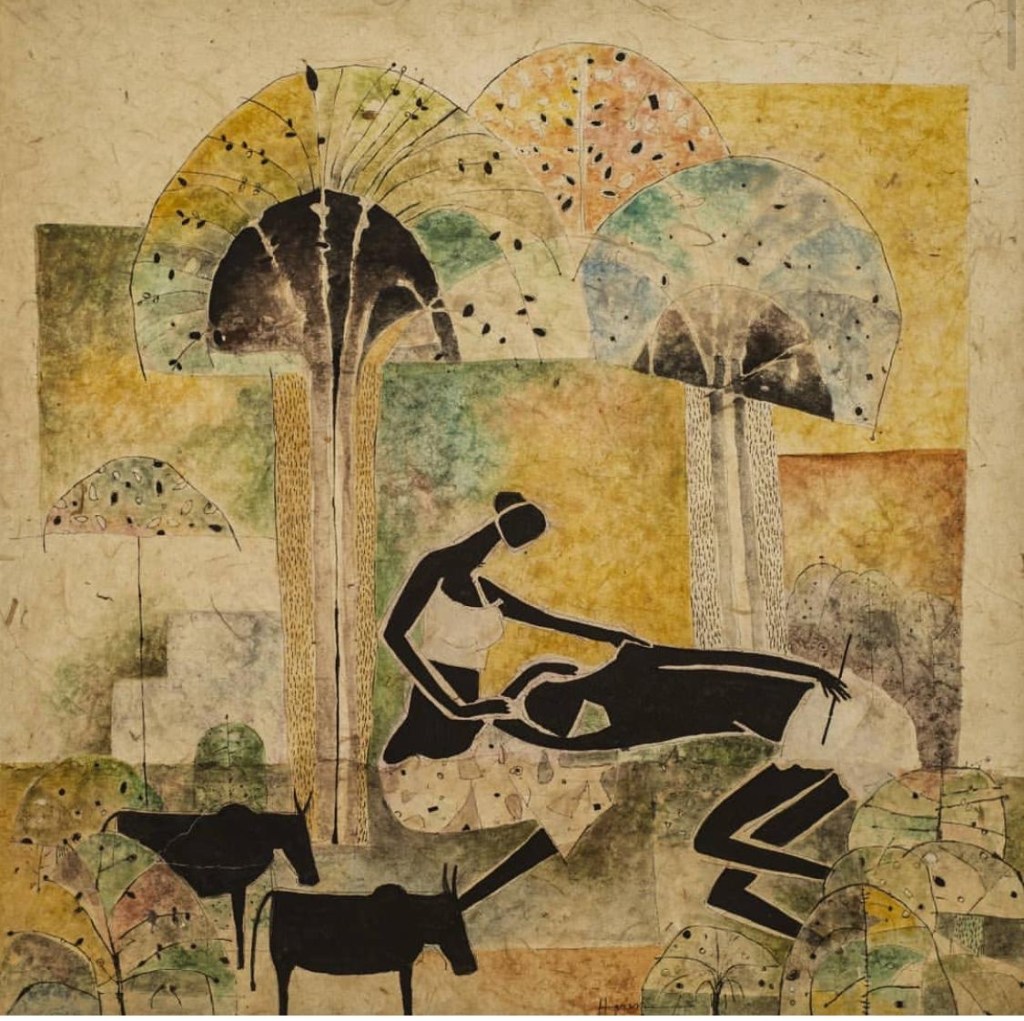
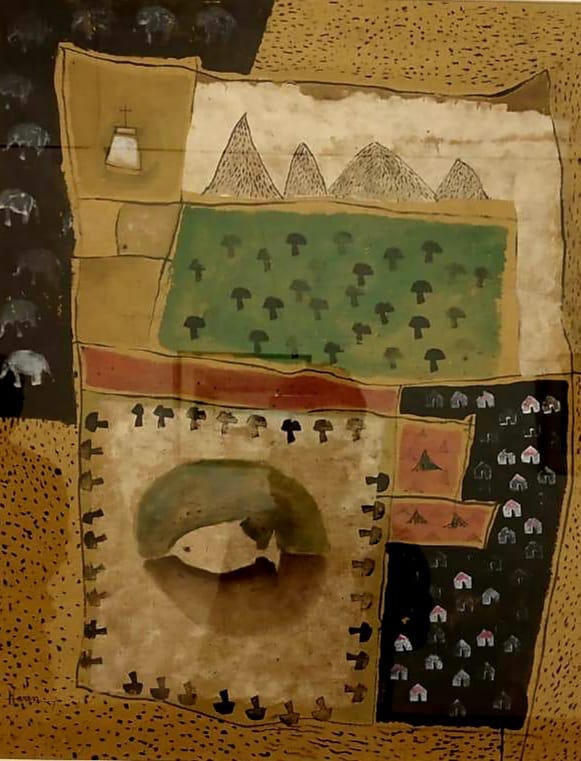
A dark, stick-like outline encompasses a human of the male species. A triangle, an oblong, a rectangle. A white patch in the midst of a sepia-green landscape. A drummer. A mother with a child holding aloft a balloon. Two women bathing in a primitive pond. A quizzical duck. A wriggling worm. Trees hills fish pigs cows fox… And, yes! A train zigzagging its way through a vast expanse of meadows. As we view the watercolours of Haren Thakur from Ranchi, you might think of the rice-white art of the Warli tribals characterised by geometric shapes that depict the rituals of everyday life. I might be inclined to revisit the painted layers on the 100,000-year laterite at the prehistoric rock shelters of Bhimbetka in the foothills of the Vindhyas in Madhya Pradesh. Another viewer might think of the ancient Sauras and the adornment of their walls in their adobe huts in Odisha. The artist himself might have recollections of the animated Santhal pats he saw being created during his student years in Tagore’s Santiniketan. However, none of Haren’s figures are simplistic. They are all stylised. And so adroitly that you are bound to sit up and take note of them no matter how many times you have come across the theme.

Form and content come seamlessly together in the paintings that Haren Thakur will exhibit in Delhi’s Habitat Centre from April 15. The artist who mastered Art at Santiniketan — home to Santhals, the native dwellers of Bengal and Odisha — then made his living in Jharkhand, which is home to 32 tribes… Indeed, from his very beginning, the beauty in the dark skin-tone of the men and women going about their chores was the most natural rhythm of life in the bazaars and streets of Bankura Bishnupur, where his family hailed from, or in Purulia, where his father made his home. 

Beyond doubt, Rabindranath’s deep affection for the Santhals and the Bauls reinforced this love. Much like Gurudev, Haren finds poetry in their tilling of the earth. In their mono-toned songs and the repetitive steps of their dance. In the fulfilment they find in the primeval life and archetypal love. And when, following in the footsteps of the Universal Poet, Haren finds beauty in a grain of sand, the everyday life ceases to be an essay in deprivation and rises to the level of art.

*

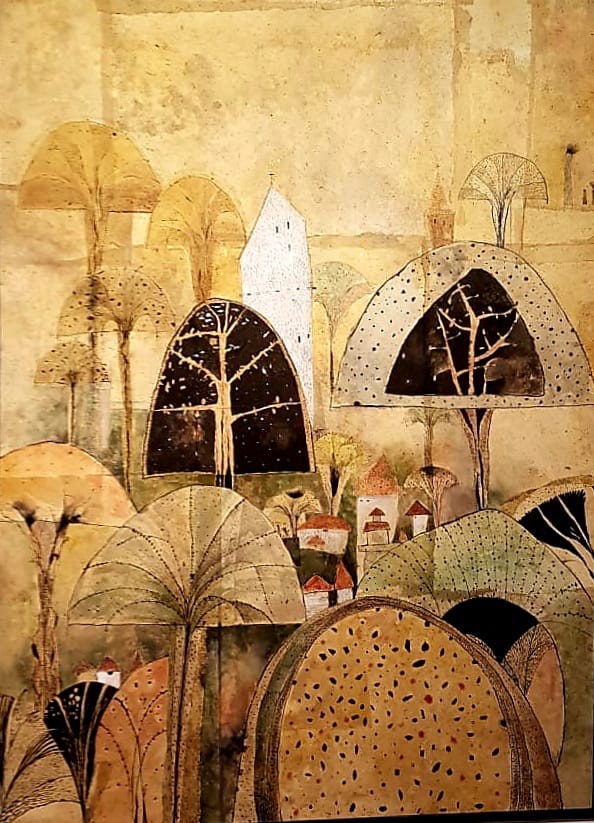
And his colour palette? That too came off the walls of his hostel in Santiniketan, from the frescoes and murals by Binode Behari Mukherjee. From the brick-toned ‘canvas’ that is the prehistoric rock painting of Bhimbetka. The pigment on Haren’s brush and tubes is never loud then, never grating. It is always muted, always mellow. And the impact is heightened by Haren’s utilisation of rice paper, and Chinese ink, on watercolour.

The Nepali rice paper became his signature in 1974. Prior to that he would work the rice paper in the tempera process that was ‘Master Moshai’ Nandalal Bose’s gharana, school – or Indian shaili, style. But in that process of painting layer by layer, the rice paper would lose its original character and serve merely as a background surface.

Then, in his fourth year, for a scholarship test of the Visva Bharati University, Haren experimented by soaking the rice paper in water. It became so pliant that he could spread it out like a piece of cloth. “And its texture!” It won him the scholarship — and immense appreciation from his teachers, Dinkar Kaushik and Somnath Hore. “They said, ‘Go ahead and explore this medium and this process further. It adds a dimension that has immense possibility.”

Fifty years have gone by since, but Haren has not given it up. Sometimes, when painting on canvas, he does apply acrylic directly on its surface. But at times, even here, he pastes rice paper on the canvas, primes it with watercolour, then inks in the forms. However he adds, “when I paint on rice paper mounted on board, I do not – cannot – use acrylic. It simply doesn’t have the capacity to be absorbed by the rice paper the way watercolour gets absorbed.” So, in such cases Haren uses transparent watercolour.

Clearly the chemistry between rice paper and watercolour is amazing. Unique.

*

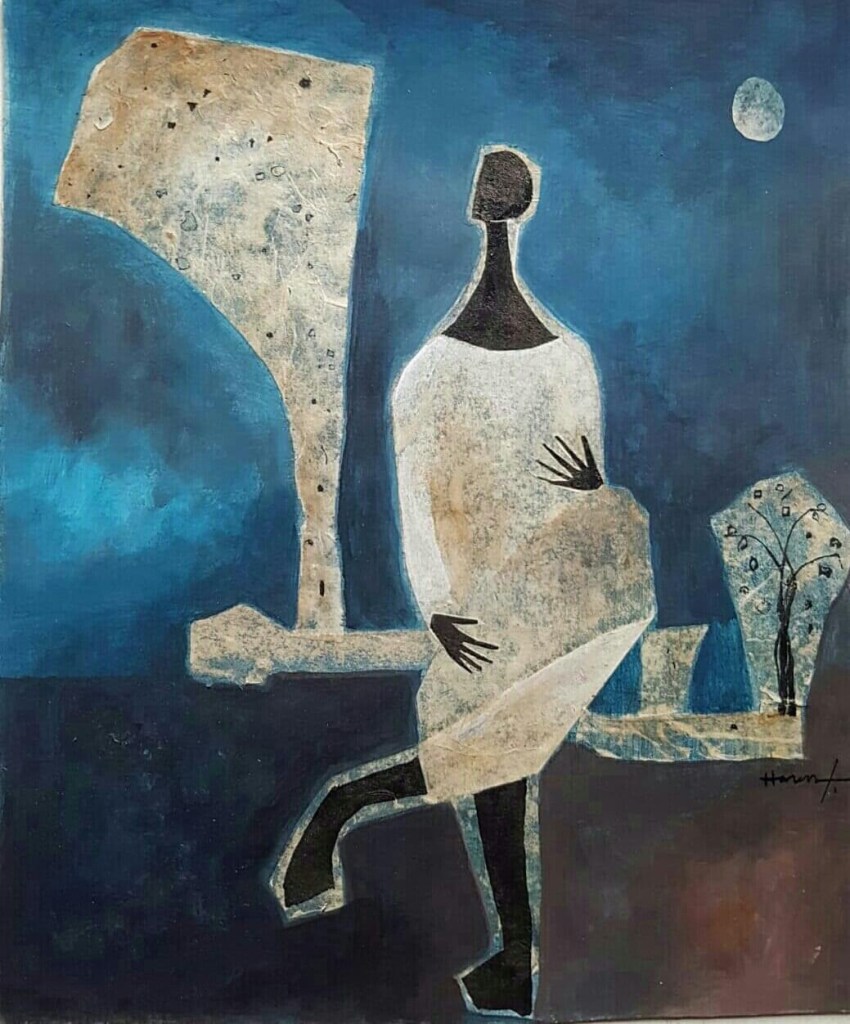
Circling back to the content: Haren’s understated pitch was reinforced by the Zen worldview of a teacher like Somnath Hore. The master minimalist’s use of the white, barely scratched by the red of a wound, spoke volumes — and it made Haren introspect. Once, while exhibiting the Wound series, Somnath Da had said, “I discovered such depth of emotion in the reticence of tones!” This soliloquy got deeply etched in Haren’s unconscious. And eventually it came to express itself in the rusty red of the iron oxide rich Birbhum soil; the roasted brown of Purulia’s rocky earth; the weathered green of the Bauls; the soothing blue of the open sky high above the woolly white of floating clouds.

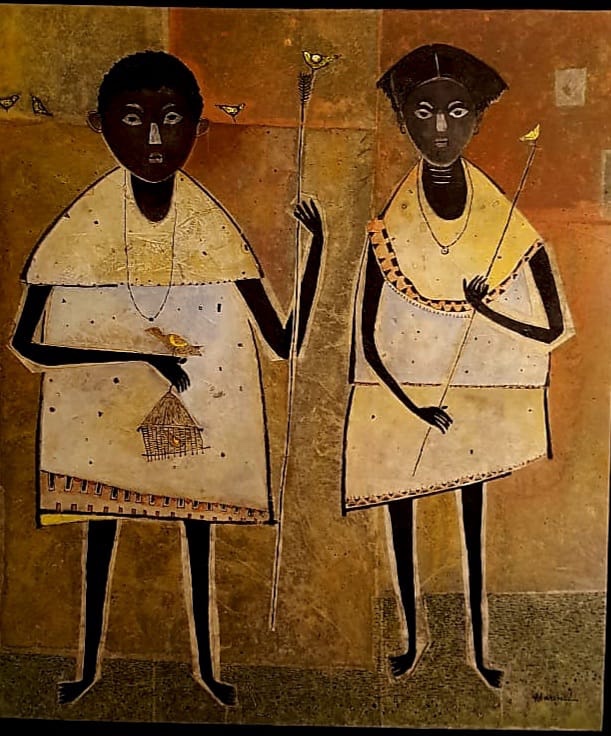
Flattened figures. Non-realistic features. Do you see a hint of Husain – or perhaps Paul Klee – in the abstraction of the human world? I notice a reflection of the figures encountered on Egyptian papyrus. Or the African world. Haren, on his part, reiterates his original inclination: the attraction towards the lack of artifice in Adivasi life. How else would the tribals go about their daily humdrum with a baby knotted to their back? Or float in an open pool under the sun-kissed sky? To the city-bred mind, this would be unthinkable — until Haren captions it ‘Nature’s Bathtub’!

But, notwithstanding my references, the art traditions of the indigenous people over the world have never influenced Haren. “Their art tradition is so rooted in their environment – be it of Jharkhand or of any other.” Even their pigments, brush, and surface are integral to their life. But he certainly derives inspiration from the lifestyle of the original inhabitants, he affirms.

“I have always admired their direct application, the spontaneity of their form,” Haren further explains. “But I am influenced rather by the uncomplicated lives they lead. Since I was in Santiniketan I have admired the way they connect with nature in everything they do. Their intimacy with animals is incredible – they seem to be in dialogue with the animals they domesticate! This became a part of my visual world, especially when I came to live in Ranchi. The same reality imbues the lives of the natives – Oraon, Munda, Ho, Sabar, Bedia, Lohar… They rest under the tree unconcerned about how the ‘civilised’ world looks at them. They speak with the hills, with clouds in the sky, with cattle and kids, trees and waters, rivers and streams!”

This they do with no inhibition. Because this routine is a reality they have inherited from their ancients. “That is why I believe there is nothing more ‘Contemporary’ than this,” Haren asserts. This innate natural life, and the Santiniketan grooming, combined to forge his vocabulary, his visual language.

So, in the exhibits, you encounter an abundance of water bodies. Pools and ponds. Rivers and waterfalls. Lotus and lily. Big fish. Many small fish in its tummy. Ducks and kingfishers. Hyacinth and hayfield. All this is a natural part of the countryside that has made Haren theirs.

Interestingly there is also this play with size. In one of the frames an elephant walks down the road – and at every footfall he is greeted by a number of… ants?! Look closely and you will decipher that they are dogs!

Haren is giving you a worm’s eye view. And, in addition to the proportion, he is  picturing the Hindi proverb Haathi chaley bazar, kutta bhaukey hazaar/ when an elephant walks to the market, a thousand dogs will bark! Political comment? You said it!

Stay tuned to the song of the Adivasi earth, Haren.

.

Ratnottama Sengupta, formerly Arts Editor of  The Times of India, teaches mass communication and film appreciation, curates film festivals and art exhibitions, and translates and writes books. She has been a member of CBFC, served on the National Film Awards jury and has herself won a National Award. 

.

PLEASE NOTE: ARTICLES CAN ONLY BE REPRODUCED IN OTHER SITES WITH DUE ACKNOWLEDGEMENT TO BORDERLESS JOURNAL

Click here to access the Borderless anthology, Monalisa No Longer Smiles

Click here to access Monalisa No Longer Smiles on Amazon International