Categories
Excerpt

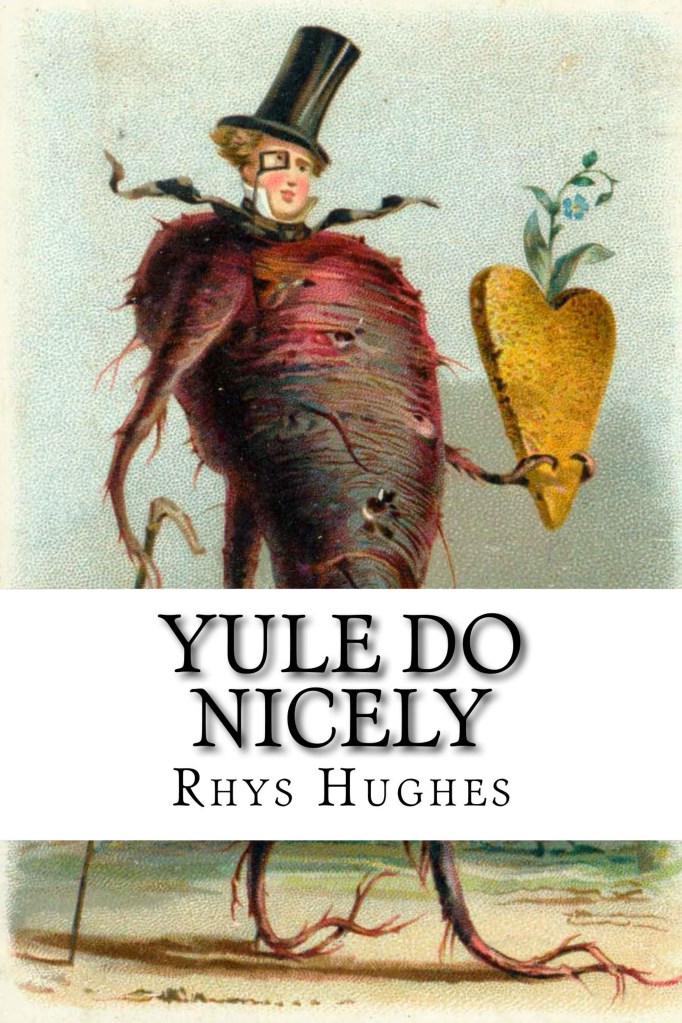
Yule Do Nicely

Title: Yule Do Nicely

Author: Rhys Hughes

The Hidden Sixpence

A young man was visiting the family of his girlfriend over the Christmas period for the first time. “I don’t believe in ghosts,” he said, as she led him into the house. In the parlour they sat down together for dinner.

“Careful you don’t swallow the hidden sixpence!” she warned, when the pudding was served.

“Cough, cough, cough, splutter!” he replied.

When he had recovered, she tenderly touched his arm. “What did I tell you? Puddings can be lethal at this time of year. You were lucky not to choke to death!”

He smiled in return but said nothing.

Concerned, she added, “Go into the kitchen and drink a glass of water. You’ll find it through that door there.”

Standing up and moving stiffly, he nodded and followed her advice, but he took a shortcut through the wall.

Three Friends

The three friends were mountain climbers who had trekked to the roof of the world. They had encountered many dangers on the way and each had taken a turn to plunge down a crevasse. Bound together by ropes as well as friendship, it seemed they had all escaped death by the narrowest of margins. One by one, they had praised their luck and had agreed that teamwork was wonderful.

After the end of one particularly difficult day, as the crimson sun impaled itself on the needle peaks of the horizon, the three friends set up their tent on a narrow ledge. The first friend, who had survived the first crevasse, boiled tea on his portable stove and lit his pipe. Stretching out his legs as far as the ledge would allow, he blew a smoke ring and said:

“Do any of you know what day it is? It is the second day of December. While timid souls are snug indoors, we are out in the cold. The wind whistles past this mountain like the voice of a ghost, shrill as dead leaves. The icy rock feels like the hand of a very aged corpse. Those lonely clouds far away have taken the form of winged demons.”

Then after a pause he added, “Everything reminds me of the region beyond the grave. I therefore suggest that we all tell ghost stories, to pass the time. I shall go first, if you like.”

Huddling closer to the stove, the first friend peered at the other two with eyes like black sequins. “This happened to me a long time ago. I was climbing in Austria and had rented a small hunting lodge high in the mountains. Unfortunately, I managed to break my leg on my very first climb and had to rest in the lodge until a doctor could be summoned. Because of a freak snowstorm that same evening, it turned out that I was stuck for a whole week. The lodge had only one bed. My guide, a local climber, slept on the floor.

“Every night, as my fever grew worse, I would ask my guide to fetch me a drink of water from the well outside the lodge. He always seemed reluctant to do this, but would eventually return with a jug of red wine. I was far too delirious to wonder at this, and always drank the contents right down. At the end of the week, when my fever broke, I asked him why he gave me wine rather than water from the well. Shuddering, he replied that the ‘wine’ had come from the well. I afterwards learned that the original owner of the lodge had cut his wife’s throat and had disposed of her body in the obvious way…”

The first friend shrugged and admitted that his was an inconclusive sort of ghost tale, but insisted that it was true nonetheless. He sucked on his pipe and poured three mugs of tea. Far below, the last avalanche of the day rumbled through the twilight. The second friend, who had survived the second crevasse, accepted a mug and nodded solemnly to himself. He seemed completely wrapped up in his own thoughts. Finally, he said:

“I too have a ghost story, and mine is true as well. It happened when I was a student in London. I lived in a house where another student had bled to death after cutting off his fingers in his heroic attempt to make his very first cucumber sandwich.

“I kept finding the fingers in the most unlikely places. They turned up in the fridge, in the bed, even in the pockets of my trousers. One evening, my girlfriend started giggling. We were sitting on the sofa listening to music and I asked her what was wrong. She replied that I ought to stop tickling her. Needless to say, my hands were on my lap.

“I consulted all sorts of people to help me with the problem. One kindly old priest came to exorcise the house. I set up mousetraps in the kitchen. But nothing seemed to work.

“The fingers kept appearing on the carpet, behind books on the bookshelf, in my soup. I grew more and more despondent and reluctantly considered moving. Suddenly, in a dream, the solution came to me. It was a neat solution, and it worked. It was very simple, actually. I bought a cat…”

The second friend smiled and sipped his tea. Both he and the first friend gazed across at the third friend. The third friend seemed remote and abstracted. He stared out into the limitless dark. In the light from the stove, he appeared pale and unhealthy. He refused the mug that the first friend offered him.

The first two friends urged him to tell a tale, but he shook his head. “Come on,” they said, “you must have at least one ghost story to tell. Everybody has at least one.” With a deep, heavy sigh, the third friend finally confessed that he did. The first two friends rubbed their hands in delight. They insisted, however, that it had to be true.

“Oh, it’s true all right,” replied the third friend, “and it’s easily told. But you might regret hearing it. Especially when you consider that we are stuck on this ledge together for the rest of the night.”

When the first two friends laughed at this, he raised a hand for silence and began to speak. His words should have been as cold and ponderous as a glacier, but instead they were casual and tinged with a trace of irony. He said simply:

“I didn’t survive the third crevasse.”

 About the Book:

Christmas is coming, the goose is getting fat, please put a penny in the old man’s hat. Yes, but we first require more information about the goose, the penny and the hat. We can’t be too careful these days. How fat is the goose getting and what connection does it have with the old man? Is the goose getting so fat that it is likely to explode with disastrous results for the nation? How will paying the old man a penny prevent this outcome? The situation is unclear. We are on more certain ground when it is explained that the following fictions have been assembled in their present form in order to celebrate the festive season. They include work from the span of the past quarter century. The first twenty-four tales form a weird advent calendar from December 1st to 24th. Then it is Christmas Day and time for the stocking and the twenty-eight little strange tales inside it. 

About the Author:

Rhys Hughes has been writing fiction from an early age. His first book was published in 1995 and since that time he has published fifty other books, nine hundred short stories and many articles and poems, and his work has been translated into ten languages. He graduated as an engineer but currently works as a tutor of mathematics. Having lived in Britain, Spain and Kenya, he is now planning to move to India. His poetry tends to be humorous light verse and offbeat lyrical fantasy, influenced mainly by Don Marquis, Ogden Nash, Edward Lear, Richard Brautigan, Ivor Cutler and Spike Milligan.

PLEASE NOTE: ARTICLES CAN ONLY BE REPRODUCED IN OTHER SITES WITH DUE ACKNOWLEDGEMENT TO BORDERLESS JOURNAL

Click here to access the Borderless anthology, Monalisa No Longer Smiles

Categories
Excerpt

On the Passing of Mahasweta Devi by Manoranjan Byapari

Title: How I Became a Writer: An Autobiography of a Dalit

Author: Manoranjan Byapari

Translator: Anurima Chanda

Publisher: SAGE Publications India and Samya under Samya SAGE Select imprint

Chapter 34: The End of an Era

The passing away of certain individuals left a huge impact on the human community. The void created by their absence was irreplaceable. This was especially true when it came to Mahasweta Devi. . . . Because of the power of Mahasweta Devi’s writing, there was a huge need for her leadership and protest. Equipped with the fire and anger akin to the sun, she was the one to have kept the fight against injustice alive. She had not given in to any temptation or fear, but spent an entire life battling in the interest of those starving penniless people tottering on empty stomachs. Her roar had raged right from the decade of the seventies to the dangerous days of Singur, Nandigram and Netai. Her fiery raging pen had dealt blow after blow like a cannon on the impenetrable fort of the cannibalistic and violent forces out to destroy human civilization . . .

              It was a painful time for Bengal, Bengalis, intellectuals and civil society. Somebody had said that a writer does not write with a pen, but with the spine . . . In those times, the one and only ‘soldier armed with a pen’, Mahasweta Devi, had protested against that which is unjust, improper and inhumane. Her fight was for the Adivasis, the foresters, the Dalits, the labouring classes and the minority groups…

    . . . With the death of Mahasweta Devi, I lost a mother who had…shown me a new direction. She was the one to explain the meaning of ‘jijibisha’ [the will to live]to me. There were multiple ways to live…But what is the point of that life which gets lost immediately after death? She showed me the direction of such an endless life.

. . . During the long thirty-six years, from 1981 to 2016, she was spread all over my life like a huge tree . . . This tree possessed the powers of the Sanjeevani plant whose mere touch could revive the dead.

              Although I started with Bartika and thereafter had my works find a place as part of course books for the West Bengal State University, within the journal of the Comparative Literature Journal of Jadavpur University, as questions under the Public Service Commission exams, I was still unsure how far I would have to swim to reach the end. According to me, I have been able to reach the ultimate stage. I have achieved as far as I could achieve, from being unlettered to discovering the world of letters which was then followed by receiving  the Bangla Akademi award and the Ananya Somman from 24 Ghonta. After obtaining the biggest two awards in Bangla literature, I could perhaps say with some amount of certainty that I have experienced it all.

. . . Having read so many books, I knew well enough that the world of my experiences were not readily available to many others.Hence, they were not able to write about it. They could not even think of writing about it, as their imaginations also failed. I, on the contrary, could easily write innumerable pages on them.  That’s what I did. I wrote four short stories and took it to Mahasweta Devi who explained, as I have mentioned earlier, that she does not publish fiction. I found the addresses of four magazines and sent them off to be published  . . . all the four stories had been published.  I found a lot of strength and self confidence at this incident. I realized that I could really do it. Even if there were no one backing me, I could fight my own fight.. ..

              I next came in contact with Mahasweta Devi in 2000, three years after my return [from Chhatisgarh]. Around this time, many of my works were published with Bartika. I revived my relations with her, which remained till her last breath . . . my association with her remained for the entire duration of 1981 to 2016. I would visit her place almost every other week. In the huge expanse of time, she wrote for so many newspapers starting with Jugantar to Bartaman, but she never wrote a line about the rickshaw-puller writer Manoranjan Byapari . . .. People might remember that just a few days before her death in 2016 she had written almost an entire-page article for Ei Shomoy about the rising young writers from West Bengal who had a lot of potential.

 . . . Mahasweta Devi loved me like her own child. She had already looked far into my future. She knew that it would cause me a lot of pain, but in her heart she wanted the world to cheer for me. However difficult it might be, she wanted me to make my own path, so that no tag of favouritism could get stuck to my life like a leech which would have compelled me to bow down my head with ‘gratitude’ all my life. She wanted me to become independent and did not desire my heart to grow weak . She had wanted me to become a writer on my own worth, an independent, self-dependent, courageous writer. 

ABOUT THE BOOK

‘Writing was my truth, my god, my everything. I could not leave it for anything.’

With these words, Manoranjan Byapari points to how writing is as important to him as breathing. How I Became a Writer: An Autobiography of a Dalit is the translation of the second volume of his remarkable life story Itibritte Chandal Jivan. In this volume, translated for the first time into English with great sensitivity, the author talks of his life in Kolkata after leaving the Chhattisgarh Mukti Morcha. He takes up the post of a cook at a school, which provides work, albeit gruelling. Part I, School Shenanigans, describes how he carried out his duties, while being treated contemptuously because he is a Dalit, and became more determined to forge a new identity as a writer. Part II, The Right to Write, reveals how his persistence gradually resulted in his works being published in little magazines and, later, by mainstream publishers and how his fame slowly spread with television interviews and prestigious awards.

He discusses Dalit writings, Dalit literary organizations and whether he is a ‘Dalit writer’. His forthright observations on society and governance provide many insights.

ABOUT THE AUTHOR

Manoranjan Byapari never went to school or university. He first wrote for little magazines where his success and popularity found him many publishers. His writing career took place as he worked as a cook for 21 years at the Helen Keller School for the Deaf and the Blind. He is a Trinamul Congress MLA for Balagarh since the 2021 West Bengal Vidhan Sabha elections. He has received many awards such as the Suprabha Majumdar Smarak Puraskar by the Paschim Banga Bangla Akademi in 2014, the television channel 24 Ghonta’s Ananya Samman in 2013 and in 2019 the Hindu Literary Fest’s nonfiction award. He is well known across India as he speaks in Hindi that he learnt in Chhatisgarh when he was with the Mukti Morcha of the late Shankar Guha Neogi.

ABOUT THE TRANSLATOR

Anurima Chanda is Assistant Professor, Department of English, Birsa Munda College, North Bengal University. She has taught English as Second Language (ESL) and students with learning disabilities at the Centre for Writing and Communication, Ashoka University. She received her PhD on Indian English Children’s Literatures from JNU. She was a pre-doctoral fellow at the University of Wüerzburg. She is also a literary translator (translating from Bengali/Hindi-English-Bengali. Among her books for children are Timelines from Indian History: From Ancient Civilizations to a Modern democracy; Tintin in Tibet by Herge: A Critical Companion; The Untouchable and Other Poem; and DK Indian Icons: Bhimrao Ambedkar: An Illustrated Story of a Life.

CREDIT LINE:

Excerpted from How I Became a Writer: An Autobiography of a Dalit by Manoranjan Byapari, translated by Anurima Chanda. Jointly published by SAGE Publications India and Samya. 2022, 376 pages, Paperback, Rs.650, ISBN: (978-93-81345-77-1), Samya SAGE Select.

PLEASE NOTE: ARTICLES CAN ONLY BE REPRODUCED IN OTHER SITES WITH DUE ACKNOWLEDGEMENT TO BORDERLESS JOURNAL

Click here to access the Borderless anthology, Monalisa No Longer Smiles
Categories
Excerpt

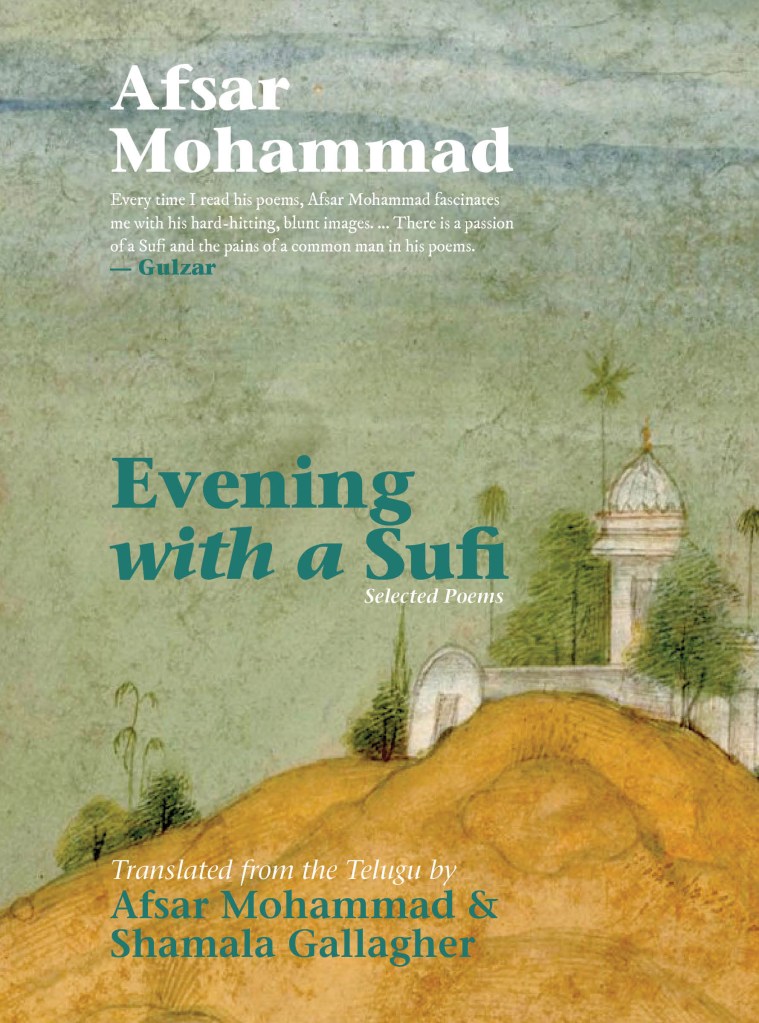
Evening with a Sufi: Selected Poems

Title: Evening with a Sufi: Selected Poems

Author: Afsar Mohammad

Translator: Afsar Mohammad & Shamala Gallagher

Publisher: Red River

Across from the Char Minar

You see how one butterfly
left us a trace of its colour,
before killing itself
on this busy street.

Here one thousand people,
one then the other
crossed and walked on
without even looking. 

Any afternoon, when the sun
smiles like a white flower
on the head of the Char Minar,
just walk straight into his look.

It’s not so hard
to pour one look into
an ever-burning oven,
a house of molten sights.

Here where the butterfly forgot
its colour and flew off into the dark,
stay and stare straight into life.     
Tell me how it looks.

The thousand people who walked,
limped, and ran by this road
told me at least a thousand lies
but in innocent tongues. 

Another Word

At the end of crying out, 
my word is a dwarf. 

How long can I live on a dwarf? 

The tear that sang before my beginning
never leaves me a gasp of shore. 

I can’t become your sea or sky. 

I am just a tearlet
beneath your eye. 

The drop 
that can swallow a desert.  


In the Middle of the Poem

The line gasps, interrupted. 
Quick gulp of silence. 
Someone pants at the rear. 

The road flies back. 
A scene flits past,
along with the footsteps. 
Silence has so many faces. 

Someone walks on either side,
hazy, indistinct. 
Someone sighs behind the shoulder. 
The poem stops. 

A Rain Lost in Hyderabad
1

Since there is nothing like evening here,
I just dream an evening
in every bit of my sleep.

When the trees erase their shades,
when the sky dries out its final sunshine,
a cold wave scoops me.

I rush to my nest and hide in its wings
before the dark night takes me.

2

Never know if this was raining since morning
or just began this noon.
The lives that unfurl in the noons
don’t know morning breezes.

Getting up past noon,
I realise the alarm was tired
of alarming me and sighed itself off.

I am best at reading time
in reverse.

3

I am the crooked one

who is born when all the rains and winters
lose their hope of moving.

4

Hyderabad is my altered self —

a dreamless sleep,
a sleepless dream,

awaking slipped under a nap. 

(Excerpted from Evening with a Sufi: Selected Poems by Afsar Mohammad, translated from the Telugu by Afsar Mohammad & Shamala Gallagher. Published by Red River, 2022)

About the book

Evening with a Sufi: Selected Poems volume brings together, for the first time in English translation (translated by the poet in collaboration with Shamala Gallagher) the selected, and often groundbreaking poetry of the celebrated Telugu poet Afsar Mohammad, known for his trendsetting poetry and literary criticism in the post-1980s Telugu literary culture. Beside an erudite translator’s note from Gallagher, Evening with a Sufi also contains two in-depth essays on Afsar Mohammad’s poetry by David Shulman and Cheran Rudhramoorthy, plus an interview with the poet by poet and translator Rohith.

About the Author

Born in a small village in the South Indian state of Telangana, Afsar Mohammad now teaches South Asian Studies at the University of Pennsylvania. Known as a trendsetting poet and literary critic in the post-1980s Telugu literary culture, Afsar has published five volumes of poetry, one collection of short stories and two volumes of literary theory essays. Afsar is also a distinguished scholar of Indian studies and has published extensively with various international presses, including Oxford and Cambridge. He is now working on a translation of Sufi poetry from Telugu to English. He can be reached at afsartelugu@gmail.com

About the translator

Shamala Gallagher is a mixed-race Indian American writer, community college teacher, and mother to a preschooler. She is the author of a poetry collection, Late Morning When the World Burns (The Cultural Society, 2019), and her writing has been published in several literary journals, including Poetry, Gulf Coast, Black Warrior Review, and the Missouri Review. She lives in a hundred-year-old house in Athens, Georgia, USA with her family and cats.

Click here to read the review

PLEASE NOTE: ARTICLES CAN ONLY BE REPRODUCED IN OTHER SITES WITH DUE ACKNOWLEDGEMENT TO BORDERLESS JOURNAL

Categories
Excerpt

Tarnath Tantrik by Bibhutibhushan

Title: Taranath Tantrik: And Other Tales from the Supernatural

Author: Bibhutibhushan

Translator: Devalina Mookerjee

Publisher: Speaking Tiger Books

Since I was deep in meditation, it took a few seconds for the smell of musk to register on my consciousness.

It was with a smile that my mind turned towards the smell. What a wonderful fragrance, I thought, nature is truly magnificent in her bounty! Immediately after this my senses sharpened because it felt as if someone was standing behind me, on the other side of the trunk of the tree. It is true that I could not see the person, but that made me no less sure of her presence. Sometimes instinct serves better than eyes. My entire being was suddenly, completely awake and alert. The air went still. Then, I felt as if my body was on fire, burning embers scorching my insides and exploding outward. The excruciating pain was growing. Was I about to faint again? Just at that moment, the pain disappeared, and there was a woman standing in front of me. I was absolutely certain that she had not been anywhere near that spot even a heartbeat ago. The suddenness echoed exactly that night when I occupied the tantrik’s seat. But this time I knew that she had come for me. This time, I would not slide into unconsciousness. I looked at her. She seemed to be frowning in disapproval—’

***

‘Are you sure you saw this woman yourself, with your own eyes?’ The question slipped out of my mouth before I could stop it. Taranath heard my disbelief, and his tone became agitated and defensive—‘Did I see her with my own eyes? Of course I saw her with my own eyes!

There she was, large as life, standing in front of me! Look, you can believe me or not, that’s up to you. But you can’t say that I’m lying to you, because I’m not.’

‘What did she look like?’ I asked, hoping to appease him somewhat.

‘If I said she was beautiful, that would be less than a proper description. She was exactly as the incantation to call her says, a loveliness beyond words, beyond compare, beyond this world. I realised that the incantations of power I had been pronouncing for months were not simply words made up to call this being, they were descriptions of her power and beauty.’

‘Did you talk to her?’ I was hanging on to his words.

‘Talk to her?’ he scoffed. ‘I was just barely hanging onto consciousness, and you want to know if I talked to her! This was not a normal woman, you understand?

Not from any point of view was she ordinary. Her power radiated from her like the sun. And those eyes!

The incantation to call her mentions her eyes, I had thought those were just words to propitiate the goddess and compel her to respond to the call. My god, you should have seen those eyes—worlds could be conquered and burn in the fiery steel of those exquisite eyes.’

I became impatient. ‘Never mind the long descriptions! What happened? What did you talk with her about?’

He became circumspect. ‘What we talked about is private, between her and me. Such things are not for others to know.’

***

‘What happened is that Madhusundari Devi started to visit me every night. In that desolate place by the river, I had called her as a lover. But you must have guessed that already. After all, who could possibly be dull enough to listen to overcautious warnings from an old tantrik?

It was a mild winter. The waters of the Barakar river were gentle, and low in the bed. The lilies in the shallow water near the banks had become dry and yellow, revealing rock-minerals in the sand that sparkled in the light of the moon. The forests on both sides of the river were shedding leaves into the breeze. The skies were clear and blue in the day, and the moon shone in a cloudless sky at night. From that time on, for three months, she visited me every night. I felt completely alive in those three months, never before, or since, have I felt like that. It’s painful to talk about feeling like that now.

You cannot imagine the pain of it, the grief of loss over a self capable of that kind of joy. I reached a pinnacle of happiness and stayed there for three whole months. She was a goddess indeed. No ordinary human woman would be able to grant such experiences of love, such deep, perfect friendship. Being with her was heavenly, not of this earth. I can’t explain it to you. What words would I use? And you would disbelieve me anyway. You’d call me a liar, or say I’m mad. Perhaps you’re thinking those things right now, as I gabble on.

It’s not just you, even my wife does not believe me. She says the tantrik had used his black magic skills to shut my brains down.

That kind of happiness is intoxicating, like being drunk on very strong wine. But being drunk on strong wine also creates an ennui of its own. I would be listless all day, nothing in this real world held my interest. The daylight hours would go in longing for the evening.

When would dusk darken to twilight under the trees, in the forest by the river? When would she appear, my beautiful actress, perfect heroine to my new-found role as hero? The nights would pass like a dream, time slipping through my fingers like dry sand, each night deeply intoxicated and glittering with joy. My consciousness would expand outwards, grow unfettered, till the sky, the planets, the gods and goddesses were all part of my being, each night, under the stars by the river.

Then, something happened.

A young woman who lived in the nearby village used to come to the river to get water. Since she came every day, I saw her quite regularly.

Excerpted from Taranath Tantrik: And Other Tales from the Supernatural by Bibhutibhushan, translated by Devalina Mookerjee. Published by Speaking Tiger Books, 2022.

ABOUT THE BOOK

Ghosts are everywhere. Most are ghosts of ideas, feelings, memories. These are our personal ghosts, and they follow us alone. But there are other ghosts, in which we share a common fear. Thickening shadows pooling at the corner of the room, unexplained breathing in the dark, the child who steps out of an old photo—the shiver of supernatural frisson, a thin crooked finger of ice tracing its way down your spine. This fear, and thrill, is rightfully the domain of the kind of ghost you will meet in this book.

In Taranath Tantrik, Devalina Mookerjee translates nine stories of the uncanny and occult by legendary Bengali storyteller, Bibhutibhushan. Seven are short stories of séance, curses, return for revenge, and the desire for things that have no place in human lives. Two are about tantra, of necromancy, spiritual power, goddesses, and ghosts.

The borders of reality are porous in this world.

ABOUT THE AUTHOR

Bibhutibhushan Bandyopadhyay (1894–1950) is regarded as one of the greatest Bengali writers. His best known works are the autobiographical novel, Pather Panchali (The Song of the Road), which was made into a film by Satyajit Ray, Chander Pahar, and Aranyak.

ABOUT THE TRANSLATOR

Devalina Mookerjee is a translator and publisher. She is also a researcher in health and education. Her interest in ghosts is based on two decades of social science research. She learned to play bass over the lockdown, mostly jazz, blues and folk, and finds that the sound of the bass goes beautifully with stories of ghosts. She lives in New Delhi with her partner and five dogs.

.

Click here to read the review of the book

PLEASE NOTE: ARTICLES CAN ONLY BE REPRODUCED IN OTHER SITES WITH DUE ACKNOWLEDGEMENT TO BORDERLESS JOURNAL

Categories
Excerpt

A Handful of Sesame

Title: A Handful of Sesame

Author: Shrinivas Vaidya

Translator: Maithreyi Karnoor

Publisher: Gibbon Moon Books

Although Navalgund had been roused from its slumber by the Mainavati elopement episode, in a few days after the eloping couple returned, going by the saying, ‘she becomes of this earth when she starts lighting the hearth’ the scandal lost steam and the town went back to sleep again.

The people returned to their busy routines of asking each other in the mornings if they were up, and turning their faces to the skies in the afternoon and saying “What do you know? There’s not a hint of rain yet.” They went back to sitting on the knoll near the Lalgade temple until darkness stepped in and until the concluding strains of the raag Bhairavi  of the Magdum’s band rehearsal became thin air, they discussed such pressing matters as the ghost in the tamarind tree beside the Sankawwa pond, or the yard-long wheat-hued cobra that had slithered into the rock cluster before the Taluk office, or the Halladmatha’s Sire’s persistent cough, or Mamlatdar’s minor wife Mandakini, or the plague mice falling dead in Hubballi, or Bal Gangadhar Tilak. After ruminating over these never-ending topics, they would hasten home to eat their evening meals and shut their doors upon the darkness outside and turn in before the wicks in the kerosene lamps in their respective homes went off with a phtt.  The womenfolk kept themselves busy with hearth, childbirth, and a little mirth of water’s worth on their way to the pond. Once in a while, they created their own entertainment with gossip and slander and quarrels – scold this one, taunt that one or mock another one. 

Navalgund has grown considerably in the thirty or forty years since the mutiny. Fleeing the Company’s oppression, many families from Nargund are now settled in Navalgund. With the increase in population, more merchants have set up shops. Earlier, Adoni’s was the only trading family in all of Navalgund. Now, with the addition of Mhantshetty, Mhankali, and Yirapakshimath, there are four merchant families. The Queen’s government had laid down with great care gravel roads because of which trade and businesses are growing. Open-topped and covered bullock carts and even horse-drawn carts are now plying from town to town on these roads. The municipality that has been there for a while has now started a school, a library and — can you believe it — even an English hospital! But no one goes to that hospital because it is rumoured that they put the flesh of chickens, sheep, and donkeys in their medicines. Hence, Vasudevaachar’s patients are constantly growing in number. Bullock carts crowd at the Panths’ door every morning. Moaning, groaning and coughing patients covered in woollen blankets wait in their veranda. Vasudevaachar walks among them bare-chested, stroking his sacred thread with both hands and advising the patients on their medication, treatment and diet, offering soothing words of courage or stern reprimands as the occasion demanded.

“Ningawwa, if give up garlic chutney for two days the sky won’t fall on your head”

“Krishtya, I’ll give you a Shankhvati. Powder it, mix it with lemon juice and lick it. Your stomach will be alright. You won’t die if you cut down on your food for a couple of days”

“Bharmya, I’m giving you this bottle of Balantsyrup. Give it to your wife and don’t drink it yourself, you whoreson…”

“Basangauda, you have the sugar disease. Fire two of your farmhands and do their work yourself. You must also eat less…”

“Subbi, I told you that feeding your daughter-in-law the red figs of the Banyan tree will beget her children. But I don’t remember promising they would be male children!”

“Do not eat or drink undrinkable and uneatable things, you sons of unwed mothers!”

“Goudra, your lady is showing signs of consumption. See if her spittle is red-tinted. It’s a terribly infectious disease. Stay away for a few days – it’s good for you and also for her.”

“It’s not just medicines that will cure you, Shambhu. You must also have faith in god. Here, repeat after me, medicine is the waters of the Ganges, the doctor is a manifestation of god’. Now, once more…”

Such medical jargon could be heard in the halls of the Panth house every day. 

From early morning to the ripening afternoon, Vasudevaachar sits in the outer hall attending to his patients. He then heads to the backyard, draws seven or eight pots of water from the well and pours it over himself completing his bath before heading to the altar and sitting down for a two-hour long, uninterrupted prayers. Sometimes the municipality’s three o’clock bell would have rung before his prayers are complete. Then, after a meal and a short siesta, with only a thin shawl covering his bare chest, he heads to the Lalgade Hanamappa temple for prayers in the late afternoon. Sometimes, if there is a sermon or sacred storyrecitation on, he sits down to listen to it. If not, he sits a while on the stone bench that’s open to the skies outside and lets himself afloat in Magdum’s melodies before slowly heading back home.

On one such rippleless evening, Tulsakka and Vasudevaachar sat chatting on the porch outside the house. The children who had gone out to play hadn’t returned yet and Ambakka was at Antambhatta’s corner house, when suddenly Rukuma rushed from the backyard to the main-door looking excited and coughed a couple of times to draw Tulsakka’s attention. She then called out to her sotto voce, “Tulsakka… tssst… come here… come quickly…” Sensing her excitement and strange expression, Tulsakka left Vasudevaachar behind and walked over looking quizzically at Rukuma who began gushing and flailing her arms animatedly.

“She’s here!” she said.

“Who ay Rukuma? Who is here?” Tulsakka asked in her normal calm voice.

“She… she!” Rukuma insisted.

“She who?” asked Tulsakka as calm as before.

Rukuma came close to Tulsakka and said with wide eyes, “She! The one from Annigeri”

Taken aback by her words, “What’s this new drama now” Tulsakka exclaimed and followed her to the backyard.

Covering the child in her lap with the loose end of her sari, she sat by the stack of cotton twigs in the backyard, her poignant face both nervous and hopeful. As soon as Tulsakka and Rukuma came close, she stood up and held the child out and her eyes filled with tears.

“Please don’t be angry, my lady… it’s three days since he’s burning with a fever. Even the master of my home hasn’t visited in a while. Do what it takes but please save my child. I heard the master of your home is a great doctor with healing hands. So I came running here. Please don’t tell my master that I was here… he will be very angry. This is my only son please save him for me…” she implored them.

Tulsakka hesitated for a moment and then said, “Come, sit here…” and showed her to the holy basil pedestal. The Annigeri woman sat down where she was asked to. Then spotting someone else, she suddenly covered her face with her sari, handed the baby to Rukuma and stood back in fright. Even Rukuma and Tulsakka were a little scared as they turned around and saw that it was Vasudevaachar. He fixed a dark gaze upon them for a moment before looking at Rukuma and saying “Bring the child in, I’ll take a look.” He walked back to his desk in the outer hall and Rukuma followed with the baby.

The Annigeri baby’s fever was owing to a knot in the stomach. Vasudevaachar gave a handful of small sachets to Rukuma and said, “Tell her to mix this in thin, watered-down milk to make a paste and feed it to the baby four times a day. Children often get fevers. Tell her not to worry. The baby will be well in a couple of hours. Open one of the sachets and give it to the baby yourself so she can learn how it’s done. Also, tell the mother to drink boiled water and to feed the baby a little less for the next four days.” He sent Rukuma away and went back to sit on the porch outside.

As Vasudevaachar’s instructions were being carried out, Rukuma and Tulsakka had formed an easy friendship with the Annigeri woman as only women could with one another. ‘Where are you from? How many years since you came to Annigeri? What did you say your name was? Mhaashaabi? What does it mean? Where did you meet Venkanna? Is this your only child?’ they were asking her. ‘How many grandchildren? I hear you haven’t seen your own lands in Annigeri… why don’t you visit once? If the baby gets well soon, I will go to the annual fairat the mausoleumof the Yamanoor saint…’ she was saying to them when suddenly Ambakka walked in through the backyard door straightening the parting in her sari. Upon finding out who the stranger was, Ambakka sprung back as if stung by a scorpion. “Ayya may her pyre be lit!” she started shrieking, “That thing may have no sense, but what about you? You have let it in like this! Hey, you! Get up… you have polluted the holy basil with your touch… pick your child up…” Rukuma and Tulsakka were saddened to see the Annigeri woman’s plight. Tulsakka spoke with her usual calm and dignified voice.

“Ambakka, please be quiet. Is this how you treat a guest?” At this Ambakka suddenly came into her wild avatar and started yelling in a shrill, sarcastic tone.

“Ayya… who’s stopping you, my lady? It’s your home… do what you like in it. Who am I to tell you anything? Venkanna mistress is your sister-in-law after all, isn’t she? She’s brought her son home moreover… it’s the procession of the family’s heir. Get the cradle out. Welcome him in, bestow gifts into her lap, give her a new sari– you haven’t given her one on her wedding, have you? Who am I to stop you…?”

“I don’t understand what she’s saying” exclaimed Mhaashaabi alarmed by the scene Ambakka was making. She said a hasty “I’ll take your leave, madam” to Tulsakka and left quickly.

The next day, after the atmosphere had cleared a bit, Rukuma went up to Tulsakka and said in a low voice, “Did you notice the baby’s nose, Tulsakka? Wasn’t it exactly like Venkanna’s?” and smiled knowingly.

A few days since then, Venkanna cornered Ambakka in the backyard. “Ambi, this is the last time. If you stick your nose in my affairs again, I’ll erase all traces of you. Be warned” he said menacingly.

ABOUT THE BOOK

A sweeping historical novel. Shortlisted for the Lucien Stryk Asian Translation Prize, 2019. The original work Halla Bantu Halla won the Central Sahitya Akademi Award.

It is the year 1857. A great uprising — what would come to be known as the first war of Indian independence — has broken out. Two brothers, emissaries of a northern king, on a mission to garner the support of the southern rulers, wander lost and hungry in a forest not far from their destination. They are captured and one of them is hung by the British. Caught in the rough and tumble of the mutiny, the other brother settles down in a place that was never meant to be more than a temporary refuge. He spends his life far away from home among people who do not speak his language. The novel spans the story of three generations of his family living under the burden of inherited nostalgia, a story that unfolds with all its flying fancies and stumbling follies on the threshold between tradition and modernity. Set against the backdrop of the freedom movement, the novel explores the lives of the people of the Dharwad region of Karnataka; their acts of faith and the realpolitik of ritual. Masterfully and sensitively translated from the Kannada, A Handful of Sesame is funny, tragic, ironic, satirical, lyrical and deeply allegorical of a young, modern nation. 

ABOUT THE AUTHOR

Shrinivas Vaidya was born in the Dharwad district of Karnataka. He conceived of the plot of Halla Bantu Halla — inspired in part by the history of his own family — a long time ago, but it wasn’t until he retired from his four-decade long career in banking that he managed to sit down and write it. The novel won the Sahitya Akademi award – the highest honour by India’s National Academy of Letters. He has written several collections of short fiction since then.  

ABOUT THE TRANSLATOR

Maithreyi Karnoor is the recipient of the Charles Wallace India Trust Fellowship for creative writing and translation at Literature Across Frontiers, University of Wales Trinity Saint David. She has won the Kuvempu Bhasha Bharati prize for translation and has been shortlisted for the Lucien Stryk Asian Translation Prize and is a two-time finalist of the Montreal International Poetry Prize. Sylvia: Distant Avuncular Ends is her debut novel.

PLEASE NOTE: ARTICLES CAN ONLY BE REPRODUCED IN OTHER SITES WITH DUE ACKNOWLEDGEMENT TO BORDERLESS JOURNAL

Categories
Excerpt

Ruskin Bond Recalls…

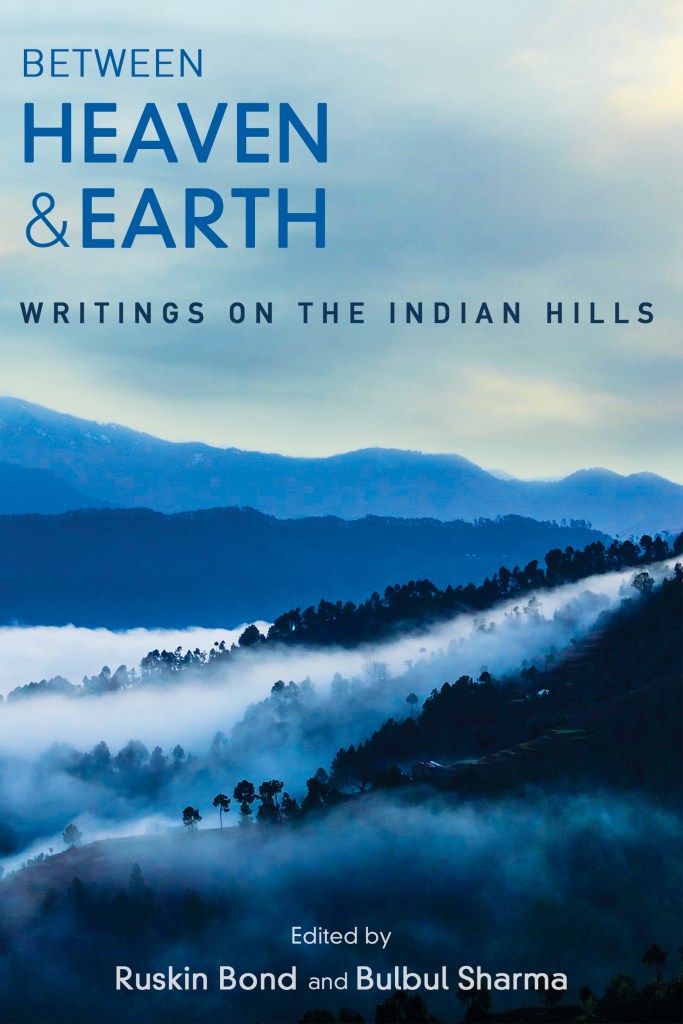
Title: Between Heaven and Earth: Writings on the Indian Hills

Editors: Ruskin Bond and Bulbul Sharma

Publisher: Speaking Tiger Books

She was eighty-six, but looking at her you wouldn’t have guessed—she was spry and took some care to look good. Not once in the five years that we spent together did I find her looking slovenly. The old-fashioned dresses she wore were clean and well-ironed, and sometimes she added a hat. Her memory was excellent, and she knew a great deal about the flowers, trees, birds and other wildlife of the area—she hadn’t made a serious study of these things, but having lived here for so long, she had developed an intimacy with everything that grew and flourished around her. A trust somewhere in England sent her a pension of forty or fifty rupees, and this was all the money she had, having used up the paltry sum she’d received from the sale of her property.

She’d had a large house, she told me, which she had inherited from her parents when they died, and she’d had an ailing sister whom she had nursed for many years before she too passed away. As she had no income, she kept boarders in the house, but she had no business sense and was losing money maintaining it. In the end, she sold the house for a song to one of the local traders and moved into two small rooms on the ground floor of Maplewood Lodge, a kindness for which she remained grateful to her friends, the Gordon sisters.

It must have been lonely for Miss Bean, living there in the shadow of the hill, which was why she had been excited when I moved into the floor above her. With age catching up, she couldn’t leave her rooms and her little garden as often as she would have liked to, and there were few visitors—sometimes a teacher from the Wynberg Allen School, the padre from the church in town, the milkman twice a week and, once a month, the postman. She had an old bearer, who had been with her for many years. I don’t think she could afford him any longer, but she managed to pay him a little somehow, and he continued out of loyalty, but also because he was old himself; there wouldn’t have been too many other employment opportunities for him. He came late in the morning and left before dark. Then she would be alone, without even the company of a pet. There’d been a small dog long ago, but she’d lost it to a leopard.

Camel’s Back Road, going to a tea party at a friend’s house, the dog sitting in her lap. And suddenly, from the hillside above her, a leopard sprang onto the rickshaw, snatched the dog out of her hands, and leapt down to the other side and into the forest. She was left sitting there, empty-handed, in great shock, but she hadn’t suffered even a scratch. The two rickshaw pullers said they’d only felt a heavy thump behind them, and by the time they turned to look, the leopard was gone.

All of this I gathered over the many evenings that I spent chatting with Miss Bean in her corner of the cottage. I didn’t have anyone to cook for me in the first few years at Maplewood. Most evenings I would have tinned food, and occasionally I would go down to share my sardine tins or sausages with Miss Bean. She ate frugally—maybe she’d always had a small appetite, or it was something her body had adjusted to after years of small meals—so I wasn’t really depriving myself of much. And she returned the favour with excellent tea and coffee.

We would have long chats, Miss Bean telling me stories about Mussoorie, where she had lived since she was a teenager, and stories about herself (a lot of which went into some of my own stories). She remembered the time when electricity came to Mussoorie—in 1912, long before it reached most other parts of India. And she had memories of the first train coming into Dehra, and the first motor road coming up to Mussoorie. Before the motor road was built, everyone would walk up the old bridle path from Rajpur, or come on horseback, or in a dandy held aloft by four sweating coolies.

Miss Bean missed the old days, when there was a lot of activity in the hill resort—picnics and tea parties and delicious scandals. It was second only to Shimla, the favourite social playground of the Europeans. But unlike Shimla, it had the advantage of being a little more private. It was a place of mischief and passion, and young Miss Bean enjoyed both. As a girl, she’d had many suitors, and if she did not marry, it was more from procrastination than from being passed over. While on all sides elopements and broken marriages were making life exciting, she managed to remain single, even when she taught elocution at one of the schools that flourished in Mussoorie, and which were rife with secret affairs.

Do you wish you had, though,’ I asked her one March evening, sitting by the window, in the only chair she had in her bedroom.

‘Do I wish I had what?’ she said from her bed, where she was tucked up with three hot-water bottles.

‘Married. Or fallen in love.’

She chuckled.

‘I did fall in love, you know. But my dear father was a very good shot with pistol and rifle, so I had to be careful for the sake of the young gentlemen. As for marriage, I might have regretted it even had it happened.’

A fierce wind had built up and it was battering at the doors and windows, determined to get in. It slipped down the chimney, but was stuck there, choking and gurgling in frustration.

‘There’s a ghost in your chimney and he can’t get out,’ I said.

‘Then let him stay there,’ said Miss Bean.

Excerpted from Between Heaven and Earth: Writings on the Indian Hills, edited by Ruskin Bond and Bulbul Sharma. Published by Speaking Tiger Books, 2022.

ABOUT THE BOOK

 ‘What is it about the hills that draws us to them again and again?’ asks one of the editors of this collection. In these pages, over forty writers—from a daughter of the Tagore family and a British colonial officer in the 19th century, to a young poet and an Adivasi daily-wage worker in the 21st century—show us what the many reasons could be: Green hillsides glowing in the sun; the scent of pine and mist; the wind soughing in the deodars; the song of the whistling thrush; a ritual of worship; a picnic, a party, an illicit affair. They show us, too, the complex histories of hill stations built for the Raj and reshaped in free India; the hardship and squalor behind the beauty; the mixed blessings of progress.

Rich in deep experience and lyrical expression, and containing some stunning images of the hills, Between Heaven and Earth is a glorious collection put together by two of India’s finest writers, both with a lifelong connection with the hills. Among the writers you will read in it—who write on the hills in almost every region of India—are Rumer Godden, Rabindranath and Abanindranath Tagore, Emily Eden, Francis Younghusband, Jim Corbett, Jawaharlal Nehru, Khushwant Singh, Keki Daruwalla, and of course the two editors themselves. Together, they make this a book that you will keep returning to for years to come.

ABOUT THE EDITORS

 Ruskin Bond is one of India’s most beloved writers. He is the author of nu­merous novellas, short-story collections and non-fiction books, many of them classics and several of them set in the hills of north India. Among his best-known books are The Room on the Roof, Time Stops at Shamli, A Book of Simple Living, Rain in the Mountains and Lone Fox Dancing. He was awarded the Padma Shri in 1999 and the Padma Bhushan in 2014. He lives in Landour, Mussoorie.

Bulbul Sharma is an acclaimed painter and writer, author of best-selling books of fiction and non-fiction, including My Sainted Aunts, The Anger of Auber­gines, Murder in Shimla and Shaya Tales. Bulbul conducts ‘storypainting’ work­shops for special needs children and is a founder-member of Sannidhi—an NGO that works in village schools. She divides her time between New Delhi, London and Shaya, a village in Himachal Pradesh.

.

PLEASE NOTE: ARTICLES CAN ONLY BE REPRODUCED IN OTHER SITES WITH DUE ACKNOWLEDGEMENT TO BORDERLESS JOURNAL

Categories
Excerpt

When I Discovered Laziness…

Title: Comfy Rascals: Short Fictions

Author: Rhys Hughes

Publisher: Raphus Press, Gibbon Moon Books

DON’T SHOOT THE MESSENGER

He who was King in the land of Booshooba ordered his most trusted messenger to deliver a sealed envelope to another ruler, the King of far distant Zazkhaban. The messenger set off on the dangerous journey and was never tempted to open the envelope and read the message within. He knew he would face terrible dangers on the path, diversions, bandits, doom pits. One diversion might lead him into a dimension of woe. Another might not. As for bandits, there were a great many of those. For countless ages they had been terrorising the lonely passes of the mountain ranges that lie between Booshooba and Zazkhaban. The messenger had to be agile and astute to avoid their clubs, spears and nets. He crawled past their sentries and soon was up and hastening again. He never tired, this most trusted messenger. Little wonder that the King of Booshooba had favoured him!

But the doom pits are worse than the bandits. No one who has fallen into them has returned, nor have even their screams risen out of those grim holes in the gruesome ground. Will the messenger be fit enough and light enough to leap them all in mighty bounds? They fall still, those unfortunates who fell into them, and now they are loose bones tumbling like jugglers’ clubs down and down through phosphorescent infinity.

But the messenger is safe beyond them. After months of hard travelling, he finally reaches the palace of the King of Zazkhaban, who takes the envelope from him and opens it. The King reads the letter with a frown that grows deeper. Finally he reaches for a loaded musket and points it at the messenger‟s head.

“Clearly you have received some bad news,” the messenger says, “but I am not responsible for what has happened. Don’t shoot the messenger! For I have simply completed my assigned task.”

Silently, but with a stern expression, the King of Zazkhaban offers the letter to the messenger. It says simply, “My dear brother, I have one favour to ask of you. Please shoot the messenger who delivers this letter.” The king pulls the trigger of the musket. There is noise and smoke and the most trusted messenger slumps to the ground and his blood flows quickly.

BALDNESS

Baldness in men is not natural but a result of civilization. It probably comes from wearing tight hats or eating processed foods. In our original condition evolution would never choose baldness because the moonlight reflecting off the shiny scalp would give away our position to predators in the jungle. Men with thick heads of hair are less likely to be pounced on by tigers. They are more likely to be used as a paintbrush by gorillas, yes, but pounced on by tigers, no! And yet, maybe we need more light at night. Could it be that bald men are necessary? The reflections of the male heads of an entire tribe might provide sufficient illumination for late sessions of applied mathematics to take place. Or for the continuance of guitar lessons.

WHEN I DISCOVERED LAZINESS

When I was young I was full of energy. I read in a book that if every man, woman and child in China jumped up and down at the same time, a tidal wave would be created by the vibrations that would engulf the United States of America. I remember thinking: so why don‟t they do that? If it’s possible, why not make the attempt? Later, I read in a different book that every man, woman and child could fit onto the Isle of Wight standing up straight like skittles, tightly packed together, and that the island would sink. Once again I asked myself: so why don’t we do it?

Even later I was told by a teacher at my school that if every man, woman and child in the world stood on the equator facing east in a long line and took one step forwards, pushing back with their foot, the globe would stop spinning. So why aren’t we lining up and stepping forward, I demanded to know? Then the answer occurred to me. Laziness! That was why there were no human-generated tidal waves, sinking islands or planetary brakes. It was because people were too lazy to make them happen. That was the precise moment when I discovered laziness and what it really meant and its importance to the daily workings and evolving history of the human race.

IDENTITY

Our identities can never survive death because they barely even exist while we are alive. They are not constants but variables. Our identities are constantly changing but so gradually that we do not perceive the changes and thus assume we are a single entity all our lives. In fact we are so far removed from the way we were, and the way we will be, that if our past or future selves were suddenly killed, we (the present “we‟) would feel nothing at all. And we do die sometime in the future without feeling a thing now, which would hardly be the case if all our selves through time were connected and merged into one unit. This is what I think and I thought it.

About the Book:

Many rascals are too tense to be comfortable. Real life rascals have much to worry about. But rascals in fiction can afford to relax a little in the waves of prose that surround them, gently swirling on the wit and wisdom, bobbing on the contrivance, floating on the syntax. It is nice to be a comfy rascal. The language and its ambiguity are the territory where Rhys produces his best in fiction. In the flash fiction format, the stories by Rhys at Comfy gets a full language ambiguity game, in the words of the superb author Brian Evenson: 

“Each of these stories is a shimmering whimsical fleck which not only satisfies in and of itself but, taken with its compatriots, builds an image of life and language that is pure play and discovery. Like Kafka’s parables, if Kafka’s sense of humour was less dark and had more puns.” 

About the Author: 

Rhys Hughes has been writing fiction from an early age. His first book was published in 1995 and since that time he has published fifty other books, nine hundred short stories and many articles and poems, and his work has been translated into ten languages. He graduated as an engineer but currently works as a tutor of mathematics. Having lived in Britain, Spain and Kenya, he is now planning to move to India. His poetry tends to be humorous light verse and offbeat lyrical fantasy, influenced mainly by Don Marquis, Ogden Nash, Edward Lear, Richard Brautigan, Ivor Cutler and Spike Milligan.

.

PLEASE NOTE: ARTICLES CAN ONLY BE REPRODUCED IN OTHER SITES WITH DUE ACKNOWLEDGEMENT TO BORDERLESS JOURNAL

Categories
Excerpt

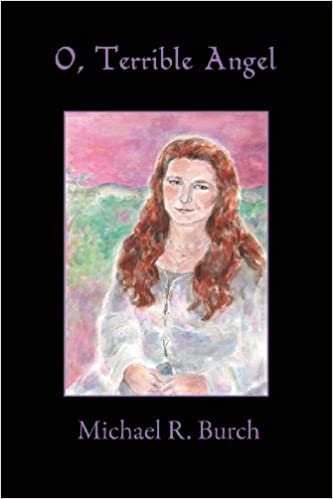
O, Terrible Angel

Title: O, Terrible Angel

Author: Michael R. Burch

Publisher: Ancient Cypress Press

Enigma
 
(for Beth)
 
O, terrible angel,
bright lover and avenger,
full of whimsical light and vile anger;
wild stranger,
seeking the solace of night, or the danger;
pale foreigner,
alien to man, or saviour.
 
Who are you,
seeking consolation and passion
in the same breath,
screaming for pleasure, bereft
of all articles of faith,
finding life
harsher than death?
 
Grieving angel,
giving more than taking,
how lucky the man
who has found in your love, this—our reclamation;
fallen wren,
you must strive to fly though your heart is shaken;
weary pilgrim,
you must not give up though your feet are aching;
lonely child,
lie here still in my arms; you must soon be waking.
 
(Published by mojo risin’ magazine (the first poem in its issue), Silly Bear, Love Poems and Poets, The Kitchen Sink, and in a YouTube reading by Jasper Sole)
 
Are You the Thief
 
(for Beth)
 
When I touch you now,
O sweet lover,
full of fire,
melting like ice
in my embrace . . .
 
when I part the delicate white lace,
baring pale flesh,
and your face
is so close
that I breathe your breath
and your hair surrounds me like a wreath . . .
 
tell me now,
O sweet, sweet lover,
in good faith . . .
are you the thief
who has stolen my heart?
 
(Originally published as “Baring Pale Flesh” by Poetic License/Monumental Moments)
 
She Gathered Lilacs
 
(for Beth)
 
She gathered lilacs
and arrayed them in her hair;
tonight, she taught the wind to be free.
 
She kept her secrets
in a silver locket;
her companions were starlight and mystery.
 
She danced all night
to the beat of her heart;
with her tears she imbued the sea.
 
She hid her despair
in a crystal jar,
and never revealed it to me.
 
She kept her distance
as though it were armor;
gauntlet thorns guard her heart like the rose.
 
Love!—awaken, awaken
to see what you’ve taken
is still less than the due my heart owes!
 
(Published by The Neovictorian/Cochlea, Borderless Journal, The Eclectic Muse (Canada), Shabestaneh (Iran), Anthology of Contemporary American Poetry, Famous Poets and Poems, The Chained Muse, Inspirational Stories, Lilac Blossom Collection, English Poetry, Love Poems and Poets, Not Just a Label and Captivating Poetry (Anthology))
 
 
Warming Her Pearls
 
(for Beth, after her bath)
 
Warming her pearls, her breasts
gleam like constellations.
Her belly is a bit rotund . . .
she might have stepped out of a Rubens.
 
(Published by Erosha, The Eclectic Muse, Muse Apprentice Guild, Nisqually Delta Review, Erbacce, Poetry Life & Times and Brief Poems)
 

About the Book: O, Terrible Angel is a collection of love poems written by Michael R. Burch for his wife Beth.

About the Author: Michael R. Burch is an American poet who lives in Nashville, Tennessee with his wife Beth and two incredibly spoiled puppies. He has over 6,000 publications, including poems that have gone viral. His poems, translations, essays, articles, letters, epigrams, jokes and puns have been published by TIME, USA Today, BBC Radio 3, Writer’s Digest–The Year’s Best Writing and hundreds of literary journals. His poetry has been translated into 14 languages, taught in high schools and colleges, and set to music by 22 composers, including three potential operas if the money ever materialises. He also edits www.thehypertexts.com, has served as editor of international poetry and translations for Better Than Starbucks, is on the board of Borderless Journal and has judged a number of poetry contests over the years.


.

PLEASE NOTE: ARTICLES CAN ONLY BE REPRODUCED IN OTHER SITES WITH DUE ACKNOWLEDGEMENT TO BORDERLESS JOURNAL

Categories
Excerpt

The Dreams of a Mappila Girl

Title: The Dreams of a Mappila Girl: A Memoir

Author: B. M. Zuhara Translator: Fehmida Zakeer

Publisher: Jointly published by SAGE Publications and Yoda Press under the Yoda-SAGE Select imprint

The kitchen was a woman’s world in those days. Work started there soon after the morning prayers. Each morning, Ummambiumma and Ummatha had the job of grinding parboiled rice that had been soaked in hot water. The clacking of the grinding stone resounded through the nalapad and the central hall during the early hours of the day. A half wall divided the big kitchen into two sections. On the ground in the main section, facing east, were five firewood stoves. Squatting on the floor, Kunhamina got these stoves burning every morning. Three grinding stones, one large and two small, were placed on a ledge built against the half wall. Ummambiumma called the big grinding stone Bombayiammi, after the city from where Valippa brought it. 

‘The master brought this ammi from Bombay especially for grinding the rice for pathiri. If the consistency of the dough is not correct, the pathiri will not be good. The pathiri we make here is famous,’ said Ummambiumma, her tone full of the pride she took in her work.

The ammis operated from morning until afternoon. Once the rice for the pathiris had been ground, the coconut for the curries was ground next, then the items required for making lunch. Ummambiumma and Ummatha kept up a continuous chatter as they worked on the ammis. Kunhamina, seated on the ground and attending to the pots on the stove, joined in their conversation every now and again.

‘If you keep talking like this, your mouths will become dry,’ Kadeesumma who supervised the work in the kitchen would warn. Mostly she went unheeded. ‘Talking helps us to do our work quickly, Kadeestha,’ Ummatha would say.

Since we cultivated rice, we always had either puttu or pathiri made with unpolished red rice for breakfast. At night, it was always pathiri. The curries were rotated on a daily basis—onion, dried fish, drumstick leaves, egg curry. The onion curry was prepared by frying peeled and diced shallots, adding turmeric and chilli powder, and finally mixing in coconut milk. When drumstick leaves were substituted for the shallots, it became drumstick leaves curry; when dried fish was added to the basic onion curry, it became dried fish curry; adding boiled eggs to the onion curry converted it into egg curry. A change in the menu happened only on special occasions or when we had visitors. When the children grumbled about the unvarying fare, omelettes or bulls-eye eggs appeared on the table. Sometimes, they gave us coconut mixed with sugar, a favourite with me.

For breakfast, the side dish for the puttu was supposed to be fish in red gravy. But we didn’t get fish early enough on most days, and so the children were served bananas and sugar with their puttu. The puttu, which was made by steaming rice flour layered with liberal quantities of shredded coconut in hollow logs of bamboo, was delicious enough to eat without any accompaniments. 

In the mornings, the kitchen was a cacophony of sounds. After the morning prayers, Valippa and Uppa were each served an egg along with their morning tea—half boiled for Valippa and hard boiled for Uppa. After he was diagnosed with diabetes, Valippa stopped eating rice pathiris, switching to wheat dosas and oats boiled in milk for his breakfast. The preparation of wheat dosas involved soaking the wheat grains in water the previous night and grinding them into a fine batter in the morning. Valippa liked tomato roast with his wheat dosas. Uppa wanted egg roast for his breakfast, whether it was pathiri or puttu. Egg roast was made by frying onions in coconut oil, adding turmeric, chilli and cumin powders, and finally breaking an egg over the mixture. When we had guests, egg chops replaced the egg roast. Instead of breaking an egg into the onion mixture, hard-boiled eggs were added into it and topped with a layer of finely sliced onions and thin round slices of golden-fried potatoes. Egg chops were Umma’s speciality. She also prepared Valippa’s oats.

Umma supervised the making of breakfast. Ummama avoided the morning rush in the kitchen and came in to oversee the preparations for lunch. When the servants heard the tapping of Umma’s medhiyadi, they would turn down the volume of their chatter.

‘Kunhiammayi is coming. Have you boiled the milk for the oats, Kunhamina?’ Kadeesumma, sitting on the wooden box peeling onions, would ask.

‘I’ve boiled the milk and kept the pan ready.’

Kunhamina would wait with the washed and dried pan. Umma came into the kitchen holding a tin of oats. On the tin was a picture of a man with a white hat that never failed to intrigue me. The tin of oats was bought specially for us at Jambu Stores in Kozhikode. Umma scooped two spoons of oats into the pan placed on the table in the kitchen. She added milk and handed it to Kunhamina who boiled the mixture, cooled it, poured it into a glass tumbler and then covered it with a lid. Meanwhile, Umma sat on a low stool by the stove on the ground. She made the egg roast for Uppa, intermittently giving instructions to Kunhamina who had started preparing the wheat dosas for Valippa.

‘Drizzle some ghee and turn the dosa, Kunhamina. Don’t let it burn.’

Like a shadow, I would stand behind Umma.

‘Move aside, Soora. Don’t follow me like a tail.’ Irritated, she pushed me aside and I started crying.

‘Dear girl, don’t cry, I’ll give you a dosa secretly,’ Kunhamina whispered. I stopped crying.

Assan came into the kitchen. ‘Is the master’s breakfast ready?’

Umma placed the wheat dosas, tomato roast and oats on a tray for Valippa. On another tray, she placed Uppa’s food and asked, ‘Have you laid the supra on the thinna?’

Assan confirmed that he had laid the mat and went to Valippa’s room with his breakfast.

Uppa and the older boys had their meals on the thinna beneath the front staircase. Mats were laid out on the platform before serving the food. Valippa joined them on the thinna for lunch.

About the Book: As a young Muslim girl growing up in the 1950s in a small South Indian village, B. M. Zuhara had simple dreams—to go to the newly opened ‘talkies’ in town and watch a movie, play with her brothers in the rice fields, learn the ancient martial art of Kalari Payatu with them, stand on the bridge and listen to the songs sung by the farmhands as they worked. But she soon realised that even being the pampered, youngest child of her family would not help her in realising some of her dreams because of her gender. Set at the time when Independent India was embracing its new identity as a free nation, this book provides a wide lens for the reader to view life in a semi-rural Kerala village. Zuhara recounts the social mores of the society she lived in and offers glimpses into the secluded lives of Muslim girls and women who, despite obstacles, made the best of their circumstances and contributed positively to their communities.

About the Author: B. M. Zuhara is a Malayalam writer hailing from Thikkodi near Kozhikode. She has written novels and short stories and has been a columnist in regional newspapers. She is the first Muslim woman writer from Kerala. Her new novel titled Pennungal (Women) is forthcoming from Chintha Publications. She won the Kerala Sahitya Akademi Award for her contribution to Malayalam literature in 2008 and has also been a recipient of awards such as Lalithambika Antharjanam Memorial Special Award, Unnimoy Memorial Award and the K. Balakrishanan Smaraka Award. Her novel Iruttu was translated to Arabic recently as part of the Qatar Ministry Cultural Exchange and was launched at the Doha International Book Fair in January 2020. She has also translated Tayeb Salih’s Wedding of Zein and Naguib Mahfouz’s Palace Walkinto Malayalam. The English translation of her novella Nilavu (moonlight) was published by Oxford University Press in the anthology titled Five Novellas. The same novella was translated into Arabic and published as Zooul Khamar while Mozhi (Talaq), another novel of hers, was translated into Arabic and published by IQRani Publishers, UAE.

About the Translator: Fehmida Zakeer is a writer hailing from Kerala. Her work has appeared in Indian Quarterly, Rose and Thorn Journal, Out of Print Magazine, Asian Cha, The Bangalore Review, Quarterly Literary Review Singapore, Muse India and elsewhere. Stories written by her have come out in print anthologies such as Pangea: An Anthology of Stories from Around the World (Thames River Press, UK), Ripples: Short Stories by Indian Women Writers (APK Publishers, India), Happy Birthday to Me (Dahlia Publishing, UK) and others. A story of hers placed first in the Himal South-Asian short story competition 2013 and another was chosen by the National Library Board of Singapore for the 2013 edition of their annual READ Singapore anthology. She was twice on the honourable mentions list of the Binnacle Ultra Short competition (University of Maine at Machias). A story of hers was shortlisted in the DNA-Out of Print short story competition, 2014 and another one was published in the Out of Print magazine issue focusing on Sexual and Gender Violence. An anthology of stories, titled Keeper of Secrets, is forthcoming from Dhauli Books.

(Excerpted from The Dreams of a Mappila Girl: A Memoir by B. M. Zuhara; translated by Fehmida Zakeer. Jointly published by SAGE Publications and Yoda Press under the Yoda-SAGE Select imprint.2022, 228 pages, Paperback, Rs. 550, ISBN: (978-93-5479-280-9), YODA SAGE Select.

.

PLEASE NOTE: ARTICLES CAN ONLY BE REPRODUCED IN OTHER SITES WITH DUE ACKNOWLEDGEMENT TO BORDERLESS JOURNAL

Categories
Excerpt

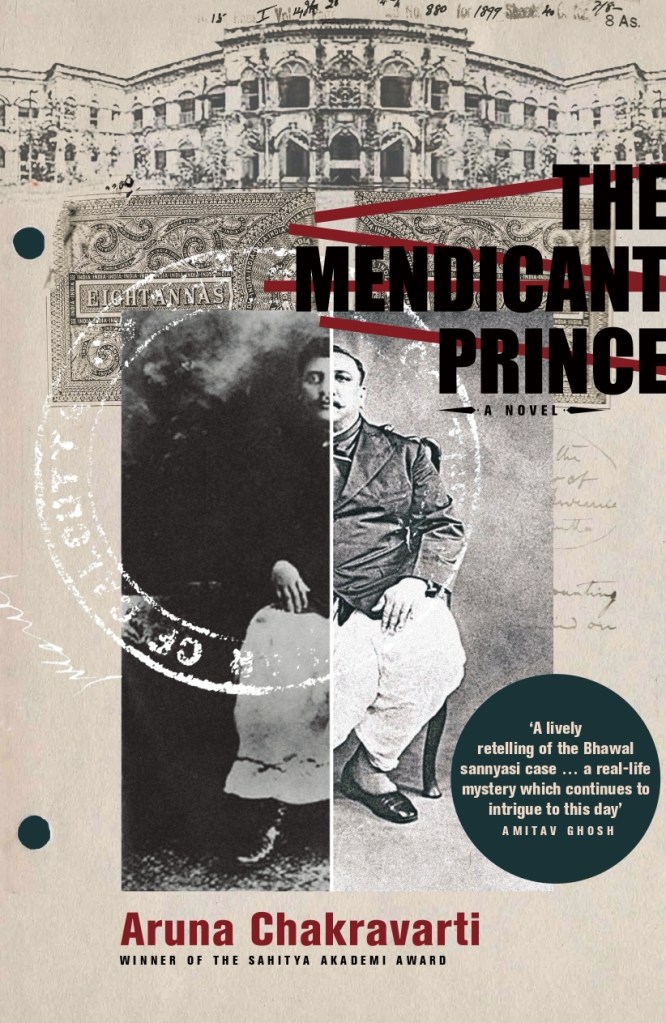
Aruna Chakravarti’s The Mendicant Prince

Title: The Prince Mendicant

Author: Aruna Chakravarti

Publisher: Picador India

January 1921

1

The Sannyasi

It was a raw, blustery morning in late January. A small knot of people could be seen standing near the Buckland Bund, an embankment on the Buriganga river. The river, which swirled and foamed along the edges of the city of Dhaka, was especially turbulent this winter.

All eyes were fixed on a man, a stranger to these parts. He had been sitting cross-legged on the Bund, gazing into the distance day and night, for the past three months, impervious to the cold gusts of wind and spray that rose from the agitated waters below. There was something odd about his appearance. He could be a Bengali, the locals surmised, judging by the shape of his face with its somewhat square jawline, wide nose and high cheekbones. His body was covered with ash but the patches that were visible were as fair as a European’s and his eyes, hooded by dark, heavy lids, a greenish brown. Masses of tawny hair fell in dreadlocks down his sturdy back and shoulders and a matted beard almost touched his navel. A tattoo—a word in some strange language—could be seen on his right arm. He was naked except for the strip of coarse orange cloth that covered his genitals. The men standing around stared at him with unabashed curiosity and exchanged glances. Once in a while someone would fling a question at him. They had been doing so from the first day they saw him sitting on the Bund.

‘Who are you? Why are you here?’ A middle-aged man in a silk lungi and woollen vest asked in a stern voice.

‘Main Bangla nahin jaanta.’ [1]The stranger’s lower lip twisted to the right as he answered in Hindi.

A barrage of questions followed in a Hindi thickly accented with Bengali.

‘Where have you come from?’ ‘Bahut door se.[2]

‘What are you doing here?’ ‘Nothing. Just sitting.’

‘That we can see. But why here?’

‘No reason. I just … just came here …’

‘Are you a sannyasi?’

‘Yes. I’m a roaming sadhu.’

‘You look quite young. Must be in your mid-thirties. Am I right?’ The stranger shrugged his heavy shoulders and turned his eyes northwards on a massive structure looming in the distance. It was the zamindar’s mansion locally known as the Rajbari. The zamindars of Bhawal were rich and powerful beyond ordinary landowners and had been dignified by the title of Raja. Their sons were addressed as Kumar, each according to his position in the hierarchy.

The man in the lungi moved aside. Another, an elderly gentleman in a dhuti[3] and shawl, took his place.

‘You are too young to abandon the world. When did you become a sannyasi?’ The old man leaned forward and examined the stranger’s face and head closely. There was a puzzled look in his eyes.

‘I ran away from home in my youth and joined a group of holy men.’

‘How long ago was that?’

‘I don’t remember.’

 ‘Where did they take you?’

‘To the mountains. I spent many years there.’

The old man nodded. But the answer didn’t seem to satisfy him.

The crowd ebbed, melted and swelled once more. Others took up the interrogation.

‘Do you have parents?’

‘No.’

‘Are you married?’

The man, calm and unruffled all this while, stiffened at this question. As though alerted to some hidden hostility. He had a prominent Adam’s apple which jumped up and down his throat.

‘Um …’ he hesitated, ‘yes … n-no. Yes. I had a wife … once.’

‘You left her too?

‘Yes.’

‘Why do you keep looking at the Rajbari?’

‘No reason.’ The answer came pat as though he had prepared for the question. ‘There’s nothing else to see …’

The men walked away and stood a little apart. They exchanged meaningful looks and nudged and whispered. Snatches of their conversation came floating through the air.

‘Exactly like the mejo kumar[4]. The same height and build. The same small hands and feet. Even the tiny wart on the lower lid of the right eye. What do you think, Taufique?’ The elderly gentleman turned to the man in the lungi.

‘Yes, indeed, Kashi kaka. I never did believe the story.’

‘You think anyone does?’

‘I don’t know about the family. The subjects certainly don’t. Not one.’

‘The man seems to be about thirty-five or thirty-six. Exactly the age the mejo kumar would have been today. Have you noticed the way he sits? Hunched forward like a bull.’

‘And his complexion! What man other than a royal could be that fair? His body is covered with ashes but I noticed his hands and feet. Particularly the feet. Rough and scaly but shell pink. Like new milk with a drop of vermilion mixed in it.’

‘The colour of his eyes? And the tiny angles sticking out from the tops of his ears? The resemblance is uncanny. The mejo kumar too had …’

‘There are marks on his back and legs. And tiny patches on the scalp in between the dreadlocks. I looked at them closely …’

‘Yes, I noticed them too. The mejo kumar’s body was ridden with syphilis when he was sent to Darjeeling. These must be the scars.’

‘He seemed a bit rattled when I asked if he was married.’

‘He did indeed. He couldn’t decide what to say.’

‘He is the mejo kumar,’ a chorus of voices joined in. ‘The story we have been told is bunkum.’

‘Concocted by the mejo rani[5] and her brother.’

‘Without a doubt. Without a doubt.’

‘Why do you think they did it?’

‘Who knows? They must have had their reasons.’

‘Mark my words, brothers,’ an old man wearing a skull cap observed darkly, ‘this man is pretending to be a sadhu, when he is in fact the mejo kumar – the second prince of the royal family. Now that both his brothers are dead, he is the sole heir of the estate. The real ruler. If I’m proved wrong, I’ll never venture another opinion as long as I live.’ He moved his head solemnly from side to side.

About the Book:

In the winter of 1909, Ramendranarayan Roy, the ailing second prince of the Bhawal zamindari, proceeds to Darjeeling with his wife Bibhavati, brother-in- law Satyendranath and a retinue of officials and servants, after being advised a change of air by his physicians. Three weeks later, a telegram from Satyendranath arrives at the Bhawal estate, carrying news of the prince’s demise and subsequent cremation.

Soon peculiar rumours start circulating around Bhawal and the surrounding town. Some say that the prince was poisoned, while others suspect that his body was taken to the burning ghat but not actually cremated. There are also whispers about an incestuous relationship between Bibhavati and her brother. The story takes a bewildering turn when, twelve years later, a mendicant comes to Bhawal, claiming to be the long-lost prince and the heir to the estate.

With no resolution in sight, matters reach the court, where the so-called prince and some family members face off against Bibhavati and her brother, aided by the British Court of Wards who are keen on maintaining ownership of the zamindari. The breathless legal drama that ensues will culminate in an incredible series of events, permanently altering the course of the estate’s history.

Inspired by the legendary Bhawal sannyasi case and evocative in its recreation of pre-Partition Bengal, The Mendicant Prince is an intriguing tale of dual identity and the inexplicable quirks of fate.

About the Author:

Aruna Chakravarti has been Principal of a prestigious women’s college of Delhi University for ten years. She is also a well-known academic, creative writer and translator with fifteen published books to her name. Her novels, The Inheritors, Jorasanko, Daughters of Jorasanko and Suralakhsmi Villa, have sold widely and received rave reviews. She is the recipient of the Vaitalik Award, the Sahitya Akademi Award and the Sarat Puraskar.


[1] I do not know Bengali – translated from Hindi

[2] From very far – translated from Hindi

[3] A cloth wrap that is a substitute for trousers

[4] The second prince

[5] The second queen or the prince’s wife

Amazon pre-order link: https://amzn.to/3uZgjCy

.

PLEASE NOTE: ARTICLES CAN ONLY BE REPRODUCED IN OTHER SITES WITH DUE ACKNOWLEDGEMENT TO BORDERLESS JOURNAL