As the newspaper forecasts rain,
and a dozen weather applications
predict a shower,
I cancel my plan to visit an expensive
cafe and reminisce about the June
rains from two decades ago
The afternoon gets a dusky look,
Swallows the sun and belches out clouds,
Transforms the hot loo into a cool breeze
I find myself waiting expectantly for
The rain that will hopefully wash away
the burdens brought by an early summer,
A summer that stole a blissful winter,
From children who wouldn’t know much
about leather jackets and warm gloves
The wilted flowers look like they would
never bloom again with vibrant hues
The tenderness of rain passes by swiftly
with soft pressed feet, and I don’t even
notice it amidst the tangles of a busy day
Unforgiving glare of the sun cuts through
the curtains, and I realise that this month
too, the paper boats of hope may not sail
Mitra Samal is a writer and IT Consultant with a passion for both Technology and Literature. She mostly writes poems and short stories. Her works have been published in Poetry Society (India), Muse India, Borderless Journal, Madras Courier, The Chakkar, and Kitaab among others. She is also an avid reader and a Toastmaster who loves to speak her heart out. She can be found as @am_mitrasamal on Instagram.
PLEASE NOTE: ARTICLES CAN ONLY BE REPRODUCED IN OTHER SITES WITH DUE ACKNOWLEDGEMENT TO BORDERLESS JOURNAL
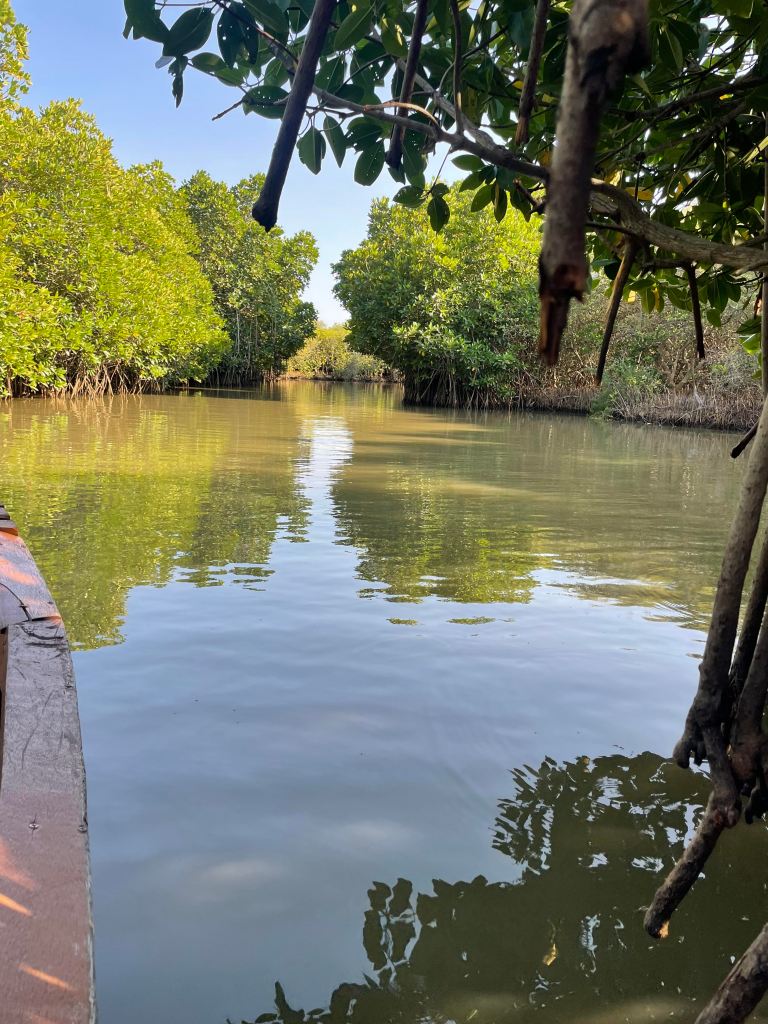
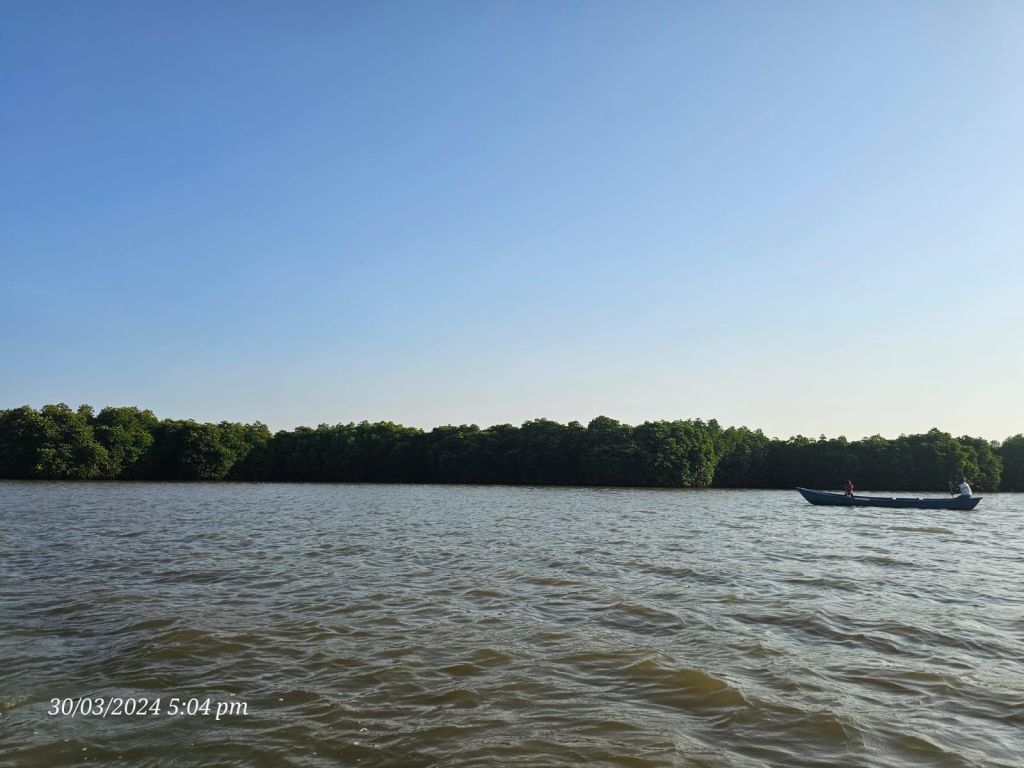
The air hummed with an enchanting melody, and the sun tipped below, casting long shadows that danced like playful spirits along the path. I boarded a small wooden boat, it’s hull adorned with intricate carvings that seemed to tell ancient tales of the forest that glides across the still waters.
The mangroves that appeared tiny from afar now rose like towering sentinels, their twisted roots reaching down into the depths. Under the canopy rising up like a vast green cathedral, the sunlight dappled into a mosaic of varied hues. The boatman, a weathered old soul with eyes that gleamed with ancient wisdom, guided us through the labyrinthine channels with a steady hand. He spoke in a hushed tone, weaving tales of forgotten gods and spirits that dwelled within the heart of the forest,
Suddenly, the boatman pointed ahead to the other side, his voice barely more than a whisper through the mist. I saw it as a portal hidden among the tangled roots of an ancient tree. As they drew closer, the earth drummed with power, and I felt a sense of wonder wash over me.
With a gentle nudge from the boatman, we passed through the portal and into another realm entirely. The world around us shifted swirling colours, blending and merging into more hues. It seems strange but wonderful, the way nature’s law seemed to bend and twist, defying all logic and reason.
The trees danced with joy, their branches swinging in time to an unseen melody, while the leaves of the green mangrove stretched out in every line, shining in the sun as they unfurled like delicate works of art.
As we ventured deeper into the heart of the mystical realm, I could almost envision Lord Shiva himself taking on the form of Nataraja, the cosmic dancer. In the shifting shadows and shimmering light, I could see the divine figure gracefully moving amidst the swaying trees and swirling mist. His celestial dance seemed to echo through the very fabric of the universe, a mesmerizing display of cosmic energy and divine grace. With each step, he breathed life into the world around him, weaving together the threads of creation and destruction in a harmonious symphony of movement. It was as though the entire forest had become his sacred stage and I, a humble witness to the timeless dance of the cosmos.
All too soon, the journey came to an end. The boatman guided us back through the portal, and we emerged into the familiar world of the mangroves. I felt a pang of sorrow tug at my heart. I longed to stay in that magical realm forever, to lose myself in its wondrous embrace.
As we made our way back to the shore, the world around me seemed somehow different. The trees whispered secrets as we passed, their voices soft and melodic. The journey into the heart of the Pichavaram Forest[1] had changed me permanently, and I could feel the hum of unseen forces in the air.
And though I may never fully understand the mysteries that dwell within its depths, I will always carry with me the memory of this magical journey.
The journey made me conscious of the endless beauty the earth has to offer and revealed to me that real magic is found in the unending beauty of nature, not in spells and incantations.
I knew this woman, a girl really.
Kept painting her apartment different colours.

Her unhappiness with herself externalized
and splashed over all those walls.

A new colour every other week.

As though a change of colour would change
her circumstances, her life.

But nothing ever changed except the paint.
Barely a chance to dry, before she was at it again.

Maybe all that painting kept her busy.
So she wouldn’t have to sit in silence.
With the terrible truth of herself.
Ryan Quinn Flanagan is a Canadian-born author residing in Elliot Lake, Ontario, Canada with his wife and many bears that rifle through his garbage. His work can be found both in print and online in such places as: Evergreen Review, The New York Quarterly, Borderless Journal, GloMag, Red Fez, and Lothlorien Poetry Journal.
PLEASE NOTE: ARTICLES CAN ONLY BE REPRODUCED IN OTHER SITES WITH DUE ACKNOWLEDGEMENT TO BORDERLESS JOURNAL
The ring on the fourth finger
Is supposed to tug at your heart strings.
Initially, it served its purpose well.
The day it slid into my life,
The diamond dazzled in ecstasy,
The metal danced in circles
With every milestone we touched.

Over years, with dishwash and promises
Running down the drain,
The lack-lustre lonely thing,
Trembling with the responsibility
Of its most precious jewel,
Disfigured the very throne it sat on.
Growing stiff and refusing to budge.
It dug into my soul for the flesh around it
Began to swell and
I writhed to fit my ring.

As I walk the shoreline now,
My fingers thin and bare,
The ring sitting uneasily
In its box,
Elliptically sulks at me.
Not only has its noose tapered
My ring-lady at the base,
The flat oval of my stubby finger
Has, for ever,
Altered its rounded face.
Averi Saha is an academic, critic and translator. She teaches in a college in West Bengal and works on folk literature. She has published academic papers, translations and original poems.
.
PLEASE NOTE: ARTICLES CAN ONLY BE REPRODUCED IN OTHER SITES WITH DUE ACKNOWLEDGEMENT TO BORDERLESS JOURNAL
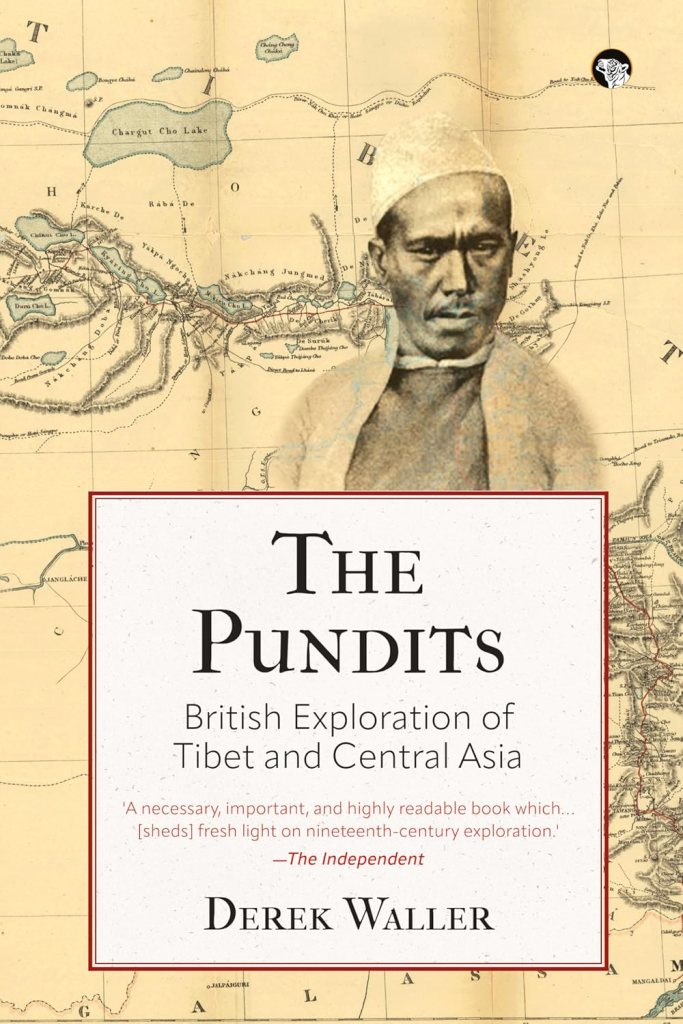
Title: The Pundits: British Exploration of Tibet and Central Asia
Author: Derek Waller
Publisher: Speaking TigerBooks
The British exploration of Tibet and Central Asia began in the 19th century as part of the Great Game, a geopolitical rivalry between the British Empire and the Russian Empire. These British explorers, known as “pundits“, were tasked with gathering intelligence on the region’s geography, culture, and politics to inform British strategic interests in the area. The pundits traveled undercover, disguised as locals, and used their linguistic and navigational skills to map out uncharted territories and report back to British authorities. Their expeditions were instrumental in shaping British policy towards Tibet and Central Asia, and their findings laid the groundwork for future British involvement in the region.
The Pundits: British Exploration of Tibet and Central Asia by Derek Waller is a fascinating book for its rich details and shedding light on the frontier policies of the British Empire. Derek J. Waller served as professor emeritus of political science at Vanderbilt University, where he taught from 1969 until his passing in 2009. He was instrumental in establishing the examination system for the Chinese government at Vanderbilt and played a key role in founding the university’s International Studies Programme in London. Additionally, he held the position of director of Vanderbilt-in-England. Waller is best known for his publication, The Government and Politics of the People’s Republic of China, which was released in 1981.
Says the blurb: “On a September day in 1863, Abdul Hamid entered the Central Asian city of Yarkand. Disguised as a merchant, Hamid was in fact an employee of the Survey of India, carrying concealed instruments to enable him to map the geography of the area. Hamid did not live to provide a first-hand account of his travels. But he was the advance guard of an elite group of Indian trans-Himalayan explorers—recruited, trained, and directed by the officers of the Great Trigonometrical Survey of India—who were to traverse much of Tibet and Central Asia during the next thirty years.”
Waller presents the history of these intrepid explorers—Nain, Mani, Kalian and Kishen Singh, Mirza Shuja, Hyder Shah, Ata Mahomed, Abdul Subhan, Mukhtar Shah, Hari Ram, Rinzing Namgyal, Ugyen Gyatso, Nem Singh, Lala and Kintup—who came to be called ‘native explorers’ or ‘pundits’ in the public documents of the Survey of India. In the closed files of the government of British India, however, they were given their true designation as spies. As they moved northward within the Indian subcontinent, the British demanded precise frontiers and sought orderly political and economic relationships with their neighbours. They were also becoming increasingly aware of and concerned with their ignorance of the geographical, political, and military complexion of the territories beyond the mountain frontiers of the Indian empire. This was particularly true of Tibet.
Despite the fact that the use of pundits was discontinued in the 1890s in favour of exclusively British expeditions, they amassed a vast amount of information on the topography of the region, the customs of its inhabitants, and the nature of its government and military resources. They were able to journey to places where hardly any European could go and did so under conditions of extreme deprivation and great danger. They are credited with documenting an area of over one million square miles, most of which was completely unknown territory to the West.
The Pundits, one of the earliest books to be written about them, is an exceptional piece of scholarly work.
.
Bhaskar Parichha is a journalist and author of Unbiased, No Strings Attached: Writings on Odisha and Biju Patnaik – A Political Biography. He lives in Bhubaneswar and writes bilingually. Besides writing for newspapers, he also reviews books on various media platforms.
.
PLEASE NOTE: ARTICLES CAN ONLY BE REPRODUCED IN OTHER SITES WITH DUE ACKNOWLEDGEMENT TO BORDERLESS JOURNAL
Our friendship overcomes the distance between the balconies.

At first the extent seems long, gaping like the head of a ship-mast sailing beyond the horizon.

We could connect only with our eyes. We do not have access to each other.

Otherwise, she is companionable, very bubbly. She is petite,

I guess she feels lost being alone. She demands I remain in the balcony all the time.

And I would, a book of poems on my lap.

My neighbours often leave her alone,

go roaming, to play or to munch popcorns in movie malls,

She would express her stress by barking through the morning,

or whining the rest of the day. I learn not to be troubled by her tantrums.

She would jump with joy upon seeing me, let me know how happy she felt using the tail.

I never reason any other purpose for that appendage.

It makes me feel inadequate, the absence of it.

In that period of love we forge  our clandestine  kinship by panting like mountaineers doing high altitude trek.

I learn to return her love.

I would lean over the balustrade and pretend to hug.

She taught my eyes to ooze oxytocin, which she channels into her wide-eyed ardour.

And then her folks move away to another apartment, taking her along.

She is not aware of the plan to move, she has not been told, she goes without saying goodbye.

I still have the book on my lap, the book of poems, open and face down.

The silence is not adequate to replace the ligature of our bond

or to teach me how to bear her absence with quietude.
Saranyan BV is poet and short-story writer, now based out of Bangalore. He came into the realm of literature by mistake, but he loves being there. His works have been published in many Indian and Asian journals. He loves the works of Raymond Carver.
.
PLEASE NOTE: ARTICLES CAN ONLY BE REPRODUCED IN OTHER SITES WITH DUE ACKNOWLEDGEMENT TO BORDERLESS JOURNAL
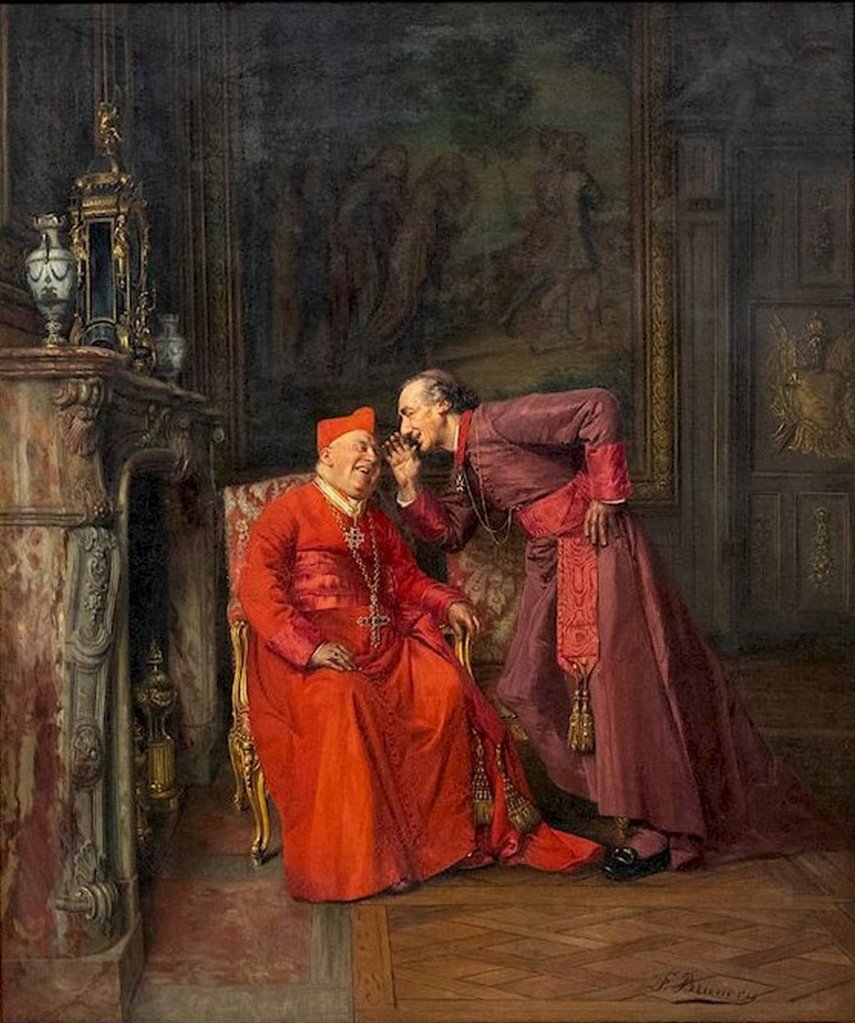
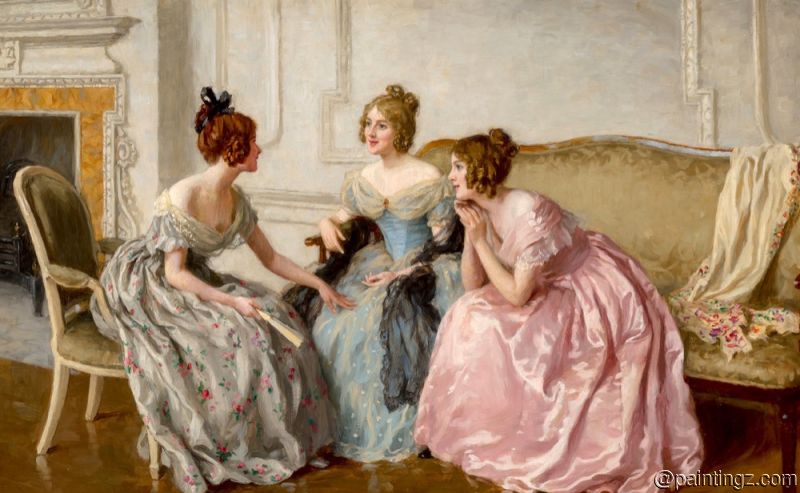
The Latest Gossip by Francois Brunery (1849-1926)Gossip by Charles Haigh Wood (1856-1927)
SATURDAY

Saturday, Saturday, Saturday, what
do you think about Saturday? It’s flat.

The grey sky reminds us of traveling
and in the wind the birds are eddying.

Dissatisfied, if you were somewhere else—
Utopia—you would be hearing bells;

you would feel mellow in the fruitful sun,
fulfilled, in the prime of life, having fun.

Such weather only comes to remind us
through memories that it’s all behind us.

Should we take a newspaper to breakfast
or will the headlines make us feel feckless

with their inane arbitrary redundance,
offering war and scandal in abundance?

So lazy that pleasures are overkill,
yet we can’t sleep all day, there’s time to fill,

and too many naps seems enervating
as an option to the girl you’re dating.

Tennis is out, and games are not your thing;
conversation doesn’t feel promising.

Exposed to Saturday’s mood of malaise,
exhausted by the accumulated weekdays,

this hurry to be in Sunday’s milling crowds
which move like corpses under viscous shrouds:

a great dull procession from Buenos Aires
up to Texas and over to Paris

and back under the patio roof that is leaking,
like a voyeur behind a Chinese screen peeking

at no one, like a bright flag that is furled,
our banner of freedom: this Saturday world!


GOSSIPS

Just because I’m a coward
doesn’t mean the gossips are right
with their concrete notions
but watch them build the trivial
with such care,
making complicated fine points
woven into, of all things,
knots,
you guessed it, to secure.
Bluntness is the only
way to say
to them they are inferior
and that you
are not a statistic.
Yes, I am also thinking:
why am I here?
To be cold goes nowhere
and so you are involved
in the humid entanglement.
The most horrible truth
is when they are right
and you are vulnerable that night,
all because you have forgotten your comb.


THE SMILING MAN


The smiling man
who straightened up
when he noticed
I saw him smiling.

“Well, I’m sorry
I put that
dour expression
there on your face
that’s so beguiling!”

And he said
in a whisper
so I couldn’t hear
as he walked on
down the mall:

“You didn’t put
that dour expression
there—
don’t worry—
it’s been there
since I was small.”

When he told
me that,
I felt better
and I sat
thinking where I’d
like to go.
I thought for
a moment I
might follow him,
an interesting man
to know.

But I knew
that he’d be
out of sight
by now

and I didn’t
want to see
him straightened up right,
anyhow.
David Francis has produced six music albums, one of poetry, Always/Far: a chapbook of lyrics and drawings (Oilcan Press), Poems from Argentina (Kelsay Books), and New York Revery (Cyberwit.net). He has written and directed the films, Village Folksinger (2013) and Memory Journey (2018). He lives in New York.
.
PLEASE NOTE: ARTICLES CAN ONLY BE REPRODUCED IN OTHER SITES WITH DUE ACKNOWLEDGEMENT TO BORDERLESS JOURNAL
American film-maker Morgan Spurlock, best known for ‘Super Size Me’ didn’t want to be remembered as just the guy who ate burgers for a month. He had other plans, as Keith Lyons discovered…
Photo from Public Domain
It was almost 20 years ago I first met the film-maker Morgan Spurlock. As part of a global tour promoting his newly released participatory documentary Super Size Me he was in New Zealand’s capital Wellington. While he told me about how he hatched the ‘really great, bad idea’ of the movie, I too came up with the crazy plan to get him into a nearby McDonald’s for a suitable photo for the magazine I was writing for.
Morgan’s film idea came after a Thanksgiving dinner at his parent’s place. While lying on a couch having eaten his fill, he was watching TV when there was a story about two people who had sued McDonald’s, claiming that the fast-food chain had misled them about the nutritional value of its burgers, fries and sodas, causing them health problems as well as a to gain significant weight. As part of the story, a spokesman for McDonald’s came on, saying there was no link between their obesity and the food at McDonald’s which was healthy and nutritious. Morgan figured that if he ate McDonald’s every day, there shouldn’t be a problem.
For 30 days, he ate nothing but McDonald’s food and drink, trying everything on the menu at least once, and accepting any super-size portions when offered. He gained weight and got sick. At the end of the month, he appeared puffy faced. His liver function was impaired, and he was depressed. The doctors monitoring his state advised him not to continue damaging his health (later, he confided to me that it took him more than a year to get back to his original weight — with help from his girlfriend Alexandra Jamison — also known as Healthy Chef Alex).
The film about the promotion of fast foods and American eating habits went on to win the best directing prize at Sundance Film Festival and was nominated for an Oscar. It capitulated the docu-prankster into being a household name.
A few years after the movie came out, he had married Alexandra (his second of three marriages which ended in divorce), who came up with the book, The Great American Detox Diet. Morgan told me about his other projects he’d been working on. After Super Size Me, he developed an unscripted documentary-style series. His 30 Days was based on putting a person in a different environment from their upbringing, beliefs, religion or profession for a month to see how exposure to opposite worldviews altered prejudice. “Yeah, I spent 25 days in a jail in Virginia,” he once emailed me casually, when he had become the person embedded in a community very different from his own. “Just so I could experience life as an inmate.” He wanted the reality TV series to explore how people might challenge their now stereotypes, so had a devout Christian living with a Muslim family, and a homophobe staying with a homosexual.
From the Public Domain
Morgan, who had been likened to a budding Michael Moore ‘for a Jackass generation’[1], went on to direct and produce more movies, including about terrorism and the fight against it in Where in the World is Osama bin Laden (2008), What Would Jesus Buy (2007), and even One Direction: This is Us (2013), and The Simpsons 20th Anniversary Special – In 3-D! On Ice! His interests were eclectic, making a documentary about comic book convention fans as well as one on men’s grooming, and another on product placement. His long-awaited Super Size Me 2: Holy Chicken!, where he looked at how the fast food industry had changed, came out in 2019, but by then his career had waned, following an admission of sexual misconduct which included being unfaithful to every wife and girlfriend he ever had, and also a long term problem with alcohol.
I lost contact with Morgan a few years ago, but still have memories of the time we walked up the stairs into McDonald’s in central Wellington. No security guards came to stop us from taking photos. No manager yelled at us. He stood smiling with that broad goofy smile of his and his trademark handlebar moustache as I snapped away taking pictures of him with the backdrop of the McDonald’s counter and menu board. He had been worried that we wouldn’t be allowed inside McDonald’s, or to take any photos. In the US, he told me, security alerts meant he couldn’t step into any Golden Arches without being challenged.
I was saddened to hear that Morgan recently died, of complications from cancer, aged 53. Many newspapers headline the news: ‘Documentarian who ate McDonald’s for 30 days and changed fast food industry’. His brother Craig said Morgan “gave so much through his art, ideas and generosity. The world has lost a true creative and a special man”.
In the late-2000s, after the success of Super Size Me, Morgan told me of his ambitions, and reminded me that he didn’t want to be typecast for just Super Size Me. “I hope I am remembered for more than just as the guy who ate hamburgers for a month.”
Keith Lyons (keithlyons.net) is an award-winning writer and creative writing mentor originally from New Zealand who has spent a quarter of his existence living and working in Asia including southwest China, Myanmar and Bali. His Venn diagram of happiness features the aroma of freshly-roasted coffee, the negative ions of the natural world including moving water, and connecting with others in meaningful ways. A Contributing Editor on Borderless journal’s Editorial Board, his work has appeared in Borderless since its early days, and his writing featured in the anthology Monalisa No Longer Smiles.
.
PLEASE NOTE: ARTICLES CAN ONLY BE REPRODUCED IN OTHER SITES WITH DUE ACKNOWLEDGEMENT TO BORDERLESS JOURNAL.
The distance between us two has grown. The day starts and ends with our disapprovals. How long can we share a life lived in strife Where clouds of admonitions rain forever?
Nostalgia I cannot relinquish resides in me. She lives in me and I cannot leave her. The sounds of melancholy live in our eyes And they sing in quiet their songs of despair.
Love has gone on a journey oceans away. Roads Are quiet and silence reigns as our talks flounder. Holding hands and embraces are lost. Storms build up and are lost. That is our destiny.
The monsoon settles down now to stay longer And spring has shrunk to be as good as absent. Yet, in every ray of sun, I want to relive the spring. Not many more blossoms are left for me to live
Pramod Rastogi is an Emeritus Professor at the EPFL, Switzerland. He is a poet, academician, researcher, author of nine scientific books, and a former Editor-in-chief (1999-2019) of the international scientific journal “Optics and Lasers in Engineering”. He has published over hundred poems in international literary journals.
PLEASE NOTE: ARTICLES CAN ONLY BE REPRODUCED IN OTHER SITES WITH DUE ACKNOWLEDGEMENT TO BORDERLESS JOURNAL
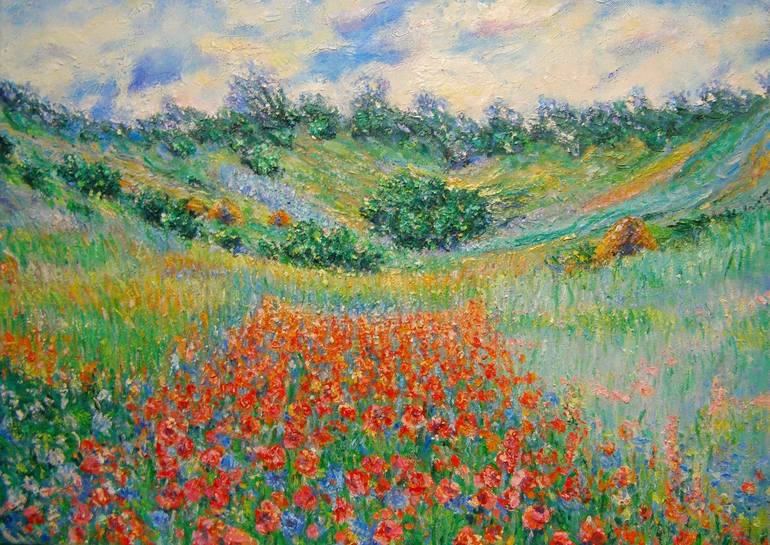
Poppy Field (Monet interpretation) by Kateryna Sabudska (Ukraine), Saatchi Art. FRom Public Domain
THE LONG JOURNEY

A journey no one else can join
A long journey my mother has taken alone

In this place where I lived with my mother
Standing alone in the wind-blown world
I look at the long, distant path
Where my mother has gone

Even if the angels in heaven
Wipe away my mother's tears
And offer her a bouquet of flowers

Without her son, her daughter-in-law
Without her granddaughters,
How lonely must my mother be!
Ihlwha Choi is a South Korean poet. He has published multiple poetry collections, such as Until the Time When Our Love will Flourish, The Color of Time, His Song and The Last Rehearsal.
.
PLEASE NOTE: ARTICLES CAN ONLY BE REPRODUCED IN OTHER SITES WITH DUE ACKNOWLEDGEMENT TO BORDERLESS JOURNAL.









 Borderless