Categories
Essay

US Polls: What should We Celebrate?

By Candice Louisa Daquin, Senior Editor, Indie Blu(e) Publishing

Even the most stalwart historian among us, will attest, it takes living in a country, inhabiting its borders, to truly understand a country. It is no wonder we struggle to truly comprehend the lived experience of people in other countries. America must look very strange to the rest of the world, just as we who live in America may stereotype and miss the nuances of the political landscape of other countries.

But as strange as America may look, it is a strange country to live in too. As an immigrant to America, I have the advantage of knowing what it is like to have lived in three other countries and been resident or citizens of them. It helps in seeing why people hold the perspectives they do.

Obviously, it is a mine field if you say only one side is ‘right’ and everyone else is wrong. That is one of two main reasons Hillary Clinton lost the 2016 election, she called the other side stupid. Whether they are or not, is not the point. The point is nothing is won by calling names and condemning groups on either side. Those groups will rise and show their power. This happened when Donald Trump, against most predictions, won the US election in 2016.

Many were in disbelief that a man who was better known as a hotelier and reality TV show host, could be President. But interestingly it was less surprising for people outside of America, who remembered Reagan and were aware of similar casting among leaders, happening in other countries. Boris Johnson could be compared in many ways to Trump, and has been, and it is certainly not the first time, someone has won a large election, who was not the favorite.

I saw it as old-fashioned backlash. The party of the left wins, next time the party of the right fights to gain a foothold, it goes back and forth, and therefore so often, nothing is accomplished in politics. Many people believed the 2016 election was an extreme because America had just had its first President of colour, Barack Obama and this was a case of ‘white trumping black’. That is not how I saw it. Many of those who voted for Trump did not do so because of his skin colour or gender, they did so because they were Republican. They were responding to their fears of a socialist government under the Democrats and the rolling out of Obama Care.

What is often misunderstood, are the reasons behind why voters vote. They are not always voting based on racism, sexism, or what is in the news at the time. That explains why in 2020, a significant number of Hispanics and Black voters voted Republican. Had it been based upon the news, one would imagine with ‘Black Lives Matter’ dominating the headlines, that every person of colour would have voted Democrat. Neither can this be explained by people of colour NOT voting, aside when Barack Obama won, where more people of colour voted than ever before.

Ultimately then, there are many reasons why people vote what they vote, and to try to predict what those are, is not easy. It is my belief core values make up more of the reasons for votes than transient values. If a core value is ‘thou shalt not take a life’, chances are, you will vote Republican because you are Pro-Life, and this is a core value. Likewise, if your core value is the 2nd amendment, and you live on a farm and have guns, you may vote Republican even if you do not like Trump.

Of course, within that, there are independent voters and swing-voters who WILL be influenced by negative campaigning, smear-attack adverts, misleading accusations, or truisms. Those people will vote based on the emotion of the hour, and they are often the voters most targeted because of their susceptibility. Whether that justifies spending 11 billion dollars on any election is up for debate. My personal view is, it is shameful to spend the kind of money we do, when people need medical help and food. I would like to see this country take money out of politics as others have, but I find it unlikely this will ever happen.

Neither Biden nor Trump are utterly liked or respected by all members of their parties, but they win based on reaching those core values, and the corralling of as many voters as possible. When money and undue influence are powerful elements of any election, you will never know the full story, only the outcome. Whilst people may have been dismayed to have Trump as President, it galvanized many Democrats to come up with a strong viable counter-candidate who could get rid of him in 2020. Unfortunately, this was not proven to be as easy as it sounded. Too many candidates ran, and votes were siphoned off. Tokenism became more important than ever (to have a female President someday, and if not, to at least have a female Vice President, to have another person of colour as President, and if not, to at least have a person of colour Vice President).

It surprised few when Joe Biden, who had originally said he would not run for 2020 ended up doing so. This was borne from his parties’ fear Trump would sweep the election again without a proven Democratic contender to stand in his way. As Biden had been VP to Obama, he seemed the natural choice, albeit older than his years, and not entirely committed at first. Sadly, Kamala Harris and others, did not receive enough popular support to be considered able to beat Trump and maybe some of this was an assumption a woman could not beat a man at this juncture in American history.

Here is one difference between American politics thus far, and many other countries, where female leaders have had a tradition even in countries one might assume to be more sexist than American (India for example). Which begs the question, are our optics even accurate? I would say they could not be if India is able to elect Indira Gandhi as leader and America has yet to have a female President. Of course, there is far more to sexism than whether a female leads a country, but it is a good starting point.

Biden is not initially as popular as some of his precursors, one could even claim he is a candidate of compromise, meaning; Give me ‘anyone but Trump’ in the eyes of some voters. Whether popular or not, is irrelevant until he begins his term and inherits the troubled US economy, set to be the worst since the Great Depression (and statistically speaking, even worse, given our larger population) and the troubles of Covid-19. It is hard to envy him this inheritance because it will be an uphill battle with little reward.

We have a history here in America of blaming leaders for natural disasters, as if they wield the power to change them. Trump has been accused of causing America to have one of the consistently highest rates of transmission and deaths of Covid-19 since March 2020 and to some extent this is unfair, given that most other countries are not far behind and we are all on a steep learning curve. Not wearing a mask or asking others to, certainly could be called irresponsible by any leader, but it’s worthwhile considering that outright accusing a leader of a country of causing deaths, might be going too far, when we look at pre-existing health care infrastructures and how they have not withstood an illness of this magnitude.

One could argue it is the legacy of all Governments who are responsible, because they simply do not plan ahead, or put money into things that need financing, and instead they live for the moment, spending on the immediate. Maybe it is the very essence of politics that is corrupt and puts the immediate ‘reward’ ahead of long-term planning and infrastructure — this is the real issue here. In which case, I do not see things changing, because in a Capitalist country, economic reward tends to outweigh social support. That said, if you compare America’s healthcare system to others, whilst it isn’t socialised and does leave many poor without resources, it also has a lot of money pouring into it, whilst socialised healthcare systems in Europe are floundering. Begging the question, if both do not really work, what is the alternative?

Whatever your political view, if you are in India right now or of Indian heritage, you must be excited to see an Indian woman as Vice President of the US, even if she doesn’t represent your political views. Not only is Kamala Harris half Indian but she is a formidable woman of great accomplishment. Whether you voted for her or not, you may find the appointment of a brown skinned woman as Vice President, a very exciting first, given the history of American white men being Vice President up until now.

But perhaps it is not sufficient to be glad a woman is in this position simply because she is a woman, or that a person of colour is voted to power simply because they are a person of colour. More is surely required. That person must have earned their stripes and be capable of the job. I think few doubt Kamala Harris’s credentials and experience thus far, make her an outstanding mentor for any woman or person of colour wishing to go into politics, which in America at least, is still a very male and white arena. Only time will tell if she can prove herself. I suspect she will.

In some ways this has made me realise that tokenism is not always a negative. Of course I would rather a time where it did not exist, but if you earned the right to equality and the only way you get it is through tokenism then it’s preferable to having no way of getting it. Kamala Harris was given the Vice President’s job because the Democrats wanted a woman and wanted a person of colour, that part is undeniably tokenism, but she earned the role, and she deserves the role and nothing can mitigate that.

So how is America responding to the election results? Well of course, as predicted, it was messy. First it looked like Trump was going to win, then abruptly he lagged because of write-in-votes (by mail) and Biden surged. Understandably, many Republicans wondered how their candidate who was ahead in some states, could suddenly fall behind based on mail-in-ballots alone? The fear that those ballots were tampered with, was discussed at length and many still believe some dirty dealing was done to stuff ballots in favor of Biden.

Whilst this was done routinely in the past, and this is documented, without proof, there is no reason to believe cheating occurred and unless a witness comes forward or ballot boxes are proven to be stuffed. It is reasonable to assume, Biden surged ahead because yes, the majority of write-in ballots by mail were for him. This is not implausible, but it leaves a bad taste in everyone’s mouth because it was not a ‘clean win’ the way both sides had hoped for. On the one hand, Democrats believed they would win by a higher percentage, and on the other, Republicans had their hopes raised and then they fell.

As for the Trump campaign and Trump himself, we are still waiting on his perspectives, but unsurprisingly, he is seeking legal redress in the hope a recount will secure him another term as President. It was said that there would be riots throughout the US if Trump won again, and this may have happened, given recent tensions, but with Biden all but heir apparent, there have been few protests coming from the Republicans. I am personally glad for this period of calm, having had many months of riots throughout this country (often with good reason). Now, seems like it should be a time of reflection and planning for 2021.

Namely, how to rid America (and the rest of the world) of Covid-19 and its hold over us, economically and socially. People have reacted differently than ever before, due to the stressors of this unprecedented time. That said, it is not unprecedented, it has just not happened for a long time, and people forget their history. One thing we can say, is if we all knew our histories better (both politically and socially) we might be in better shape to handle what is coming.

Back to Kamala Harris. What can the first female Vice President do for women throughout America and the world? What can she represent, engender, inspire? And what will having the second person of colour in the second highest position of the land do to helping eliminate racism and racial tensions? In some ways I believe it will be like neighbourhoods. History shows us, when white neighborhoods had people of colour move in, their first response was racism and over time, the racism reduced. It is my hope by having people of colour (and women) in positions of political power in America, it will reduce racism and sexism. And implement more equality. Whether that happens or not, time will tell.

For all the faults his detractors will list, Trump is still a deeply popular man among his core bases. No he is not very well liked by Fox News, the only Republican run media channel in America, nor do some of his fellow Republicans respect or like him, but among the ‘regular Joe’ throughout America, you could see a vast number of people still rooting for him. Democrats would have us believe this is as simple as the divide between those who are racist and those who are not. Respectfully I disagree. I think that is too simplistic an analysis. People who vote for Trump are not always voting for the negative aspects, others may equate with Trump, such as racism, sexism, elitism. They may in fact be voting for Trump because they are afraid of change, they may be voting for Trump because he’s the Republican candidate and they have always voted Republican or they may be voting because they don’t feel they are represented by the other party.

If this is the reason, then it would not be fair to say those people were just ignorant racists. And this is what divides America. The beliefs we hold about each other. As a lesbian woman, as an immigrant, as a Jewish woman, as a mixed-heritage woman, as a female, I check a lot of minority boxes. But I know within those boxes there is are multiple considerations. Consider the situation of a Jew. Jews are dying out (literally) they are the most targeted minority in the US today, Muslim immigration increases throughout the world, it is possible a Jew will vote Republican because they perceive Republicans to be pro-Israel and thus pro-Jew, whilst it is possible they perceive Democrats to be anti-Jewish because of certain Democrats who are Muslim and have spoken strongly against Israel. If this one example can be expanded to fit all possible examples, we can see why it is not as simple as RACIST = VOTING FOR TRUMP.

I neither defend, justify, or condemn either side for mistakes made, because it only inflames people to read condemnation. Rather than criticise, let us look at what does work, and do more of that. It works to consider how to help people, it works to care about people. It works to value diversity because in diversity, we get variety, and that is a good thing. Despite the fact that America is a country built on immigrants, we seem to, once we reach the melting-pot, have forgotten our origins, and gone our own ways. Many immigrants do not ‘become’ conservative, they already hold traditional, conservative views that they continue to hold once they have immigrated. To expect them not to, is to disrespect their culture as much as telling them to change to fit ours. Equally, any immigrant, and I speak as one, should respect the basic tenets of a country they immigrate to. If you hate women and gays, do not live in a country that asks you to respect them. Simple things like that.

We need to learn this and not rely as heavily on obvious tokenism and short-term tactics to gain voters. By doing this, we learn more about what voters really want, what matters most to them and why. We can then have conversations about how to achieve this on both sides, and the polarity in both parties can begin to be reduced, which is a good thing for everyone. As the Republicans still hold the Senate, Biden’s hands will be somewhat tied, and this divide only exacerbates the going back and forth in politics that causes less to happen on both sides. Isn’t the ideal to do more? No matter what party is in office? We should never celebrate that we are so divided, we should seek ways to come closer together.

Nonetheless it is a cause of celebration for Kamala Harris to be Vice President of America and I hope this heralds a time of less friction. It is good to disagree and debate. It is not so good to have hate and erosion. It may seem clear cut. But think of it like this; both sides feel it is clear cut. Not just one. And with such diametric differences, we must find what we have in common again. I do not believe this is impossible. Discounting the true haters, most of us are not bad people, we are just varied, our beliefs, what motivates us, what we fear. A good leader will try to unify. In this Pandemic we have seen we are far from unified, with people refusing to wear masks, whilst others say; ‘let those who are going to die, die, so we don’t ruin our economy’ and this has really brought us to our knees. What better time to rebuild, and find what we can agree upon? I hope we never forget to value human life and each other, irrespective of our differences. Ultimately, we are far more alike than different.

.

Candice Louisa Daquin is a Sephardi immigrant from France who lives in the American Southwest. Formerly in publishing, Daquin is now a Psychotherapist and Editor, having worked in Europe, Canada and the USA. Daquins own work is also published widely, she has written five books of poetry, the last published by Finishing Line Press called Pinch the Lock. Her website is www thefeatheredsleep.com

.

Disclaimer: The opinions expressed are solely that of the writer.

.

PLEASE NOTE: ARTICLES CAN ONLY BE REPRODUCED IN OTHER SITES WITH DUE ACKNOWLEDGEMENT TO BORDERLESS JOURNAL

Categories
Young Persons' Section

Sara’s Selections, December 2020

Halloo Readers!

We are back this month with a collection of poems, stories and essays. Christmas, Hannukah, New Year and more… What will the festivites and the new year unfold? Here is writing with hope and happiness for a better future. It never ceases to amaze how wise and full of fun Bookosmians are! So, at end of the year, we handing over now to the glamorous Ms Sara, our favourite presenter.

Thank you for the compliment. And our festivities continue into December with more fun and dreams that draw us closer to your fantastic ideas. We start with poetry.

Poetry

10 year old Dhriti Keni from Chennai speaks for so many of us, when she talks of the world books unravels for us.

What I find in books 

Travelling throughout the world
Meeting new people
Living the life
Being lost all alone
In a completely new land.

.

Seeing the tall and high mountains
The enormous sky
The hot burning lava
Visiting new lands.

.

Feeling the happiness
Of reading books
Meeting kings of the past
Saying hello to the green goblins.

.

Dancing with princes and princesses
Living at royal castles
Solving new adventures
Swimming through enchanted oceans.

.

Opening hidden past lives
Discovering new doors
Solving mysterious adventures.

.

Some say reading
Maybe a hobby
But for me it’s my life.

.

In unknown lands
There are mysteries
Awaiting to be solved.

Here is a wonderful nature poem on the ‘ Golden Crowned Crane’ by 8 year old Arkendu Banerjee from Kolkata.

Golden Crowned Crane

A bird from the family of crane,

With a grey coloured crown.

We will call it a grey crowned crane,

With a speciality itself in its name.

.

A bird with grey crown,

Not found in the Indian town.

It’s the national bird of Uganda,

Not less famous than Anaconda.

.

Displays its dance  in the rains,

It is omnivorous and eats insects and grains.

And makes a honking sound,

When it moves around.

13 year old Riva Agarwal from Kolkata has something special to say to her dad. Read on.

A father’s love is underrated

We all have seen movies and read books,
On how hard our mothers work and cook.

.

It is true, they work hard, but so do our fathers,
Their love should be appreciated more often too.

.

I have always wanted to be like my father when I grow,
He makes me see the world with a different view.

.

Whenever I have problems he is there to assist,
The ways he has helped me, would make quite a list.

.

His wisdom and knowledge has shown me the way,
And I am thankful for him everyday.

.

I might not tell him often enough,
But he is the one I truly love.

And here are some interesting stories.

Stories

8 year old S.Sanjana from Chennai shares this powerful story to wake us up to the issues of deforestation.

An Old Neem Tree

“Wake up, you are getting late,” said my Mom.

I am a part of a Science Club in my school and my teachers were planning for a  visit to the nearby local forest, to help us learn about plants and insects. All of us were excited!

We reached the forest. Our teacher  asked us to pair up and we started  walking into the woods. The sad part was that we were not able to see much of trees there. We saw some shrubs, bushes and some butterflies. Here and  there, we saw some huge trees.

Suddenly, I heard some noise. When I turned back, I saw a tall old neem tree.I continued walking. Again, I heard the same noise.

With confusion and curiosity, I saw the neem tree weeping. I could not believe  my eyes. I went near the tree and asked how could it talk, and what was the reason to cry?

The tree said that a gang of people used to come at night and cut down the trees. The people residing near by were not aware of it. If this continued, the forest will be destroyed. “Please help us!” said the neem tree.

After hearing this, I called my friends and told them what had happened, but no one believed me. So I went and informed some people residing there. I asked them to monitor the forest at night.

Next day the same people came to my house and said that they caught the gang and handed over to the forest department. The people appreciated and thanked me.

Next week I went to the same forest with my parents. The old neem tree was so happy and it shed its leaves and flowers on me.

The neem tree said, “Thank you so much, dear. You saved the forest.”

Even now I can’t believe it happened. Did we become so inattentive as humans, that a tree had to come alive and talk to us, to save our own forest?

Avoid deforestation.

Neem tree with flowers: Photo courtesy; Wiki

A powerful story by 12-year-old Karthik S from Bangalore gives a perfect lesson as the COVID vaccine seems likely in the near future. Hoping the execution would be smooth and well thought of, leaving our past differences behind!

COVID Vaccine for Animals

Far, far away in the Gir forest in Gujarat, there lived animals and they all had a meeting for settling the issue of creatures panicking because of COVID-19 and the lockdown started by King Simba in the forest of Gir. So, some animals came and asked for the vaccine.

King Simba announced a forest meeting at his den near the big rock and asked the royal messenger, Mr. Ping to spread the message to the respective administrators– Mr. Sharko, administrator for the sea; Mr. Oogway, Minister of the sea; Mr. Toadhog, administrator for the amphibians; Ms. Bunny, Minister of rodents; Mr. Jerry, Administrator of the farms; Mr. Pete-Administrator of the sky and Ms. Buzz- Administrator of the insects.

At last he called his royal priest, Mr.  Ellyvant and his royal minister for the meeting, Ms .Pam Pam. Mr. Goat, who had spoken against King Simba last time was not invited.

They all sat down comfortably near a tree and started discussing the issue.

Elephant: Where is King Simba?
Panda: Yeah! Where is he?
Shark: We are where he told us to come.
Turtle: Let us wait. I think he is getting ready.
Lion: ROAR!!!!! I am here.
Parrot: At last he is here.
Rabbit: King Simba, what were you doing all this time?
Mouse: Everyone is getting scared of going out.
Camel: No one is coming out for water because of the fear of this virus. We need water supply and the canal is a little far.
Bee: None of the insects are coming out. Bees are not making honey as they cannot go out to collect nectar.

Lion: Yes, I understand all your concerns and that’s why I have brought Mr. Ellyvant the elephant. Mr. Ellyvant knows about Ayurveda and he has prepared  a vaccine for us. Is it ready Mr. Ellyvant?

Elephant: Yes! Of course, I have prepared it so we can overcome this virus  anytime but there is a problem. This medicine needs tulsi leaves and I do not have any. The animals were unsure of what to do. Some of them got scared.

Goat: Wait, there is a small tulsi plant near the farm.

Everyone looked at Mr. Goat in surprise. Wasn’t he banned from the meeting?

King Simba walked slowly towards the goat. The animals were sure the goat would be punished.

Lion: What are we waiting for then? Let us go.

The animals were relieved.

Some things are more important than small fights. They all sat in a nice car and went to the farm for the tulsi leaves. Soon the vaccine got invented and they  happily lived ever after.

Here is yet another imaginative story by 8 year old Dia Nanavati from Ahmedabad.

A kingfisher named Lucy

Once upon a time in a forest called Congo, there was a Kingfisher named Lucy. She was the smartest kingfisher in the forest. Her friend was a hedgehog called Hosko. One day Lucy and Hosko went to play in the forest. While they were playing, it started getting dark and they got lost.

Hosko said, “We are lost and we don’t know where to go!” Lucy said, “Don’t worry, we will think of something.”

Suddenly they saw something sparkle like a star on the ground. Lucy picked it up to see what it was and realised it was a magic mirror. “Oh wow!” exclaimed Lucy. “Maybe we can use this magic mirror to home!”, said Lucy. But how?

Suddenly the mirror sparkled and a unicorn came out of it! The unicorn said it was sent by the magic mirror’s fairy God mother. Lucy and Hosko sat on the unicorn and reached home. They were tired so they went to sleep.

Another one of Lucy’s friends Sammy the parrot was passing by when he saw something strange on Lucy’s window. He peeked through Lucy’s window and saw a unicorn! He woke Lucy up excitedly and said, “Why is there a unicorn in your room?”.

Lucy said in a sleepy voice, “How will I know? Let’s ask the unicorn what she is doing here.”

The unicorn told Lucy, “My name is Holly and I’ve come to help you become the smartest kingfisher in the forest.” Lucy was thrilled until she realised, she already was the smartest kingfisher in the forest!

7 year old Ayaansh Patni from Kolkata is taking us off on a creative voyage, to Mars, no less. Vroooom!

A science competition, on MARS!

It was a science competition like no other. The location was Mars! 

My friend and I went to Mars in a spaceship. When we landed, we wore a suit so that we would get oxygen and we would not fly away due to lack of gravity. The competition was happening in an alien school. 

We showed off our invention- a dustbin that collected all the waste materials automatically. Then we all went to eat in the hostel and the aliens offered me to eat. I bit it and screamed as it hurt my tooth. It was a stone! What strange things aliens eat!

In their city, there were different types of animals that had big noses and ears. Even the sunset and sunrise were very different. Later we both saw something unusual. Plants were walking and talking!

On  the trees there were many fruits , chocolates and candies. By just standing under the tree we got one chocolate in our mouth. Candies tasted like juicy fruit in our mouth. The red soil made all the plants, trees bright red. It looked beautiful.  

The alien school taught us many different dances and instruments to play music. We were given a translation machine to understand them in a better way. We really enjoyed Mars. It was time for us to come back to Earth. The aliens gave us a lift. We thank our school for giving us this marvelous experience.

Now for some essays…

Essays

What do you want to be when you grow up? 13 year old Moksh Jain from Surat has a ready answer. Read on.

If I Were An Engineer

If I were an engineer, I would be wearing a long, white lab coat with M.E.O. written on it.

M.E.O is the full form of the company I am planning to create- Moksh’s Engineering Organisation. I would also be wearing those weird lightweight plastic glasses that people often wear in labs.

If I were an engineer, would work for the environment. I would make boats with magnets that would calibrate with the earth’s magnetic field and  help them propel from one location to another. Think of how much the  environment will benefit since no fossil fuels will be burnt!

Next,  I would make a device that would absorb greenhouse gases and convert it into oxygen. This device can be used in hospitals for patients on  ventilators who require oxygen to breathe. 

I would also make a spaceship that would be protected against radiation as the biggest challenge in covering planetary distances is radiation. My idea is to put in a machine that vibrates in a loop and produces electricity which will give it enough power to travel in outer space. 

So this in short, is what I would do, if I become an engineer. 

13 year old Gofiaa from Chennai writes on Christmas. Gofiaa is a person who loves to explore new things. She always likes to be unique in whatever she does. Her hobby is learning new languages.

All about Christmas

Hurray! December has finally come, which means Christmas time!

This is a joyful time where we give, receive presents, have big feasts, decorate  our home with lights and bells, having a wonderful time with our family and friends and of course receiving presents from Santa Claus and singing classic carols like jingle bells.

It reminds us of the importance of sharing, caring, living in peace and harmony with our loved ones. Now, let’s go back and see how it all started. During 6th  century B.C in Bethlehem, a baby boy was born in a barn in humble conditions.

Guess who it was? Yes, it was Jesus Christ. So we celebrate Christmas on  account of Lord Jesus’s birth. The celebration of Christmas started from Rome but it didn’t become a major Christian festival. Many Christmas traditions  started spreading little by little until 9th century. After that it became a major Christian festival.

Now let’s talk about Santa Claus, every kid’s favourite person! It is believed  that there lived a monk named St. Nicholas. He gave away all his inherited wealth and started helping the sick and the poor and buying gifts for children  during Christmas. He became popular for his kindness. Many people got  inspired by him and started helping poor and buying gifts for children. That is where the Santa Claus tradition began.

At first, when Christmas celebrations were started, it was only amongst  Christians but now it is celebrated by everyone, no matter who they are or what religion they belong to. On Christmas Eve, preparations are made like  Christmas dinner, decorations, buying gifts etc. It is the best time of the year for both kids and adults.

Christmas’s true message is to give up one’s very self, think of only of others,  bringing the greatest happiness to others and to unite with every human being  around the world. As the pandemic is here, let’s share our wishes and presents from safer distance.

Let us celebrate this Christmas safely and happily.

So, here is Sara wishing you all a fabulous Hannukah, Christmas & New Year! See you again in 2021

( This section is hosted by Bookosmia)

.

PLEASE NOTE: ARTICLES CAN ONLY BE REPRODUCED IN OTHER SITES WITH DUE ACKNOWLEDGEMENT TO BORDERLESS JOURNAL.

Categories
Editorial

Hope in the Future

This last month has been one full of celebrations. Despite climate change, despite COVID, we as humans have not lost hope. Hope that has been restored and reinforced by not just the festivals we celebrate but by the outcome of the US elections — the return of the climate change friendly faction. With global warming, ice melts and rising ocean levels becoming a reality, we find there is still hope for reversing the trend. Johan Rockstrom, an eminent environmental scientist, based in Stockholm, has said that it is possible to transform the future of humanity in the next decade if we conform to the right policies. Though we are moving away from the “safe tipping points” and towards “destabilising the entire planet”, he stated in a TED talk last month “the next 10 years to 2030 must see the most profound transformation the world has ever known”.  The new President elect, Joe Biden has promised not just to support scientists in their attempt to curb the pandemic but has also promised to be climate friendly. That will hopefully move towards restoring the Earth back to health and we, as a race, can continue to survive in an environmentally friendly culture. At least Rockstrom tweeted to that effect: “With Biden the door to ‘well below 2°C/1.5°C’ remains open. Now we have G3 on Climate: G1=EUs net-zero by 2050; G2=Chinas net-zero latest 2060; G3=US net-zero 2050. The three largest economies go carbon neutral in 30 years. Can be the tipping point!”

Full of hope for a happier future, Borderless Journal brings forth its November issue. We had a theme of festivals, climate change and humour. We have fun poetry by Vatsala Radhakeesoon, Penny Wilkes and Rhys Hughes, who has also given us a poem about climate change as have some others, like Kashiana Singh, John Grey, Anita Nahal, Adrian David and more. In prose, our columnist, Devraj Singh Kalsi, weaves in humour as he writes of his travails with tenants. He understates to create an impact. Travel has been covered in a trip to Trieste by Mike Smith of England in a tongue in cheek fashion. There is a musing on climate and man’s impact on the environment, where interestingly, the writer, D V Raghuvamsi, wonders if COVID 19 is a ‘pre-planned act of nature’ to reaffirm that man is not the most powerful creature on Earth — an unsual thought? What do you think? We have a lovely musing on cats during corona by Nishi Pulugurtha and on festivities by Anasuya Bhar too.

Festivals have been taken up in a big way in Sara’s Selections hosted by Bookosmia, Nidhi Mishra and Archana Mohan, with pieces on Halloween, Durga Puja (the landmark festival of Bengalis worldwide) and Diwali. Interestingly the theme of Durga as an icon has found its way to our essay section by the founding editor of Different Truths, a senior journalist, Arindam Roy. He has dealt with not only the legends of Durga but cultures that oppose the legend and glorify the villainous demon the goddess destroyed — and all within the geographical boundary of one country!

On the other hand, Dr Meenakshi Malhotra has taken up Kali, who is worshipped by Bengalis for destroying another demon around Diwali. The myths around Diwali keep astounding me with their variety — different celebrations all around the same time of the year — some related to Krishna, some to Rama and a few to Kali, some of it again captured in our young person’s section. Dr Malhotra’s essay mentions Bankim Chandra Chatterjee’s novel Anandamath (1882) as it centred around the concept of Kali. Some critics, she tells us, claimed he had taken a secular and not a religious stance on the raging independence movement. Having read the book many years ago, I still remember it enough to know that this novel does see religion as part of the movement.

The reason I talk of this is because I wondered why some intellectuals persist in being disconnected from reality — religion is a major part of non-intellectual lives in Bankim’s country. This brings me to the next essay by Pratyusha Pramanik on cancel culture and the Indian intelligentsia. She pretty much explores this distancing of intellectuals from reality. A good essay — I would highly recommend it. I wonder was this distancing also the issue that led to the fall of the Democrats in 2016 in USA?

The theme of women has been reinforced in Bhaskar Parichha’s book review of a translation of Bani Basu’s  A Plate of White Marble. He has reflected on the plight of widows and women. This time Dustin Pickering has given us a review on a book by Korean poet, Wansoo Kim — who has earlier contributed poetry to Borderless, poems transcending the line drawn between the two Koreas. Candice Louisa Daquin has reviewed an interesting collection, Lastbench — basically American voices protesting Trump regime. As hope is he will be soon relinquished off his role, this anthology will be of immense historic interest.

Delving into history this time is our book excerpt from The Birth of The Chronicler of the Hooghly by Shakti Ghosal, exploring the evolution of the Bengali festival as we know it, Durga Puja, with the legendary Robert Clive in the eighteenth century. Also brushing into history and mythology, is the multi-layered short story that explores the Ellora caves and the famous Nataraja statue and union with divinity stretching to Manchester United and soccer by Sunil Sharma. He has an interview with us also as the editor of SETU, a journal that bridges across cultures and languages imbibing the best from all.

The other interview is with Aysha Baqir, who other than being a writer, impresses with her stupendous work in Pakistan. From Bangladesh this time, Sohana Manzoor has again raised voices in support of women.

There are a number of stories but our pièce de résistance is the translation of Bengali writer Tarashankar Bandopadhyay’s Daini (witch) by Aruna Chakravarti. Bandopadhyay, a recipient of probably all the major awards possible at a national level, spins out an intense story on witch hunts in early twentieth century Bengal. This narrative has been flavourfully translated and brought to life by Sahitya Akademy winner Chakravarti.

I know I am not able to write about each writer but each piece in this issue is splendid in my opinion. And I would invite readers, who might be more discerning than me, to take the plunge and discover the wonders of our November edition.

Thank you for being there for us dear readers as without you, we have no one to read us.

I wish all of you a fabulous festive season — Diwali, Kali Puja, Thanksgiving et all.

Have a wonderful read.

Sunshine and Happiness,

Mitali Chakravarty

Categories
Contents

Borderless, November 2020

Translations

The Witch, a short story by renowned Bengali writer Tarasankar Bandopadhyay (1898 to 1971), translated by Aruna Chakravarti. Click here to read.

Doubt, A poem by award winning and popular poet Avaya Shrestha, translated from Nepali by Haris C Adhikari. Click here to read.

Poetry

Click on the names to read the poems:

John Grey, Nayonika, Scott Thomas Outlar, Pranjulaa Singh, Milan Mondal, Hema Ravi, Dr Piku Chowdhury, Kaikasi V .S., Kashiana Singh, Saranyan BV, Rhys Hughes, Robin Wyatt Dunn, Anita Nahal, Fizza Saeed, Gauri Mishra, Navneet K Maun, Adrian David, Gopal Lahiri, Smitha Vishwanath, Aminath Neena.

Humour

Rhy Hughes, Vatsala Radhakeesoon, Penny Wilkes

Musings

Musings of a Copywriter

Encounters with my Tenants by Devraj Singh Kalsi is a humorous take, almost a la Bollywood style, on what landlords face from aggressive tenants. Click here to read.

Of Cats, Classes, Work and Rest

Nishi Pulugurtha takes a look at lecturing classes in the past and the present with some gumballing kittens for distraction. Click here to read.

The Essential Pujo

Dr Anasuya Bhar takes us on a nostalgic journey of what was the spirit of the Durga puja — a community event. Click here to read.

Me and James Joyce in Trieste

Mike Smith makes a trip to Trieste to photograph himself with a favourite author… And then? Click here to read.

Blade of Grass: A Lesson Learnt

“Is this pandemic a pre-planned act of Nature? Is this outbreak to make us comprehend that human organism is not the most all-powerful species on Earth?” Click here to read DR D V Raghuvamsi’s musings.

Essays

Durga: Iconography, Discourse and Counter-Discourse

Arindam Roy discusses the evolution of the goddess at the intersection of history, politics and religion. Click here to read.

How a Dark Goddess Lights up a Fallen World

Dr Meenakshi Malhotra delves into the relevance, history and iconography of Kali as we draw nearer the date of Diwali and Kali Puja. Click here to read

Cancel Culture and Indian Intelligensia
Pratyusha Pramanik
, a researcher in Humanistic Studies, explores the impact of a desire to cancel out people from social media. Click here to read.

Stories

The Literary Fictionist

In the Shadow of the Nataraja: A Kinship takes the readers on a journey through Ellora, Rio de Janerio, Rome, Jerusalem and even Manchester United till Sunil Sharma  finds answers of a different kind. Click here to read.

The Silhouette

A gripping short story by Sohana Manzoor from Bangladesh. Click here to read.

Disconnected

Chaitali Sengupta explores the clash of cultures in a poignant telling. Click here to read

The Cartographer

Praniti Gulyani unravels the story of a birth during a riot. Click here to read.

Ghumi Stories: At Par in the Pandemic

Nabanita Sengupta explores the impact of COVID19 in the small town of Ghumi. Click here to read

Book Excerpt

The Birth of The Chronicler of the Hooghly by Shakti Ghosal takes us back to the start of a colonial Durga Puja. Click here to read.

Book Reviews

Lastbench, anthologised protest poetry from America reviewed by Candice Louisa Daquin. Click here to read.

Prescription of Civilization by Wansoo Kim, poetry from Korea reviewed by Dustin Pickering. Click here to read.

A Plate of White Marble by Bani Basu, translated from Bengali to English by Nandini Guha, reviewed by Bhaskar Parichha. Click here to read.

Interviews

Sunil Sharma, writer, academic, critic and editor of the online journal SETU, takes us on an exploration of his well known e magazine. Click here to read.

Aysha Baqir, a writer who has successfully empowered many underprivileged women in Pakistan, on her journey as a development personnel and novelist. Click here to read.

Sara’s Selections:

Our young people’s section hosted by Bookosmia. Click here to read.

Editorial

Hope in the Future. Click here to read…

Categories
Essay

How a Dark Goddess Lights up a Fallen World

Dr Meenakshi Malhotra delves into the relevance, history and iconography of Kali as we draw nearer the date of Diwali and Kali Puja

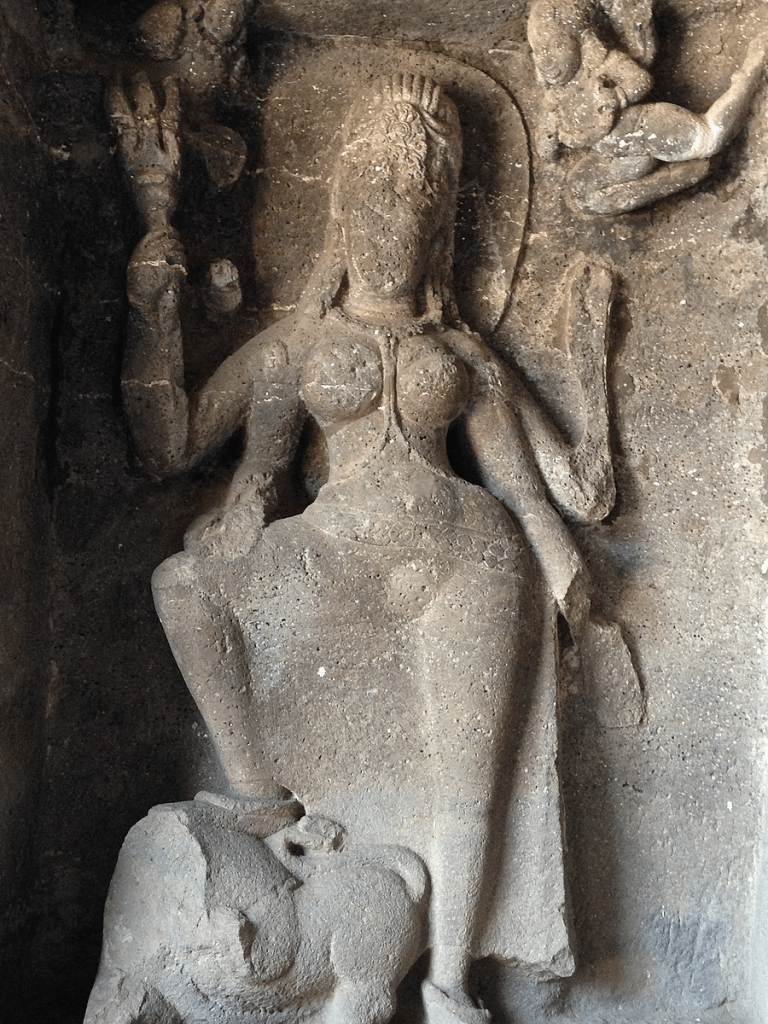
Kali sculpted into the Ellora Caves

Kali Puja, a festival that celebrates the defeat of a demon in the hands of a dark goddess Kali,  is celebrated in Bengal and some other parts of India on the new moon day of the Hindu month of Kartik, and coincides with one of the biggest Hindu festivals in India, Diwali. It usually falls around end of October or early November. Kali Puja is performed to signify the victory of good over evil, and the celebration is geared to seek the help of the goddess in destroying evil. Although Kali was present in mythology and some scriptures, she was on the margins of the spectrum of Hindu goddesses. Kali-worship was popularised by Raja Krishnachandra of Krishnanagar in Nadia(Bengal), only  around the 18th century or so. By 19th century the family and community worship of Kali became an annual event, much like the event of Durga-worship under the patronage of elite and wealthy families. It coincided with a resurgence of Hindu revivalism in 19th century Bengal, which was fuelled in part by a perceived threat to Hinduism by imperialism and colonialism. 

Kali is perhaps the most mystifying in the Hindu pantheon of gods and goddess. Evoking deep devotion in her devotees, she represents a vision and spectacle which is truly terrifying. Kali represents an eternal puzzle and an enigma to scholars and rationalists. Represented as standing upon Shiva and wearing a necklace of human heads, she represents the image of the divine mother as dark and destructive, cruel and cannibalistic.

Perhaps we need to recapitulate the history of the goddess’s representation in various religious texts that she appears in. The Agni-and Garuda Puranas record that her worshippers petition Kali for success in war. In the 5th segment of the Bhagavata Purana, Kali is represented as the patron saint of outlaws, who invoke her in fertility rites that involve human sacrifice, according to David Kinsley in his book on the Hindu Goddesses: Visions of the Divine Feminine in the Hindu Religious Tradition.

Banabhatta’s 7th century drama Kadambari contains a similar story featuring a goddess named Chandi, an epithet used for both Durga and Kali. A tribe of hunters worship Kali, plying her with ‘’blood offerings”. According to David Kinsley, this pattern of representation appears in numerous other texts. In Vakpati’s Gaudavaho, a historical poem of the late 7th and early 8th century, Kali is portrayed as clothed in leaves and as one who accepts/receives human sacrifice.

In Bhavabhuti’s Malatimadhava, a drama of early 8th century, a female devotee of Chamunda, often identified with Kali, captures the female protagonist, Malati, with the intention of sacrificing her to the goddess. Like Kali, Chamunda is depicted as a terrible goddess, a maternal dentate, “a mother goddess with a gaping mouth and bloody fangs”. One hymn praising Chamunda describes her as “dancing wildly and making the earth shake” just as Kali did while defeating the demons who threatened to destroy the cosmos. Another text is Somadeva’s Yasatalika (11th-12th century)which describes a goddess Candamari whose iconography seems remarkably similar to Kali’s. Candamari is described in the 11th century text referred to above as a goddess who adorns herself with pieces of human corpses, uses oozings from corpses for cosmetics, bathes in rivers of blood, sports in cremation grounds and uses human skulls as drinking vessels. Bizarre and fanatical devotees gather at her temple and undertake forms of ascetic self-torture.

In the pantheon of Hindu goddesses, Kali represents a force that is disruptive, wild and uncontrollable. She threatens stability and order and when she kills and subdues demons, she becomes frenzied and drunk on her victims’ blood.  Untameable and liminal, Kali is cast in the image of a mother goddess who resolutely resists domestication.

We notice a resurgence of Kali worship in 19th century Bengal. While Kali and other Shakti goddesses are worshipped in some parts of India like Bengal and Himachal and  in Nepal which borders India on the north east side, many of the Hindus of northern  India worship the gods of Vaishnavism, like Krishna. In the south, the sects of Vaishnavism and Shaivism accord primacy to Krishna and Shiva, respectively.

The British had colonised most of India by the second half of the 18th century. By late to mid-19th century, imperialism had led to a burgeoning critique of colonialism and the beginnings of nationalism, catalysed by waves  of  social reform, particularly in Bengal, Maharashtra and Punjab. While the worship of the fair, refulgent, glorious and most significantly, domesticated, figure of the goddess Durga was started and encouraged  to provide a platform for the Bengali community to come together — a similar function was performed by the worship of  Lord Ganesha in Maharashtra — Kali worship came to be practised by more subordinated social groups. She acquired respectability and recognition among educated middle-class Bengalis when she became the central figure in Hindu revivalism led by Ramakrishna Paramahansa (1835-1885).  One  reason for this  phenomenon that promoted and made Kali worship respectable in the late 19th century, was the emergence of a new sect that, merging classical Hinduism and other forms of worship like Tantrism (a school of Hinduism which believes in the practice of some secret rituals to gain knowledge and freedom), rejected dualism.

Ramakrishna Paramahansa who was at the forefront of this phenomenon was a mystic and ascetic who was dedicated to Kali-worship, and whose devout practices offered devotees a space outside the domain of colonialism, which in turn helped trigger a Hindu revival. For the middle class Bengali functionaries who were in the lower rungs of colonial service, their subservience might have proved emasculating, a thesis argued by  Sumit Sarkar, Mrinalini Sinha and others. In this context, it could be speculated that Kali’s fierceness, her performance of virile masculinity might have helped her devotees reclaim a sense of manliness by associating themselves with her masterfulness.

Another reason Kali worship  became especially popular among militant nationalists, criminals and outlaws, forest dwellers and tribal populations, and emerging fringe groups was because they discovered in Kali a powerful resource for protesting against their impoverishment and downtrodden status. Kali was also seen as a way of articulating their aspirations  for political empowerment.  As a mother goddess associated with fertility, birth, creativity as well as violence and martial prowess and anger, Kali offered the nationalist movement an apt narrative and iconography. It is a well documented fact that Kali-worship increased in Bengal in the 1890s and the first decade of the 20th century, along with the rise of extremist and militant nationalisms.

One of the first novelists in India and the foremost novelist of late 19th century Bengal who was instrumental in the rise of the novel in India , Bankim Chandra Chattopadhay (1838-1894) describes Kali in his novels is a signifier of Hindu cultural nationalism. In his political novel, Anandamath, he uses Kali to signify ‘time’(Kala)and political change. According to critics like Jasodhara Bagchi, Bankim departs from classical and medieval Indian literary conventions. They see Bankim’s use of the iconography of Kali as reflective of a modern, secular, rationalist sensibility. However, Bankim did not believe that Indians would rally behind a secular independence movement. Instead he felt that a sense of nationalism could best be cultivated through religion in the Indian context.

Bankim also believed that women and the feminine principle are particularly powerful forces  for social change. He equated the nation with the divine maternal and asserted that the homeland or motherland should be the object of devotion. This adaptation of Shakti’s mythology to the Indian nationalist project lent the figure of the mother goddess a new militancy. 

In the novel Anandamath (literally meaning ‘abode of joy’) Kali’s darkness signifies India’s degradation at the present time. In ancient times, the ‘mother’ was glorious and resplendent. In the present, Satyanand , one of the characters in the novel, says, “look what the mother has come to…Kali, the dark mother. Kali is naked ,” he adds , “because the country is impoverished, the country is now turned into a cremation ground, so the mother is garlanded with skulls.” This is however a temporary state because the monk believes that the goddess and motherland will be restored to its previous glory, rescued by her brave sons.

Bankim develops the idea of linear time, past-present-future, which is tied up with his idea of writing a history of Bengal. Kali gets linked to evil, to political action but also to the idea of temporality–‘kala’, which literally means an epoch- and more importantly, the idea of apocalypse. Kali’s stepping on Shiva is seen as a reversal, a turning upside down of the accepted order of things. For Bankim who was a functionary in the colonial government, this vision of a world upside down had its use in restoring one’s self-respect.

 In the late 20th century, Kali was again invoked as a  vital part of  right wing assertion and the rise of Hindu nationalism of the 1990s.The Vishwa Hindu Parishad (World Hindu Council) called its women’s wing ‘Durga Vahini’ (the carriers of Durga’s lore), which was established in 1991,invoking the names of Durga and Kali to signify cultural assertion of Hindu womanhood. However, the women’s movement in the 1990s found that the “ ‘Shakti of the modern Durga’, was not directed against violence in the home and community but was directed externally to the Muslims-both men and  women…the myth that all women are equal and could be mobilised around a common issue on a common platform lay shattered” (Sarkar and Butalia,1995)a point that gets reinforced time and again. Flavia Agnes, a lawyer who works on issues of women’s rights, indicates her discomfort with Kali as an emancipatory trope for all Indian women as it remains essentially Hindu and does not accommodate women from other religions and communities. Kali or the dark goddess as a pan-Indian figure of empowerment for all women remains problematic, as it is too exclusionary and mired in violence.

Where there might be a tiny sliver of a possibility of reclaiming Kali as an emancipatory idea or a figure of emancipation might possibly be in two areas. One is to break the deadlock of ‘fair and beautiful’ in Indian culture, the prevalence of gender stereotyping of a reductive kind. Here, dark skinned girls carry a sense of social stigma and  are often, in media representations, encouraged to use products that would lighten the effects of dark skin, both to improve their prospects of a glamorous career and a decent marriage. The other maybe to do with the idea of motherhood which is made more complex. While Durga rather than Kali is associated with motherhood, Kali as mother maybe reclaimed as a mother who does not necessarily shield her children by sugar-coating reality, but introduces them to death, destruction and the existence of ultimate reality. That is the significant moment in the iconography of Kali — the moment when she steps on Shiva, her consort, who is also the Lord who presides over destruction, in the Hindu trinity of Brahma-Vishnu-Maheshwar(another name for Shiva). Her tongue pops out as she is caught in this stance of utter surprise, frozen in eternity(in her representations) even as she presides over time(kala).

References:
Bagchi, Jasodhara(2008) Positivism and Nationalism:Womanhood and Crisis in Nationalist Fiction-Bankim Chandra’s ‘Anandamath’ Women’s Studies in India: A Reader ed Mary E.John, Penguin, pp124-131.

Chattopadhyay, Bankim Chandra(2005)Anandamath or The Sacred Brotherhood, translated by Julius Lipner, OUP

Kinsley, David(1986) Hindu Goddesses:Visions of the Divine Feminine in the Hindu Religious Tradition, Motilal Banarsi Das

Sarkar, Sumit(1998) Renaissance and Kaliyuga:Time, Myth and History in Colonial Bengal in Writing Social History. OUP,186-215.

Dr Meenakshi Malhotra is Associate Professor in English at Hansraj College, University of Delhi. She  has edited two books on Women and Lifewriting, Representing the Self and Claiming the I, in addition  to numerous published articles on gender and/in literature and feminist theory. Some of her recent publications include articles on lifewriting as an archive for GWSS, Women and Gender Studies in  India: Crossings (Routledge,2019),on ‘’The Engendering of Hurt’’  in The State of Hurt, (Sage,2016) ,on Kali in Unveiling Desire,(Rutgers University Press,2018) and ‘Ecofeminism and its Discontents’ (Primus,2018). She has been a part of the curriculum framing team for masters programme in Women and gender Studies at Indira Gandhi National Open University(IGNOU) and in Ambedkar University, Delhi and has also been an editorial consultant for ICSE textbooks (Grades1-8) with Pearson publishers. She has recently taught a course as a visiting fellow in Grinnell College, Iowa. She has bylines in Kitaab and Book review.

.

PLEASE NOTE: ARTICLES CAN ONLY BE REPRODUCED IN OTHER SITES WITH DUE ACKNOWLEDGEMENT TO BORDERLESS JOURNAL.             

Categories
Poetry

November Diaries

By Dr. Piku Chowdhury

November is a strange limbo in tropical terrain

Somewhere between festive highs and silent pain

Of imminent fall. The time to look back

Before the last leaves drop into oblivion.

The night sky burns with pyroclastics,

Rituals to dispel evil and vice, as diyas flicker in silent attempt

To retain some sun in eclipsed hearts.

November skies a strange contradiction

With pristine blues and weeping greys

That pour some secret wishful moments

 In the confluence of heat and cold.

As verdant rain-washed desires and dreams

 transform into mellowed gold.

Flashes of evil in ghostly chill

 fill apprehensive autumn nights-

As hearts gear up for snowy heights

shedding the past in a stupendous feat,

November diaries fill with past

 that blends with confused present-

Macabre tales of trick or treats.

.

Dr. Piku Chowdhury is a teacher in a government aided post graduate college of education and an author of 8 books. She has published more than 70 articles in international journals and acted as resource person in many national and international seminars and symposia. She has published poems, acted as editor,  translator and core committee member of curriculum revision in the state. 

PLEASE NOTE: ARTICLES CAN ONLY BE REPRODUCED IN OTHER SITES WITH DUE ACKNOWLEDGEMENT TO BORDERLESS JOURNAL.

Categories
Stories

The Silhouette

A short story by Sohana Manzoor

Nishat got up from the swing and walked to the edge of the balcony to look at the procession leaving the house. They left her with no choice now. She will have to do what she had only put off from doing all these years.

Nishat’s husband, Muhib was ever ambitious, shoving all ethics under the carpet and disposing off his oppositions right and left. Nishat was finally tired of picking up the pieces and resuming normalcy. She was done with pretending to be naïve and stupid. Her thoughts turn to her children. Miserable mother that she was, she had failed utterly in raising them.

Her son Purbo was getting married and she had just refused to attend the wedding. For the first time in her life she had looked at her husband and said quietly, “You have sold your son to the highest bidder and I refuse to accept it.” There was pin drop silence in the room and her two daughters, Rima and Rikta had gone white. Purbo sat like a statue and her husband Muhib stared at her in sheer disbelief. Nobody knew that Nishat could think like that, let alone speak. The ever-patient wife and mother had finally thrown a gauntlet to her imposing husband and the fashionable but useless brood she had raised. They just stared at it and did not know what to do with it. Nor did they understand what it meant. Nishat spoke again, “If you return to this house with your chosen daughter-in-law, I will leave the house. You will never see me again.”

Of course, nobody believed what she said, but they could not quite laugh her threat away. The shadow of a dead girl was already at the threshold of their posh home. And hence they all felt a nagging uneasiness.

Purbo was supposed to marry Shreya. They had known each other since school and Muhibur Rahman was then a regular service-holder. Both families were in agreement that Purbo and Shreya would marry. But when Purbo finally came back from abroad with a PhD in Economics, things had drastically changed. By that time, his father had earned tons of money through business and consultancy and was looking for a better match for his brilliant and only son. Purbo, of course would not hear of anybody else until he met Farina—the gorgeous daughter of his father’s newly acquainted friend and business-partner. Initially, he was reluctant, but then he too was swayed by the riches of his prospective father-in-law and his charming daughter.

He started to compare the two girls and Shreya, even though quite attractive, kept on falling short by his newly acquired western yardstick. He had already taken to occasional drinking and Shreya with her middle-class upbringing, wrinkled her nose at the mention of alcohol. She was curious about the parties that Purbo frequented, but he did not show interest in taking her there. Purbo also felt irritated with some other typically middle-class aptitude she showed. Finally, he realised that there was nothing Shreya could give him that could tie him to her for an entire lifetime. Unfortunately, that realization did not deter him from taking advantage of her. And Shreya, in her last efforts to retain him, lost miserably. Nishat still recalled with an aching heart the young woman who had come to see her with an ashen face for the last time. She had seen her grow up and could not protect her from her own son.

Then one fine afternoon, Purbo announced to a delighted father and a dumbfounded mother that he had broken off with Shreya and he was ready to marry Farina. Nishat looked at her son sadly and said, “But Shreya waited only for you all these years. She could have been married by now…”

Her husband laughed out aloud, “Shreya is not good enough for our Purbo. Why should he be happy with glass when he can have diamonds?”

Nishat said quietly, “You don’t know if Farina is diamond. And what makes you think Shreya is not diamond. She may not have a rich father…”

Muhib raised his hand and said irritably, “Enough. My son will marry whoever I want him to.”

“Your son? Is he not mine too?”

Muhibul Islam looked at his wife with surprise. “What has gotten into you, woman? What rubbish are you talking about? Purbo himself said he won’t marry Shreya. That’s it.”

Nishat said in a voice that was unlike her affable self, “Purbo should marry Shreya. You pride yourself of wealth and money. Don’t forget that Shreya’s father gave you the initial capital to start off your venture.” Muhib’s face darkened. “You promised on his death-bed that Shreya will be your daughter-in-law.”

Nobody spoke for a while. Muhib tried to laugh as he said, “I will pay Shreya off. I will give her back her father’s share of the money. Money should not tie two people together.” He paused and added reprovingly, “Now push away that middle-class mentality of yours. We are rising!”

Nishat sat in her chair frozen. Years of memories with Shreya and her parents threatened to drown her. She looked at her son askance; she could not see the rambunctious boy she had raised in this clean-shaven young man ready to shed his past like a dead skin.

*

It would be hours before they were back. She might as well take a last look around the house that had been her home for the last fifteen years. Every piece of it was her creation. Her husband and children may have gotten many of the rare and expensive articles in the house, but she took care of their whereabouts. She was the one who kept the house speckless. When people came to visit, they noted the burnished furniture, soft carpets in the drawing room with three different sitting arrangements. From the green plants in brass pots right outside the windows to the trinkets displayed on marble top side tables—everything bespoke her taste. Nobody knew though how she had hidden all her frustration and sorrow beneath them. Her life, thoughts, expectations, and even her children, were taken away from her bit by bit. All she was left with were these souvenirs. A curator of dead values and emotions — that is what she had become.

As she walked about her much-loved garden, she placed her bare feet in the soft grass. The blue, pink and yellow grass flowers in the bed nodded at her. She did not like roses and refused to have them. Instead, she had planted deshi* flowers like hajar beli, hasnahena and jasmine. Instead of bougainvillea, she had madhabilata climbing up her gate. Yes, there were caterpillars in them, and her children often objected to the tree. But she used to laugh those away.

She wondered how things would change now that she had decided to leave. Would they cut the madhabilata creeper, and these local flowers down? Would they create hot houses for roses? Would there be chrysanthemums and poppies in the flowerbeds?  She sighed. But what did it matter? When one chose to leave, one should never look back. Now she had to hurry to make arrangements. Standing at the landing of the stairwell, she called out to Minu. Minu had been with her for years—since she got married. Nobody called her by her first name anymore except Nishat.

Bhaijaan*, come home quickly.  Something bad has happened to Bubu…. “The line went off and Muhib did not know what to make of it. Here he was standing and chatting amiably with his behai* Chowdhury Modabber Islam. Everybody knew Modabber Islam, who was not only a business tycoon, but also very important personnel. What was there to tell? Of course, Muhibur Rahman had made a name for himself too, but he lacked the family name. His son was a rising economist and he intended to see him well-settled in the society. Wasn’t it bad enough that his wife was not at the wedding? She had announced dramatically the week before that she was not happy with their son’s wedding and would leave the house if the marriage took place. Stupid woman. Now how to get home “quickly” leaving all these behind? Muhib just waved aside the uneasy knot that was getting bigger and tighter.

Muhib got home slightly earlier than the rest. They would be arriving in another half an hour. The entire house was ablaze with lights. Masuda, his wife’s personal maid, was waiting at the top of the stairs and she was in tears. Nishat called her “Minu” though and the familiarity that existed between them always made him uncomfortable.

“I’m sure, something terrible has happened. Bubu gave bakhshish* to all of us and then she locked herself inside,” Masuda said in a broken voice. She chose not to reveal that her mistress had given away her old and heavy wedding necklace and a pair of gold bangles too.

“But these should go to the aunties!” the maid had protested.

“Rima and Rikta? They don’t care for these. These came from my parents. These are old fashioned, and they will throw these away or change for something fancy. I want you to have them, Minu. You knew my parents and cared for them.”

Muhib noted with irritation that Minu referred to his wife as “Bubu.” Could she not call her, “Madam,” or “Apa” at least? “Bubu” sounded too intimate. He knocked on the door and then rapped. He shouted, “For God’s sake, Nishat. Don’t make a scene now. Today’s your son’s wedding day.” But even to him the words sounded hollow. Nishat’s voice mocked at him, “You’ve sold your son to the highest bidder.”

Finally, they had to break the door down.

They found her in the bathtub of her bathroom. As the police carried away her body, Muhib wondered detachedly why she chose to die exactly as Shreya did. Was there not a less dramatic way out?

Seated in the small parlour on the first floor, Muhibur Rahman suddenly had a taste of sand in his mouth. The initial shock and rage were replaced by a despondency he did not know he was capable of feeling. The blank and dead look in his children’s eyes had hit him harder than any loss he had ever encountered. Earlier he had been wondering how he would explain it to the bevy of friends and relatives. Now, however, he felt despair sinking into him. It was rather easy to ignore the shadow of his unhappy wife as she was living. Now she might be dead to the rest of the world, but how in the world was he going to ignore the ignoble wife who had transformed into a silhouette to haunt him and his children as long as they lived?

*Deshi — indigenous

*Bhaijan — brother

*Behai — father-in -law of the son

Sohana Manzoor is Associate Professor, Department of English & Humanities at ULAB.

.

PLEASE NOTE: ARTICLES CAN ONLY BE REPRODUCED IN OTHER SITES WITH DUE ACKNOWLEDGEMENT TO BORDERLESS JOURNAL

Categories
Humour Poetry

Thankestein & More…

By Rhys Hughes

Thankenstein

The scientist who meddles with dark thoughts in the privacy of an apparatus-cluttered attic

is feeling ecstatic because of the sight that greets him on the automatic operating table in the centre of his gloomy room.

It is a monster constructed from parts that once belonged to people who now are dead

but he only knows for definite the name of the one who contributed the brawny left arm and that was Fred.

.

When read aloud the names of the others might resemble a chorus of doom

especially as he thinks he vaguely recognises the chap who contributed the major portion of the misshapen head

(a fellow who expired so recently that standards of decency prevent me from revealing exactly how, for what that’s worth)

so Victor the experimenter won’t mutter anything at all, thank goodness! and yes that’s the name he was given at birth.

.

He hopes to be famous for being the first man to create artificial life on Earth.

If he is successful with this monster he will go on to design himself a wife.

Not that he couldn’t find himself a girlfriend to marry if he really applied his mind.

But he prefers to make a refined spouse from scratch right at the top of the house and mend her as required.

.

All the body parts he stole came from the graves of very polite people

but he wasn’t aware of this fact when he exhumed the corpses with a spade in the moonlight shadow of a churchyard steeple.

And now the monster is ready and he will dare in his lair to pull the lever that sends electric current tearing through the flesh,

most of which is fresh but with a few gone off bits here and there.

.

The creature stirs, sits up and murmurs a gracious hello to his creator and notes that Victor appears to be famished

and so he invites him for tea and some buns with honey at a nice café later even though he has no money to pay for them.

His instinct is to be civil at all times even with a bolt through his neck that prevents him from courteously nodding

and thick cotton wadding in his mouth that stops him from speaking clearly when he is being impractically lavish.

.

Victor is baffled by this behaviour of the ghastly creature, whom he expected to act in a manner more horridly apt

but he simply shrugs his shoulders and accepts the situation as a hungry cat might allow a radish to be placed in its dish.

Not that the comparison is a good one, but the hour is late and I’m the one who happens to be writing this poem

so we’ll let it stand as it is and wait for Victor’s shrug to finally vanish.

.

Still hoping for an answer, the monster steps off the table onto the floor and offers his right hand for a friendly shake

and Victor doesn’t know the name of the original owner of that particular set of fingers but suspects it belonged to a girl.

Then the monster pats his creator on the back and thanks him again and again with a smile like an array of black pearls

and wishes him all the best and inquires after his health and praises his lustrous curls.

.

But Victor’s curls are nothing special for they are just unkempt locks that have been combed by his studious fingers.

The warm but slightly odd feeling generated by the monster’s compliment nevertheless continues to linger within him.

In the mind of Victor as he inspects his creation at a more judicious angle there rise doubts about what he is dealing with

and he feels alarmed at the distinct possibility that his monster might be congenitally friendly to all and sundry.

.

Monsters are supposed to be malign and frighten everybody in the nation

but this one is turning out to be the most genial entity in the entire history of biological experimentation.

Victor is bemused and considers the patchwork of good manners that stands unsteadily before him on mismatched feet

while the devoted monster sways but says thank you and remains sweet without an obvious motive or reason.

.

Then the scientist comes to a sudden decision and lunges for his adjustable spanner

and undoes the neck bolt with savage twists until the head falls off and rolls along the floor into a collision with the corner

but the dreadful head in motion still mouths a silent thank you and blows a majestic kiss, polite to the bitter end.

I don’t want a wife like that, Victor tells himself with a shiver, for she would offend my notion of domestic bliss.

.

I want a spirited woman who will keep me on my toes and not a docile little lady who will apologise when I pull her nose.

He considers his experiment a failure and plans his next move and soon in that attic room he is full of qualms and fears.

Should I take all the parts back to the graveyard, he asks himself, his chin upon his hand, or keep them as souvenirs

of the time I proved to myself that a rude and lewd nature is more desirable in a monster than a respectful gentle mood?

.

In the end he judges it easier to keep the parts, but the jars in which he seals the flesh turn out not to be quite airtight

and depression makes him indolent in the weeks that follow and he watches sadly as the bits slowly decay away.

He wasn’t exactly the greatest scientist of his day nor the happiest man in his town

but one thing can be said in his favour that should add considerably to his renown…

.

To the Victor, the spoils!

Pumpkin

Would you like some toast?

(The waitress was a most gracious

host as she approached.)

.

You have bread! I said.

.

And she replied:

Yes, of course. A thoroughbred horse

is the best kind of bred.

.

Then in my silence

she continued:

I would deduce you have led a

sheltered life if you prefer any variety

other than that?

.

To which I responded:

.

A horse is not a loaf

all things being equal. I don’t wish

to make a fuss but equus

for breakfast is worse

even than a poached top hat.

What else do you have?

.

No top hats at all, she sighed.

.

How about a bowler soup?

I inquired with a drooping

mouth (it surely was

uncouth of me to look like

that… but no top hat!)

.

Nothing, she sighed. The

kitchen flooded and all the food was

spoiled. We are growing

pumpkins to pump out the water but

they will take many more

months to be ready.

.

At this point I felt quite unsteady.

Pumpkins won’t pump out water!

That’s absurd. Consider

the word more carefully. They

pump kin. Though I will

concede that they sometimes

shift kith too. But H2O?

No! Rue the day that

idea came your way. Why it’s

chemically outrageous,

the logic of the notion is

quite fallacious. Now please be

gracious enough to show

me the door.

.

There it is, she said

as she pointed with a long

itchy finger. It is ajar,

a jar of apricot

jam.

.

The door jambs were made

from fruit,

this is true, yet

there was still no proper toast

so the point is

moot. I stood up in my boots.

.

I swear that

I’ve had better service from

a ghost, one with a

pumpkin head,

I said as I departed. But the

waitress snarled

at my retreating

back and started to hurl abuse.

.

You ought to drain your spinal

fluid, oh pesky druid.

Warts for keys!

Birds and fleas!

Pumpkins for frumpkins such as you!

There is no such word

was my final retort as I slammed

the door behind me.

Air Guitar Contest, Wiki

Air Guitar Poem

.

Many people play

the air guitar. I have a friend

who plays an air lute

instead. It is cute that he feels

the need to be so

mediaeval. As for myself: I play

the air tambourine,

the air cymbals,

the air harmonium,

the air flugelhorn,

and pretty much the entire range

of possible musical

instruments, even those that

are tuned differently

from the scales I

know so well. And I even play

the air cow bells.

.

The only

instruments I avoid are the

air wind chimes and

the air Aeolian harp.

.

I find those rather tricky…

.

Rhys Hughes has lived in many countries. He graduated as an engineer but currently works as a tutor of mathematics. Since his first book was published in 1995 he has had fifty other books published and his work has been translated into ten languages.

.

PLEASE NOTE: ARTICLES CAN ONLY BE REPRODUCED IN OTHER SITES WITH DUE ACKNOWLEDGEMENT TO BORDERLESS JOURNAL. 

Categories
Musings of a Copywriter

My Encounters With Tenants

By Devraj Singh Kalsi

I have absorbed more about life from tenants than teachers. The lessons were practical and harsh – involving critical issues that challenged my problem-solving skills.

I did not know what to do when a tenant hired a pack of goons who climbed our boundary wall with hammers to hone their demolition skills. I stood near the verandah and witnessed the post-dinner horrific sight of cracking up the newly-constructed brick wall. When I wanted to know the reason, one burly shadow approached me with his face half-covered with a towel and explained the encroachment had a mission: construction of a club. I identified the man from his hoarse voice – a tenant who sold cattle fodder and ran a transport business. I did not wish to have any truck with him as I feared he could get me bumped off on any main road or highway anytime. Those freak accidents to seek revenge that get reported but never get solved as murders.  

I was angry at his audacity. But I could not hurl expletives to vent my anger – not even in my mother-tongue. His agile team had tools to conduct any lethal operation, chop off my tongue in the medieval style of torture, and feed it to the stray dogs barking at the full moon. While I was still trying to persuade him politely to suspend the act of vandalism, he was unwilling to cave in. What caved in and collapsed like a pack of cards in front of my blood-red eyes was my red brick wall. He threw an open challenge, egging me to approach the police for succour.

I rushed to the nearest police station in my cosy nightwear, with full faith in the rule of law. Furious to hear my complaint, the cop asked me to get into the police van with great respect. We reached the spot in five minutes, with a clear intent of swinging into rapid action and throwing those scoundrels out by firing gunshots in the air. The burly tenant emerged from a deserted lane and blocked our path, and then escorted the officer aside for a briefing session near a paan shop. The cop returned thoroughly brainwashed and comforted me, urging me to settle the dispute through mutual understanding with the local people and politicians. It was a blatant act of trespassing and he dismissed it as a dispute.

I was shocked to hear his advice. As political approval was with the tenant, the cop decided to stay out of the messy situation. It was my first brush with political power – earlier seen only in Bollywood films where leaders control the men in uniform for vendetta.  

The next day was an eye-opener of sorts as the tenant had grabbed the vacant land by erecting a makeshift structure with bamboo, placing a king-size carrom board with a bulb lighting it up with electricity hooked from the nearest pole. His henchmen drank liquor, played loud music, and lungi-danced to celebrate their big win. When I met that tenant again, he took me to the local leader for a meeting. It was my first encounter with the maverick leader who pretended to hear impartially and then urged me to accept the valid demands of the tenant. It was clear that the aggrieved tenant wanted the land in our backyard. It was a trick to scare and browbeat the landowners into submission, to draw their attention without any serious intent of causing physical harm. A second-generation tenant picking up stones to hurl at the landlord and his family in the middle of the night was playing an attention-seeking game, not trying to usher in any revolution. 

A portion of the land was already grabbed so there was no question of negotiation. The land belonged to him – though without ownership papers. He wanted to maintain cordial terms even after this episode to get it duly registered in his name. He arranged a meeting with his cabinet and revealed he had a divine vision in which he was ordered by a popular God to build a temple on this land. He was merely executing the Lord’s will – there was nothing morally wrong with it. Imagine a devotee making this appeal with folded hands and vermilion smeared on his forehead.  

To cut a long story short, he paid half price and grabbed the entire plot. I was expecting a grand temple to be raised on the land we had donated. I was hoping to be invited as the chief guest to inaugurate the temple since my contribution was legendary. My name should be recorded as the land donor in some corner of the holy premises for future generations and history to remember me. Instead of constructing a temple, the tenant built his double-storey house and sold the ground floor to a fellow trader. His magical story-telling conned me – it was fabricated to soften the god-loving and god-fearing guy in me. The tenant is still alive, and I wish to meet him someday and ask how it feels to fool people in the name of God and religion. 

There was another tenant who always said his business was down though I found new stock whenever I went to his shop. He used to sell innerwear and T-shirts. For several years I picked up clothes to adjust with the rent. He was happy not to pay any rent. I was not a landlord who forced him to pay but a benevolent one who arrived as a customer at his store with rent receipts as gift vouchers to redeem. He complimented me, called me handsome whenever he saw me wearing the T-shirt from his shop. He promised to get me more fancy stuff every month. Soon other tenants began their woeful narrative of poor business to make me buy something from their shops as well. One tenant ran a gift store and he expected me to have lots of girlfriends to buy something for their birthdays and Valentine Day. He was a soft toy specialist who wanted to offload teddy bears and puppies, those heart-shaped red balloons, and cute busty dolls. 

Since it was hot inside the market, the tenants got together to raise demands for air-conditioning without accepting any hike in rent. They complained to their business association. The president and the secretary found it an opportunity to interfere and lord over. One afternoon, the tenants took off their sweat-soaked shirts and sat half-naked in front of the collapsible main gate. The local media crew invited to cover their bulging bellies while they raised fists and slogans, seeking an end to this torture. They called the market complex a blast furnace, a gas chamber, and what not. They decided to look for a cheaper solution when a hike in rent was proposed again. They hired a local jobless engineer to supervise the breaking of the concrete roof to install exhaust fans for cooling, without the approval of the property owner.  

I was surprised to find my name splashed in the local tabloid. Some quotes were attributed to me though I did not utter a single word. I was projected as a torturous, inhuman, insensitive landlord whose black hands needed to be broken and burnt.

My effigy going up in flames is a memorable sight that amuses me even today. It is a rare distinction that I should add to my resume. Some of my local friends and girlfriends found me not a nice guy to know after this – a debauched, exploitative landlord from the ignoble past. All the allegations flying around soiled my reputation. Those who knew me well also knew the people who were sponsoring these protests – the affluent business families who wanted to grab the prime property by making it difficult for us, creating adverse situations that compelled us to flee for the safety of our lives. It was a learning exercise to get dubbed as a notorious villain who did not have any traces of humanity left in him. The importance of smear campaign and negative publicity gave a clear idea of how to use it cleverly in advertising to edge past your competitors.

I cannot wrap up without mentioning one tenant who ran a wine shop. I had to go to his liquor shop to collect rent. Many respected people, bhodrolok types including my tutors saw me in front of the crowded wine store. They spread the news that I was a spoilt brat who had started frequenting the liquor shop after my father’s untimely death. I did not stop going to the wine store despite negative publicity as I liked looking at the fancy bottles. Such intoxicating stories brewed in the small town and many well-wishers supported and justified by saying Sardarjis start drinking early. The relationship between perception and reality is a dicey one. It is a different story that I have not started drinking yet! 

Devraj Singh Kalsi works as a senior copywriter in Kolkata. His short stories and essays have been published in Deccan Herald, Tehelka, Kitaab, Earthen Lamp Journal, Assam Tribune, and The Statesman. Pal Motors is his first novel.  

.

PLEASE NOTE: ARTICLES CAN ONLY BE REPRODUCED IN OTHER SITES WITH DUE ACKNOWLEDGEMENT TO BORDERLESS JOURNAL. 

Categories
Humour Poetry

Nonsense Verse

By Vatsala Radhakeesoon


Dog of the Fog

Amidst the fog
lived Doodle the dog
When the sun wore
its golden attire
Doodle barked like thunder
“Burn, burn Green Island!”
.
Last Sunday, Owl the wise Seer
declared his behaviour as
“weird, undignified, and anti-cheer”

.

“Whoo-ooooooooo”
shouted Doodle in anger
wagging his tail in some way,
rather peculiar,
almost perpendicular
And off he flew
to some icy Penguin Land
in his roaring machine
The Grumpy Golden Retriever!

Yaya

When Yaya the yak yawned
Marigolds and roses blew away
and were reduced to scattered pieces
.
So the Ministry of Flowers
enforced a law:
Yaya should wear  a gold-platted
yawn-mask in Petal Land
.
Yaya smiled and complied
as he loved all flowers
And his mask looked much like a
refined jewel to him
.
Afterwards whenever he yawned
Poise-fully stood all flowers
on the ground and in artistic pots
At times  they swirl in a dance all circular
At times merrily they sang till dusk
“ Yaya’s yawn is now gentle,
soft, soft is the breeze
Yaya, now is our friend, oh dear friend
and in harmony we shall all live
in this colourful no fear land”.

.

Biography: Vatsala Radhakeesoon Vatsala Radhakeesoon, born in Mauritius in 1977, is the author of 11 poetry books  including Tropical Temporariness (Transcendent Zero Press, USA, 2019),  Whirl the Colours (Gibbon Moon Books UK/Kenya, 2020) and नीली हंसिनी के गाने – Songs of the Blue Swan (Bilingual Hindi -English, Gloomy Seahorse Press, UK/Kenya,2020). She is one of the representatives of Immagine and Poesia, an Italy based literary movement uniting artists and poets’ works. Vatsala currently lives at Rose-Hill and is a literary translator, interviewer and artist.