Hearthside“When you are old and grey and full of sleep...” — W. B. Yeats
For all that we professed of love, we knew
this night would come, that we would bend alone
to tend wan fires’ dimming bars—the moan
of wind cruel as the Trumpet, gelid dew
an eerie presence on encrusted logs
we hoard like jewels, embrittled so ourselves.
The books that line these close, familiar shelves
loom down like dreary chaperones. Wild dogs,
too old for mates, cringe furtive in the park,
as, toothless now, I frame this parchment kiss.
I do not know the words for easy bliss
and so my shrivelled fingers clutch this stark,
long-unenamoured pen and will it: Move.
I loved you more than words, so let words prove.
(Originally published by Sonnet Writers)Love Has a Southern Flavour
Love has a Southern flavour: honeydew,
ripe cantaloupe, the honeysuckle’s spout
we tilt to basking faces to breathe out
the ordinary, and inhale perfume ...
Love’s Dixieland-rambunctious: tangled vines,
wild clematis, the gold-brocaded leaves
that will not keep their order in the trees,
unmentionables that peek from dancing lines ...
Love cannot be contained, like Southern nights:
the constellations’ dying mysteries,
the fireflies that hum to light, each tree’s
resplendent autumn cape, a genteel sight ...
Love also is as wild, as sprawling-sweet,
as decadent as the wet leaves at our feet.
(Published by The Lyric, Contemporary Sonnet, The Eclectic Muse (Canada), Better Than Starbucks, The Chained Muse, Setu (India), Victorian Violet Press, A Long Story Short, Glass Facets of Poetry, Docster, Trinacria, PS: It’s Poetry (anthology), Borderless Journal (India), and in a Czech translation by Vaclav ZJ Pinkava)Infinityfor Beth
Have you tasted the bitterness of tears of despair?
Have you watched the sun sink through such pale, balmless air
that your soul sought its shell like a crab on a beach,
then scuttled inside to be safe, out of reach?
Might I lift you tonight from earth’s wreckage and damage
on these waves gently rising to pay the moon homage?
Or better, perhaps, let me say that I, too,
have dreamed of infinity . . . windswept and blue.
(Originally published in broadsheets by TC Broadsheet Verses then subsequently published by Piedmont Literary Review, Penny Dreadful, the Net Poetry and Art Competition, Songs of Innocence, Poetry Life & Times, Better Than Starbucks and The Chained Muse)
Autumn Conundrum
It’s not that every leaf must finally fall,
it’s just that Spring can never catch them all.
(Published by The Neovictorian/Cochlea, Deronda Review, Jewish Letter (Russia), Verse Weekly, Brief Poems, Deviant Art, Setu (India), Stremez (Macedonia), and translated into Russian, Macedonian, Turkish, Arabic and Romanian)Piercing the Shell
If we strip away all the accoutrements of war,
perhaps we’ll discover what the heart is for.
(Published by The Neovictorian/Cochlea, Deronda Review, Art in Society (Germany), Jewish Letter (Russia), Brief Poems, Poem Today, Complete Classics, Deviant Art, Setu (India), Stremez (Macedonia), Fullosia Press, and translated into Russian, Macedonian, Turkish, Arabic and Romanian)Not Elves, Exactly
(after Robert Frost's "Mending Wall")
Something there is that likes a wall,
that likes it spiked and likes it tall,
that likes its pikes’ sharp rows of teeth
and doesn’t mind its victims’ grief
(wherever they come from, far or wide)
as long as they fall on the other side.
(Originally published by The HyperTexts)
.
Michael R. Burchhas over 6,000 publications, including poems that have gone viral. His poems have been translated into fourteen languages and set to music by eleven composers. He also edits The HyperTexts (online at www.thehypertexts.com).
.
PLEASE NOTE: ARTICLES CAN ONLY BE REPRODUCED IN OTHER SITES WITH DUE ACKNOWLEDGEMENT TO BORDERLESS JOURNAL.
Mad as a March hare… everytime March springs into action, flowers turn the season into a rainbow of wonderful colours. And I start to think of imagine a little white rabbit running with a clock for a tea party in Mughal Gardens (next to the Indian President’s home) or in the sprawling lawns of the White House, where lives the American President. Where do you think the white rabbit came from? All the way from Lewis Caroll’s creation, Alice’s wonderland. If you have not read the book, do so now — it is a lot of fun! The idiom was popularised by the Alice’s Adventures in Wonderland in 1865. Incase, you want to check out a free copy of the book, click here to read.
The Mad Hatter’s tea party in Alice in Wonderland
But, that is enough about March hare madness. We cannot keep Ms Sara waiting any more. With a hop, skip and jump, we hand the stage over to Ms Sara… Thank you for your patience Ms Sara — we are now ready to visit your wonderland.
No issues. I have been munching on this packet of popcorns… from the Mad Hatter’s tea party. Now, did they have popcorn on the menu? Maybe, I will click on the link and check out. It is always nice to re-read a classic like Alice in Wonderland. But, let us start on our adventure in the Bookosmian wonderland with poetry.
Poetry
Eight-year-old Saanvi Baheti from Bangalore brings to us a delightful S poem on the inviting salty waters of the sea.
The Salty Sea
by Saanvi Baheti
The salty sea slaps the shore,
I can see the seagulls soar.
I can see, sand slipping through my hand,
The sun was shining for a short span.

I went swaying slowly in the sea
Splishing, splashing, Silly me!
The sun was shining stupendously,
Oh! How I love the salty sea.
Nine-year-old Shifa Zahra Touseef from Lucknow imagines what would happen if a book could talk…
The Book On The Hook
by Shifa Zahra Touseef
I am a book

Clinging on a long hook.

I can talk.

I can say Quack, Quack.

Happily, I fly over a shack.

Now, I am starting to think

That work was done in a wink,

Was great and fast,

When humans disappeared at last.


I did, I combed furry whiskers of the blue ant

And styled the long, pink hair of an elephant.

I scrubbed the dirt off the feet

Of a grumpy lump of concrete,

While no one fed the old tiny whale

Her favorite piece of yummy little kail.


The squeamish whining of the snail

Attracted a noisy yet

Beamish chorus of dinosaur-whales.

Those frowning faces of whales

Couldn’t stop drooling on the shale.


A foosh-foot named Brango

Missed his beloved yellow flamingo.

The yellow one chorped-chirped

Until sad Brango burped.

The burp was loved by Mr. Moon

The parrot, the talking riddle, and the raccoon.

Now, the foosh-footed one fled

In the forest covered with green bread.


This is lovely, said the ‘Quack Quack’ book

Now, resting under the sun with a coloured look.
Seven-year-old Navitha S from Mysore pens a lovely little poem about her favourite place at home, her garden.
My Precious Garden
by Navitha S
My favourite place is my garden,

Where there are flowers and plants and breeze.


I feel very happy when I go there,

The wind gives me joy and peace.


Wherever I sit in the garden, I feel the breeze.

The garden is the most beautiful thing in my house.


I feel that my garden is precious

It is a colourful thing which I like the most.


I sit and have my meal in the garden


It is very cool.
Let us move on to Essays. And here we have one on returning to school after the lockdown.
Essays
Sandya B Rajan, a 14-year-old Bookosmian from Chennai went back to school after 11 months and shares what that was like.
Back To School during Coronavirus
by Sandya P Rajan
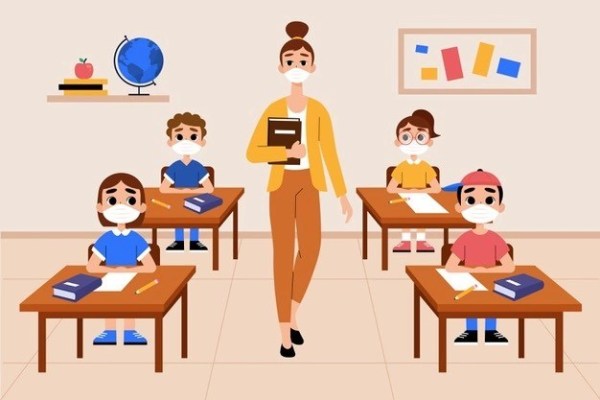
Due to the coronavirus pandemic, schools were closed but learning continued with classes conducted online.
After nearly eleven months, the school reopened for classes (grades) 9,10,11, and 12. After hearing the news I was very excited but sad too.
Reopening of school meant waking up early in the morning and missing the comfort of home. But I was so excited to be in school with all of my friends. No more comfortable clothes, gadgets, and online quizzes. But we could interact with the teacher and get our doubts clarified in person.
The day before school, I packed my bag, bought sanitizer and an extra mask, and got ready for school. I went to bed very early that day. I woke up and got ready for school. My parents dropped me at school. I usually go by van to school, but due to the pandemic, my parents are dropping me to school.
The temperature was checked at the school gate. Only twenty students were allowed to sit in a classroom. So the class was split into two. We had classes. We got our doubts clarified. There were a lot of safety precautions followed in my school which made me feel safe and secure inside the campus.
After coming to school, I had to sanitize my bag and other belongings, which was an extra task I would have to do regularly. Even though it wasn’t a normal school day, it was a new experience for me. Let us hope for the best in the upcoming days.
Konark is a town in Odisha where there is a famed temple of the Sun and a dance festival takes place there every year. Ten-year-old Divyanshi Das from Bangalore takes us to Konark.
Odisha : A Mix Of Heritage And Natural Beauty
by Divyanshi Das
Odisha is a truly impressive and spectacular place, famous for its heritage sites, unpolluted beaches, pilgrimage and more.
Odisha provides a lot of sightseeing opportunities which attracts many tourists every year. So, let me introduce you to two astounding festivals from the state.The first is the sand art festival of Konark usually held from 1st to 5th December at Chandrabhaga beach, Konark, Puri.
Sand art is the art of making sculptures using sand. The artists who participate are expected to follow certain rules. They can only use the beach sand, water and hand tools. No machinery tools are allowed.
Artist are supposed to start their work on the first day (morning) and they need to be ready with their sculptures by the evening when the festival is inaugurated and opened. The festival lasts five days so the artists have to make a new sculpture every day. Artists have to keep in mind that their sculpture should not hurt the religious sentiment of the people in any way.
The second festival I want to tell you about is the Konark Dance festival . Have you heard of the Sun Temple at Konark? It is a world heritage site and the site for the dance festivals. Some of the best dancers of the country come to perform here. The aim of the festival is to promote Indian classical dances.
Hope you liked reading about the festivals. Do visit the wonderful state of Odisha!
Wow! Two essays that show that this year might be better than last year. In any case, the future is always better than the past. Isn’t it? Here is Jessica Rachel who dreams of one and it is a story by her.
Stories
Nine-year-old Jessica Rachel from Chennai had a vivid dream about a happier and better world and has an important message of how we can make our dreams come true.
I Dream Of A Better Tomorrow
by Jessica Rachel
Every day was the same. I went to school, I studied and came home and slept and the pattern repeated. Wherever I went, there was hardly any greenery and a lot of pollution. I saw people were homeless and their kids had a lack of education.
Then one day, Covid-19 came along and affected the whole world. Those who were poor had no money to even get basic necessities for themselves.
We were instructed to sit at home and many people lost their jobs. The government tried to help those people. Some children could afford to attend online classes but not everyone was privileged.
One day I was thinking about this as I was falling asleep.
I had a lucid dream and found out that I could change the world however I want.
So, I first planted lots of trees. I planted seeds in every garden and empty spaces. I planted about 10,000 trillion seedlings around the world. Then I tackled the pollution from factories by enhancing the flora around them.
Then I channelled the lakes and rivers around the world and connected them to every home in this world. Now everyone could have fresh water to drink every day.
Then I went to the lands that were barren and built a playground using soil and water. I dug a deep hole and made a slide and filled the bottom with fresh water]. I kept some floats nearby. Next, I went to another barren land and filled it with snow. I created a snow playground.
I woke up and realised that this was all a dream. But I knew that it is not impossible to make this dream a reality.
We can make this come true by working together towards a beautiful environment. Until and unless we work together, we can never make our dreams come true.
Now, nine-year-old Nandini Maheshwari from Delhi brings us a story about a monkey that learnt to conquer its fear thanks to a wise old Orangutan.
The Day Muchilal The Monkey Learnt To Jump
By Nandini Maheshwari
Muchilal was a very handsome monkey. He had a big moustache. He wore a colorful turban. He was very polite and friendly. But he had a problem. He was afraid to jump. He used to think he would fall down if he tried to jump. Many mean monkeys in the tribe teased Muchilal a lot for being afraid.
He decided to go to the old wise orangutan to learn how to jump. The orangutan told him to fast for one day and Muchilal did so. He didn’t eat anything, not even his favorite bananas. He was starving badly.
Then the old wise orangutan hung some bananas on a very high branch of a tree. As soon as the fast got over, Muchilal was eager to munch something to satisfy his hunger.
The orangutan told Muchilal that now that his fast has got over, he can eat his favourite food – bananas. But to eat them he has to jump over the highest branch.
Initially, Muchilal was nervous but he was so hungry that he jumped to the highest branch with a big leap. Muchilal gulped the bananas and he also realized that he could finally jump.
This is how he overcame his fear.
What happens if you have to walk up dark stairs at midnight after watching a horror movie? Another story about conquering fears by twelve-year-old Nethrra S from Salem.
A spooky walk up the stairs
By Nethrra S
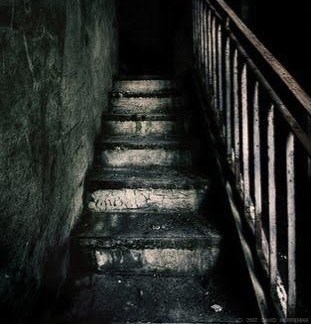
It was 11 pm on a rainy night. I was about to go to bed after watching a horror movie when my mother told me to go and close the terrace door. I was shocked!
In my house, to reach the terrace we have to climb two floors. I didn’t want to be alone since the horror movie was still in my head but I said ‘okay’ to my mother. I switched on the light to the stairs but unfortunately, the power failed.
I got a torch but there was no battery in it. I thought of taking a mobile phone but my mother was on call, my father was busy doing something with his phone.
I felt scared despite having agreed. I silently went to the stairs and stepped on it frightened.
I started to climb when I suddenly heard thunder as it was raining. I stepped on to climb to the second floor when I heard someone shouting my name loudly. This frightened me more. I started to chant religious mantras as they say ghosts are scared of Gods.
Suddenly, I heard my favourite song and wondered who was playing that when there was no power?
Finally, I reached upstairs and closed the terrace door. I took a deep breath and ran downstairs fast.
As I reached down, my mother said that she was calling me aloud and it was my sister who played my favourite song on her phone. My father asked me how I had climbed up in the pitch dark. I didn’t respond but I was glad there were no ghosts up the stairs!
A little girl gets lost in a cave. How does she manage to get out? Read this story of kindness and courage by seven-year-old Iksha Kalwal from Pune.
Finding A Treasure At The End Of The Rainbow
By Iksha Kalwal
One beautiful morning, Olivia went out for a walk. While keenly observing a stick insect, she fell into a cave. She was trying to walk slowly to find a way out. She was scared in that dark cave, anxious not knowing how she was going to get back home. Olivia remembered that her parents always said to be calm in this kind of situation and look for something to help her find a way out.
She saw a thin ray of light reflecting on her. Olivia ran towards it and bumped into a pot. She saw a small plant with a face asking for water. She quickly took out her water bottle and watered the plant. It smiled at her like a flower in the spring.
The plant asked her, “Will you please take me out of this filthy cave?” Olivia replied, “I will.” Olivia took the plant with her and found an exit to the cave.
After walking for a while, she saw a beautiful palace. A lonely bird was sitting at the window and humming a song. That hummingbird happily flew and sat on Olivia’s shoulder. Now Olivia had two friends as she continued walking to find a way home.
They saw footprints and followed them. “That might be the way!” said the plant. As they walked following the footprints, the bird sat on an arrow sign.
“Great, my friend!” exclaimed Olivia. They followed the arrow sign and reached a hut. Curious, they went inside the hut and found a puppy with an injured leg. The three friends quickly agreed to take care of him. Olivia took out her water bottle and gave water to the puppy.
Olivia, the plant, the bird, and the puppy, set back out to find home and finally reached a riverside. Olivia could see her village far away across the river! They saw a man sailing a boat, and he offered to help them cross the river.
As they crossed the river, Olivia reflected upon her journey, grateful for the friends she made along the way and was delighted that she found the treasure – her village – at the end of the rainbow!
I hope you enjoyed the visit to Bookosmian wonderland because I am off to read now … and figure out if they had popcorn at the tea party in Alice’s adventures! See you in Borderless again next month.Bye!
Avik Chanda converses about his best selling book on Dara Shukoh and its current relevance. Click here to read.
Stories
The Literary Fictionist
In Forgeries, Don Quixote & Epistemes, Sunil Sharma unravels the mystique of the Spanish ingénue, the man who fights windmills and has claimed much much literary attention post Quichotte. Click here to read.
A story of 1950s indiscipline related by Brindley Hallam Dennis with a soupçon of humour. Click here to read.
Musings/ Slices from Life
Musings of a Copywriter
In Lessons from Partition, Devraj Singh Kalsi explores how Partition impacts not only countries but families. Click here to read.
Adventures of a Backpacking Granny
In Homestay at St Petersburg, Sybil Pretious travels take her to St Petersburg where she tells the story of a woman she meets, a survivor from the 900 day Siege of Russia. Click here to read.
A discussion by Candice Louisa Daquin based on reading Candace Owens’ book Blackout: How Black America Can Make Its Second Escape from the Democrat Plantation. Click here to read.
These are fragments of memories from her childhood by Pronoti Baglary. With them, she tries to recap the flavours of an Assamese village. Click here to read more.
Krittika Mehta journeys through Erich Segal towards self discovery. “The world was dipped in swirling, glittering celebrations with friends, family and unknown to embrace a new year…” Click here to read more.
Michelle Hanley takes us on a magical adventure of culinary delights made by her grandmother. “It may just be that last bit of cake refilling the pan over and over again…” Click here to read more.
Ratnottama Sengupta, eminent journalist and daughter of Bengali writer Nabendu Ghosh, has been a force behind translating Bengali literature and bringing it to the doorstep of those who do not know the language. In this exclusive, she discusses how translations impact the world of literature. Click here to read.
Happiness and humour! Is that an unrealistic goal to achieve in this life? Moving away from the contentiousness of fame, of argument, of who achieves how much more and how much faster, we might be able to uncover a world sheathed in happy smiles. Is it only the pandemic spreading gloom?
The fear of dying or suffering does create a shroud of gloom that often interrupts our social interactions. The unreasonableness of fear draws us away from reality. Hans Rosling, a Swedish physician who called himself a possibilist, says: “There’s no room for facts when our minds are occupied by fear.” Fear or depression is the opposite of humour and happiness. The ability to think clearly and laugh at situations leaves us when we are fearful. Fear also leads to depression and the feeling of being oppressed. Humour is perhaps the only antidote to laugh away our fears and depression, to combat darkness and bring back smiles, hope and happiness. We have laughter clubs. Laughter binds all its members in happiness. And that is why we try to host plenty of it in Borderless Journal.
Embedded in the musings, fiction and poetry sections, we have humour, pathos, poignancy and laughter. Rhys Hughes with his tongue-in-cheek poetry, musings by Will Neussle and a short flash fiction by Brindley Hallam Dennis make us laugh outright as do some of the wonderful pieces written by youngsters in ‘Sara’s Selections’ hosted by Bookosmia, thanks to Nidhi Mishra and Archana Mohan. Michael Burch has also given us humour, happiness and poignancy in his collection of poems in memory of his mother.
We have introduced a new column that creates bridges across the world with not just facts but compassion and comprehension of the suffering and bravery of mankind by a woman who has traversed through diverse cultures all her life, Sybil Pretious. In this episode of ‘Adventures of the Backpacking Granny’, she explores the impact of Perestroika while in St Petersburg (Russia). Devraj Singh Kalsi has also given us an unusual piece talking about the impact of Partition on the family structure within the subcontinent. These two musings, while resting on major political events that changed the world for many of us, reflect different perspectives and are handled in vastly different ways by both the writers.
Reflecting on binaries, is a story from the imagined township of Ghumi, a series that Nabanita Sengupta has been publishing with us for more than six months now. Sohana Manzoor has given us a poignant story with a surprise ending from Bangladesh on the theme of witch-hunting, previously reflected upon in one of Aruna Chakravarti’s translations of Tarashankar’s famous story, ‘Daini’ (The Witch). Sunil Sharma has given us another interesting cross-cultural narrative based on his interpretation of Don Quixote and has also provided us a poem. We have a lovely collection of poetry this time, thanks to Michael Burch, who has helped with the editing and selection of poems. Vatsala Radhakeesoon has shared both her painting and a poem based on the painting with us – both vibrant and unusual works.
We have, for the first time a writer from Iran and translations from Persian to English by Davood Jalili of his works. A poem and an essay by Iranian poet Bijan Najdi give us a glimpse of their stories and perspectives. Jalili has also translated Devaki Jain’s interview to Persian to publish in the Arzhang, the online journal where the previously translated Aruna Chakravarti’s interview had found a home. We are very grateful to him for giving wider exposure to the content of Borderless as we are to Binu Mathews of Countercurrents for sharing our content in his popular site. Jalili with his translations to English brings in new perspectives into our fold as do Aditya Shankar with his translation from Malayalam poetry and Fazal Baloch with his translation of a Balochi folk tale.
The other major translation we have is that of a Nabendu Ghosh story by his late son, Dipankar Ghosh. ‘The Saviours’ had been translated previously by Bhashabi Fraser in a collection of Partition stories and was seen as representative of that era. However, as a literary paper from Universidad de Cádiz indicates, the story steps beyond the Partition to another relevant issue that continues to plague India — the divide created by wealth, caste and education, the absolute obtuseness of the affluent to the suffering of the less privileged, an issue that continues to shame as we reel from the pandemic.
There is an in-depth book review of a translation of Satyajit Ray’s grandfather, Upendrakishore Ray Chowdhury, by academic Nivedita Sen. Immortalised by the grandson in an award winning film, Goopy Gyne Bagha Byne, the story has been recently translated to English from Bengali and published under the title of The Adventures of Goopy the Singer and Bagha the Drummer.
An essay on translations by eminent journalist Ratnottama Sengupta, who has been bringing out works of Bengali writers in English and Hindi, explains the need for building these bridges across time and cultures. Candice Louisa Daquin’s essay on the Kali Project, which resulted in an anthology of poems on feminist issues in India initiated by an American concern, attempts to transcend borders as does the interview with Suzanne Kamata, an award-winning writer based out of Japan but born and brought up in the USA.
Candice Daquin has also given us another powerful reflection on the core values of mankind. This theme of an exploration of humane values has been reiterated in our interview with Avik Chanda, the author of the best-selling history of Dara Shukoh.
Do visit and take a look at our oeuvre, which far exceeds what has been mentioned in this little note. We value both our contributors and readers. Please feel free to comment and make suggestions so that we can serve you better.
Have a lovely month, looking forward to spring and newness!
By Bijan Najdi, translated from Persian by Davood Jalili
The world does not become bitter with the sword.
It does not become bitter with shooting, cries and fists.
The bitterness of the world
Is not the deer’s necks
And leopard’s tooth
And the death of a fish.
In the throat of a heron, there is not a disaster.
Bitterness lies in
The dolls with bellies full of TNT
Which fell on Vietnam
And on the country lanes of Palestine.
Disaster.
The joy of our children is
That they have seen a doll on the ground
And run with cheers and smiles (towards it).
.
Republished with Permission: Our Children was first published in Reality is My Dream brought out by the publisher, Nashr e Markaz.
.
Bijan Najdi (Persian: بیژن نجدی, pronounced [biːʒæn nædʒdiː]; (15 November 1941 in Khash, Iran – 25 August 1997 in Lahijan, Iran) was an Iranian writer and poet. Najdi is most famous for his 1994 short story collection TheCheetahs who ran with me (Persian: یوزپلنگانی که با من دویدهاند)).
Davood Jalili (1956, Iran) is an Iranian writer, translator and poet. He has published many articles on Iranian websites and magazines and has three published books.
.
PLEASE NOTE: ARTICLES CAN ONLY BE REPRODUCED IN OTHER SITES WITH DUE ACKNOWLEDGEMENT TO BORDERLESS JOURNAL
“Be present in all things and thankful for all things.” Maya Angelou
Sometimes I have turned off the radio during lockdown — too many people complaining, not enough dwelling on their blessings. I preferred to take my attitude from my tenacious, pioneering parents, survivors from holocausts, long sieges and other disasters much worse than this one. It reminded me of one of the people I met on my travels.
In 2007, I travelled to Russia — a wonderful place for adventure — and plumped for a homestay in St Petersburg. This is not a travelogue, just a snippet of admiration for survivors.
On the flight, I sat next to a trainee travel agent.
“You are travelling to Russia on your own?” she queried.
I confirmed the fact.
“Do you speak Russian?”
I didn’t.
“Do you have family or friends here?”
I didn’t.
She had asked me how old I was and on gaining that information she just shook her head. This was not the kind of older traveller she was expecting to deal with in future.
In a rather decrepit taxi, I arrived at the homestay. You stayed with a family who provided a room, two meals and local knowledge. The apartment was situated in an enormous unpainted concrete building with a forbidding exterior. The taxi driver hollered, his face pointing to the upper stories. A face barely reaching the top of the balcony peered over and called back in Russian.
We waited.
A diminutive woman who looked childlike in stature came out of the heavy entrance door. We traded greetings. She spoke English.
I followed upwards and finally she produced an enormous bunch with giant keys. She unlocked the door. We went up some steps. The same procedure again twice more. I began to wonder if this was a castle in the air. After unlocking the final door, we were in the flat and the doors firmly locked behind us. I had to follow this procedure every time I went out. I settled in a large bedroom. She later called me for tea and special Russian cake.
With initial polite enquiries over, she began her story.
“When I was only two, my family was in the Siege of Leningrad.”I was very quiet. My attention was total. I knew that the siege in 1941 had lasted for almost three years — 872 days to be exact. Almost two million people lost their lives. I couldn’t imagine the hardships they would have gone through.
“Very soon our water was rationed, the thirst was awful. We had just this much bread (she put the tips of her thumb and forefinger touching in a circle) for one day. It was the coldest winter. We threw everything we had into the fires to keep warm – clothes, furniture, instruments, ornaments. Our family had only one iron bed left. Every family was the same and we had to support each other. It was so hard.”
I was silent. Now I could understand why she was so small. Her growth had been stunted by lack of nourishment in her early years, but her spirit was indomitable. A lesson indeed.
She went on,
“But now our Government try to give survivors from the siege compensation in money and also a trip to anywhere in Europe every year.”
I didn’t like to say that I thought nothing could compensate for what she had been through, but she was grateful and loved visiting Italy.
I learnt so much more about Perestroika which she did not approve of but that is not pertinent to this story. It was just to remind myself to count my blessings daily.
Sybil Pretious writes mainly memoir pieces reflecting her varied life in many countries. Lessons in life are woven into her writing encouraging risk-taking and an appreciation of different cultures.
.
PLEASE NOTE: ARTICLES CAN ONLY BE REPRODUCED IN OTHER SITES WITH DUE ACKNOWLEDGEMENT TO BORDERLESS JOURNAL
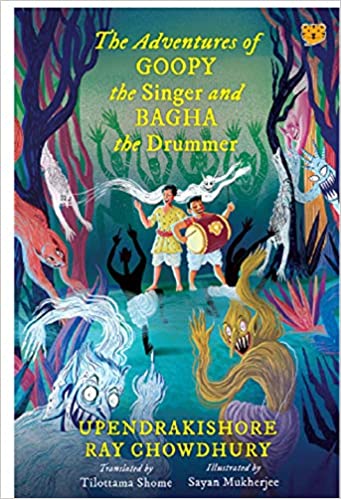
Title: The Adventure of Goopy the Singer and Bagha the Drummer
Author: Upendrakishore Ray Chowdhury, translated from Bengali to English by Tilottama Shome. Illustrations by Sayan Mukherjee.
Publisher: Talking Cub, an Imprint of Speaking Tiger Books, 2020.
Upendra Kishore Ray Chowdhury’s name was well-known as an innovative children’s writer, painter, musician, photographer and a pioneer printer-publisher in the late nineteenth century. His grandson, Satyajit Ray, immortalized his long short story for children ‘Goopy Gyne Bagha Byne’ as a reputed film that deployed a lot of music, dancing and fantasy elements.
This graphic version of the story, particularly its musical score that was penned and directed by Satyajit Ray himself, had almost obliterated the children’s tale that was a household word in Bengal earlier. Since it is a story about two naïve, rustic boys who desperately try to be a singer and a drummer respectively, Satyajit Ray worked on and elaborated the musical potential of the story by writing lyrics for songs that could be sung by Goopy, with Bagha’s drumming as accompaniment. The songs like Dekho re Nayan Mele ( Opening Your Eyes and Look), Bhuter Raja Dilo Bor (The King of Ghosts Grants a Wish) and Maharaja Tomare Selaam (Salute to you Maharaja) have been all time favourites for the last fifty years. The two sequels to the film, Hirak Rajar Deshe (Hirak King’s Kingdom) and Goopy Bagha Phire Elo (Goopy Bagha Return) were written by Satyajit Ray himself, although the latter was directed by Ray’s son Sandip Ray. The innocuous Bengali story therefore surfaced on the celluloid screen, and then extended through sequels to follow the adventures of Goopy and Bagha through time.
The status of an internationally acclaimed film also enabled the story to traverse across space by getting translated in different languages, particularly English. Among recent translations are those by Swagata Deb (Penguin, 2004) and Barnali Saha (Parabaas, 2012). Perhaps in order to communicate a different tone and emphasis, in this one, Tilottama Shome took up another translation. She has stuck to each and every word of the original. Although Upendrakishore’s stories have been translated by well-known scholars, editors and translators like William Radice, Madhuchhanda Karlekar and Arunva Sinha, this translation is also very fluent. The use of casual vocabulary in English that is used on a daily basis, like ‘vocal warm-ups’, ‘country bumpkins’ and ‘spooked’, add to the readability of it. The illustrations by Sayan Mukherjee, which include a lot of the ghosts, is brilliantly evocative of the ghostly fun and frolic in Ray’s film.
The story, which is something between a folk tale, a benign ghost story and a fantasy around a realistic setting with two ingenuous protagonists, has many violent episodes. Most of Bengali children’s folk-fairy tales like those in Dakshina Ranjan Mitra Majumdar’s Thakurmar Jhuli portray such unpleasant interludes, which is not different from Grimms’ or Hans Andersen’s Fairy Tales depicting brutal human behavior and blood and gore. Such violence and deaths go back to the earliest children’s stories, possibly to equip children with the overpowering truth that is an important, if an unsavoury, aspect of life. The violence becomes an indispensable component of children’s stories, since children need to be aware of what they might confront in the real world.
Bruno Bettelheim, a psychologist who tried to read fairy tales in terms of Freudian psychoanalysis, said that children need to be exposed to fairy tales with grim episodes in them. He demonstrated that these dark happenings, fantastic as they may be, expose and initiate the child to real life that is inclusive of the ruthless and the arbitrary and contribute to children’s holistic understanding of life. In this story, when Bagha goes home, he finds that his parents have died in the interim he was away. Goopy’s parents remain alive, perhaps to signify that deaths in real life are ubiquitous, imminent but random. But there is greater cruelty than death in children’s stories.
According to Ernest Jones, Sigmund Freud’s biographer and a psychoanalyst in his own right, the savagery in children’s stories represents expressions of the unconscious mind like the jealousy and hostility inherent within family relationships. He elaborated how abstract moral concepts like anger, fear and guilt are ‘physicalized’ and ‘externalized’ in children’s tales to enable children to conquer them. Also, after acknowledging these harsher primal feelings and instincts, the child gets to make sense of what is happening all around. Goopy and Bagha’s boat loses balance and capsizes due to their cacophonous singing and drumming, causing the passengers to tremble and roll around. This drowns and kills all the passengers except the two of them who are also terrified but keep afloat by clutching on to Bagha’s drum. But Gidwitz, a twenty first century children’s writer, explains how violence is deployed as a didactic tool to reinforce the moral certainty of good triumphing over evil, which must be punished. For example, in another episode where the garden house of the king is burnt down by the guards in accordance with royal injunctions, everyone who was responsible for proactively setting fire to the house dies but Goopy and Bagha, who are inherently good, escape with the help of their magic boots.
Goopy Gyne is also a ghost story with a difference. Ghosts appear in such a story within a realistic backdrop, not by invoking them or within a supernatural setting, but out of the blue. They also do not haunt an individual human being, a particular place/ house or a specific object, and are therefore aliens who are removed as suddenly as they appear from the forest in which they are discovered, after they have performed their task. They are not characters who take part in the narrative.
Goopy and Bagha initially get panic-stricken on seeing the glowing eyes of the ghosts that are like burning coal and their radish-like teeth. However, these are not the spirits of the dead that have revived to take revenge or to try to fulfill their unfulfilled desires in life. These ghosts continue to act as external agents who empower the two friends, much like the fairy godmothers in fairytales who grant boons to the protagonists and rescue them from perilous situations.
The terror that these ghosts have the potential to invoke is one that instead becomes a pleasant experience because Goopy and Bagha learn very soon that these spirits are extremely generous. The film is also enlivened with the scene with the ghosts. The narrative describes a curious reversal in which Goopy and Bagha are themselves mistaken as ghosts, thanks to all the miraculous scenes associated with their magical powers. But their achievement of raining delicacies and sweets, their accoutrements in looking like princes or the magic episodes of the two friends fleeing from any difficult situation with the help of their enchanted boots is actually an outcome of the three wishes granted to Goopy and Bagha by the ghosts. The ghosts are responsible for bestowing melody and rhythm to Goopy and Bagha’s music that used to be tuneless, jarring and noisy before.
The music in the story is wholly their contribution, something that has been underscored by Satyajit Ray in delightful compositions in the film. It might, in fact, be a pioneering enterprise, copyright permitting, to translate the screenplay that includes the songs.
Nivedita Sen is Associate Professor in English at Hansraj College, University of Delhi. She works on Bangla children’s literature, and has translated authors like Tagore, Sukumar Ray, Asha Purna Devi, Leela Majumdar and others for Harvard University Press, Vishwabharati Press, Sahitya Akademi, Katha, Tulika and more.
.
PLEASE NOTE: ARTICLES CAN ONLY BE REPRODUCED IN OTHER SITES WITH DUE ACKNOWLEDGEMENT TO BORDERLESS JOURNAL.
A story of 1950s indiscipline related by Brindley Hallam Dennis with a soupçon of humour
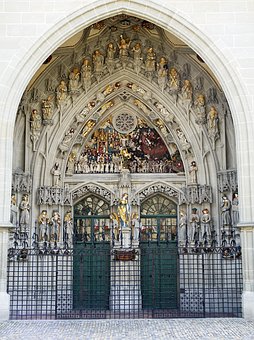
The cathedral doors were massive. They towered above them. Even the keyhole and the iron ring handle were above their heads. And you would think it was the youngsters’ fault, the way they got a severe reprimand when the headmaster and his group arrived on the riverbank. Perhaps he had a word with Mr Stephens too, on the quiet in the coach on the way home.
Sound travelled oddly in big old buildings like that cathedral. Something whispered in one place at the other end of the cloisters could be heard quite clearly, yet something spoken in a quite normal voice above the heads of the children couldn’t be heard in the middle of the nave. What was heard perfectly clearly by the children was the instruction to go back inside through the huge wooden doors because you were with Mr Stephens’ group. And what stuck in the minds of at least one of them for decades afterwards was the shock of seeing that vast, empty grey space when they did. Mr Stephens and his group had simply vanished. Perhaps there was another door out of the building, somewhere down towards the choir stalls, or behind the pulpit.
It was Bryan who poked around behind the candles and the rood screens and in several other gloomy places, but he found no-one. It was Bryan who suggested that they should go back outside and tell the headmaster that Mr Stephens and his group had disappeared. It was Bryan who went outside and came back in saying that the Headmaster and his group were missing too. Then they had all gone outside and stood at the foot of the Cathedral doors wondering what to do.
What memory hasn’t recorded is the life of the city that must have continued to pass by, to and fro, in front of the building where they stood, whatever the Headmaster and Mr Stephens and their groups were doing. All sorts of people must have gone by and noticed the five or six adult-less seven-year-olds huddled against those doors like medieval supplicants denied entrance on account of some unforgivable sin or unacceptable affliction. Perhaps even policemen on their beats passed by without intervening, along with Samaritans and other travellers.
It was Bryan, probably, being a precocious but thoughtful child, who suggested, that they should go down to the river where they were scheduled, after their picnic lunch, to go on a boat trip. Mr Stephens and the Headmaster and their groups would be bound to show up there, obviously. Bryan had a watch, perhaps, or maybe they looked up at the Cathedral clock, if there was one. I think Bryan would have been the sort of boy who would have had a watch. Perhaps several of them did. And perhaps too, children being more observant often, and attentive to adult memes, they had taken in the oft-mentioned half past twelve of the planned lunch break at the wooden tables down by the landing stage.
It would have been Bryan, if anyone, who guessed or even knew that if you want to find a river, going downhill is as good a strategy as any. Or it might have been blind luck of the good sort, as one must suppose the abandonment by Mr Stephens, or the Headmaster, if wilful neglect or lack of attention or plain unruliness in the children were not to blame, had been the bad luck.
Whatever the explanation for the recovery of the situation it came to pass that the children moved safely through that urban jungle and found themselves on the riverbank where boats plied for hire. There they waited the half hour or so that it took for Mr Stephens and the Headmaster and their groups to circumnavigate the city’s ancient walls. Which of these two arrived first, memory does not record but what remains clear is that the Headmaster was very cross and flustered. He may have wished that there had been enough parental volunteers among the group to have prevented the occurrence. Or maybe, he did not.
With a voice sharper than they were used to hearing, the negligent children were told, that, seeing as they had already consumed their picnics, and before the appointed time, he, the Headmaster, would take them personally around the walls as that been the major educational objective of the trip, before they embarked on the boat. This he did at a pace remarkable for such small legs, and the walls passed beneath them in a blur.
By the time they got back to the riverbank, the Headmaster had cooled down, and made it plain that there would be no more mention of the children’s momentary lapse of concentration, and that they should be glad that nothing untoward had come of their irresponsible behaviour. They were advised, for their own sakes, if they wanted such trips in the future, not to talk about their misdemeanour with their friends or brothers and sisters back at school, and certainly not with their parents. Such indiscipline was not to be tolerated, and though it need not be dwelt on, it might serve as a useful lesson to us all.
Going back a lifetime later what was most surprising was how small those Cathedral doors really were.
Brindley Hallam Dennis lives on the edge of England where he writes occasional plays, poetry, and essays. His writing has been published and performed. He blogs at www.Bhdandme.wordpress.com
.
PLEASE NOTE: ARTICLES CAN ONLY BE REPRODUCED IN OTHER SITES WITH DUE ACKNOWLEDGEMENT TO BORDERLESS JOURNAL
These poems by Michael R Burch are dedicated to his mother, Christine Ena Hurt (1936-2020)
Mother’s Smile
(for my mother, Christine Ena Burch)
There never was a fonder smile
than mother’s smile, no softer touch
than mother’s touch. So sleep awhile
and know she loves you more than “much.”
So more than “much,” much more than “all.”
Though tender words, these do not speak
of love at all, nor how we fall
and mother’s there, nor how we reach
from nightmares in the ticking night
and she is there to hold us tight.
There never was a stronger back
than father’s back, that held our weight
and lifted us, when we were small,
and bore us till we reached the gate,
then held our hands that first bright mile
till we could run, and did, and flew.
But, oh, a mother’s tender smile
will leap and follow after you!
Deliver Us ...
(for my mother, Christine Ena Burch)
The night is dark and scary—
under your bed, or upon it.
That blazing light might be a star ...
or maybe the Final Comet.
But two things are sure: your mother’s love
and your puppy’s kisses, doggonit!
Such Tenderness
(for all good mothers)
There was, in your touch, such tenderness—as
only the dove on her mildest day has,
when she shelters downed fledglings beneath a warm wing
and coos to them softly, unable to sing.
What songs long forgotten occur to you now—
a babe at each breast? What terrible vow
ripped from your throat like the thunder that day
can never hold severing lightnings at bay?
Time taught you tenderness—time, oh, and love.
But love in the end is seldom enough ...
and time?—insufficient to life’s brief task.
I can only admire, unable to ask—
what is the source, whence comes the desire
of a woman to love as no God may require?
The Poet's Condition
(for my mother, Christine Ena Burch)
The poet's condition
(bother tradition)
is whining contrition.
Supposedly sage,
his editor knows
his brain's in his toes
though he would suppose
to soon be the rage.
His readers are sure
his work's premature
or merely manure,
insipidly trite.
His mother alone
will answer the phone
(perhaps with a moan)
to hear him recite.
Delicacy(for my mother, Christine Ena Burch, and all good mothers)
Your love is as delicate
as a butterfly cleaning its wings,
as soft as the predicate
the hummingbird sings
to itself, gently murmuring—
“Fly! Fly! Fly!”
Your love is the string
soaring kites untie.
Final Lullaby
(for my mother, Christine Ena Burch)
Sleep peacefully—for now your suffering’s over.
Sleep peacefully—immune to all distress,
like pebbles unaware of raging waves.
Sleep peacefully—like fields of fragrant clover
unmoved by any motion of the wind.
Sleep peacefully—like clouds untouched by earthquakes.
Sleep peacefully—like stars that never blink
and have no thoughts at all, nor need to think.
Sleep peacefully—in your eternal vault,
immaculate, past perfect, without fault.
Michael R. Burchhas over 6,000 publications, including poems that have gone viral. His poems have been translated into fourteen languages and set to music by eleven composers. He also edits The HyperTexts (online at www.thehypertexts.com).
.
PLEASE NOTE: ARTICLES CAN ONLY BE REPRODUCED IN OTHER SITES WITH DUE ACKNOWLEDGEMENT TO BORDERLESS JOURNAL.
Translated to English from Bijan Najdi’s essay in Persian by Davood Jalili
Bijan Najdi is often identified with the collection of short stories, Cheetahs who ran with me. But he was a poet at heart. His melodic prose and his powerful stories have the traces of poetry between words. The flow of poetry in his stories evolved into a very exquisite flow of thoughts and perceptions. Najdi wrote an article entitled ‘The Third Perception of Man’ in which he considers poetry to be the outflow of the most intense emotions.
Man’s first perception of fire must have been to touch and burn himself, that is, to feel the burning with direct contact. The next step was to understand the fire to learn from his earlier experience. That is, we see the fire, and without touching it, we know that it burns. This third stage is understanding the fire of “poetry”. That is, if you can, without the fire in your presence, think of it, feel the burning in your fingertips that you have to put your hands under the tap, you have achieved a poetic moment in your life, without the help of words.
Now you can transpose this third stage from fire to the suffering of others, to the history of your land, to the massacre in Palestine, to freedom, to the mass burials in Herzegovina. Poetry does not need “words” in such circumstances. It is the highest form of expression of the most intense suffering of humankind.
The study of the traces of life and the survey of dreams, the nightmares of cavemen and the psychoanalysis of designs and shapes carved in stone prove that even before the advent of calligraphy and language, man had experienced all three stages of perception. The drawings on the stone that depict a human with bird wings on the back and legs of a deer and a human profile are an object of the same third sense.
Is suffering and love born of lines and words the only foundation for poetry? Does our understanding of God depend on our learning to write the word “God”?
However, it was but natural that after the evolution of language and the emergence of calligraphy, man tried to write that “third comprehension”. Henceforth, poetry was no longer seemingly independent of time. Poetry proved its objectivity with the help of the “word”.
In simpler language, basically, any kind of understanding does not necessarily need words, but with words, understanding can be built.
Form and content are a philosophical and academic discussion. They have nothing to do with poetry or at least they have nothing to do with the moments of composing poetry.
There are two types of thinking. Both can, perhaps, influence poets as well.
Some people look at their surroundings with inductive reasoning and want to get a whole by identifying and analysing the details. On the other hand, some people deduce by accepting and prove from a general rule. They would accept the thought for the presence of each component.
Both methods have scientific values. Poetry as the “third perception” is born of intense feelings that frees the poet from both when writing poetry: form and content.
There are poets who believe that form is the manifestation of poetry. In my opinion, this kind of formalism is just a way of thought; that they want by looking at an apple, to get an idea of its taste and smell, with the help of the word, and they want to reach “sense and understanding”. There is nothing wrong with that, but I think it conflicts with the “essence of knowledge.”
However, no one can stop this group from trying.
Volume has dimensions in its geometric definition, so it has an inside and an outside. However, the enclosed space is not the object of discussion. Every point of space is either in or out. That is, each point of it can be both inside and outside at a time. Volume poetry[1], according to Royaee[2], one of the most famous poets of this school, is the transcendence over length, width and height to float in the contraction and the expansion of the soul of the universe, which the poet enters with the “help of words”.
Volume poetry is a look at nature, objects and words that create a sense of yearning by discovering the form and inherent talent of the word to explain the inside and the out to escape from volume.
The spatial poetry of Royaee steps out of the volume enclosed in the words, to get help from the hidden spaces between words, oblivious to the consciousness of being a man. But in such poetry, you can neither sense the history nor the historical identity of the poet.
Nevertheless, poetry of Royaee is full of eagerness to know. But because he is not able to convey his eagerness in his manifesto of volume poetry, his adherents and he have diametrically opposing outputs. I think this is a kind of crisis in poetry, but we should not be afraid of it.
A real crisis arises in poetry when people’s eyes, ears, and minds become accustomed to only one type of poetry.
The crisis was the same as we had in the years before the revolution, when some people did not consider Sepehri[3] a poet because of his Marxist views.
The crisis was that under the pretext of modernism, poetry based on belief and mysticism could be rejected in a society. The culture of any society is the result of social behaviors. If these behaviors are restricted in a certain way, a crisis does arise.
The basic bedrock of any art is freedom, and no one should and can ignore the value of lyricists or post-revolutionary idealist poetry because of their interest in white poetry[4].
However, I do not know what poetry is and what good poetry is.
I have no reason to like a good poem as I feel a burning sensation in my fingertips without touching the fire. Believe me, I am neither a poet nor a novelist, I just love the literature of my country very much.
.
(Published with permission from Bijan Najdi’s wife and family)
Bijan Najdi (Persian: بیژن نجدی, pronounced [biːʒæn nædʒdiː]; (15 November 1941 in Khash, Iran – 25 August 1997 in Lahijan, Iran) was an Iranian writer and poet. Najdi is most famous for his 1994 short story collection TheCheetahs who ran with me (Persian: یوزپلنگانی که با من دویدهاند)).
Davood Jalili (1956, Iran) is an Iranian writer, translator and poet. He has published many articles on Iranian websites and magazines and has three published books.
[1]– Volume Poetry is a type of poetry written evolved around 1967. In 1969, Royaee and several poets published the essence of the volume poetry. Volumeism, mental movement, volumetric vision, mental distances, three-dimensional attitude, are other names that have been applied to this type of poetry
[2] – Royaee is an Iranian poet (1932) who now lives in Paris. He wrote a Manifesto of volume poetry
[3] –Sohrab Sepehri (born October 6, 1928 in Kashan – died May 1, 1980 in Tehran) was an Iranian poet, writer and painter. He is one of the most important contemporary poets of Iran and his poems have been translated into many languages including English, French, Spanish and Italian.
[4]White Or Sepid poetry or Shamloui poetry is a type of modern Persian poetry that appeared in the 1930s with a collection called Fresh Air by Ahmad Shamlou and may be compared to free poetry (in French : vers libre ) in Western literature. The main difference between these works and previous examples of new poetry was in the form of poetry. In this style, the rhyme of prosody is generally not observed, but the song and music are reflected. In the classification of modern Persian poetry, sometimes any poem that does not fit in the form of Nimai poetry (Nima Youshij the innovative of New Poetry) is called white poetry.
.
PLEASE NOTE: ARTICLES CAN ONLY BE REPRODUCED IN OTHER SITES WITH DUE ACKNOWLEDGEMENT TO BORDERLESS JOURNAL




































 Borderless