Categories
Essay

Can Songs be the Musical Conscience of a Film?

Prithvijeet Sinha uses Gaman (Departure), a Hindi movie around the pain of migrant workers, as a case study to highlight his contention that lyrics and songs convey much in Indian films.

 As my essay dives into the realm of the personal intermingling with the universal, I have found that the quintessential point of a space, definitive of our existences and livelihood, flows seamlessly in our lives. A collective omnibus houses our private churnings, moving from one point to another as life scripts new adventures of the mind and the spirit to discover valuable assets and find that sacred space — a home to give refuge to our true and innate selfhoods. The idea of the heart as home of our fiercely personal torrents of thoughts is something I adhere to. As such, the heart is a lonely island and much as personal journals and diaries have a secretly lush inner world to communicate, the subtle and implicit art of songwriting is the external synonym and outlet that universally connects our inner world with the outside.

 The functional meaning of a song is actually born out of the discerning of listeners. Khairun, the lonely young woman at the heart of the film, Gaman (1978), is one such example in a sea of millions around the world, one of countless women left to tend to the hearth while the responsibility of corralling finances snatches their men away from them prematurely. Such is the dilemma that a newly annointed marital union becomes essentially a platonic one, testing the sombre beginnings of this lifelong intertwining of two strangers. As if it’s a rite of passage for their individual selves after they have taken their vows in the public eye and been pronounced as man and wife. They burn for that warmth and familial touch of companionship with these songs sung by playback artistes (conveying from the prism of Khairun) becoming spiritual constants when the physical reality of them staying together is rendered impossible. Through her fortitude and its equal mirroring in her husband’s predicament in the city, we find the power of this union to sustain itself in two different places. Their mindscapes merge and Khairun is a conduit for this film’s portrayal of pain of separation and social anxiety. As if she has a telepathic connect with her beloved as when, through voice-overs, we find her letters informing Ghulam of her own angst and her brooding face and eyes loom over Bombay’s skyline.

 It’s the language of our soul or Aatma as we call it in Indian canon.  We are not alone then. There is no conflict in this union and the words, it seems, flow out of our own being.  The beauty, melancholy and dignified distance invested in them bring the pining heart and the hopeful soul together in perfect tandem.

In Gaman, both protagonists live in the shadows of crumbling aristocracy, in a village in North India where the present is bleak and like a ghost informs the poor population about its impending desolation. In a post-colonial nation, the humbler occupants of this social compartment still have survival to contemplate upon and their lands and farming have given them no respite from debts. As the central characters are Khairun (the iconic actress, Smita Patil) and Ghulam Hasan (another stalwart actor, Farooq Sheikh), the film shot in the erstwhile Muslim and predominantly secular princely state of Kotwara, could be reflective of the dilapidated shells of a centuries old lineage which may have had connections in the past and seen better days. But rampant unemployment, educational lacuna and a hand-to-mouth existence contextualize a move to the big city for the man. The name Khairun itself has a certain melancholic ring to it, I think and Ghulam as his name goes becomes a slave of his fated new beginnings.  Their taciturn marital bond is presented in brief moments together.

 In simple but rousing poetry, the real challenge of moving ahead in the big city while leaving behind the rustic stronghold and a real home is poignantly conveyed.  Identities are at stake and have to find a home, even if it is the most modest resort of reassurance. The womenfolk have no real say or stake in this scenario and Khairun’s silence is a witness to that. The song then that appears is ‘Aap ki yaad aati hai raat bhar’ (Your memories were all that remained all night long).

Composed by Jaidev, written by Makhdoom Mohiuddin and sung iconically by Chaya Ganguly, who won the prestigious National Award for playback singing, love and longing are two sides of the same coin. When I heard this song few years back, it came like a lilt from beyond, the central melody captivated me and made me croon its perfectly structured lines. There was a distinct local character to it and the realism of the situations converged with the romanticism of natural images. These images were stages in their marked separation and the passage of time was invoked. The opening lines translated are, “Your memories were all that remained all night long, moist eyes kept smiling all night long.”  The stoic quality of internalization is very succinct here. “Muskurati Rahi”( a smiling wayfarer) in feminine form reflects the mindset of Khairun, the young bride and woman. There is a brevity of conveying the lull within the heart’s storm. A pensive directness addressed to oneself in isolation and to the beloved is like a pithy interior monologue; a missive to the one who yearns for an established bond.

The song is unique as it’s one of the few ones to begin with the chorus or central refrain which clearly elucidates its personal nature of pathos. The first verse continues with the imagery of the still night and dark, private chambers of the heart where longing is given rest and an assured hand. It goes like, “the flames of pain were burning/alighted all night long /melancholy’s flicker was trembling throughout.”

 The fickle spirit is putting up a brave front and is vulnerable, spending its time in contemplation. From the opening plucking of strings, which I think is the instrument santoor and burgeoning flutes, the intimate incandescence of the couple is set into motion in a composition set in the pure classical mold. Khairun’s dialogue travels all the way to us. There is a shine to their passion for each other which refuses to interfere with their earnest pursuits. 

The second verse is more tilted towards romanticism. Its mesmerising notes are referenced with the flute to symbolise love and its dimensions. In Indian lore, Krishna played the flute for self-definition and courtship. Here, its transcendental spell is cast on a lonely soul as attested in the lyrics, “the tuneful, charming notes of the flute/come as reminders of memories all night long.” The speaker is in third person and omnipresent thus the personal becomes the universal and the use of night imagery can make it the last moorings of an individual before sleep gets the better of her/him and every recollection is committed to memory’s animated storehouse. The invocation of the flute is a sweet token for the promise of every stable relationship. The foundation has to be lovely and full of warmth even though it is an ephemeral ideal.

The talent of the lyricist here is that these escape from falling into a basket of random cliches as its essence is in Urdu poetic tradition.  Look at those plangent eyes of Khairun, deep vessels of wait and ceaseless langour, akin to an Amrita Shergill paintings.  

The mystery of the night has direct approximation in the next verse, “the night moon entered depths of the heart/ its glow illuminated the night.”  The moon is a personal symbol as it’s cast in the image of Ghulam for Khairun and vice versa. The unattainable height of its location is related to the profound number of miles separating husband and wife. Its dim light is the only source of illumination thus hope is enshrined in these lines for the little kernel of happiness that may bless them sooner or later.  The desire for union is prevalent here. In the video of the song, notice how the lyrics pertaining to moonlight are juxtaposed with streetlights and neon lights of Bombay where Ghulam drives a taxi for a living and Khairun tends to the household lighted by a dim bulb. Light plays a crucial role in their overlapping narratives. Winter has set in the village and Bombay is the metropolis on whose streets Ghulam has to ply his cab. 

Finally the gypsy heart that celebrates isolation and is detached from unnecessary expectations finds its way in the final verse, “a lover wanders around lanes/ a voice echoes all night long”

 This is not the blabbering of a madman but the deep call of the soul’s recesses. Should both Khairun and Ghulam adopt detachment till they are united or celebrate their individual and in a larger sense collective isolation? Their private musings do their bidding for the heart. The head and heart dilemma is hence paramount.  The lover’s wandering minstrel like ways approximate the private reserves of love and longing. Dual interplay of inner and outer personas match wits and still lucidity is sought and achieved in the quietude of this composition via slender, elegant employment of guitar, drums and flutes.

 Chaya Ganguly’s voice dominates the sway of restrained pathos and hope here while Smita Patil’s eyes and Farooq Sheikh’s stoicism endure as he posts letters and Khairun holds them. ‘Seene Mein Jalan, Aankhon Mein Toofaan’ (A burn in the chest/ a storm in the breath) captures the rush and milling crowds of big cities where individuality hankers for identity while ‘Ras ke bhare tore Nain’ (your eyes are full to the brim) addresses the aesthetics of longing from the same soundtrack. The playbacks by Suresh Wadkar and Hira Devi Mishra respectively are pitch perfect.  The panorama of humanism under duress finds its true form and content in the direction of Muzaffar Ali (auteur of iconic Umrao Jaan), cinematography of Nadeem Khan, lyrics by Shahryar, writer Hriday Lani and crisp editing by Jethu Mundul.

The music of Gaman won Jaidev a National Award too for best music and deservedly so. The film also won a special mention accolade.

Gaman in Urdu signifies transit, passage, migration, departure or movement but I was surprised by how according to Zen Buddhist currency in Japanese, it is an equivalent of stoic endurance and patience. These markers ultimately are a natural corollary of movement of any kind. The music of Gaman is a perfect amalgamation of the personal and universal and devolves meaning to the idea of distance. Timeless musical exemplifications like these simply don’t exist anymore. It is the soul of Khairun that ultimately guides us to that point of personal transit.

Prithvijeet Sinha has been prolifically publishing works of various hues in journals and magazines like   Cafe Dissensus, Confluence, The Medley, Borderless, Wilda Morris’ Poetry Blog, Screen Queens, Rhetorica Quarterly, Lothlorien, Chamber Magazine, Livewire  among others. He believes writing to be the true music of the soul.

.

PLEASE NOTE: ARTICLES CAN ONLY BE REPRODUCED IN OTHER SITES WITH DUE ACKNOWLEDGEMENT TO BORDERLESS JOURNAL. 

Categories
Pirate Poems

Pirate Blacktarn meets the Siren

A strange tale in verse by Jay Nicholls

PIRATE BLACKTARN MEETS THE SIREN

Pirate Blacktarn was sailing around
When all of a sudden, he heard a sweet sound,
A marvellous melody, wafting on the sea.
“Let’s go and see what that sound can be.”
“No you can’t,” said Tim Parrot anxiously,
“That’s the Siren’s song, turn back quickly.”

“Nonsense Tim, don’t be such a bore
Full sail ahead, I want to hear more.”

“No, no,” said Tim, “the Siren’s song’s a trap.
She’ll sing and tell tales till you doze and nap.
And at last you’ll fall asleep and never wake again.
Don’t you know the Siren makes statues of men?”

“Rubbish, don’t make a fuss, we’re brave and tough
And we’re not afraid of Sirens,” said Blacktarn in a huff.

So they sailed at speed to the Siren’s shores
Following her enchanted music’s lures.
“Welcome,” called the Siren as they finally came near,
“I have a tale or two, perhaps you’d like to hear?”

Her hair was shining silver and her eyes were glinting green,
The most amazing creature they’d ever seen.
Her lilting, laughing voice was rich and sweet as honey.
Mysterious and serious, fantastical and funny.

“Don’t listen,” cried Tim, flapping his wings with worry.
“Oh be quiet Tim, we’re not in a hurry,
“We can surely stay for just a little while.
Pleased to meet you Siren,” said Blacktarn with a smile.

Then the Siren gave them all a potion to drink
And they drank and drank and forgot to think.

“I see you pirates have come a long, long way,
You must stay here and rest,” they heard the Siren say.
Then she told them tales of the people of Mer
And of sunken ships full of long-lost treasure,
And the terrible battles of the squids and the whales
And the shining sea fire that never ever fails,
And the undersea caves that glitter with diamonds
And the eels that weave through the waving fern fronds,
And the ghosts of dead pirates all shivering and cold
Still seeking their hoards of silver and gold.

Their heads began to nod and their eyes began to close
And one by one they fell into a deep enchanted doze.
They hardly knew if they were waking or dreaming
For all was hazy and magical seeming.
Blacktarn’s mouth opened wider and wider
And he didn’t even notice when in jumped a spider.

“Wake up! Wake up!” cried Tim in agitation,
But the pirates were lost in their imagination.
“Time for drastic action,” thought Tim, very worried,
And away to his friends the seagulls, he hurried.

“Help me, please help me, I don’t know what to do,
The Siren’s enchanted Blacktarn and all his crew.”

Then the Lord of the Seagulls held a meeting of his flock,
They all gathered together on his great grey rock.
They didn’t like the Siren, she turned birds into stone
And wore necklaces and rings made of seagulls’ bones.

“What we’ll do is hold a seagull’s chorus,”
The Great Gull decided, “and we’ll make such a fuss
That the Siren’s voice will be silenced and unheard,
Then the pirates will wake,” announced the Great Bird.
The gulls all agreed this was a very good idea
For a certain sort of seagull screech is hideous to hear.
So away they flew to the Siren’s shores
And saw the pirates and heard their snores.
The Great Gull himself let out a wild cry
Then the seagull chorus screamed through the sky.
The din they made echoed round and round
Till the Siren’s voice was completely drowned.

“Wake up Blacktarn,” called all the birds,
“Wake up, don’t listen to the Siren’s words.
Wake up Mick and Bob, wake Stowaway Fay
Wake, if you want to live another day.”

Tim went round pecking at the dozy crew.
“Wake up Captain and Rakesh and you and you.”
Then the crew stopped hearing the Siren’s voice.
They only heard the gulls, they didn’t have a choice.
“I must have been napping,” said Bob opening his eyes,
“I’ve had some strange dreams,” said Mick in surprise.

Then they stared at the Siren in horror and dismay
She’d turned purple with rage, now she couldn’t get her way.
She frothed at the mouth and her eyes went red
And writhing snakes twisted round her head.

“Run,” yelled Fay and at top speed they fled,
And didn’t dare stop, they were so filled with dread.
At last they reached the ship and sighed with relief.
That was an adventure quite beyond belief!”

“I wish I could remember the stories she told,
 I wanted to hear those magic tales unfold,”
Said Stowaway Fay, with a rather sad sigh.
“Me too,” said Bob. “Yes” said Mick, “so did I.”
“You be grateful you haven’t been turned to stone,”
Said Parrot Tim crossly, “then you’d really moan.
If it wasn’t for the help of the gulls of the air
You’d be trapped forever in the Siren’s snare.”

“Nonsense,” said Blacktarn, “we were dozing a while,
We weren’t caught up in the Siren’s guile.
I told you no Siren would get the better of me,
Now come on crew, get sailing, across the Lemon Sea.”

.

Note: The ‘Pirate Blacktarn’ poems were written in the early 1990s but were never submitted anywhere or shown to anyone. By lucky chance they were recently rescued from a floppy disc that had lain in the bottom of a box for almost thirty years. There are twelve poems in the series but no indication as to what order they were written in and the author no longer remembers. However, they seem to work well when read in any order. They all feature the same cast of characters, the eponymous pirate and his crew, including a stowaway and an intelligent parrot. The stories told by the poems are set on a fictional body of water named the Lemon Sea. (Dug up by Rhys Hughes from the bottom of an abandoned treasure chest).

Jay Nicholls was born in England and graduated with a degree in English Literature. She has worked in academia for many years in various student support roles, including counselling and careers. She has written poetry most of her life but has rarely submitted it for publication.

.

PLEASE NOTE: ARTICLES CAN ONLY BE REPRODUCED IN OTHER SITES WITH DUE ACKNOWLEDGEMENT TO BORDERLESS JOURNAL

Categories
Musings of a Copywriter

Nations Without the Nobel

Devraj Singh Kalsi takes a fresh look at national pride with a soupçon of sarcasm and humour

Many nations have not produced a single Nobel Laureate. Many have not produced a Nobel Winner in all the categories. Many have a solitary winner in over a century. Many keep winning the prize year after year in some category or the other. Such countries appear blessed with prodigious people who are rare to find like platinum and gold.  

The sorrow of not winning a single medal goes deep for a country as it cannot do anything about it – only a citizen can make the nation proud with his powerhouse talent. A nation can only encourage talented citizens to keep their intellectual pursuits alive. Two categories – literature and peace – hold promise and raise big hopes as these are related to creativity and noble deeds to make the world a better place.  

Imagine what happens to a country or a community if there is no Nobel Winner in literature from its soil. The sentiments of a nation that won a Nobel once in a century deserve to be felt. Such nations and communities end up deifying the solitary winners. This poses a formidable challenge to other people who feel threatened under their aura and remain insecure about the potential to repeat such a feat.  

Where winning becomes a habit, the nations feel proud to have the best minds. The common people surge with collective pride in their genetic superiority and celebrate the presence of the Nobel winners as a divine gift. When great talent is ignored, there is a groundswell of suspicion that these global honours are discriminatory. It opens debates and people start scrutinising their work in great detail. Perhaps there is merit in the contention that the winner did not deserve it, but the choice is a reality to be accepted with a heavy heart. The intellectual fraternity finds the time to run a complete scan and critical write-ups appear in the newspapers for some days after the big announcement is made. 

Just one Nobel Laureate for Literature in more than a century is not an impressive score for a nation that boasts of a rich cultural heritage much before the Nobel came into existence. Once there is a winner, there should be a crop of successive winners to keep alive the tradition of winning. Otherwise, the collective respect for the single winner becomes so overwhelming that the community and the nation edify the achiever and criticism becomes unacceptable. If the stream of Nobel winners keeps flowing, with at least half a dozen winners in a century, there are more claimants for veneration. The respect accumulated for the winners gets divided and the process of deification of a solitary winner gets derailed. 

You become aware that with so many Nobel laureates, you have to respect them all, read them all, and assess them all. The judgment of the Nobel panel has placed them at par, but the judgment of readers is supreme. The people from the North join in to celebrate the winner from their region while the people from the South start worshipping the winner from their region. Since the winner hails from the same region, they feel closer to his identity than his work. There is a sense of appropriation as they want to have a winner from their community to be lauded more.  

With multiple winners, there are more claimants to excellence and devoted readers with their strong biases critique them or compare them the way they like. If there is a single winner, the status of the sole winner gets further uplifted. If there are no repeat winners with time, it makes the people of the country feel what they are currently producing is not worth any award. They revisit the past and try to emulate the winner. If a nature poet who won, they try to become clones and find success in the same category to prove they are not bad nature poets. 

Nations erupt in joy to feel elated. But the intellectual talent is global. Art created in a country is a global asset. Perhaps we are still immature as we are less enthusiastic about the work and more focused on the Nobel winner and his race, nationality, and identity.  

Devraj Singh Kalsi works as a senior copywriter in Kolkata. His short stories and essays have been published in Deccan Herald, Tehelka, Kitaab, Earthen Lamp Journal, Assam Tribune, and The Statesman. Pal Motors is his first novel.  


PLEASE NOTE: ARTICLES CAN ONLY BE REPRODUCED IN OTHER SITES WITH DUE ACKNOWLEDGEMENT TO BORDERLESS JOURNAL. 

Categories
Nature's Musings

Avian Stories

Poetry by Penny Wilkes. Photographs by Michael B Wilkes & Penny Wilkes

Peregrine Adventures

I awaken with a question: Where will I discover today’s adventure? 

A swish of wings meets me as I walk out the door.  

“Hop on for a ride,” a peregrine falcon coaxes.

“Whee,” I say as the bird directs me to his back. 

My mind launches into the sky.

I feel elevation and joy as feathers surround me. 

Fledglings entertain with their mock battle.

Feeling renewed with ferocity,

I slip back into my body.

Language of Trees

In years when curiosity did

    all the work, nothing irritated

         like the inconvenience

            of nightfall that robbed

                 her of tree climbing light.

She clutched and scampered

      into magnolias and oaks

          despite parental warnings.

                   Eavesdropped on birds

She questioned why ancestors left

             the doughy scent of branches.


While tasting the tang

    of sour apples, she hid

            her promises in limb shrines.

 With feet back on the earth, 

    breezes left her senses 

             dazzled by evening’s light.


Applause arises from the sea.

Penny Wilkes,  served as a science editor, travel and nature writer and columnist. An award-winning writer and poet, she has published a collection of short stories, Seven Smooth Stones. Her published poetry collections include: Whispers from the Land, In Spite of War, and Flying Lessons. Her Blog on The Write Life features life skills, creativity, and writing:  http://penjaminswriteway.blogspot.com/ and at penjaminswriteway.blogspot.com. My photoblog is @: http://feathersandfigments.blogspot.com/

Michael B Wilkes is an award winning architect and  photographer who has collaborated on three books of poems with his wife Penny Wilkes. On two occasions he has received recognition among the 100 Most Influential peoples in San Diego by the San Diego Daily Transcript. Michael B Wilkes site:  http://mbwilkesphotography.com

.

PLEASE NOTE: ARTICLES CAN ONLY BE REPRODUCED IN OTHER SITES WITH DUE ACKNOWLEDGEMENT TO BORDERLESS JOURNAL

Categories
Stories

First Lady

A short story by Rituparna Khan about Dr. Kadambini Ganguly, the one of the first practising lady doctors of British India and South East Asia.

“New Eden Hospital for Women and Children, Calcutta,” an engraving, 1882

It was 1894, Eden Hospital, Kolkata. A young, married woman was brought to the hospital by her husband and mother-in-law. They were in a state of confusion and plight. The young woman was smarting with acute abdominal pain. The lady doctor present in the emergency department was asked to look into the matter by the Hospital Super.

“What! A lady doctor? Is she a doctor or just a mid-wife?” exclaimed the arrogant husband of the poor, suffering wife. “So many doctors have checked my wife and tried to diagnose the cause of her pain and bulging abdomen. They couldn’t understand how to operate the tumour. They all failed. Now, what will this woman do? Does she have a proper degree?” He almost created a scene at the reception.

The poor wife lay quietly on a bench, suffering in patience.

Disturbed by the din and bustle a lady came out. Attired in an impeccable, sober get up she tried to understand the reason for such a cacophony in the hospital corridor. In a while, she came to know that she was the reason of that humdrum and confusion. Hardly paying any attention to the arrogant husband, she asked the attendants to take the woman inside a cabin to examine her thoroughly. After proper examination she was certain that the woman was pregnant. Though there were some complications, it was far from a case of a tumour.

She came out of the cabin to share the good news of motherhood of the arrogant husband’s wife.

“Chatterjee Babu, you might have doubts on my medical abilities and degrees, but the fact is, your wife is not suffering from any tumor. She is going to be the mother of your child. Though there is some complication in her pregnancy, it can be sorted with proper treatment and regular checkup.” explained the lady doctor with her usual self composure.

The mother-in-law was elated to get the news. After so many years, her beloved bouma (daughter-in-law) would be giving an heir to the family. The husband was befuddled, yet happy to gather the news.

“Take her home now. I shall visit her every alternate day for check up, if you really believe that a so-called mid-wife like me can be any good to your pregnant wife Chatterjee Babu,” she spoke with composed and authoritative demeanor.

The embarrassed husband fell short of words to apologise for his misbehaviour. He was inquisitive about the identity of that lady doctor. However, he felt it would belittle him to ask her for her name openly.

The lady could read his mind from his inquisitive eyes. She invited him to her chamber to remove his doubts. The she began another story:

“A girl was born in 1861 in Chandsi, in Bengal’s Barisal district (now in Bangladesh). A born protagonist in a family of five siblings and guided by a very stern and orthodox mother, she was the apple of her father’s eye. A few years after she was born, the family shifted to Bhagalpur district of Bihar and settled there. Her childhood was strongly influenced by the Bengal Renaissance and her father, Braja Kishore Basu, was a renowned champion of the Brahmo Samaj. He was the headmaster of the local school and a dedicated soul to female emancipation. He was also the co-founder of Bhagalpur Mahila Samiti in 1863, the first of its kind of women’s organisation in India.

A steadfast, straight forward, fearless girl from the early days of her life, she was always at the forefront of all social services in her village for which most of the time she received brickbats rather than bouquets. But that couldn’t curb her indomitable spirit. Much to the society’s annoyance, her mother’s dismay and much to her father’s ardent belief in her, this little girl wanted to be a doctor, the first female doctor who could serve people, especially, women.”

After delivering this short yet mesmerizing monologue, she paused. She asked the husband to follow her to the cabin to see his wife. Happy, yet befuddled, the man followed the stately lady.

Chatterjee Babu was relieved to find the real reason for his wife’s ailment. He comforted his shy wife and asked her to rely on the doctor’s advice.

“Madam, please continue with the story,” he pleaded.

“Yes, I shall, and I wanted to share this other half of the story with both you and your wife. So, I asked you to come here. Please sit there on the chair.” She instructed.

Again, she began: “The little girl reached adolescence. She was more determined than ever to go for higher studies to become a doctor and serve her nation. All were against her rebellious ideals except her father, who supported her.

“It was 1875. The village and its vicinity were badly infected by cholera. This young girl along with her brothers went from door to door providing required aid to the poor, hapless patients. That was not all since more challenges awaited her.

“One fine morning her cousin, Braja Babu’s niece, was dropped off in her uncle’s home because she was suffering from cholera. Her orthodox in-laws were not ready to keep her in their house. Braja Babu’s family members, including the mother of the ailing girl were not prepared to accept her entry into their house. The poor girl was given refuge in the shabby cow shed. She was left to die in grief. This young girl couldn’t bear the plight of her cousin sister. She asked the family members to call a doctor for her treatment. In those days getting treated by a Saheb (British) doctor was a sin. It was considered to be more glorious to die than get touched, examined and treated by a male British doctor.

“With no other options left, the younger cousin hatched a daring plan. She went to the British doctor at the local dispensary and asked him to visit her cousin in disguise of a female mid-wife. She also requested the doctor not to touch her sick cousin. She requested guidance to help him examine her cousin. She wanted to be his hands effectively. The doctor was stunned at the courage and self-confidence exhibited by the young teen. Half-heartedly, he went to the patient. The girl examined her cousin exactly in the way the doctor instructed. To his utter surprise, the girl could successfully diagnose that her cousin was not infected with cholera. She was just pregnant. Later, the family members came to know the truth. Though they were angry to start with. As a result of her father’s intervention and the doctor’s certification about bravery and wisdom of the young girl, she was spared. In a few months her cousin gave birth to a healthy baby girl.

“That was also a story of a true diagnosis of a pregnant woman. After eighteen years, this is also a story of diagnosis of pregnancy of another woman. In both the situations, the examiner who could make the proper diagnosis was and is this lady, sitting in front of you, a lady doctors at this hospital. That day also no one wanted to believe in her, a young teenager from a village. Today also the scenario has not changed much. Why should you believe that an Indian lady may be competent enough to be a successful doctor! But you believe it or not Chatterjee Babu, the fact is that I am a lady doctor with proper degrees and am interested to treat your wife if you allow me to do so.”

Ashamed of his earlier arrogant presumptions, the man apologised. He was certain that his wife was in safe hands under the treatment of this lady. Happily, he came out of the chamber with his wife.

At the next instance he exclaimed to his wife, “Oho Monorama, I forgot to ask her name. Who is she?” With these words he turned towards her chamber again.

Dr. Kadambini Ganguly, FRCS, LRCP, England: the board at the entrance of the chamber blinded his eyes with utter befuddlement.

“How stupid of me! She is Dr. Kadambini Ganguly, the first practising lady doctor of India and South East Asia. How could I be so blind, arrogant and prejudiced? Who could be the best option for my Monorama and our family than this magnanimous human being and a great doctor? Oh God! I have no face to stand in front of her and beg an apology. You please forgive me.”

Ref:

  1. https://www.indiatoday.in/education-today/gk-current-affairs/story/kadambini-ganguli-india-s-first-female-doctor-who-made-calcutta-medical-college-start-admitting-women-1570858-2019-07-18
  2. https://www.thebetterindia.com/113789/kadambini-ganguly-one-of-indias-first-women-graduates-doctors/

Rituparna Khan is a creative writer. “Tales told and Untold” is her collection of short stories. “Melting Thoughts” is her collection of poetry. By profession she is a geographer.

PLEASE NOTE: ARTICLES CAN ONLY BE REPRODUCED IN OTHER SITES WITH DUE ACKNOWLEDGEMENT TO BORDERLESS JOURNAL. 

Categories
Poetry

Pigeons, Us & Gods

By RJ Kaimal

Pigeons, Us & God

In the hall
pigeons
stare down at
us as we
chant and sing
devotional songs.

Are they
wondering
if it is really
necessary to be so
loud to be
devoted?

Isn’t God just
around the next
corner of our
hearts?

That Day

That day there was
much to be
said.

Not a word was
spoken.

Eyes Looked at
each other and
much love was
exchanged.


Exploration

I sent a part of
myself very far away
to explore and chart
unknown territories of
my mind.


RJ Kaimal has more than 2000 poems on the AllPoetry.com site. His writings are featured by The Classical Poets of New York, Storyhouse.org, & Poetrysoup. He lives in Bangalore, India. 

.

PLEASE NOTE: ARTICLES CAN ONLY BE REPRODUCED IN OTHER SITES WITH DUE ACKNOWLEDGEMENT TO BORDERLESS JOURNAL. 

Categories
Bhaskar's Corner

Manoj Das – The Master Storyteller

Bhaskar Parichha pays a tribute to one of the greatest storytellers from the state of Odisha, India, Manoj Das( 1934-2021), who lived to be 87 and passed on from normal causes this April

“I have now read the stories of Manoj Das, with very great pleasure. He will certainly take a place on my shelves beside the stories of Narayan (R K Narayan). I imagine Odisha is far from Malgudi but there is the same quality in his stories with perhaps an added mystery.”

Graham Greene.

“Whenever people praise Paulo Coelho and the like, I always think of Manoj Das. What a great prolific writer we have. He could have easily reached the heights and beyond of the one Coelho reached. But he preferred the silence, simplicity and serenity to fame and glory. In this, he has lived the very values he gave us through his stories.”

— Aravindan Neelakandan, Indian Journalist

With the passing away of Manoj Das, Indian literature has lost a master storyteller who wrote bilingually — in English and his mother tongue Odia — with equal affluence. Novelist, short story writer, poet, essayist, editor, columnist and a sadhaka, Manoj Das will be remembered by generations of Odias for his literary outpouring for over half a century. Odisha-born (in a village called Sankhari in Balasore district bordering West Bengal), his fame went far beyond terrestrial limits.

Manoj Das began   writing quite early. His first work — a book of poetry in Odia — Satavdira Artanada (Cries of a Time) was published in 1949 when he was barely in high school. In 1950, he launched a literary magazine, Diganta (Horizon). His first collection of short stories Samudrara Kshudha (Hungry Sea) was published the following year. Manoj Das often cited Vyasa, and Valmiki and Fakir Mohan Senapati, as his early influences.  

He took active interest in student politics while studying for his bachelor’s degree in Cuttack’s prestigious Ravenshaw College. A youth leader with radical views, he even spent a year in jail for his revolutionary undertakings. After graduating from Puri’s SCS (Samanta Chandra Sekhara)

College, he received a postgraduate degree in English literature from Ravenshaw College. He was also a delegate to the Afro-Asian students’ conference at Bandung, Indonesia in 1959.

After a short stint as a lecturer in Cuttack’s Christ College, Manoj Das came away to Sri Aurobindo Ashram in Pondicherry in 1963, where he had been professor of English Literature at the Ashram’s International Center of Education. Pondicherry (modern Puducherry) became his ‘Karma Bhoomi’ and his abode of sadhana. His quest for devoutness motivated him to become an inmate of Sri Aurobindo Ashram of which he was an integral part till his end.

Manoj Das wrote expansively and in various genres. Poetry, novel, short story   travelogue and books on India’s history and culture dominated his works. Shesha Basantara Chithi (Spring’s Last Epistle ),Tuma Gam o Anyanya Kabita (Your Village and Other Poems) Dhumabha Diganta ( Dusky Horizon), Manojpancabimsati (Twenty-five short stories) and the most recent one, Shesha Tantrikara Sandhanare (In Quest of  the Last Tantric), are among the Odia works he is best known for. His writings in Odia have mesmerized readers for decades. 

Manoj Das has often been known as the Vishnu Sharma of modern Odia literature —   for his magnificent style and effective use of words. His   oeuvre displayed many dimensions of human nature. He was a truth-seeker, a thinker-writer whose works are defined ‘as a quest for finding the eternal truth in everyday circumstances’.

He began his English writing in 1967 with the publication of the short story collection A Song for Sunday and Other Stories. It was followed by Short Stories of Manoj Das. Both attracted commendation from literary doyens like Mulk Raj Anand, K P S Menon and K. R. Srinivasa Iyengar. Some of his other notable works in English are ‘ The Escapist’, ‘A Tiger at Twilight’, ‘The submerged Valley and Other Stories’, ‘The Bridge in the moonlit Night’, ‘Cyclones’, ‘Mystery of the Missing Cap’, ‘Myths’, ‘Legends’, ‘Concepts and Literary Antiquities of India’. He wrote his memoir ‘Chasing the Rainbow: Growing up in an Indian Village (2004.) 

After the publication of ‘The Submerged Valley’, Graham Greene, whose appreciation of contemporary Indian fiction was limited to R K Narayan, wrote to Dick Batstone, publisher of the book, expressing happiness at his discovery of Das. “I imagine Odisha is far from Malgudi, but there is the same quality in his stories with perhaps an added mystery.” 

Manoj Das is best known for his dramatic expression as well as satire. His writings dealt with various social and psychological issues: displacement, natural calamities such as floods, people’s belief in ghosts and spirits, duplicitous politicians, et cetera. While his writings were social commentaries on post-Independence times, the short stories, novels, essays and poems blended physical experiences with fantasy and left an indelible impression on Indian literature.

An exponent of the philosophy of ‘Sri Aurobindo and The Mother’, Manoj Das wrote weekly columns in almost all national dailies: The Times of India, The Hindustan Times, The Hindu and The Statesman. A whole generation of readers grew up reading his columns, which were contemporaneous and dealt with emergent issues. His newspaper writings — revealing the subterranean truth — are treasured by many.

He wrote for academic journals and periodicals too; and his international appeal grew most in the 1970s and 1980s when The Illustrated Weekly of India and The Imprint published his numerous stories. He also edited a cultural magazine, The Heritage, published by Chennai’s Chandamama group.

Awards came to Manoj Das effortlessly:  the topmost being the Saraswati Samman, Padma Shri and Padma Bhushan for his lasting contribution in the field of Literature and Education. Kendriya Sahitya Akademi conferred its highest award on Manoj Das. He was Member, General Council of Sahitya Akademi, and the Author-consultant, Ministry of Education, Government of Singapore in the early eighties besides leading an Indian delegation of writers to China.

In 1971, his research in the archives of London and Edinburgh brought to light some of the little-known facts of India’s freedom struggle in the first decade of the twentieth century led by Sri Aurobindo for which he received the first Sri Aurobindo Puraskar (Kolkata).

Being a bilingual writer, when someone asked about the language he envisaged before writing a piece, he answer back:  “In the language of silence — if I do not sound presumptuous, the creative process ought to be allowed some mystery. Inspiration surely precedes articulation through any language. This is absolutely true in regard to good poetry and substantially true in regard to good fiction. Without this element of inspiration, which is beyond language to begin with, literature can hardly have a throbbing soul.”

From a disenchanted Marxist to an ardent humanist, Manoj Das was an ingenious author. His creative works – running into a thousand and more — dealt with the Indian psyche and were so spontaneous that it impressed both the Indian and the Western reader — for the authenticity and the diversity.

Manoj Das had an uncanny capacity for presenting the serious and the serene in a way that was amusing, often arousing a lasting humor. Elements of fantasy as metaphor have a domineering presence in his fictions.

 P Raja, author of Many Worlds of Manoj Das, has a deeper insight into his works: ‘Mystery in a wide and subtle sense, mystery of life, indeed, is the core of Manoj Das’s appeal. Born before Independence, he has thoroughly used in his fiction. His experiences, gathered at an impressionable age, of the epoch-making transitions through which the country was passing. Thus we meet in his works lively characters caught up in the vortex of India’s passage from the colonial era to freedom, the impact of the end of the princely states and the feudal system, and the mutation of several patches of rural India into clumsy bazaars.’

For thousands of men, women, and children of the past three generations, Manoj Das has been the very synonym of courtesy and bliss. His words have inspired countless readers and have instilled a faith in the purpose of life.

Glossary

Sadhaka – Someone who pursues a certain discipline with devotion.

Sadhana — Meditation

.

Bhaskar Parichha is a journalist and author of No Strings Attached: Writings on Odisha and Biju Patnaik – A Political Biography. He lives in Bhubaneswar and writes bilingually. Besides writing for newspapers, he also reviews books on various media platforms.

.

PLEASE NOTE: ARTICLES CAN ONLY BE REPRODUCED IN OTHER SITES WITH DUE ACKNOWLEDGEMENT TO BORDERLESS JOURNAL

Categories
Stories

Neembu Ka Achaar or Maa’s Lemon Pickle

Flash Fiction by Suyasha Singh

 I loved Maa’s lemon pickle. The blazing temperatures of Delhi and inedible hostel mess food, both made me long for that lip smacking sweet-sour delight. When we were little, Adi and I would tip-toe towards the kitchen in the afternoon as Maa took an occasional nap and scoop a spoon or two from the glass jar. Placing it back in the exact position without a chink was the hard part, where my little brother’s agile-as-a-cat skills came in handy. And by chance if they didn’t, I was already far, far away from the crime scene.

The thought of our childhood shenanigans made me smile.

When her call came in the evening I whined about the nightmarish aloo in the dinner, the only dish no one could go wrong with, even the ones who leap two feet away while launching the vegetables into bubbling hot oil. She patiently listened with intermittent consolation as I continued my grumblings about how she would never understand the torture I was going through. And how I wished I had her lemon pickle with me to make it all bearable. When I got off the phone, I realized Maa was awfully silent throughout.

Semester exams ended and I arrived home. I didn’t even enter the gate when Maa took my bag and asked if I had eaten on the journey. Of course I had. But the sight of Maa-made thali evaporated any residual food in my belly. I washed my hands and changed clothes in a hurry. Along with soft steamy roti and curry, there was one other condiment on the plate. I drooled. After the dinner was done papa and I went for a walk. And I came to know why she sounded different on the call that day — Naani had passed away. Nobody told me, my exams were still going on at that time. She thought it was better not to tell. I pushed back a sob in my throat. As I entered through the door I observed Maa, her eyes seemed puffy. I slept koala-hugging Maa that night.

Later Adi told me the story behind the heavenly condiment that magically landed on my plate. Maa had picked the freshest and ripest of the lemons for the pickle almost one month before. Washed and dried them when the sun was at its brightest in the day. Sat beside it on a dari like a watchman and glared the crows and monkeys away.

She had prepared the garam masala and kept it ready beforehand. Nothing in the market smells or tastes authentic, Maa lived by this belief. In the month’s ration she had specifically added more of daalchini and laung. The day sun-dried lemons were cut into smaller pieces and smeared with black pepper, garam masala, chili powder and a little sugar; papa went to office with previous night’s curry in the tiffin dabba. She kept the huge glass jar filled with the pickle to bathe in the sunlight covering it with one of papa’s old unusable cotton handkerchiefs. Maa said, it was because lemons were breathing, you couldn’t just suffocate them with a plastic lid.

Some of the days she would dash leaving her puja in the middle to make sure sun had not given way to an overcast sky. It was extremely important to shelter pickles from the moisture. Other days a faint thud would wake her up from her nap and the jar would be cradled inside. The pickle had softened just to the right extent with the sweet-sour flavour permeating through the delicate membranes of the lemons. Black pepper created the perfect zing and the garam masala added that burst of flavours in every dab. It also kept the stomach well during the hot, dry summer days, Maa believed. The lemon pickle was ready just in time for me to return.

I was glad I had the whole of the summer vacations to stay with her. I could not even imagine what she might be going through. She had the habit of calling Naani around noon every day, now Maa and I spent that time sharing our stories with each other. I felt sad but it seemed inconsequential against the grief of a daughter.    

After I had licked the whole of the pickle jar dry, one night while we sat with our cups of milk in front of the cooler which seemed of no use in such humidity, I asked Maa to tell me the exact recipe, without overlooking even a tiny detail. She smiled and took out from the drawer which was stuffed with various recipe cuttings from Grihshobha and hand-written final versions of sweets and curries, a tattered moth-eaten pale yellow diary. She opened a page, carefully caressing in the process every leaf with her gaze, the title said ‘Neembu ka Achaar’ and she narrated it to me step by step.                                                           

 As Naani had done thirty years ago… 

The day I packed the bag for my return, she handed me a plastic tiffin, wrapped and double-knotted in a plastic bag. This time, I securely placed it along with my belongings without the flurry of complaints of how it would leak and spoil. It was not just a lemon pickle that I was taking with me — it was boundless love of mothers, warmth packed in time capsules of food, an affection passed down that swept me in its folds…it was magic that transcended everything…

A plate of Lemon Pickle. Courtesy: Creative Commons

 Glossary                                                                                                  

Aloo (as they appear on the mess notice board): Potatoes

Thali: a large round platter

Roti: chappatis

Naani: maternal grandmother

Dari: a cotton carpet/ mat

Garam masala: a mixture of ground spices such as cumin, coriander, cinnamon (daalchini), clove (laung) etc.

Puja: prayer

Grihshobha: a biweekly magazine for women

Neembu ka Achaar: Lemon pickle

Suyasha Singh spent her formative years in Bareilly, Uttar Pradesh, before moving to New Delhi. She is a graduate from Miranda House, Delhi University and is currently pursuing her Master’s from Jawaharlal Nehru University. Her short fiction has been published in The Bombay Review

.

PLEASE NOTE: ARTICLES CAN ONLY BE REPRODUCED IN OTHER SITES WITH DUE ACKNOWLEDGEMENT TO BORDERLESS JOURNAL. 

Categories
Poetry

Amour

By Nithya Mariam John

Amour

Search for vacant spaces in your beloved’s eyes.

No, you won’t find those easily.
Like the young ones under a hen’s wings,
she hides her emptiness beneath her eyelids,
which never forgets how you kissed the eyebrows, once upon a time.

If you look deeply into the wells of her resonating laughter,
you can draw waters of bare desires and deferred passions.
You are never blamed for the act, neither is she guilty of it --
 being blank, is not sinful.
It lies like an open wound, gaping at the skies,
eclipsed by the penetrating sun.

Kiss the hollowness gently,
but never try to step in.

Please watch the barrenness from afar,
do not barge inside, nor scar her privacy,
with your sharp tongue.
For if you do,
she may let you in,
but you will always be the unwelcomed thief, 
who’d robbed her of the last inch of the planet,
which she had painfully reserved for herself.

Dr. Nithya Mariam John is a teacher, poet , editor,  translator and critic with three published collections of poetry and an anthology. Her works have appeared in Kendra Sahitya Akademi’s Journal of Indian Literature, Malayalam Literature Survey, Muse India, Indian Ruminations and Samyukta Poetry. She podcast eight episodes titled ‘Torn Pages of a Diary’ during the pandemic year 2020. She blogs at Mizhi (nmjs.in). email : nithyamariam@gmail.com 

PLEASE NOTE: ARTICLES CAN ONLY BE REPRODUCED IN OTHER SITES WITH DUE ACKNOWLEDGEMENT TO BORDERLESS JOURNAL. 

Categories
Excerpt

The First Travelogue by a Bengali Lady from England in 1885

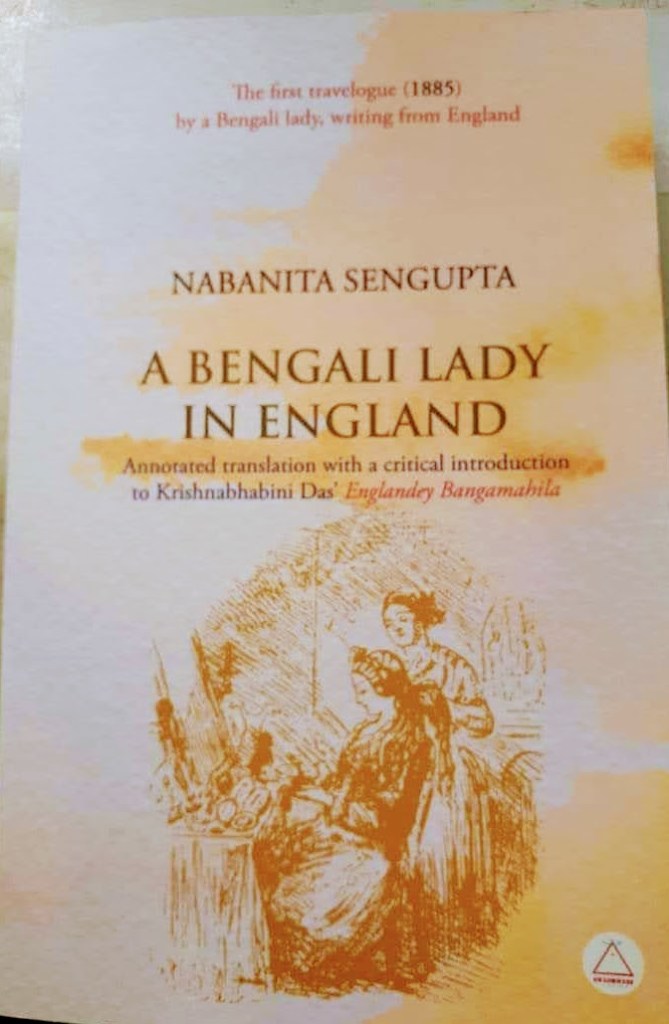
Excerpted from A Bengali Lady in England: Annotated Translation with Critical Introduction to Krishnabhabini Das’ Englandey Bangamahila. Translated by Nabanita Sengupta: Published by Shambhabi, 2020.

From the Introduction

Englandey Bangamahila is an important text that highlights the socio-cultural history of that period and conforms to the dominant ideologies of the nineteenth century. But beyond all these, there is a distinctive woman’s voice, sympathetic to her fellow sufferers. In fact, her concern about other Bengali women, trapped in the traditional Bengali society is the driving force behind this text. Krishnabhabini Das’ overwhelming concern about the fate of the Bengali women visible in the issues she chose to represent in her text makes her narrative one about the subjugated women of Bengal. The persona of Krishnabhabini is built up through the way she perceives the existence of her fellow sisters as opposed to the relatively free women of England. The author becomes inseparable from other women of India who faced the doubly bonded life at every moment of their existence. It reminds us of Rowbotham’s concept of ‘collective consciousness’ that goes into the making of a woman’s self, as discussed in Susan Friedman’s essay, “Women’s autobiographical selves: Theory and Practice”. It is this collective consciousness which constitutes Krishnabhabini’s psyche and identity.

In Friedman’s words it is actually a “sense of shared identity with other women, an aspect of identity that exists in tension with a sense of [her] own uniqueness” (44). It is this tension between the individual identity and the shared identity which adds to the complexities of women’s life writings. The individual identity of Krishnabhabini as a woman enjoying relatively greater freedom compared to her fellow sisters contradicts the identity that she gains in solidarity with them. These issues together make Krishnabhabini’s work more complex than a mere travelogue.

Nationalism and travel writing being two important concerns of the nineteenth century Englandey Bangamahila has often been examined under these lenses. As pointed out by Simonti Sen, “Krishnabhabini clearly resided with her co-travellers in the space constitutive of the nation. Her travel account is cast in the usual frame that separates the ‘backward East from the ‘progressive West’ and engages with all the stock-in-trade nationalist questions” (Travels to Europe 23). But what has been ignored under the impact of these more dominant concerns is the effort that underlies the making of this travel narrative. It is more than evident that for a lady with her background and situation it was not possible to have access to all the places and details she describes in the text. She must have had recourse to other texts on England. The question is how did she use them? Does her use of such text add a special dimension to her narrative?

British Woman

Among the affluent there are many women who are completely given to luxury. They leave their home and children to their servants’ care and spend their time indulging in music, fashion or reading novels. But how can I blame them for this? In almost every country it is seen that the rich women are lazy. Everywhere, surfeit of wealth is the root cause of a luxurious living. Women build the foundation of a family. So if the women in general had been lazy here, then the British household could not have run efficiently and England too would not have developed so much. I feel that they are the true counterparts of their men. The way these women help their men and at times even do men’s work are things that we almost never see in our country. Apart from their own work, these women can also execute men’s jobs efficiently. They often run shops, work as clerks, teachers, write books and contribute in newspapers, arrange meetings and accomplish much more. Women constitute half of a country’s population: their aversion to work and inclination towards laziness harm the whole nation. British women have not restricted themselves to just household chores. They cooperate with men in many other works; great tasks are being accomplished here and there is so much of progress.

British women who live in India are extremely lazy because everything they need, including servants, come quite cheap in this country. Also, they do not care much about money as their husbands earn a high salary. Food, fashion, gossiping, music and strolling in the open air are their chief preoccupations. Taking these women as models, the Indians consider all British women to be babu[i]. There was a time when I too believed that all British women were lazy, but after seeing everything here, that impression has changed. I have been greatly surprised to see them capable of as much hard work, tolerance and diligence as men. Instead of just aping the manners of these women if we can imbibe their virtues, then perhaps we shall be truly benefitted.

England provides a lot of opportunity for women’s education. There is no dearth of good schools or colleges for girls in cities here. In almost every neighbourhood in London there are two to three girls’ schools. Nowadays in the universities of London, Oxford and Cambridge, women can get the same education as men. In the University of London[ii], women receive education together with men, attending the same classes and under the same professors. They pass the same examinations and receive the same degrees. Though the examinations here are tougher than the B.A and M.A examinations of our country, many women competing with men pass these and often score much higher marks. In London, there is no dearth of women who hold university degrees like men.  One can often hear names such as Miss Smith, B.A, Misses Jones, M.A, etc. Now women do not hesitate to participate even in those tough examinations which few men take up. This proves that women are not inferior to men in terms of intelligence; the fact that they have achieved as much as men in spite of all the hurdles they face actually prove their superiority. I have heard that in North America, women can attain the high posts of judge, barrister etc, and preside over legal cases as men do. All the upper-class women are quite well-educated! The British women yet do not take part in professions that might require higher degrees of efficiency than teaching or practicing medicine. But here too, there is such a progress in the field of education that it seems quite soon the British women will surpass the American ones in this regard.

I cannot express the extent of happiness that I feel when I see girls and young women going to schools and colleges in groups like the boys and young men. Here the girls too go to school from the age of six or seven till they are twenty to twenty-five. Many women are not satisfied even with this. Like the educated British men, they continue their pursuit of education till the end of their life. Here there are many women who are authors, scholars and scientists. In certain aspects the women dominate men.  Best of the novels of recent times have come from women authors[iii].

In the provinces girls not only study but also learn stitching, knitting, music, physical exercises and at times even cooking. British parents take good care so that their daughters can learn all these skills. They take equal care to impart education to both their sons and daughters. There is no lack of female teachers here and that is why while appointing teachers for their sons they do the same for their daughters as well, spending almost an equal amount of money for both. Not just in the rich households, but even the daughters of middle class houses pursue education and learn music and other necessary art forms till they are eighteen or nineteen. Parents spend liberally till their daughters become skilled enough in all these subjects. They feel happy to have done their duties towards their daughters. Compared to India, here the girls belonging to lower classes are much better educated and more intelligent than their counterparts in India. In this country, barring the lowest strata of society, almost everybody’s daughters and wives can read, write and play on the piano. Almost everyone is skilled in household chores and dress making etc.

Along with their intellect, British women take adequate care of their health. In almost every girl’s school there are facilities for physical exercises and games. In many cases, women are as expert as men in games like gymnastics which require physical stamina. They are also at par with men in walking, horse riding, running, and lawn tennis.  I have often seen many such women who are stronger than many Bengali men in terms of both physical and mental strength. I doubt whether an Indian man would be able to walk as much as an upper class British woman does. Also, the women here are stronger and more industrious than the women of other European races. It is said that an Italian lady does not walk as much in a year as a British lady walks in a day. So it is not surprising that such strong and industrious mothers will bear healthy and strong children who, will later grow up to be brave, spirited and hard-working British men.


[i] The word babu discussed earlier, refers to those nineteenth century men who spent their time and money in luxury and foppery. But  interestingly, though it is used for men in Bengali society, Krishnabhabini confers this on the rich and idle English women given to laziness.

[ii] Though the author presents an almost utopian view of women’s education, it was not until 1878 that the University of London opened its doors to women. According to the brief history of the institution provided in their official website “in 1880, four women passed the BA examination and in 1881 two women obtained a BSc.”

[iii] Victorian novels were dominated by women authors, many of whom have obliviated from public memory in the later years. Nineteenth century saw prolific novelists like Mary Elizabeth Braddon (1835-1915), also known as the “queen of circulating libraries” who authored about eighty books; George Eliot (1819-1880), one of the most learned and scholarly writers of her times, whose chief concern was the contemporary society and women; Elizabeth Gaskell (1810-1865), immensely popular in her times though not remembered much by posterity, her most popular work was Mary Barton, her contribution to the ‘condition of England’ novels along with Dickens, Disraeli and others. There were many more women novelists in this period, the Bronte sisters, Jane Austen, Mary Shelley, Fanny Burney to name a few.

About the Book

Englandey Bangamahila is the first travel writing by a Bengali woman in England, published in 1885. This book is a documentation of the 19th century England—its strength and prejudices, as seen through the eyes of a twenty-year-old woman, Krishnabhabini Das, a housewife belonging to an orthodox Hindu family. Krishnabhabini did not believe in social taboos and went against quite a number of them like travelling abroad, educating herself, not adhering to the 19th century views of motherhood. Her book too was iconoclastic in a number of ways, including its bold criticism of British imperialism and other aspects of British culture. Written from the perspective of a doubly marginalised individual, this book is a rich study of ethnography, culture studies, postcolonial studies, 19th century nationalism and gender studies.

Author’s Bio:

Born in 1864, Krishnabhabini Das was an iconoclast woman who, in spite of being married into an orthodox Hindu family, worked for the development of women throughout her life. She travelled to England in the 1880s with her husband, leaving behind her nine-year-old daughter. Though the trip enriched her in various ways, it also led to a long separation from her daughter who was married off at a very early age. She, being far away in another country, could not stop her child’s marriage. Krishnabhabini wrote a detailed account of the British lifestyle during her stay in England in her book Englandey Bangamahila and after returning to India continued with her social work and writings in the leading periodicals of her times. She died in 1919 leaving behind a lifetime of work regarding upliftment of women.

Translator’s Bio:

A translator and creative writer by choice and teacher by profession, Dr. Nabanita Sengupta is presently employed as assistant professor in English at Sarsuna College, affiliated to the University of Calcutta. She is also associated with two literary societies – Intercultural Poetry and Performance Library and Kolkata Translators’ Forum. Her poetry, fiction and non-fiction have been variously published at places like SETU, Borderless Journal, Muse India, Coldnoon, Café Dissensus, NewsMinute.in, News18.com, Kitaab.org and Different Truths. She also has a number of critical writings to her name and has presented papers at various national and international seminars and webinars. Her latest publication is A Bengali Lady in England: Annotated Translation with a critical Introduction to Krishnabhabini Das’ Englandey Bangamahila.