Sanjay Kumar gives us a glimpse of how theatre has been used to transcend trauma and create bridges

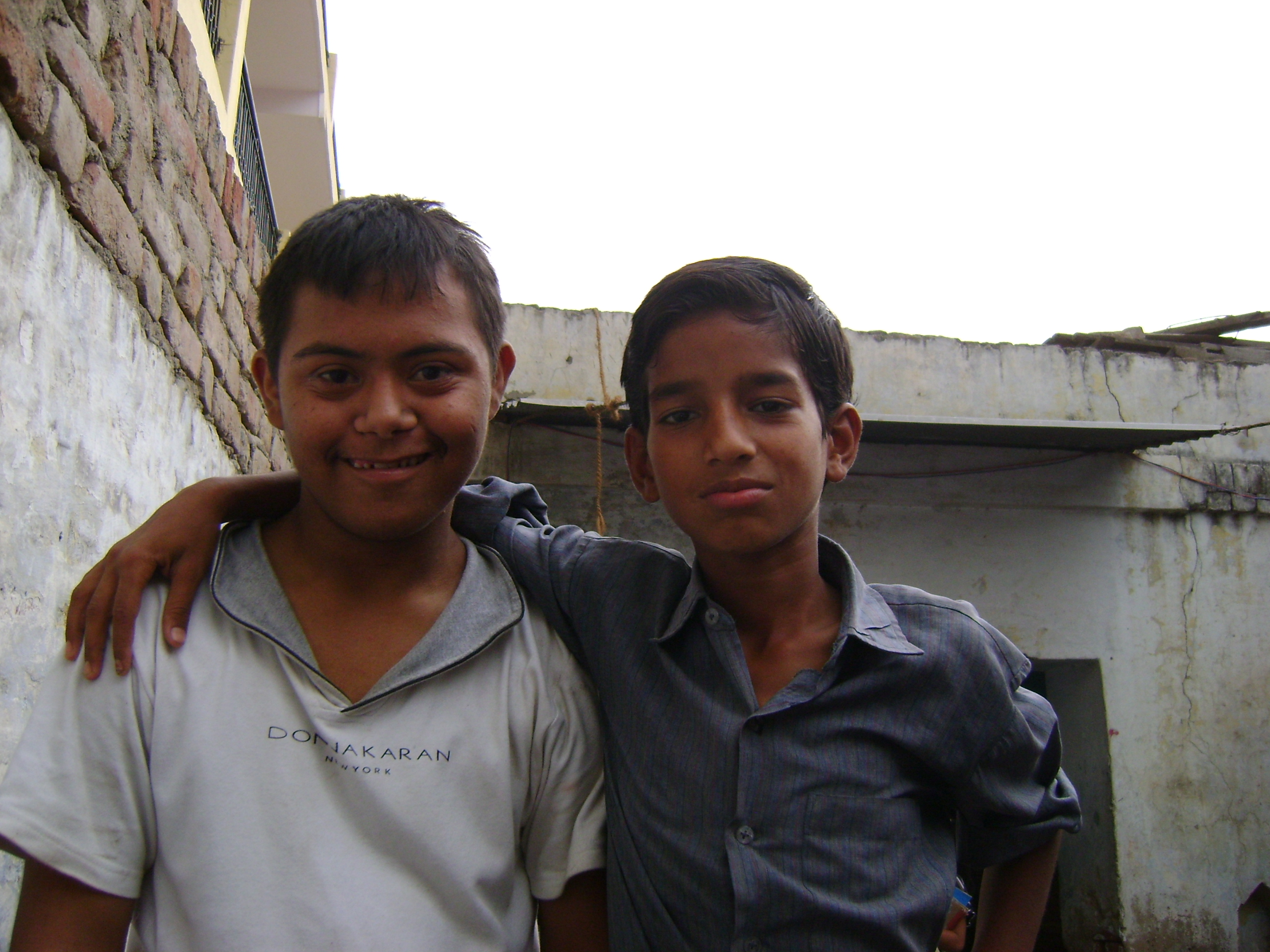
This essay uses the material of five years of continual theatre workshops conducted from mid 2006 to the present day with young adolescent children, siblings and neighbours of victims of sexual abuse and cannibalism in Nithari, India. My point of entry is that of a practitioner of workshop-based theatre with the activist theatre group, pandies’ theatre (Delhi).
pandies’ theatre, though registered formally in 1993, traces its origins to 1987 when some students and teachers of an undergraduate college in Delhi University decided to move away from the flippant, meaningless plays put up in the name of competitions and festivals by theatre societies of various colleges and take up more meaningful full length plays staged at the commercial auditoriums in more or less half commercial manner. The society performed Lorca, Ngugi, Strindberg, Vicente Lenero, Genet and Brecht in that order. Surviving under the rubric of a college was becoming difficult. Students who had completed their studies wanted to be with us, students from other colleges wanted to join and there was consistent opposition from college authorities regarding the wasted time of the students and the unconventional themes of the performances. pandies’ theatre was born in 1993.
Moving away from a college and a university, with four teachers including the author as the office bearers and an executive committee consisting of ex-students. The initial strength of the group was around thirty members and the active component continues to be so though the total number has grown larger. Begun with a simple agenda of staging plays relevant to our ethos and time, it has evolved as an activist group – left, feminist and atheistic. It started as a proscenium oriented English theatre group but from 1996 turned increasingly activist taking on projects rather than plays. The dominant number of women among the younger members assured a feminist beginning for the group.
As the decade moved and majoritarian communal hatred flourished, pandies moved away from a simple secular outlook to a more definitive atheistic position. Post 2002, following the heart-breaking Gujarat pogrom, the group took a conscious decision to target anti-communal forces and work intensively with young people and these have been the high points of recent years. The group has penetrated more and more into the margins, working specially with under-privileged children from diverse area. Our work, which is now almost totally activist, can be put under three divisions: first, scripting and directing performances (largely adaptations and original scripts) for the proscenium, first staged in a commercial theatre and then used also for Awareness programmes; second, using theatre as a means of generating awareness on diverse issues ranging from feminist theatre to gay rights to child rights and rights of religious minorities and this attempt includes legal and legislative intervention. And the third and at the moment the most focussed area lies in creating theatre with young people with a view to articulating trauma, containing conflict and getting space for marginalised voices in policy formulation.1
For resources the group often looks within. At times the projects are funded, like when the politics of the funding agency agrees with that of pandies’. For instance, the group has worked with the government in the late 90s on HIV awareness and reform in laws against rape and at various times with like-minded NGOs (Non-Government Organisations) on issues of child rights and gender. However, especially in its more radical projects (including the one discussed here), the group is often forced to turn to its own resources, which means money from friends and from the members of the group, including those who are working in the project itself. pandies’ has increasingly felt that whereas funding is required for large-scale work and to bring about social and legal change, incisive shorter projects, that do not derive funding from outside bring an uncompromising radical sharpness to the work and need to feed into agendas of reform and contribute towards policy-making. For its performance-based awareness campaigns and specially its theatre teaching workshops with young people the group prefers to move in where there is some pre-existing infrastructure (as the school Saksham in the example here, or an NGO run camp for displaced children or a state-run reformatory) but is not averse to move in directly where its members perceive a dire need.
Workshop based theatre at Nithari, the focal point of this paper, assumes extreme importance for me and my colleagues at pandies’ as it provides a uniquely sustained and sustainable foray into assessing the viability of performance as a process of social amelioration, even if it is of one kind of workshop based activist performance in one area. As the Chief Facilitator I attempt to graph changes that theatre workshops and performance bring in the consciousness of the participants and facilitators as young, trained facilitators (some in their late teens and most in their twenties) work with the survivors of a traumatic carnage. I proceed further to try and examine wider implications of these changes.
The Carnage and its Context
Nithari was placed on the national centre-stage in December 2006 – January 2007 as, after two years of unceasing complaints from its impoverished residents, the police finally moved in to discover carcasses of fifty-three children from the drains of the posh houses bordering the village. That story of severed limbs and rotting body parts forms one of the most enduring narratives in the written and electronic media in the country.
The carnage is intimately linked with the complex multi- layerity of life in a city like Delhi, the capital of India. The rampant growth of Delhi has forced the national government to extend the city beyond the parameters of Delhi’s administration and create a National Capital Region to divert this growth. At the moment the pan-construct (NCR) includes areas of three states, Haryana, Uttar Pradesh and Rajasthan, besides Delhi and New Delhi. Coerced proximal living of different classes creates many problems in Delhi itself and these get compounded as one moves to the NCR. Chunks of rural land have been taken over by the state governments for urbanisation – building roads and industries, malls and multiplexes. Pockets of small, old “villages” exist juxtaposed with posh multi-storeyed residential apartments and offices that rank among the most expensive in the country. These old rural spaces survive as the source of menial help – maids, servants, gardeners and fruit and vegetable sellers – for the rich residents around. Many old villages have become slums, the abode of migrant labour that comes here from all parts of the country to improve its lot. The disparity creates palpable tensions. The residents of these poor pockets, specially their children, some of whom have been born here and many have spent most of their lives here, are sensitive to the blatant display of wealth by the rich residents and especially, their children. They are also resentful of the looking up the barrel that this mode of living inevitably entails.
The rich middle class claims its tale of woes. Its voices are hegemonic and define what is the norm and what constitutes aberration:
“Crime is a big issue, thefts, robberies and murders abound,” they tell us, “These poor children, children of the poor do drugs, they steal and one has to be careful even of one’s cell phone on traffic lights.”
Such narratives seek to obfuscate the many crimes of exploitation and neglect of the poor.
Nithari is a paradigmatic illustration of the anomalies above. An erstwhile village, present slum, in Uttar Pradesh, Nithari, is situated just on the outskirts of Delhi, in the National Capital Region. Its residents are mainly migrant labourers and vendors and it lies in the extremely upmarket township of Noida. The carnage at Nithari, also provides an adequate rupturing of the hegemonic narrative of the middle class; the crime is hideous and inflicted on the poor children by its rich residents.
Mediatisation
Headlines (electronic and written) pursued the discovery of the bodies and all processes that followed (including ours) have had to negotiate with the effects of this mediatisation. The stories of the media followed a perceivable pattern from investigative journalism to sensationalism. The “reporting” started with a fragmented list of possibilities: organ trade, extraction and sale of blood, involvement of a medical syndicate, apathy/ collusion of the police and the administration, trafficking gone awry, perversion and sexual abuse of young boys and girls at the hands of rich, adult exploiters and of course, cannibalism. The place became a focal point and soon media stories highlighted certain causes with the erasure of others. The violence inherent in such hostile class juxtapositions was quickly sidelined, the criminal neglect of the area and its inhabitants including issues of sanitation, health and education totally pushed under the carpet and the apathy of the police and the administration was put on the back burner. The residents of the area; the families and friends of the children who died still yearn for those investigative threads to be pursued. Media stories narrowed and rested on a sensational perversion as a rich man and his servant were netted by the police under the charge of kidnapping, sexually abusing and killing the children. This became real material for headlines. The servant would entice the young with goodies: chow mein and chocolates, the older rich master, a pervert used to rape and sodomize the children and the servant, the real maniac, would chop them and eat them later. The media explored different psychological angles and nightmarish stories of the servant’s confessions – like his preference for the raw livers of children – still appear.2
Moving away from these narratives I will try and re-create the story of survivors; a study of the consciousness of young children aged 7 to 15 at that time, who lost their siblings and friends in the incident and have tried to make sense of their lives. Can these fragmented stories of forced sexualisation, of lost childhood, of questioning the sanctity of the institution of family and of the distrust of protectors constitute an evolving collective consciousness?
Interaction with the Facilitators
A further point of interest for me, Nithari, or rather the charity school Saksham3 there, is also the site of interaction between young trained activists – facilitators of Delhi’s pandies’ theatre and the child-survivors of the place. A core group of about 12 facilitators have been working with about 250 children at Nithari. These are young men and women in their late teens and early twenties, middle class and with some training of conducting theatre workshops and lots of enthusiasm. They too are all invariably in a subversive relationship with the grown-up, norm-defining voices of their class. Many certitudes of middle class existence are being challenged here: the valorisation of family, the sanctity of marriage, the hegemony of adult voices, the efficacy of the education system, middle class notions of success and right wing decadence – the hold of religion and morality on our conduct and behaviour. In tune with the young at Nithari, the facilitators have helped create performances that in their rebelliousness give a lie to much that is valued and valorised in our structures.
This mutual process of learning and teaching spanning five years has used many dimensions of the workshop mode to explore the nuanced connections between performance and affirmative action, ferreting on the way the insidious link between mainstreaming attempts and developmental policies, identifying often the source of victimisation in the hegemonic voices of the mainstream and locating equally often the core of misery in the very space that ostensibly provides relief. This process raises questions: Is performance Cathartic? Does it provide trauma therapy? Or does it look beyond to envision a better future for all? Does it fire radicalism? Or does it mainstream radical thought? Is it a tool to critique policy, especially developmental policy from the marginal perspective? Does it bring in marginalised, radical voices to alter the course of development? Is the workshop-based mode of theatre an articulation of subversive, disagreeing voices? And can it avoid the snares of co-option into the status quo? The questions abound.
Moving on from the first public performance in April 2007 through seven performances till April 2010, I will structure my study on a close study of three performances.
India Habitat Centre – April 2007
Constitution Club (Haq) – January 2009
American Centre – July 2010
Workshop Methodology
In its workshop mode, pandies’ uses two methods, differing primarily on the amount of time spent to cover the various stages. Where there is a time constraint, or where the group works in conflict zones4 or with incarcerated children in reformatories or in NGO run camps, the preference is for intensive five to six day workshops with the volunteers often living on the site and working on a 24 hour format. The various stages of the method given below are covered fast and a performance is created. Working with young people in a marginalized community, on the other hand as in Nithari, the group often slows down the process keeping its visits limited to a couple of times in a month. The stages of the workshop are covered once and a climax is created in terms of a performance when either an occasion exists or an occasion is created. After the first performance, the method becomes more and more centred on self-expression and creation as pandies withdraws and the young work more among themselves analysing and critiquing the processes around them. The more experienced among them assume the role of facilitators for the uninitiated. pandies intervenes intermittently to create and cater for an occasion with a performance. The Nithari story, punctuated with workshops and performances provides a rare enabling narrative highlighting not only the efficacy of theatre to change the world but also exploring which side of the class spectrum needs that change.

The Play-workshop consists of an adaptable, flexible methodology. The broad aim consists of putting the sufferers through a process of going inside themselves and creating performances based on their collective experience. The facilitators, after initiating the process recede into an a la carte mode, available on demand.
We begin with exercises – physical and theatrical. These exercises are a part of the repertoire of all theatre groups (narrativising truths and lies, completing broken images, forming images and “machines” – adapted from Augusto Boal, Brecht, Dario Fo and also culled from indigenous Indian traditions5). Physical exercises that make the children focus and help remove preconceived peer formations give way to theatre exercises. Image making provides a good transition. We give the children a word and in ten seconds, using their face and bodies each child has to individually create an image that according to her/him reflects the word. Words are weighted, often in pairs or multiples (father-mother, local politician – bureaucrat, policeman – activist) and the process of introspection has begun. Each child is looking within her/himself interpreting to cull images that correspond to his notion of the word.
Collective image making follows individual exercises. At this point the group is divided into smaller groups. Each group is now given a word/concept more complex than earlier (family, life in Nithari vs. life in Noida, scene in a Noida mall, children of the rich, my village-slum/ how I would like it to be, my society/how I would like it to be, grown-ups, etc.). Each group collectively creates an image/picture corresponding to the concept given. In the image, each child must represent something and the total picture convey the group’s collective view of the concept. The challenge is that everybody watching should be able to guess the word/ concept from the image. The process of collective introspection, of looking into each other’s experience and creating a collective picture has taken place. Image making leads to “machines” – repetitive representations of collective images where sounds and movement are incorporated and communication taken a step higher, however, language is not used as the mode of communication.
Collective introspection is taken a stage further by narrativising. As they get more relaxed, they relate stories from their lives. In workshops that are event/ trauma centred, the participants are encouraged to talk about their experience of that event, otherwise, foregrounding concerns on issues of class exploitation, gender disparity, communalism and casteism, the facilitators give them “topics” to tell narratives from their extended experience. They are playing and at the same time it is real. It is a re-creation, done before a specific audience consisting of the facilitating group, the caregivers (in this case teachers of Saksham) and the rest of the children in the workshop. Each group then proceeds, with the help of one facilitator, to create a narrative that tries to incorporate the experiences of all the members of the group with the proviso that the narrative as a whole should make sense as a story. Each group chooses its leader, writer/ collator and presenter. This narrative, often very sketchy and containing bits of everybody’s story and at the same time not being really anybody’s story, is then played into a theatrical performance.
pandies’ usually prepares small theatrical pieces for each set of workshops. These piece(s) are generally presented after the narrativising session to elicit further discussion and throw theatre ideas at the participants before they prepare their own skits.6 Each group, then, first makes a small skit around the short story they had created earlier. The instructor’s intervention is strictly on demand and the participants work largely by themselves. Using more ideas from the workshop, these plays are built into performances of about twenty to thirty minutes each. Often, specially if the target is a public performance, these performances are tied together for a longer episodic production. But where there is homogeneity of themes, the more challenging mode is to try and create one sequential script combining experiences from all the narratives. The performances are geared to what the children want to tell us. At times they stress messages that they feel we want to hear but oftener they do get charged up and highlight events that have disturbed them and they want us to know.
The Beginnings
After Gujarat pogrom 20027, pandies’ had taken a decision to use the workshop mode of theatre with children of varying regions, classes and religions to mitigate religious bigotry. A special focus was on marginalised children of slums or bastis who are targets of such bigotry. Volunteers of the group reached Saksham, Nithari through a mutual contact in May 2006 the place that continues to be the site of our intervention. Using secular ideals (religion and caste) as the backdrop we started working with the children on different issues.
Using our tried methodology we started with three or four visits a month usually on every Saturday. In keeping with standard practice with the sub-groups, stories were evolving around trafficking of children, problems in education of the girl child, masculine bias in stories of romance and impact of communal riots on children living in urban slums. In the early months it became apparent that children, a handful who had been coming to the school and many more, including the participants’ siblings and friends, had been disappearing for over two years. Reports were being lodged at the police station but the police personnel were dismissive and nobody had imagined the extent of the carnage.
The interaction between the facilitators and the participants was proceeding fine. A bit overawed by these middle class somewhat older youth, the participants were also hugely attracted towards them. And they often used mimicry, humour and undercutting as a way of asserting their equality.
The workshops too were showing more than satisfactory progress. In six months we had completed the process of group making, gone through the crucial stages of making collective images and machines and reached the point where the four created groups were devising their short stories. The four groups working along with their facilitators were moving in different directions. The first group was working out a love story and seeking to make a gender statement through it. The second was focussing on the necessity of educating girls. The third centred on trafficking and sensitive issue of the sale of children of their class. And the fourth taking the issue of Hindus and Muslims living together focussed on existing communal discord and the need for harmony.
The Carnage and Trauma Workshops
Six months down the process and Nithari suddenly became the most often used word in the vocabulary of the NCR. For five weeks after the discovery of the carcasses, the police cordoned off the entire area and nobody was allowed to go there except residents. There was the fact of the carnage and the devastating stories of the media some of whom held the greed and the criminality of the residents as the real reasons of the carnage. The toll on the participants was apparent. When we went to meet them we were met with the most unusual silence. These were extremely expressive children, hard to suppress. They had been struck dumb by the horrible findings and the media stories that followed the revelation of the carnage.
As facilitators we had to get proactive and we started daily workshops dealing with trauma. In these trauma workshops we cajoled them into expressing their hurt, their anger, their opinions – in anecdotes, in fictionalised stories or in silences. Expressing without words worked and they reverted to silent machines, to recapitulate and express what they felt about the carnage and its media reports. As a collective their consciousness reflected confusion and hurt; unable to comprehend what happened they were combating with why it had happened. Borrowing from the rhetoric of those around including their parents, schoolteachers and the many TV channels many took recourse in self-blame as their first vocal expressions:
“The children who died went for chow mein, for sweets and chocolates,” they said, “They were greedy and paid the price for it.”
Clichés like “if one is not greedy then one survives” followed. The repercussions could be felt in many ways. Their parents were locking them in their houses while going out seeing it as the only means of ensuring their safety. Something vital had been lost. The innocent dignity that often characterises children of this class was gone. The event had sexualised them in the ugly forms of child rape, coerced sodomy and cannibalism.
In the trauma workshops, through silent machines, the groups re-enacted what they thought had happened in the house where the children, their siblings and neighbours, were killed. Soon we were also getting oral narratives of children who had escaped abduction and little later, full skits of their perception of the event and its causes. Indifferent exploitation by the rich, hostility of the police and the state administration and insensitivity of the media emerged as the dominant themes.
Is trauma cured, or at least lessened by such a cathartic release? By going back to it and seeing it without the initial fear and shock? In this case, the answer could only be a partial affirmation. Emerging out of a stunned silence was only the beginning of facing trauma. The participants and the facilitators, together with the teachers and parents decided that a public performance was essential. It would restore confidence and self-worth that had been lost in this episode. A performance before the oppressive rich was required, required to present their point of view from the margins before the class responsible in the larger sense for the trauma. Further many harsh things were being “reported” about them, their parents and their dead friends that had to be corrected. There was a fear; the fear of sensationalism – after all they would be seen as Nithari’s children – exotic animals who had the spotlight. But that fear had to be suppressed before larger gain. We all also felt that the sense of guilt had to be eliminated and a collective future envisioned to “moving on” from here.
The facilitators too had to deal with trauma. For people working with them nothing can be more devastating than confusion and hurt on the faces of loving, aspiring children. The facilitators responded to the theatre of the grotesque by passionately furthering the process of performance creation by the participants and by preparing small skits of their own to assert their position and articulate what they had learnt at the workshop.
The First Performance
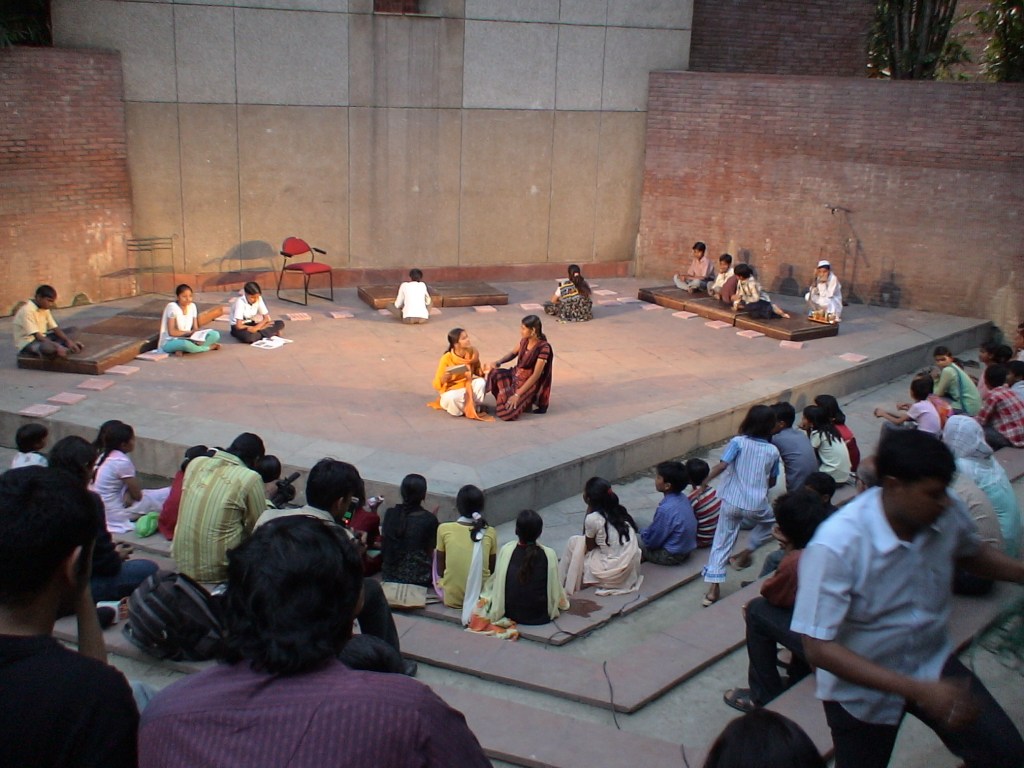
The first event was at the India Habitat Centre(IHC),8 Delhi in the open amphitheatre on the 9th and 10th of April 2007. The two-hour performance contained samples from the trauma workshops, supportive skits from the facilitators and above all, four episodes from the holistic workshop started earlier, six months before the discovery of the carnage.
Four pieces were from the trauma workshops: An oral narrative by a girl who had escaped abduction, one machine and two skits re-performing the event itself. This section was an illustration of both the Cathartic process and its limitations.
Biases and stereotyping, based on belittling class-based prejudices were repeatedly stressed. For instance, the girl’s narrative besides being a tale of fear and heroism detailing how she had escaped and rescued her younger brother from the men who had tried to kidnap her in a van (one according to her was the servant shown on TV) also recounted that she had been thrown away because she was ugly and a polio victim and the men laughed while throwing her out stating she wasn’t good enough for rape. Further, she had fought for and rescued her brother not only as he was her sibling but also because she felt that her family would have punished her had the boy been lost, after all he was a boy and normal, so more precious than her.
The machine and two skits were re-creations; recapitulated and rehearsed. While re-creating, they were also putting the trauma behind. They covered a gamut of perspectives – official narratives (both police and administration), media stories and the views of grownups in their neighbourhood including their parents. All three had the master and his servant at the centre of the event. The machine focussed on organ trade. The children are killed and cut up by a doctor/ surgeon and kept preserved in the freezer, the police drink with the master. A maid discovers the act, she too is killed, the police are again bribed and they sit as before drinking with the master.
The first skit brought in the involvement of the community in the process of bringing the events to light. Creative with stagecraft, they divided the stage into two parts – one representing the inside of the house and the other the village and everything outside. Inside, the story was again of children being cut for organ trade and outside, the inhabitants are getting upset over the disappearance of the children. They report to the police who are apathetic though not complicit.
The stage division erased, the residents break into the house to discover the cut up bodies. They summon the police with this evidence. And the police move in to arrest the two. The third focussed on sexuality and perversion. The master tells his servant to procure sex workers highlighting his preference for young dark women. The servant finding the task increasingly difficult kidnaps a young girl from the neighbourhood after calling her in to clean the place. The drunken master rapes her, scared of consequences, they together kill her and then cut her up to dispose the body. This becomes a usual process and after cutting the body, the two sit and eat its parts. Anxious residents call in the police but the master bribes them away. Going beyond Catharsis, the participants were providing their position on the rich and powerful. The plays did not make a class difference between the servant and the master, they were both part of the rich reality that both metaphorically and in this case literally, feeds on the children of the poor. The indictment was complete. The Police personnel came across as corrupt, drunkards who thrive off the crimes committed on the poor, one skit did show some hope from them, as they move in to act though it is after the residents’ initiative.
Four plays emerged from the workshops started six months before the discovery of the carnage.
The episode on love and romance was liberally peppered with Bollywood9 songs. It took up the issue of premarital sex and its implications for the boy and the girl. The boy aggressively pursues the girl. They go for a walk in the night, it gets too late and consequently, they spend the night at the house of one of his friends. Delicate in its treatment, the episode did not directly talk of sex but rather of the morning after. On return the girl’s family feels pressured to ask the boy to marry their girl but the boy resolutely refuses. The girl wants to move on but becomes the target of scandals and lewd remarks by lumpens (again Bollywood songs). The girl’s friend asks three important questions: Was there anything wrong in what they did? And if there was something wrong then were they both not equally responsible? Why does society punish the girl alone?
The play about the education of the girl child looked at the whole gamut of problems that make it difficult, despite state policy, to provide free education to girls of working class parents. It was set around a girl child of migrant parents who work from early morning and expect the girl to do the morning household chores. The teachers, though they feel the importance of educating girls, are insensitive. And the Principal chides the parents of the girl, who is not doing well because she reaches school after household work and when three classes are over, to welcome the chance provided by the government and ensure that their daughter avails of it. The insulted parents stop the girl’s going to school. As they get ready to marry her (despite her being under-age) the younger brother stands up for her and tells his parents that he will earn money to educate his sister. He exhorts other brothers to do the same and asserts that till male siblings stand up against it, the practice of gender-discrimination within the family will continue unabated.
The third play had begun as a narrative critiquing trafficking. The facilitators, fed on stories of sex work, trafficking and begging, thought that the children would naturally condemn such an exercise. Even earlier they were shocked that a few children had actually tried to defend the buyer of children. In the workshops following the discovery of the carnage, this feeling became the dominant feeling. Perhaps the participants were expressing their total loss of faith (tenuous that faith is even in other times) in the institution of family and possibly their unfathomable anger against the “protectors” in the family. The facilitator, as is the practice in such cases, allowed the children pursue their own thought. The alcoholic father first pulls the boy out of school and puts him to work but when that does not work he takes him to a nearby town and sells him to two businessmen. The men are actually good for the boy. They make him work in their shop but allow him to study in the evening and at night. Desire took over the plot. The boy goes on to become a doctor and returns to his village. The father, very ill because of his alcoholism, repents his deeds. The boy looks after him, starts a hospital in the village and works there.
The fourth play was a lesson in communal harmony. Good neighbours, a Hindu family and a Muslim family turn foes as the area comes in the throes of communal hatred. The children bring them together again as the Muslim child saves the life of his Hindu friend.
If we proceed to draw some tenuous conclusions from these plays without, to begin with, bringing the facilitators into play, we see that in these months, between January and April, the children had got beyond the need for immediate trauma therapy. The longer skits showed the limitations of the Cathartic process and evidenced their desire to engage with themes that the middle class thinks as its sole preserve: the romance story took the theme of premarital sex, apart from saying that society uses a different gaze while looking at the boy and the girl, the episode showed that the children were equipped to talk about an area usually regarded as beyond them in terms of class and age. They also ridiculed notions of romance of rich kids of their age for basing their fantasies on Bollywood recipes, false in any case and certainly ridiculous for them in their poverty.
The second play having possibly the most clichéd theme was the most radical in its treatment. It showed the limitations of affirmative action when such action is imposed from above and without taking cognisance of the opinions of those for whom it is intended. The state provides free education but what is the state of this free education (the children at this charity school evidence that practically no classes were held in the administration school that lies in their area, classes started after the community, showing awareness of their rights, approached the local authorities and forced them) and the reasons for not sending girls to school are many: family “honour,” girl’s “purity,” somebody else’s property, reluctance to spend on auxiliaries like transport and stationery even when the education is free and above all, the necessity for girls to do household work in the morning before they can be expected to do anything else. No process of education can proceed without negotiating the above and as the play went on to show, when principals and teachers of administration schools chastise or take a condescending attitude towards the parents the end of the process has already taken place.
The plot of the third was the most unsettling as it took on the holy cow of social structures – the family. The anger against parents (often identified not as “my parents” but simply as the institution called “parents”) continues to be phenomenal and is second only to the hatred against the state machinery and the middle class (often seen as a continuum by the children). If parents cannot protect their children do they have the right to have any? And is it not more fortunate to be a slave in a rich household than a legitimate child in an impoverished home? Does not the first give more space and chances of success? And the one on religious harmony assumed special significance because slums are inhabited by people of all religions. In pandies’ experience, all slums in and around Delhi have at least twenty five percent Muslims. The play showed how slum dwellers live in harmony despite religious and caste differences, they are propelled into killing the rich of the other community by the rich of their own community at the outbreak of religious riots. Further, it fore-grounded the child as the point of reconciliation. Children are usually deemed too small for this loot and kill agenda. The bonds between them are far more difficult to break and can constitute the core of ameliorative process.
The workshops had keenly sensitised the facilitators and brought out their insecurities and traumas and their conflicts with the adult world. The skits enacted by them furthered the confrontation aspect of the performance as a whole. On the first day the four young members of the group, still in late teens, projected their own understanding of child rights and its violation by adults. The plot revolved around two single-parent families, one rich and one poor. The two were connected by the minor boy from the poor family who works in the household of the rich. His father, an alcoholic, subjects him to periodic violence and takes his money to buy alcohol. The rich boy, who is older though still in school, has his own travails under his high achiever mother. The two boys strike a friendship, the older boy introduces the young poor to drugs and the two do them together. They are caught by their respective parents with drugs on their person. The play placed the two families on the two sides of the stage. The mother scolds the son berating him for having failed her. He hits back accusing her of having no time for him between her lover and her career. In an evocative speech he asserts that her relevance in his life is that of an ATM card. On the other side of the stage and the class spectrum, the poor boy accuses the father of the same and also of defining the paradigm of drug abuse in the family asserting that his alcoholism is responsible for the ruin of the family and also the death of his mother. The play ended with visuals of confused parents.
No apology for drug abuse and no valorisation of the single mother who would have been a progressive woman in a usual pandies’ play, there was only an uncompromising critique of the institution of the family.
Had the Nithari experience equipped them to question this institution? On the second day, 8 facilitators all in their early twenties performed their skit. The ludic provided the explorative as the facilitators “played” children of Nithari and took up the drama from the bursting of the news of corpses. The Nithari children are playing, what would “play” constitute in the circumstances? They play various aspects of their lives. They play family but there is no protection for the children, only abuse, violence and exploitation, they play relationships but that’s about sexual perversions, they play police but its about bribery and beating the poor, they play media but its about sensations and career-making and they play the rich but it is about raping and eating the poor young. Emotionally arousing, the skit showed poor childhoods lost at the hands of the uncaring adults. Continuing in unabated waves and actually tying the play together was the recurrent news of the disappearance of children. Children of the poor disappear, will continue to disappear because they are nobody’s children. The facilitators had learnt from the lived experience of the participants.
The exclusively middle class audience showed a lot of warmth to the children and praised their courage but they had come prepared to watch a rousing scandal. The disjunction between the margins and the mainstream stood out in bold relief. The audience looked for anger, for a Cathartic release of angst and almost chided us for not showing more hatred towards the “two killers.” Adhering to theatre as a pressure cooker valve idea, the audience was seeking a purgation of negative emotions. They praised the participants’ courage but that wasn’t the sought for valorisation. The attitude of the media was much worse. Some members of a reputed TV channel had the audacity to ask me change the structure of the performance and have the narrative of girl, who had escaped, at the beginning because he had been asked to shoot that. There were problems: the children, especially during the audience interaction at the end, were a little awkward, they despaired that nothing would improve in spite of their efforts and remnants of self-blame persisted. However, the discomfort generated in the audience and the reviews assured us that we were collectively taking the early steps towards a theatre of class confrontation and the class other, (the middle class specta(c)tor) had been placed as the villain of the performance and asked whether s/he can visualise a better role for her/ himself.
After the first Performance
In workshop theatre the processes that follow from performance are equally dynamic and continue to graph the course of radical growth of the participants and also the facilitators. The intensity of the work done together from the discovery of the carnage to the first performance at IHC secured a lasting emotional bond between pandies’ and Nithari’s children. Many new children joined the workshops as the popularity of the school grew. In keeping with pandies’ methodology we withdrew to let the collective consciousness evolve by itself and let the basic plays of the first set of workshops get nuanced and grow into full length pieces and new plays emerge from the efforts of the participants. The expectation being that the older/ senior children would replicate the steps of the workshop with new participants with minimal guidance from pandies’ members. We would go as a group intermittently when they would have a occasion/ function or when we could arrange a performance for them at the behest of an NGO who could cover expenses and also leave enough for a little treat for our young artists. The weekly workshops became monthly (at times less) discussion sessions for the participants to discuss issues that concerned them often leading to machines and skits on the same issue.
The discussion sessions provided another measure of growth. Sexuality and sexual relationships form an integral part of any workshop involving young participants and facilitators. Nithari, with its sagas of rape and coerced sodomy of children, has had it inscribed from the outset. In a hidebound society like India, sexuality is taboo even for the middle class young and as many of them confess the incidence of abuse in childhood is very high with many blocking it out of their consciousness. The issue is further complicated for the young facilitator whose sex life has often just begun and s/he is boasting about it before peers, and/ or more often hiding it from figures of authority. Nithari discussions, and in-house performances became a revered space between the young facilitators and their younger participants where both could talk unbridled and in confidence, a space that neither side is willing to relinquish in a hurry.
Discussion sessions and ensuing enactments also revolved around local concerns. And these included issues of health and sanitation. At this stage the high points of the workshop are not holistic or climactic but often fragmented. After the Habitat Centre performance they discussed with us the drama around the kidnapping of the Adobe India CEO’s son (which had actually occurred in November 2006, a little before Nithari first hit headlines) who lived a couple of kilometres from the drains where the bodies were found. The boy had been “rescued” by the police in 48 hours. They had heard from their elders that the father had paid a total of Rupees 5 crores10, a lot of which was taken by the police. Their performances raised the questions: Was that the real reason why the police had bungled with the investigations around their companions? Didn’t they feel ashamed when they took their monthly cheques? This issue obviously affects the participants and has recurred in their public performances.
Another interesting performance was around the lynching of an ice cream vendor in the village/ slum. As per reports that we got at the workshop, the man was caught raping a minor, the frustrated wrath of the inhabitants was let loose on the man and he was lynched to death before the police got to the scene. Reaching the workshop while this had just happened in the interiors of the village/ slum, the spectacle that greeted us was of the children avidly licking ice creams. They had taken/ stolen the ice creams from his trolley as he was being lynched. Their teachers were very angry. The accused created a small skit around it. The man was justly reviled for being a child rapist and they defended themselves asserting that he deserved worse than their act and besides they had not actually stolen only taken ice creams from his van with full intention of paying if he recovered! We did not know whether to scold them or smile at their antics. Ethical framing was getting difficult.
An extremely important issue that repeatedly comes up is that of Child Labour11. The impassioned discussions and performances endorse that many affirmative policies of the state would be better if they took cognisance of the sectors that they are aimed at. One of the most interesting enactments on this issue was created around the following event. A young boy, son of an ice cream vendor and one of the brightest in our workshop, used to take his father’s trolley and sell ice creams two hours in the evening while his father (who was vending through the day) took his rickshaw to transport people returning from their offices (Noida had a difficult time in terms of commuting within till the metro was introduced there and rickshaw pullers made a killing during office hours). This brought in extra money for the family, which according to the son (perhaps taking inspiration from the play of girl child education that they had been performing) enabled the family to send his sister to school. The father was arrested under the Child Labour Act and it took six days of negotiations from us (and probably a hefty bribe from the man) to secure his freedom. The child, together with some close friends among the participants created a skit around the incident and many others followed. They all felt that it was not only unfair but also ethically wrong on the part of the state to have such laws. If you cannot provide children the right to education or to play, can you take away work from them too?
Further, if a child studies in an administration school in the morning, a charity school in the afternoon and is doing well in academics (as was the case above), was it correct to measure his family with the same yardstick with which one measured those whose children were sent for work 12 hours a day in factories or in the houses of the rich? And is not the work of children, like the one above, to be lauded as an act that enables the family and keeps the child away from harm (drug abuse and petty crime for instance). The government of the rich needed to think more like the poor. The laws need to be supple and more individual case centric. Many discussions, machines and skits followed on the issue of child labour and the framing of (better) laws on the issue.
The process of inner transformation within the community needed to be juxtaposed with the presentation of their points of view before activists, bureaucrats and politicians – policy makers in general. Intermittently, over this period of time, the children presented developed plays (from their first effort) along with shorter pieces culled from later workshops in spaces/ occasions provided by NGOs and government agencies.
The Second Performance
As another illustration of their growth I focus on one such performance. In January 2009 pandies’ was approached by a prominent Child Rights NGO, Haq, to perform on Child Rights. We felt it the occasion to show case a piece from Nithari. The children did most of the work by themselves with suggestions coming from pandies’ members during the last days of rehearsals. The performance took place at the Constitution Club, a popular, affordable place at the heart of New Delhi on the 29th of January, 2009. The participants had worked on – polished and added to two performances from the Habitat experience (girl child education and trafficking of children episodes) but what was really interesting was a long prologue, almost as long as an episode, that they had added entirely by themselves.
Reverting to the earliest exercises in the workshop, the participants had culled out the convention of the sutradhar, a narrator who is within and outside the plot. The narrator was a journalist. At times she acted as the raisonneur, giving out the perspectives that the play wanted to highlight and at other times she reverted to being a journalist, ridiculed and reviled by the residents. The prologue started with three boys sitting centre up stage – the first had his eyes covered, second his ears and third his mouth. The reference point was obviously the three monkeys of Gandhi (the father of the Indian nation)12. But they are not Gandhi’s monkeys, they represent personnel of the Delhi Police who see nothing, hear nothing and are incapable of opening their mouth to critique or take a position. She has come here to “celebrate” the second “anniversary” of Nithari (it was almost exactly 2 years from the discovery of the carnage). The Prologue was structured around her asking questions from the residents and their answers.
The residents curse the police for not being there when they were required and now just sitting there and ogling women. Anger against the happenings of Nithari finds vent against the house where the killings took place. The children who play around deliberately pelt it with stones aiming to break panes and damage the structure itself. Asked about her feelings two years after the scandal, one young woman turns on the journalist accusing her and her ilk of making their careers out of Nithari but doing nothing for its uplift.
“The camera always points up at the faces of the residents and never down at the faeces on the streets.” She says, “Do you think the lack of sanitation and proper hygiene and education facilities is less important than the corpses found two years ago?”
A young boy who lost his brother in the carnage refers to the Adobe India CEO’s son’s case and declares with a sardonic smile, “Five crores changed hands, my parents do not have so much money, what then is the worth of my life?”
On being questioned about persistent fears, the children tell the journalist that there is no fear in their hearts only rage, rage not only for the alleged killers but for the entire government machinery that sees them as dispensable.
Haq had collected a formidable audience. Activists and developmentalists, bureaucrats and politicos, it included the former Vice President of the country, and members of the national and state (Delhi) parliaments including the son (himself a member of the Delhi parliament) of the Chief Minister of Delhi. The audience was not only powerful but also far more sensitive and importantly, the performers more self-assured. They were asked to sum up their feelings, to assert what they wanted. A keen sharpness had entered the child discourse and any attempt at patronising was ruthlessly snubbed. They talked confidently about state and middle class hypocrisy – how for all the shouting against children working it was people of the same class that employed them and the state did little to catch the real culprits, even when they were caught they were let off after paying bribes; they went on to emphasise that gender discrimination, even the hideous forms of dowry torture and violence against women were actually middle class realities; and they critiqued state policy that had, for all its drum-beating, utterly failed in the battle against poverty. They concluded hoping that their theatre would find its way into influencing policy. The mode of locating the source of trauma in mainstream processes that make policy and generate relief had been taken steps further.
The Third Performance, American Centre, New Delhi
A major occasion presented itself in 2010. The American Centre, which had recently opened its auditorium for staging and screening local plays and cinema (albeit with an American connection) was going “social” and approached pandies’ theatre to do an awareness campaign. We felt it would be a good space to instead of staging a pandies’ production stage a play from Nithari. The performance took place on the 10th of July 2010. Though we did make a small reflexive skit, detailing the experience of some of the facilitators, staged between the two plays of the participants, in this latest exercise pandies’ involvement was less than before. We went there to tell them and start the process, the participants made two large groups and took some suggestions from pandies’ members. They prepared two new plays entirely by themselves and the entire exercise took about one month. Leaving the carnage far behind the participants wanted to work on topical issues that interest them. One group was split, some of them wanted to work on inter-caste issues while others preferred working on the negative role of Khap panchayats13, in the news for killing many young lovers at that point. The other group wanted to look closer on gender issues and say a few harsh things to the rich who have pretensions of being gender sensitive but are actually more jaundiced.
The first group got off the blocks fast and used a central narrative, a filmy story of a lower caste boy falling in love with an upper caste girl. The star-crossed story apart, the play’s canvas was big and included an expose of how deep-rooted are caste biases that even today, after more than sixty years of legal removal of caste privileges, the upper caste continue to spurn the lower castes. It also exposed conniving politicians who think little about murder and riots in fact of nothing except power, money and vote banks. The indictment of the rich powerful was severe and retained the immediacy by being structured around Delhi.
The play started with a cricket match between the upper caste boys and the lower castes. At stake is the right of the lower castes to play cricket in the government run playground (meant for all) and if they win they can play but if they lose they should not be seen even in the area. Despite obvious instances of cheating the lower caste team wins. The match sharpens the hostility of the upper castes.
It is in this background that the lower caste protagonist falls in love with the sister of the boy he had challenged in the cricket match. Love blossoms courtesy Bollywood songs and watching films. They confess their love and decide to make each other life partners.
Counter forces keep building up. First the brother sees his sister eating ice cream with the lower caste and forbids her from meeting him. They catch them again and slap and threaten the boy. Things are getting out of hand for them as the love continues to blossom. An upper caste boy, a friend of the brother, comes up with a devious plan. They will call the Khap panchayat to take up this issue. This would entail a loss of “honour” but that was happening anyway with the sister cavorting with a lower caste and the future could only make it worse. But as the leaders of the Khap panchayats belong to their caste and community they would have the boy and his family thrown out of the village. The panchayat scene brought forth the latent caste hatred of all and the sarpanch14 as per expectation banishes the low caste boy and his family. He relents on the father’s pleas to allow him to have his shop in the village but they must live outside.
The scene shifts to the house of a lady minister, an aspirant for chief ministership (spoofing the Delhi CM). She whiffs the profit to be made out of the caste conflict. Her plan is simple — kill the young couple and put the blame on each other’s families and use lumpens to stoke the caste fire. Use goons to instigate a riot and use the same to political advantage by blaming those in power. A severe campaign in the media would result in power coming to her hands. As she goes ahead, the result is mayhem. As she moves to become CM, her lackeys who had done the dirty work for her and whom now she refuses to reward, expose her before the media before the swearing ceremony. Pelted by shoes by her constituents, she runs away.
The second play used an episodic form. The form was really interesting. It had two narrators, a boy and a girl. Not only do they narrate and comment but also each of the episodes emerges from their consciousness and their hilarious conflicts formed take off points for an engendered analysis. They narrate anecdotes and stories and then “show” them to us. There were four brief stories, all working with the reversal of usual gender stereotypes to make us laugh at our biases.
In the first episode, the girl narrator gives us a deliberate reversal of male centric marital rituals as a girl and her father go to see a boy for her and select the husband who is good with all housework. Peppered with adaptations of Bollywood songs we see the son-in-law and father-in-law fight in a reversal of the classic mother-in-law vs. daughter-in-law paradigm. The girl narrator continues with the second narrative. Girls challenge boys to a cricket match, the boys cheat and are about to win, the girls cheat better and win. The boy story teller takes over to provide the “real picture” and begins the story of a girl who becomes a night guard and is then plagued by fears, one by one other girls join her but each is scared about her safety, the male narrator’s fantasy then summons a brave young man to save them. The girl narrator ruptures the fantasy to assert that women do not need any male to protect them and are quite self-sufficient. The last skit focussed on a woman traffic cop who does not take bribes (two reversals here, first most traffic cops are men and second all take bribes) and sets aberrant men right. This bit was again filled with many songs of love as the boys who go around without licenses try to woo her to escape a fine and the lock-up. Peppy and energetic, the effort ended with a song exhorting the audience to support girls and stand by their right to education.
The impact of this performance needs more illustration. For audience we had a core of people from the American Centre, activists, powerful people of the middle class (many who had come because it was the American Centre), a number of regular pandies’ viewers and above all, many working-class parents of the participants. The confidence of the children bordered on arrogance, an arrogance that signified the success of the enterprise.
The performance in true Brechtian mode was entertaining, a lot of laughter, a lot of fun and a lot of critique. The audience appreciated them but any attempt at patronising was put down harshly by the participants. One middle class audience bastion that was being attacked was: “I know better, this is really for the other person.” Questioned repeatedly about the truth of their assertions about gender disparity, the children frankly took a pedestal to talk at their audience. They asserted that their efforts at improving social conditions should not go waste; that their educated middle class audience should stop suppressing their daughters; not be biased against those whom their children loved regardless of class, caste and religion; that the message of social reform can succeed only if it is passed on and they hoped their message would not be forgotten by all once they reached home.
The growth continues. In 2009, the first two students sat for the 12th board examinations and cleared them. Many students at Saksham go to the morning administration school and come here in the evening, the unique experiment succeeds as the older ones go out looking for careers the younger ones take on the task of teaching the new children. Sachin and Soni, our two mascots, the first is good with computers, has cleared the 12th standard and has got a job with a foreign company to operate a complex games machine with computers. Soni is appearing for the 12th and has trained as a nurse/ maid and works in a hospital. They want to be cricketers and lawyers, one bought a motorcycle recently on instalments asserting that he had been seeing the similar bike with one of the facilitators and always wanted one.
Are we taking away their radical marginality and pushing them into bourgeois centrism?
Notions of success are formed by the hegemonic class. The danger is there that as the target group evolves, the desire of moving on, of ceasing to be victims gets tied with mimicking and looking up to the oppressive class other. This was one of the themes of the small pandies’ skit presented between their episodes. It was culling together by 4 facilitators of their feelings and of the discussions that they had had around the impact of Nithari. The core issues were the anomalies of middle class activism and whether the development of a marginalised collectivity (including our “radical” intervention) can avoid the pitfalls of mainstreaming? Is the middle class, the class that hegemonises all the static discourses and value structures, capable of radicalism? Is it a consciousness capable of a self-reflexive critique? The stories of the facilitators were also stories of individual reckoning. For one girl facilitator, an experimenting bisexual who lives her life on her own terms steering clear of any commitments and in a hostile relationship with the concept family, Nithari was a running away, running away to reality, away from the inanities of a meaningless middle class existence. Another confessed that her relationship with her family had been non-existent and these kids with whom she has grown up with over four and half years constitute the only family she has. For both the girls Nithari and its children constitute a created space to learn to express and more importantly to say no to what one finds reprehensible. A boy, an exhibitionist bisexual with kohl-stained eyes and painted nails, who boasts having random sex everywhere confessed to how scared he was when a young adolescent propositioned him. He needs this relationship to be outside the ambit of the sexual and he does not want to take anything from here. A younger facilitator confessed to how concepts of gender sensitivity, child rights and respect for the disabled came alive in Nithari. On stage he shared his experience of “learning” child rights in school and discovering it to be cruel joke when applied to his experience in Nithari.
The facilitators find themselves in threshold politics, first, between the participating protagonists and specta(c)tor villains, and then, being connected to their middle class selves, between the grossness of their class and their sensitivity to these impoverished youth.
Liminality truly characterises the consciousness of the participants as they lie at the hub of four evolving zones: collectively, an awareness of their marginality – their poverty and their migrant situation that keeps them looking up the tunnel and makes them vulnerable, keeping alive the possibility of another “Nithari”; at the same time, a sharp articulate critique of the mainstream, specially of the government, the police, the media and middle class value structures in general; most satisfyingly, the desire to be “activists,” to pursue further the paradigms set by being teachers of younger children at Saksham and facilitators of new participants in their theatre workshops and also, at a more individualistic level to “show them” which includes success in mainstream terms, with the accompanying spectre of co-option into the value structures of the oppressive class other.
Nithari continues to be the site of workshop theatre based ameliorative interaction. In the immediate context of the carnage this interaction worked as trauma relief but in the very actualisation of that therapeutic process, it revealed that such relief was also a safe outlet for accumulated anger of marginality and located the source of trauma in the mainstream discourses that are taking on the task of providing the relief by way of compensation and valorisation. It repeatedly unveils development ideals as mainstreaming processes that have little to do with targets for which they are intended. As the multi-layered liminality above reflects, the process is not linear or evenly paced and problems of the interaction between the margins and the mainstream, from extreme subversion to possible co-option, have surfaced from time to time. The confrontationist theatre that evolves questions established social structures and gives a lie to many “universal” truths of the hegemones of the dominant class.
The process continues. . . .
Notes
1. pandies’ theatre is a Delhi (India) based group. It was registered (under the societies act 1860) in Sept. 1993. The plays, often projects, are directed/ chief facilitated by Sanjay Kumar, and essentially multi-lingual scripts evolve in workshops with major contributions from actors/ activists. Thoroughly researched, they are collated, at times written, by the director in conjunction with Dr. Anand Prakash and Ms. Anuradha Marwah – creative writers and members of the group. The group performs in the proscenium, does performance based awareness programs in communities, villages, slums, colleges, schools and marketplaces and creates theatre with the marginalised young to enable them to express their views and influence policy.
Proscenium Performances
Adaptations
Macbeth, 1993
Womanscape, 1993 (inspired by short stories of Doris Lessing)
Brecht – The Resistible Rise of Arturo Ui, 1994
Ibsen – Ghosts, 1994-96
Beautiful Images, 1995-96 (from Simone de Beauvoir – Les Belle Images)
Visitations, 1999
Odet – Waiting For Lefty, 2004
Presentation of original scripts
The Story of Meera – 1995
Call her a Witch – 1996
Mannequins – 1997
She’s MAD – 1997
Veils – 1998
(K)nots – 2000
Cleansing – 2002, presented in July at the CTW – Manchester, 2002
Not Inside Us – 2004
Margins – 2006
Danger Zones – 2007 – 2008
The Curse Conquered – 2008 – 2009
Jab We Elect –Feb 2009
Wed-Lock – June 2009
Sarkari Feminism – September 2010
Awareness Campaigns
These provide fora for discussion on many issues and include capsules directed at legal and social reform.
HIV and sex workers
Rape: social and legal reform
LGBT rights
Rights of incarcerated men and women in Tihar Jail
Child rights
Workshops – Creating theatre with the young to make space for marginalized voices
From its very incipience, pandies has placed primary focus on empowering young people. We conduct workshops – that commence with a play from us and proceed to inspire the target group to create and present a play before their community. These plays focus on issues important for them: gender biases, child rights, communalism, race/caste, HIV, and all kinds of local/ topical matters and also include the sociolegal ambit within which social discrimination takes place and possible modes of rectification.
Areas of work
Delhi and surrounding villages
Haryana and Punjab
Jammu and Kashmir
Rajasthan
Uttarakhand
Karnataka
Orissa
Mumbai
As the Indian polity swung right in the 90s, pandies’ added to its original focus on gender by prioritising an aggressive anti-communal position. Toward the end of 2002, in the hitherto largely peaceful state of Gujarat, thousands of people were killed (official estimate put it at 2,000 but this has been contested by independent reports) in unprecedented acts of violence. The bulk of those who died were Muslims and a large number were women and children. The reports of arson, looting, murder, and rape that came from Gujarat were more horrifying than any such reports since the partition of the country in 1947. Official reports described them as Hindu-Muslim “riots.” Many media reports and the National Human Rights Commission report have contested this, rather seeing the violence as genocide, a kind of “ethnic cleansing” carried out by people of the majority religion with support if not actual sponsoring by the right-wing Gujarat state government. The pogrom broke the hearts of many thinking people in the country. What really roused us was the fact that the same government that had been seen as responsible for this pogrom in the state came back to power with an overwhelming majority, fuelling its campaigns with the “glory” of this violence. It needs to be stated here that, however, in the subsequent national election, the right wing parties were ousted from power.
2. Nithari case: The case proceeds in courts. On the 13th February, 2009 both accused, the master Moninder Pandher and the servant Surender Koli were given the death sentence by the Ghaziabad special Sessions Court (Uttar Pradesh). In September, the Uttar Pradesh High Court acquitted Moninder and upheld the death sentence on Surender. This is with reference to two cases of murder, 12 more are pending against them. The residents of Nithari feel that the master will be let off and more money will change hands. The workshop participants, while seeking punishment for the two, want a different resolution like the house should be donated to the young in Nithari to be converted into a play field for them or held as trust for a school for the young here.
3. Saksham is a charity school in Nithari started in 2002 by Nadira Razak, a bank officer who was upset by the sight of so many children without education in this village/ slum. The school does not charge any fees, it does not get funds from government or foreign donors and keeping a minimal budget survives of the money collected by the trust. Its mode of teaching can simply be called non-formal as it functions in morning and evening shifts and employs older children to teach the younger. It has a count of over 4oo students today.
4. pandies’ has been working in the war-torn state of Jammu and Kashmir for nearly a decade, bringing the young of the conflicting groups – Kashmiri Pandits and Kashmiri Muslims together to have a dialogue through workshop theatre. Among other groups we are also working intensively with jailed juveniles in Delhi’s reformatories and with platform children from all over India in NGO run camps.
5. Both classical and popular India traditions influence our exercises. A depiction of the eight principal rasas: love, pity, anger, disgust, heroism, awe, terror and comedy, for instance takes place along with image making and with the same methodology. The narrativising stage includes the convention of sutradhar (who introduces the story) and also devices used by the bibek of the jatra tradition where it is not so much a narrator as a voice of conscience. Many of these exercises resonate in the performances created by the participants later.
6. Having discussions and eliciting the opinions of the participants is of utmost importance to the process. The facilitators perform, narrate stories, share anecdotes (real or created at the moment) to get the participants to speak. Hesitant to speak about themselves, the participants are encouraged to share their extended experience – what happened to their uncles, cousins or neighbours. Narratives of the self begin in the guise of another till the participant gains confidence to talk about her/ himself in her/ his own voice.
7. Gujarat: Toward the end 2002, in the hitherto largely peaceful state of Gujarat, thousands of people were killed (official estimate put it at 2000 but this has been contested by independent reports) in unprecedented acts of violence. The bulk of those who died were Muslims and a large number were women and children. The reports of arson, looting, murder, and rape that came from Gujarat were more horrifying than any such reports since the partition of the country in 1947. Official reports described them as Hindu-Muslim “riots.” Many media reports and the National Human Rights Commission report have contested this, rather seeing the violence as genocide, a kind of “ethnic cleansing” carried out by people of the majority religion with support if not actual sponsoring by the right-wing Gujarat state government. The pogrom broke the hearts of many thinking people in the country. What really roused us was the fact that the same government that had been seen as responsible for this pogrom came back to power with an overwhelming majority, fuelling its campaigns with the “glory” of this violence.
8. India Habitat Centre: Located in central Delhi, the Centre has emerged as a hub of cultural activity. However, unlike the older auditoriums in the Mandi house area, the Centre remains an almost exclusive abode of the middle class. This suited our purpose, as we wanted the first performance to be before this class.
9. Bombay, now Mumbai, the centre for making Hindi cinema is often referred to as Bollywood. Hindi films and their songs are hugely popular in India and penetrate every aspect of Indian life.
10. It equals about 700,000 GBP. It’s a sum that for the poor child belongs to the world of fantasy but is actually not unreal as ransom for a child of the super rich in India.
11. Child Labour: The government of India has virtually stopped people from employing children under 14 (and those under 16 from hazardous occupation) through three crucial acts:
The Child Labour (Prohibition and Regulation) Act, 1986
The Juvenile Justice (Care and Protection) of Children Act, 2000
The Right of Children to Free and Compulsory Education Act, 2009
Child right activists have really worked for these Acts. But a lot of people that we work with are not happy with these laws and the way they are used by the police. Child Labour Laws is one area where the gap between policy formation and the opinions of those for whom it is intended is huge and workshop theatre repeatedly shows the disjunct between the agenda and its successful implementation.
12. M. K. Gandhi’s notions, flouted by most and critiqued by many, still form an idealistic reference point for many in India. The reference here is to his use of a statuette of three monkeys – one with eyes shut, one with ears shut and the third with mouth shut – to connote that one should not see, hear or speak evil. A very popular symbol, the three monkeys are often used within and outside the conventional meaning framework. Nithari’s children used it to evoke the apathy of the police.
13.Empowered by the government, as part of the decentralising endeavour, the elected panchayat is the basic unit of self-government in rural India. The Khap panchayat traces its power from tradition and comprises village elders and often members of the upper caste. Popular and extremely powerful in the state of Haryana, Khap panchayats exist also in western Uttar Pradesh and eastern Rajasthan. Their origin goes back to ancient India and they were once extremely powerful, losing power before emergence of modern structures of the legislature and the judiciary. Khap refers to a gotra (sub-caste) or clan. These are community groups — usually comprising elderly men from the community — that set the rules in an area comprising one or more villages.
In parts of northern India, particularly among the Jats of Haryana they have re-emerged very powerful seeking an amendment in Hindu Marriage Act, 1955, to ban marriages within the same gotra (sub-caste). They seek to cover not only the parents’ sub-castes but also marriages of those who reside in the same village. They claim that valorised local customs dictate that a boy and a girl belonging to the same gotra or to the same village are brother and sister. Panchayats are traditionally against inter-caste marriages but this movement has been aimed at sub-caste marriages. Khap panchayats were in news in from late 2008 onwards because the deaths of a number of young lovers (often called “honour killings”) of the same caste were attributed to their dictat.
14. The leader of the panchayat (and the Khap panchayat) is called sarpanch.
.
(First published in Consciousness, Theatre, Literatures and the Arts 2011, edited by Daniel Meyer-Dinkgräfe, Cambridge Scholars Publishing)
.
Sanjay Kumar has been part of the International Residency Programme at the Rockefeller Centre, Bellagio, Italy and an alum of the prestigious, US Government’s IVLP (International Visitors Leadership Program) and is the recipient of Delhi University’s (Vice Chancellor’s) Distinguished Teacher Award in 2009.
PLEASE NOTE: ARTICLES CAN ONLY BE REPRODUCED IN OTHER SITES WITH DUE ACKNOWLEDGEMENT TO BORDERLESS JOURNAL







 Borderless