Categories
Tagore Translations

The Ordeal of Fame

A humorous skit[1] by Rabindranath Tagore, translated by Somdatta Mandal

Hasyakoutuk(1914) or Humour by Tagore, the collection in which this skit was published.

Scene One

The lawyer Dukori Dutta is sitting on a chair. Kangalicharan enters nervously, ledgers in hand.

 Dukori: What do you want?

Kangali: Sir, you are a well-wisher of the nation –

Dukori: Everyone knows that. But what do you actually want?

Kangali: You have devoted your life for the welfare of the ordinary man –

Dukori: And I do so while I am carrying on my legal business but what is your point?

Kangali: Sir, actually I don’t have much to say.

Dukori: Then why don’t you finish soon.

Kangali: Think for a while and you’ll have to admit “ganat paratrang nahi”, that is to say, nothing is better than music —

Dukori: Look here, man. Before I admit anything, I need to know the meaning of what you just said. Say it in Bangla.

Kangali: Sir, I don’t know the exact Bangla meaning. But the main idea is that one loves to listen to songs a lot.

Dukori: Everyone doesn’t like them.

Kangali: Anyone who doesn’t like songs must be —

Dukori: Lawyer Dukori Dutta.

Kangali: Sir, don’t say such things.

Dukori: Then should I lie?

Kangali: The sage Bharata is the first Aryan to have…

Dukori: If you have any lawsuits to file against the Sage Bharata then tell me. Otherwise stop giving a speech on him.

Kangali: I had a lot of things to say.

Dukori: But I don’t have the time to listen to a lot of things.

Kangali: Then let me state the case in brief. In this city we’ve established a society called “Gannonati Bidhyaini” – The Society for the Betterment of Music. Sir, we want you —

Dukori: To deliver a lecture?

Kangali: No, Sir.

Dukori: To be the chairman?

Kangali: No, Sir.

Dukori: Then tell me what it is that I have to do. Let me tell you before hand, singing songs and listening to songs – I have done neither previously and will not do either of these things in future.

Kangali: Sir, you won’t have to do either. (Advancing a receipt book) Just some donation–

Dukori: (Startled, gets up) Donation! Good grief! You aren’t an easy man to please. When you came in you appeared to be a good-natured man and came in with an embarrassed face – I thought then that you were in legal trouble. Take your donation booklet immediately or I will file a police case against you for trespassing.

Kangali: Wanted a donation but got a beating! (To himself). But I I’ll teach you a lesson.


Scene Two

Dukori Babu with newspapers in his hand.

Dukori: This is great fun. Someone called Kangali Charan has informed all English and Bengali newspapers that I have donated five thousand rupees to their “Gannonati Bidhayini Society”. What donation, the only thing I didn’t do is throw him out by the collar. In the meantime, I’ve gained a reputation that will be very good for my business. They will also benefit from this. People will think that since they have got five thousand rupees as donation, it will turn out to be a huge meeting. No doubt they will get greater donations from elsewhere. Nevertheless, fortune will surely favour me.

The clerk enters.

Clerk: Sir, have you donated five thousand rupees to “Gannonati Sabha?”

Dukori: (scratching his head and smiling) Well, it is just a story some one has made up. Why do you listen to it? Who told you that I have donated? Suppose I did, so what? Why make a fuss about it?

Clerk: Oh, what humility! Paying five thousand rupees in cash and then trying to conceal the deed is no feat for an ordinary man.

Enter servant.

Servant: Plenty of people have assembled downstairs.

Dukori: (To self) See! In one day, my income has increased. (Gladly) Bring them upstairs one by one – and bring paan leaves and betel nut as well as some tobacco.

The first supplicant enters.      

Dukori: (Shifting a seat) Come – be seated. Sir, have some tobacco. Who is there? Hey—could we have some paan.

First Supplicant: (to himself) Really, what an amiable person! If he doesn’t fulfil one’s desires desires, who will?

Dukori: And what could have brought you here?

First Supplicant: Your generosity is famous all over the country.

Dukori: Why listen to such gossip?

First Supplicant: What humility! I had heard about you earlier, but today the difference between sight and sound has been eliminated.

Dukori: (To self) I hope he will come to the point now. Plenty of men are waiting downstairs. (Openly) So, what do you need?

First Supplicant:  For the development of the nation, from the heart —

Dukori: Yes, it is good of you to mention the heart.

First Supplicant:  That’s right. Great honourable persons like you are India’s —

Dukori: I am agreeing to all that you are saying so why don’t you concede this part to me? And so —

First Supplicant: It’s the habit of people who are full of humility that when it comes to their own virtues –

Dukori: Spare me sir. Come to the point!

First Supplicant: You know, the fact is that day by day our country is regressing —

Dukori: That is because people don’t know how to say things concisely.

First Supplicant: Our once rich and glorious motherland is now mired in poverty.

Dukori: (Like a long-suffering person, covering his head with his hand) Go on.

First Supplicant: Day by day sinking in the well of poverty –

Dukori: (In a pleading tone) Sir, what is the point?

First Supplicant:  Then let me tell you the real thing –

Dukori: (Enthusiastically) That’s better.

First Supplicant: The English have been looting us.

Dukori: This is something worth pursuing. Collect proof and I will appeal to the    magistrate’s court.

First Supplicant: The magistrates too are sharing the spoils.

Dukori: Then I will lodge an appeal in the court of the District Judge.

First Supplicant: The District Judge is a dacoit.

Dukori: (Surprised) I can’t figure you out.

First Supplicant: Let me tell you, all the money from the country is being sent abroad.

Dukori: That is terrible!

First Supplicant: So, a meeting –

Dukori:(Alarmed) A meeting?  

First Supplicant:Yes, see this is the booklet.

Dukori: (Wide-eyed) Booklet?

First Supplicant: Some donation would be –

Dukori: (Jumping up from the bench) Donation! Get out — out — out!

Quickly the table is turned, ink spilled, the first supplicant tries to exit hurriedly, falls down, gets up, chaos ensues.

The Second Supplicant enters.

Dukori: What do you want?

Second Supplicant: Your country-wide munificence —

Dukori: I’ve gone through it all once before. Tell me if you have anything new to say.

Second Supplicant: Your patriotism –

Dukori: Good lord! He seems to be saying exactly the same things!

Second Supplicant:  Your virtuous acts for the motherland –

Dukori: This is too much! Come straight to the point!

Second Supplicant:  A meeting.

Dukori: What? Another meeting?

Second Supplicant: Here, see this booklet.

Dukori: Booklet? What booklet?

Second Supplicant: To collect donations.

Dukori: Donations! (Pulls his hand) Get up, get out, out – if you love your life —

                        The man leaves without saying anything else

Enter third supplicant.

Dukori: Look, here. Appeals to my patriotism, generosity, politeness – all these have been exhausted. Try something else.

Third Supplicant: Your openness, philanthropy, and liberal views –

Dukori: That’s somewhat better. At least he’s saying something new. But sir, leave all those things and start our discourse.

Third Supplicant:  We have a library –

Dukori: Library? Not a society?

Third Supplicant: No sir, no society.

Dukori: Oh! I’m relieved. Library! Excellent. Go on.

Third Supplicant: Here, see the prospectus.

Dukori: Sure this isn’t a subscription booklet?

Third Supplicant: No sir, not at all. Merely printed leaflets.

Dukori: Oh! What next?

Third Supplicant: Some donation.

Dukori: (Jumping up) Donation! Who’s there? There’s a dacoit in my house today. Policeman! Policeman!

The third supplicant escapes as fast he can. Enter Harashankar Babu.

Dukori: Come in, come in, Harashankar. I remember our college days. But we haven’t met since then. You don’t know how happy I am feeling after seeing you.

Harashankar: I too have a lot of pleasant and unpleasant things to share with you. But I will do those things later. First let us finish a piece of business.

Dukori: (Excited) I haven’t heard anyone talk to me about business for a while now, brother. Tell me, tell me so that I can fill my ears with business talk. (Harashankar takes out a booklet from under his shawl). Oh, what is that? I see a booklet coming out!

Harashankar: The boys in my locality have decided to hold a meeting –

Dukori: (Startled) Meeting?

Harashankar:  Yes, sort of. So, for some donation –

Dukori: Donation! See I have loved you for a long time now but if you utter that word in my presence, we will become enemies for ever.

Harashankar: Is that so! You can donate five thousand rupees to some “Gannonnati Sabha” of Khargachia but cannot sign a cheque of five rupees at the request of your friend? One must be a heartless person to step in here to seek your company!          

Exits with great speed. A man enters, notebook in hand.     

Dukori: Notebook? Bringing a notebook to me yet again? Get lost, will you?

The Man: (Scared) I’ve come from Nandalal Babu —      

Dukori: I don’t care for Nandalal or anyone else. Leave immediately.

The Man: Sir, what about giving some money—

Dukori: I won’t pay you any money. Get lost.

The man runs away

Clerk: Sir, what have you done? He was trying to return the money Nandalal Babu owed you. We need to get the money back today. We can’t do without it.

Dukori: Good grief! Go and call him back.

The clerk goes out and comes back a little later

Clerk: He’s gone. I couldn’t find him anywhere.  

Dukori: This is a problem indeed.

A man enters with a mandolin in hand.

Dukori: What do you want?

The man: We need connoisseurs of music like you. What haven’t you done for the advancement of music! I will sing a song for you.

He starts playing his mandolin immediately and sings a song set to the tune of Raga Iman Kalyan.

                        Glory be to Dukori Dutta

In the world his munificence saw…etc etc.

Dukori: What nonsense! Stop, stop.

Enter a second man with a mandolin in hand.

Second man:    Sir, what does he know of music? Listen to my song:

                        Dukori Dutta you’re a blessed man

                        Whoever knows your greatness can…  

First man:       Glory – g—l—o—r—y

Second man:    D—u—u—u—u—kori—i—i

First man:       Duk—o—o—o—

Dukori:(With fingers in his ears) Oh my god! I can’t take it anymore!  

 A man enters, tabla in hand.

Player: Sir, a song without a musical accompaniment? How can that be?

He begins playing. A second player enters.

2nd player: What does he know of accompaniment? He cannot even hold the tabla correctly.

1st singer: Stop.

2nd singer: Why don’t you stop!

1st singer: What do you know about singing?

2nd singer: What do you know?

The two start arguing about the scales and rhythm of music. Then they fight with their mandolins.

The two players start bandying the beats used in tablas such as “dhekete didhey ghene gedhe ghene.” The contest climaxes with a tabla fight.

Enter a group of singers and some more men with donation booklets in hand.

1st person: Sir, song –

2nd person: Sir, donation –

3rd person: Sir, meeting –

4th person: Your benevolence –

5th person: A khayal in Raga Iman Kalyan –

6th person: For the welfare of the country –

7th person:  A tappa song by Sari Miyan—

8th person:  Shut up, shut up!

9th person:  Please stop, brother. Let me finish my words.

Everyone starts pulling Dukori’s shawl and shouts of “Sir, listen to me, Sir, listen to my words” can be heard etc.

Dukori: (in a voice admitting defeat) I am going to my uncle’s place. I will stay there for a while. Don’t give my address to anybody.

Exit.

The brawl between the singers and the musicians continues in the house for the whole day. In the evening the clerk tries to stop the quarrel, gets injured, and collapses.


[1] [Translated by Somdatta Mandal from “Kshatir Birambana” B.S. Magh 1292].

Somdatta Mandal is a former Professor of English and ex-Chairperson, Department of English, Visva-Bharati, Santiniketan, India. A recipient of several prestigious fellowships like the Fulbright Research and Teaching Fellowships, British Council Charles Wallace Trust Fellowship, Rockefeller Residency at Bellagio, Italy, Salzburg Seminar and Shastri Indo-Canadian Faculty Enrichment Fellowship, she has been published widely both nationally and internationally. She has also an award from Sahitya Akademi for the All India Indian Literature Golden Jubilee (1957-2007) Literary Translation Competition in the Fiction category for translating short stories series ‘Lalu’ by Sarat Chandra Chattopadhyaya.

.

PLEASE NOTE: ARTICLES CAN ONLY BE REPRODUCED IN OTHER SITES WITH DUE ACKNOWLEDGEMENT TO BORDERLESS JOURNAL

Categories
Review

Tagore’s Play Performed 105 Times in WWII Concentration Camps

The Post Office by Tagore was written, translated and performed in multiple languages throughout Europe. Rakhi Dalal revisits the original translation done by Devabrata Mukherjee in 1912.

Title: The Post Office

Author: Rabindranath Tagore

Translator: Devabrata Mukherjee

Publisher: Niyogi Books

Dakghar was written in Bengali by Rabindranath Tagore in 1911. Devabrata Mukherjee, an Oxford University student at the time, translated the play into English in 1912. It was first published in London by Cuala Press in 1914 with an introduction by W.B.Yeats.  He, along with Lady Gregory, had also directed its first staging in English in 1913 by the Abbey Theatre in Dublin. The production then transferred to the Court Theatre, London, later the same year before the Bengali original was staged at Tagore’s Jorasanko theatre in Calcutta in 1917.

This play was translated into French by André Gide and was read on the radio the night before Paris fell to the Nazis. During World War II, there were 105 performances of The Post Office in concentration camps in Germany. Perhaps one of the most noteworthy was its staging by Janusz Korczak, a Polish-Jewish educator who ran a Jewish orphanage in a ghetto in Warsaw. It was there that the play was organised for children just a few weeks before they, as well as Korczak, were deported to the concentration camps of Treblinka.

The story revolves around a young child Amal, an orphan adopted by his Uncle Madhav, who suffers from an ailment. On the instruction of the physician treating him, he is restricted within the house and is not allowed to go outside. In his quest to explore the world beyond the confines of his home, he sits near a window facing a road and talks to people passing-by. He becomes fascinated by the newly constructed post office near his window and imagines receiving letters from the king. The play presents a vivid picture of Amal, his longings, his ideas of life and the limitations that he faces.

Nirmal Kanti Bhattacharjee, in the introduction to this edition, quotes the bard from the letter he wrote to Andrews in 1921 where he says, “Amal represents the man who has received the call of the open road – he seeks freedom from the comfortable enclosure of habits sanctioned by the prudent and from the walls of rigid opinion built for him by the respectable.”

The narrative traverses through the realms of a mind born free, eager to understand and appreciate the beauty of the natural world and, yet with time, constrained by the ideas fostered as acceptable by societal norms. Amal would rather venture outside and hop like a squirrel than sit at home, toiling at books which his Uncle thinks makes a man learn. He would rather cross mountains and go farther to seek work than be disheartened by their imposing structure. To his Uncle, the hills are barriers whereas to Amal, they are the hands of earth raised into the sky, beckoning people from far off.

The play also explores the nature of human dealings with outsiders, the usual conventions of a society while dealing with persons we may only come across as strangers and seem to emphasise upon the virtue of the sense of fraternity which the otherwise busier life tends to disregard. Amal meets a dairyman, a watchman, a flower gathering girl, a gaffer and a headman while sitting at his window and leaves an impression on each of them. He endears as a persona in harmony with nature as well as in his interactions with other people through his life so that the journey becomes more joyous for everyone. 

This play is written in two acts. In the first act, Amal wishes to discover the world outside his restrictions while sitting at his window. In the second act his condition worsens, and he is confined to his bed where he spends his time waiting for the postman to deliver a letter from King. And finally, he sinks into his last sleep.

In its October issue of 1914, The Times Literary Supplement wrote: “This is the first impression that the play gives, as a play should: an impression of actuality, complete within the limits of human life as seen and heard in a real world.” The second act may be seen as a wait for the messenger of God/death which delivers the final fate for Amal. W.B. Yeats says that the “play conveys to the right audience an emotion of gentleness and peace” which is epitomised by Amal’s character.

This play translated by Mukherjee more than a hundred years ago continues to touch hearts to this date. Given our present context, impaired by the excessive capitalistic tendencies of the age, marred by wars, blurred by frenzies of hatred seeping into the fabric of societies, this comes as a gentle reminder of the necessity to live in peace, to approach nature and humans, even strangers, with compassion and to show more consideration in our dealings with them. It helps us understand that a mind that can live in harmony with nature and with humankind, can eventually embrace the final call in tranquillity.

The Post Office is a splendid play written with a poetic cadence which has elements of tragedy and yet manages to leave the reader with a sense of serenity that seems to be the writer’s message for a life to live in harmony with nature, with humankind and with oneself.

.

Rakhi Dalal is an educator by profession. When not working, she can usually be found reading books or writing about reading them. She writes at https://rakhidalal.blogspot.com/ .

.

PLEASE NOTE: ARTICLES CAN ONLY BE REPRODUCED IN OTHER SITES WITH DUE ACKNOWLEDGEMENT TO BORDERLESS JOURNAL. 

Categories
Poets, Poetry & Rhys Hughes

The Origin of Wuxing Lyrical

Back in 2012, I started my own small press, a very modest affair indeed, with the main aim of publishing my own short stories. Various publishers had issued slim chapbooks of my tales and these chapbooks had gone out of print. I gathered as many of them as possible together and published them in one big volume as The Tellmenow Isitsöornot, a curious title that probably needs an explanation. Edgar Allan Poe, in one of his strange comedies (he wrote comedies as well as tales of terror and they are almost as disturbing as his more famous macabre and wholly serious masterpieces) invented a fictional tome to match The Thousand and One Nights and he called it The Tellmenow Isitsöornot because those words seem to evoke ancient mystery and cryptic secrets, but in fact if you say them in an Irish accent you end up with ‘Tell me now, is it so or not?’ and as this struck me as a delightful joke, I appropriated the title.

At first, I only published e-books but then I decided that it would be nicer to publish paperbacks too. Also, I wanted to publish writers other than myself. The idea occurred to me of publishing an anthology with a specific theme. I chose to put together a book of cat stories and poems entitled More Than a Feline and so I imagined that this was the start of publishing many such anthologies. But our plans often go wonky. No more anthologies appeared. I published collections of my own work and a couple of volumes of poetry by individual authors, but still I felt the urge to issue an anthology. I conceived a project called Coconut Moon that originally was too ambitious to work well, four interconnected volumes that would be released over the span of one year. The cover of the first was designed and I received lots of good work, but the project soon became disorganised and even chaotic. I lost my enthusiasm for the books, while recognising that I ought to pull my socks up and issue them anyway.

I needed something to perk me up and I hit on the idea of putting together a much simpler anthology. If I could publish this book, then my enthusiasm for the neglected Coconut Moon project would return. The momentum generated would keep me going. But I am getting ahead of myself. The idea of creating an easy anthology in order to get a difficult one moving again came to me because of a happy set of circumstances.

Many years ago, I wrote down a joke and this is something I often do. When I was young, I used to wonder who were the people who invented jokes, little suspecting that one day I would be one of them. I had forgotten the joke but then I was reminded of it. I decided to turn it into a poem. This is a method I use to freshen my old jokes and turn them into a new kind of object. People often seem to prefer my jokes when they take the form of poems. The joke was about my sign in Chinese astrology and how it might humorously be misunderstood. I am a fire horse. What if this was misheard as ‘fire hose’? It could prove disastrous and exquisitely absurd.

I wrote the poem and shared it and, shortly afterwards, a writer by the name of James Bennett responded with a poem of his own about a water rat, which I assume is his own sign in Chinese astrology. It was then obvious to me that a poetry sequence had been set in motion. As I know little about astrology of any kind, I had to do some research to discover that in the Chinese system there are twelve animals that combine with five special elements, giving a total of sixty personality types. Why not a poem for every animal-element combination? This seemed a good objective, but I had no great desire to write all the poems myself. It was clear that I needed to recruit other poets!

I imagined I would be able to assign the animal-element combinations in a rigorous way, but of course this was not to be. My organisational skills are too poor for such a course of action. Poets were asked to contribute and those who agreed were allowed to choose whatever combinations they found appealing. It was a better system for me, but it meant that some combinations were doubled or even tripled. Metal and fire turned out to be the most popular elements while wood and earth were the least popular. Water floated somewhere in the middle. Dragons and snakes seemed to provide more inspiration than rabbits and goats. Instead of insisting on exactly sixty poems for the anthology, I decided that the project would be complete only when every combination had been covered at least once, which happened after I received seventy-eight poems. These appear in the book in the order that I received them.

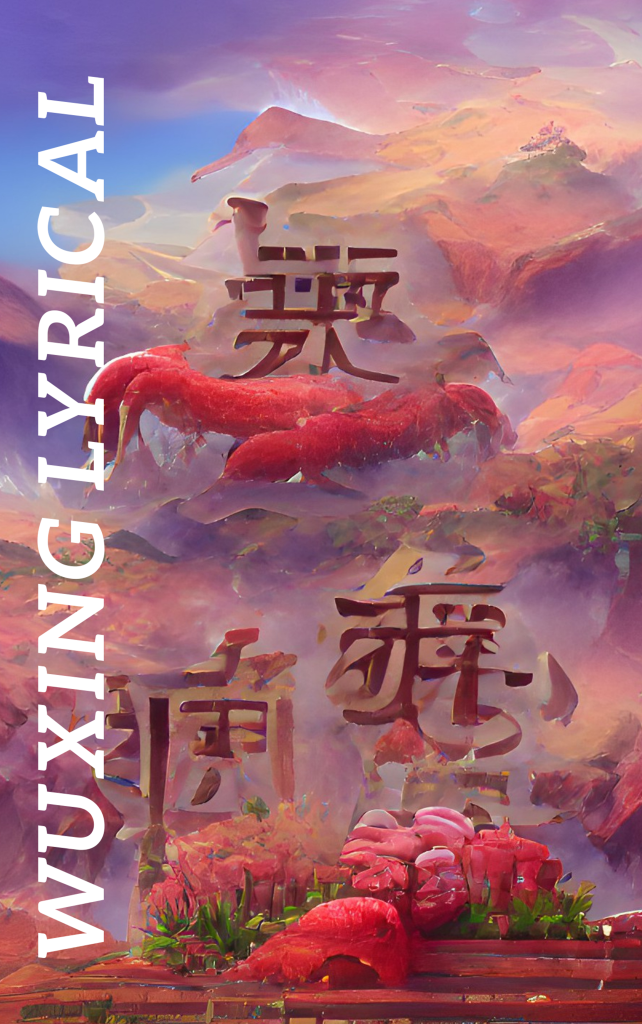
As for the title, that was easy. I like punning titles. I learned that ‘wuxing’ is an ancient spiritual system connected with Chinese astrology and from there it was a small step to play a word game with the phrase ‘waxing lyrical’. I still needed to design a cover for the book, but I had designed several covers in the previous few months and felt I could accomplish the task reasonably well. It is true that creating an anthology requires a lot of work but only after it has been published comes the truly hard part: marketing it effectively and efficiently. It is an unfortunate fact that books are unable to sell themselves. How nice it would be if they did! Then we could move on to the next project smoothly and without worrying about exposure, reviews, popularity.

Wuxing Lyrical took less than a month from the initial concept to the actual book. It now seems to me that I will be able to return to the abandoned Coconut Moon and get it launched after all. I also think that more anthologies are feasible, and I have been toying with themes for these. Some themes might be broad and open to interpretation while others could be extremely precise and particular. An anthology of mini-sagas seems very likely to happen (a ‘mini-saga’ is a story or a poem exactly fifty words in length). Anthologies with the themes of ‘animals’ and ‘planets’ appeal to me. I am also half inclined to put together anthologies of poems about puddings, chess, robots, weather and islands. Maybe I should seek an illustrator for these future projects. Illustrated books of poetry are nicer than plain ones, especially if the poetry is humorous.

Rhys Hughes has lived in many countries. He graduated as an engineer but currently works as a tutor of mathematics. Since his first book was published in 1995 he has had fifty other books published and his work has been translated into ten languages.

.

PLEASE NOTE: ARTICLES CAN ONLY BE REPRODUCED IN OTHER SITES WITH DUE ACKNOWLEDGEMENT TO BORDERLESS JOURNAL
Categories
Notes from Japan

An Encounter with the Monet on Naoshima

Suzanne Kamata writes of snacking on Claude Monet’s hundred year old recipes while savouring his art and that of the famed artist who makes bold art with polka-dots, Yayoi Kusama

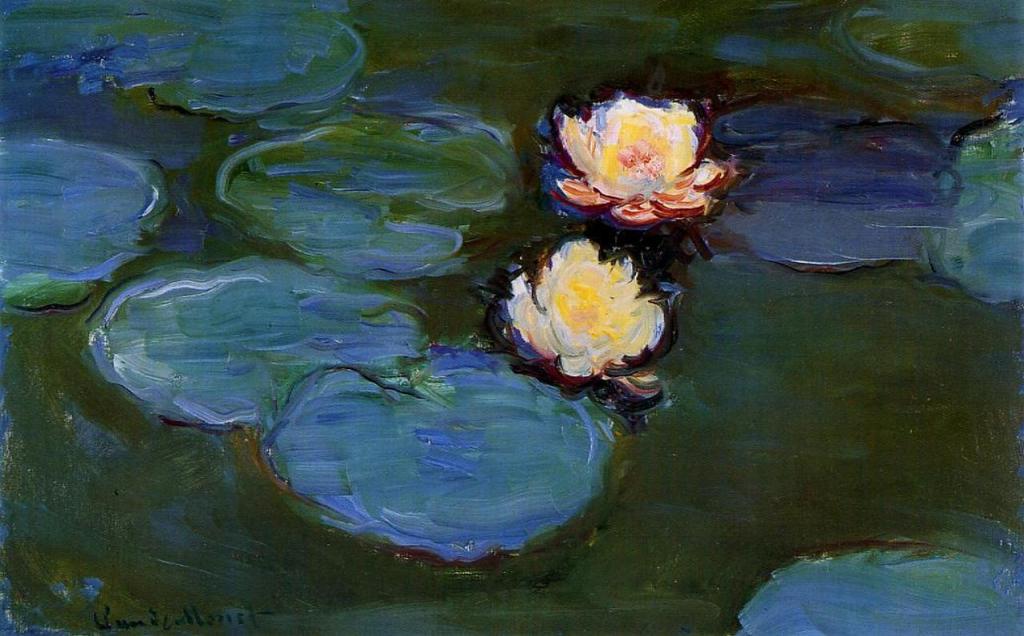
Water lilies by Claude Monet (1840-1926) Courtesy: Creative Commons

When I heard that the annual convention of the Association of Foreign Wives of Japanese would be held in nearby Takamatsu, I signed up. I would be able to meet other women with Japanese husbands and attend workshops in wine-tasting or yoga. At night, there would be a big banquet. During the day, there would time to visit the island Naoshima.

I’d heard about this island, once used primarily as a site to dump industrial waste. Now it was full of art museums, and part of the Setouchi Triennale, an art festival which takes place every three years, including this year. Among the permanent exhibitions is one of Claude Monet’s famous water lily paintings, housed in the Chichu Museum designed by world-renowned architect Tadao Ando.

Monet’s art has long been popular in Japan. The French artist had admired Japan. His garden in Giverny, France was designed in the Japanese garden style. A garden modeled after the one in France has been constructed farther south in Shikoku, but the painting was on Naoshima.

At the convention, I met up with my friend Michelle, an artist who sometimes works in coloured pencils, and sometimes in dust. She wanted to go to the island with all the art museums as much as I did. Michelle, Elana, an Italian woman whose husband is an art history professor, and I decided to visit Naoshima together. There are no bridges connecting Naoshima to Shikoku. The only way to get there is by ferry. We took a taxi to the ferry terminal and bought our tickets.

We decided to sit outside on the deck of the ferry. The wind whipped our hair and reddened our cheeks as we watched the city receding. The smaller islands scattered off the coast grew larger. Finally, we approached the dock at Naoshima. We could see the giant red polka-dotted pumpkin sculpture created by Yayoi Kusama, perhaps Japan’s most famous contemporary artists, known for her Kool-Aid colored wig and obsession with dots. Having been diagnosed with schizophrenia, Kusama has lived in a psychiatric hospital for many years. She continues to make art in her studio at the hospital.

Inside the giant red polka-dotted pumpkin by Yayoi Kusama. Photo Courtesy: Suzanne Kamata

Once off the ferry, we were confronted with a row of mom-and-pop restaurants. A bus runs from the harbour to the museums, but we decided to walk. It wasn’t far to our destination. Later that evening, we would be eating a lavish dinner and drinking wine. We needed the exercise.

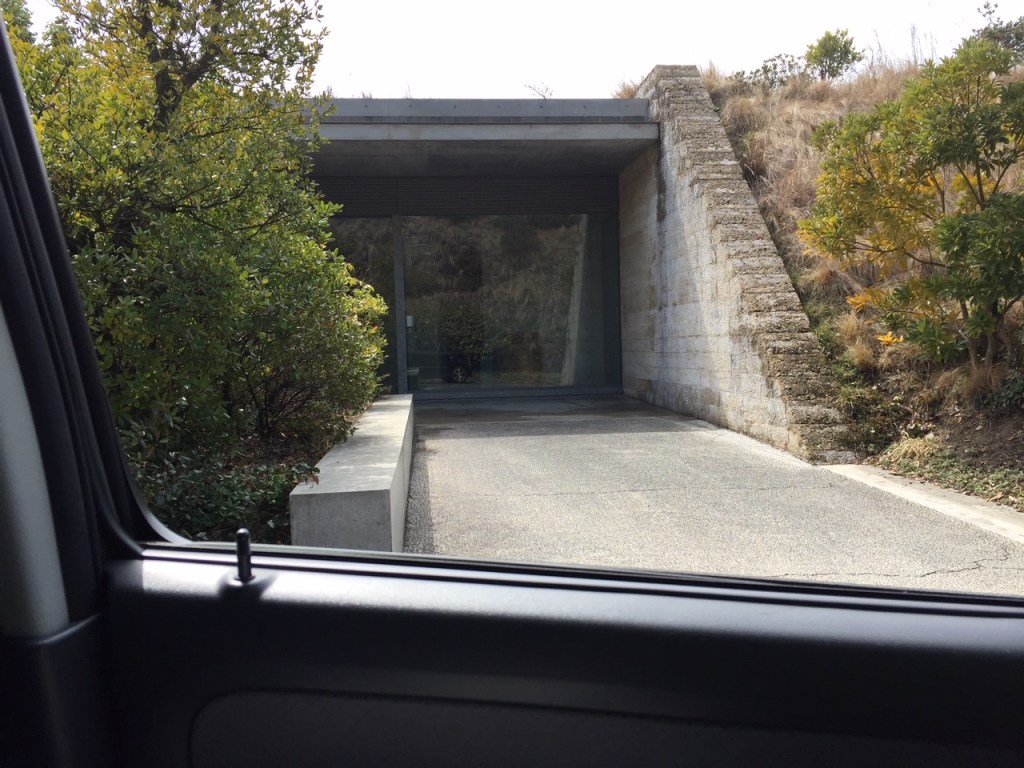
The entrance to the Chichu Museum. Photo Courtesy: Suzanne Kamata

The Chichu Museum was built into the side of a mountain, like a bunker, and lit only by whatever sunlight came in through the windows. The walls were grey concrete and most of the staff wore white lab coats. The brochure advised us to “maintain a quiet environment in the museum.”

As we were mainly there to see the Monet, we made that our first order of business. We descended an elevator to a dark hall and came upon a rack of slippers.

“Please change your shoes,” the docent said.

I removed my sneakers and slid my feet into a pair of vinyl slippers. Michelle and Elana did the same. Now we were ready to enter the hallowed space.

The room was circular, the walls blindingly white, offsetting the deep blues and purples of Monet’s sun-lit pond. We spent several seconds before each panel. The paintings were called “Water Lilies, Cluster of Grass,” “Water Lilies, Reflection of Weeping Willows,” and “Water Lily Pond.”

Michelle, who was a big fan of Monet, sighed happily. It was the off-season. We were the only ones in the gallery besides the docent. There were no other visitors in slippers waiting to shuffle in after us so we were allowed to take our time.

Michelle plopped down on the clean, white floor. Such irreverent behavior in this holy space! She leaned back and admired the paintings from this new perspective. Was she the first person to ever sit down on this floor?

“What the heck,” I thought. I admired her free spirit. I sat down on the floor beside her.

The docent stepped forward. Our unusual actions had clearly made her nervous. We weren’t touching the art or taking pictures. We weren’t doing anything bad. She had no reason to scold us, but she kept her eyes on us.

“Monet would laugh!” Michelle said. “He was messy. He would think it was funny that we had to change into slippers to look at his art.”

I was inclined to agree. I had seen photos of him. He had an unruly beard. His clothes were rumpled. Later, I would watch a video clip of Monet painting in his garden. He had a cigarette in his mouth even as he touched his brush to the canvas. Little dogs ran around at his feet. No smoking would ever again be allowed near his water lily paintings. Not these ones, at least. No dogs, either.

We visited the rest of the museum then had lunch in a café overlooking the sea which served desserts made from Monet’s recipes. In addition to painting food, he had enjoyed cooking it himself. I sampled his madeleines and apricot jam – delicious! — then bought a cookbook from the gift shop so that I could make them at home.

A madeleine made with Monet’s recipe. Photo Courtesy: Suzanne Kamata

Suzanne Kamata was born and raised in Grand Haven, Michigan. She now lives in Japan with her husband and two children. Her short stories, essays, articles and book reviews have appeared in over 100 publications. Her work has been nominated for the Pushcart Prize five times, and received a Special Mention in 2006. She is also a two-time winner of the All Nippon Airways/Wingspan Fiction Contest, winner of the Paris Book Festival, and winner of a SCBWI Magazine Merit Award.

PLEASE NOTE: ARTICLES CAN ONLY BE REPRODUCED IN OTHER SITES WITH DUE ACKNOWLEDGEMENT TO BORDERLESS JOURNAL
Categories
Stories

Intersleep

By Nileena Sunil

The true woman who possesses exceeding wisdom, 
She consults a tablet of lapis lazuli  
She gives advice to all lands...  
She measures off the heavens,  
She places the measuring-cords on the earth.

Naina read those lines which she had written on the first page of her journal. They were lines from a hymn written by the ancient Sumerian priestess, En Hedu’anna, written in two-thousand three hundred BCE. Every time she read those lines, she felt a sense of awe, as well as of sadness. How grand, how inspiring those lines were, those lines written millennia ago, during the dawn of civilisation? She sighed. Once, she too had wanted to be like En Hedu’anna, an astronomer, or at least a poet. But that was not her destiny. She was stuck in her corporate job, one that seduced her with the prospects of a financially stable existence, and refused to let her escape from its web. She idly turned the pages of the journal with the intention of starting a new entry. Perhaps that would help her fall asleep.

She was not sure why she kept waking up in the middle of the night. It was not the first time, in fact she had been facing such interruptions for a while. She would go to bed at eleven, only to wake at around two, and she would then be unable to fall asleep again till around four. She had tried to force herself to sleep a few times, but she was unable to do so. I might as well embrace it and turn this into my new routine. She thought of the article she had read the other day about how medieval Europeans slept in two phases. They would go to bed in the evening, wake up s a little after midnight and wait for around an hour for their second sleep. In the interlude, they would pray or do chores or work or study. The article actually suggested the practice might not even be unique to medieval Europeans, rather it could be something found all over the world, for centuries, millenia even. If it was so common, then how harmful could it be? Only, she had nothing to do in the interlude. The idea of doing office work at that hour nauseated her, nor did she think she wanted to read or watch anything at that time. She thought she could write in her journal, but as she held the pen, she found out that no words flowed from it at that time.

Sighing, she decided to go to the terrace, to get some fresh air.

Naina looked at the stars. She had always thought there was something magical about them. She used her fingers to trace the tiny pinpricks of light, wishing she could identify constellations. There was a time when she knew how to, but she had forgotten. Orion was the only one whose location she could remember. The Hunter. There was a time she wanted to be an astronomer, but she eventually realised it wasn’t very realistic a dream for her. En Hedu’anna’s verse came back to her mind.

She measures off the heavens

Her mind turned to another female astronomer, from the pages of history. Maria Cunitz, from seventeenth Silesia, who authored a book that refined the works of Johannes Kepler. She imagined being an astronomer in those times, getting to look at a night sky sans light pollution, trying to calculate and make deductions without a calculator or the internet. Wasn’t it strange that it was that way for most of human history, yet such a life was unimaginable for those in the present? Naina’s mind went back to the Silesian astronomer and the life she had led. It must not have been easy to be a woman of science in those times.

Naina then thought again, of sleeping habits in the past. Biphasic sleep must have been the norm in Maria Cunitz’s time. Did she look at the stars between her sleep cycles as well? She hoped she did. It would be nice to have something like this in common with her, Naina thought as she descended the stairs.

.

Nileena Sunil is a student and a writer from India. She has previously written short stories for The Collapsar Directive and Flash Fiction Addiction, anthologies by Zombie Pirate Publishing.

PLEASE NOTE: ARTICLES CAN ONLY BE REPRODUCED IN OTHER SITES WITH DUE ACKNOWLEDGEMENT TO BORDERLESS JOURNAL. 

Categories
Poetry

Poetry by Shantanu Ray Chaudhuri

Shantanu Ray-Chaudhuri
POEM
 
A poem beckons
      in dawn’s distant glow
across the sea.

Can you teach me
       how to walk on water?
You have all the answers.

Or is it too late in the day,
          or has the day fractured
even before it has begun?
 
But I must walk
       if only to drown.
Surely, it is never too late

to lose all your bearings
        in the quest for silence
at the poem’s heart.


FUGITIVE
 
In these anonymous lanes
I look for the lost tree of my childhood
 
now buried deep in night’s dark soul.
The city lights are myths
 
that mask the impossible longings
of my fugitive heart.


WORDS

These words, forever elusive
calling from a future crossroad
have led me to this dream.
 
Tiptoe into my sleep
this one sleepless night
and retrieve them for me.
 
Only if caressed by you
will they come home.
Only if born of you
 
will they find meaning.
Only then will a poem
walk out and breathe.
 
MUSINGS AT DUSK
 
Can you tell me why it feels like something has just ended? And yet in the end, is a beginning? In the moving on, a return? Why has one wanted to traverse miles of open spaces today? And why has one stayed rooted at one place, enclosed inside four walls of this room? Why has one wanted to spread one’s arms and embrace the world? And why has one buried one’s face in the pillow and shied away? Why was dawn so heady and at peace with itself? And why has the day born of it felt like a stranger? Why has dusk approached with this breathtaking suddenness, as if wanting an end? And why then has it paused, hesitant, contented itself with an ellipse … Why does it feel as if I am being written somewhere? And yet an essence has been blotted in unwept tears? Why does it feel like someone has called my name again and again? And yet, all day, I have been privy to the silence of mountains in the winter?

Shantanu Ray Chaudhuri is a film buff, editor, publisher, film critic and writer. Books commissioned and edited by him have won the National Award for Best Book on Cinema twice and the inaugural MAMI (Mumbai Academy of Moving Images) Award for Best Writing on Cinema. In 2017, he was named Editor of the Year by the apex publishing body, Publishing Next. He has contributed to a number of magazines and websites like The Daily Eye, Cinemaazi, Film Companion, The Wire, Outlook, The Taj, and others. He is the author of two books: Whims – A Book of Poems (published by Writers Workshop) and Icons from Bollywood (published by Penguin/Puffin).

.

PLEASE NOTE: ARTICLES CAN ONLY BE REPRODUCED IN OTHER SITES WITH DUE ACKNOWLEDGEMENT TO BORDERLESS JOURNAL

Categories
Stories

Mausoleum

By Hridi

Twenty-one months later, Rai[1] arrives in Paris. It is spring and she is here on a pilgrimage of memory. It is not her first time in this city, she has visited it before through the eyes of another: a city bathed in the mellow yellow of an exceptional limestone, chestnut trees abloom beside the Seine, a river green as malachite, the white sleek pleasure boats and the chuffing barges passing under the grave arches of thirty-seven bridges, each distinct from the last, a differently shaped shadow rippling below, connecting over and again the opposites of what divides the city, a people who know the art of touch all too well. Yes, the sights, the smells, all familiar. The spring air smells of her beloved; an enormous peace descends upon her.

Ever since she stepped on the train from the suburbs where she has taken her rooms, she finds herself scanning every face in the metropolitan crowd, every face looking elsewhere, somewhere, lost outside the present of their almost mechanical movements, perhaps like her, seeking another face. Strangely, this feels like home, like the city she left behind many months ago, ostensibly to travel. For all it takes from its inhabitants, a great city gifts them an anonymity that is sacred to the human heart. Therein remains its primary seduction for diversity. Your face becomes a mask of itself. You live, unapologetic, learning to make room for yourself where none exists. Every great city has this air of elsewhere, she concludes. I can already see Rai could live here; it is reminiscent of where she grew up. Yet, today, more than ever before, she is homesick, for the soil, the faces, the lives she tore herself away from.

You wonder how I glance into her heart with such ease. Let me lead you to the answer.

She has your address, half-a name, a few photos. What does it matter? One cannot create what one did not destroy first. She is obeying the laws of physics you joked about nineteen months ago, the laws that would inevitably bring you nearer and nearer. Here she is, touching you almost, a ghost walking beside her, pointing out every other piece of beauty in this city which does not lack of them. You stood here once, your feet touched this pavement, oh god, you stood here! This is where you clicked the photograph you sent her saying, “Remember me.” But she isn’t speaking to you, not yet.

Insecure, naïve, scared, stuck she had been, but mostly scared…terrified… of losing you, the last thread of sanity in a world collapsing around her, screaming into her ears with a deathly consistency, inevitability. You had been her escape, god, how she had escaped… Looking back, she thinks… no, there is no looking back. I almost lost my mind when you left, she would like to say, but… almost, that word… I was living with monsters tearing each other apart. To you, I showed only what I hid from others, and hid from you all that offal the monsters would leave behind at the end of each meal. They knew how to devour a girl of nineteen. The result is her face, at twenty-one, that of an old woman.

But that is an advantage, especially in big cities.

when you left even the stones were buried:

the defenceless would have no weapons.[2]

Her poet knows she remembers every place you promised to show her. It is the city of forgotten promises. She has read every book you ever recommended, watched every movie you spoke of, revisited two languages for you, painted you, cursed you, pleaded with you, desired you, hated you, shattered the boundaries of her known world for you; for the rest of her life, she will celebrate the nineteenth of July as the birthday of her heart; and yet, you are only a ghost who she cannot talk to. But she will, now that she has reached your city. Tomorrow she will talk to you. Tonight, she will write for the first time in twenty-one months. Through the dim lights of the small window of the suburban apartment, you will see her typing away. She will write again.

The painting earlier this morning made her think of God. This is not unusual, merely the first impact of a Monet painting on one who has only seen photographs all her life. Remember the poems she would translate for you? She reads them sometimes now, searching for mistakes. Her innocence makes me laugh, her capacity for love is adorable. It is what she will write about.

Why did you introduce all those new words in her mind? That was a mistake. Didn’t you know words are a writer’s biggest fear? Well, you can see the result for yourself, aren’t you happy? That she forgot how to write, that she mixes up alphabets of three different scripts every time she picks up the pen, trying to find a language that will make you answer. But you tricksters play on…

This city is a mausoleum of your memory. This is the first line she writes. The rest of the night is spent weeping between fits of sleep. You watch on, right outside the window. I watch you watch.

It is still very dark when Rai finds herself irretrievably awake. A faint fragrance of some spring blossom is wafting in through the half-open window. It is light by the time she reaches the small station; the air is crisp as the ticket in her hand, the cold from the river making her button up her coat. Today she will walk beside the Seine.

Many have said that the soul of Paris flows in the green waters of the Seine. Obviously, those fools know nothing about souls. Souls do not flow away, they haunt.

The yellow aura of the buildings is enhanced in the pale morning light, the river dappled in the golden, the empty promenade inviting. Later in the day the tourists and hawkers will crowd this part of the city, but it is yet hers, all hers. A few joggers and some sleepless ones as her claim the early hours.

She starts walking from the tower towards Musée d’Orsay along the river. You walk behind her, slightly unsure. On this morning you realise this city entwined itself in her personal history long before you arrived. It wounds your pride, shakes your confidence in her fidelity. The artworks hanging in that building yonder have been the pursuit of her fascination for almost a decade now. You knew it, if fact, that is where you met, in a shared longing of elsewhere, of nostalgia for a world you were never a part of.

In senior school math, they taught that for an equation to have real solutions, one must apply constraints. But within the parentheses of those limits exist an infinity of choice. Remembrance is a choice. Her math tutor from school, the old man with the twinkling eyes, would insist mathematics is the purest form of poetry. How long has it been since she remembered him? What is the pollen in this air that brings back the past so lovingly?

The path Rai traces, to a viewer like me, appears most comical. But I’ve been around here long enough to know lunacy is the mother of imagination, it afflicts the seekers more often than you would think. Sometimes she walks beside the river, sometimes climb the stairs to cross a bridge that fancies her, then strolls again along the other bank, as if her wandering steps cannot have enough of the novelty of a river joined with such frequency, such care. In her culture, the poets have sung for centuries of the two banks of a river as lovers separated in togetherness, together in separation. This far from home, the metaphor revisits her.

My memory is again in the way of your history2. A city with a history of over two millennia, glorious in this spring, what does it care of your unrequited love, foolish girl? Yet she would repeat under her breath these lines from her favourite poet. He spoke of war, of a heritage blown to bits overnight, over years, preserved in the memory of its refugees; how interchangeable is it with the torn love she carries with such grace? Foolish as she is, I think I am getting quite fond of her stubbornness.

And you! I almost forgot your apparition there, caught in watching her too. What are you sulking about? Quick, she is walking towards the Pont des Arts. Wicked rogue, won’t you play her once on the love lock bridge of clichés? She is standing at the centre now, spread before her the split halves of tremendous urban life, speeding fast in the midday heat; on either side, decades of forgotten promises caught in iron, rusted, locked away. She bends to inspect the locks. Even as you rush ahead to play your game, you turn back and shout at me, “You are wrong, it is a cliché only if you win in love.” Through the strong breeze on the bridge, I try to make myself heard: “So much for your words, go close enough if you dare and she will speak to you.” I think you heard me. The plan works. On one of these locks, Rai discovers her own name, a single name, a word, perhaps echoed in rust from decades of a solitary namesake on the same bridge, but that staunch heart knows what it wants to believe. Who will save her? You are close enough to touch her now, and she senses you. When you have spied on people’s secret lives for as long as I have, you tend to expect melodrama. But Rai, travelled across twenty-one months of quiet longing, is not surprised. You have appeared before her on fretful nights, sweat-stained afternoons, rainy mornings, in songs, in tears, in sudden joy, in sunshine, in broken shadows of grief, in the citadel she has built for you, how can she not expect you? She is narrating a story now, the story of what her name, written on that lock, means.

It was the one of the first fables of love ever fabricated in her part of the world. Centuries old. The story of a woman who falls in love to the music of a cowboy she has never laid her eyes on. Their illicit love-making becomes the whisper of the land. With the passing years, the musician in the boy slowly succumbs to the warrior in the man, who eventually gets crowned in a country far away. Rai is left waiting; music is not so easily forgotten. Like all classics, this too is of unrequited love.

The lazy warmth of the afternoon has brought out many on the promenade. Sunning away, relaxing with beers, some sitting alone, some in picnics; in the little island of Île de la Cité, a band of young jazz enthusiasts blow into their trumpets; the flowers compliment the myriad soft colours on all dresses: the Seine is the frame of happiness. I watch the two of you stroll, a happy couple, woman and ghost, breathing in the Spring you promised her not so long ago. Grief is the kindest of opiates, it dissolves in its own fantasia. Tonight, with all the walking, she will need some wine. The cheap wine of this tired evening will put her to sleep. You do not have to sing lullabies, but pray, lie down beside her. Let her hold in her palm the ghost of your erect manhood, rest her head against the illusion of your chest. In you, she desires sleep so in her sleep she may desire you, consummate a mirage. Do not stay outside.

It is night yet when she leaves. “The Frog & British Library” glows in its ironic neon, the streetlights halo in the clear blue hour. The Pont de Tolbiac stoops groggily over the ultramarine blue of the water pregnant with shimmering reflections: the illumined buildings, the barges anchored at the edge, the symmetrical reflections from the arch of the next bridge, perhaps (she fancies), the last of the stars too. The beauty of this night stings her eyes with an almost physical pain. She is thinking of you, of what remains of what you were.

I’m everything you lost. You won’t forgive me.

My memory keeps getting in the way of your history.

There is nothing to forgive. You won’t forgive me.2

Her poet is speaking again. Yes, she is here to ask for your forgiveness. She has left everything behind, for nothing ahead, in this long, long solitary journey only to ask for your forgiveness. Forgiveness for naïveté, for insensitivity, for distance, for loving with more sincerity than a heart bears without protest. The little crystal she wears around her neck on a string, she believes it has a beauty she does not deserve, like you, who loved her more for the magnanimous reflection in your kindness than her own small artless self. Your absence fills the air above the deep blue Seine like a forgotten god of this city that is yours. The semi-circle of these lanterns shiver beneath her like a pantheon of answers. Hope costs nothing, you told her once, and that is how she dared. To cross an ocean for you. The boatmen of this world speak of riches on the opposite bank, her voyage was merely to free the emptiness of her claustrophobic heart, restless, restless, oh, ever so restless. Perhaps, and I speak only as the outsider who inhabits you both, you should forgive her now.

Years ago, on summer nights, her grandmother would tell her the story of the boy who dived into the bottomless pond in the middle of the desert to salvage the pink pearl. The next morning, the villagers found a banyan tree at the centre of the pond, its roots vanishing into the fathomless. Legend says every full moon night, the heart of the boy cries for the pearl, and in the morning, a new column is added to the mass of hanging roots, a stream of condensed tears feeding the pond. Thus grew the desert city of Ehsaan around an oasis of endless fertility.

The blue is beginning to fade, a turquoise haze envelopes the bridge, the barge, the lamps, her; from the horizon, a faint blush rises, spreading softly over the sky. It is still night, the crescent moon still in bloom, but the last scattered stars are evasive now.

If only somehow you could have been mine,

what would not have been possible in the world?2

Suddenly, the streetlights go off. In this instant, dawn has arrived. The sky transits less hastily. The city of her beloved is waking up. A bus awaits to take her where she came from, through fields of uniformly shaven colour- yellow, green, brown, waves of symmetry upon a calm earth. A piece of this calm resides in her now, the river has doused the fire scourging her insides. Something has healed.

She will return. I, the Seine, rushing past a million lives, over a hundred thousand springs heartbreakingly beautiful, have promised to save the pink pearl in my bosom until then.


[1] Another name of Radha, the beloved of the divine cowherd Krishna

[2] Excerpted from “Farewell” by Agha Shahid Ali (1949-2001)

Hridi is an Indian writer currently based in Belgium. Her works have previously appeared in AainanagarContemporary Literary Review IndiaModern Literature, The Piker Press and Across the Margin, among others.

 PLEASE NOTE: ARTICLES CAN ONLY BE REPRODUCED IN OTHER SITES WITH DUE ACKNOWLEDGEMENT TO BORDERLESS JOURNAL. 

Categories
Essay

Living up to my Seafaring Name in Tasmania

Narrative and photographs by Meredith Stephens

When I asked my mother why she called me ‘Meredith’, she told me that she had named me after one of the children in the class she had been teaching before she got married. Still curious, I looked up the meaning of my name and found that it meant ‘leader of the sea’. But it wasn’t until my seventh decade that I left the cloistered world of academia and became a seafarer. Then I was finally able to live up to my name, at least partially. Not only did I become a sailor, I also became a serious hiker, and learnt how to replace my daily shower for sporadic dunks in the ocean.

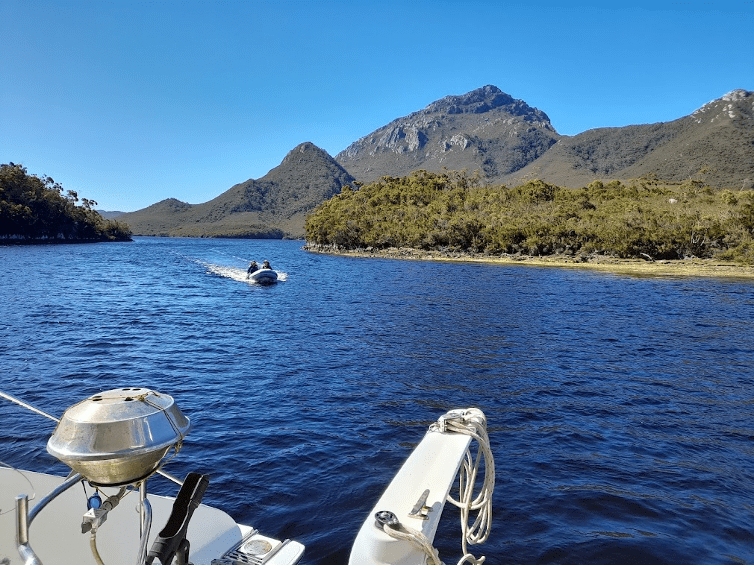
Alex, Luke, Verity and I were sailing south along the rugged western coast of Tasmania to Port Davey. The morning we arrived I ventured onto the deck and noticed that there was no beach, and the foliage was scrub rather than forests. As we entered Port Davey, we noticed still waters and jagged mountains. Several other yachts were anchored in the cove. Kayakers wove their way hugging the coast. I sat on the stern of the deck taking in the scenery that few people have the chance to observe. Port Davey is only accessible by small plane or boat, not by road.

Once anchored we decided to climb Balmoral Hill. Luke chose this because it promised the best rewards for the least effort; it would be a relatively easy climb with spectacular views. We made our way in the dinghy to the shore. We followed the wombat tracks, pushing our way through the bushes and native flowers, and reached the summit in under an hour. Balmoral Hill lived up to its promise. Views of Port Davey extended in all directions. The climb down was more challenging than the climb up, and I found myself lagging behind the others as usual.

We returned to the boat and it was still only 3 pm. We hadn’t been able to take regular showers because of the limited supply of fresh water on the boat. Luke and Alex decided to have a swim. Alex begged me to go in too.

“If you go in, I’ll give you a gin and tonic,” promised Alex.

He knew that was a sure-fire way to entice me in. I donned my swimsuit and secured my hair on the top of my head. I poked my feet into the water. Alex kept encouraging me to go in and finally I braved the cold brackish waters. I willed myself to stay in for a minute or two before climbing back up the ladder. Then Alex offered me a brief but hot shower on deck. True to his word, he brought me a gin and tonic with my favourite snack of hummous and seaweed crackers.

It was still early afternoon.

“Do you want to go ashore again?” Alex offered.

A narrow strip of white shore was enticing us. We made the 100metres trip to the shore in the dinghy. The shore consisted of white granite pebbles. We walked up and down the pebbles so that they could massage the soles of our feet, providing a shiatsu-like treatment.

The next morning Alex and Luke were looking forward to climbing Mt Rugby.

“How long does it take to climb?” I asked Luke.

“About six or seven hours.”

Alex had always encouraged me to go on daily hikes with him, and I was worried that I would have to undertake a six hour hike up Mt Rugby. Alex read my mind, and I realised that he was not expecting me to accompany them. He reminded me how to use the VHF [Very High Frequency] radio in case we needed to summon help. Verity and I stayed on the boat, working on our laptops in the saloon, gazing through a window at Mt Rugby, as the boat gently swayed back and forth. I went onto the deck periodically to scan Mt Rugby to try and sight Alex and Luke, but couldn’t find them. Before I knew it they had returned.

That evening, while positioning the dinghy, the rope became intertwined in the propellor. Alex donned his swimmers and dived quickly into the cold water to cut the rope. Every now and then he emerged from the water with his mask. His legs and feet were visible beneath the surface of the tannin filled water every time he dived back in. Eventually he cut the rope and returned to the boat.

The next morning we continued to Joe Page Bay to see the swans. After anchoring we hopped into the dinghy and headed for the lagoon. We noticed flocks of swans in the distance but as soon as they heard the engines of the dinghy they took off. The water was too shallow because it was low tide. We were at risk of hitting the river bottom, so we eventually turned around and returned to the boat.

It was another two days before we exited Port Davey. We headed back in the direction of the open ocean to anchor for the night, ready to leave the next day. Alex and Luke carefully chose the calmest spot in the north-west corner of Brambell Cove. Mt Millner was beckoning so we took the dinghy ashore and headed up the mountain.

“What if I can’t do it?” I asked Alex.

“You can rest on the beach if you like,” came the reply.

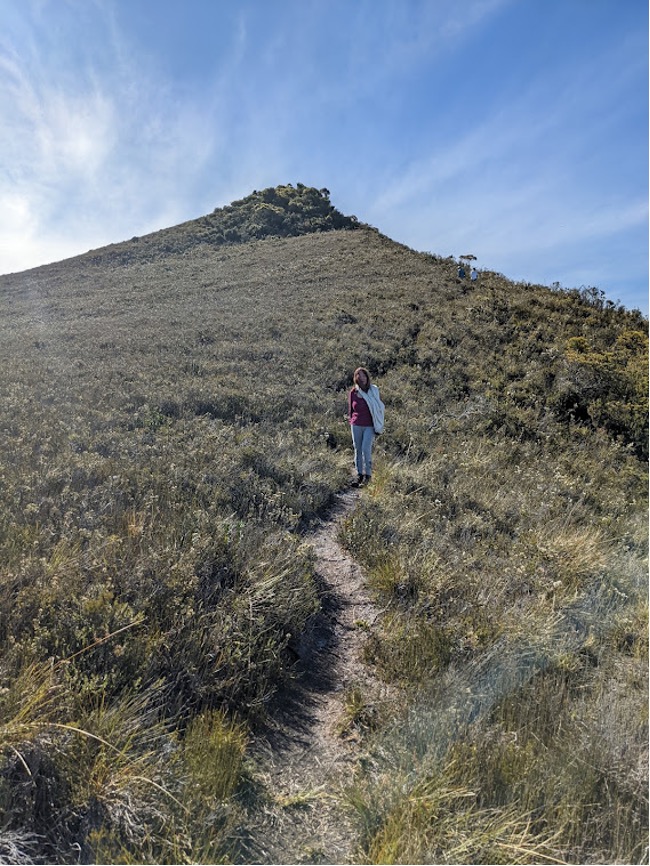
We entered a shady grove and found the path. Verity and Luke took the lead and Alex the rear, so I wouldn’t get left behind. The wombat track was studded in deep holes and it was hard to enjoy the view of the islands while being careful where I placed my feet. I thought we had nearly reached the summit, but it kept stretching ahead.

“You go ahead. I don’t need to get to the summit. I’ll rest here.” I pleaded.

Alex was having none of it.

“Look! We have reached the saddle. You can even go downhill for a bit before we ascend again. Not much further to go!” he encouraged me.

How could I disagree when Alex had so much confidence in me? I continued to clamber up the mountain. The bare surroundings turned to dense scrub and I had to push the branches away from my face to clear the way. Then in my haste I found myself falling backwards. My landing was cushioned by some thick undergrowth. My feet, bound up in my heavy hiking boots, stretched before me and I was tempted to rest a bit longer, but I worried about holding the others up, so I took a deep breath and summoned the effort to get up. No sooner had I reached the summit than I realised that it was another false summit. Rising before me was a steep incline to the sky.

“I can’t do it Alex!” I called behind me.

“You’re very nearly there. Then you can say that you climbed to the summit.”

I didn’t really care about being able to boast that I had reached the summit. Would anyone be impressed by that? But again, Alex’s enthusiasm pressed me on. With such encouragement it would be surly to refuse.

After climbing the steep incline I really did reach the summit. I caught a glimpse of the seascape below and the conical islands dotted in the bay. The fierce sun was oppressive and so I turned away, gratefully sat down on some heather, and pulled my hair away from my neck. Alex gave me some water.

“Do you want to walk to the other end of the summit?” Alex invited me.

If you walked to the other side you could look down on an ocean bay, but I could view it from my seated position and this time I really did decline.

After sitting there for twenty minutes I was cool enough to brave the descent. Luke and Verity climbed down quickly and waited on the shore. Alex took the rear and we trod along the wombat path trying to avoid the holes. Finally we reached Luke and Verity. We removed our hiking boots, hopped into the dinghy and motored back to the boat.

We had to ration fresh water and did not want to waste it taking a shower. I didn’t relish bathing in the ocean but I was both hot and perspiring so I felt I didn’t have a choice. I popped on my swimsuit, asked Alex to pull down the ladder, climbed down and immersed myself in the water. Finally, I was cool and clean. I couldn’t imagine being any more tired after the strain of the climb, the punishing sun and immersion in cold water. I am surprised I managed to mount the false summits and reach the real summit. It shows how encouragement can push you beyond the goal you set for yourself.

Alex prepared dinner. Behind the boat the sunset over the sea turned from an intense orange to purple. That night the boat was so still that we could have been excused for thinking we were on land. I was finally beginning to embrace my seafaring name.

Now that I had some sense of having earnt my first name, Meredith, I was ready to explore territory featuring the second part of my name, Stephens. My Great Aunt May, born around 1906, used to explain how her forebears had run a ‘Stephens’ shipping line in London in the late 1800s. Even my surname had a seafaring connection.

The next day we headed out to the open ocean past Bramwell Bay on our left and Breaksea Islands on our right. We anchored at Spain Bay, took the dinghy to shore, and then hiked to the other side of the peninsula. First the vegetation was low, and gradually gave way to bracken. We had to push the branches aside as we trudged through the mud. Then the path entered a forest with a canopy above the trail. Wooden stairs gave way to Stephens Bay. We sat on a rock to rest, and nibbled on some of the dry seaweed washed up on the beach, wondering what it would taste like if rehydrated in a misoshiru soup. I pondered whether I had an ancestral connection to this place as ships on their way from England to the east coast of Australia would have passed by this bay.

Back on board, despite the cold, I thought I would brave the waters again to refresh myself. I donned my swimsuit and tentatively climbed down the ladder into the sea. Alex dived in before me and I could tell from his expression that it was colder than we expected, as we were closer to the ocean. I held onto the ladder and vigorously moved my legs to warm myself up. I could only manage thirty seconds in the water despite resolving to last two minutes.

The next morning Alex entreated me to get up so as not to miss out on the spectacular scenery as we rounded southern Tasmania. The seas were as calm as they could possibly be. The boat was gently cantering in slow motion across the swell. South West Cape loomed in the distance, about an hour away. Luke was at the helm and Alex, Verity and I climbed carefully to the front of the boat holding onto the rails, and sat on the foredeck while we passed the cape, as the sun forced its way into view. Five hours later we rounded South East Cape, one of the five southernmost capes in the world, the others being West Cape Howe (Western Australia), South Cape (New Zealand), Cape Horn and the Cape of Good Hope.

Heading to the South West Cape, south western Tasmania

After so many decades spent in libraries and classrooms, my life had taken a turn and I suddenly found myself surrounded by ocean. Of course, living on a boat did not mean I would abandon reading and writing. In fact, the long hours at sea afforded even more time for these pursuits. This was especially the case when at anchor waiting for rough seas to subside, out of internet range, when there was little else to do. Nevertheless, I think my mother would have been more than surprised had she known that I would spend weeks at sea in some of Australia’s most remote waters. Neither of us could have imagined how literally I would grow into my name.

Meredith Stephens is an applied linguist from South Australia. Her work has appeared in Transnational Literature, The Muse, The Font – A Literary Journal for Language Teachers, The Journal of Literature in Language Teaching, The Writers’ and Readers’ Magazine, Reading in a Foreign Language, and in chapters in anthologies published by Demeter Press, Canada.

PLEASE NOTE: ARTICLES CAN ONLY BE REPRODUCED IN OTHER SITES WITH DUE ACKNOWLEDGEMENT TO BORDERLESS JOURNAL
Categories
Poetry

Sunday Morning with My Daughter

Poetry By Abin Chakraborty

SUNDAY MORNING WITH MY DAUGHTER

I'm halted by leaves
That flow through the streets 
With dry brown banners on high.

They chant their slogans of expired dreams
And sing to the tunes of decay and dross
With posters of others' bright claims.

Drained, I trudge and balance my books 
And sink within sofa and sloth.

But suddenly she bursts with laughter and light
And tramples my checklist of loss with her dreams
That range from the towers of wizards and kings
To spaceships in canyons of Mars.

I jump on her broom and fly
And bin all my "items not found".

LAYERS OF GREY

At times the days are all blurred.
Calendar and clock, melt into shapes
Of one grey blob
Sprinkled with fleets of yellow fallen leaves
Which sweep like ghazals of long buried loves
Here, along asphalted planes.

Slowly and slowly, they creep into my veins
And drain all the pigments through pores.
So, I flap and fumble in frustrating files
And fiddle with the fables of fate.

Of course, it's not always such.
There are bursts of crimson and Cobalt and mauve
That light up the dark of dog-eared days
With splashes and patterns of light.

But all seems distant and loose.
I flutter and rattle like windows unhinged
Or knobs that are no longer in groove.

Only in mists of grey, pallid strokes
My pages of misshapen woollens are laid
Like hoardings of outdated ads.

I cuddle and smear their shades
And grizzle into layers of grey.

Abin Chakraborty teaches English Literature in Chandernagore College and his poems have been published in different magazines. A collection of his poems, Unlettered Longings, has recently been published by Ukiyoto Publishing.

.

PLEASE NOTE: ARTICLES CAN ONLY BE REPRODUCED IN OTHER SITES WITH DUE ACKNOWLEDGEMENT TO BORDERLESS JOURNAL

Categories
Mission Earth

Falling Down and Getting Up!

By Kenny Peavy

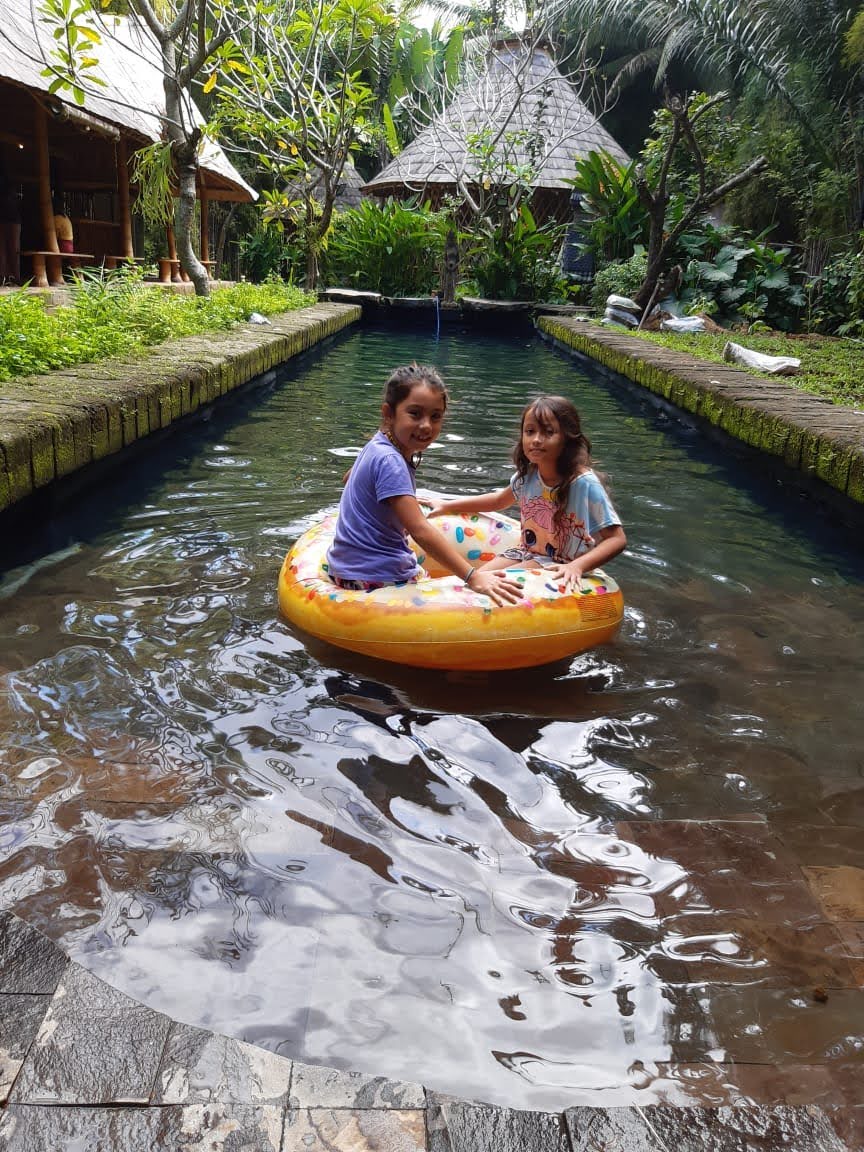
If you were born sometime around 1980 or before you most likely spent your childhood outdoors playing, exploring and gallivanting around your neighbourhood. If you were lucky your neighborhood had a mysterious forest that beckoned to be explored!

Sadly, that is rarely true these days.

Right around the turn of the millennium, in the year 2007, as estimated by someone that keeps track of such things in the United Nations, something historic happened and went unnoticed. Most of us didn’t even realise it happened, but it has had a profound effect on us and, especially our children.

For the first time in human history, more people were living in urban areas than rural areas. With more folks in cities and suburbs they had less access to Nature and natural spaces on a daily basis. This means less free-range outdoor play for most kids. Less unsupervised time to roam around in Nature to get lost, fall down, get scraped up and get up again to keep exploring and playing.

The tragedy to all this is that kids are getting less exposure to age appropriate risks and risky play in natural settings. They’re no longer pretending to be Steve Austin The Million Dollar Man or Evel Knievel and expending energy and learning while running full speed to test out the limits and balance of their bionic legs.

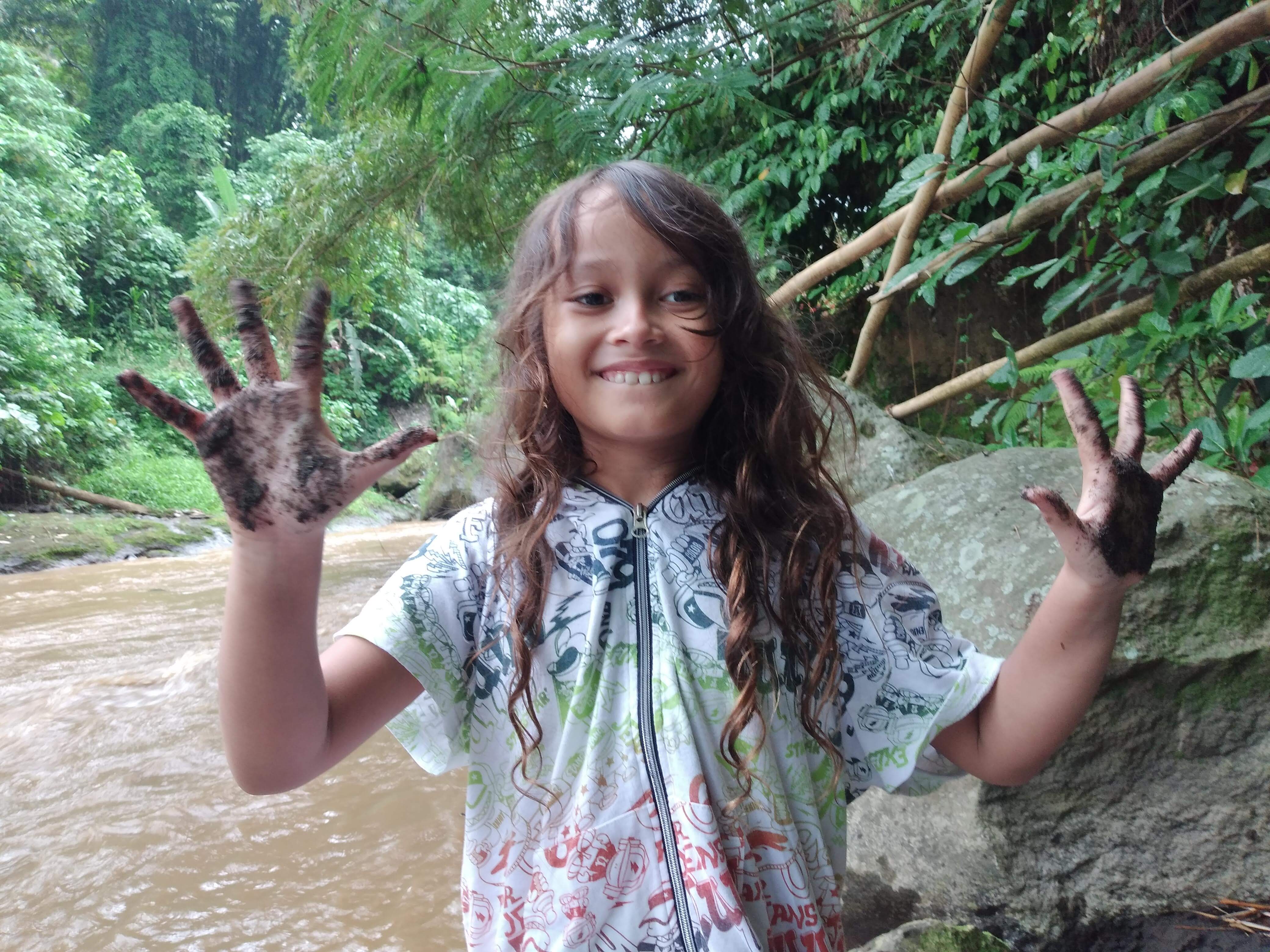
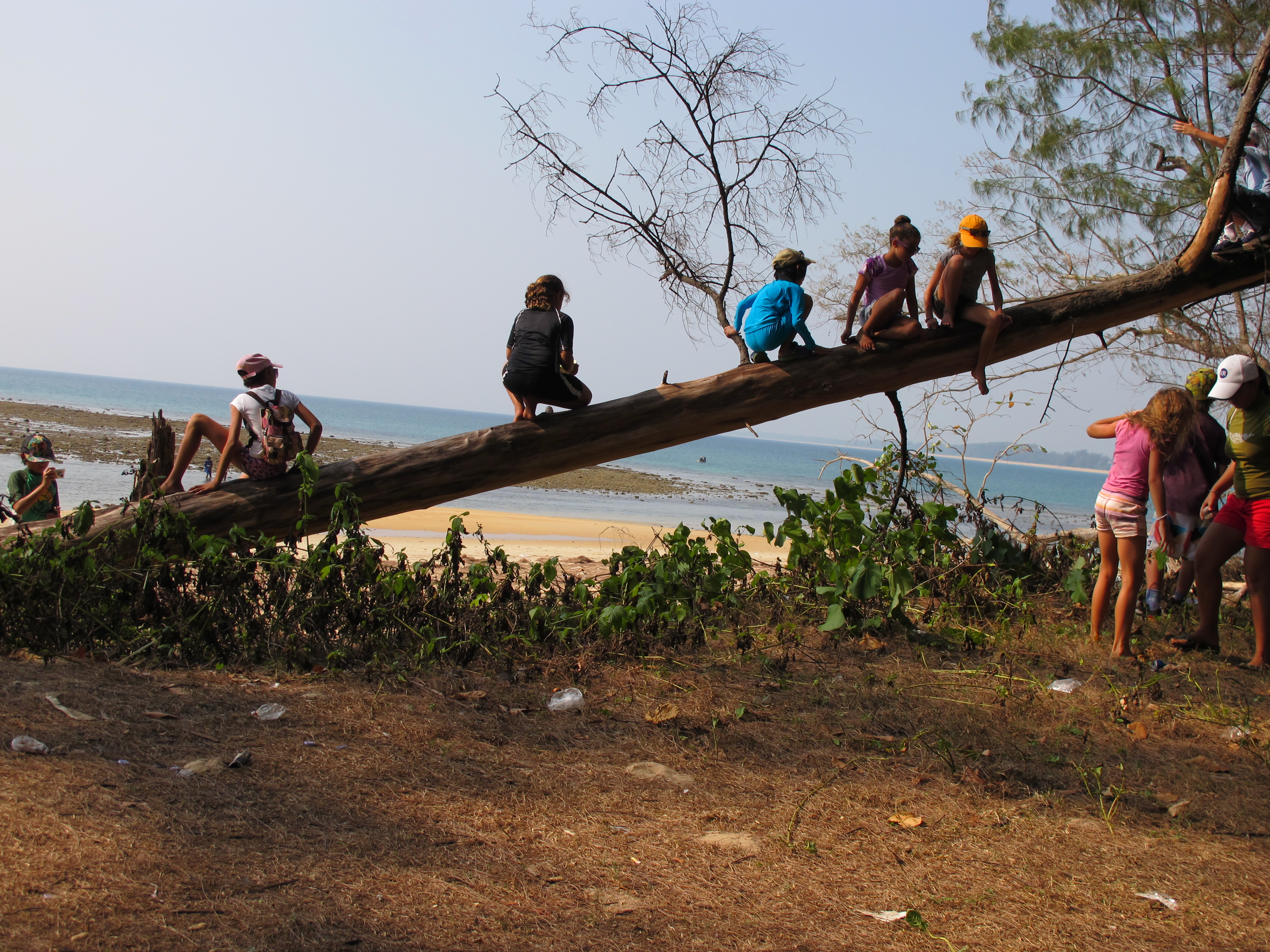
If we want our kids to learn their limits and grow up to be resilient adults, we need to let them test those limits in risky play by climbing trees, jumping ramps, riding bikes and sliding down muddy slopes.

Last week my 9-year-old daughter flipped her bicycle. She ran up to the house crying and screaming. Sure enough, she had a bruised clavicle. Pretty painful I imagine with plenty of tears and whelps of pain to accompany the accident. We checked the injury and she still had mobility in the shoulder and arm. No bleeding. No trauma anywhere else. Even so, we went to the clinic for a check. It was all fine and she’s healing well.

Since then, we’ve had several discussions on why and how she flipped her bicycle. What she learned from it. What she would do next time and how she might avoid flipping her bike in the future.

Needless to say, I too have flipped my bike spectacularly many, many times. It comes with the territory of playing outdoors. So, I could relate and offer advice and stories from my personal experience too!

Now she wears her accident as a badge of honor. She said outright and truly believes she’s a tough girl. More confidence coupled with the experience of an accident means cautious and informed confidence. Experience and wisdom for the next time, which will surely come at some point.

So how do we raise resilient kids?

First, you’ve got to overcome your own fear as a parent or teacher. Get outside and fall down yourself.

No one wants a tragic or serious injury but if we learn our personal limits and test our boundaries early on then we’re much less likely to make mistakes or errors in judgement that lead to the bigger and more serious injuries.

Take it stepwise and walk barefoot in the forest. Climb a few trees. Hike up some steep hills. Learn your personal limits and boundaries.

Your kids will naturally take risks and want to jump and climb. Let them learn their limits. You can create a safe, yet challenging environment by letting them make mistakes and learn from them.

They will inevitably fall down and get scraped up. It comes with the territory. But they will learn from it and become more resilient in the process. As an added bonus, they’ll learn their personal limits and push the boundaries of their comfort zones too!

Lastly, learn basic first aid, wilderness first aid and how to deal with emergencies. Not only will this increase your knowledge of what to do in the event of an accident it will also increase your confidence and expand your comfort zone for letting your kids and students learn, play and explore outdoors in Nature.

None of us wants a serious accident but at some point, we all fall down.

The trick is learning to get up and try again!

.

Kenny Peavy is an environmentalist who has a memoir called Young Homeless Professional. He has co-authored a pioneering environmental education handbook, As if the Earth Matters, and recently, an illustrated book, The Box People , was re-released digitally to enable children, young people and their parents and educators anywhere in the world to use the book. He also created Waffle House Prophets: Poems Inspired by Sacred People and Places

PLEASE NOTE: ARTICLES CAN ONLY BE REPRODUCED IN OTHER SITES WITH DUE ACKNOWLEDGEMENT TO BORDERLESS JOURNAL