By S. Ramakrishnan, translated from Tamil by Dr B. Chandramouli
The man was around 30. He had sleepless eyes, unkempt hair, and pale lips. He had on a grey half sleeve shirt and blue pants which did not match. Wearing rubber slippers with frayed edges, he was carrying a cloth bag, which he guarded closely on his lap, as if it contained a rare object. Because persons like him were a common sight at the taluka[1] office, no one paid him any attention. He had the hesitant look of someone about to request a loan. He was sitting in a slanted position leaning on his right leg.
The taluka office assumes a relaxed atmosphere during lunchtime. Losing its stiffness, it becomes more like a public library. Workers smile; you can talk to them easily. Maybe he was waiting for that stretch of time. They had built this new office with three floors on a side street near the end of the overhead bridge. When you think of a taluka office, you get the picture of a dusty neem tree, dirty steps and semi-dark rooms; this building was not like that. But there was a jeep blocking the entrance and abandoned bikes that reminded of the old office.
Most government offices did not have lifts; even if they did, they did not work. This office also had only a big staircase. While climbing the stairs, you could see a big government poster pasted on the opposite wall. The office had big windows, like in wedding halls. One worker who did not like too much light had opened only half of the window near his seat. During lunchtime, there was big traffic of vendors: Bagyathammal who sells hot murukku in a silver bucket; Muthu, who sells sweets and snacks; Kasim, who sells towels and lungis, and Kalaivani, who sells nighties and cotton sarees. The workers at the office were their favourite customers.
They continued to visit, even though the office had moved. Especially, Kesavan who sells the hot coconut sweet ‘boli’, had a free run of this office; he would enter regardless of who was there. He will place two bolis wrapped in newspaper on the Tahsildar’s table.
Bagyathammal could climb the stairs slowly only because she was overweight and also had a corn on her foot. They would know of her arrival just by the noise the silver bucket made on the steps. Many workers would be satiated only after munching on her murukku after lunch. They had a water cooler for cold water, which the old office did not have. Kasim would always fill his green bottle with the cold water. He would relish drinking that cold water with a unique expression of bliss on his face. Except for the boy from the tea stall opposite, and Subbiah from the xerox store, most people who came to the office were there to get certificates for caste, income, residency or land ownership. You could easily identify them by their looks. Being nervous, they would drop and scatter their certificates; some could not even answer the questions. Though all the wooden tables were similar, only the table where the officer received the petitions would appear huge to them. Even the leaders in the pictures hung on the wall were unsmiling.
After lunch, many of the workers would not return to their tables immediately. Some would go downstairs to smoke. Raghavan, who was going downstairs, noticed the man sitting aslant.
“What do you want?” he asked while passing.
When the man hesitantly said, “You see.., I.. well,…”
Raghavan told him, “Go inside and ask.”
Some workers had returned after the lunch break. Jayanthi was keeping her washed tiffin box near the window. The man stood in front of Sabapathy’s table and called out — “Sir…”
.
Sabapathy was searching for a pin to use as a toothpick. Thinking that the man was selling some snacks, he asked, “What did you bring?”
The man produced an old photograph from his bag and said. “Muhammad Ali’s photo.”
Startled and uncomprehending, Sabapathy asked, “What is that?”
“Muhammad Ali Sir, the world famous boxer. My father is the one standing nearby; see here, it has Muhammad Ali’s signature at the bottom.”
“OK, but why are you showing it to me?” asked Sabapathy, not understanding.
“They took it when Muhammad Ali came to Madras.”
“That is all fine. Are you here to give some petition?”
“I came to sell Muhammad Ali’s signature, Sir,” he said hesitantly.
Sabapathy did not understand what he said.
“Selling a signature?… But what can I do with it?” asked sarcastically.
The man hung his head and said, “It is a very valuable signature, Sir. I have money problems at home; that is why I came to sell.”
Sabapathy smiled sarcastically, as if he has found the right person to pass the time with and said, “I know nothing about boxing. See Sekhar in the corner seat? Show it to him.”
Sekhar was the one who can get a loan for anybody in the office. Nobody knew where he got the money from. But he would get a commission of Rs50 for every Rs1000.He had loaned many of his colleagues money during contingencies. He would strictly collect his share on payday.
The man went to Sekhar and showed him the old photograph.
Sekhar looked up at it and asked thoughtfully, “Do you want a death certificate?”
“No, Sir; this is Muhammad Ali.”
“Muhammad Ali means?” Sekhar asked, confused.
“Famous boxing champion; he came to Madras in 1980. He boxed with Jimmy Ellis in front of MGR. My dad was a big boxer in those days; he lost one eye in boxing, but could still fight very well. Muhammad Ali himself had congratulated him. They took this photo when Muhammad Ali was staying in Connemara hotel. There was a huge crowd to see him. My dad was waiting to get his signature on this photo. Muhammad Ali himself took him to his room and signed it for him. My father was thrilled.” he was narrating it like a story.
“Just tell me what you want now,” said Sekhar.
“Please buy this signature. All I want is Rs 500.”
Sekhar did not expect this.
“What am I going to do with this — clean my tongue?” Sekhar asked angrily.
“Do not say that Sir. Muhammad Ali’s signature has value.”
“Let us see how many people in this office know who Muhammad Ali is.” As if taking up a great challenge, Sekhar grabbed the photo from the man and gathered all the office staff in front of him.
Sekhar said in a mocking tone,
“If anyone can correctly identify the man in this photo, I will give the person Rs100.”
One lady asked, “An actor?”
“There is a tailor in my street who looks just like him; his ears are exactly like his,” said Jayanthi.
“Isn’t he the football champion?” asked Mani.
Rangachari was the one who correctly said.
“That is Muhammad Ali, World heavyweight boxing champion. He was born Cassius Clay; he later changed his name to Muhammad Ali.”
“Correct Sir; and it is his signature. At least you can buy this.”
“I do not even have enough time to box with my wife; what am I going to do this? If it was a foreign stamp, at least I could give it to my daughter,” said Rangachari in a mocking voice.
“Do not say that, Sir. I can cut off my father’s picture. Please give me Rs 500,” the man pleaded.
“Five hundred rupees is too much for a signature,” said Rangachari.
“You people demand like that too,” he thought. But he swallowed the thought and said, “If my dad were alive, he would not sell this.”
“It is alright if you want to sell, but where did you come to the taluka office?” asked Rangachari mockingly.
“You are all educated people. I thought you would know the value of this.”
“Forget the signature; you see, even if Muhammad Ali himself comes here, there is no value.” Rangachari laughed automatically, as if he has cracked a joke.
Meanwhile, hearing some footsteps on the stair, peon Munusamy announced that the Tahsildar[2] has arrived.
The safari suit clad Tahsildar Rathinasamy must have noticed the man as he went to his room. He rang the bell as soon as he sat down.
Peon Munusamy hurried into the room.
“Who is that guy standing outside? Is he selling perfume? I told you not to let people like that.”
Munusamy said, “He is not selling perfume, Sir; he came to sell some photo.”
“Ask him to come in,” the Tahsildar said angrily.
The peon told the man who was standing helplessly that the Tahsildar wanted to see him.
The man entered the room slowly.
The Tahsildar asked him with a stern face, “What is this, a marketplace where anyone can walk in and sell stuff? Who are you and why did you come here?”
The man was scared at his anger and hesitantly said, “Muhammad Ali’s signature…photo”
“Ask S1 to come in,” said the Tahsildar angrily.
Sabapathy came.
“Is this a government office or an exhibition? How did you let this man in?”
“We thought he came to give some petition. But he is spinning a yarn about a photograph.”
The Tahsildar said loudly “We should not leave it like this; you call the police. If we grab someone like this, the next one will be afraid to come.”
The man said with a troubled face, “Sorry, sir. I will leave,” he turned to walk out.
“What do you have in your hand? Show it to me.” the Tahsildar asked with the same anger.
The man showed him the photo with Muhammad Ali and his father.
“Did you come to get a donation?”
“No Sir; I came to sell Muhammad Ali’s signature,” he said in a weak voice.
“Don’t you have some other place for that?” the Tahsildar threw the photograph on the table carelessly.
“It is alright sir; just give me the photo; I will leave”
By this time, Rangachari had entered the room and described about Muhammad Ali in fluent English; the Tahsildar listened, only half understanding.
“Who will buy this?”
“There are collectors for this. You can get for 5000, or 10,000 rupees for that.”
“Is that right?”
“Severe money problems at home; that is why I came to sell.” the man repeated.
“What am I going to do if I buy this? I do not even have a place to hang my picture at my home.” the Tahsildar expressed his sense of humour with that statement.
At his juncture, Sekhar came to the office and said, “It is a new type of fraud, Sir. They print a picture off the internet and try to sell it.”
“No Sir. This is my father.”
“Do you have any certificate to prove it?” asked Sekhar.
“Why should I deceive you, Sir,” the man asked pitifully.
“Sekhar is correct. Nowadays, it is difficult to trust anyone; we should be cautious,” said Rangachari.
“Get rid of him and post a notice saying no outside persons are allowed here.” said Tahsildar.
The man took the photograph from the table and placed it in his bag, and walked downstairs.
An old man waiting to submit some petition asked him if the Tahsildar has arrived. He answered yes and left.
It was after three. He felt like fainting because of extreme hunger. The street was hot in the scorching sun. There was no breeze. He walked towards the bus stand to catch a bus to his suburban home.
Suddenly the bag in his hand felt heavy. It sounded as though someone was laughing.
Was that Muhammad Ali laughing?
It was as if his arm was being dragged down by the heavy bag.
He took out the photo and looked at it. His father’s face standing near Muhammad Ali had a unique smile.
He was wondering what he is going to do by taking the photo back to his home.
There was a tar drum standing under the tamarind tree; it was leaking tar. He took out the photo and stuck it on the tar. Muhammad Ali was looking at the street baking in the scorching sun from the photograph stuck to the tar tin.
As if to express his anger, he shrugged off his slippers and started walking barefoot at a fast pace.
The road stretched like the tongue of a strange beast.
S. Ramakrishnanis an eminent Tamil writer who has won the Sahitya Akademi Award in the Tamil Language category in 2018. He has published 10 novels, 20 collections of short stories, 75 collections of essays, 15 books for children, 3 books of translation and 9 plays. He also has a collection of interviews to his credit. His short stories are noted for their modern story-telling style in Tamil and have been translated and published in English, Malayalam, Hindi, Bengali, Telugu, Kannada and French.
Dr.Chandramouli is a retired physician.. He is fluent in English and Tamil. He has done several English to Tamil, and Tamil to English. He has published some of them.
.
PLEASE NOTE: ARTICLES CAN ONLY BE REPRODUCED IN OTHER SITES WITH DUE ACKNOWLEDGEMENT TO BORDERLESS JOURNAL
Let no one tell me I'm falling short
From expectations I so fiercely fought!

Let no one tell me who I am
Only me and the great 'I-am' --

Free from my chains,
And free from pain.
Free to love my skin,
And free from so called sin.
Free from creed and colour
And free to find my Anchor!!

I was born to be free!
I was born to be me!
I'm all of the above
And more than your eyes can see!

I am my Father’s Daughter
And I just can't fall short!
I don't want to measure up!
And I don't want to match up!
I was born to be free!
I was born to be me!

Free from expectations I so fiercely fought --
Let no one tell me I'm falling short!!
Rachel Jayan is the head of the primary school at Indus International School, Bangalore. She is a passionate educator who wishes to see a transformational change in her students. She believes it is important that each individual makes time to reflect, introspect, apply, express and inspire others to make, and be the change they wish to see in the world today.
PLEASE NOTE: ARTICLES CAN ONLY BE REPRODUCED IN OTHER SITES WITH DUE ACKNOWLEDGEMENT TO BORDERLESS JOURNAL
There are many places that poetry comes from — desire, death, dream, memory, sharp sensuous apprehension, the wrist-grip of language’s freedom and magic, the joys and fractures of the world that we engage in everyday, the necessity to commit to paper (or to posterity) what weighs upon the heart or head, the existential imperative to express, or the naïve hope of making the world a better place.
In general, the act of poetic creation draws its sap simultaneously from several of these sources. Many a time, however, one of these inspirations is bound to tower over all the rest. In the case of Prerna Gill’s Meanwhile (HarperCollins, 2023), the mysterious seduction of words combined with an urge to dress the world in impenetrable veils of meaning by conscientiously shuffling the charted signifiers and signifieds of language, seem to offer the veritable will-to-poetry.
One is drawn to the studied casualness of the title which, with its quiet, meditated understatement, purports poetry to be a by-the-way affair, a random afterthought. Nothing could be farther from the truth. In the title as well as in the book as a whole, there is a skilled juxtaposition of two contiguous temporal frames — the physical and the psychic. The physical frame is the one in which the seemingly significant events of life take place. The psychic frame constitutes the ‘meanwhile’ of poetry.
This ‘meanwhile’ is not to be treated lightly for it is in these pockets of found time that the actual business of confronting the self for survival takes place. Here is a drawn-out negotiation with history, experience, emotions, pain, and trauma, and a poignant reconciliation with each of them. The psychological explorations of the ‘meanwhile’ in this collection are all-absorbing and have the potency to completely obstruct, offset and vanquish the eventful flow of physical time — “it’s always hungry in here” (‘An Hour Stays’). Nevertheless, this is not allowed to happen and both frames persist together, their density often overlapping.
If one pays sufficient aural attention, there is to be heard a silent ticking within Prerna’s poems, a tense balance between the physical or material and the psychic or mental, that threatens at any moment to collapse – “I sink through deep green waters/ To a cement floor buried/ Under boxes, old chairs, a pantheon in a funk” (‘Visit’). The fifty-nine poems in Meanwhile, then, manifest themselves as an acknowledgement of this essential fragility of time, balance, and life — a realisation that if the mind’s playhouse is affected or darkened, the lights in life’s theatre will inevitably be extinguished.
In the author’s words, the book is “an attempt to understand the less-than-shiny things that I can’t quite ignore any longer. The everyday things. The things that let the shadows in.” The paradoxical nature of time, emotional spontaneity and polyphony, the weaving/unweaving of the self, its fragile alignment/dealignment with the world, and the conglomeration of being constitute the thematic canvas of these poems. The cover image of a huge butterfly replacing the forehead and eyes of a human (woman’s) face looms to significance here. The symbolic suggestion of an alternative (inward or non-human) vision is hard to rule out (for animals occupy an enviable space in many poems of this collection) even as one is brought to mind of the butterfly effect of causation that operates, perhaps, most relentlessly in the headspace.
The acuteness of experience, the intensity of its processing, and its configuration through terse but often abrupt and abstruse images constitute the three essential prismatic walls of Meanwhile. Here is a carefully constructed theatre of the mind where lights and sounds radically transform in meaning through connotative and symbolic suggestions. In much of Prerna’s poetry is a semantic and narrative inscrutability that seems to operate as conscious poetic strategy. In the noumenon of these poems is both illumination and construction. Language is both torch and subterfuge, revelation and concealment, statement and retraction so that travelling through these poems is to traverse an experiential space that is deliberately half-lit.
In ‘Unmasked’, the poet writes:
Glaucous moon shivering inches of glass
She cuts her shape, cuts at it in echo
Grows it asking after her sons and rent
The possibility of rain and grandchildren
And if they glimpsed her first body
In birthmark, headline, running stitch
Here, as in many of her pieces, the real and the surreal walk together, undistinguished. In ‘Chedipe’, for instance – “Never could tell if she first saw him/ From behind green bottles or tall grass” – the atmosphere often turns disturbing and sometimes, singularly acherontic. In ‘Tributary’, the witnessing of the phenomenon of death opens a startling avenue of perception:
Until his splintering close enough to see
How easily a tributary is made:
A young man slipping from the course of the day
His hours held close as cards
In these poems’ handling of the self as subject, one finds little narcissism. The mind that is sculpted by particularity of experience, memory and upheaval of feeling is, to be sure, intensely subjective and yet, the distillation of these experiences in poetry makes way for a rich reading. What animates these poems and renders them more than abstract musings of an idiosyncratic mind is their keen and devout understanding of life’s complexity, its essential sense of injustice, and its brief but significant redemptions – “days pressed to currants between/ Pages folded for the edge of winter/And winters still” (‘Ant, Grasshopper’) or “Things of a hard blue sky yearn/ For the only light they do not share” (‘Before This Summer’) The use of short, clipped, often dramatic sentences; the frequent avoidance of punctuation; a polished, urban vocabulary; and an essential belief in the lability of time chisel these poems into pieces reflective of a deeper and highly nuanced reality of the mind as of the world.
The collection has several memorable poems. ‘Bucketsful’, for instance, brilliantly conjures childhood memory, loss, diminishing, and incommunicability through the bulbous image of frogs “Leaping to the rim/ Like it knew a boiling hurry” and ends with words that “balloon my throat and the only ones who would understand them/ Have long skipped town”. In ‘Trees’, the “verdant announcements” of foliage are capable of sustaining life despite its monotony – “Allergies, dry cleaning, soup” so that “in one glance/ The world becomes/ Leaves”. ‘Autopsy’ builds itself around a single cinematic image – “The naked bulb above the table/ Flickered too much” and as a verb, can symbolically extend itself from a person to a situation to life itself. ‘The Dollmaker’, one of those poems that makes the act of reading this collection inseparable from the recognition of the author’s experiences as a woman in the world, skilfully builds up the automated rhythms of a woman’s being in a sexist universe.
Meanwhile, thus, offers a whole new world for our absorption, intriguing in its opacity, and plumbing a depth that is accessible only to those who are prepared to lose themselves in the sharp silhouettes of its images. Here is the gradual but steady eclipsing of material geography to throw light upon the imperialism of the psyche and in this, there is a fine and fluid celluloid effect at work. On the wide screen of language, Prerna’s images travel with a terse celluloid confidence – aware, both, of being and non-being, of leading the reader through a range of signification that can never be pinned down to conclusion, of living a lie and yet upholding the truth.
As a debut collection of poems, Meanwhile stands out for its innovative experimentation with language which borders, often, on the existential, as if sanity and survival depended upon these elaborate linguistic disguises — the trickery of words, the enticement as well as the connotative distance of images, and the impossibility of locating a referential kernel to crack. In the measured pace of Prerna’s poems is a chromatic adventure that navigates the complex terrain of human emotions via a symbolism of shape, feeling and colour illuminating the little-known multiverse of the subconscious – “Square fingers running a pen/ Over prescription or continent” (‘Maps’) or “You, with nights under your fingernails/ Tell no one how it happened” (‘Black’).
In the excavated or found space of ‘meanwhile’ flows a continuous and consistent dialogue between the various selves – the past and the present, the mentor and the mentee, the seeing and the knowing, the forgetful and the cautious, and so on and so forth. When this space transforms itself into the intersubjective bond of poetry it becomes therapeutic, healing both the speaker and the listener from a pain that is deeply shared as inhabitants of a difficult world — “Some mornings I think of a rabbit with orchid ears/ The stray toms left her in a pit in my stomach/ Filled with lettuce and sweet straw (‘Keeping’) or “In this way, we are brittle femur/ And like this, we are sky” (‘White’).
The world will, perhaps, continue to be what it is. Meanwhile, here is a book that promises to be a friend.
Basudhara Roy teaches English at Karim City College affiliated to Kolhan University, Chaibasa. Author of three collections of poems, her latest work has been featured in EPW, The Pine Cone Review, Live Wire, Lucy Writers Platform, Setu and The Aleph Review among others.
.
PLEASE NOTE: ARTICLES CAN ONLY BE REPRODUCED IN OTHER SITES WITH DUE ACKNOWLEDGEMENT TO BORDERLESS JOURNAL
Grief was something I thought I could run away from. If I created as much physical distance as I could from my place of loss, surely I could find healing. I had just lost my beautiful sister Stephanie after more than five decades of sisterhood and hoped that I could find healing in travelling to distant climes. There couldn’t be anywhere more distant than the Sierra Nevada Mountains in California. The time zone is sixteen hours behind Adelaide, and the season is contrasting. Surely by distancing myself in time and space I could recover from my grief.
My partner Alex’s chief pleasures are planting trees, sailing, and hiking. In the Sierra Nevada, he could indulge his passion for hiking. We arrived in the Sierra in early June and stayed in a cedar house surrounded by ponderosa pines, Douglas firs and junipers, yawning into the sky. Every day we planned a hike along the numerous trails winding through the mountains. Even in June, it was pleasantly cool. Alex lit a fire in the fireplace every evening, and I donned a thick jumper. On our third day, our chosen hike followed a trail alongside the northern shoreline of Shaver Lake.
“If a bear approaches, the worst thing you can do is run away. Hold your ground and shout at them. Otherwise, they will think you are prey,” warned Alex.
Till then, I had been enjoying my stroll through the mountains at an elevation of almost 1800 metres, and it never occurred to me that we could cross paths with a bear. In Australia we often crossed paths with kangaroos, who would hold our gaze for a few seconds before gracefully hopping away. I had never considered that wild animals could be predators. Then, on second thoughts, I thought it would be nice to see a bear, and with Alex alongside me, felt less vulnerable.
“You have encountered wild bears before in California, haven’t you?” I quizzed Alex.
“Oh yes, several times,” he confirmed.
“Wasn’t there one time when you were alarmed?”
“Yes. That was when I was hiking alone in Montana. They couldn’t hear me. If a bear can hear you, they are more likely to stay out of your way. Some people use whistles.”
I started scanning the hillside for signs of large moving creatures, but instead my attention was drawn to the abundant wildflowers that I had never seen in Australia. I noticed bright red flowers protruding beneath the huge pine trees, known as Snow plants.
Snow plant (Sarcodes sanguinea)
I kept longing to spot a bear, but instead continued to notice wildflowers. The most common wildflowers were sensed by smell before I sighted them, small creamy flowers with a heady fragrance of rich honey. I wished I could photograph the smell.
Buck brush (Ceanothus cuneatus)
The nearby town of Shaver Lake had been saved by the firefighters in the 2020 wildfire known as the Creek Fire, the largest fire in California’s history. You could see the line where the fire had been stopped. On one side were scarred mountains which had lost their vegetation, and on the other remained majestic pine and fir trees.
Fire Devastation
On the side that had been spared, some pink flowers, known as mountain pride, asserted themselves through a crack in a boulder.
Mountain pride (Penstemon newberry)
I had been looking for bears, but instead found myself in the midst of a North American spring. Splashes of colour of ever more exotic wildflowers emerged along the roadsides and the trails.
Path through the forest
My hope to overcome grief through travel to a distant land had been in vain. Moving from a southern hemispheric autumn to a northern spring, and moving back sixteen hours in time to yesterday, was not enough to relieve me of my mourning. I missed phone calls and text messages from my sister Stephanie, and especially the opportunity to recount the tales of my travels when I returned home. Stephanie was my most avid listener, and never expressed any envy when I regaled my travel tales. Her concentration propelled me to provide ever more details of my travels. Now, I honour her memory by continuing to pursue the kinds of activities that she took delight in and writing the kinds of stories that she enjoyed.
In Loving Memory of Stephanie, Entrusted to God’s Care
Meredith Stephens is an applied linguist from South Australia. Her work has appeared in Transnational Literature, The Muse, The Font – A Literary Journal for Language Teachers, The Journal of Literature in Language Teaching, The Writers’ and Readers’ Magazine, Reading in a Foreign Language, and in chapters in anthologies published by Demeter Press, Canada.
PLEASE NOTE: ARTICLES CAN ONLY BE REPRODUCED IN OTHER SITES WITH DUE ACKNOWLEDGEMENT TO BORDERLESS JOURNAL
the colour of love

an astrophysicist friend once told me
that in his field, red is cold and blue is hot
-- that a red giant in much colder
than a blue ring nebula --
that’s when I realised
why your roses never impressed me
Priya Narayanan’s poems and stories have found home in various anthologies and literary journals. In a parallel universe, she is an interior architect straddling the professional and academic worlds of design with equal passion.
.
PLEASE NOTE: ARTICLES CAN ONLY BE REPRODUCED IN OTHER SITES WITH DUE ACKNOWLEDGEMENT TO BORDERLESS JOURNAL
With its four-storey outlet in GK-2, Ajay Jain has made Kunzum the new happening place for book lovers in Delhi-NCR. He converses with Shantanu Ray Chaudhuri about his journey and about making brick and mortar stores viable in the era of Amazon as the writer browses through the different sections of the bookstore.
Book event with actor, Kabir BediBook event with Booker winner, Geetanjali ShreeIn Kunzum Bookstore. Photos provided by Shantanu Ray Chaudhuri
It is a bookstore unlike any I have been to, and that’s saying a lot. I visited it first sometime in December 2022, when it was still a work in progress, and even then it was stunning enough for me to get my aged parents, who need walking sticks, and my wife, who at the time was nursing a broken ankle, to visit this as a new year outing on 1 January 2023. Since then Kunzum at M Block Market, Greater Kailash 2, New Delhi, has grown to four floors spread over 10,000 square feet. The first floor is the regular bookstore, the second the Penguin bookstore. The third the ‘Theatre Kunzum’ – a 125-seater events hall – and the fourth an eighty-seater theatre, with plans for a café. There are other Kunzum bookstores which are a more modest 2500 square feet each. The original Kunzum Travel Café is approximately 500 square feet.
I enter it and am transported to a book lover’s paradise. Its very affable owner, Ajay Jain, and brilliant curator, Subir Dey – who generates in me a huge complex with his awareness of books and a hole in my pocket with his recommendations for the same – have time and again asked me to work out of the store. Which I would have gladly done, but for the fact that, one, it is impossible to get any work done once you enter its precincts (the only work it allows is browsing its shelves), and, two, I fear that I will end up spending all my salary at the store.
What makes it remarkable is that Ajay can visualise a store chain like this in this day and age where we hear a constant refrain of brick and mortar stores closing down. Of how difficult it is to sustain one in the age of Amazon. Most of the major bookstores across the country have devoted a large part of the space to stationery and toys. Ajay is determined not to do that. As far as he is concerned, a bookstore is a bookstore. And there will be no dilution of the space. As Ajay says, “I was very clear from day one. We will not sell teddy bears, stationary, croissants (chuckles). It might be a slightly steeper learning curve, but we want to learn how to sell more books. If I’m not selling enough books, why am I in this business? I could have invested this money somewhere else. For me, it’s a social mission to push more people to read. If everyone, every human being on this planet, reads books, it would be a much better place to live in. When we read books, we also challenge rampant consumerism – we are taking the money away from buying other stuff to buy books.”
Given the quite extraordinary range of books, including rare and collectors’ editions – I picked myself a mind-blowing one on iconic book covers, The Look of the Book, by Peter Mendelsund and David Alworth – Subir Dey, the curator, is the backroom star of the show. A quiet, self-effacing book lover, Subir says, “I have been doing this for myself, at home, before Ajay started the bookshops. One day, I just picked up the phone and asked him, how can I help? Then, there is the community angle. I talk to fellow bibliophiles both online and offline who point out all the amazing editions of great books. The curation team at Kunzum is indispensable. Everyone has their favourite genre and we all diligently keep track. The classics and graphic novels are an easy target because of their popularity. Then there are collected works and anniversary/commemorative editions that we try to keep track of. Publishers help us with that too. For example, the Dune series picked up when the new movie came out. There are so many beautiful editions of the book that it is hard to choose. There are graphic adaptations of long-form novels like 1984, Animal Farm, The Kite Runner that we tracked down and have in stock. These are great books for someone who is intimidated by the traditional long-form novel format. This could be their gateway drug into reading and Kunzum would love to get them addicted. Special editions are a brilliant gifting idea. Books are the best gift you can give to people. Most of us have friends who are avid readers. These special editions are a very thoughtful gift. We tell our customers to bring a book to a party full of people who are bringing bottles of wine. We all used to give and receive books as gifts, growing up. Those books shaped our worldview. We are rolling out ads on social media to highlight the special editions available with us and pretty soon you will see more of these titles highlighted not just online but in our stores too. There is a demand for it, we have seen an uptick in the interest among buyers who are looking for specific edition of their favourite books and our team is happy to track them down.”
The Beginnings
Ajay Jain: I have a background in engineering and management, so I worked in the IT industry for five years. Then I got into sports management, and did that for five years. At the age of 31, I dropped everything and moved to the UK to study journalism. I did my master’s in journalism there. I came back in 2002, worked for the Express group, started a youth newspaper, got into blogging and freelance writing – mostly business and tech writing – which I did till about 2006–07. I was one of the earliest professional bloggers in the world. As a journalist/blogger/ influencer (the word wasn’t there at the time), and as somebody who wanted to write books, I figured I wanted to do something where I could create more of a legacy.
Early Reading
Ajay Jain: Growing up, I read the usual staple. You had your Enid Blyton, Nancy Drew, Hardy Boys, Famous Five. Unlike my classmates, I never read Agatha Christie or PG Wodehouse, but I had read all of James Hadley Chase by the time I was in Class 8. My headmaster used to ask me why I was borrowing these books from the library. I did so because they were there! I read a whole mixed bag of books in middle school and high school, even in college. I read Sidney Sheldon, Jeffrey Archer, Ayn Rand – a mixed bag. Anything that caught my fancy.
Travel Writing
Ajay Jain: Around 2007, at a personal and professional crossroads and unable to relocate from Delhi, I said to myself, ‘Okay, let me do the next best thing,’ and I became a travel writer. I’d done a few short road trips around India, and I was really enjoying travelling. Since I’d also learnt photography, I was doing a lot of that. I thought, why not make it a profession? So I hit the road.
I didn’t want to write a Lonely Planet kind of book, and I also didn’t want it to be a literary piece. I was thinking of my own format. The first trip I actually went on was to this place called Spiti in Himachal. I spent a night in Manali, and then headed for Spiti. I crossed the Rohtang Pass. Till then, it was fine because there were other people. I’d never done that kind of terrain ever. I drove for hours in a high-altitude desert area with no road signs, no mobile signals, nothing! Just a track where you followed earlier track marks. After a while I realised I was lost!
The Defining Moment – the Birth of Kunzum
Ajay Jain: I just kept driving, not coming across another human being for hours. Imagine not seeing another human being for hours in a country like India. Suddenly I came upon a plateau, upon a sign that said ‘Kaza’, which was where I was headed! That spot, where I stood, was the most astounding place. As I looked around, the only thing I saw was snow peaks, Buddhist flags flying, complete silence. It was breath-taking. I thought to myself, if this is what the planet is, if this is what India is, I want to be a travel writer. In that moment, not only did I find my direction to Kaza, I found my direction in life as well. The spot where I stood was Kunzum-La.
After I returned, I called my blog Kunzum.com. A little accident in technology worked in my favour. I had reserved the domain called traveltattoo.com as my travel blog. For some reason, the registrar didn’t inform me that my domain was up for renewal. It got taken by someone else. In losing traveltattoo.com, I got Kunzum.com. That’s how the name Kunzum came up.
Kunzum Gallery, Hauz Khas Village
Ajay Jain: I did a few shows for my photography at places like Habitat Centre and got a decent response. I was encouraged to open a place of my own and came across a place in Hauz Khas Village. I picked it up in 2009 and opened up a gallery there. On the first day I sold a print, and then for the next year or so I didn’t sell a single thing! So, I was just sitting there with some friends, mulling over what to do, and we realised that all the people who bought my prints in Habitat just happened to be passing by. They saw the prints, they liked it, and bought it on the spot because the prints weren’t very expensive. I decided to do something there (in the gallery in Hauz Khas) that would get people in. That’s when we decided to offer seating in the gallery- let people come in, enjoy free WiFi, etc.
We set up a small library so that people could borrow books, and decided to serve up tea, coffee and cookies. We thought we could pay for all of this. When we looked at the numbers (and crunched them), we realised that if we pay for everything and a certain number of people come, and nobody pays, we will be out of pocket by so much, but will have acquired some customers for that price of coffee and cookies and all.
Funding the Enterprise
Ajay Jain: I was still freelancing, and had been investing over the years with whatever I’d saved from my various ventures. I was just getting by. We decided to rebrand the place in Hauz Khas from Kunzum Gallery to Kunzum Travel Café. The place took a life of its own. A few days after we opened, someone came in asking if we could do a poetry reading, to which I agreed. Before we knew it, we had over 200 events happening in the café every year. There were all sorts of events – book launches, film screenings, poetry events, talks, etc.
We were clear about the financials. If you benefited commercially from it, you pay us. If there was nothing commercial, if you didn’t have the budget, okay, you could use the space anyway (if the event was suitable). We kept it flexible. My main motivation was to get people in, to see my photography and my books, which were sold at the café.
Bookstore Chain in the Time of Amazon
Ajay Jain: During the pandemic, I was reassessing a lot of things. I have always believed that just because we are doing something well, we should not be doing it all our lives. With the pandemic, I had to shut Kunzum Café for over two years, making do with a skeletal staff throughout. I wrote my first novel. I kept wondering: how do I find an audience for my books? No matter how big your publishers are, or how big you are as an author, you still need to find your own readership. Then I thought, why don’t I set up a book club? A national book club, something that would have many people. The response came in quickly as well. I enrolled a couple of thousand members.
That’s when I thought, why don’t I turn Kunzum Travel Café into a chain of reading rooms? Build a model where we create reading rooms across the country, where people come and sit and read. The numbers didn’t add up though. There was no model that would make this sustainable for me. Enough people wouldn’t pay enough money to make this a library-type of model. It wouldn’t work in this climate, especially when real-estate had become so expensive. I had learnt how to build a community, how to bring people together through Kunzum Travel Café, but I didn’t know how to monetise it.
People had asked me, will there be more Kunzum Travel Cafes? Will there be a Kunzum Travel Café franchise? For me, Kunzum Travel Café was more of an exercise in personal branding. For the external investor, there would be no ROI since the only one benefiting from Kunzum Café was one Ajay Jain. In the process, I started making money doing brand endorsements through Kunzum Travel Café. It was more like a PR agency, so the only guy benefiting would have been me.
That is when I realised I should open a chain of bookshops! The model would be Kunzum Travel Café, but with a bookshop added to it. I did some back-of-the-envelope market research. There were people buying books, publishers doing business. In absolute numbers, there were more books being sold than ever before. I went to the bookshops which had good business – like Bahrisons, Faqir Chand, Midlands, etc. They had a huge legacy and were located in prime locations. I figured that I’d learnt how to make Kunzum Café in Hauz Khas a destination, and that I’d make this new venture a destination also. I didn’t really feel too daunted by this, I knew we’d figure things out as we went along. If I started asking too many questions, I would have been dissuaded immediately, so I thought that I’d figure it out on the road.
We have five locations. The GK one has four floors, so you can consider them either four stores or just one. At the core, the business model is simple – sell books, and sell enough books to make a profit. It’s still early days for us, we are on the way as we speak. I know that trends are right, and within this year we will be operationally profitable, so I’m not too worried about that.
I did a bit of reading, given that stores were closing all over the world, and the rise of Amazon. If Amazon did not exist, or if Amazon did not offer such discounts, many more bookshops would be open today. People would still prefer to walk into a bookstore for the experience of buying a book over buying it online. Because Amazon offers such discounts, most people think books are easier to buy online. I blame publishers squarely for this, not Amazon.
The Irony of Publishers Killing Bookstores
Ajay Jain: If books and readership are being challenged by other forms of entertainment, and readers are distracted, one needs to look at this as something cultural. That’s why experiences become important. Experiences are connected to physical spaces. That’s how you expand readership. Unfortunately, when I started interacting with publishers, I noticed that they show little intent to expand readership in society. They are making enough money not to think about expanding readership. It’s not enough for publishers to tell me, “Hey, I love what you’re doing at Kunzum Café.” They need to plug the discounting at Amazon, and the piracy of books. More than piracy, I think the discounting is a problem, which publishers can solve partly through lobbying, and partly through curtailing supply, if they want to. They own the product, and if they say no, that can change things.
The publishers’ argument is that they give the books to distributors to be sold, and these distributors are not within their control. The fact is, everyone is traceable. Publishers know who is selling their books, and can plug supply. If a reseller picked up a book on Amazon to resell, the publisher could tell Amazon to stop them. It could get into a cat-and-mouse game but eventually, it would dissuade them so much that the incentive to play this game would go down.
France Shows the Way
Ajay Jain: Look at what happened in France. The government in France forbade Amazon from offering discounts of more than 5 per cent on books. The French government realised bookshops were a national cultural asset. Because of this, bookshops that were struggling are now flourishing, and new bookshops are opening. This change came through legislation.
In India, if publishers want, they can move the Competition Commission, and say that discounting on Amazon is an unfair trade practice. In a country like India, where you have the MRP [Maximum Retail Price], if you can’t sell above MRP, how can you sell below MRP? Especially because all governments in India have the same stated position on FDI [Foreign Direct Investment] in retail, which is to ‘protect the small trader’. So, Competition Commission could look at how these discounting practices are putting businesses in such a precarious situation. If the publishers make enough of a song-and-dance about it, if they lobbied, if they took legal recourse, I think this issue can be resolved. We have a precedent in France now.
Financial Viability
Ajay Jain: When I was doing research, I wasn’t researching into whether I could open bookshops or not. I was researching how to make it viable. I had already decided I was going to commit to this venture. I’d started acquiring the real estate for it. I read someplace, “Bookshops don’t fail. Bookshops run by lazy booksellers fail.” In today’s day and age, not just books, you have to sell every commodity as an experience. You could be selling shirts, shoes, books, anything, because everything you want is available online. But if you want people to come to the stores, shopping malls, markets, you need to create that experience for people.
The Four Cs of Bookshop Design and Marketing
Ajay Jain: I have formulated what I call ‘The Four Cs of Bookshop Design and Marketing’. First is Configuration, which is basically the way you design the stores. If you look around, we’ve designed them in a way that the shelves don’t overwhelm you. There is enough space to move around, to sit down, to go through the books. You have browsing space and you can maintain a distance between yourself and the shelves. Not only is the vibe inviting, the design also allows you to discover books which you may not have discovered in an overstocked bookstore. The whole mood of being inside a bookstore is extremely important.
The second C is Curation. The kind of titles we select, the way we display them, and the way we help customers discover new material. Finding books customers were not looking for makes for a delightful experience. That is what will bring them back. These customers will say, “Hey, you know what? I went to Kunzum and found this great book! I loved it. It was money well-spent and time well-spent.” This is where Subir and his team come in.
The third C is Community, which we were doing at Kunzum Travel Café. We wanted to build a community of not just readers, but creators – writers, artists, designers, editors, everyone involved in creating books. Again, like Kunzum Travel Café, look at it like a larger cultural thing. So, bring in musicians, film-makers, puppeteers! We wanted to bring these people together to create a community.
The fourth C, Convene, aims to bring these people together for events. Ever since we’ve been fully operational, we’ve already hosted over 500 authors. We’re adding many more events, more programming, more partnerships, so that people can come and use our spaces. We make sure that there is enough space for people at our events, and that people don’t have to push bookshelves in order to be able to participate. We have dedicated spaces for events.
Since many people in my team come from the book retail industry, when the first store opened, the first question they asked was, “Sir, haven’t you wasted a lot of space?” The event space is going to be your brand ambassadors, your marketing agents. People will want to come for these events. We built the whole model on these four Cs. The signs are positive. People will come and talk about you, and be here, and will want to buy books from you. It’s just a matter of time before enough people will buy these books.
The Penguin Floor and Other Initiatives
The Penguin floor
Ajay Jain: In GK 2 we had just one floor, the first floor, a general bookstore, to begin with. Then an opportunity came to acquire the rest of the building above. Because the terms were attractive, I agreed. Then I thought, why not have thematic floors? One thought was that half of the second floor could be a graphic comic and art store, and the other half would be for children’s books, with the rest of the spaces above being dedicated to events. I was in the Penguin office having a general talk about multiple things. I really loved their office, so I said, “Look, it’s like a bookstore in itself.” I proposed that we should have an exclusive Penguin store. Penguin is one publisher with such range and distribution in books, no other publisher has ever come close. Their international collection is only increasing, and they have so much to offer. I don’t think the exclusive floor in our bookshop would have worked with any other publisher, just because no other publisher can offer the range Penguin has. They have graphic novels and comics – an important genre for us.
Then we got an offer from the top management, and I got excited. Like everything else in life, I ran with the idea, and decided to work out the viability later. The idea is that our bookshop showcases the best Penguin has to offer, incentivising Penguin to bring in their best in terms of their programming, their authors, and their events. It technically becomes a Penguin showcase. For us, it’s an opportunity to work closer with the world’s biggest publishing house. A few weeks ago, the UK Penguin team confirmed to me that this (the floor of the bookshop) was the only exclusive Penguin store in the world.
As part of a community, we’ve actually taken a lot of initiatives. One of them is called Book Bees, which is a book club for children, for kids up to twelve. Our children’s book section is called Kunzum Book Bees now. We also have a general book club called the Kunzum Book Club. Anyone can become a member for free. If you become a member, you get priority invites to events, we will give you first access to signed editions, which are always in limited supply; we will give you a little discount on our books, stuff like that. That’s part of the community-building exercise.
We launched the Kunzum CEO Book Club, where we’re getting corporates to come on board to encourage the culture of reading. The proposition being that all leaders are readers. If you want to nurture leadership within your organisation, you need to promote readership. We’re reaching out to them, asking them to buy books on a structured basis to distribute them amongst their employees, and maybe go even beyond that, by distributing them amongst their vendors, their customers, to spread the culture of reading.
We launched this programme called ‘Kunzum Key’ which is open to everyone, but primarily for creators of all kinds. You could be an actor, a dancer, a film-maker, a producer, an event-manager, a musician, anything! We give a free membership card that allows them to create at Kunzum – keep their own sort-of-office as long as they follow a fair-use policy. These creators can come, sit here, do their work, hold meetings, have interactions, brainstorm, showcase their work in some way. They will be offered free WiFi, which we don’t offer our regular customers. Every time these creators come they will be given a no-questions-asked complimentary cup of coffee or tea, and the bookstore will give them a very hefty 20 per cent discount on all the books they buy at the store.
Then there are the lit-fests. We are reaching out to every possible event where there are likely to be people who will buy books. We are asking them to make us their official bookstore partner.
Reaching Out to the Underprivileged
There’s a limitation to how many bookstores we can set up and how much we can do in each store. We don’t want to expand our physical spaces indiscriminately because we want to stay true to the culture we are trying to create. If we expand too much, or thin ourselves out, even if we get funding, which comes with its own pressures, we don’t want to lose our essence.
Our idea of expansion is to take Kunzum to potential readers. The corporate sector is a very obvious one. We’ve started doing small book fairs and events at different localities to promote the culture of books and reading at your doorstep. Schools and colleges are important to us. The intent is there. We’ve already reached out to a few schools, some of the DAV schools, where we did some events. There’s around a thousand schools there. Each school in the DAV chain cuts across all segments of society. We’ve also been approached by a few universities and colleges. We have a limitation of manpower. We want to make sure our manpower can pay for itself. We want to reach out to schools to, again, promote this culture of reading. If schools start buying at an institutional level from us, they can make books available for students who are not able to afford books. That’s where, again, we go back to the whole ethos of ‘Curation’ we are trying to create. Don’t just buy books that you think everyone is reading for the sake of being like everyone else. We’ll help you select books that you may not have thought of. I have been thinking of a programme where enthusiastic readers who are unable to afford books can be matched with someone who could fund their books. Of course, we will have to do it in a slightly more structured way. When I meet anyone from above a certain economic stratum, I see how privileged they are because they can afford to buy books but they are not reading books. There are people out there who want to read books…
At an LGTBQIA event that we had done, a guest who loves books said she couldn’t read anymore because of an eyesight problem. There was another young person there who wanted to read books but could not afford to buy. They just got chatting, they’d never met each other, and the former bought the book for the latter. She said, “I can’t read, but you can, so here’s the book for you.” How do we kind of institutionalise this programme? We’ll have to figure it out.
Regional Language Library
There are a couple of issues here. We will have a space constraint – where do we store it? Number two, how would we curate it? Because every language would require a different curator. In a city like Delhi, there would be enough Telugu readers, Bengali readers. But then, Bengali readers may want something other than the popular titles we might store. They might be looking for a larger collection. A lot of vernacular readers invest a lot in their respective languages. We might not be able to build depth to cater to that audience, so that’s a challenging situation to be in.
Going Ahead
We want to be present in every community – corporates, residential neighbourhoods, schools and colleges, etc. In a small way, we are sending books to rural areas too. For that to pick up pace, we need to look at it slightly differently. For now, we’re doing it in our small capacity. The whole idea is, irrespective of how many stores we have, we just want to go out there and get more people to read. Whether they borrow books and read, or buy books from Kunzum or not, let that be secondary. It falls upon every book lover to spread the good word, and encourage other people to read. Once you overcome that inertia and start reading, you stay with it.
Ajay Jain in Kunzum Bookstore
(Published in multiple sites)
Shantanu Ray Chaudhuriis a film buff, editor, publisher, film critic and writer. Books commissioned and edited by him have won the National Award for Best Book on Cinema twice and the inaugural MAMI (Mumbai Academy of Moving Images) Award for Best Writing on Cinema. In 2017, he was named Editor of the Year by the apex publishing body, Publishing Next. He has contributed to a number of magazines and websites like The Daily Eye, Cinemaazi, Film Companion, The Wire, Outlook, The Taj, and others. He is the author of two books: Whims – A Book of Poems(published by Writers Workshop) and Icons from Bollywood (published by Penguin/Puffin).
Tell me what to feel!
Please tell me what I should feel!
I read an obit this morning,
I need help!
I knew this person,
Worked for him,
Was a buffer for him.
Tried to keep his craziness from becoming an infection.
I should forgive him.
It is supposed to be a good thing to do.
For me, I don’t understand forgiveness,
Besides, I’m not the one his example killed,
I’m not the surviving family, only a surrogate.
The social environment protected him – but not the rest of us.
Now I know. Now I’m smarter. Now I know it was fuelled by alcohol.
I should have been smarter then, stronger.
I should have always been smarter.
I should be smarter today –
It’s been fifty years now, so
Tell me what should I feel!
Ron Pickett is a retired naval aviator with over 250 combat missions and 500 carrier landings. His 90-plus articles have appeared in numerous publications. He enjoys writing fiction and has published five books: Perfect Crimes – I Got Away with It, Discovering Roots, Getting Published, EMPATHS, and Sixty Odd Short Stories.
.
PLEASE NOTE: ARTICLES CAN ONLY BE REPRODUCED IN OTHER SITES WITH DUE ACKNOWLEDGEMENT TO BORDERLESS JOURNAL
Not being a fan of spices and sourness, the only pickle I liked while growing up was my maternal grandmother’s oil-free lemon pickle. It used to be a staple at her house. I took special pleasure in fishing out entire globes of fleshy, marinated lemons out of the glass jar. Others would use the steel spoon to cut out smaller pieces, while I struggled to bite into the whole lemons, fearing such an attempt would ruin the appeal of the perfectly pickled, fading yellow lemon globules. One could have it with any meal. It would liven up the simplest dal-bhaat[1]as easily as it would ensure the swift return of lost appetite. The jar would sit on my grandparents’ dining table by the window, from which the afternoon sun would regularly macerate the tangy mix. It was probably the most faithful witness to all our conversations. Looking back, I feel the pickle jar was never not full. Did didun[2] stash away secret batches to quickly replace the empty jars?
It was not until I was in university, having gone back to my grandparents’ house in my hometown to do fieldwork for my master’s dissertation, that I fully acknowledged the existence of the pickle that I so loved and had come to associate with my grandmother, as something that required making! This visit was my only solo stay with my grandparents and I felt the need to ask my grandmother for the pickle recipe. I had little experience with cooking back then, but even so the recipe sounded fairly easy.
She asked me to pick out blemish-free lemons, preferably thin-skinned ones, and make an x incision from the crown to the bottom, but not all the way. A bit of skin and flesh would hold the sliced-open lemon together. The gashes needed to be stuffed with salt. Then, the lemons had to be crammed into a dry glass jar – however many together as tightly as possible. Then one needed to sprinkle more salt on top and generously shower the lemons with lemon juice till they would be fully immersed in the solution. Then the jar needed to be placed in a sunny spot for a week or so, by which time the lemon rind should have taken on a paler, translucent complexion. The salt would have dissolved entirely, leaving a sticky, viscous marinade in its place. You could keep this for years, my grandmother told me. And that made sense; no wonder she always had some at home. I promised myself that I would make it as soon as I got back home.
I didn’t make the pickle for years. Didun passed away only three months later. Life took over and I forgot about the pickle. When I visited my grandfather after didun‘s passing, he still had the pickle jar sitting on the dining table. It was oddly shocking to see this. I felt like I had transgressed into an unspoken private understanding that my grandfather shared with his late wife. In retaining a jar of pickles prepared by her, he had in a small way kept a part of her with him. She would have had sterilised this very jar with scalding water, wiped it with a dry cloth and kept it in the sun to dry it completely. She must have picked out the lemons that would make for the perfect pickle – thin-skinned or else it could become bitter. Before stuffing them into the jar, she would have pushed back her gold bangles further into her arms, and held her breathe to keep any moisture from getting into the ingredients. Once done with the stuffing and juicing, she would have wiped the outside of the jar and placed it on the choicest spot meant to get the most sun. That afternoon when dadubhai and I sat for lunch, he gestured me to take out some pickle for him. It felt wrong to ingest something that had been prepared by someone who didn’t exist anymore. And so, I came to associate the pickle with loss, not of my grandmother but loss in general – of childhood mates, cousins I couldn’t speak to anymore, relatives that had passed on, and worst of all, the knowledge of impending, eventual, inevitable loss.
The years went on and I didn’t find myself wanting to taste the pickle. The jar, too, had disappeared from its usual place of prominence on the dining table. It was replaced by my ailing grandfather’s many medical supplements. Then he too passed on and the difficult task of sifting through his belongings fell on my mother and me. As we tackled one room after another, we found many curious items: books from her childhood which had clearly been the cause of fights between her and her elder sister; an old camera with which I had clicked photos of my new-born brother; animal hide from a time when it wasn’t illegal to possess one. Then came the most sparsely stocked room of all, the puja room, which had come to be used as a small larder of sorts, apart from its designated purpose of worship. I found sitting on a shelf here, a pickle jar, still containing some bit of the pickle prepared by didun. The mixture had turned a dark brown colour and was probably inedible. At least ten years had passed since it had been made. Maa pointed out that it was indeed the same jar, I nodded in acknowledgement. I didn’t know what to make of any of it. As if it wasn’t difficult enough to rifle through the mundane intimacy that is a couple’s possessions – shongshar[3], a universe unto itself – and deciding on what to retain for sentimental value, what to give away, and what to deem apt for the municipal garbage bin. Now this! I knew what I had to do with a jar of spoilt pickle. There was no point in pondering when we had each taken a designated number of days off from our jobs to be here to declutter the house.
For the rest of the stay our emotions plateaued and peaked, but we went ahead with what had to be done. Dadubhai had been gone for one year at this point and I could feel the final severing of my ties with what felt like the first act of my life.
I returned back to Delhi. The rhythm of my routine took over for good. A month later, while completely immersed in writing up chapters for my research project, I found myself on a hunt for the perfect glass jar to make pickles in. Unlike what I had imagined, it was no great coming to when I decided to make my grandmother’s famous lemon pickle at what it now my temporary home away from every person that feels like home. I couldn’t manage to find a jar I liked. The lemons I had ordered online had already been delivered and was sitting in my refrigerator. Sensing I was going to pass on the plan yet again, I started going through my cupboard in search of a suitable substitute. I had a small glass jar with a red plastic lid, which had been the receptacle of some delicious chutney from my husband’s colleague at work. I decided that would have to do. The lemons that were delivered to me were neither thin-skinned, nor uniformly sized, and worst of all they weren’t even chosen by me! But they would have to do. I processed the lemons, filled the gashes with salt, stuffed them into the small container, and filled it to the brim with salt and lemon juice.
It’s been a week since I made the mix and I tasted it with a bit of simple khichdi[4]and aloo bhaja[5]. The rinds were a bit bitter and not quite translucent yet, but this would have to do. Next month, when I meet my mother in my hometown for the housewarming of our new home, I want her to taste it. Does it make her remember things she could have sworn she had forgotten?
ECLIPSE

Sometimes I pencil an octave across
the sky, when it grows blue, I sense
the sea burn and blisters on my skin.
When I was younger, I used to wonder
why seagulls in certain oceans had to

sound like falcons toward the onset
of autumn. I belong to that ocean where
Odysseus returned to Ithaca slaying
the lotophagi. Borne of thought,
in the cast of Pallas, we could persuade

Neptune without a disguise or Ravan
without burning the island. Yet a woman
has to grow into a blood moon sometimes,
grow an arc to leap across the tides.
At one point she would cross the boundaries

of Earth and eclipse the shadows lurking
around the horizon. On the last day
of spring,  hyacinths grow by the lagoon of
rancour in the promise of redemption. I wonder
how the female dragonfly deals with the times

she feels the need to rise beyond the lake
and go right into the moon’s cold breath.
Frozen in her words, I wonder how the female
centipede meets with an earthquake,
in deep meditation inside the hollow of the oak tree.
Smitha Sehgal is a legal professional in Govt of India CPSE and a bilingual poet who writes in English and Malayalam. Her poems have been featured in contemporary literary publications such as Usawa Literary Journal, EKL Review, Madras Courier, Ink Sweat & Tears and elsewhere.
PLEASE NOTE: ARTICLES CAN ONLY BE REPRODUCED IN OTHER SITES WITH DUE ACKNOWLEDGEMENT TO BORDERLESS JOURNAL
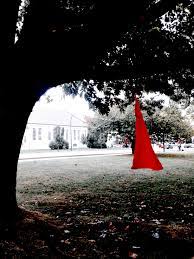
Art installation inspired by Métis artist Jaime Black at Seaforth Peace Park, Vancouver, on the National Day (May 5th) in Canada for Vigils for Missing and Murdered Indigenous Women. Courtesy: Creative Commons
There doesn’t seem to be a sudden red announcement
of anything, this single red shirt hung from a pine tree
on one of my many walks that could end up anywhere
this side of warring night goggle asymmetry
and sliming my strapped way back down to Axmith Drive
I christen distressed jean slugs come out of shell,
reverse Dante out of Hell
from those many paved drives back up on Richardson
that would rather see the world fold in on itself
like amateur origami before whale blubber lipstick
from the tube ever dries to the side of a
face worth kissing.
Ryan Quinn Flanagan is a Canadian-born author residing in Elliot Lake, Ontario, Canada with his wife and many bears that rifle through his garbage. His work can be found both in print and online in such places as: Evergreen Review, The New York Quarterly, Borderless Journal, GloMag, Red Fez, and Lothlorien Poetry Journal.
.
PLEASE NOTE: ARTICLES CAN ONLY BE REPRODUCED IN OTHER SITES WITH DUE ACKNOWLEDGEMENT TO BORDERLESS JOURNAL


 Borderless