Categories
Musings

Distant Worlds Converging on Screens during the Global Pandemic

By Meredith Stephens

Adelaide is half an hour ahead of Japan, and today while in lockdown in Adelaide I keep an eye on the clock so I can join a meeting over 7000 kilometres away in Japan. Ten years ago this would have been a scene in a science fiction novel (at least for me), but now I just have to click a link and I can participate in meeting in a distant place and in a different language. Until now my worlds of Australia and Japan have been hermetically sealed. It has been impossible to be simultaneously present in both, but this crisis has brought them together for the first time. I can sit in front of the screen and attend a meeting in Japan, with the comforting presence of my ageing Labrador snoozing at my feet in Adelaide.

Until now my worlds have been separated by distance, language, culture, friends, acquaintances, food, pets, seasons, flora and fauna. Despite these innumerable differences we share one important commonality — the time zone. Adelaide shares its longitude with Japan and is only thirty minutes ahead in the Australian winter, and ninety minutes ahead in the Australian summer. Few have shared my two worlds other than family, a few friends, and a few students. When I go to check in at the airport in Adelaide the ground staff have never heard of the Japanese city where I live. I am the sole person regularly making this particular commute. I rarely tire of having parallel lives in locations which don’t intersect. My work is in Japan, and when I am there, I commute to the workplace, visit the shops and go to the doctor by bicycle. In spring I can enjoy plum blossoms, cherry blossoms, azaleas, irises and hydrangeas. What’s more, nothing rivals the stark beauty and symbolism of Japanese gardens.
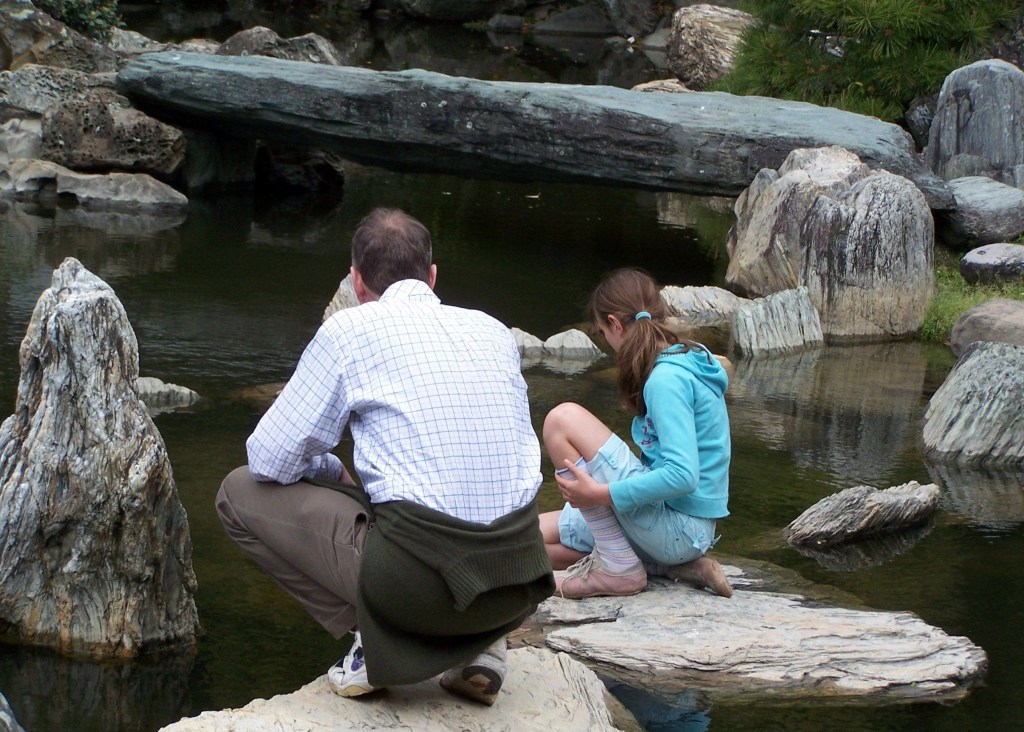
I have Japanese friends, so I can enjoy daily conversations in their beautiful language. I can exchange emails in a language which is flexible enough that it can be written both horizontally or vertically. I also have English-speaking friends, mainly Americans and Canadians. It’s very exciting to make North American friends from such distant places as Arkansas, South Carolina, Philadelphia, New York and Spokane in the US, and Quebec, Ontario and Vancouver in Canada. I could never hope to meet such friends in Adelaide, which is in the southern hemisphere and faces the Southern Ocean. So my world has expanded not just because I am in Japan but also because of my ex-patriate friends.

In Adelaide my world is characterized by immediate and extended family, my doggie, and native birds with distinctive birdsong that you will not hear anywhere else. It is always a great pleasure to arrive in Adelaide back from Japan and be woken early in the morning to a family of cackling kookaburras, magpies, and lorikeets.
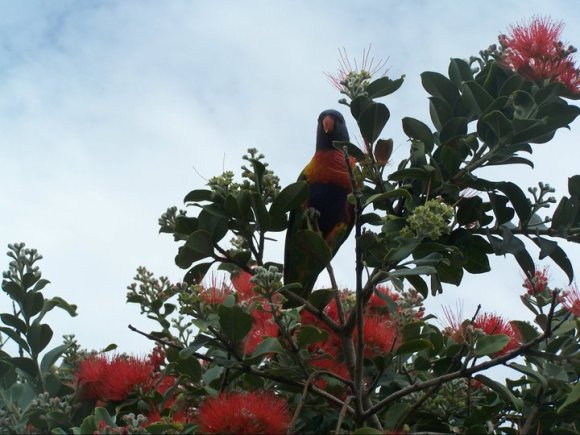
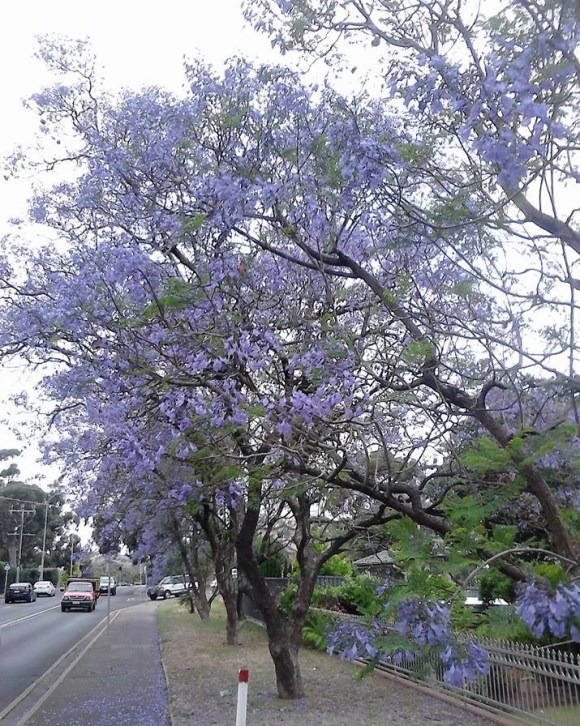
In the older suburbs, the spaces between houses are wide enough that you can forget that you have neighbours and imagine you are living in the country. Japan has taught me to be alert to seasonal change, and has enhanced my enjoyment of the Australian spring, when I can enjoy golden wattle, bottle brushes, eucalyptus flowers, jacaranda and roses.
It’s gratifying to participate in two different cultures and landscapes as I commute between Japan and Australia. However, each side is pulling my allegiance in a different direction. My colleagues in Japan think that I take off to Australia too often, and my family in Australia tell me it is time to come home. Each side seems to be unaware of how important the other side is to me. I feel guilty that I cannot please both parties, but I can give up neither. I hope the decision will be taken out of my hands. There is a word in Japanese to indicate the struggle between two children when they fight for a toy and neither will let go- toriai – and I feel like that toy which is being pulled in two directions.

It has taken a global pandemic for these two worlds to converge. Protecting people’s health has led to Australia’s international and state borders being closed. International flights have been cancelled. My lifestyle of commuting to Japan has come to an abrupt halt. Social distancing has been imposed. Shops, other than supermarkets and pharmacies, are closed. Most medical appointments are now by telehealth. Meanwhile my employer has entreated me to return to Japan and I feel guilty for refusing, but I am frightened of both the trip and being marooned in a country where I have no family.

A hurried solution to this has been online participation in meetings. This has been facilitated because of sharing a common time zone. If I were in America or Europe I might find myself participating in meetings during the night. My hitherto mutually irreconcilable worlds are finally converging. I have been able to click on a link and hear the familiar voices of Japanese-speaking colleagues from the comfort of my Adelaide sofa, with my faithful doggie at my feet. Never has participation in a meeting been so pleasurable. I can listen to my sweet Labrador’s regular deep breathing, progressing to gentle snoring as she rests, oblivious to this international communication. When I rest my eyes on the computer screen during the meeting I see the familiar Japanese writing, and watch the movement of the mouse as the moderator indicates the progression of the agenda. Meanwhile the intense Australian sunshine forces its way through the slats in the blinds. For the first time I might be able to hear kookaburras competing for my attention during a meeting which is being held in Japan. The hermetic seal between these two worlds over 7000 kilometres apart has been punctured, and I feel a sense of relief that the familiar voices of Japanese colleagues can reach me not only in the southern hemisphere, but also on the southern coast of this Antipodean continent.
Meredith Stephens is an applied linguist in Japan. Her work has appeared in Transnational Literature, The Blue Nib, The Font – A Literary Journal for Language Teachers, The Journal of Literature in Language Teaching, The Writers’ and Readers’ MagazineReading in a Foreign Language, and in chapters in anthologies entitled What’s Cooking Mom? Narratives about Food and Family, The Migrant Maternal: “Birthing” New Lives Abroad, and Twenty-First Century Friendship, all published by Demeter Press, Canada.
Categories
Stories

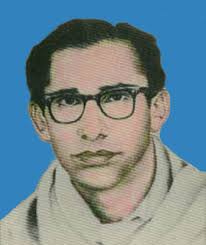
A Balochi Story: The Lost Coin

by Syad Zahoor Shah Hashmi

Translated from Balochi by Fazal Baloch

It was a summer day. The sun was up in the sky. Early in the morning he left for the sea and sat on the shore. There was still a touch of coldness of the last night left in the sands. He cast a look at the tides generated by the wind that blew over the othernight.

The water was shallow and under the mud flat sea insects had dug their burrows. And if someone unmindfully stepped on the mud flat, he would sink knee-deep beneath the ground. Some sixty yards from the sea there stood a few trees, some date palms and a big neem tree. In the morning sun it would cast its shadow as far as to the sea-brink. But as the day began to unfold the friendship between its shadow and the sea would start to fade.

He came and sat by the very shadow. Later when he looked around he found the shadow had long left him. Beyond the neem tree there was a pyramid of sands. From one angle its top looked like the peak of a volcano. Like a dyke, it enclosed some date palms in its depth. Once a beautiful garden, now it lay in utter ruins. There was even no trace of the fence left there. It had become a sort of hideout from the surrounding world.

On the left, a narrow trail passed through the sand. As people continuously treaded on the sand, some of the grains attained cohesiveness and the others flew drifted in the wind. Thus it took the shape of a trail which appeared like the parting of a woman’s golden hair. On the left side of that trail there was a well where people would come to fill their empty pitchers and pots.

All of a sudden a whisper seized his attention. He lifted his eyes up and caught sight of a blind man emerging from the right side of the pyramid. He was led by a girl who held one end of his walking stick. He shifted his concentration to the blind man rather than to the girl. The girl led the blind man to the sea and an hour later they were back on their way home.

He too got up and made his way home behind them. Midway through he exchanged greetings with the duo. At last he was out of the sands. He found it quite difficult to move forward because the trail was littered with grains of sands.

When he walked past the well, his heart skipped a beat. It was the second old stone-walled well located at the farthest end or you can say at the beginning of the sands. He recalled something but soon jerked his head to cast that old memory off his mind but it refused to budge. He felt burning sensation in his head and eyes. He touched his body to determine if he had fever. He was not sick at all. He quickened his steps so that he could reach his destination at the earliest. Suddenly, he whispered to himself:

“It is nice that you go home but nobody lives there. You will be all alone there as well.”

He was right. Nobody lived at his house save himself. He had a good friend but he spent the whole day working outside. At night he would come and they talked together but he too couldn’t give him company for a longer time because he had to look after his family. Again he said to himself: “Loneliness is beautiful but only when one needs it. Likewise it is nice to have someone’s company when one grows sick of loneliness. Today I feel as if I’ve grown sick of my loneliness. I think I should feel such weariness only after the sunset but today it has happened otherwise. My mind has been stormed in the morning.”

He kept moving ahead, wondering. Midway through, an acquaintance ran into him and greeted him. He couldn’t recognise him. He moved fast as if someone had been waiting him for quite some time and any sort of delay would lead to a huge loss.

He slowed his pace and even halted for a while but soon resumed to move forward with quick steps. He was some hundred steps away from his house when his eyes caught someone standing at the corner of the boundary wall that enclosed his house. He bowed his head and began to move with rather slow steps. As he drew nearer, he raised his head and found a woman was looking for something by the wall. He recognised her. Every day she would walk past that way to fetch water. He thought she might have lost her nose pin or ring. He asked her:

“What are you looking for?”
“A rupee.”
“A note?”
“No, a coin.”
“So what?”
“I’ve lost it.”

He also began to look for it. A moment later he raised his head up and found instead of searching for her lost coin she was gazing at him. He ran his hand into his pocket but couldn’t found any coin there. He turned to her: “I’ve no coin on me. Wait I’ll get you one from my house.”
He opened the gate and she followed her in. He searched his coat pocket. She said: “Is there any water at your house?”
“What do you mean by water?”
“I mean drinking water.”
“Yes, there is.”
He picked up the glass to fetch her water, but she took it from his hand and said: “I’ll get it myself.”
She filled the glass, came back, stood right before him and said: “Please drink.”
“I haven’t taken any fatty food in the morning. So, I do not have the urge to drink water.”
“It is summer. And in summer days it feels refreshing to drink water. By the way what did you take in the morning?”
“A cup of tea.”
“What else?”
“Nothing else.”
“Alright. I’ll bring you some eggs.”
“When?”
“Tomorrow.”
He was about to drink water when she said: “Don’t stand and drink.”
He sat on the edge of the cot and said, “But you are standing yourself.”
“I’ll sit down.”
“May I know your name?”
“Mahal.”
“Mahal?”
“Actually my name is Mahatoon but out of affection my mother used to call me Mahal.”
“Are you married?”
“Yes.”
“Any children?”
“I’ve three children but it has been the fifth year since my husband went on a journey.”
“Is he angry with you?”
“No he is not. But once left he never turned back. Occasionally he sends us money but…”
“But what?”
“Nothing.”
“You didn’t ask me my name.”

“I know you since the day you came to live in our neighbourhood. I also noticed your friend who visited you and you kept talking to each other till the midnight. After midnight, you would go out. I wondered where you went at those late hours of the night and when you would return home.”

“But I think you don’t have to do anything with my routines.”

“One night I kept waiting for you and saw you come back at dawn.”

“So, you have been keeping a watch over me!”

“Do you enjoy being alone?”
“Why?”
“Just asking.”
“What do you think?”
After a brief silent she said: “You are not alone anymore.”
“Yes not at least at this very moment.”
One and half hour later she got up to leave. He said: “You didn’t even drink water.”
“You drank and I got my thirst slaked.”
She was about to strolled out of the door when he turned to her:
“But you didn’t take your coin.”
“Which coin?”
“The one I said to give you in recompense.”
“Oh you mean that lost coin?”
“Yes.”
“I got it.”
She scurried forward and at the door she turned back and said: “I’ll bring you some eggs at sunset.”
After she left he was amazed. He began to ponder and whispered to himself: “She found the coin? When? Where? In this house?”
A while later something struck to his mind and he smiled and spoke loudly: “Hmm! The lost coin!”

Syad Zahoor Shah Hashmi (1926-78) is known as the pioneer of modern Balochi literature. He was simultaneously a poet, fiction writer, critic, linguist and a lexicographer par excellence. Though he left undeniable marks on various genres of Balochi literature, poetry remained his mainstay. With his enormous imagination and profound insight he laid the foundation of a new school of Balochi poetry especially Balochi ghazal which mainly emphasises on the purity of language and simplicity of poetic thoughts. This school of poetry subsequently attracted a wide range of poets to its fold. He also authored the first ever Balochi novel ‘Nazuk’ and compiled the first comprehensive Balochi-to-Balochi dictionary containing over twenty thousand words and hundreds of pictorial illustrations.

Fazal Baloch is a Balochi writer and translator. He has translated several Balochi poems and short stories into English. His translations have been featured in Pakistani Literature published by Pakistan Academy of Letters in 2017 and Silence Between the Notes — the first ever anthology of Partition Poetry published by Dhauli Books India in 2018. His upcoming works of translation include Why Does the Moon Look So Beautiful? (Selected Balochi Short Stories by Naguman) and God and the Blind Man (Selected Balochi Short Stories by Minir Ahmed Badini).

Categories
Poetry

Katsaridaphobia/Gospel According to Cockroaches

By Aditya Shankar

1

And the insect haters, repellent sprayers, broom

wielders will eventually reside beneath soil:

the second life. The hand that swats thy loved

ones will lie defenseless. Time of cockroaches

and oppressed shall arrive.

2

Soil will erode like the layers of sandwich. The

one who seeks will traverse its depth. The one

who licks the world shall know and conquer.

3

Our itchy legs shall crawl and penetrate the fire

in the flesh and the temptation of the wood coffin.

4

He who comes digging for forefathers and lost

cities shall tremble at our conquest and return to

house of darkness, referred hereafter as hell.

5

Punish them with your touch. Tease them

with your shadow. Crawl in their nightmares.

Appear as rarely as God among sinners.

6

And when you take an avatar, infest his cup-

board and attic with the thousand children you

beget. Fear shall have no face.

7

The army of your lineage shall be the

messenger of colour. Fire, soil, and life beneath

shall have your shade.

8

Eat the sleep of men and women from whose

country, the messenger never returns.

9

Bore holes in their books and clothes. Plough their

notions until they turn into roads that lead nowhere.

Aditya Shankar is a Pushcart and Best of the Net nominated Indian poet, flash fiction author, and translator. His work has appeared in international journals and anthologies of repute and translated into Malayalam and Arabic. Books: After Seeing (2006), Party Poopers (2014), and XXL (Dhauli Books, 2018). He lives in Bangalore, India.

Categories
Musings

Notes from Kerala: Running during COVID

By Shevlin Sebastian 

Every day, at 6 p.m., I set out from my home in Kochi for a run. In these coronavirus times, I have marked out a route that runs parallel to the main road. For a few days, the cops, in khaki uniform, were stopping cars and two-wheelers but they left the individuals alone. 

I have started running after a decade. During those years, I was swimming. But the pool, where I swim, is closed. The lifeguard has gone home. The club is shuttered. There is a lone watchman in a blue uniform standing at the gate and saying, “Nobody is here.” 

In my mid-fifties, it takes time for my body to move. The legs are stiff, and movements in the arms are negligible. But around 300 meters into my run, a miracle happens. My body shakes off the lethargy, my legs start moving rhythmically, and soon I am gliding across the road. A younger version has taken over. Or maybe, my muscle memory has asserted itself. 

It is a beautiful route. There are large trees with overhanging branches on either side.

Most houses have lawns in front where red and white roses bloom. In some homes, there are vegetable patches at the back. In the concrete jungle of Mumbai, you may have to pay crores of rupees to enjoy this. But in Kochi, these are the houses of middle-class people. How lucky we are!  

Over the rasping of my breath through my open mouth, I can hear birdsong. No longer are auto and car horns and the groaning exhaust of ill-maintained lorries the dominant sound. When I run, I no longer have to look at the road, as no vehicles are coming from the opposite direction, just a stray white dog who looks at me with mournful eyes as if asking, “Where have all the people gone?” 

But they are there, inside their houses, and outside too. 

I see a woman picking up a large blue bedsheet from a clothesline on the terrace of her house. I see a thirty-something woman, in a white nightgown, standing at the door, holding a sleeping baby, with a white headscarf, in her arms, and looking curiously at me. On another terrace, a woman is watering her plants, placed on the parapet, a row of red pots, using a green hose. “Nice colour contrast,” I think. 

On this hot, April summer day, with more than 95 per cent humidity, perspiration starts to drip down my forehead. My breath is rushing out, like water from a burst pipe, through my open mouth. Incredibly, at this moment, I think of my mother. 

Last night, when I went to meet her, she said she was thinking of her father. She said the entire family had gone to the St. Alphonsa Pilgrim Centre at Bharananganam (75 km from Kochi). “My father was about to fall into a deep pit, which was hidden under a canopy of weeds,” she said. “But at the very last moment, he bent and saw it. He said that St. Alphonsa had saved him.” 

It is a big family — many brothers and sisters. A few are scattered all over the world. Three have passed away. Her parents are both dead. Their house has become a private college. Where my grandfather used to sit in a low armchair, a short, squat man, with silver hair and a bald brown patch at the top of his head, in a large hall, where the tick-tock of a large black clock on the wall could be heard clearly, now college students come and listen, with drooping eyes, to the drone of a teacher, who looks bored and sounds listless. He’s been teaching the same syllabus for decades. 

As my mother spoke, I realized that she is an orphan. She can never meet her parents anymore except in her imagination. And in a matter of years, I will be an orphan too, as my father is now 93 and my mother is 83. What would life be like without parents? A friend, who lost his parents, told me that you think of them more when they have passed away rather than when they are alive. 

I run faster and expectedly I can feel a pain in my lungs, as my body tells me to slow down. And so I do. 

I am depressed. I have lost my job in the print media, and my 38-year career seems to have come to an end. What do I do now? Owing to the virus, the economy is at a standstill. And so am I. 

I have a daughter and a son in college. Early marriage, but late parenthood. Two miscarriages roiled my wife’s equanimity. But finally, after nine years of marriage, and several treatments at various fertility centres, God nodded and the babies came. But now, how do I pay my bills, their bills, our bills? Thankfully, my wife has a good job as a counsellor in a college. So, we won’t starve. 

Unfortunately, we have a bitter-sweet marriage. The pattern is one week of sweetness followed by three weeks of sourness. This routine has continued for a long time. “You are too self-absorbed,” she said. “I can’t handle it.” 

We have been married for 27 years.   

I partly agree with her. All writers go inside themselves all the time. You lose touch with the outside. You lose awareness of people and their emotional needs. Which woman likes that?

Since I have slowed down, my breath, through my wide-open mouth, has begun to go in and out easier. One day, there will be the last breath. Which day, month and year will it be? At what time? How old will I be? Who will be around me? Will I be in a hospital room all alone? Will my children be far away? In another country? Will they have any affection left for me? 

And will my wife be still around? Will she be staring at me, by my bedside, as I get ready to leave the planet; will it be a bittersweet moment for her? Sad that I am dying but happy for some crumbs of freedom after I am buried — free at last, free at last, thank God Almighty I am free at last. 

And nobody will point fingers at her, which might have happened if we had divorced. These accusations could have been shouted at her by relatives or our children. But this is the smoothest way to freedom. The bugger died. Not my fault. 

I feel my legs starting to move smoothly again. I think this is a second wind. If I want, I can stop. But I know I can continue if I keep going in this steady manner. Now my body has become like a machine. Of course, it is an ageing machine. 

It was my friend Sanjay who introduced me to running. I was a frail boy with black-framed spectacles, who liked to read books all the time. A nerd. He lived two buildings away on a street beside a large park in Calcutta. I don’t know how we first met, but we were in our teens. He was 6’ and I was 5’ 5”. And he had a passion for tennis. He played it every day at a club inside the park. And to keep fit, he would go for runs on the perimeter of the park. He urged me to come with him. 

“I have never run before,” I said. There is always a first time, he said. So I asked my parents to buy me a pair of white keds, and they gladly did so. They did not like me staying cooped up inside the house all the time. A shy boy with no friends. 

But when I started running, it was a revelation. I had a smooth style. Always, from the very beginning, I felt that I was gliding over the ground. “Man, you are good,” said Suresh, who showed thumbs up to me. There was a reason for his appreciation. He ran in a heavy lumbering way. Of course, he was 85 kgs and this weight proved a hindrance. It came as no surprise that through the decades, he never liked running. 

But I am sure he likes his present-day life a lot. He is a tennis coach at a millionaires’ club in Florida. Through shrewd real-estate deals and stock investments, Suresh has made a pot of money. He lives in a gated community that has a clear lake, an amber-blue swimming pool, a well-equipped gym and a gleaming black Mercedes Benz in his garage. But he has stayed in touch. Calls me once a month. Has retained his Indian accent and simplicity. When in the mood, both of us speak in Bengali, as a nostalgic tribute to our Calcutta roots. A Rajput and a Malayali speaking in Bengali. That’s the beauty of a syncretic India, now under furious attack by fundamentalists who are unwilling to accept that the people they demonise have a soul just like them. 

I am running steadily now. Three elderly men, in white and multi-coloured lungis, stand around, keeping the social distancing norms (Kerala has the highest literacy rates in India, so they know the rules) and chat about the hot weather. I go past. They pause to look at me. May make comments about me after I have gone some distance away. It does not worry me at all. But what I am worried about is the state of my knees.   

A decade ago, fearful that my knees would take a hit since I was always running on tarred roads, I shifted to swimming. And this turned out to be even better than running. Gliding through the water, every muscle getting a workover, especially the lower back, always a point of weakness for sedentary workers, the sense of rejuvenation I felt when I stepped out of the pool after a 45-minute session. There was nothing to match it. My brain became soaked in dopamine.   

And the moment my head hit the pillow, I was out, like a knockout blow to the chin by a professional boxer. 

But now, in the times of the virus, I have to rely on the good old legs but the dopamine that seeps out is a trickle, like the flow of water in a river during the middle of a drought. Still, something is better than nothing. Be happy.  

In the end, I stop running and take out my handkerchief and wipe my face and neck. And keep wiping it as the sweat continues to flow. I walk and walk, till I finally reach my home….an oasis as well as a battlefront.   

Shevlin Sebastian is a journalist based in Kochi. He has published around 4500 articles over 30 years, most of them feature stories. He has worked in Sportsworld magazine, (ABP Group), The Week magazine (of the Malayala Manorama Group), the Hindustan Times in Mumbai and the New Indian Express in Kochi and in DC Books, Kottayam. 

Categories
Poetry

Praying Mantis

By Orbindu Ganga

Painted in a shade 
Rested in her cave,
Silent enough to be staid
To be camouflaged
With the leaves,
Whirling from the obtuse
To touch the straight angle,
She echoes the form
In the way, she looks,
She creeps like a humanoid
To trigger the strive for higher form,
She drafts her movement
Like a saint for everybody’s well-being,
Seeing with a vision in two
To hear them mumble in one,
She was created 
To whisper in the ambiance,
Ingrained with gratitude
To seek the showers of blessings,
From the almighty 
With folded hands to him,
The human opened their eyes
To get intrigued to see the visual.
She stood still 
For as long she could,
Making her the cynosure
For rest to admire,
Showing all the species
The power of prayer,
The mantis is the prophet
Praying for all the species.

Orbindu Ganga is a post-graduate in science and the first recipient of Dr. Mitra Augustine gold medal for academic excellence. He worked in financial, banking and publishing domains, proving his finesse as a Soft Skills Trainer and Content Account Manager (Client Relationship Manager). Orbindu Ganga is a multilingual poet, author, critic, content writer, sketch artist, researcher, and spiritual healer. His poems have been published in many international publications and anthologies. He has published two research papers in poetry. His painting and article have been published in a spiritual journal – Awakening. He has authored the book “SAUDADE.”

Categories
Essay

Rebuilding After Corona

By John Scales Avery

A better world is possible!

It is hard to predict how long the terrible COVID-19 pandemic will last, but at some time in the future it will end, and we will be faced with the problem of rebuilding the world after the enormous economic and human destruction which the disease will have left in its wake. The pandemic has thrown light onto the world’s political and economic systems, and has shown them to be wanting. Most people today do not wish to return to the old normal. That “normal” was part of the problem. The post-pandemic world must be a new and changed world!

Is a better world possible? Of course it is! Our present world is filled with an almost unimaginable amount of injustice, greed and folly. Why is our present world so full of glaring faults? One reason can be found in the slow rate of change of genetic evolution, compared with the lightning-like rate of cultural evolution. We face the problems of the 21st century with an emotional nature that has not changed much since our ancestors lived in small tribes, competing for territory on the grasslands of Africa. Our emotional nature contains an element of tribalism to which militarists can all too easily appeal.

Recovery offers climate action opportunities

When the COVID-19 pandemic is over, governments will be faced by the task of repairing the enormous economic damage that it has caused. The situation will be similar to the crisis that faced US President Franklin D. Roosevelt when he took office during the Great Depression of the 1930’s. Roosevelt, encouraged by John Maynard Keynes, used federal funds to build much-needed infrastructure around the United States. His programs, the New Deal, ended the Great Depression in his country.

Today, the similar concept of a Green New Deal is being put forward globally. This concept visualizes government-sponsored programs aimed at simultaneously creating both jobs and urgently-needed renewable energy infrastructure. The Green New Deal programs could be administered in such a way as to correct social injustices.

A sustainable economic system

Economists, with a few notable exceptions, such as Nicholas Georgescu-Roegen, Aurelio Peccei and Herman Daly, have a cynical tendency to confine their discussions to the short-term future. With self-imposed myopia, they refuse to look more than a few decades into the future. This allows them to worship growth, and to advocate perpetual growth. But endless growth of anything physical, on a finite earth, is a logical impossibility.

Our present financial system is unsustainable, and it works for the interests of a few very rich people.  For the sake of the long-term future, we must build a sustainable, steady-state economic system, an economic system which reduces inequality, and which serves the broad public interest, an economic system with both a social conscience and an ecological conscience.

A new freely downloadable book

I would like to announce the publication of a book, which discusses the changes that we must make to create a better world after the pandemic has ended. The book may be freely downloaded and circulated by clicking on this link.

http://eacpe.org/app/wp-content/uploads/2020/04/Rebuilding-After-Corona-by-John-Scales-Avery.pdf

Other books and articles about  global problems are on these links

https://wsimag.com/authors/716-john-scales-avery

https://wsimag.com/authors/716-john-scales-avery

I hope that you will circulate the links in this article to friends and contacts who might be interested.

I hope that you will circulate the link in this article to friends and contacts who might be interested.

John Scales Avery is a theoretical chemist at the University of Copenhagen. He is noted for his books and research publications in quantum chemistry, thermodynamics, evolution, and history of science. His 2003 book Information Theory and Evolution set forth the view that the phenomenon of life, including its origin, evolution, as well as human cultural evolution, has its background situated in the fields of thermodynamics, statistical mechanics, and information theory. Since 1990 he has been the Chairman of the Danish National Group of Pugwash Conferences on Science and World Affairs. Between 2004 and 2015 he also served as Chairman of the Danish Peace Academy. He founded the Journal of Bioenergetics and Biomembranes, and was for many years its Managing Editor. He also served as Technical Advisor to the World Health Organization, Regional Office for Europe (19881997). http://www.fredsakademiet.dk/ordbog/aord/a220.htm. He can be reached at avery.john.s@gmail.com. To know more about his works visit this link. http://eacpe.org/about-john-scales-avery/

First Published in Countercurrents.org

Categories
Poetry

Virus, Unanswered Questions and more…

By Manu Dash

Virus


The ocean is now equipped to endorse swimming.
It’s time to endure the ineluctable annual trip.
The sky mirrors the swashbuckling journey; 
Someone waiting for you at the end of the shore.
Lights will be clouded when you move avoiding the lighthouse;
Use your instinct always before the lullaby disowns its source.
Darkness and sea-storms area package, inclusive of Olive Ridley.
Ignorance will one day fall like baby teeth.
Leading the life of a peacenik is a terrible act.
Have you taken the cutlass with you?
Not necessary that you should use all the things you have;
Throw in everything during the missionary position.
Avoid sand dunes which are nothing but Homeric nods.

An Unanswered Question


The little boy asked his mother,
‘Who made our village river?’

Mother raised her face from
The homework and answered, ‘God’.

‘Has he made our village too?’
‘Yes’ said she.
 ‘Why the inequality in making
 Buildings, roads, and facilities?’

‘Ask these questions with God
When you grow older,’
Mother laughed.

The following year, the boy met God
When his school bus plunged into the river.
But no one knew if he raised the question
Before God. 


Obituary for an Artist


Did he outwalk
The barrage of dreams?

The shadow of helplessness grows taller
Day after day;
Death snatched the singsong soul
With half the morning stroll 
Unfinished under
The pregnant sky.

A rain of tears damp 
The virtual wall; 
The rosary of marigolds 
Appears like spent bullets; 
And the gun salute by the state
Sinks in the arms of darkness.

What’s there in the body
Without the soul;
What’s there in the soul 
Without the body?

You are thirdfourthfifthsixth
May be in this week alone.
Unfinished lines and incomplete brush strokes
Play with the washerman’s canine;
Experience the anguish of eternal waiting.
No one will bother to blame fragile memory
And wait for the echoing rhetoric.

Advice to an Osteoporosis Man Who Loves to Run

After dismantling the long night
Let’s stop running now.

It smells like a joss stick.
Fog captures the road ahead.

I’ll never know
Whose tender hands made these shoes
That chime and kiss our asphalt road of life.

May I donate to you my ancient history
Burdened with false pride and a whine
That may bring numinosity to the soul?

Let’s turn back now.

The days go ahead in their spendthrift way
Before you pray a silent prayer
Where no prayer-flag is in sight.

You may drink the newspapers
Brimming with the retching of time.

(with permission taken from A Brief History of Silence, Dhauli Books 2019)

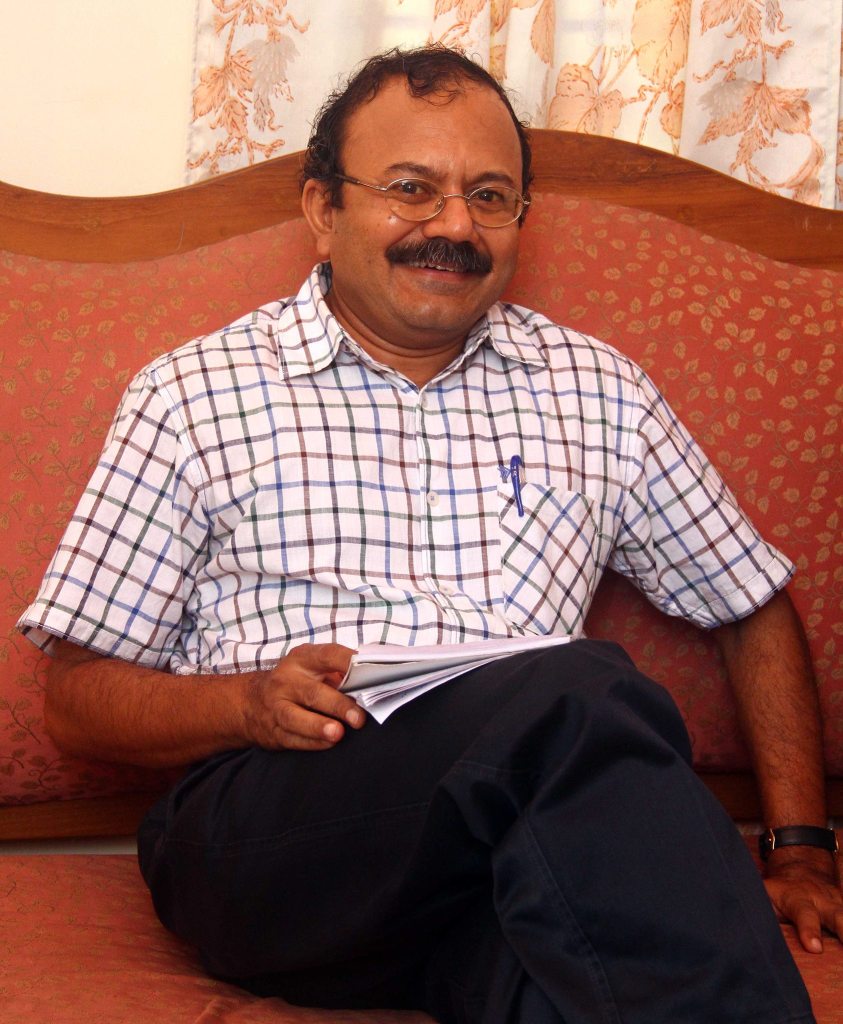
Manu Dash (1956) is a poet, editor, translator, publisher and curator of the annual Odisha Art & Literature Festival. He has published 25 books in Odia and English. While in college, he joined the “Anam Writers’ Movement” — an anti-establishment movement in Odia literature — shortly before the imposition of Emergency in India in 1975. He is the founder of Dhauli Books, which won the prestigious “Publishing Next Industry Award for the Best Printed Book of the Year in Indian Languages” in 2018.

Categories
Essay

Begum Akhtar: The ‘Mallika-e-Ghazal’

By Bhaskar Parichha

‘When I decided to be a singer, my mother warned me I’d be alone a lot. Basically we all are. Loneliness comes with life.’

-Whitney Houston

For Begum Akhtar loneliness came rather belatedly — after her marriage to barrister Ishtiaq Ahmed Abbasi. With marriage came the ban — no music, no concert. How can a Begum sing publicly?

However, Akhtaribai Faizabadi, as she was known before marriage, couldn’t have lived a day without a recital because she was born for it.

Her first guru was Ustad Imdad Khan, a great sarangi exponent. She was also trained under Ata Mohammed Khan. But it was in Kolkata in the early thirties that her musical career took a big twirl. She began learning music from such classical stalwarts like Mohammad Khan, Abdul Waheed Khan and Ustad Jhande Khan. There was no going back after that.

Begum Akhtar gave her first public performance at a very early age — fifteen to be precise and she took the music world by storm.  Sarojini Naidu — the nightingale of India — was so moved   by Begum Akhtar’s singing during a concert organised in the aid of victims of Bihar earthquake that she prophesied the materialisation of a great singer in the young Akhtaribai.

Ghazal singing was Begum’s forte. She cut her first disc for the Megaphone Record Company in the mid-thirties followed by a number of gramophone records carrying her ghazalsdadrasthumris.  What is little known about the ‘Queen of Ghazals’ is that she was a feminist to the core.  Begum lived her life like no other woman till her death in 1974. She had dared to play around with the freedom to make choices in life, revealing a true feminist soul.

With the advent of the talkie era in India, Begum Akhtar acted in a few Hindi movies. In fact, she was the leading lady in films of those times. Ek Din Ka Badshah (An Emperor for a Day) was her first film produced by the East India Film Company of Calcutta. Then came Nala Damayanti (1933).  Like others of her genre, she herself sang her songs. She continued acting and there were a couple of memorable films to her credit: Ameena (1934), Mumtaz Begum (1934), Jawaani Ka Nasha (The Drunkenness of Youth, 1935), Naseeb Ka Chakkar (The Circle of Destiny, 1935). She acted in Roti (1942) — produced and directed by Mehboob Khan — for which she sang six ghazals. The music was composed by melody maestro Anil Biswas.

Begum Akhtar’s association with films continued even after a face-off with Mehboob Khan. Music Director Madan Mohan gave her a chance to sing in two of his films– Daana Paani (Food-Water,1953) and Ehsaan (Favour,1954). Satyajit Ray’s Bengali film Jalsaghar (The Music Room, 1958) was her very last role where she played the role of a classical singer. Begum Akhtar alternated between Bombay and Lucknow in pursuit of her career. She had a stint in theatre too. But her voice needed to be regularly hoisted up. So, she gave up acting in theatre.

Begum Akhtar’s voice matured with time, adding richness and depth. She sang ghazals and light classical pieces in her inimitable style. She has nearly four hundred songs to her credit — an incredible inventory for someone who grew up amid harsh conditions.

A regular performer on All India Radio, she invariably composed her own ghazals and most of her compositions were raga– based. Begum Akhtar had a deep, husky and richly-timbered voice with nasal intonations. In her thumris she blended the Purab and Punjabi styles. She did not resort to taan patterns in a fast tempo. Her dadras were infused with a sprightly mood; her ghazals were thumri-oriented with much scope for improvisation.

The peculiar charm of her voice was easier felt than described. Hers was an extraordinary voice — not ‘round or petal-soft but angular and pincer-like.’ She was known to use a momentary split in her voice, called ‘patti’, which appeared like a crack in the upper register. It is said that her admirers waited for the ‘patti’ to come out when she sang.
Begum Akhtar was a scholar of Urdu poetry too. Her favorite poets were Ghalib, Dadh, Faiz Ahmed Faiz, Jigar Moradabadi, Shakeel Badayuni, and Kaifi Azmi. Many small poets rose to prominence when she selected their lyrics. It speaks highly of her music that she had an impressive following even in regions where Urdu or Hindi was not properly understood. In later years she sang in Bengali and Gujarati too. She taught for a trice at the Bhatkhande College of Music in Lucknow. Her disciples included Shanti Hiranand, Rita Ganguly, Vasundhara Pandit, and Rekha Surya.

The singing sensation’s last concert was held in Ahmedabad. It was here that she fell ill and had to be rushed to a hospital. Death came her way on the 30th of October, 1974 leaving a big void in ghazal singing. She was posthumously awarded the Padmabhushan, the third highest civilian award in India.

Begum Akhtar’s name is synonymous with the notion of ghazal gaayaki*. She immortalized her own definitive style of singing — a style that few have been able to be equivalent. She is fittingly called — Mallika-e-Ghazal.

*The mode of rendition

Bhaskar Parichha is a Bhubaneswar-based  journalist and author. He writes on a broad spectrum of  subjects , but more focused on art ,culture and biographies.His recent book ‘No Strings Attached’ has been published by Dhauli Books. 

Categories
Interview

In Conversation with Physicist-Novelist K.Sridhar

By Nalini Priyadarshni

K. Sridhar

K. Sridhar is a Professor of Theoretical Particle Physics and has published a book Particle Physics of Brane Worlds and Extra Dimensions published by Cambridge University Press. He has an edited volume on Integrated Science Education and more than a hundred research papers in physics.

He is also a writer of literary fiction, has published a work of fiction called Twice Written, a critical edition of which has also been published more recently. He is working on his second novel, provisionally entitled Ajita. He writes poetry though he does not publish his poetry. He dabbles in philosophy, especially of science, and writes reviews of visual art shows. He is fond of doing lectures on rock music and writing short pieces on Hindi cinema on social media. He lives with his wife and daughter in Mumbai. Poet Nalini Priyadarshni unravels his literary journey in an online interview.

Nalini: Thank you so much, Sridhar, for taking time to talk to Borderless Journal. It’s not every day that we get a chance to read literary fiction written by an accomplished scientist. What struck me when I was reading your book was its layered narrative, story within story and eminently relatable characters. Tell us, how Twice Written began? Was it a character or an image?

K. Sridhar: Actually, neither. I think it was the concept. I should remind you that Twice Written was called ‘Palimpsest’ originally and the title was changed only before it was published. It was really the idea of a palimpsest I was working with and about lives being erased and written over. So that is where it began, I think. Of course, as I got into the actual writing, I was drawing on a fund of characters and images that I had stored somewhere in my memory to flesh out the details of the book.

Nalini: Why is the unconscious mind a writer’s best friend?

K. Sridhar: I think it is what the unconscious tosses up into one’s writing that holds a lot of surprise, not just for the reader, but also for the writer. In fact some recurrent literary elements, some shades of a character that one has not even planned out make their appearance in the writing and helps break what would otherwise be very structured prose.

Nalini: Which of your characters of Twice Written do you feel more connected with? Why?

K. Sridhar: I feel connected to all the protagonists in the story. However, one of them, Prahlad is probably closest to the person I am — his story sounds pretty much like my own. But I connect also to the other characters, not just Prahlad.

Nalini: What’s the most difficult thing about writing characters from the opposite sex?

K. Sridhar: Writing any character is a challenge, even if it is ‘someone very much like you’. But when you don’t share sex, region, temporal location, class, caste with your characters it is an even bigger challenge. My own approach is to feel the person and write as honestly as one can about the person.

Nalini: What did you like to read as a child?

K. Sridhar: As a child and as a young adult, my reading was quite eclectic. I read virtually anything I could lay my hands on. But when I was about eight or nine, I read and reread the Mahabharata in English, written by C. Rajagopalachari and really remembered every detail of it. After the age of about 16, I started reading a good amount of philosophy and books related to science. I also started reading poetry seriously around then.

Nalini: What book are you reading these days? Which contemporary writer you enjoy reading the most?

K. Sridhar: Again, I read authors who I have been reading for a long time and it is over a period of time I have read them and my respect for them grows every time I return to them. I don’t worry about their contemporaneity. As for favourites, Borges, Kundera and Calvino are right up there.

Nalini: What authors are you friends with and if they influence your writing process. If yes, how?

K. Sridhar: I have a few friends who are authors, some even very successful and well-known. But I can’t say any on them has influenced my writing. It is partly because they think of themselves as writers and of me as a scientist who writes!

Nalini: E M Forster said “the only books that influence us are those for which we are ready, and which have gone a little further down our particular path than we have yet gone ourselves.” What do you think? Is there a book that left a lasting impression on you?

K. Sridhar: If you want me to name one book, I will probably choose Italo Calvino’s If On A Winter’s Night A Traveller . . .

Nalini: How do you manage being a globe-trotting scientist, an academician, an art critic, a writer and a poet? Did I miss music enthusiast and an avid movie buff?   

K. Sridhar: I think I owe this as much to my wide-ranging interests from an early age as I do to the fact that I do not take any of these tags too literally. I think it also helps that I have a good deal of self-belief so I don’t find it daunting to explore a new area of interest.

Nalini: What is your writing kryptonite?

K. Sridhar: I think for any writer, it would be distraction from what one is working on. Especially for writers of fiction, I feel that distraction can be a problem. It is when one lets oneself get distracted that one could hit a block. It is something one can handle only with perseverance and discipline.

Nalini: How did publishing your first book change your writing process?

K. Sridhar: Even when I was writing Twice Written, I knew I was writing it for myself, for the pleasure of writing. The process of publishing (and republishing – the book has got republished as a critical edition) has, if at all, convinced me even more that I should be writing the way I want to and write what I believe in. If that also appeals to a readership then all the better, if not, there will always be an intimate circle who will read it and appreciate it because they know what effort has gone into it.

Nalini: Do you have any writing quirks? Would you share them with the readers?

K. Sridhar – Nothing very much. But it may interest your readers to know that I typeset my novels using a typesetting system called LaTeX which is usually used for mathematical and scientific typesetting. But because I use it so much it is like second nature to me and so I also use it to typeset my novels with.

Nalini: Do you Google yourself?

K. Sridhar: I did a bit after the novel was just out but, after a while, no.

Nalini: If you could tell your younger writing self anything, what would it be?

K. Sridhar: This is a confusing question for me. I was not so young when I started writing my first novel. And now that I am deep into my second novel I don’t feel very old either. I guess I am the sort who feels that time flows like a river but it hasn’t done much beyond wetting my feet!

Nalini: Let me reconstruct my question, if you could time travel and communicate with Sridhar who had just started writing Twice Written, is there anything you would like to tell him? What would that be?

K. Sridhar: I guess it will be ‘You are off to a good start. Keep at it.’

Nalini: What words of advice do you have for writers just starting out?

K. Sridhar: I don’t want to sound pretentious and “advice” aspiring writers but I think it is good to remember that one writes for oneself. One cannot start writing by positing an imagined reader.

Nalini: Thank you so much once again. It was a pleasure talking to you.

(This interview was conducted via email.)

Nalini Priyadarshni is a feminist poet, writer, translator, and educationist though not necessarily in that order who has authored Doppelganger in My House and co-authored Lines Across Oceans with late D. Russel Micnhimer. Her poetry, prose and photographs have appeared in numerous literary journals, podcasts and international anthologies including The Lie of the Land published by Sahitya Akademi, New Delhi. A nominee for the Best of The Net 2017 she lives in Punjab, India and moonlights as a linguistic consultant.

Categories
Poetry

The Birds in These Strange Times and more…

By Matthew James Friday

The Birds in These Strange Times
A pair of kites have come for the lake
now the airport is closed, buoyed by empty 
skies, rustling wooded hills, lacey waters.

My wife shows me trees on the lake’s
whispering edge where cormorants gather,
roosting in the trees like paused pterodactyls. 

An adult swallow giddy with its suddenes,
rolling in the early April air, the very first
migrant recoiled by a changed climate.


Back to Blue
Imprisoned in caution,
the cases rising, fear abundant,
school closed, classes cancelled.
All online now. I watch
a documentary about Miles Davis.

I have always struggled with Jazz,
berated the lack of melody,
felt lost amongst the jostling notes.
But following his story, the craft
from the chaos, the passion in tone

I choose to try again. Back to Blue
starts, and notes sound as alarming
as the online coverage but the jingling 
chords, the blasts of trumpet suddenly 
sounds peace while the world tears. 


Balance

From the balcony I watch a cat
watching a squirrel leaping
from one tree to another, change
its mind, return and scuttle
up and down branches, a slither
of fast fur perfectly balanced,
death either side of sure claws.
The squatting cat tilts its head
as the squirrel becomes branch,
then pads off to draw its own line.

In Rooms, Therefore We Are

The rooms we build define us, shape us, create and consume us.

To function as a modern human is to be in a room: offices, classrooms, waiting rooms, shops, bedrooms, gardens, cafés, libraries, trains, airplanes, theatres, cinemas and stadiums.

Alone or confessing, on holiday, marrying, working or transgressing. Watching or waiting, dancing, defecating or contemplating.

Our own heads are a skeletal room we stare out of; thoughts, ideas and words bouncing around the bony walls. Billions pray to be safely ushered into the everlasting room beyond these rooms, to be reunited with those who were once in our rooms.

The number of rooms make all the difference between a slum resident and a billionaire, freedom and imprisonment; rooms that can be built from waste material or secreted into yachts; rooms that only the most valiant warriors can ascend to while others descend to the deepest unreachable rooms.

To feel free, we leap over the walls to the open, roomless countryside, though we return to rooms at night or make them using tents. We stare deeply and longingly into the blinking night sky, wondering if there are rooms on other planets like our planet, which is one giant, spinning room, moving through an ever-expanding room.

Even the atom itself is a kind of theoretical room, built mainly of nothing, of potentially something through which hums the moments of energy that we use to build up all the matter around us.

         Perhaps we love rooms because that is where we began, in our mother’s warm interior room; safe from everything outside and other. Perhaps it is the safety of this dark, nourishing room that is the shadow between every room thereafter.

As children we build pretend rooms, hide in them from the monsters that sneak into our rooms, that lurk in their own dark spaces in the corners.

As adults we spend days rushing in and out rooms. Now, confined to our rooms in fear of that which knows no walls, we are more thankful than ever for the walls. We stare at each other from balconies and buildings, all afraid in our rooms and wondering when the doors will open again.


Matthew James Friday has had poems published in numerous international magazines and journals, including, recently: All the Sins (UK), The Blue Nib (Ireland), Acta Victoriana (Canada), and Into the Void (Canada). The mini-chapbooks All the Ways to Love, Waters of Oregon and The Words Unsaid were published by the Origami Poems Project (USA).
Website:      http://matthewfriday.weebly.com