Categories
Review

‘A rich tapestry of narratives’

      Book Review by Meenakshi Malhotra
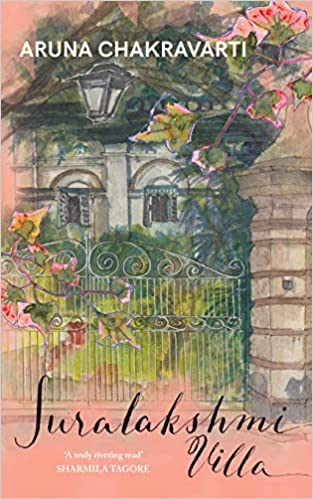
Title: Suralakshmi Villa

Author: Aruna Chakravarti

Publisher: Pan Macmillan, 2020

Suralakshmi Villa (2020) is a novel based on a short story in a previous collection of short stories by Aruna Chakravarti. In the afterword to the novel, the author explains how the novel came about: Ruth Prawer Jhabvala, on whose fiction Chakravarti had done her Ph.D thesis many years ago, commented how the short story had possibilities of being extended into a novel. In doing so, the author’s redoubtable skills have come to the fore yet again.

In Suralakshmi Villa, Aruna Chakravarti has woven a rich tapestry of narratives of human interest, focusing particularly on women(which is the author’s strong suit)  intertwined with narratives of Bengal’s Hindu and Muslim culture, history , religion art, architecture, myths and folklore in a fusion which can be described as syncretic. All these elements are woven into the narrative in a seamless way, which is in no small  measure  a testament to the author’s immense  storytelling skills.

The novel is essentially plot driven with a diverse and complex cast of characters; it intersperses the main plot of Suralakshmi’s  seemingly inexplicable decision to leave her flourishing career as a gynaecologist, her marriage and life in Delhi with the subplots of a fairly large set of characters, spanning about 6-7 decades across most of the twentieth century. The story narrates the varying fortunes of the family of ICS officer Indra Nath Chaudhuri who chooses to settle in South Delhi, in a milieu which is relatively free of the stranglehold of traditional family norms and customs, along with his wife and five daughters, Mahalakshmi, Kanaklakshmi, Suralakshmi,Dhanalakshmi and Rajlakshmi.  For  all his professional stature, Indra Nath is putty in the hands of his larger-than-life wife, Lakshmi, who rules the roost . Prostrated by depression after the premature widowhood of her sixteen-year-old daughter, Mahalakshmi, she decides to educate her daughters rather than prioritise or focus on their marriages and have them choose their husbands, if at all, in their own time. This decision has varying repercussions. Suralakshmi decides to marry a married man seventeen years older than her, that too at the age of 31.     

Suralakshmi’s  story however is not the only plotline in the novel; in the tangled skein of the novel is also the disparate-but-intertwined story of Eidun and her family, which links this story of domestic abuse with a rescue and redemption narrative of sorts. It also maps the story of Indra Nath’s nephew, Pratul, his coming of age and marriage with Nayantara and  that of their children– Kinshuk and Joymita.  

For a story with such a large cast of characters, the parallel plots are juggled with amazing skill and dexterity. What also redounds to the author’s credit is her handling of the complex timelines as well, as the novel loops back and forth chronologically, covering the better part of the twentieth century from the 1930s to 1998. The plot works in a cyclical and circular way, as it spirals and hurtles  towards its final conclusion, which seems random until its causality is made evident.  There is a conscious and carefully calibrated  structure and architectonics involved in the apparent seamlessness of the novel.

The predominance of the plot and the large cast of characters however come at a cost, albeit a minor one, in the light of what the novel achieves. Chakravarti does not explore the interior psychology of most of her characters barring a few crucial briefly sketched in character traits. Characterisation  is often done through a mirroring effect where the response of other characters convey character traits; also, analogues, contrasts and conversations are used  to convey the varied workings of people’s minds. Thus , Suralakshmi’s decision to marry a philandering bigamist Moinak Sen is conveyed through the outrage of her sisters and her stubbornness and intransigence comes up in the course of Pratul’s conversation with his docile wife, Tara or Nayantara. Her impulsiveness is conveyed but  not the inner-workings of her mind and both her ‘love’ and the conjugal bliss that follow are not entirely  convincing.

In a different register, while Eidun and her sisters-Ojju, Meeru and Jeeni’s stories are convincing in their depiction of the oppression  and  travails  of women in impoverished Muslim families, the tale of domestic abuse raises some questions. There is of course the generational aspect of it with the saga of dispossession  portrayed  in the stories of their mother, Ruksana  and the grandmother, Zaitoon-Bibi` as well, but the depiction of the Muslim male as depraved and amoral does leave one with an edge of discomfort. It seems too stereotypical, too pat and cliched,  too two-dimensional. While misogynistic patriarchies and toxic masculinity is not restricted  to  one religious group, in the novel it is one religious group that bears a disproportionate burden of it. The uneducated lower class Muslim men hardly bear comparison with the educated  upper class Bengali men (mostly Hindu) in the novel, and while this disjunction may have  been  created by the exigencies of the plot, it does leave one with a niggling sense of discomfort.

Having said that, Suralakshmi Villa is a tale well told, on almost every count. The unsentimental treatment of motherhood is worth commenting on and when Suralakshmi decides to leave Kinshuk in Delhi with his father, we are made to realise her alienation and her affiliations. She comes across as a dignified and idealistic figure, in her steadfast commitment to protect Eidun, a responsibility she has taken on herself. Even if Suralakshmi’s — and others’ — lives are embedded in a web of materiality, her decision, dignified and noble, transcends her immediate material conditions.

Suralakshmi’s decision to go away and start a charitable hospital in Malda, is depicted in the novel as an act of conscious choice, although it  is  a choice which elicits surprise from others since she leaves her house to Moinak, her errant husband and his offspring. 

Suralakshmi goes away with Eidun, leaving  her son  Kinshuk in the care of his father, with no evident sign of regret or a backward glance.  Her decisiveness here comes as no surprise since it chimes  in with what we know of her already. Even if there is no formal separation, we (and the characters in the novel) are left in no doubt about her intentions. I would go so far as to describe her choice — and her power to choose and live by her choices as feminist, since,  there is definitely an element of agency in the way she decides on a significant moment of transition and then goes ahead with its execution.

Suralakshmi Villa is definitely a welcome addition to the canon of women’s writing in India, multi-textured and multi-layered. Its complexity does not take away from its readability but  adds to its depth and power to attract and hold the attention of the reader.    

    Dr Meenakshi Malhotra is Associate Professor in English at Hansraj College, University of Delhi. She  has edited two books on Women and Lifewriting, Representing the Self and Claiming the I, in addition  to numerous published articles on gender and/in literature and feminist theory. Some of her recent publications include articles on lifewriting as an archive for GWSS, Women and Gender Studies in  India: Crossings (Routledge,2019),on ‘’The Engendering of Hurt’’  in The State of Hurt, (Sage,2016) ,on Kali in Unveiling Desire,(Rutgers University Press,2018) and ‘Ecofeminism and its Discontents’ (Primus,2018). She has been a part of the curriculum framing team for masters programme in Women and gender Studies at Indira Gandhi National Open University(IGNOU) and in Ambedkar University, Delhi and has also been an editorial consultant for ICSE textbooks (Grades1-8) with Pearson publishers. She has recently taught a course as a visiting fellow in Grinnell College, Iowa. She has bylines in Kitaab and Book review  
Categories
Discussion

Rabindranath Tagore: A Universal Bard

Aruna Chakravarti in discussion with Sunil Gangopadhyay

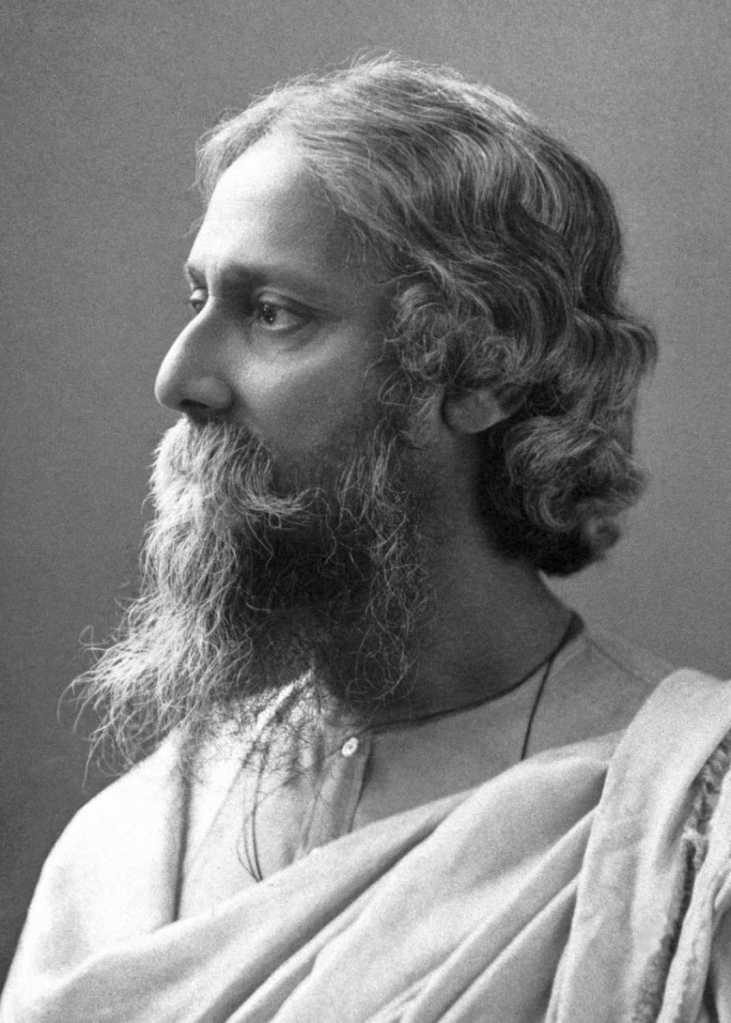
Rabindranath Tagore (1861 to 1941) was born on May 7th. He was a brilliant poet, writer, musician, artist, educator – a polymath — and of course, we all know of him as the first Nobel Laureate from Asia. His writing spanned across genres, across global issues and across the world.

Today to jubilate this great writer on his one hundred and fifty ninth birth anniversary, we have a conversation by two greats of our era. They, like Tagore, are from Bengal — both Sahitya Akademi award winners; Aruna Chakravarti , a writer who has translated his famed Gitabitaan, and she talks about the great poet with Sunil Gangopadhayay (1934-2012), a renowned Bengali author who authored a novel on Tagore in Bengali, Prothom Alo or First Light.  Aruna Chakravarti has translated Gangopadhyay’s novel too and she also has her own novel on the Tagore family women, Jorasanko, which has been a best seller in India.

The conversation brings out the relevance of Tagore in the current day world and more interesting details focussing on responses of modern day writers to his poetry and philosophy. A part of the celebrations organised by Sahitya Akademi to jubilate the 150th birth anniversary of Tagore in Kochi in 2011, it spans the passing of an era in literature. Borderless is very privileged to host the transcript of the discussion that took place between the two giants of Indian literature, on one of the greatest and most impactful writers of this Earth, a thinker and creator who ascends the boundaries of time – our Kobiguru Rabindranath Tagore.

Aruna Chakravarti:  Sunil da. You have maintained in a number of your public statements that, as a young writer, you had no great admiration for Rabindranath. Neither did your contemporaries of the Kallol group. You considered his work sentimental and archaic and wanted to get out of his shadow. Which you did by writing in a very original and dynamic way. Yet, now that you are in your seventies, we see in you a great admirer of Tagore. You have read his works conscientiously. And I’m told you can sing at least two lines of each of the two thousand songs composed by him. Not only that. You have made him the central character of your novel First Light and used the awakening of his poetic inspiration as a metaphor for the awakening of an entire nation. When and how did this change take place?

Sunil Gangopadhyay :   Yes. We were rebels who wanted to write in a stronger, more down to earth and powerful language. We rejected Rabindranath as a model and had mixed feelings about his work. Some of his poems we thought were dated and some others were too long. But that does not mean we did not admire him. We did admire him particularly his lyrics which we knew, even then, would be immortal.

In one of my poems I have said that even if everything else Rabindranath has written dies out with time — his songs will live. My friends and I used to compete with each other as to who knew the greatest number of his songs. We would spend our evenings singing Rabindra Sangeet and reciting his poems. Some of us could recite reams of pages. But it is true that we admired him in private and rejected him in public. We made our dislike of the Rabindra scholars, who lionised  him shamelessly, quite apparent. They declared that he was the last word. That the pulse of poetry had stopped with him. They turned him into a god.

We couldn’t accept that. We were young and hot headed and reacted strongly. And sometimes we used abusive language. One of my friends declared publicly that he had kicked out a collection of Rabindranath’s poetry. But, in reality, nothing like that had happened. And we hated the term Gurudev. Why Gurudev? Why such blind adulation?

Aruna Chakravarti:  Has any of your work been influenced by Rabindranath’s?

Sunil Gangopadhyay:  No. We tried, very cautiously, not to imitate Rabindranath and if we found the faintest traces of imitation in the work any of our friends, we ridiculed him.

Aruna Chakravarti:  I don’t mean consciously. And I’m not referring to your early writing. Later, when you realised the value of his work, did it not rub off in any way? Subconsciously perhaps?

Sunil Gangopadhyay :  Can any Bengali writer escape Rabindranath? I’ve learned the basics from him. Poetic structures, the use of rhymes and metres—from where else did I learn all this?

Aruna Chakravarti :  Sunil da.  Though you started writing while still in your teens it was exclusively in Bangla till 1987, when your novel Arjun was translated into English. Which makes it a little over a couple of decades that you started reaching out to a Western readership. Something similar happened to Rabindranath. He wrote from childhood upwards in Bangla then, suddenly, chose to turn bilingual at the age of fifty when he translated the lyrics of Gitanjali. Why do you think this happened? As I see it neither of you had any particular compulsions to make your work a part of the literature of the West. Please share your thoughts on this in the light of your own experience.

Sunil Gangopadhyay:  Rabindranath had travelled widely by that time. He, as we all know, was the most widely travelled man of his times — a kind of roving ambassador for India.  He had met many eminent men and women from other countries who were impressed with his personality and curious to know what and how he wrote. They urged him to translate his work. And he did so. That was the primary reason. His family didn’t think much of this endeavour.  Dwijendranath Tagore, his eldest brother, writes in his Memoirs that one day he saw Rabindranath lying on his bed with books and papers spread out before him. On asking him what he was writing Rabindranath told him that he was translating some of his work because the sahebs wanted to read it. Dwijendranath was quite annoyed and told his younger brother, ‘If the sahebs want to read your work they should learn Bengali.’ People did not care for translations then. Bankim translated his own work but did not like them at all.

Aruna Chakravarti: And what about you? You have said, often enough, that you are perfectly content with your Bengali readership and with using Bangla as the sole language of your literary expression. Yet you did commission translations of your work. Why was this?

Sunil Gangopadhyay: Aruna, I must tell you that I’ve never, in my whole life, requested anyone to translate my work. People have done it. I have not stopped them. There is a reason for it. I consider myself a poor writer and believe that my books do not merit translation. I do my best but genuinely believe that a really good and perfect book still remains to be written by me. Besides my English is not so good. I can’t tell if the translation is worthwhile or not. You have done an excellent job. People who know English tell me that your translations are better than the originals.

Aruna Chakravarti:  Really Sunil da! Please don’t embarrass me. But let’s move on from this to another point.From the advent of English education in India writers have sensed a tension within themselves regarding choice of language. Michael Madhusudan and Bankimchandra began their literary careers in English then switched over to Bangla. With Rabindranath the opposite happened.  But not quite. He continued to write prolifically in both languages. But it seems as though he chose English for certain genres and Bangla for others. English—to express his ideas on politics, religion, education and philosophy. In short, he chose to use it as a language of communication with a wider world. But Bangla was the language of his heart. It was his language of communion—the language of his music and poetry. Here I’m reminded of the song Gaaner bhitor diye jakhan dekhi bhuvan khani (I see the universe through my songs) in which he concedes that it is only through his music that he can commune with God and all created things. And, though he doesn’t say so, the fact that he can do this only in Bangla is implicit.  It is interesting to note that he did not write a single song in English. He could have done so. He was sufficiently knowledgeable about Western music and his English, too, was impeccable. We see traces of Western influence in some Bangla songs. But he never, ever, wrote an English song.

Sunil Gangopadhyay:  Quite true. He loved Bengal and the Bengali language. He travelled to so many countries and wrote so much during those times. But the places he visited are conspicuous by their absence in his poetry. Even during his travels, the focus of his songs and lyrics were fixed, unwaveringly, on his own land. Wherever he went — be it Iran, Italy, England or Argentina — he never recorded his experiences there in song. Rather, whatever he composed during those times, reflected the melancholy of parting and a bitter sweet nostalgia for what he had left behind.

Another thing.  Rabindranath always maintained that the English renderings were not good. And I agree. Leave alone the works of others even his own translations are a feeble shadow of the original. Sometimes I wonder why Yeats and Rothenstein liked his English Gitanjali so much. It is nothing compared to the Bangla. And I don’t think his best work has been translated. There are no good translations of the poems of Balaka and Purabi. His work in English are remarkably slender.  It runs into 56 volumes in Bangla and in English we have only four.

Rabindranath may have been a world writer in his views, but he had the heart and soul of a Bengali. He loved Bengal and loved her language. During the Partition of Bengal in 1905, when the language was threatened, Rabindranath came out on the streets, for the first time in his life. He was not that type at all. He hated publicity. But he led his people in protesting against what he considered was an infringement on the lives of Bengalis and a move to crush them by diluting the power of their language. Fortunately, the Partition of Bengal did not happen in his lifetime. It happened six years after his death along with the Partition of India.

Aruna Chakravarti:  Coming back to your comment that, during his travels, he never composed a song on the land in which he was staying, I am put in mind of the song he wrote in Germany once just before Durga Puja. He wrote Chhutir banshi bajlo…ami keno ekla boshe ei bijane (the holiday flute played… why am I sitting alone in this foreign land). Pure déjà vu! To move on to another aspect of Rabindranath’s engagement with the West — we know that Rabindranath fell back on the notion of Gurukul when he started his school in Shantiniketan. He conceived it as a brahmacharyashram with himself as Gurudev or Preceptor. 

This was an expression of his lifelong discomfort level with the western system of education. He had fared badly in all the English schools to which he was sent including the ones in England. Yet Rabindranath responded enthusiastically to European literature, art and music and even studied the new scientific theories with interest from his early youth. The poetry he wrote in his teens was largely inspired by that of Dante and Petrarch. Another interesting fact is that he had not only read the major poets he was also aware of the obscurer ones. For instance, he had read the boy poet Chatterton and saw a close resemblance between himself and him…

Sunil Gangopadhyay:  Bhanu Singher Padavali (Bhanu Singh’s verses)?

Aruna Chakravarti:  Yes. This was particularly apparent when Rabindranath was writing the lyrics which were published as Bhanu Singher Padavali.  Both young men were incurable romantics and obsessive dreamers who lived in a visionary world they half believed in. Like Chatterton, who concealed his identity behind that of the non-existent medieval poet Rowley, Rabindranath used the pseudonym BhanuSingh — a non-existent Vaishnav poet. Do you see a contradiction between his absorbing interest in everything European and his rejection of it in terms of an educational process?

Sunil Gangopadhyay:  Rabindranath couldn’t stand the rigid discipline of the British public school system. He hated confinement of any sort and the notion of being dosed with quantities of knowledge within the four walls of a school room was obnoxious to him. That is why he fared badly in all the English schools to which he was sent—both in India and in England.

Aruna Chakravarti:  Yes. His brother Somendranath, who wasn’t quite normal as a boy and became distinctly unhinged in later life, fared better.  But Rabindranath’s inability to benefit from a structured system of education wasn’t restricted to English schools. His brother Hemendranath, who had taken charge of the primary education of the children of Jorasanko, told his father often — Robi mon dei na (Robi doesn’t pay attention). His music tutors complained that he didn’t attend his classes regularly and even when he did, was inattentive and careless.

Yet Rabindranath rose to be one of the world’s greatest composers and could be numbered among a dozen of its most learned men. What, in your opinion, lay behind the strange amalgam of qualities that made up Rabindranath? The meticulous self-education he put himself through with no aids other than simple lexicons and dictionaries indicate rigorous self discipline.  A wondrous ability to imbibe knowledge and an instinctive rejection of a formal, structured process of education! How does one explain it?

Sunil Gangopadhyay:   Well. He was a genius Aruna. And who can gauge the psyche of a genius? Or even try to analyse it?  And what is more he developed his art slowly and carefully. He did not rest on his extraordinary abilities. He worked hard at them. He was one of the most disciplined and hardworking men born in this world. He made some mistakes in his life, but doesn’t everyone make mistakes? When he established the brahmacharyashram he did it on the advice of his friend Brahma Vidya Upadhyay. The idea appealed to him, but he did not realise that it was a highly impractical one. Impossible to implement. 

He began by enrolling students without charging fees. But he could not keep it up. He had to sell his wife’s jewellery, even his own favourite watch, to pay his teachers. But how long could these funds last? He couldn’t make ends meet. Finally, he had to start charging fees.

Another defective system he introduced was the observance of caste. Brahmin boys would not touch the feet of Kayastha teachers. But Kayastha teachers would touch the feet of their Brahmin colleagues. Even that had to be given up.

But the great thing about him was that he never failed to admit his mistakes and rectify them. He realised that even a guru has to grow and evolve. And he learned steadily and continuously from the journey of his life. He was truly successful with his experiment of Viswa Bharati, the meeting of Bharat with Viswa—India with the world. He realized that India’s greatness lay not in her ancient system of education but in her ability to assimilate and bring together all the nations and cultures of the world.  Ei bharater mahamanaber sagar teere (In this land of Bharat, rests the ocean of all races of mankind).

Aruna Chakravarti: Very true. But some of the systems he introduced in Shantiniketan have remained to this day.  For example, his belief that a child can learn only if he’s in the midst of nature, which must have been behind the concept of the “open air schoolhe started, is still respected. No class rooms. Learning only on bedis (platforms) under the trees.

Sunil Gangopadhyay:  That was a foolish idea! And it didn’t work. It rains three months in the year in Birbhum and the rest of the year, it is either burning hot or bitterly cold. There are only short spells of pleasant weather in spring and autumn. The open-air school was impractical. It was at best a gesture. And it has remained a gesture. And to tell you the truth—I’ve never understood why Rabindranath had to open a school. He was a poet and should have remained content with writing poetry. Why did he have to pose as an educationist? Where was the need?

Aruna Chakravarti:  The time is running out, Sunil da, and I can see the Chair gesturing to me to start winding up.  I had many more questions and was looking forward to hearing your views on the conflicting Western responses to Gitanjali prior to the Nobel Prize and after. But it looks as though I’ll have to keep it aside for a private discussion. I’d like to end with one observation. Though it is not a question I would be happy to have your response. Many of your admirers, among whom I count myself, are of the opinion that no other Indian writer has come closer to Rabindranath’s prolificity, his vast range of genres and the depth and expanse of his vision than yourself. Many of us see you as Rabindranath’s legitimate successor and feel sure that you will be recognized as such and invested with his literary mantle in the not so distant future. Would you like to respond to this prophesy?

Sunil Gangopadhyay:  Thank you Aruna. But no. I have nothing to say.

Aruna Chakravarti:  Thank you, Sunil da, for your inputs. They have been most interesting and have certainly pushed the borders of our understanding of Rabindranath substantially. Thank you once again. 

 This conversation took place at a Tagore Conference organised by the Sahitya Akademi in Kochy in 2011.

Categories
Review

‘The Cultural Ambassdor of India’

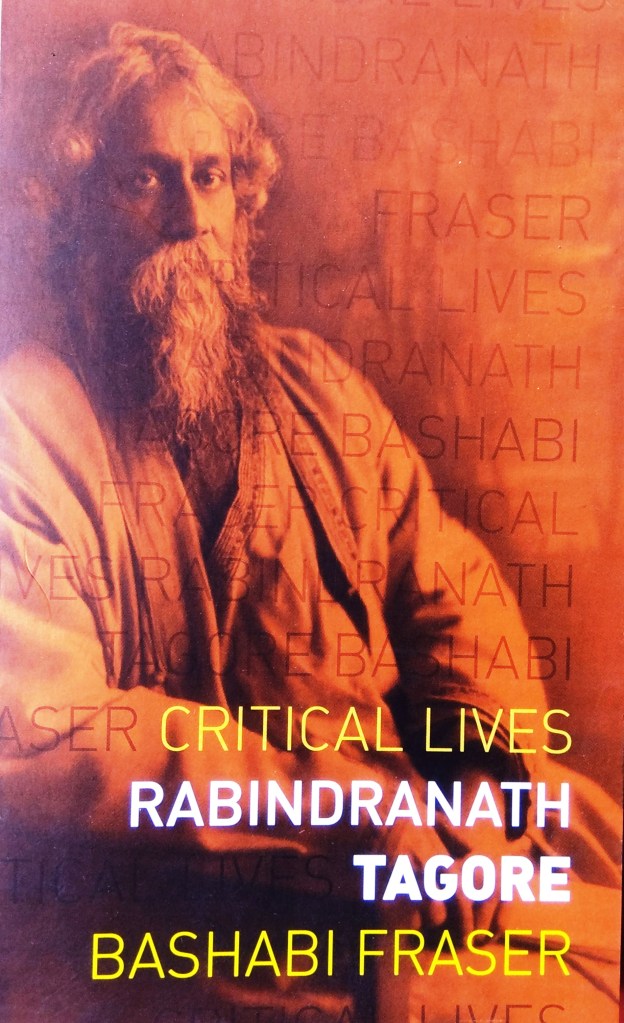
Book review by Bhaskar Parichha

Title: Critical Lives: Rabindranath Tagore

Author: Bashabi Fraser

Publisher: Reaktion Books Ltd- /Speaking Tiger, 2020

Almost even eighty years after his death, Rabindranath Tagore continues to be written about. Any biographical account of Tagore’s life and works — whether it is in Bengali, English or any other language — is attention-grabbing and is received with awe and admiration. Indeed, for the bard whose immortal lines echo even today – Jodi tor daak shune keyo na ashe, tobe aakla cholo re (If no one answers to your call, walk alone) — no number of books is enough to have another look at his great mind, make another study of his brilliance.

Emeritus Professor, co-founder, and Director of the Scottish Centre of Tagore Studies (ScoTs) at Edinburgh- Napier University, Bashabi Fraser’s newest book on Tagore ( Reaktion Books, London/Speaking Tiger Publishing, New Delhi) is a brilliant account of the Kobiguru simply for the reason that it is both enlightening and at the same time perceptive. This discerning and sophisticatedly brought out a book of 250 pages gives a unique insight to Tagore’s life, his experiences in India, Europe, China, and Japan and cites numerous incidents from his life that directly influenced some of his great works.

Says Fraser in the introduction of her book: “this biographical study reassesses the Renaissance man, a polymath, who embodies the modern consciousness of India, engaged as he was in nation-building and contributing to the narrative of a nation.”

Part of the series ‘Critical Lives’ of leading cultural figures of the world in the the modern period, this biography explores the life of the great artist, writer philosopher in relation to his creations.

As the blurb says, “polymath Rabindranath Tagore was the first non-European to be awarded the Nobel Prize for Literature, in 1913. But Tagore was much more than a writer. Through his poems, novels, short stories, poetic songs, dance-dramas, and paintings, he transformed Bengali literature and Indian art. He was instrumental in bringing Indian culture to the West and vice versa, and strove to create a less divided society through mutual respect and understanding, like his great contemporary and close friend, Mahatma Gandhi.”

Even though Annie Besant was the first to call Gandhi a ‘Mahatma’, Tagore made the name popular. In the author’s view, “both Tagore and Gandhi, who were and still remain India’s greatest intellectual and political minds, respectively, continued to depend on each other for mutual support until Tagore’s death in 1941. Both believed that man needed to rely on his inner resources, on truth, love, and compassion to find full freedom to realize himself and fellow human beings as brethren.”

But, then, she sees a difference between the two great men: “While Gandhi was against technological advancement and science, Tagore, as a modernist believed that science and humanities were needed for holistic education and social advancement.”

Divided into a dozen chapters (‘The Tagores of Jorasonko’, ‘Growing up in the Tagore Household’, ‘English Interlude’, ‘Journey to the Banks of Padma’, ‘The Abode of Peace’, ‘From Shantiniketan to the world Stage’, ‘The renouncement of Knighthood’, ‘Where the World Meets in a Nest’, ‘The call of truth’, ‘Waves of Nationalism’, ‘Tagores’ Modernity and The legacy: At Home and the World’) the book has more than thirty illustrations — culled out from various albums.


Besides making a timely re-evaluation of the poet’s life and work, Fraser weighs up Tagore’s “many activities and shows how he embodies the modern the consciousness of India”. She examines in great detail Tagore’s ties with his childhood in Bengal, his role in Indian politics and his interests in international relationships, as well as addressing some of the misreading of his life and work through a holistic standpoint.

Fraser says, “India’s debt to Tagore is immense, and together with Mahatma Gandhi, he remains one of the architects of modern India and India’s primary soft power. Tagore’s liberal humanism and modernity make him relevant today and his place in world literature can be endorsed by a close study of his life, times, and work.”

This intuitive and charmingly written biography of a man who transcended all sorts of borders is a must-read. For someone who is interested in knowing the events which shaped Tagore’s literary career, this concise and yet critical book will be of immense help. More than anything else, the present volume is an indispensable and resourceful guide to know all that Viswakobi Rabindranath Tagore stood for. 

Bhaskar Parichha is a Bhubaneswar-based  journalist and author. He writes on a broad spectrum of  subjects , but more focused on art ,culture and biographies.His recent book ‘No Strings Attached’ has been published by Dhauli Books. 

Categories
Stories

From A Lockdown Diary: On The Lightness Of Being

By Sunil Sharma

Satish never thought that one day he would become a character from The Plague.

He had enjoyed Camus and the pop Hollywood films on disaster and pestilence but soon lost interest.

Unbelievable! Absurd!

Doomsday-projections.

Content produced for the core buffs thrilled by a grim future: catastrophes destroying civilisations; the bleak sci-fi talk of the mid-space interstellar collisions; meteorites decimating populations; apes or aliens taking over as masters — invasions of another kind, unpredictable, unseen events with tragic consequences. An Earth endangered. And a hero, as the last survivor of a devastation, impossible in real time, at least for him.

A big turn-off.

Yet, deep down, the end-of-the-world scenarios— extreme climate change; humans-turned- zombies; androids, apes running the world—exercised a morbid fascination also.

Was it a possibility?

Yes. Floods. Famines. Smog. Pollution. Melting ice. Pessimistic news that could no longer be denied.

One thing he could not escape was this terrible condition — the unseen fate of being overwhelmed by a tragedy of epic scales. Once it began to unravel without a warning, it could leave the planet paralysed.

Apart from terror and racial violence, disease and virus have emerged as new existential threats.

Pandemics could make the master race vulnerable, despite advancements of science and tech.

Naturally such disasters fascinated and repelled the mind.

Now arrives COVID-19.

***

His Mumbai apartment — his entire universe, post-work, shrank down to a cluttered space of 650 square feet. A mere glass cage, suspended in air; the Eastern Express Highway and an arching flyover, few kilometres away, as the bustling backcloth, signs of a busy mega city that never sleeps, a manic Mumbai in over drive — currently, it was in the quiet of a tough quarantine.

A state he never imagined could happen to him or the dream city.

But it was happening, like a nightmare, unspooling like a pestilential movie from Hollywood.

Fantasy becoming real!

He was both horrified and terrified.

Mumbai stalled.

Satish had never seen such a scene — a city of millions in lockdown.

Plague was an actuality.

And he was stuck inside his rented apartment, like a fluttering insect in a glass jar.

From the glass-window, he stared at the deserted highway. Half-an-hour later, he was watching the opposite tower, from the balcony, where families leant out or sat in view of the windows, bored to death by the lack of activity and movement.

It was lockdown.

Fear!

Nothing could ground the wheels of a community like fear.

Mumbai had come to a standstill– like India — first time in history for this length of time.

He was in self-isolation.

For 21 days!

The Plague and Hollywood look convincing, plausible—almost prophetic.

Sometimes art points out the way and correctly maps responses, individual and collective, to a gigantic apocalypse.

I plan to read Camus again and watch pestilence-themed Hollywood flicks.

Satish wrote in his journal.

Some genius suggested in one of the WhatsApp groups, to blog, vlog or write in a diary, one’s innermost thoughts, ideas, fears, joys of living in the vice-like grip of corona virus: “Better try the diary, friends! Write in a neat hand the trials and tribulations of getting quarantined in your own home! Diary writing is a vanished art now! Revive it. Pour out your thoughts, stories, moods, views there. Call it the ‘Jottings of a plague journal’. Or any other name. The important thing is an account of the days and hours spent inside a home turned restricted space, sanctuary, fort or cell—whatever—where an inner or outer transformation takes place. Be creative!”

The idea sounded good.

The only modification: He created an online diary.

He had never felt this limited, immobilized!

For twenty-one days, you were asked to stay inside.

There were rumors galore.

Suddenly, the virus had become global obsession.

Catch-22: If you went out, you would get caught by the cops or the virus or both; if you stayed indoors, you stayed safe. But there was an uncomfortable sense of suffocation within the walls.

He wanted to rush out into the open.

Such moments were terrible!

A sense of claustrophobia and an urge to go to the garden in order to gulp fresh air, reclaim the empty streets, to run and shout from the intersection; talk to the trees and birds — activities never thought of as desirable for a 32-year-old business executive with a travel agency in the Fort area haunted his being.

Break out!

Creativity offered liberation.

Writing.

Music.

These can set you free and make you wander unknown realms!

Satish jotted down his fleeting ideas in the journal, sometimes in italics. Earlier, he had maintained a diary, writing down his feelings as he could not share the pain and sadness of being a shy and poor teenager in a small town. There were things he could not trust with his two close friends.

That is the power of the word.

Life caught on and Satish had forgotten his diary.

Writing had given him an outlet.

He was reminded of the packed guitar.

I will play the guitar.

He jotted down.

Guitar.

Given with this message: “You wanted to play the guitar. A sister’s humble gift to a younger brother. Love from Boston!” He had cried the whole night.

He took out the Hawaiian guitar, unpacked it and felt nostalgic.

***

A home in Ghaziabad. A widow gave tuitions and raised two children.

The sister worked part time and excelled academically. Later on, she went to America on H-IB visa. She sent money to her mama regularly from Boston where she eventually married an Irishman.

Few years later, Satish too joined the agency and moved to Mumbai.

The sacrifices of the mother and sister!

I will write to mother. Request her to come down here.

***

It all started on Saturday, April 4.

It began like the previous day — ordinary and dull.

At 8.30 am, the boss sent a note: “Temporary staff terminated. More heads to roll soon. Recession takes its toll.”

 He panicked. What would happen, if I he got fired?

“Wait and watch,” said the boss.

Satish was on the edge of an abyss.

Instalments? Bills?

Another entry.

“First time I felt vulnerable. Uncertain future. I now understand the pain of the downsized whom earlier I dismissed as incompetent and poor performers.”

9.30 am:

Call from a co-worker. She was tearful: “How should I cope? They fired a lot of people. My husband is already out of job. Two kids. Old mother-in-law in need of medical attention. What should we do?” And more weeping.

“Please, Janet. We are with you. You need anything, let me know.  I have saved some money. I can spare something.”

“No, dear brother! Thanks…” Her voice trails off.

And the call gets disconnected

Moved, Satish writes:

Hope! It sustains the humankind in crises.

10.30 am:

The birdsongs.

It was a revelation. God exists.

Divine notes.

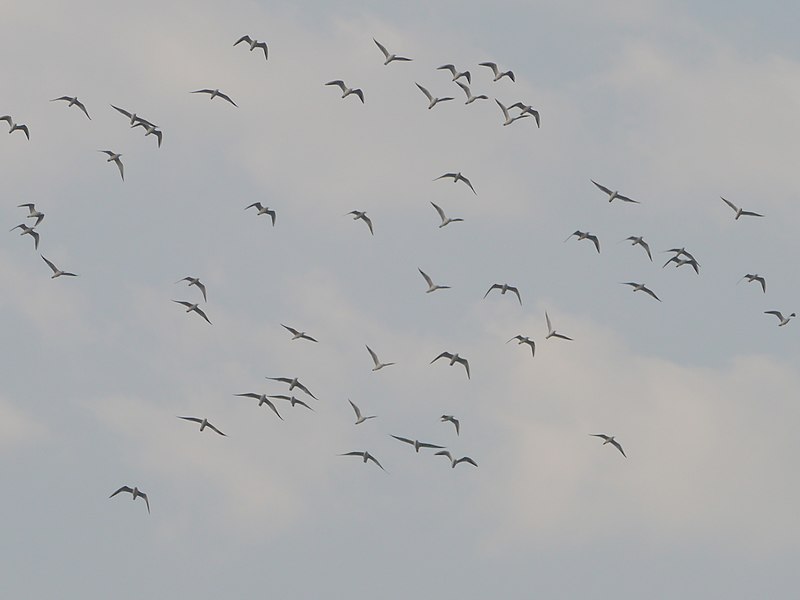
I see the flight of storks, parrots, pigeons, sparrows and crows. And a regal kingfisher.

The birds chirp.

Parrots squawk.

Mynas chatter.

And the song of a nightingale wafts on a fresh breeze from across the salt pens and few wetlands, at the back of the building.

I am hearing these natural sounds in a metro centre — after years.

Sheer delight, this heavenly symphony, confirms the presence of God again for me.

10.55 am:

…I want to fly freely in the space, like the birds!

How precious this freedom!

Give me wings, God, please!

I want to fly.

11.25 am:

Food.

The maid cannot come. I have to cook meals for the day.

Now I understand the value of home-cooked meals made by the women of family.

Wife!

Sakshi is at her maternal home. Must thank her for her daily loving meals that I often did not appreciate. As I have to cook daily, I, now, appreciate the value of her cooking and caring.

Resolution: I will write a thank-you note to mama, sister and Sakshi tonight.

***

Urgent: I must check with the domestic help, if she needs money.

Is she getting her daily meals during the lockdown?

11.55 am:

No response from the help.

God protect her and her family!

What about Chottu? Is he safe? Is he getting meals daily, this young boy from Bihar?

When Sakshi is not here, I go to this street-side cart where Chottu serves hot and sugary ginger-tea in little glasses. He always has a sweet smile, this frail kid with a mop of curly hair. Clad in the brown half pants and a yellow oversized T, bare feet, flitting between the customers and stall owner-cum-tea maker; washing the glasses quickly and then going to the shops nearby for the delivering the orders — it is like a one-boy show.

Everybody calls him Chottu. And loves his golden smile. Some regular patrons sometimes give him small tips. In the night, the boy sleeps in the hand cart only.

I must find out.

And Kaul Saab!

The elderly Kashmiri uncle, two floors above. Kind. Soft-spoken.

Once Sakshi had slipped down in the courtyard of the building, Kaul uncle immediately took her to the doctor in his car—and back.

Evening, he brought fruits to “my daughter Sakshi and son Satish. Anything you guys need, let me know. The retired person will be happy to be of some help.”

We both had felt indebted to this tall and gracious widower living alone in the teeming city.

Afterwards, we occasionally met in the elevator or the lobby and exchange few words.

How is he managing without his domestic help?

I will check with him also on phone, in case he needs something.

12.30 pm:

Got both on the phone!

Chottu was delighted and asked again, “Saab, you sure paying for my meals through the food- delivery app?”

“Yes, son. Sure.”

“Thanks, Saab.”

Kaul uncle was also happy. “Daily meals? Wow! Not tech savvy, though. Cannot handle these basic apps. Much appreciated! I will pay in cash.”

“No, Uncle! Let your son pay.”

“Thanks again for remembering your old uncle.”

5.30 pm:

I have this strange experience:

…I am getting lighter. The sky invites. Birds beckon. The sky is blue and beautiful. There is no smog. The air is intoxicating. I pray to God: I want to soar bird-like in the divine vault and savour the freedom of a vast expanse. Please, God!

Freedom!

And, suddenly, I get smaller, fly out of the window, grow instant wings, begin exploring the heavens, a man-bird in reality.

Amazing!

Up in the air.

The sun winks.

The clouds kiss my flushed cheeks

The birds include me in their joyous flights. I circle with them and describe patterns in the sky, like an expert.

I continue to soar above a city made better by the sights of strays being fed by solitary men; migrant workers being given rations or meals twice every day; cops served with tea and water bottles; the medical professionals presented with flowers — new unsung heroes and heroines — by strangers; trees and flowers grow fast; rivers cleaner; streets quieter; visibility increased: stars appear clearly before my startled eyes.

It is sheer magic!

This post-industrial world unseen, thanks to Corona, opening up, as a dream.

And me — flying and inhaling the fresh wind, so invigorating — over this altered landscape, freely, joyfully; I first time understand the meaning of life, positive living, despite the pandemic, COVID-19, the lockdown, the huge threat of infection and confinement.

The virus has completely destroyed the arrogance of humans as a master race.

Nature is taking back control. And giving lessons.

I keep on flying in my new avatar.

The towers and the city gleam beneath my gossamer wings and a full heart.

The network of twisted roads, almost empty of traffic.

No pollutants to sting skin or eyes.

Birds hop on the asphalt!

As I soar higher, I see the creatures out in the alleys and the highways, people reaching out, in a grand gesture, to those in need, like in a big community.

Liberated!

Free of earthly bonds, at last!

I fly lighter and higher into another realm of evolved consciousness, reality.

Ecstatic, I become one with the elements, in an odd transformation, in time of a pandemic…

Incredible! Is it not?

Sunil Sharma, an academic administrator and author-critic-poet–freelance journalist, is from suburban Mumbai, India. He has published 22 books so far, some solo and some joint, on prose, poetry and criticism. He edits the monthly, bilingual Setu: http://www.setumag.com/p/setu-home.html
For more details of publications, please visit the link below:
http://www.drsunilsharma.blogspot.in/

Categories
Poetry

The Girl Who Went Fishing

By Biju Kanhangad

(Translated by Aditya Shankar)

Beneath the blue waterline,

father’s catch basks in the sunlight: a fish.

The gray-black of crows shroud the pale oar.

Reddish crabs reach the shore, transcending

the festered basket discarded by mom.

In the houseboat, the yellow flowers on

the worn rouka* are still wet.

Unable to submerge the shark, remnants of

the blue spreads into the sky, bawls.

*Bodice in Malayalam, can also be used to see connections

Biju Kanhangad is a poet, painter and post graduation in Malayalam literature. In 2005, he represented Malayalam in the national poetry seminar conducted by Sahitya Akademi. He was awarded the Mahakavi P poetry prize (2013), Moodadi Damodaran prize (2015), Joseph Mundassery Memorial Award (2017), Thamarathoni Kavita prize (2020) and other awards of repute. Thottumumbu ManjayilayoKanhangdu, Azhichukettu, June, Ucha Mazhayil, Vellimoonga, Puliyude Bhagathaanu Njanippozhullathu, Ullanakkangal, Ochayil Ninnulla Akalam, Mazhayude Udyanathil are his anthologies of poems. Essays: Vaakinte Vazhiyum Velichavum, Kavitha Mattoru Bhashayaanu. His poems have been translated into English, Hindi, Kannada, and Tulu.   

Aditya Shankar is a Pushcart and Best of the Net nominated Indian poet, flash fiction author, and translator. His work has appeared in international journals and anthologies of repute and translated into Malayalam and Arabic. Books: After Seeing (2006), Party Poopers (2014), and XXL (Dhauli Books, 2018). He lives in Bangalore, India.

Categories
Musings

What Ramayan taught me about my parents

By Smitha R

Who knew a repeat telecast of a mythological series based on the life of a man/God would set me on the road to new discovery about my own parents. When Ramayan began to be re-telecast on the national television, I had no intention of being glued to it. I am not a big fan of men who abandon their wives, even if they are the Supreme Being/Leader. So, it was a surprise that I ended up watching a whole episode of the series with my family.

Now, you need to understand that the drawing room, where we have our TV, is the war room of my home. It is where all the wars in the family are fought so as to ensure those passing by our house know every minute details of the bombs being dropped. A stranger can walk into our house and determine how the hierarchy works by looking at who has the remote.

It is also the place everyone in my family rushes to while talking loudly on their mobile. They then proceed to glare at the occupants until the television is meekly muted. It is where we have our breakfast, lunch and dinner and where we perform acrobatics sitting on the sofa to avoid getting up when the maid comes to clean the room. It is where my mother finds it necessary to place a chair bang in front of the television so that 80% of the occupants get to watch her back and not what is on the screen.

Since my parents won’t let us have a slice of television time, I have, like a true scavenger, taken to stealing bits and pieces of their fun time. I do it by pestering my parents with intelligent queries about the dumb soap operas that they like to watch.

So, when I sat down together to watch Ramayan, after losing yet another remote war to my parents, I had every intention of ruining their fun. The over- the-top acting, the poor production and the almost hilarious expressions the actors had in the name of emotions gave me enough ammunition. I began a running commentary that could rival that of Navjot Sidhu, the cricket player turned commentator. But my mom was not pleased and she soon sent me to shell some peas. Yes, my mother, the innovator that she is, has over the years devised better punishment-cum-chores for her adult children when they outgrew their ‘face the wall’ disciplining.

As I sat with the peas, I could not but help notice the delight with which my mom watched the series. Her face mirrored every expression that the characters had. I felt bad for trying to ruin it for her and could not help but ask, “Why are you so excited about watching the re-run of a series you watched three decades ago?”

“I never watched it. We did not have a TV at home then,” she replied, still glued to the television.

“What, then how do I remember watching it?” I asked.

“You kids would go with your dad to the neighbour’s house to watch it on a Sunday. I had to cook for everyone, so I never came,” she said in a matter-of-fact tone.

 Suddenly it occurred to me that watching Ramayan on television was not the only thing my mother had given up. I remember going on trips with my dad on his scooter leaving my mom behind as the vehicle could not ferry all five of us. Everytime we went to do all the fun things, my mom voluntarily stayed back because a taxi was a luxury we could hardly afford. Three decades of living with my mom and there were chapters of her life I was never privy to. I decided to shut up and vowed to ask her more about her life as a young career woman with three kids once the episode came to an end.

Since multi-tasking was never my strength, I ended up ignoring the peas and actually watched Ramayan with my parents. While my parents seemed to follow the series, I felt like I had skipped several important chapters in the story.

So, when the episode came to an end, I had several queries. What forced King Dashrath to grant a boon to his third wife Kayekayi? What is Parsuram’s background? How come two avatars of Vishnu happened to inhabit the earth at the same time during Ramayan?

My dad seemed to know the answer to all the questions I had and that is when I discovered what an amazing story teller he is. As a kid, I don’t remember him ever reading us a bedtime story. A voracious reader himself, he bought us a lot of books but never read to us, maybe because he preferred Malyalam and we deviated towards English. I think it was also because both my parents were caught in the struggle to provide the three of us a decent living and at the end of the day, they did not have much energy to do anything other than order us to go to sleep, bedtime stories be damned.

I soon found out that he had extensive knowledge of Indian mythology and could weave a story that could put the best bards to shame. He had read the Bhagavad Gita and the Bible and could quote couplets from them with ease. When had he learned this? How is it that living in the same house I had missed so much about my own father? Why is it that despite having no pressure, I had not taken out the time to interact with my own parents? How had I taken them for granted to such an extent that so many aspects of their life had remained hidden from me?

As I interacted more with my parents over Ramayan I realised that they had earned the right to hog the remote. It was their attempt at ‘having fun’ at an age where their health limited the avenues for entertainment. For them, it was not mindless television watching. It was their way of relaxing after a life spent giving up on things. The way they saw it, it was time for the kids to return the favour.

Smitha R is a former journalist with a passion for travel that often fails to take into consideration her poor financial health. When she is not whipping up a disaster in the kitchen, she is busy distributing ‘an honest opinion’, unmindful of the perils..

Categories
Musings

If all time was eternally present …

By Ketaki Dutta

After almost fifteen days of this ‘lockdown’, I drew a long breath and took up my laptop to scribble away my thoughts. Know not why! Just a way of keeping myself busy, just a mode of whiling away the ‘time’ which otherwise might lie heavy on my heart, cannot say exactly why. Or maybe, being inspired by the ‘lockdown diaries’ penned and shared on Face Book by my friends! Cannot tell you the reason exactly!

 Last night, I sat up till late. Sleep eluded me. Dreams kept streaming in, whenever I was trying to catch forty winks! I gave up my futile attempts to fall asleep and went on reading! A metallic noise vibrated my cellphone. The noise usually cuts through the stillness of my room, in vacant hours when messages, especially ones on WhatsApp, pour in. I felt lethargic. Did not check the messages, went on going through Italo Calvino’s Six Memos for the Next Millennium instead. A beautiful book. It opened up casements on many unknown terrains, quite interestingly. I read and was being informed subsequently.

However, before dozing off finally for the night, I went to check my incoming messages. There was a video-clip sent by a friend, who used to burn midnight oil during school days. I am sure, the habit of staying up late into the night, talking to the moon and stars, is still very much with her. I ignored it and checked the other messages, navigating off. But somehow, some inadvertent press on some button began playing the clip. I did not stop it. Went on watching instead. It was a short film with not more than three small scenes. But believe me, I found myself in a pool of tears when it ended.

You are wondering… I know. For that, I have to share the story, I am afraid, there’s no well-formed story at all, but just a simple narration. Naturally, how can you expect a story to be told in such a narrow compass of say, some 7 minutes or so? Well, let me tell you what happens there actually… 

A little boy rushes to school to attend his classes. Every day, he finds to his utter dismay, that the teacher has already entered the class before him. As he raps on the closed door of the classroom, the teacher asks him to get in. And each day, he feels irked to find himself late for the class. The teacher daily drubs him loudly with a measure-scale on his right palm and the boy never whimpers nor groans in pain. With pain writ large on his face, he takes his seat instead. Tears glisten at the corner of his eyes, but they do not spurt out or course down his cheeks.

He sits at his desk, driving his pain down his gullet. One afternoon, as the teacher cycled through his neighbourhood, he spotted the boy behind a wheelchair. The young boy was pushing the wheelchair with a man with deformed limbs seated on it. The man looked sad.

The teacher felt sad, cast a glance at his watch and paddled off. He could feel the boy’s pain, it seemed. He sighed aloud. Next day, the boy was late to the school as usual. He found the teacher standing with the scale, calmly. He was just looking at him. The teacher had forgotten to utter the curses with which he used to snub him before. He stuck out his hand to his teacher. The teacher put the scale on the boy’s palm, lightly, knelt before him and took him in an affectionate embrace.

The boy was puzzled. He did not comprehend the reason.

The film ended here. A soft piano went on playing in the background. It was soft, but so evocative of many untold emotions!

I shared this clip on my Facebook page with a note saying, “Cannot say why I loved it so much! This language is Latin and Greek to me. I do not teach little kids. But somewhere, somehow, the inner chord felt a tug. A plaintive note issued. A drop or two coursed down my cheeks, unawares!”

Many comments poured in. Many likes and loves followed. I answered only one from among them, delving into my feelings, rather I tried to justify my emotions, “Pain has its own language, expression of love too has. No langue and parole divide can stand in its way! The message rings loud and clear through it all.”

  After downing a few cups of green tea and coffee down my oesophagus, I sat with Italo Calvino. Read a few pages. Was being charmed by his take on poetry. I was really carried away by his notion ‘lightness in poetry’.

I remembered Kundera’s Unbearable Lightness of Being and was trying to imbibe the thought as propagated by Calvino. On the 6th June 1984, Italo Calvino was welcomed officially by Harvard University to deliver the Charles Eliot Norton Poetry Lectures. He divided his lectures into six talks of which I was going through ‘Lightness’ first. While talking about ‘lightness’ he named Cavalcanti and went to talk in length about his poems, at the first place, ‘lightening of language by which meanings are carried by a verbal fabric that seems weightless, until they take on that same rarefied consistency’, secondly, ‘the narration of a train of thought,’ and ‘a visual image of lightness that takes on symbolic value’. I was trying to fathom deep into these notions of ‘lightness’.

Suddenly, I looked out through my open window and the world was getting ready to usher in evening in myriad hues. I was lost somewhere.

Cutting through the silence of my room, the phone rang. I received and at the other end a voice commanded, “So, when are you going to send your essay on Lawrence?” Oh yes, by this evening… I hate to renege on a promise. Hence, after a frugal supper, I sat with the paper on Women in Love by Lawrence and sent it by 1.40 a.m.

  Dog-tired, on a lockdown night, I lay straight on my bed to get transported to the much-desired realm of dreams…surrendering slowly to the inviting arms of the eiderdown…losing myself…drifting into dreams…

Ketaki Datta is an Associate Professor of English at Bidhannagar Government College, Kolkata, India. She did her Ph.D. on Tennessee Williams’s late plays and later it was published, titled, “ Black and Non-Black Shades of Tennessee Williams”. She has quite a few academic publications along with two novels, two books of poems and quite a few translations. She had been interviewed by Prof. Elisabetta Marino, University of Rome, archived by Flinders University, Australia. She won grants for working at American Studies Research Centre[1993,1995], Hyderabad, India. She presented academic papers at IFTR Conference[Lisbon], University of Oxford and University of California, Santa Barbara. Her debut collection of poems, Across the Blue Horizon, had been published from U.K. with the aid of Arts Council, England. Her latest poetry-book, Urban Reflections: A Dialogue Between Photography and Poetry has been published by KIPU, University of Bielefeld, Germany, with Professor/Photographer Wilfried Raussert [photographs of Street Art of Americas]. She has interviewed American novelist, Prof. Sybil Baker, recently for Compulsive Reader. She is a regular reviewer of poetry volumes with Compulsive Reader, USA. She interviewed poet Lucha Corpi of San Francisco, in 2018. She is the Regional Editor, India, of thetheatertimes.com, headed by Prof. Magda Romanska, Emerson College, Boston, U.S.A.

Categories
Poetry

Unconditional Thread & more…

By Vatsala RadhaKeesoon

Unconditional Thread

Born from 
the Divine’s golden thread
Molded with 
perfection, purity and grace
I’m the invisible heart – 
the unconditional thread
ruling the universe

I’m soft
I’m generous
I’m not from 
the Mundane
the materialistic world
the uncanny competitive rules 

I’m omnipresent
but recognized, seen
only by the unadulterated

I, Unconditional Thread
survive in immortal realms
and go on whispering
in every ear
“ Love, love and love
discarding mental blocks
and embracing spontaneity.”


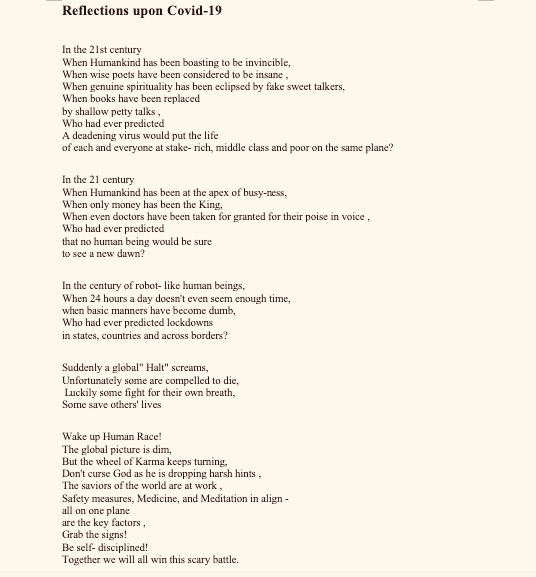
Reflections upon Covid-19

In the 21st century
When Humankind has been boasting to be invincible,
When wise poets have been considered to be insane ,
When genuine spirituality has been eclipsed by fake sweet talkers,
When books have been replaced
by shallow petty talks ,
Who had ever predicted
A deadening virus would put the life
of each and everyone at stake- rich, middle class and poor on the same plane?

In the 21 century
When Humankind has been at the apex of busy-ness,
When only money has been the King,
When even doctors have been taken for granted for their poise in voice ,
Who had ever predicted
that no human being would be sure
to see a new dawn?

In the century of robot- like human beings,
When 24 hours a day doesn't even seem enough time,
when basic manners have become dumb,
Who had ever predicted lockdowns
in states, countries and across borders?

Suddenly a global" Halt" screams,
Unfortunately some are compelled to die,
 Luckily some fight for their own breath,
Some save others' lives

Wake up Human Race!
The global picture is dim, 
But the wheel of Karma keeps turning,
Don't curse God as he is dropping harsh hints ,
The saviors of the world are at work ,
Safety measures, Medicine, and Meditation in align -
all on one plane
are the key factors ,
Grab the signs!
Be self- disciplined!
Together we will all win this scary battle.

Excerpted from Unconditonal Thread , Alien Buddha Press, USA (2019)

First published in Le Defi, Mauritius, April 2020

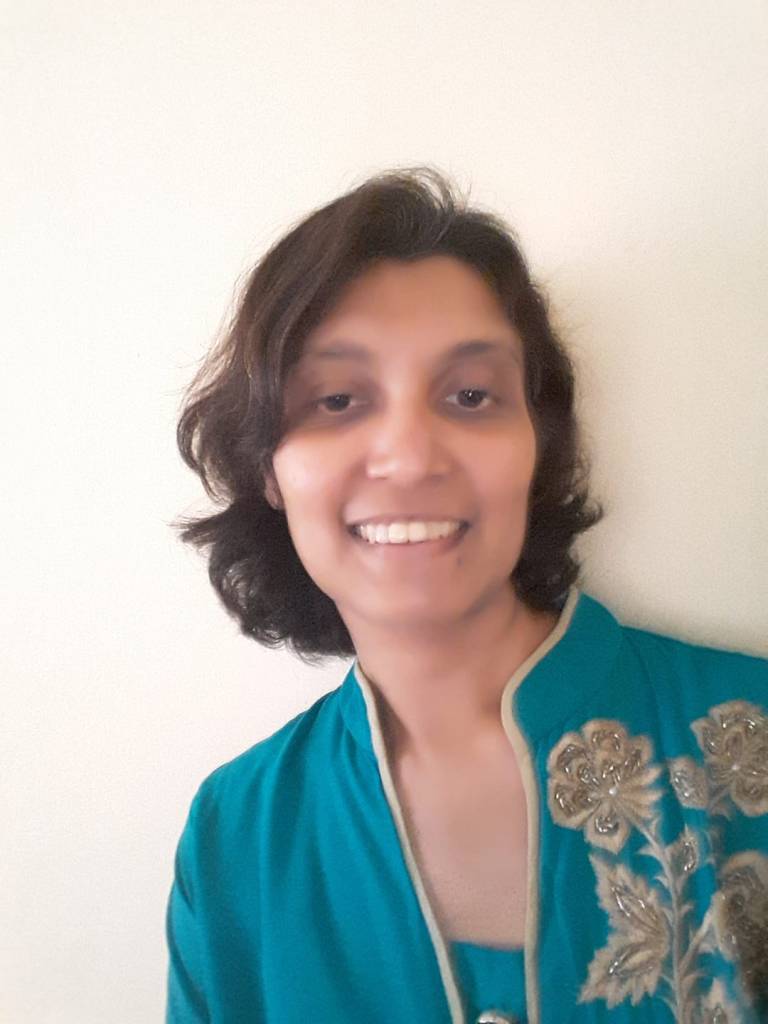
Vatsala Radhakeesoon was born in Mauritius in 1977. She is the author of 8 poetry books  including When Solitude Speaks (Ministry of Arts and Culture Mauritius, 2013), Unconditional Thread ( Alien Buddha Press, USA,2019), and Tropical Temporariness (Transcendent Zero Press, USA, 2019). She is one of the representatives of Immagine and Poesia, an Italy based literary movement uniting artists and poets’ works. She has been selected as one of the poets for Guido Gozzano Poetry contest from 2016 to 2019.  Vatsala currently lives at Rose-Hill and is a    literary translator, interviewer and artist.

Categories
Musings

Embracing Imperfections: Kintsugi Hearts


By Laura Saint Martin

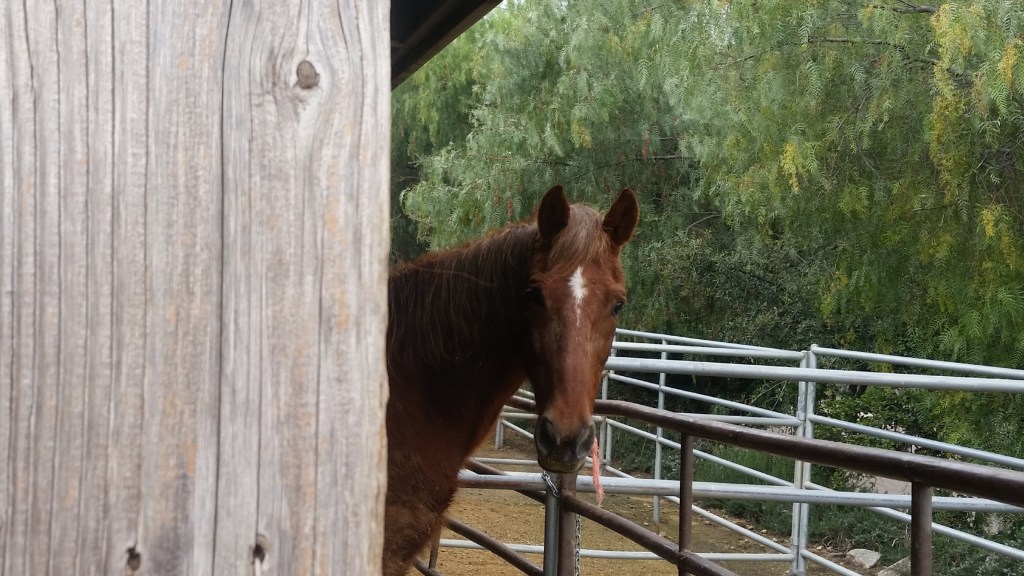
As I wipe the sweat from Pogie’s spotted coat, I think about what horses mean to me. Aside from their centuries of service to mankind, for the work they’ve done and the wars they’ve carried us into, I think horses bring out the best in us. I am especially an advocate of equine interaction for people on the autism spectrum. Horses certainly saved me.

We are not born broken. We are born different. Fear and ignorance break us. Every bad habit broken in schools, hospitals and clinics is a little shard of our crushed spirits. Just as every broke horse is too frightened of consequences to be his true self, we are too frightened to tap out unique creativity. If we excel at something, it is classified as an “intense interest,” a symptom rather than a skill.

My parents shunned applied behaviour analysis. They instead taught me alternatives to my impulsivity. They taught by example. They knew better than to try to bring order to my chaos. so they taught me to give chaos an orderly space to bang around in.

Because my chaos liked to break things.

Broken.

Who isn’t? Good ol’ chaos drops us on our heads all the time, and we break. And we mend. But not perfectly. Like the Japanese art of kintsugi*, we emerge less perfect but more beautiful. Intriguing. We are a story.

When I soothe the seismic skin of my horse, I imagine filling his broken places with trust. This is not easy for him. I’m a predator and he’s prey. I stink of meat and death. But his heart will eventually slow, the surf of his skin becalmed, and he in his turn will flood my cracks with gold.

*Japanese art of mending and philosophy of embracing the flawed or the imperfect.

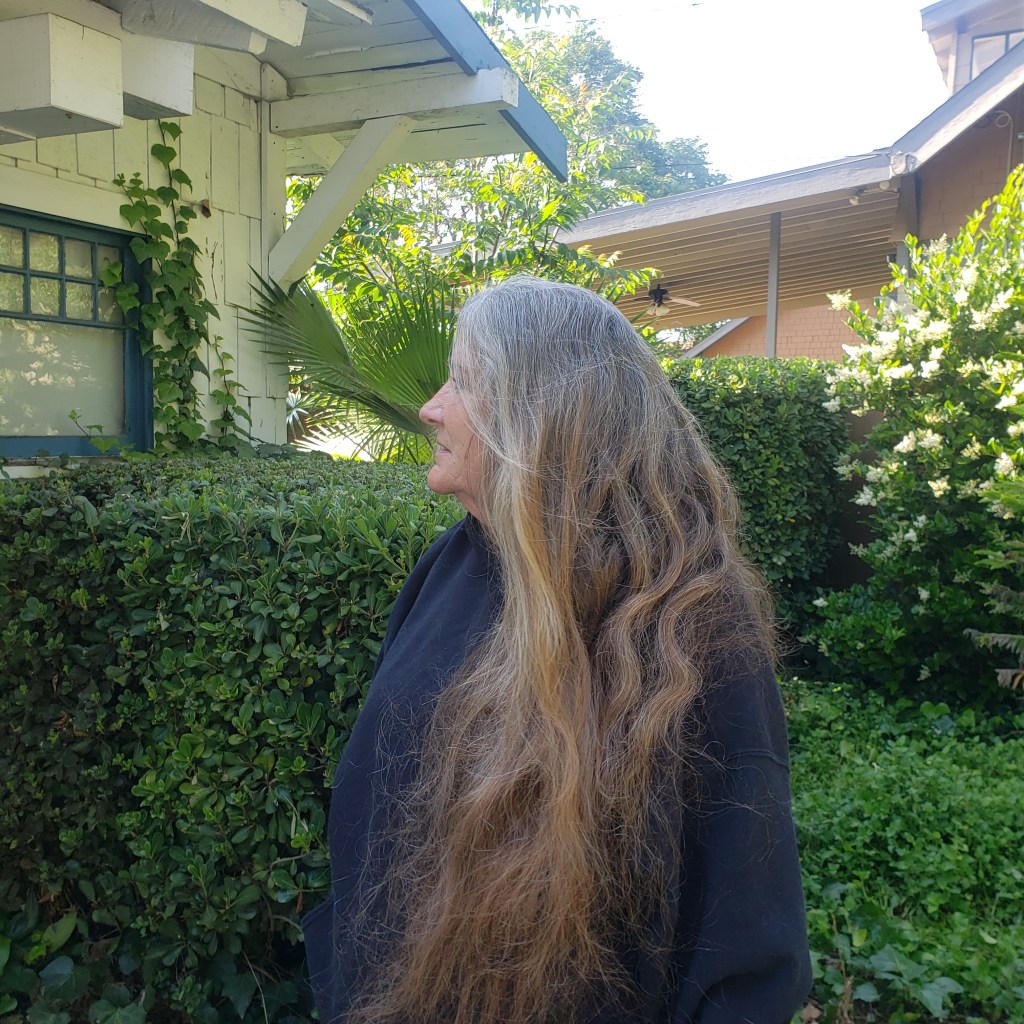
Laura Saint Martin is a semi-retired psychiatric technician, grandmother, jewelry artist, and poet. She is working on a mystery/women’s fiction series about a mounted equestrian patrol in Southern California. Sha has an Associate of Arts, and uses her home-grown writing skills to influence, agitate, and amuse others. She lives in Rancho Cucamonga, CA with her family and numerous spoiled pets, and has dedicated her golden years to learning what, exactly, a Cucamonga is. She works at Patton State Hospital and for Rover.com. She can be contacted at two.socks@hotmail.com.

Categories
Interview

An Interview with a COVID 19 Virus

by Abdul Rashid Agawan

ARA: Well Mr Covid-19, it is said that you are born and brought up in Wuhan.

Covid-19: I don’t know exactly. Some say I was created by Zionists to reduce the world population. There is also an opinion that CIA has launched me to destroy Chinese economy, whereas USA blames that a Chinese lab has fathered me as a biological weapon. Muslims believe that Allah has created me to punish their enemies. Some vegans are of the view that I am an incarnation of God assigned to eradicate omnivores from the Earth. Really, not sure who I am? I remember that when I saw the world in my first encounter with it, I found myself stuck on a toilet wall in the Wet Market of Wuhan from where a lady vendor transmitted me to others and soon I have become almost omnipresent.

ARA: What is your mission?

Covid-19: I feel an internal urge to reform the world. I see how race, nationalism, religion and history are causing sufferings to vast majority of mankind. I see how a section of mankind is devastating nature, its own home. I am against divisive tendencies. Of course, I am against a mankind that failed to respect other kinds of the world. I don’t give value to nationalism. I don’t care for religious hypocrisy. I am not even bothered by masses who elect tyrants. I would like to teach them all a lesson or two.

ARA: You may perhaps agree that there is a natural diversity among people on the ground of race, geography, religion, history and the like.

Covid-19: In my view, they are all differently-one. A tree is a one unit though its roots, trunk, leaves, flowers and fruits appear differently. There is no doubt that mankind is one race with 99.9% common DNA. National boundaries are fictitious. All religions claim their origin from one supreme being. History is just a story book of the past. If they cannot be sure of a few months-long history of my origin then how can they passionately believe in their distant past, including prehistory. Alas! Man lives in his self-made illusion. I am forcing him to come out of this illusion.

ARA: How much you have succeeded in your mission?

Covid-19: First of all, I have prisoned the culprit – man – to further harm anyone or each other. Those who will unfollow my dictates, will suffer. With this global lockdown and two billion homebound prisoners, nature is reclaiming its space. Air has been purified. The rivers are clean. Animals are free to move. The green carpet of the earth is expanding. The ozone layer is healing. Crimes have come down. The shallowness of religious bigotry has been exposed. The ideological polemics are becoming redundant. So much so far.

ARA: But, millions of people are suffering, thousands are dying every day….

Covid-19: I am not to be blamed. It is their own chosen fate. They are free to adopt better system, better leader and better code of life. However, their greed is unparalleled  in nature and almost insatiable, which distracts them from taking a right decision. If man is diminishing thousands of species with billions of life forms in a year, he has no right to claim mercy. There is no one to weep for men.

ARA: What is your advice to people who care?

Covid-19: Man should develop a global system based on justice, freedom, dignity, mercy, equality, knowledge and brotherhood, not only within human society but transcending to all life forms on the earth. Everything has its due share in nature and that should be respected. Greed is catastrophic. Let man learn during my reign the lessons of caring and sharing. Let him break his shell of greed or face the consequences, as I am not going to rest until I fulfil my mission. If I fail, there are more like me in store to join the onslaught. As I have said, whatever is occurring represents a human choice. Man has an option to choose a pleasant future. He will, if he is wise as he claims.

Abdul Rashid Agwan is a social activist, political analyst and author of many books.

First published in Countercurrents.org