Categories
Poetry

An Age-Old Struggle

Poetry and translation from Korean by Ihlwha Choi

Abelard & Heloise, a French painting between 1425-1450
Love affairs are usually secret,
But some must be kept especially hidden.
In the case of Abelard and Heloise*, it had to be secret,
Though no matter how flawless a love affair may be, it is best hidden.
Because even then, it was not declared that God is dead.
Daytime words were heard by birds, and night-time words by rats.
Lotte and Werther*,
Caused turmoil before the expiration date,
Romeo and Juliet*,
Were talked of by people.
A love that has passed its expiration date should blend into the myriad of green like a flowering tree,
But being left desolate like the back of a sandcastle by the sea
Or an empty reed warbler nest in a field
Is a lonely affair.
Though a story ascends high into the peaks of immortality
And a spectacular scene tempered by fiery flames may remain,
In the case of Abelard and Heloise, who heated the Middle Ages,
It was an age-old battle between God and mortals.


*The names of a high-ranking cleric and a young nun in medieval France.
*Lotte and Werther from Johann Wolfgang Goethe’s 1774 novel, The Sorrows of Young Werther
*Romoeo & Juliet (1597, play by William Shakespeare)

Ihlwha Choi is a South Korean poet. He has published multiple poetry collections, such as Until the Time When Our Love will Flourish, The Color of Time, His Song and The Last Rehearsal.

.

PLEASE NOTE: ARTICLES CAN ONLY BE REPRODUCED IN OTHER SITES WITH DUE ACKNOWLEDGEMENT TO BORDERLESS JOURNAL. 

Click here to access the Borderless anthology, Monalisa No Longer Smiles

Click here to access Monalisa No Longer Smiles on Kindle Amazon International

Categories
Essay

From Place to Place

By Renee Melchert Thorpe

Formative years can imply simply a growing body or the development of a complex outlook on life.   My mother, born Mary Ann Hostetler in Pontiac, Illinois, lived her formative years in colonial India.   Here is what I know about two formative migrations that made her who she was.  She was a quick study, a keen photographer, and resourceful traveler, but she also had an uncanny sensitivity to the need of people to feel welcome anyplace.

She had a deeply fond memory of arriving with her family in West Bengal when she was a mere 2 years old.  On the dock of Calcutta, waiting to greet the Hostetlers, was another Mennonite missionary, a man who would escort the family to the mission compound.  Dispatched aloft by her mother, little Mary Ann absolutely “sailed into his arms”, feeling sincere love and comfort from this steady and attentive new man.  He would sometimes take her for walks in the farms and villages, letting her reach out safely.  There was nothing to fear in this new place, and she was allowed to build her confidence.

Crates and luggage would have been handled by porters, a first lesson in India’s system of echelons, privileges and defenses, which even Anabaptists would adopt. India would embrace Mary Ann with her cacophony and vibrancy.  There was always the conservative life at home and in the classroom, but she could escape into the chowrasta[1], eat street food, and read the discarded letters such food was wrapped in.

From the age of 5, she boarded at a dreary school in the extraordinary altitude of Darjeeling, wintered in the rural outskirts of Calcutta, spoke street dialect like an urchin, and learned to draw from memory a Mercator map of the world showing the borders of all the British colonies.  During school break back in her parents’ mission compound, she and her brother might pass time picking fat ticks from the tender hide of a little bullock her parents kept, but her favourite activity in those warm days was to climb an old mango tree which stood just out of range of her mother’s call and read a book.  Any book.  She was never without one.

She and her family made two returns to the US, the first in 1936 for a Mission Board furlough, and again in 1944, when she had graduated from high school and the war, closing in first on the Straits Settlements, and soon after striking the Calcutta docks, was too close for comfort. 

For that 1936 furlough, the family stayed a few days in Calcutta’s Salvation Army hotel while her mother shopped for items to bring back with them to the States.  Her list would have included a tablecloth and sheeting, cotton yardage, British wool, perhaps a few sandalwood items. These things would not have been exotic souvenirs but rather, practical items for their year ahead enduring America’s Great Depression.  They were, after all, the family of a pastor, disinclined to appear exceptional or proud.

Through their Salvation Army hotel window, my mother gazed down at the Fairlawn Hotel next door, where well-heeled families relaxed with tea service on white rattan furniture, children scattered gleefully on the vast greensward, late afternoon birdsong above, and a distant Victrola warbling from inside the forbidden edifice.  She longed to experience such pleasures, and decades later, she did finally stay a few nights at the Fairlawn in 1992, with me, as I had chosen the hotel without knowing its gnawing maneuvers deep in my mother’s soul.

Checking in, we met the flamboyant and zaftig British redhead in charge of the place, my mother’s very age, daughter of the owner from those last days of the Raj.  That woman could scream gutter Bengali at the top of her lungs, and the next moment turn to my mother and politely ask about some little thing important only to little girls from a faraway garden city.  I watched as these two disparate women embraced and laughed together.    

The day she and her own mother arrived in the Los Angeles port of San Pedro, she was astonished to disembark and hear sweaty stevedores yelling and chattering in English.  This told her more about America and what was purportedly its classless society, than any adult’s own description could have.  She thrilled at this discovery.  She was unconcerned about fitting in with new school mates, got along well with them, even though they whispered amongst themselves about “her brogue.”

She never told me anything about her trip back to India, a year later.  But she would have sailed again, stuffed into Second Class.  I imagine her trying to lose her parents, availing herself of the ship’s library.  But I don’t know.

She graduated from Mount Hermon School as the “Best Girl,” although if you visit there, you can discover that the clueless new headmaster from her graduation year neglected to have the big silver trophy emblazoned with her name for the class of 1944.  Her brother’s is there with the year 1943 on the school’s “Best Boy” cup.  But he simply forgot to put in the engraving order when it was Mary Ann Hostetler’s honor.  My mother harbored few resentments, but this was a sore point, as she had worked very hard at academics.

I have never seen Bombay Harbour, where she finally left India as a young woman, but this is what she has told me.  It was wartime, 1944, but she was full of hope and thrilled to be out of that grim and cold school in the clouds.   

Mary Ann and her family boarded a passenger liner repurposed to carry a large number of troops.  A little sister had been born in India, making the family five, now billeted in what was once a First Class cabin, as were other American families leaving India.  Of course, no monogrammed towels or French milled soaps awaited them, but she relished the luxury of portholes and her own bunk.

The ship left Victoria Dock in April of 1944, mere days before the catastrophic accident of the munitions-laden SS Fort Stikine accidental fire and explosion, which destroyed every vessel in the harbor.  Wartime secrecy held successfully for decades, and my mother never learned of the near miss until many years after the war was over. 

All kinds of security measures were taken, even though the atmosphere on the crowded ship was convivial and relaxed. No flags flew.  And they sailed a zigzag course as a precaution against torpedoes.  They were in a convoy with two other soldier and civilian transports, but never saw the other ships except when in harbour.  One of those harbours was Melbourne, where boarded dozens of Australian war brides, and every last one of those young women, my mother said, had a screaming infant.  Those women shared second class cabins.  Two mother/baby pairs had bunks and one pair slept on their cabin floor.

Everyone aboard seemed to be flirting with the soldiers and welcoming distraction.  My mother and her new girlfriends, and even a few of the young Australian mothers, were nurturing chaste romances and enjoying their youth.  It was so much fun, and so stress-free, that my mother looked down at her wrist one day, where there had flourished for many months a large filiform wart, resembling some sort of fleshy agave plant; it had vanished. 

They went through the Panama Canal, a surprise for everyone aboard as well as for their stateside families.  All had been told by the war department that the convoy would land in San Francisco.  Instead, they went to Boston.  Plans were upset, lives were disrupted, and thousands of families who had made their way to California were now faced with crossing the wide country to meet their loved ones.  Typical instance, my mother said, of the war and the US government inflicting the population with whimsy, wasted efforts, or red tape in the name of national security.

To glimpse at last the American flag flying in Boston harbour gave my mother an indescribable feeling of safety and delight.  Worries carefully buried were truly gone.  The war would end in a little over a year’s time.  She had the rest of her life ahead of her.  

The USA was a safe harbour for a few years of university before she was off again, this time to Japan.  Decades later, with an empty nest, she and my father chose Italy.   Migrations were just part of living, and wherever she went, if she met another person displaced by whatever reason, she had a new best friend.  I knew them, too.  The Finnish dry cleaner, the Salvadorian woman who answered the phone at the Honda repair shop, or the Japanese lady who ran an art supply store: these people came from away, and so had she.

.

[1] An intersection of four roads.

Renee Melchert Thorpe has fiction and nonfiction work has appeared in several Asian journals and magazines.

.

PLEASE NOTE: ARTICLES CAN ONLY BE REPRODUCED IN OTHER SITES WITH DUE ACKNOWLEDGEMENT TO BORDERLESS JOURNAL

Click here to access the Borderless anthology, Monalisa No Longer Smiles

Click here to access Monalisa No Longer Smiles on Kindle Amazon International
Categories
Poetry

Fleeting Images

By Wayne Russell

FLEETING IMAGES 

Fleeting images jostling for
a permanent place in the
hallowed halls of my mind,
can't help drowning in my
nostalgia.

I hold her within the sweaty
palm of my hand, the soul of
this candle trembling in the
gentle springtime breeze.

The river continues its journey
effortlessly, lost in the haze of
millennia gone; I can see her in
dark shadows, her ghost drifting

in the abstract of life death and
everything else in-between.

Wayne Russell is a creative jack of all trades, master of none. Poet, rhythm guitar player, singer, artist, photographer, and author of the poetry books “Where Angels Fear” via Guerilla Genius Press, and the newly released “Splinter of the Moon” via Silver Bow Publishing, they are both available for purchase on Amazon.

.

PLEASE NOTE: ARTICLES CAN ONLY BE REPRODUCED IN OTHER SITES WITH DUE ACKNOWLEDGEMENT TO BORDERLESS JOURNAL

Click here to access the Borderless anthology, Monalisa No Longer Smiles

Click here to access Monalisa No Longer Smiles on Kindle Amazon International

Categories
Essay

A Story Carved in Wood, Snow and Stone  

Narrative and photographs by Urmi Chakravorty

As a traveller, I always try to zero in on destinations that are less frequented and hence, more likely to retain their pristine touch. We applied the same thumb rule during our recent ten-day visit to Himachal Pradesh.  Leaving the more popular venues to backpackers and robust tourists, my husband and I reached Sangla Valley to savour three days of undiluted peace and unsullied natural beauty at Batseri.

Situated at a height of 2700 metres (8530 feet) above sea level, Batseri is a postcard-pretty village in Sangla, in the Kinnaur district of Himachal. Our hotel was located right in the middle of an apple orchard – an embodiment of luxury and modern engineering juxtaposed against a backdrop of idyllic charm, antiquated structures and time-worn practices. As we stepped into our spacious room and attached balcony, the sight that greeted us was nothing short of amazing!

Apple orchard

Just outside the hotel boundary lay an enormous stretch of ivory, grey and beige – rocks, pebbles and shingles, accumulated through centuries of weathering and deposition – through which, gently meandered the Baspa with its wealth of shimmering emerald waters. This breath-taking layout was hemmed in by the giant deodar, fir and spruce trees on one hand, and the glistening snow-capped peaks of the gigantic Kinnar Kailash range on the other. The picture was enhanced by a common sit-out area in the patio, where one could plonk down on the quaint, low seats crafted out of timber and have a leisurely breakfast, while the whispering conifers hummed a ditty. Or simply, choose a vantage log-seat at a shadowy spot and catch up on some reading over caffein. The possibilities were endless and we were already rueing the prospect of our departure after a fleeting three days.

At Batseri, our bedside morning alarm was replaced by the natural birdsong. Relaxing in the balcony with a piping hot cuppa and waiting for the sun to peek from behind the peaks was an experience to cherish. We watched in awe as the sky metamorphosed into a fast-changing palette of peach, pink and gold, steeping the entire valley in a warm glow. Men and women, flora and fauna, welcomed yet another chance at renewal and opportunity.

One morning, we set off for a village walkthrough, after polishing off a hearty breakfast. The hotel exit was located about half a kilometre away from the building. The connecting pathway was smooth though quite steep, and was flanked by apple orchards on both sides.

Summer is the time when the trees bear white-and-pink papery flowers, which are eventually blown off by the winds, leaving behind the core, which, subsequently bears fruit. The flower-laden trees, against a backdrop of green grass and snow-capped mountains, were a splendid vision in white. The women working in the orchards seemed a cheerful, gregarious lot who either tended to the apple trees, or prepared the soil for a crop of green peas, red beans and buck wheat – cash crops which can withstand the extremities of nature in these parts. During their break, I found them sitting, sharing tea and chatting animatedly with the owner of the property. Class barriers and alienation of the non-privileged had clearly not tainted this picturesque hamlet, I mused happily.

The same camaraderie and co-existence marked even the simple, day-to-day interactions of the villagers, as we observed later. The highlight of the village was the hallowed temple of Badri Narayan Ji[1], an intricately carved wooden temple which sported a very neat, well-maintained premise. The original temple was destroyed in a fire in 1998 and it was rebuilt with the collective effort of the villagers. The young priest shared a familial bond with the local residents, who, in turn, helped uphold the sanctity and cleanliness of the temple and the shrine. No visitor is allowed to climb up the three steps leading to the sanctum sanctorum – the offerings are collected by the priest and offered to the deity. Nobody — young or old, rich or ordinary — challenges or questions. We had earlier observed a similar austerity in other temples of Kinnaur, as well. In fact, some mandate the wearing of the colourful, traditional Himachali cap for men inside the premise. Women usually have stoles, scarves and dupattas[2] to cover their heads with.

From the temple, a single path led us forward to the village. We met and spoke to the local store-keepers, animal herders, agriculturists, home-makers – everyone greeted us affably and spoke about their lifestyle and community. Their pride in their village and its traditions, along with their warmth and hospitality, left an imprint on my heart. We observed the houses which were a complete and welcome departure from the glass-and-metal structures that we usually see. They were all built of sturdy wood collected from the nearby deodar forests and burnished well to display a sheen. Each house had ample open area where they stowed away firewood and other essentials. There were no fences or barbed wires to demarcate properties. Piles of stones collected from the Baspa riverbank were stashed neatly to make a low boundary between two houses. I remembered noticing a similar demarcation among the orchards outside our hotel, too. Here was a community where people thrived on an innate sense of trust and fraternity; scaling of boundaries, literal or otherwise, was something unheard of.

Motor vehicles were not allowed inside the village, barring a rare two-wheeler, though we did see a couple of cars parked at the entrance. Fluffy, pampered street dogs dotted the paths and slept on the stairways of homes – they formed the extended family of the entire village. Just like the adorable Sheroo, a Bhutiya furry who ruled over our hotel like a boss!

The entire Sangla Valley is on the path to accelerated development with multiple road and hydel power projects being executed at regular intervals. The strong currents of the voluminous Baspa are harnessed for this purpose. These projects form an important source of livelihood for the local residents who cannot engage in extensive cultivation because of the inclement weather and soil conditions.

Enroute to Chitkul

The next to-do on our itinerary was a visit to Chitkul, the last village on the Indo-Tibet border. Perched at an elevation of 3450 metres (11,320 feet), this charming village with its panoramic view of the majestic Kinnar Kailash range and the verdant vistas, is often considered the ‘Jewel of the Baspa Valley’. Our cab took us to the last motorable spot beyond which were located the Army and the ITBP camps. As we stepped out of the vehicle and looked around, we were left agape by the ethereal splendour of the place! The snow-kissed peaks alternated with rugged mountain faces and together, they stood like silent sentinels towering over the sprawling alpine meadows, pockets of dense green woods, and the gurgling, meandering Baspa. The Baspa is fed by the perennial Himalayan glaciers and shares a common catchment basin with the Ganga. Fifty shades of green, all in one canvas, I thought to myself!

Scenic Chitkul

Far away, we spied the Chitkul village, conspicuous by its symmetrical hutments and their colourful roofs.  We walked around the undulating meadows with cautious steps – a reminder for us to embrace the various ups and downs of life with grace and equanimity. The place abounded in rocks, boulders and pebbles of all sizes and shapes which prompted me to make a humble cairn of my own – a modest attempt at preserving my footfall on this slice of heaven!

At a distance, we saw defence personnel going about their duty in a brisk, professional manner, unfazed by the grandeur of their surroundings. As the clock ticked by and the shadows lengthened, we knew it was time to turn back. We drove into the small hub of activity in the village which housed the last Post Office of India and also, its last dhaba[3]. Rows of colourful prayer flags strung alongside the road seemed to whisper prayers for our well-being and safety. Multiple pictures and a hearty meal of rajma-chawal [4]later, we headed back to our hotel in Batseri.

As we approached the premises, our driver pulled up on the side and switched off the engine. There was a pile-up of men and machine, and all vehicular movement was halted. We alighted and ambled forward to probe the matter. The sharp slope leading up to our property had been completely blocked by the sudden uprooting of an ancient tree around noon, its gnarled branches reaching up ominously towards the twilight sky. The administration had swung into action, aided generously by the villagers. The monotonous whirr of the giant chainsaw cutter axing down the tree into large chunks, and the occasional thud of the felled logs, reminded us, yet again, of the unpredictability and difficulty of life in the remote mountains. We strolled around the nearby areas for about half-an-hour before a narrow tract was created on one side for us to walk through. The stranded people — visitors and villagers alike — trundled out.

After spending three memorable days at Sangla, we headed out to our next destination. I spent the last few minutes on our balcony, listening to the gentle susurration that seemed to whisper ancient secrets of the mountains. I admired the patterns created by the play of sunlight through the leaves –- that gave me life lessons in gratitude for these fleeting, beauteous moments of life. As we drove away, I cast one last lingering look at beautiful Batseri –- a fascinating story of life carved in wood, snow, and stone.

[1]Badri Narayan is another name for Vishnu

[2] Stole

[3] Roadside eatery

[4] Red bean curry and rice

Urmi Chakravorty is a former educator and presently, a freelance writer and editor. She has been published by The Hindu, The Times of India, TMYS Reviews, Indian Review, Mean Pepper Vine, eShe, The Chakkar, Kitaab International and The Wise Owl, among others.

.

PLEASE NOTE: ARTICLES CAN ONLY BE REPRODUCED IN OTHER SITES WITH DUE ACKNOWLEDGEMENT TO BORDERLESS JOURNAL

Click here to access the Borderless anthology, Monalisa No Longer Smiles

Click here to access Monalisa No Longer Smiles on Kindle Amazon International

Categories
Poetry

Beneath the Baobab Tree

By R. L. Peterson

Beneath a Baobab tree a black and white cat, body tense,

Black tail straight as a shotgun, legs spring loaded,

Delicate left paw lifted

Claws flashing in the morning sun,

A bushy tailed red squirrel her target,

Ancient instincts at play.

The red squirrel’s companion hidden until now behind the Baobab tree,

Hears the silent warning, leaps over the black and white cat,

His bushy tail waving, his chatter a laugh or a taunt,

A black and white cat and bushy-tailed red squirrels

Playing life and death games

Beneath a Baobab Tree in Long Beach, California.

.

R. L. ‘Pete’ Peterson’s award-winning fiction has graced many publications over the years. His After Midnight – A Short Story Collection, (Pallamary Publishing), debuted in 2019. His novel, Leave the Night to God (Pact Press), is available wherever books are sold. Hisshort story workshops are popular for their practical content andhumorous delivery. As a Marine, Pete served at American Embassies inthree foreign countries. Reach him at petersonwriter9391@gmail.com.

PLEASE NOTE: ARTICLES CAN ONLY BE REPRODUCED IN OTHER SITES WITH DUE ACKNOWLEDGEMENT TO BORDERLESS JOURNAL

Click here to access the Borderless anthology, Monalisa No Longer Smiles

Click here to access Monalisa No Longer Smiles on Kindle Amazon International

Categories
Nostalgia

A Musical Soiree

By Snigdha Agrawal

This was an annual event organised at home, on Tagore’s birthday.  Preparations started a week before ‘Pochishe Boishakh’)[1].

Musical instruments were dusted and tuned, particularly the most used harmonium and tablas. The living room was rearranged.  Chairs were pushed against the walls.  Centre and side tables were removed, creating space for floor seating.  Durries were laid over the carpet.  All the pash balish — bolsters — in the house with freshly laundered covers, placed haphazardly for those wanting to recline.  A space earmarked for the performers, usually against the room’s longest wall.  On this wall hung a fairly large black and white framed photo of Tagore, garlanded with freshly picked jasmine flowers. Not the fully bloomed one.  White buds with short green stems.  We girls were given the responsibility of making smaller wristbands from the jasmine buds, presented to the visitors.  Stalks of rajanigandha (tuberoses) stood erect in tall vases placed on either side of the photo. 

The overpowering smell of jasmine and tuberoses drowned other smells floating in from the kitchen.  A hands-full kitchen as no jalsa[2] is complete without serving the guests chai and piping hot assortment of pakoras — onions, potatoes, brinjal, pumpkin flowers, battered fried crispy brown. Poppy seed-sprinkled vegetable chops, cylindrically shaped, were polished off as fast as they were made and served.  The service continued till the guests left, mouths sweetened with the dessert — usually rossogollas, delivered by the sweet-meat dhoti-clad guy, arriving on foot, carrying gigantic-sized aluminium dekchis[3]balanced on two ends of a pole, hoisted on his shoulder.

It was an open house event for those interested and wanting to join.  There were the regulars and walk-ins as well. Performers and audience.  A manageable crowd most years. Rarely spilling out into the adjacent veranda.  Cane chairs were lined up to accommodate the latecomers.  Ma, a gifted and trained singer had the honour of opening the ceremony with the songHey Nutan, Dekha dik aar-baar janmero prothamo shubhokhan…”[4].  On popular demand, she went on to sing a couple of Tagore’s songs not omitting the song dedicated to Boishakh esho hey boishak, esho…esho. Taposniswasbaye mumushure dao uraye, botsorer aborjona dur hoye jak…”.  [5]A song that has been on our minds, with the current heat wave raging throughout the country.

As the evening progressed there were recitations from Tagore’s poetry collection.  A young couple, Soumenda and Rinadi, our neighbours, had the gathering spellbound with their singing and poetry recitation.  Close neighbourhood friends of ‘Puluda’, the affectionate nickname of the famed actor, the Late Soumitra Chatterjee, the talented couple were in demand at many such musical soirees held on Vijaya Doushami[6] in community clubs.  And through them, we met the greatest Bengali screen actor of all time, on many occasions, when he visited after the day’s outdoor shooting in the picturesque surrounding in Maithon and Panchayat, way back in the 1960s. 

With our leaving the gated community complex in 1968, ended the annual Rabindra Jayanti home celebrations. A not-forgotten era.  Rabindranath Tagore lives on. These days, I listen to Rabindrasangeet on YouTube, remembering the days of youth, Ma’s full-throated voice, and Somenda, and Rinadi regaling us with their practised/professional voices. Pakoras are replaced now with sushi.  God rest their souls. 

.

[1] The 25th day of the Bengali month of Boishakh, recorded as the official date of birth of the Rabindranath Tagore in 1861. As per the Gregorian calendar, the date falls between the 7th or 8th of May.

[2] Musical soiree

[3] broad-rimmed cooking utensil with a flat round bottom

[4] Oh ever new!/ Let my eyes behold once more/ the first blessed moment of birth.- Translation by Aruna Chakravarty, Borderless Journal

[5] Hail O boisakh! Welcome./ Blow away deadly diseases with your ascetic breath./May the debris from the old year disappear. – Translation from Borderless Journal

[6] Last day of Durga Puja

Snigdha Agrawal (nee Banerjee) has published four books and is a regular contributor to anthologies.  A septuagenarian, she writes in all genres of poetry, prose, short stories and travelogues.

PLEASE NOTE: ARTICLES CAN ONLY BE REPRODUCED IN OTHER SITES WITH DUE ACKNOWLEDGEMENT TO BORDERLESS JOURNAL

Click here to access the Borderless anthology, Monalisa No Longer Smiles

Click here to access Monalisa No Longer Smiles on Kindle Amazon International

Categories
Poetry

In Exile

By Rinku Dutta

“In exile, you are an uprooted tree. Naked.

Leafless.
Bloomless.
Barren.”

She drops words, like tears,
Into the urn of our silence.

“Look!” she thrusts forward a tattooed wrist,
“In exile, you are a ghost tree:
No cicadas mating on your bark. No birds nesting,
No birdlings vying to fly. No squirrels scurrying.

No soil.

Hugging your roots, no solacing
Moisture.”

“In exile, you are a fish flung from water,”
She rolls up her sleeve and reveals
A tattoo of a fish, its skeleton.

“In exile, you have been picked to the bone
By Grief --
Grief has gouged out your pink flesh.
You have no skin.
You are left with spare spine
And bones;
Bones, hanging from your backbone.”

Turning, she pulls up her shirt: “But see!
Here’s my real secret.”

Nestling in the curve of her back,
Another tattooed fish;
A whole fish this one, shimmering silver.
“See! She’s alive! She’s swimming up the river.”
Says Hanan (whose name means the warm-hearted one)
“Like salmon,
She’s battling upstream.
She’ll return one day to her spawning ground.
Trust me. She will.
Never doubt that. Ever.”

Rinku Dutta is an educator writing about her experiences. Exploring the Roots of Harmony: India and Pakistan Conflict Transformation is a monograph of a selection of her essays. Her poems have been published in RIC Journal.  

.

PLEASE NOTE: ARTICLES CAN ONLY BE REPRODUCED IN OTHER SITES WITH DUE ACKNOWLEDGEMENT TO BORDERLESS JOURNAL

Click here to access the Borderless anthology, Monalisa No Longer Smiles

Click here to access Monalisa No Longer Smiles on Kindle Amazon International

Categories
Musings of a Copywriter

Berth of a Politician

By Devraj Singh Kalsi

During long-distance train travel, I stay anxious about my fellow passengers in the neighbouring seats. Like any other optimist, I am hopeful of finding beautiful, exciting people to make the hours fly like minutes, to ensure I do not have to pull the curtains and switch on the reading lamp. When the attraction of the window seat offering a panoramic view of the green world fades after a few hours, having engaging people occupying the opposite seats to converse with on a wide range of issues ranging from politics to films is a boon. The presence of yawning bores makes it soporific as their loud, unending phone conversations detailing domestic drudgery start getting on the nerves after a while. Unfortunately, most of my train journeys have nothing refreshing to offer. So, the sight of a young smart lady walking in with her ticket to locate the seat was a huge visual relief. But the joy was short-lived when an elderly lady with a bawling baby in her arms followed her.

Understandably, they were related and perhaps shared a mother-daughter relationship. The young lady understood they were allotted the upper berths. She requested a swap. But the greed of the window seat prevailed. I declined the switch. This bland refusal left her shocked. The elderly lady also did not pitch in with her personalised appeal as she understood that if I could say no to a beautiful young lady, my response would remain the same in her case.

Before they could climb up, a gentleman wearing a hat walked in and seeing their predicament, offered his lower berth to the young lady. Delighted that the young lady would be seated opposite, I took it as some kind of relief but sadly the young lady climbed up while the elderly lady with the child sat in front and started changing diapers. The beautiful lady and the hatted gentleman went up. The gentleman spread himself above my seat while the lady occupied the upper berth on the opposite side. I thought this would provide some opportunity to catch a glimpse of the beauty, but she was so grateful that she enjoyed conversing with the hatted gentleman regarding her difficult journey to the national capital for medical treatment. The gentleman continued to guide her even though she did not seem interested in his advice.

He showed his sensitive side by asking the railway staff to control the air-conditioning temperature as it was quite chilling at night. He made it appear he was doing it for the small child and the lady out of concern even though they had not asked for it. The elderly lady thanked him by saying her arthritic knees needed this relief. As the AC turned warmer with his intervention, the women were assured they were in the presence of a genuinely caring person whereas I was a villain who declined to help women in need and now stayed wide awake to overhear their conversation. When the young lady found my furtive glances too hot to handle, she pulled half the curtain to block my sight. Perhaps this was well-deserved for being from her perspective, uncaring.  

During the night, the hat belonging to the gentleman toppled onto my berth and awakened me. I sat up and threw it near the corner gently, hoping not to disturb his snores. In the wee hours of the morning, the hat fell again but this time his legs also dangled in front of me. Perhaps, he was getting up from his berth to probably visit the loo. He suddenly jumped down and took the hat from me, with a barely audible thank-you, and searched for his slippers underneath the seat. When he returned to the cabin, he picked up his phone and gave a wake-up call to his family and reminded them that his parcel would arrive via courier that morning, much before he reached home. They would have to receive it in his absence.

When the railway catering staff came for taking breakfast orders, the hatted gentleman was accorded great respect. They seemed to be familiar with him. During their conversation, it emerged he was a former parliamentarian who still travelled quite frequently by the same train to the national capital. When the elderly lady on the opposite sought to know his name, he revealed his full identity. I searched online. The first page gave the image of the gentleman wearing a hat, with a short biodata revealing his long, illustrious political journey spread over the decades doing social service. In a way switching the berth for the lady showcased his sensitive side and also hinted at the comfort and ease with which he could switched sides during his political innings. Had the lady and her family been a resident of his constituency, he would have definitely got their votes.

He got a grand salute for the tip he gave to the staff member after breakfast, and it reminded him of how common such genuflection had been during his heydays. I felt I should have started a conversation with him to know the state of politics today, but since he appeared to relive the past glory, it did not appear he had any connection with the present dispensation. It was not likely he was positive of a grand comeback, as he remained wedded to the glorious past, with his worn-out hat representing the outdated courteousness and etiquette long associated with the past. When the elderly lady thanked him profusely for his kindness, he folded his hands like an astute politician does in front of the public during election time and stayed modest about his generosity with a smile spread wide on his puckered face.

When it was time to disembark, he sat on one side of my berth and shuffled his dossiers, and called up an associate, asking him to fix an appointment in the second half of the day. That a former member of the House slept on my upper berth was a privilege indeed. Now I could boast about it and for that, I needed to have a selfie with him or his autograph at least.  I was sceptical since he knew I had declined to help the women he might refuse to entertain my request. My hesitation prevailed as I could not countenance a rejection in front of the ladies. So, I resisted my urge for an introduction.

When he stood up clutching his files and dragged the wheeled trolley with the other hand, I maintained a safe distance from him, scared of dashing my luggage against his legs. I was expecting there would be a few acolytes waiting with marigold garlands to receive him at the station, but I was surprised to see there was not a single person waiting for the former leader. He was a lone man pulling his burden and finding his way among the crowd. He kept walking the length of the platform with his hat almost toppling in the wind, firmly holding his set of files and the trolley with the other hand.

Devraj Singh Kalsi works as a senior copywriter in Kolkata. His short stories and essays have been published in Deccan Herald, Tehelka, Kitaab, Earthen Lamp Journal, Assam Tribune, and The Statesman. Pal Motors is his first novel.  


PLEASE NOTE: ARTICLES CAN ONLY BE REPRODUCED IN OTHER SITES WITH DUE ACKNOWLEDGEMENT TO BORDERLESS JOURNAL

Click here to access the Borderless anthology, Monalisa No Longer Smiles

Click here to access Monalisa No Longer Smiles on Kindle Amazon International

Categories
Excerpt

These Many Cold Winters of the Heart by Ryan Quinn Flanagan

Cover art by Shona Flanagan

Title: These Many Cold Winters of the Heart

Author: Ryan Quinn Flanagan

Book Publisher: Roadside Press

50 Little Angels  

She died last week and the family convened
to box up all her things:
a few jewelry box keepsakes,
the new-fangled salad spinner from eight birthdays ago
that she could never work and refused to use,
that blazon of 50 little angels on the mantle,
hands clasped and eyes ascended in silent
porcelain deference; a small army thrown into boxes,
taped up and sent to storage, so the landlord
could list the place in the papers the following Tuesday,
champion an eat-in kitchen and proximity
to public transit.

(First appeared in Rusty Truck)

A Giant Bear Jumps Up the Rockface Outside Sudbury, Ontario

You never realize how helpless you would actually be
if the cards came calling.

A giant bear jumps up the rockface outside Sudbury, Ontario.
A single leap up over twenty feet after sprinting
in front of my truck.

Across three lanes of traffic.
Those powerful hind legs digging claws
deep into billions of years of solid Canadian Shield.

Power windows don’t seem so great after that.
We have a long way to go.

It was just a moment,
but it was everything to me.

Why anyone would count carbs after that
seemed completely farcical to me.

I was in control of nothing.
And all the power steering in the world
could not help me with that.


(First appeared in Setu)

Foreclosure Town


What the level of hand soap was at
when your brother died.

I would never forget that.
How many rings were failing the shower curtain.

How many tubes of toothpaste were left in the pantry,
were all the labels facing out?

That is the difference.
I remember everything.

How the air felt against the side of my nose
as the wind picked up.

Peeling railings on my fingers.

Those careless brown flecks with the orange underside.
How nothing seems to get everywhere.


(First appeared in Rusty Truck)

About the Book:

Ryan Quinn Flanagan’s These Many Cold Winters of the Heart begins with an epigraph from Emily Dickinson “I am out with lanterns looking for myself,” a perfect depiction of this collection. You will be riveted from the opening poem, “I Grew Up in a Brewery Town,” where the Molson plant closes down but “people survived, they usually do” although “everyone had to pay for their beer now/and they were drinking more than ever” to the powerful “wonderful bloody magic” in “The Butterfly Hunter” near the end. Flanagan has no shortage of acute observations on everything from a humorous pair of crows and the homelessness of tents in winter, to Bob Dylan and Lawrence of Arabia. A plentiful array of humorous, everyday usually irreverent pieces, also stunning moments of awe, and sometimes addressing tough subjects without flinching, from unexpected violence and death, to family mental illness, the loss of a brother, and the suicide of a childhood friend and an uncle and its after-effects. These latter poems will sneak up on you and take your breath away….I highly recommend These Many Cold Winters of the Heart and look forward to having the book in hand. Susan Ward Mickelberry, author of And Blackberries Grew Wild.” (From Susan Ward Mickelberry Reviews).

“Ryan Quinn Flanagan walks us through daily life in These Many Cold Winters of the Heart. ‘This is no simple dirty ditty[.]’ The moments he captures come running off the page like a giant bear ‘A single leap up over twenty feet after sprinting/in front of my truck.’ He explores death, work, and all the minutiae of life somehow knowing how all the pieces fit together…” Karen Cline-Tardiff, Gnashing Teeth Publishing.

About the Author:

Ryan Quinn Flanagan is a Canadian-born author who lives in Elliot Lake, Ontario, Canada with his wife and many bears that rifle through his garbage.  His work has been published both in print and online in such places as: The New York Quarterly, Rusty Truck, Borderless Journal, Evergreen Review, Red Fez, Horror Sleaze Trash and The Blue Collar Review.  He enjoys listening to the blues and cruising down the TransCanada in his big blacked out truck.

PLEASE NOTE: ARTICLES CAN ONLY BE REPRODUCED IN OTHER SITES WITH DUE ACKNOWLEDGEMENT TO BORDERLESS JOURNAL

Click here to access the Borderless anthology, Monalisa No Longer Smiles

Click here to access Monalisa No Longer Smiles on Amazon International

Categories
Stories

Rani Pink

By Swatee Miittal

Hustling through the dirty streets, she pulls the dupatta over her head to save herself from the scorching sun.

It is her fifth visit to the market that week. The exhaustion has begun to set in. But this is her only son’s wedding and she wants everything to be perfect.

“Here, this one it is!” Her son exclaims in relief pointing his phone towards the garment shop.

Thanks to GPS, they could finally reach the big old shop nestled in the bustling streets. As she steps inside, she asks him to join, but he promptly refuses. He has no interest in all this garment shopping, “What a waste of time!” he thinks to himself.

“You shortlist some stuff and give me a call, I’ll come and try them. And Mamma, please hurry up!”

“You have no clue how much time goes in the wedding shopping beta[1]. I want you to look your best in every single function! I really recommend you come help me select your garments for the main events at least. You know it is your wedding after all, your choice is really important.”

“You know na, I have zero interest in clothes, besides I will come to make the final choice once you shortlist a few. I don’t have the time and patience to sort through hundreds of options. As it is, everyone is going to look at the bride only, it hardly matters what I wear.”

She enters the shop, while he sits on a chair at the entrance, flips out his phone and starts scrolling.

After almost 40 minutes, he receives a call from her to come in for trials. She has finally managed to find a couple of good options for him, and he seems pleasantly satisfied with them.

As they walk towards the cash counter, she excitedly shows him a saree she found for herself.

“I loved the colour! What do you think? I think this would look perfect for the engagement ceremony!” She chirps. Her eyes lit up as she puts the saree on her shoulder to show him.

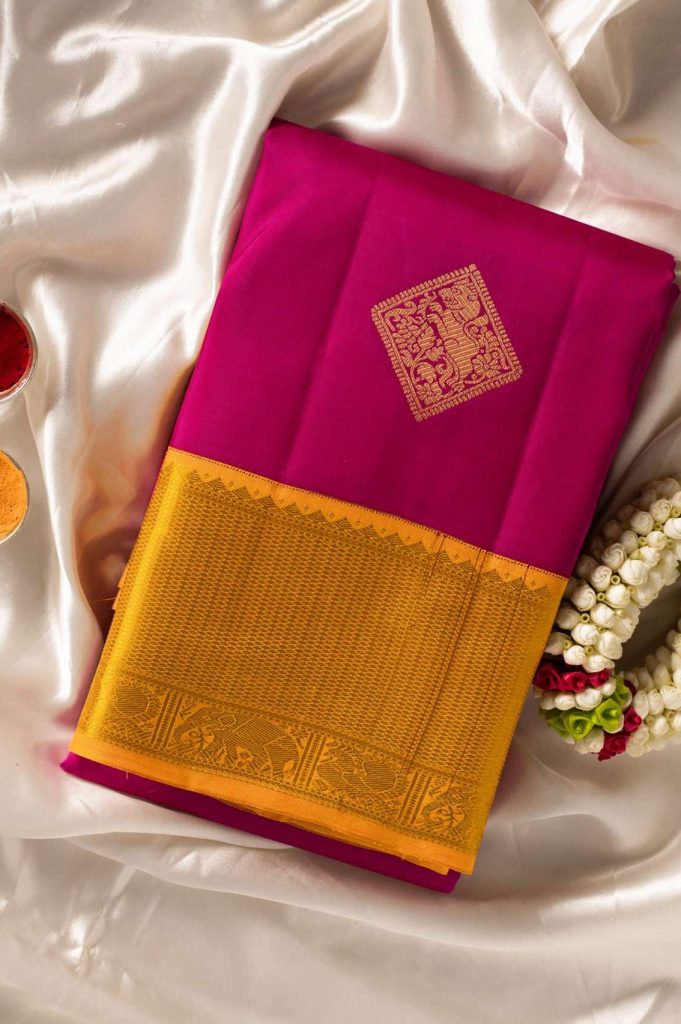
He gives a look at the sari. Rani pink with a yellow and gold border. He nods in disapproval and remarks, “Mamma, at least think about your age. You are fifty plus, the groom’s mother. Does this colour suit you?”

He turns to the sales guy and asks him directly, “Bhaiya[2], do you have something for the groom’s mother? Something age appropriate?”

He nods with a sly smile “I told the same thing to aunty ji, but she insisted on the Rani Pink one. We have multiple options for the groom’s mother. bhaiya ji, cream, beige, navy blue, light green. She didn’t like a single one.”

“Mamma, what will people say?” He whispers in her ears.

“Yeah, you are right. Let us look for something more age appropriate for me. She gently lets go of the rani pink and proceeds to pay for his clothes.

[1] son

[2] brother

Dr. Swatee Miittal, an artist, writer, and storyteller is committed to shedding light on societal issues through deconstructing old narratives. With a Ph.D. in audience behaviour with respect to theatre and storytelling, she has crafted stories addressing gender equality, relationships and mental health.