Categories
Slices from Life

Awesome Arches and Acrophobia

Narrative and photographs by Meredith Stephens

My partner, Alex, has always been enthralled with the natural beauty of the west of the United States, having spent sixteen years studying and working there in his youth. He wanted to share his love of this part of the world with me, so took me on a seven-day road trip from his base in the Sierra Nevada Mountains to Fort Collins in Colorado and back.

“You must see Arches National Park in Utah!” urged Alex’ long-time friend Ryan. “Bryce National Park is worth visiting too.”

Two days later we arrived at Bryce National Park. At first, the scenery was pleasant but unremarkable. I wondered why there were so many tourists and so many cars in the carpark. We donned our raincoats and walked towards the trail to follow the other tourists. It started hailing and I pulled my hood around my face. Thunder and lightning resounded. A tall thin park ranger approached us from the other direction and looked directly at me.

“We advise you to turn around immediately and seek shelter. We have lost ten people in twenty-five years in these weather conditions.”

We looked at the brochure to confirm this and read that there had been four fatalities and six injuries. I would have been happy to follow the park ranger’s advice, but we had driven for eleven hours to get there and were too curious to turn back. We started walking towards the Navajo Loop trailhead at Sunset Point. Tourists were posing for photographs at the rim. I wondered what the attraction was and peered over the rim myself. Suddenly, I understood why the site was so crowded.

Navajo Loop

I gingerly placed one foot after another to carefully descend the steep muddy trail. Each time I planted my foot down I held it steadily to ensure I would not slide. A couple approached us from the opposite direction as they ascended the trail.

“We strongly recommend you turn around immediately!” they warned. “It’s treacherous in these muddy conditions.”

Muddy trail

We thanked them, but I continued to gingerly traipse through the mud along the downward trail for a few metres.

“You go ahead,” I urged Alex. “I can’t go any further.”

It continued to hail, and we could hear thunder. I turned around and slowly plodded back up the muddy trail back to the edge of the rim, closely followed by Alex. We contented ourselves with the less slippery 2 km walk along the rim to Sunrise Point and back. Back at the car, we scraped the mud off our shoes, fairly unsuccessfully, and continued our drive to Arches National Park.

The Arches National Park is so popular that visitors have to book through a timed entry system. At 6 pm, when the booking system opened, Alex opened the booking site and secured one of the few remaining availabilities for a 7am entry the next day. He hoped we could also enter just before sunset that day, after 6pm when entry was not timed.

Four-and-a half-hours later we arrived at Arches National Park. The drive had been uneventful along straight desert roads and it had been difficult to force myself to stay awake, as I sat in the passenger seat.

“If we are too tired, we can go straight to our accommodation,” suggested Alex.

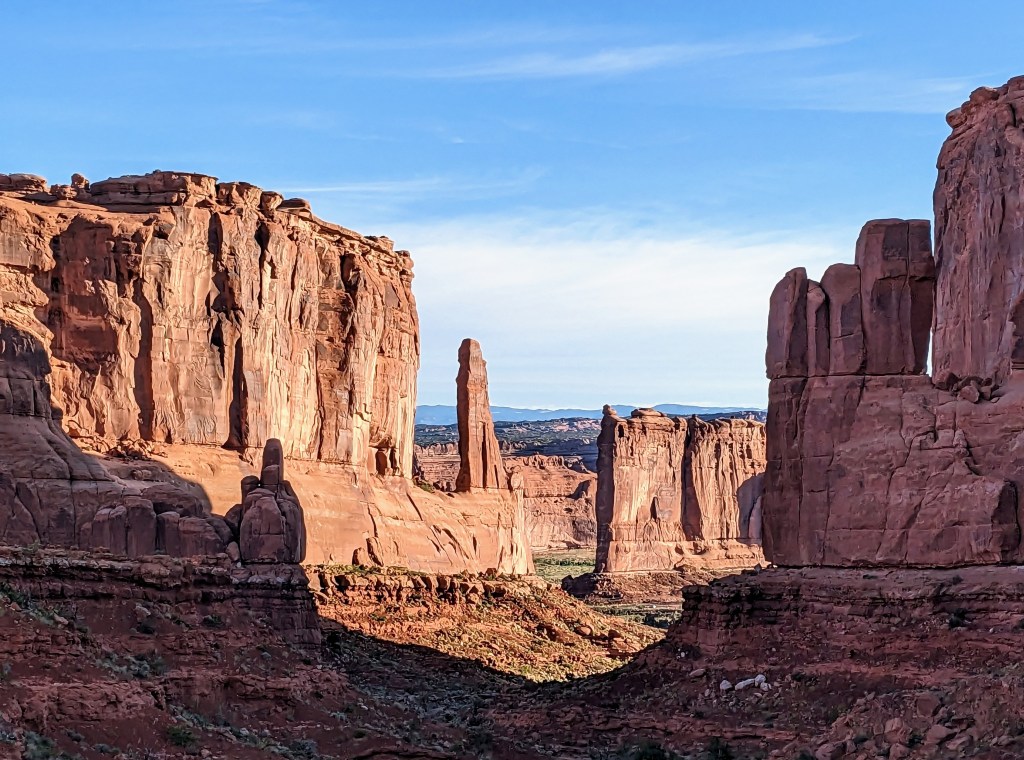
I hoped we would do so. I needed to escape from the enclosed space of the passenger seat. Suddenly huge rock formations loomed just beyond the park gates, and we decided to enter. I was lulled from my stupor into a sense of shock from the grandeur of the giant ochre rocks emerging from the plains. I could sense the onset of palpitations.

“I think I’m going to faint, Alex,” I warned him.

“I think you’re experiencing ‘geophilia’,” he responded.

Suddenly, I realised why people found the study of geology so fascinating. Strata upon strata of ochre rocks rose before us. Their layers indicated the movement of the earth’s surface over eons of time,

Entrance to the Arches

The sunset light flattered the rock formations. Cars lined the road heading to the distant formation of Delicate Arch thirteen miles into the park, and tourists parked their vehicles at the many carparks along the wayside to walk amongst the various giant rock formations.

The next morning, we rose to meet our 7am booking to enter the park. The light portrayed the rock formations in a slightly different way from the light of the evening before. We headed to the trail leading to the Delicate Arch. Even at that early hour, the carpark was almost full, and we secured a space before following the throng of tourists walking the trail heading to the arch. We scrambled across rocks and boulders in the piercing sunshine. I glanced at the climbers ahead of me and thought it would be impossible to reach where they were climbing, but with Alex’s encouragement found myself joining them. After a series of false summits, we found ourselves within sight of the arch. I looked at the abyss below and suddenly decided I would content myself with watching others pose for photographs in the arch rather than entering myself. A photographer was set facing a couple posing in the arches perilously close to the drop-off. Couples and children walked across the rocks in front of me towards the arches.

“I feel sick, Alex! I can’t go any further.”

I wondered why the others were walking so freely along the rocks in front of me, in full view of the yawning abyss.

“I promise I’ll hold your hand.”

“I don’t want to drag you down!”

“You won’t!”

I continued to worry I would drag Alex down with me in the abyss, but as usual, succumbed to his confidence. I gripped his hand and refused to gaze below me, carefully placing one foot in front of the other. Fellow tourists were taking turns to pose under the arch. A couple noticed us heading towards the arches.

“Shall we take your photo for you?” they offered.

Alex accepted and handed them his phone.

We continued to inch towards the arch. Finally we reached it and posed beneath it. I tried to assume a confident stance that I did not feel, all the while steeling myself away from glancing down at the abyss. I was naturally inclined to hold myself steady in a tense position, but instead decided to stretch my free arm outwards and pretend to exert confidence.

Arches

After standing there for long enough for the couple to take turns photographing us, we returned to the smooth large boulders ready for our trail down the mountain. As we walked down, I started reflecting on the contrast between how brave others seemed to feel as they freely walked over the boulders facing the abyss, and how timid I had felt.

“I think I have a fear of heights!” I announced to Alex. “I don’t know how I made it to retirement age without noticing this.”

There was one more trail we wanted to pursue, namely, the Devil’s Garden. As before, there were few empty places in the carpark. We finally edged into a free space, and then headed to the trail on our way to the Landscape Arch. This time I decided to read the information posted on the sign at the entrance. It read “Drop-offs on both sides challenge those with fear of heights”. I realised that there must be at least some people who shared my fear.

Arches National Park remains the most impressive national park I have ever visited. The force of nature had never felt so overwhelming.  I felt small in this vast ancient landscape but privileged to be able to witness it.

Meredith Stephens is an applied linguist from South Australia. Her work has appeared in Transnational Literature, The Muse, The Font – A Literary Journal for Language Teachers, The Journal of Literature in Language Teaching, The Writers’ and Readers’ Magazine, Reading in a Foreign Language, and in chapters in anthologies published by Demeter Press, Canada.

PLEASE NOTE: ARTICLES CAN ONLY BE REPRODUCED IN OTHER SITES WITH DUE ACKNOWLEDGEMENT TO BORDERLESS JOURNAL

Click here to access the Borderless anthology, Monalisa No Longer Smiles

Click here to access Monalisa No Longer Smiles on Kindle Amazon International

Categories
The Observant Immigrant

Can We Create a Better World by Just Wishing for it?

By Candice Louisa Daquin

The wish to laugh and shrug off differences that create unhappiness and wars is a universal one. The majority of us want to avoid unhappiness at any cost. There is however, a downside to trying to avoid unhappiness by being too open about unhappiness. When we begin to pathologize everything as a disorder, we may inadvertently neglect our ability to generate better mental health.

Before mental illness was discussed en mass, it was private and considered shameful. This had obvious detrimental effects on those suffering, but one could also argue there was a benefit to not making everything so extremely public. Like with any argument, there are pros and cons to how far we publicize mental health. The extreme of ignoring it, didn’t work. But does the extreme of talking about it to death, really help people as much as we think?

In the second half of the 20th century, owing in part to a neglect of, and a need for; improved mental health care, societies began to shift from encouraging suppression of emotion to a recognition of psychological distress and its impact. Institutes and then the de-institutionalisation movement, became ways of coping with people who struggled to function in society. But these people didn’t choose to be unhappy. Whilst it’s obvious this shift to publishing mental health instead of hiding it, has been highly beneficial in some regards; we should also consider its far reaching ramifications.

“(Historically) Many cultures have viewed mental illness as a form of religious punishment or demonic possession. In ancient Egyptian, Indian, Greek, and Roman writings, mental illness was categorised as a religious or personal problem. In the 5th century B.C., Hippocrates was a pioneer in treating mentally ill people with techniques not rooted in religion or superstition; instead, he focused on changing a mentally ill patient’s environment or occupation or administering certain substances as medications. During the Middle Ages, the mentally ill were believed to be possessed or in need of religion. Negative attitudes towards mental illness persisted into the 18th century in the United States, leading to stigmatisation of mental illness, and unhygienic (and often degrading) confinement of mentally ill individuals,” states an article on this issue.

By publicising everything, in reaction to the days when mental health was viewed with more stigma, we have not improved suicide statistics or mental illness numbers like we’d logically assume. When something is freed of stigma and shame, more people admit to suffering from mental illness than ever before, which will make it seem like more people have mental illness, when it could simply be that they are more willing to admit to having it. On the other hand, there is an observed phenomena of things becoming socially contagious.

How can we be sure we’re not increasing mental health numbers by making it so acceptable to be mentally ill? By over-emphasising it on social media? Publicising the struggle to avoid stigma, is positive, but the degree to which we discuss mental illness may be so open, as to increase numbers or over-diagnose people. For example, everyone gets sad sometimes, that doesn’t mean everyone suffers from clinical depression. Everyone gets anxious sometimes but that doesn’t mean everyone suffers from anxiety. The distinction is: Is it a disorder or a feeling? Do clinicians spend enough time considering this when they give patients a life-long diagnosis? And what is the effect of such a diagnosis?

When psychiatrists diagnose mass numbers of people, especially easily influenced teenagers, with serious life-changing mental illnesses, that immediately means the reported numbers swell. Who is to say they would be that large if diagnosis weren’t so open ended? Nebulous? Open to outside influence? Or even, the pressure of pharmaceutical companies and desperate doctors wanting quick fixes? What of parents who don’t know how to handle their rebellious teen? Is that mental illness or just life? If they demand treatment and the teen is labeled mentally ill, do they fulfil that prophecy? And if they hadn’t been diagnosed, would their reaction and outcome be different?

Our innate ability to laugh and shrug things off, comes from the challenges in life that were so terrible we had no choice if we wanted to go forward. If we remove those challenges, are we teaching our kids how to cope with hard things or wrapping them in cotton wool and medicating them? When a family of ten children ended up with eight routinely dying, how else could families cope with such tragedy but to have that coping mechanism of laughter and the ability to shrug off despair and horror? It did not mean anyone was less caring, or feeling, but that sensitivity had to be weighed against our ability to endure. We could argue we endure less pain now than ever before, as we are less likely to lose a great number of people we know, die due to disease and famine and other historical reasons for early death. Many will never even see the body of a dead relative, so how can they process that loss?

The modern world brings with it, its own attendant risks and stressors. People growing up in 1850 may not have had to worry in the same way, about looking young to keep a job, or trying to ‘do it all.’ On the other hand, they might have had to worry about not having a society that helped them if they lost a job, or how to stop their families from starving or their village from being raided. They had fewer social cushions in that sense and more of a risky day-to-day. This was starkly true when we compare the recent pandemic outbreak with say the plagues of earlier centuries. People died in the street and were left to rot, whereas now, even as we struggled and many died, we had a modicum of order. For all our terrors with Covid 19, it could have been far, far worse and has been. I say this from a position of privilege where I lived in a society that had access to medical care, and I’m fully aware many still do not, but nevertheless if we directly compare the experience of the Black Death with Covid-19, we can see tangible improvement in what those suffering, could access.

This means whether we believe it or not, appreciate it or not, we have over-all an improved quality of life than even 50 years ago. At the same time, we may have swapped some deficits for others. It may seem a minor consolation for the myriad of modern-day woes, but we are better off than our grandparents who were called ‘The Silent Generation’. They grew up learning to not speak of their struggles but cope with them silently. These days we have outlets. And in other ways, we are more alone, it is a strange mixture of progress and back-tracking. Some would argue our grandparents had a simpler, healthier life. But if average life expectancy is anything to go by, we are growing older because for the majority, our access to medical care and over-all nutrition, are improved. On the other hand, more grow old but sick-old, which is not perhaps, something to aspire to.

When we consider how badly many eat, and in truth, we do ourselves no favour when so many of us are obese and suffering from diseases of modern living such as lack of exercise, heavy drinking, lack of sleep and eating fast-food. It might be most accurate to say we have swapped some deficits such as dying due to curable diseases, and dying from malnutrition or lack of access to care and antibiotics, with modern deficits like increasing cancer rates and increasing auto immune disorders, all of which are increasing with the swell of the modern world and its life-style.

What it comes down to is this; through the wars of the past, people stood next to each other in trenches whilst their friends were blown to pieces or died in agony. They had PTSD[1] then, they suffered from depression and anxiety, but they also had no choice but to carry on. For some, the only way out was suicide or AWOL[2], while for many, they stuffed their feelings down and didn’t speak of it. Clinicians thought this way of coping caused illness and it led along with other reasons, to an improved mental health system.

But, now, in 2022, you might be forgiven for thinking EVERYTHING was a disease, and EVERYONE suffered from something, and you might find yourself wondering if some of this perceived increase was the direct result of going from one extreme to the other. Initially, nobody was mentally ill. Nowadays, who isn’t? Is this a better model?

Having worked with mentally ill people for years as a psychotherapist, I can attest that mental illness is a reality for many. I knew it was before I ever worked in the field, and it was one reason I chose that field. I wanted to help others because I saw viscerally what happened to those who did not receive help. Despite this I came to see the value of sometimes putting aside all the labels and diagnosis and medications and treatments and trying to just get on with the process of living. If we tell someone they are mentally ill and medicate them and coddle them and tell them they don’t need to try because they are so sick, then it doesn’t give them much motivation to see what else they can do.

True, for many, they are too sick to do anything but survive and that in of itself is a big achievement. So, when we talk about the need to motivate ourselves beyond labels, we’re talking about those who we’d call high functioning. People who may suffer from depression, or anxiety, but are very able to do a lot of things despite that. Does medication and therapy and labeling them, really help them make the most of their lives? Is putting them on disability for years without reviewing if things could or have changed, help? Can they learn something from our ancestors who had to just laugh and get on with it, no matter how tough things got?

It may seem a very old-fashioned approach to consider ‘toughing it out’ and having come to America and seen how much onus they put on toughing it out, I have mixed feelings about the value of doing so. The idea of being tough enough means there is always the reverse (not being tough enough) and that feels judgmental. Being judgmental, I think, has no place in recovery.

What does have a place in recovery, is doing the best you can and not letting labels define or defeat you. In this sense, I see a lot of commonalities with those struggling today and those who struggled 150 years ago. Maybe we can all learn from them and combine that with some modern prescriptivism that give us more chance to laugh and thrive, rather than fall under the yoke of a diagnosis and its self-fulfilling prophecy?

I have had many clients who felt their diagnosis disincentivized them from any other course of action than being a patient. The medication route alone is fraught with ignorance. For so long SSRIs[3] and other anti-depressants were heralded as lifesavers for depressed people, but what proof existed for this aside the hope a cure had been found? Years later studies showed only 30% of people seemed to respond to anti-depressants versus placebo.

Then second and third generation drugs were created, all the while charging exorbitant prices, and patients routinely took 2/3/4 medications for one ‘illness.’ Aside the expense and physical toll taking that much medication can do, there was a mental cost. Patients felt over-medicated, but not happier, not ‘better.’ By tputing their faith in drugs, they lost their faith in other ways of getting ‘better’ and some spiraled downward. The reality is we are all different and we process life differently. Some of us are more forward-focused, others, through imitation, genes or experience, may not be. It isn’t a deficit or illness, it’s a personality, that can change somewhat but should also be understood as the diversity of how humans cope.

Treatment Resistant Depression became the new diagnosis when modern medication failed, and new drugs were considered in tangent with current drugs, but this led to people taking more drugs, for longer periods of time, often with little improvement. How much of this is due to a negligent approach to treatment that only saw drugs as the answer? Meanwhile therapy was cut-back or became prohibitively expensive, cutting off other options for treatment. It’s logical that therapy can help avoid feeling isolated, but when the system prefers to medicate than provide therapy, there are so many taking medicines for years, that were only meant as stopgaps.

Should the media or your general physician, be the one telling you what drugs you should be taking, if at all? Preying on the desperation families  by the introduction of for-profit medication, muddies the waters further.  The disparity of information means no one source can be trusted, especially as information is ever-changing. More recently a study showed that anti-depressants may not work at all it was commonly held clinical depression was caused by a chemical imbalance and studies show correcting that imbalance does not improve depression as was once thought.

This shows us that psychiatry still has a long way to go, and when they claim things as facts, they rarely are. It contends we should not blindly trust what has become a profit led industry, where many of its practitioners see patients for a short time but somehow still diagnose them with serious mental disorders. Surely, we should consider equally, the importance of conservative diagnoses and recognise that normal variants are not necessarily disorders. In many cases, it may be that under diagnosing rather than over-diagnosing could work better.

For example, I know of many (too many) patients who told me they were diagnosed with bipolar disorder, before the age of 21 by a regular non-mental health doctor, or by a psychiatrist. Their subsequent mistrust of the system is understandable with that experience. How can someone tell you that you have bipolar disorder at 17 years of age, from a 20-minute conversation?

Even the diagnostic criteria for bipolar 1 or 2 in the DSM (Psychiatric Diagnostic and Statistical Manual), is flawed, because it’s too generalised and only highly trained professionals would be able to understand the nuance. Most are not that trained and therefore take at face value, when a diagnostic tool says someone has bipolar if they experience an episode of mania. But firstly, are they defining mania correctly? Is the patient describing mania correctly or being led? Were there mitigating factors?

If you diagnose a child with a serious mental disorder and medicate them, how can you be sure their brains aren’t affected by taking that strong medication before they have reached full development? How can you be sure they are not becoming what they are told they are? Too often, people spend years under the cloud of medication, only to emerge and realize that what was a discrete episode of depression, was medicated for decades, robbing them of the ability to recover? Doesn’t a label make it likely that some will feel helpless?

Moreover, how much power does a label have on our sub-conscious? If we are told, we are (will not be able to do something, why would we even try? If we believe we are depressed, are we less or more likely to fight against it? Isn’t some fighting a good thing? Likewise, diagnosing older people with a disease like Bipolar (a disease that occurs after puberty), shows the mistakes of the psychiatric world. How can a 70-year-old man ‘suddenly’ be Bipolar unless he has a brain-tumour or otherwise? Dementia is often misdiagnosed as Bipolar because badly trained doctors seek answers for aberrant behavior, without considering the whole story, such as how can someone of 70 develop a disease that affects those around the age of 18? Sure, some can slip through the gaps, but often, it’s the frustration of the family or doctor colouring the diagnosis. Such life-long labels should not be given lightly.

What if we treat mental illness depending upon its severity, in a different way? Consider the value of improving real-world ways of copying despite it, instead of relying on medications that were only ever meant as a stop gap and not developed to be taken for years on end? Nor over-medicating without due cause. Nor medicating young people based on very loose diagnostic expectations. Or assuming everyone who says they feel depressed or anxious, is clinically depressed or anxious, or that medication is their only solution?

Organisations that take vulnerable teens who often have co-morbid diagnosis of drug-or-alcohol abuse alongside mental illness, into the wilds, seem to be a real-world way of encouraging those young people to find coping mechanisms outside of addiction and reliance upon medication. Equally, when a young person (or anyone really) is productively employed in something they feel has meaning, this is one way anxiety and depression can improve.

We’ve seen this with Covid-19 and the necessary isolation of so many school children. Whilst it was unavoidable, the rates of depression spiked, in part because studies show people need interaction with each other. This is why online learning has a poorer outcome than classroom learning, this is why older people are less at risk of dementia if they socialise. We are social animals, we feed off each other and we empower each other. Finding your place in the world is always in relation to others to some extent.

We may never avoid war completely or our human tendency for strife, but we also have a powerful other side that urges people to do good, to help each other, to laugh and shrug off the differences that divide us. What good does’ division ever do? Unhappiness is unavoidable at times, but sometimes it’s a choice. We can choose to recognise something is hard and actively pursue ways of improving it. We can struggle through and feel good about the struggle and the effort we put in. if we take that all away and don’t encourage people to try, we give them no way out. Sometimes there is no way out of suffering or mental illness, but often we cannot know that unless we have tried.

Many years ago, people valued older people because they were considered wise and able to impart valuable life lessons to impetuous youth. Nowadays, the elderly are not respected and are often siphoned off into homes before their time, because people find them an inconvenience. There is a theory that humans became grandparents because grandparents were an intrinsic part of the family make-up. This explained why humans were among the only mammals to live long after menopause. Most animals die shortly after menopause, nature believing once your reproductive years are behind you, you have no value. But humans were distinct because they live long after menopause. The grandparent theory supports this by demonstrating the value of grandparents, and we can learn a lot from what nature already knows. It is never too late to have value, it is never too late to learn and grow, and it is never too late to laugh and come together, setting differences aside.

Those who achieve that, may well be happier and live healthier lives, as laughter is shown to be a great anti-ager as well as an improvement on our overall mental and physical health. Of course, what we can learn from the extremism found in the cult of positivity, illustrates there must be balance and we cannot expect to be happy all the time or unaffected by tragedy when it occurs. But staying there, and not attempting to move beyond it, to reclaim ourselves and our futures, seems to be a way to avoid going down that dark tunnel of no return.

Experience shows, we are what we think. We don’t have to be positive 24/7. To some extent any extreme sets us up for burnout and puts too much pressure on us to be ‘up’ all the time, when it’s natural to have down times. But striving for happiness, or contentment, or just finding ways to shrug off the smaller things and come together, those are things most of us wish for. So, it does no harm to direct our energies accordingly and prioritise our ability to cope. Perhaps our differences are less important sometimes, than what we have in common, and what we can do to make this world a more livable place.


[1] Post-traumatic Stress Disorder

[2] Absent without Official Leave

[3] Selective Serotonin Reuptake Inhibitors

Candice Louisa Daquin is a Psychotherapist and Editor, having worked in Europe, Canada and the USA. Daquins own work is also published widely, she has written five books of poetry, the last published by Finishing Line Press called Pinch the Lock. Her website is www thefeatheredsleep.com

.

PLEASE NOTE: ARTICLES CAN ONLY BE REPRODUCED IN OTHER SITES WITH DUE ACKNOWLEDGEMENT TO BORDERLESS JOURNAL.

Categories
Musings

To Infinity & Beyond!

By Candice Louisa Daquin

Inclusiveness seeks to bridge gaps between peoples and places. Too often our parochial approach in life, leaves us alienated and estranged. But speaking of aliens … in the 2000’s it seems we are at last coming to the point in time where humans will begin to, if not live off world, then visit in greater numbers. Space travel? That’s truly borderless. How exciting to imagine traveling the universe and having our eyes opened to the immense possibilities of space!

Though the elites enjoy space travel, the question remains, will the human race en mass ever truly reach the stars and expand beyond Earth? With this in mind, I posit the following questions;

Is it viable?

Back in the 1950s there was a contagious worldwide fervour to go to space, fuelled by the fantasy of sci-fi writers and films that made this achievement seem imminent. Maybe after the two world wars and the fatigue of poverty contrasted with the hopefulness of better days ahead, we were finally able to dream. In a way, space travel has always been the purview of the dreamer. The Soviets launched the world’s first satellite, Sputnik I, in October 1957. The competition and fear between America and the Soviet Union no doubt accelerated the development of space exploration during this time. Additionally, the cessation of world wars made this logistically more possible, and the knowledge gained from those wars was utilised to create space worthy ships. The race to get to space was a Cold War competition between the United States and the Soviet Union to develop their respective aerospace abilities and send satellites, space probes, and humans up into space. But the whole world was involved, with astronauts, scientists and researchers working together as much as they competed with each other.

In April 1961, Soviet cosmonaut Yuri Gagarin entered Earth’s orbit, in Vostok I, a space craft for one person, becoming the first man ‘in space’. In the 1960s, the US reached the moon (unless you believe that this was faked, in which case, film maker Stanley Kubrick made a faux film of reaching the moon, information on this can be found in the revealing documentary Room 237, by Rodney Ascher made in 2012!). If indeed the moon was reached, it seemed back then, this was just the beginning. There was a palpable obsession with the future. Technology that would get us to space gripped the United States and deeply influenced the cultural artefacts of the time. In 1955, Walt Disney paid consultants who worked on space-related projects to help him design the rocket ship rides of Disney’s Tomorrowland. Songs about space, art and fashion relating to space were all fascinations that beget the drive forward. Stanley Kubrick‘s film The Shining (1980) is supposed to have secret references to the faking of the lunar landing. Whether faked or real, the world believed humans landed on the moon and in a way that’s what counts most — perception.

Then wham! Our predictions of where we’d be by the 2000’s seemed vastly optimistic. For a plethora of reasons, not least, the sheer magnitude and cost of space travel. We were not riding on space elevators or darting around the universe by the 2000’s – so all those old shows predicting we’d be there by now, seemed to be just fantasy. Some people point to the Challenger explosion as the beginning of the end of American at least, space adventure. Cost, danger, the environment, many reasons can be ascribed but do not explain the extreme and total diminishment of interest. Once upon a time people pressed themselves to store fronts to watch old TV’s displaying live rocket takeoffs and now nobody seemed to care if America has abandoned her search for the stars. Was the interest just an epoch in time that has been replaced with other technologies and obsessions? How does this explain other countries who continue to fund and grow their space programmes? How can something as crucial as endeavouring to reach another world, be shelved in favour of the latest iPhone?

Astronauts have spoken out claiming the reason humans have only just returned to the lunar surface since 1973 (China just landed in 2020) isn’t based on science or technical challenges, but budget and political hurdles. This is easy to believe if you consider the American technology that landed them on the moon had less ‘tech’ than a modern-day scientific calculator. I remember going to Houston and seeing the original ‘space control’ and how tiny everything was and wondering how on earth they landed men on the moon and returned them safely. To advance that technology for further space exploration is both expensive, daunting and involves consistent agreement among politicians. Makes you wonder how it was ever made possible! The reason America funded the space race initially was because it was a point of pride (beating the Soviet Union) which as pathetic as that seems, seemed to gear up enough people to make it happen. Without that impetus, politics drowns the scientist and astronauts wish to advance space exploration.

The mother of invention isn’t just necessity, it’s also fantasy. Artists have long influenced inventors – think Star Trek and the low-tech ideas they had, which have been replicated more recently in flip-phones and video-chat. Sci-Fi writers and thinkers have influenced those who seek to go to space as much as anyone else. It could be argued there is no real delineation between fiction and reality in this case, owing to their mutual influence. If we could create a lunar base, scientists believe this base could evolve into a fuelling point for future further-flung missions into deep space. It could also lead to the creation of improved space telescopes and eventually enable us to live on Mars. We need to push ourselves to the next level of exploration – having relied upon ageing technologies that we have not funded sufficiently to advance. Now, billionaires like Elon Musk push for space tourism, rather than chronically underfunded agencies.

One of the biggest impediments, is how to pay and guarantee safety. NASA is under-funded and receives a tiny percentage of the overall US budget. Priorities go to the military and other immediate programs that are deemed more essential. Since this is political, it’s up to the public to generate an interest in space travel. Sadly, even when the Apollo program was at its greatest; after Aldrin and Neil Armstrong stepped onto the lunar surface, only 53% of Americans said they thought the programme was worth the cost, according to a report in the Insider.With politicians changing too frequently to see through long-term investment space projects, this stymies those who believe space exploration should be prioritised. Buzz Aldrin has been strategising to get to Mars for over 30 years, as he lamented the lack of support space exploration receives. Aldrin and other experts agreed it must involve international cooperation: “A US-led coalition would include Europe, Russia, India, Japan and China, as well as emerging space nations the United Arab Emirates, South Korea and Saudi Arabia,” Aldrin said in an article in The Gaurdian. “We can afford to go to Mars but we must have fiscal discipline. We must focus our limited resources on only those things that are really necessary to get to Mars. In my view, we are currently spending over $6bn on programs we do not need to get to Mars. We need reusability, every element of the system.”

It’s nearly 2022 and we’re still not there en mass or reaching further. We’re told it’s possible but technologically there are hurdles to overcome, not least the effect of long-term space travel on the human body, or the effects of uncontrolled radiation from the (belt) or the methods by which we fuel vessels for such long-haul trips. Space radiation is one of the greatest risks for astronauts. “Determining astronaut health consequences following radiation exposure involve very complex processes,” stated Tony Slaba, Ph.D., NASA research physicist in a government website. “It’s difficult to quantify exactly how radiation is interacting with tissues and cells – and more complicated to quantify and determine what long-term outcomes are going to be in terms of the potential diseases and biological system effects.”

And that’s without touching on putting people into statis or some kind of sleep. We have great ideas and history tells us great ideas eventually become reality, but it’s taken us longer than we anticipated back then. Technologies like magnetic and water shielding have only gone so far and need to be prioritised if we’re to live off-planet. Another real threat, alien microorganisms, prions or diseases humans have zero exposure or immunity to. If we imagine what Covid-19 has wrought, it’s easy to see why bringing ‘space-bugs’ back to earth or exposing astronauts to unknown elements, could be fatal. Finding unbreakable ways of protecting everyone will prevent the science fiction horror stories from coming true. But what’s more likely? Thinking about potential dangers being brought back to Earth, or the excitement of exploration?

What does it bring us if we achieve it?

The people who will benefit from space travel won’t be you and I. It will be the trillionaires who can fund projects and much like early explorers they will exploit natural resources and profit from them. Whether they find planets made of diamonds or copper or other expensive minerals it will be they with their reach, who like plantation and slave owners will come out on top. One can argue this is a replication of the exploitation of the Earth, and those people working for the giant industries. I would agree. Does this mean all space exploration is without value? There is always value to reaching further, but it generally comes at a cost and requires exploiting the masses by the few. Pluses could include sending people off world to ease the burden on the planet as we become overpopulated. We might be able to terra form, and create liveable planets that can sustain life, although predictions suggest this would take lifetimes. One idea has been generation ships; where ships are able to manufacture a way to self-generate power and travel for long distances and time. Those in the ship may live their entire lives onboard and it may be their children or grandchildren who reach the final destination. The idea of sacrifice always exists when considering far-flung exploration, and this was often the case when people got into little wooden boats centuries ago in quest of unknown continents.

Can we learn from the mistakes made by early explorers? Or will we repeat history because it’s our nature? If we cannot create planets that are self-sustaining then we rely upon earth to supply those planets with food and water etc. and that’s less sustainable than not going off world. Potentially if we could make this work, it would be years in the future, but might give the human race the opportunity to significantly grow due to increased resources. Without this, we are stymied by the resources of one planet, which we are using up rapidly. Whether it’s a good thing to increase the human race throughout a galaxy or universe, remains unknown. We could be viewed as cockroaches or explorers, that’s up to the interpreter and our choices should we become a race of space farers.

A 2018 Pew Research Center poll showed the tide is turning, with the majority of voters saying NASA space exploration is necessary but majority want the skies scanned for killer asteroids. Maybe the way we get to space will change, in that we have to think of modern day, pragmatic methods of funding space travel, even if its in the guise of space tourism or tagging on the back of projects to protect the planet against killer asteroids. Maybe it will take another tragedy like an asteroid hitting the Earth to advance our current knowledge, as this seems to be the only way humans operate. We are less inclined to prevent disaster as to respond to it. Sadly, if the environment continues to be eroded, we may have no choice but to seek off-world options, and we don’t want to leave that option till it is too late to act. With dramatic weather pattern changes throughout the world, it’s never been more essential to protect Earth but we’ve not doing a very good job if the oceans and air pollution are anything to go by.

What are the potential down-sides?

It isn’t possible to talk about this without considering the many side-effects of space travel. Many I’ve already touched on but it’s worth really to reconsider history which has shown the penchant of humans to dominate and disrespect other cultures. Humans often consider themselves the ultimate alpha, the top dog, but in truth they could be replaced tomorrow depending on weather and climate and natural disasters, just as the dinosaurs were. We shouldn’t let our hubris make us forget our responsibility to our planet. Some argue space travel is a waste of resources and money because it’s looking beyond us rather than at what we already have. Shouldn’t we be fixing our home-grown problems before we focus on the skies? Others say we should look at the ocean before we consider space. Home grown issues include the devastation human beings have wrought on Earth, which most of us are familiar with.

Given we are reckless with our inventions. They benefit us but not necessarily the natural world around us. Is it any wonder to guess why expanding the human race can be a matter of concern? I’m not one who believes humans are the apex and that we are entitled to be. I predict one day we’ll give up our throne. But there’s the other side of me filled with the wonder of imagining what is out there. I mean, if space is infinite, which they have agreed upon, that means it never ends, a concept few of us can even understand or relate to. Imagine? Infinity. What does that even mean? When we humans begin-middle-end and everything around us does the same. It’s the true sense of forever, something larger than we will ever be. I’m filled with a fascination for a universe that doesn’t end, how do I wrap my head around that and comprehend the myriad possibilities this entails!

What I do know is if something never ends there literally are eternal possibilities meaning every possible eventuality must occur, because of the law of replication. There are only a certain number of creations that come from a universe containing certain components and those creations if given affinity, will reproduce in varied forms, but also replicate. I think this is where the concept of parallel universes comes from. Rather than a literal slice in time dividing one notion of reality from another similar but not the same version of reality. A universe that has no end, will eventually ‘play out’ every scenario, a little like you could crack any code if you had long enough to go through the permeations – but we don’t have time, so we don’t do that. The universe, however, does have time, infinite, so all that can be created will be, and all that has been created (including us) will be created (again) in shades of similarity. This I believe is where we get the concept of a parallel universe, although that’s not quite what it is.

If we add to this the concept of space and time, how time is not a set notion but rather, a perception based on humanity, the same goes for our understanding of the material world. In other words, we’re limited by our own physical presence and lifespan in our understanding of what is beyond us. For those like Steven Hawkins or Ashwin Vasavada (Project Scientist for NASA’s Mars Rover Curiosity, in charge of a team of 500 researchers), they can see beyond what is literal and imagine like any great thinker, beyond what we know and assume, and extrapolate. This extrapolation includes quantum physics and the breaking away from normal modes of thinking to include things we’re only beginning to understand.

If time is not mutable, if concepts of reality really don’t exist as we assumed they did, then it throws everything into question. Is what we perceive as reality even remotely real? Or just a flawed, human-centric bias? And if the latter, the universe’s secrets are closed to the limitations of our minds? This is why some who have taken psychedelic drugs have said, sometimes the doorways of perception (Aldous Huxley’s The Doors of Perception, written about his experiences with mescaline in May 1953) must be opened differently. Huxley was in turn influenced by the poet William Blake who wrote: “If the doors of perception were cleansed then everything would appear to man as it is, Infinite. For man has closed himself up, till he sees all things through narrow chinks of his cavern.”

Science, logic, mathematics, will probably provide us with many answers but in order for us, as sentient but limited-sentient beings, to evolve perceptively, we may need a further key to elucidate things beyond subjective perception. Some evaluation of psychedelic drugs as facilitators of mystical insight with great potential benefits for science could be that missing link.

Having read a great deal of science fiction, I wonder if I would think like this had the ideas not been implanted by some of those great science fiction tomes and operas. I suspect we build on what we learn, so nothing is entirely original, but in building on others, we may come closer to answers than if we operated in a vacuum. This is also true with making science fiction a reality. But just as our urge is to explore, we should be mindful of past mistakes as a race (human) and not repeat the colonialist model that only caused pain. Otherwise, life could be no more than a petri dish with us experimenter or experimented upon. There is more to life than conquer or absolute knowledge. There is the humility of experience and growing from it, which is something we often diminish. Perhaps spirituality and hard science are not after all, so incompatible.

Will it actually happen?

The development of nuclear-thermic powered propulsion systems to enable long-haul space-flight is essential to reduce crews journey time and make travel to Mars and beyond realistic. Heat shields to ensure landing is safer on unknown planets, would cut down on landing fatalities. Next generation space suits that are flexible and livable would allow explorers to spend more time in their suits than the suits of old that were not invented for long term use. There would also need to be a nuclear fusion style power system that enabled those landing on planets, to tap into power whilst on planet, and not fear running out. Radio systems used currently, can take up to nine years to send transmissions from say, Mars to Earth, so the development of technology like lasers to send information and communications rapidly would be essential. Scientists like Sharmila Bhattacharya (Director of Research in the Biomodel Performance Laboratory of the Space Bio-sciences Division, NASA) are spending decades researching the effects of the human body in space to understand how to survive, even thrive in space.

I’d love to think our progeny will reach space in a way we have yet to. Why? Because there is something fantastic about imagining us getting off-world and exploring. I think human beings are innately curious but like cats, their curiosity can be destructive. I would like a more utopian future, where we learn from prior mistakes and if we do reach space, we do so ethically. I don’t know if that’s possible, but anything less will be just another belching coal mine, suffocating those who work in it and those who live around it and that is not a dream I share.

Why is going to space so bewitching when we have unexplored oceans that we’re contaminating rather than exploring (Eight million metric tons: That’s how much plastic we dump into the oceans each year. That’s about 17.6 billion pounds — or the equivalent of nearly 57,000 blue whales — every single year. By 2050, ocean plastic will outweigh all of the ocean’s fish.). Without the ocean, the planet dies Is space travel selfish when starving people here on Earth need immediate help rather than pouring money into space flights that are at this time, only for the privileged? I think we all share a bigger dream of being ‘more’ than simply Earthlings. If a God exists maybe they don’t want us to go beyond these confines, or maybe they do. If a God doesn’t exist, then it seems obvious we’d want to go as far as we could, because again, this is our nature. It’s how we do it. And if we do it because we’ve ruined this planet, that’s a pretty good determinant that we’re going to make the same mistakes in space.  

Finally, is it necessary?

This is perhaps the most important question because we do a lot of things that are not strictly speaking necessary. Ever noticed how when someone gets money, they spend a lot of it on ‘unnecessary’ things? Why don’t some of these uber-rich people put money into worthy causes with the same intensity as frivolous? Why do those with money often need more? Why is the accumulation of material gain, so addictive? All this relates to a bigger question, a moral question. What is necessary versus what is not? For a rich person they go well beyond what is necessary in an ordinary sense because their wealth gives them more opportunity. Interestingly those who win the lottery are often said to be less happy after winning than before. Perhaps money is a double-edged sword. There is something to be said for adversity and earning our own way in the world, and a realistic measure. A bit like when you spoil and ruin a child because you indulged them and they no longer have a sense of the true worth of things.

We are very entitled when we get into those vaunted positions and perhaps things we think are necessary, are not. So how do we decide? Is it right for us to be a moral judge and tell others their dreams and excesses are not allowed? Realistically we could never control excess, so it’s not an option. There will always be people who live on different levels and have excesses the ordinary person cannot imagine. Those people may use up the resources we have to share, in greater quantity, which is bad. Or they may inadvertently propel our collective aspirations further. By having some of us who are capable of making dreams come true, the rest of us are swept along by the excess and the dream. In this sense, dreams are necessary, as they give us all something to aspire to, even if we may not literally be the one possessing the outcome of the dream.

I think it is necessary to have aspiration and fanciful dreams that aren’t strictly speaking practical or entirely pragmatic. Sometimes we just want to dream bigger than we are, because we know we are all going to die eventually, and we want something astounding. For some of us this may be God, for others it may be space (or it may be both). Without this, we revert back to the star gazers of the past, who probably also hoped their progeny would reach those stars but didn’t have the means to make it come true themselves. If you have the means, maybe you should use them, just as if you have the ability to invent and conceptualise, you do so. Maybe it’s an intrinsic collective wish that we should not neglect, by being entirely sensible. Maybe we won’t save the planet by aiming for the stars, but we might find a little magic.

Candice Louisa Daquin is a Psychotherapist and Editor, having worked in Europe, Canada and the USA. Daquins own work is also published widely, she has written five books of poetry, the last published by Finishing Line Press called Pinch the Lock. Her website is www thefeatheredsleep.com

.

PLEASE NOTE: ARTICLES CAN ONLY BE REPRODUCED IN OTHER SITES WITH DUE ACKNOWLEDGEMENT TO BORDERLESS JOURNAL.

Categories
Poetry

Prairie Poems

By Michael Lee Johnson

Courtesy: Michael Lee Johnson
Alberta Bound 


I own a gate to this prairie
that ends facing the Rocky Mountains.
They call it Alberta --
trails of endless blue sky
asylum of endless winters,
the hermitage of indolent retracted sun.
Deep freeze drips haphazardly into spring.
Drumheller, dinosaur badlands, dried bones,
ancient hoodoos sculpt high, prairie toadstools.
Alberta highway 2 opens the gateway of endless miles.
Travel weary, I stop by roadsides, ears open to whispering pines.
In harmony North to South
Gordon Lightfoot pitches out a tune-
"Alberta Bound."
With independence in my veins,
I am a long way from my home.


Tiny Sparrow Feet
 
It's calm.
Cheeky, unexpected.
Too quiet.
My clear plastic bowls
serves as my bird feeder.
I don't hear the distant
scratching, shuffling
of tiny sparrow feet,
the wing dances, fluttering, of a hungry
morning's lack of big band sounds.
I walk tentatively to my patio window,
spy the balcony with my detective's eyes.
I witness three newly hatched
toddler sparrows, curved nails, mounted
deep, in their mother's dead, decaying back.
Their childish beaks bent over elongated,
delicately, into golden chips, and dusted yellow corn.

Michael’s poetry sung to music

Michael Lee Johnson lived ten years in Canada during the Vietnam era and is a dual citizen of the United States and Canada. Today he is a poet, freelance writer, amateur photographer, and small business owner in Itasca, DuPage County, Illinois. Mr. Johnson is published in more than 2033 new publications. His poems have appeared in 42 countries; he edits and publishes ten poetry sites.

.

PLEASE NOTE: ARTICLES CAN ONLY BE REPRODUCED IN OTHER SITES WITH DUE ACKNOWLEDGEMENT TO BORDERLESS JOURNAL