ALL AFTERNOON LONG
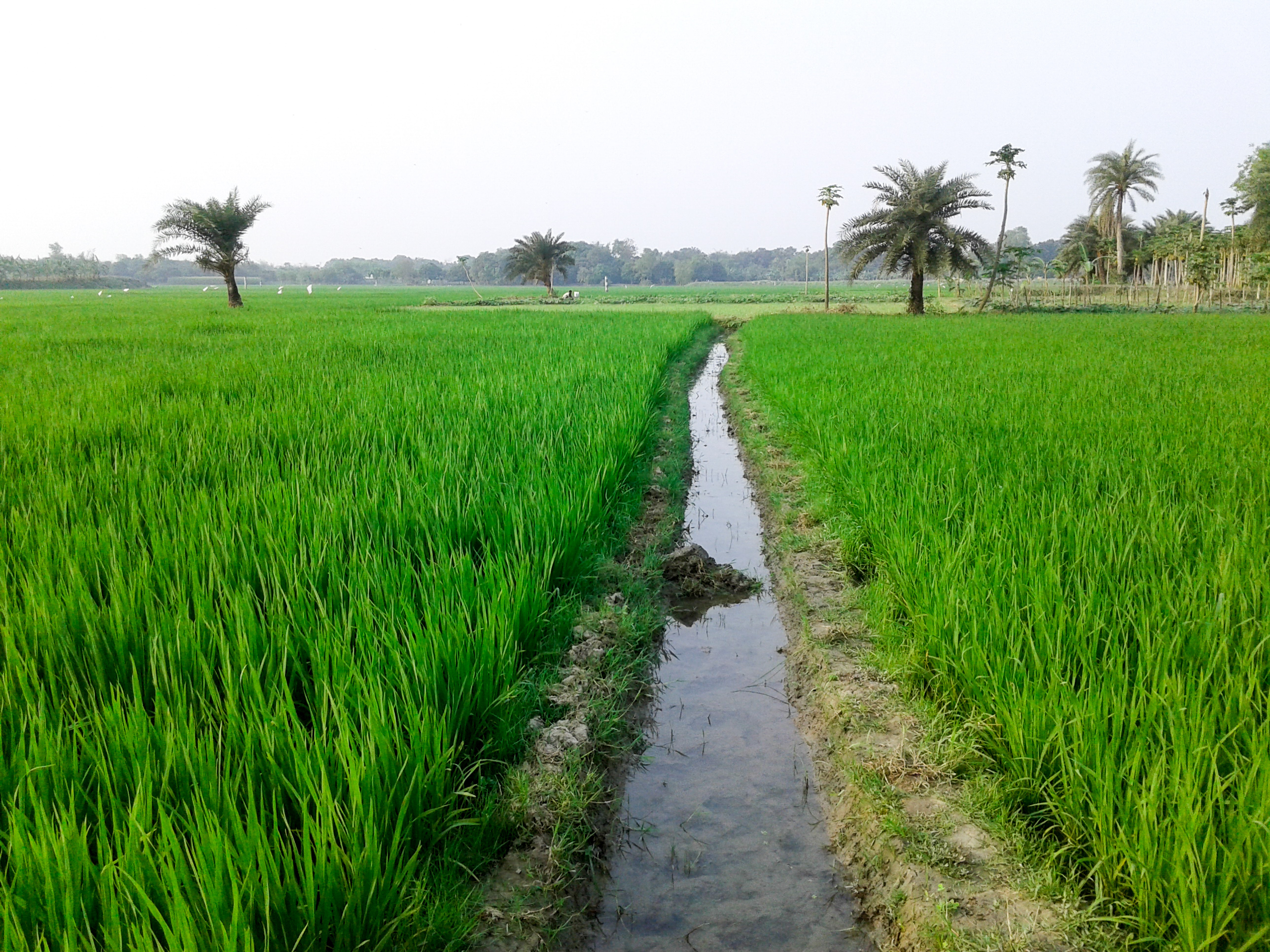
All afternoon long I saw Bashir inside the paddy field.
All through the afternoon the skeleton of that three-storied red brick building
Besides the paddy field was being set up.
				(Everything is turning urban!)
Who owns that building? Why is it being built?
	In the minds of the birds perched on this shore in fading evening light,
		Or unlike the birds, or the boatmen in the boats plying here or the other shore
With their usual outcries,
The blue sky looked on impassively, its mind vacant.
	In my dream at night, I saw Kolkata’s tram company getting ready to be here as well.
		Bashir’s bullocks twain out in this day’s sun look for a break
As domesticated quadrupeds of the world will.
		Which country’s what animals’ and which tribes’ sketches will they resemble
		In becoming museum tales for the high-born and in being immortalised?
						The truths about them will be lost steadily!
			And yet in this land of museums, in the soundless but open room of one of them,
Could it be they would go up in flames without making civilisation any poorer
				Despite its stupendous piston?
Here the only story everyone still knows is of the jackdaw and the fairy tale princess, Shankhamala!
There are innumerable bird, nests and eggs on treetops here but still they haven’t been able to build
 this day a scientific poultry shop!
(These translations are from Jibanananda Das: Selected Poems with an Introduction, Chronology and Glossary, translated by Fakrul Alam, published by The University Press Limited, Dhaka, 1999. Republished with permission from the original publisher.)
Jibonanada Das (1899-1954) was a Bengali writer, who now is named as one of the greats. During his life he wrote beautiful poetry, novels, essays and more. He believed: “Poetry and life are two different outpouring of the same thing; life as we usually conceive it contains what we normally accept as reality, but the spectacle of this incoherent and disorderly life can satisfy neither the poet’s talent nor the reader’s imagination … poetry does not contain a complete reconstruction of what we call reality; we have entered a new world.”
Rabindranath’sOikotan (Harmonising) was first published in 1941. It has been translated by Professor Fakrul Alam specially to commemorate Tagore’s Birth Anniversary.
HARMONISING

How little I know of this immense world,
Of its countless countries, cities, capitals,
And the never-ending deeds of its peoples
As well as its rivers, hills, deserts and seas
And innumerable animals and strange trees—
So many things fated to be forever unknown
Such a vast assemblage
And yet my mind has to be content with only a corner!
Frustrated, I read as many books and travel tales as I can
With boundless enthusiasm.
I pick up too vividly written accounts I come across
With never-diminishing eagerness,
Satiating my knowledge deficit
With treasures I’ll gather by scavenging for them!

I am the world’s poet. Whatever of its sounds I hear
I try to reverberate in my flute later
But though this may be my intent
Many of earth’s notes still elude me
For despite my efforts, gaps remain!
I intuit earth’s amazing harmonies
Through leaps of my imagination
On many an occasion intense silence fills my soul
Notes sounding across remote snowy mountains
And the azure stillness of the sky too
Invite me to commune with them again and again!
The unknown star at the apex of the south pole
Reigning illustriously	through long nights
Illuminates my sleepless eyes on midnights.
Distant waterfalls cascading down
With immense force, flooding everything in sight,
Transmit their harmonies to the innermost me.
I connect intuitively as well with poets everywhere
Contributing to nature’s harmonies
All keep me company and give me immense delight
I receive offerings of lyric notes from the muse of songs
As well as intimations of the music of the spheres.

The outside world can’t fathom fully
The most inaccessible of being residing in us
For He is in our innermost part
And only when one enters it
One gets to know the Being who is truly Him
But I can’t find the door with which to enter there
Since I’ve erected fences in pathways everywhere!
Farmer who keep tilling the soil
Weavers threading yarn and fishermen casting nets—
Varied professions having far-reaching impact
On them all depend whole families and lifestyles.
But the honour due to them is confined
To people of the top tiers of the society I live in
We can only peep at them from narrow openings!
At times I’d take paths fronting their neighbourhoods
But never ever was resolute enough to enter inside!
If one can’t connect one’s life with another’s though
The songs one composes can become cumbersome
And so, I concede to charges levelled against me
And admit my own songs’ limitations.
I know my verses may have traversed varied paths
But they haven’t reached everywhere!
The one who can share a peasant’s life
And whose words and deeds are kins
Is the one who is truly close to the soil
And I’m all ears to listen to that kind of poet.
I may not have created a feast of literary delights
Yet, what I couldn’t attain I keep questing for
Let what I discover ring true
And let me not mislead others’ eyes with fakery
It’s not right to earn fame without paying its true price
It isn’t right at all to indulge in any kind of foppery!

Come poet, retrieve as many as you can
Of those voiceless ones whose minds are unheard
And relieve those nurturing deep hurt inside
In this land lacking spirit
Bereft of songs being sung on any side,
A land which has become an arid desert
For want of joy and the strain created by neglect
Fill with the essence of everything beautiful
And untie the spirit residing in one’s innermost being
 In literary festivals and musical concerts organised,
Let those playing the one-stringed ektara be duly feted.
And the muted ones who can’t express either joy or sorrow
And those whose heads are bowed and voices silent
While facing the world—
Oh gifted one,
Let me hear them all—near or far
Let them partake of your fame
As for me—
Again and again, I’ll pay homage to you
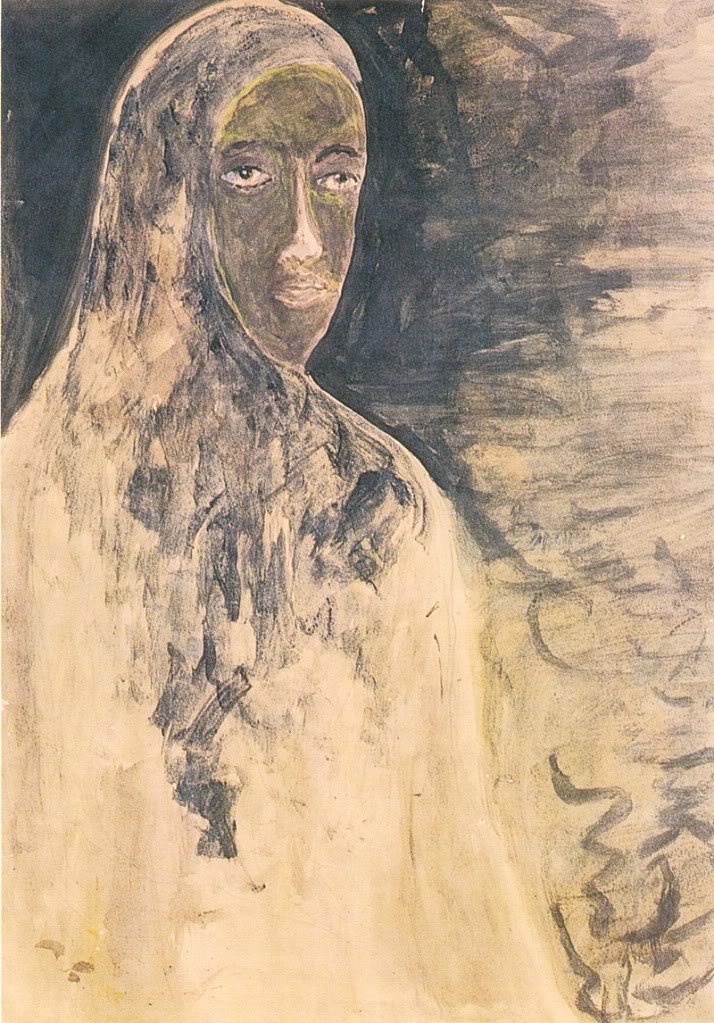
Veiled Woman: Painting by Rabindranath Tagore. Courtesy: Creative Commons
ENDLESS LOVE (Anonto Prem)

It is as if I’ve loved only you,
Hundreds of times, in hundreds of forms
In life after life, age after age, again and again!
Forever, and with an enchanted heart,
I wove necklaces of lyrics
Which you’d wear beautifully,
Accepting my gifts gracefully,
Life after life, age after age, again and again!
The more I hear stories from far away times
Of agonies lovers endured in ages long past,
Of tales of unions and separations
And whenever I look at events of days of yore,
Piercing the veil of darkness of times past
They appear in the form of an eternal star
In your visage.
The two of us float forward
In the current of a union
Emanating from eternity.
The two of us keep frolicking
Amidst millions of lovers,
Whose eyes moisten with tears of separation
Or light up with bashfulness as they meet—
In a love transcendental but in a guise all new
In love everlasting, but of this very day and age!
Born in united Bengal, long before the Partition, Kazi Nazrul Islam(1899-1976) was known as the Bidrohi Kobi, or “rebel poet”. Nazrul is now regarded as the national poet of Bangladesh though he continues a revered name in the Indian subcontinent. In addition to his prose and poetry, Nazrul wrote about 4000 songs. ‘Manush‘ or ‘Mankind’ was published in Nazrul’s collection called Sanchita.
MANKIND

Of equality I sing.
There isn’t anything greater or nobler than a human being.
Wipe all distinctions based on country, period and situation.
Let all religions and countries be one.
In all nations, ages, and homes let God be your companion.

Arising from a dream, a zealous priest opens the temple door and exclaims:
“Devotee, open doors,
The God of Hunger stands outside; time now to pray to Him.”
Surely, he thinks, God’s Grace will transform him into a King!
Wearing tattered clothes, emaciated, and voice enfeebled by hunger,
A wayfarer pleads: “Open the door, I’ve been hungry the whole week.”
Instantly, the door is shut, the hungry one is turned away.
In the darkness of night his hungry eyes glare all the way.
The beggar mutters, “Lord, the temple seems to be his, and not yours!”

Yesterday the mosque was full of sweets and meat and bread,
This day the sight of the leftovers makes the Mullah glad!
Just then a hungry man comes in, sores on his skin,
He says, “Sir, for the seventh day I’m starving!
Enraged, the Mullah exclaims, “So what, if you are hungry?
Go and lie down where carcasses of cattle are cast away!
By the way, do you pray?” The wayfarer confesses, “No Sir!”
The Mullah swears, “Swine, time then for you to scram!”
Picking up all leftovers, the mullah the mosque gate slams!

The hungry one turns back, muttering, “I can claim,
Eighty years I survived without ever invoking your name
How come, from me, Lord, you never withdrew your bounty?
Should I conclude mosques and temples are not for me?
That Mullahs and Brahmins have shut their doors to the poor?
Where are you, Chengiz, Mahmud of Ghazni, and Kalapahar?
Storm all doors of these so-called houses of prayer!

Who bolts the House of God? Who locks its portals?
All doors force open, smash ’em with hammers and crowbars.
Alas House of Prayer
Aloft on your minarets charlatans flaunt themselves,
Disdaining mankind!
Who could these people be, loathing man,
But kissing ostentatiously the Vedas, the Bible, and the Quran?
Snatch from their lips all the holy books.
Don’t forget their originators perished in the hands of such crooks!
Hypocrites always prosper thus! Listen all you fools,
Men brought books into being; books didn’t create men!
Adam, David, Moses, Abraham, Jesus and Mohammed,
Krishna, Buddha, Nanak, and Kabir are our ancestors.
Their blood course through us, we are their successors,
We are their kin; our bodies are like theirs.
It is possible that one day we will achieve their statures!
Don’t laugh, friends. My self stretches to infinity,
None -- not even I -- knows what greatness lies within me.
Perhaps within me is Kalki, in you Mehdi or Jesus,
Who knows where one begins and ends; who can limit us?
Why loathe the man so, brother, why kick him at will?
It could be that even in him God keeps vigil!
Or even if he is nobody, no one exalted or great,
See him as a man besmeared and completely shattered.
And yet no house of worship or sacred book on earth
Can measure up to that small body’s worth!
It could be that in his humble hut one day will be born
Someone who in his unique way the world will adorn!
The message the world awaits, the superman not yet glimpsed,
Perhaps will appear in this very hut someday soon!

Is he untouchable? Does he put you off? But he isn’t reprehensible!
He could be Harishchandra or Lord Shiva!
An untouchable today could be Emperor of all Yogis tomorrow.
Tomorrow, you will eulogise him, will praise him to the skies
Who is that you call a rustic, who is it that you despise?
It could be Lord Krishna in a cowherd’s guise!
And what if the one you hated as a peasant so
Was King Janaka or Lord Balaram incognito?
Prophets were once shepherds, once they tilled fields,
But they brought us news of eternity—which will forever be.
Male or female, you kept refusing all beggars every day
Could it be that Bholanath and Girjaya were thus sent away?
Lest feeding a beggar makes you feast less,
Your porter punished the beggar at your door,
What if you thus drove a deity away?
What punishment will lie for you then who can say?
What if the goddess thus insulted never forgives you?
If your heart wasn’t so greedy, so obsessed with only what you need,
Friend, you would see that in serving you the gods became impoverished!
Beast that you are, will you abuse the God within your heart
To swallow the nectar distilled from human misery and hurt?
Will that drink make you happy? Will that satiate your lust?
Only your evil angel knows what food will please you most.
One your evil angel knows how you can self-destruct best!
Through ages, beast, know that what thrusts you to death is lust!
Where Have All These Birds Gone
Where have all those birds gone now—and those horses --
And the women in those white houses?
Wet with the fragrance of acacias-tinged with golden sunlight
Those birds—and those horses--have left our world behind;
My heart, tell me where -- where have they all gone now?
Darkness, like that dead pomegranate—silence.
On the Pathways for Long…(Prithbir Pothe Aami Bohu Din from Ruposhi Bangla)
Having lived in the world’s pathways for a long, long time
I know many stressful, hidden tales of the heart now.
In forests, branches and leaves sway -- as if
Djinns and fairies conversing! On greying evenings
I’ve seen on their bodies a drop or two of rain dripping down.
Like parched paddy will. White specks of dust soften in rainwater.
A faint scent suffuses farmlands. From frail bodies of Gubur insects
Indistinct, melancholy sounds dip into the dark river water;
I’ve seen them all -- have seen the river immerse in the sloping dark;
Shapmashis fly away; In Asuth tree nests, ravens flutter their wings
Incessantly; someone seems to be standing in the lonely, fog-filled field.
Farther off, one or two straw-roofed houses lie scattered.
Why do the frogs croak on in Nolkhagra forests? Can’t they not stop?
Freshly laid crow eggs slip and slide into the Sheora bushes.
(These translations are from Jibanananda Das: Selected Poems with an Introduction, Chronology and Glossary, translated by Fakrul Alam, published by The University Press Limited, Dhaka, 1999. Republished with permission from the original publisher.)
Jibonanada Das (1899-1954) was a Bengali writer, who now is named as one of the greats. During his life he wrote beautiful poetry, novels, essays and more. He believed: “Poetry and life are two different outpouring of the same thing; life as we usually conceive it contains what we normally accept as reality, but the spectacle of this incoherent and disorderly life can satisfy neither the poet’s talent nor the reader’s imagination … poetry does not contain a complete reconstruction of what we call reality; we have entered a new world.”
Jibananada Das (1899-1954) was a Bengali writer, who now is named as one of the greats. During his life he wrote beautiful poetry, novels, essays and more. He believed: “Poetry and life are two different outpouring of the same thing; life as we usually conceive it contains what we normally accept as reality, but the spectacle of this incoherent and disorderly life can satisfy neither the poet’s talent nor the reader’s imagination … poetry does not contain a complete reconstruction of what we call reality; we have entered a new world.”
ONE DAY IN THE FOG...(“Akdin Kuashai” from Ruposhi Bangla)
I well know a day will come when you won’t find me in this foggy field
Having ended its walks, the heart will move on to a silent, icy room then
Or perhaps it will be a while before it can be consoled. It may take time
For it to forget this earthly field. In astonishment, I’ll keep looking
At the shaliks of the field from my bed in darkness. Will golden eagles
Still unfurl their wings and waft their way to this fog-filled field from afar?
To this day they head for bare ashwath branches as evening turns golden.
While through the soft rice stalks field mice still keep looking at the stars
As evening descends. Do bees still not build hives in intense dense darkness?
Having their fill of honey, don’t they fly away in the foggy, evening wind?
So far they must fly to, alas…or perhaps hemmed by chalta leaves
Some get trapped under hives. The flies fly away…drop… die in the grass—.
IF LIFE WERE ETERNAL…

Given the boon of eternity, I would walk the ways of the world eternally.
All, all alone -- what if I would see lush green grass in full bloom then?
And what if I beheld the yellowing grass withering away -- And view
The sky full of wan white clouds at dawn? Like a tattered munia bird
Blood reddened breast in the evening -- I would see the stars repeatedly;
I would see an unknown woman’s hair drifting away from a loosened bun;
A woman who would leave -- with a face bereft of the evening sun’s glow.
Jibonanada Das (1899-1954) was a Bengali writer, who now is named as one of the greats. During his life he wrote beautiful poetry, novels, essays and more. He believed: “Poetry and life are two different outpouring of the same thing; life as we usually conceive it contains what we normally accept as reality, but the spectacle of this incoherent and disorderly life can satisfy neither the poet’s talent nor the reader’s imagination … poetry does not contain a complete reconstruction of what we call reality; we have entered a new world.”
Professor Fakrul Alam takes us through the three Partitions of Bengal whichultimately led to the creation of Bangladesh, with focus on the role of Dhaka University. Click hereto read.
Professor Fakrul Alam brings to us Tagore songs in translation and in discussion on the season that follows the scorching heat of summer months. Clickhere to read.
Fakrul Alam writes nostalgically of his visits to Feni in Noakhali, a small town which now suffers from severe flooding due to climate change. Click here to read.
Giraffe’s Dad by Tagore: Giraffer Baba (Giraffe’s Dad), a short humorous poem by Tagore, has been translated from Bengali by Professor Fakrul Alam. Click here to read.
Oikotan(Harmonising) has been translated by Professor Fakrul Alam and published specially to commemorate Tagore’s Birth Anniversary. Click here to read.
Monomor Megher Songi (or The Cloud, My friend) has been translated by Professor Fakrul Alam. Click hereto read.
Jibananada Das (1899-1954) was a Bengali writer, who now is named as one of the greats. In his lifetime, he wrote beautiful poetry, novels, essays and more. He believed: “Poetry and life are two different outpouring of the same thing; life as we usually conceive it contains what we normally accept as reality, but the spectacle of this incoherent and disorderly life can satisfy neither the poet’s talent nor the reader’s imagination … poetry does not contain a complete reconstruction of what we call reality; we have entered a new world.”
I will sleep

Having lived in the world’s pathways for a long, long time
I know many stressful, hidden tales of the heart now.
In forests, branches and leaves sway -- as if
Djinns and fairies conversing! On greying evenings
 I’ve seen on their bodies a drop or two of rain dripping down.
Like parched paddy will. White specks of dust soften in rainwater.
A faint scent suffuses farmlands. From frail bodies of gubur insects
Indistinct, melancholy sounds dip into the dark river water;

I’ve seen them all—have seen the river immerse in the sloping dark;
shapmashis fly away; In asuth tree nests, ravens flutter their wings
Incessantly, someone seems to be standing in the lonely, fog-filled field.
Farther off, one or two straw-roofed houses lie scattered.
Why do the frogs croak on in Nolkhagra forests? Can’t they not stop?
Freshly laid crow eggs slip and slide into the sheora bushes.

(“Ghumiye Poribe Aami” or “I will sleep” from Ruposhi Bangla, first published in Daily Star, Bangladesh)

Aghrayan’s Wintry Wilderness

Saying, "I know you don't look for me anymore in this world these days"--
I ceased speaking. Aswatyha tree leaves lay strewn amidst the grass then--
Withered and disheveled. Wintry agrahyan has arrived in this world's forests.
And yet long, long ago, our minds had been chilled by hemonto's onset!

(Agrahayan and Hemonto are names of Bengali seasons)
Tagore wrote on almost all aspects of life. Here are Fakrul Alam’s translations of Tagore’s songs for Ashar, the third month in the Bengali Calendar around the months of June-July. It is the time the monsoons start to set in. The sky, the flora and the fauna are resplendent and fecund with the much-awaited showers. Alam, a renowned scholar and translator from Bangladesh, was kind enough to share these six songs of the season which will soon be a part of his forthcoming publication on translation from the Gitabitan, Tagore’s treasury of more than 2000 songs.
Garland of Lightening Gems(Bajromanik Diye Gantha, written in 1925)
Ashar, how delicate is your garland of jewelled thunderbolts!
Your dark beauty is set off by lightning flashes
Your spells have the power to melt stones and sprout crops--
On your winged feet you bring from sandy wastes flower garlands
On withered leaves you come in torrential and triumphant showers
Your clouds resound like tom-toms in festive abandon
In your deluge of delicious green, parched earth revives
But keep your awful, life-threatening floods away!
In the Thunderous Clouds(Oi Je Jhorer Meghe, written in 1922)
There--in the lap of storm clouds--the rain comes
Its hair loosened, its sari’s borders flying!
Its song beats flutter mango, blackberry, sal and rain-trees
Making their leaves dance and murmur in excitement
My eyes, moving in beat to its music
Wander in falling rain, losing themselves amidst sylvan shades
Whose familiar voice calls out to me in the wet wind endlessly
Stirring a storm of anguish in my soul on this lonely day?
The Tune of New Clouds(Aaj Nobeen Megher Shoor Legeche, written in 1922)
Newly arrived clouds stir a tune in my mind today
And my thoughts become all aflutter causelessly
How these clouds lure me outdoors again and again,
Casting their shade on my eyes every now and then
In the rain pouring from the sky tumultuously
What message of the path to pursue do they bear?
That path will take my mind’s tune into the unknown
And disperse it in the bower of one forever forlorn!
The Sky’s Musings(Aaj Akashe Moner Kotha, written in 1922)
This day I hear the sky’s musings in thundershowers
They’ve reverberated in my heart all day long.
On the dark lake water, clouds thicken
The wind, bearing the pain of centuries,
Has murmured in my heart all day long
By my window and in darkness
I commune with the sky, all alone
Like rustling branches, hidden memories stir
Evoking a tear-soaked tune in my soul
As crickets chirp on—all day long!
Under the Kadmaba Trees(Esho Nipo Bone,written in 1925)
Come and walk in the shade of the Kadamba tree rows
Come bathe in rain water streaming down incessantly
Let down your disheveled thick jet-black tresses
Drape around your bodies your sky-blue saris
With kohl-lined eyes and jasmine garlands
Come and walk in the shade of Kadamba tree rows!
Every now and then, my dear, dear soul mates,
Let smiles light up your lips and eyes wondrously
To the beat of pouring rain, let Raga Mallar tuned songs,
Sung in your sweet voices, sound in forests sonorously
Come and walk in the shade of Kadamba tree rows!
Tear-filled Sorrow(Ashrubhara Bedona, written in 1925)
Tear-filled emotions stir everywhere!
Whose desire sounds in dark in the clouds this day?
They speed across tempestuously,
Whose lament echoes in the rumbling?
Who could be focused on such fruitless worship?





 Borderless