Categories
Essay

From Bombay to Kolkata — the Dhaaks of Durga 

Ratnottama Sengupta travels through time and space to explore a UNESCO-declared ‘Intangible Cultural Heritage of Humanity‘, a festival called, Durga Puja

Dhaakis (Drummers) playing dhaaks (drums) at Durga Puja. From Public Domain

It was Saptami, the second day of the five-day Durga Puja that had been inaugurated the previous day. I had new dresses lined up for all five days. But the dawn of Saptami brought us news of disaster. A short circuit had razed the entire pavilion along with the clay icons of Durga, her brood comprising Ganesh, Kartik, Lakshmi, Saraswati and their vahanas — the lion, owl, swan peacock and mouse. Gone was the chaalchitra, the halo-like backdrop presided over by Lord Shiva and depicting the story of the goddess who fought the demons Chanda Munda, Shumbha, Nishumbha, Madhu Kaitav, Raktabeej Mahishasur…

We were mourning all through the Pujas that particular year. No new dresses worn, no new shoes on our feet, no ‘Dussehra Greetings’ nor any sweets on ‘Bijoya’. We felt sad not because of  the effort my father, Nabendu Ghosh, had put in as the President of the Puja conducted by the Udayan Club, but because of the belief that “Durga comes home to her parents during this period.”

*

My father’s ancestral home was in East Bengal. My grandfather, Nabadwip Chandra Ghosh, was an Advocate who relocated to Patna in 1920. Every autumn after that the family would travel back to Dhaka for a month. Because the Durga Puja in their family home was the lone puja of Kalatiya, the village which is now a suburb of Dhaka. Everyone there would flock to ‘Ukil Babur Bari’[1]for the puja and prasad in the afternoon and the cultural programmes in the evening. Jatra, theatre, Pala Gaan, Naam Sankirtan — the itinerant groups of performers comprised of singers, actors, the narrator or the sutradhar, and the adhikari or the manager. It was at one such performance that Baba[2], then all of seven, fell in love with a ‘lady’ who had played Draupadi. Imagine his disappointment when the departing ‘lady’ turned out to be a clean shaven youth!

The next year at that very Puja Mukul [3]— the pet name of Nabendu Bhushan — first ‘acted’ as a Sakhi[4]! At eight his ‘manhood was offended at the thought of playing a handmaiden. But when he stood on the stage with three other boys, all dressed in finery and wigs, all praying ‘Madhav rakho charaney[5]!’ he was transported to Lord Krisha’s court in ancient Dwarka. That was his first experience of Rasa[6] — and unaware even to himself he had set on a lifetime’s journey with the arts.

When life took him to Bombay in 1951, there were few Pujas and no possibility of publishing anything in Bengali. Pragati Club of Andheri started a Puja in Mohan Studios that had Bimal Roy as the President and Nabendu Ghosh as the Secretary. That Puja continues to this day — and to this day these two names figure in the brochure the club publishes annually. Pragati[7] used to bring out a handwritten magazine back then. PraBas — meaning, migrant life, was an acronym for Prabasi Bangla Samaj.[8] Edited by Nabendu Ghosh, it boasted hand-painted covers by renowned artist Chitto Prasad.

Pragati, Kallol, Udayan, Natun Palli, Shivaji Park, Chembur — all the major Pujas of Mumbai continue to publish a brochure for the Pujas as a souvenir of the festival and also  to raise funds through ads by the sponsors.

*

All through my school life, which I spent travelling to the Bengali Education Society’s English High School at Dadar, I would necessarily spend one evening rolling into late night at the Shivaji Park puja pandal. Long in advance I would plan which dress to wear. The latest Bengali movie would be screened. The Puja Specials would have already come home — in the pavilion we would pick up some new publication of Sunil Gangopadhyay or Shirshendu Mukherjee. The Puja songs would keep playing while we, a bunch of batch-mates from all over Mumbai, would endlessly snack on fancy food and chat.

My university years saw a shift of ‘allegiance’ to Notunpalli, the Puja started by Shakti Samanta at Bandra in 1972 as did all the major Bengali biggies of Bollywood, from Salil Chowdhury, Basu Chatterjee, RD Burman to Jaya Bhaduri and Amitabh Bachchan, who would earlier visit the Puja at Ramakrishna Mission at Khar. Now I would flock to the stalls of handloom saris, salwar suits, fashion dresses — some of which were set up by my cousins or friends. Rupa, Aloka-Tulika-Lipika, Mina Kakima and Latika Kakima — wives of actor Tarun Bose and playback artiste Talat Mehmood, sons and daughters of Dhruv Chatterjee and Asit Sen, seasoned CEOs and young bankers — the stimulating adda[9] here ranged from cinema to career choices, economics to politics.

*

Talking of Ramakrishna Mission, I am reminded of Manobina Roy, wife of Bimal Roy. Jethima[10] and my mother Kanaklata would set up a stall where they would sell papad and vadi, narkel and til naru, muri moa and kucho nimki[11]. These sesame, coconut or lentil balls were all made at home by Didimas[12], Kakimas and Mashimas[13]who lived in Rana Cottage near our house in Malad. If the Kumari Pujo[14]and Sandhi Puja[15]rituals were special for these seniors, Bijoya was super special for me and my friends. This post-immersion round of socialising to greet friends spelt many visits, to Bandra and Khar, Santa Cruz and Andheri, Goregaon and Borivali. And visiting the family of our parents’ friends meant not only naru-nimki, it could also mean chops, cutlets, cakes, sandwiches — goodies that were not so common in Bengali households 65 years ago, when sandesh and rosogolla, sweets made from cottage cheese, were also sold door-to-door, by men who brought them to our houses in aluminium trays tied in cloth!

*

That’s a faraway reality from what obtained in Kolkata where I spent some Puja holidays at my aunt’s (Ranjita Mashi’s) place on Motilal Nehru Road. It was opposite Deshpriya Park, where we children would report every morning of the five days, to help distribute the floral offering for pushpanjali and the prasad[16] in sal leaf bowls. Pandal hopping was a must, primarily on foot, as the pavilions designed with cloth themselves were works to admire. And on Dashami[17] evening, Haabu, Dipu, Reena, Minu and I would stand near the Rash Behari post office opposite Priya Cinema and watch the idols, sculpted with the signature of traditional idolmakers of Chitpore, being taken for immersion in the Ganga. What joy it was as we could watch all the Goddesses we’d heard of but not visited — even from Krishna Glass or Teish Palli! A much glamourised and glorified version is now held on Red Road, the main artery of the city, with the Chief Minister presiding over the Carnival of Immersion.

Twenty years ago when I returned to make my home in Kolkata, Deshpriya Park was still home to a Sarbojanin Durgotsav[18]. But it hit the headlines in October 2015 when mayhem broke loose crushing surging crowds who had assembled to view the 88-foot “Biggest Durga Ever.” Effectively the community celebration had become a cause for corporate branding and competition. Sponsors, in some cases, outnumbered the – neighbourhood — ‘parar‘ — volunteers. Reason? Perhaps because television was trying to grab eyeballs in every home. Even Kumari Pujo at Ramakrishna Mission was being watched on screens across the oceans. And as the Arts Editor of The Times of India, I was planning celebrity visits and artistic trophies for our Pujo Barir Shera Pujo [19]competition in high rise buildings and gated communities.

*

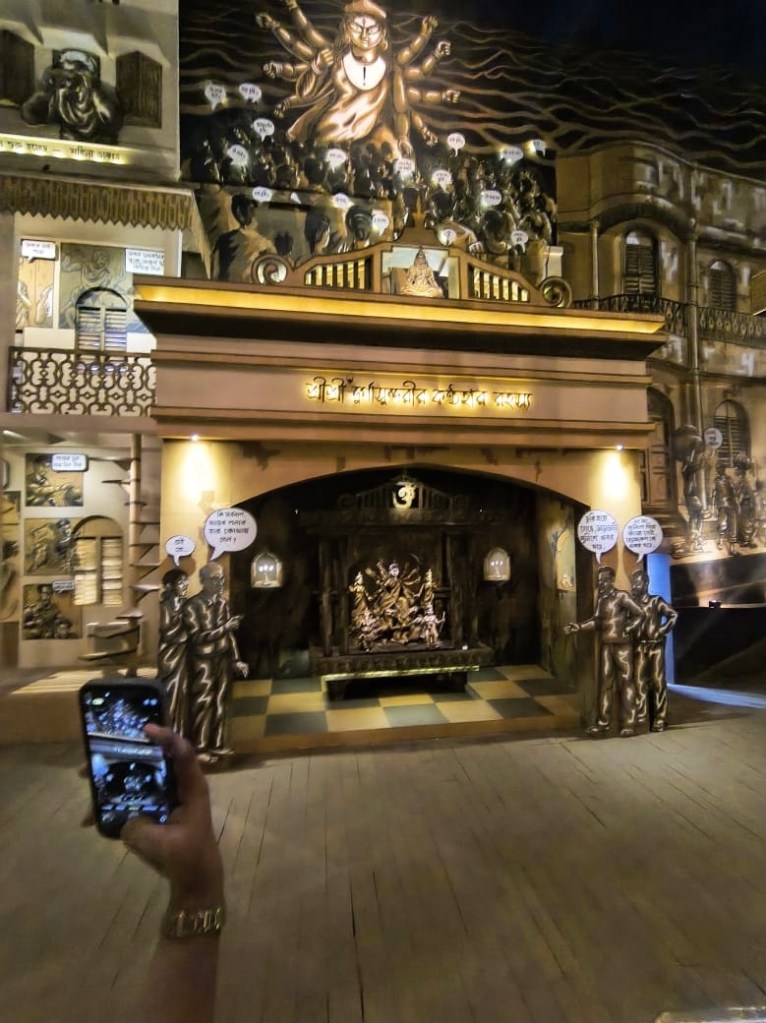
But what was the biggest change in observing Sarbojanin Durgotsav in Bengal? These public worship grounds had transformed into vast galleries where artists were staging the icons as installation art. These concept-driven pujas took leaves out of mythology but interpreted the goddess in the light of contemporary and universal concerns. Some were highlighting Her as a feminist force. Some as an embodiment of Nature. For some, She denotes the cosmic universe. Elsewhere crafts and looms got prominence. Family bonding was not forgotten. From the icons to the pavilions, from the chaalchitra to the fairy-light decoration — there was a unity of thought and execution. In the process, knowledge about practices in distant corners of our country, or of lifestyles several countries away from ours became accessible to the average person on the street. 
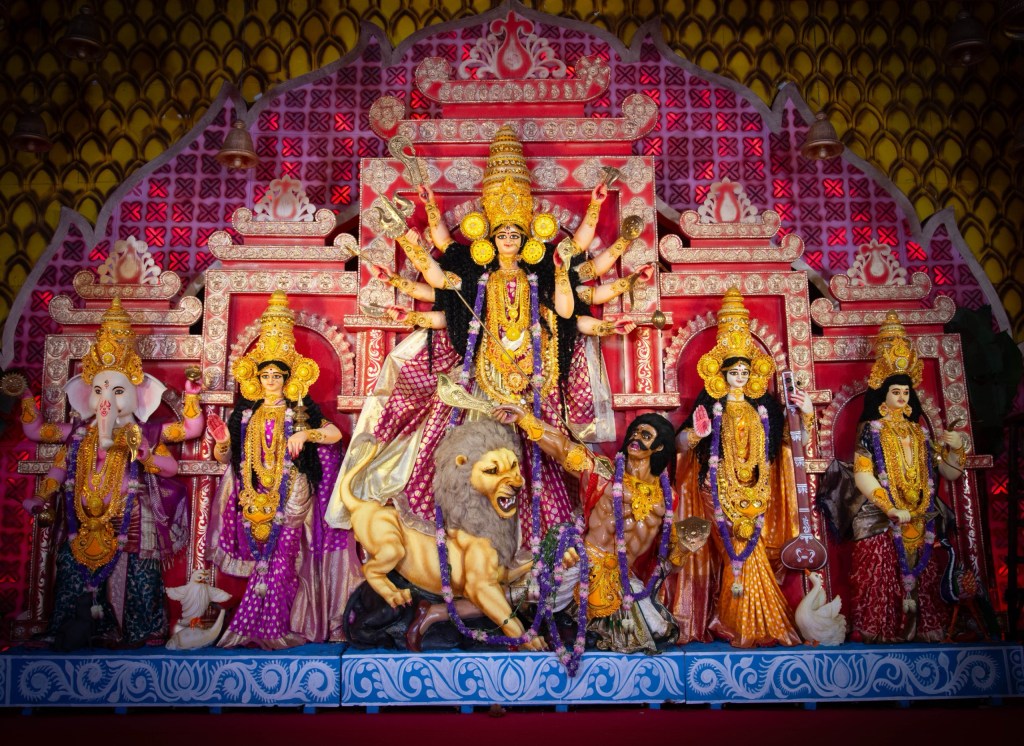
There has been another interesting development. For years, the divas of Indian screen, from Bengal to Bombay, have inspired the Pals[20] of Chitpore. Sometimes she resembled Hema Malini, sometimes Madhuri Dixit. The demon too has been modelled after the politicians who are seen as foes.

At Arjunpur near Dumdum airport, the Third Eye of Durga is the nib of a fountain pen – as is the pointed middle of the three-pronged trident, trishul: “The pen represents wisdom and thought, and it is also the contemporary weapon to protest and fight,” explained Shampa Bhattacharjee. The artist from Delhi had designed the icon while her husband, physicist, created the atmosphere with rotating lights and floating balls – al in luminous steel.

*

Durga as a feminist force is perhaps the most natural interpretation of the goddess who was construed as a Goddess because evil demons had sought immunity against all other forms of power save a woman. Durga was conceived as Durgati Nashini — Destroyer of Misfortunes. The mace, the trident, the circular Sudarshan, the bow and arrow, the sword – every single weapon that empowered her was gifted by a God, be it Vishnu, Brahma, Shiva or Agni, Vayu, Varun, or even Yama. Read, the masculine forces. Perhaps that is why, the jagirdars and zamindars, under the nawabs and the British Raj worshipped Shakti, the icon of empowerment. The Raj families of the City of Palaces, the Debs of Shovabazar, the Chowdhurys of Behala, the Roys and Duttas of Kalutola and Nimtala, the Mullicks of Marble Palace or Rais of Andul – they still pay their obeisance to the Image of Shakti. And the celebration in the ancestral homes of these bonedi – once aristocratic – families are a tourist attraction.

Ironic that, during the struggle for Independence from the imperialists, She became the embodiment of motherland. Abanindranath Tagore’s iconic painting of her as the embodiment of sacrifice stays etched in our hearts and our souls to this day. 

And when I stand before any invocation, in any form, in any corner of the subcontinent, these words of my father ring in my ears. “Imagine the map of India as you stand before Maa Durga. To her right are Lakshmi and Ganesha — the two realisations of Prosperity and Success — who are worshipped in Rajasthan, Gujarat, Maharashtra, Karnataka. On her left are Saraswati and Kartik — representing Learning and Wisdom and Craft — worshipped in Assam, Bengal, Orissa, and the Deccan. At her feet is the Mahishasur, also depicted in our epic as the Dusht Ravan who ruled Lanka. And above her, reigning from the chaalchitra is Mahadev Shiva, identified with the Himalayas. Asamudra Himachal, from the mountain to the ocean, it is our motherland — Bharat Tirtha[21].”

*

The crux of it? Durga Puja is not merely the worshipping of a Hindu god. What started as a religious phenomenon in the households of the rich or powerful is no longer merely ritualistic. In this millennium, it is a vibrant celebration involving, at every step, the Indian thought and creativity, mind and heart, economy and management. It knits the masses in more ways than one. The castes and classes, the highs and lows of society — no one is left out of the festivity. It is a sociocultural happening. Year after year after year it is, in the truest sense of the term, Sarbojanin.

Small wonder the largest public art festival of the subcontinent has been recognised by UNESCO as an Intangible Cultural Heritage!

[1] Lawyer’s house

[2] Father

[3] Bud

[4] A woman actor

[5] Krishna, give us a place at your feet

[6] Flavour or essence

[7] Publisher, name means progress

[8] Bengali Immigrant Society

[9] Chit chat

[10] Paternal aunt

[11] Sweet and savoury snacks

[12] Grandmothers

[13] Paternal and maternal aunts

[14] Worship of girl child

[15] Evening prayers

[16] Snacks given out as blessings

[17] Last day of Durga Puja

[18] Community Durga Puja

[19] The Best Durga Puja Display

[20] The statue makers

[21] Pilgrimage of India

Ratnottama Sengupta, formerly Arts Editor of  The Times of India, teaches mass communication and film appreciation, curates film festivals and art exhibitions, and translates and writes books. She has been a member of CBFC, served on the National Film Awards jury and has herself won a National Award. 

.

PLEASE NOTE: ARTICLES CAN ONLY BE REPRODUCED IN OTHER SITES WITH DUE ACKNOWLEDGEMENT TO BORDERLESS JOURNAL

Click here to access the Borderless anthology, Monalisa No Longer Smiles

Click here to access Monalisa No Longer Smiles on Amazon International
Categories
Essay

 Bottled Memories, Inherited Stories

By Ranu Bhattacharyya

I hear the scents whisper. Familiar fragrances of clove and cinnamon, imbued with spicy notes of pepper and eucalyptus beckon and tease. Elusive murmurs of mysterious oils and herbs tinge the air as I walk along a narrow-paved lane in Old Dhaka, overshadowed by looming walls on either side. I ignore the press of prying eyes and inquisitive bodies that accompany my passage. The call of the scents is irresistible, and I feel strangely unafraid of what lies before the next turn in the path ahead. These were the scents of my childhood — of summer afternoons spent secretly exploring the forbidden depths of my grandmother’s closet, the kaancher almarih[1] where her medicines were stored in shiny glass bottles with peeling labels.

The narrow lane spills into a small courtyard hemmed by buildings on three sides. Everything is closed because it is Friday, the day of prayer in Bangladesh. Peering through grimy windows, I see gigantic iron cauldrons, cavernous kansa kadhais[2], their gold gleaming in glimpses amidst sooty splatters, huge ladles and enormous tongs. Some vessels perch on hand-crafted mud stoves, their sides smoothened and baked by fires. Wooden logs are stacked in the corner along with bulging sacks of coal. Nearby, some large pieces of cloth, perhaps used for straining, are hung out to dry. In the shadowy recesses, shelves stacked with glass bottles glisten with reflected light. It seems almost staged, like a theatrical representation of a medieval kitchen and yet the evidence of daily use is undeniable.

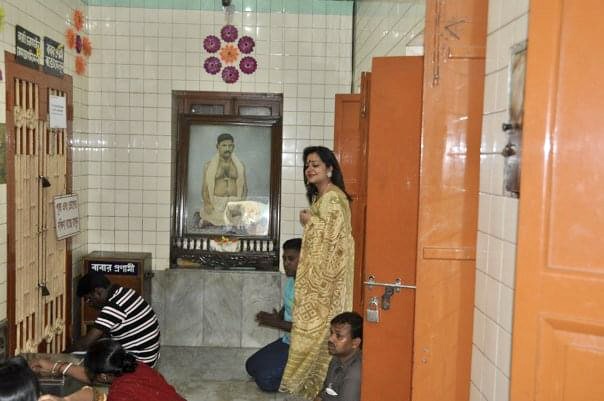
The fourth side of the courtyard has an open doorway. A sudden urge, an inexplicable pull, lures me towards it. I feel I know what lies beyond its brink. Yet how could that be? In this alien city, situated in a land scarred by a brutal Partition, from where does this knowing come? Concentrating on lifting the edge of my saree as I step across the threshold, it takes me a moment to lift my eyes to see what lies ahead. A painting of a pot-bellied man seated cross legged on an asana[3], a sacred thread adorning the vast expanse of his chest, looks solemnly back at me. Before me was the same face I’d seen on countless bottles in that medicine cupboard of my childhood — the same glossy hair, oiled and parted with precision, the same curled moustache, the same narrow bordered white dhoti[4].

The author with her great grandfather’s portrait in Dhaka. Photo Courtesy: Ranu Bhattacharyya

I find myself before a life-size portrait of my great grandfather, Mathura Mohan Chakraborty, founder of Shakti Aushadhalaya, the Ayurvedic pharmacy famed in the streets of Dhaka, Calcutta, Patna, Benaras and Rangoon at the turn of the 19th century. The kitchen behind me was the pharmacy’s karkhana[5] to prepare medicines of his formulations. His portrait hung before the inner sanctum of the temple he had dedicated to the revered Bengali saint, Lokenath Baba. Legend claimed that the mystic had whispered the recipe of the first medicinal formulation to his most faithful disciple — my great grandfather.

Ever since I arrived in Dhaka as an expat, I had been searching for the Shakti Aushadhalaya premises. Everyone knew of the company; yet nobody seemed to know where it was located. I was introduced everywhere as a young scion of the family. And though whispers followed me at gatherings and smiles broadened on hearing I was the great granddaughter of Mathurababu, my questions regarding the whereabouts of the company drew blank stares and confused responses. In horticulture, the word scion, refers to the detached living part of a plant that is cut to be grafted onto another plant. The sundering of this particular scion had been so complete, over so many generations, through such a series of violent events that it seemed my search for the original plant would remain elusive.

It was only through persistent enquiry that I found myself in Swamibagh Road in Old Dhaka where the manufacturing unit of Shakti Aushadhalaya was located. Mathurababu had founded the company in Patuatuli, Dhaka, in 1901. Family lore suggests Lokenath Baba inspired him to venture far from his origins as a schoolteacher in Bikrampur. The ascetic recognised his potential, unusual in those times, as a graduate versed in three languages — Bengali, Sanskrit and English. Starting from humble beginnings in the family kitchen, peddling hair oil and tooth powder in his neighbourhood, Mathurababu’s prescient business acumen saw his enterprise flourish. The company produced and supplied quality Ayurvedic medicines at low prices. Mathurababu also established an Ayurvedic institute, attached to his manufacturing unit to popularise Ayurvedic knowledge. The institute taught Ayurveda and philosophy in Sanskrit. Students were offered free tuition, boarding, and lodging.

Ayurveda, considered the oldest existing health science in the world, is believed to have originated in India 5000 years ago. The journey of Ayurveda from ancient times to its present incarnation is a fascinating story that follows several simultaneous trajectories, embracing geopolitics and history, trade and commerce, science and industry, technology and travel.

It is with a sense of wonder that I encounter my great grandfather’s name in journals and books that describe the history of Ayurveda in India. He was among the earliest entrepreneurs to transition towards production of Ayurvedic drugs for the market. Directly involved in all aspects of his company, Mathurbabu immersed himself in the study of Ayurveda and had an extensive library of rare treatises on ancient Indian medical traditions, including a prized copy of Susruta Sanhita[6].

He noticed that Western medicines advertised their products in newspapers and journals. Following this model, he embraced a similar practice for his own company. An advertisement published in Muhammadi in February 1940 included endorsements from freedom fighter Chittaranjan Das, Lord Lytton, the Viceroy of India, and Lord Ronaldshay, the Governor General of Bengal. In the vintage advertisement, Lord Lytton wrote: “I was very interested to see this remarkable factory which owes its success to the energy and enthusiasm of its proprietor Babu Mathura Mohan Chakravarty B.A. The preparation of indigenous drugs on so large a scale is a very great achievement. The factory appeared to me to be exceedingly well managed and well equipped &c. &c.” In the same advertisement, in Bengali, Chittaranjan Das endorsed that nothing could surpass the production processes for medicines at Shakti Aushadhalaya.

Since the mid-19th century, several eminent leaders of the Indian freedom struggle visited Mathurbabu’s factory in Dhaka. On June 6, 1939, in the company’s visitor’s book, Subhash Chandra Bose wrote, “I visited the Sakti Oushadhalaya[7], Dacca, today and was very kindly shown around the premises. Indigenous medicines are prepared here on a large scale and in accordance with Ayurvedic principles. The institution reflects great credit on Babu Mathura Mohan Chakravarty, whose enterprise has brought Ayurvedic medicines within the reach of the poor. I wish him all success to the institution which he has built up after so much enterprise and hard labour for a long period. The success of Sakti Oushadhalaya, Dacca, means the popularity of Ayurveda throughout the country and this in its turn means the relief of suffering humanity.”

When my parents visited us in Dhaka a year after our arrival, we went back to Swamibagh Road. Our visit included a trip to the shop where the medicines of Shakti Aushadhalaya were sold.

Despite being taken over by the Pakistan government in 1971 and subsequently acquired by a private entrepreneur, the company remains operational in Bangladesh to this day with 37 branches nationwide. Though Mathurababu’s portrait is no longer on the medicine bottles in the shop, the names of the formulations inscribed, are still recognised by my mother.  As we browse through the offerings, a crowd begins to form around her, hailed and welcomed as Mathurababu’s direct descendant. Much to my mother’s delight, the crowd guided her to his house, a now derelict mansion hidden in the by-lanes of Old Dhaka.

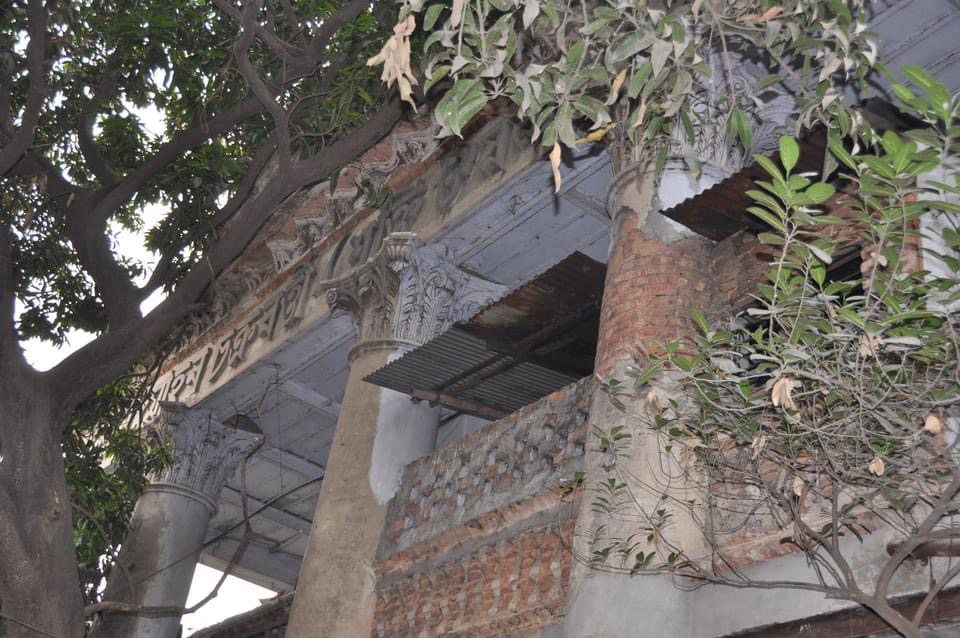
We entered the property through an ornamented gatehouse that opened to a large courtyard. On one side was the Baithakghar, the public receiving room with the Nat Mandir, the family temple in front of us. On the other side was the majestic mansion with tall columns, topped with ornate capitals. Next to the Nat Mandir was a small doorway that led to a shaded courtyard with a well, meant for the family’s private use. Beyond was yet another courtyard, enclosed with buildings on three sides.

As I climbed the stairs leading to the second floor, I had a feeling of déjà vu. I felt I had been here before through my grandmother’s stories. Her small feet must have climbed these stairs. There was the arched windows she had said she gazed out of, and the vast veranda with colonnades, where she played with her eight siblings. Wandering through the rooms, I hear her voice narrating tales of her childhood — kite races on the terrace, indolent boat rides on the Padma, and the indulgence of choosing sarees from the weavers who came all the way from Benaras.

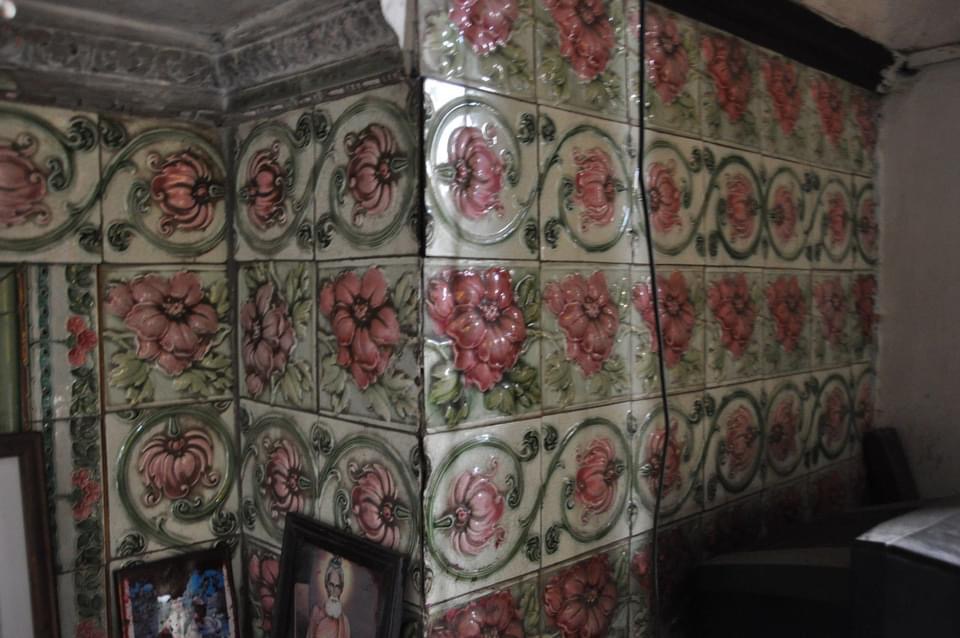
The house is now home to several families who regard our arrival with wary welcome. “Where are the Italian painted tiles?” I ask eagerly. The story of the tiles imported by her father from Italy were amongst the kaleidoscope of stories that my grandmother had shared with me. Whisperings and murmurings ensue amidst the crowd and then a hefty cupboard was pushed aside to reveal the tiles in all their faded glory.

Slowly it dawns upon me that the silent bottle in my grandmother’s cupboard had encoded stories that belied its seemingly mundane materiality. To uncover these lost stories, I embark on a renewed search for those old medicine bottles of my childhood. Their fragrance lingers at the edges of my memory, offering tantalising glimpses to fragments of knowledge. The sense of smell is our oldest sense. My memories of stories narrated by my grandmother were inextricably connected to the scents locked in that bottle. Would holding the bottle in my hand peel back the layers of my memory, answer some unanswered questions about my grandmother’s roots, help me map the route of our family’s journey? But alas! Those bottles are lost to time. My grandmother’s generation is gone and I search among Mathurababu’s scattered grandchildren and great grandchildren to no avail.

My grandmother left Dhaka in 1936, never to return. Mathurbabu’s house on Calcutta’s Central Street was completed that year, and it is there he moved with his wife and three youngest unwed daughters, including my grandmother. His older son remained in Dhaka to oversee the factory and drug production, while Mathurbabu focused on controlling the distribution from a central office in Calcutta. Till his death in 1942, despite his ailing health and flagging energy, he visited the company’s distribution centres spread across Calcutta everyday, accompanied by his faithful retainer Nathu. Probing for reasons for this abrupt migration, my uncle gave me a solitary clue. He recalled that my great grandfather had felt his family was unsafe in Dhaka. With this obscure clue in hand, I delved into history books for elaboration. I read about the rise of communal tensions in Bengal from the mid-1920’s. The Dhaka riots of 1930 targeted several well-established businessmen and involved loot and arson of their business and personal properties.

In 1947, there was yet another wave of migrations far more existential and grimmer. After the borders were drawn between the newly formed nations of India and Pakistan, the remaining family fled Dhaka overnight, leaving behind the factory, the mansion, in fact, all their material possessions in a land suddenly hostile to their continued habitation. Unable to exercise control over their properties in East Pakistan, there was an initial attempt by Mathurbabu’s heirs to establish a factory in Chandernagore. Without my great grandfather at the helm, this nascent enterprise floundered and ultimately sank. Cut from its moorings in Dhaka, Mathurbabu’s inheritors could not keep the business afloat in India. Slowly his legacy dissipated. The Shakti Aushadhalaya head office in Calcutta’s Beadon Street closed and the shops in Calcutta, Karachi, Kabul, and Colombo lowered their shutters.

Through generations of migration and resettlement, we are left with only scattered memories and fragmented stories. These intangible remains are my inheritance today. These intangibles are bound neither by form, nor by time. Instead, they offer limitless possibilities for exploration, crafting and archiving. Memory, nourished by the repeated telling of stories, provides continuity. These intangible wisps of legacy — a remembered glimpse of a peeling label, the stories heard from my grandmother, the whispered whiff of a familiar fragrance, open a door to the past and invite me to connect it to the present. “Listen to us,” the scents call. “Let us tell you our story.”

[1] Glass cupboard

[2] Bronze woks

[3] A rug for prayers

[4] A cloth wrap for the lower half of the body

[5] Workshop

[6] Ancient Sanskrit text on medicine, dated to 12th-13th century

[7] Pharmacy

Ranu Bhattacharyya, author of The Castle in the Classroom: Story as a Springboard for Early Literacy, Stenhouse, 2010, is an educator and writer who has lived and worked across the world, exploring and archiving narratives that connect people and cultures.

.

PLEASE NOTE: ARTICLES CAN ONLY BE REPRODUCED IN OTHER SITES WITH DUE ACKNOWLEDGEMENT TO BORDERLESS JOURNAL

Click here to access the Borderless anthology, Monalisa No Longer Smiles

Click here to access Monalisa No Longer Smiles on Kindle Amazon International

Categories
Review

Mapping the Mind

Book Review by Navleen Multani

Title: Mapping the Mind, Minding the Map

Editors: Basudhara Roy and Jaydeep Sarangi

Publisher: Sahitya Akademi

Mapping the Mind, Minding the Map edited by Basudhara Roy and Jaydeep Sarangi anthologises twenty contemporary poets. This book unveils a large canvas of poems penned by poets hailing from diverse locations and cultures, evoking thoughts on existential dilemmas of the contemporary world. The 391 pages of the anthology comprise poems by multiple poets: Adil Jussawalla, Arundhati Subramaniam, Ashwani Kumar, Bashabi Fraser, Bibhu Padhi, Jayant Mahapatra, K. Satchidanandan, K.Srilata, Keki N.Daruwalla, Lakshmi Kannan, Mamang Dai, Nabina Das, Robin S. Ngangom, Sanjukta Dasgupta, Tabish Khair, Usha Akella, Yogesh Patel and more

Every poem entails evocative images, visual and syntactic cues that put forth poetics of everyday life. Traversing maps and minds, this engaging collection of two hundred poems unravels different places and persons. The anthology is a poetic narrative and holistic exploration of locating oneself through language. As the book brings together experiences and knowledge of space, it pushes readers to rethink how landscape shape identity.

Memories encompassing reflections on landscapes, ancient history, myth, family, home, towns, cities, countries, music, seasons, elements of nature, disasters, wants, love and wounds of Homo Sapiens, women, mother as well as immigrants abounds the creation of every poet. Memories of special days, seasons, cities and cultures culminate in the compositions of Mamang Dai. Nabina Das’ creations talk about death and else. Sanjukta Dasgupta juxtaposes past and present to celebrate free spirit of Kali, Alakshmi and Millenial Sita.

This compilation, published by Sahitya Akademi, is an itinerary for dreamers and travellers alike. Ten poems by each poet weave a tapestry of emotions, experiences, moments and memories that define persons, places, practices and cultures. Every word, image and syntactical turn in these poems moves readers to discover poet’s emotional state. Events and myriad experiences, memorable and unpleasant, form an intricate reflection on life. The poems are also revelations about the contemporary world. The mosaic of memories present a ceaseless stream of significant moments that mould the minds and the maps. The compositions heighten consciousness, enrich the understanding of readers and deepen their humanity. The poems make the readers encounter hardships, moments of despair, compassion, empathy and resilience to extract invaluable insights. Reflections on difficult and dark times infuse renewed strength to deal with adversity.

Every poet uses different linguistic register to delve into solitude, decay, death and a new force that nurtures mind as well as takes to greater understanding about existence. “When Landscape Becomes Woman” by Arundhati Subramaniam reveals “That a chink in a wall is all you need to tumble into a parallel universe”. Whether it is Bashabi Fraser’s “Mothers All” claiming, “They are the bravest soldiers-marching on”, or Adil Jussawalla’s “Refuge” telling “Mother tells her rosary from six to seven, her one hour refuge,” each poet, irrespective of gender, envisions an independent and autonomous identity. “What’s wrong with us Kali women?”, “Maryada[1] and modern Draupadi”, “Woman in a Landscape” by Adil Jussawalla, “History”, “Draupadi”, “Partition Ghazal”, “The Tribal Goddess” and “Patna to Nalanda-1979” by Keki N.Daruwalla transport readers from past to present and illuminate multi-facets of life. “Somewhere like a shadow in the night like a black mineral in the earth, /Somewhere in a mirror where you can see your dreams a poem awaits deftly angled light,” writes Keki Daruwalla. Ashwani Kumar’s poems dwell on Alzheimer’s, lies emerging from deception, town vanished in the reservoir of waters and the strange ways of the world.

The deftly crafted poems blend imagery, thoughts and experiences. Many of the poems are centred on home, landscape and seasons. Titles of a few poems like “Mitti[2]’, “Bhakti[3]”, “Haldi[4]”, “Mahaprajapati[5]”, “O Boisakh[6]” and “Lopamudra[7]” have not been provided with a translation. Supplementing these titles are poems like “Earthrise”, “Missives of Music”, “The Same Moon from Edinburgh to Calcutta: A Refracted Lens”, “Sunrise at Puri-on-Sea”, “The River” and “Earth Day”.

The poems ranging from prose to typographic and linguistic variations, Mapping the Mind, Minding the Map speaks to larger issues of urban Indian identity, acceptance, adaptation and cultural estrangement. These map the poetics of womanhood, the body, institution, family and love. By doing so, the anthology erases traditional boundaries to develop a new poetic form. The poems are ensembles of words that unite to present verbal, vocal and visual sphere of communication.

This three-dimensional language becomes carrier of aesthetic message of the poet. The reduction of language to a word or fragments in many of the poems is similar to the reduction of landscape to map elements selectively and generally. This gives a distinct charm to the anthology. The poems explode with bird-names, names of cities and countries making these compositions a dialectical map. Very aptly the poems, as Howard McCord contends, can be comprehended as “a map on which articulation of consciousness can be charted, and the serial flow we associate with prose can be gathered into clusters and islands of words which reveal the individual’s voice and vision, even his philosophical stance, more accurately than a line broken by a general rule imposed.” Poems in Mapping the Mind, Minding the Map are maps that offer ways to know simplified, generalised and selective views on the world and human existence.

[1] Dignity

[2] Mud

[3] Devotion

[4] Turmeric

[5] The woman who raised Buddha

[6] The second month in the Bengali calendar which coincides with April-May

[7] A philosopher who lived in the Rigvedic age

Dr Navleen Multani is Associate Professor, Head, School of Languages, and Director, Public Relations at Jagat Guru Nanak Dev Punjab State Open University, Patiala (India). She is Area Editor with Oxford Online Bibliographies: Literary and Critical Theory.

.

PLEASE NOTE: ARTICLES CAN ONLY BE REPRODUCED IN OTHER SITES WITH DUE ACKNOWLEDGEMENT TO BORDERLESS JOURNAL

Click here to access the Borderless anthology, Monalisa No Longer Smiles

Click here to access Monalisa No Longer Smiles on Kindle Amazon International

Categories
Interview Review

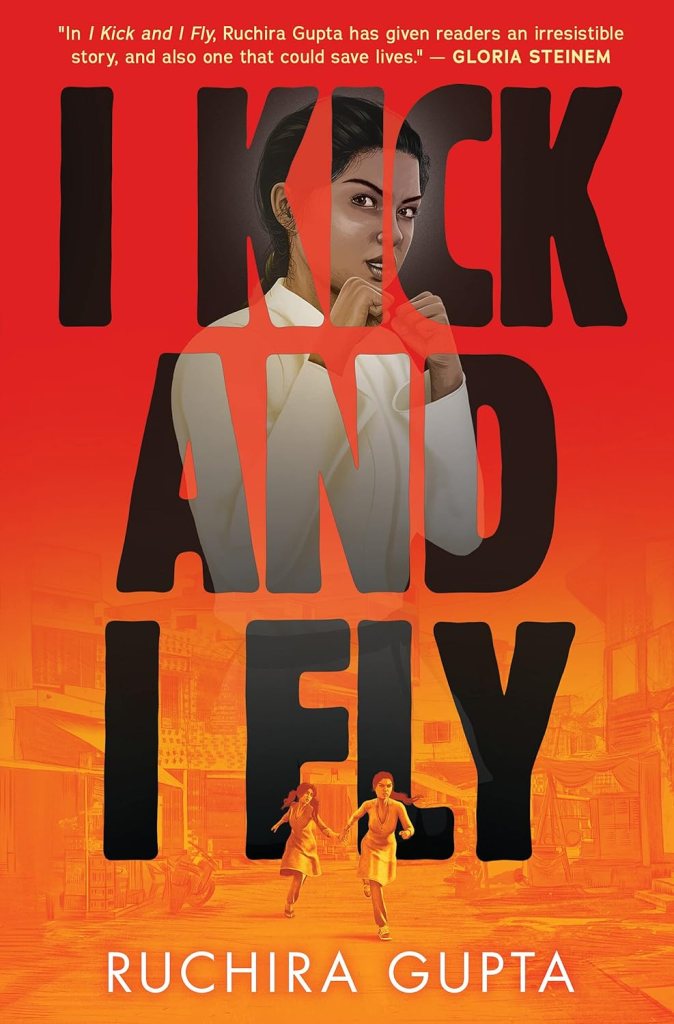
I Kick and I Fly: Ratnottama Sengupta Converses with Ruchira Gupta

Ratnottama Sengupta has known Ruchira Gupta for more than 40 years. But reading I Kick and I Fly has made her see in a new light the young journalist who has become a force of change in the global fight against human trafficking.

Kiddy. Ruchi. Journalist. Documentary filmmaker. Emmy Award winner. Founder President, Apne Aap[1]Women Worldwide. Social activist. Agent of changes to international laws. Sera Bangali[2]. Ekta[3] Award winner. Professor, NYU. Cancer survivor. Essayist. Exhibited artist. Published novelist…

“What next?” I could have asked Ruchira Gupta. And without waiting for her to reply I could add, “Member of Rajya Sabha? The first step to even higher offices on the world stage.” Because? This kid born to Rajni and Vidya Sagar Gupta has dedicated her life-breath to ensure that not a single child is either sold or bought for sexual gratification in exchange of a few rupees.

Hardly surprising that when she picked up her pen while recovering from Covid in her family home in Forbesganj, she penned a novel like I Kick and I Fly. “A book that is a MUST READ for one and all who are interested in fighting, tackling, and – not or – ending sex trafficking,” as Anjani Kumar Singh, Director, Bihar Museum said at the launch in Patna. Because? It is a story of optimism as Heera the protagonist, overcomes unimaginable obstacles to emerge a path breaker in the Nat community who believed it was the fate of its girls to sell their body at puberty, or even earlier, for the welfare of their family.

Inspirational. And in the most absorbing way. Read this excerpt from the novel to understand how a message becomes engrossing read.

"My name is Heera. I am from a town named Forbesganj, in a state called Bihar, in northern India, very close to Nepal,” I begin. My voice is shaking along with the rest of me. But I go on. “My brother and I are the first people in our family to ever go to school, and I have grown up believing that being sold for prostitution is my Destiny. That there are few doors open to me as a child of an oppressed-caste family. Our people used to be wrestlers and performers. But overnight we were told we could not do those things anymore, that our entire way of life was illegal.”

My voice is shaking less now and I manage to look at people in front of me. “How do people survive when they are not allowed to do the work they know and love? For my family of nomads, it meant asking people for a place to live, and then doing just about any job they told us we could do. One of these jobs was having sex with people for money.

“These children and women had no choice but to sell their bodies in exchange for a place to live. For food to eat. And for their husbands to be given work. And though people say that times have changed, they must not have changed everywhere, because I have been told since I was a little girl that selling my body was what I had to do to support myself and my family. And I believed it. Many in my family believed it too.

“Finally early this year it was my turn to be put up for sale. My family was in a tight spot, in debt to the wrong man. I grew up in a red-light area, so I knew what it involved. There are no secrets kept from kids where I come from. So, I said No, and we tried to get around it.

“My mother paid back our loan, but the traffickers came for me anyhow. The first time I got away. The second time they got me, but I was rescued by my brother and teacher.

“When I was stuck in a tiny room with my traffickers outside the door, I asked myself why had they kept coming for me even when they had no claim, no right? And that’s when I fully realized that they believed my body belonged to them, and I knew for certain it did not. It was kung fu that helped me understand this. Because it is through kung fu that I learnt, my body would do what I told it to. That my body listened to me – and only me.”

I take a breath. “There is power in my body. My body connects me to my cousin, my aunt, my grandmother who were all sold for prostitution. But kung fu also connects my body to my ancestors, who were champion wrestlers. If both these things lived within me, could I choose which course I wanted to take?”

I look up now, realizing that I have memorized the final words on the page. “For most of my life, the answer to that was NO. But suddenly I felt that maybe there was another possibility. I didn't do it on my own: I needed my family to stand with me, and most importantly, a cheerleader who made me believe that safety could be mine. Rini Di taught me kung fu and opened the doors of the world to me. And that is how I have come to stand before you now.”

Heera stands before her teachers and her friends, other survivors of trafficking as an example who not only fights, successfully, the might of traffickers but who actually saves another trafficked girl.  Who, even more importantly, instils faith, and courage, and dream… In her brother, her mother, and her father. Her brother Salman who always stood by her even as he studied for a better future. Her Mai who broke stones for a livelihood and gathered enough courage to take a loan to put in place a roof over their head. Her Baba who stands as a loser but accepts change and even starts to nurse a dream — for his daughter as much as for his son.

And so, when the Martial Arts Foundation awards Heera and her co-fighter friend, Connie, a scholarship to train for one full year in New York, along with admission to a local school, Heera too starts dreaming. Of a future, perhaps only twelve months down, when her family would be dwelling in a pink-bricked three roomed house. When Salman would study in a residential school in Siliguri. When Mai would have a betel shop. When Baba would be a porter at the railway platform. When her cousin Mira Di would be a seamstress with a tailoring shop of her own in the very backroom where she was forced to service men. When the corrupt policeman, Suraj Sharma, and the trafficker, Ravi Lala, would be in jail, no longer on the prowl in Girls Bazaar.

“It’s not a dream,” says Ruchira , reiterating the clinching line of I Kick and I Fly. “I have seen this transformation actually take place in Forbesganj. “There were 72 home-based brothels in the lane when Apne Aap started. Today there are two. Girls no longer sit outside waiting for customers. The two sisters who were locked up in the hut have finished school. One is a chef, the other is a teacher. The girl who was kidnapped is a karate trainer. Someone like Mai really has a betel paan leaf shop and someone like Mira Di is a seamstress. The cattle fair is no longer allowed to bring dance or orchestra groups.”

This was the perfect time to strike a conversation with Ruchira Gupta, I reckoned. And so I decided to shoot…

Me: How – rather, why – did you start writing I Kick and I Fly?

Ruchi: I started writing this story when a fourteen-year-old girl just like Heera won a gold medal in a karate championship in Forbesganj. She was being groomed for prostitution with other girls in her lane. A lane just like Girls Bazaar.

Her journey was not easy, it was heroic. I saw how she and her friends overcame hunger, fought off their fear and stood up to traffickers with grace and gusto. An annual cattle fair used to claim girls from that lane every year. When my NGO, Apne Aap, opened a community centre and a hostel there, we were constantly attacked by men like Gainul and Ravi Lala. They would stalk the mothers, the daughters, and me. They hurled abuses, threw stones, stole from our office and even kidnapped girls. We built higher walls around the hostel to prevent traffickers from jumping over. I posted guards outside my home, hired lawyers, filed police complaints and cases in court. Just like Mai, some mothers in the lane disobeyed their husbands even though they were beaten up. Their daughters were the first batch of girls in our hostel.

Me: Are all the characters real? Is the hope real? Do people in real life change the way Baba does?

Ruchi: Most of the events in the book are inspired by real people, places, events. To give you one example: A trafficking survivor from Indonesia told me how she was locked up and how she escaped from a brothel in Queens, New York, by disguising herself in a burqa. She is now a global leader in the struggle against trafficking. In my novel, Heera uses the same device to rescue Rosy.

Baba, Heera’s father, is also based on real-life fathers in the Nat community of Forbesganj. They would actually auction off their daughters to the highest bidder when the mela came to town! But as I began working in the red-light area I saw that they were not black and white criminals but human beings desensitised through decades and generations of oppression. Of course, there was no excuse that they did not try to fight back. I did see some fathers change when they saw their daughters succeed. Until then the possibility of a different future had not even occurred to them.

When hope unfurls in a downtrodden human being, it is like a tendril. I saw it in the eyes and actions of some fathers in the red-light area of Forbesganj when their daughters won gold medals in karate.

Me: You have not learnt kung fu. Why did you project Rini Di – clearly your alter ego – as a kung fu teacher? It is a physical art of self-defence. How precisely does that connect with, or help, girls who are in the river of flesh?

Ruchi: I still remember, it was early morning when a boy came to my home with his mother to seek help. His sister and cousin were locked up by traffickers to stop them from coming to the hostel. We had to mobilise the police to get them out. I noticed then that the girls were badly bruised while the traffickers were unscathed. I wished that the girls were able to fight back.

Our Apne Aap women’s group met that afternoon at the centre. Everyone was afraid that we would be beaten in retaliation for the police raid. That’s when I suggested martial arts classes. The women loved the idea. I used to see a couple teach karate teacher near the rice fields to boys in a private school. We hired them and the classes began. Soon the bullying in schools stopped.

As the girls started to win competitions, something changed. The very townspeople who had agitated to urge the principal to expel our red light children began to respect them. And the fathers in the community began to see value in their daughters. The biggest change was in the girls themselves. They began to own their bodies and value themselves. As they gained self-esteem, they began to do better in class. Soon more mothers began to stand up to the traffickers and even to their husbands in the lane, saying they would send their daughters to school.

Me: How did Apne Aap help change the picture at the ground level?

Ruchi: Today Apne Aap has educated more than 3,000 girls from red-light areas through school and college and is still continuing to do so. They are in jobs as animation artists, teachers, doctors, lawyers, chefs, managers of pizza parlours and of gas stations too.

Our NGO’s community has become a safe space to hold meetings, share stories, get food, do homework, and plot against traffickers. Women, very much like Mai and Mira Di, meet regularly in the centre to solve their problems. They fill out forms with the help of Apne Aap workers to access government entitlements like low cost housing, ration and loans. They go collectively to talk to the authorities when there are delays.

The Apne Aap legal team helps victims to file police complaints, testify in court and get traffickers convicted. The real Gainul and the real Ravi Lala are in jail. In 2013, Apne Aap survivor leaders and I testified in Parliament for the passage of section 370 IPC, a law that punishes traffickers and allocates budgets for services to the prostituted and the vulnerable.

Before these could happen, I had shown my documentary and testified to the UN and to the US senate for laws that would decriminalise the victims; increase choices for vulnerable and trafficked girls and women; and punish the traffickers and sex buyers. I can proudly say that my testimony and inputs contributed in the passage of the UN Protocol to end Trafficking in Persons and the UN Trafficking Fund for survivors as well as the passage of US Trafficking Victim Protection Act.

Me: Ruchi you come from an established, politically aware, well connected and much respected family. You grew up in the metros and now live an international life, mostly abroad. You won a coveted award for The Selling of Innocents. You helped in the making of Love, Sonia. Why did you not continue to make films? In short, what compelled you to start Apne Aap Women Worldwide?

Ruchi: As you know, I started as a journalist right after graduation. I learnt to ask questions, and I listened. The question that changed my life was: Where are the girls?

I was researching a story in the hills of Nepal when I came across rows of villages with missing girls. I had asked this to the men playing cards in the villages in Nepal. I followed the trail and found that a smooth supply chain existed from these remote hamlets to the brothels of India. Little girls, perhaps only twelve, were locked up in cages in Kolkata, Delhi and Mumbai for years and sold for a few cents night after night.

All the girls were from poor farming families. Many, like Heera, were from nomadic indigenous communities or marginalised castes. Like her, they were either not sent to school, or bullied until they dropped out, or pulled out by their fathers and sold into prostitution.

I was sad, then angry, and finally determined to do something about it. That’s how I ended up exposing the horror in my documentary. When I was on the stage in Broadway receiving the Emmy in 2013, all I could see beyond the glittering lights were the eyes of the mothers who had broken their silence to save their daughters. I decided in that instant to use my Emmy not to build a career in journalism but to make a difference.

I did two things. I dubbed it in six languages and I travelled across the world with it. I screened it in villages to show parents what the brothels were like. I showed it to the UN and the US Senate when I testified against the crime that is human trafficking. It contributed to a global push by activists that led to a new UN protocol to end trafficking and the first US anti-trafficking law, the Trafficking Victims Protection Act (TVPA).

Me: What was your magic wand?

Ruchi: I had no magic wand. I didn’t even have experience to stop the kidnapping of girls, or knowledge about how to put traffickers in jail. I was an English literature student from Kolkata’s Loreto College who joined The Telegraph while pursuing my honours degree graduation. But as a journalist, I saw the reality and invented ways to move forward.

Something had happened while I was filming the documentary. A pimp had stuck a knife to my throat. I was in a small room. There was nowhere to run. Suddenly, I was encircled by the 22 women I was interviewing. They told the pimp that he would have to kill them first. He knew it would be too much trouble to kill so many women, so he slunk away. I was saved. That moment changed my life.

The Emmy award money helped me start Apne Aap Women Worldwide with the women who had bravely spoken up in my film. I listened to the women who said they had four dreams: Education for their children; a room of their own; an office job; and punishment for those who bought and sold them. That became my NGO’s business plan.

I learnt that the best solutions came from those who experience the problem. The idea of the hostel, the idea of food in the community centre, and even the idea of karate came when we sat in a circle in the mud hut that is our community centre. It evolved into a grassroots approach which we call asset-based community development – ABCD or the 10 Asset model. Every woman or girl who becomes an Apne Aap member gains ten assets – both tangible and intangible. These are: a safe space, education, self-confidence, the ability to speak to authorities, government IDs and documents, low-cost food and housing, savings and loans, livelihood linkages, legal knowledge and support, and a circle of at least nine friends.

Each of these assets is a building block in an unfolding story of personal and community change. I wrote this novel to share with you that change is possible.

Me: Ruchi you had come up with the art-documentation, The Place Where I Live is Called Red Light Area. You got the girls to make a series of videos about different aspects of their life. You supported a documentary on the scheduled tribes. What inspired you to shun Art For Art’s Sake and pursue Art as Activism?

Ruchi: I learned in a very practical way the power of women’s collective action and the importance of sticking by one another. I promised myself I would never give up on those women’s dream. As a result, today thousands of girls have exited the prostitution systems from brothels across the country. There is more awareness about sex trafficking globally. And there are better laws and services for victims like Mira Di in over 160 countries.

Me: But we still have miles to go before we sleep…? 

Ruchi: Yes, because the truth is that there isn’t one but many, many more Heeras. Girls Bazaar still exists in many parts of the world, including the USA. The brothel in Queens is real. The International Labour Organisation estimates there are more than 40 million victims of human trafficking globally with hundreds of thousands of victims in the US alone. Human trafficking is the second largest organised crime in the world, involving billions of dollars, according to the United Nations Office for Drugs and Crime (UNODC).

Me: So, what more actions would you suggest to tackle the issue? Through IKAIF, an upbeat tale of an underdog’s rise to victory, you have shown that ‘lost girls’ earmarked for ‘the oldest profession’ can erase their ‘destiny’ through education, and reliance on their own inner strength. What other positive actions would you suggest?

Ruchi: Heera’s is a story of hope in spite of great odds. It’s about our bodies — who they belong to, the command they can give us. It is about friends who make changes you want in your life. It is about a community that resolves to make change contagious, and succeeds.

You too can ‘Join The Movement’ to create a world in which no child is bought or sold. You can do that in so many ways. You can 1) Sign the freedom pledge on my website Ruchiragupta.com. 

2) Learn more about the issue by reading I Kick and I Fly, and by watching The Selling of Innocents on my website.

3) Create further awareness by sharing the book, the movie and the pledge on your social media handles.

4) Volunteer and intern with Apne Aap or a local NGO in your town.

And you can Sponsor a girl like Heera on apneaap.org!

.

[1] Oneself

[2] The Best Bengali – An award given by the Ananda Bazaar Patrika group

[3] Unity: The Ekta Award is a National Award from India

Ratnottama Sengupta, formerly Arts Editor of The Times of India, teaches mass communication and film appreciation, curates film festivals and art exhibitions, and translates and write books. She has been a member of CBFC, served on the National Film Awards jury and has herself won a National Award. 

.

PLEASE NOTE: ARTICLES CAN ONLY BE REPRODUCED IN OTHER SITES WITH DUE ACKNOWLEDGEMENT TO BORDERLESS JOURNAL

Click here to access the Borderless anthology, Monalisa No Longer Smiles

Click here to access Monalisa No Longer Smiles on Amazon International