Categories
Excerpt

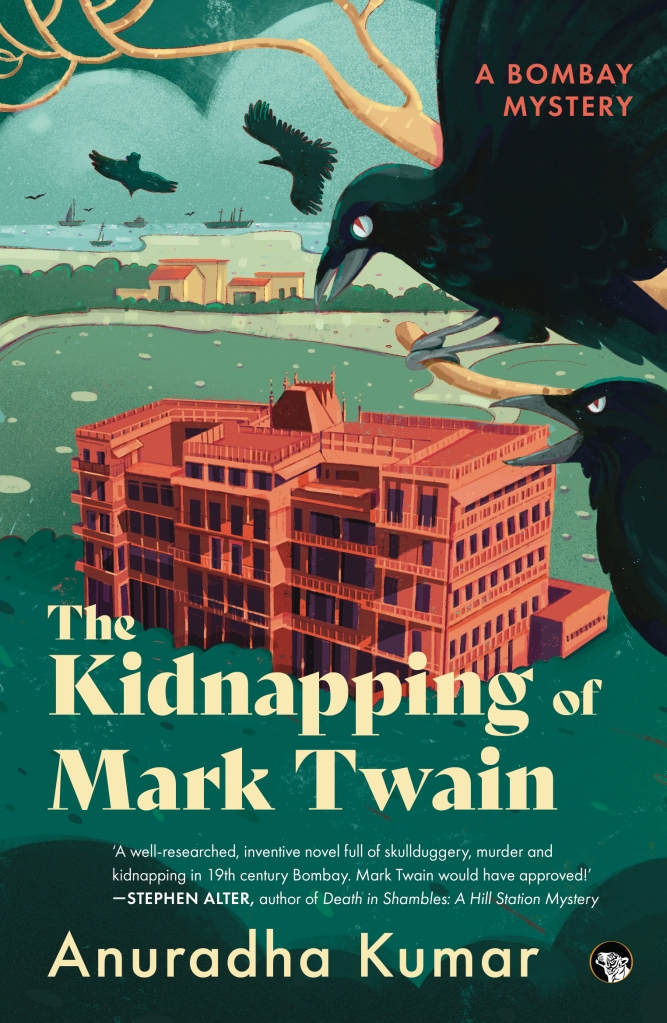
The Kidnapping of Mark Twain

Title: The Kidnapping of Mark Twain: A Bombay Mystery

Author: Anuradha Kumar

Publisher: Speaking Tiger Books

An hour passed as Henry, back in his rooms at the Byculla Club, waited for Abdul to return from the doctors’ bungalow. He had taken a message from Henry to Maya. He would not be back to have dinner with the Clemenses that evening. ‘Don’t give Maya memsahib the message in front of them,’ Henry warned, and Abdul gave him his usual long-suffering look. He really wasn’t an idiot, Henry thought to himself ruefully. ‘And if she asks more, tell her some urgent business came up.’ Henry’s face darkened, for he wouldn’t tell her about his intentions of tailing Bancroft, even accosting him. ‘And come back fast, we need to…’

Abdul looked at him expectantly, but Henry paused, pursed his lips. ‘I will tell you when you are back.’

He looked toward his desk, where his prized Colt Bisley lay in the locked second drawer. A brand-new model, with its five-inch barrel, that he had bought in London. Henry didn’t want to use it, especially on Bancroft and he hoped the other man wouldn’t make it difficult for him. Freddie Bancroft had quite a reputation, one that preceded him. He had first trained as a dentist and then worked as an insurance agent in Philadelphia before he had set out to make a magician of himself. It was an ambitious hope, and Bancroft could be impatient. The time when the

New York papers had reported unfavourably about his show, when his illusions had not worked, and his card tricks had bored much of the audience, Bancroft had thrown a tantrum, throwing his magician’s props on the seated audience. He had then burst into the offices of the New York Journal. He had accosted the editor on the late evening shift, accusing him, and the paper, of favouring the other magician Alexander Hermann, and insisted that the next day the office itself would vanish into thin air.

A portion of the office was indeed found ablaze early the next morning, but Bancroft had an alibi. There were many people who had seen him on the return train to Philadelphia. And the culprits were found to be two workers who were part of the union of newspaper workers. But Bancroft later bragged about it, that he could indeed hypnotize people to do his bidding.

He had made sure people in Bombay knew about this too, and he was determined to stage his own show at the Rippon Theatre on Grant Road. Bancroft had dropped flyers all over, had demanded advertising space for himself in the Gazette, and was also soliciting funds from the likes of Albert Sassoon, Shapoorji Bengalee, and the others, to build those elaborate sets he so wanted. But, of course, Henry, his fellow countryman, hadn’t been of much help, nor had he pulled his weight with the customs people.

Henry sighed. He was letting his jealousy get to his head. Bancroft must have added to his skills in the months he was in Bombay. For he had impressed Maya, and in a far shorter period of time, Mark Twain too, it would appear. And perhaps, Henry thought, Bancroft wanted Twain to write about him, an entire piece in the American papers about the magician’s immense popularity in the East. And now, it would appear that Bancroft may have been the last person to actually see Mark Twain, for he must have peered into his room, as he had Boehme’s, and it was likely, he did know a thing or two.

Henry looked at his notes on the table, and realized with some consternation that he had forgotten a meeting. With a man he disliked as much as he did Bancroft, but when business mattered, Henry knew he had to be quite the professional. Arthur Pease, the tireless campaigner against opium, the vices of drinking, and prostitution, had expressed an interest in the electric fans. They were needed, Pease had said, for the big meetings and assemblies he called every once in a while, in the Parsi meeting halls, and the town hall, and especially at the Reformatory Institute that was a particular favourite of his, for he always found a willing and suppliant audience here.

An hour later, Henry felt there was little point waiting for Abdul in his study. The longer he was on his own, the more he would fret over Twain and think sullenly about Bancroft. So Henry resolutely set off first for the police headquarters, and then to meet with Arthur Pease in Khetwadi, that lay a bit after Crawford Market. This was where Pease lived in a small bungalow, part of which doubled up as a healing centre for addicts.

Henry left a note for Abdul by the table near the hat stand, next to the silver embossed tray that usually held the keys, messages, and letters. Come to…, and he wrote the address. House next to Daji clinic. Crawford Market. Come as soon as you see this.

He called for a carriage, from the many standing aimlessly by the club. The coachman, a Pathan judging from his build and turban, saluted smartly as he jumped down from his seat to hold the door open. ‘The police station first,’ Henry said in a low voice, ‘and then someplace else. I will tell you later. You do have the time, I hope?’

‘Good, sahib, very good,’ the coachman said, nodding to his helper who would ride with him. The boy resting at the foot of the statue that everyone called the Standing Parsi, came running up, and the carriage shook momentarily as he jumped up behind. ‘Go fast, all right?’ Henry said, looking through the window.

The man nodded, gently tapping the pony, a young, spirited brown animal, with his whip, and then, looking over his shoulder said, ‘They are sending a lot of the police toward Sewree and Parel, the workers are angry. They really anticipate trouble, and they are stopping us from going there.’

(Extracted from The Kidnapping of Mark Twain: A Bombay Mystery by Anuradha Kumar. Published by Speaking Tiger Books, 2023)

About the Book: In 1896, Mark Twain arrives at the docks of Bombay, wife and daughter in tow, and, after attending a party in his honour, vanishes from his room at the iconic Watson’s Hotel in the dead of night.

Desperate to find the legendary writer and avoid an international incident between his country and Britain, the American Trade Consul, Henry Baker, teams up with Abdul, his trusted aide, and Maya Barton, a free-spirited Anglo- Indian with surprisingly intuitive detective skills. But they have their task cut out for them: Mark Twain’s disappearance appears to be entangled with a thriving opium trade; an intimidating, self-righteous preacher; an anxious magician who walks on stilts; a professional thief on the run; and a powerful labour leader, Tuka, whose young wife is found strangled in her bed.

Full of fascinating period detail and delightful cameos—and awash with suspense—The Kidnapping of Mark Twain is a thrilling page-turner.

About the Author: Anuradha Kumar was born in Odisha. She studied history at Delhi University and management (specializing in human resource management) at the XLRI School of Business, Jamshedpur. She has worked for the Economic and Political Weekly. She has an MFA in Writing from the Vermont College of Fine Arts (VCFA). Her stories have won awards from the Commonwealth Foundation, UK, and The Little Magazine, India. She writes regularly for Scroll.in. Her stories and essays have appeared in publications like Fiftytwo.in, The India Forum, The Missouri Review, among others. She has written for younger readers as well. This present work is her 11th novel.

PLEASE NOTE: ARTICLES CAN ONLY BE REPRODUCED IN OTHER SITES WITH DUE ACKNOWLEDGEMENT TO BORDERLESS JOURNAL

Categories
Review

Fixing a Fractured World

Book Review by Bhaskar Parichha

Title: Permacrisis: A Plan to Fix a Fractured World 

Authors: Gordon Brown, Mohamed El-Erian, Michael Spence, Reid Lidow 

Publisher: Simon & Schuster UK

A nation or region’s success depends on three things: growth, economic management, and governance. The three dimensions are interconnected and affect each other. Growing an economy is a fundamental part of economic development. Factors like productivity, technological innovation, and sector expansion are all part of it. Infrastructure, education, and research and development are key to sustainable growth. Strong growth can create jobs, raise incomes, and improve living standards.

Governments and institutions take policies and decisions to maintain the economy’s stability and effectiveness. Setting fiscal policies, regulating financial markets, and overseeing trade and investment are tasks involved. The goal of effective economic management is to promote stability, increase competitiveness, and grow the economy. For macroeconomic stability and progress, it takes inflation, budget deficits, and exchange rates into account.

Countries and regions are governed by rules and structures. It includes political institutions, legal systems, and decision-making processes. By promoting transparency, accountability, and participation, sound governance ensures power is exercised fairly and justly. Decisions are made keeping in view society’s most beneficial interests, and citizens’ rights are protected. Maintaining stability, attracting investment, and promoting economic development requires strong governance.

Growth, economic management, and governance reinforce each other. Sustainable economic growth requires effective economic management, ensuring resources are allocated efficiently and policies support it. Effective governance promotes stability and attracts foreign investment through efficient economic management. A well-functioning governance system ensures that economic growth benefits are distributed equitably. After the recent pandemic, economists are worried about a prolonged crisis. Could we be experiencing a permacrisis? It is likely that the current state of the world will lead to anxiety, and that is what this book tells us in splendid detail.

Permacrisis: A Plan to Fix a Fractured World by Gordon Brown, Reid Low, Mohamed A. El-Erian and Michael Spence looks at the economic downturn the world is struggling through right now.

After holding the office of Chancellor of the Exchequer for over a decade, Gordon Brown became Prime Minister. During the 2009 London G20 summit, he mobilised global leaders to walk the world back from the brink of a second Great Depression. He is currently serving as the UN Special Envoy for Global Education, spearheading efforts to ensure quality, inclusive education for all children. He is also a Global Health Finance Ambassador for the World Health Organization. Brown holds a PhD in history from Edinburgh University.

Mohamed A. El-Erian is President of Queens’ College Cambridge. As Chief Economic Advisor at Allianz, he formerly served as Co-Chief Investment Officer and Chief Executive of PIMCO. Besides columnising for Bloomberg Opinion, he’s also a Financial Times contributor. He is a Senior Global Fellow at the Lauder Institute and Rene M. Kern Practice Professor at Wharton School. Before joining Harvard Management Company, he was a managing director at Solomon Smith Barney/Citigroup. His books When Markets Collide and The Only Game in Town were New York Times bestsellers.


Michael Spence is Emeritus Professor of Management at Stanford University. He is a Senior Fellow at Stanford’s Hoover Institution, and a Council on Foreign Relations Distinguished Visiting Fellow. He is an adjunct professor at Bocconi University and an honorary fellow at Magdalen College. He authored The Future of Economic Growth in a Multispeed World. He was Dean of the Stanford Business School from 1990 to 1999, and Dean of the Harvard Faculty of Arts and Sciences from 1984 to 1990. His awards include the John Kenneth Galbraith Prize for teaching excellence and the John Bates Clark Medal. He won the Nobel Prize in Economic Sciences for his work in information economics in 2001.

Reid Lidow served as Los Angeles Mayor’s Executive Officer. Reid worked on Gordon Brown’s campaigns before. During his undergraduate studies at USC, Reid double majored in International Relations and Political Science. He received a Gates Cambridge Scholarship and an MPhil in Development Studies from Queens’ College, Cambridge. 

As some of the most highly respected and experienced thinkers of our time, these friends found that their pandemic zooms increasingly focused on a cascade of crises: sputtering growth, surging inflation, poor policy responses, an escalating climate emergency, increasing inequality, a rise in nationalism, and a decline in international cooperation. They shared their fears and frustrations with each other. The more they talked, the more they realised that, despite past mistakes that set the world on this bumpy path, there is a better path to a brighter future. Their varied perspectives contributed to their pursuit of a common goal: attainable solutions to the world’s fractures. Those thoughts are reflected in this book.

According to the authors, our current permacrisis is a result of broken approaches to growth, economic management, and governance. Even though these approaches are flawed, they can be repaired. A provocative, inspiring plan to change the world is the need of the hour. The book illustrates how we can prevent crises and improve the future for the benefit of the many and the few. According to the book, problems that remain unresolved for a prolonged period of time will only worsen; this is what happens in a permacrisis, which is why we must act quickly.

This instructive book provides a sensible plan of reform that can be used to create a world that is fairer and more equitable.

.

Bhaskar Parichha is a journalist and author of UnbiasedNo Strings Attached: Writings on Odisha and Biju Patnaik – A Political Biography. He lives in Bhubaneswar and writes bilingually. Besides writing for newspapers, he also reviews books on various media platforms.

.

PLEASE NOTE: ARTICLES CAN ONLY BE REPRODUCED IN OTHER SITES WITH DUE ACKNOWLEDGEMENT TO BORDERLESS JOURNAL

Click here to access the Borderless anthology, Monalisa No Longer Smiles

Click here to access Monalisa No Longer Smiles on Kindle Amazon International

Categories
Review

No Doomsday Narrative

Book Review by Bhaskar Parichha

Title: Climate Capitalism: Winning the Global Race to Zero Emissions

Author: Akshat Rathi 

Publisher: Hachette India

Climate capitalism combines economic growth and environmental sustainability. This approach leverages market forces and capitalist principles to address climate change. Climate capitalism aims to create a system where businesses can thrive while reducing their carbon footprint and promoting clean technologies. A key driver of climate capitalism is the belief that the market will drive innovation and investment in sustainable practices. The transition to a low-carbon economy can be accelerated by creating economic incentives for companies to adopt clean technologies.

There are many strategies and policies involved in climate capitalism. Carbon pricing mechanisms, such as carbon taxes or cap-and-trade systems, put a price on carbon emissions to create a financial incentive for companies to reduce their emissions. The development and deployment of clean technologies can also be supported through subsidies or grants.

Climate capitalism also integrates environmental considerations into corporate decision-making. Sustainable business strategies include setting greenhouse gas emission targets, adopting environmentally-friendly practices throughout operations, or incorporating sustainability goals into business strategies. Climate capitalism advocates argue that businesses can drive economic growth while also contributing to climate mitigation and adaptation. A more sustainable and prosperous future can be achieved by aligning financial incentives with environmental objectives.

Critics, however, are concerned that greenwashing may result in superficial attempts to appear green. Climate capitalism may not go far enough in addressing the systemic changes necessary to address climate change, and more radical action is needed. Economic development and environmental sustainability are reconciled by climate capitalism. By harnessing market forces to create a more sustainable future, it acknowledges the role that market forces can play in driving change. Whether climate capitalism can deliver on its promises and effectively address climate change challenges remains a subject of debate.

In this context, this book is an excellent addition.Climate Capitalism: Winning the Global Race to Zero EmissionsbyAkshat Rathi is a fascinating book that sheds a fresh look at the issue. Akshat Rathi is a senior reporter at Bloomberg News. Bloomberg Green’s Zero podcast is hosted by him. A PhD in organic chemistry from Oxford and a BTech in chemical engineering from IIT Mumbai, he has worked for QuartzThe Economist and the Royal Society of Chemistry. His writings have also been published in NatureThe Hindu and The Guardian

According to the blurb: “Our age will be defined by the climate emergency. But contrary to the doomist narrative that’s taken hold, the world has already begun deploying the solutions needed to deal with it. On a journey across five continents, Climate Capitalism tracks the unlikely heroes driving the fight against climate change. From the Chinese bureaucrat who did more to make electric cars a reality than Elon Musk, to the Danish students who helped to build the world’s longest-operating wind turbine, or the American oil executive building the technology that can reverse climate damages, we meet the people working to scale technologies that are finally able to bend the emissions curve.”

Through stories that bring people, policy and technology together, Rathi reveals how the green economy is possible, but profitable. This inspiring blend of business, science, and history provides the framework for ensuring that future generations can live in prosperity. It also ensures that progress doesn’t falter.

Which economic policies are most effective at reducing greenhouse gas emissions and combating climate change? Climate Capitalism examines the economics and politics of market-based climate change solutions. It is essential reading for all students and teachers, unionists and business leaders, grassroots activists and politicians.

.

Bhaskar Parichha is a journalist and author of UnbiasedNo Strings Attached: Writings on Odisha and Biju Patnaik – A Political Biography. He lives in Bhubaneswar and writes bilingually. Besides writing for newspapers, he also reviews books on various media platforms.

.

PLEASE NOTE: ARTICLES CAN ONLY BE REPRODUCED IN OTHER SITES WITH DUE ACKNOWLEDGEMENT TO BORDERLESS JOURNAL

Click here to access the Borderless anthology, Monalisa No Longer Smiles

Click here to access Monalisa No Longer Smiles on Kindle Amazon International

Categories
Tribute

Jayanta Mahapatra: A Poetic Luminary

By Dikshya Samantrai

Jayant Mahapatra (1928-2023), Courtesy: Creative Common

While we celebrate the life and works of Jayanta Mahapatra, we are reminded that his poetry transcends time and place. It invites us to contemplate our own existence, our relationships, and our place in the world. Through his words, he has left an indelible mark on the world of literature, demonstrating that poetry has the power to illuminate the soul and bridge the gaps that separate us.

In the realm of Indian English poetry, few names shimmer as brightly as Jayanta Mahapatra’s. With his pen as his brush and words as his palette, Mahapatra has painted a rich tapestry of emotions, existential contemplations, and cultural explorations across his entire oeuvre. His poetic journey is a testament to the transformative power of words, a journey that has touched the hearts and minds of readers across the globe. Born in Cuttack, Odisha, in 1928, Jayanta Mahapatra emerged as a prominent figure in Indian English poetry during the latter half of the 20th century. His literary contributions are marked by an intricate interplay between his Odia heritage and a universal sensibility, transcending geographical and linguistic boundaries. His poetry resonates with the human soul, delving into the complexities of existence and the nuances of human emotions.

Mahapatra’s poetry is characterised by its profound introspection. He peers into the innermost recesses of the human psyche, unearthing the facets of identity, memory, love, and loss. His verses serve as mirrors, reflecting not only his own experiences but also inviting readers to confront their own inner landscapes. This journey of self-discovery is a central theme in much of his work. A Rain of Rites(1976), marked his debut in the world of poetry. In this collection, Mahapatra’s poetic voice emerges with striking clarity. He grapples with the isolation of the individual in a complex world, where traditions and rituals rain down upon us like a deluge. His poems often evoke a sense of longing and the search for self-identity, themes that resonate with many who grapple with the modern human condition. Some of his most celebrated poems like “Five Indian Songs”, “Samsara”, “The Whorehouse in a Calcutta Street”, “Hunger”, and “Dawn at Puri” are featured in this collection.

Mahapatra’s deep connection to his homeland, Odisha, infuses his poetry with a unique sense of place and culture. His verses are filled with vivid depictions of Odisha’s landscapes, its people, and its age-old traditions. The collections Shadow Space (1997), Life Signs (1983) and Waiting (1979) stand as testaments to this connection. Through his words, he transports readers to the shores of Puri, the temples of Konark, and the chaotic streets of Cuttack in poems at the same time intertwining them with stark social evils such as rape, poverty, widowhood and casteism. Mahapatra often juxtaposes moments of exquisite beauty with stark desolation in his poems. This interplay between the beautiful and the unsettling creates a sense of dissonance that challenges conventional notions of aesthetics and forces readers to grapple with the coexistence of contrasting elements in life.

In “Relationship” (1980), the book that fetched him the Sahitya Akademi Award, Mahapatra delves into the intricate web of human connections of his personal life. Briefly, “Relationship” is a single poem that deals with the diverse relationships the poet shares with the Konark temple, Kalinga war, friends, parents, anxieties, scruples, suffering, and glory and decay of Odisha. In his words, the poem “was a romance with my own land and with my innermost self”. He explores the complexities of relationships, both personal and societal, with a keen and compassionate eye. Many of his poems resonate with readers on a universal level, as they ponder the nature of love, the fragility of bonds, and the ever-shifting dynamics of human interaction.

Mahapatra’s poetry often treads the fine line between the spiritual and the worldly. In Temple (1987), he dives deep into the realm of faith and spirituality. His verses serve as a bridge between the sacred and the profane, inviting readers to reflect on the profound interplay between the material and the divine. These poems are an exploration of the human quest for transcendence, a theme that has been a consistent thread in his work. In his collections such as Hesitant Light (2016), Land (2013), Random Descent (2005) The False Start (2001), Mahapatra continued to delve into existential questions with unwavering honesty. A number of his poems serve as a mirror to the complexities of life, urging readers to confront the transient nature of existence, the ever-elusive pursuit of meaning, and the relentless passage of time. Throughout his career, Jayanta Mahapatra has exhibited a strong sense of social consciousness. He uses his poetry as a medium to address issues of poverty, inequality, and human suffering. His empathetic voice bears witness to the world’s injustices, serving as a reminder of the poet’s responsibility to shed light on society’s darker corners. His poetry challenges us to confront uncomfortable truths and advocate for change through the power of words in poems such as “Crossing the River”, “Village Mythology”, “Progress”, “Bazaar Scene”, “These Women”, “Blind Singer in a Train”, “Hunger” and many others.

Jayanta Mahapatra’s literary journey has been paved with accolades and awards that reflect his enduring impact on literature. He was honoured with the Sahitya Akademi Award in 1981, the Commonwealth Poetry Prize in 1987, and the Padma Shri, one of India’s highest civilian honours, in 2009. These accolades acknowledge not only his literary prowess but also his ability to touch the hearts of readers with his profound insights and evocative verses.

Jayanta Mahapatra’s legacy is not confined to his words on paper; it lives on in the hearts and minds of those who have been touched by his verses. His poetry is a timeless gift to humanity, a profound reflection on the human experience, and an enduring testament to the power of the written word. It becomes a powerful catalyst for introspection and reflection. A deeper understanding of both the self and the world challenges readers to confront uncomfortable truths, inviting them to embark on a journey of self-discovery and intellectual engagement. His work not only unsettles but also deeply enriches and provokes us to think. We are reminded that his legacy will continue to inspire and resonate and Jayanta Mahapatra’s name will forever remain etched in the annals of literature, a testament to the enduring power of the poet’s voice.

.

Dikshya Samantarai is a PhD Research Scholar from the Department of English, School of Humanities, IGNOU. Working on the representation of body politics in Jayanta Mahapatra’s poetry, her research contributes to the ambit of critical discourses in Indian English.

PLEASE NOTE: ARTICLES CAN ONLY BE REPRODUCED IN OTHER SITES WITH DUE ACKNOWLEDGEMENT TO BORDERLESS JOURNAL

Click here to access the Borderless anthology, Monalisa No Longer Smiles

Click here to access Monalisa No Longer Smiles on Kindle Amazon International

Categories
Bhaskar's Corner

Chittaranjan Das: A Centenary Tribute

By Bhaskar Parichha

Chittaranjan Das (1923-2011)

In the contemporary world, with its multiple environmental crises, conflicts, and violence, persisting poverty, and social exclusion, the question about the role of arts in general, and of literature specifically, must inevitably arise. Do they have any positive role other than entertainment and distraction, or are they merely the icing on a rapidly decaying and disintegrating cake?

Without naming the problem in exactly this way, much of Chittaranjan Das’s work was devoted to implicitly answering this question, for he clearly recognised that a merely functionalist approach to trying to identify the role of the arts in society would be totally inadequate and theoretically shallow. Rather, to answer the question more fully, we should ask what constitutes a society’s self-understanding, its modes of self-representation, and its internal hermeneutics, and how, methodologically speaking, we can gain access to this deep cultural grammar of a society. Das’s original professional career was as a rural sociologist and teacher of the subject in Agra and elsewhere. As a sociologist he would have been aware that such questions arise not only in the sociology of the arts, but equally in relation to such intractable subjects as religion, suicide, and the emotions.[1]

The year 2023 is the centennial birth anniversary[2] of the thinker, educationist, critic, pioneer of Odia non-fiction writing and one of the finest translators, Professor Chittaranjan Das. Chittabhai — as he was known throughout Odisha — was the most prolific writer, with numerous diaries, essays, reviews, autobiographies, memoirs, columns, textbooks, and monographs.

Many eminent writers were born in Bagalpur village in Jagatsinghpur district. Chittaranjan Das was one of them. He was the third child of five brothers and three sisters. He attended Punang School after schooling in his native village. Afterwards, he attended Ranihat Minor School and Ravenshaw Collegiate School. In 1941, he passed the matriculation examination and enrolled at Ravenshaw College, Cuttack, for higher education. However, he became involved in the independence movement. His inspiration came from Manmohan Mishra[3]

During his Ravenshaw student days, he was an active member of the Communist Party of India. In 1942, he joined the Quit India Movement and was imprisoned. During his jail term, Das  acquired many skills, including learning languages, particularly French. In 1945, he was released from prison and attended Santiniketan. During his academic career, he was exposed to a wide variety of intellectuals, thinkers, and writers. He was deeply influenced by their works.

His studies in psychology, sociology, and cultural anthropology continued in Europe and abroad in the years that followed. He was trained in clinical psychology at the Vienna School established by Sigmund Freud. It was here that he met philosopher Martin Buber. He continued his studies at Santiniketan and later at Copenhagen University, Denmark.

He returned to Odisha in 1954 and joined the Jibana Bidyalaya, a school inspired by Gandhi’s ideals on education, established by Nabakrushna Choudhury and Malati Devi. Later on, he became the headmaster of this institution. He left after four years and took a teaching assignment near Agra.

Sri Aurobindo’s philosophy drew Das to the revered sage’s teachings. Upon returning to Odisha, he taught at the Institute of Integral Education in Bhubaneswar, based on Sri Aurobindo’s values. This was in 1973. While he did not stay for long, he remained associated with this movement until his death in 2011.

Das considered the whole world to be his home. He was proficient in a wide range of languages, including Hindi, Urdu, Bengali, Assamese, Sanskrit, Danish, Finnish, French, Spanish, and English. His vast studies covered many areas of social and human sciences like philosophy, psychology, religious studies, and linguistics as well as school studies. His knowledge is reflected in 250 books he wrote or translated into Odia.

He was a regular contributor to newspapers and his columns appeared in major Odia dailies like Dharitri, Pragativadi, Sambad, Samaja and more. These short pieces have been compiled into books that give insight into his views on contemporary issues. His first writing was an article in a school magazine. The article ‘Socrates’ appeared in 1937 in the Ravenshaw Collegiate magazine, Sikshabandhu.

Das travelled widely around the world. During his travels, he closely examined the social, cultural, and political life of the countries he visited. He wrote books describing his impressions. He has translated many books into Odia from countries he visited. His translation work is vast. His understanding of the topic and the translation of the books make for a pleasant reading experience.

He was an excellent diary writer. These captured his feelings about many incidents. The autobiographical diary entries have been published as Rohitara Daeri[4], a series of over 20 volumes. His love for the mother tongue was unparalleled. Despite excellent command of more than a dozen languages, including German, Danish and Finnish, as well as Sanskrit, Pali, Urdu and Bengali, he wrote mostly in his mother tongue, Odia.

His contribution to Odia literature was huge because he translated the works of many prominent writers — Bengali writer Ashapurna Devi, polymath Albert Schweitzer, French novelist François Mauriac, British-Indian anthropologist Verrier Elwin, Danish poet Karl Adolph Gjellerup, French writer Antoine de Saint-Exupéry, Lebanese-American poet and writer Kahlil Gibran, Russian poet Boris Pasternak, former President of India Sarvepalli Radhakrishnan and the iconic Mahatma Gandhi. Sri Aurobindo’s principal philosophic work, a theory of spiritual evolution culminating in the transformation of man from a mental into a supramental being and the advent of a divine life upon earth, Life Divine, is Chittranjan Das’s significant work.

Many awards have come his way. In 1960, for his essay ‘Jeevana Vidyalaya’[5], he was awarded by the Odisha Sahitya Akademi. He was given the Sarala Award in 1989 for his essay ‘Odisha O Odia’. He was conferred with the Sahitya Akademi Award in 1998 for his book Biswaku Gabakhya [6]. He bagged more accolades from Prajatantra Prachar Samiti, Gangadhar Rath Foundation, Utkal Sahitya Samaj and Gokarnika.

Chittaranjan Das’s works incorporate both creative experimentation and a transformative philosophy. He has worked in education, literature, cultural creativity and artistic criticism. During his lifetime, he was instrumental in the growth and development of numerous social action and development groups. Throughout his writings, he discussed self-development, social change, and mankind’s evolution. His Odia autobiography Mitrasya Chakhusa  [7]is an extraordinary work in the genre.

A scholar of eminence, literary commentator and author of numerous books in Odia and English, he was known as ‘Socrates of Odisha.’

.

[1] John Clammer (The Essays of Chittaranjan Das on Literature, Culture, and Society/Ed. Ananta Kumar Giri and Ivan Marquez)

[2] The Odia writer lived from 1923-2011.

[3] A revolutionary writer and poet who lived from 1917 to 2000.

[4] Rohit’s Diary

[5] School of life

[6] Window to the World

[7] Through the eyes of a Friend

Bhaskar Parichha is a journalist and author of UnbiasedNo Strings Attached: Writings on Odisha and Biju Patnaik – A Political Biography. He lives in Bhubaneswar and writes bilingually. Besides writing for newspapers, he also reviews books on various media platforms.

.

PLEASE NOTE: ARTICLES CAN ONLY BE REPRODUCED IN OTHER SITES WITH DUE ACKNOWLEDGEMENT TO BORDERLESS JOURNAL

Click here to access the Borderless anthology, Monalisa No Longer Smiles

Click here to access Monalisa No Longer Smiles on Kindle Amazon International

Categories
Excerpt

Bhubaneswar@75 – Perspectives

Title: Bhubaneswar@75 – Perspectives

Editors: Bhaskar Parichha/Charudutta Panigrahi

Publisher: Pen In Books

INTRODUCTION

As we look forward to the next 25 years … 

April 13, 1948. It was on this day that the first Prime Minister of India Pandit Jawaharlal Nehru laid the Odisha capital city’s foundation stone. Since then, Bhubaneswar has remained a celebrated model of modern architecture and city planning with its prehistoric past as a temple city. Along with Jamshedpur and Chandigarh, Bhubaneswar is one of modern India’s first planned cities. 

While laying the foundation-stone, Nehru observed: ‘Bhubaneswar would not be a city of high-rise buildings for officers and rich men without relation to the common masses. It would be consistent with the idea of reducing differences between the rich and the poor. The New Capital would embody the beautiful art of Odisha, and it would be a place for beauty…so that life might become an adjunct to beauty.’

Bhubaneswar is a temple town with a series of ancient sandstone temples varying in size from the towering eleventh century Lingaraja Temple. It was a city of temples. Once upon a time, there were more than 7,000 temples in and around Bhubaneswar. Today, there are only a few. 

EXQUISITE ARCHITECTURE

From a religious standpoint, the Lingaraj temple is the most popular. Other temples include the 7th century Vaital temple, the impressive 10th century Mukteshwar temple, and the 11th century Raja Rani temple with its fine carvings. There are many other temples of exquisite architecture. 

Several Grade-I temples of national importance have been protected by the Archaeological Survey of India (ASI) in Old Bhubaneswar, such as Ananta Basudeva, Mukteswara, Persurameswara, and Rajarani Temples, which are just a few examples. Bhubaneswar’s modern capital is shaped by Old Bhubaneswar’s ancient temples.

The state capital city planning began near the old temple town. The Master Plan for the upcoming city of Bhubaneswar was prepared by Dr Otto H Koenigsberger on the concept of neighbourhood unit planning. The original plan envisaged horizontal development rather than vertical growth for a population of 40,000 with administration as the primary function. Koenigsberger designed a linear pattern for the city, with administrative units on the main artery, and neighborhood units attached to them. Neighborhood units offer residents the most sophisticated amenities in a city. They were placed at short distances to give people easy access to schools, hospitals and other facilities.  

CENTRAL VISTA

Six units were developed. Unit-V served as the site for the administrative complex, while other units were planned according to neighborhoods. As part of the town center, there was a market building, a weekly market, a day-to-day market, and a bus station. There was a central vista with views of the Raj Bhawan. There was also a commercial zone along Janpath and Bapuji Nagar up to the railway station. Koenigsberger’s planning zone provided characteristic weather control and a salubrious climate throughout the year. This area — the heart of the city — maintains the lushest green cover in the city with open space and a well-organized transportation system.

A neighborhood unit required that each child live within a quarter of a mile or a third of a mile of their school. Housewives were required to live within a half mile of the civic center to shop there and have access to medical facilities within the town. Distances between a person’s home and place of employment could conveniently be covered by a bicycle or a cycle rickshaw. Koenigsberger suggested 7 different types of roads for 7 different groups of users and 7 different functions. Those are footpaths, parkways, cycle paths, minor housing streets, major housing streets, main roads and main arteries.

Bhubaneswar was planned to be the state capital, but it is primarily a city for government officials. Residential quarters were designed to meet the needs of officials from various income groups. Planning was made to meet the ideal urban family’s requirements. This was done by providing them with single-storey independent houses with a front yard and kitchen and garden space in the back yard. Government bungalows have extensive open spaces around them and abundant space between one house and another. Those with high incomes occupy bungalows near the main employment complex. 

Low income housing consists of mostly one and two bedrooms comprised of more than one unit broken into rows. Early in the planning process, residential quarters in different neighborhoods were mostly standardized. Small scale industries and manufacturing activities were added after 1980. Much of the original plan has changed in twenty years.

HERITAGE ZONE

Bhubaneswar has been declared a special heritage zone as Ekamra Kshetra, which consists of several significant structures. Various socio-cultural and religious heritages of Odisha are represented in the monuments, which represent different periods in Odisha’s history. In recent years, several of these significant elements have steadily lost their significance due to modern construction activities.

An integrated regional development plan has been prepared to meet the growing demand for services in the region. This plan has been declared as the Comprehensive Development Plan (CDP) of the Bhubaneswar Development Plan Area (BDPA). The BDPA comprises Bhubaneswar Municipal Corporation, Khurda Municipality, Jatani Municipality and adjoining 122 Mouzas. The Long Term Perspective Plan for Bhubaneswar-Cuttack Urban Complex (BCUC) provides a vision for the development of the whole region by 2030. Bhubaneswar-Cuttack Urban Complex being the hub of commercial, political, administrative and socio-cultural activities in Odisha, it has rich potential for development. 

A lot of resentment was felt — and it still exists — when Bhubaneswar replaced Cuttack as the capital on 19 August 1949, two years after India gained independence from Britain. In recent times, Bhubaneswar and Cuttack have been called the ‘twin cities of Odisha’ – one with a modern look and another with a millennium-old history. Bhubaneswar and Cuttack have become closer since the Netaji Subhash Chandra Bose Bridge, also known as the Trisulia Bridge, opened on 19 July 2017. 

BIG FIVE

There are a few Tier-2 cities in the country that host the top five IT companies in the country. Bhubaneswar is one of them. These companies include Infosys, Wipro, Tata Consultancy Services, Tech Mahindra, and Mindtree. It is considered one of the three most attractive places in the world to do business, according to the World Bank. Bhubaneswar has been selected as one of the first twenty cities in India to be developed as a smart city. This is part of his flagship ‘Smart Cities Mission’ which seeks to develop 100 smart cities in India. 

Bhubaneswar was added to the World Heritage List (WHL) as part of the application process. The WHL requires that the site be of outstanding value, as well as having at least one of the ten selection criteria met. This is required for inclusion on this list. Bhubaneswar meets four of them. Over 100 cities have been designated World Heritage Sites by UNESCO.

Nations that nominate heritage sites and cities to UNESCO, and submit data, maps, and photographs, are given heritage status by the organization. World Heritage Status is the highest honor and most prestigious title given to heritage monuments, sites, and cities in recognition of their universal value.

Bhubaneswar, one of the two Indian capitals planned after independence, alongside Chandigarh, is today one of the most prominent cities in Odisha. It has a culture as vibrant as the city itself. With a population of one and a half million, Bhubaneswar has become known as one of the most happening cities in Eastern India. India’s evolving urban landscape places the city among its upcoming metropolises.

This book contains twenty-seven essays written by learned scholars on different aspects of Bhubaneswar. From temples to town planning, from becoming India’s sports capital to urban living, from culture to literature, and from business to education, the book says it all. It represents everything that has happened since the foundation stone was laid. It is a throwback to what we have witnessed.

It is hoped that by the time Bhubaneswar celebrates its centennial twenty-five years from now, the city’s signature identity and impeccable heritage will have been preserved and passed on to future generations in a more intact form. 

Bhaskar Parichha

About the Book:

The capital of Odisha and a city that is still in the process of being shaped, Bhubaneswar is many things to many people. The Temple City, as it was once called, was home to thousands of temples at one time.

The foundation stone of ‘modern’ Bhubaneswar was laid in 1948 by Pandit Jawaharlal Nehru. It became the administrative capital of Odisha in the learly 1950s. Bhubaneswar was declared a ‘smart city’ under the urban initiative by the government of India in 2014.

Bhubaneswar, one of the two capitals planned after independence, is today a vibrant city in Odisha with an equally vibrant culture. With a population of one and a half million, Bhubaneswar has become known as one of the most happening cities in Eastern India. India’s evolving urban landscape places the city among its upcoming metropolises.

The book has 25 essays on different aspects of Bhubaneswar written by scholars of standing. From temples to town planning, from becoming India’s sports capital to urban living, from culture to literature, and from business to education, the book says it all. It is a compilation of all that has happened over the past 75 years.

A ‘portrait’ of the city is presented in the book.

About the Editors

Bhaskar Parichha (1957) is a senior journalist and author of five books Unbiased: Writings on India, No Strings Attached: Writings on Odisha, Madhubabau – The Global Indian, and BijuPatnaik – A Biography. He has edited an anthology of essays entitled Naveen @25 -Perspectives. He is a bilingual writer and lives in Bhubaneswar.

Charudutta Panigrahi (1968) is a social advocate and practicing intellectual. He has set upthink tanks in India and abroad. A TED Speaker and an author, he is a polymath whose work takes him everywhere. This is from the last mile in indigenous communities to the high table of global policy making. He lives between Gurgaon, Bhubaneswar, and Panjim with his family. His recent release, The Scent of Odisha, has been received well by readers all over and is acclaimed as an exceptional Odisha chronicle of current times. He is engaged in climate change work and has set up a global platform called Climatists in Berlin.

PLEASE NOTE: ARTICLES CAN ONLY BE REPRODUCED IN OTHER SITES WITH DUE ACKNOWLEDGEMENT TO BORDERLESS JOURNAL

Click here to access the Borderless anthology, Monalisa No Longer Smiles

Click here to access Monalisa No Longer Smiles on Kindle Amazon International

Categories
Review

Resisting ‘Death from Overwork’

Book review by Bhaskar Parichha

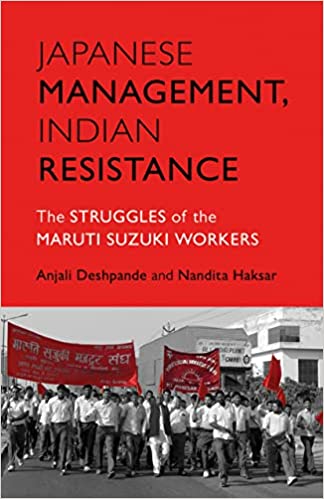
Title: Japanese Management, Indian Resistance: The Struggles of the Maruti Suzuki Workers 

 Author: Anjali Deshpande / Nandita Haksar

Publisher: Speaking Tiger Books

A fire broke out around 7 pm on 18 July 2012 at Maruti Suzuki India’s manufacturing plant in Manesar (Haryana). It claimed a manager’s life. The workers have been in the public eye since. Basically, worker-management tension snowballed into a major fracas that day — a fire broke out in the plant. The manager, Awanish Dev, was suffocated to death. Workers were held responsible.

Within days, over two thousand temporary workers and 546 permanent workers were dismissed by the company. Thirteen of them— including the entire workers’ union leadership-were later charged for murder, ending yet another independent body for collective bargaining.

Japanese Management, Indian Resistance: The Struggles of the Maruti Suzuki Workers by Anjali Deshpande and Nandita Haksar tells the story of the biggest car manufacturer in India through the voices of the workers, interviewed over three years. They give us an understanding that the Maruti Suzuki revolution wasn’t the unmitigated success it was touted to be when they tell us about their resistance to being turned into robots by uncompromising management. It becomes abundantly clear that the Maruti Suzuki revolution was not what was expected. It is a fascinating account of what happened behind the scenes, particularly what happened both in the beginning and during the ensuing years. A closer look at the facts would cast doubt on the anti-worker judgment. 

Anjali Deshpande is a journalist and activist. She has participated in many campaigns and movements including the women’s movement and the Bhopal gas tragedy survivors’ struggle for justice. She is also a novelist and writes in Hindi. Nandita Haksar is a human rights lawyer, teacher and campaigner. She represents contract workers and trade unions in the Supreme Court. She writes extensively and has published several books, including on the trade union movement in Kashmir and migrant workers from the Northeast. 

Says the blurb: “Unions are the last, and often only, line of defence workers have in modern industries, especially when the management isn’t averse to undermining their rights, dignity and health in pursuit of higher profits. This was true of Maruti Suzuki. Workers would get a seven-and-a-half-minute break from physically demanding work—precise to the hundredth of a second—to run to the toilet half a kilometre away and force a samosa and piping hot tea down their throats. But they were denied two minutes of silence in the memory of a deceased colleague’s mother.”

The sabotage of their unionising efforts, generally in collusion with the Haryana state government, came as no surprise to the workers. Yet they struggled through and managed to form successive representative bodies at both the Gurgaon plant, and the one set up in Manesar in 2007. But not only were they crushed, some were never officially registered. The often misrepresented events of July 2012 were far from an isolated incident. But few today, as then, are willing to see the matter from workers’ perspective. 

This book was the culmination of months of work by the authors, including locating and interviewing many workers and trade union leaders, including former life convicts out on parole. In the book, oral history narratives are interwoven with detailed analyses of legal processes as they are framed against the backdrop of widespread labour unrest, which makes for a book that has been meticulously researched. The context of a welfare state transforming into a corporate state, in which profits trump citizens’ rights, and Japanese-style management policies ruthlessly trample on workers’ rights, is clearly delineated, as is the sustained resistance of workers against this development. 

As the factory got privatised, while Suzuki made more profits, workers experienced a steady deterioration in their work conditions. The level of automation increased, the number of robots grew and so did the dehumanisation of working conditions. The Japanese have a word for a phenomenon that distinguishes modern Japanese work culture: `karoshi’, meaning `death from overwork’. This culture was imported onto Indian soil.

Several changes were instituted after Suzuki tightened its grip on the Indian production units. Among these were some pseudo-spiritual measures: vastu expert, Daivajna K S Somaiyaji, conducted rituals over two or three weeks to rid the Manesar plant of `negative energy’ which he said was due to its once being a burial ground, and because three temples were razed to set up the plant. Brahmakumaris also taught yoga and meditation to workers, specifically to keep their emotions in check!

It is a must-read book for anyone who is interested in organisational behaviour, labour relations, social work, industrial psychology, law, or political science. Aside from the clarity of the writing, the vivid descriptions bring alive the lives of the people who participated in one of the most widely known but least understood conflicts in management-worker relation.

Bhaskar Parichha is a journalist and author of UnbiasedNo Strings Attached: Writings on Odisha and Biju Patnaik – A Political Biography. He lives in Bhubaneswar and writes bilingually. Besides writing for newspapers, he also reviews books on various media platforms.

PLEASE NOTE: ARTICLES CAN ONLY BE REPRODUCED IN OTHER SITES WITH DUE ACKNOWLEDGEMENT TO BORDERLESS JOURNAL
Click here to access the Borderless anthology, Monalisa No Longer Smiles

Click here to access Monalisa No Longer Smiles on Kindle Amazon International

Categories
Essay

Epaar Bangla, Opaar Bangla:  Bengals of the Mind

Asad Latif

By Asad Latif 

If nations are imagined (but not therefore imaginary) communities, Bengal is a nation. The reality of nationhood rests on the quality of the imagination that goes into it. 

Calcutta, where I was born in 1957, provided me with a cartographic point of entry into the imagined geography of Bengal. My Bengal began with West Bengal, within which lay a rough face-to-face society rich in visual and oral provenance. The everyday homeliness of rural thatched mud huts were reflected in the high gabled roofs which contoured the spiritual skyline of Dakshineswar. Minstrel bauls walked through the soul, half-starved on their way to seeking salvation for everyone. The very soil of Bengal broke out in bhatiali song. The chau dancers of Purulia dramatised Hindu epics in a language emotively accessible to all. The energy of santhali dances invoked the performative agency of a tribal culture that refused to let pre-industrial and pre-state time lapse into contemporary irrelevance.   

Agricultural West Bengal encompassed the legacy of a land whose grasp was much longer and larger than the social circumference of middle-class life in Calcutta. In my own ancestral village in Hooghly district, a short train journey from Howrah station, boys my age could climb trees and run barefoot and naked across scorching soil, outpacing the shy urbanite in me. Young women, taught to avoid the roving gaze of male strangers, lowered their eyes to the ground in modest contemplation when men passed by. Farmers could bend unbearingly long to till the land, standing upright for only a few minutes before they resumed their toil. No one spoke English. No one needed to. No one needed me. I needed them.

To the west of West Bengal lay the rest of India. The “rest of the Indians” were decipherable. In Bihar and Odisha, once a part of Bengal Presidency, rump Bengal lived on in the linguistic and cultural traces of the colonial past. Farther west, West Bengal vanished into an eclectic Indian nationalism. I must say, though, that on a long train journey from Calcutta to Cochin in Kerala as a teenager, I thought (rightly or wrongly) that the particular shade of green found in the vegetation of West Bengal was lost till it was found in Kerala again. The renewed connection between Calcutta and Cochin made it possible for me to extend my Bengali-ness vicariously all the way to Kerala, making me quite a pan-Indian Bengali, I suppose. The connective nationalism of Indian Railways (like that of the State Bank of India) plays no small part in protecting the unitary reality of contemporary India. 

Farther to the west of the rest of India lay the lands of Islam. They began with forbidden territory: Pakistan. Pakistan embodied the Partition of India, the departure of space from Indian time. For me, West Pakistan was unknown terrain: No one I loved or hated lived there. But if, indeed, there was an “Islamic world”, then I certainly inhabited it subliminally. I was (and am) a Muslim. I belonged to the global efflorescence of a great faith that had spread into my birth and self-recognition. West Pakistan had nothing to do with it. My mother was a practising Muslim (after a fashion), my father was a practising atheist. As a five-day-old, I had been “adopted” by a childless Hindu couple who lived in the same block of flats as my parents. Nilima Kurup (née Bose) took me to temples, and Parameshwara Raghava Kurup, well-versed in the Vedas, stayed away from the Puranas. But no one made me anything but a Bengali indebted forever to the Islamic religiosity of South Asia, Central Asia, the Middle East, and beyond. Certainly, I belonged to the lands of Islam. There was nothing vicarious about this. It is just that West Pakistan had nothing to do with my identity. I respected its existence even as it stayed indifferent to mine (since it had no idea that I existed). That was all.   

East Pakistan was different. I had relatives there on both my mother’s side and my father’s. I remember a childhood visit to my paternal uncle’s home in Narayanganj. It was raining. Unlike West Bengal (where rain falls on people), the people of East Bengal fall on the rain. A female cousin, all of six years old, made an excuse of going to the bathroom: instead, she took a bath in a roomful of rain as wide as the skies outside, within sight of the elders, dancing with the abandon of the water that flowed through her tresses, kissed her eyes, drenched her frock, and caused an uproar that led her to be dragged back to lunch, laughing unrepentantly. Meanwhile, her elder brother wanted to go to the “bathroom” as well. He was held back by his hair and resisted violently, raining cries of recrimination on everyone. Watching my wild bangal (native East Bengali) cousins in righteous ghoti (native West Bengali) awe, I decided that East Pakistan was too Bengali for me. 

But it was not to be. 

Bangladesh

Baker-ul Haque came to live next door to our flat in Nasiruddin Road, Park Circus, Calcutta, in 1971. A year younger, he caught up with me in historical time with vivid stories of how he and his family had escaped Bogra, trudging through forests as the Pakistani air force strafed fleeing civilians, people fell dead on the left and the right, his mother held on his elder sister’s hand, he grasped his younger siblings firmly, his father led on, and all of them made their way — to me. I doubted specific details of his heroic journey, but not his visceral courage. I witnessed it when my pet dog chased him to the fourth-storey terrace, he climbed on to the parapet and kept walking on it calmly, I held the dog back, and I implored Baker to climb down. He smiled at me insouciantly. It was only when he saw tears in my eyes that he relented. Once he was safely down, I wanted to give him a hearty kick, but settled for a rib-shattering hug instead. Epaar Bangla[1]wins when Opaar Bangla[2]is safe. 

Baker and his family lived next door, in the third-storey flat which the writer Syed Mujtaba Ali had occupied briefly earlier. Given his literary reputation, I stayed away from him, but he was rather fond of me, and I invaded his rooms whenever I found the door ajar. The family which stayed with my own family was that of Lutfar Rahman, an Awami League Member of the National Assembly from Khulna. Chachaji[3] smiled a lot but was fierce, chachiamma[4] was benign to a fault, their elder son Ornob took after his mother and their younger son Tulu (his pet-name) took after his father. Both brothers, who were much younger than I was, became mini companions on laughing excursions to the same terrace on which Baker had reduced me to tears.         

The liberation of Bangladesh on December 16, 1971 (which happily and sadly soon saw Baker’s and Lutfar Chacha’s families returning to Bogra and Khulna) was my rebirth as a Bengali. I had been born into the bifurcated mythos of Bengal, which was first partitioned administratively in 1905 in an act rescinded in 1911, and then partitioned along national lines in 1947 to produce Pakistan. The partition of that Pakistan in 1971 produced an independent Bengali nation called Bangladesh. It is only in the years to come that I would understand the reasons for the ontological security of Bangladesh: it is a sated or satisfied nation because its borders guarantee the two conditions of its existence — that it be Bengali and Muslim in co-determinate measure — with provision being made for the rights of non-Bengalis and non-Muslims within its borders. Indeed, so successful has Bangladeshi nationalism been that its majority population finds it unnecessary to seek links with West Bengal to achieve cultural completion. That attitude is reciprocated in West Bengal, whose incorporation into the Indian ethos makes Bangladesh its closest neighbour, but a neighbour nevertheless. 

Yet, to look across the border within Bengal, to see its integrity, is to un-see its divisions. Bengal is named ground: To walk on it, even vicariously, is to recover the insights of Walter Benjamin [5]on his visit to Moscow. Benjamin’s delineation of Russia as named ground (in his Reflections) leads him to proclaim that “you can only see if you have already decided… Only he who, by decision, has made his dialectical peace with the world can grasp the concrete. But someone who wishes to decide ‘on the basis of facts’ will find no basis in the facts”. The facts are always too many. The facts are contested. The facts might not even be facts. But Bengal is decidedly one — not because of its successes but because of its vulnerabilities. 

The Refugee Within

The fragile figure of the refugee straddles the two Bengals. Achintya Kumar Sengupta’s[6] poem, Udvastu[7], rendered unforgettably in the recitation by Kazi Sabyasachi[8], is a part of an aural tradition without which it is impossible to re-imagine the Bengal that existed once. What makes the refugee central to the idea of Bengal as a state of mind is that she embodies the land’s biological unity and integrity in the very act of losing her place in its stolen geography. Bearing the scars of uprooting, dispossession and exile, the refugee socialises the pain which lasts long after the immediate displacement of enforced migration has passed. To seek refuge is to pass from basha to bariBasha is a temporary place of residence, no matter how long that temporarity lasts. Bari is an inherited abode which is both ancestrally personal and nationally interchangeable with desh, the native land. The udvastu or vastuhara[9] from East Bengal seeking refuge in West Bengal since 1947 had to contend with what Nilanjana Chatterjee calls “epistemological denial in India”, wherein those who had crossed the border were treated as an economic burden. 

The epilogue to the story of the refugees of 1947 was written in 1971, when it was the turn of Bengali Muslims from East Pakistan to join Bengali Hindus in seeking refuge in West Bengal. While the vast majority of refugees spent months in harrowing conditions, professional and other middle-class families were often hosted by middle-class families in West Bengal who could afford to do so. It was not unknown for the family of a Bengali Hindu, who himself had come from East Bengal in 1947, to share its basha with a Bengali Muslim family. The Bengali Muslim knew that he would return home if Bangladesh won the war. His Hindu host kept dreaming of a bari relegated forever to the nostalgic lay of a lost land. 

My family was more lucky. Our first trip to Bangladesh was to Lutfar Chacha‘s home in Khulna across the land crossing in Benapole. Of course, I enjoyed the royal spreads at breakfast, lunch, tea and dinner. But what filled my eyes was the sight of Ornob, Tulu and their little sister (by then), strutting about their home as if it was theirs. It was theirs. Bangladesh restored in me my extended sense of myself, my identity as a resident of Epaar Bangla who sought completion in the autonomy of Opaar Bangla. Soon after, I visited Baker in Bogra. At one dinner, his mother sat down just the two of us together. Naturally, I got the larger piece of fish in a bowl. I cooked up an excuse for Baker to go and look for something. I exchanged the bowls. He returned to eat. When we began with the vegetables, he exchanged the bowls. That insouciant smile again. I hate him. He has outwitted me always inspite of being a year younger.     

The refugee is the first citizen of imagined Bengal. She will also be the last. That is, without Bangladesh and West Bengal being the ultimate refuge of the transitional Bengali self, there will be no Bengal.  

There will be no me.

Birth matters. No one can be born in two places.

In his essay, “Englands of the Mind”, Seamus Heaney[10] registers the birthing role of place in the “interlacing and trellising of natural life and mythical life”; what a land does is to afford a man “nurture that he receives by living among his own”. Bengal forms a similar geography of the mind. It received me among my own. Life was material, which is to say that it veered from the banal to the brutal, but it was redeemed by the furtive companionship of the imagination.  The trellising which Heaney notes does not have to be idyllic. It rarely is. Australian writer Dorothea Mackellar’s[11] poem, “My Country“, written while she was homesick in Britain, captures the native lore of a land that her ancestors supposedly discovered for her. She writes: “I love a sunburnt country,/ A land of sweeping plains,/ Of ragged mountain ranges,/Of drought and flooding rains.” Australia is nothing without its enervating drought and its equally uncaring rain. Mackellar dismisses the pastoral epiphanies of a promised expatriate land, particularly “When sick at heart, around us/ We see the cattle die”. Natural disasters provoke her to reclaim art from nature. She redeems a wayward landscape by offering it refuge in her lines.

I am no Heaney or Mackellar. Bengal has no need to find refuge in my words. May these English words of mine find refuge in the lap of Bengal from which I sprung into life.  


[1] Epaar Bangla: This side of Bengal (West Bengal)

[2] Opaar Bangla: That side of Bengal (East Bengal or Bangladesh)

[3] Father’s younger brother is chacha and ji is an honorific in chachaji

[4] Father’s younger brother’s wife

[5] Walter Benjamin, German-Jewish man of letters and aesthetician (1892-1940)

[6] Achintya Kumar Sengupta (1903-1976), writer and editor in Bengali language

[7] Refugee in Bengali

[8] Kazi Sabyasachi (died 1979), a Bengali Elocutionist, Nazrul’s son

[9] Dispossessed in Bengali

[10] Seamus Heany, 1939-2013, Irish writer

[11]  Dorothea Mackellar, 1885-1962

 Asad Latif is a Singapore-based journalist. He can be contacted at badiarghat@borderlesssg1

PLEASE NOTE: ARTICLES CAN ONLY BE REPRODUCED IN OTHER SITES WITH DUE ACKNOWLEDGEMENT TO BORDERLESS JOURNAL

Categories
Poetry

Oh! My Dear Face 

By Ananta Kumar Singh

Oh! My dear face 
Never be upset 
I didn't come to pimples 
I didn't come to dimples 
Oh! My dear face 
Never be upset 
I didn't come to wrinkles 
I didn't cause the mind to rankle
Oh! My dear face 
Never be upset.

Ananta Kumar Singh is an Indian poet. He hails from Bargarh in the Indian state of Odisha. He is studying English literature at Ravenshaw University. 

PLEASE NOTE: ARTICLES CAN ONLY BE REPRODUCED IN OTHER SITES WITH DUE ACKNOWLEDGEMENT TO BORDERLESS JOURNAL

Categories
Bhaskar's Corner

Tagore & Odisha

Odisha and West Bengal, two geographically contiguous states of India, are as much a proximate in culture and language. Both states have a close link – from people movements to culinary familiarity. More to that. Puri attracts lakhs of people from Bengal. In truth, it is the Bengalis around whom the holy city of Puri revolves. They contribute greatly to the city’s economy. The Tagore family of Jorasonko too had a close connection with Odisha and it stretches back to generations. Rabindranath Tagore’s great grandfather Nilamani Thakur had come to Cuttack as a ‘Sirastadar‘ (revenue collector) duly appointed by the British.

In 1840, Rabindranath’s grandfather Prince Dwarakanath Tagore had bought a small estate near Pandua in the present Jagatsinghpur district. Tagores even had a house built in Cuttack’s Tulasipur area. Later, Rabindranath’s father Maharshi Debendranath Tagore visited Odisha sometime around  1851 to supervise the estate at Pandua  from where he visited Puri.

Records of those times bring out how the Tagore family was fascinated by Puri’s pristine beach, the camaraderie, and the cool breeze.

In 1891, Rabindranath Tagore visited Odisha for the first time to oversee the land his ancestors had bought. Tagore’s maiden visit to Odisha was memorable and soul-stirring. The bard’s fascination for Puri finds mentioned in ‘Chinnapatra’ — his letters to Indira Devi, Tagore’s niece. In one such letter, Tagore wrote: 

“The road from Cuttack to Puri is good. It is high with low-lying fields on both sides. There are big shady trees, mostly mango. At this time, all the mango trees are in blossom, filling the way with fragrance. Some villages are seen surrounded by mango, pipal, banyan, coconut and palm trees.”

Tagore informs further:

“In places covered carts are standing on the banks of shallow rivers. There are confectioners under palm-leaf thatches. Inside the huts in rows, under the trees on both sides of the road, the pilgrims are taking their meals. The beggars are shouting in strange languages, whenever they see fresh batches of pilgrims or carriages or palanquins.”

He wrote fabulously about what he saw on his way to the glorious city of Puri:

“As one approaches Puri, the pilgrims are seen in greater numbers. Covered carts are seen moving in lines. People are found lying down, looking or gossiping together on the banks of tanks. On the right side of the road, a big spire of the Jagannath temple rises. Suddenly at one place, crossing the line of trees and bushes, the wide stretch of sandy sea-beach and the azure line of the sea become visible.”

Tagore visited Odisha once more in 1893.This time it was Cuttack with his nephew Balendranath. Tagore was a guest at the then District magistrate BL Gupta, ICS ( Malati Chaudhury’s grandfather). Having spent a few days there, Tagore  set out to Puri  on a palanquin and he was spellbound  over the unspoiled  sceneries on both sides of  the Jagannath Sadak as it was called then. Tagore’s last visit to Odisha was in 1939. 

 He came on the request of Biswanath Das, the then Chief Minister (called Prime Minister) of Odisha   to visit the province. When Das was in Kolkata to attend a meeting of the All India Congress Committee, he personally met the poet to pay respects and extend the invitation.

Tagore reached Puri on 19th April in 1939. He was warmly received by the ministers and government officials. The poet stayed in the Circuit House as the state government’s guest. But all his engagements were canceled as the poet developed a slight fever and the doctors advised him complete rest.

On 8th May 1939, the poet was given an ovation on behalf of the women of Odisha. The next day — his birthday – was celebrated with gusto. The birthday bash was held on a well decorated pandal with an opening song. The poet was welcomed with the chanting of Vedic hymns by the pundits of Puri’s Sanskrit College. Flower, sandal paste, vermilion and coconuts were offered to the poet as a mark of veneration.

So enthralled was Tagore at this spirit of love and affection that he wrote in a letter to his former Secretary Dr. Amiya Chakravarti:

“I have come to Puri. I am the invited guest of those who are now at the helm of the affairs of Orissa. There is something novel in this fact. In older days, they who were kings or heads of the state, used to honour the meritorious, thereby honouring their own countries and governments. By this liberality, they used to keep contact with human culture and admit the universal heritage in the development of faculties.”

He further wrote:

 “We have learnt the modern system of political administration from the English. The talented have no place in it. The statesmen of Europe wield the outward aspect of that power which is based upon economic and administrative laws. They cannot have the right to govern the spirit that lies underneath but it is needless to argue that having acknowledged and paid due regard to it, a noble environment can be created for the government. In oriental system of administration, the scope for acknowledgment of the individual talent has, however, not been neglected.”

In the same letter, he was a bit apologetic: 

“Let me now tell you about myself. I have no work here, nor am I of any use to anybody. Those who are taking care of me here, expect no material advice from me. That salutary and refreshing effect with which the sea breeze is touching my body and mind is the very symbol of the hospitality of the newly responsible Orissa Government. Administrative procedure has created no obstacle to it, nor has it been affected by the budgetary economy.”

On human relations Rabindranath wrote when he was convalescing:

“Sitting on the first floor of the Circuit House, I have unhesitatingly given myself up to pure idleness. The ministers here, having noticed the tired condition of my health, come every day to encourage me to spend my days without any purpose. The mentality of admitting human relationships even in the midst of heavy pressure of work is still inherent in our country; and this has been felt by me especially after I have come over here.”

During his stay at Puri, the Raja of Puri – an institution by himself – and the Superintendent of Sri Jagannath temple, bestowed upon Rabindranath, the title Parama Guru (the great teacher). As the poet was indisposed, the ceremony was not held publicly. The Dewan (manager) of the king came down to the circuit house in a procession to confer the title. The panegyric was read out in the hallowed Sanskrit language. Then a camphor garland, head dress and a pair of silk clothes were offered as a mark of respect by the chief priest. 

Historian Prof. Pravat Mukherji later wrote about Tagore’s acceptance of the recognition thus: “He had been warmly received in many countries of the world, but the reception which was given that day by the people of Odisha touched his heart, as it was according to the traditional Hindu style.”

Tagore’s stay in Puri had a few other blissful moments. Many poets and freedom fighters met him. Among them were Lexicographer and compiler of ‘Purnachandra Bhashakosh’ (Odia Encyclopedia), Gopal Chandra Praharaj, Pandit Raghunath Mishra, freedom fighter Sarala Devi, poet and novelist Kalindi Charan Panigrahi and yet another gentleman from Jajpur, Chandrasekhar Das, about whom Tagore penned a few lines:

“O’ my unknown admirer,

Today you have become known.

With my blessings I repay

My admirer your loan.”

Two contemporary Odia poets — Bhaktakabi Madhu Sudan Rao and Kantakabi Laksmikanta Mohapatra (creator of the state song ‘Bande Utkal Janani’) – were inspired by Tagore and wrote two books – Kusumanjali (Posy of Flowers) and Jiban Sangeeta (Life Song) respectively, which are rare beginnings in modern Odia literature. 

It was also during the Puri layover that Tagore wrote the dance drama ‘Chitrangada’ – the theme he seemed to have overheard from the local epic-sayers. Tagore also wrote some of his famous poems: Pravasi (Expatriate), Janmadin (Birthday) and Epare Opare (This side and that side) in Puri. In Pravasi, Tagore describes himself as a “man of the world and he does not consider anybody to be alien”

Tagore loved the people of Odisha so much that he concluded: 

“From a distance I have formed an idea about the love of the people and the efficiency of those who are at the helm of the administration of Orissa at present, and now I am appreciating it from close quarters.”


References:

Guru Kalyan Mohapatra: Puri & the Poet

Sambad by Prof Basanta Kumar Panda ( Odiya translation of Chinnapatra). The excerpts from the Chinnapatra have been translated by Bhaskar Parichha from Odiya.

.

Bhaskar Parichha is a journalist and author of No Strings Attached: Writings on Odisha and Biju Patnaik – A Political Biography. He lives in Bhubaneswar and writes bilingually. Besides writing for newspapers, he also reviews books on various media platforms.

.

PLEASE NOTE: ARTICLES CAN ONLY BE REPRODUCED IN OTHER SITES WITH DUE ACKNOWLEDGEMENT TO BORDERLESS JOURNAL