As a curator, Ratnottama Sengupta writes about the long trajectory of films by artists, beginning with Husain’s Berlinale winner, down to the intrepid band she screened at the just concluded 30th Kolkata International Film Festival
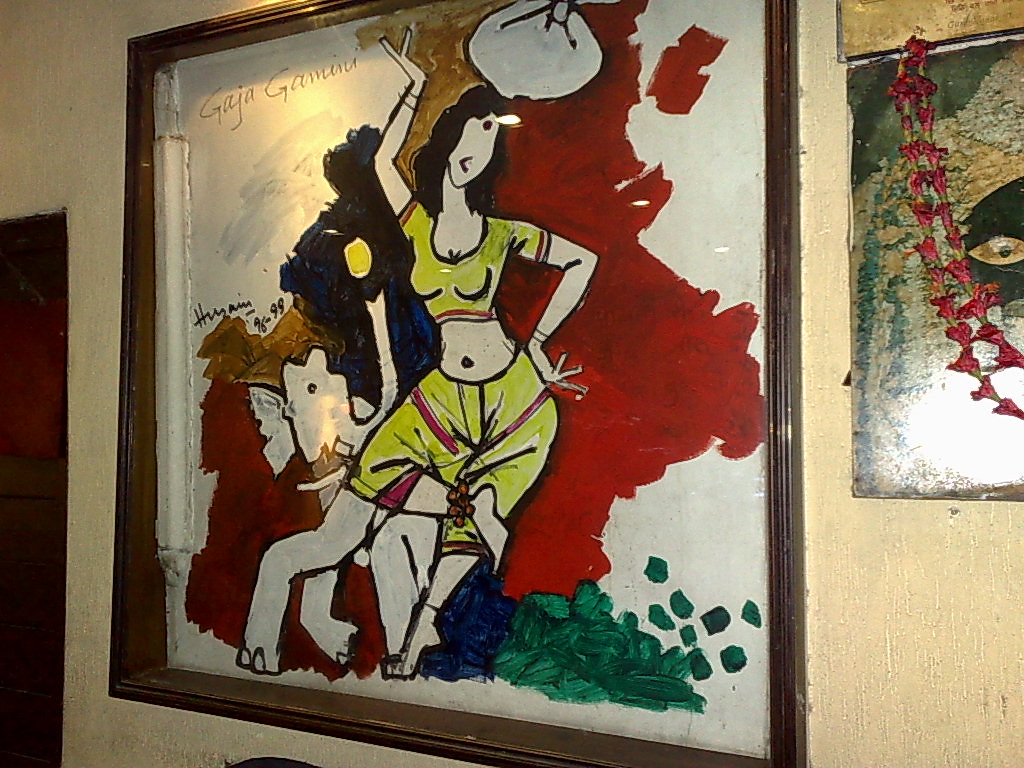
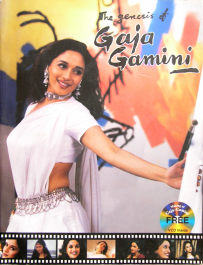
Gaja Gamini: Painting by MF Hussain Gaja Gamini (An elephant’s walk) Movie by MF Hussain
When Maqbool Fida Husain won the Golden Bear in the 17th edition of the Berlin Film Festival, the year was 1967. I, in my pre-teen years, knew little about painting. But growing up in a family of filmmakers I was already conversant with the art of looking through the camera. So I was disoriented that the film critics of the time were baffled by what had impressed the international jury.
Royalty, tigers, ruins, hawks, school children, anklets, on the river bank – all these images moving only to music, not a word uttered. The jury at Berlinale were astounded by the richness of the artist’s idiom that had breathed life into a Rajasthan that is rich in architecture as it is in painting, in costume as in music.
This dawned on me years later, when I curated the exhibition, 3 Dimensions, forthe All India Fine Arts and Crafts Society in New Delhi. It featured paintings, sculpture and graphic art or drawings by artists from Husain, Satish Gujral, Ghulam Mohammad Sheikh, Jatin Das to Sanjay Bhattacharya, Paresh Maity, Mimi Radhakrishnan, Shadab Hussain, among others.
A unique feature of this exhibition was that all the participating artists had interest in another expression of art. So every evening of that week had seen a Ram Kumar and Mimi read their short stories; a Narendra Pal Singh and Jatin Das read their poems; a Sanjay Bhattacharya render Tagore songs of and a Shruti Gupta Chandra perform Kathak. Ratnabali Kant had staged a Performance Art in the presence of Prime Minister V P Singh who had inaugurated the week-long exhibition by reading his poems. And, on the closing day, I had screened Through a Painter’s Eyes. That’s when it dawned on me: it was the originality of vision captured by the 7-minute short film had won over Berlin as also Melbourne and our very own National Awards too.
Subsequently Husain, who had started out from the tenements of Bombay by painting oversized hoardings of Hindi films on the sleeping tramlines at the dead of night, had at the ripe age of 84 made Gaja Gamini (2000) with stars such as Madhuri Dixit, and Minaxi — A Tale of Three Cities (2004) with Tabu and Naseeruddin Shah. Ironically these films baffled the critics just as much as the earlier short film had. However the dazzling visuals of vibrant figures and colourful structuring of the (non)-narrative had found acceptance in the Marche du Film section of Cannes 2004.
*
I have since then tried to fathom what drives artists who are skilled at painting with oil or watercolour, or sculpting wood or stone, metal or clay, or creating graphic images on paper or linoleum, to wield the megaphone. Now, instead of holding the camera or editing the celluloid strips with their hands, they use their mind, their mind’s eyes, their creative imagination.
Some other contemporaries of Husain too had, after attaining glory in the plastic arts, turned to experimenting with the new, ever evolving, ever contemporary art form — cinema. In 1970, Tyeb Mehta, who had briefly worked as an editor, made Koodal, meaning ‘Meeting Ground’ on the Bandra station of Mumbai’s Western Railway. The synthesis of images of humans and animals had won him the Filmfare Critics Award.
Cartoonist Abu — born Attupurathu Mathew Abraham — was a journalist and author who had worked for Punch, Tribune and The Observer in London before returning to work with The Indian Express. He was given a special award by the British Film Institute for the short animation No Ark, clearly a cryptic message deriving from the Biblical tale of Noah’s Ark.
Equally engrossing is the story of Syzygy, also produced by Films Division, and directed by Akbar Padamsee. This 16-minute short, premiered at a UNESCO screening in Paris 1969, had no narrative, no sound, or even colour. It only had lines evoking shapes typically used to refer to the alignment of celestial bodies. Only one man had stayed back till the end of the screening — and he had said to Padamsee, “Most people could not understand your film — it’s a masterpiece.”
Reportedly that man had gone on to become the programming director at Cinematheque Francaise – world’s largest film archive. That’s where Indian filmmaker found Ashim Ahluwalia found a copy of Events in a Cloud Chamber, Padamsee’s second film that was sent for screening at the Delhi Art Expo — never to be returned to the artist. The lost-in-transit film has now been professionally reinterpreted by Ahluwalia.
NB: All these films were supported by filmmaking bodies, and though often baffled, cineastes realised theirs was a new way of seeing the visual expression that goes under the arching umbrella of cinema.
*
This desire to understand, adapt, and get under the skin of a modern medium had driven Tagore, a century ago from today, to paint expressionistic forms and also to film Natir Pujo (1931). And today we find a band of artists from Delhi, Mumbai, Kerala and Baroda making films that bridge disciplines from landscape and abstraction to mimetic movement and drama.
What are the notable features of these films that are mostly made on video? They too have little need for dialogue. Instead, their sight is supported by music of natural sound. If the objects they capture through the lens are arresting forms, vacant spaces can be just as inviting. When they have humans as their protagonists, they are keen to capture body language rather than drama. Colourful palette is not a foregone conclusion – monochromes and black and white can be more poignant. Because? Their visuals are but vehicles for commenting on social reality and for communicating philosophic content.
Legends or veterans, seasoned or sprouting, this intrepid band of adventurers includes Vivan Sundaram, Ranbir Kaleka, Gopi Gajwani, Rameshwar Broota, Bharti Kapadia, Babu Eshwar Prasad, Gigi Scaria, Protul Dash, and Sanjay Roy. They are a continuum of the spirit of experimentation that had driven Husain and Tyeb, Abu Abraham and Akbar Padamsee.
Films by Artists at KIFF*

1 *Disclaimer* 2016/ 9:40 min
By *Gigi Scaria* focuses on the sleight of hands by a magician
2 *On the Road* 2021/ 5:7 min
By *Babu Eshwar Prasad* is a nostalgic look at road movies that are part documentary, part adventure.
3 *Sabash Beta* 3 min
By *Rameshwar Broota* with Vasundhara Tewari applauds the galloping of a fleighty horse.
4 *Leaves Like Hands of Flame* 2010/ 5:34 min
By *Veer Munshi* likens the fallen chinar leaves to the autumn in the lives of uprooted Kashmiris.
5 *L for…* 2019/ 13:14 min
By *Bharti Kapadia* plays with the sight and - surprisingly - the sound of the alphabet.
6 *Fruits Ripen and Rot* 2022/ 4:21 min
By *Sanjay Roy* is a surrealistic look at the divergent responses to food that is central to everyman's existence.
7 *How Far…?* 2023/ 12:37 min
By *Ranveer Kaleka* is an elegy, a dirge, mourning the losses wrought to Planet Earth by human destruction such as war.
8 *Burning Angel* 2024/ 4:37 min
By *Pratul Dash*  is an abstract story of the same destruction.
9 *Turning 2008/ 11 min
By Vivan Sundaram is a silent, colourful comment on the waste created by consumerist civilization.
10 *Time* 1974/13 min
By *Gopi Gajwani* is a riveting tale of how relative a minute is to one in mourning, one waiting, and for one in love.


*Kolkata International Film Festival
.
Ratnottama Sengupta, formerly Arts Editor of The Times of India, teaches mass communication and film appreciation, curates film festivals and art exhibitions, and translates and write books. She has been a member of CBFC, served on the National Film Awards jury and has herself won a National Award.
.
PLEASE NOTE: ARTICLES CAN ONLY BE REPRODUCED IN OTHER SITES WITH DUE ACKNOWLEDGEMENT TO BORDERLESS JOURNAL
Title: Safdar Hashmi: Towards Theatre for a Democracy
Author: Anjum Katyal
Publisher: Orient Blackswan
How do you write a biography of a man who was yet to reach the full expression of his multifaceted talents? How do you document his contribution to social action? Do you say that the tragedy of such a premature death is not only that he died young, but that his life was cut short while his talents were still quivering on the cusp of flowering, struggling for full self-expression? As witnesses to this shocking and traumatic event, we can call it a critical event; a moment in time which is still out of it. It is a moment of reckoning which forces us to revisit our assumptions about theatre as entertainment, a Brechtian moment which alienates us from our previous experience and which forces on us “a new and shocking revelation/revaluation of all we have been.”
In a kind of tragic irony, Safdar Hashmi’s[1]story became front page news when he was brutally attacked by some goons who were trying to stop the Jana Natya Manch actors from enacting a street play in Sahibad, one of Delhi’s industrial suburbs, on the 2nd of January, 1989. At that time, he was barely 35 years old.
Born into a close-knit family in 1954, the youngest of four siblings, Safdar Hashmi grew up in Delhi and Aligarh. His first few years of initial schooling were Aligarh and then he moved to Delhi, where he graduated from St Stephens. While the family had to struggle financially, they had plenty of opportunities to be involved in the vibrant cultural scene of Delhi in the late 1960s and early 1970s. Safdar Hashmi: Towards Theatre for a Democracy by Anjum Katyal, a writer, editor and translator, with a forward by the eminent actor Naseeruddin Shah, details the journey of Hashmi, his total dedication to and involvement with theatre. In his forward, Shah writes that Hashmi was an actor who was unconcerened with personal fame or celebritydom. He was a theatre activist who saw theatre as a means of social action and an instrument of change; he was so dedicated to his work that he was “willing to die for it”.
The book houses his early years, his stint in Kashmir, where he proved to be a catalyst in college and university theatre and drew students into it. He worked for the newly instituted television industry in Kashmir, which helped him earn some much needed money to sustain his passionate love for his own work with street theatre .
The slim volume is a veritable treasure trove of anecdotes about theatre from one of its scholars and connoisseurs and the narrative of Safdar’s journey is interspersed with rich dollops of theatre history. Katyal tell us stories of theatre giants like Badal Sircar, Utpal Dutt, Vinod Nagpal and M.K.Raina, thespians whose life stories and work were closely entwined with the history of theatre in India.
To quote the author, “[T]here is little reliable scholarship on the history of theater in India and on Safdar Hashmi’s contribution to Indian theatre.” Katyal’s book on Hashmi addresses both the issues, covering a substantial chunk of post-independence theatre and specifically the 1960s and seventies. Thus, we get to hear about the contributions of Utpal Dutt and Badal Sircar, doyennes and trail blazers of people’s theatre. Katyal examines the larger socio-political environment against which activist theatre evolved within the country. Drawing from different folk traditions , this adumbrated the vision that was truly democratic in its scope and reach and which moved out of proscenium theatre to reach trade unions and factory workers, the streets, factories and the marketplace.
Utpal Dutt, the intrepid screen and theatre actor recalled that they were “infected by the real IPTA[2]’s concern for the people’s political struggle” and he professed, “the exhilaration of direct political action…changed me completely”. These actors also offered valuable insights into the nature of the street theatre, including its capacity for consciousness raising and revolutionary action. Many of the street plays with their specific critiques “gathered the dispersed rage (of the people); it rallied angry men into an angry mass.”
Apart from socio-economic issues like price rise and labour exploitation, street theatre also focused on political issues like the Emergency and the Naxalite movement. In terms of experiments with form, in 1972 Badal Sircar and his group, Satabdi[3], introduced their Third Theatre; pieces evolved through intensive workshops. The physical and even “graphic body language, the ensemble approach in which all actors formed a close part of the whole with interchangeable ‘roles’, the simple uniform-like costumes, and the strategic props were all taken straight from the news or the actors’ lives, in many cases. The narrative was often non-linear, like a collage of facts , ideas and images”.
Non-proscenium theatre, which could be performed in intimate spaces or outdoors for larger audiences, inspired groups in other parts of the country to evolve performances, which were experimental and non-formal, combining disparate styles. The Third Theatre enabled practitioners the flexibility to practise their art even if they had no access to funds or sponsors. However, state-sponsored violence and the imposition of the Emergency in 1975 clamped down on street and activist theatre in India.
From IPTA to the plays of Utpal Dutt and Badal Sircar, the book gives a dialogic account of history of theatre, both for the specialist and non-specialist alike. Safdar Hashmi himself has written quite extensively on the history of street theatre, stating that “street theatre as it is known today can trace its direct lineage no further than the years immediately after the Russian Revolution of 1917.” It was a basically a militant, political theatre of protest. As Katyal traces the history of street theatre, she writes, “The history of street theatre in India is usually traced back to the 1940s and to the IPTA. However, the attempt to use theatre in public spaces to communicate a political message to the common people began as early as the 1930s, when the SFI[4] started using it to spread the message of class struggle among the masses.”
JANAM or the Jana (People’s) Natya (Dramatics ) Manch (Stage)was founded by Safdar Hashmi in 1973. He poured himself into developing plays like Machine, From the Village to the City and Killers, which demonstrated the group’s commitment to workers’ rights and issues. The group also took up women’s causes to raise consciousness in a society which had normalised violence against women. Their play, Aurat (Woman), met with unprecedented success and had 2500 shows. Their theatre also dealt with sectarian or communal violence.
In her book, Katyal ultimately locates the significance of Safdar Hashmi’s and the Jana Natya Manch’s work in its strengthening of democracy and democratic processes. Tragically and ironically, he paid a high price for it.
.
[1]Safdar Hashmi (1954-1989) was one of the most major proponents of street theatre in India.
Dr Meenakshi Malhotra is Associate Professor of English Literature at Hansraj College, University of Delhi, and has been involved in teaching and curriculum development in several universities. She has edited two books on Women and Lifewriting, Representing the Self and Claiming the I, in addition to numerous published articles on gender, literature and feminist theory. Her most recent publication is The Gendered Body: Negotiation, Resistance, Struggle.
.
PLEASE NOTE: ARTICLES CAN ONLY BE REPRODUCED IN OTHER SITES WITH DUE ACKNOWLEDGEMENT TO BORDERLESS JOURNAL
The palms sway as if they are reminded of a time long ago when they did not know that tectonic shifts would eventually edge them closer to the peninsular sequestration of mainland India. I bristle with the unimpeded curiosity of a man who knows that there is little to be seen apart from the reality of the here and the now. Corbyn’s Cove remains deliciously impaired by the downhill stretch of road that sees at least a hundred motor mishaps a year; I cannot help but grimace as the palms continue their little dance in immaculate rhythm with the late evening breeze.
Corbyn’s Cove seems to be a delightful aperitif before the hinging actuality imposed upon us by that of the most symbolic images of the island: the Cellular Jail. The garden near the gate of Cellular Jail boasts of petunias imported from England; I give them as much of a passing glance as the after-effects of the audio-visual show permit me.
Savarkar, hailed as a hero by the modern dispensation of our country, was perhaps the most well-known inmate of this gaol. As a reward for the valour he displayed while submitting at least three mercy petitions to the British for clemency after being sentenced here, the airport in Port Blair was named after him. On being granted that, Savarkar virtually stopped all criticism of the British Raj, as a result of which he enjoys a considerable legacy in present-day India as a freedom fighter. The museum here offers no facts about the said freedom or fighting. A young schoolboy asks questions to which his parents have no answer.
*
The convoy through which our car moves in giddying fashion on the Andaman Trunk Road leads us, after a fleeting glimpse of the indigenous people of the island — the Jarawas, to Baratang, where limestone caves await. An old, almost run-down ferry transports us to the mangrove creeks over the Middle Strait and heaves with painful aggravation before vomiting us out of its hull. The mud volcanoes watch with distaste and emit a sigh of antipathy. While the limestone caves remain apathetic to our incursions, I pay no heed to their unvoiced contempt.
Wading through the mangrove forests of Baratang Island
But unlike many of my forays in the past, I have felt less at home in Andaman than I have anywhere else. On leaving Port Blair, it seems as if I am circumnavigating an alternate planet, where the corruption that greed unfailingly encourages is let down by the unbridled probity of the officialdom, many of whom hail from the mainland. There is little of culture to speak of, save that which is showcased by settlers from the mainland. As is usually the case when emigres outnumber natives by their sheer magnitude, the indigenous peoples of Andaman have been forced to the margins of a history that they could not claim to have created.
Repeated written requests to visit the island of Nicobar get turned down. Resigned to an expedition that matches the itinerary of other visitors from the mainland, it is not hard to find solace in Aberdeen Bazaar in downtown Port Blair when the sun goes down. The limestone caves of Baratang had been exceptionally kind during the day, decrypting my confusion between stalagmites and stalactites with ease. Listening to my questions with the uninhibited sagacity of a sixty-year-old, the caves showcased how indifference does not necessarily have to portray weakness.
*
Havelock is perhaps the best-known illustration of a one-horse or one-road-town. The ferry from Haddo twists and tumbles in the unfamiliar Bay of Bengal, infamous for its stomach-churning capabilities; it is not before the reassuring Naseeruddin Shah makes an appearance on the in-house television that I finally close my eyes. I wake to the turquoise-clear waters of the same tormentor (the Bay, not Shah) before descending into the waiting taxi, grateful for another chance at life.
The sun sets without leaving a trace of itself at Radhanagar, and the Bengali migrants who serve up a delightful Mughlai parantha[1] talk endlessly of the overflow of tourists. Their Tamil neighbours, who sell seashells and illegal necklaces made from corals, seem happy enough to welcome the said disturbance, without whom their livelihoods would have been at stake.
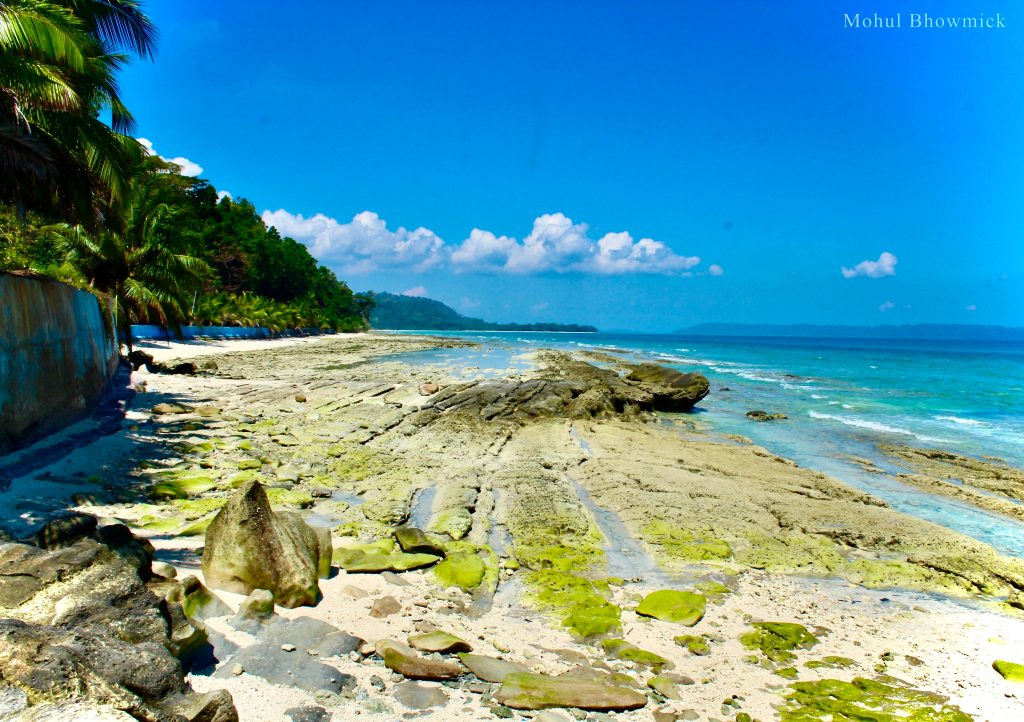
The next day, the Kala Patthar beach seems astral at high noon as the sun beats gently down on the golden sand. I sit sipping on tender coconut juice and remind myself that it is too easy to seek the idea of Shangri-la in such locales, and not in the grim reality that the here and the now present. The harsh sun that burns my bare forearms to embers brings with it the missive that utopia, after all, is a state of mind.
The bright sun parches you on the Kala Patthar beach, Havelock Island.
“All the way to heaven is heaven,” Saint Catherine had decreed in the fourteenth century. I found little to argue with the apostle when heading into Neil Island, recently renamed Shaheed Dweep by the central government. Bharatpur merits no mention at all, or about as much as a slap the genteel administrator at the tourist information centre would deserve for including it in one’s itinerary. Laxmanpur 1 and 2, strangely enough, overwhelm me enough to want as little to do with them as possible; it is often the untested and untried that draw a weary traveller’s mind.
Going against the tide? Almost sunset at the Laxmanpur -2 beach on Neil Island.
*
Return to Port Blair. The droll afternoon spent at Ross takes one back a century or two, but the cacophony that the resultant evening provides is worthy enough of a Tarantino chef-d’oeuvre. At dinner, two raucous Punjabi gentlemen argue over the viscosity of the dal makhni on offer; I take second helpings of the rabri[2] keeping an ear out for the chatter. They involve the floor staff as well, who are helpless, and have no option but to get a new batch of dal tadka served. The gentlemen say that they remember having asked for dal fry… I wonder what Rasheed, our driver during the sojourn, feels when he drops his guests at the airport for their flights back home to the mainland. He has never stepped out of Port Blair and continues to seem distant from the release (or is it escape?) that the terminal offers. I imagine him looking towards me misty-eyed, hopeful for a future in which his reality mirrors that which Andaman often proffers to travellers. But he turns the car around and rushes past the incoming traffic even before we have entered the concours
[1] Mughlai Parantha is flatbread stuffed with minced meat and coated with eggs
Mohul Bhowmick is a national-level cricketer, poet, sports journalist, essayist and travel writer from Hyderabad, India. He has published four collections of poems and one travelogue so far. More of his work can be discovered on his website: www.mohulbhowmick.com.
PLEASE NOTE: ARTICLES CAN ONLY BE REPRODUCED IN OTHER SITES WITH DUE ACKNOWLEDGEMENT TO BORDERLESS JOURNAL.
An innovative rap contest between Gandhi and Martin Luther King, Gandhi as a stand-up comedian, his life as a musical, and at least seventeen actors portraying him across numerous films. No other political and spiritual leader has influenced our cultural discourse as much as M.K. Gandhi. This despite Gandhi’s deep-rooted aversion to cinema and theatre. Shantanu Ray Chaudhuri looks at the legacy of Gandhi in films, plays, songs and TV shows.
“Slim be a combination of an actual kamikaze and Gandhi.” This is Eminem, seventy years after the Mahatma was assassinated, in a song from his 2018 album Kamikaze, that also became the theme song of the Marvel film Venom. It is interesting to conjecture what the bhajan-loving apostle of peace and non-violence would have to say about being referenced by the hip-hop rapper in a song whose very next lines talk of killing and use the F-word.
Probably no other political leader anywhere in the world has been part of popular culture – films, songs, music videos, animation shows, graphic novels – as much as Mohandas Karamchand Gandhi. Newsreels on him run into hundreds of hours. A China-based journalist, A.K. Chattier, put together one of the first celluloid versions of the Mahatma’s life and times from archival material available, sourcing rare footage. Unfortunately, both the print and the negative have been lost.
Beginning with the American feature documentary Mahatma Gandhi: Twentieth-century Prophet in 1953, to The Gandhi Murder, a conspiracy theory film on the assassination, in 2019, he has been part of at least thirty films. Even the Marvel film Age of Ultron has his footage. As many as seventeen actors have played him onscreen: J.S. Casshyap, Ben Kingsley, Sam Dastor, Jay Levey, Yashwant Satvik, Annu Kapur, Rajit Kapur, Mohan Gokhale, Naseeruddin Shah, Surendra Rajan, Mohan Jhangiani (voiced by Zul Vilani), Dilip Prabhavalkar, Dr Shikaripura Krishnamurthy, Avijit Datta, S. Kanagaraj, Neeraj Kabi and Jesus Sans.
Of these, Sam Dastor featured as the Mahatma in Lord Mountbatten: The Last Viceroy (1986) and Jinnah (1998), while Surendra Rajan has donned Gandhi’s garb as many as six times, in Veer Savarkar (2001), The Legend of Bhagat Singh (2002), Netaji Subhash Chandra Bose: The Forgotten Hero (2005), the TV movie The Last Days of the Raj (2007), the short film Gandhi: The Silent Gun (2012) and Srijit Mukherji’s Gumnaami (2019).
Gandhi and Early Indian Cinema
It was common in the 1930s and 1940s for film hoardings to have life-size pictures of Gandhi over the photographs of the stars. The protagonist of Kanjibhai Rathod’s mythological Bhakta Vidura (1921), the first film to be banned in India, resembled Gandhi, cap and all. Ajanta Cinetone’s Mazdoor (1934), written by Munshi Premchand, too was banned, and promoted as ‘the banned film’, as it dealt with Gandhian principles. Produced by Imperial Film Company and directed by R.S. Chaudhary, Wrath (1931) had a character called Garibdas who fights untouchability. The censors cut out many of its scenes and renamed it Khuda Ki Shaan. Vinayak Damodar Karnataki’s Brandy Ki Botal (1939) took up Bapu’s campaign against liquor and referred to Gandhi as ‘azadi ka devta’.
The Feature Biopics
The most well-known of these is Richard Attenborough’s 1982 film. In the making for over twenty years, it remains, warts and all, the definitive film on Gandhi. And though Attenborough made the cardinal error of falling prey to what Nehru had warned him against at the outset when the director had met him with the proposal in 1963 – “Whatever you do, do not deify him … that is what we have done in India … and he was too great a man to be deified” – there is no doubt that this is an epic labour of love that delivers a series of spectacular set-pieces of great emotional heft.
As the filmmaker himself observed, “It took me 20 years to get the money to get that movie made. I remember my pitch to 20th Century Fox. The guy said: ‘Dickie, it’s sweet of you to come here. You’re obviously obsessed. But who the f***ing hell will be interested in a little brown man wrapped in a sheet carrying a beanpole?’” As it turned out, the whole world was, as was the Oscar committee. And Ben Kingsley set a benchmark for the onscreen Gandhi that has been impossible to top over forty years later. So complete was the identification that a few years later a popular Hindi film, Peechha Karro (d: Pankaj Parashar, 1986), had a character swear by Ben Kingsley instead of Gandhi.
Ben Kingsley
Surprisingly, despite the many incarnations of the Mahatma on cinema, Gandhi is only one of two full-length feature films to deal with his life. The other one being Shyam Benegal’s The Making of the Mahatma (with Rajit Kapoor essaying the role), which as its Hindi title, Gandhi Se Mahatma Tak, suggests, deals primarily with his experiences as a barrister and in South Africa. Several biopics on national leaders of the freedom movement feature Gandhi in important cameos. These include Sardar (d: Ketan Mehta, 1993, Annu Kapoor as Gandhi) and Jabbar Patel’s Dr B.R. Ambedkar (2000, with Mohan Gokhale as Gandhi), probably the first time the Mahatma was shown in a negative light. There was also the 2011 film Dear Friend Hitler, based on his correspondences with Adolf Hitler (played by Raghubir Yadav).
These biographical films include Gandhi, My Father, which deals with his tortured and tumultuous relationship with his son, Harilal Gandhi. Based on the latter’s biography Harilal Gandhi: A Life by Chandulal Bhagubhai Dalal, the film was directed by Feroz Abbas Khan, who had earlier helmed a stage version, Mahatma Vs Gandhi (based on Dinkar Joshi’s Gujarati novel Prakashno Padchhayo), starring Naseeruddin Shah and Kay Kay Menon as Gandhi and Hiralal respectively. The film version starred Darshan Jariwala and Akshaye Khanna as father and son respectively.
The Adversarial Gaze
Existing with the eulogies are a handful of films that portray the world of his adversaries – people like Nathuram Godse and Veer Savarkar, in particular. Unfortunately, none of these have the rigour of the works of Richard Attenborough and Shyam Benegal and have been rightly dismissed as sensationalist. Ashok Tyagi’s 2017 short film Why I Killed Gandhi, which released in early 2022, became controversial for allegedly showing Godse as a hero, forcing its lead actor to apologise for playing the role of Godse. In the same vein is Ved Rahi’s Veer Savarkar (2001). Kamal Haasan’s Hey Ram (2000), a fictional tale of the moral dilemmas facing a would-be assassin of Gandhi, is in comparison a more nuanced take, though Naseeruddin Shah is probably the healthiest Gandhi onscreen ever.
Naseeruddin Shah as Gandhi
But by far the more interesting fiction came close to sixty years ago. In 1963, around the time that Attenborough was talking to Pandit Nehru about his film on Gandhi, Nine Hours to Rama created quite a flutter for its purportedly ‘sympathetic’ take on Nathuram Godse. Narrating the last nine hours of the life of Gandhi’s assassin, this one is a strange beast. Dismissed by academic Ravinder Singh as “a heady concoction of a little history and too much fiction”, the film shows Godse involved in an affair with a married woman and even an encounter with a prostitute. Godse tries to lure the former into sharing a room with him, describing the sexual encounter likely to follow as ‘dessert’ after a meal. No wonder, the film, as well as the novel of the same name by Stanley Wolpert on which it was based, faced protests from both Congress and Godse’s supporters, and an eventual ban.
A laughable enterprise in all respects – the only thing it probably gets right are the three bullets, and even that scene is followed by a ridiculous one where Gandhi forgives Godse who is shown as repenting his act immediately afterwards – what is surprising about it are the credentials of the people involved with the project. The director Mark Robson is well known for Hollywood blockbusters like The Bridges of Toko Ri, The Harder They Hall, Peyton Place and Von Ryan’s Express. The screenwriter Nelson Gidding scripted critically acclaimed ones like The Haunting and Andromeda Strain. And among the cast, we have respected actors such as Jose Ferrer (who essayed the definitive Cyrano de Bergerac on stage and screen) and Robert Morley.
What makes this somewhat of a curio are the smattering of Indian actors in cameos, including David as a policeman, Achala Sachdeva (as Godse’s mother) and P. Jairaj as G.D. Birla. By far the most interesting and innovative aspect of the film is its credit titles – comprising the ticking of an old-fashioned pocket watch – designed by Saul Bass, which is deserving of a full-length article.
The Shadow of Gandhi: Gandhigiri
Gandhi’s life and philosophy have cast long shadows, particularly in Hindi cinema. Almost all films that show a police station invariably have his photograph up there on the wall as part of the background décor. However, it is in the subtle messaging of Hindi cinema that his influence is most strongly felt, particularly the way our films have for the longest time made a virtue of being poor, equating money with all evil.
Possibly the one film that epitomises the enduring legacy of the Mahatma and was instrumental in reintroducing him in popular discourse is Raju Hirani’s Lage RahoMunna Bhai (2006). In a stroke of genius, the filmmakers have a goonda hallucinating about the Mahatma, who inspires him to ‘Gandhigiri’ (the term caught on in a big way, leading to a 2016 film starring Om Puri titled Gandhigiri) instead of gundagiri as a tool to get your way
Munnabhai and Gandhi
Though not as influential as the Munna Bhai film, Jahnu Barua’s Maine Gandhi Ko Nahin Mara (2005) is as important. The film, about a retired professor whose dementia-wasted mind begins to believe that he was accused of killing Gandhi, is a metaphoric exposition of what Gandhi and the values he espoused mean today, how he has been reduced to a statute, a road and a stamp. If Munna Bhai has the two goondas recalling Gandhi only from his photo on currency notes and on account of 2 October being a dry day, Barua’s film highlights how we remember the man only on two days – 2 October and 30 January
Gandhi’s influence on the national psyche has been part of many other films tangentially. The 2009 film Road to Sangam is the story of a Muslim mechanic entrusted the job of repairing an old V8 ford engine, little knowing that the car had once carried Gandhi’s ashes to the sangam for immersion. While Shah Rukh Khan’s character in Swades is named Mohan, and the film, according to Mahatma Gandhi’s grandson Tushar Gandhi, “epitomises Gandhi’s values”, A. Balakrishnan’s Welcome Back Gandhi (2012) imagines the leader returning to contemporary India and dealing with a country he barely recognises.
Girish Kasaravalli’s Koormavatara (2011) tells the story of a government employee who is selected to portray Gandhi in a TV series, owing to his strong resemblance to the leader. Having never acted before and not a believer in Gandhian principles, he resists before reluctantly taking up the assignment. Reading on Gandhi and his philosophies transforms his life as people start flocking to him and he must negotiate the tricky terrain of being regarded as a modern-day Gandhi.
Different Strokes
Imagine Gandhi and and civil rights champion Martin Luther King Jr engaged in a battle of rap! That is exactly what Keegan Michael Key and Jordan Peele did in the popular web series Key and Peele, which has Gandhi and King going the hip-hop way to decide who is the better pacifist.
While the inspiration behind the name of the Canadian punk rock band, Propagandhi, is not hard to ascertain, the animated TV series Clone High, made by Phil Lord, Christopher Miller and Bill Lawrence, imagined teenage versions of legends, among them Gandhi, who is shown as a ‘fun-loving, hyperactive teenage slacker’. An episode in the popular TV show Seinfeld has a character claiming to have met Gandhi and having an affair with him. In the TV series FamilyGuy, Gandhi shows up as a stand-up comedian while South Park has a character meeting Gandhi in hell.
Following in the footsteps of Mahatma Vs Gandhi and Lillete Dubey’s Sammy, from Pratap Sharma’s play (the title derived from the word ‘swami’ which was used by South African whites as a demeaning term for Indian workers), Danesh Khambata went the Broadway-style musical way with his theatrical production, Gandhi: The Musical. The play covers the leader’s life through sixteen songs, a dozen dances, featuring a cast of over forty dancers, incredibly introducing song-and-dance routines into the Mahatma’s life.
The impact that playing Gandhi has on an actor and the process that it involves also need to be explored at greater length as it provides insights on how influential he continues to be. Joy Sengupta, who portrayed Gandhi in Sammy, says, “It changed my perspective in life. I was all revolutionary and fashionably loathing Gandhi. I had even directed a play on Bhagat Singh, taking pot-shots at Gandhi. Sohail Hashmi told me not to do that, as Gandhi was the only and the most powerful secular symbol surviving in India. That kind of opened a few clogs in my head regarding what secularism is, whether it could coexist with spiritualism, etc. Ten years later, Sammy happened. I gave up all mainstream work for four months to focus on the play. I went to every Gandhi institution I could, pored over every photograph to imbibe the body language. Every films division reel to get his body rhythm. Recording of his speeches gave me his intonation and pitch. I switched to a Gandhian diet and lost 12 kg. I travelled by local transport. I took in all the hardships and drew strength from the Gandhian perspective of using your negatives by turning them into your strengths. This is something I had read when I was a kid in a school textbook, and it had remained with me. Now it became my full-blown philosophy – hardships and punishment can go on to make you a better man. I did not go for any complicated process – Gandhi believed in simplicity and executed everything in its simple organic form (something the intellectual Nehru found difficult to understand). It was simple. Be transparent, rely on truth, accept faults and do penance, forgive others, do it yourself, and always look at the poorest and most vulnerable as a consequence of your actions. Most importantly, listen to your inner voice for guidance. If you really mix all that, you get a simple childlike man who was always busy doing simple things to improve his inner being. I aimed for his essence, focussing on catching his spirit on stage and not mimicking him.”
Songs eulogising Gandhi are dime a dozen in India, of course. These include the reverential non-film ‘Suno-suno ae duniya waalon Bapu ki ye amar kahani’(Mohammad Rafi) and ‘Gundham hamare Gandhiji’ (S.D Burman).
While the celebrated ‘De di hamme azadi bina khadag bina dhal, Sabarmati ke sant tune kar diya kamal’ (Jagriti, 1953) spoke of Gandhi as someone to look up to, to emulate, Lage Raho Munna Bhai’s sensational ‘Bande mein tha dum’ made Gandhi cool, a buddy you can count on when in trouble, giving us a Gandhi for Generation Z.
For someone who has been such an integral part of popular culture, and for someone almost deified for his pacifism, Gandhi’s views on cinema are stridently illiberal. In fact, some of his pronouncements almost echo those of the bigoted ‘right’ that keeps calling for bans and boycotts. Describing cinema as a ‘sinful technology’ and a ‘corrupting influence [as bad as] a drinking bout, he said, “If I was made prime minister, I would close all the cinemas and theatres…” and “if I had my way, I would see to it that all cinemas and theatres in this country were converted into spinning halls”.
He watched just two films in his life, and hated both. The first one was Mission to Moscow (1943), which Miraben insisted he watch. The film, based on the memoirs of Joseph Davies, the US ambassador to Russia, featured scantily clad women in a few dancing scene. Horrified, Gandhi admonished the people there ‘for showing such nude dances’ to him. Soon after, he happened to watch Vijay Bhatt’s production Ram Rajya, at the insistence of the film’s art director, Kanti Desai. Extremely reluctant, Gandhi agreed only because, as he said, “I will have to see an Indian film as I have made the mistake of watching an English one.” And contrary to popular opinion, as industrialist Shanti Kumar Morarje mentioned, he disliked it ‘especially because of the shouting and uproar in the film’.
Such was his abhorrence for cinema – “The cinema, the stage, the race-course, the drink-booth and the opium-den – all these [are] enemies of society …” – that industry stalwarts like Khwaja Ahmad Abbas and Baburao Patel wrote open letters and editorials to Gandhi, articulating “the positive contribution of cinema to entertainment and its utility as a tool to further the cause of Indian freedom movement.” Patel wrote: “Let this champion of Daridra Narayan come down and meet us and we shall try to convince him, or be convinced. Surely as workers in the film field, we are not worse than the poor untouchables for whom the old Mahatma’s heart so often bleeds. And if he thinks we are, the more reason why he should come to our rescue.”
But to no avail. Gandhi remained unmoved. As he said, “I refuse to be enthused about [cinema] and waste God-given time [on it] … in Ahmedabad children get headaches, lose power of thinking, get fever and die … The disease is caused by going to cinemas.”
The dislike defied all logic and was so deep-rooted that it probably needs a psychiatric assessment. Or better still, a film that addresses the great man’s aversion to cinema.
(Parts of this essay was first published in The Telegraph)
Shantanu Ray Chaudhuriis a film buff, editor, publisher, film critic and writer. Books commissioned and edited by him have won the National Award for Best Book on Cinema twice and the inaugural MAMI (Mumbai Academy of Moving Images) Award for Best Writing on Cinema. In 2017, he was named Editor of the Year by the apex publishing body, Publishing Next. He has contributed to a number of magazines and websites like The Daily Eye, Cinemaazi, Film Companion, The Wire, Outlook, The Taj, and others. He is the author of two books: Whims – A Book of Poems(published by Writers Workshop) and Icons from Bollywood (published by Penguin/Puffin).
PLEASE NOTE: ARTICLES CAN ONLY BE REPRODUCED IN OTHER SITES WITH DUE ACKNOWLEDGEMENT TO BORDERLESS JOURNAL
Rupali Gupta Mukherjee visits a restored palace in the heartland of Bengal
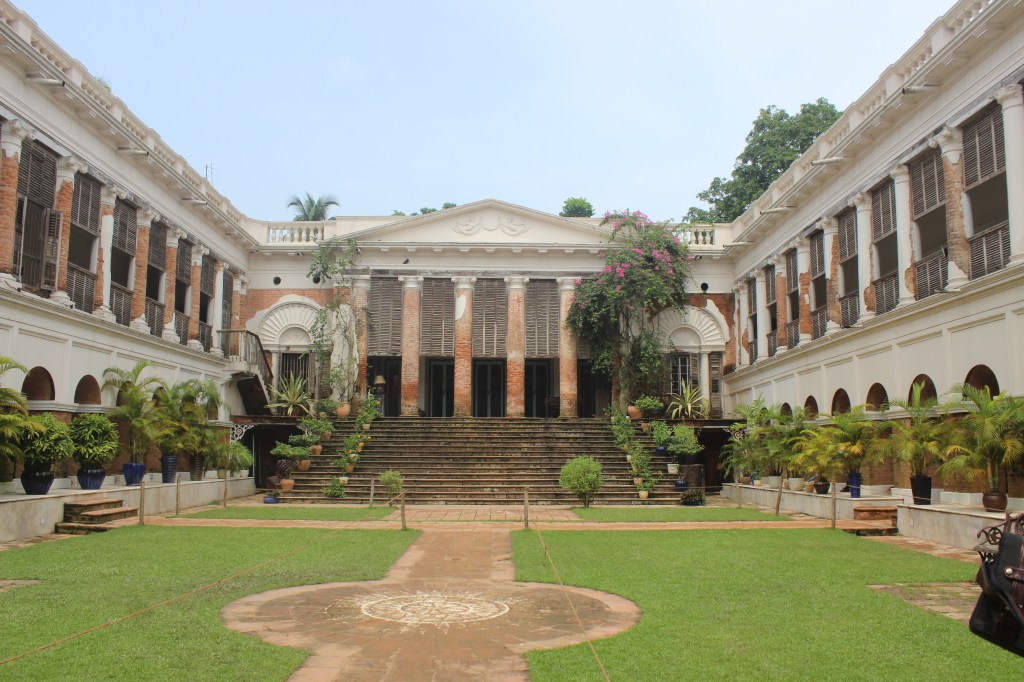
The Courtyard of Rajbari Bawali. Photo Courtesy: Rupali Gupta Mukherjee
From time immemorial, rajbaris, or the palatial homes of zamindars, have been a part of Bengal art and architecture, although many such splendid mansions have fallen into ruin owing to ownership issues or lack of conservation. Some are being converted to hotels, like the rajbari at Bawali. Located sixty kilometers from Calcutta, the palace-hotel enthralled with its restored regal rhythm, glamour and enduring legend. We were transfixed, bemused and in love with the aesthetic elegance.
“The daunting task of restoring the crumbling historic manor into a lavish hotel was a mammoth task. An exclusive 300-year-old colonial mansion transformed into a stunning luxury heritage boutique estate”, said the proud Resident Director of the property, Ms. Mrinalinee Majumdar. Once an imposing abode of the aristocratic zamindar family, The Rajbari Bawali undoubtedly, has revived an integral part of Bengal’s glorious history and culture.
Mr. Ajay Rawla discovered the 18th century palace in a state of ruins in 2006 and tried his best to reconstruct its history. Mr. Rawla, the Chairman, spent around seven years restoring the Rajbari’s past glory. The restoration work received acclaim, award of excellence by INTACH [Indian National Trust for Art and Cultural Heritage]. The restored Rajbari Bawali has also been featured by Conde Nast UK on their hot list of “Top 50 Hidden Destinations of the World’. The Duke and the Duchess of York were guests at the Rajbari during their visit to India.
Bawali Rajbari has a remarkable history, dating back to more than four hundred years, starting with the Mughal Emperor Akbar. The name “Bawali” can be traced to its first settlers, forest dwellers from the Baul. Initially, this place was known as “Bowali” but over the years this has changed to “Bawali”. This erstwhile swampland, once part of the Sundarbans, was handed over as a reward to Shoba Ram Rai, an army officer under Maharaja Man Singh of Jaipur, the commander-in-chief of the Mughal Emperor. History tells us that the Mondols of Bawali were originally Roys. Their dominance in the fringes started way back in 1710. Later, the royal family prospered under Haradhan, who enjoyed the benefaction of the East India Company.
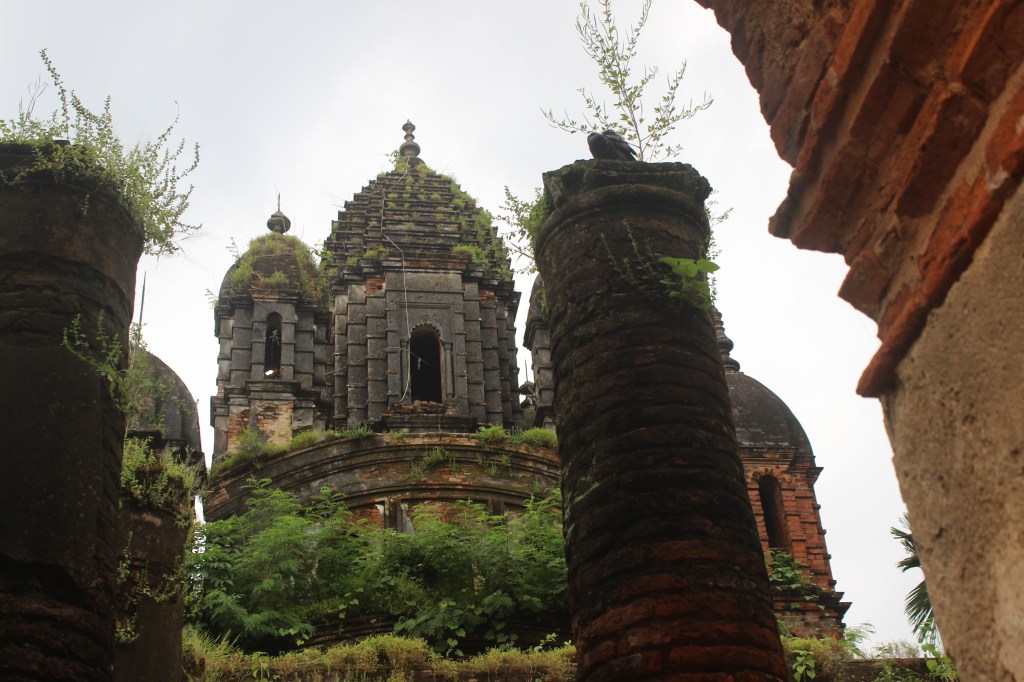
350-year-old Radha Krishna Temple built in the traditional aat-chala style. Photo Courtesy: Rupali Gupta Mukherjee
It was autumn, just before Durga Puja, when we planned a day trip to explore the rajbari at Bawali. As we moved towards the entrance of the rajbari, more than three-centuries-old, Radha Krishna temple, opposite the palace, caught our attention. An arched alley made of red bricks and pillars with Victorian floral motifs. The temple steeple stands out from the rest of the architecture. It has delicate terracotta etching outside, with moss and plants growing in cracks. We were amazed at the rich intricate structural motifs. This is another heritage site that desperately needs restoration, we felt. The West meets the East in the lofty temples and the palace of Bowali. The European style columns that hold up the temples in the village are atypical in the rest of the state. Beautiful gardens dotted with fashionable statues of Italian marble and a sinuous water turret weaves a flowing reverie. It’s really sad that most of the structures are in ruins and on the verge of collapse.
Finally, we found ourselves in front of the main entrance leading to Rajbari Bawali. The welcome was grand with the beating of the dhaak, the traditional drums, and women in traditional attire, clad in red bordered white saris, welcoming guests with the traditional smear of tika on the forehead, flowers and sweets. We were overwhelmed by the antique fixtures, after stepping inside the courtyard which revived the bygone era of the zamindars, nawabs and their lifestyles steeped in grandeur. The welcome drink was refreshing and the entire property was a visual delight, a photographer’s paradise.
The Terrace café, with a part of the vestiges from the roof took us back to the primeval past. A striking segment of the palace merges the new with the ancient, keeping the antiquity alive. Apart from exploring the huge chattels we enjoyed the sumptuous traditional Bengali lunch. The royal lunch was served with utmost warmth and hospitality. The food was exceptionally delicious, was flawlessly soaked in conventional recipe and served in a stately style. Burnt clay plates lined with banana leaves served lip-smacking kochur loti chingri, kassa mangsho, Bhetki Paturi. The dessert was mouthwatering and elaborate, I loved the misti doi. The ongoing melodious live concert on the lush green lawn adjacent to the dining arena was definitely scintillating.
It was an astounding experience for us; something, undeniably beyond expectation, we started our journey with the thought of exploring a historical site but we were overwhelmed by the exclusiveness of the palatial structure, antique display, hypnotic charm of the ‘Zamindari Raj’ and the warmth of the employees. I was in a trance for weeks after visiting the elite ‘khazana’ of the colonial era and was keen to know more about its imperial past. My quest brought to light many hidden facts.
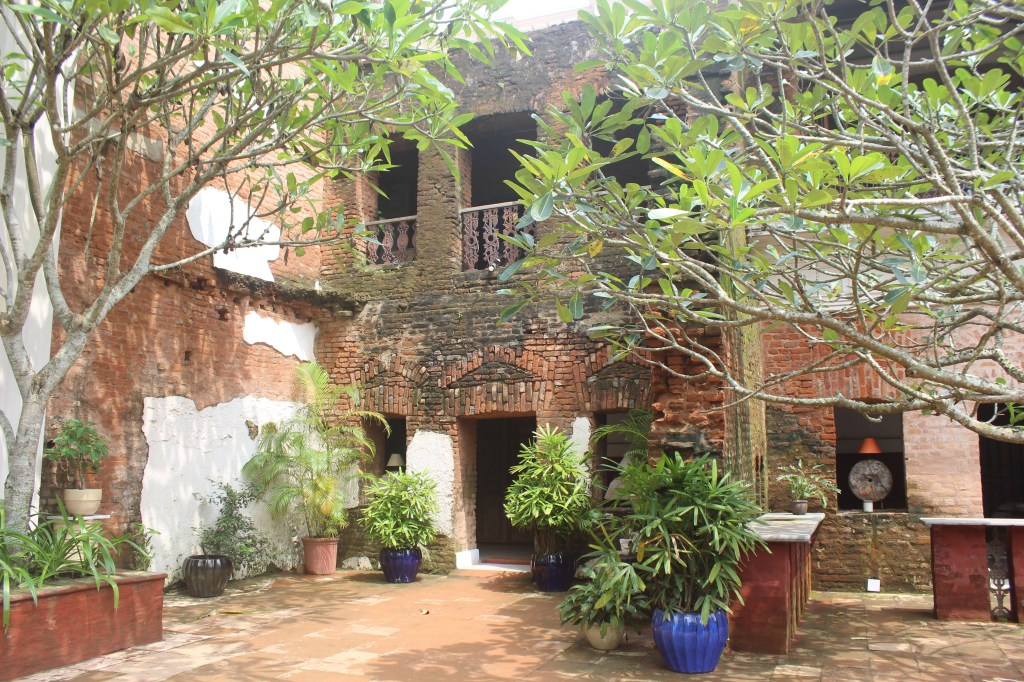
Unrestored Part of the Rajbari. Photo Courtesy: Rupali Gupta Mukherjee
The ruins of the rajbari and its surrounding relics was also the memorable shoot venue preferred by renowned film director Mrinal Sen for his Shabana Azmi, Naseeruddin starred movie Khandhar. It was screened at the 1984 Cannes Film Festival. Later after restoration of the Khandhar, in 2003 Rituparno Ghosh selected the same setting, Bawali Rajbari for his National award-winning film Chokher Bali, an adaptation from Tagore’s novel of the same name. This also bagged the Chicago International Film Festival Award [2003] The rajbari is an extraordinary architectural masterpiece about 60km away from Kolkata, steeped in convention and opulence, a heritage boutique resort
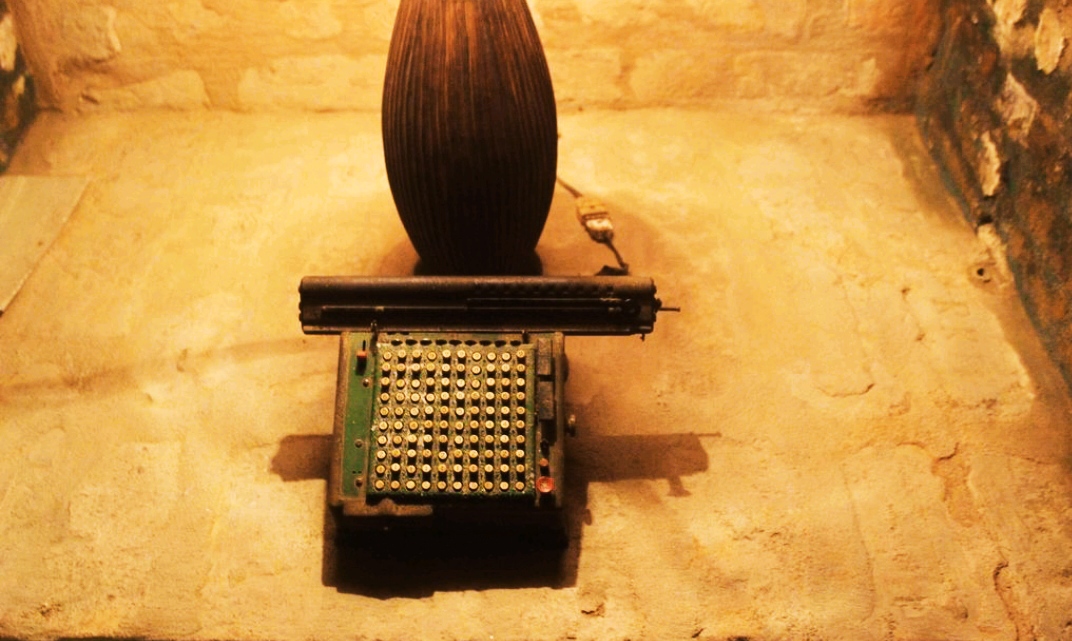
It had been more than a month now, but still the spell of the Greco-Roman style Rajbari, the dungeon, jailkhana, cellar storing liquors from 1858, antique decor portico, fax machine and gramophones of archaic fashion, well-ventilated thakurdalan, spacious grand piano room, exquisite chandeliers in the dining hall and the faintly lit vestibule will take you, beyond doubt, to a baffling pensive world of romance!
Antique Fax machine
The bottles in the cellar of the ‘Jailkhana’ with labels of East India CompanyGramophone in the thakurdalanObjects from the past displayed in the hotel. Photo Courtesy: Rupali Gupta Mukherjee
Glossary:
kochur loti chingri — Prawn
kassa mangsho – goat meat
bhetki paturi – fish
misti doi – sweetened yoghurt a Bengali speciality.
Rupali Gupta Mukherjee has a passion for reading, writing and reciting poetry. She is a nature enthusiast, loves to travel and has a zeal for photography.
.
PLEASE NOTE: ARTICLES CAN ONLY BE REPRODUCED IN OTHER SITES WITH DUE ACKNOWLEDGEMENT TO BORDERLESS JOURNAL







 Borderless