Categories
Review

Ebrahim Alkazi: Holding Time Captive

Book Review by Satya Narayan Mishra

Title: Ebrahim Alkazi: Holding Time Captive

Author: Amal Allana

Publisher: Vintage Books, Penguin

During an extensive interview, Pankaj Kapur, the highly acclaimed actor, director and writer, nostalgically remembered his days in NSD[1] as a student in the 70s and of Ebrahim Alkazi who was the guiding light of the school as the Director from 1962-77. Mandi House was the vibrant cultural hub where the quartet of NSD, Triveni Kala Sangam, Sriram Art Centre and Kamani Auditorium breathed cadences of art, music, dance and theatre. As the presiding deity of NSD, Alkazi’s prodigious talent in all aspects of theatre except costume (where his wife was the moving spirit) brought his dynamic genius into the quest for intercultural and interdisciplinary thinking in artistic expressions that was both transformative and liberative for his myriad students like Sai Paranjpye, Nasir, Om Puri, Surekha Sikri, Uttara Baokar and Pankaj Kapur[2], who later on lit the stage and celluloid  though their exceptional talents and skill. He would have been a hundred this month. Amal Allana, his daughter has authored a biography of her father, Ebrahim Alkazi: Holding Time Captive. The book  makes an absorbing read.

She brings out Alkazi’s early encounters and reception by the Hindi Theatrewallas of Delhi in the early 60s. It is the story of a western educated Bombayite who was presumptuous enough to think he could teach Delhi theatre buffs a thing or two. As a second-year student, Sai Paranjpye recalls Ebrahim as a storm under whom a metamorphosis took place in the NSD overnight. Walking in to the den of Hindiwallah writers’ camp, Alkazi caught them unawares by picking up the works of the most cerebral and experimental of the Hindi new wave movement; Mohan Rakesh’s Aashadh Ka Ek Din[3]and Dharmavir Bharat’s Andha Yug[4]Aashadh ka Ek Din, a play with a rural background, was the story of the Indian villager, whose lifestyle, pace and values were succumbing to the inevitable onslaught of urbanisation. The basic theme was autobiographical to Mohan Rakesh himself, where he identified himself with a classical playwright like Kalidas. This mix of history and the present entwined in to a single entity, was a modernist strategy that Alkazi too had attempted while contemporising myths. He exquisitely crafted the mise en scene[5]that sparkled with delicate, nuanced performances from young student actors such as Sudha Sharma as Mallika and Om Shiv Puri as Kalidas.

 India had lost a war with China in 1962.  Alkazi had chosen Andha Yug, set during the last days of the Kurukshetra war, when Aswasthama stood in rage, prepared to use the ultimate weapon to annihilate the mankind. It was just not the play’s topicality, its anti-war thrust that drew Alkazi to it. Alkazi tried to shrug off the baggage of European modernism he was carrying, embarking now on a foundational journey towards a deeper ‘discovery of India.’ Through Andha Yug, Alkazi came closer to learning about India’s value system and philosophy as explored in the Mahabharata, while Aashad gave him an appreciation of the artistic sensibility of the great Sankrit poet-dramatist Kalidas, India’s veritable Shakespeare. From now on, he would engage with the idea of India between the two polarities: India as a myth and India as a kind of documented reality. Alkazi was introducing the idea that theatre was a performance art, not literature performed on stage. He was creating a language of performance that was distinct from the language of words.

The making of Tughlaq and its staging in Purana Qila is a watershed event in the theatre landscape of Delhi. Alkazi was greatly drawn to Girish Karnad’s play Tughlaq. Karnad had confided in him how Tughlaq was the most idealistic, the most intelligent king ever to come on the throne of Delhi and one of the greatest failures also. And how in the early sixties India had also come very far in the same direction. Alkazi felt that this play effectively reflected the trials and opposition a visionary leader faced, while trying to function within a corrupt political scenario. The cast of Tughlaq had some of the most brilliant actors, each painstakingly trained by Alkazi himself. There was Manohar Singh who was playing Tughlaq, Surekha Sikri and Uttara Baokar were doubled as Sauteli Ma, Nasiruddin Shah as the Machiavellian Aziz, Rajesh Vivek as Najeeb. The young reporter members included Pankaj Kapur, KK Raina, Raghuvir Yadav, a veritable who is who of latter-day cinema. Tughlaq was staged in 1972 at the Purana Qila (Old Fort) in Delhi, utilising the historical ruins as a backdrop for the dramatic spectacle. This production is considered a landmark event in Indian theatre, combining history, politics and performance to create a commentary on the reign of Tuqhlaq[6] and politics of the 60s.

Nehru’s dream of reconstructing the nation needed a powerful and unitary concept of ‘nationalism’ to recognise all productive forces in the country. Culture was very much a part of the reconstructive process that needed to be systematised and brought under one umbrella and for this purpose, three national academies had been set up: the Sangeet Natak Academy, the Lalit Kala Academy and the Sahitya Akademi. The desire to modernise Indian theatre was part of the same reconstructive cultural policy. And Alkazi was the mascot of the theatre movement and Mandi House, the epicentre of cultural conflation and crescendo.

The Purana Qila festival in 1972, with Tughlaq, Sultan Razia and Andha Yug became the most talked about cultural event of the decade He wanted to offer both the hoi polloi and the cognoscenti, including burqa clad women, high quality theatre that did not conform to ‘popular taste’; theatre that had a social relevance, that both instructed and entertained. This was Alkazi’s ideal of what constituted national theatre.

There have many stars in firmament of Indian theatre. Ebrahim revitalised Indian theatre. Habib Tanvir, blended folk traditions with modern drama. Badal Sirkar revolutionised Bengali theatre by challenging conventional norms. They are like the great troika of Indian Cinema, Satyajit Ray, Ritwick Ghatak and Mrinal Sen.

Alkazi left NSD as it was denied autonomy by scheming bureaucrats. Allana brings out how Alkazi passionately believed that an artist belongs to no political party, and has no religious ideology. An artist has to distance himself from each one of these in order to see each one of these objectively. “And finally, he has to distance himself from himself.” He wrote: “ It is our duty and moral responsibility to study history dispassionately, but with a passion for the truth, with humility and with a profound sense of responsibility and to ask ourselves seriously: What is the legacy that we shall leave behind?

[1] National School of Drama

[2] Well known Indian actors

[3] A Day in Aashadh (June-July) was a Hindi play that debuted in 1958

[4] Blind Age was a verse-play in Hindi written in 1953

[5] Placed on stage

[6] A 1964 Kannada play by Girish Kannad, translated to Urdu in 1966 in NSD and most famously performed for in Purana Qila, New Delhi, in 1972

Satya Narayan Misra is a Professor Emeritus and author of seven books. The latest, Against the Binary, was published in December 2024. He is a regular columnist and reviewer of books for several leading newspapers in Odisha and digital platforms likeScroll.in and The Wire. He was associated with the NSD in the 70s.

.

PLEASE NOTE: ARTICLES CAN ONLY BE REPRODUCED IN OTHER SITES WITH DUE ACKNOWLEDGEMENT TO BORDERLESS JOURNAL

Click here to access the Borderless anthology, Monalisa No Longer Smiles

Click here to access Monalisa No Longer Smiles on Kindle Amazon International
Categories
Review

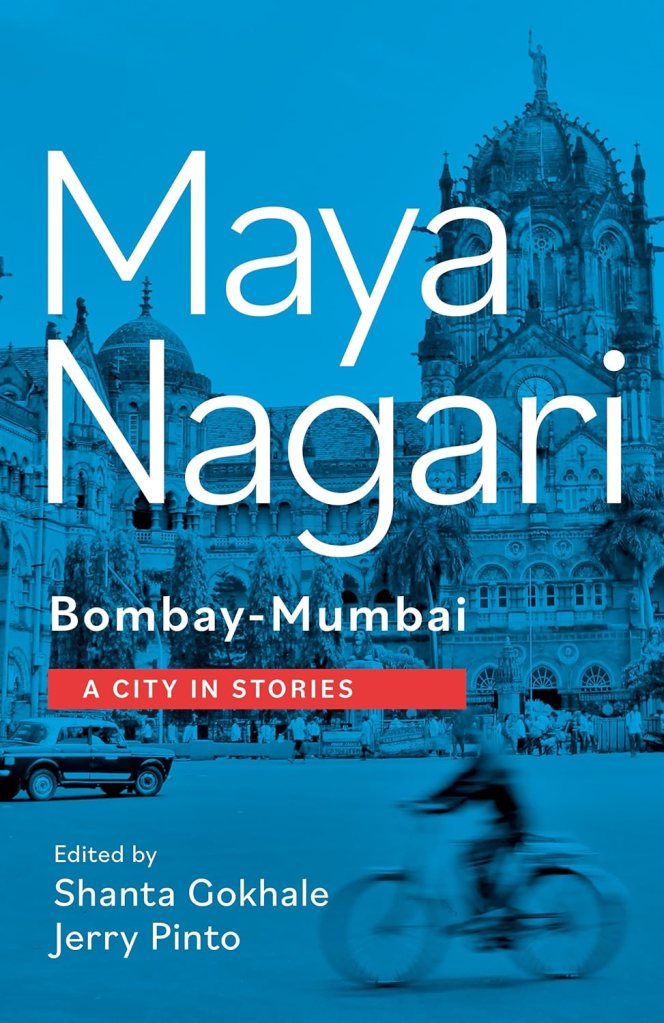
Maya Nagari: Stories of Bombay-Mumbai

Book Review by Somdatta Mandal

 Title: Maya Nagari: Bombay-Mumbai A City in Stories

Editors: Shanta Gokhale, Jerry Pinto

Publisher: Speaking Tiger Books

The very mention of the name Mumbai (or Bombay) brings to our minds a great city in India where the thriving metropolis grows at a rapid speed because people not only flock here from different parts of the country to make quick bucks and survive against all odds, but also because the film industry of Bollywood has also established it as a city of dreams, one that never sleeps and instead creates a mirage-of-sorts — an illusion, rightly labelled by the editors of this anthology as ‘Maya Nagari’. Edited by Shanta Gokhale and Jerry Pinto, this book, comprising twenty-one short stories about Mumbai takes the road less taken to create a non-uniform image of the metropolis. In tune with its multicultural and multilingual nature, we have stories about the city that is a sea of people and speaks at least a dozen languages. There are stories translated from Marathi, Urdu, Gujarati, Tamil, Hindi, Kannada, Malayalam, and stories written originally in English. Among the writers are legends and new voices—Baburao Bagul, Ismat Chughtai, Pu La Deshpande, Ambai,Urmila Pawar, Mohan Rakesh, Saadat Hasan Manto, Ambai, Jayant Kaikini, Bhupen Khakhar, Shripad Narayan Pendse, Manasi, Krishan Chander, Udayan Thakker, Cyrus Mistry, Vilas Sarang, Jayant Pawar, Tejaswini Apte-Rahm and Anuradha Kumar.

As Jerry Pinto clearly states in the introduction, the stories can be read as we like, we can begin with the first story or the last, or any story in between. The observant reader might notice that he and the other editor Shanta Gokhale have deliberately chosen not to organise the material according to chronology, or geography. This is partly because they believe that the city lives in several time zones and spaces at once, as does India, but also because there is something essentially chaotic about its nature. So, he says, “the stories echo and bounce off each other, they do not collide, but there is a Brownian motion to these patterns” and he hopes to let the readers find it. Here, Mumbai is stripped of its twinkle; it is deglamourised to reveal how it’s the quotidian that lends the city its character—warmth and hostility alike and as inhabitants of the city the editors call ‘home,’ they hope a narrative will emerge.

In the twenty-one stories of this collection, there is the city that labours in the mills and streets, and the city that sips and nibbles in five-star lounges, the city of Ganapati, Haji Malang and the Virgin Mary. What binds the stories together is ‘human muscle’ – the desperate attempts of men and women of all classes and castes to survive in this heartless city amid all odds.

The stories are of different lengths and written in different narrative styles. Of the five or six stories translated by Shanta Gokhale herself from Marathi, one is struck by the excessive length of the so called ‘short’ stories. The very first one “Oh! The Joy of Devotion” by Jayant Pawar, forty-five pages in length, narrates in detail about the Ganapati festival and how it is related to the fate of the local people. Pu La Deshpande’s story “A Cultural Moment is Born”, set in the 1940s, tells stories of people living in chawls [slums] and how they spend their cultural days. Another very long story translated by Gokhale called “The Ramsharan Story” tells us about the rise and fall of a bus conductor by the name of Ramsharan who turns out to become a union leader. Baburao Bagul’s “Woman of the Street”, written originally in Marathi and translated by Gokhale again, tells the story of Girija, a sex-worker trying to collect money to cure her son in the village. The story ends on a disturbing note, as it reaffirms the relativity of success.

Once again, Krishan Chander’s story “The Children of Dadar Bridge” translated from Hindustani by Jerry Pinto is so long that it qualifies to be called a sort of novella. In this powerful story God comes to earth to a chawl and offers food to the first-person narrator. Then, impersonating as a small and innocent child, and along with the child narrator, he moves around different places in the city to witness its activities firsthand — we get to know about behind the scene affairs that take place in the film studios, about satta[1] dens, about bribery, local dons who arm-twist every new hawker to carry on their business after receiving their weekly cut money and more. In “Civic Duty and Physics Practicals”, Malayalam writer Manasi reveals the different experiences one comes across living in a society defined by power equations. Issues of hooliganism, superstition, illegal colonies, corruption, intimidation and violence are explored in a single story where the narrator is struggling, for days, with blaring speakers at a wedding nearby, even as her son tries hard to prepare for his upcoming exams. The story soon takes a dark turn where power trumps over consideration for fellow human beings.

A very powerful story written by Ambai in Tamil called “Kala Ghora Chowk” deals with issues of Marxist ideology, trade unions and the fate of a raped woman called Rosa. Anuradha Kumar’s “Neera Joshi’s Unfinished Book” tells us the life story of one woman who “made the city” and the perennial problems of displaced mill workers when the closed mills give way to high-rise buildings. Some of the stories are of course written in a lighter vein, though they also depict different problems related to city life. As the title of Vilas Sarang’s story “An Afternoon Among the Rocks” suggests, it narrates the plight of a couple trying to make love in the deserted seashore and how they get hijacked by a smuggler! In “The Flat on the Fifth Floor”, Mohan Rakesh writes about two sisters who meet the narrator after one failed love affair. A moving picture of the closing down of cinema halls in Mumbai comes out very beautifully in the Kannada story “Opera House” by Jayant Kaikini, especially narrating the plight of one of the sweepers working there when the declaration of permanent closure is pasted everywhere. Tejaswini Apte-Rahm’s “Mili” tells the story of a man who meets his ex-girlfriend after five years.

Though it is not possible to give the details of each and every story included in this anthology in this review, one must mention some of the stories that were originally written in English. Cyrus Mistry’s “Percy” about a young and lonely Parsi boy is so compelling that it was even made into a Gujarati motion-picture. “House Cleaning” by Jerry Pinto tells the story of a woman cleaner and his son, who talks about the reality of street dwellers. Eunice de Souza’s “Rina of Queen’s Diamonds” is not a straightforward narration at all but offers a collage of different vignettes of life in Bombay.

Though most of the stories portray the seamier side of life and in some ways de-glamourise Mumbai, at the same time they also portray how human resilience can combat all sorts of odds, and the city can be revealed only through shared experiences. Thus, each of the twenty-one stories in this collection tells a different tale of Mumbai, Bombay, Momoi, Bambai, Manbai and many others. As the editors have rightly pointed out at the beginning of their introduction, “You cannot catch a city in words. You cannot catch a city at all.”  They felt that “it is not meant to be caught…this city resists even more because it was not designed at all; it just happened and it keeps on happening.” Thus, the four-hundred plus pages of this anthology Maya-Nagari remains a book to be treasured and read now at leisure and also at any time in the future.

.

[1] Betting or gambling dens

Somdatta Mandal, critic and translator, is a former Professor of English at Visva-Bharati, Santiniketan, India.

.

PLEASE NOTE: ARTICLES CAN ONLY BE REPRODUCED IN OTHER SITES WITH DUE ACKNOWLEDGEMENT TO BORDERLESS JOURNAL

Click here to access the Borderless anthology, Monalisa No Longer Smiles

Click here to access Monalisa No Longer Smiles on Kindle Amazon International