I forget the names of streets. My memory has slowed in time. I am just happy to be able to think with this mind.
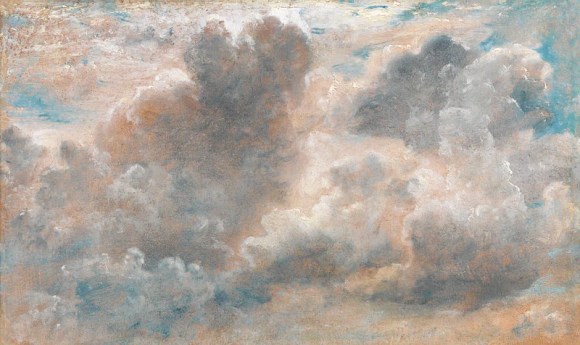
I am often in the clouds with this mind thinking how long will it be when it rains again. I forget the exact date it did
rain. I know it was more than a month or maybe two months ago. I was looking at the sky
when the rain fell inside my eyes. I do not know what street I was at when the rain came down.
NAMING CLOUDS
I tried to name each cloud I saw throughout the day.
I called one dark angel which had a serpent’s tongue and a devil’s tail. Every time
I looked up was to name another cloud. Infierno
was the name I gave the hell cloud with its heart
on the outside. Hell I named it. Saintliness was far from
its design. Rimbaud I named another cloud just because.
I SAY ENOUGH
I say enough about the best and worst of times. It is nature and the cosmic voodoo of life that keeps this itch alive to let my anger, joy, and sadness out. What about love? I say a little about it some days too. I say enough of love when I am stuck in reflections of when I believed in such things. My cloudy mind is often lost in a shadow of doubt.
Born in Mexico, Luis Cuauhtémoc Berriozábal lives in California and works in the mental health field in Los Angeles. His poetry has appeared in Abramelin, Barbaric Yawp, Blue Collar Review, Borderless Journal, Fixator Press, Kendra Steiner Editions, Mad Swirl, The Literary Underground, and Unlikely Stories.
.
PLEASE NOTE: ARTICLES CAN ONLY BE REPRODUCED IN OTHER SITES WITH DUE ACKNOWLEDGEMENT TO BORDERLESS JOURNAL
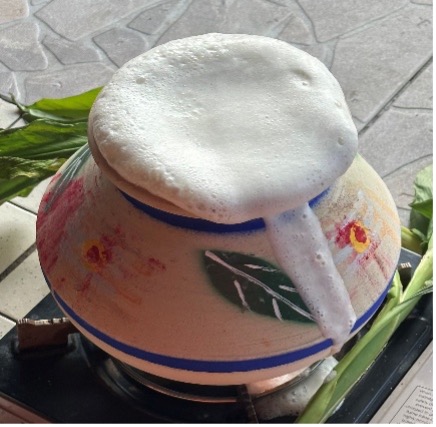
Pongal Pot. Photo Courtesy: Ravi Varmman K Kanniappan
On the 15th of January 2026, while much of the modern world was busy checking notifications, updating calendars, and worrying about quarterly outcomes, traditional Tamil households across the globe were doing something far more radical, watching milk boil. “Pongal”, the harvest festival, is one of those ancient cultural practices that stubbornly refuses to modernise. It does not arrive as an app update, cannot be streamed, and has no subscription model.
Milk is poured into a pot, heated patiently, and allowed, indeed encouraged, to overflow. This overflow is not considered inefficiency or waste, but it is the very point. It signifies abundance, wellbeing, and prosperity not merely for humans but for the entire ecosystem that made the meal possible, the sun, the rain, the soil, the cow, and the quiet, unseen labour of nature itself. Rice, lentils, jaggery, nuts, legumes, and raisins follow, and the resulting sweet dish is shared freely among family and friends, because prosperity that is not shared is considered incomplete.
This is an economy based not on accumulation but on circulation, not on profit but on participation. Something I believe is deeply unsettling to modern sensibilities.
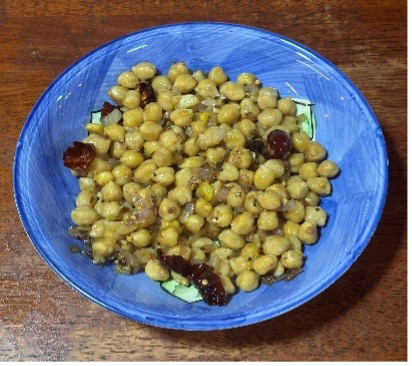
Into this defiantly non-consumerist ritual wandered a chickpea with an extraordinarily well travelled past. This was no humble backyard legume, nor had it been picked up at the nearest market. It had sprouted in Mexico, been packed in Lebanon, purchased in Sierra Leone, and generously gifted by my wife Greeja’s friend, Saras, and her husband Pieter, a Belgian whose kindness, like the chickpea itself, clearly knows no borders. The chickpea’s journey to Malaysia, where, after crossing more continents than most humans manage in a lifetime, it finally fulfilled its destiny, being cooked into a traditional Tamil Pongal.
By then this chickpea had crossed more borders than most people ever will, navigated more currencies than a multinational executive, and yet arrived without a single stamp of self-importance. If globalization were ever to seek a spokesperson, it would do well to choose this chickpea, which achieved in silence what conferences and treaties have struggled to explain. The chickpea does not attend Davos, does not publish white papers, does not tweet about resilience or sustainability, and yet it embodies globalisation with a calm confidence that makes economists look unnecessarily stressed.
We often speak of globalisation as though it were invented sometime in the late twentieth century by economists with impressive haircuts and Power Point skills. But the chickpea, unimpressed by timelines, has been global for at least nine thousand years. Its origins lie in the “Fertile Crescent”, that much abused cradle of early civilisations covering modern day Turkey and Syria, where early cultivation was recorded between 7500 and 6800 BCE. The wild ancestor, “cicer reticulatum”, still grows in southeastern Turkey, quietly ignoring the fact that humans have spent millennia fighting over the land around it. From this region, chickpeas spread naturally to the Middle East, the Mediterranean basin, and India by around 3000 to 2000 BCE, becoming a staple across cultures, religions, and cuisines. This was globalisation without shipping containers, trade sanctions, or consultants, just humans carrying seeds because hunger is wonderfully non-ideological.
India, once it encountered the chickpea, embraced it with characteristic enthusiasm and then proceeded to dominate its production. Today, India accounts for more than 70 percent of global chickpea output, a statistic that has made the chickpea an unlikely participant in modern trade wars. Protectionist policies, tariffs, reciprocal duties, and import bans imposed by major players such as India, the United States, and Mexico have transformed this humble legume into a politically sensitive commodity. It turns out that even the simplest food becomes controversial once spreadsheets get involved.
Thiruvalluvar (an ancient philosopher), writing two thousand years ago, anticipated this uncomfortable truth with brutal clarity:
“Only those who live by agriculture truly live; all others merely follow and feed upon them.” - Kural 1033
The verse throws stylish shade at modern life, while we sip lattes under perfect air conditioning and call it “work”, farmers are out there negotiating with the sun, rain, and stubborn soil to keep humanity fed. Our sleek jobs, fancy titles, and glowing screens? Well, they are merely luxury addons. Strip away agriculture and civilisation collapses into a very well-dressed famine. Turns out, all our progress still runs on dirt, with attitude.
The chickpea’s journey to South America, especially Mexico, is a reminder that globalisation has often travelled under less noble banners. Portuguese and Spanish explorers introduced chickpeas to the New World in the sixteenth century, carrying them across oceans as reliable, non-perishable protein sources. From these initial points of contact, chickpeas spread across Central and South America, embedding themselves into local agriculture and diets. In modern times, Mexico has emerged as a significant exporter, specialising in the Kabuli variety prized for its size and quality, with major production zones in Sonora and Sinaloa. Argentina and Chile also joined the club. Thus, a crop born in ancient Anatolia, nurtured in India, and sanctified by ritual, found itself repackaged for global markets, complete with branding, logistics, and regulatory oversight. The chickpea, once again, remained silent.
Silence, however, does not mean insignificance. Homer knew this. In TheIliad (Book 13) he famously compares arrows ricocheting off Menelaus’s armour to chickpeas and dark-fleshed beans flying off a threshing floor in the wind. The metaphor works only because the audience knew exactly how dried chickpeas behave, hard, resilient, and oddly bouncy. By likening lethal weapons to pulses, Homer not only emphasises the strength of the armour but also performs a subtle act of cultural grounding. The epic world of gods and heroes is momentarily tethered to the everyday agricultural reality of farmers winnowing grain. War, Homer seems to say, may be glorious, but it is ultimately sustained by food. Chickpeas, by 800 BCE, were so deeply embedded in Greek life that their sound and movement were universally recognisable. Even epic poetry depended on legumes.
Indian tradition offers an equally revealing, if more logistical, narrative. In South Indian tale associated with the Mahabharata, an Udupi King is said to have managed catering for the massive armies at Kurukshetra. Legend holds that he could predict daily casualties by observing leftover food. In some versions, the king visits Krishna at night, who eats a handful of roasted chickpeas, the number consumed corresponding mysteriously to the thousands who would fall the next day. This allowed precise meal planning and zero waste on an industrial scale of destruction. These divine data analytics allowed the king to cook exactly the right amount of food, avoiding waste on a genocidal scale. It is perhaps the earliest example of just-in-time inventory management, achieved without software, powered entirely by chickpeas and divine omniscience.
If you have ever wondered why Udupi cuisine is famous for efficiency and planning, this story offers a clue. Here, chickpeas function not just as food but as instruments of cosmic accounting.
Interestingly, while early Vedic texts sometimes viewed certain pulses as unsuitable for sacrifice, the Mahabharata period saw chickpeas elevated into sraddha rites (funeral rituals) and daily offerings. They transitioned from questionable to sacred, a promotion many humans would envy.
Thiruvalluvar’s ethical framework accommodates this evolution effortlessly:
“Sharing food and caring for all life is the highest of virtues.”-- Kural 322
A noble idea, until chickpeas quietly steal the spotlight. Modest, beige, and absurdly cooperative, they divide endlessly without complaint and nourish everyone from monks to gym bros. While humans argue ethics in panels and podcasts, chickpeas get on with the job, feeding the masses without ego. In the moral economy of virtue, they don’t preach but they simply multiply and sustain, humbling us one hummus bowl at a time.
Across civilisations, chickpeas became the dependable fuel of endurance. Roman soldiers consumed them as part of their standard rations, boiling them into thick porridge known as “puls” when meat was scarce. Gladiators relied on pulses for strength, earning nicknames that emphasised grain and legume consumption rather than heroism. Spanish and Portuguese sailors trusted chickpeas on long sea voyages because they did not rot, sulk, or demand refrigeration. During World War II, Allied researchers turned again to pulses to address vitamin deficiencies among troops, while the modern Indian Army continues to include chickpea flour and whole chickpeas in field rations due to their high caloric density and reliability. Empires rise and fall, but soldiers keep eating chickpeas.
Modern science, arriving fashionably late as usual, now confirms what ancient armies, monks, and farmers already knew. Chickpeas are celebrated as “brain food,” dense with nutrients that support cognitive function, mood regulation, and neurological health. Nutritional psychiatry highlights their role in reducing inflammation and stabilising the gut brain axis, making them valuable in alleviating anxiety and depression. Unlike the sugar-fuelled spikes and crashes of contemporary diets, chickpeas offer slow-release energy, the kind required for sustained thought, emotional regulation, empathy, and decision making. In a world addicted to instant gratification, caffeine dependence, and burnout worn as a badge of honour, the chickpea is almost offensively patient. That patience makes it profoundly incompatible with modern lifestyles, and incompatibility, in our times, is the surest mark of subversion.
If this sounds like ancient wisdom romanticised through hindsight, it is worth noting that modern civilisation has recently spent billions of dollars rediscovering precisely the same conclusion, often during lunch breaks. Sometime in the post-Covid era, somewhere between a glass walled co-working space and an overbranded café serving ethically sourced air, a young startup founder sat staring at his laptop, attempting to optimise a problem modern life seems uniquely skilled at inventing, how to eat “mindfully” without actually having time to eat. His company was building an AI-driven wellness platform designed to “personalise nutrition using real time biometric feedback.” Investors liked it. The pitch deck had the correct fonts. The valuation was impressive for something that had not yet solved hunger, distraction, or exhaustion.
Lunch arrived in recyclable packaging engineered to survive a nuclear winter. Inside was a bowl labelled Ancient Protein Medley. It contained quinoa flown in from the Andes, kale grown in a vertical farm two kilometres away, avocado sourced from somewhere geopolitically awkward, and, almost as an afterthought, roasted chickpeas. The chickpeas were rebranded as “plant-based protein spheres,” presumably because “chickpea” did not sound sufficiently disruptive, scalable, or fundable.
As the founder ate mechanically between Slack notifications, his smartwatch vibrated with updates. Blood sugar stable. Cortisol marginally elevated. Cognitive focus acceptable. The AI recommended breathing exercises and fewer screens. The founder ignored both and continued eating. The irony was complete. A system powered by cloud computing, global capital, and predictive algorithms had concluded, after millions in funding, that roasted chickpeas were ideal for sustained energy and mental clarity.
This was not new knowledge. Roman soldiers had marched on it. Tamil farmers had lived on it. Sailors had crossed oceans with it. But now it had a dashboard, a graph, and a subscription model.
Later that evening, the same founder attended a panel discussion on sustainability. Someone in the audience asked about regenerative agriculture. The panellists responded confidently, invoking carbon credits, blockchain traceability, lab-grown proteins, and the future of food. No one mentioned legumes fixing nitrogen. No one mentioned soil. No one mentioned that the chickpeas quietly sitting in the founder’s lunch bowl had already done more for planetary health than the entire panel combined. The chickpeas, true to form, offered no comment, no keynote, and no thought leadership, only nourishment.
The chickpea’s journey eastward is no less intriguing. It reached China via the Silk Road, settling primarily in Xinjiang, where evidence of cultivation dates back around two thousand years. There, it became part of Uighur medicinal traditions, prescribed for ailments ranging from hypertension to itchy skin. During the Tang and Yuan dynasties, chickpeas gained prominence as a “cosmopolitan” food, sometimes referred to as the “Muslim bean”. Yet in central China, the chickpea struggled for a distinct identity, often conflated with the common pea even by Li Shizhen[1], the famed Ming dynasty herbalist. Not all travellers are recognised for who they are, some spend centuries being mistaken for someone else.
And yet, through all this travel, confusion, commodification, and conflict, the chickpea remained quietly regenerative. Unlike extractive crops, it forms a symbiotic relationship with Rhizobium bacteria in its roots, fixing nitrogen from the air and enriching the soil. It takes and gives simultaneously, leaving the land better than it found it. This is perhaps the most radical aspect of the chickpea’s philosophy, one that stands in stark contrast to modern economic models based on extraction and exhaustion.
Thiruvalluvar warns us gently but firmly:
“Harm done to others inevitably returns to oneself.” – Kural 319
A warning humans hear, nod at, and immediately ignore. The chickpea takes a cooler approach. It survives by being outrageously generous, throwing itself into curries, salads, and hummus without a trace of resentment. No revenge arc, no ego. Just pure edible goodwill. While we stress over karma and consequences, the chickpea lives its truth, give everything away, become indispensable, and achieve immortality in every lunch bowl.
Humanity today resembles the ancient chickpea, hard, resilient, perpetually defensive. We pride ourselves on toughness, bouncing off crises with admirable persistence, yet rarely ask what we leave behind. Climate change, trade wars, and political upheavals are the shrill winds of Homer’s winnowing floor, tossing us about. The question is not whether we survive the tossing, but whether we enrich the soil when we land. Progress, the chickpea suggests, is not about becoming larger, louder, or more profitable. It is about being regenerative, ordinary, and useful.
In an age obsessed with luxury, consumption, and curated lifestyles, the chickpea offers a quietly subversive model. It is not elite food, but it is the food of soldiers, monks, labourers, and families. It does not advertise, rebrand, or reinvent itself. It simply nourishes.
Thiruvalluvar captures this understated wisdom perfectly:
“From seeds come harvests, and from giving comes abundance.” -- Kural 1030
A line politicians quote solemnly before approving tax breaks for themselves. The chickpea, deeply unimpressed, just does the math. One seed becomes many, then redistributes itself aggressively into every cuisine on earth. No gatekeeping, no merit tests, no ‘personal responsibility’ lecture. While humans weaponise scarcity and call it policy, the chickpea runs a ruthless experiment in abundance and wins, by being cheap, shared, and impossible to cancel. The chickpea has lived this truth for millennia.
So perhaps the real lesson of globalisation does not lie in trade agreements or consumer choices but in a small legume that has travelled from ancient Turkey to modern Mexico, survived Roman marches and mythic wars, endured misnaming and trade barriers, and still ends up quietly nourishing someone’s meal.
Even now, after dashboards have glowed, algorithms have pontificated, and every opinion has been optimised into a performance, the answer remains stubbornly ancient, from Roman roads to Tamil fields. The chickpea does not care about your ideology, your portfolio, or your meticulously curated identity. It will grow, fix nitrogen, feed someone, and move on without a press release.
In a world addicted to spectacle, branding, and moral pontification, this calm, beige indifference feels almost obscene. Quiet competence and unfashionable, the chick pea, turns out to be the rarest, and most outrageously extravagant, luxury left.
The travelled chickpea. Photo Courtesy: Ravi Varmman K Kanniappan
[1] Li Shizen(1518-1593), Ming acupuncturist, herbalist, naturalist, pharmacologist, physician.
Ravi Varmman explores leadership, culture, and self-inquiry through a philosophical lens, weaving management insight with human experience to illuminate resilience, ethical living, and reflective growth in an ever shifting world today.
PLEASE NOTE: ARTICLES CAN ONLY BE REPRODUCED IN OTHER SITES WITH DUE ACKNOWLEDGEMENT TO BORDERLESS JOURNAL
Bibliography
Pongal festival, milk boiling ritual, symbolism of abundance and ecology
Ramaswamy, N. (2004). Festivals of Tamil Nadu. New Delhi: Sterling Publishers.
Origins of chickpea domestication in the Fertile Crescent; dates (7500–6800 BCE); wild ancestor Cicer reticulatum
Zohary, D., Hopf, M., & Weiss, E. (2012). Domestication of Plants in the Old World (4th ed.). Oxford: Oxford University Press.
Spread of chickpeas to India by 3000–2000 BCE
Fuller, D. Q. (2006). Agricultural origins and frontiers in South Asia. Journal of World Prehistory, 20(1), 1–86.
India producing ~70% of global chickpeas; modern trade disputes
FAO. (2023). FAOSTAT Statistical Database: Pulses Production and Trade. Rome: Food and Agriculture Organization of the United Nations.
Thiruvalluvar quotations, dating (~2nd century BCE–2nd century CE), agrarian ethics
Pope, G. U. (1886). The Tirukkural. London: Oxford University Press.
Introduction of chickpeas to the Americas by Spanish and Portuguese explorers
Smith, B. D. (2011). General patterns of niche construction and the management of ‘wild’ plant and animal resources. Philosophical Transactions of the Royal Society B, 366(1566), 836–848.
Modern chickpea cultivation in Mexico (Sonora, Sinaloa), Kabuli variety exports
Gaur, P. M., et al. (2012). Chickpea breeding and production. Plant Breeding Reviews, 36, 1–87.
Homer’s Iliad Book 13 chickpea/threshing-floor simile
Homer. (c. 8th century BCE). The Iliad, Book XIII. Trans. E. V. Rieu. London: Penguin Classics.
Udupi King / Mahabharata legends involving chickpeas and casualty prediction
Hiltebeitel, A. (2001). Rethinking the Mahābhārata: A Reader’s Guide to the Education of the Dharma King. Chicago: University of Chicago Press.
Chickpeas in sraddha rites and post-Vedic ritual elevation
Olivelle, P. (1993). The Āśrama System: The History and Hermeneutics of a Religious Institution. Oxford: Oxford University Press.
Roman soldiers, gladiators, and chickpea-based diets (“puls”)
Garnsey, P. (1999). Food and Society in Classical Antiquity. Cambridge: Cambridge University Press.
Chickpeas in maritime rations and early modern naval diets
Braudel, F. (1981). The Structures of Everyday Life: Civilization and Capitalism, Vol. 1. New York: Harper & Row.
Use of pulses in World War II nutrition and modern military rations
Nestle, M. (2002). Food Politics: How the Food Industry Influences Nutrition and Health. Berkeley: University of California Press.
Nutritional psychiatry: chickpeas, gut–brain axis, slow-release energy
Jacka, F. N. et al. (2017). Nutritional psychiatry: The present state of the evidence. The Lancet Psychiatry, 4(3), 271–282.
Modern “wellness tech,” quantified nutrition, and startup food culture
Lupton, D. (2016). The Quantified Self. Cambridge: Polity Press.
Nitrogen fixation via Rhizobium in chickpeas; regenerative agriculture
Peoples, M. B., et al. (2009). The contributions of legumes to reducing the environmental risk of agricultural production. Agriculture, Ecosystems & Environment, 133(3–4), 223–234.
Chickpeas in China via Silk Road; Xinjiang cultivation; “Muslim bean”
Hansen, V. (2012). The Silk Road: A New History. Oxford: Oxford University Press.
Li Shizhen and historical misclassification of chickpeas
Unschuld, P. U. (1986). Medicine in China: A History of Ideas. Berkeley: University of California Press.
Time has erased the road where I walked as a child. The last time I walked through here there were trees and grass.
Time has eroded everything. There is no shade, no flowers blooming, and no fruit on the vines. It is all rubble.
How sad it makes feel to see this road go away like if it never existed. I have only returned to say goodbye.
THE END OF SILENCE
I am almost at the end of silence. I am way past the end of love. Everything is almost over.
Where could I go now? And does it really matter? I feel the wind in my eyes. In a matter of time, I will be blind.
Summer is long gone. The glass is neither half empty nor half full. The leaves that fall at my feet will be followed by their mother trees.
I will spread out like a tortilla The sea will carry my remains away toward sunset like my will says. The sky will fill with clouds and birds will sing my goodbye song.
My time will soon run out. I could still hold out for a moment. I am as impassive as solitude. My eyes are fixed upon the sun.
Lay my soul to rest. Let me pass like all things.
THE FOG BELOW MY FEET
The ceiling has dropped. There is fog below my feet. The ceiling has dropped. I can barely see the street.
I can imagine this a meeting of ghosts gathering all around us. It must be their mouths blowing smoke out of a ghost cigarette.
I grounded my car. I left the keys on the nail. I grounded my car. If I drive, I am sure to fail.
I can imagine I am walking on clouds rising from the ground. It is nature, the fog-maker, reminding us to look out and slow down.
Art by John Constable ( 1776-1837). From Public Domain
Born in Mexico, Luis Cuauhtémoc Berriozábal lives in California and works in the mental health field in Los Angeles. His poetry has appeared in Abramelin, Barbaric Yawp, Blue Collar Review, Borderless Journal, Fixator Press, Kendra Steiner Editions, Mad Swirl, The Literary Undeground, and Unlikely Stories.
.
PLEASE NOTE: ARTICLES CAN ONLY BE REPRODUCED IN OTHER SITES WITH DUE ACKNOWLEDGEMENT TO BORDERLESS JOURNAL
What if I crossed the border after 50 springs, summers, falls, and winters? After all the learning, the forgetting, the labour, and lost loves, after all the growing pains, the births, deaths, and family joys and tragedies? What if I returned to the land of my youth, a much older man than the seven-year-old, wide-eyed boy? I will offer the best of me. Who will offer me the best of them? I will have to find a place to call home, a seat at a table where I will have my meals, a place where I could have a conversation with someone other than myself, a room where I could read and write, and most of all sleep. Who will break bread with me, help me decorate the house with books and flowers, with paintings and plants, and share stories, laughter, and wine from time to time? As I write these words, other words are being twisted, designed to make people like me to return to the place of our birth, if we are fortunate enough.
BUCKETFUL OF RAIN
If it is goodbye, I could use a bucketful of rain to drench this fire. Reduce it to smoke before this heart becomes ash.
Even the light trembles and the sun is blushing seeing this conflagration. I should have seen the signs but I hope too much.
Play that violin soft and slow. Speed up the pace as the fire spreads out of control. I can take the heat just a little bit longer.
LIMITS
I climb the branch to the flower; the spider-from-mars’ web-to-the-stars; I flow and fly with the wind further still; through time and newborn worlds; I allow my thoughts to remain on earth; keep the sun and magnifying glass away from me; even an ant has its limits.
Luis Cuauhtémoc Berriozábal was born in Mexico, lives in California, and works in Los Angeles.He has been published in Blue Collar Review, Borderless Journal, Chiron Review, Kendra SteinerEditions, Mad Swirl, and Unlikely Stories. His most recent poems have appeared in Four FeathersPress.
.
PLEASE NOTE: ARTICLES CAN ONLY BE REPRODUCED IN OTHER SITES WITH DUE ACKNOWLEDGEMENT TO BORDERLESS JOURNAL
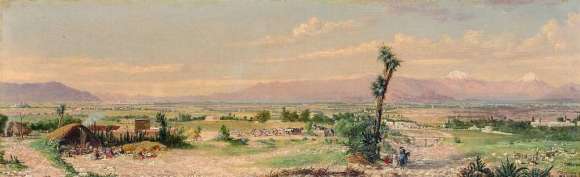
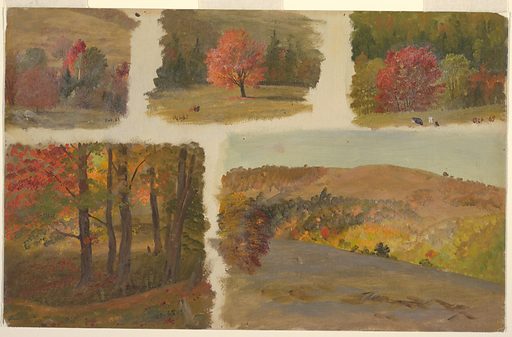
Art by Frederic Edwin Church(1826–1900). From Public Domian
I WANT SPRING

As autumn begins
I want spring.
I don’t want winter.
I don’t want summer.
I want spring.

I am straying from
the current
season. I want to
go away to spring.

Carry me off through
all the bers, September,
October, November,
and December.

Take me away from
the rys, January and
February. I do not
need to make any
resolutions on the
year’s first day. I do not
need Valentine’s Day.

I want spring.
I want spring
all in bloom.


WHEN AUTUMN COMES

My hands are full
living in solitude.
I love a little less
when I feel destroyed.

I feel anti-social
when autumn comes.
This is just a phase
I have stretched out.

I inaugurated sadness.
I curse the owl
that predicts my fate.
It does not like me.

I will love again.
I feel it in my skin.
I know it sounds absurd.
But I will love again.


IN THE SHADOW OF NIGHT

Stumbling in the shadow of night
where the scarcity of light bleeds
over what could not be seen. It
could be a monster or fiend or friend.

It is easy for me to pretend what
is not there. I don’t really know if
anyone is asking. What if it was me
who is slower than most? I am not

some great thief who comes out
at night. I am not brave enough to
fight the monster or the fiend. I
could face my friend with a smile.
Luis Cuauhtémoc Berriozábal was born in Mexico, lives in California, and works in Los Angeles.He has been published in Blue Collar Review, Borderless Journal, Chiron Review, Kendra SteinerEditions, Mad Swirl, and Unlikely Stories. His most recent poems have appeared in Four FeathersPress.
.
PLEASE NOTE: ARTICLES CAN ONLY BE REPRODUCED IN OTHER SITES WITH DUE ACKNOWLEDGEMENT TO BORDERLESS JOURNAL
Mountains are baked into the earth, caked with mud, green grass, rocks and dirt.
Somewhere between trees and brushes, howling wolves belt out nature’s blues.
Blades of grass, smooth, and rough pebbles, lead to the edge of the mountain’s
peak. In the fog, in the pines, a lone wolf keeps to itself as birds
sing all day long, far from the towns, cities, in the baked mountainside.
FINEST PAINTBRUSH
Unfold your finest paintbrush to night’s blackboard, with gentle strokes fill the darkness with starlit skies. In the morning clean your paintbrush, dip it in orange, red, and yellow colors to paint the blue skies for the amusement of lovers and friends, even strangers.
Do not languish in apathy. Bring that paintbrush around and cover every square inch of the canvas that surrounds us. Unleash your Leonardo, your Michaelangelo, and your Vincent. Splash the skies like Jackson, spread out like Diego and Frida. Make the roses blush and open.
PULL THE BLINDS
Pull the blinds, outside our illusions live as birds, their monotonous song
fill the skies. I love them. They are fragile. With their wings they are safe.
I pull the blinds. It is like taking masks off. For days I close the blinds. For days I leave them open. For all I know, I just pretend
there are no blinds. I do not care about what happens outside in the light or darkness.
I pull the blinds for the last time.
Born in Mexico, Luis Cuauhtémoc Berriozábal lives in California and works in the mental health field in Los Angeles. His poetry has been featured in Blue Collar Review, Borderless Journal, Mad Swirl, Rusty Truck, and Unlikely Stories.
.
PLEASE NOTE: ARTICLES CAN ONLY BE REPRODUCED IN OTHER SITES WITH DUE ACKNOWLEDGEMENT TO BORDERLESS JOURNAL
I am not young anymore. In the evening, I stay home. I have no bouquet of flowers to offer for any beautiful girl.
In the evening, I keep to myself. I buy no roses for anyone. I write no love poems. I do write a few for the birds.
I prefer a silent evening. I prefer sleeping a little too much. The birds sing me to sleep. Their song pushes through my window.
I am not young anymore. I pick at my scab I got from picking oranges, not from picking flowers for a beautiful girl. If you did not know, the orange tree has sharp thorns.
I LOVE YOU
There is one thing I will never say to you. And if I say it once, I will not say it again. I will not say the one word I want to say to you. There was a time I knew nothing. Even my eyes gave me away. I settle for what we have if it is just for a little while. Let’s face it, a little while might be all I have left. The hourglass has the sand near the bottom. It will not be long when I get too old or sick for you. I watch the sky from my window. It goes from light to grey to black. I am living this life one day at a time. What is lost I will never get back. There is one thing I want you to know. I will not say it to you today or tomorrow.
MY OWN BOOK
I brought my own book for a ride. I took it and stopped at 9th Street pretending it is where it wanted me to stop. I read a few poems to a man that was just got off the train. One line I read made him laugh. He asked me to stop before he threw up.
The man did not like my poetry. He told me not to quit my day job. That thought never crossed my mind, and poetry was never a second job. I got back in my car and drove my own book home and put it away in the bookshelf for the night to sleep.
Born in Mexico, Luis Cuauhtémoc Berriozábal lives in California and works in the mental health field in Los Angeles. His poetry has been featured in Blue Collar Review, Borderless Journal, Mad Swirl, Rusty Truck, and Unlikely Stories.
.
PLEASE NOTE: ARTICLES CAN ONLY BE REPRODUCED IN OTHER SITES WITH DUE ACKNOWLEDGEMENT TO BORDERLESS JOURNAL
Let’s sing on the blank sheet for an hour, half an hour, or for a few chaotic minutes. Let’s sing of days and nights, of good and bad times with words, with a sentence or two. Let’s bring dancers around who can dance as we sing. Let’s sing of happiness and misfortune. Let’s sing for the birth of water and fire. Who wants to join me in song? Let’s sing of all things real and surreal. Let’s sing about you and me if there is any space left on the blank sheet.
WHEN I SAY NOTHING
When I say nothing that says plenty. I pay attention. I listen. I let you talk till the fly on the wall cannot live another day, till the cricket is the next to talk from a crack in the door. I keep my lips rested for your kiss. I am not going to stay silent for much longer. As sure as my breath can no longer keep its secret, my heart, my mouth, is yours.
Luis Cuauhtémoc Berriozáballives in California, works in Los Angeles, and was born in Mexico. His poetry andillustrations have appeared in Black Petals, Borderless Journal, Blue Collar Review, KendraSteiner Editions, and Unlikely Stores. His latest poetry book, Make the Water Laugh, waspublished by Rogue Wolf Press.
.
PLEASE NOTE: ARTICLES CAN ONLY BE REPRODUCED IN OTHER SITES WITH DUE ACKNOWLEDGEMENT TO BORDERLESS JOURNAL
I am an early riser. This morning I could not get up. I was in an ocean dream. The fish talked to me. I was delighted to hear them speak. I thought the ocean dream was real. The alarm clock must have been in the ocean dream as well.
KNOWING NOTHING
Here I contemplate knowing nothing. There is my plan laid out. It is a dismal
plan. Out in the town I paint on walls, wooden and brick ones, and metal doors. Humming a song, I paint question marks and rain drops. It’s nothing artistic like a flower in a vase, a yellow rose shining.
FATIGUED
Fatigued, I dream so deep, I become ashes in an urn.
I am below the earth, above the clouds.
In a dream, a woman sleeps with me and next to me. A river flows outside our window.
Birds sing baleful songs.
I feel my broken teeth with my tongue -- there is no fixing them or anything else.
Luis Cuauhtémoc Berriozábal lives in California, works in Los Angeles, and was born in Mexico. His poetry and illustrations have appeared in Black Petals, Borderless Journal, Blue Collar Review, KendraSteiner Editions, and Unlikely Stores. His latest poetry book, Make the Water Laugh, was published by Rogue Wolf Press.
PLEASE NOTE: ARTICLES CAN ONLY BE REPRODUCED IN OTHER SITES WITH DUE ACKNOWLEDGEMENT TO BORDERLESS JOURNAL
A brief introduction to Rhys Hughes’ Sunset Suite, published by Gibbon Moon Books this year, and a discussion with the author on this ‘Weird Western’ and more…
Rhys Hughes
Perhaps — that’s the wrong way to start a review or any article— but given that this is a book that offers immeasurable possibilities, like sunsets or stars, one could still start with a ‘perhaps’… You might start with another word of course!
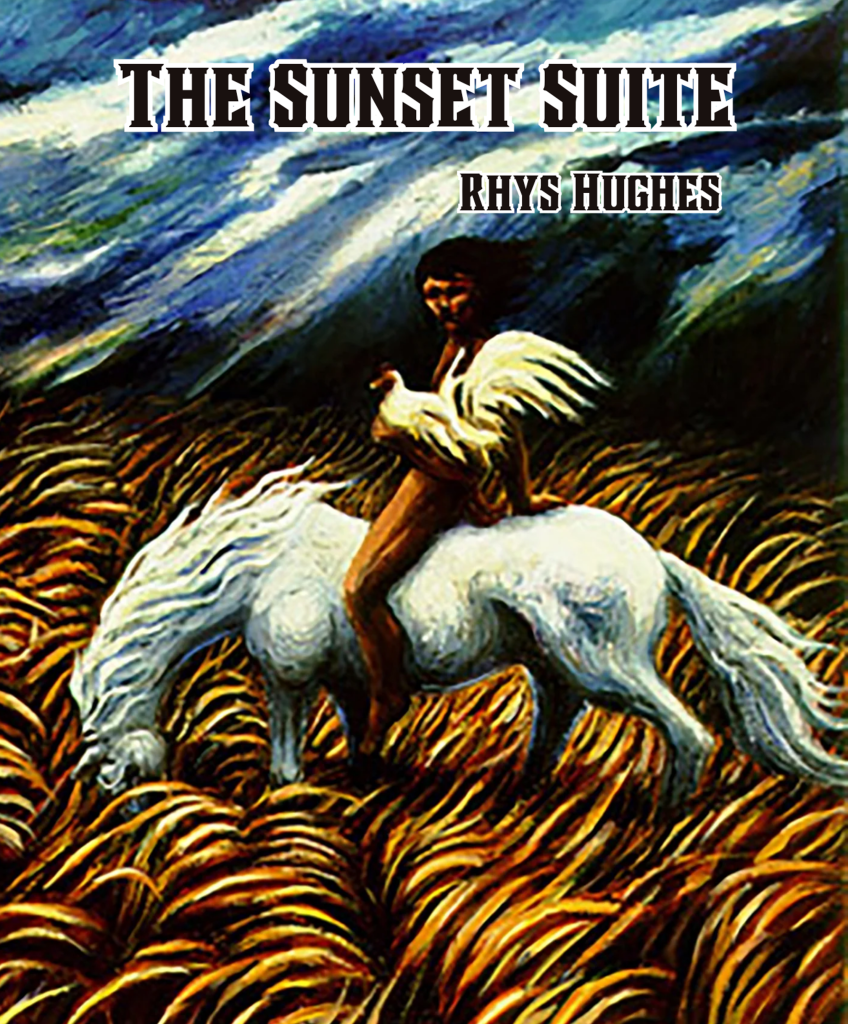
Perhaps, Rhys Hughes’ TheSunset Suite is a novel? Or, is it not? It seems to be a group of short, tall tales tied neatly into coffee lore, coming closest structurally to The Arabian Nights — stories told by the Scheherazade, originating around Middle Ages, much after coffee was discovered in Ethiopia by a goatherd in 800 CE. The book departs in various shades from the One Thousand and One Nights, even though magic creeps in every now and then.
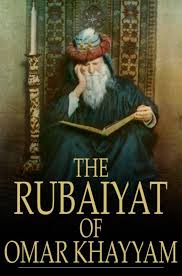
Hughes also seems to have a fascination for coffee lores for he redid TheRubaiyatof Omar Khayyam (1048-1131), translated from Persian by Edward Fitzgerald, substituting the wine with coffee a year ago. And here you have two men in the Wild West, telling tall tales, inspired by 26 mugs of coffee.
In The Empire Podcast by William Dalrymple and Anita Anand, there are a couple of episodes on coffee. Coffee houses sprouted around the fifteenth century in the Middle East and flourished during the Ottoman Empire, spreading over time to Europe, and even to America… if we are to believe Hughes! In those times, soldiers, among others, gathered in coffee houses, much to the dismay of kings. The warriors started turning to tall tales, philosophy and gossip instead of training all the time. The rulers were unhappy at the turn of events. Germany went so far as to ban coffee. An article on food history tells us: “One of the most curious of these events happened in Prussia, a precursor to modern-day Germany, where it’s leader Frederick the Great banned coffee by decree in 1777. And he did it for a reason that is almost baffling to modern notions of health and what’s good for society: He wanted people to drink more beer.” In the podcast, they do tell us Germany produced beer. In those days, coffee was seen as a suspicious drink, an aphrodisiac with magical qualities. It is these magical qualities that are invoked in TheSunset Suite.
Brand and Thorn are two coffee drinkers under the stars, sitting over a bubbling pot — and each cup from the pot has a tale in it, professes the author. That the tales are part of a dreamscape of darker hues verging on the absurd, bringing out the strangeness of the illusion we call life and its endless possibilities, comes as a surprise.
People turn into corn cobs, biscuits, musical notes, sombreros and are resurrected in paintings of nightmares at the end, tying the characters loosely into a frame. Phoenixes swim underwater and horses turn into boats and ‘a hill of beans’ becomes a ‘mountain of beans’. The transformations seem to be reminiscent of Kafka’s Metamorphosis (1915) or Pinter’s The Room (1957) … but we are left wondering, are they?
The settings are often realistic at the start but head for the absurd as they end. Each story has a punch and leaves the reader open mouthed in amazement. They are imaginative, clever — sometimes playing on words — like the story of a genie who was told by a robber to make money ‘no object’ — a turn of a phrase which should mean that money is so plentiful that anything is affordable. But the genie, trapped in time and traveling over centuries, misunderstands the grave robber. He makes money into a literal ‘no object’— ‘abstractions, vague colours, mental scents and other intangible things’.
Hughes expands the literary world to a frog, a dog and even an armadillo who are yet to publish their books. This seems almost like an inversion of Luigi Pirandello’s play Six Characters in Search of an author (1921), where the characters left incomplete by a deceased author are looking for a resolution. Hughes’ reader, who talks of these authors from the animal kingdom, waits patiently for the books to turn up. In another story, evocative of the same play by Pirandello, the characters from his earlier tales are trapped in a painting and talk to the artist, ‘the keeper of Lore’, who paints his own nightmares peopled by the creations of Hughes. One of the last narratives, this one ties the stories into a loosely structured unit.
“I am Grampsylvania. That wasn’t my original name, but it’s my name for the foreseeable future. He changed me, you see, from a man into a gigantic but sapient corncob pipe. I don’t mind.”

“And he changed me into a biscuit,” said another voice. “I was just George Lewis once but now I’m The Biscuit Kid.”

A third voice added, “Turned me into a hat, a sombrero. I was Max Grizzly originally. Not that I dislike being a hat.”

“Wonder what he’ll turn you into?” they said to Henry [the artist inside the painting].

“I don’t want to change.”

“Well, you don’t have a say in the matter.”
The idea of the writer as the ultimate creator stretches through tall tales to experimental forms. ‘The Biscuit Kid’ is a one-and-a-half-page story written in one sentence — is it an attempt at what is known as the stream of consciousness technique (as in James Joyce’s Ulysees, 1918) or just a quirky experiment? A strange tale about a man turning into a biscuit in a sulphurous pond with tea dunked into it with an allusion to the Boston Tea Party has the victim floating in infinite circles … is it a comment on history repeating itself? The narrative of ‘Reintarnation Smith’ maps the history of the world rather randomly through the many reincarnations of the protagonist, from a palaeolithic shaman (were there shamans in that time frame?) to a Napoleonic soldier and a First World War trooper to an intelligent tree in a world where humanity has become extinct! The alternatives offered and suggested are mind boggling…
Each story sees itself as a possibility expressed in a light gripping vein, characteristic of the author, who has ostensibly been seen as a cult writer… though I am not sure what that term means or how Hughes, who has authored more than fifty books and writes up storms of stories and poems, feels about it — Let’s ask him. We start with the most pressing question —
This is on something that has me perplexed after reading Sunset Suite. How do you think a frog, a dog or an armadillo would hold a pen? Can we read frog/ dog/ armadillo — or would one need to download a special app from Google to read their books? Or is it better to have a frogman/ dogman/ armadilloman translate these? Please enlighten us.
Armadillo: Image from Public Domain
I hadn’t really thought about it until you asked the question. They would have to use telekinesis to hold a pen. The power of their minds. Maybe they have bigger minds than we think. Having said that, I don’t know why we always assume that if you have a bigger mind, you will be able to move physical objects just by thinking. When I was young, I often tested my own telekinetic powers. They never worked, of course. Except for once, when I made a cardboard box cover a daisy during a storm. I was staring out the window and willing the box to fall on the daisy and protect it from the wind, and that is what actually happened! All of a sudden, the box rose in the air and came down over the flower. Certainly it was the wind that did the trick, rather than my mental powers, but at the time I wondered if perhaps I had found the secret of telekinesis. Frogs, dogs and armadillos would write books using telekinesis. The real question is how much we would understand of what they had written. I don’t suppose we have much in common with frogs or armadillos. The dog’s books might be more accessible. I guess most of the descriptive writing in a dog’s novel would be smell-based because that’s how dogs map the world. But while reading a dog’s novel, should we dog-ear the pages to keep our places? Or human-ear them?
That’s an astute observation… Maybe we can dino-ear them! Did all dinosaurs have ears…? Let’s leave that discussion for another time. Next, I need to know what is a cult writer? Are you one? Please explain.
I don’t really know, to be honest, and I’m not sure if I am one or not. Many years ago, I was told that I was one. I think it’s another way of saying, “Your books aren’t very popular,” but softening that blow by implying that, “At least some people read and enjoy them.” I embraced the definition for want of any better label. We do like labels, that’s the problem. When I write, I write just for myself. Not quite. I do try to write in a similar mode to the writers I most enjoy, and they have audiences. If they didn’t, I wouldn’t know about them. I adore the books of Italo Calvino [1923-1985], but I don’t know many other readers who read him. Does that make him a cult writer? I don’t think so. I think it’s just more likely that I am a little isolated and simply don’t know the readers who do read that kind of fiction. And yet I am in contact with some people on the internet who seem to share my taste in fiction. In fact, they give me recommendations of authors I’d never heard of, who turn out to be wonderfully in tune with my taste. Apparently, if you are a writer who is more loved by other writers than by readers who don’t write, you are a writer’s writer, and that’s a form of cult writer. Last year, I read the nine novels of the almost forgotten Henry Green [1905-1973], who was described as a writer’s writer’s writer, in other words a cult writer cubed. I suppose that to be a cult writer is simply a stage for some writers as they work their way up to greater popularity. It’s probably possible for writers who were once hugely popular but who are no longer appreciated by a sufficiently wide readership to turn into cult writers on the way down.
Why did you not write of a squonk in this book since it is your favourite fantasy animal? Will you be writing on a squonk soon?
A squonk: A mythical creature in American Folklore. Image from Public Domain.
There are no squonks in The Sunset Suite because I have written too much about them elsewhere. I don’t want to oversquonk myself. I first learned about squonks from Jorge Luis Borges’ Book of Imaginary Beings [1957] I think. And then I noticed references to the creature in all sorts of places. Years ago, I wrote a short story called ‘The Squonk Laughed’ because squonks are the saddest of all entities. I wanted to write about one that cheers up. And one of my longest ever poems is about a squonk ragtime pianist who works in a Wild West saloon, ‘Honky Tonk Squonk’. The very word is funny. It sounds round but also squelchy, rather like a cream-filled pastry. There is an excellent song by the band Genesis about squonks called simply ‘Squonk’ and it’s a song that will tell you absolutely everything you need to know about squonks if you listen carefully to the lyrics. In my book, it seemed to me that it was time to show some restraint when it came to squonks. You can have too much of a good, weepy thing.
How long did this book take to germinate into a full blown one and how did it come about?
Not long at all. Some of my projects proceed very slowly, they take years or even decades to be completed. But most of my projects are done fast. This is because if I take too much time over them, I worry that I will lose the thread or threads of the plot or plots, or that the mood and atmosphere of the work will change and be lost. That’s not always a disadvantage. I might begin work on a book thinking it is going in a certain direction. Then I put the project aside for a long time. When I return to it, I have often forgotten the direction I had intended to take the book. So I make it go in a different direction, and it seems to me that sometimes this other direction is a superior journey to the original intended direction. Who knows? But that has no relevance to The Sunset Suite because I wrote it in just a few weeks. I can’t recall exactly how long it took, but it wasn’t a drawn-out process. It happened to be one of those projects that flowed easily. Many do, and I am always grateful to them. It is almost as if I am not doing the work but simply acting as a channel for a set of stories that exist in some cosmic cloud. This is probably a fanciful delusion, but it is one that many writers have had over many centuries. We are conduits as well as creators. We are pipelines as well as pipers.
Have you actually been to the Wild West? Why have you set your book against this backdrop?
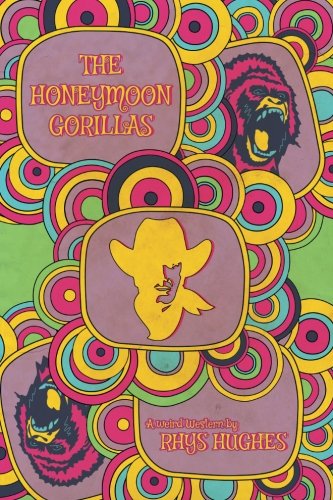
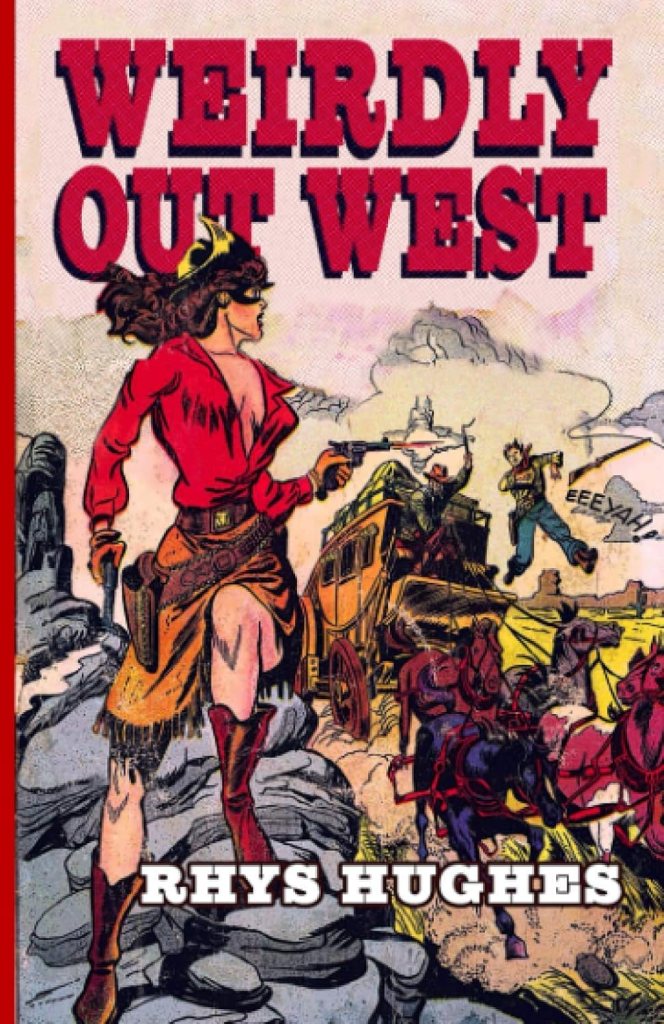
I have never been to the Wild West. I have never even been to the West. Even the most easterly part of the American continent is west to me. The furthest west I have been is Ireland. Yet I love Westerns, especially so-called ‘weird’ Westerns. Having said that, I have been to Almeria in Spain, the only desert in Europe, where many ‘Spaghetti Westerns’ were filmed. It looks the way I imagine Mexico or Arizona might look, but I can’t know that for sure because I haven’t been there. Maybe one day I will. I have written quite a few Westerns, all of them weird and unusual. The first was a novella called The Gargantuan Legion. I had the idea for that when I was very young. Much later I wrote a novel called The Honeymoon Gorillas [2018], and then a collection of stories, poems and short plays called Weirdly Out West [2021]. Shortly after finishing The Sunset Suite, I wrote a Western novel
called Growl at the Moon that has been accepted for publication. I am currently working on a novel titled The Boomerang Gang. I find writing weird Westerns to be great fun, relaxing too, yet they apply a strong stimulus to my imagination. Next year I hope to write a novel called Fists of Fleece, which will combine Welsh folklore with Wild West tall tales, creating an especially offbeat hybrid.
You have strange names given to characters peopling The Sunset Suite. Why? Please elaborate.
I enjoy giving my characters strange names. I also think it’s safer. Suppose I have a character in a story named Tim Jones and something absurdly odd happens to him. There might be a real Tim Jones out there in the world who will start thinking that I am referring to him and maybe even mocking him. It is better to give the character a name that surely no real person will ever have. Argosy Elbows, for example, or Crawly Custard. Readers can regard these as nicknames, if they wish. I often make lists of offbeat names for characters that I will use in future stories. Some of these names have been waiting decades to be used. Other names I invent on the spur of the moment while writing. Invention on the spur of the moment is an appropriate thing to do when writing a Western. But in fact the names in The Sunset Suite are still fairly conventional. Jake Bones, Shorty Potter, Killy the Bid, Grampsylvania, Max Grizzly, Cowboy Bunions, Dan Flyblown, Lanky Ranter. It’s not beyond the bounds of plausibility that real people out there do have such names.
Why do you keep obsessing over coffee? Please explain.
I hope it’s not quite an obsession. I like coffee, that’s all. I guess it’s my favourite drink. No offence to water, tea or beer! I am in the process of cutting down on my coffee consumption. I have been reducing my intake for the past twenty years, but it’s still not at zero. I am reducing it very slowly indeed, that’s why. Mind you, the reason why there is so much coffee in The Sunset Suite is simply because cowboy films always show the characters drinking coffee around a campfire. They surely told stories to each other at night while drinking the coffee. It occurred to me that I could use this as a frame for my book. A sequence of strange stories set in the Wild West linked together by the fact that each tale was generated by a cup of coffee. At the end of the book, the two tale tellers have drunk too much coffee. The book is a warning that will be heeded too late. But we are all adults. We don’t really need to be warned about such perils as coffee consumption.
Since classification is an important aspect of human existence, how would you classify your book?
It’s a ‘Weird Western’. That’s what I have been calling it. This is a real sub-genre, and I think my book can be labelled as such without any objections. I might also call it a comedy, a picaresque or portmanteau farce, a speculative whimsy. But it remains a Western, that’s undeniable. It makes substantial use of parody, pastiche, paradox and probably other things beginning with the letter ‘p’. At the same time, I don’t mind if the book is classified just as a fantasy or even only as fiction.
What have been the influences on this book? On your writing?
The main influences on this particular book of mine were other weird Westerns by writers I admire, in particular The Hawkline Monster [1974] by Richard Brautigan, which was marketed as a Gothic Western. Brautigan was especially good at writing short but thoughtful passages that are often at tangents to each other but nonetheless do combine with each other satisfyingly. Another influence was probably a collection of stories I read when I was young, The Illustrated Man [1951] by Ray Bradbury, in which a sleeping man’s tattoos come alive one at a time and tell stories as they do so. But in my book, it is the cups of coffee that come alive in a fictional sense. I also think that the pulp Western author Max Brand was an influence on my book, especially his stranger works, such as The Untamed [1918], which seem to blend echoes of ancient mythology with the more conventional cowboy motifs and clichés.
Would you call these stories humorous? They do linger with absurdity and a certain cheekiness.
I like to think they are humorous. I like to think that The Sunset Suite is a comedy among other things. Most of my fiction has some comedic elements, even if the general tone of the story is serious. Real life is a mishmash of tragedy, comedy, indifference, absurdity, beauty, and who knows what else, so it’s only right and proper for fiction to be such a mishmash too. Obviously, in a short story there’s not much room in which to throw everything, so one has to be more careful when it comes to constructing the piece. The mode of the book, which features a framing device in which is found a set of individual tales that echo each other’s themes, is one I especially enjoy using. I am planning other books that follow this structure.
What books are you whipping up now?
I always work on several projects at the same time. I am currently working on two novels. One of them is a satirical thriller called Average Assassins, and the other is another weird Western called The Boomerang Gang, which is about an Australian immigrant to the Wild West in the late 19th Century and it features an experimental aeroplane with boomerangs for wings. I am also working on a large project called Dabbler in Drabbles, which consists of four volumes of drabbles. A drabble, as I’m sure you know, is a flash fiction exactly 100 words in length. There will be one thousand drabbles in total when the project is finished. The first three volumes have already been published and I am pushing ahead with the fourth. Yet another project I’m working on is a collection of short meditations called City Life. These meditations are supposedly written by the cities themselves and there will be sixty of them in total. I am working on other projects too, but I won’t mention those yet.
Thank you Rhys for your fantastic writing and your time.
(This interview has been conducted through emails and the review written by Mitali Chakravarty.)






 Borderless