Categories
Essay

The Magic Dragon: Cycling for Peace

It’s been five years since the American cyclist ‘Hutch’ died, yet his message of peace remains, as Keith Lyons remembers the global citizen who challenges us all to live life to its fullest

In early 2019, having not heard from an old friend ‘Hutch’ for a few weeks, I learnt that the American I’d first met in China has died of natural causes at his new humble home in the mountains of Greece. He was almost 80 years old.

There’s nothing extraordinary about living until your late 70s. Or relocating to live the last years of your life in a warmer place. But Hutch was not your ordinary septuagenarian retiree. Nor was he a typical American. Though when I first heard about him in 2009, it was when a German friend staying with me in southwest China had come across a sign on the wall of an Italian restaurant in Lijiang, Yunnan, seeking fellow cyclists for day trips around the area. The deal was, go on a ride with Hutch and other cyclists, and he would pay for lunch or dinner. “So how was he?” I asked my friend about the organiser, who had a website promoting world peace. “American, very American,” she replied. I was intrigued by this.

But it wasn’t till another month or so that our paths crossed, and I met him in a café with a gaggle of others: locals, Chinese youngsters who had moved to Yunnan province, and some foreigners.

Hutch was treating them all to drinks and pizza. I found out later, he bought bikes for some ride participants who became his friends. That’s the kind of person he was. 

Hutch was not a tall man in stature, and the cycling obviously kept him very fit, I noted on first meeting him. He wore lycra cycling gear, a neck scarf and bandana, and had a gentle face, with a bright eyes and a benign smile. He was polite, and entertaining, and clearly enjoyed the carbo-loading pizza as much as the entourage, made up of English-speaking Chinese who ranged from their 20s to 40s.

He invited me to join them, as after pizza, there was going to be cake and dessert. He got up to shake my hand, and I noticed he was wearing cycling shorts, with spindly yet muscle-toned legs.

Having set up his new China base in the mountain town where I’d been living since the mid-200s, I got to know him over drinks, meals, outings and adventures. Mr F. A. Hutchinson (I never knew what those initials stood for) acquired names in each country where he stayed – Haqi in China, Nima (meaning ‘sun’) in Tibet, Hache in Bolivia. At one stage he was signing off his emails with ’The Magic Dragon’, his serpent name. ‘Or just call me a bum on a bike’, was tagged to the end of his signature. I just knew him as Hutch. 

Generous and giving, sometimes overly generous, he also adopted adult children, accumulating a family of daughters and sons in China during his half decade living in Xining and Lijiang. While his trusted bike, Ms.Fetes, was loaded with pannier bags front and back, he didn’t carry much baggage from his past, which had seen him serve in Vietnam, work for decades in TV sports production in the US, and establish a talent development agency in China in 2007. 

Over the couple of years I knew him in Lijiang I can only recall a few occasions when he was not sporting padded cycling shorts. More often than not he turned up to cafe, meeting and events on his bicycle, sometimes not bothering to take off his cycling helmet indoors. 

That cycle helmet proved its value one day when we were out cycling in the hills to an alpine lake around 2,600 m above sea level not far from LIjiang. Hutch was a cyclist with remarkable stamina, and his slow and steady approach could burn off others 40 years his junior on hill climbs. While Hutch had cycled all over China for a number of years, without major incident or accident — a fact which impressed all who inquired about the safety and sanity of cycling in The Middle Kingdom — while out with me he broke that 100% safety record. Coming down a winding hill late one afternoon the wheels of his bike skidded on icy gravel and he ended up falling off his bike, a large truck behind him putting on its brakes just in time to avoid running him over. Worried he was requiring an ambulance or hospital treatment, I rushed over to Hutch to find him un-fazed by it all. He cycled back to where he was living, and tried to tend to his battered and bloody knees, elbows and hands himself, a wry smile over his beard-stubbled face. 

One of Hutch’s most impressive achievements in China was to cycle from Lijiang across Tibet to Lhasa and onto Mt Kailas, a feat made more incredible by the challenges and dynamics of a group ride (participants from several countries included Elvis), and then the breakaway split by some cyclists which jeopardized the whole mission. I helped with some of the logistics during the year-long adventure, but am still in awe of anyone who can cycle for weeks at altitudes over 4,000 metres across the Tibetan plateau. The tale of the 70-year-old American who cycled across China to Tibet made newspaper headlines, and he featured on the front cover of cycling and outdoor magazines. We gave him a hero’s welcome when he returned to Lijiang, his story still told by expats and locals living in north-west Yunnan. 

As well as his cycling pilgrimage to the holy mountain of Tibet, we worked on a housing project for small Tibetan-style eco-houses with wind and solar energy made for US$10,000. In Lijiang, he helped his friend Irlin set up a small eatery (possibly to ensure he had a reliable supply of Western food), and he was a regular visitor to my café, ‘Lijiang Millionaire’s Club’, and the crosstown cafe (and tango dance studio), ‘Over the Bridge’, run by fellow New Zealander, Stephen Dalley. 

After Hutch’s years in China, he was ready for a change. Increasingly worried about the Chinese government’s clampdowns on freedom of speech, his frustrations spilled over from the anonymous government to the Chinese people. He often carried a green canvas shoulder bag with the words in Mandarin of Chairman Mao ‘Serve the People’ — and found occasion to show that to shopkeepers, bank clerks, ticket sellers or government officers — anyone who was stonewalling him or telling him ‘mei you’ (don’t have). 

Perhaps inspired by the practical and easy-going nature of Kiwis, Hutch was looking forward to heading to New Zealand, where he already had a number of contacts. After Lijiang, he went to Australia, New Zealand, and then to South America, before moving to Europe a few years ago to live in Spain, Germany and Greece. 

He was on a personal crusade, to promote peace and understanding, and wanted to get more people on bicycles, by holding inclusive, inexpensive cycle tours. “One of our slogans, Burn Fat, Not Oil,” he wrote.

One of Hutch’s key talents was to enlist others to join, and get them working together, even though he admitted he didn’t like groups. However, the laziness or greediness of others sometimes meant that his efforts floundered into anarchy and stagnation.

While often on the move, Hutch wasn’t a ‘rolling stone gathering no moss’ kind of person. Instead, he acquired more friends everywhere he went. I never saw him play the age card, but enjoyed hearing his wisdom acquired from a long and interesting life. He had some strong opinions on various subjects. Once you met Hutch and he got your contact details, it was like being on an email subscription list you could not get off. A few times I got fed up with the email exchanges, not so much from Hutch, but from some of his old American friends, and despite requests to opt out, found myself back on the list a few months later.

Taoist Hutch believed we needed to change the world, and to change ourselves. He quoted Mahatma Gandhi on his site: “You must be the change you wish to see in the world.”

He rallied against capitalism, materialism, money and greed. He complained about how money was god, the world was going mad, and against the failures of democracy with widespread corruption of its leaders. One year his favourite slogan was, “We have met the enemy, and he/she is us.”

Hutch urged ‘women of the world to unite’. He was impressed by former New Zealand prime minister Jacinda Ardern, often sending me links to news articles about her, but he was not so favourable about Myanmar’s leader Aung Sun Suu Kyi and her lack of response to ethnic cleansing, telling me, “I am starting to really dislike this woman.”

He called for urgent measures to address what he saw as the biggest and most unrecognised problem facing the human race: over-population. Each day he posted comments with news articles under the title ‘Pathology in America’, or with his take on issues, written in upper case: SLEAZE-BAG TRUMP’S AMERICA. He cursed wrongdoers, and hoped they would face the consequences. ‘WOE BE UNTO TRUMP FO ALL THIS! MAY ALL THE 7 DEPREDATIONS, FULL UPON HIM AND HIS CHILDREN’S CHILDREN, FOR 7 GENERATIONS’1, he penned recently after a second child died in government custody at the US border. 

Sometimes his missives were written as poems or as cryptic riddles. Likewise, he was prepared to consider other views, new information or the different opinions of those better informed, and he would figuratively smoke the peace pipe.

Hutch did occasionally like to smoke a pipe, not with tobacco but with the ‘happy baccy’. (Indeed, today there’s an article in Scientific American suggesting THC in marijuana may boost rather than dull the elderly brain).

“As I get older, I seek peace and tranquillity,” he wrote in one of his emails to me. “What has been important to me is a different life, one seeking answers to the riddle of life.” In another he sent last year, he said he was getting closer. “Closer to what? The peace of mind of having overcome materialism.” In another email he wrote “at this age, we take life one day at a time”.

He wrote latterly that he had wanted to live in Meteora in Greece, having fantasised about it while in Germany, visiting his long-time friend and patron, Rucha. The rock formation in central Greece has a stunning hillside Eastern Orthodox monastery, second in importance only to Mount Athos. Almost prophetically, he said recently, “We never know when our time has come, so better to act Now!”

On Christmas Eve last year, after a good day out cycling around Meteora, the 78-year-old wrote a poem which started:

What a cycling day this has been,
What a rare mood I’m in
Being the Light
Screaming Delight. . . .

It was in the small town of Kalampaka near Meteora where Hutch died, around 2 January 2019 — according to his close friend Xu Tan — after coming down with a bad cold a few days before. He was cremated at the base of the Meteora rocks. 

“I’m not much big on ‘goodbyes’,” Hutch posted as he left Australia in late 2011 on his way to New Zealand. “I usually slip out the back, Jack . . . get a new plan, Stan — and basically get myself down the road.”

“There is no reason to be sad when someone dies and sheds their body,” he said. “In fact, we should celebrate such a transition.” 

After learning of his death, many candles were lit in memory of Hutch, in China, Australia, New Zealand, South America, in Europe, in the USA — all around the world, a remembrance and celebration of that cranky, freewheeling legend, as he cycled over the hill into the sunset, and into a brand new dawn.

And five years later, we still remember the man and his message.

Photo provided by Keith Lyons
  1. These are authorial comments retained for colour but do not reflect the stand of Borderless Journal ↩︎

Keith Lyons (keithlyons.net) is an award-winning writer and creative writing mentor originally from New Zealand who has spent a quarter of his existence living and working in Asia including southwest China, Myanmar and Bali. His Venn diagram of happiness features the aroma of freshly-roasted coffee, the negative ions of the natural world including moving water, and connecting with others in meaningful ways. A Contributing Editor on Borderless journal’sEditorial Board, his work has appeared in Borderless since its early days, and his writing featured in the anthology Monalisa No Longer Smiles.

.

PLEASE NOTE: ARTICLES CAN ONLY BE REPRODUCED IN OTHER SITES WITH DUE ACKNOWLEDGEMENT TO BORDERLESS JOURNAL. 

Click here to access the Borderless anthology, Monalisa No Longer Smiles

Click here to access Monalisa No Longer Smiles on Kindle Amazon International
Categories
Essay

Peeking at Beijing: The Wall

How can anybody comprehend one of the largest and most ancient cities in the world? Keith Lyons goes up high, underground, underwater and down some dead-end alleyways as he tries to understand in just three days what took 3,000 years of history to create.

Day One*

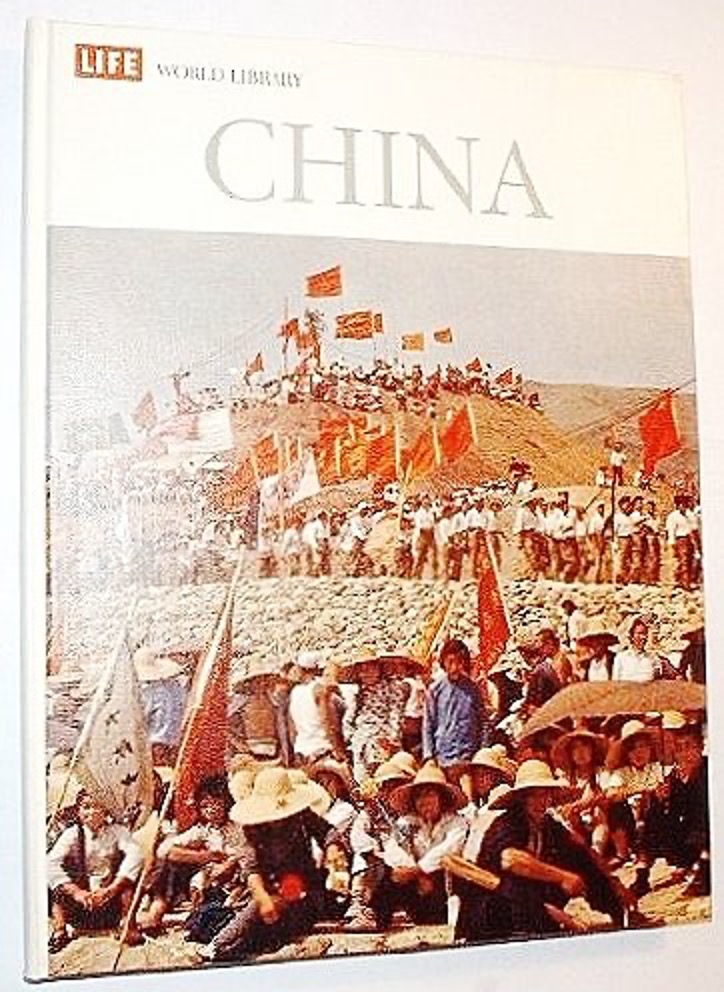
My fascination with China started at an early age. I remember as a child leaving through the Time-Life World Library series volume for China (1965); its photographs grainy black and white, and tinted colour, only serving to increase the mystique about the nation then isolated behind the Bamboo Curtain at the height of Mao’s Cultural Revolution. Back then, to be able to stand on the Great Wall of China, or to see the vastness Tiananmen Square seemed as probable as going on a school trip to the Moon.

I was in my late 20s when I first visited the Middle Kingdom, and through a series of events, choices, and decisions, later found myself living and working in the ethnic borderlands of southwest China for more than a dozen years from the mid-2000s. During that time in-country, as well as before and after during my various travels throughout China, how many times do you think I visited the capital, Beijing? Half-a-dozen times? Or at least 10 times? Sorry. I have to confess, even though I ‘knew’ Beijing through books and documentaries — and creating travel itineraries for tour groups — I never once visited in person the Chinese capital. 

Yes, that’s right. I crafted detailed, tailor-made itineraries for first-time visitors to Beijing, to give them an insider’s experience of the capital, without getting within a thousand kilometres of the great city. My excuses include:

1 – China is vast, and almost the same size as Europe;

2 – It would take 3 days by train from my courtyard house in Yunnan’s Lijiang to the Forbidden City, and I wasn’t up for such a long journey

3 – To be honest, I wasn’t as enthralled about Beijing after hearing mixed reports from other travellers, so I decided I could live (and/or die) without casting my eyes upon the sights and wonders of Beijing. 

A small window of opportunity opened to me recently when the stars aligned between jobs and other responsibilities. I had turned down the invitation to speak at a national tourism conference about the future of China’s tourism development post-pandemic, but I got to visit China for the first time since 2019, making an extended stopover in the capital. A visa-exemption initiative recently re-instated to encourage tourism without the need for pre-approved visas meant I could theoretically apply for a 144-hour transit stamp. 

So, I touched down at Beijing’s Capital International Airport (IATA code PEK) early one morning after an overnight flight from the southern hemisphere. This being my first time without a pre-approved (and expensive) visa I was a little nervous, and my fears were not allayed when no one was staffing the 144-hour visa desk. Was this the first great wall I had to overcome? I got sent from one immigration queue to another, a couple of times having to go against the flow of newly-arriving passengers and slip upstream through security. When eventually an official arrived to process the paperwork and issue the transit stamp, I had to show all my flight and accommodation bookings; not an easy task when you can’t connect to the airport wi-fi. 

I was sweating, not just because of the late summer heat, but also because I had booked a bus tour to the Great Wall that was leaving at 8 a.m. from central Beijing, a train and subway ride away. “Dear Sir, our assembly point is at Exit C of Dengshikou Subway Station on Line 5,” read my instructions. “You can see the guide wearing a blue vest. Please arrived at the assembly point 10 minutes early.”

Having a Chinese bank card, a map preloaded onto my phone, and some decent residual Mandarin skills, along with no reservations about queue-jumping as payback for being delayed, I found an ATM, and headed to the exit of the massive airport. There were only a few seconds to admire the impressive roof arching over Terminal 3, designed by Sir Norman Foster for the 2008 Beijing Olympics as I marched across the marble floors towards the Capital Airport Express. It was just after 7 a.m. but already I could see how Beijing Capital Airport is — or was — the second busiest airport in the world. 

Transferring from the airport line train downtown to the metro, the time on my phone was counting down towards the departure time. I worried that if I missed my bus, my whole trip would be ruined; and that such an inauspicious start to my Beijing exploration would cause a chain reaction of delays, missed opportunities and regret. Maybe I’d never make it to the Wall. Then I thought: take it easy, it’s not the destination, it’s the journey. I studied the Chinese characters for Dengshikou, recognising the first Sinogram as meaning light or lantern.

Arriving at the subway station, I quickened my pace up the stairs and escalators to emerge into sunlight at Exit C. It was 7:59. Fortunately, a blue-vested person was standing in the middle of the carpark. “Do I have time to grab something to eat or drink?” I asked the ZANbus guide in my slightly rusty Mandarin. “No. We’re leaving right now,” she said, ushering me onto the bus.

“But we have bottles of water on sale onboard.”

My online booked tour, a bare basics budget-friendly US$25 including admission ticket, offered three advantages: visiting a less-visited section of the Great Wall a mere 70km from Beijing, arriving before the ‘other tourists’, and being a strictly ‘no shopping’ experience (many tours visit several stores where guides and drivers make huge commissions). As the only non-Chinese person on the coach, the guide (who was supposed to speak some English) gave me a special briefing (in Mandarin), explaining the options for going up and coming down from the Mutianyu section of the wall, as we sped out of the metropolis heading towards the green rolling hills in the hazy distance. 

As we passed orchards, with growers selling freshly-picked fruits and nuts, I secretly wished we could stop for some shopping, not just to support the locals, but to ease my rumbling empty stomach. A nearby passenger, a man in his 20s visiting from a central province, whom I later dubbed ‘Running Man’, live-streamed the succession of farmer’s markets we zoomed past, in between video-chatting to his girlfriend. “There’s apples, pears, apricots, plums, grapes, persimmon, walnuts and huge peaches,” I heard him say. Since the bus driver didn’t once slow down, I justified to myself that, even though probably quite delicious, that produce would probably be exorbitantly over-priced for day-tripping Great Wallers like myself. 

By 9.30am I was striding along an arcade of mainly unopened shops past the visitor centre, stopping to buy more water, and some snacks. “How about an ice cream?”one vendor asked me after I looked into his glass-top freezer. “Later, OK?” A cafe offered a latte coffee, but the US$8.25 price tag reminded me that China gives too much status to the beverage, which is sometimes just instant coffee and creamer. A Chinese family, long-resident in the UK, gave me a fuller rundown on the logistics for sightseeing, where to meet the guide for the trip back to Beijing (the waiting hall just near Burger King), and most importantly, when the bus driver would be leaving (4pm sharp). “Also, if you tell them you are with this bus company, there’s a discount at Subway,” the teenage son chimed in as we boarded an electric vehicle for a short ride to the base station for the ascent of the crestline high above us. Looking along the line of the hills, I could just make out the crenellated up-and-down patterns of the walls, stretching off into the far distance. 

Now you’ve probably heard it many times, but let’s dispel the myth: the Great Wall of China is not visible from space. It is not visible from the Moon. It isn’t even visible to the naked eye from the low-orbit International Space Station. The popular myth goes back centuries, and more recently has been part of the propaganda of modern China to state that the wall was the only human-made structure that could be seen from space. The myth was challenged when Apollo 12 lunar module pilot Alan Bean said, “The only thing you can see from the Moon is a beautiful sphere, mostly white, some blue and patches of yellow, and every once in a while, some green vegetation. . . No man-made object is visible at this scale.”

Some artificial structures such as cities, highways and dams are visible from space, but the Great Wall is only visible from low Earth orbit with magnification or high-powered camera lenses. This was confirmed by China’s own first astronaut who went around planet Earth 14 times in 2003 on Shenzhou 5. “The Earth looked very beautiful from space, but I did not see our Great Wall.”

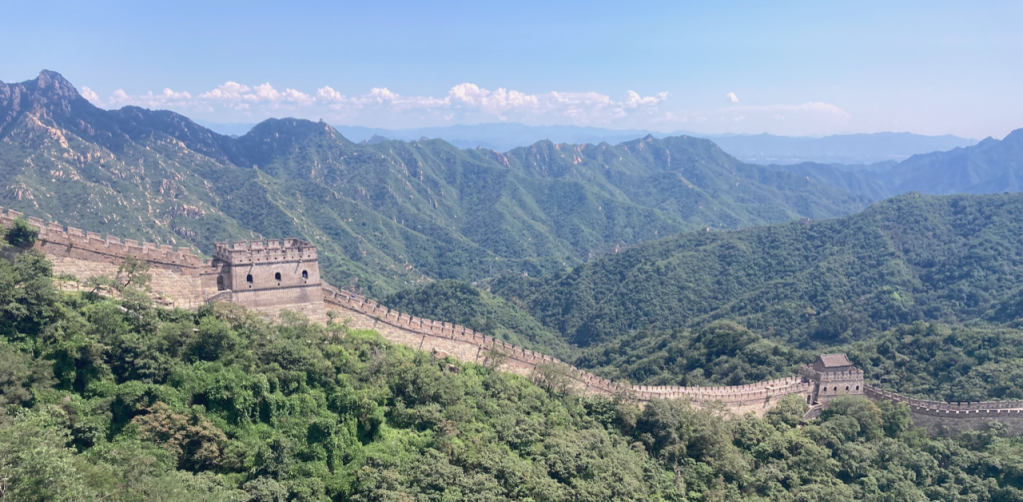
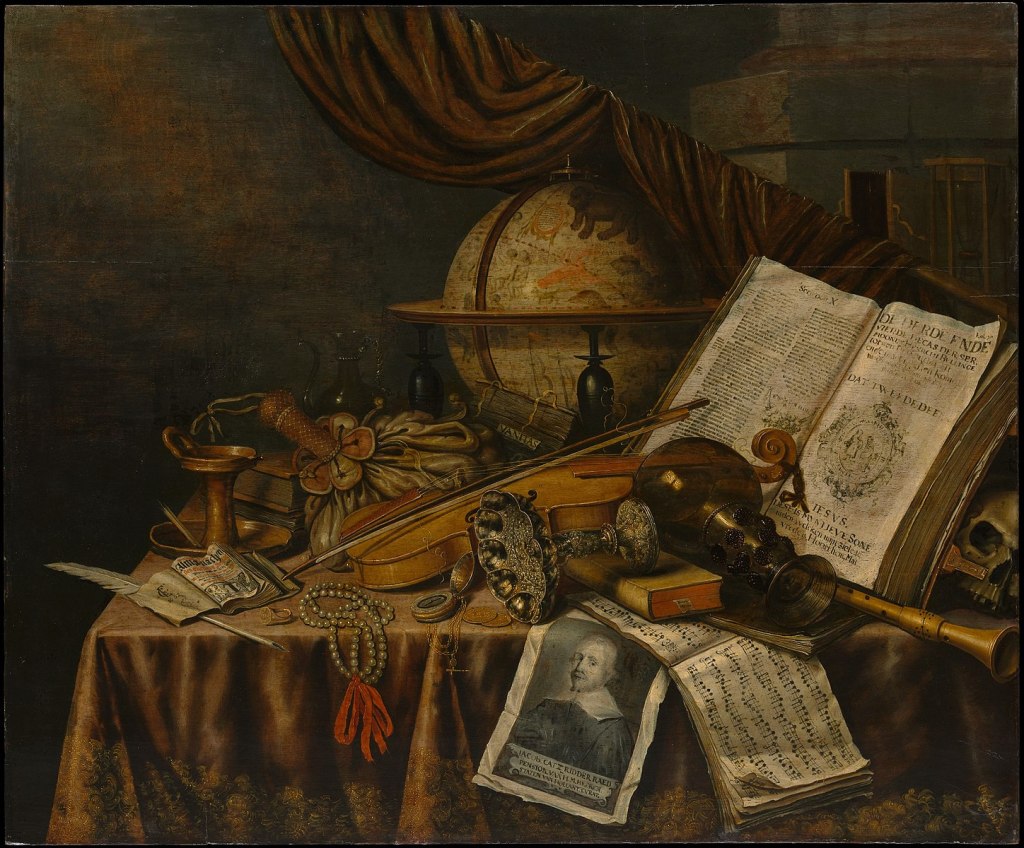
Photographs provided by Keith Lyons

To get personal and up-close with the Great Wall, other passengers decided to get a chairlift up and traipse further along between watchtowers and then take a toboggan (“speed slide”) down for 5 minutes of excitement. Rather than hike up (crazy in the heat), I opted to take the same cable car up and down (less than US$20 return).

Within minutes we could look down on the graceful, curved line of each section of the wall as it gently arched from one watchtower to the next. Wow! As the cable car reached its terminus near watchtower 14, the extent of the Great Wall to the north was revealed, fading to the horizon as vegetation and battlement became indistinguishable. 

The Mutianyu section extends some 5.4km, and though work began in the 6th century, much of it was rebuilt or renovated in the 15th and 16th centuries. In the 1980s about 2.3 km of that section was restored, so over the last three decades, more and more people have been able to visit the less crowded and commercialised alternative to the more famous, most-restored, scenically magnificent Badaling section. 

At Mutianyu, constructed of granite blocks, the wall has been made pedestrian-friendly and smooth, though there were steps, some steep in parts as they climb to the series of watchtowers. My fellow passenger Running Man darted around taking selfies and videos, as if he had only 24-hours left to live. Couples set off to the best spots to take photos, while a group of three university students set their sights on the highest watchtower, No.20, which could take one or two hours return depending on speed, stops and stamina. The path climbs from the low of watchtower 17, with the steepest leg between 19 and 20. 

Being something of a mountain goat myself, you might expect me to join them purposefully climbing towards the much-talked-about ’20’, but this goat was tired, jet-lagged, and hungry. Instead, I wandered along to the next abutments and decided to just sit in the shade admiring the view. This is just what I had envisioned, I wrote in my journal. And it was. Just like in the photos. Actually, I had expected the Great Wall might be more crowded with jostling visitors, but less than half those getting off the cable car ventured beyond watchtower 16 — and it wasn’t a weekend or holiday. 

At watchtower 17, it was so quiet and still that I could hear cicadas in the pine and chestnut trees flanking the wall. A pair of sparrows darted around, a plane flew overhead, and I watched the slow progress of a centipede across the path from the inner parapet to the invader-facing crenelation, a distance of four or five metres. Surely, the centipede hadn’t climbed all the way up the seven or eight metres of the Wall’s walls, five times the height of an adult? During its construction, which went until the mid-1600s, parts of the wall were made with bricks, held together by a durable glutinous rice mortar — arsenic was used to prevent insects from eroding away the wall. 

An old man, who has been sitting nearby in the shade while his adult son and grandchildren went on further, finishes drinking from a plastic water bottle and discards it over the side. I feel like saying something, but stop myself, realising that some attitudes and behaviours are slow to change. He probably thinks the Great Wall was visible from space, I confide to myself. 

The Wall’s modest width, no bigger than a road, was probably why it couldn’t be easily spotted from above. However, it did provide a fast means of travel and transportation for troops. Officially, the Great Wall was some 21,198 km long – that’s equivalent to half the equator – but up to a third of the structure has disappeared over time. It’s not just one continuous wall either, with sidewalls, parallel walls, enclosing walls, and even sections where there are no walls, just high mountain ridges, rivers, ditches or moats as the barriers. The Wall can lay claim to being the longest man-made structure as well as the largest building construction project ever undertaken. On a blank page I start a rough sketch of the section in front of me, trying to get my head around how this is just a tiny fraction of the longer, greater wall.

As well as being for border defence, the Great Wall also served to transmit messages, using watchtowers and beacon towers. From the next watchtower, the grandson of the bottle-litter-man waves but failing to catch the attention of the old man, he runs back along the wall path yelling, “Yéye – Granddad! Did you see me waving to you at the next castle?”

There is a certain irony about this extensive bulwark constructed across northern China and southern Mongolia up to two millennia ago to keep out invaders which now every day is climbed over by tourists from Mongolia, Russia, Eurasia and beyond. This is supposed to keep us out. But here we are, on the top of the wall and fortifications, having invaded, not from beyond, but from the downtown of the capital of the nation. So much for the upright projections, resembling teeth bared at the enemies. 

Other travel experts and expats living in Beijing tell me if I visited Mutianyu a month later, I would see the surrounding maple, oak and chestnut trees in their autumn splendour. In winter, snow transforms the scene. But on this day, I am just happy to be present, to take on the literal meaning of Mutianyu — Admire Fields Valley — as I take the cable car down to the bountiful valley, snack on a corn cob sprinkled with chilli, and some fresh walnuts. As the clouds turn to a sudden rainstorm, in the comfort of the waiting hall, after savouring an ice cream, I let the day catch up on me.

Photo provided by Keith Lyons

Back on the bus at 4pm, Running Man is sunburnt red and sweaty — but still grinning as he sorts through his photos and videos. The mother hen guide gives us all a small memento of the day, a fridge magnet of the Great Wall, as a reward for all making it back on time. 

The next thing I recall is being woken by the guide. I must have drifted off to sleep. “We’ve arrived,” she says, pointing towards an entrance to the Beijing metro which seems different from the starting point. For a moment, I wonder if I have been dreaming it all: the Great Wall, the perfect day, how everything worked out in the end. Then I realised it was all true: I’ve just seen and been on the Great Wall. And I have the fridge magnet in my pocket to prove it. I turn to say goodbye to Running Man, but he’s already exited the bus, and is making for the escalator down.

*Read the Day two of Keith Lyon’s China trip by clicking here

Keith Lyons (keithlyons.net) is an award-winning writer and creative writing mentor originally from New Zealand who has spent a quarter of his existence living and working in Asia including southwest China, Myanmar and Bali. His Venn diagram of happiness features the aroma of freshly-roasted coffee, the negative ions of the natural world including moving water, and connecting with others in meaningful ways. A Contributing Editor on Borderless journal’s Editorial Board, his work has appeared in Borderless since its early days, and his writing featured in the anthology Monalisa No Longer Smiles.

.

PLEASE NOTE: ARTICLES CAN ONLY BE REPRODUCED IN OTHER SITES WITH DUE ACKNOWLEDGEMENT TO BORDERLESS JOURNAL. 

Click here to access the Borderless anthology, Monalisa No Longer Smiles

Click here to access Monalisa No Longer Smiles on Kindle Amazon International
Categories
Stories

The Mysterious Murder of Adamov Plut

By Paul Mirabile


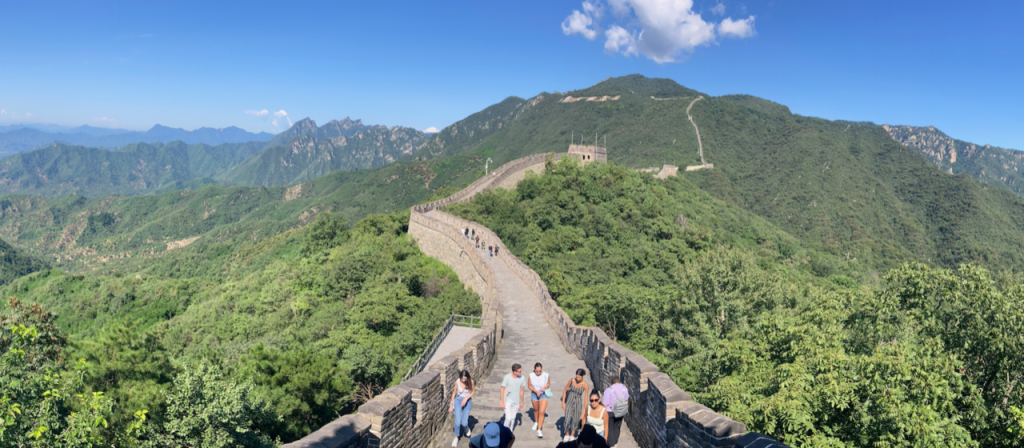
Vanitas Still Life, painting by Evert Collier(1640 –1708). Courtesy: Creative Commons

Back home in Madrid, having abandoned Adamov Plut to his posthumous fate, I was a bit surprised that neither the New York Times nor the Washington Post reported anything about the murder, not even a paragraph, or as the French so imagitively put it, an entre-filet ! I soon realised, due to this journalistic silence, that the time had come for me to give a full account of my relation to Mr Plut ; that the time had come for me to expose, publicly, by way of this revelation, his ‘mysterious murder’.

My information is of the surest sources for the simple reason that it was I who had Mr Plut murdered ! Yes, I ! And for reasons that shall be shortly disclosed. A mysterious man he might have been; however, his methods of acquiring priceless books and other inestimable valuables can hardly be called mysterious: Mr Plut was a vulgar thief, a scoundrel, an ingenious trickster whose singular flair caused much grief to many individuals, enraged those whose trust had been flouted.

It was in Istanbul, where I was invited to sojourn with an Armenian merchant, that I witnessed Mr Plut’s dupery. And if my naive friend fell for his crooked smile, I certainly didn’t swallow his high tale of returning to pay him for the two illuminated manuscripts my friend had graciously offered the blighter on condition that he be held accountable for them. His thick, coarse lips translated a smile that held contempt and disdain towards those who trusted him. So infuriated and insulted did I feel on behalf of my friend that that I reacted on a lightning urge and decided to follow him. I said nothing of this to my disbelieving companion, but left immediately in pursuit of my game — and game it was — for I, to tell the truth, had nothing more substantial to do at the moment and felt disposed for a good hunt.

I said that Mr Plut was a genius. Yes, in his own way. However, genius has its limitations. His arrogance and haughtiness knew no bounds, although he knew that his foul doings had attracted the attention of police and Interpol. Some may surmise that a certain paranoia drove him to invent individuals tracking him down like a wild boar or moose. No, no one was tracking him down except me, and that as subtlety as possible. In Uzbekistan, I actually chatted with him over a cup of coffee on two occasions disguised as a professor of Slavic philology, dressed in a quilted chapan robe and silk embroidered tubeteyka cap. There we sat in Samarkand, sipping our thick beverages in the vaulted bazaar at one of the storied cafés that dot the town. He was all smiles, obsequious and gold-toothed. I had the impression that I was dealing with a child or a mentally-dwarfed man whose sense of reality lacked all discernment or sagacity. I concluded that he had come into quite a bit of money, and never having had to work for a livelihood, traipsed about the world at his leisure, buying or stealing books, cheating people out of their invaluable collections. So self-indulgent and confident was he that he never saw through my masquerade as we conversed in broken Russian.

It was at that café where I learned about his fabulous treasure, as he called his book hoard. Only an idiot would have divulged this information to a perfect stranger, but as I said, Mr Plut’s contemptible demeanour caused him to fall into the most infantile traps. Traps that I began laying out for him, and that would lead to his downfall. For I had begun to design my own plan to relieve the rogue of his fabulous possessions, all the more so since he also let slip that his parents had passed away, and he had inherited the house. How I would make his treasure mine and ‘disinherit’ the  owner  still remained vague in my mind.

We departed as ‘friends’, as two strangers seeking an answer to the mystery of their existence. Or so I made him believe. Mr Plut appeared to me a dying species, a worldly aesthete, in spite of his extreme vulgarity and ponderous gait, whose debonair demeanour masked a loathing for his victims, a bent for the lowest duplicity, a gratification in spinning the most treacherous stratagems in order to allay his desire to prevail.

Mr Plut slipped out of Uzbekistan without my knowing it. He probably used his Russian passport, one of the four of five in his possession. I felt a twinge of misgiving. Had the fat fellow got on to me? After many enquiries, I finally discovered that he had crossed into China at the Xinjiang border, and was hastening towards the Yunnan. Why ? I hadn’t the faintest idea …

His brief sojourn in the town of Lijiang enabled me to catch up with him. My Chinese was fluent enough not only to query his whereabouts in that lovely town, but more important still, to learn of his new ‘purchases’, once I had questioned the director of the Dongba Museum of Culture. Mr Plut had planned to gone there to acquire several Naxi pictographic sacred books, which he did from a rather corrupt priest with whom he had been corresponding for some time, using a special code so as not to be unmasked by the Chinese authorities of the Centre. The director only learned of this a week after the unlawful negotiations had occurred, and three or four very valuable Dongba liturgical books had been stolen. It goes without saying that the rapacious priest was severely punished.

I immediately left Lijiang much to my displeasure for it was indeed a quiet, pleasant place, and set out in hot pursuit of the marauder. I followed his all too familiar scent through Nepal into North-western India to the Zanskar region where he put up for a while at the Phuktal Gompa[1], a strange spot to make a halt. But a perfect hideout to gain time in order for planning his next move, whilst at the same time inveigling in the most repulsive manner his generous hosts.

The monastery is nestled in the most remotest of valleys, ensconced within a cliff of tuft of fairy chimneys, crags and honey-combed spires which bulge black and red against the background of sandy, dazzling ash and cinerous tones of hemp. I had trekked there from Lamayuru in twenty days, and as I was to learn, Mr Plut had arrived there three days ahead of me, but by way of Padum. To gain the main entrance of the gompa, the pilgrim had to climb a steep path, keeping his or her right shoulder to the seventeen chortens[2] that mark the steep climb towards the vaulted entrance. I had shaved my head, grown a long beard and donned a woollen chuba tightened around my waist with a long colourful sash. It kept me warm, for in spite of it being Summer, the nights were very cold, and my cell had only a small wood-burning stove to keep me warm.

I spent three weeks at the monastery, sleeping on a ratten matting, eating skieu, tsampa and chappatti, drinking steaming salt-buttered tea off a chopsey — a low, small table — reading or gazing out of the little window that offered me a full view of the dusty, treeless courtyard below, where monks would mutter their mantras, and beyond into soundless nights whose stars were generally veiled.

Without Mr Plut’s slightest suspicions, I assisted at all the ceremonies, mornings and evenings, even vigils, while in the afternoon, I would venture out into the monastic complex, twisting and turning in the warren of lanes, under the low archways and high ladders, at times pursuing my promenades upon the rather precipitous mountain paths. As to Mr Plut, he hardly left his cell, and when we did cross paths, he most probably took me for a Buddhist pilgrim. Once or twice I sat near him in the prayer hall in the meditation grotto, but he never attempted to communicate with me, albeit he did not seem very deep in prayer or contemplation. He was probably scheming his next miserable move. His face had become terribly pale and flabby. His darting, black eyes seemed to have sunk deeper into their sockets. Unable to sit cross-legged on the low benches at the back of the prayer hall, he sat ‘western style’, staring off into the clusters of chanting monks, tilting his huge, bobbing head every so often to the banging drums, blowing ox-horns and tinkling triangles. Observing him from afar, I sought to sound his soul, to wring out his innermost thoughts, to extract from his evident lassitude and apathy his flight from both his victims and himself. But Mr Plut was a sphinx. Would he rise out of his own ashes when his hour came ?

I left the good monks three days after his departure, a hasty one indeed. And they were furious! The scoundrel had stolen several pustuks[3] and thangkas, and failed to pay for the prayer masks that he ‘purchased’. They implored me to find the culprit, inform the police and recover their stolen property. It was perhaps the beseeching words of the infuriated monks, after having received such incomparable hospitality from them, that my plans to have the thief killed began to germinate ! The theft was not only gratuitous, it exposed the very ugliness of the man’s heart, blackened by greed, cynicism and remorselessness. It would only be a matter of time before he tasted a soupçon of his own medicine.

Meanwhile the cat would play with the mouse, a rather fat mouse at that ! I boarded the cargo ship that took the fugitive from Karachi to Oakland via Japan. On the long, monotonous voyage across the Pacific, my ominous shadow crossed his at the most unsuspecting moments. Attired as a Pashtun merchant, bearded, long-haired and turbaned, Mr Plut sensed an onerous presence whenever he laboriously carried his huge body across the decks. How many times had my eyes penetrated his anguish, his torment, his pangs, not of compunction, but of incomprehension. He scented a sleepless menace pressing him. Fear inflamed his dark, beady, mirthless eyes like the burning incision of the trenchant knife.

Oakland … Sacramento … Reno … Tombstone … Boulder … Santa Fe … Saint Louis … Chicago … New Orleans … Birmingham … Miami … Atlanta and finally New York. Yes, New York, where the curtains would finally fall on this tragic fat figure. Where upon the stage of 8 million walk-ons, and against the backdrop of the grottiest of hotels, the last act of Mr Plut’s abominable performance would be played out.

His infatuation with Louis Wolfson amused me, as well as his grandiose project to write twelve stories in twelve different languages signed by twelve different authors. I found all this quite pompous and pathetic. A real exercise in self-indulgence to say the least. All this information I culled when I ‘accidentally’ met him in the ill-lit corridor of that hotel on Water street in downtown Manhattan. In New York, I played the role of a French researcher in mediaeval literature, a field that he completely ignored, in spite of possessing several manuscripts of Anglo-Norman stamp, apparently purchased (so he said ?) from a London book-seller. I pretended to be interested, taking the opportunity to study him closely. Besides, he was such an inveterate liar how could one believe anything he said ? He lied to curry favour and win confidence, only to swindle and steal from the naive and simple-hearted. Better to observe his eyes, his gestures, his bouncing from one tongue to another. These were all genuine signs of his distorted psychological make-up. To play my part well, I sported an immaculate white suit, orange tie, a pair of silver-rimmed glasses and spanking new alligator shoes. I had shaved my beard and moustache and had my hair cut very short, leaving a few gossamer wisps which touched the tips of my ears and fell bouncily on my forehead.

Every day I followed his Humpty Dumpty gait as he waddled to and from the public library, in and out of Central Park. And it was there, in Central Park, that I noted two blond-haired rough fellows slouching on a bench, eating the remains of fried chips or chicken sandwiches, cursing and making gross signs at the passers-by, drinking beer and spitting. They were seated at the same bench daily — the bench that Mr Plut walked by every day. They seemed to know him because they would hoot at him, call him names and ask for money. Fatso passed by without even a glance at them.

One Saturday, I decided to approach the two ruffians. They sized me up with obvious contempt, and made it perfectly clear that I was intruding on their ‘territory’. I sat down none the less, and exposed my scheme to be rid of Mr Plut once and for all, explaining how the culprit had cheated and robbed so many people. The two burly blokes, former marines in the Green Beret (or so they vaunted!) listened attentively as I unfolded my plan: Three thousand dollars for each if they would simply walk up to his room in the early morning hours, the night porter always being asleep, knock at his door and kill him, however, without any blood shed or theft of his belongings. It must be a murder without reason, without any sign of bestial violence. One of them suggested strangulation. Yes, excellent idea. It would thus be a ‘clean’ murder.

And so it was, very professional at that I must say. They were paid off, as agreed. And I left New York two days later, as planned, a very satisfied man indeed …

This all happened five years ago. Now … well, here is where my account ends and my confession begins. For you see, Mr Plut was never really murdered ! Those two ‘ruffians’ were in fact F.B.I. agents who had been trailing me since disembarking in California. To tell the truth, Interpol and local police had been following me since the Istanbul affair. How and why they began doing so I cannot say. During my trial neither the judge nor the prosecuting attorney afforded any information as how the F.B.I. learnt of my scheme, nor why they had decided, at one point in time, to cooperate with Plut. What was I convicted of ? What was my indictment ? As to my appointed lawyer, a young short-sighted clerk more than a seasoned lawyer, who could be easily cajoled by the ‘evidence’ against me, pliantly manipulated by the prosecutor, after he had taken the floor and had made an absolute fool of himself. He let out a sigh of relief when the judge pronounced a sentence of fifteen years instead of twenty-five! The wigged judge, a grotesque figure studded with huge warts, yawned throughout my lawyer’s deplorable speech for the defense, as well as during my feeble plea. There was no jury either to lament or to applaud his verdict. It was a trial held at ‘huis clos’[4], military style. I buried my face in my hands. As expected, my lawyer made no effort to appeal.

Had Plut sensed my innermost aversion towards him ? Or seen through my many disguises ? He was a clever man, and probably had hired detectives to learn why I was following him. The hotel room murder was staged. Plut lay recumbent on the floor, waiting for me to steal his papers so that I would be indicted for premeditated murder (although there was no murder!), of paying off hoodlums to commit this murder (although they were F.B.I. agents!) and the theft, which indeed it was (but fifteen years for that?) of his household papers, keys, and other official documents concerning his inheritance … and that vile short story of his.

So here I sit in my rancid smelling cell in Madrid, having been arrested at the aeroport on my arrival some five years ago, writing out this confession. I do not to repent mind you, I have no intention of atoning for my doings, nor avowing my sins. These words wrenched from my pen seek to vent the animosity and hatred I harbour towards that fat impostor who had the cheek to write me a letter from the Seychelles revealing how he had got on to me since Uzbekistan, and how our little cat and mouse game had amused him greatly : “You thought me a fool, deary, but I saw through your pusillanimous scheme in Samarkand ; that was some outfit, but you forgot the galoshes ! Not to mention your pilgrim weeds at Phuktal which truly charmed me, and your blazing orange tie in New York. Come, come, what French professor would ever sport an orange tie with a badly tailored, cheap white suit ?” The vicious irony underlining these sentences, along with a soupçon of cynicism caused me to gag. The blighter added in a post-script that he had sold all his books for a fabulous sum of money, and had retired from the world’s wearisome fair. In the envelope I found a photo of him sipping coconut juice, lying on the golden sands of a crescent-shaped beach under groves of swaying palm trees and an indigo blue sky. I laughed bitterly, and yet, in spite of my nettled nerves, pinned up the blasted photo in my lonely cell, a sort of souvenir of our enshrouded relationship …

One day at the prison library, browsing idly through a dull, detective story, I thought of Plut’s or Hilarius Eremita’s story The Enchanted Garden, which I had taken and read to amuse myself on the aeroplane to Buenos Aires. Had anyone ever published such ridiculous trash? To my horror, the answer came three days later whilst I rummaged through a new batch of literary magazines, some of which contained short stories in English, French and German. And there it was — The Enchanted Garden, by Hilarius Eremita, Plut’s pen name. I couldn’t believe my eyes — someone had published that rubbish ! Plut indeed had the last laugh, adding insult to injury, salt to my festering wounds.

I savagely tore out the pages of his story from the magazine, went to the toilet, ripped them into tiny pieces and flushed the filth down the bowl. So much for hiss ‘first of the twelve’ ! I shan’t be punished for it, no inmate in this prison reads any language besides Spanish, and that with a dictionary … I’m sure it was Plut who sent me that magazine to drive the knife deeper into my wounded pride. The miserable rat !

So here I sit at my iron table, staring at Plut’s photo as he sips his coconut drink under the blue skies and swaying palm trees whilst I sip my wretched thin noodle soup with strips of hard, nervy beef under a cracked, peeling, dirty grey prison ceiling …

.

[1]          Monastery in Tibet

[2]          The Tibetan word for stûpa, a Buddist shrine which initially housed the relics of the Buddha.

[3]          Books used for Buddhist ceremonies written in Tibetan.

[4]          Behind closed door without any public participation or observers. It is a French legal term.

Paul Mirabile is a retired professor of philology now living in France. He has published mostly academic works centred on philology, history, pedagogy and religion. He has also published stories of his travels throughout Asia, where he spent thirty years.

.

PLEASE NOTE: ARTICLES CAN ONLY BE REPRODUCED IN OTHER SITES WITH DUE ACKNOWLEDGEMENT TO BORDERLESS JOURNAL

Click here to access the Borderless anthology, Monalisa No Longer Smiles

Click here to access Monalisa No Longer Smiles on Kindle Amazon International