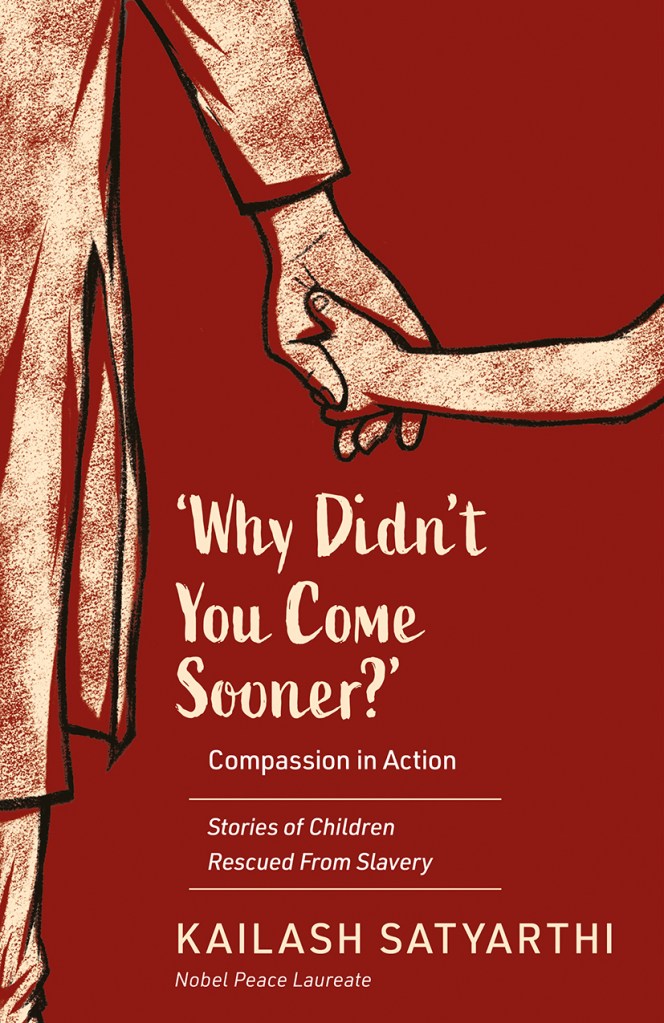
Title: Why Didn’t You Come Sooner? Compassion In Action— Stories of Children Rescued From Slavery
Author: Kailash Satyarthi
Publisher: Speaking Tiger Books
I seated a few of the children in my car, and drove away as fast as I could. The truck with the men and women followed me. The clothes of the children who sat with me in the car were tattered and torn. The wounds on their flesh could be seen through the holes in their clothes. Every such wound is a blot on human civilization. The frightened little girls were trying to hide their bellies and chests by hugging their knees. They simply could not make sense of all that had happened since morning. I made tentative attempts to talk to them. I tried explaining to them that they were now free from bonded labour and were being taken to a secure place. But they had never known freedom, or safety. How could they understand what I was trying to tell them? Maybe they assumed I was their new owner.
Just then, I remembered that there were some bananas lying in the back of the car. I asked the children on the back seat to distribute them among themselves. I thought they must be hungry, and might feel better after eating something. But no one picked up the bananas.
‘Go on, child. Pick up that bunch of bananas and pass it on,’ I gently repeated myself.
One of the children gave it to the child sitting in front. An emaciated girl and a little boy were seated next to me. I told them to pass on the fruit to everyone in the back and keep one each for themselves. The girl looked curiously at the bunch as she turned it around in her hands. Then she looked at the other children.
‘I’ve never seen an onion like this one,’ she said.
Her little companion also touched the fruit gingerly and innocently added, ‘Yes, this is not even a potato.’
I was speechless to say the least. These children had never seen anything apart from onions and potatoes. They had definitely never chanced upon bananas before. Upon further cajoling, some of them started chewing on the bananas. But they were trying to eat the fruit without peeling it. Some tried to swallow it while others were trying to hide it in their palms after having spat it out. My imprudence had for a moment pushed me back a few thousand years. The difference between an unpeeled banana and a peeled one was the distance between slavery and freedom. I quickly tried to rectify my error and taught them how to peel a banana and consume it. Most of them tasted the sweetness of the fruit and probably relished it too.
They began sharing this new experience among themselves in their dialect. I was feeling their joy too. Just then, the little girl sitting next to me tapped me on the shoulder and almost screamed.
‘Why didn’t you come sooner?’
I instantly turned to face her. Her innocent, tear-filled eyes and pained voice laced with anger pierced my heart. I could tell that these words had risen from the depths of her heart, where they lay suffocating for years.
Her younger brother had passed away for lack of availability of medicine. Once, the quarry owners had beaten up her father and uncle and branded them with burning cigarettes. They had raised their voice against the sexual exploitation of the women and tried to escape. Even the tiny hands of the children, when wounded, were never tended. They couldn’t even manage to get bits of cloth to tie around their wounds. This little girl had survived the entirety of hell in the eight years of her life. This was probably the first time that she could bring herself to trust someone enough to mouth the words, ‘Why didn’t you come sooner?’
That challenging question deepened the restlessness and anger that the issue of child slavery aroused in me. The child who posed this question was none other than Devli. She had put it to me, but it is one that needs to be answered by every person who speaks of faith, law, the Constitution, human rights, freedom, childhood, humanity, equality and justice. That question is as pertinent today as it was on that day all those years ago.
According to an estimate, there are around five million labourers employed in stone quarries in India. Hundreds of thousands among them are child labourers. Contractors and their agents pay tiny advances to impoverished families in backward areas and get them to come to the quarries on some false pretext or another. This is the organized crime of human trafficking that is often dressed up as migration or displacement. Usually, there is no record of workers in the quarries. In other words, children like Devli and her parents do not exist anywhere in legal terms.
To break up the stone, deep holes are drilled in it with powerful machines by skilled or semi-skilled workers which are then detonated with the use of gunpowder. The large rocks that are exposed after the explosion are broken down into smaller stones by adult men and women as well as children. The smaller children are engaged in removing the soil before the detonation takes place as well as removing the small stone chips after. Death is far from uncommon among these unskilled labourers who often get buried under the rocks thrown up by the explosions or when a quarry, unsteady from the shock, caves in.
(Excerpted from Why Didn’t You Come Sooner?: Compassion In Action—Stories of Children Rescued From Slavery by Kailash Satyarthi. Published by Speaking Tiger Books, 2023)
About the Book:
The work of rescuing children from slavery is not for the faint of heart, as the twelve gut-wrenching accounts in this book will show. Harder still is to give them their life back, after they’ve been kidnapped, trafficked, sold, abused and made to work in horrific conditions, often for as long as they can remember. Pradeep was offered up for human sacrifice by his family, thought to be a bad omen; Devli was a third-generation slave in a stone quarry in Haryana, who had never seen a banana before her rescue; Ashraf, a domestic child labourer at a senior civil servant’s house, was starved and scalded as punishment; Sahiba was trafficked from Assam to be someone’s wife against her will; Kalu was abducted and made to weave carpets all day long, his injuries cauterized with phosphorus scraped off matchsticks; Bhavna was trapped in a circus, sexually abused for years by her owners; Rakesh was worked in the fields all year round like cattle, and spent the nights locked up with them in the stable; Sabo was born to labourers at a brick kiln, and never knew life outside it; and Manan lived his childhood mining mica in the forests of Jharkhand, barely given time to even mourn his friend who got buried when the mine caved in. Kailash Satyarthi’s own life and mission were entwined with the journeys of these children. Having lived through unspeakable trauma, they had lost faith in humanity. But behind their reticence, behind their scraggy limbs and calloused hands and feet, hope still endured. This book tells the story of their shared struggle for justice and dignity—from the raid and rescue operations of Satyarthi’s Bachpan Bachao Andolan, to international campaigns for child rights. It is a testament both to the courage of the human spirit and to the power of compassion.
About the Author:
Kailash Satyarthi (b. 11 January 1954) is one of the most well-known child rights activists in the world. He has led many national and international campaigns to protect child rights and promote their education over four decades and rescued countless children from slavery. He is a recipient of the Nobel Peace Prize, among many other human rights awards.
.
PLEASE NOTE: ARTICLES CAN ONLY BE REPRODUCED IN OTHER SITES WITH DUE ACKNOWLEDGEMENT TO BORDERLESS JOURNAL






 Borderless